NASA has selected ADNET Systems, Inc. of Bethesda, Maryland, to provide global modeling and data assimilation support at the agency’s Goddard Space Flight Center in Greenbelt, Maryland.
The Global Modeling and Assimilation Support contract is a single-award, cost-plus-fixed-fee, indefinite-delivery/indefinite-quantity contract with a maximum ordering value of approximately $84 million with a five-year period of performance beginning March 15, 2026.
Under this contract, the contractor will be responsible for supporting and maintaining NASA Goddard’s Global Modeling and Assimilation Office’s Goddard Earth Observing System (GEOS) model and data assimilation system. Tasks include supporting the development and validation of individual model components within GEOS and the development and integration of external components like sea and land-ice models within the modeling and assimilation system.
For information about NASA and other agency programs, visit:
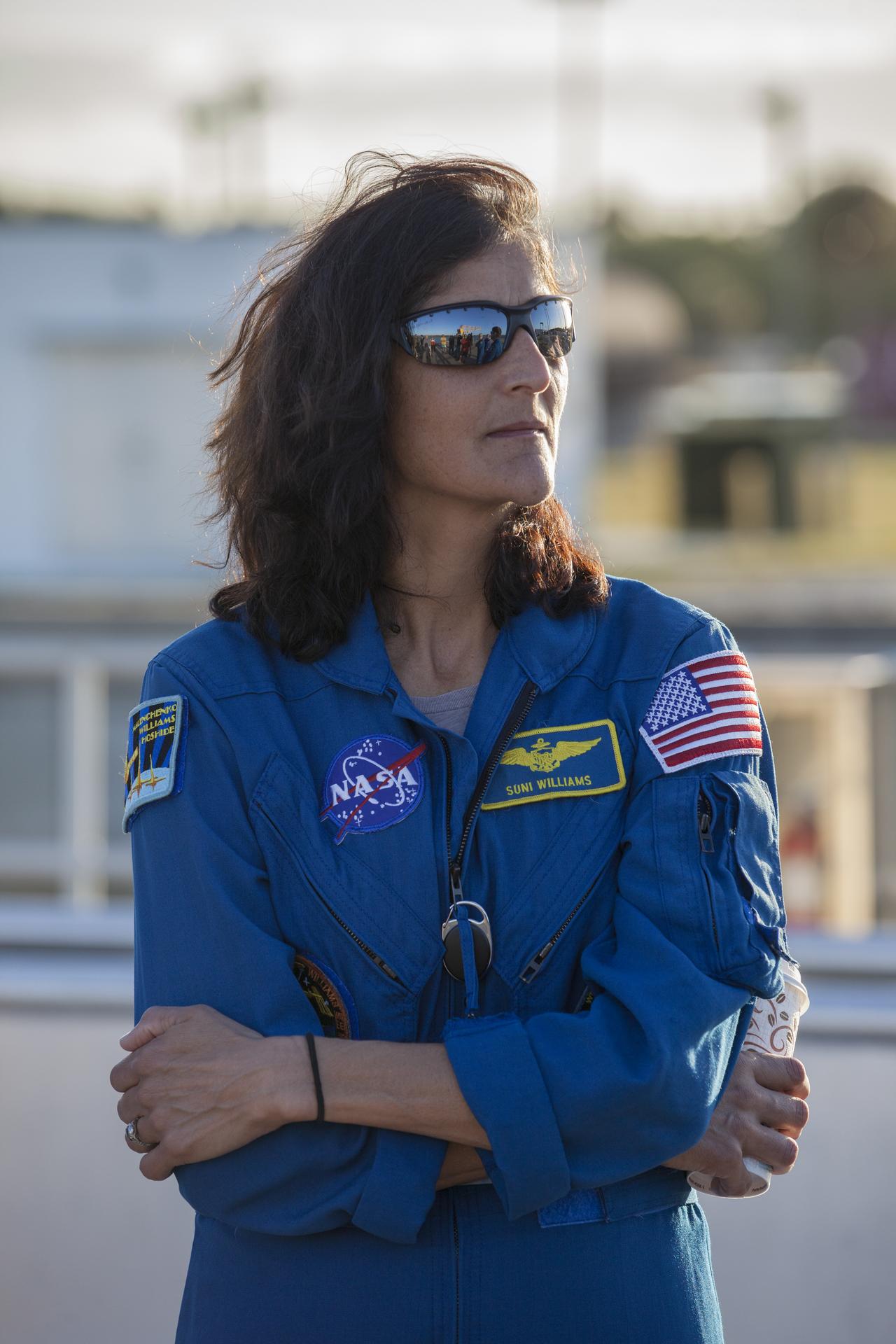
NASA astronaut Suni Williams at Cape Canaveral Air Force Station’s Naval Ordnance Test Unit basin in Florida on March 28, 2018.
Credit: NASA/Kim Shiflett
After 27 years of service, NASA astronaut Suni Williams retired from the agency, effective Dec. 27, 2025. Williams completed three missions aboard the International Space Station, setting numerous human spaceflight records throughout her career.
“Suni Williams has been a trailblazer in human spaceflight, shaping the future of exploration through her leadership aboard the space station and paving the way for commercial missions to low Earth orbit,” said NASA Administrator Jared Isaacman. “Her work advancing science and technology has laid the foundation for Artemis missions to the Moon and advancing toward Mars, and her extraordinary achievements will continue to inspire generations to dream big and push the boundaries of what’s possible. Congratulations on your well-deserved retirement, and thank you for your service to NASA and our nation.”
Williams logged 608 days in space — second on the list of cumulative time in space by a NASA astronaut. She ranks sixth on the list of longest single spaceflight by an American, tied with NASA astronaut Butch Wilmore, both logging 286 days during NASA’s Boeing Starliner and SpaceX Crew-9 missions. Williams also completed nine spacewalks, totaling 62 hours and 6 minutes, ranking as the most spacewalk time by a woman and fourth-most on the all-time cumulative spacewalk duration list. She also was the first person to run a marathon in space.
“Over the course of Suni’s impressive career trajectory, she has been a pioneering leader,” said Vanessa Wyche, director of NASA’s Johnson Space Center in Houston. “From her indelible contributions and achievements to the space station, to her groundbreaking test flight role during the Boeing Starliner mission, her exceptional dedication to the mission will inspire the future generations of explorers.”
Williams launched for the first time aboard space shuttle Discovery with STS-116 in December 2006 and returned aboard space shuttle Atlantis with the STS-117 crew. She served as a flight engineer for Expeditions 14/15 and completed a then-record-breaking four spacewalks during the mission.
In 2012, Williams launched from the Baikonur Cosmodrome in Kazakhstan for a 127-day mission as a member of Expedition 32/33. She also served as space station commander for Expedition 33. Williams performed three spacewalks during the mission to repair a leak on a station radiator and replace a component that gets power from the station’s solar arrays to its systems.
Most recently, Williams and Wilmore launched aboard the Starliner spacecraft in June 2024 as part of NASA’s Boeing Crew Flight Test mission. She and Wilmore went on to join Expedition 71/72, and Williams again took command of the space station for Expedition 72. She completed two spacewalks on the mission and returned to Earth in March 2025, as part of the agency’s SpaceX Crew-9 mission.
“Suni is incredibly sharp, and an all-around great friend and colleague,” said Scott Tingle, chief of the Astronaut Office at NASA Johnson. “She’s inspired so many people, including myself and other astronauts in the corps. We’re all going to miss her greatly and wish her nothing but the best.”
Beyond her spaceflight experience, Williams held numerous roles throughout her NASA career. In 2002, she served as a NEEMO (NASA Extreme Environments Mission Operations) crew member, spending nine days living and working in an underwater habitat. After her first flight, she served as deputy chief of NASA’s Astronaut Office. She later was the director of Operations in Star City, Russia, following her second mission to the space station. Most recently, she helped establish a helicopter training platform to prepare astronauts for future Moon landings.
The Needham, Massachusetts, native holds a bachelor’s degree in physical science from the United States Naval Academy and a master’s degree in engineering management from Florida Institute of Technology in Melbourne, Florida. A retired U.S. Navy captain, Williams is an accomplished helicopter and fixed-wing pilot, having logged more than 4,000 flight hours in 40 different aircraft.
“Anyone who knows me knows that space is my absolute favorite place to be,” said Williams. “It’s been an incredible honor to have served in the Astronaut Office and have had the opportunity to fly in space three times. I had an amazing 27-year career at NASA, and that is mainly because of all the wonderful love and support I’ve received from my colleagues. The International Space Station, the people, the engineering, and the science are truly awe-inspiring and have made the next steps of exploration to the Moon and Mars possible. I hope the foundation we set has made these bold steps a little easier. I am super excited for NASA and its partner agencies as we take these next steps, and I can’t wait to watch the agency make history.”
Learn more about how NASA explores the unknown and innovates for the benefit of humanity at:
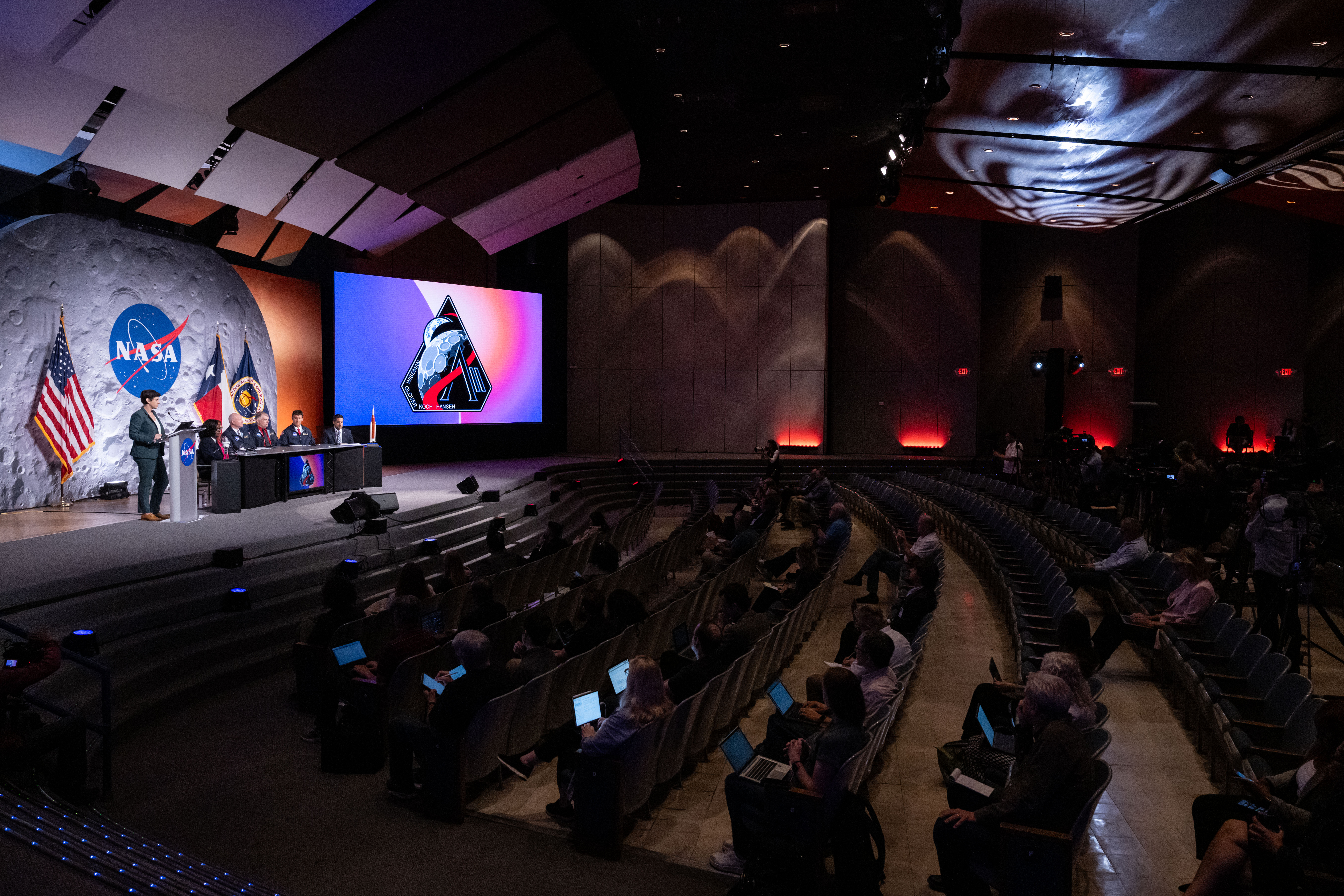
NASA hosted the Artemis II Mission Overview briefing in the Teague Auditorium at NASA’s Johnson Space Center in Houston, Sept. 23, 2025.
NASA/James Blair
Media accreditation is open to attend Artemis II mission activities at NASA’s Johnson Space Center in Houston. Johnson is where flight controllers in mission control will manage the test flight after liftoff of the first crewed Moon mission under the agency’s Artemis campaign.
Targeted to launch no earlier Friday, Feb. 6, the Artemis II mission will send NASA astronauts Reid Wiseman, Victor Glover, Christina Koch, and CSA (Canadian Space Agency) astronaut Jeremy Hansen on an approximately 10-day journey around the Moon and back to test the systems and hardware, which will return humanity to the lunar surface.
After launch day, NASA will host daily briefings at Johnson throughout the mission with agency managers and mission experts. The briefings will be streamed on NASA’s YouTube channel.
International media without U.S. citizenship must apply to cover the mission in person at Johnson by 5 p.m. CST Friday, Jan. 16. U.S. media must apply by Friday, Jan. 30. Media representatives must apply by contacting the NASA Johnson newsroom at jsccommu@mail.nasa.gov. NASA’s media accreditation policy is available online.
Due to high interest, in-person space is limited. Credentialed media will receive a confirmation email if approved. Those who are accredited to attend the Artemis II launch at NASA’s Kennedy Space Center in Florida are not automatically accredited to attend events at Johnson and must receive a separate confirmation for activities in-person at NASA Johnson.
As part of a Golden Age of innovation and exploration, Artemis will pave the way for new U.S.-crewed missions on the lunar surface in preparation to send the first astronauts to Mars.
To learn more about the Artemis II mission, visit:
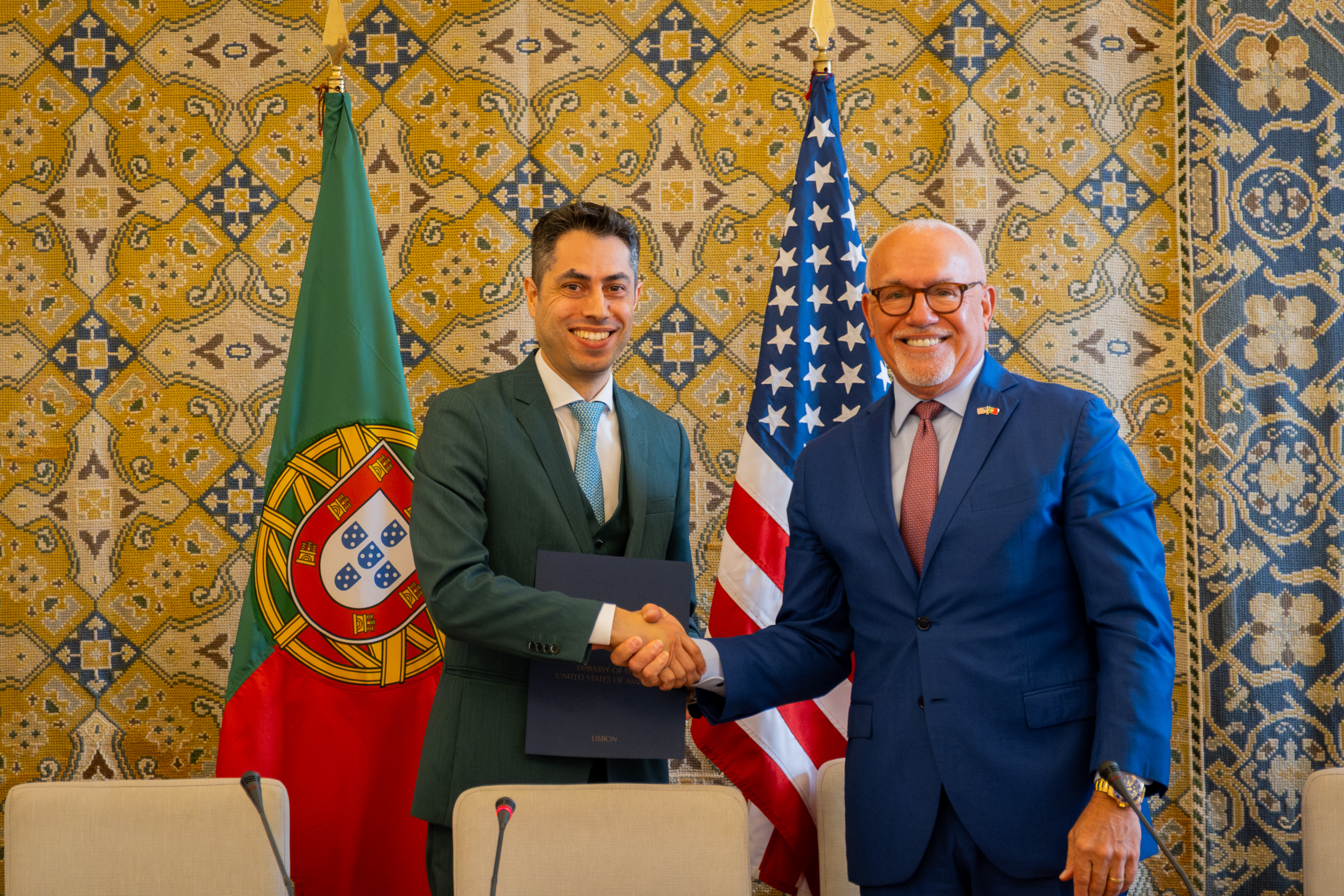
Hugo Costa, executive director for the Portuguese Space Agency, and U.S. Ambassador to Portugal John J. Arrigo pose for a photo on Jan. 12 during a ceremony in Lisbon, Portugal, to mark the country’s signing of the Artemis Accords.
Credit: U.S. State Department
Portugal is the latest nation to sign the Artemis Accords alongside 59 other countries in a commitment to advancing principles for the responsible exploration of the Moon, Mars, and beyond with NASA.
“Portugal joins a cadre of nations building the framework for safe, transparent, and prosperous activity in space,” said NASA Administrator Jared Isaacman in recorded remarks. “This is our generation’s Golden Age of Exploration. Together, we are advancing innovation, driving international collaboration, and discovering the secrets of the universe.”
Portugal’s Secretary of State for Science and Innovation Helena Canhão signed the Artemis Accords on behalf of the country on Jan. 11.
“2026 is the year in which humans will return to the Moon. It will mark the beginning of a new era of space exploration, reminiscent of the Portuguese explorers of the past, such as Magellan and his circumnavigation of our planet,” said Hugo Costa, executive director of the recently established Portuguese Space Agency, about the signing. “As a nation that approaches space sustainability with great care and responsibility, Portugal and the Portuguese Space Agency are proud to join the Artemis Accords and contribute to the sustainable, beneficial, and peaceful use of space for all humankind.”
A ceremony to recognize the signing was held on Monday in the capital city Lisbon, during a semi-annual meeting between the United States and Portugal to discuss cooperation between the two governments.
“This is a meaningful step forward for responsible space exploration,” said U.S. Ambassador to Portugal John J. Arrigo, who participated in the event. “Shared principles like those in the Artemis Accords are essential to ensuring that space remains a domain of stability, safety, and opportunity for all nations.”
In 2020, during the first Trump Administration, the United States, led by NASA and the U.S. Department of State, joined with seven other founding nations to establish the Artemis Accords, responding to the growing interest in lunar activities by both governments and private companies.
The accords introduced the first set of practical principles aimed at enhancing the safety, transparency, and coordination of civil space exploration on the Moon, Mars, and beyond.
Signing the Artemis Accords means to explore peaceably and transparently, to render aid to those in need, to ensure unrestricted access to scientific data that all of humanity can learn from, to ensure activities do not interfere with those of others, to preserve historically significant sites and artifacts, and to develop best practices for how to conduct space exploration activities for the benefit of all.
More countries are expected to sign the Artemis Accords in the months and years ahead.
El cohete Sistema de Lanzamiento Espacial (SLS, por sus siglas en inglés) de la NASA, visto en la nave High Bay 3 del Edificio de Ensamblaje de Vehículos mientras los equipos t esperan la llegada de los tripulantes de Artemis II para abordar su nave espacial Orion en la parte superior del cohete como parte de la prueba de demostración de la cuenta atrás de Artemis II, el sábado 20 de diciembre de 2025, en el Centro Espacial Kennedy de la NASA en Florida.
Conforme la NASA se acerca al lanzamiento del vuelo de prueba Artemis II, la agencia pronto llevará por primera vez su cohete Sistema de Lanzamiento Espacial (SLS, por sus siglas en inglés) y la nave espacial Orion a la plataforma de lanzamiento en el Centro Espacial Kennedy de la agencia en Florida para comenzar la integración final, las pruebas y los ensayos para el lanzamiento.
La NASA tiene como objetivo comenzar desde el sábado 17 de enero su traslado desde el Edificio de Ensamblaje de Vehículos hasta la Plataforma de Lanzamientos 39B, lo que tardará varias horas. El viaje de casi 6,5 kilómetros (cuatro millas) en el vehículo transportador oruga 2 podría durar hasta 12 horas. Los equipos técnicos están trabajando día y noche para dar por terminadas todas las tareas antes del transporte del cohete. Sin embargo, esta fecha objetivo está sujeta a cambios si fuera necesario tiempo adicional para los preparativos técnicos o debido a las condiciones meteorológicas.
“Nos estamos acercando a la misión Artemis II, y tenemos su lanzamiento a la vuelta de la esquina”, dijo Lori Glaze, administradora asociada interina para la Dirección de Misiones de Desarrollo de Sistemas de Exploración de la NASA. “Nos quedan pasos importantes en nuestro camino hacia el lanzamiento, y la seguridad de la tripulación seguirá siendo nuestra principal prioridad en todo momento, a medida que nos acercamos al regreso de la humanidad a la Luna”.
Al igual que con todos los nuevos desarrollos de sistemas complejos, los ingenieros han estado solucionando varios problemas en los últimos días y semanas. Durante las comprobaciones finales antes del traslado, los técnicos detectaron que un cable relacionado con el sistema de terminación de vuelo estaba doblado en contra de las especificaciones. El personal técnico lo está reemplazando y hará pruebas con el nuevo cable durante el fin de semana. Además, una válvula relacionada con la presurización de la escotilla de Orion presentó problemas que hicieron necesario llevar a cabo pruebas de demostración de la cuenta regresiva el 20 de diciembre pasado. El 5 de enero, el equipo reemplazó la válvula e hizo pruebas de su funcionamiento que resultaron exitosas. Los ingenieros también trabajaron para resolver fugas en el hardware de soporte en tierra que es necesario para cargar oxígeno gaseoso en Orion a fin de proporcionar aire respirable.
Traslado
Una vez que el cohete y la nave espacial integrados lleguen a la plataforma de lanzamiento, la NASA comenzará inmediatamente una larga lista de verificación para los preparativos en la plataforma de lanzamiento, incluyendo la conexión de equipos mecánicos de apoyo en tierra, como líneas eléctricas, conductos del sistema de control ambiental de combustible y tomas de surtido de combustible criogénico. Los equipos de personal técnico encenderán todos los sistemas integrados en la plataforma por primera vez para garantizar que los componentes del hardware de vuelo funcionen correctamente entre sí, con el lanzador móvil y con los sistemas de infraestructura terrestre.
Una vez que esté todo completado, los astronautas de Artemis II, Reid Wiseman, Victor Glover y Christina Koch de la NASA, y el astronauta de la CSA (Agencia Espacial Canadiense) Jeremy Hansen, llevarán a cabo una caminata final en la plataforma.
Ensayo general con circulación de combustible y llenado de tanques
A finales de enero, la NASA llevará a cabo un ensayo general con circulación de combustible, el cual es una prueba previa al lanzamiento para llenar los tanques de combustible en el cohete. Durante este ensayo general, el personal técnico hace una demostración de la capacidad de cargar más de 700.000 galones de combustible criogénico en el cohete, lleva a cabo una cuenta regresiva para el lanzamiento y practica la extracción segura del combustible del cohete sin tripulación presente en el sitio.
Durante el lanzamiento, el equipo de cierre, o de tareas finales, será responsable de asegurar a los astronautas en Orion y cerrar sus escotillas. El personal de cierre también utilizará este ensayo para practicar sus procedimientos de forma segura sin tener tripulación a bordo de la nave espacial.
El ensayo general con circulación de combustible incluirá varios “encendidos”, o pruebas de funcionamiento, para demostrar la capacidad del equipo de lanzamiento para detener, reanudar y reiniciar operaciones en varios momentos diferentes de los últimos 10 minutos de la cuenta regresiva, conocida como conteo terminal.
La ejecución del primer encendido comenzará aproximadamente en las 49 horas antes del lanzamiento, cuando los equipos encargados de lanzamiento son llamados a sus estaciones, hasta 1 minuto y 30 segundos antes del lanzamiento, seguido de una pausa planificada de tres minutos y luego la reanudación de la cuenta regresiva hasta 33 segundos antes del lanzamiento, el punto en el que el secuenciador de lanzamiento automático del cohete controlará los últimos segundos de la cuenta regresiva. Luego, los equipos técnicos volverán a reiniciar a T-10 minutos y detendrán el conteo, y luego reanudarán los procedimientos hasta 30 segundos antes del lanzamiento como parte de una segunda ejecución.
Si bien la NASA ha integrado las lecciones aprendidas con Artemis I en los procedimientos de la cuenta regresiva para el lanzamiento, la agencia hará una pausa para abordar cualquier problema durante la prueba o en cualquier otro momento si surgen retos técnicos. Los ingenieros vigilarán de cerca la carga de combustible de hidrógeno líquido y oxígeno líquido en el cohete, después de los desafíos que se encontraron con la carga de hidrógeno líquido durante los ensayos generales con circulación de combustible de Artemis I. Los equipos técnicos también prestarán mucha atención a la efectividad de los procedimientos recientemente actualizados para limitar la cantidad de nitrógeno gaseoso que se acumula en el espacio que está entre el módulo de tripulación de Orion y las escotillas del sistema de cancelación de lanzamiento, lo que podría representar un problema para el personal de cierre.
Es posible que se requieran ensayos generales con circulación de combustible adicionales para garantizar que el vehículo esté completamente revisado y apto para el vuelo.
De ser necesario, la NASA podría trasladar al cohete SLS y la nave Orion de vuelta al Edificio de Ensamblaje de Vehículos para realizar trabajos adicionales antes del lanzamiento después del ensayo general con circulación de combustible.
Próximos pasos para el lanzamiento
Después de un exitoso ensayo general con circulación de combustible, la NASA convocará una revisión de aptitud para el vuelo en la cual el equipo de gestión de la misión evaluará la aptitud de todos los sistemas, incluyendo el hardware de vuelo, la infraestructura y el personal de lanzamiento, vuelo y recuperación antes de comprometerse con una fecha de lanzamiento.
Aunque la ventana para el lanzamiento de Artemis II se podría iniciar tan pronto como el viernes 6 de febrero, el equipo de gestión de la misión evaluará la aptitud para el vuelo después del ensayo general con toda la nave espacial, la infraestructura de lanzamiento, y la tripulación y el personal de operaciones antes de seleccionar una fecha para el lanzamiento.
A fin de determinar las posibles fechas de lanzamiento, los ingenieros identificaron las restricciones clave necesarias para cumplir la misión y mantener a salvo a la tripulación dentro de Orion. Los períodos de lanzamiento resultantes son los días o las semanas en los que la nave espacial y el cohete pueden cumplir los objetivos de la misión. Estos períodos de lanzamiento explican la compleja mecánica orbital relacionada con el lanzamiento en una trayectoria precisa hacia la Luna mientras la Tierra rota sobre su eje y la Luna orbita la Tierra cada mes en su ciclo lunar. Esto da como resultado un patrón de alrededor de una semana de oportunidades de lanzamiento, seguido de tres semanas sin oportunidades de lanzamiento.
Existen varios parámetros principales que establecen la disponibilidad del lanzamiento dentro de estos períodos. Debido a su trayectoria única en relación con las misiones de alunizaje posteriores, estas limitaciones clave son exclusivas del vuelo de prueba de la misión Artemis II.
El día y la hora de lanzamiento deben permitir que SLS pueda llevar a Orion a una órbita terrestre alta, donde la tripulación y los equipos técnicos en tierra evaluarán los sistemas de soporte vital de la nave espacial antes de que la tripulación emprenda su viaje con rumbo a la Luna.
Orion también debe estar en la alineación adecuada con la Tierra y la Luna en el momento del encendido de motores con inyección translunar. El encendido de motores con inyección translunar de Artemis II pone a Orion en rumbo de sobrevolar la Luna, y también lo pone en una trayectoria de retorno libre, en la cual la nave espacial utiliza la gravedad de la Luna para enviar la nave espacial de regreso a la Tierra sin maniobras adicionales importantes de propulsión.
La trayectoria para un día determinado debe garantizar que Orion no esté en la oscuridad durante más de 90 minutos a la vez para que las alas de los paneles solares puedan recibir y convertir la luz solar en electricidad, y la nave espacial pueda mantener un rango de temperatura óptimo. Los planificadores de la misión eliminan las posibles fechas de lanzamiento que llevarían a Orion a eclipses prolongados durante el vuelo.
La fecha de lanzamiento debe sustentar una trayectoria que permita el perfil de entrada adecuado planificado durante el regreso de Orion a la Tierra.
Los períodos a continuación muestran la disponibilidad de llevar a cabo el lanzamiento hasta abril de 2026. Los planificadores de la misión mejoran estos períodos en función de un análisis actualizado más o menos dos meses antes de que estos comiencen, y ellos están sujetos a cambios.
Período de lanzamiento del 31 de enero al 14 de febrero
Oportunidades de lanzamiento los días 6, 7, 8, 10 y 11 de febrero
Período de lanzamiento del 28 de febrero al 13 de marzo
Oportunidades de lanzamiento los días 6, 7, 8, 9, 11 de marzo
Período de lanzamiento del 27 de marzo al 10 de abril
Oportunidades de lanzamiento los días 1, 3, 4, 5, 6 de abril
Además de las oportunidades de lanzamiento basadas en la mecánica orbital y los requisitos de desempeño, también existen restricciones sobre qué días dentro de un período de lanzamiento pueden ser viables en función de la reposición de productos básicos, las condiciones meteorológicas y las operaciones de otros usuarios en el cronograma del Área Este. Como regla general, se pueden hacer hasta cuatro intentos de lanzamiento dentro de la semana aproximada de oportunidades que existen dentro de un período de lanzamiento.
Mientras la agencia se prepara para su primera misión tripulada más allá de la órbita terrestre en más de 50 años, la NASA espera aprender durante los procesos, tanto en tierra como en vuelo, y dejará que la aptitud y el desempeño de sus sistemas indiquen el momento en que la agencia está lista para el lanzamiento.
Como parte de una edad de oro de innovación y exploración, el vuelo de prueba de Artemis II, el cual tendrá una duración aproximada de 10 días, es el primer vuelo tripulado para la campaña Artemis de la NASA. Este es otro paso hacia nuevas misiones tripuladas de Estados Unidos en la superficie de la Luna, lo que llevará a una presencia sostenida en la Luna que ayudará a la agencia a prepararse para enviar a los primeros astronautas estadounidenses a Marte.
Encuentra más información sobre la campaña Artemis de la NASA en el siguiente sitio web (en inglés):
NASA has selected ARES Technical Services Corporation of McLean, Virginia, to provide launch range operations support at the agency’s Wallops Flight Facility in Virginia.
The Wallops Range Contract has a total potential value of $339.8 million with a one-year base period expected to begin Tuesday, Feb. 10, and four one-year option periods that if exercised would extend it to 2031. The contract includes a cost-plus-fixed-fee core with an indefinite-delivery/indefinite-quantity component and the ability to issue cost-plus-fixed-fee or firm-fixed-price task orders.
The scope of the work includes launch range operations support such as radar, telemetry, logistics, tracking, and communications services for flight vehicles including orbital and suborbital rockets, aircraft, satellites, balloons, and unmanned aerial systems. Additional responsibilities include information and computer systems services; testing, modifying, and installing communications and electronic systems at launch facilities, launch control centers, and test facilities; and range technology sustainment engineering services.
Work will primarily occur at NASA Wallops with additional support at sites such as the agency’s Bermuda Tracking Station, Poker Flat Research Range in Alaska, and other temporary duty locations.
For information about NASA and agency programs, visit:
NASA announced Monday the selection of industry proposals to advance technologies for the agency’s Habitable Worlds Observatory concept – the first mission that would directly image Earth-like planets around stars like our Sun and study the chemical composition of their atmospheres for signs of life. This flagship space telescope also would enable wide-ranging studies of our universe and support future human exploration of Mars, our solar system, and beyond.
“The Habitable Worlds Observatory is exactly the kind of bold, forward-leaning science that only NASA can undertake,” said NASA Administrator Jared Isaacman. “Humanity is waiting for the breakthroughs this mission is capable of achieving and the questions it could help us answer about life in the universe. We intend to move with urgency, and expedite timelines to the greatest extent possible to bring these discoveries to the world.”
To achieve its science goals, the Habitable Worlds Observatory would need a stable optical system that moves no more than the width of an atom while it conducts observations. The mission also would require a coronagraph – an instrument that blocks the light of a star to better see its orbiting planets – thousands of times more capable than any space coronagraph ever built. The Habitable Worlds Observatory would be designed to allow servicing in space, to extend its lifetime and bolster its science over time.
To further the readiness of these technologies, NASA has selected proposals for three-year, fixed-price contracts from the following companies:
Astroscale U.S. Inc., Denver
BAE Systems Space and Mission Systems, Inc., Boulder, Colorado
Busek Co. Inc, Natick, Massachusetts
L3Harris Technologies Inc., Rochester, New York
Lockheed Martin Inc., Palo Alto, California
Northrop Grumman Inc., Redondo Beach, California
Zecoat Co. Inc., Granite City, Illinois
“Are we alone in the universe? is an audacious question to answer, but one that our nation is poised to pursue, leveraging the groundwork we’ve laid from previous NASA flagship missions. With the Habitable Worlds Observatory, NASA will chart new frontiers for humanity’s exploration of the cosmos,” said Shawn Domagal-Goldman, director of the Astrophysics Division at NASA Headquarters in Washington. “Awards like these are a critical component of our incubator program for future missions, which combines government leadership with commercial innovation to make what is impossible today rapidly implementable in the future.”
The newly selected proposals build on previous industry involvement, which began in 2017 under NASA’s “System-Level Segmented Telescope Design” solicitations and continued with awards for large space telescope technologies in 2024. The newly selected proposals will help inform NASA’s approach to planning for the Habitable Worlds Observatory concept, as the agency builds on technologies and lessons learned from its Hubble Space Telescope, James Webb Space Telescope, and upcoming Nancy Grace Roman Space Telescope.
To learn more about NASA’s Habitable Worlds Observatory, visit:

 Login
Login