Reading view

There are new articles available, click to refresh the page.

GameStop Transfers $420M in Bitcoin to Coinbase, Sparking Exit Speculation

By: Amin Ayan

GameStop has transferred its entire Bitcoin stash to Coinbase Prime, triggering fresh speculation that the video game retailer may be preparing to unwind its short-lived Bitcoin treasury strategy.

Key Takeaways:

  • GameStop moved its entire 4,710 BTC stash to Coinbase Prime, sparking speculation of a potential exit from its Bitcoin treasury.
  • If sold near current prices, the company would realize an estimated $75M–$85M loss on its Bitcoin holdings.
  • The transfer comes as corporate crypto treasury strategies face pressure amid falling digital asset prices.

Blockchain analytics firm CryptoQuant flagged the move on Friday after identifying a wallet labeled as belonging to GameStop that sent all 4,710 BTC, worth roughly $420 million at current prices, to Coinbase’s institutional trading platform.

“GameStop throws in the towel?” CryptoQuant asked in a post on X, suggesting the transfer was “likely to sell.”

GameStop Faces Potential $75M–$85M Loss on Bitcoin Bet if Sold

If liquidated near recent market prices, the sale would lock in a sizable loss.

CryptoQuant estimates GameStop accumulated its Bitcoin in May at an average price of around $107,900 per coin, implying unrealized losses of roughly $75 million to $85 million, depending on execution price.

GameStop announced its Bitcoin purchase earlier this year after CEO Ryan Cohen met with Strategy chairman Michael Saylor in February to discuss corporate crypto treasury models.

At the time, the move aligned the meme-stock retailer with a growing group of public companies experimenting with digital assets as balance-sheet holdings.

GameStop throws in the towel?

Their on-chain wallets just moved all BTC holdings to Coinbase Prime, likely to sell.

Between May 14–23, 2025, they bought 4,710 BTC at an avg. price of $107.9K, investing ~$504M.

Now selling for around $90.8K, potentially realising approximately… pic.twitter.com/Bp7MwRVQ43

— CryptoQuant.com (@cryptoquant_com) January 23, 2026

Since the transfer, GameStop has not publicly confirmed whether it has sold or intends to sell the Bitcoin.

While moving funds to Coinbase Prime often precedes a sale, given the platform’s deep liquidity and execution tools, such transfers do not always signal imminent liquidation.

Coinbase Prime also provides custody and wallet management services through its regulated trust business, leaving open the possibility of an internal restructuring.

The timing has fueled debate. Corporate Bitcoin treasuries surged in popularity throughout 2024 and early 2025, but the model has faced growing scrutiny as crypto prices pulled back sharply in recent months.

Several firms that adopted similar strategies are now sitting on steep paper losses, prompting some to trim holdings to shore up balance sheets.

Ethereum-focused ETHZilla, for example, recently disclosed selling part of its Ether reserves to reduce debt.

Cohen Stock Purchase Lifts GameStop Shares as Bitcoin Questions Swirl

The transfer also coincides with renewed activity from Cohen himself.

A regulatory filing this week revealed the CEO purchased an additional 500,000 GameStop shares worth more than $10 million, helping push GME shares up over 3% on Thursday.

The stock move added another layer of intrigue, with some investors viewing the buy as a vote of confidence amid uncertainty around the company’s crypto exposure.

Despite the recent pressure, corporate crypto treasuries remain embedded in traditional markets.

Earlier this month, MSCI opted not to remove digital asset treasury companies from its indexes, a decision that spared firms like Strategy from potential billions in passive outflows.

The post GameStop Transfers $420M in Bitcoin to Coinbase, Sparking Exit Speculation appeared first on Cryptonews.

Proposal to Temporarily Cap Bitcoin Transaction Data Gains Support From 583 Nodes

By: Amin Ayan

Support is growing for a Bitcoin proposal that would temporarily limit the amount of data embedded in transactions, as a debate over network spam and node decentralization intensifies.

Key Takeaways:

  • BIP-110 has gained early traction, with 583 Bitcoin nodes signaling support for a temporary cap on transaction data.
  • The proposal seeks to reverse recent Bitcoin Core changes that removed OP_RETURN limits.
  • Supporters argue stricter data limits are needed to curb spam and preserve node decentralization.

Bitcoin Improvement Proposal 110 (BIP-110) is currently signaling support from 583 nodes, or about 2.38% of the network, according to data from The Bitcoin Portal.

Out of roughly 24,481 reachable nodes, those backing the proposal are primarily running Bitcoin Knots, an alternative node implementation often favored by operators critical of recent changes to Bitcoin Core.

BIP-110 Proposes One-Year Cap on Bitcoin Transaction Data

BIP-110 proposes a temporary soft fork that would reintroduce strict limits on transaction data at the consensus level.

Specifically, it caps transaction output sizes at 34 bytes and restricts OP_RETURN data, a script used to embed arbitrary information into transactions, to 83 bytes.

The soft fork is designed to last for one year, after which the limits could be extended, modified or allowed to expire.

The proposal emerged in response to changes introduced in Bitcoin Core version 30, released in October 2025.

That update removed the long-standing 83-byte limit on OP_RETURN data following a pull request first introduced earlier in the year.

The move was controversial and met with widespread criticism from parts of the Bitcoin community, which argued the change was made without sufficient consensus.

OP_RETURN has long been a flashpoint in Bitcoin governance debates. While it enables use cases such as timestamping and metadata anchoring, critics say uncapped data fields encourage blockchain spam and non-financial use of block space.

Larger data payloads increase storage and bandwidth requirements for nodes, raising concerns that running a full node could become cost-prohibitive for everyday users.

BIP-110 RC3 🫡 pic.twitter.com/5KeoTCyhWV

— Justin (@innerhat) January 21, 2026

Critics of the Core update argue that higher hardware demands risk undermining one of Bitcoin’s defining features, which is the ability for individuals to verify the network using consumer-grade hardware.

As node operation becomes more expensive, they warn, the network could drift toward greater centralization.

Bitcoin educator Matthew Kratter compared unchecked data usage to a parasitic threat. He has argued that excessive spam could overwhelm the network’s underlying structure, weakening Bitcoin’s resilience over time.

BIP-110 Backers Frame Proposal as Temporary Fix

Supporters of BIP-110 see the proposal as a corrective measure rather than a permanent policy shift.

By making the soft fork explicitly temporary, its authors aim to give the network time to assess the impact of restored limits without locking Bitcoin into a long-term rule change.

Others remain unconvinced. Bitcoin Core contributor Jameson Lopp has defended the removal of OP_RETURN limits, arguing that artificial caps do little to deter spam and may instead push unwanted activity into other parts of the protocol.

From this view, market fees should determine how block space is used.

The post Proposal to Temporarily Cap Bitcoin Transaction Data Gains Support From 583 Nodes appeared first on Cryptonews.
Bitcoin Price Prediction: BTC at $88K as BIP-110 Adoption and GameStop Fuel a Make-or-Break Zone

Bitcoin is trading near $88,700 as markets weigh a pullback from $97K against rising regulatory clarity in the US, internal network debates, and shifting technical momentum. Senate crypto reforms, growing BIP-110 adoption, and rumors around GameStop’s BTC transfer have added noise, but price action suggests consolidation, not collapse. The $88K zone now stands as the key pivot for Bitcoin’s next directional move.

Bitcoin Governance Debate Resurfaces as BIP-110 Node Adoption Expands

Bitcoin’s long-running governance debate has resurfaced as adoption of Bitcoin Improvement Proposal 110 (BIP-110) edges higher. Roughly 2.38% of Bitcoin nodes are now running BIP-110, a temporary soft fork designed to limit non-monetary data, or “spam,” embedded in transactions.

The proposal restores restrictions on OP_RETURN data and output sizes that were loosened in recent Bitcoin Core updates.

Facilitating Spam is incompatible with Bitcoin’s sound money mission via decentralization.

Facilitating Spam makes it more expensive/cumbersome to use Bitcoin in a self sovereign manner than it otherwise would without Spam.

Activate BIP-110 yesterday.

Filters up.🛡 https://t.co/6czRByhKLb

— ₿itcoin ₿ombadil (@BitcoinBombadil) January 24, 2026

The issue has divided the community. Critics argue that allowing excessive arbitrary data risks turning Bitcoin into a data-storage network, raising node costs and pushing out smaller, home-run operators, which could increase centralization. Supporters counter that usage should not be artificially limited and that existing spam filters are ineffective.

While the debate may create short-term noise, it has little direct price impact. Over time, efforts like BIP-110 reinforce Bitcoin’s decentralization, strengthening its credibility as resilient, trust-minimized money.

GameStop Moves 4,700 BTC to Coinbase Prime, Raising Sale Speculation

GameStop has moved its entire Bitcoin holding, roughly 4,710 BTC worth over $420 million, to Coinbase Prime, sparking speculation that a sale may be imminent. According to CryptoQuant, the company acquired its Bitcoin at an average price near $107,900, meaning a full exit at current levels around $90,800 would imply an unrealized loss of roughly $76 million.

GameStop throws in the towel?

Their on-chain wallets just moved all BTC holdings to Coinbase Prime, likely to sell.

Between May 14–23, 2025, they bought 4,710 BTC at an avg. price of $107.9K, investing ~$504M.

Now selling for around $90.8K, potentially realising approximately… pic.twitter.com/Bp7MwRVQ43

— CryptoQuant.com (@cryptoquant_com) January 23, 2026

Large transfers to institutional trading platforms often precede selling, but the move alone does not confirm liquidation. GameStop has not issued any public statement, leaving markets to interpret the intent.

The broader impact on Bitcoin appears limited. More than 190 publicly listed companies now hold Bitcoin on their balance sheets, underscoring continued institutional participation.

Even if GameStop were to exit, it would represent an isolated corporate decision rather than a shift in overall institutional confidence. Short-term volatility is possible, but longer-term demand remains intact.

Bitcoin Price Prediction: BTC Tests $88K Support as Breakout Pressure Builds

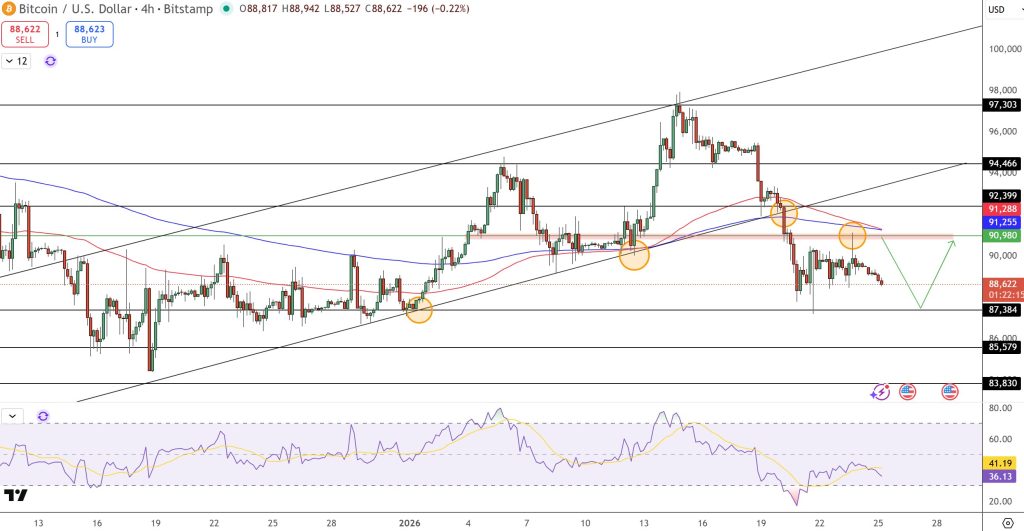
Bitcoin price prediction remains bearish as BTC is trading near $88,600, entering a corrective phase after failing to hold the $97,300 swing high earlier this month. On the 4-hour chart, price has slipped back into a rising channel that guided the move from the $83,800 low.

The rejection at channel resistance marked a momentum shift, reinforced by long upper wicks and a bearish engulfing candle that broke short-term support.

Bitcoin Price Chart – Source: Tradingview

BTC is now testing a key confluence zone between $88,000 and $87,300, which aligns with prior demand and the lower boundary of the ascending channel. Recent candles show smaller bodies with lower wicks, suggesting selling pressure is easing rather than accelerating. However, price remains below the 50-EMA and 100-EMA, while the 200-EMA near $91,200 continues to cap rebounds, keeping near-term bias cautious.

RSI has rebounded from oversold levels near 30 and is stabilizing around 40–42, signaling balance but not strength. The structure resembles a descending flag within a broader uptrend. If $87,300 holds, a reclaim of $90,000 could open $92,400–$94,500. A clean break below risks $85,600.

Bitcoin (BTC/USD) Trade Setup: Buy $87,500–$88,000, target $94,000, stop below $85,500.

Bitcoin Hyper: The Next Evolution of BTC on Solana?

Bitcoin Hyper ($HYPER) is bringing a new phase to the BTC ecosystem. While BTC remains the gold standard for security, Bitcoin Hyper adds what it always lacked: Solana-level speed. The result: lightning-fast, low-cost smart contracts, decentralized apps, and even meme coin creation, all secured by Bitcoin.

Audited by Consult, the project emphasizes trust and scalability as adoption builds. And momentum is already strong. The presale has surpassed $30.9 million, with tokens priced at just $0.013635 before the next increase.

As Bitcoin activity climbs and demand for efficient BTC-based apps rises, Bitcoin Hyper stands out as the bridge uniting two of crypto’s biggest ecosystems. If Bitcoin built the foundation, Bitcoin Hyper could make it fast, flexible, and fun again.

Click Here to Participate in the Presale

The post Bitcoin Price Prediction: BTC at $88K as BIP-110 Adoption and GameStop Fuel a Make-or-Break Zone appeared first on Cryptonews.

US Spot Bitcoin ETFs See Worst Week in One Year After $1.33B Outflows

By: Amin Ayan

US spot Bitcoin exchange-traded funds recorded their weakest performance in nearly a year, shedding $1.33 billion in net outflows during a shortened four-day trading week, according to data from SoSoValue.

Key Takeaways:

  • US spot Bitcoin ETFs logged their weakest week in nearly a year, with $1.33 billion in outflows.
  • Selling peaked midweek, led by heavy redemptions from BlackRock’s IBIT.
  • Ether ETFs also turned negative, shedding $611 million over the same period.

The pullback marks the worst weekly showing since February 2025 and reflects a sharp reversal in investor sentiment after strong inflows the previous week.

The outflows follow a period of optimism, when spot Bitcoin ETFs pulled in $1.42 billion in net inflows.

Midweek Bitcoin ETF Outflows Surge as $709M Exits in Single Day

Selling pressure peaked midweek. Wednesday alone saw $709 million exit Bitcoin ETFs, making it the heaviest outflow day of the week.

Tuesday followed closely behind with $483 million in redemptions. Outflows eased toward the end of the week, with $32 million leaving on Thursday and $104 million on Friday.

The magnitude of the withdrawals echoes the turbulence seen in late February 2025, when Bitcoin ETFs lost $2.61 billion in a single week during a sharp market downturn.

That episode, often referred to by analysts as the “February Freeze,” coincided with Bitcoin’s drop from above $109,000 to below $80,000 and included a record $1.14 billion single-day outflow on Feb. 25.

BlackRock’s iShares Bitcoin Trust (IBIT), the largest spot Bitcoin ETF by assets under management, posted outflows on all four trading days last week.

Data from SoSoValue shows the fund experienced its heaviest redemptions on Tuesday and Wednesday, accounting for a significant share of the overall decline.

1/ US Spot Crypto ETF Weekly Flows (Jan 12-16, ET)

• BTC ETFs: +$1.42B
• ETH ETFs: +$479M
• SOL ETFs: +$46.88M
• XRP ETFs: +$56.83M

Source: SoSoValue#CryptoETF #SoSoValue pic.twitter.com/Wi35m9jMLu

— SoSoValue (@SoSoValueCrypto) January 19, 2026

IBIT currently holds about $69.75 billion in net assets, representing roughly 3.9% of Bitcoin’s total circulating supply.

Despite the recent pullback, the broader picture for spot Bitcoin ETFs remains positive.

Since their launch in January 2024, cumulative net inflows stand at $56.5 billion, with total net assets across all US spot Bitcoin ETFs reaching approximately $115.9 billion.

Ethereum ETFs were not spared from the broader risk-off move. Spot Ether ETFs posted $611 million in net outflows for the week, reversing the prior week’s $479 million inflow streak.

Wednesday was again the worst day, with $298 million redeemed, followed by $230 million on Tuesday.

Total net assets for Ether ETFs now sit around $17.7 billion, with cumulative inflows of $12.3 billion since their July 2024 debut.

Solana ETFs Defy Broader Sell-Off as Bitcoin, XRP Funds See Outflows

Not all crypto-linked funds followed the same pattern. Spot Solana ETFs continued to attract capital, recording $9.6 million in net inflows over the week, extending a multi-week positive trend.

Bitwise’s BSOL remained the category leader by assets. Spot XRP ETFs, meanwhile, saw mixed flows, ending the week with $40.6 million in net outflows after a sharp $53 million exit on Tuesday.

The ETF drawdowns come amid signs of shifting market dynamics on-chain. According to a CryptoQuant report, Bitcoin holders have begun realizing net losses for the first time since October 2023.

The firm noted the market has moved from a profit-taking phase into a loss-realization phase, with roughly 69,000 BTC in realized losses since Dec. 23, a pattern reminiscent of past transitions from bull to bear markets.

The post US Spot Bitcoin ETFs See Worst Week in One Year After $1.33B Outflows appeared first on Cryptonews.

Bitcoin Price Mirroring Key Patterns From 2021 – Is History About To Repeat?

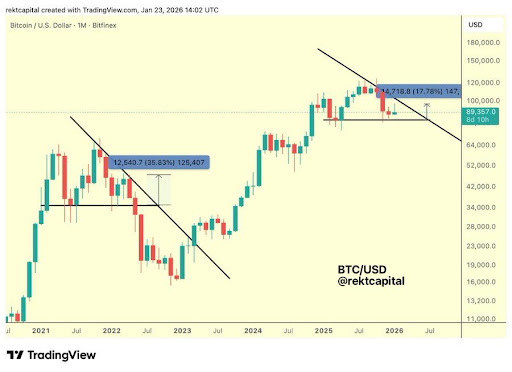
The Bitcoin price is showing signs of history repeating itself, as current price action mirrors key patterns from the 2021 cluster. With resistance near $91,000–$92,000 and the macro downtrend looming, traders are watching closely to see if BTC will break higher or face renewed pressure. The coming days could prove decisive in shaping the next major move.

Bitcoin Mirrors 2021 Cluster: History In Motion

Bitcoin continues to mirror the price patterns seen during the 2021 cluster. Crypto analyst Rekt Capital noted that the current market structure is echoing historical behavior, suggesting that similar dynamics are at play. Traders are closely watching these familiar patterns to gauge whether the cycle is repeating itself or if new trends may emerge.

The rules of the game remain consistent. A bearish acceleration would likely be triggered if Bitcoin breaks down from the macro descending triangle base, currently positioned around $82,000. Conversely, a bullish bias would require a decisive break above the macro downtrend, which sits near $100,000. These levels serve as critical decision points for the market, dictating whether bulls or bears gain control in the coming sessions.

Bitcoin

So far, Bitcoin has encountered rejection in the high $90,000s, falling just short of the macro downtrend. This mirrors previous market behavior, in which the asset developed a basing structure near the triangle’s base before attempting to push higher toward the downtrend’s upper boundary. It demonstrates that history is repeating itself for now, with the market consolidating and preparing for its next directional move.

If the macro downtrend continues to act as resistance, the triangle’s base may gradually weaken over time. Such a development would increase the risk of further downside, making the reaction at both the base and the downtrend crucial. 

BTC Surpasses $91,000 Before Facing Selling Pressure

In a recent market update by Ted, it was noted that while Bitcoin broke above the $91,000 threshold yesterday, the rally met significant resistance. Sellers entered the market with substantial force at these local highs, effectively capping the momentum and preventing a sustained breakout.

As a result of this rejection, Bitcoin has retreated into the “no-trading zone.” Ted suggests that this period of sideways price action is likely to persist through the next couple of days, largely driven by the typical low-liquidity environment seen during the weekend.

Looking ahead, the outlook remains cautious. Ted emphasizes that any upward movements will likely be short-lived until BTC can decisively clear the $91,000 to $92,000 resistance zone. Meanwhile, such a move must be backed by strong spot demand to prove its validity.

Bitcoin

$7 Trillion Player Is Moving Into Bitcoin, Can This Trigger A Surge To $200,000?

Swiss banking giant UBS, with assets under management (AuM) of up to $7 trillion, is set to launch Bitcoin trading for some of its clients. This comes amid predictions that regulatory clarity and broader adoption could send the BTC price to as high as $200,000. 

UBS To Offer Bitcoin Trading To Some Wealth Clients

Bloomberg reported that UBS is planning to launch crypto trading for some of its wealth clients, starting with its private bank clients in Switzerland. The bank will reportedly begin by offering these clients the opportunity to invest in Bitcoin and Ethereum. At the same time, the crypto offering could further expand to clients in the Pacific-Asia region and the U.S.

The banking giant is currently in discussions with potential partners, and there is no clear timeline for when it could launch Bitcoin and Ethereum trading for clients. This move is said to be partly due to increased demand from wealth clients for crypto exposure. UBS also faces increased competition as other Wall Street giants are working to offer crypto trading. 

Morgan Stanley, in partnership with Zerohash, announced plans to launch crypto trading in the first half of this year, starting with Bitcoin, Ethereum, and Solana. The banking giant may soon also be able to offer its crypto products, as it has filed with the SEC to launch spot BTC, ETH, and SOL ETFs. 

Furthermore, JPMorgan, another of UBS’ competitors, is considering offering crypto trading to institutional clients, although this plan is still in the early stages. The bank already accepts Bitcoin and Ethereum as collateral from its clients. Last year, it also filed to offer BTC structured notes that will track the performance of the BlackRock Bitcoin ETF.

Can Bank’s Entry Trigger A BTC Rally To $200,000  

Kevin O’Leary predicted that Bitcoin could rally to between $150,000 and $200,000 this year, driven by the passage of the CLARITY Act. His prediction came just as White House Crypto Czar David Sacks said banks would fully enter crypto once the bill passes. As such, there is a possibility that BTC could reach this $200,000 psychological level in anticipation of the amount of new capital that could flow into BTC from these banks once the bill passes. 

BitMine’s Chairman, Tom Lee, also predicted during a CNBC interview that Bitcoin could reach between $200,000 and $250,000 this year, partly due to growing institutional adoption by Wall Street giants. Meanwhile, Binance founder Changpeng “CZ” Zhao said that a BTC rally to $200,000 is the “most obvious thing in the world” to him.

At the time of writing, the Bitcoin price is trading at around $89,600, up in the last 24 hours, according to data from CoinMarketCap.

Bitcoin

Stablecoins Gain Ground In Africa As Remittances Outpace Aid, Ex-UN Official Says

Africa is seeing a quiet shift in how people send and hold value. Mobile phones are central. According to Vera Songwe, a former UN under-secretary-general, millions who lack bank accounts can use stablecoins to protect savings and move money faster. That access matters in places where inflation has been high and bank fees are steep.

Use By Businesses And Everyday People

Reports have disclosed that stablecoins now make up around 43% of all crypto transaction volume in sub-Saharan Africa. Nigeria alone processed nearly $22 billion in dollar-linked stablecoin activity over a recent 12-month span.

That money is used for remittances, payroll and business settlements. Firms and market traders are among the biggest users, but many everyday people are joining in too.

In countries such as Egypt, Nigeria, Ethiopia and South Africa, demand is driven by volatile local currencies and rules that limit access to dollars. Mobile money networks help push adoption along.

Stablecoins Speed Up Cross-Border Payments

Traditional remittances can be costly. At a World Economic Forum panel in Davos, Switzerland on Thursday, Songwe noted that sending $100 through traditional money transfer services in Africa often costs around $6, making cross-border payments both slow and costly.

Stablecoins cut those costs and shorten wait times from days to minutes for many transfers. Small payments and wages can be settled quickly, and that speed changes how businesses plan cash flow.

Local Rules Are Changing Fast

Governments are reacting in different ways. Ghana passed a Virtual Asset Service Providers law to bring trading into a formal framework. On January 13, Nigeria required crypto platforms to link transactions to tax ID numbers, a move meant to bring activity into official records.

South Africa’s central bank has warned that stablecoins and other tokens could pose risks to financial stability as use grows. Policy is being written while users and tech firms keep pushing ahead.

Risks And The Road Ahead

High inflation remains a core reason people are turning to stablecoins. Reports say inflation has exceeded 20% in 12 to 15 countries since the pandemic, and that reality pushes people to look for alternatives to local notes.

Everyday Use, Measured Change

What started as a tech niche has grown into a practical tool for many across the continent. For small and medium businesses, the benefit is clear: faster settlements and lower costs.

For people without bank accounts, a smartphone can now open a route to store value in currencies less tied to local inflation. Adoption will likely keep rising, but how quickly it becomes part of mainstream finance will depend on stronger rules, better safeguards, and the continued spread of simple mobile services that people trust.

Featured image from Unsplash, chart from TradingView

💾

With more stablecoin transfers in 2024 than Visa and Mastercard combined, the asset-pegged token is shifting from niche crypto instrument to a foundational e...

Chainlink On Standby: A Big Move Is Loading, But Bitcoin Decides

Chainlink remains on standby as daily candles continue to show indecision, keeping traders on edge. The next significant move for LINK largely depends on Bitcoin’s momentum, with bulls and bears waiting for a clear signal before committing. Until then, the market is in a holding pattern, building tension for the breakout or breakdown.

Traders Await Clear Direction For Chainlink

According to an update from CryptoWzrd, the daily candles for both Chainlink and LINKBTC continue to print indecisive price action, reflecting a lack of strong conviction from either side of the market. Despite recent movements, neither buyers nor sellers have been able to establish a clear directional edge, keeping the broader outlook neutral for now.

To gain a reliable directional bias and unlock higher-probability trade opportunities, healthier and more decisive daily candles are required, as price could continue to chop within its current range. Bitcoin is expected to remain the primary driver of the next significant move. In particular, LINKBTC needs to print another bullish daily candle in the coming week to maintain any constructive momentum. 

Chainlink

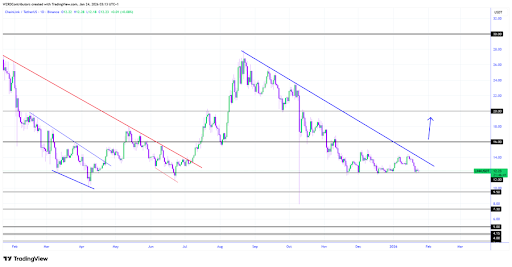
Failure to do so could shift the balance back in favor of the bears and increase downside pressure. A continuation of weakness would likely result in a break of the daily lower-high trendline, followed by a loss of the critical $12 support level. 

On the bullish side, if Bitcoin provides the necessary support, LINK could attempt a recovery rally toward the $16 resistance zone. Until a clearer higher-timeframe structure emerges, the trading focus remains tactical. Attention will be placed on the lower-timeframe charts, particularly over the weekend, to capitalize on quick, short-term opportunities while avoiding unnecessary exposure to indecisive daily conditions.

Intraday Chart Shows Tight Range, Market Lacks Clear Direction

The analyst concluded that the intraday chart remains choppy, with price action tightly compressed within a narrow range. Such conditions point to persistent market indecision, in which neither bulls nor bears have shown sufficient conviction to drive a sustained move in either direction. As a result, trade setups lack clarity and carry elevated risk.

From a tactical perspective, a retest of the $13 resistance level, followed by clear signs of rejection or fading momentum, could open the door to a short opportunity. However, if price holds above $13 with strong acceptance, that would place the market in more constructive territory and tilt the bias back in favor of the bulls.

Until one of these scenarios plays out decisively, the analyst emphasized the importance of waiting. A more mature and well-defined chart structure is needed before engaging in the next trade, ensuring better confirmation, cleaner entries, and improved risk-to-reward conditions.

Chainlink

GameStop Transfers Full Bitcoin Stack, Analysts Flag Possible Exit

GameStop moved its entire Bitcoin stash into Coinbase Prime this month, according to blockchain trackers that monitor large transfers.

The wallet associated with the company sent a large deposit to the institutional arm of Coinbase, a platform used by big traders and companies.

Analysts watching on-chain flows immediately flagged the move as a likely setup for a sale, though no confirmed sell orders have been announced.

Big Move To Coinbase Prime

According to on-chain reports, GameStop holds 4,710 BTC that it bought last year, and that full balance was shifted into Coinbase Prime.

The company first bought the coins in May 2025 at prices that averaged near $107,900 per BTC, a buy that cost roughly $504 million at the time.

Moving a corporate treasury from cold storage to an active institutional account is often read as a step toward execution — to sell, hedge, or rebalance — but it is not the same as a sale itself.

GameStop throws in the towel?

Their on-chain wallets just moved all BTC holdings to Coinbase Prime, likely to sell.

Between May 14–23, 2025, they bought 4,710 BTC at an avg. price of $107.9K, investing ~$504M.

Now selling for around $90.8K, potentially realising approximately… pic.twitter.com/Bp7MwRVQ43

— CryptoQuant.com (@cryptoquant_com) January 23, 2026

What Analysts Are Saying

Reports say the math is simple and stark: selling now, with Bitcoin trading closer to the $90,000 area, would lock in a sizable loss versus the initial purchase price.

Several analytics firms put that figure near $76 million if the whole lot were sold at recent market levels. Some market watchers suggest the company could be doing tax-loss harvesting or trimming volatile assets on its books.

Others view it as a pragmatic adjustment to reduce treasury exposure to crypto swings. Still, defenders of the move point out that GameStop’s Bitcoin stake was never a core retail play; it was a treasury experiment meant to diversify.

How Much Has Already Moved

Not all outlets agree on timing or size of day-by-day transfers. Reports note that some transfers earlier this month added up to about half of the original position — roughly 2,396 BTC moved in smaller tranches before the full deposit was flagged.

On-chain sleuths track each shift, and those staggered movements can mean many things: a staged sale, an internal reorganization, or simply routing through a trusted custodian before any trades.

Market And Shareholder Reaction

Share action around GameStop has not mirrored the crypto chatter. While Bitcoin watchers focused on the wallet move, investors were also reacting to company news on other fronts, including fresh share purchases by CEO Ryan Cohen.

Featured image from PeterPhoto, chart from TradingView

Gold Becomes The Whale Safe Haven As Bitcoin Takes A Back Seat

A large investor shifted funds into tokenized gold this week, and Bitcoin felt the impact. Prices dipped while a whale quietly bought millions in XAUT, a gold-backed token, signaling a short-term move toward traditional hedges.

Whales Move Into Tokenized Gold

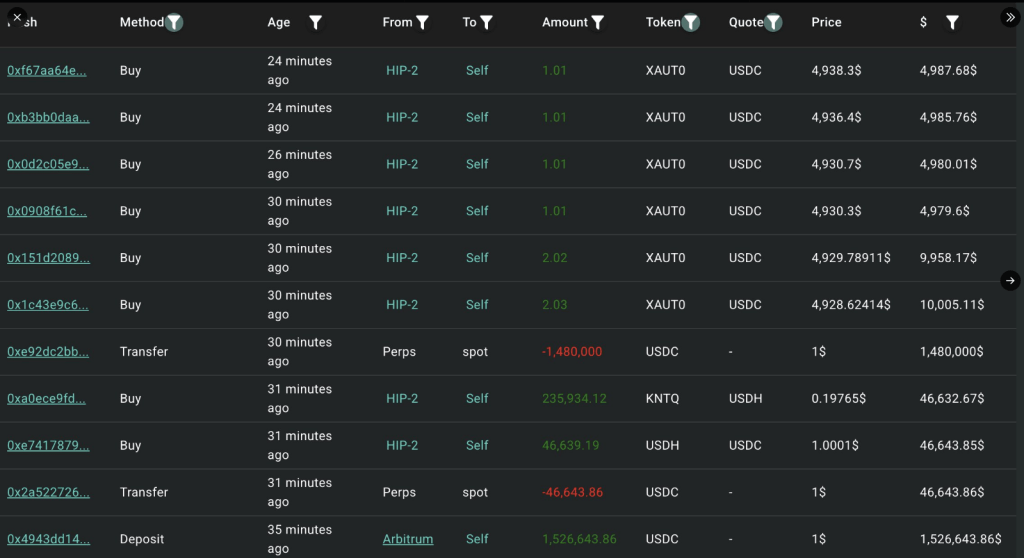
According to on-chain trackers, one address moved $1.53 million in USDC into Hyperliquid to buy XAUT. Reports note that the same wallet had earlier bought about 481 XAUT, a purchase worth roughly $2.38 million.

The address still holds close to $1.44 million in USDC, which suggests more purchases could follow. These moves were picked up on public blockchains and then flagged by analysts watching large transfers.

This kind of action can matter. When big players shuffle cash, smaller traders often take notice and hedge their bets. The shift is not proof of a long-term trend, but it shows that, at least for now, some large holders prefer gold exposure over extra crypto risk.

Whales are buying gold, not crypto.

~30 mins ago, whale 0x6B99 deposited 1.53M $USDC into Hyperliquid to buy $XAUT again.

He has already bought 481.6 $XAUT($2.38M) and still holds 1.44M $USDC, which may be used to buy more $XAUT.https://t.co/0uV2kNEiD0 pic.twitter.com/rYA09b1OEn

— Lookonchain (@lookonchain) January 23, 2026

Gold And Silver Hit Fresh Highs

Reports say gold has been moving sharply higher, with spot prices climbing close to $5,000 per ounce in global trading this week. Silver also rose above $100 per ounce, with intraday gold prints near $4,988 before settling.

Traders tie the surge to geopolitical tensions and the idea that interest rates may ease, which encourages money into metal-based stores of value.

A weaker dollar has also helped. Market chatter points to increased demand as investors seek steadier places to park capital while global politics and policy choices create more worry.

Bitcoin’s Price Action And Market Mood

Bitcoin traded around $88,653 at one stage, slipping about 1% on the day and nearly 30% below its prior cycle top. That gap is large. It has market participants questioning whether BTC will stay the go-to hedge during times of high stress. Some long-term holders remain confident. Others are watching liquidity and macro signals more closely.

Reports have disclosed renewed criticism from economist Peter Schiff, who argued that Bitcoin has underperformed versus gold since 2021.

He highlighted the opportunity cost for investors holding BTC while metals climb to record prices. Schiff wrote on social platforms that precious metals are outperforming and that this weak run for Bitcoin weakens its role as a store of value in the eyes of some.

What This Means For Crypto Investors

Short-term rotations like this often reflect risk preferences rather than permanent shifts. Some funds and wealthy individuals seek lower-volatility assets when headlines grow louder and policy paths look uncertain.

Others still view Bitcoin as a long-term play tied to scarcity and network effects. The current picture is a mix: metals are strong, tokenized gold is drawing attention, and crypto markets are reacting.

Featured image from Pexels, chart from TradingView

Bitcoin Realized Profit/Loss Reveals Underlying Structural Shift — What’s Happening?

Based on data from the weekly price chart, Bitcoin is witnessing a significant loss of over 6% following recent widespread market liquidations. Notably, the premier cryptocurrency has taken on a consolidatory stance in the past day, as if to lend credence to growing hopes of some price recovery. However, a recent on-chain analysis points out that Bitcoin’s outward show of resilience might merely be theatrical and that the flagship cryptocurrency could be facing a dark future ahead.

Bitcoin Enters 30-Day Cumulative Realized Loss Phase Since October 2023

In a recent Quicktake post on CryptoQuant, crypto education and research group XWIN Research Japan dissects the present on-chain situation of Bitcoin, with the center of attraction being the Bitcoin Net Realized Profit/Loss metric, which shows the leading cryptocurrency has recorded a net realized loss on a 30-day basis for the first time since October 2023. 

Bitcoin

However, the losses seen in 2023 were short-lived and rapidly retraced, unlike the current decline, which is broader and more persistent, suggesting a possible structural shift in market dynamics. At this moment, it appears that investors are less-interested in “buying the dip,” nor are they looking to “HODL” through the Bitcoin price action, and are more willing to accept losses.

For this reason, the market can be more plausibly described as being in a state of caution. It is, however, worth mentioning that the present phase does not necessarily precede a market crash. If anything, it reflects that Bitcoin may be entering a more volatile phase, independent of speculative frenzies.

Realized Profits Signal Late-Stage Of Bull Cycle 

XWIN Research further reinforces the hypotheses by referencing the trend in realized profits. According to the market experts, Realized Profits peaked in March 2024 at approximately 1.2 million BTC, and reduced slightly to 1.1 million in December 2024. 

As of July, 2025, realized profits had sharply dropped to 517,000 BTC, reflecting an increasing exit of profit-taking activity within the market. But this pales in comparison to the lower 331,000 BTC recorded in October. The analytics group explained that this contraction occurred despite a rise in prices, thus suggesting an absence of deep upside momentum.

The group further highlights that this is a telltale sign of a late-stage bull market, one which was seen in 2021-2022. In this period, realized profits slowly dropped before the Bitcoin price flipped bearish. More shockingly, the annual timeframe tells a similar story, with annual net realized profits contracting from 4.4 million BTC to 2.5 million BTC, just within October 2025 and early 2026. This is also similar to the phase that preceded the bear market of 2022.

In essence, Bitcoin is in a transitioning phase, from a mature bull phase to a volatile environment. As of this writing, the Bitcoin price stands at $89,462. 

Bitcoin

Featured image from Pexels, chart from Tradingview

Bitcoin Pattern From 2022 That Led To Crash To $20,000 Reappears

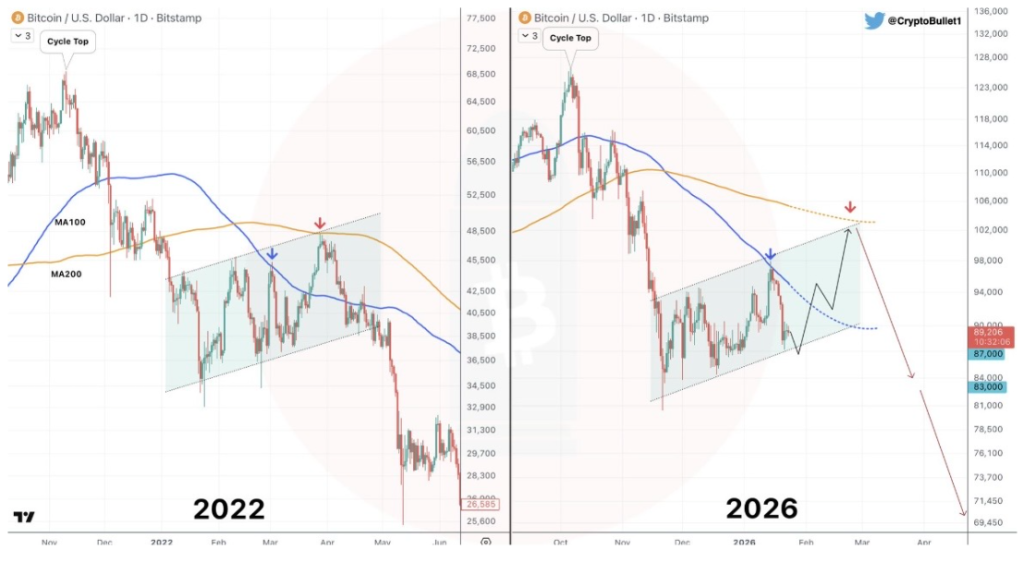
Bitcoin (BTC) is mirroring the same setup from its 2022 bull cycle, which led to a massive price crash to $20,000. According to market expert Crypto Bullet, this recurring structure could signal another major correction for BTC ahead. However, this time the leading cryptocurrency could give up almost a quarter of its current value. 

2022 Bitcoin Chart Pattern Signals Over 20% Crash

In his technical analysis released on X, Crypto Bullet revealed that Bitcoin is currently repeating a 2022 structure that could lead to a more than 20% decline in its value. To support his bearish outlook, the analyst presented a parallel chart comparing Bitcoin’s price action from 2023-2022 and 2025-2026, highlighting similar technical patterns, price behavior, and Moving Averages (MA). 

During the 2022 cycle, Bitcoin experienced a similar pattern, beginning with a test of the 100-day Moving Average (MA100), highlighted as the blue trendline on the chart. After facing rejection at that level, the price pulled back to a nearby support zone inside a rising channel. From there, BTC staged a sharp rally, surging to fresh highs around $48,500, where it aligned with the 200-day Moving Average (MA200), marked in orange. 

However, the recovery proved short-lived. Bitcoin soon reversed course and failed to reclaim the MA200 as support. Once the cryptocurrency’s price structure was lost, downside momentum accelerated, pushing the price into a much deeper correction toward the $20,000 level. 

According to Crypto Bullet, Bitcoin is repeating this exact pattern in 2026. It has already retested the MA100, gotten rejected, and moved lower into a support zone within a similar ascending channel. The chart also showed that in both cycles, BTC reached a “market cycle top,” first around December 2023 and then again in November 2025, before breaking down and entering a consolidation phase

Given how closely Bitcoin is mirroring its 2022 setup, Crypto Bullet has forecast another dramatic price crash, predicting a more than 23.5% drop from its current price near $89,500 to $68,450. Before this decline happens, the analyst expects BTC to experience a short-term recovery, potentially climbing back above the $100,000 psychological level to reach $102,000. 

Bitcoin Could Still Rally To $92,000

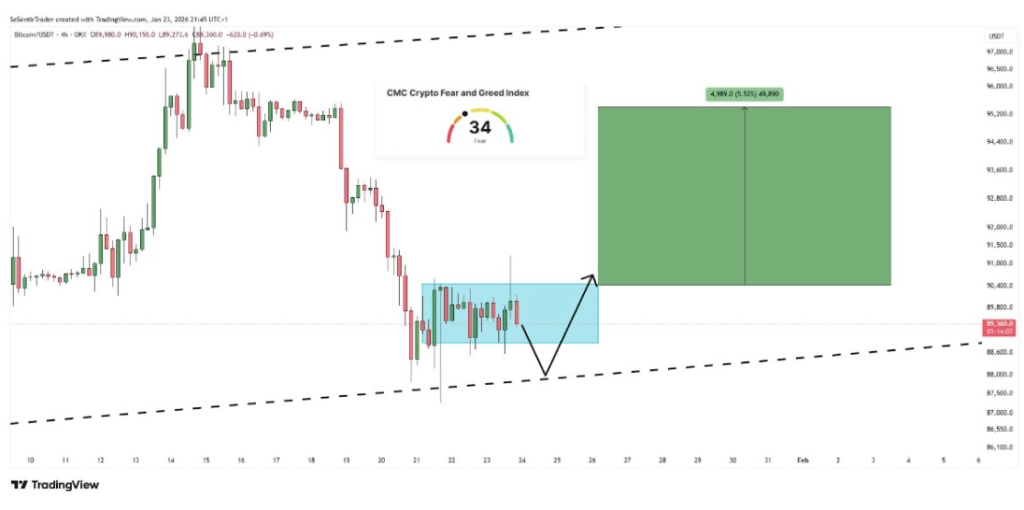
Crypto analyst Tyrex has stated that Bitcoin has been consolidating for the past 48 hours, with price holding above $89,000 for most of that period. Despite the muted price action, he believes that BTC could soon rally to $92,000. The analyst also noted that the broader market is in a state of fear, with many traders anticipating further declines in Bitcoin.

However, the analyst cautions that this expected drop may be a trap. He points out that an ascending channel is forming on Bitcoin’s chart, prompting him to adopt a more bullish outlook despite the prevailing bearish sentiment and sideways price movement.  

Featured image from Unsplash, chart from TradingView

Bitcoin Metric Suggests Miners Are In Recovery Mode — Price To Follow?

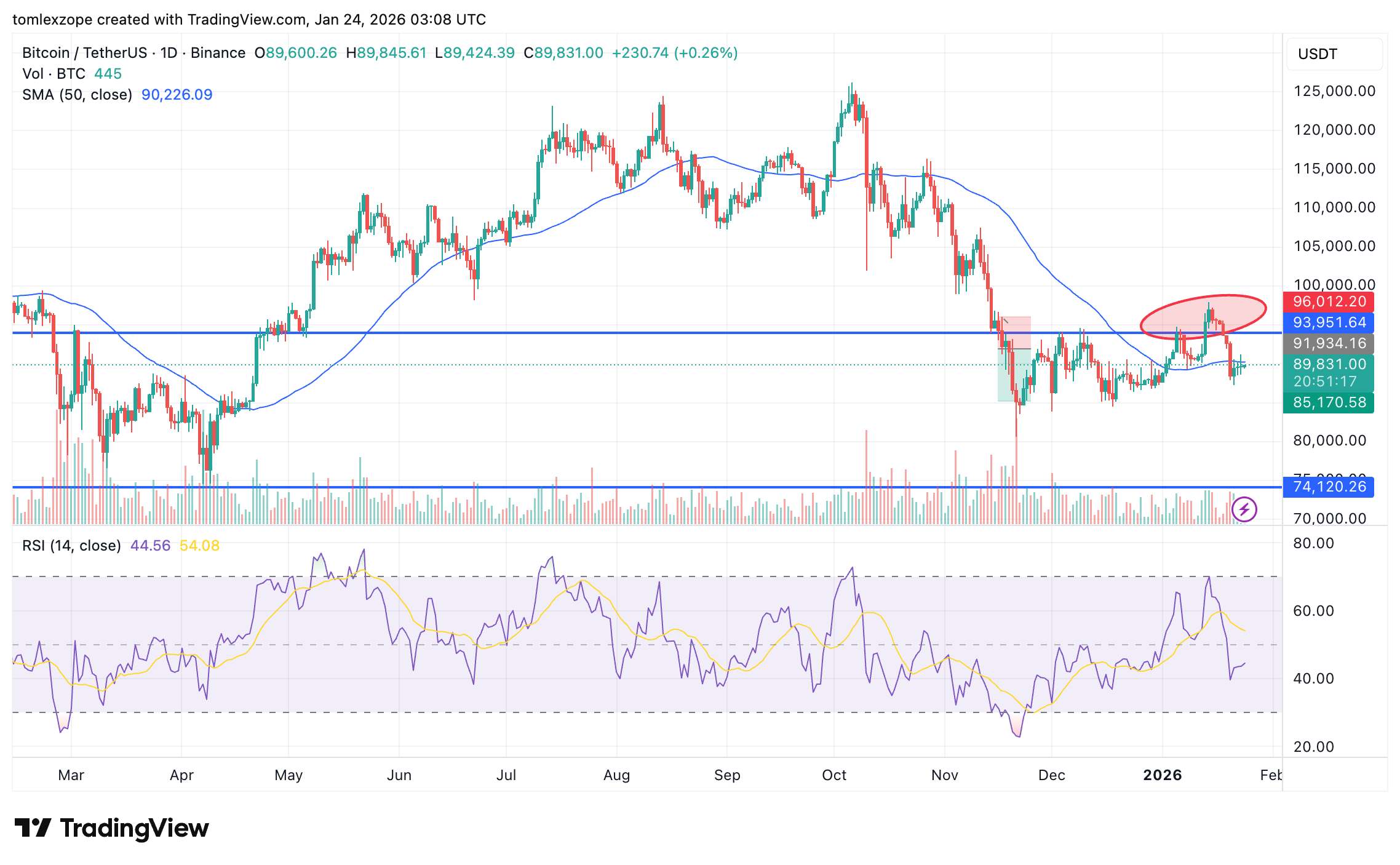
Over the past week, the price of Bitcoin faced a significant setback in its goal of reclaiming the six-figure threshold. The flagship cryptocurrency has been hovering around the $90,000 mark, as the market can’t seem to make a decision concerning the next price direction.

As Bitcoin faced a mild sell-off, which, in turn, drove its price to fall from its recent highs, specific market participants were under severe pressure, including the miners. Interestingly, a recent on-chain evaluation has raised the possibility that miners’ stress might be ending soon.

Miner Financial Health Flashes Classic Reversal Sign

In a January 23 post on the social media platform X, market expert Axel Adler Jr highlighted that the Bitcoin miners might have started their post-capitulation recovery journey. The relevant indicator here is the Miner Financial Health Index (7D-SMA). 

For context, this metric tracks the balance between miner revenue and miner selling pressure. Hence, it reflects whether miners are net BTC distributors or accumulators. Simply put, the metric shows if Bitcoin miners are under pressure, stable, or even profitable. 

Capitulation events often reflect on the Miner Health Index as a negative value, as the amount of BTC spent surpasses the amount of BTC earned. On the other hand, miners are typically said to be in the recovery phase when the balance between revenue and spending starts to lean away from the negative.

Image

From the chart shared by the analyst, it is apparent that the index has taken on an uptrend, targeting neutral levels on the metric’s charts. History shows that the index does not merely target the neutral mark when it trends upward.

Hence, if history were to repeat itself, the Bitcoin miners could be in for a rewarding ride, having survived the most recent capitulation event. Interestingly, the price of Bitcoin appears to have a directly proportional relationship with the Miner Health Index.

Bitcoin Price Gathers Momentum As Market Condition Shifts

In a separate post on X, Bitcoin Vector highlighted that Bitcoin might be garnering strength for a significant move in the near term. According to the analytics platform, this development coincides with the market exiting what was previously a “high-risk environment.”

Bitcoin Vector explained that this exit from a risky market environment was last seen in April 2025, just before the bull run resumed. The on-chain analytics firm explained that we could be witnessing the late stages of a classic momentum bottoming pattern, which historically leads to large rallies. 

Essentially, there has to be one last push lower in price and, at the same time, a momentum boost to the upside, for the bullish signal to be completely formed. As of this writing, Bitcoin is valued at around $89,830 with no significant movement in the past 24 hours.

Bitcoin

Bitcoin Price Prediction: BTC Stuck at $89,500 – Are Korea’s Breach and UBS the Catalyst?

Bitcoin is trading near $89,500, locked in a tight range that reflects consolidation rather than weakness. While price action remains compressed, a series of institutional and regulatory developments this week is reshaping how the market views Bitcoin’s longer-term role.

South Korea’s $48M Bitcoin Custody Breach Raises Alarms

South Korean authorities are investigating the disappearance of roughly 70 bn won ($48 mn) worth of seized Bitcoin from official custody. The issue surfaced during a routine audit by the Gwangju District Prosecutors’ Office, according to local reports.

Preliminary findings suggest the loss resulted from a phishing attack, after a staff member reportedly accessed a fake website, leading to leaked credentials. While details remain limited due to the ongoing investigation, the case has reignited debate around how governments store and protect confiscated digital assets.

South Korean prosecutors investigate disappearance of seized Bitcoin following phishing attack

Multiple Bitcoins went missing in mid-2025 after private key credentials were exposed in a phishing attack, resulting in irreversible transfers

— crypto.news (@cryptodotnews) January 23, 2026

Importantly, the incident does not reflect a failure of the Bitcoin network itself. Instead, it underscores weaknesses in human processes and custody frameworks. Long term, this type of breach may push governments toward stricter crypto custody standards, ironically strengthening institutional confidence rather than weakening it.

You can't make this up.

"an agency worker accessed a scam website"

Nearly $50M in seized Bitcoin was stolen in a phishing attack.

What could have gone to a national strategic bitcoin reserve has now fallen into the hands of bad actors.

As state agencies and employees work… pic.twitter.com/sga9sqJExD

— Boring Security (@BoringSecurity) January 23, 2026

UBS Explores Crypto for Private Banking Clients

In a separate but related signal, UBS is reportedly evaluating plans to offer cryptocurrency investing to select private banking clients, beginning with Bitcoin and Ether for wealthy Swiss customers. According to Bloomberg, the bank is assessing third-party partners to support the rollout.

UBS plans to make cryptocurrency investing available for some private banking clients in what could become a significant move into digital assets for the wealth manager https://t.co/pWi6Inm9AP

— Bloomberg (@business) January 23, 2026

If successful, UBS could later expand the service into the US and Asia-Pacific, aligning with similar initiatives from Morgan Stanley and JPMorgan. The move reflects growing demand among high-net-worth investors for crypto exposure through trusted, regulated institutions, rather than exchanges alone.

Bitwise’s Bitcoin-Gold ETF Signals Macro Thinking

Adding to the institutional theme, Bitwise Asset Management has launched the Bitwise Proficio Currency Debasement ETF (BPRO) on the NYSE. Unlike spot Bitcoin ETFs, BPRO is actively managed and blends Bitcoin, gold, precious metals, and mining equities, with at least 25% allocated to gold at all times.

The fund carries a 0.96% expense ratio and targets long-term investors focused on capital preservation. By pairing Bitcoin with gold, Bitwise frames BTC as a macro hedge against currency debasement, not a speculative trade.

Bitcoin Price Forecast: $89,500 Range Tightens as Breakout Pressure Builds

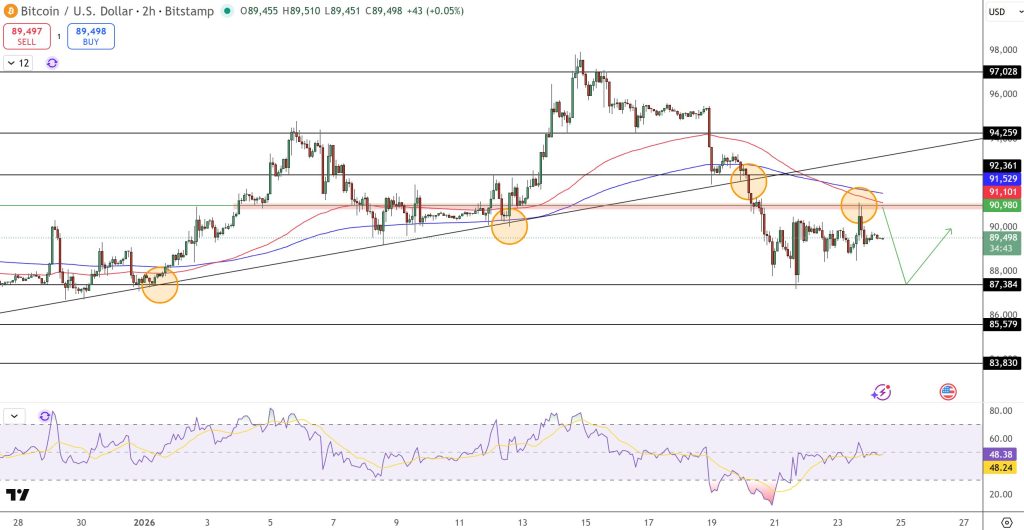
Bitcoin is trading near $89,500, holding inside a narrowing range after a sharp rejection from the $97,000 peak earlier this month. On the 2-hour chart, price action points to compression rather than breakdown. BTC continues to defend the $87,300–$88,000 support band, an area repeatedly tested and protected by buyers.

Long lower candlestick wicks around this zone suggest sellers are struggling to gain follow-through, signaling thinning supply at lower levels.

Bitcoin Price Chart – Source: Tradingview

From a structural view, Bitcoin remains anchored to a rising trendline that has guided price higher since the $83,800 low. While price briefly slipped below the 50-EMA and 100-EMA, it has stabilized near the 200-EMA, which is flattening instead of rolling over.

This behavior typically reflects a transition phase, not a confirmed trend reversal. The broader setup resembles a descending flag within an ascending channel, a formation that often resolves in the direction of the prevailing trend.

Momentum supports this outlook. RSI has rebounded from oversold levels near 30 and is now hovering around 48–50, signaling balance rather than renewed selling pressure. Recent candles show smaller bodies and reduced volatility, often seen before range expansion. If BTC dips, $87,400 remains key support. A push above $90,980 would open the path toward $92,400 and $94,250.

Trade setup: Buy near $88,000–$87,500, target $94,000, stop below $85,500.

Bitcoin Hyper: The Next Evolution of BTC on Solana?

Bitcoin Hyper ($HYPER) is bringing a new phase to the BTC ecosystem. While BTC remains the gold standard for security, Bitcoin Hyper adds what it always lacked: Solana-level speed. The result: lightning-fast, low-cost smart contracts, decentralized apps, and even meme coin creation, all secured by Bitcoin.

Audited by Consult, the project emphasizes trust and scalability as adoption builds. And momentum is already strong. The presale has surpassed $30.9 million, with tokens priced at just $0.013625 before the next increase.

As Bitcoin activity climbs and demand for efficient BTC-based apps rises, Bitcoin Hyper stands out as the bridge uniting two of crypto’s biggest ecosystems. If Bitcoin built the foundation, Bitcoin Hyper could make it fast, flexible, and fun again.

Click Here to Participate in the Presale

The post Bitcoin Price Prediction: BTC Stuck at $89,500 – Are Korea’s Breach and UBS the Catalyst? appeared first on Cryptonews.

What Are the Best Strategies to Attract Real Users to Your P2P Exchange?

Building a P2P exchange is easy earning real user trust is the real challenge. This blog shares simple, practical strategies to attract genuine users, build confidence, and grow a P2P exchange that people actually enjoy using.

The technology may be ready, but real success begins when genuine users start trusting your platform and trading regularly. Attracting real users isn’t about aggressive promotion, it’s about building something people feel comfortable using. When P2P Crypto Exchange Development is approached with empathy and clarity, users don’t just sign up, they stay.

Start by Understanding What Users Truly Care About

Every successful platform starts with a simple understanding: users don’t care about features as much as they care about outcomes. They want safety, flexibility, and control. When founders focus on solving real user problems instead of copying competitors, the platform naturally stands out. A user first mindset during P2P Crypto Exchange Development helps create an exchange that feels purposeful, not generic.

Trust Is Built Quietly, Long Before the First Trade

Trust doesn’t come from promises, it comes from clarity. Users want to understand how trades are protected and what happens if something goes wrong. When transparency is built into the experience, users feel confident enough to act. A calm, reassuring approach to trust during P2P Crypto Exchange Development creates confidence without needing loud messaging.

The First Experience Often Decides Everything

The first few minutes on your platform decide everything. If users feel confused, they leave without explanation. If things feel simple and intuitive, they explore further. Exchanges that prioritize ease during P2P Crypto Exchange Development reduce friction and make users feel welcome rather than overwhelmed.

Clear Communication Builds Instant Confidence

Professional doesn’t have to mean complicated. Clear, friendly language builds stronger connections than technical explanations. When users understand what’s happening at every step, they feel respected. Thoughtful communication throughout P2P Crypto Exchange Development turns uncertainty into confidence.

Make Your Platform Fit Naturally Into Everyday Life

People trust platforms that align with how they already operate. Supporting familiar payment methods and local preferences makes your exchange feel practical and relevant. When real life usability is considered during P2P Crypto Exchange Development, users don’t need to adjust their habits; they simply participate.

Early Users Shape the Future of Your Exchange

Early users are more than sign ups, they are your first believers. When they feel valued, they share their experience organically. A respectful, fair approach during P2P Crypto Exchange Development turns early adopters into long-term supporters who help shape your platform’s reputation.

Helping Users Learn at Their Own Pace Builds Loyalty

Not every user arrives ready to trade immediately. Some need time to understand how things work. Simple guidance and patient education help users build confidence at their own pace. When learning is part of P2P Crypto Exchange Development, users feel supported rather than pressured.

Users Stay Where the Platform Feels Alive

Users stay where they feel noticed. Quick responses, visible improvements, and open to feedback create a sense of presence. A platform designed with care during P2P Crypto Exchange Development feels alive, trustworthy, and worth returning to.

Consistency Is What Turns Users Into Regular Traders

Trust grows through repetition. When a platform performs reliable day after day, users relax and trade more freely. Strong foundations in P2P Crypto Exchange Development ensure the exchange grows without losing stability, which is essential for long-term confidence.

Authenticity Is What Makes Users Believe in You

Users recognize authenticity. When marketing reflects the actual experience, trust deepens naturally. An honest approach aligned with P2P Crypto Exchange Development creates relationships built on respect, not exaggeration.

Conclusion

Attracting real users to your P2P exchange is a gradual, people driven process. Business owners and startups that succeed focus on trust, simplicity, and genuine value rather than quick wins. When users feel understood and protected, growth follows naturally. Building with intention and care makes all the difference, and partnering with a depend on P2P Crypto Exchange Development Company like Beleaf Technologies can help turn this thoughtful approach into a platform users truly trust and recommend.


What Are the Best Strategies to Attract Real Users to Your P2P Exchange? was originally published in Coinmonks on Medium, where people are continuing the conversation by highlighting and responding to this story.

Bitcoin Price Still Has Room To Fall Below $60K — Crypto CEO

The Bitcoin price had a relatively rough trading period over the past week, as it hovered around the psychological $90,000 mark. The flagship cryptocurrency, which looked set for a return to six-figure valuation barely over a week ago, now seems to have lost all its bullish momentum.

Broadly speaking, these recent struggles put to rest questions around the “relief rallies” to the upside, and correlate more with the current bear market structure. However, the latest on-chain evaluation shows that the Bitcoin price woes could worsen from here on out.

Expert Explains Why $60,000 Is Possible For BTC Price

In a recent post on the X platform, Alphractal CEO and founder Joao Wedson said that the Bitcoin price could still have room to fall below the $60,000 level. This not-so-optimistic prediction is based on the number of days Bitcoin has traded at prices higher than today.

According to Wedson, there have been 355 days when the Bitcoin price has traded at levels higher than today. This figure was derived from the “Days Spent at a Profit” metric, which tracks the number of days in Bitcoin’s history where the market price was higher than the current price.

This indicator measures how much price action — in the past — has occurred above the current price level. From a historical standpoint, an increase in the number of “Days Spent at a Profit” tends to occur during bear cycles or extended periods of sideways movement, implying that different investor groups are holding BTC at a price higher than their cost bases.

Bitcoin price

As Wedson highlighted, the “Days Spent at a Profit” metric reached around 775 days as the Bitcoin price approached a bottom. Going by this historical context, the current level of this indicator (355 days) suggests that the flagship cryptocurrency is still a distance away from extreme levels often associated with bearish market bottoms.

Ultimately, this deduction means that the price of Bitcoin could still be at risk of an extended decline over the next 300 days. According to the Alphractal, this extended period of price decline could see BTC revisit $60,000, potentially triggering significant liquidations among retail investors and institutional players who entered the market post-ETF.

Bitcoin Price At A Glance

As of this writing, the price of BTC stands at around $89,900, reflecting no significant change in the past 24 hours. However, the market leader is currently down by over 5% on the weekly timeframe, while nearly 30% adrift its all-time high of $126,080.

Bitcoin price

Bitcoin Approaches Key Monthly Close — Here Are 3 Likely Scenarios

In the last week, Bitcoin suffered another correction wave with prices dropping to around $88,000 as the crypto market continues to face a weak investor appetite. While the premier cryptocurrency has experienced some slight relief, an approaching monthly close indicates the market is at a critical juncture that could define its price direction for February.

Bitcoin Market Weighs Rebalance Or Complete Breakdown

According to seasoned analyst KillaXBT, Bitcoin is heading into a pivotal monthly close next week, as recent price action suggests the market is approaching an inflection point. Notably, after sweeping external highs near $94,600 earlier in the month, BTC has since faced firm rejection, pushing price back toward the lower end of its recent range between $88,000-$90,000.

The rejection from these highs resulted in pronounced upper wicks on higher timeframes, a structure that often signals aggressive selling pressure. However, KillaXBT explains that such wicks are frequently partially or fully retraced, due to liquidity. With a full trading week still remaining before the monthly candle closes, the market analyst postulates that there are three primary scenarios that could determine price direction for February.


Bitcoin

Firstly, Bitcoin could rise into the end of the month, allowing for a stronger monthly close. Under this scenario, February could begin with price forming the upper portion of the current wick, potentially revisiting the low-to-mid $90,000s before rolling over later in the month toward the $83,800 region.

In the second scenario, Bitcoin closes the month near current levels around $89,000, followed by an early-February move to hunt liquidity in the $91,000–$92,000 range before resuming a downward trend. Interestingly, both scenarios align with the idea that the market may first move higher to rebalance liquidity before resolving lower.

The third scenario presents a more severe outcome that aligns with a potential market breakdown. In this case, KillaXBT forecasts Bitcoin could retrace below the weekly and monthly open at $87,664 and close beneath this level before February. The analyst describes this scenario as “violently bearish”, as it increases the probability of a rapid move towards a lower support in the new month.

Notably, KillaXBT favors the first two scenarios, as the present sentiment being heavily bearish indicates that most investors are least expecting a move to the higher side. However, the analyst also emphasizes that the loss of $83,800 support in any scenario would significantly alter the outlook for any remaining long exposure.

Bitcoin Price Overview

At press time, Bitcoin trades at $89,645 following a minor 1.4% gain in the last day.

Bitcoin

❌