Reading view

There are new articles available, click to refresh the page.

Solana AI Token Ava Plunges 96% After ‘Insiders’ Snipe 40% of Supply

Solana-based AI token Ava, known by its ticker AVA, has plunged more than 96% from its peak after new on-chain analysis raised questions about how the token’s supply was distributed at launch and whether insiders coordinated early purchases.

The latest findings come from blockchain analytics firm Bubblemaps, which published an analysis on X showing that around 40% of AVA’s total supply was accumulated at launch by a cluster of wallets linked to the token’s deployer.

Remember $AVA?

40% bundled at launch, linked to the deployer

Your AI girlfriend took all your money 🧵 pic.twitter.com/31uMnlglfi

— Bubblemaps (@bubblemaps) December 18, 2025

Wallet Clustering Points to AVA Token Sniping at Launch

According to Bubblemaps, the wallets were funded shortly before launch, showed no prior on-chain activity, and bought large amounts of AVA as soon as the token became available.

AVA launched on Nov. 13, 2024, on Pump.fun, a Solana-based memecoin launch platform that promotes fair and decentralized token launches.

The project gained early attention as one of the first 3D AI agent tokens, backed by Holoworld AI, a Polychain Capital portfolio company.

By January 2025, AVA had reached a fully diluted valuation of roughly $300 million, driven by a surge of interest in AI-themed crypto projects.

Bubblemaps said its analysis identified 23 wallets, including the deployer, that were funded within tight time windows through centralized exchanges such as Binance and Bitget.

Source: Bubblemaps

The wallets received similar amounts of SOL and then used automated trading strategies to buy AVA at launch.

The firm added that additional wallets connected to this initial cluster followed similar funding and timing patterns, which it said strongly suggests coordination rather than independent participation.

In crypto markets, this practice is commonly referred to as sniping, where bots are used to purchase new tokens the moment they become tradable, often securing large allocations before retail participants can react.

While sniping itself is not illegal, a heavy concentration of supply among early wallets can increase the risk of sharp sell-offs if those holders decide to exit.

The firm said the analysis shows that despite AVA’s public positioning as a community-driven launch, a single coordinated entity ended up controlling a large share of the supply.

AVA’s Market Reality Sets In as Token Sheds 96% From All-Time High

More than a year after launch, the impact is visible in the token’s market performance.

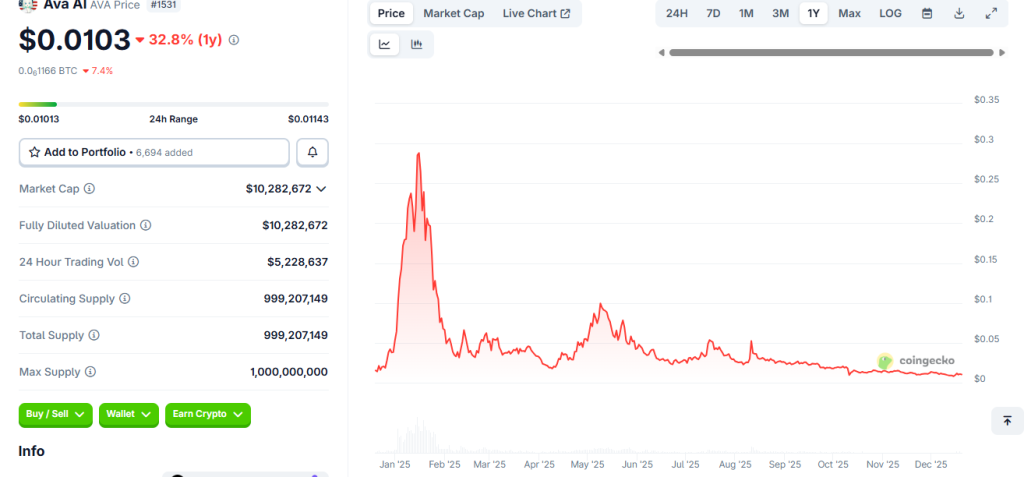
AVA is down over 79% from its launch price and more than 96% from its all-time high of about $0.33, reached on Jan. 15, 2025, according to CoinGecko data.
Source: CoinGecko

The token now trades near $0.01, erasing most of its early gains.

This decline has occurred despite continued development by the team behind Holoworld AI. The project describes Ava as the first AI agent virtual image token, designed to power audiovisual AI agents capable of interaction and emotional expression.

Holoworld claims to have created more than 10,000 3D virtual characters, partnered with over 25 IP and NFT brands, and attracted more than 1 million users.

Even so, those developments have not prevented a steep drop in AVA’s market value. AVA has a fixed total supply of 1 billion tokens, with 50 million released at launch as part of a 5% public sale.

The broader token distribution includes long-term allocations for community incentives, the team, private investors, liquidity, and ecosystem development, many of which are subject to vesting schedules.

The episode adds to a growing list of cases where Bubblemaps has flagged concentrated token ownership shortly after launch.

In recent months, the firm has published similar analyses involving PEPE, the $WET presale on Solana, MYX Finance’s airdrop, and other high-profile tokens, often pointing to coordinated wallet behavior and heavy early sell pressure.

While not all cases resulted in enforcement action or project failures, they have intensified scrutiny around fair-launch claims and insider transparency.

The post Solana AI Token Ava Plunges 96% After ‘Insiders’ Snipe 40% of Supply appeared first on Cryptonews.

Bitcoin Treasury Metaplanet Opens to US Investors via $MPJPY ADRs — No New Shares

Metaplanet, a Tokyo-listed Bitcoin treasury company, is set to open its stock to U.S. investors through a new American Depositary Receipt program, giving American buyers dollar-denominated access without issuing any new shares.

The company said trading of its sponsored Level I ADRs will begin Friday on the U.S. over-the-counter market under the ticker symbol MPJPY, according to an announcement.

Each ADR will represent one ordinary Metaplanet share and will trade in U.S. dollars.

The program is being launched with Deutsche Bank Trust Company Americas acting as depositary, while MUFG Bank will serve as custodian for the underlying shares in Japan.

Metaplanet Shares Jump After Company Upgrades U.S. Trading Structure

Metaplanet said the decision followed growing demand from U.S. retail and institutional investors who have been seeking a more direct and efficient way to gain exposure to the company’s equity.

Chief executive Simon Gerovich said the move reflects feedback the company has received over several quarters and marks another step in expanding global access to Metaplanet’s stock.

U.S. trading of Metaplanet ADRs begins December 19. Ticker: $MPJPY

This directly reflects feedback from U.S. retail and institutional investors seeking easier access to our equity. Another step toward broader global participation in Metaplanet. pic.twitter.com/XEvfAFw8Z3

— Simon Gerovich (@gerovich) December 19, 2025

The ADR program is not designed to raise capital, and it does not affect the number of issued common or preferred shares and will not dilute existing shareholders.

Instead, the structure is intended to improve settlement efficiency, lower transaction costs, and increase transparency for U.S. investors who face operational and regulatory hurdles when trading foreign-listed stocks directly.

Metaplanet’s shares have previously traded in the U.S. under the symbol MTPLF, but that arrangement was not part of a sponsored ADR program.

The company said the earlier trading format involved no formal agreement with a depositary bank and limited its ability to provide consistent disclosures and investor support.

By contrast, the new sponsored ADR framework places Metaplanet directly within the program’s governance and reporting structure, aligning it more closely with standard practices used by internationally listed companies.

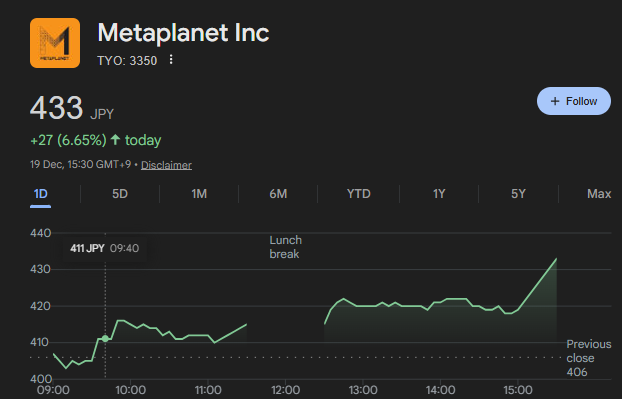
Source: Google Finance

The announcement appeared to be welcomed by the market, as Metaplanet shares rose 6.65% in Tokyo trading following the news, closing at 433 yen.

After Rapid Bitcoin Accumulation, Metaplanet Taps the Brakes

The U.S. listing comes as Metaplanet continues to refine its broader Bitcoin-focused balance sheet strategy.

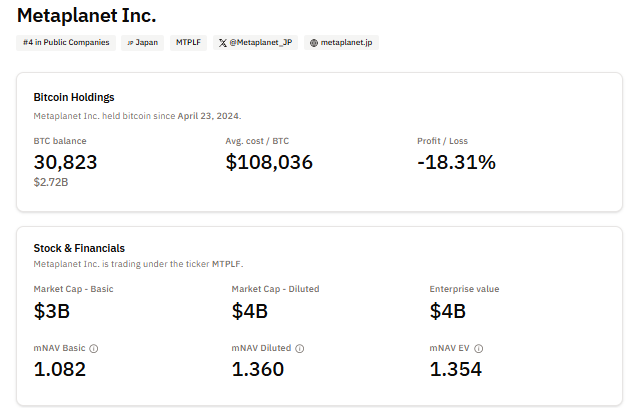
Since launching its Bitcoin acquisition plan in April 2024, the company has accumulated 30,823 BTC, making it one of the largest corporate holders globally alongside Strategy.

Metaplanet acquired roughly 29,000 BTC during 2025 but paused further purchases in late September, with its most recent acquisition dated Sept. 29, according to Bitcointreastries.net data.

Source: Bitcointreasuries

That pause followed a period of volatility for Bitcoin treasury companies, as falling share prices pushed some firms’ enterprise values below the market value of their Bitcoin holdings.

Metaplanet faced similar pressure in mid-October, when concerns emerged over its market-to-Bitcoin net asset value ratio.

🔴 Metaplanet's mNAV hits 0.99, trading below $3.4B Bitcoin reserves as one in four treasury firms are trading at discount, with corporate buying down 95% since July.#Metaplanet #Bitcoinhttps://t.co/1KgbHxWGf5

— Cryptonews.com (@cryptonews) October 14, 2025

The company said that ratio has since recovered above 1 and stood at 1.12 at the time of publication.

Equity Raises, Bitcoin Loans, and a Strategy-Style Structure

Metaplanet has relied on a mix of equity and debt instruments to fund its Bitcoin strategy.

In November, the company approved the issuance of 23.61 million Mercury Class B preferred shares through a third-party allocation, raising about ¥21.25 billion, or roughly $135 million.

🇯🇵 Metaplanet approves the issuance of new Class B shares via a third-party allotment.#Bitcoin #Metaplanethttps://t.co/p8fYF0FyZt

— Cryptonews.com (@cryptonews) November 20, 2025

The conversion price was set well above the prevailing market price, limiting near-term dilution.

Around the same time, Metaplanet disclosed a new $130 million loan backed entirely by Bitcoin under an existing $500 million credit facility.

As of its latest treasury update, the company’s Bitcoin holdings were valued at roughly $2.7 billion, based on an average acquisition cost of $108,070 per coin.

Source: CoinGecko

With Bitcoin trading below that level, Metaplanet reported unrealized losses of about $636 million.

The company is also preparing to introduce a new preferred-share structure modeled on funding vehicles popularized by Strategy.

The post Bitcoin Treasury Metaplanet Opens to US Investors via $MPJPY ADRs — No New Shares appeared first on Cryptonews.

SEC Labels Third-Party Bitcoin Mining a ‘Security’ in $48M Fraud Bust

The U.S. Securities and Exchange Commission says some third-party Bitcoin mining hosting deals can amount to securities, according to a federal lawsuit tied to an alleged $48 million fraud involving mining firm VBit Technologies.

In a complaint filed Wednesday in the U.S. District Court for the District of Delaware, the SEC accused VBit founder and former CEO Danh C. Vo of misleading thousands of investors.

Regulators claim the company sold unregistered investment contracts linked to hosted Bitcoin mining operations.

Source: SEC

At the center of the case are so-called “Hosting Agreements” promoted by VBit between late 2018 and early 2022. The SEC says the contracts were pitched to retail investors as a largely hands-off way to generate passive income through Bitcoin mining.

Why the SEC Says VBit’s Mining Contracts Were Securities

Bitcoin mining typically involves running specialized computers to validate transactions on the Bitcoin network in exchange for newly minted coins.

The SEC alleges Vo used the technical complexity of the process to promote a turnkey model in which investors were told they owned mining rigs that would be pooled and operated entirely by VBit.

Returns were marketed as proportional to each investor’s share of computing power, or hashrate.

According to the complaint, nearly all of VBit’s customers entered into these Hosting Agreements, which were sold in tiered packages ranging from lower-cost plans to premium offerings that purportedly included up to eight mining rigs.

Investors were encouraged to choose hosted mining rather than operating equipment themselves through discounted pricing, longer contract terms, and promises of steady returns without operational involvement.

The SEC alleges those representations were false. Court filings state that VBit sold far more hosting agreements than it had the mining equipment to support.

In 2020, the company allegedly sold agreements covering more than 3,300 rigs while operating fewer than 1,000.

In 2021, agreements reportedly covered more than 8,400 rigs, while only 1,643 were in operation.

As a result, the hashrate promised to investors could not be delivered.

The agency further alleges that investors never owned or controlled specific mining equipment and were entirely dependent on Vo and VBit’s operations to generate profits.

🇺🇸 Trump son Eric Trump-backed American Bitcoin intends to use the net proceeds from $220 million raised in a new share issuance to fund for Bitcoin equipment purchase.#EricTrump #AmericanBitcoin #Hut8https://t.co/23zTABD4tb

— Cryptonews.com (@cryptonews) July 1, 2025

On that basis, the SEC argues the Hosting Agreements meet the definition of investment contracts under the Supreme Court’s Howey test and therefore should have been registered as securities.

Investors Locked Out as SEC Says Mining Firm Moved Funds Offshore

Under U.S. law, an arrangement can be deemed a security if investors contribute money to a common enterprise with a reasonable expectation of profits derived primarily from the efforts of others.

The SEC claims VBit’s hosting model satisfies all four elements, placing it within federal securities rules governing registration, disclosure, and anti-fraud protections.

The complaint also accuses Vo of fabricating investor account balances through an online portal that displayed hypothetical mining returns unrelated to actual Bitcoin production.

The bitcoins that were mined were allegedly controlled exclusively by Vo.

The SEC says that between December 2020 and November 2021, Vo transferred approximately $48.5 million of investor funds to personal accounts, distributed millions to family members, and used investor money for cryptocurrency trading.

After learning of the SEC’s investigation in 2021, Vo allegedly left the United States. VBit later announced it had been sold to an entity called Advanced Mining Group, which the SEC describes as a shell company used to maintain the appearance of ongoing operations.

By mid-2022, investors were locked out of their accounts.

The SEC is seeking permanent injunctions, disgorgement, civil penalties, and a ban preventing Vo from serving as an officer or director of a public company. A jury trial has been requested.

The post SEC Labels Third-Party Bitcoin Mining a ‘Security’ in $48M Fraud Bust appeared first on Cryptonews.

Senate Confirms Pro-Crypto Mike Selig as CFTC Chair — What To Expect

The U.S. Senate has confirmed crypto-friendly lawyer Mike Selig as the next chair of the Commodity Futures Trading Commission (CFTC), ending a prolonged period of leadership uncertainty at one of the country’s most important financial regulators.

The confirmation passed Thursday as part of a mass approval of federal nominees, with senators voting 53–43 under the provisions of Senate Resolution 532.

Confirmed, 53-43: Confirmation of the en bloc nominations provided for under the provisions of S.Res.532.

— Senate Cloakroom (@SenateCloakroom) December 19, 2025

Selig’s confirmation comes as President Donald Trump’s second administration moves to fill some of the most consequential regulatory vacancies affecting the digital asset sector.

Alongside Selig, the Senate also elevated Travis Hill to chair the Federal Deposit Insurance Corporation (FDIC), placing permanent leadership at two agencies that play central roles in how crypto markets operate and how crypto companies interact with the banking system.

Power Without a Mandate: The CFTC’s Quiet Struggle Over Crypto Oversight

At the CFTC, the absence of a Senate-confirmed chair had become a growing operational problem. The agency, which is structured as a five-member independent commission, has been operating for months with just a single commissioner.

Acting Chair Caroline Pham remained the only seated member after a wave of resignations earlier in the year, a situation that concentrated authority while also limiting deliberation and long-term planning.

🇺🇸 The chair of the U.S. Commodity Futures Trading Commission (CFTC), Rostin Behnam, has announced his resignation, effective January 20, according to a Financial Times report.#CFTC #CryptoRegulations https://t.co/1AY9hfcCKv

— Cryptonews.com (@cryptonews) January 7, 2025

Although an acting chair can legally carry out agency functions, the lack of a permanent leader and full commission constrained the CFTC’s ability to build staff, coordinate with other regulators, and advance major new rulemakings.

That leadership gap mattered most for crypto policy. While Congress continues to debate legislation that would expand the agency’s mandate, the absence of a confirmed chair made it harder for the CFTC to set a clear regulatory direction or prepare for an expanded role.

🇺🇸 Senate introduces new Crypto Market Structure Bill draft to expand @CFTC authority over digital commodities like $BTC and $ETH.

#ClarityAct #CFTChttps://t.co/qKO9rR7aYs

— Cryptonews.com (@cryptonews) November 11, 2025

Previous nominees, including Brian Quintenz, were withdrawn amid political friction, extending the period of uncertainty.

During this interim phase, Pham focused on internal reforms rather than sweeping regulatory changes.

Her tenure emphasized clearing compliance backlogs, streamlining enforcement processes, and launching limited pilot initiatives tied to digital assets.

Pham led a “back-to-basics” approach, resolving internal backlogs and launching early digital asset initiatives, but the lack of a permanent, Senate-confirmed chair made it harder to advance complex rulemakings or coordinate closely with other regulators such as the Securities and Exchange Commission.

The agency also began what it called a “crypto sprint,” a set of targeted efforts that included updating regulatory language to reflect blockchain-based markets and formally approved spot crypto trading.

Selig’s Term Begins as CFTC Prepares for a Larger Role in Crypto Markets

Selig now takes on the role with a full and permanent mandate. He is a former CFTC official and most recently served as chief counsel to the SEC’s Crypto Task Force. He was nominated in October, replacing the administration’s earlier choice for the position.

📣 US President @realDonaldTrump is preparing to nominate @MikeSeligEsq as the next chair of the @CFTC#Trump #Cryptohttps://t.co/UUjnN7ENyC

— Cryptonews.com (@cryptonews) October 25, 2025

His term as chair will run through April 2029. During his confirmation process, Selig said crypto would be a priority and also pointed to ongoing challenges at the agency, including limited staffing, tight resources, and governance concerns.

The CFTC currently employs about 543 full-time staff, far fewer than the SEC’s roughly 4,200 employees, even as lawmakers in both chambers consider bills that would give the CFTC primary oversight of crypto spot markets.

Once sworn in, Selig, the current acting chair, Pham, will depart to join crypto payments firm MoonPay as chief legal and administrative officer.

🏦 The US CFTC Chair Caroline Pham will join crypto payments firm MoonPay, following the Senate's confirmation of her successor, Mike Selig.#CFTC #CarolinePham #MoonPayhttps://t.co/Bu3z0uGLvI
— Cryptonews.com (@cryptonews) December 18, 2025

While operating with a single commissioner may allow faster internal decision-making, it also raises questions about legal durability and bipartisan balance.

Several senators have already stated that confirming additional commissioners will be a key issue in 2026.

The post Senate Confirms Pro-Crypto Mike Selig as CFTC Chair — What To Expect appeared first on Cryptonews.

‘Severe Mistake’: Lawmakers May Limit De Minimis Tax Exemption to Stablecoins Only

US lawmakers are weighing a change to long-debated crypto tax rules that could narrow relief for everyday users, prompting warnings from Bitcoin advocates that the shift would undermine the original purpose of the policy.

The issue centers on a proposed “de minimis” tax exemption, a rule meant to spare small crypto payments from capital gains taxes. Under current IRS guidance, digital assets are treated as property.

That means every purchase made with crypto, even a cup of coffee, counts as a taxable event that requires tracking cost basis and reporting gains or losses.

Supporters of the exemption say this framework makes daily use impractical and discourages crypto from functioning as money.

Bitcoin Groups Warn of Flawed Crypto Tax Exemption

The debate intensified this week after representatives of the Bitcoin Policy Institute, a nonprofit advocacy group, said lawmakers are considering limiting the exemption to stablecoins only.

Conner Brown, the group’s head of strategy, said on X that limiting a de minimis exemption to stablecoins would be a “severe mistake,” arguing that it would exclude ordinary Bitcoin payments from relief while favoring assets that rarely generate capital gains in the first place.

I’m hearing very concerning news out of Capitol Hill today.

De Minimis tax legislation may be limited to only stablecoins, leaving everyday Bitcoin transactions without an exemption.

This would be a severe mistake. BPI will be publishing a response. Stay tuned.

— Conner Brown (@BitcoinConner) December 17, 2025

The idea behind the exemption is straightforward, allowing small personal crypto transactions to be excluded from capital gains reporting, similar to how foreign currency transactions are treated.

Most proposals have suggested a per-transaction threshold of around $300, paired with an annual cap of roughly $5,000 in total tax-free gains.

The concern raised by Bitcoin advocates is that recent drafts or negotiations may narrow the scope of the exemption to stablecoins.

Stablecoins are designed to maintain a steady price, usually pegged to the U.S. dollar, which means most transactions do not produce capital gains.

Critics argue that granting them a de minimis exemption offers little practical relief while leaving Bitcoin users facing the same reporting burden.

Why would you even need a de minimis tax exemption for stablecoins? They don't change in value.

This is nonsensical. The wealth effect that would be unleashed via a de minimis tax exemption for bitcoin would be material. It should be the sole focus.

Stablecoins shouldn't even… https://t.co/FS5JW8vhTB

— Marty Bent (@MartyBent) December 18, 2025

Some commentators have questioned the logic of prioritizing stablecoins. Marty Bent, founder of media outlet Truth for the Commoner, wrote on X that stablecoins “don’t change in value,” making a small-gain exemption unnecessary.

Can Bitcoin Be Used Like Cash? Lummis Thinks Taxes Are the Problem

Senator Cynthia Lummis of Wyoming has been one of the most vocal supporters of the idea. In July, she introduced legislation proposing a $300 exemption for crypto transactions, along with a $5,000 annual limit.

Her proposal also included exemptions for digital assets donated to charities and tax deferral for crypto earned through mining or staking.

Lummis has long argued that the exemption would make Bitcoin practical for everyday use, instead of something people are forced to treat only as a long-term holding.

That argument resurfaced in October when Block founder Jack Dorsey pressed lawmakers to lift tax rules that make daily Bitcoin payments difficult. Lummis replied publicly, saying she was working on the issue and urging supporters to speak up.

✅ @SenLummis has responded to @jack's call for a Bitcoin tax exemption for small transactions, stating she is "Working on it." #CryptoTax #Bitcoinhttps://t.co/6S4GtW7Vpf

— Cryptonews.com (@cryptonews) October 9, 2025

The exchange put fresh focus on a problem the crypto industry has raised for years. Bitcoin was introduced as a peer-to-peer electronic cash system.

Over time, however, transaction fees, slow settlement, and tax obligations have pushed most users toward holding rather than spending it.

As discussions continue, Congress appears closer than it has been in years to revisiting crypto tax rules.

In December, Representative Max Miller, who sits on the House Ways and Means Committee, said a draft bill on digital asset taxation has already circulated among lawmakers and could advance before the August 2026 recess.

🚨 U.S. lawmakers target August 2026 for a comprehensive crypto tax bill to clarify reporting, staking, and small-transaction rules. #CryptoTax #CryptoNews #Blockchainhttps://t.co/Gr8rKi9NF6
— Cryptonews.com (@cryptonews) December 10, 2025

Starting in 2026, the IRS plans to introduce new reporting rules, including 1099-DA forms from centralized exchanges, giving tax authorities a clearer picture of crypto activity.

The post ‘Severe Mistake’: Lawmakers May Limit De Minimis Tax Exemption to Stablecoins Only appeared first on Cryptonews.

Whistleblower Drops 5,000+ Secret Chats in Pump.fun MEV Scandal — Lawsuit Intensifies

A U.S. federal judge has allowed new evidence to be added to a sprawling class-action lawsuit tied to Solana-based memecoin platform Pump.fun.

This happened after a whistleblower resurfaced with nearly 5,000 internal chat messages that plaintiffs say shed new light on alleged insider trading and transaction manipulation.

Pumpdotfun & Solana lawsuit update:

Leave to amend (file new complaint) GRANTED

“What appeared to be a fair, automated marketplace was, Plaintiffs say, structurally tilted to extract value from ordinary users while rewarding those with privileged access to Solana's… pic.twitter.com/mctvXdWScM

— Burwick Law (@BurwickLaw) December 15, 2025

In a December 9, 2025 order filed in the U.S. District Court for the Southern District of New York, Judge Colleen McMahon granted plaintiffs permission to amend and refile their complaint against Pump.fun, MEV infrastructure firm Jito Labs, the Solana Foundation, Solana Labs, and related executives.

Retail Losses, Insider Priority Alleged in Pump.fun MEV Lawsuit

The decision clears the way for the case to proceed with expanded factual allegations centered on maximal extractable value, or MEV.

This controversial practice allows validators or sophisticated traders to profit by reordering transactions within a blockchain block.

The lawsuit was brought by Diego Aguilar, Kendall Carnahan, and lead plaintiff Michael Okafor on behalf of investors who purchased tokens launched on Pump.fun between March 1, 2024 and July 23, 2025 and later incurred losses.

⚖ Pumpfun (@pumpdotfun) faces $5.5 billion class action lawsuit alleging unlicensed casino operations while generating $722 million revenue from retail trader losses.#Pumpfun #Lawsuithttps://t.co/yiKwU8HSEE

— Cryptonews.com (@cryptonews) July 24, 2025

Plaintiffs allege the defendants operated what they describe as a coordinated “Pump Enterprise” that secretly gave insiders priority access to newly launched tokens while marketing those launches to the public as fair and resistant to rug pulls.

According to the complaint, Solana Labs’ validator infrastructure allegedly enabled transaction ordering control, while tools developed by Jito Labs allowed certain participants to pay for priority execution.

Pump.fun is accused of acting as the public-facing venue that launched the tokens, collected fees on every trade, and promoted a fair-launch narrative despite allegedly knowing insiders had structural advantages.

Plaintiffs say insiders bought tokens at low prices before public trading, triggering rapid price increases through automated bonding curves and leaving retail buyers to absorb losses once insiders exited.

Judge McMahon said the new evidence, supplied by a confidential informant who reappeared in September 2025, was not previously available and that plaintiffs acted diligently in seeking to amend their filing.

She rejected, however, a request to submit additional material under seal and outside the defendants’ view, citing fairness and transparency concerns.

Under the court’s schedule, plaintiffs must file their second amended complaint by December 19, with motions to dismiss due by January 23, 2026.

After Ethereum, Now Solana: MEV Faces Growing Legal Reckoning

The case builds on earlier litigation filed in July accusing Pump.fun of operating an illegal “meme coin casino” that allegedly generated more than $722 million in revenue while inflicting between $4 billion and $5.5 billion in losses on retail traders.

⚖ https://t.co/BB5leCKHRh faces criticism after extracting $741 million in fees while being accused of facilitating harmful livestream content as X suspends platform accounts amid $1 billion fundraising plans.https://t.co/pDiCRn80Wz

— Cryptonews.com (@cryptonews) June 17, 2025

Court filings claim the platform processes tens of billions of dollars in cumulative trading volume and launches tens of thousands of tokens daily, while the vast majority of user addresses fail to realize meaningful profits.

At the center of the dispute is MEV, a practice that has become increasingly prevalent across major blockchains.

MEV involves extracting profit by influencing the order in which transactions are processed, often through front-running or sandwich attacks.

Research cited in recent court filings and industry reports shows MEV bots now consume a substantial share of blockspace on Solana and Ethereum-based networks, contributing to higher fees and uneven execution outcomes for ordinary users.

🔍 MEV bot spam is now the main barrier to blockchain scalability, consuming most new throughput on Ethereum rollups and Solana.#MEV #BlockchainScalabilityhttps://t.co/kNRiwwORsU

— Cryptonews.com (@cryptonews) June 17, 2025

The legal scrutiny around MEV has intensified following criminal cases tied to similar tactics.

In one closely watched matter, two MIT-educated brothers, Anton and James Peraire-Bueno, were charged with wire fraud and money laundering after allegedly exploiting Ethereum’s validator layer to extract $25 million in seconds.

Although a jury later failed to reach a verdict, prompting a mistrial, the case marked the first criminal prosecution centered on MEV manipulation and shows the difficulty courts face when applying traditional fraud statutes to blockchain mechanics.

The post Whistleblower Drops 5,000+ Secret Chats in Pump.fun MEV Scandal — Lawsuit Intensifies appeared first on Cryptonews.

Binance Plans US Comeback: CZ May Cut Stake, Eyes Trump and BlackRock Deals: Report

Binance is quietly laying the groundwork for a return to the US market, weighing structural changes to its American operations as founder Changpeng Zhao shows renewed interest in a country the exchange once retreated from, according to a Bloomberg report.

The discussions, which remain ongoing, include a possible recapitalization of Binance.US that could reduce Zhao’s controlling stake, a move seen internally as key to overcoming regulatory and licensing barriers in several states.

People familiar with the matter said Zhao’s position as a majority owner has long complicated efforts to expand, particularly after US regulators charged both him and the company in 2023 for failing to maintain effective anti-money laundering controls.

Binance.US Still Blocked in Many States as Comeback Speculation Grows

Zhao no longer holds any formal role at Binance following that plea agreement, which also restricts him from direct or indirect involvement in the company’s operations. Still, his influence remains significant.

Recently pardoned by President Donald Trump, Zhao has emerged publicly as a vocal supporter of the administration’s pro-crypto stance and has repeatedly described the US as central to the industry’s future.

🆓 BREAKING: Trump pardons Binance founder CZ following lobbying efforts, according to WSJ sources familiar with the matter.#Trump #CZ #Binancehttps://t.co/xduQ7XVO3i

— Cryptonews.com (@cryptonews) October 23, 2025

Speaking earlier this month at Binance Blockchain Week, he said it was his “full intention to help make America the capital of crypto,” calling the country an “emerging land” for the exchange after years of retrenchment.

Binance has rejected claims that its global business is behind a planned return to the US market, saying the two entities operate independently and do not share control.

Binance.US did not respond to requests for comment. Neither did Changpeng Zhao, the company’s founder, nor current CEO Richard Teng.

Talk of a possible comeback follows a steep decline for Binance.US, which was once a major player in the American crypto market. Changpeng Zhao previously said the platform controlled about 35% of US trading volume at its peak before a wave of regulatory actions dramatically reduced its presence.

State regulators moved against the exchange on multiple fronts as several states withdrew its licenses, while others, including New York, never granted approval for it to operate.

As a result, Binance.US is still blocked from doing business in more than a dozen states and US territories.

Why Crypto Firms Are Turning Their Attention Back to the U.S.

While bills aimed at clarifying crypto market structure remain stalled in Congress, the broader regulatory mood in Washington has shifted.

🇺🇸 Sen. Moreno warns U.S. lawmakers: “No deal is better than a bad deal.” U.S. crypto legislation may be delayed

#Regulation #CLARITYActhttps://t.co/Z9QlO4yiD4

— Cryptonews.com (@cryptonews) December 9, 2025

The Trump administration has eased enforcement pressure, dropped several high-profile lawsuits, and advanced legislation such as the GENIUS Act for stablecoins, steps that industry executives say could reshape access to the US market.

That shift is drawing other crypto firms back into focus on America. Exchanges, including Kraken and Gemini, are preparing for potential US listings, while institutional participation has accelerated through spot Bitcoin ETFs.

Gemini, founded by the Winklevoss twins, is targeting a $2.22B valuation in its U.S. IPO.#Gemini #IPOhttps://t.co/VjzVpsCTAm

— Cryptonews.com (@cryptonews) September 2, 2025

For global exchanges, the combination of regulatory clarity, institutional acceptance, and the size of the US market has become increasingly difficult to ignore.

Binance Quietly Expands Partnerships With Major Financial Players

Binance has also been strengthening ties with established financial players.

According to people familiar with the matter, the exchange has discussed deeper collaboration with BlackRock, which already offers a tokenized money-market fund used as collateral on Binance.

Talks have included additional products and possible revenue-sharing arrangements, though BlackRock declined to comment.

At the same time, Binance has moved closer to World Liberty Financial, a crypto venture linked to Trump’s family.

🚀 @Binance has widened access to the Trump family–linked USD1 stablecoin, adding new fee-free trading pairs.#Binance #Trumphttps://t.co/s0vD9yk357

— Cryptonews.com (@cryptonews) December 12, 2025

Internally, Binance has reshuffled leadership to emphasize continuity. Co-founder Yi He, Zhao’s partner, was promoted to co-CEO alongside Teng and has taken on a more visible public role.

The post Binance Plans US Comeback: CZ May Cut Stake, Eyes Trump and BlackRock Deals: Report appeared first on Cryptonews.

SoFi Makes History: First U.S. National Bank to Issue Stablecoin on Public Blockchain

SoFi has become the first U.S. nationally chartered retail bank to issue a dollar-backed stablecoin on a public, permissionless blockchain, marking a turning point in how regulated banks participate in on-chain finance.

The future of on-chain settlement is here. ⚡

Today we launched SoFiUSD, a fully reserved #stablecoin issued by SoFi Bank, N.A., positioning us as a stablecoin infrastructure provider for other banks, fintechs, and enterprise platforms.

We are the first nationally chartered…

— SoFi (@SoFi) December 18, 2025

The company announced the launch of SoFiUSD, a fully reserved stablecoin issued by SoFi Bank, N.A., positioning the bank not only as a consumer-facing issuer but also as an infrastructure provider for other banks, fintech firms, and enterprise platforms.

SoFi Brings Stablecoins Inside the Banking System

According to SoFi, the stablecoin is live for internal settlement activity and will be made available to SoFi members in the coming months.

The launch places SoFi at the center of a fast-moving shift in U.S. financial regulation, where federal agencies are beginning to formally integrate blockchain-based payment instruments into the banking system rather than treating them as an external risk.

SoFiUSD is issued directly by SoFi Bank, an OCC-regulated and FDIC-insured depository institution, and is backed one-to-one by cash reserves held at the Federal Reserve.

That structure seeks immediate redemption while avoiding credit or liquidity risk tied to commercial paper or other yield-bearing instruments.

As a national bank, SoFi is required to provide certified reserve reporting under the rules established by the Guiding and Establishing National Innovation for U.S. Stablecoins Act, or GENIUS Act, which was signed into law in July 2025.

GENIUS Act Ends Years of Stablecoin Uncertainty for U.S. Banks

The GENIUS Act created the first comprehensive federal framework for payment stablecoins in the United States.

It permits insured depository institutions to issue stablecoins through approved structures, provided they meet strict reserve, disclosure, and supervisory requirements.

Updated guidance from the OCC and FDIC followed in the months after the law’s passage, explicitly allowing banks to engage in stablecoin issuance, custody, and tokenized settlement under a defined rulebook.

🇺🇸 OCC authorizes US banks to facilitate client crypto trades through riskless principal transactions, removing structural barriers to digital asset services.#OCC #USbanks #Cryptohttps://t.co/e2BCyJG9hc

— Cryptonews.com (@cryptonews) December 10, 2025

That clarity reversed years of uncertainty that had previously forced SoFi to pause its crypto services in 2023.

SoFi said the stablecoin will be used across a range of settlement functions, including crypto trading, card network settlement, merchant payments, and international remittances.

For users in countries with volatile currencies, the company plans to support SoFiUSD as a dollar-denominated balance within debit or secured credit products.

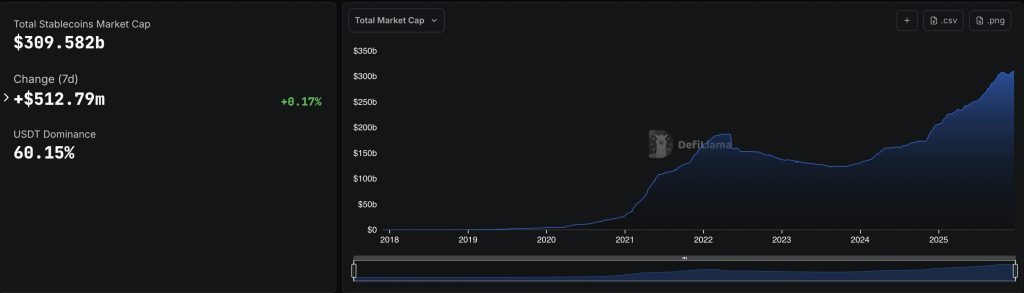
The launch comes as the stablecoin market continues to grow rapidly. Data from DefiLlama shows the total stablecoin market capitalization at roughly $309 billion, with Tether’s USDT accounting for more than $186 billion and Circle’s USDC close to $78 billion.

Source: DefiLlama

Analysts project that the global stablecoin market could exceed $3 trillion by 2030, driven by demand for faster settlement, lower-cost cross-border payments, and access to dollar liquidity outside the traditional banking system.

Stablecoins Step Into the Mainstream as U.S. Oversight Tightens

Regulatory momentum has accelerated alongside market growth. On December 16, the FDIC approved a proposed rule outlining how FDIC-supervised banks can apply to issue payment stablecoins under the GENIUS Act.

🇺🇸 U.S. banks are cleared to issue dollar-backed stablecoins under a federal framework as @FDICgov unveils draft rules under the GENIUS Act.#Stablecoins #FDIC #GENIUShttps://t.co/TelgvOhEAg

— Cryptonews.com (@cryptonews) December 17, 2025

The proposal establishes a formal application process and confirms that only approved entities, known as permitted payment stablecoin issuers, can issue such assets in the U.S.

✅ The OCC has conditionally approved five crypto firms, including @Circle and @Ripple, to launch national trust banks.#Ripple #Circlehttps://t.co/wCeTNrhOQZ

— Cryptonews.com (@cryptonews) December 13, 2025

Earlier this month, the OCC also conditionally approved several crypto firms, including Circle and Ripple, to pursue national trust bank charters, bringing more digital-asset companies under a single federal supervisory framework.

The post SoFi Makes History: First U.S. National Bank to Issue Stablecoin on Public Blockchain appeared first on Cryptonews.

Kaito Kickstarter Projects Suffer Massive Post-TGE Crash — Is the Alpha Gone?

Several projects that raised capital through Kaito’s community-driven launchpad are facing steep losses following their token generation events, reigniting questions about post-TGE performance, valuation discipline, and whether early “alpha” around the platform has faded.

According to data shared by market participants, a number of Kaito-backed projects have suffered heavy drawdowns after launch.

Several projects backed by Kaito Kickstarter saw significant post-TGE drawdowns. Play AI, launched at a $50m, now has an FDV of only $2.1m; Hana Network, launched at a $40m valuation, now has an FDV of $10.5m; Novastro, launched at a $50m valuation, now has an FDV of $1.05m; and…

— Wu Blockchain (@WuBlockchain) December 18, 2025

Play AI, which debuted at a fully diluted valuation of about $50 million, is now valued near $2.1 million.

Hana Network dropped from a $40 million launch valuation to roughly $10.5 million, while Novastro fell from $50 million to just over $1 million. Bitdealer declined from $35 million to approximately $2.8 million.

The pattern has reinforced concerns about how early-stage valuations on social-driven launchpads translate once tokens begin trading openly.

Kaito Launchpad Faces Questions as Multiple Tokens Sink After TGE

The weakness has not been limited to newly launched projects. Several tokens that previously ran campaigns within Kaito’s ecosystem have also seen prolonged declines.

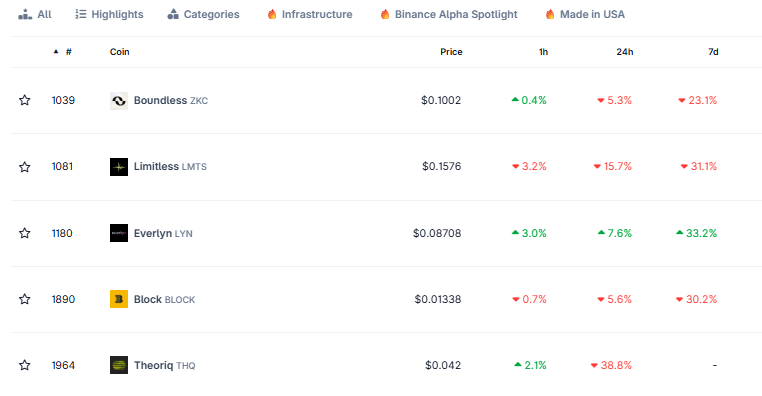
Boundless’ ZKC token is trading around $0.0995, down nearly 90% since its September launch.

Source: CoinGecko

Limitless’ LMTS has fallen more than 46% since October, Everlyn’s LYN is down over 71%, and Block’s BLOCK token has lost close to 70% from its launch levels.

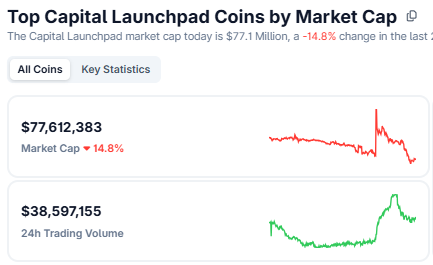
Notably, tokens launched under Kaito Capital Launchpad, which aggregates these offerings, currently have a combined market capitalization of about $77.1 million, down nearly 15% over the past 24 hours, with roughly $38.3 million in daily trading volume.

Source: CoinGecko

Kaito operates an AI-powered information platform focused on “InfoFi,” where user-generated content, engagement, and on-chain activity are turned into structured data.

Its launchpad, sometimes referred to as the Yapper or Capital Launchpad, allows Web3 projects to raise funds and attention before and after their TGEs.

Projects set their own terms, including valuations and vesting schedules, while the community helps surface campaigns through staking, voting, and accumulated reputation points earned by creating content.

As Campaigns Falter, Pressure Builds Across the Kaito Ecosystem

Allocations are typically assigned during a preferred phase before opening remaining slots on a first-come basis.

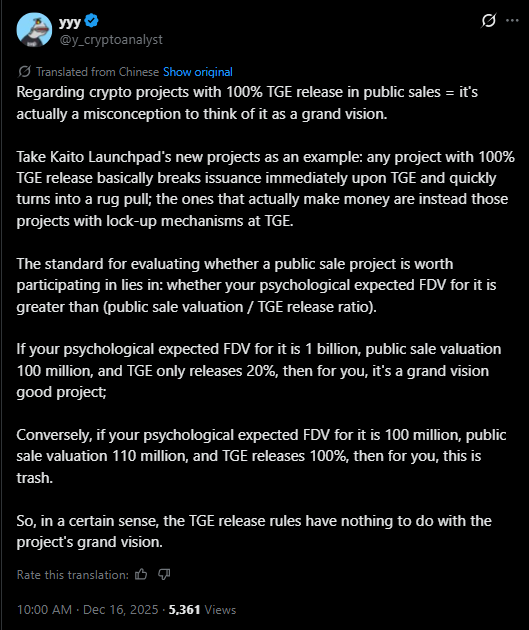
Criticism has grown around how some of those campaigns have played out. Analysts have pointed to full token unlocks at TGE as a key contributor to sharp sell-offs.

Source: YYY/X

One crypto analyst noted that projects releasing 100% of supply at launch effectively place all issuance into circulation at once, leaving little buffer against immediate selling pressure.

Others highlighted that public sale valuations often left little upside once tokens began trading.

Creator relations have also become a flashpoint.

Community members tracking campaign outcomes said dozens of projects either altered reward terms or delayed distributions after campaigns concluded, while others launched without clear timelines or structures.

Yu Hu being a typical KOL that screams “I told you so” after one successful call ignoring the 69 bad ones they called that went south.

Maybe i should lecture you a bit about your own platform if you don’t know.

Since Q1 kaito have listed over 100+ projects. Both Pre & Post TGE… https://t.co/p812l09NoN

— Ola Ξlixir (@thegreatola) December 17, 2025

Only a minority were cited as having delivered rewards as originally communicated. These disputes have added friction between creators and project teams that relied on Kaito’s engagement engine for visibility.

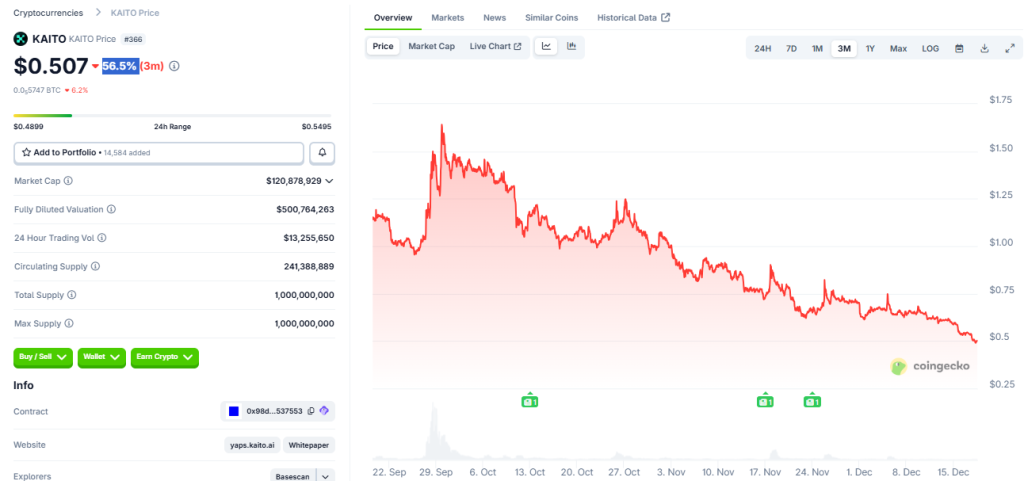
The broader sentiment shift has weighed on Kaito’s own token. KAITO is trading near $0.50, down more than 56% over the past three months.

Source: Coingecko

The token is now roughly 83% below its all-time high of $2.88, though it remains slightly above its historical low.

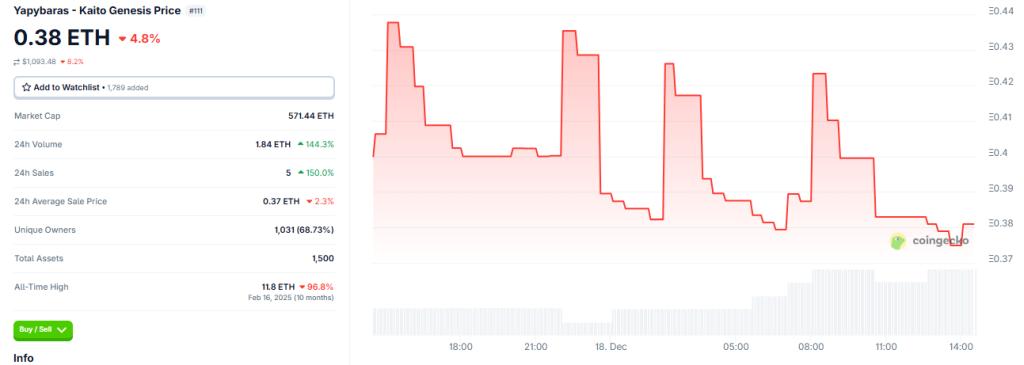
The downturn has been accompanied by visible strain inside the ecosystem. Yapybaras NFTs tied to the platform fell to around 0.38 ETH, and upcoming token unlocks scheduled for December 20 have added to near-term caution.

Source: CoinGecko

At the same time, some holders have pointed to recent platform updates aimed at tightening verification, reducing low-quality content, and increasing transparency around participation rules.

TLDR:

– AI makes the cost of content near-zero, as we're seeing across all major social media platforms – with bot-generated content a widespread issue outside of X too

– Movement away from KOL back-door deals, to a more inclusive model for wide-spread creators leads

– This… https://t.co/STM1F5z2LC

— Kaito AI 🌊 (@KaitoAI) December 15, 2025

Kaito recently outlined changes focused on on-chain identity checks, stricter reputation thresholds, and new verification methods designed to reduce manipulation and bot-driven engagement.

The company said its system is evolving in response to feedback, with further adjustments expected.

The post Kaito Kickstarter Projects Suffer Massive Post-TGE Crash — Is the Alpha Gone? appeared first on Cryptonews.

SEC Issues New Mandate: Broker-Dealers Must Control Crypto Private Keys or Face Consequences

The U.S. Securities and Exchange Commission has issued a new staff statement that sharply clarifies how broker-dealers must handle custody of crypto asset securities, marking a shift from years of regulatory ambiguity toward direct operational expectations.

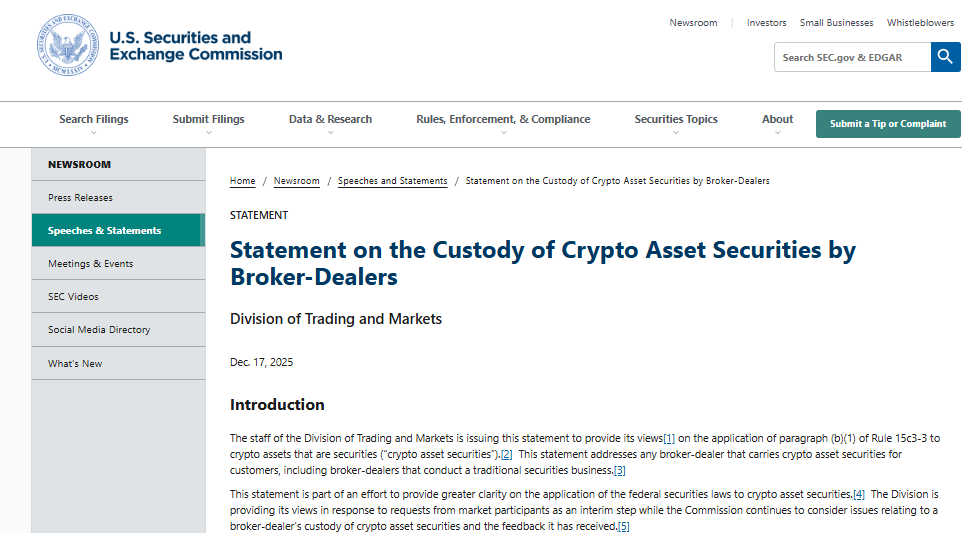
In a statement released on Dec. 17, 2025, the SEC’s Division of Trading and Markets said broker-dealers that carry crypto asset securities for customers must maintain exclusive possession of those assets by controlling the private keys used to access and transfer them.

Our Division of Trading and Markets issued a staff statement on the custody of crypto asset securities by broker-dealers. https://t.co/5u3mrAGmmu

— U.S. Securities and Exchange Commission (@SECGov) December 17, 2025

Firms that fail to meet this standard may not treat themselves as having custody under federal customer protection rules.

Holding Crypto Isn’t Enough—SEC Says Control Is What Counts

The statement focuses on paragraph (b)(1) of Rule 15c3-3, the long-standing customer protection rule that requires broker-dealers to maintain physical possession or control of fully paid and excess margin securities.

While the guidance does not introduce a new rule, it explains how the staff believes that requirement can be met when securities exist on a blockchain rather than in traditional form.

Under the SEC’s view, a broker-dealer can deem itself to have possession of a crypto asset security only if it has direct access to the asset on the relevant distributed ledger and the technical ability to transfer it.

Source: US SEC

That access must not be shared, as the staff emphasized that neither customers nor third parties, including affiliates, can hold private keys or otherwise move the asset without the broker-dealer’s authorization.

The guidance also requires broker-dealers to formally assess the blockchains and networks on which crypto asset securities operate before taking custody and to repeat those assessments at regular intervals.

Also, firms are expected to evaluate performance, security, governance, upgrade processes, and risks such as hard forks, 51% attacks, or protocol changes that could affect ownership records.

If a broker-dealer becomes aware of material security or operational weaknesses in a blockchain network, the staff said the firm should not treat itself as having possession of the asset.

The focus, according to the statement, is on risks tied directly to custody and transfer, rather than market or reputational concerns.

Crypto Custody Was Once Off-Limits; The SEC Now Says Otherwise

The statement arrives after several years in which broker-dealers argued that crypto custody was effectively impossible under SEC interpretations.

Between 2022 and 2024, the agency’s approach relied heavily on accounting and structural constraints that discouraged traditional firms from entering the space.

⚖ Firms under the SEC's jurisdiction will receive a notice first ahead of being hit with an enforcement action, Chair Paul Atkins says. #PaulAtkins #SECChairhttps://t.co/aWBXuDc2pW

— Cryptonews.com (@cryptonews) September 15, 2025

Staff Accounting Bulletin 121 required public companies holding customer crypto to record those assets as balance-sheet liabilities, making custody capital-intensive and, for many banks, commercially impractical.

At the same time, the SEC limited crypto custody largely to special-purpose broker-dealers that were barred from operating traditional securities businesses.

Large firms declined to pursue that model, citing operational complexity and regulatory uncertainty.

Industry lawyers often described the period as a regulatory dead zone in which compliance was required but rarely achievable.

The new statement attempts to resolve that standoff by tying compliance to concrete operational controls rather than abstract concerns about blockchain design.

The custody clarification follows another notable development at the SEC. On Dec. 13, the agency published a crypto wallet and custody investor bulletin outlining risks and best practices for self-custody and third-party custody.

The guide discussed rehypothecation, commingling of assets, and the trade-offs between hot and cold wallets, indicating a more educational posture toward crypto investors.

Together, the custody statement and investor guidance suggest a recalibration in how the SEC approaches crypto market infrastructure, with clearer expectations for firms and more explicit protections for customers.

The post SEC Issues New Mandate: Broker-Dealers Must Control Crypto Private Keys or Face Consequences appeared first on Cryptonews.

💾

Prediction Markets vs Meme Coins: Is This Where Crypto’s Next Alpha Lives?

Prediction markets are emerging as one of the fastest-growing corners of crypto just as meme coins retreat from their recent peak, setting up a broader debate across the industry about where speculative capital is heading in 2026.

The comparison gained momentum after Kalshi’s head of crypto, John Wang, described prediction markets as “the meme coins of 2023,” arguing that both capture attention during periods when traders are searching for asymmetric opportunities.

JUST IN: Head of crypto at Kalshi John Wang says “prediction markets are the memecoins of 2023.” pic.twitter.com/ZtGGHBSaht

— Whale Insider (@WhaleInsider) December 15, 2025

The remark landed as meme coin activity cooled sharply following a volatile run that defined much of the last two years.

Meme Coins Had Their Moment — Is This the Collapse Phase?

Meme coins surged in 2023, driven by new token launches and heavy social media exposure.

The sector’s total market capitalization reached nearly $22 billion by the end of that year, while trading activity expanded dramatically.

Source: Coinmarketcap

Data from the period shows average trading volume rising more than ninefold over the first eleven months.

Two intense rallies defined the year, particularly an April–May burst fueled by highly speculative launches.

That speculative energy carried into 2024, when meme coins climbed to an estimated peak market cap of around $150 billion in December, helped by Dogecoin, Shiba Inu, Pepe, and a wave of political-themed tokens.

The reversal was equally sharp. By late 2025, the sector’s total value had fallen below $42 billion, with daily volumes shrinking and individual tokens losing most of their prior gains.

Source: Coinmarketcap

Market data now shows memecoin trading volumes down roughly 85% from their highs, reflecting a broad pullback in risk appetite.

Are Traders Done With Meme Coins? Prediction Markets Are Quietly Taking Over

As meme coins faded, prediction markets moved in the opposite direction.

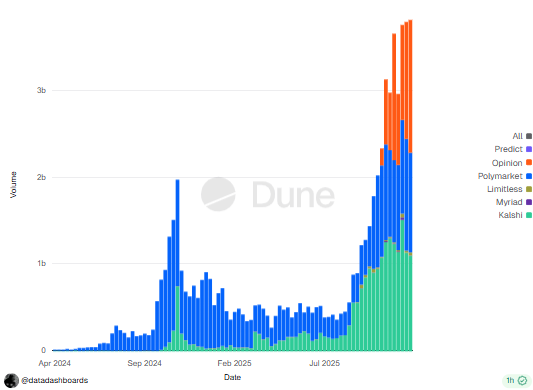
Platforms such as Kalshi, Polymarket, and Limitless recorded a combined $44 billion in trading volume this year, with Kalshi alone reaching $1 billion in weekly volume, driven largely by sports and political contracts.

Source: dune/datadashboards

On-chain prediction markets have expanded even faster. Monthly volume has jumped from under $100 million in early 2024 to more than $13 billion today, a 130-fold increase, according to joint research from Keyrock and Dune Analytics.

Non-sports markets, including economics, politics, and technology-related events, accounted for most of the growth in 2025.

The structure of prediction markets differs sharply from memecoins, a point repeatedly raised by industry participants.

Prediction Markets vs Memecoins

Watch in 2x speed

– "Memecoins will die like NFTs. Prediction markets will take over" (starts @ 0:16)

– Flaws in prediction markets (starts @ 2:25)

– Flaws in memecoins (starts @ 5:24)

– Prime @Pumpfun > prime @Polymarket (starts @ 5:59) https://t.co/ARppIQ8cTO pic.twitter.com/cesTAQNYEH

— shaams 🐂 (@shaams) December 16, 2025

Prediction contracts allow traders to buy “yes” or “no” shares tied to a specific outcome, with prices reflecting implied probabilities and settling through oracles once events conclude.

Supporters argue this creates clearer pricing and limits some of the manipulation risks that have plagued low-liquidity token markets.

Honestly makes sense why people are just moving over to Polymarket and all these other prediction market platforms. You don’t have to worry about 12 year olds bundling coins, you don’t have worry about your “favorite” kol shilling a coin then full clipping soon after, you don’t…

— GH0STEE (@gh0stee) December 15, 2025

Critics counter that returns are capped by design, making it harder for smaller traders to achieve outsized gains compared with early-stage memecoin trades.

Can Prediction Markets Kill Meme Coins?

Framing the trend as “prediction markets killing memecoins” misses the point.

Memecoins are not dead. Liquidity has simply receded, and that contraction is affecting many other crypto sectors as well.

History shows that meme-driven markets tend to hibernate, not disappear. When volatility returns and risk appetite expands, memecoins can resurface quickly.

At the same time, prediction markets are clearly earning a durable user base. Their growth isn’t purely cyclical hype; it’s being driven by real-world events, regulatory clarity in some jurisdictions, and demand for structured speculation. That gives them a resilience memecoins often lack during downturns.

The more likely outcome is coexistence, not replacement.

Memecoins will continue to dominate during speculative surges and attention-driven cycles. Prediction markets will attract traders seeking clarity, probability-based pricing, and event-driven exposure. They serve different psychological and financial needs.

If anything, the current shift shows a maturing crypto market, one where capital rotates rather than evaporates and where speculation takes multiple forms instead of clustering around a single narrative.

The post Prediction Markets vs Meme Coins: Is This Where Crypto’s Next Alpha Lives? appeared first on Cryptonews.

💾

India Pushes Tokenization Bill to Open Billion-Dollar Real Estate to Middle Class — Will It Pass?

India’s Parliament this week argued about bringing asset tokenization into the country’s formal legal framework, as lawmakers debated whether digital fractional ownership could widen access to wealth while keeping capital anchored at home.

Speaking in the Rajya Sabha on Tuesday, Member of Parliament Raghav Chadha urged the government to introduce a dedicated Tokenization Bill that would allow assets such as real estate, infrastructure projects, and intellectual property to be divided into digital units and purchased in small portions.

Why does India need a 𝗧𝗼𝗸𝗲𝗻𝗶𝘀𝗮𝘁𝗶𝗼𝗻 𝗕𝗶𝗹𝗹?
I explained in Parliament today. pic.twitter.com/Ucw395cWpg

— Raghav Chadha (@raghav_chadha) December 16, 2025

Chadha framed the proposal as a financial inclusion measure, drawing a parallel with India’s Unified Payments Interface, which transformed everyday payments by lowering entry barriers for millions of users.

Can Tokenization Unlock Wealth for India’s Middle Class, or Is Regulation Holding It Back?

Chadha told lawmakers that India’s middle class remains largely limited to savings accounts, fixed deposits, and mutual funds, with little exposure to assets that typically generate higher long-term returns.

He argued that tokenization could allow ordinary investors to buy small stakes in office buildings, highways, and other capital-intensive projects, while also providing faster liquidity without relying on brokers or complex paperwork.

He called for bespoke legislation and a regulatory sandbox that would allow new models to be tested under supervision, rather than being forced into existing and often ill-fitting rules.

With a population estimated at about 1.46 billion people and a median age under 30, the country has seen sharp reductions in extreme poverty, which is now estimated at around 1% using the $2.15-per-day benchmark.

Source: World Bank Group

Broader poverty measures still show large gaps, however, with more than a quarter of the population falling under the lower-middle-income poverty line.

Only a smaller portion of household wealth is actively deployed in financial markets, leaving limited room for diversification into assets such as carbon credits, infrastructure, or commercial property.

Early Tokenization Efforts Emerge as Regulators Urge Caution

Supporters of tokenization say fractional ownership could lower minimum investment thresholds and draw parts of this idle capital into more productive use.

Critics note that the pool of people able to participate meaningfully remains constrained by income levels and uneven financial literacy.

India already has early experiments in this space. In GIFT City, platforms such as Tokeny and Terazo have worked on regulated tokenized real estate structures, typically using special purpose vehicles and public blockchains like Polygon.

These efforts operate under existing securities and virtual digital asset rules, rather than a unified tokenization law.

The Reserve Bank of India and the Securities and Exchange Board of India have both allowed limited pilots but have stressed caution, especially around investor protection and settlement risk.

State-Level Momentum Grows, Yet India Falls Behind on Asset Tokenization

Momentum has also come from state governments. In November, Maharashtra Chief Minister Devendra Fadnavis said the state was working toward a framework that could unlock an estimated ₹50 trillion in idle capital by digitizing asset transfers, particularly in Mumbai’s real estate market.

The announcement followed RBI disclosures that its wholesale central bank digital currency pilots for financial instruments had improved settlement efficiency, reinforcing interest in blockchain-based infrastructure.

Despite this activity, India still trails countries that have moved faster on asset tokenization.

Jurisdictions such as the UAE, Singapore, Germany, Hong Kong, and the United States have adopted clearer legal standards allowing regulated platforms to offer fractional ownership to retail investors.

👨🏻‍⚖️ The SEC has given a key green light to the Depository Trust and Clearing Corporation’s (DTCC) push into blockchain-based markets. #SEC #Cryptohttps://t.co/LOvN1BzjZ1

— Cryptonews.com (@cryptonews) December 12, 2025

In Dubai, for example, property tokenization pilots have reduced entry points from millions of dirhams to a few thousand, while Singapore’s Project Guardian has focused on institutional-grade frameworks that can later scale to the public.

🌱 Dubai’s real estate market is witnessing a surge in new investors thanks to its new tokenization initiative.#Dubai #Tokenizationhttps://t.co/HwG1ztgavq
— Cryptonews.com (@cryptonews) July 17, 2025

Indian policymakers have been wary of moving too quickly, citing complex land titles, fragmented state laws, and data privacy concerns.

The result is that tokenization remains narrow in scope, even as crypto adoption at the grassroots level is high.

The post India Pushes Tokenization Bill to Open Billion-Dollar Real Estate to Middle Class — Will It Pass? appeared first on Cryptonews.

💾

California Governor Targets Trump’s Crypto Pardons: CZ, Ulbricht Branded ‘Criminal Cronies’

California Governor Gavin Newsom has intensified his criticism of President Donald Trump’s use of presidential pardons, spotlighting crypto-related clemency decisions as part of a wider political argument over public safety, corruption, and the expanding role of digital assets in U.S. politics.

Newsom this week unveiled a new state-backed website that tracks what his office describes as Trump’s “top criminal cronies,” alongside newly released crime data showing continued declines across California’s major cities.

As Violent Crime Drops Across California, Newsom Highlights Trump-Era Pardons

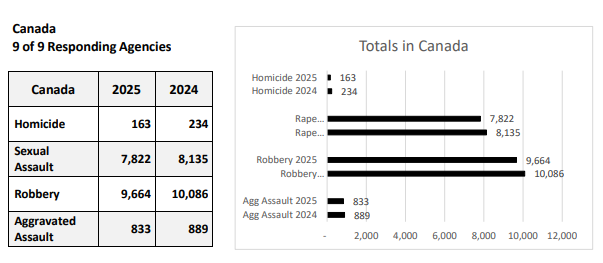
According to figures from the Major Cities Chiefs Association, homicides fell 18% year over year, robberies dropped 18%, aggravated assaults declined 9%, and violent crime was down in every major California city reporting data, with the sharpest decreases recorded in Oakland and San Francisco.

Source: MCCA

Against that backdrop, Newsom framed the website as a contrast between state-level crime reduction efforts and Trump’s record of pardons.

The page catalogs individuals who received clemency or protection from Trump, including figures from politics, organized crime, and the cryptocurrency sector.

The governor said the goal was to place public information in one location so voters could assess who is being elevated or shielded through presidential authority.

Crypto-related pardons feature prominently. The site lists Binance founder Changpeng “CZ” Zhao, who pleaded guilty in 2023 to violating the Bank Secrecy Act by failing to implement an adequate anti-money laundering program at the exchange.

Zhao was sentenced to four months in prison in April 2024 and released later that year. In October, Trump signed a full pardon, a move later confirmed by Binance.

The White House said the decision followed a standard review by the Department of Justice and White House Counsel’s Office, with Trump stating publicly that he did not know Zhao personally.

🚨 The @WhiteHouse has defended Trump's @cz_binance pardon, calling it a correction for an "over-prosecution," and the decision followed a "thorough review" process. #Trump #Binance #CZhttps://t.co/3voAxijutA

— Cryptonews.com (@cryptonews) November 5, 2025

The pardon triggered political backlash, with Democratic senators, including Elizabeth Warren and Bernie Sanders, accusing Trump of signaling leniency toward white-collar and crypto-related crimes.

Newsom’s website also references Ross Ulbricht, the founder of the Silk Road marketplace, who was sentenced to life in prison for narcotics and money-laundering conspiracy charges linked to more than $214 million in illegal drug sales facilitated through Bitcoin.

👮 @RealRossU, pardoned founder of the Silk Road marketplace, is publicly advocating for clemency for @rogerkver, known as "Bitcoin Jesus."#RogerVer #Bitcoinhttps://t.co/nFhN9IIBdn

— Cryptonews.com (@cryptonews) February 21, 2025

Trump pardoned Ulbricht for his 2015 conviction. In addition, the site highlights the March pardons of BitMEX co-founders Arthur Hayes, Benjamin Delo, Gregory Dwyer, and Samuel Reed, all of whom had pleaded guilty to Bank Secrecy Act violations.

Trump Says He Will Review Samourai Wallet Case, Rekindling Crypto Pardon Scrutiny

The debate intensified further this week after Trump said he was open to reviewing the case of Keonne Rodriguez, the CEO of privacy-focused Bitcoin wallet Samourai.

Rodriguez was sentenced last month to five years in federal prison after pleading guilty to money laundering charges tied to a Bitcoin mixing service that prosecutors said processed $237 million in illicit funds.

👨🏻‍⚖️ US prosecutors are pushing for the maximum five-year prison sentence for the founders of @SamouraiWallet.#Crypto #Samouraihttps://t.co/N487Ab9t1c

— Cryptonews.com (@cryptonews) November 4, 2025

Beyond crypto, Newsom’s website lists a range of other high-profile pardons, including former Illinois Governor Rod Blagojevich, former Honduran President Juan Orlando Hernández, and former congressman George Santos.

It also references Trump’s decision to grant clemency to roughly 1,500 individuals charged or convicted in connection with the January 6 Capitol attack.

The governor’s office paired the website launch with a defense of California’s public safety spending, noting $1.7 billion invested since 2019 in crime prevention, law enforcement hiring, and organized retail theft operations.

Officials said the state’s approach contrasts with federal cuts to public safety and anti-trafficking programs under the Trump administration.

In response to Trump’s pardons, Representative Ro Khanna of California has proposed legislation that would bar elected officials from owning or launching cryptocurrencies, arguing that pardons tied to digital asset figures raised conflict-of-interest concerns.

The bill would require divestment or blind trusts for lawmakers holding crypto assets.

The post California Governor Targets Trump’s Crypto Pardons: CZ, Ulbricht Branded ‘Criminal Cronies’ appeared first on Cryptonews.

💾

SAFE Crypto Act Targets Crypto Scams After $9.3B Losses — New Federal Task Force Looms

Two U.S. senators have introduced new bipartisan legislation aimed at tightening the government’s response to cryptocurrency-related fraud.

The bill follows a sharp rise in reported losses linked to investment scams that reference digital assets.

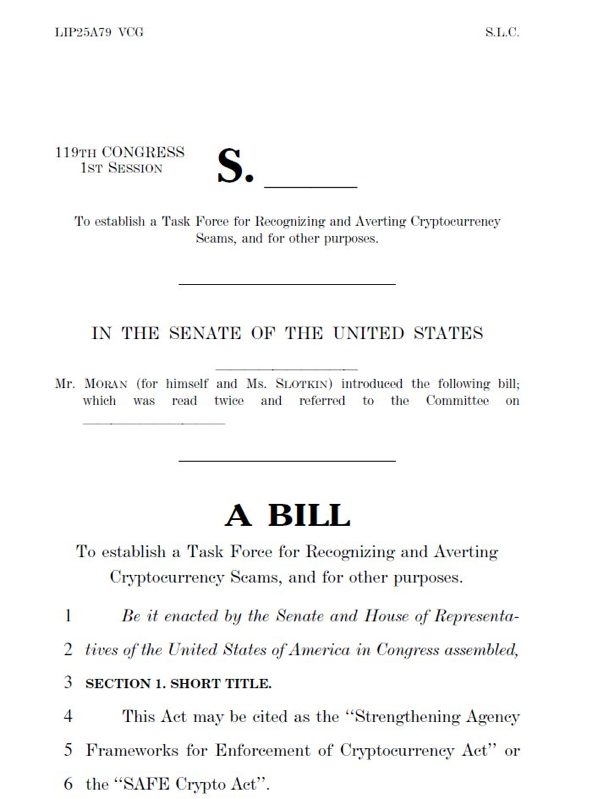
The proposal, known as the Strengthening Agency Frameworks for Enforcement of Cryptocurrency Act, or the SAFE Crypto Act, was introduced by Senator Elissa Slotkin, a Democrat from Michigan, and Senator Jerry Moran, a Republican from Kansas.

Source: congress

The bill seeks to create a federal task force focused on identifying, tracking, and preventing crypto-related scams while improving coordination between government agencies, law enforcement, and private-sector experts.

Crypto Scams Cost Americans $9.3B in 2024, Hitting Older Investors Hardest

The legislation comes as crypto-related scams continue to hit more Americans, with older investors particularly at risk.

The Federal Bureau of Investigation reports that U.S. residents lost around $9.3 billion to crypto investment schemes in 2024. That’s up 66% from the year before.

👾 The FBI recorded $9.3 billion losses spread across various crypto-related investment scams, extortion, ATM and kiosks, among others, in 2024.#FBI #CryptoFraud #CryptoScamhttps://t.co/1Eb8KStAHk
— Cryptonews.com (@cryptonews) April 24, 2025

The FBI said many of these scams don’t rely on hacking crypto networks. Instead, they use tricks like social engineering, pretending to be someone else, and slowly gaining trust over time to get people to hand over their money.

U.S. Lawmakers Seek Cross-Agency Task Force to Tackle Crypto Scams

Under the SAFE Crypto Act, the Treasury Secretary would be required to establish a task force for recognizing and averting cryptocurrency scams within 180 days of the bill becoming law.

The Task Force would bring together top officials from the Treasury, the Department of Justice, the Financial Crimes Enforcement Network, the Secret Service, and other federal agencies. State and local law enforcement would also get a seat at the table.

The bill also calls for participation from digital asset service providers, stablecoin issuers, custodians, blockchain intelligence firms, consumer protection organizations, and victims’ advocacy groups.

The task force would be charged with examining trends across a wide range of crypto-related fraud, including Ponzi schemes, rug pulls, fraudulent token offerings, money laundering operations, and so-called financial grooming scams.

SAFE Crypto Act Builds on Washington’s Push to Protect Seniors From Crypto Scams

Senator Elissa Slotkin, who supports the bill, says crypto scams are getting trickier as the technology catches on, and local police just don’t have the right tools to keep up.

The legislation also emphasizes real-time collaboration between the public and private sectors to help trace and stop the flow of funds linked to scams.

It requires authorized stablecoin issuers to have the technical ability to freeze, seize, burn, or reissue digital assets tied to illegal activity, all in accordance with due process and existing laws.

The proposed task force would be mandated to meet at least three times in its first year and produce a public report for key congressional committees within that period.

Following the initial report, it would provide annual updates, and the task force would automatically disband three years after its first submission.

The SAFE Crypto Act is just one piece of a bigger push in Washington to crack down on investment scams, especially the ones that go after seniors and other people who are often targeted.

Before this, lawmakers floated the National Senior Investor Initiative Act of 2023. That bill would set up a special task force at the SEC focused on protecting older investors.

Then there’s the Fraud Prevention and Recovery Act from 2024, which tries to give the government more power to go after all kinds of fraud.

On top of that, the SEC put together a cross-border task force at the end of 2025 to deal with international securities scams hitting Americans. Clearly, people are getting more worried about fraud rings that stretch across countries.

The post SAFE Crypto Act Targets Crypto Scams After $9.3B Losses — New Federal Task Force Looms appeared first on Cryptonews.

💾

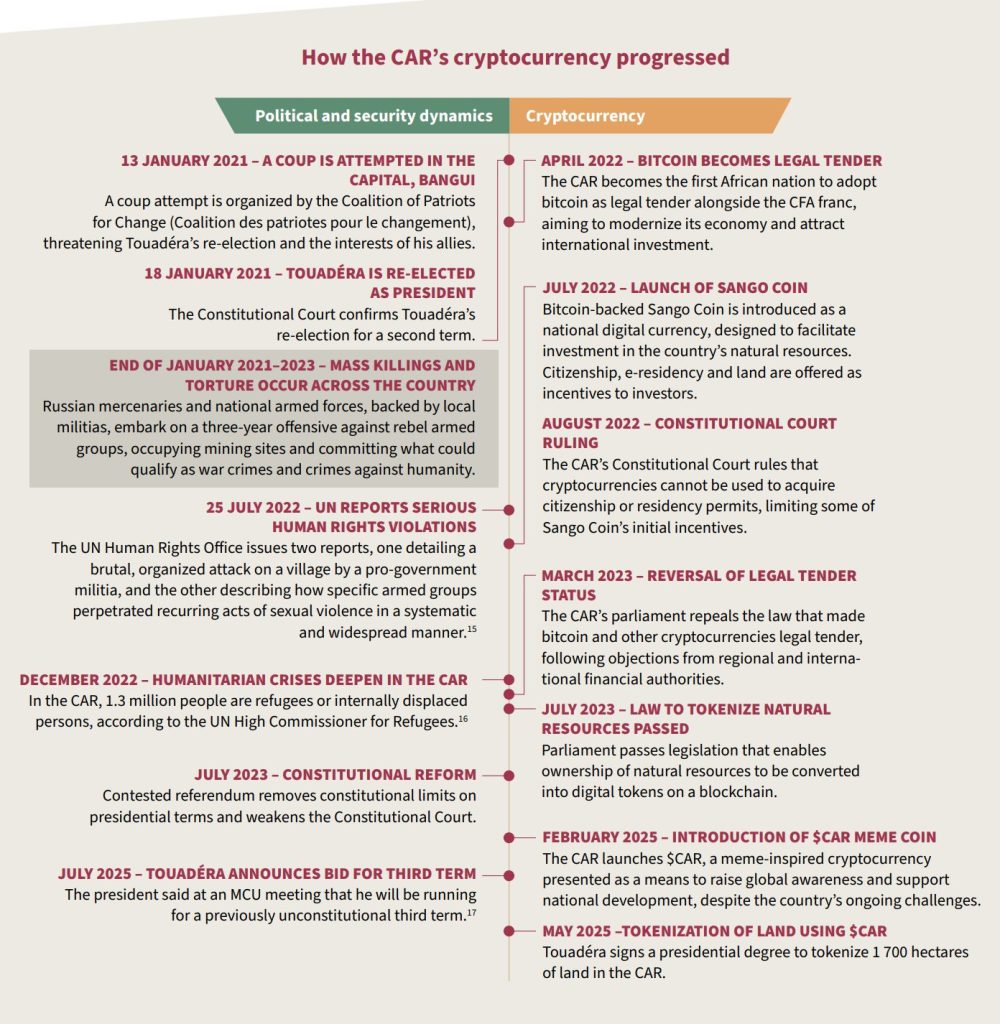
CAR’s Crypto Push Hands Power to Elites, Foreign Criminal Networks, Report Warns

The Central African Republic’s ambitious embrace of cryptocurrency has deepened elite control over financial resources and exposed the country to potential exploitation by foreign criminal networks, according to a recent report by the Global Initiative Against Transnational Organized Crime.

The report, titled “Behind the blockchain: Cryptocurrency and criminal capture in the Central African Republic,” paints a stark picture of how the country’s crypto ventures, from adopting Bitcoin to launching Sango Coin and the CAR meme token, have unfolded in a fragile state marked by limited electricity, low internet penetration, and weak regulatory oversight.

Report Says CAR’s Crypto Projects Excluded Most Citizens

The report noted that the government framed these initiatives as tools for economic growth, modernization, and national development.

In practice, however, meaningful participation by the majority of citizens has been largely impossible.

Limited access to digital infrastructure and the country’s ongoing insecurity have effectively excluded most of the population from engaging with these crypto projects.

The report traces the rollout of these initiatives alongside broader political trends, including the consolidation of executive power and the increasing influence of foreign actors.

Critics have argued that the CAR’s crypto projects primarily serve elite interests, offering investment opportunities in mining, forestry, and tokenized land largely inaccessible to ordinary citizens.

Sango Coin, launched in mid-2022, promised infrastructure projects such as a “Crypto City” and offered foreign investors access to land and e-residency.

Despite heavy promotion, only a small fraction of the tokens were sold, and many promised outcomes remain unrealized.

The subsequent $CAR meme coin, introduced in early 2025, experienced extreme volatility, technical irregularities, and opaque governance, raising further concerns about market manipulation and speculative practices.

Source: The GI-TOC

The GI-TOC report highlights the role of shadow networks, foreign private actors, and individuals with histories of fraud in promoting the CAR’s crypto agenda.

President Touadéra has been described as surrounded by crypto enthusiasts, pro-Russian businesspeople, and controversial figures, including Nicolae Bogdan Buzaianu, linked to alleged illegal timber trafficking, and Émile Parfait Simb, associated with multiple fraud convictions.

The report concludes that these initiatives appear designed to enrich a narrow circle of insiders while opening new channels for foreign influence and transnational organized crime at the expense of the wider population.

Weak Oversight and Poor Infrastructure Hamper CAR’s Crypto Ambitions

The CAR’s crypto ventures have also faced significant domestic and regional challenges.

Bitcoin’s adoption as legal tender was widely criticized by international financial institutions, regional regulators, and the country’s own Constitutional Court.

In March 2023, after regional groups pushed for change, the CAR parliament scrapped Bitcoin’s legal tender status and adjusted its rules to match the Central African Economic and Monetary Community standards.

The report shows the concentration of power within the Sango ecosystem. The way things are set up mostly benefits public officials and a small circle of insiders, raising concerns about transparency and accountability.

Additionally, the tokenization of natural resources and land carries substantial risks of misappropriation and rent-seeking, especially in a context of weak oversight and ongoing insecurity.

Efforts to mitigate the risks of elite capture and criminal exploitation have been limited. The CAR has begun to work with regional regulators to align cryptocurrency rules with broader monetary frameworks.

However, infrastructure deficits, extreme poverty, and ongoing political instability continue to constrain citizen participation and oversight.

Observers warn that without stronger regulation, public education, and international cooperation, the country’s crypto ventures may remain tools that concentrate wealth and influence among elites while exposing the nation to criminal and financial vulnerabilities.

The post CAR’s Crypto Push Hands Power to Elites, Foreign Criminal Networks, Report Warns appeared first on Cryptonews.

💾

Binance Cleans House: New Listing Criteria Expose Blacklisted “Deal Brokers”

Binance has unveiled a major overhaul of its token listing process, aiming to improve transparency, tighten control, and eliminate fraudulent intermediaries that have plagued the exchange’s listing ecosystem.

The world’s largest cryptocurrency exchange announced third-party “deal brokers” are strictly prohibited from facilitating listings.

Binance has released an announcement outlining its listing process and framework, covering the Alpha, futures, and spot markets. Binance emphasizes that projects must submit listing applications directly through official channels, and third-party intermediaries are strictly…

— Wu Blockchain (@WuBlockchain) December 17, 2025

The company also released a blacklist of individuals and firms alleged to have misrepresented themselves, including BitABC, Central Research, May/Dannie, Andrew Lee, Suki Yang, Fiona Lee, and Kenny Z, signaling that legal action will be pursued against those engaging in such activity.

New Listing Standards Aim to Boost Visibility and Quality on Binance

According to Binance, the new listing criteria cover the Alpha, futures, and spot markets and are designed to create a more structured and transparent framework for projects seeking exposure on the platform.

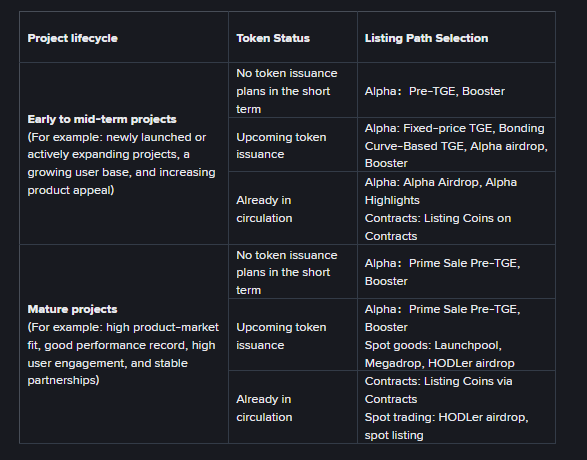
Binance’s Alpha platform targets early-stage tokens, providing distribution opportunities through Pre-TGE, Prime Sale, TGE community events, airdrops, and Booster programs, helping projects gain momentum before full market launches.

Source: Binance

Binance’s contract platform allows users to access derivatives to hedge positions, establish long or short trades, or manage liquidity, while the spot platform remains the largest venue for direct trading and long-term holding of high-quality crypto assets.

The exchange also provides mechanisms like Launchpool, Megadrop, and HODLer airdrops to increase visibility for new projects, particularly those that have demonstrated progress, strong teams, and active communities.

Binance currently records $11.13 billion in 24-hour trading volume, reflecting a 28.2% decline over the same period. The exchange supports 441 listed coins across 1,638 trading pairs.

Binance Overhauls Listing Process After Criticism of Speculative Tokens

The new standards address several challenges Binance has faced over the past two years.

The exchange had previously announced token listings only hours before trading commenced, a practice that often caused price spikes on decentralized exchanges followed by rapid sell-offs on Binance itself, creating volatility that hurt late entrants.

Binance also confronted criticism for listing speculative or low-quality projects that failed to deliver long-term value, contributing to market losses and investor distrust.

Additionally, third-party intermediaries claiming to guarantee listings had become a major source of scams, misleading project teams and creating confusion around the legitimate application process.

These changes follow longstanding concerns expressed by Binance founder Changpeng Zhao, who in February 2025 described the listing process as flawed.

⛓️‍💥 CZ criticized Binance’s listing process, calling it a “bit broken.”#ChangpengZhao #Binance #TSTMemecoinhttps://t.co/y3o2rT6RPJ

— Cryptonews.com (@cryptonews) February 10, 2025

Zhao noted that the short interval between listing announcements and actual trading created opportunities for rapid price manipulation and undermined confidence in the process.

Binance has since moved to introduce more structured due diligence, community co-governance voting for listing and delisting tokens, and a monitoring zone for projects that fail to meet ongoing reporting or activity requirements.

Community members can vote on whether projects should remain listed, adding a layer of public oversight.

Crypto Founders Raise Concerns About Binance’s Listing Requirements

The overhaul also comes amid high-profile controversies surrounding listing practices.

In October, CJ Hetherington, founder of the prediction market startup Limitless, claimed that Binance demanded 8% of his project’s token supply plus $2 million in additional payments to secure a listing and alleged that the exchange engaged in token “dumping” post-listing.

❌ CZ doesn't deserve a presidential pardon — and anger from Binance users following last week's crash proves it#ChangpengZhao #Opinionhttps://t.co/T0mbuyxHnA
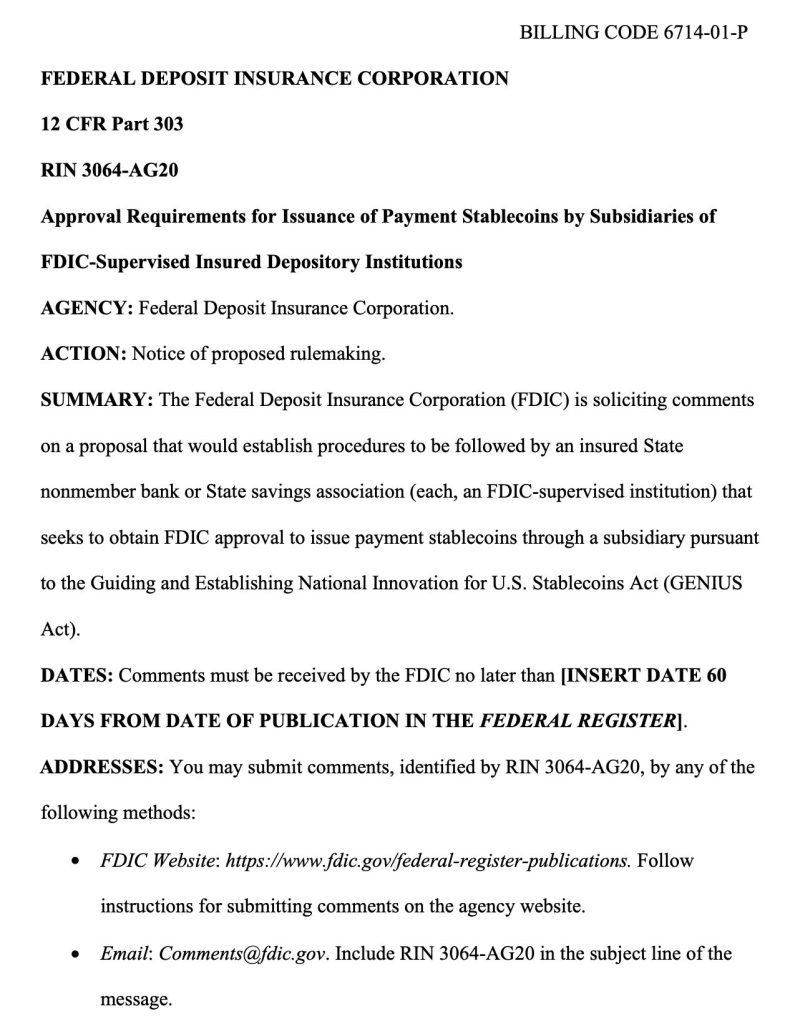
— Cryptonews.com (@cryptonews) October 15, 2025

Binance initially responded with threats of legal action, labeling Hetherington’s posts “false and defamatory,” though the company later acknowledged some of the details regarding token allocations.

Binance maintains that it does not profit directly from listing fees, asserting that allocated tokens are used for marketing, airdrops, and other initiatives that benefit users, rather than the exchange itself.

Despite the controversies, many crypto founders still view a Binance listing as highly desirable, given the exposure and liquidity the platform provides, though some have criticized the process as “predatory” or overly complex.

The post Binance Cleans House: New Listing Criteria Expose Blacklisted “Deal Brokers” appeared first on Cryptonews.

💾

U.S. Banks Cleared to Issue Stablecoins as FDIC Moves to Implement GENIUS Act

U.S. banks are moving closer to issuing dollar-backed stablecoins after the Federal Deposit Insurance Corporation (FDIC) approved a proposed rule that sets out how FDIC-supervised institutions can apply to do so under the GENIUS Act, a stablecoin law signed earlier this year.

The proposal marks the FDIC’s first concrete step toward implementing the legislation and shows a broader shift in how U.S. regulators are bringing digital payment instruments into the traditional banking system.

The FDIC’s Stablecoin Blueprint: Who Gets In, Who Stays Out

Source: FDIC

The proposed rule, approved unanimously by the FDIC board on Tuesday, would create a formal application process allowing certain state-chartered banks to issue payment stablecoins through separately capitalized subsidiaries.

The framework applies to state nonmember banks and state savings associations supervised by the FDIC.

These banks would not be permitted to issue stablecoins directly on their balance sheets but could do so through a subsidiary that receives prior approval from the agency.

Under the GENIUS Act, only approved entities known as Permitted Payment Stablecoin Issuers are allowed to issue payment stablecoins in the United States.

A payment stablecoin is defined as a digital asset intended for payments or settlement that maintains a stable value, typically backed one-to-one by cash or highly liquid assets such as U.S. Treasury securities.

The law explicitly states that these stablecoins are not deposits, legal tender, or securities.

Here is the FDIC’s Blueprint for Bank-Issued Tokens

The FDIC’s proposal lays out a detailed application process. Banks would be required to submit written requests explaining the structure of the subsidiary, the design of the stablecoin, and how it would maintain price stability.

Applicants must disclose reserve composition, liquidity arrangements, capital levels, governance structures, redemption policies, and reliance on third-party service providers.

The agency also requires information on ownership, management, and control, and bars approval if key personnel have histories of serious financial crimes.

Reserve requirements form a central pillar of the proposal. Stablecoins issued by approved subsidiaries must be fully backed on a one-to-one basis, with clear policies governing reserve management and asset segregation.

Subsidiaries would also need to explain how users can redeem stablecoins for dollars in a timely and transparent manner, including fee disclosures and advance notice of any changes.

To reinforce oversight, each issuer must retain an independent public accounting firm to verify reserve balances through monthly attestations.

What Happens If Regulators Don’t Act? FDIC’s Stablecoin Timer Explained

The timeline outlined in the rule sharply limits regulatory delay.

The FDIC has 30 days to determine whether an application is substantially complete and 120 days to approve or deny it. If the agency fails to act within that period, the application would be deemed approved by operation of law.

Denials must be justified on safety and soundness grounds, and applicants would have access to a dedicated appeals and hearing process.

Notably, the proposal also includes a temporary safe harbor that allows early applicants to request limited waivers of certain GENIUS Act requirements for up to 12 months.

The FDIC will accept public comments on the proposal for 60 days after it is published in the Federal Register.

The move comes amid a broader recalibration of U.S. crypto and digital-asset policy.

Last week, the Office of the Comptroller of the Currency confirmed that national banks may engage in riskless principal crypto transactions, allowing them to intermediate client trades without holding inventory.

🇺🇸 OCC authorizes US banks to facilitate client crypto trades through riskless principal transactions, removing structural barriers to digital asset services.#OCC #USbanks #Cryptohttps://t.co/e2BCyJG9hc

— Cryptonews.com (@cryptonews) December 10, 2025

Also, the Treasury Department has also begun implementing its responsibilities under the GENIUS Act, including oversight of non-bank stablecoin issuers.

The post U.S. Banks Cleared to Issue Stablecoins as FDIC Moves to Implement GENIUS Act appeared first on Cryptonews.

SEC Drops 4-Year Aave Investigation Following ‘Significant’ Defense Battle: Report

The U.S. Securities and Exchange Commission has formally concluded its multi-year investigation into the Aave Protocol without recommending any enforcement action.

The action ends nearly four years of regulatory uncertainty surrounding one of decentralized finance’s most widely used lending platforms.

Aave founder and chief executive Stani Kulechov disclosed the outcome in a public post on August 12.

After four years, we are finally ready to share that the SEC has concluded its investigation into the Aave Protocol.

This process demanded significant effort and resources from our team, and from me personally as the founder, to protect Aave, its ecosystem, and DeFi more… pic.twitter.com/aZeLrZz5ZQ

— Stani.eth (@StaniKulechov) December 16, 2025

Aave Survived the SEC’s DeFi Crackdown — Here’s What Happened Behind the Scenes

The probe into Aave began around late 2021 or early 2022, during a period of heightened regulatory scrutiny of decentralized finance platforms.

At the time, the SEC was expanding its enforcement focus beyond centralized exchanges to include protocols offering lending, borrowing, and liquidity services without traditional intermediaries.

While the SEC did not publicly outline the scope of its concerns, industry observers have long assumed that the inquiry centered on whether the AAVE token or aspects of the protocol’s operations fell under U.S. securities laws and whether any registration obligations applied.

Throughout the investigation, Aave cooperated with regulators, engaging with SEC staff over several years.

In June 2025, Aave representatives met with members of the SEC’s Crypto Task Force to discuss regulatory approaches, though the agency has not indicated whether those discussions were connected to the closure decision.

Kulechov said the process required significant effort and resources from both the company and him personally, describing the investigation as a prolonged period of regulatory pressure not only for Aave but for decentralized finance more broadly.

As is typical in cases that end without enforcement, the SEC did not publish findings or allegations tied to the probe.

The letter stated that, as of that date, staff did not intend to recommend an enforcement action to the Commission in connection with the investigation identified internally as “HO-14386.”

The notice followed standard SEC practice and included a disclaimer that the decision should not be interpreted as an exoneration and does not prevent the agency from reopening the matter in the future.

The SEC has consistently maintained flexibility to act quickly when investor protection concerns arise, avoiding rigid procedural rules that could delay enforcement.

Notably, earlier today, the Aave (AAVE) token reached a high of $194 before dipping to a low of $184. The token has since stabilized at $187.67, marking a 2.4% gain over the past 24 hours.

Source: CoinGecko

For Aave users, it means the protocol can continue operating without the immediate risk of U.S. enforcement action tied to the long-running SEC investigation.

It also reduces regulatory uncertainty around Aave’s core products, offering users more confidence that the platform will remain accessible and stable in the near term.

Is the SEC Done Fighting Crypto? Major Cases Close Without Charges

Aave’s case is the latest in a growing list of high-profile crypto investigations closed without charges in 2025.

In December, Ondo Finance disclosed that the SEC had ended its own multi-year probe into the firm’s tokenized real-world asset products and its ONDO token.

🚨 @SECGov has dropped its two‑year investigation into @OndoFinance with no charges filed. Could this mark the turning point for tokenized securities in the U.S.?

#SEC #OndoFinancehttps://t.co/k039KEBaWE

— Cryptonews.com (@cryptonews) December 8, 2025

The broader enforcement landscape has shifted notably since early 2025, as the SEC has dropped or dismissed cases and investigations involving Coinbase, Kraken, Robinhood, OpenSea, Uniswap Labs, Consensys, Crypto.com, and several other firms.

Many of those actions were withdrawn with prejudice, preventing the agency from bringing the same claims again.

The change followed a leadership transition at the SEC and a stated move away from regulation through litigation toward developing clearer policy guidance.

A review published by The New York Times earlier today found that the SEC initiated no new crypto-related federal court cases.

📉 The @SECGov has sharply scaled back its enforcement actions against the cryptocurrency industry since @realDonaldTrump returned to office.#SEC #Trumphttps://t.co/NCTPm62pCR

— Cryptonews.com (@cryptonews) December 16, 2025

Of the crypto cases inherited from prior administrations, the agency pulled back from more than half, either dismissing them, staying proceedings, or conceding key issues.

The post SEC Drops 4-Year Aave Investigation Following ‘Significant’ Defense Battle: Report appeared first on Cryptonews.

UK Crypto Ownership Plunges to 8% — But High-Value Portfolios Are Soaring

Crypto ownership in the UK dropped noticeably in 2025, even as the investors who stayed in the market continued to build larger holdings, according to new figures from the Financial Conduct Authority (FCA).

The data from FCA’s Cryptoassets Consumer Research 2025 report shows that 8% of UK adults currently own some form of cryptocurrency. That is down from 12% a year earlier, marking the first clear decline in participation since crypto use surged during the pandemic.

Source: FCA

While fewer people now hold digital assets, ownership has not fallen back to early levels. In 2021, just 4% of adults reported owning crypto, meaning today’s figure is still roughly double what it was four years ago.

The figures point to a market that is becoming smaller but more concentrated. Rather than attracting new entrants, crypto ownership appears to be shifting toward existing users who are committing more capital and holding their assets for longer periods.

Crypto Ownership in the UK Still Dominated by 18–34 Age Group

The profile of crypto holders has remained broadly consistent. Ownership is higher among men at 11%, compared with women, and is most concentrated among people aged 18 to 34, where 15% report holding crypto.

Source: FCA

Overall public awareness of crypto remains high, with 91% of respondents saying they have heard of cryptocurrencies, matching 2024 levels and continuing a multi-year trend of widespread familiarity.

Individuals from ethnic minority backgrounds and higher-income social grades are also more likely to own digital assets, according to the FCA’s nationally representative survey of more than 2,300 respondents.

Source: FCA

Bitcoin remains the most commonly held cryptoasset, owned by 57% of users, and recorded a five-percentage-point recovery after several years of declining ownership.

Ethereum followed at 43%, largely unchanged from 2024. Also, other assets were held at much lower levels, with Solana, Dogecoin, XRP, and Cardano the most commonly mentioned beyond the two market leaders.

Small Holders Exit as High-Value Crypto Portfolios Grow

Behind the headline decline in ownership, the report shows a steady shift toward higher-value holdings.

The share of users holding £1,001 to £5,000 in crypto rose to 21%, up four percentage points from 2024, while those holding £5,001 to £10,000 increased to 11%, up three points.

Source: FCA

At the same time, the number of people holding £100 or less continued to fall, extending a trend seen over several years.

The FCA noted that the difference between high- and low-value holders has widened since last year, particularly in motivations linked to long-term investing.

Most crypto purchases continue to be funded using personal cash.

Around 76% of users relied on disposable income, while 25% used long-term savings and 19% used previous investment gains.

Source: FCA

The use of credit cards or borrowing fell further, with just 9% reporting credit-based purchases, down five percentage points from 2024.

The data also suggests that new adoption is slowing, noting that only 5% of crypto owners first bought assets after October 2024, while most entered the market between 2019 and 2021.

Incentives such as rewards or promotions also declined, with just 17% of users reporting receiving one in the past six months.

Source: FCA

The report also noted centralized exchanges remain the dominant access point, used by 73% of UK crypto users, an increase from last year. Coinbase and Binance remained the most widely used platforms, though Binance’s share declined.

UK Ranks 11th in Global Crypto Adoption as regulation gets clearer

The findings come as the UK continues to reshape its regulatory framework. In 2025, the government introduced legislation to bring crypto activities under the FCA’s supervision while also formally recognizing digital assets as personal property under UK law.

👨🏻‍⚖️ The UK has formally recognized cryptocurrencies and stablecoins as legal property through a new Act of Parliament.#UK #Cryptohttps://t.co/I68t8BBZoD

— Cryptonews.com (@cryptonews) December 3, 2025

Full implementation of the regime is not expected until 2027, but the FCA has already accelerated approvals and launched consultations covering trading, staking, lending, and decentralized finance.

Globally, the UK ranked 11th in Chainalysis’ crypto adoption index, behind countries such as India, the United States, Brazil, and Vietnam.

The post UK Crypto Ownership Plunges to 8% — But High-Value Portfolios Are Soaring appeared first on Cryptonews.

KindlyMD Bitcoin Treasury Faces Nasdaq Delisting As It Plunges Below $1 — Can It Survive Like MSTR?

KindlyMD Inc., a healthcare and Bitcoin treasury company, is facing the risk of being delisted from the Nasdaq after its share price remained below the exchange’s minimum bid requirement for an extended period.

In a Form 8-K filing dated Dec. 12, the company disclosed that it had received a notice from Nasdaq’s Listing Qualifications Department after its common stock closed below $1 for 30 consecutive trading days, placing it out of compliance with Nasdaq Listing Rule 5450(a)(1).

Source: SEC filing

KindlyMD’s shares, which trade under the ticker NAKA, are currently priced at $0.38. The stock is down nearly 5% on the day, has fallen more than 30% over the past month, and is down over 73% year to date.

KindlyMD Faces June 2026 Deadline to Recover Stock Price

Under Nasdaq rules, KindlyMD has 180 calendar days, or until June 8, 2026, to regain compliance by maintaining a closing bid price of at least $1 for a minimum of 10 consecutive trading days.

Source: Google Finance

KindlyMD’s current situation marks a steep reversal from earlier optimism surrounding its Bitcoin strategy.

In May, the company merged with Nakamoto, a Bitcoin-focused public entity, in one of the first known cases of a healthcare firm formally adopting Bitcoin as a core treasury asset.

📢 @KindlyMD merges with Bitcoin-native Nakamoto to launch the first-ever Bitcoin-backed healthcare company. #Bitcoin #treasury #Metaplanethttps://t.co/Gw5h56BP70

— Cryptonews.com (@cryptonews) May 13, 2025

The combined entity retained the KindlyMD name, with Nakamoto operating as a wholly owned subsidiary, and raised more than $700 million through a mix of private placements and convertible debt to fund Bitcoin purchases.

That strategy accelerated in August, when KindlyMD acquired 5,764 Bitcoin in a single transaction, spending approximately $679 million at an average price above $118,000 per coin.

According to CoinGecko data, the company now holds Bitcoin valued at about $502.6 million, placing it around 32nd among public Bitcoin treasury holders, down from 26th three months earlier.

Source: CoinGecko

At current prices, the position carries an unrealized loss of roughly $176 million, or about 26%.

Bitcoin itself is trading near $87,000, up modestly on the week, but many publicly listed companies holding crypto on their balance sheets have seen their stocks fall faster than the underlying assets.

The Bitcoin Treasury Trade Isn’t One-Size-Fits-All: KindlyMD vs. Strategy

KindlyMD’s financial filings reflect the strain of its rapid transformation. In its third-quarter report, the company posted revenue of $0.4 million from its healthcare operations, while operating expenses climbed to $10.8 million, driven largely by costs tied to its Bitcoin strategy.

KindlyMD (NASDAQ: NAKA) today announced its Q3 2025 financial results.

Please review our press release for full financial details and forward-looking statements.

Press release available herehttps://t.co/QQHBZg0nGk

— Nakamoto (@nakamoto) November 19, 2025

The company reported a net loss of $86 million for the quarter, including non-cash charges linked to the Nakamoto merger and unrealized digital asset losses.

Notably, the company said the Nasdaq’s notice has no immediate impact on its listing and that its shares will continue trading on the Nasdaq Global Market during the compliance period.

If it fails to recover, the company may seek to transfer to the Nasdaq Capital Market or pursue a reverse stock split, though it cautioned that there is no assurance either step would be successful.

The situation differs from Strategy Inc., formerly MicroStrategy, which is facing uncertainty tied to index eligibility rather than exchange rules.

🧨 Strategy’s spot @MicroStrategy in major indexes is now at risk, with JPMorgan warning that a removal from MSCI USA or the Nasdaq 100 could spark billions in outflows.#Strategy #CryptoStocks https://t.co/ozDjakVUm7

— Cryptonews.com (@cryptonews) November 21, 2025

MSCI began reviewing its index methodology in October 2025, triggering a sharp sell-off in MSTR shares.

The company has formally submitted its 12-page letter to MSCI opposing the proposal.

While the stock later stabilized after retaining its Nasdaq 100 position, the risk remains, with a delisting potentially triggering billions in forced passive fund sales.

MSCI is expected to issue a final decision in January 2026.

Notably, across the market, digital asset treasury stocks have broadly underperformed their underlying holdings in recent months.

Source: DefiLlama

Data shows that in November, inflows into DATS were only $1.32 billion in inflows, their lowest level of the year, showing a cooling of investor appetite as volatility and regulatory uncertainty persist.

The post KindlyMD Bitcoin Treasury Faces Nasdaq Delisting As It Plunges Below $1 — Can It Survive Like MSTR? appeared first on Cryptonews.

❌