Reading view

There are new articles available, click to refresh the page.

Weekly Regulation Roundup: Pardons, Pullbacks, and a Pro-Crypto Reset in Washington

U.S. crypto regulation entered a new phase this week marked by a convergence with leadership changes and a visible retreat from the enforcement-heavy posture that defined the previous regulatory cycle.

From President Donald Trump’s openness to reviewing a high-profile crypto conviction to sweeping changes at the SEC, CFTC and Federal Reserve, the direction of travel is becoming increasingly clear: Washington is recalibrating its approach to digital assets.

Trump Shows Openness to Reviewing Samourai Wallet Case

Earlier this week President Donald Trump indicated he is willing to review a potential pardon for Keonne Rodriguez, founder and CEO of privacy-focused Bitcoin wallet Samourai, who was sentenced last month to five years in federal prison on money laundering charges.

During an Oval Office session on Monday, Trump responded to a reporter’s question by acknowledging awareness of the case and instructing Attorney General Pam Bondi to examine it.

While no formal review has been announced the remarks alone are notable given the broader context of crypto-related enforcement pullbacks under the Trump administration.

The Samourai case has become a flashpoint in debates over financial privacy, open-source software liability, and the limits of money transmission laws when applied to non-custodial tools.

Trump’s comments suggest the White House may be open to reassessing cases viewed by parts of the crypto community as regulatory overreach.

Senate Confirms Mike Selig as CFTC Chair, Clearing Leadership Logjam

In a parallel shift, the U.S. Senate confirmed crypto-friendly lawyer Mike Selig as the next chair of the Commodity Futures Trading Commission ending months of leadership uncertainty at the derivatives regulator. The confirmation passed 53–43 as part of a broader slate of federal nominees.

🇺🇸 The Senate finally confirms @MichaelSelig as the new @CFTC Chair, ending a long leadership vacuum and setting the stage for clearer U.S. crypto regulation. #CFTC #MikeSelig https://t.co/IvLEpQhesH

— Cryptonews.com (@cryptonews) December 19, 2025

Selig is widely viewed as supportive of clearer market structure rules for digital assets and a more predictable regulatory framework. His arrival is expected to accelerate rulemaking around crypto derivatives and spot market oversight, particularly as jurisdictional debates between the CFTC and SEC remain unresolved.

This confirmation also clears the way for Acting Chair Caroline Pham to exit the agency and move into the private sector.

Caroline Pham to Join MoonPay as Revolving Door Turns

Caroline Pham who has served as Acting CFTC Chair confirmed she will depart the regulator to join crypto payments firm MoonPay once Selig is sworn in. Pham wrote on X she looked forward to a smooth transition calling the future “bright.”

Her move shows the increasingly porous boundary between crypto regulation and industry, a dynamic likely to intensify as enforcement pressure eases and policy clarity improves. While such transitions raise perennial questions about the revolving door, they also reflect growing institutional confidence in the sector’s long-term legitimacy.

SEC Enforcement Retreat Accelerates Under Trump

Perhaps the most striking development came from a report indicating the Securities and Exchange Commission has dropped, paused, or dismissed nearly 60% of its crypto-related enforcement cases since Trump returned to office.

According to The New York Times while enforcement continues across traditional markets, crypto cases have been disproportionately affected. The shift is a sharp departure from the aggressive posture taken between 2021 and 2024, when the SEC pursued dozens of actions against exchanges, DeFi protocols, and token issuers.

The trend was reinforced this week by reports that the SEC has formally dropped its four-year investigation into Aave following what sources described as a “significant” defense effort. Together, the developments point to a reassessment of litigation-heavy regulation in favor of clearer rules.

Fed Reverses Crypto Banking Restrictions, Custodia Back in Focus

The Federal Reserve also moved to unwind prior crypto restrictions, withdrawing its 2023 policy statement that effectively barred banks from engaging in crypto-related activities and blocked Custodia Bank’s master account application.

Vice Chair for Supervision Michelle Bowman said the reversal aims to support responsible innovation while maintaining safety standards. The move comes as Custodia continues to challenge its exclusion from the Fed system, amid broader scrutiny of “debanking” practices that sidelined crypto firms between 2020 and 2023.

The policy shift reopens the door for regulated crypto banks to access core financial infrastructure — a important step for institutional adoption.

Congress Targets Scams as Enforcement Focus Shifts

Even as agencies pull back from broad enforcement, lawmakers are signaling that fraud remains a red line. Senators Elissa Slotkin and Jerry Moran introduced the bipartisan SAFE Crypto Act naimed at combating crypto-related scams after reported losses hit $9.3 billion.

The bill proposes a dedicated federal task force to improve coordination between regulators, law enforcement, and the private sector, reflecting a more targeted approach: protect consumers from fraud.

A Regulatory Reset Takes Shape

Taken together, this week’s developments suggest a decisive pivot in U.S. crypto policy. Enforcement-first strategies are giving way to pardons, leadership changes, institutional access, and narrower fraud-focused oversight.

For the industry, the message is mixed but unmistakable: the era of blanket hostility is fading, but scrutiny is not disappearing — it is being reshaped.

The post Weekly Regulation Roundup: Pardons, Pullbacks, and a Pro-Crypto Reset in Washington appeared first on Cryptonews.
Bitcoin ETF IBIT Ranks Among Top 2025 Fund Flows Despite Negative Returns

BlackRock’s spot Bitcoin exchange-traded fund IBIT, has emerged as a notable outlier on the 2025 ETF flow leaderboard, ranking sixth by year-to-date inflows despite posting a negative return for the year, according to data highlighted by Bloomberg Intelligence analyst Eric Balchunas.

$IBIT is the only ETF on the 2025 Flow Leaderboard with a negative return for the year. CT's knee-jerk reaction is to whine about the return but the real takeaway is that is was 6th place DESPITE the negative return (Boomers putting on a HODL clinic). Even took in more than $GLDpic.twitter.com/68uq3HFRuO

— Eric Balchunas (@EricBalchunas) December 19, 2025

IBIT is currently the only ETF among the top flow leaders showing a year-to-date loss, with returns down roughly 9.6%. Yet the fund has still attracted approximately $25.4 billion in net inflows, placing it ahead of a range of established equity and commodity products — including the SPDR Gold Trust (GLD), which is up more than 64% over the same period.

Investor Demand Signals Shift Toward Long-Term Allocation

The divergence between price performance and investor demand underscores a structural shift in how capital is engaging with Bitcoin exposure through regulated vehicles. Rather than reacting to short-term price movements, investors appear to be using periods of drawdown to accumulate positions via ETFs.

\Balchunas describes the trend as a “HODL clinic,” suggesting that longer-term allocators are increasingly driving flows into spot Bitcoin ETFs, treating them as strategic holdings rather than momentum trades.

Equity ETFs Still Dominate, but Bitcoin Stands Out

By comparison, the largest inflows in 2025 have gone to broad-based equity ETFs such as Vanguard’s S&P 500 tracker VOO, which has drawn more than $145 billion in net inflows alongside a mid-teens return. Other top-ranking funds include large-cap and total market products such as IVV, VTI, and SPYM, all benefiting from strong equity market performance.

IBIT’s presence among these vehicles is notable given Bitcoin’s higher volatility and its relatively recent introduction as an ETF asset class.

Bitcoin ETFs Outpace Gold Despite Underperformance

The data also highlights a contrast with gold ETFs. While GLD has benefited from strong price appreciation in 2025, its inflows have lagged behind IBIT’s, indicating that performance alone has not been the primary driver of allocation decisions this year.

According to Balchunas, the more significant takeaway may be what IBIT’s inflows imply for future cycles. If a Bitcoin ETF can attract more than $25 billion in a year marked by negative returns, the potential for substantially larger inflows during a strong market environment could be considerable.

As spot Bitcoin ETFs continue to mature within traditional portfolio frameworks, flow data is increasingly being viewed as a leading indicator of long-term adoption. IBIT’s 2025 performance suggests that, even amid price weakness, investor conviction in regulated Bitcoin exposure remains resilient.

The post Bitcoin ETF IBIT Ranks Among Top 2025 Fund Flows Despite Negative Returns appeared first on Cryptonews.

Bitcoin Cycle Turns as Demand Exhaustion Signals Bear Market: CryptoQuant

Bitcoin’s latest market cycle has entered a new phase, with onchain and derivatives data pointing to demand exhaustion and a transition into bear market territory, according to CryptoQuant’s latest Crypto Weekly Report.

After multiple demand-driven rallies since 2023, the firm says the structural pillars that supported higher prices are now weakening.

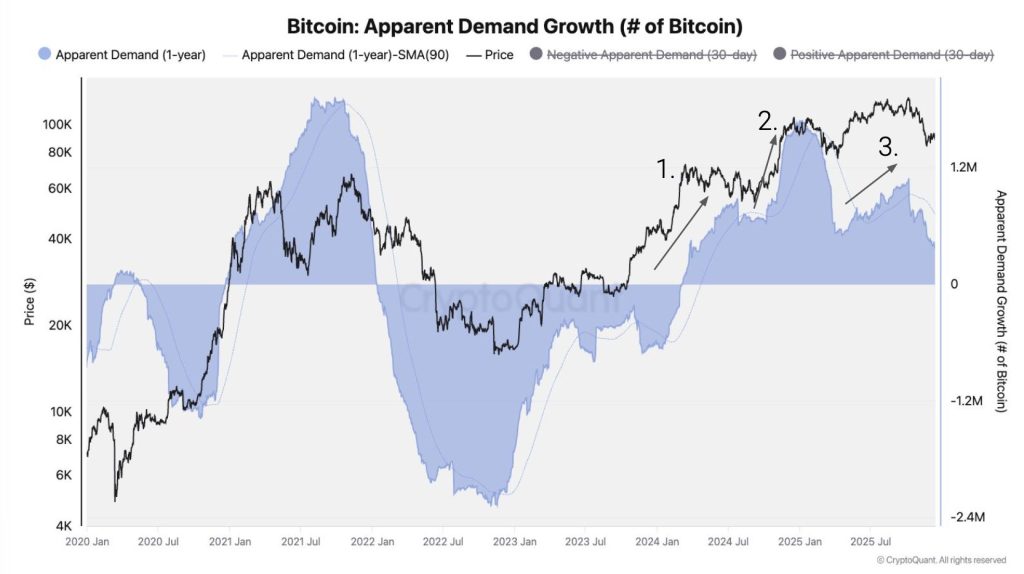
Bitcoin’s demand boom is fading.

This cycle ran on three spot demand waves, and the latest one looks like it’s rolling over.

Since early October, demand is below trend, which can stay bearish for price. pic.twitter.com/7IWnRscD8H

— CryptoQuant.com (@cryptoquant_com) December 19, 2025

Demand Growth Falls Below Trend

CryptoQuant’s analysis shows that Bitcoin demand growth has decisively slowed since early October 2025, falling below its long-term trend.

The current cycle featured three major spot demand waves: the launch of U.S. spot Bitcoin ETFs, optimism surrounding the U.S. presidential election outcome, and a surge of interest from Bitcoin Treasury Companies.

With these catalysts largely priced in, incremental demand has diminished, removing a key source of price support that previously sustained upward momentum.

The firm notes that when demand growth rolls over in this manner, it has historically marked the end of bullish phases, regardless of broader narratives around supply shocks or halving events.

Institutional and Large-Holder Demand Reverses

Institutional behavior is now reinforcing the bearish signal. U.S. spot Bitcoin ETFs have shifted from accumulation to distribution in the fourth quarter of 2025, with net holdings declining by approximately 24,000 BTC. This stands in stark contrast to Q4 2024, when ETFs were strong net buyers and a central driver of market strength.

At the same time, onchain data shows that addresses holding between 100 and 1,000 BTC—often associated with ETFs, funds, and corporate treasuries—are growing below historical trend.

CryptoQuant compares this pattern to late 2021, when similar demand deterioration preceded the 2022 bear market.

Derivatives Markets Signal Weakening Risk Appetite

Derivatives data adds further confirmation. Funding rates in perpetual futures, measured using a 365-day moving average, have declined to their lowest level since December 2023. Falling funding rates typically indicate reduced willingness among traders to maintain leveraged long positions.

Historically, such conditions have been more consistent with bear market regimes than bull phases, reflecting declining risk appetite and lower conviction among market participants.

Price Structure and Downside Scenarios

From a technical perspective, Bitcoin has broken below its 365-day moving average, a key long-term indicator that has historically separated bull and bear market conditions.

CryptoQuant stresses that Bitcoin’s four-year cycle is driven primarily by demand expansions and contractions rather than the halving itself.

Despite the bearish shift, downside projections suggest a relatively shallow cycle. Past bear market bottoms have aligned with Bitcoin’s realized price, currently near $56,000.

This would imply a drawdown of roughly 55% from the recent all-time high—potentially the smallest bear market decline on record. Interim support is expected around the $70,000 level, offering a key zone to watch as the cycle continues to reset.

The post Bitcoin Cycle Turns as Demand Exhaustion Signals Bear Market: CryptoQuant appeared first on Cryptonews.

Bitwise Predicts ‘ETF-palooza’ as Over 100 Crypto-Linked ETFs Set to Launch in the U.S. by 2026

U.S. asset manager Bitwise has forecast a wave of new crypto-linked exchange-traded funds (ETFs), predicting that more than 100 such products could launch in the United States by 2026 as regulatory clarity accelerates and issuer barriers fall.

2026 PREDICTION: More than 100 crypto-linked ETFs will launch in the U.S.⁰⁰In October 2025, the SEC published generic listing standards, allowing ETF issuers to launch crypto ETFs under a general set of rules. A clearer regulatory roadmap in 2026 is why we see the stage being… pic.twitter.com/rQbcWe6JE4

— Bitwise (@BitwiseInvest) December 17, 2025

In a post shared on X, Bitwise said recent regulatory developments have set the stage for what it described as an “ETF-palooza,” marking a sharp shift from years of regulatory resistance toward broader institutional access to digital assets.

Regulatory Shift Opens the Floodgates

According to Bitwise, a key inflection point came in October 2025, when the U.S. Securities and Exchange Commission published generic listing standards for crypto-linked ETFs.

The move allows issuers to bring products to market under a standardized framework, rather than seeking bespoke approvals for each fund.

This change is expected to shorten approval timelines and reduce legal uncertainty, making it easier for asset managers to launch ETFs tied to a wide range of digital assets and crypto-related strategies.

“A clearer regulatory roadmap in 2026 is why we see the stage being set,” Bitwise said, pointing to the cumulative effect of rulemaking, court rulings, and precedent-setting approvals over the past several years.

From Bitcoin to Broad Crypto Exposure

The prediction builds on a rapid evolution in the U.S. crypto ETF market. After more than a decade of rejected applications, spot Bitcoin ETFs finally launched in early 2024.

In 2025, the scope widened again with the launch of Solana-linked ETFs, alongside new generic listing standards that reduced regulatory friction. Bitwise’s timeline also points to potential XRP and Dogecoin ETFs entering the market before 2026, reflecting growing issuer confidence in demand for diversified crypto exposure.

If realized, the expansion would move the ETF market beyond single-asset products toward thematic, basket-based, yield-oriented, and strategy-driven offerings.

Institutional Demand Drives Momentum

Market participants say institutional appetite is a key driver behind the surge. ETFs offer regulated, familiar access to digital assets for pension funds, wealth managers, and retail investors who may be restricted from holding tokens directly.

By embedding crypto exposure within traditional market infrastructure, ETFs also reduce operational hurdles around custody, compliance, and risk management — long-standing concerns for institutional allocators.

Bitwise’s forecast suggests competition among issuers could intensify as firms race to capture first-mover advantage in niche segments, potentially driving fee compression and product innovation.

Bitwise Chief: Bitcoin to Hit Fresh Records in 2026

Bitwise Chief Investment Officer Matt Hougan and Grayscale Research both project BTC will exceed its previous peak despite conventional wisdom suggesting 2026 should be a pullback year. Forecasting that Bitcoin will shatter its traditional four-year cycle and reach new all-time highs in 2026, driven by massive institutional capital inflows and regulatory clarity.

Bitcoin has historically followed a four-year cycle tied to halving events, with three significant up years followed by sharp corrections.

The post Bitwise Predicts ‘ETF-palooza’ as Over 100 Crypto-Linked ETFs Set to Launch in the U.S. by 2026 appeared first on Cryptonews.

Brazil’s Banco BS2 Taps Bitpanda Tech for Institutional Crypto Infrastructure

Bitpanda Technology Solutions, the digital asset infrastructure arm of European crypto platform Bitpanda, has entered into a partnership with Banco BS2, becoming its first banking partner in Latin America.

The agreement allows Banco BS2, a Brazilian digital bank focused on corporate and institutional clients, to integrate institutional-grade crypto infrastructure as it expands its digital asset offerings.

Bitpanda Expands Institutional Footprint in Latin America

Earlier this year Bitpanda announced plans to expand into Latin America several months ago, Banco BS2 becomes BTS’ first banking partner in the region.

Bitpanda Technology Solutions said it aims to provide regulated financial institutions with modular, scalable infrastructure that allows them to enter the digital asset market without building technology in-house. The move shows growing interest among Latin American banks in offering crypto-related services to institutional and corporate clients.

Fusion Platform to Power Trading and Liquidity

As part of the agreement, Banco BS2 will initially integrate Fusion, Bitpanda’s advanced trading and liquidity platform designed for institutional use. Fusion aggregates liquidity from multiple venues and is built to support high-throughput trading, execution efficiency, and risk management.

Beyond trading, the partnership framework allows Banco BS2 to explore additional components of Bitpanda’s infrastructure stack, including custody technology and tokenization capabilities. Any further deployment will be subject to regulatory approvals and Banco BS2’s internal governance and customer-facing controls, said the firm.

Growing Institutional Demand

Nadeem Ladki, Managing Director at Bitpanda Technology Solutions, said the partnership shows there is growing institutional demand for experienced infrastructure providers as crypto adoption grows.

“Brazil is entering a new phase of digital asset adoption, and financial institutions will need partners with deep experience operating in these environments,” Ladki said. “Banco BS2’s vision for the digital asset economy aligns closely with what our infrastructure enables.”

Carlos Eduardo T. de Andrade Jr., an executive at Banco BS2, said the collaboration supports the bank’s strategy meeting international standards while navigating Brazil’s regulatory landscape.

“Bitpanda’s infrastructure allows us to move forward safely and efficiently in offering services related to the digital asset ecosystem, keeping pace with regulatory evolution and the demands of the Brazilian market,” he said.

Brazil’s Regulatory Clarity Accelerates Bank Adoption

The partnership comes as Brazil’s digital asset market enters a more mature phase. Earlier this year, the Central Bank of Brazil (Bacen) issued landmark crypto regulations, providing clearer guidelines for financial institutions engaging with digital assets.

The regulatory clarity has encouraged banks to explore crypto trading, custody, and tokenization services in a more structured and compliant manner.

Bitpanda and EurocoinPay Sign Deal

Earlier this month, Bitpanda announced a new partnership with EurocoinPay intended to widen access to institutional-grade crypto liquidity across Spain.

Under the agreement, EurocoinPay said it will integrate Bitpanda’s liquidity platform, allowing its users to trade more than 650 crypto-assets with competitive pricing and high-quality execution.

EurocoinPay has been a key player in Spain’s digital asset landscape for years. The partnership seeks to allow the company to have a much broader asset catalogue, delivered through a compliant infrastructure trusted by institutions across Europe.

🇪🇸 Bitpanda Technology Solutions partners with EurocoinPay to expand access to institutional-grade crypto liquidity in Spain.#Bitpanda #Spainhttps://t.co/i7Q5soZij0

— Cryptonews.com (@cryptonews) December 11, 2025

The post Brazil’s Banco BS2 Taps Bitpanda Tech for Institutional Crypto Infrastructure appeared first on Cryptonews.

Falcon Finance Deploys $2.1B USDf Synthetic Dollar on Base Network

Falcon Finance announced the deployment of USDf, its $2.1 billion multi-asset synthetic dollar, on Coinbase-backed Layer 2 network Base, introducing a new “universal collateral” asset.

Falcon Finance’s synthetic dollar is now live on @base.

This expansion introduces Falcon's $2.1 billion market cap synthetic dollar, backed by a diverse mix of crypto blue chips and tokenized RWAs, to a cost-effective, builder-friendly Ethereum L2 that has become a leading hub… pic.twitter.com/g813beBEsf

— Falcon Finance 🦅🟠 (@falconfinance) December 18, 2025

The integration allows users to bridge USDf from Ethereum to Base and access some of the most competitive yields among major yield-bearing stable assets, as onchain activity across the network reaches record levels.

The launch comes as Base continues to consolidate its position as a core hub for decentralized finance and onchain payments, with infrastructure increasingly designed to support both crypto-native and mainstream financial use cases.

Base Activity Surges Following Fusaka Upgrade

The deployment coincides with a pivotal month for Base following the activation of Ethereum’s Fusaka hard fork, which expanded Layer 2 capacity by approximately eight times.

Since the upgrade, Base said it has recorded a sharp rise in network performance, with monthly transactions surpassing an all-time high of more than 452 million.

Lower transaction fees and expanded gas limits have improved the economics of onchain activity, enabling more complex DeFi strategies and high-frequency use cases such as micropayments.

The improved scalability has also strengthened Base’s appeal to developers and institutions seeking reliable, cost-efficient settlement infrastructure.

A Multi-Asset Approach to Stable Value

Unlike traditional fiat-backed stablecoins, USDf is overcollateralized by a diversified basket of assets that includes crypto blue chips such as Bitcoin, Ethereum and Solana, alongside tokenized U.S. Treasuries, sovereign bonds, equities and gold.

This structure brings more than $2.3 billion in reserves onchain, positioning USDf among the top ten stable assets by backing and making it a distinct addition to Base’s liquidity layer.

Falcon Finance has also been expanding USDf beyond purely crypto-based collateral. Most recently, the protocol added tokenized Mexican sovereign bills (CETES), introducing emerging-market sovereign yield into its onchain reserve mix.

Yield Mechanics and DeFi Integration

The integration introduces new yield opportunities for Base users through Falcon’s yield-bearing token, sUSDf. Since launch, sUSDf has distributed more than $19.1 million in cumulative yield, including nearly $1 million over the past 30 days.

Returns are generated through diversified strategies such as funding rate arbitrage, cross-exchange price arbitrage, options-based strategies and native altcoin staking.

“Expanding USDf to Base is part of a larger shift we’re seeing across onchain markets,” said Fiona Ma, VP of Growth at Falcon Finance. “Stable assets need to be more flexible, more composable, and available across the networks where people are actually building. Base is one of those places.”

Base users can now bridge USDf, stake for yield, provide liquidity on platforms such as Aerodrome, and tap into the network’s expanding DeFi stack.

For Base, the arrival of a multi-asset-backed synthetic dollar adds another core financial primitive as the network increasingly positions itself as a settlement layer for both decentralized and traditional finance rails.

The post Falcon Finance Deploys $2.1B USDf Synthetic Dollar on Base Network appeared first on Cryptonews.

💾

‘Willful Negligence’ Is Fueling Web3 Hacks, Says Immunefi CEO After $27M Multisig Breach

The cryptocurrency industry is once again confronting deep-seated security failures after a whale-linked multisignature wallet was drained of approximately $27.3 million following a private key compromise earlier today.

According to PeckShield the attacker has already laundered about $12.6 million, roughly 4,100 ETH, and still held around $2 million in liquid assets. The security firm show the drainer routing a large chunk of the haul through Tornado Cash, a privacy mixer often used to break transaction links.

$27.3M Multisig Breach Exposes Persistent Operational Risks

The incident stemmed from a compromised private key tied to a whale’s multisig wallet, allowing attackers to siphon off roughly $27.3 million.

While multisignature wallets are widely viewed as an institutional-grade security standard, the breach shows how operational weaknesses — rather than smart contract flaws — remain one of the ecosystem’s most dangerous attack vectors. Private key mismanagement, phishing, and insider risk continue to undermine even sophisticated custody structures.

Crypto Losses Approach $90B as 2025 Attacks Accelerate

After more than 15 years of security efforts, the crypto industry has now lost nearly $90 billion to hacks and exploits. The pace of theft has accelerated sharply in recent months, reports Immunefi.

In November alone, more than $276 million was stolen, pushing total losses for 2025 beyond $9.1 billion. That means roughly 10% of all historical crypto losses have occurred within the past 12 months, highlighting a rapidly deteriorating threat landscape.

Immunefi CEO Says ‘Willful Negligence’ Is Fueling Web3 Hacks

Mitchell Amador, founder and CEO of Immunefi, a crowdsourced security platform safeguarding over $180 billion in digital assets, said the sector’s biggest vulnerability is not technical complexity but willful negligence.

“Crypto is facing a security reckoning,” Amador said. “As ecosystems scale, surging on-chain activity is colliding with shrinking post-deployment security budgets and an expanding, fast-moving attack surface.”

Amador notes that 99% of Web3 projects operate without basic firewalls while fewer than 10% deploy modern AI-driven security tools, leaving most protocols dangerously exposed after launch.

Post-Launch Vulnerabilities Drive Majority of 2025 Exploits

According to Amador, the majority of high-impact hacks this year did not result from failed audits. “Most hacks this year haven’t occurred due to poor audits,” he said. “They’ve happened after launch, during protocol upgrades, or through integration vulnerabilities — blind spots that audits alone can’t catch.”

The pattern reflects a broader shift in attacker behavior, targeting operational transitions rather than initial

Why Real-Time Lifecycle Security Must Replace Audit-Only Models

Amador argues the industry must abandon static, audit-centric security approaches in favor of continuous, automated, lifecycle security.

“On-chain security is simply not mature enough,” he said. “It’s still predicated on manual reviews and fragmented systems that prevent organizations from adapting their security posture in real time.”

While the technical solutions already exist, Amador explains adoption has lagged — a gap that continues to expose billions of dollars in user and institutional funds.

As crypto scales into mainstream finance, the latest $27 million multisig breach may serve less as an isolated incident and more as a warning: without a fundamental shift in security culture, losses are likely to keep mounting faster than the industry’s defenses can evolve.

🐳 A crypto whale lost about $27.3M after a private key compromise let an attacker drain its multisig wallet and start laundering the funds on-chain.#Multisig #DeFi https://t.co/tk40Vshhbm

— Cryptonews.com (@cryptonews) December 18, 2025

The post ‘Willful Negligence’ Is Fueling Web3 Hacks, Says Immunefi CEO After $27M Multisig Breach appeared first on Cryptonews.

💾

Circle Partners With LianLian Global to Explore Stablecoin Payments

An affiliate of Circle Internet Group, Inc. (NYSE: CRCL), the issuer of stablecoin USDC through its regulated entities, announced on Wednesday that it has signed a Memorandum of Understanding with LianLian Global, a licensed cross-border payments provider, to explore expanding the use of USDC.

We are collaborating with LianLian Global to explore stablecoin-powered infrastructure for cross-border payments.

As part of our continued work to expand the utility of USDC within regulated financial systems, this collaboration will focus on evaluating how digital dollar… pic.twitter.com/Syoc26AbXC

— Circle (@circle) December 17, 2025

The partnership will explore opportunities to build stablecoin backed payment infrastructure designed to make international payments more accessible for merchants and digital platforms operating across global markets, said the firm in a press release.

Modernizing Cross-Border Payment Infrastructure

Both parties will assess how stablecoins such as USDC can support faster and more resilient transactions especially in high-volume international payment flows.

By upgrading treasury and settlement processes the initiative aims to reduce friction in cross-border payments while improving reliability for merchants operating across multiple jurisdictions and currencies.

Driving Efficiency and Interoperability

According to the announcement the agreement also focuses on improving cost efficiency and streamlining settlement processes for merchants and platforms. Traditional cross-border payments often involve multiple intermediaries with delayed settlement times and opaque fees.

Circle and LianLian Global will also explore how stablecoin rails can help simplify these flows allowing near real-time settlement and improved transparency.

Expanding Access in Emerging Markets

Another factor of the collaboration is identifying opportunities in emerging markets where digital payment solutions can expand access and economic participation.

Stablecoins have increasingly been viewed as a tool to improve financial inclusion by lowering barriers to entry and enabling faster, more affordable cross-border transactions.

By combining Circle’s digital currency infrastructure with LianLian Global’s regional expertise – the partnership aims to unlock new payment use cases for merchants in fast-growing markets.

Working with Regulated Financial Institutions

The partnership is part of Circle’s strategy of working closely with regulated financial institutions and licensed payment providers as stablecoins become more embedded within global financial systems, saif the firm.

Yam Ki Chan, Vice President, Asia Pacific of Circle, said the agreement is part of Circle’s commitment to building open and interoperable financial infrastructure tailored to the needs of modern commerce in Asia and beyond.

With operations across key international trade corridors, LianLian Global serves millions of merchants worldwide, particularly in e-commerce and cross-border trade.

The partnership will also explore using Circle’s layer-1 blockchain Arc to support future payment use cases across the LianLian Global network, reinforcing the role of stablecoins in the evolution of regulated digital payments.

The post Circle Partners With LianLian Global to Explore Stablecoin Payments appeared first on Cryptonews.

💾

SBI Ripple Asia Signs MOU With Doppler Finance to Explore RWA Tokenization

Japan’s SBI Ripple Asia and Doppler Finance have signed a memorandum of understanding to explore collaboration on XRP-based yield infrastructure and real-world asset tokenization on the XRP Ledger (XRPL).

The agreement will center on developing transparent yield infrastructure for institutional clients, supporting XRP’s evolution from a payments-focused asset into a yield-bearing financial instrument.

We’re pleased to announce a partnership between SBI Ripple Asia and Doppler Finance.

Together, we will explore collaboration in XRP-based yield infrastructure and real-world asset (RWA) tokenization on the XRP Ledger, advancing institutional-grade finance on XRPL. pic.twitter.com/dKt5i1nzlF

— Doppler Finance (@doppler_fi) December 17, 2025

First XRPL-Native Partnership for SBI Ripple Asia

The partnership represents progress for the XRP ecosystem, as SBI Ripple Asia aligns directly with a protocol built natively on the XRPL.

Doppler Finance, which operates XRPfi infrastructure designed for regulated environments, will work alongside SBI Ripple Asia to explore use cases that bridge traditional financial standards with decentralized ledger technology.

Institutional Custody and Regulatory Alignment

As part of the initiative, SBI Digital Markets, a Monetary Authority of Singapore (MAS)-regulated digital asset firm, has been appointed as the institutional custodian.

The arrangement provides segregated and independent custody, helping to mitigate exchange-related risks and ensuring assets are held in line with institutional security and governance requirements.

The custody structure is intended to reinforce trust among regulated entities and financial institutions considering on-chain yield exposure via the XRP Ledger, said the firm.

Doppler Expands Footprint in Japan’s Financial Ecosystem

This latest collaboration strengthens Doppler Finance’s presence in Japan, a strategically important market for digital asset innovation and regulation.

Partnering with SBI Ripple Asia, a joint venture established by Ripple and SBI Holdings, expands Doppler’s positioning as a compliant and trusted yield infrastructure provider within the XRP ecosystem.

So far, Doppler’s infrastructure has already been adopted by qualified institutions and integrated with major exchanges and wallets. Its track record of operational stability has made it an attractive option for institutions seeking on-chain yield without compromising regulatory or risk standards.

“Partnering with SBI Ripple Asia is a major validation of the trust and reliability we’ve built into the Doppler infrastructure,” said Rox Park, Head of Institutions at Doppler Finance.

“Together, we aim to expand XRP’s role as a productive, yield-bearing asset while introducing institutional standards to the broader XRPL ecosystem,” adds Park.

Bridging Traditional and On-Chain Finance

SBI Ripple Asia said the collaboration aims to accelerate the development of secure and transparent yield infrastructure on the XRP Ledger.

By combining Doppler’s institutional-grade framework with SBI Ripple Asia’s experience in digital asset adoption across Japan and Asia, the partners see opportunities to expand XRP’s utility and connect traditional finance with emerging on-chain systems.

The post SBI Ripple Asia Signs MOU With Doppler Finance to Explore RWA Tokenization appeared first on Cryptonews.

💾

DTCC and Digital Asset to Tokenize U.S. Treasury Securities on Canton Network

The Depository Trust & Clearing Corporation (DTCC) has partnered with Digital Asset Holdings and the Canton Network to enable the tokenization of DTC-custodied U.S. Treasury securities.

Minting and using U.S. Treasuries on Canton is coming in 2026, enabling tokenized USTs to be exchanged in near-real-time with stablecoins and other digital assets – all with the privacy and controls regulated markets demand.

A major unlock for global collateral mobility to… pic.twitter.com/XnvdprRq7X

— Canton Network (@CantonNetwork) December 17, 2025

DTCC said this is its first move toward making DTC-custodied assets available on-chain, as traditional financial institutions continue to explore regulated, scalable blockchain applications.

Earlier this month, the U.S. Securities and Exchange Commission cleared the way for DTCC to advance its expansion into blockchain-based markets.

Regulatory Backing Allows On-Chain Expansion

The latest partnership follows DTCC’s recent receipt of a No-Action Letter from the U.S. Securities and Exchange Commission, allowing it to implement and operate a new service to tokenize real-world assets held at The Depository Trust Company (DTC).

The firm said regulatory clarity provides the foundation for DTCC’s on-chain strategy allowing the organization to experiment with blockchain-based workflows while remaining aligned with existing market safeguards and compliance standards.

By working with Digital Asset and the Canton Network, DTCC said it aims to bridge traditional post-trade infrastructure with distributed ledger technology in a controlled and institution-ready environment.

U.S. Treasury Tokenization Pilot Planned for 2026

Under the partnership, DTCC plans to mint a subset of U.S. Treasury securities custodied at DTC on the Canton Network.

The organizations are also targeting a minimum viable product in a controlled production environment during the first half of 2026. Based on client demand, DTCC said it expects to expand both the scale and scope of the project in subsequent phases.

To support the initiative, DTCC said it will leverage its ComposerX suite of platforms, which is designed to facilitate tokenization and interoperability across market infrastructures.

Building Institutional-Grade Digital Infrastructure

DTCC CEO Frank LaSalla describes the collaboration as a step toward creating digital infrastructure that connects traditional and digital financial ecosystems.

“This collaboration creates a roadmap to bring real-world, high-value tokenization use cases to market, starting with U.S. Treasury securities and eventually expanding to a broad spectrum of DTC-eligible assets,” he said.

Long-Term Vision for Capital Markets Tokenization

Digital Asset Co-Founder and CEO Yuval Rooz said the partnership highlights a collective ambition among market leaders to build interoperable, future-proof financial systems.

He notes that DTCC’s involvement could unlock new liquidity opportunities, products, and operational efficiencies across capital markets.

While the full roadmap is expected to unfold over several years, the initial phase is intended to deliver benefits to market participants by providing access to tokenized U.S. Treasurys in a regulated environment.

JPMorgan to Launch Tokenized Money-Market Fund on Ethereum

Earlier this week the Wall Street Journal report reported JPMorgan Chase’s $4 trillion asset-management division is launching its first tokenized money-market fund on the Ethereum blockchain, according to a

The bank will initially seed the vehicle with $100 million of its own capital before opening it to external investors, reports the WSJ.

The post DTCC and Digital Asset to Tokenize U.S. Treasury Securities on Canton Network appeared first on Cryptonews.

💾

Ripple President Monica Long Says Stablecoins to Move From Pilot to Production by 2026

Stablecoins are poised to become a foundational layer of global finance over the next two years, according to Ripple President Monica Long, who says the asset class is shifting from experimental pilots to full-scale production across mainstream payments.

In commentary outlining her expectations through 2026, Long argues that stablecoins are no longer a niche crypto innovation but are on track to become the default infrastructure for cross-border payments, embedded directly into legacy financial rails used by banks, merchants, and corporates worldwide.

Stablecoins Embedded Into Global Payment Rails

Long points to recent developments from traditional payment giants as evidence that stablecoins are being “hard-wired” into incumbent systems.

Visa and Stripe going live with USDC settlement for merchants, she says, marks a turning point where blockchain-based rails are being adopted within existing corporate payment flows rather than operating in parallel.

💳 Visa Inc. is set to allow stablecoin-based settlement across its US payments network, expanding its suite of crypto-related services.$USDC #Visa https://t.co/i6vVCqWAiH

— Cryptonews.com (@cryptonews) December 16, 2025

“In 2026, stablecoins will integrate with legacy financial rails and, within the next five years, become fully integrated into global payment systems,” Long said, adding that cross-border payments are likely to be the first area where stablecoins emerge as the default settlement mechanism.

B2B Payments Drive the Next Adoption Wave

While early stablecoin growth was dominated by retail trading and remittances, Long said she expects business-to-business payments to lead the next phase of adoption.

B2B payments already account for the majority of stablecoin flows, a trend she believes will accelerate as corporates seek efficiency gains.

Beyond faster settlement, Long highlighted the impact on corporate balance sheets, particularly in Europe, where she estimates €1.3 trillion remains trapped in working capital across payables, receivables, and inventory.

Stablecoins, she said, have the potential to unlock this capital by enabling real-time settlement and improved cash-flow management.

Crypto Shifts From Speculative to Structural

Long also outlines a structural shift underway across the crypto sector. She expects crypto to evolve from an alternative asset class into the operating layer of modern finance, with institutional balance sheets holding more than $1 trillion in tokenized and digital assets by the end of 2026.

Regulatory clarity is a key enabler of this transition. Long cites frameworks such as the EU’s Markets in Crypto-Assets (MiCA) regulation as laying the legal groundwork for a compliant stablecoin market.

By 2027, she expects banks and financial institutions in regulated regions to issue and hold their own regulated stablecoins.

Custody and M&A to Accelerate

As institutional interest grows, Long predicts increased consolidation across crypto infrastructure, particularly in custody services.

The commoditisation of custody, she explains, is likely to drive a new wave of mergers and acquisitions as traditional banks, service providers, and crypto firms seek to accelerate their blockchain strategies.

She expects more than half of the world’s top 50 banks to formalise at least one new digital asset custody relationship in 2026.

Looking ahead, Long believes crypto M&A will increasingly extend beyond the sector itself as firms pursue usability and scale.

“To acquire the next billion users, especially institutions, crypto must get radically easier to use and move outside the echo chamber,” she said.

The post Ripple President Monica Long Says Stablecoins to Move From Pilot to Production by 2026 appeared first on Cryptonews.

RedotPay Raises $107M Series B as Stablecoin Payments Surge to 6M Users Worldwide

RedotPay, a stablecoin payment fintech, has raised $107 million in an oversubscribed Series B funding round showing investor confidence in the role of stablecoins in everyday payments.

This latest funding raise brings RedotPay’s total capital secured in 2025 to $194 million as the company continues to scale rapidly.

Thrilled to share that we’ve successfully closed our Series B funding round, a major step in our mission to make digital finance accessible, secure, and efficient for everyone. 🚀

By building on #blockchain rails, we’re moving beyond traditional #fintech to deliver a faster,… pic.twitter.com/gEvONlLZzO

— RedotPay Official (@RedotPay) December 16, 2025

Rapid User Growth and Surging Payment Volumes

RedotPay said it now serves more than 6 million registered users across over 100 countries. As of November 2025, the platform has surpassed $10 billion in annualized payment volume, with transaction volumes nearly tripling year-on-year.

According to RedotPay more than 3 million new users joined the platform during 2025 through November showing rapid adoption of stablecoin-powered financial services among both crypto-native and mainstream users.

The company said it has also reached a key milestone in monetization, generating over $150 million in annualized revenue while maintaining a profitable, scalable business model.

RedotPay says its growth is driven by infrastructure and strong demand for predictable, borderless payments in markets facing currency volatility, inflation, or limited banking access.

Series B Led by Goodwater, Backed by Crypto Heavyweights

The Series B round was led by Goodwater Capital, with participation from Pantera Capital, Blockchain Capital, and Circle Ventures, alongside continued backing from existing investors including HSG.

“Stablecoin has the potential to disrupt global money flow and strengthen financial inclusion,” said Jin Oh, Partner at Goodwater Capital, adding that RedotPay has demonstrated “remarkable traction” across major markets. Investors highlighted the platform’s ability to translate blockchain infrastructure into real-world payment utility at scale.

Building Stablecoin-Powered Financial Services

RedotPay said it is focused on making fund movement instant, predictable, and borderless through a suite of stablecoin-powered products. These include a stablecoin-based card that allows users to spend digital assets globally, stablecoin payout rails for fast international transfers, and access tools that bridge traditional finance with digital assets via multi-currency accounts and peer-to-peer marketplaces.

“Our goal is to help users manage their finances with confidence through stablecoin-powered financial services,” said Michael Gao, Co-Founder and CEO of RedotPay. He notes that the new funding will accelerate product innovation while expanding the company’s global footprint in a compliance-focused manner.

Scaling Compliance, Talent, and Global Reach

RedotPay plans to deploy the new capital toward strategic acquisitions, licensing, and compliance expansion to support entry into new markets.

The company will also accelerate global hiring across engineering, product, and compliance teams. Looking ahead, RedotPay said it aims to deepen its presence in key growth regions.

The post RedotPay Raises $107M Series B as Stablecoin Payments Surge to 6M Users Worldwide appeared first on Cryptonews.

Tether Invests $8M in Speed to Scale Lightning-Based Stablecoin Payments

Tether announced it has led an $8 million investment in Speed1, Inc., a payments infrastructure company building global settlement rails using the Bitcoin Lightning Network and stablecoins.

Tether Leads $8M Strategic Investment in Speed to Advance Lightning-Native, Stablecoin-Powered Payments
Learn more: https://t.co/RyeiRAwCqY

— Tether (@Tether_to) December 16, 2025

The funding round also included participation from Ego Death Capital. The investment aligns with Tether’s broader push to expand real-world payment use cases for USDT while supporting Bitcoin-native financial infrastructure.

Speed focuses on allowing instant low-cost payments by combining Lightning’s high-speed transaction capabilities with stablecoin settlement for price stability. The company said the funding will support product development and continued global expansion.

Growing Payment Volume and User Base

Speed currently processes more than $1.5 billion in annualized payment volume across consumers, creators, platforms, and enterprise merchants. Its core products—Speed Wallet and Speed Merchant—serve approximately 1.2 million users and businesses. The platform offers instant payments, native Bitcoin and USDT settlement, and global routing designed to meet enterprise reliability requirements.

The company positions its infrastructure as a bridge between Bitcoin-native networks and practical payment needs, particularly for cross-border transactions, creator payouts, and merchant settlement.

By integrating stablecoins alongside Lightning, Speed enables users and businesses to choose between volatility exposure and price-stable settlement, depending on their needs.

Tether Deepens Focus on Bitcoin-Aligned Infrastructure

Tether said the investment supports its strategy of strengthening Bitcoin-aligned financial infrastructure while expanding the utility of USDT beyond trading and into everyday payments.

According to the company, Speed’s architecture demonstrates how Lightning and stablecoins can operate together at scale, combining low fees, global reach, and compliance-focused design.

“Speed is showing what Lightning can achieve when paired with a stable, liquid digital dollar like USDT,” said Tether CEO Paolo Ardoino. He added that the company is focused on backing infrastructure that reduces friction in payments and broadens access to reliable settlement rails, particularly for mainstream commerce.

Bridging Speculation and Real-World Use

Speed’s leadership said the platform is designed to move crypto beyond speculative use cases and into functional, global payments. CEO Niraj Patel said Lightning provides transaction speed, while stablecoins enable universal access and predictable value, allowing the infrastructure to support consumers, creators, and merchants at scale.

Speed integrates closely with the Lightning Network while allowing stablecoin settlement for users who require price stability. The company said this hybrid approach lowers friction across cross-border payments, platform-level settlement, and merchant transactions especially in regions where traditional banking infrastructure is costly or inefficient.

As stablecoins and Bitcoin-based networks gain traction in payments, the investment highlights growing interest from major digital asset firms in infrastructure that supports real-world financial activity rather than solely trading and speculation.

Earlier Visa announced it will allow stablecoin-based settlement across its US payments network broadening its suite of crypto-related services.

The post Tether Invests $8M in Speed to Scale Lightning-Based Stablecoin Payments appeared first on Cryptonews.

Hyperscale Data and American Bitcoin Expand Corporate Bitcoin Treasuries

Hyperscale Data Inc., an artificial intelligence-focused data center company anchored by Bitcoin, said its Bitcoin treasury has reached approximately $75.5 million, representing about 97.5% of its market capitalization.

The NYSE American–listed company said the valuation is based on Bitcoin’s price as of December 14, 2025, and Hyperscale Data’s closing share price on December 15.

The company also reiterated its long-term objective of holding Bitcoin equal to 100% of its market capitalization as part of its broader $100 million digital asset treasury strategy.

Sentinum Holdings and Recent Purchases

Hyperscale Data’s wholly owned subsidiary, Sentinum Inc., held approximately 498.46 Bitcoin as of December 14, according to the press release.

This total included about 69.68 Bitcoin generated from mining operations and 428.79 Bitcoin acquired on the open market, including roughly 41.31 Bitcoin purchased during the week ended December 14. At a Bitcoin closing price of $88,175, these holdings were valued at approximately $44 million.

Additional Capital Allocated for Bitcoin

Beyond its existing holdings, Hyperscale Data said it has set aside $31.5 million in cash for future open-market Bitcoin purchases.

The company said it plans to deploy this capital using a dollar-cost averaging strategy designed to reduce exposure to short-term market volatility while steadily increasing its long-term Bitcoin reserves.

Executive Chairman Milton “Todd” Ault III described reaching 97.5% of market capitalization as a major milestone, adding that the company remains focused on accumulating Bitcoin despite price fluctuations.

Hyperscale Data said it generally targets deploying at least 5% of allocated cash each week, though the pace may vary depending on market conditions. The company will continue to publish weekly updates every Tuesday detailing its Bitcoin holdings as it progresses toward its $100 million DAT target.

American Bitcoin Grows Treasury to 5,098 BTC

American Bitcoin has expanded its Bitcoin treasury to more than 5,098 BTC, marking a sharp increase in holdings since its Nasdaq debut on September 3, according to a company update on X.

American Bitcoin has increased its total Bitcoin reserve to over 5,098 BTC and achieved a BTC Yield of 96.5% from its Nasdaq debut on September 3 through December 14, 2025. Strategic accumulation continues. pic.twitter.com/yB4rYV1t6Y

— American Bitcoin (@ABTC) December 16, 2025

The firm reported a BTC Yield of 96.5% over the period through December 14, 2025, a metric that tracks growth in Bitcoin exposure on a per-share basis rather than price appreciation alone. American Bitcoin’s satoshis per share rose to 533, reflecting continued accumulation and balance-sheet expansion.

A company chart shows steady growth in total BTC reserves throughout the year, with a notable acceleration in the second half of 2025 as American Bitcoin pursued what it described as a strategy of ongoing, disciplined accumulation.

The update places American Bitcoin among a growing group of publicly listed firms using Bitcoin as a core treasury asset, as institutional adoption of BTC continues to broaden across equity markets.

The post Hyperscale Data and American Bitcoin Expand Corporate Bitcoin Treasuries appeared first on Cryptonews.

Visa to Allow U.S. Institutions to Settle Transactions Using Circle’s USDC on Solana

Visa Inc. announced on Tuesday it is set to allow stablecoin-based settlement across its US payments network broadening its suite of crypto-related services.

The payments giant will allow US financial institutions to settle transactions using Circle Internet Group Inc.’s USDC stablecoin over the Solana blockchain.

Faster Settlement for U.S. Banks?

By allowing USDC settlement, Visa said it is offering banks and fintechs faster funds movement over blockchain networks, seven-day availability, and improved resilience during weekends and holidays.

Initial participants include Cross River Bank and Lead Bank, both of which are settling transactions with Visa in USDC over the Solana blockchain. Visa said broader availability for U.S. institutions is planned through 2026.

Blockchain Infrastructure and Arc Partnership

Visa said it is also deepening its collaboration with Circle by serving as a design partner for Arc, a new Layer 1 blockchain currently in public testnet. Arc is being built to support high-performance, large-scale commercial activity onchain.

Visa plans to use Arc for USDC settlement within its network and intends to operate a validator node once the blockchain goes live, further integrating blockchain infrastructure into its core settlement processes.

Modernizing Treasury and Liquidity Management

According to Visa, U.S. stablecoin settlement allow seven-day settlement windows, improved liquidity management, and greater automation for participating banks. The framework is designed to bridge traditional payment rails with blockchain-based infrastructure while maintaining Visa’s standards for security, compliance, and reliability.

“Financial institutions are preparing to use stablecoins as part of their treasury operations,” said Rubail Birwadker, Visa’s Global Head of Growth Products and Strategic Partnerships. “USDC settlement gives banks a faster, programmable option that integrates with existing systems.”

Building on a Global Stablecoin Track Record

This latest U.S. launch builds on Visa’s earlier stablecoin settlement pilots across Latin America, Europe, Asia-Pacific, and the Middle East and Africa. Visa began experimenting with USDC settlement in 2021 and became one of the first major payment networks to settle transactions in a stablecoin in 2023.

Circle said the U.S. expansion represents a milestone for institutional adoption of stablecoins, while early banking partners highlighted benefits such as clearer liquidity timing and API-driven settlement.

Visa said it will continue to expand its stablecoin capabilities and recently launched a Stablecoins Advisory Practice through Visa Consulting & Analytics to help financial institutions assess and implement stablecoin strategies.

🚀 @Visa launches a stablecoin advisory service to help banks and fintechs navigate regulation and adoption as the market tops $300B. #Stablecoins #DigitalPayments https://t.co/9APTexHQ0X

— Cryptonews.com (@cryptonews) December 15, 2025

Binance Blockchain Week Highlights Stablecoin Momentum

Speaking at Binance Blockchain Week 2025, Binance CEO Richard Teng focused heavily on the rapid expansion of the stablecoin market, describing stablecoins as one of crypto’s most effective real-world use cases. He said global stablecoin market capitalisation climbed by nearly 50% this year, while the number of wallets holding stablecoins has also risen by around 50%.

Teng highlighted transaction data as evidence that stablecoins are moving firmly into the financial mainstream. He noted that daily stablecoin transaction volumes have now surpassed those processed by Visa.

Teng also attributed this growth to improving regulatory clarity, including recent progress in the US, and pointed to emerging-market initiatives such as Bhutan’s nationwide crypto payments system built on Binance Pay as examples of how stablecoins are increasingly being used as core payment infrastructure rather than speculative instruments.

The post Visa to Allow U.S. Institutions to Settle Transactions Using Circle’s USDC on Solana appeared first on Cryptonews.

BitMine Immersion’s ETH Holdings Surge to 3.97M Tokens – Over 3.2% of Total Supply

BitMine Immersion Technologies said it now holds more than 3.2% of the total Ethereum token supply, placing the company roughly two-thirds of the way toward its stated goal of acquiring 5% of all ETH in circulation.

As of December 14, the company reports it held 3,967,210 ETH, following the addition of more than 102,000 tokens over the past week. Based on market prices at the time, BitMine’s ETH position alone represented a multibillion-dollar allocation.

🧵
BitMine provided its latest holdings update for Dec 15th, 2025:

$13.2 billion in total crypto + "moonshots":
-3,967,210 ETH at $3,074 per ETH (@coinbase)
– 193 Bitcoin (BTC)
– $38 million stake in Eightco Holdings (NASDAQ: ORBS) (“moonshots”) and
– total cash of $1.0…

— Bitmine (NYSE-BMNR) $ETH (@BitMNR) December 15, 2025

Crypto, Cash and “Moonshots” Reach $13.3B

BitMine reports that its combined crypto holdings, cash reserves and strategic investments totaled approximately $13.3 billion. Alongside its Ethereum position, the company holds 193 bitcoin, $1.0 billion in cash and a $38 million stake in Eightco Holdings, which it categorizes as a “moonshot” investment.

The company said the scale and composition of its balance sheet reflect a deliberate strategy to combine liquidity with long-duration exposure to digital assets.

Management has also stressed that maintaining a cash buffer allows BitMine to continue accumulating crypto during periods of market volatility while preserving operational flexibility.

Institutional Backing and Market Liquidity

BitMine said it continues to be supported by a group of prominent institutional and strategic investors, including Cathie Wood’s ARK Invest, Founders Fund, Pantera Capital, Galaxy Digital, Digital Currency Group, Kraken and Bill Miller III, as well as individual investor Tom Lee.

The company views this backing as critical to its ambition of reaching the 5% ETH ownership threshold, which it refers to internally as the “Alchemy of 5%.” In the equity markets, BitMine’s stock has emerged as one of the most actively traded in the United States.

According to Fundstrat data, BMNR has averaged roughly $1.9 billion in daily trading volume over the past five days, ranking it as the 41st most traded U.S. stock.

Staking Plans and Shareholder Meeting Ahead

BitMine said it is also developing a staking initiative known as the Made in America Validator Network, or MAVAN, which is expected to be deployed in early 2026. The company has described the project as a secure, institutional-grade staking solution designed to generate yield on its Ethereum holdings.

BitMine will hold its annual shareholders meeting at the Wynn Las Vegas on January 15, 2026. The event is expected to provide further updates on its treasury strategy, staking rollout and progress toward its long-term Ethereum ownership target.

The post BitMine Immersion’s ETH Holdings Surge to 3.97M Tokens – Over 3.2% of Total Supply appeared first on Cryptonews.

Digital Asset ETP Inflows Hit $716M as Bitcoin, Ethereum and XRP Lead Weekly Gains: CoinShares

Digital asset investment products recorded another week of inflows as improving sentiment around major cryptocurrencies continues to draw capital back into the market, according to the latest data from CoinShares.

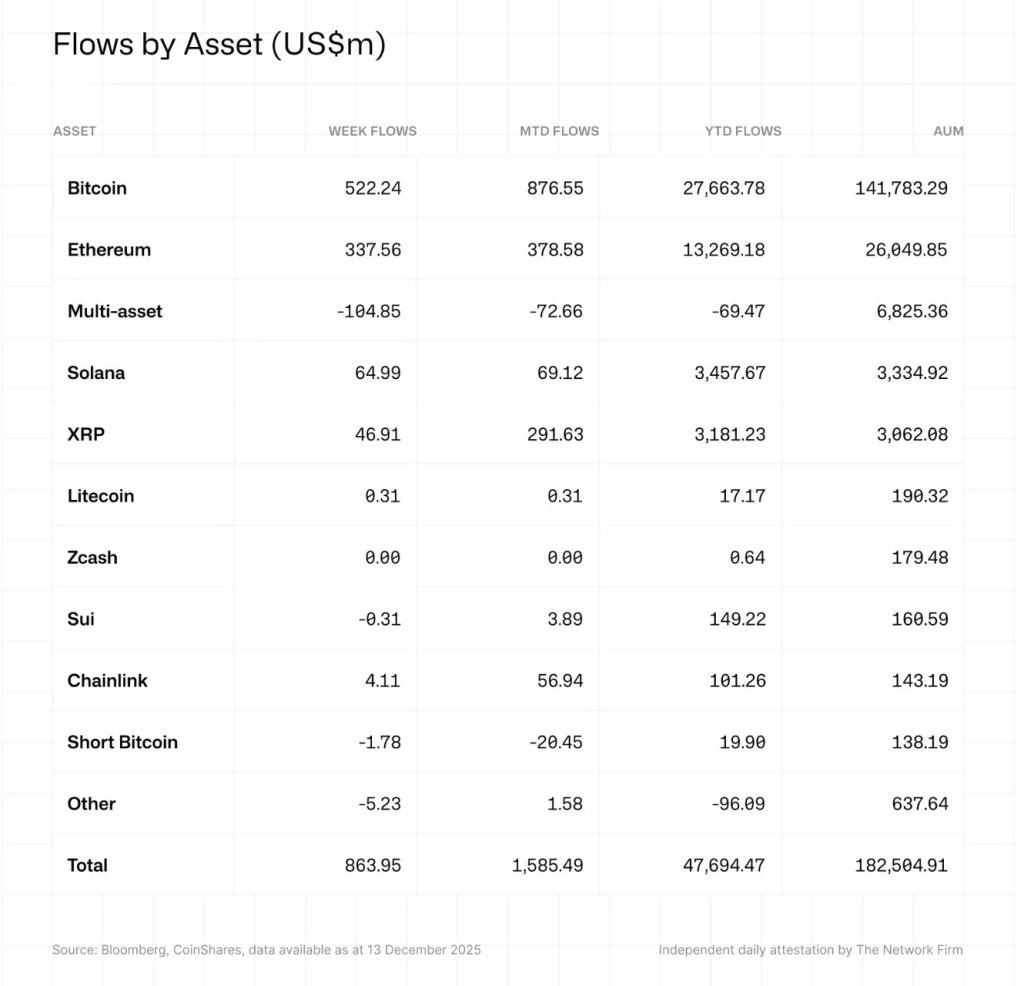
Weekly inflows into digital asset exchange-traded products (ETPs) reached $716 million, pushing total assets under management (AuM) to $180 billion.

While still well below the $264 billion all-time high the steady inflows suggest investor confidence is gradually rebuilding after a volatile period for crypto markets.

Learn more in our full report: https://t.co/xTpsANOdqw

— CoinShares (@CoinSharesCo) December 15, 2025

Investor Confidence Gradually Improves

CoinShares noted that digital asset funds have now posted their third consecutive week of modest inflows showibg what it described as a “cautious yet increasingly optimistic” investor base.

This comes despite mixed price performance following the US Federal Reserve’s recent interest rate cut, with post-decision trading marked by uneven flows and divergent sentiment across assets.

Total inflows across digital asset investment products reached $864 million over the broader reporting period, underscoring continued demand even as macro uncertainty persists. CoinShares said the data also suggests investors are increasing exposure rather than making broad risk-on bets.

US Dominates Regional Inflows

Inflows were broad-based geographically but heavily concentrated in a handful of markets. The US led by a wide margin accounting for $483 million of weekly inflows followed by Germany with $96.9 million and Canada with $80.7 million.

Looking at a longer timeframe, the US also continues to dominate sentiment posting $796 million of inflows last week alone. Germany and Canada also remained net positive, with inflows of $68.6 million and $26.8 million respectively. CoinShares said these three countries have driven the bulk of demand in 2025.

Bitcoin, Ethereum and XRP Lead Demand

Bitcoin remained the largest beneficiary in absolute terms, attracting $352 million in weekly inflows. Notably, short-Bitcoin investment products recorded outflows of $1.8 million, signalling a further easing of negative sentiment toward the asset.

Despite thje renewed interest CoinShares highlights that Bitcoin has been a relative laggard this year, with year-to-date inflows of $27.7 billion compared to $41 billion over the same period in 2024.

Ethereum continues to close the gap recording $338 million in weekly inflows and lifting year-to-date inflows to $13.3 billion. That figure is a 148% increase compared to 2024 also reflecting growing institutional engagement with Ethereum-based products.

XRP also stood out – drawing $245 million in inflows while Chainlink posted a record $52.8 million weekly inflow — equivalent to 54% of its total AuM.

Altcoins Show Selective Strength

Beyond the major cryptos Solana’s year-to-date inflows reached $3.5 billion, a tenfold increase compared to 2024, even though recent weekly flows were more muted.

Aave and Chainlink recorded smaller weekly inflows of $5.9 million and $4.1 million respectively.

Not all assets benefited – Hyperliquid saw weekly outflows of $14.1 million, highlighting that investor appetite remains selective rather than indiscriminate.

Overall CoinShares said the data points to a market that is stabilising, with capital gravitating toward large-cap and established digital assets as confidence slowly returns.

The post Digital Asset ETP Inflows Hit $716M as Bitcoin, Ethereum and XRP Lead Weekly Gains: CoinShares appeared first on Cryptonews.

JPMorgan to Launch Tokenized Money-Market Fund on Ethereum Seeding $100M in Capital: WSJ

JPMorgan Chase’s $4 trillion asset-management division is launching its first tokenized money-market fund on the Ethereum blockchain, according to a Wall Street Journal report.

The bank will initially seed the vehicle with $100 million of its own capital before opening it to external investors from Tuesday.

Exclusive: JPMorgan Chase is joining the list of traditional financial firms seeking to bring blockchain technology to an investing staple: the money-market fund.

— The Wall Street Journal (@WSJ) December 15, 2025

JPMorgan Brings Money Markets Onchain

According to the WSJ report the private fund, called the My OnChain Net Yield Fund — or “MONY” — is built on JPMorgan’s in-house tokenization platform, Kinexys Digital Assets.

It will be available to qualified investors, defined as individuals with at least $5 million in investable assets and institutions with a minimum of $25 million. The minimum investment size is set at $1 million.

Tokenization Gains Momentum After GENIUS Act

The launch comes during a rise in momentum for tokenized financial products following the passage of the GENIUS Act earlier this year. The legislation established a US regulatory framework for dollar-backed stablecoins, helping to remove uncertainty around onchain settlement and digital representations of traditional assets.

Since then, Wall Street firms have accelerated efforts to tokenize everything from equities and bonds to real-world assets, viewing blockchain as a way to improve operational efficiency, reduce settlement times and expand investor access.

“There is a massive amount of interest from clients around tokenization,” said John Donohue, head of global liquidity at J.P. Morgan Asset Management told the WSJ.

“And we expect to be a leader in this space and work with clients to make sure that we have a product lineup that allows them to have the choices that we have in traditional money-market funds on blockchain,” adds Donohue.

How the MONY Fund Works

Investors can subscribe to the MONY fund through JPMorgan’s Morgan Money portal, the bank’s digital money-market investing platform. In return, investors receive digital tokens representing their fund shares, which are held in their crypto wallets.

Like traditional money-market funds, MONY invests in baskets of short-term, high-quality debt instruments. The fund accrues dividends daily and pays interest designed to track prevailing money-market yields, which have remained attractive amid a higher interest rate environment.

Stablecoins and Institutional Adoption

Subscriptions and redemptions can be made using either cash or USDC, the dollar-pegged stablecoin issued by Circle Internet Group. Allowing USDC settlement highlights how regulated financial products are increasingly incorporating crypto-native payment rails.

JPMorgan’s move builds on its broader blockchain strategy, which includes tokenized deposits, onchain settlement and wholesale payment infrastructure. While MONY is limited to institutional and high-net-worth investors, it shows a broader shift toward integrating blockchain into core financial products once considered far removed from crypto.

The post JPMorgan to Launch Tokenized Money-Market Fund on Ethereum Seeding $100M in Capital: WSJ appeared first on Cryptonews.

Weekly Crypto Regulation Roundup: SEC Pulls Back, CFTC Expands and Trump’s Influence Grows

This week delivered one of the most consequential stretches for U.S. digital-asset policy in recent memory. From the SEC stepping back from past enforcement priorities to the CFTC launching new pilots and rewriting old rules, the regulatory agenda is shifting rapidly—and the political backdrop is changing just as fast.

With banks now gaining expanded permissions to transact in crypto and Congress re-opening the CBDC debate, the industry is entering 2026 with an entirely new set of power dynamics. Below are the major developments shaping the new regulatory landscape.

Trump’s National Security Strategy Sidesteps Bitcoin, but the Context Matters

The Trump administration released its 2025 National Security Strategy (NSS), a 33-page document detailing the White House’s priorities across global economic and technological fronts. Surprisingly, digital assets received no mention. Instead, the report leaned heavily into AI, quantum computing, biotech, and other frontier sectors.

For a pro-crypto administration that has already established the President’s Working Group on Digital Assets, signed the GENIUS Act for stablecoin regulation, and pulled back on several enforcement actions, the omission stands out. It indicates that while the White House is making room for digital assets in market policy, crypto has not yet broken into core national-security planning.

Still, the administration’s actions matter more than the document’s omissions. Bitcoin may not have earned a line in the NSS, but regulatory behavior suggests digital assets are becoming embedded in the economic strategy—even if not yet the security framework.

SEC Closes Ondo Probe Without Charges—A Break From the Past

In another sign of shifting enforcement posture, the SEC formally ended its multi-year investigation into Ondo Finance without filing charges. The probe focused on whether Ondo’s tokenized treasuries complied with securities law and whether the ONDO token itself constituted a security.

🚨 @SECGov has dropped its two‑year investigation into @OndoFinance with no charges filed. Could this mark the turning point for tokenized securities in the U.S.?

#SEC #OndoFinancehttps://t.co/k039KEBaWE

— Cryptonews.com (@cryptonews) December 8, 2025

The no-action outcome echoes a broader pattern emerging at the regulator: several enforcement cases initiated during the Biden administration have been softened, paused, or dropped entirely. For market participants, it raises a key question: Is the era of aggressive regulatory hostility finally ending?

The decision also gives further legitimacy to the fast-growing real-world asset (RWA) sector, which is increasingly viewed as a regulated bridge between traditional finance and blockchain markets.

CFTC Expands Its Role: New Collateral Pilot and Rule Withdrawals

If the SEC is stepping back, the CFTC is accelerating.

Acting Chair Caroline Pham unveiled a major pilot program allowing Bitcoin, Ether, and USDC to be used as collateral in derivatives markets. The initiative will give regulators real-time visibility into how tokenized collateral performs under market stress, a key step toward integrating crypto into regulated clearing and settlement.

In the same week, the CFTC:

  • Scrapped its outdated 2020 “actual delivery” Bitcoin guidance, which had long been criticized as incompatible with modern trading practices and the GENIUS Act;
  • Granted no-action relief to four prediction markets—Polymarket US, LedgerX, PredictIt, and Gemini Titan—easing reporting burdens and reducing enforcement risks for a category of platforms that has grown faster than regulators expected.

These moves show that the CFTC is preparing to become the dominant U.S. crypto regulator, a shift that appears to be in line with Congressional momentum behind expanding the agency’s mandate.

✅ The CFTC granted narrow no-action relief to four prediction markets, reducing immediate enforcement risk.#CFTC #Cryptohttps://t.co/hqT6BcApBB
— Cryptonews.com (@cryptonews) December 12, 2025

Congress Reignites the CBDC Fight

Rep. Keith Self (R-Texas) introduced an amendment to the annual defense bill that would prohibit the development of a U.S. central bank digital currency. He accused GOP leadership of breaking promises by removing anti-CBDC language from the bill’s latest version.

The amendment highlights deepening political divides over digital cash. Conservatives argue that a CBDC threatens financial privacy, while supporters say it modernizes payment infrastructure. With the 2026 election cycle approaching, CBDCs are becoming a wedge issue, and legislative momentum remains uncertain.

Banks Move Into Crypto as Regulators Open the Door

In a landmark decision, the Office of the Comptroller of the Currency (OCC) said national banks may now engage in riskless principal crypto transactions, allowing them to buy from one customer and sell to another without holding inventory.

This effectively gives banks permission to operate as regulated intermediaries in crypto trading, narrowing the gap between banking and digital-asset markets. Combined with previous OCC guidance allowing custody and balance-sheet holdings, the banking sector is now closer to full crypto market participation than ever before.

In parallel, regulators revealed that nine major banks imposed inappropriate restrictions on crypto companies, further underscoring the need for consistent standards as banks move deeper into the space.

Trump’s CFTC Nominee Heads to a Crucial Senate Vote

Michael Selig—Trump’s nominee to chair the CFTC—is now headed for a full Senate vote. If confirmed, Selig will helm an agency gaining sweeping new authority over crypto markets. His pledge to make the U.S. “the Crypto Capital of the World” sets the stage for one of the most consequential regulatory leadership eras since Bitcoin’s inception.

🇺🇸 CFTC nominee Michael Selig heads to Senate floor as agency removes 2020 crypto rules and authorizes spot trading on regulated exchanges.#CFTC #Trump #Cryptohttps://t.co/PfMzEGGIIE

— Cryptonews.com (@cryptonews) December 12, 2025

The vote, expected imminently, comes as the CFTC operates with only one seated commissioner and faces staffing concerns about its ability to regulate an expanding sector.

This week reflects a structural turning point. The SEC is retreating. The CFTC is positioning itself as the primary crypto overseer. Banks are entering the market. Congress is fighting over CBDCs. And the Trump administration is shaping the future from the top down.

The post Weekly Crypto Regulation Roundup: SEC Pulls Back, CFTC Expands and Trump’s Influence Grows appeared first on Cryptonews.

Interactive Brokers Begins Allowing Stablecoin Deposits for U.S. Retail Clients

Global electronic brokerage Interactive Brokers has begun allowing U.S. retail clients to fund individual brokerage accounts with stablecoins, allowing customers to transfer funds directly from personal crypto wallets.

The feature, powered by crypto infrastructure provider Zerohash, marks a major expansion of the firm’s digital-asset capabilities. The rollout will occur in phases, with availability determined by account type, jurisdiction, and regulatory requirements.

In addition to the U.S. pilot, Interactive Brokers said it has also started offering stablecoin deposits to a wider group of global users, allowing transfers in USDC that are automatically converted to U.S. dollars upon arrival.

The company said the move gives traders faster and more flexible funding options, particularly compared to traditional banking rails that are limited by clearing times and operating hours.

JUST IN: Financial giant 'Interactive Brokers' to allow brokerage accounts to be funded by crypto stablecoins. pic.twitter.com/rJgWvxtWWA

— Watcher.Guru (@WatcherGuru) December 12, 2025

How USDC Funding Works

To deposit via stablecoin, clients must log into the Interactive Brokers Client Portal, go to Transfer & Pay, select Deposit Funds, and choose “Fund with Stablecoin.” Users then select a blockchain network—such as Ethereum, Solana, or Base—and Zerohash generates a unique wallet address and QR code for the transaction.

Clients must send USDC from their personal crypto wallets to the provided address, ensuring that the selected blockchain network matches the one chosen during the deposit setup. Interactive Brokers strongly advises against manually typing wallet addresses due to the risk of irreversible errors.

Transaction Limits, Fees, and Supported Assets

Stablecoin deposits come with several constraints: a $10 minimum per transfer, a $25,000 per-transaction cap, a $25,000 daily limit, and a monthly ceiling of $100,000. At present, only USDC is supported; deposits in other stablecoins or cryptocurrencies will not be processed.

Interactive Brokers said it does not charge deposit fees, though users must cover blockchain gas fees associated with the chosen network. Zerohash applies a 0.3% conversion fee, with a $1 minimum. Most deposits are credited within minutes following blockchain confirmation, offering speed advantages over ACH or wire transfers.

Interactive Brokers cautions that USDC must be sent on the exact blockchain network selected during setup. Sending assets via the wrong network or to an incorrect wallet address may result in rejection, delays, or permanent loss of funds. Users encountering issues are directed to the firm’s stablecoin deposit FAQ for troubleshooting.

Step Toward 24/7 Bank-Free Funding?

By allowing deposits directly from crypto wallets, Interactive Brokers is moving toward a funding model that is faster, continuously available, and less dependent on banking intermediaries.

The phased U.S. rollout shows growing institutional acceptance of stablecoins as a practical settlement tool, particularly for active traders seeking real-time funding flexibility.

Coinbase Predicts Stablecoins Will Enter the Mainstream

Stablecoins are set to move firmly into the financial mainstream next year, according to Keith Grose, UK CEO of Coinbase, who expects continued acceleration in consumer adoption and regulatory clarity.

Speaking ahead of expected policy developments in the UK, Grose outlines why he believes stablecoins are becoming a central pillar of the next phase of digital finance.

“We see stablecoins transitioning into mainstream payment rails in the UK and worldwide in 2026,” Grose said. “More consumers are now using stablecoins for seamless everyday payments, without needing to change how they transact.”

He added that global investors are increasingly turning to digital-currency alternatives to diversify away from traditional dollar-denominated instruments.

The post Interactive Brokers Begins Allowing Stablecoin Deposits for U.S. Retail Clients appeared first on Cryptonews.

❌