The SLA provides information about roles, responsibilities, rates, and service level indicators for all NASA Centers. The SLA is negotiated on an annual basis in line with the fiscal year. A single SLA is shared by all NASA Centers and signed by the Associate Administrator, Chief Financial Officer, Chief Information Officer, and the Office of Inspector General. The SLA provides for the delivery of specific services from the NSSC to NASA Centers and Headquarters Operations in the areas of:
Financial Management
Procurement
Human Resources
Information Technology
Agency Business Services
NSSC Bill (Formerly know as Performance and Utilization Report (PUR))
*** On-Line Course Management and Training Purchases have been realigned to the OLC &Training Purchases section of the bill in accordance with the realignment of training funds. Center Special Projects have been consolidated into one Special Projects bill with the funding Center identified for each project.***
The NASA Shared Services Center (NSSC) Payroll Office (NPO) reviews, validates, and delivers time and attendance data to the Department of the Interior (DOI) Interior Business Center (IBC) for NASA Centers. NPO acts as liaison between Centers, employees and IBC for other payroll related activities such as supplemental payments, prior pay period adjustments (PPPA) and settlement agreements.
The future of flight, space exploration, and science starts at NASA’s Langley Research Center in Hampton, Virginia, where we have been advancing innovation for more than 100 years. Join us as we look back at NASA Langley’s achievements in 2025 that continued our storied legacy of pushing the boundaries of what is possible.
Langley Researchers Explore MARVL-ous Technology for Future Trips to Mars
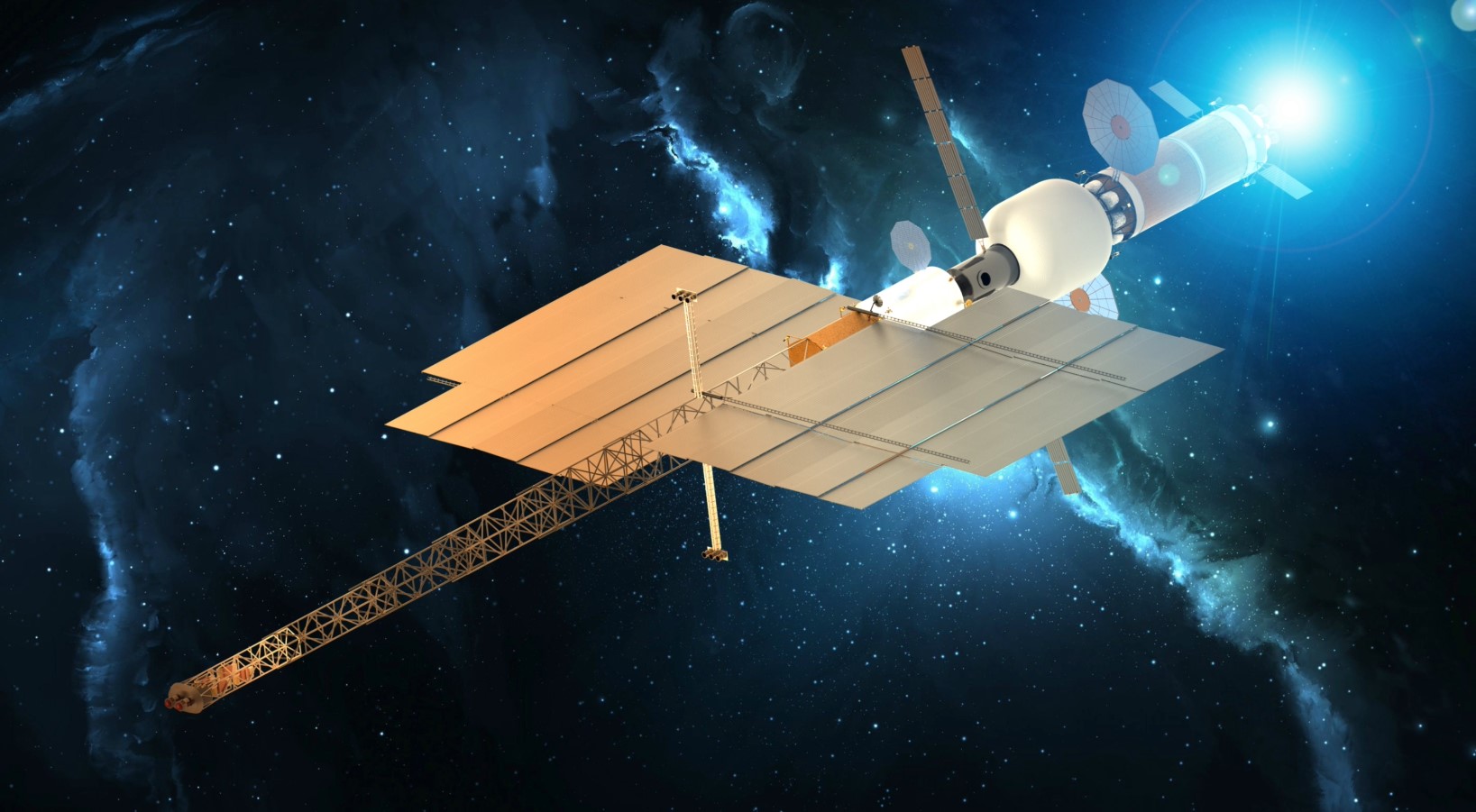
Modular Assembled Radiators for Nuclear Electric Propulsion Vehicles, or MARVL, aims to take a critical element of nuclear electric propulsion, its heat dissipation system, and divide it into smaller components that can be assembled robotically and autonomously in space. This is an artist’s rendering of what the fully assembled system might look like.
NASA
As NASA returns astronauts to the Moon through the agency’s Artemis campaign in advance of human exploration of Mars, researchers at Langley are exploring technology that could significantly reduce travel time to the Red Planet. Modular Assembled Radiators for Nuclear Electric Propulsion Vehicles, or MARVL, would use robots for in-space assembly of elements needed to enable nuclear electric propulsion of future spacecraft, which could transform travel to deep space.
NASA Cameras Catch First-of-its-Kind Moon Close-up
This rendering demonstrates what is happening during a stellar occultation and illustrates an example of the light curve data graph recorded by scientists that enables them to gather atmospheric measurements, like temperature and pressure, from Uranus as the amount of starlight changes when the planet eclipses the star.
NASA/Langley Research Center Advanced Concepts Laboratory
In April, planetary scientists at Langley led an international team of astronomers during a cosmic alignment three decades in the making: a rare opportunity to study Uranus. The one-hour event gave them a glimpse into the planet’s atmosphere, information that could enable future Uranus exploration efforts.
NASA Instrument Measures Wind for Improved Weather Forecasts
This visualization shows AWP 3D measurements gathered on Oct. 15, 2024, as NASA’s G-III aircraft flew along the East Coast of the U.S. and across the Great Lakes region. Laser light that returns to AWP as backscatter from aerosol particles and clouds allows for measurement of wind direction, speed, and aerosol concentration as seen in the separation of data layers.
NASA Scientific Visualization Studio
Severe or extreme weather can strike in a moment’s notice, and having the tools to accurately predict weather events can help save lives and property. Scientists at Langley have developed and are testing an instrument that uses laser technology to gather precise wind measurements, data that is a crucial element for accurate weather forecasting.
Langley Researchers Develop New Technique to Test Long, Flexible Booms
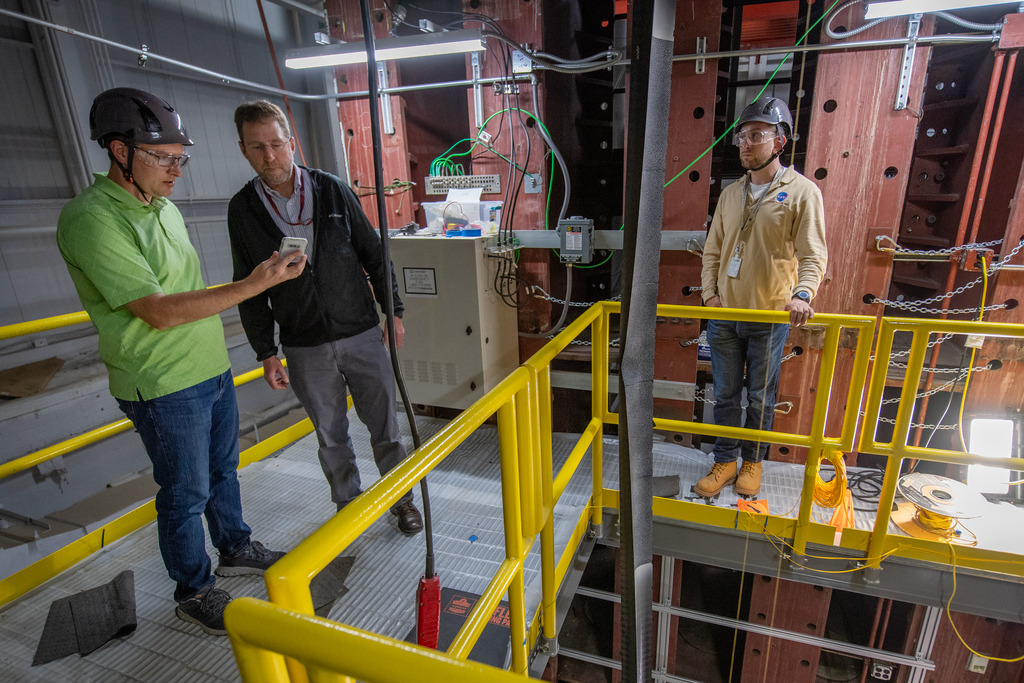
Researchers look at a bend that occurred in the 94-foot triangular, rollable and collapsible boom during an off-axis compression test.
NASA/David C. Bowman
Gravity can create issues when testing materials for space, but Langley researchers have found a way to successfully use gravity and height when testing long composite booms. Testing these composite booms is important because they could support space exploration in a variety of ways, including being used to build structures that could support humans living and working on the Moon.
NASA Imaging Team Supports Missions to Advance Space Exploration, Science
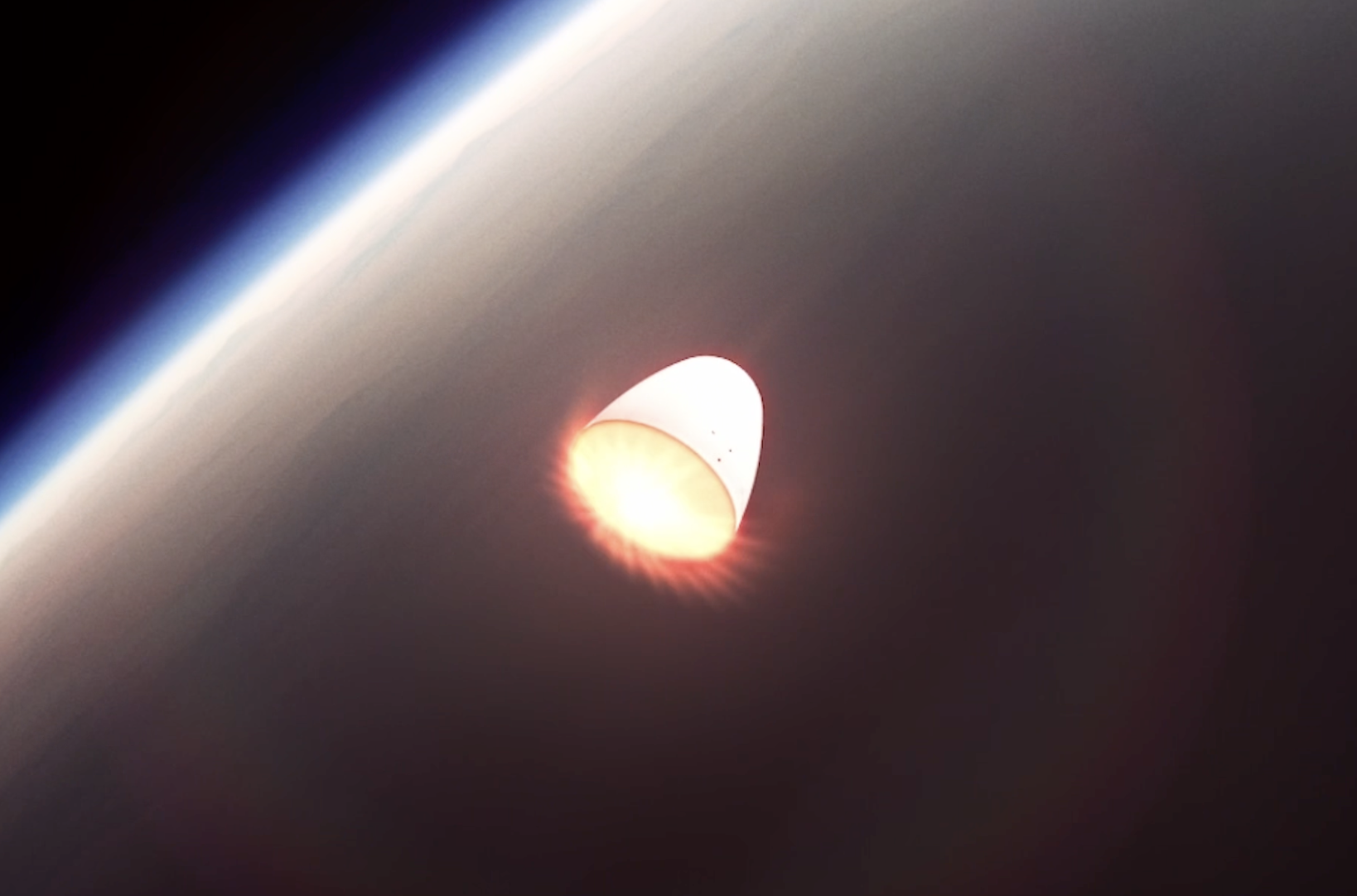
A rendering of a space capsule from The Exploration Company re-entering Earth’s atmosphere.
Image courtesy of The Exploration Company
A Langley team that specializes in capturing imagery-based engineering datasets from spacecraft during launch and reentry continued its work in 2025, including support of a European aerospace company’s test flight in June. Not only does the team support a variety of missions to advance the agency’s work, but they also collaborate with the private sector as NASA works to open space to more science, people, and opportunities.
NASA Instrument Uses Moonlight for Improved Space Measurements
An artist’s rendering of NASA’s Arcstone instrument on-orbit gathering measurements of lunar reflectance.
Blue Canyon Technologies
One of the most challenging tasks in remote sensing from space is achieving required instrument calibration on-orbit. Langley scientists are addressing the challenge head on through the Arcstone mission, an instrument that launched in June and aims to establish the Moon as a cost-efficient, high-accuracy calibration reference. Once established, the new standard can be applied to past, present, and future spaceborne sensors and satellite constellations. Arcstone uses a spectrometer, a scientific instrument that measures and analyzes light, to measure lunar spectral reflectance.
NASA Mission Continues Monitoring Air We Breathe
By measuring nitrogen dioxide (NO2) and formaldehyde (HCHO), TEMPO can derive the presence of near-surface ozone. On Aug. 2, 2024 over Houston, TEMPO observed exceptionally high ozone levels in the area. On the left, NO2 builds up in the atmosphere over the city and over the Houston Ship Channel. On the right, formaldehyde levels are seen reaching a peak in the early afternoon. Formaldehyde is largely formed through the oxidation of hydrocarbons, an ingredient of ozone production, such as those that can be emitted by petrochemical facilities found in the Houston Ship Channel.
NASA’s Scientific Visualization Studio
The success of NASA’s Tropospheric Emissions: Monitoring of Pollution mission, or TEMPO, earned the mission an extension, meaning the work to monitor Earth’s air quality from 22,000 miles above the ground will continue through at least September 2026. The Langley-led mission launched in 2023 and is NASA’s first to use a spectrometer, a scientific instrument that measures and analyzes light, to gather hourly air quality data continuously over North America during daytime hours. The data gathered is distributed freely to the public, giving air quality forecasters, scientists, researchers, and your next-door neighbor access to quality information about the air we breathe down to the neighborhood level.
NASA Tests New, Innovative Tech to Enable Faster Launches at Lower Costs
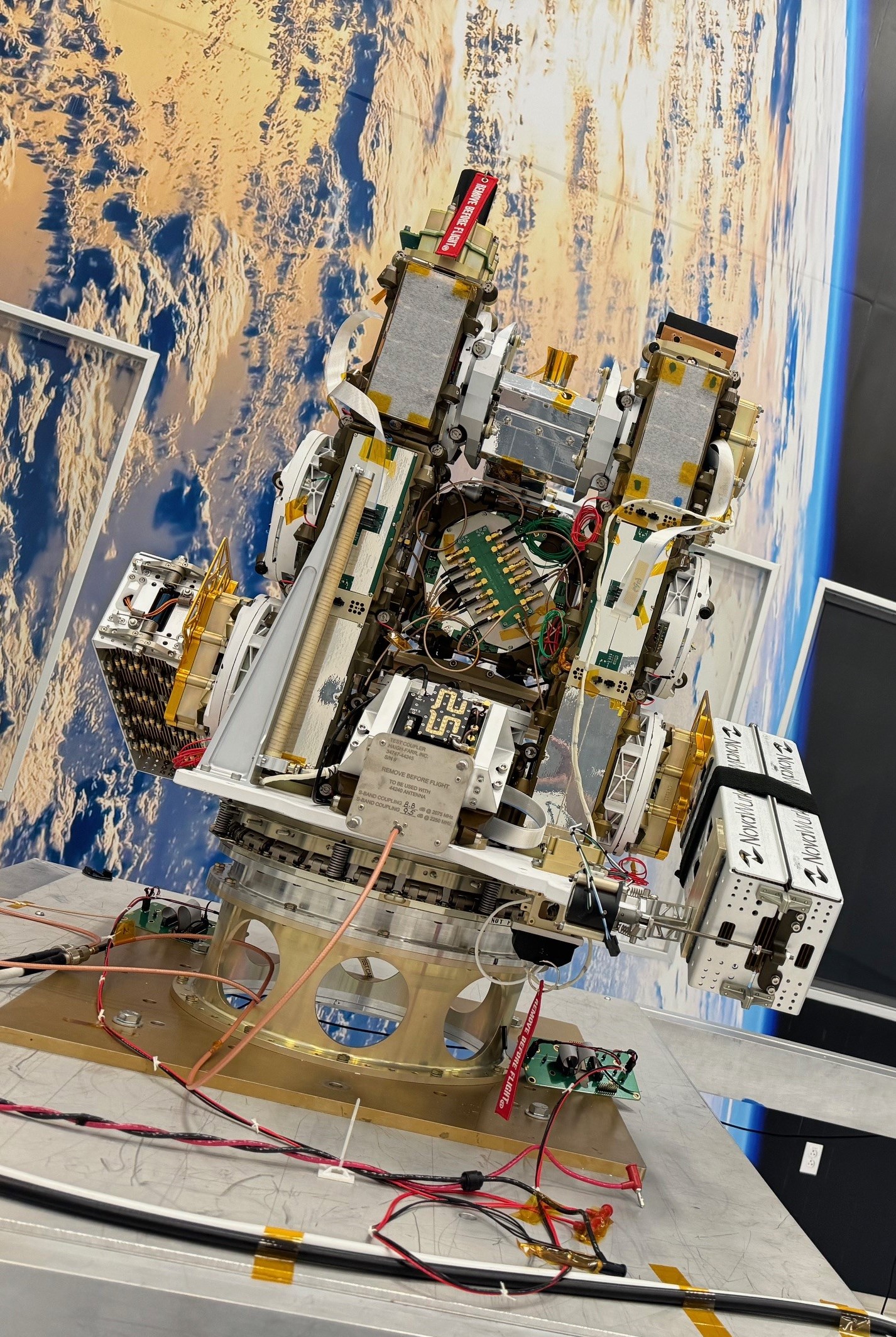
The fully assembled and tested Athena EPIC satellite which incorporates eight HISats mounted on a mock-up of a SpaceX provided launch pedestal which will hold Athena during launch.
NovaWurks
NASA’s Athena Economical Payload Integration Cost mission, or Athena EPIC, launched in July with the goal to shape a future path to launch that saves taxpayers money and expedites access to space. Athena EPIC was the first NASA-led mission to utilize HISat technology, small satellites engineered to aggregate, share resources, and conform to different sizes and shapes. Langley’s scientists designed and built the Athena sensor with spare parts from NASA’s CERES (Clouds and the Earth’s Radiant Energy System) mission to gather top of atmosphere measurements. Athena EPIC demonstrates a novel way to launch Earth-observing instruments into orbit quicker and more economically.
Drop Test at Langley Offers Research, Data for Potential Air Taxi Designs
The future of air travel includes the safe integration of drones and air taxis into our airspace for passenger transport, cargo delivery, and public service capabilities.That is why NASA is investigating and testing potential air taxi materials and designs to help the aviation industry better understand how those materials behave under impact. Data collected from a drop test at Langley’s Landing and Impact Research Facility in June will help in the development of safety regulations for advanced air mobility aircraft, leading to safer designs.
Langley Wind Tunnel Tests Help Support Advanced Air Mobility Aircraft Development
NASA researcher Norman W. Schaeffler adjusts a propellor, which is part of a 7-foot wing model that was recently tested at NASA’s Langley Research Center in Hampton, Virginia. In May and June, NASA researchers tested the wing in the 14-by-22-Foot Subsonic Wind Tunnel to collect data on critical propeller-wing interactions. The lessons learned will be shared with the public to support advanced air mobility aircraft development.
NASA/Mark Knopp
NASA advanced the future of air taxis and autonomous cargo drones by testing a 7-foot wing model in Langley’s 14-by-22-Foot Subsonic Wind Tunnel. This effort produced data on critical propeller-wing interactions, as well as data relevant to cruise, hover, and transition conditions for advanced air mobility aircraft. The results will help validate next-generation design tools and accelerate safe, reliable development across the advanced air mobility industry.
NASA Tests Air Taxi Tech for Future Aircraft Development
The Research Aircraft for electric Vertical takeoff and landing Enabling techNologies Subscale Wind Tunnel and Flight Test undergoes a free flight test on the City Environment Range Testing for Autonomous Integrated Navigation range at NASA’s Langley Research Center in Hampton, Virginia on April 22, 2025.
NASA/Rob Lorkiewicz
The lack of publicly available engineering and flight data to help address technical barriers in the design and development of new electric vertical takeoff and landing (eVTOL) aircraft is a challenge for researchers and engineers. That is why Langley researchers are using a research aircraft that provides real-world data, obtained through wind tunnel and flight tests, to help fill the information gap and check the accuracy of computer models for flight dynamics and controls. Making this data available to all is a key step in transforming the way we fly and safely integrating new aircraft into our nation’s airspace.
NASA Material Flies High for Study of Long-Term Effects of Space
Robert Mosher, HIAD materials and processing lead at NASA Langley, holds up a piece of f webbing material, known as Zylon, which comprise the straps of the HIAD.
NASA/Joe Atkinson
A material from NASA Langley is riding high as it orbits the Earth aboard a United States Space Force test vehicle, giving researchers a better understanding of how the material responds to long-duration exposure to the harsh vacuum of space. The strap material is a part of a Langley-developed aeroshell to protect spacecraft re-entering Earth’s atmosphere or to ensure their safe landing on other celestial bodies, such as Mars. Understanding how extended exposure to space affects the material is important as NASA prepares to send humans beyond the Moon.
NASA Flights Study Impacts of Space Weather on Travelers
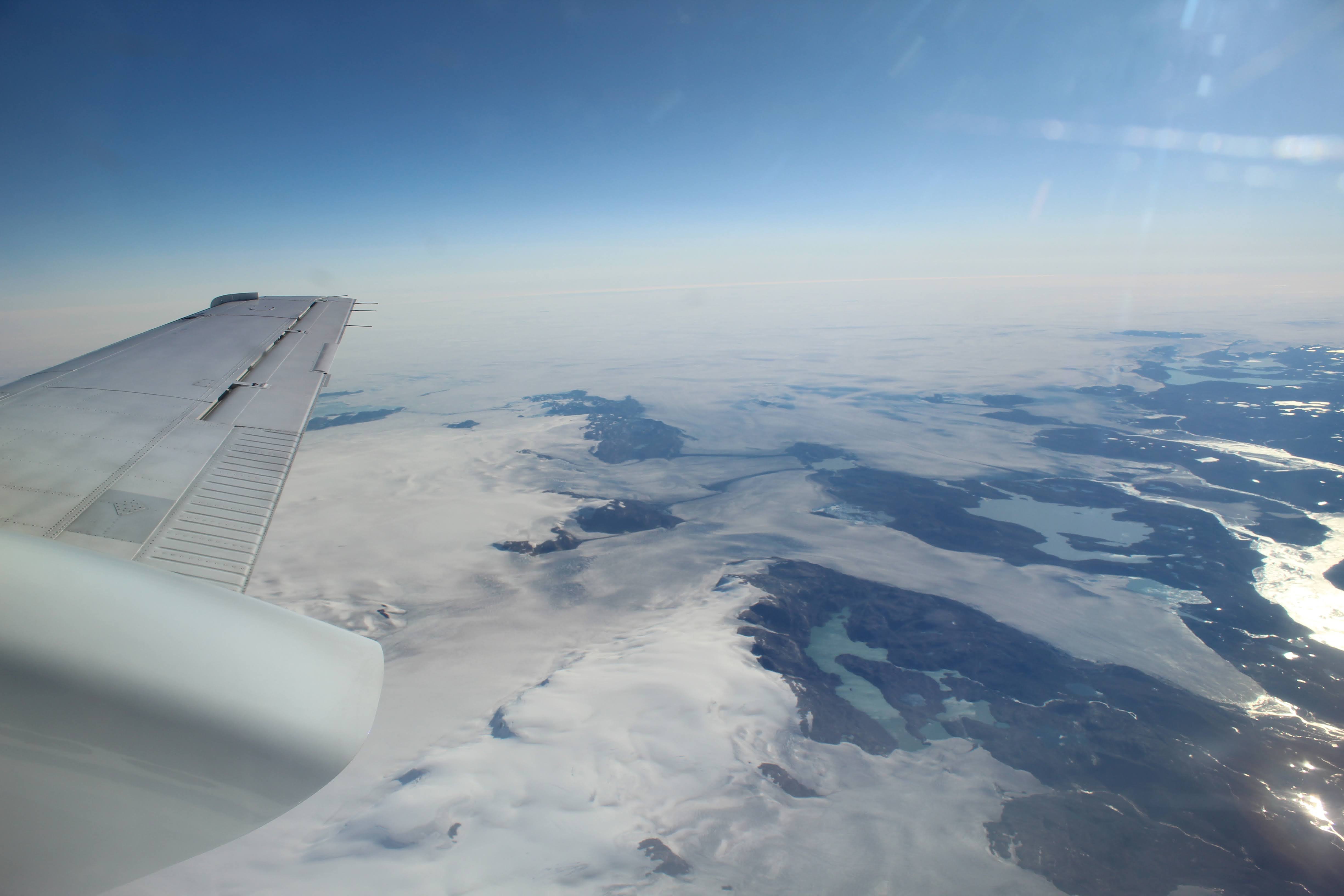
Frozen and rocky terrain in the Polar region observed from above Nuuk, Greenland during NASA’s SWXRAD science flights.
NASA/Guillaume Gronoff
Data gathered during a Langley-led airborne science campaign late this summer could help protect air travelers on Earth and future space travelers to the Moon, Mars, and beyond from the health risks associated with radiation exposure. NASA’s Space Weather Aviation Radiation (SWXRAD) aircraft flight campaign took place in Greenland and measured the radiation dose level to air travelers from cosmic radiation. Researchers are using the information to enhance a modeling system that offers real-time global maps of the hazardous radiation in the atmosphere and creates exposure predictions for aircraft and spacecraft.
NASA’s Dragonfly Completes Wind Tunnel Tests at Langley
Set up and testing of Dragonfly model in the Transonic Dynamics Tunnel
NASA/David C. Bowman
As NASA returns astronauts to the Moon through the Artemis campaign in preparation for human exploration of Mars, the agency also has its sights set on Saturn, specifically Saturn’s moon Titan. NASA’s Dragonfly, a car-sized rotorcraft set to launch no earlier than 2028, will explore Titan and try to discover how life began. This fall, engineers placed a full-scale test model representing half of the Dragonfly lander in Langley’s Transonic Dynamics Tunnel to evaluate how its rotor system performed in Titan-like conditions. The data will be integral in developing the rotorcraft’s flight plans and navigation software as it investigates multiple landing sites on Titan.
NASA Offers Science, Technology, and Expertise During Disaster Response
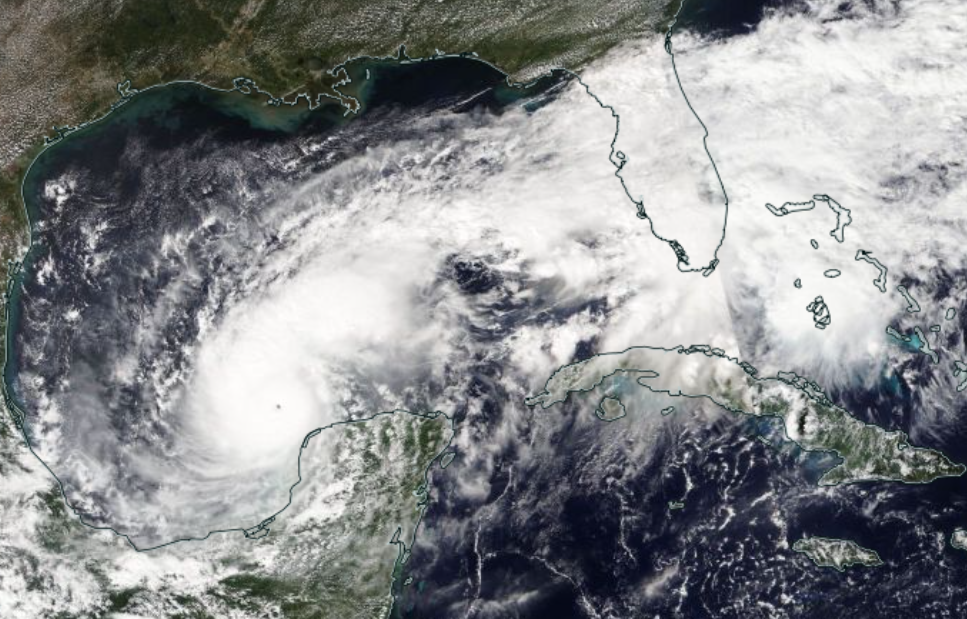
True color imagery of Hurricane Milton on Oct. 7, 2024, from the NOAA-21 satellite.
NASA / NOAA
In response to severe weather that impacted at least 10 states in April, the NASA Disasters Response Coordination System (DRCS) activated to support national partners. The DRCS is headquartered at Langley. NASA worked closely with the National Weather Service and the Federal Emergency Management Agency serving the central and southeastern U.S. to provide satellite data and expertise that help communities better prepare, respond, and recover.
NASA’s X-59 Takes Flight
In October, NASA’s Quesst mission celebrated a major milestone – the X-59 quiet supersonic one-of-a-kind research aircraft flew for the first time, a historic moment for aviation. The hard work, talent, and innovation of NASA engineers and project team members, including many based at NASA Langley, made this achievement possible. One of the notable traits of the X-59 is the eXternal Vision System (XVS) which allows the test pilots to safely maneuver the skies without a forward-facing window. This unique supersonic design feature was developed and tested at NASA Langley.
The X-59’s first flight was a major step toward quiet supersonic flight over land, which could revolutionize air travel.
What a Blast! Langley Begins Plume-Surface Interaction Tests
Views of the 60-foot vacuum sphere in the which the plume-surface interaction testing is happening.
NASA/Joe Atkinson
A team at NASA Langley is firing engine plumes into simulated lunar soil because as the United States returns to the Moon, both through NASA’s Artemis campaign and the commercialization of space, researchers need to understand the hazards that may occur when a lander’s engines blast away at the lunar dust, soil, and rocks.
Langley Inspires Through Community Engagement, Educational Opportunities
NASA Langley highlights its Cirrus Design SR22 during Air Power Over Hampton Roads STEM Day.
NASA/Angelique Herring
Langley connected with communities across Virginia and beyond to share the center’s work and impact, and inspire the next generation of explorers, scientists, and researchers. Thousands of spectators enjoyed hands-on activities and exhibits during the Air Power over Hampton Roads air show at Joint Base Langley-Eustis in Hampton, Virginia, where NASA Langley’s aviation past, present, and future were on full display. More than 2,300 students from across the nation eagerly participated in Langley’s 2025 Student Art Contest, and shared their artistic spin on the theme, “Our Wonder Changes the World.” Langley and Embry-Riddle Aeronautical University announced an agreement in September that will leverage Langley’s aerospace expertise and Embry-Riddle’s specialized educational programs and research to drive innovation in aerospace, research, education, and technology, while simultaneously developing a highly skilled workforce for the future of space exploration and advanced air mobility.
Langley looks forward to another year of successes and advancements in 2026, as we continue to make the seemingly impossible, possible.
This compressed, resolution-limited video features a preliminary sequence of the Blue Ghost final descent and landing that NASA researchers stitched together...
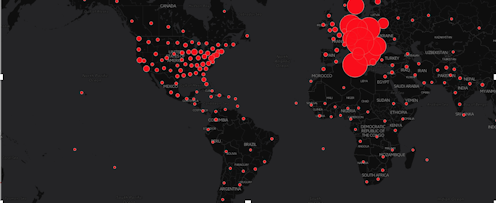
A geographical map depicting hotbeds of dark web activity related to illegal products. Larger circles indicate more activity.Christian Mattmann, CC BY-SA
In today’s data-rich world, companies, governments and individuals want to analyze anything and everything they can get their hands on – and the World Wide Web has loads of information. At present, the most easily indexed material from the web is text. But as much as 89 to 96 percent of the content on the internet is actually something else – images, video, audio, in all thousands of different kinds of nontextual data types.
Further, the vast majority of online content isn’t available in a form that’s easily indexed by electronic archiving systems like Google’s. Rather, it requires a user to log in, or it is provided dynamically by a program running when a user visits the page. If we’re going to catalog online human knowledge, we need to be sure we can get to and recognize all of it, and that we can do so automatically.
How can we teach computers to recognize, index and search all the different types of material that’s available online? Thanks to federal efforts in the global fight against human trafficking and weapons dealing, my research forms the basis for a new tool that can help with this effort.
Understanding what’s deep
The “deep web” and the “dark web” are often discussed in the context of scary news or films like “Deep Web,” in which young and intelligent criminals are getting away with illicit activities such as drug dealing and human trafficking – or even worse. But what do these terms mean?
The “deep web” has existed ever since businesses and organizations, including universities, put large databases online in ways people could not directly view. Rather than allowing anyone to get students’ phone numbers and email addresses, for example, many universities require people to log in as members of the campus community before searching online directories for contact information. Online services such as Dropbox and Gmail are publicly accessible and part of the World Wide Web – but indexing a user’s files and emails on these sites does require an individual login, which our project does not get involved with.
The “surface web” is the online world we can see – shopping sites, businesses’ information pages, news organizations and so on. The “deep web” is closely related, but less visible, to human users and – in some ways more importantly – to search engines exploring the web to catalog it. I tend to describe the “deep web” as those parts of the public internet that:
Require a user to first fill out a login form,
Involve dynamic content like AJAX or Javascript, or
Present images, video and other information in ways that aren’t typically indexed properly by search services.
The U.S. government has been interested in trying to find ways to use modern information technology and computer science to combat these criminal activities. In 2014, the Defense Advanced Research Projects Agency (more commonly known as DARPA), a part of the Defense Department, launched a program called Memex to fight human trafficking with these tools.
Specifically, Memex wanted to create a search index that would help law enforcement identify human trafficking operations online – in particular by mining the deep and dark web. One of the key systems used by the project’s teams of scholars, government workers and industry experts was one I helped develop, called Apache Tika.
The ‘digital Babel fish’
Tika is often referred to as the “digital Babel fish,” a play on a creature called the “Babel fish” in the “Hitchhiker’s Guide to the Galaxy” book series. Once inserted into a person’s ear, the Babel fish allowed her to understand any language spoken. Tika lets users understand any file and the information contained within it.
When Tika examines a file, it automatically identifies what kind of file it is – such as a photo, video or audio. It does this with a curated taxonomy of information about files: their name, their extension, a sort of “digital fingerprint. When it encounters a file whose name ends in ”.MP4,“ for example, Tika assumes it’s a video file stored in the MPEG-4 format. By directly analyzing the data in the file, Tika can confirm or refute that assumption – all video, audio, image and other files must begin with specific codes saying what format their data is stored in.
Once a file’s type is identified, Tika uses specific tools to extract its content such as Apache PDFBox for PDF files, or Tesseract for capturing text from images. In addition to content, other forensic information or "metadata” is captured including the file’s creation date, who edited it last, and what language the file is authored in.
From there, Tika uses advanced techniques like Named Entity Recognition (NER) to further analyze the text. NER identifies proper nouns and sentence structure, and then fits this information to databases of people, places and things, identifying not just whom the text is talking about, but where, and why they are doing it. This technique helped Tika to automatically identify offshore shell corporations (the things); where they were located; and who (people) was storing their money in them as part of the Panama Papers scandal that exposed financial corruption among global political, societal and technical leaders.
Tika extracting information from images of weapons curated from the deep and dark web. Stolen weapons are classified automatically for further follow-up.
Identifying illegal activity
Improvements to Tika during the Memex project made it even better at handling multimedia and other content found on the deep and dark web. Now Tika can process and identify images with common human trafficking themes. For example, it can automatically process and analyze text in images – a victim alias or an indication about how to contact them – and certain types of image properties – such as camera lighting. In some images and videos, Tika can identify the people, places and things that appear.
Additional software can help Tika find automatic weapons and identify a weapon’s serial number. That can help to track down whether it is stolen or not.
Employing Tika to monitor the deep and dark web continuously could help identify human- and weapons-trafficking situations shortly after the photos are posted online. That could stop a crime from occurring and save lives.
Memex is not yet powerful enough to handle all of the content that’s out there, nor to comprehensively assist law enforcement, contribute to humanitarian efforts to stop human trafficking and even interact with commercial search engines.
It will take more work, but we’re making it easier to achieve those goals. Tika and related software packages are part of an open source software library available on DARPA’s Open Catalog to anyone – in law enforcement, the intelligence community or the public at large – who wants to shine a light into the deep and the dark.
Christian Mattmann is affiliated with Jet Propulsion Laboratory, California Institute of Technology (NASA JPL).

 Login
Login