Reading view

There are new articles available, click to refresh the page.

SEC Seeks 10-Year Ban for Ellison, 8 Years for Wang and Singh

The Securities and Exchange Commission filed proposed final consent judgments today seeking officer-and-director bars against three former FTX executives who testified against Sam Bankman-Fried, with Caroline Ellison facing a decade-long prohibition, while Gary Wang and Nishad Singh would receive eight-year restrictions.

The filings in Manhattan federal court formalize settlement terms for executives who cooperated extensively with prosecutors during Bankman-Fried’s criminal trial but still face permanent securities law injunctions.

Ellison, Wang, and Singh agreed to permanent injunctions barring future violations of federal antifraud provisions, along with five-year conduct-based restrictions, according to SEC Litigation Release 26450.

The proposed judgments require court approval before taking effect.

The U.S. SEC said it has filed proposed final consent judgments in the Southern District of New York against Caroline Ellison, former CEO of Alameda Research, Zixiao “Gary” Wang, former CTO of FTX, and Nishad Singh, former co-lead engineer of FTX. Subject to court approval, the…

— Wu Blockchain (@WuBlockchain) December 19, 2025

Notably, the latest SEC enforcement action was conducted by Amy Burkart alongside investigators Devlin Su, Ivan Snyder, David Brown, Brian Huchro, and Pasha Salimi under the supervision of Laura D’Allaird and Amy Flaherty Hartman from the Cyber and Emerging Technologies Unit.

FTX Executives Consent to Permanent Securities Fraud Injunctions

The SEC’s original complaints alleged that from May 2019 through November 2022, the executives participated in raising over $1.8 billion from investors through false claims about FTX’s safety measures and risk controls.

Prosecutors charged that Bankman-Fried, Wang, and Singh exempted Alameda Research from automated risk mitigation while granting the trading firm unlimited access to customer deposits.

Wang and Singh wrote software that diverted FTX customer funds to Alameda, while Ellison directed misappropriated assets toward the hedge fund’s trading operations.

Bankman-Fried subsequently transferred hundreds of millions in additional customer funds to Alameda for venture investments and personal loans to executives, including Wang and Singh.

The three defendants consented to final judgments without admitting or denying the SEC’s allegations.

Beyond permanent antifraud injunctions under Securities Exchange Act Section 10(b) and Securities Act Section 17(a), they accepted conduct-based restrictions that would prevent similar violations for five years.

Cooperation Yields Divergent Criminal Sentences Despite Securities Bars

Just days ago, it was discovered that Ellison completed approximately 11 months at Danbury Federal Correctional Institution before transferring to community confinement in October, with her projected release now set for February 2026.

⚖ Caroline Ellison moved to community confinement after 11 months, projected release February 2026 following FTX fraud cooperation.#FTX #Cryptohttps://t.co/gFUZ1a4Tdu

— Cryptonews.com (@cryptonews) December 17, 2025

Judge Lewis Kaplan sentenced her to two years despite defense requests for probation, praising her substantial cooperation while maintaining that the fraud’s severity warranted incarceration.

During her September 2024 sentencing hearing, Ellison expressed deep remorse while holding back tears.

On some level, my brain doesn’t even comprehend all the people I harmed,” she told the court.

Her attorneys had requested no prison time, but Kaplan rejected what he termed a “literal get-out-of-jail-free card” despite acknowledging her unprecedented cooperation.

Federal prosecutors emphasized Ellison’s critical testimony in their September sentencing recommendation, noting the “what” and “how” of the crimes would have been difficult to prove without her three days of trial testimony.

She revealed that Bankman-Fried instructed executives to invest billions in customer assets that had been secretly siphoned from FTX through Alameda Research.

Wang and Singh received time-served sentences with supervised release after testifying that Bankman-Fried directed the creation of an “allow negative” feature that granted Alameda nearly unlimited access to customer funds.

Both avoided additional prison time entirely following their cooperation.

FTX Bankruptcy Delivers Creditor Repayments Exceeding Original Claims

FTX’s Chapter 11 reorganization plan resumed distributions in May 2025, delivering between 119% and 143% to eligible creditors who completed verification requirements through designated service providers BitGo or Kraken.

Around 98% of affected users with claims under $50,000 received 119% of their declared funds under the bankruptcy court’s approved restructuring framework.

Bankman-Fried remains incarcerated at a low‑security Federal Correctional Institution Terminal Island in Los Angeles, serving his 25-year sentence following conviction on seven fraud and conspiracy counts.

🏛 Sam Bankman-Fried (SBF) is pushing for a new trial this week following his 2023 conviction tied to his time at FTX.#SBF #FTXhttps://t.co/xEIAr7gcJE

— Cryptonews.com (@cryptonews) November 3, 2025

Most recently, his November appeal hearing challenged the claim that he was “presumed guilty,” asserting that he was denied fair trial procedures.

At the same time, his family continues to seek presidential clemency, arguing that FTX maintained sufficient assets to repay all customers in full throughout the collapse.

The post SEC Seeks 10-Year Ban for Ellison, 8 Years for Wang and Singh appeared first on Cryptonews.

Election Year Politics Threaten Bipartisan Crypto Bill Push

The Senate’s long-awaited crypto market structure bill is hitting another critical juncture as midterm election pressures begin to overshadow bipartisan negotiations.

According to Politico, Senate Banking Chair Tim Scott now faces mounting challenges to pass the landmark legislation after pushing a committee vote into 2026, with lawmakers warning that Congress’s traditional election-year gridlock could derail the effort entirely.

The bill aims to establish a comprehensive regulatory framework for digital assets and to determine which federal agencies oversee different crypto sectors.

Its passage hinges on Republicans reaching an agreement with Senate Democrats on several sticking points, including ethics concerns surrounding President Donald Trump’s family’s crypto ventures, which could become campaign flashpoints.

🇺🇸 Sen. Moreno warns U.S. lawmakers: “No deal is better than a bad deal.” U.S. crypto legislation may be delayed

#Regulation #CLARITYActhttps://t.co/Z9QlO4yiD4

— Cryptonews.com (@cryptonews) December 9, 2025

Republicans hope to deliver what would be a signature legislative achievement of Trump’s second term.

Campaign Cash Complicates Political Calculus

The crypto and banking industries are preparing massive campaign spending pushes that could scramble the political dynamics as elections approach.

Politico asserts that the crypto sector has already poured over $140 million into the Fairshake super PAC network, backing industry-friendly candidates across both parties.

In a significant development this week, major U.S. banks launched the American Growth Alliance, a nonprofit that will deploy “tens of millions of dollars” to advance their interests in the crypto debate, particularly around restricting yield programs on stablecoins.

These competing financial incentives create complicated pressures for Democrats, especially.

While passing legislation could keep them in crypto firms’ good graces, failing to reach a deal might actually incentivize continued industry support since bipartisan backing would be needed for future legislative efforts.

Senator Cynthia Lummis noted that the industry’s willingness to contribute to both parties creates “a powerful incentive for politicians to pussyfoot around.

@SenLummis says she wants a markup on the crypto market structure bill next week even as staff are “exhausted” from nonstop revisions. #Crypto #USPolicy #Lummishttps://t.co/RadNIvnWLp

— Cryptonews.com (@cryptonews) December 9, 2025

The crypto industry’s political advocacy group, Stand With Crypto, escalated the pressure this week, announcing it will score lawmakers based on how they vote during market structure markups and warning that “failure to pass Market Structure jeopardizes everything that this community has built and fought for.

Window for Action Rapidly Closing

Senator Thom Tillis (R-N.C.) warned that lawmakers have until roughly March to finalize the bill, after which “we’re in the political silly season.

The compressed timeline comes as bipartisan negotiations stretch deeper into an election year marked by heightened political tensions.

Scott said this week that lawmakers are “making steady, bipartisan progress” while working through the text “in a thoughtful, deliberate way,” emphasizing his focus on “building a durable framework that provides regulatory clarity, protects investors, and keeps America at the forefront of financial innovation.

Democrats say they’re focused on substance rather than political considerations.

Senator Ruben Gallego also emphasized the urgency of action following an October meeting with crypto executives, warning that failure to pass legislation could push crypto industries overseas or into illicit markets.

Negotiations Continue Amid Multiple Pressure Points

The Senate effort follows months of stalled progress after the record-breaking government shutdown and disagreements over decentralized finance regulation.

While the House passed its Digital Asset Market Clarity Act in July with bipartisan support, giving the CFTC primary oversight of digital commodities, the Senate has been developing its own framework, using different terminology, such as “ancillary assets,” to define non-security tokens.

Scott must also navigate concerns from some GOP members, with Senator John Kennedy defending the delayed markup as “inevitable” while praising the chairman for creating “a sense of urgency” amid productive negotiations.

Recent developments have intensified the legislative urgency beyond campaign finance considerations.

The pro-crypto advocacy group Stand With Crypto warned that inaction would jeopardize years of industry development.

🚨Teachers’ union AFT calls on Congress to kill the crypto market-structure bill before it advances. warning that the bill threatens pensions and 401(k)s, #Crypto #Pensionshttps://t.co/YTicn3pURn

— Cryptonews.com (@cryptonews) December 10, 2025

Meanwhile, opposition emerged this week from the American Federation of Teachers, which warned the legislation could expose public-sector pensions to unsafe assets by allowing companies to tokenize stock and bypass traditional securities oversight.

AFT President Randi Weingarten said the bill “poses profound risks to the pensions of working families,” arguing it would replace existing safeguards with a framework that leaves retirement plans more vulnerable than they are today.

The post Election Year Politics Threaten Bipartisan Crypto Bill Push appeared first on Cryptonews.

Bitcoin Cash Price Prediction: Is the BCH Price Headed to $650 Before Christmas?

Bitcoin Cash stands out as one of the strongest-performing altcoins in the crypto market currently, and if it maintains this momentum, Bitcoin Cash price prediction indicates the token is targeting $650 before Christmas.

BCH Outperforms Despite Bear Market Scare

Even on October 10, when most altcoins crashed by approximately 80%, Bitcoin Cash barely moved and has rallied over 20% since then.

Currently trading around $595.50 with a market capitalization of $11.9 billion, BCH requires only a 12% surge to break the $650 resistance and surpass Cardano as the 10th largest cryptocurrency by market cap.

https://twitter.com/CoinDome_/status/2001973383043400176?s=20

Data from Coinglass reveals that Binance’s top traders are rapidly expanding their BCH long positions.

And with Grayscale’s September filing with the U.S. Securities and Exchange Commission (SEC) to obtain approval for exchange-traded funds (ETFs) that would follow the performance of Bitcoin Cash, the possibility of BCH surpassing $650 when approved is very high.

With the filing, the digital assets platform intends to convert its current closed-end trusts for Bitcoin cash into ETFs that will mainly be listed on NYSE Arca or Nasdaq.

Bitcoin Cash Price Prediction: Daily Chart Shows Bullish Structure Building

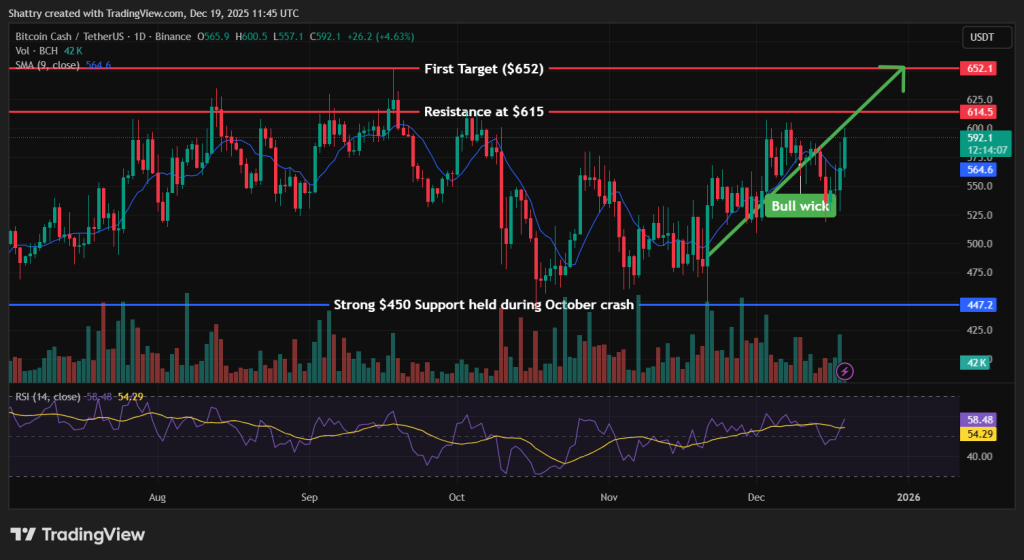
Bitcoin Cash’s daily chart displays a constructive bullish formation developing after successfully defending the $450 support during October’s selloff, which marked a clear higher-timeframe demand zone.

Since that low, price has established a series of higher lows and recently printed a strong bullish wick, signaling aggressive dip-buying and rejection of lower prices. BCH now trades above its short-term moving average, which is beginning to slope upward, reinforcing the momentum shift back to the upside.

The $615 area remains the key near-term resistance, having capped price multiple times in recent months, but the latest daily close near $592 suggests growing pressure on this level.

Bitcoin Cash Price Prediction - Price Chart Analysis
Source: TradingView

RSI has advanced back above the mid-50s, reflecting strengthening bullish momentum without entering overbought territory, leaving room for continuation.

If BCH secures a decisive daily close above $615, the structure supports continuation toward the $650–$652 region, which aligns with the next major resistance and prior distribution zone.

Failure at resistance would likely trigger a shallow pullback toward rising trend support around the mid-$560s, but provided price maintains above this area, the broader bias remains bullish with higher prices favored over the coming sessions.

Maxi Doge Raises $4.3M To Position for Christmas Rally

If Bitcoin Cash breaks the $650 resistance before Christmas, significant attention would spotlight undervalued presale projects like Maxi Doge (MAXI).

Maxi Doge is an early-stage memecoin following the Dogecoin playbook that helped it achieve over 2x pump during the November-December 2024 Santa rally.

The project has now established an alpha channel to help traders exchange insider tips, share early trade ideas, and discover hidden opportunities to capitalize on a similar memecoin Christmas rally.

Bitcoin Cash Price Prediction - Maxidoge banner

The MAXI presale has already raised over $4.3 million and offers 72% annual staking rewards for those entering early at the current $0.000274 price before it increases.

To buy early, visit the official Maxi Doge website and connect a crypto wallet like Best Wallet.

You can pay with existing crypto like USDT and ETH, or use a bank card to complete your purchase immediately.

Visit the Official Maxi Doge Website Here

The post Bitcoin Cash Price Prediction: Is the BCH Price Headed to $650 Before Christmas? appeared first on Cryptonews.

MemeCore Price Prediction: Can the M Price Rebound Following a Sharp 9% Decline Overnight?

MemeCore price has dropped 9% in the last 24 hours, extending total losses to nearly 50% from September highs.

However, analysts say the MemeCore price prediction indicators point toward a rebound before year-end.

“Meme 2.0” Blockchain Infrastructure

MemeCore operates as a Layer 1 blockchain centered on the “Meme 2.0” concept, aiming to evolve meme coins from short-term speculative vehicles into sustainable, community-powered assets.

https://twitter.com/AltCryptoGems/status/2001336590141161544?s=20

Beyond functioning as another digital gambling token, MemeCore provides infrastructure enabling creators, communities, and brands to tokenize and monetize memes directly on-chain.

MemeCore establishes itself as a convergence point where humor, creativity, and decentralized finance meet.

The $M token facilitates transactions, ecosystem incentives, and governance, synchronizing user participation with network expansion.

The blockchain employs a “Proof of Meme” (PoM) consensus mechanism that rewards creators, validators, and users of meme coins.

MemeCore is now approaching a $3 billion market capitalization while maintaining above $1.50 despite recent declines.

This momentum shows no signs of slowing down as chart patterns point to a potential rebound heading into Christmas.

Memecore Price Prediction: $1.70 Support Critical for Recovery

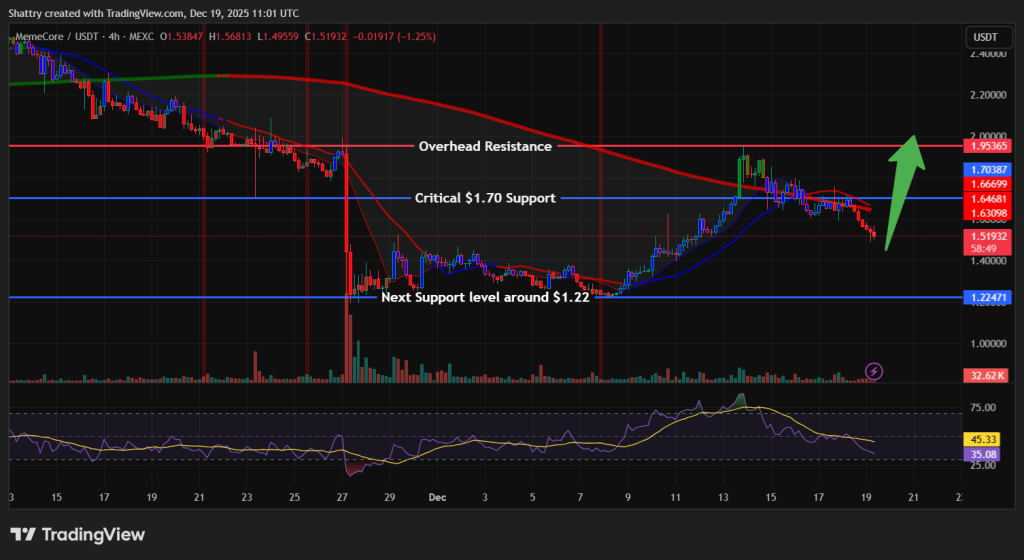
This 4-hour chart shows MemeCore in a recovery phase after a sharp capitulation move, but momentum has clearly slowed as price runs into overhead supply.

The rebound from the $1.22 base was strong and impulsive, indicating aggressive dip-buying and short covering, yet that rally stalled just below the $1.95 area, which now stands out as a well-defined overhead resistance.

Since failing there, price has rolled over and is consolidating below the critical $1.70 support, a level that has flipped from demand to a key make-or-break zone.

MemeCore Price Prediction - Memecore Price Chart
Source: TradingView

RSI has cooled into the mid-30s to low-40s range, reflecting fading buying pressure without yet signaling extreme oversold conditions.

This implies consolidation or further downside is still possible before a sustainable bounce develops.

As long as $1.70 is reclaimed quickly, the broader recovery structure from $1.22 can stay intact, leaving room for another attempt toward $1.95–$2.00 resistance.

However, failure to hold this zone increases the probability of a deeper retracement, with $1.22 acting as the next major downside magnet where stronger demand previously stepped in.

Pepenode Offers Early Access to Memecoin Season 2.0

MemeCore recovery above the $1.90 resistance level could trigger a memecoin season 2.0 rally that would benefit early-stage meme coins like Pepenode (PEPENODE).

Pepenode is a new crypto project still in its presale round that’s already raised over $2.3 million despite the memecoin sector losing over 50% of its value year-to-date.

MemeCore Price Prediction - Pepenode Banner

It’s a game where you can mine coins without needing expensive hardware setups.

You play the game in your web browser, set up virtual mining rigs, and upgrade your facilities to earn PEPENODE tokens.

Now that more people are investing in Pepenode’s mining rigs, the presale price is increasing every day.

To join the presale before the ongoing round sells out, go to the official Pepenode website and connect a crypto wallet like Best Wallet.

You can then buy PEPENODE tokens for $0.0012016 and pay with crypto using ETH or USDT, or use a bank card for fast payment.

Visit the Official Pepenode Website Here

The post MemeCore Price Prediction: Can the M Price Rebound Following a Sharp 9% Decline Overnight? appeared first on Cryptonews.

Bank of Japan Hikes Rates to 30-Year High as Yen Weakens – The Catalyst for Bitcoin Rebound?

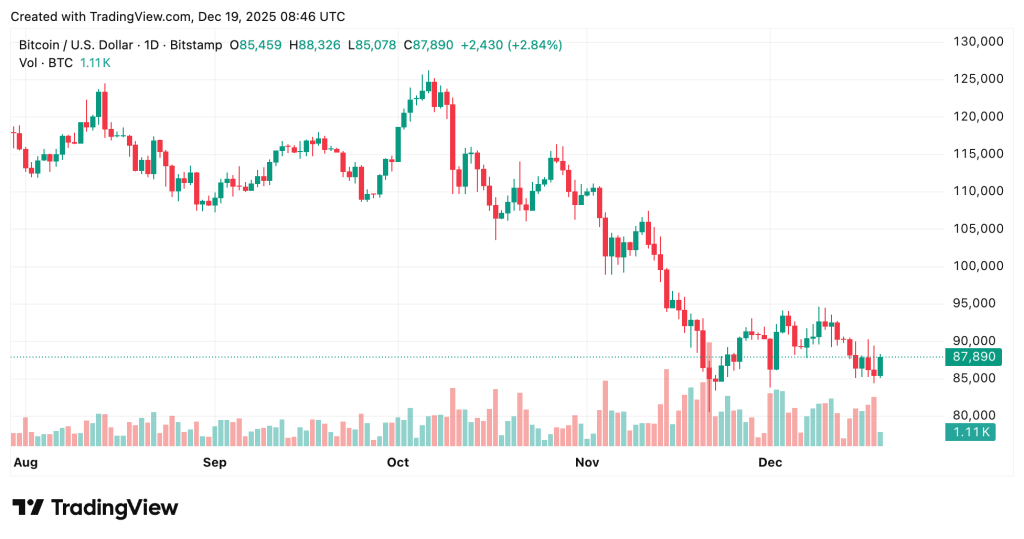
The Bank of Japan raised interest rates to 0.75% on December 19, marking the highest borrowing costs in three decades and triggering immediate speculation about implications for global crypto markets.

Bitcoin climbed 2.5% to approach $88,000 following the decision, which came as policymakers balanced inflation concerns against mounting fiscal pressures from Prime Minister Sanae Takaichi’s $117 billion stimulus package.

Bank of Japan Hikes Rates - Bitcoin Price Chart
Source: TradingView

The central bank voted unanimously to lift short-term rates from 0.5%, stating that “real interest rates are expected to remain significantly negative,” and that “accommodative financial conditions will continue to firmly support economic activity.

Governor Kazuo Ueda emphasized the bank would “continue to raise the policy interest rate and adjust the degree of monetary accommodation” if the economic outlook materializes as projected.

Historic Move Confronts Deepening Fiscal Challenges

The rate increase represents Japan’s most aggressive monetary tightening since 1995, though borrowing costs remain far below those in other major economies.

The decision arrives as Takaichi’s government pushes through expansive fiscal policies funded largely by issuing more bonds.

More than half of the stimulus spending will come from additional debt issuance, raising concerns about Japan’s already massive public debt, more than twice the size of its economy.

Speaking to The New York Times, George Goncalves, head strategist at MUFG, noted the “volatile mix of growing debt, higher interest rates, aggressive fiscal spending and tariffs make the path forward for Japan’s economy difficult to predict.

Market reactions were mixed, with the yen initially strengthening before giving up those gains as investors digested the statement’s implications.

Christopher Wong, currency strategist at OCBC, speaking with Reuters, added that “the yen initially strengthened but quickly surrendered those gains, in part reflecting thin market liquidity that amplified short-term price action rather than a reassessment of fundamentals.

Divergent Policy Paths Signal Volatility Ahead

The rate hike comes amid broader regulatory shifts in Japan’s crypto landscape.

The Financial Services Agency recently proposed requiring exchanges to hold dedicated reserves against customer losses, extending a framework long used in traditional securities markets.

The move follows major breaches, including Bybit’s February 2025 hack, which resulted in roughly $1.46 billion in losses.

Japan is also simultaneously preparing its most sweeping overhaul of crypto oversight in almost a decade, planning to move digital assets under the Financial Instruments and Exchange Act.

The transition would impose stricter disclosure requirements and explicit insider-trading rules covering token listings, major system breaches, and large-scale issuer sales.

Arthur Hayes, former BitMEX CEO, reacted bullishly to the decision on social media. “Don’t fight the BOJ: -ve real rates is the explicit policy,” Hayes wrote. “$JPY to 200, and $BTC to a milly.

Don’t fight the BOJ: -ve real rates is the explicit policy. $JPY to 200, and $BTC to a milly. pic.twitter.com/PdZh87ruVI

— Arthur Hayes (@CryptoHayes) December 19, 2025

Speaking with Cryptonews, Ignacio Aguirre, CMO at Bitget, offered measured optimism despite near-term uncertainty.

However, the BOJ’s tightening stands in contrast to widely expected Fed rate cuts in early 2026, setting up a period of heightened volatility that often creates attractive accumulation windows for long-term investors,” Aguirre said.

He projected Bitcoin could retest the $95,000–$100,000 range by early 2026.

Market Analysts Split on Bitcoin’s Near-Term Trajectory

Trader Michael van de Poppe downplayed the hike’s lasting impact on crypto markets.

Markets knew this beforehand, so the actual impact of this rate hike is firstly, going to have less impact the more those will take places as the marginal impact for the Carry Trade is getting less and less,” van de Poppe said.

He argued markets had “overpriced this to the downside prior to the event expecting a big crash to occur,” adding that given the soft inflation outlook, “it’s time to get back to the fair price for Bitcoin.

Bitcoin initially dipped below $86,000 following the announcement due to yen carry trade unwinds, but quickly rebounded above $87,000 as pre-event downside fears proved overblown.

CryptoMichNL noted the hike’s reduced marginal impact on carry trades from prior adjustments, with markets having priced in a severe crash that didn’t materialize.

TOM LEE SAID #BITCOIN IS STILL GOING TO $200,000 IN THE NEXT 45 DAYS 🚀 pic.twitter.com/2lpo0wlJPN

— That Martini Guy ₿ (@MartiniGuyYT) December 19, 2025

Meanwhile, Fundstrat’s Tom Lee also reaffirmed his prediction that Bitcoin will reach $200,000 by late January 2026 in a recent CNBC interview, implying a near-doubling from current levels around $85,500 amid post-election consolidation.

Lee’s forecast draws on surging spot ETF inflows exceeding $30 billion year-to-date and anticipated regulatory easing under the Trump administration, aligning with his accurate 2024 call for Bitcoin surpassing $100,000 during the halving cycle.

The post Bank of Japan Hikes Rates to 30-Year High as Yen Weakens – The Catalyst for Bitcoin Rebound? appeared first on Cryptonews.

Aptos Proposes Quantum-Resistant Signatures to Future-Proof Blockchain Security

Aptos has unveiled AIP-137, introducing SLH-DSA-SHA2-128s as its first post-quantum signature scheme to protect against future quantum computing threats.

The proposal, drafted by Aptos Labs Head of Cryptography Alin Tomescu, aims to prepare the network for quantum computers that are cryptographically relevant before they become an urgent concern.

The initiative arrives as quantum computing transitions from theoretical speculation to tangible reality, with IBM discussing scaling paths and NIST publishing finalized post-quantum standards.

While experts debate whether quantum threats will materialize in five or fifty years, Aptos is choosing conservative preparation over reactive scrambling.

Plans for a post-quantum future on Aptos, drafted by @AptosLabs' Head of Cryptography, @alinush.

→ AIP-137 aims to empower Aptos to better respond to future developments in quantum computing with a focus on ease of integration & limited new security assumptions.

Learn more 👇 https://t.co/dgPRueL4Jk

— Aptos (@Aptos) December 18, 2025

Conservative Security Over Performance

AIP-137 prioritizes security assumptions over efficiency by selecting SLH-DSA-SHA2-128s, a stateless hash-based signature scheme standardized by NIST as FIPS 205.

The scheme relies exclusively on SHA-256, a hash function already embedded throughout Aptos infrastructure, requiring no new cryptographic assumptions.

This conservative approach addresses past failures in post-quantum cryptography, where schemes like Rainbow, a NIST finalist based on multivariate cryptography, were broken entirely on commodity laptops in 2022.

By building on proven hash functions rather than exotic mathematical assumptions, Aptos minimizes the risk of classical attacks defeating supposedly quantum-secure schemes.

The trade-off is between size and speed. Signatures will measure 7,856 bytes, 82 times larger than Ed25519, while verification takes approximately 294 microseconds, roughly 4.8 times slower.

These performance costs are deliberate, accepting efficiency losses in exchange for ironclad security guarantees that don’t introduce untested cryptographic assumptions into the system.

Alternative schemes like ML-DSA offer smaller signatures and faster verification but depend on the hardness of structured lattice problems, introducing new mathematical assumptions.

Falcon delivers even better performance with compressed signatures around 1.5 KB, but requires floating-point arithmetic, which makes implementation error-prone.

Aptos is reserving these aggressive optimizations for future proposals once SLH-DSA establishes a conservative baseline.

Preparing Without Mandating Migration

The proposal explicitly avoids forced migration, keeping Ed25519 as the default signature scheme while introducing SLH-DSA as an optional layer that governance can enable when quantum threats warrant activation.

Users requiring post-quantum assurances can adopt the scheme selectively without disrupting the broader network.

This measured approach aligns with broader industry perspectives on quantum preparedness.

MicroStrategy founder Michael Saylor recently argued that “quantum computing won’t break Bitcoin—it will harden it,” suggesting that networks that upgrade proactively will see security improve while supply dynamics tighten, as lost coins remain frozen.

The Bitcoin Quantum Leap: Quantum computing won’t break Bitcoin—it will harden it. The network upgrades, active coins migrate, lost coins stay frozen. Security goes up. Supply comes down. Bitcoin grows stronger.

— Michael Saylor (@saylor) December 16, 2025

His view reflects a growing consensus that quantum threats, while serious, present opportunities for networks prepared to evolve their cryptographic foundations.

For Aptos, implementation includes feature flags allowing controlled deployment across validators, indexers, wallets, and development tools.

The phased rollout gives the ecosystem time to adapt infrastructure before quantum computers become capable of breaking current cryptography.

Industry-Wide Quantum Concerns Mount

The proposal reflects broader anxiety in the crypto industry about the timelines for quantum computing.

Solana co-founder Anatoly Yakovenko recently warned that Bitcoin has a 50% chance of facing quantum breakthroughs within five years, urging accelerated adoption of quantum-resistant schemes as AI acceleration compresses development timelines.

Experts estimate 30% of Bitcoin’s supply, roughly 6-7 million BTC worth hundreds of billions of dollars, remains vulnerable in older address formats that expose public keys directly.

Tech giants are racing toward quantum supremacy with aggressive timelines. IBM plans to build 100,000-qubit chipsets by decade’s end, while PsiQuantum targets one million photonic qubits within the same timeframe.

Microsoft claims quantum computing is now “years, not decades” away following recent chip breakthroughs, while Google’s Willow chip solved problems in five minutes that would take classical computers billions of years.

⚠ Solana's @aeyakovenko warns Bitcoin has 5-year window to prepare for quantum computing threat with millions of BTC potentially vulnerable to future attacks.#Bitcoin #Quantumhttps://t.co/z9VpFCZwNM

— Cryptonews.com (@cryptonews) September 19, 2025

Gavin Brennen from Macquarie University told Cryptonews that estimates for breaking 256-bit elliptic curve signatures have dropped from requiring 10-20 million qubits to around one million.

A plausible timeline for cracking 256-bit digital signatures is by the mid-2030s,” Brennen said.

Grayscale’s 2026 Digital Asset Outlook also acknowledged quantum computing as a long-term cryptographic challenge but dismissed near-term price impacts, noting cryptographically relevant quantum computers remain unlikely before 2030.

However, the asset manager emphasized that most blockchains will ultimately require post-quantum upgrades as the technology advances toward practical viability.

The post Aptos Proposes Quantum-Resistant Signatures to Future-Proof Blockchain Security appeared first on Cryptonews.

NYSE Owner ICE in Talks to Invest in MoonPay at Nearly $5 Billion Valuation

Intercontinental Exchange (ICE), the company behind the New York Stock Exchange (NYSE), is negotiating an investment in crypto payments firm MoonPay as part of a funding round that could value the company at approximately $5 billion, according to a recent Bloomberg report.

The potential valuation marks a 47% increase from MoonPay’s previous $3.4 billion valuation, which comes just a month after the company secured approval from the New York Department of Financial Services to position it alongside Coinbase and PayPal.

Intercontinental Exchange, owner of the New York Stock Exchange, is in talks to invest in crypto payments firm MoonPay as part of a funding round, people familiar with the matter said https://t.co/vpWqgfO5bF

— Bloomberg (@business) December 18, 2025

ICE Expands Digital Asset Portfolio with Strategic Bets

ICE’s potential investment reflects an aggressive expansion into emerging financial technologies.

The exchange operator already manages Bakkt, its proprietary crypto platform, and recently deployed $2 billion into Polymarket, the prediction market platform that gained prominence during the 2024 election cycle.

Beyond direct investments, ICE forged a technical partnership with Chainlink in August to deliver foreign exchange and precious metals rates onchain through Chainlink Data Streams.

The integration leverages ICE’s Consolidated Feed, which aggregates real-time pricing data from over 300 exchanges and marketplaces worldwide, contributing to Chainlink’s derived FX and metals datasets used across decentralized finance protocols.

The latest NYSE-backed investment talks emerge as MoonPay transitions from a simple cryptocurrency on-ramp provider into a full-service digital asset custodian capable of holding client assets and executing institutional-level trades.

The Limited Purpose Trust Charter complements MoonPay’s existing BitLicense, allowing the company to expand custody and other crypto services throughout New York.

This regulatory milestone places MoonPay in direct competition with established players operating under New York’s strict digital asset licensing requirements, which include comprehensive anti-money laundering protocols and consumer protection standards.

Moonpay High-Profile Leadership Hire Signals Regulatory Focus

MoonPay announced Wednesday that Caroline Pham, the acting chairman of the Commodity Futures Trading Commission (CFTC), will join as chief legal officer following her departure from the agency.

Pham will depart once the Senate confirms Mike Selig, Trump’s choice to chair the CFTC permanently.

She showed her readiness for the handover on X, writing: “I’m looking forward to a successful confirmation of Mike Selig as the CFTC’s next chairman and a smooth transition once he is sworn in. The future is bright. Onward and upward.

🏦 The US CFTC Chair Caroline Pham will join crypto payments firm MoonPay, following the Senate's confirmation of her successor, Mike Selig.#CFTC #CarolinePham #MoonPayhttps://t.co/Bu3z0uGLvI

— Cryptonews.com (@cryptonews) December 18, 2025

Her background spans both Wall Street and Washington.

She previously led market structure for strategic initiatives as a Managing Director at Citigroup. She used her CFTC role to push forward innovation policies that supported President Trump’s pro-crypto objectives.

The leadership addition arrives as MoonPay expands its product offerings.

The same day, digital asset platform Exodus partnered with MoonPay to launch a US dollar-backed stablecoin aimed at mainstream adoption.

According to JP Richardson, co-founder and CEO of Exodus, “Stablecoins are quickly becoming the simplest way for people to hold and move dollars onchain, but the experience still needs to meet the expectations set by today’s consumer apps.”

Building a Regulated Footprint

MoonPay has steadily expanded its regulatory credentials throughout the year.

The company secured a Money Transmitter License from Wisconsin’s Department of Financial Institutions in March, strengthening its nationwide compliance framework.

Ivan Soto-Wright, MoonPay’s co-founder and CEO, emphasized the strategic importance of regulatory credentials at the time.

gotta catch 'em all!

the Wisconsin Department of Financial Institutions has granted MoonPay a Money Transmitter License

for Wisconsin residents, your experience buying crypto just got even better ~ especially when you use MoonPay Balance pic.twitter.com/40hAspQkwr

— MoonPay 🟣 (@moonpay) March 14, 2025

“Earning our Wisconsin MTL strengthens our position in the market as a fully-regulated platform, and further solidifies our commitment to iron-clad compliance,” he said.

The company has simultaneously pursued partnerships that extend its infrastructure beyond traditional crypto trading.

In late October, Rumble announced an exclusive collaboration with MoonPay to launch Rumble Wallet, enabling content creators to manage earnings outside conventional banking systems and execute trades in Bitcoin and other digital assets directly through the video platform.

The post NYSE Owner ICE in Talks to Invest in MoonPay at Nearly $5 Billion Valuation appeared first on Cryptonews.

45% of Young Investors Own Crypto as Housing Dreams Fade: Survey

Nearly half of younger US investors now hold crypto as traditional wealth-building paths grow increasingly out of reach, according to new data from Coinbase.

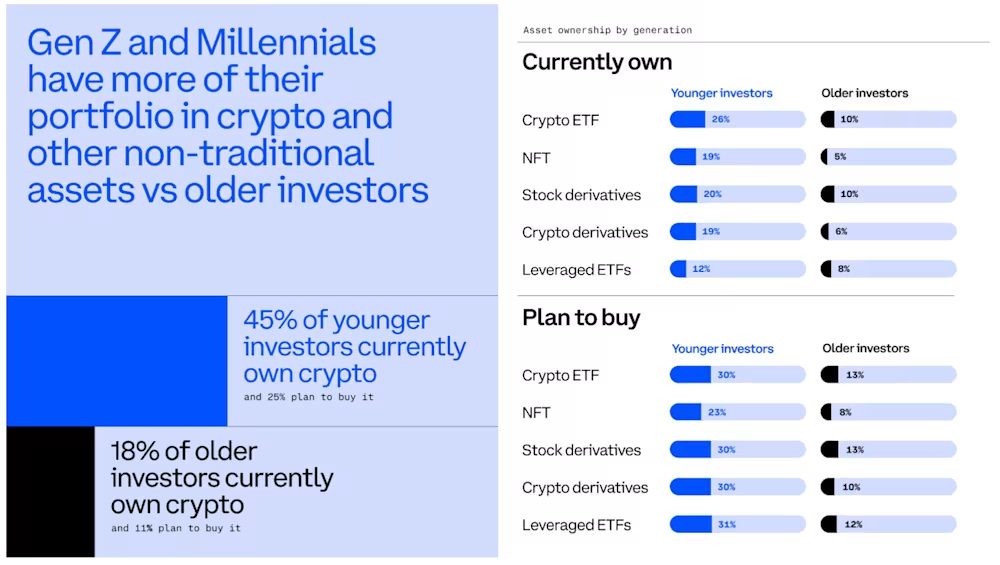
The findings show that 45% of younger investors already own crypto, compared to just 18% of older generations, and that three-quarters believe their generation faces harder odds of building wealth through conventional means than previous cohorts did.

The State of Crypto Q4 2025 report, compiled from a survey of 4,350 US adults, including 2,005 active investors, found younger generations allocating 25% of their portfolios to non-traditional assets, triple the 8% allocation among older investors.

Beyond the allocation gap, younger investors demonstrate markedly different attitudes toward digital assets, with four in five viewing crypto as creating financial opportunities that wouldn’t otherwise exist for their generation.

Young Investors Own Crypto - Coinbase Survey Summary
Source: Coinbase

A Generation Betting Against the Old Playbook

Despite reporting greater optimism about broader economic conditions, younger investors don’t believe traditional wealth-building mechanisms work in their favor.

The cohort has watched housing affordability deteriorate while student debt mounted and wage growth lagged, driving 73% to conclude that their generation faces steeper wealth-building challenges than 57% of older adults.

This perception translates directly into portfolio decisions. While stock ownership rates remain similar across age groups, younger investors add substantially more alternative exposure, actively seeking reward mechanisms beyond conventional stock dividends.

The strategy reflects deliberate pursuit of tools and markets that might help close generational wealth gaps rather than passive investment approaches.

The crypto allocation isn’t treated as speculative positioning but as a central strategy. Nearly half of younger investors (47%) want access to new crypto assets before general market availability, compared with just 16% of older investors.

Four in five younger adults believe cryptocurrency will play a significantly larger role in future financial systems, dropping to three in five among older investors.

Risk Appetite Extends Beyond Bitcoin and Ethereum

The willingness to embrace emerging opportunities doesn’t stop at spot crypto holdings.

Four in five younger investors say they’re willing to try new investment opportunities before others, compared with under half of older adults.

Interest spans crypto derivatives, prediction markets, round-the-clock stock trading, early-stage token sales, altcoins, and decentralized finance lending products.

This pattern marks a clear departure from recent data showing cooling crypto enthusiasm across broader investor populations.

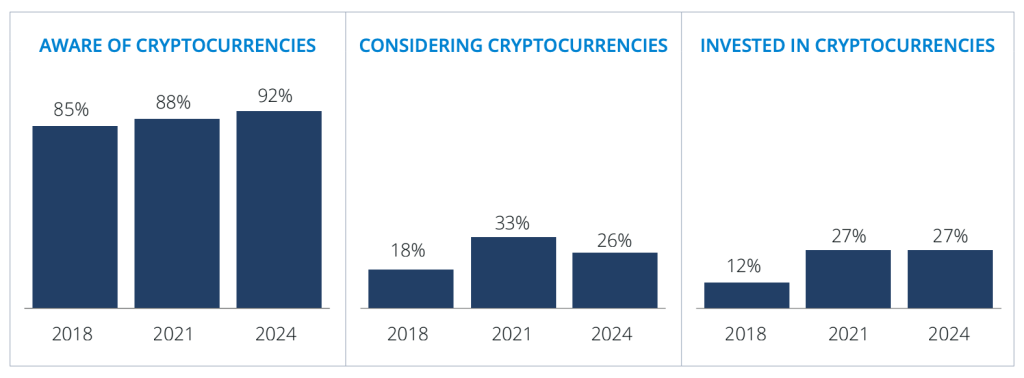
A December FINRA Foundation study found crypto consideration among US investors dropped from 33% to 26% between 2021 and 2024, while those viewing digital assets as extremely or very risky rose from 58% to 66%.

Source: FINRA

Yet that pullback appears concentrated among older demographics rather than the younger cohort driving current adoption.

The generational divide extends to trading behavior and information sourcing.

Younger investors trade more frequently, take more calculated risks to chase higher returns, and push platforms toward always-on operations that support a wider asset range.

US crypto purchase interest falls to 26% from 33% in 2021 as investor risk appetite declines sharply, FINRA study shows.#US #Cryptohttps://t.co/4mTMJ49hLC

— Cryptonews.com (@cryptonews) December 5, 2025

Notably, social media “finfluencers” now guide investment decisions for 61% of investors under 35, with YouTube serving as the dominant platform, and word-of-mouth from friends and family surpassing financial professional recommendations.

The Infrastructure for a New Investment Generation

The shift toward non-traditional assets among younger investors aligns with separate findings showing institutional adoption bolstering confidence.

A November Zerohash survey found that 35% of wealthy young Americans had already moved money away from advisers who did not offer crypto exposure, with more than four-fifths reporting increased confidence as major institutions like BlackRock, Fidelity, and Morgan Stanley embraced digital assets.

Portfolio concentration in volatile assets raises legitimate concerns about long-term financial stability.

However, the trend appears durable rather than speculative, with median allocations to non-traditional assets reaching meaningful levels, and younger investors consistently describing crypto as essential to wealth-building strategy rather than an opportunistic position.

🇺🇸 US crypto exchange Coinbase is letting users to trade stocks on its platform and place bets on a wide range of events through a partnership with Kalshi.#Coinbase #CoinbaseKalshi #PredictionMarkethttps://t.co/7X7UId3tKZ

— Cryptonews.com (@cryptonews) December 18, 2025

Coinbase is responding by building what it calls the Everything Exchange, designed to support trading across asset types at any time while maintaining security, compliance, and responsible innovation standards.

The approach recognizes that younger investors expect platforms native to an internet-first generation rather than traditional market structures built around limited trading hours and narrow asset selection.

The post 45% of Young Investors Own Crypto as Housing Dreams Fade: Survey appeared first on Cryptonews.

MSCI Index Changes Could Force $15B Crypto Treasury Selloff

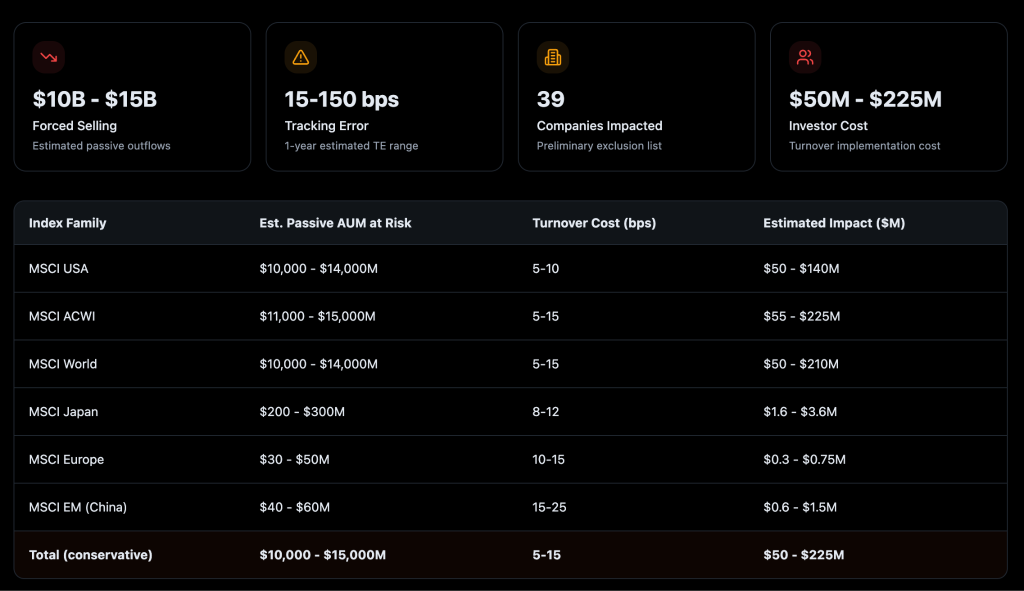
MSCI’s proposal to exclude digital asset treasury companies from its Global Investable Market Indexes has triggered mounting opposition from industry leaders, with analysts warning the move could trigger selling pressure of $10 billion to $15 billion across 39 companies holding $113 billion in combined float-adjusted market capitalization.

MSCI Crypto Treasury Selloff - Index list
Source: BitcoinForCorporation

The consultation closes December 31, with a final decision expected January 15, 2026, targeting firms whose digital asset holdings exceed 50% of total assets, with implementation scheduled for February’s Index Review.

Strategy Inc. formally challenged the proposal in a December 10 letter, signed by Executive Chairman Michael Saylor and CEO Phong Le, calling the move “misguided” and “profoundly harmful consequences” to capital markets and U.S. digital asset leadership.

The company argued that the proposal conflicts with the current administration’s pro-innovation digital asset agenda, including initiatives such as a Strategic Bitcoin Reserve and efforts to expand retirement plan access to digital assets.

Operating Companies Face Investment Fund Classification

Strategy’s core argument centers on distinguishing operating businesses from passive investment vehicles.

The company emphasized that it runs a Bitcoin-backed corporate treasury and capital markets program, issuing equity and fixed-income instruments with varying levels of Bitcoin exposure.

BitcoinForCorporations’ technical analysis demonstrates MSCI’s proposal violates core benchmark principles of representativeness, neutrality, and stability under IOSCO and BMR standards.

We spell out the potential implications of MSCI's proposed 50% DAT exclusion rule: https://t.co/ceJZU0dRTP pic.twitter.com/5CixFrEYVR

— George Mekhail (@gmekhail) December 17, 2025

The group notes that MSCI has historically included REITs despite their 75% real estate concentration, Berkshire Hathaway, with its large investment portfolio, and mining companies holding substantial gold reserves.

Yet, it has never excluded operating companies based on their treasury asset composition.

Strategy warned MSCI’s 50% threshold is arbitrary, noting crypto volatility and divergent accounting standards could cause companies to “whipsaw on and off” indices as valuations fluctuate.

Industry Coalition Challenges Methodology

Strive Asset Management also submitted opposition on December 6, with CEO Matt Cole arguing that the proposal misunderstands the role of Bitcoin-focused firms in AI infrastructure.

Miners, including MARA Holdings, Riot Platforms, and Hut 8, are retooling data centers for high-intensity AI workloads. “Many analysts argue that the AI race is increasingly limited by access to power, not semiconductors,” Cole wrote.

Strive proposed a parallel “ex-digital asset treasury” index version, allowing selective avoidance while maintaining full market exposure for others.

For now, BitcoinForCorporations’ petition opposing the exclusion has gathered over 1,000 signatures, while Bitwise Asset Management has also voiced its support for the strategy, arguing “the power of a great index lies in its neutrality.”

Bitwise supports @Strategy inclusion in MSCI's Global Investable Market Indexes. https://t.co/TXtKb8SvAN pic.twitter.com/sOa4v6sCyh

— Bitwise (@BitwiseInvest) December 11, 2025

Financial Impact Analysis Reveals Concentrated Risk

Before now, JPMorgan analysts have previously estimated that Strategy alone could face $2.8 billion in outflows, with $9 billion of its market capitalization held by passive funds.

BitcoinForCorporations’ analysis projects total forced selling between $10 billion and $15 billion, with tracking error ranging from 15 to 150 basis points, depending on volatility, particularly harmful to institutional mandates with 20 to 50 basis point tracking tolerances.

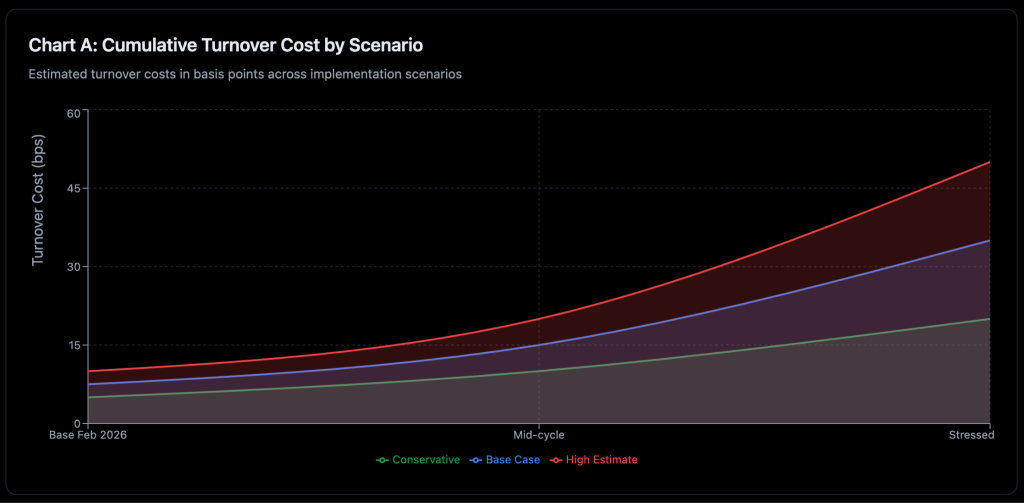
MSCI Crypto Treasury Selloff - Cumulative Turnover Cost by Scenario
Source: BitcoinForCorporation

The preliminary list includes 18 current constituents representing $98 billion in float-adjusted market capitalization facing immediate removal, accounting for 87% of total capital impact.

An additional 21 non-constituents, worth $15 billion, face permanent exclusion, representing massive pre-emptive blocking in MSCI’s methodology. Strategy accounts for 74.5% of the total impacted market cap at $84.1 billion.

Implementation costs are estimated between $50 million and $225 million across index families, with turnover costs ranging from 5 to 25 basis points. The MSCI ACWI faces the highest estimated impact, ranging from $55 million to $225 million.

Speaking with Cryptonews, Farzam Ehsani, Co-founder and CEO of VALR, explained that markets are pricing in potential forced flows.

The market is assessing not only the likelihood of a decline in stock prices of companies whose balance sheets are tied to Bitcoin’s movements, but also potential chain reactions within funds using these indices as benchmarks,” Ehsani said.

Affected companies collectively hold over $137 billion in digital assets.

The industry awaits MSCI’s January 15 decision. Strategy urged MSCI to reject the proposal, stating “the wiser course is for MSCI to remain neutral and let the markets decide the course of DATs.

The post MSCI Index Changes Could Force $15B Crypto Treasury Selloff appeared first on Cryptonews.

💾

Fed Scraps 2023 Crypto Banking Ban That Blocked Crypto Bank Custodia

The Federal Reserve withdrew its 2023 policy statement that effectively barred banks from crypto activities and denied Custodia Bank’s master account application.

The move comes as Wyoming-chartered Custodia pursues a full-court appeal of its master account denial, while regulatory agencies expose widespread debanking practices that systematically excluded crypto firms from traditional banking services between 2020 and 2023.

Vice Chair for Supervision Michelle Bowman said the policy shift creates pathways for responsible innovation while maintaining safety standards.

New technologies offer efficiencies to banks and improved products and services to bank customers,” she said.

The original 2023 guidance had limited state member banks to activities permitted under other federal banking regulations, but evolving financial systems and improved regulatory understanding rendered those restrictions obsolete.

🚨NEW: Big news from the @federalreserve today: It’s withdrawing its 2023 guidance that effectively blocked uninsured banks from becoming Fed members and engaging in crypto.

This guidance underpinned the Fed’s denial of @custodiabank’s master account. pic.twitter.com/2qlFqhnPAv

— Eleanor Terrett (@EleanorTerrett) December 17, 2025

Custodia Escalates Legal Battle After Years of Regulatory Roadblocks

Custodia filed a petition with the Tenth Circuit Court of Appeals on December 15, requesting en banc review of the Fed’s denial of its master account after a three-judge panel upheld the rejection in October.

The bank argues the decision violates the Monetary Control Act’s mandate that payment services “shall be available” to eligible depository institutions, creating unconstitutional veto power over state banking charters.

Without master account access, Custodia cannot use Federal Reserve wire transfers or automated clearinghouse systems despite meeting all statutory requirements under Wyoming’s Special Purpose Depository Institution framework, which requires 100% reserve backing and prohibits lending to reduce risk.

The petition raises federalism concerns about federal regulators effectively overriding Wyoming’s 2020 charter decision, which was designed to attract digital asset companies within stringent safety parameters.

Back in November, Judge Timothy Tymkovich’s dissent highlighted that granting unreviewable discretion to regional Reserve Bank presidents raises constitutional questions, since those officials are selected by private bank directors rather than appropriately appointed as federal officers.

⚖ Custodia Bank petitions full appeals court to review Federal Reserve's master account denial, citing constitutional concerns and federal law violations.#Crypto #Bank #Fedhttps://t.co/KyM8MlA1WC

— Cryptonews.com (@cryptonews) December 16, 2025

The dissent created a 2-2 split among circuit judges on whether the Monetary Control Act mandates master account access, with Tymkovich writing that the Fed’s interpretation grants unreviewable discretion while contradicting the statute’s plain language.

The Kansas City Fed denied Custodia’s application in January 2023 after 27 months, citing crypto-asset risks despite internal documents showing staff deemed the bank’s capital adequate and its executive team impressive.

Federal Reserve Governor Christopher Waller has since acknowledged the Fed possesses sufficient tools to manage risks through tailored account structures without resorting to blanket denials.

His October remarks undermined the necessity argument that regulators used to justify rejecting Custodia’s application, while broader investigations revealed systematic exclusionary practices across major banks.

Banking Giants Exposed for Inappropriate Crypto Restrictions

The Office of the Comptroller of the Currency released findings showing all nine largest national banks imposed inappropriate restrictions on lawful businesses, including digital asset companies, between 2020 and 2023.

JPMorgan Chase, Bank of America, Citibank, Wells Fargo, U.S. Bank, Capital One, PNC, TD Bank, and BMO maintained internal policies requiring escalated approvals or blanket restrictions on sectors conflicting with institutional values.

The review examined thousands of debanking complaints after President Trump signed an August executive order intended to prevent account closures based solely on crypto activity.

OCC Comptroller Jonathan Gould said the practices were widespread and represented improper use of national bank charters.

Some users claimed their accounts were abruptly closed under vague references to concerning activity, fueling allegations of coordinated exclusion similar to Operation Chokepoint.

Banks insisted they did not discriminate, but many restrictive policies were publicly visible throughout the investigation period.

The regulatory shift extends beyond debanking investigations.

✅ The OCC has conditionally approved five crypto firms, including @Circle and @Ripple, to launch national trust banks.#Ripple #Circlehttps://t.co/wCeTNrhOQZ

— Cryptonews.com (@cryptonews) December 13, 2025

The OCC conditionally approved five crypto firms, including Circle and Ripple, to launch national trust banks in December, giving digital asset companies access to federal banking charters with single-rulebook oversight instead of navigating state-by-state regulations.

Paxos received federal supervision to issue stablecoins, while Ripple’s charter excludes RLUSD issuance but allows custody and settlement services without deposit-taking or lending activities.

The approved firms have 18 months to raise capital, assemble staff, and build compliant infrastructure before facing final OCC examination.

The post Fed Scraps 2023 Crypto Banking Ban That Blocked Crypto Bank Custodia appeared first on Cryptonews.

💾

Coinbase Wins India Approval for $2.45B CoinDCX Stake

Coinbase has received regulatory approval from India’s Competition Commission to acquire a minority stake in CoinDCX valued at $2.45 billion, marking a crucial milestone in the US exchange’s expansion into one of Asia’s fastest-growing crypto markets.

The clearance follows months of regulatory review and deepens Coinbase’s partnership with India’s largest digital asset platform.

Chief Legal Officer Paul Grewal called the approval an “important regulatory milestone” that strengthens Coinbase’s long-term commitment to CoinDCX, which now serves over 20.4 million users across India and the UAE with more than $1.2 billion in assets under custody.

The investment builds on Coinbase’s initial backing of CoinDCX in 2020 and comes after the Indian exchange faced significant security challenges earlier this year.

We appreciate the Competition Commission of India approval of our proposal to acquire a minority stake in @CoinDCX, marking an important regulatory milestone and deepening Coinbase’s long-term partnership with one of India’s most established and trusted digital asset platforms. pic.twitter.com/IzTmJkyO7u

— paulgrewal.eth (@iampaulgrewal) December 17, 2025

Recovery Following $44 Million Security Breach

The approval arrives seven months after CoinDCX suffered a major hack that compromised $44 million from an internal liquidity account.

Cybersecurity firm Cyvers linked the July incident to North Korea’s Lazarus Group, noting the attack followed the same pattern as the $234 million WazirX breach that occurred exactly one year earlier.

Hackers executed the theft in just five minutes across seven rapid transactions, siphoning funds after conducting test transactions days earlier.

Indian police later arrested a CoinDCX software engineer whose compromised credentials allegedly enabled the breach.

However, the employee claimed that hackers exploited his system while he worked as a freelancer using company equipment.

CoinDCX CEO Sumit Gupta confirmed customer funds remained secure throughout the incident and launched a recovery bounty program offering up to 25% of retrieved assets, potentially worth $11 million.

Coinbase explicitly referenced the breach in its investment statement, writing that CoinDCX’s response to challenges “only strengthened our conviction in their team and platform.

Strategic Positioning in Key Growth Markets

The investment reinforces Coinbase’s presence in India and the Middle East, following CoinDCX’s acquisition of Dubai-based BitOasis last year.

Coinbase described both regions as “top regions for crypto growth” driven by high adoption rates, supportive regulation, and substantial economic potential.

Gupta said the fresh capital would accelerate new product launches across the Web3 ecosystem while enabling market expansion and enhanced security infrastructure.

He called the investment “more than just capital,” adding that “it’s a deep vote of confidence in our mission, approach, and team.

The funding comes as Coinbase simultaneously reopened direct operations in India following a two-year hiatus, now offering crypto-to-crypto trading with plans to integrate rupee deposits by 2026.

🇮🇳 Coinbase returns to India after two-year absence, with plans to introduce rupee deposits and fiat trading by 2026.#Coinbase #Indiahttps://t.co/xTgnD4Ux9I
— Cryptonews.com (@cryptonews) December 8, 2025

The company’s return required full regulatory compliance after suspending services in 2023, when payment processors blocked its access to the Unified Payments Interface.

John O’Loghlen, Coinbase’s Asia-Pacific director, explained that forcing existing customers to close their accounts ran counter to typical business strategy but established a clean regulatory slate.

Coinbase subsequently secured Financial Intelligence Unit registration alongside competitors, including Binance, KuCoin, and Bybit, all of which faced similar regulatory obstacles before paying penalties and resuming operations.

Broader Strategic Expansion Beyond India

The CoinDCX deal strengthens Coinbase’s foothold in a market where citizens hold approximately $4.5 billion in digital assets, despite restrictive tax policies, including a 30% profit levy and a mandatory 1% transaction tax.

India consistently ranks among the top countries in global crypto adoption indices, though the Reserve Bank continues to oppose cryptocurrencies due to financial stability concerns.

Coinbase now employs over 500 people across India while continuing to hire for both domestic and international operations.

Grewal recently joined the US-India Business Council board to strengthen bilateral commercial relationships.

The CoinDCX investment aligns with Coinbase’s broader expansion into new product categories and markets.

🇺🇸 US crypto exchange Coinbase is letting users to trade stocks on its platform and place bets on a wide range of events through a partnership with Kalshi.#Coinbase #CoinbaseKalshi #PredictionMarkethttps://t.co/7X7UId3tKZ

— Cryptonews.com (@cryptonews) December 18, 2025

The exchange recently launched prediction markets through a partnership with Kalshi, introduced stock trading capabilities, and announced Solana integration at its San Francisco product showcase, where CEO Brian Armstrong declared that “Coinbase is now the best place to trade every asset, not just crypto.

The company also filed with US regulators for a National Trust Company Charter to offer payments and financial services without relying on third-party banks. It also recently relocated its corporate registration from Delaware to Texas to improve regulatory efficiency and flexibility.

The post Coinbase Wins India Approval for $2.45B CoinDCX Stake appeared first on Cryptonews.

💾

Bitcoin Price Prediction: Active Wallets Drop to 2023 Lows as Liquidity Thins — Can BTC Reclaim $100K and Invalidate the Bears?

On-chain data reveals that the number of active Bitcoin wallets has declined to 2023 lows, indicating that even as prices fluctuate, fewer market participants are conducting transactions.

Bitcoin price prediction metrics suggest that the price must reclaim the $100,000 psychological threshold to prevent a deep bear market decline.

Fear Index Hits Extreme Territory as Year-End Approaches

Bitcoin’s Fear & Greed Index has plummeted to 11, signaling Extreme Fear.

Crypto Markets Enter a Slowdown Phase

“The number of active Bitcoin wallets has fallen to its lowest level in the past year, indicating that even when prices move, fewer participants are actually transacting.” – By @xwinfinance pic.twitter.com/pt9RAEwx0M

— CryptoQuant.com (@cryptoquant_com) December 17, 2025

According to a Japanese analyst at XWIN Research, fresh capital inflows into Bitcoin are beginning to diminish, and as year-end nears, both participation and capital typically become less active, further reducing market liquidity.

“In such an environment, price action tends to become more volatile due to thin liquidity. At the same time, reduced noise allows the underlying supply and demand dynamics to become clearer,” the analysts explained.

Crypto analyst Moreno also observed that Bitcoin sits at a level carrying more significance than appearances suggest.

The current $86,000 price rests above the True Market Mean Price (TMMP), which represents the average on-chain acquisition price of investors, excluding miners.

Moreno projects that if Bitcoin maintains above the TMMP ($81,500), the bull trend would be well alive.

Bitcoin Price Prediction: Weekly Chart Shows Critical $81K Defense Zone

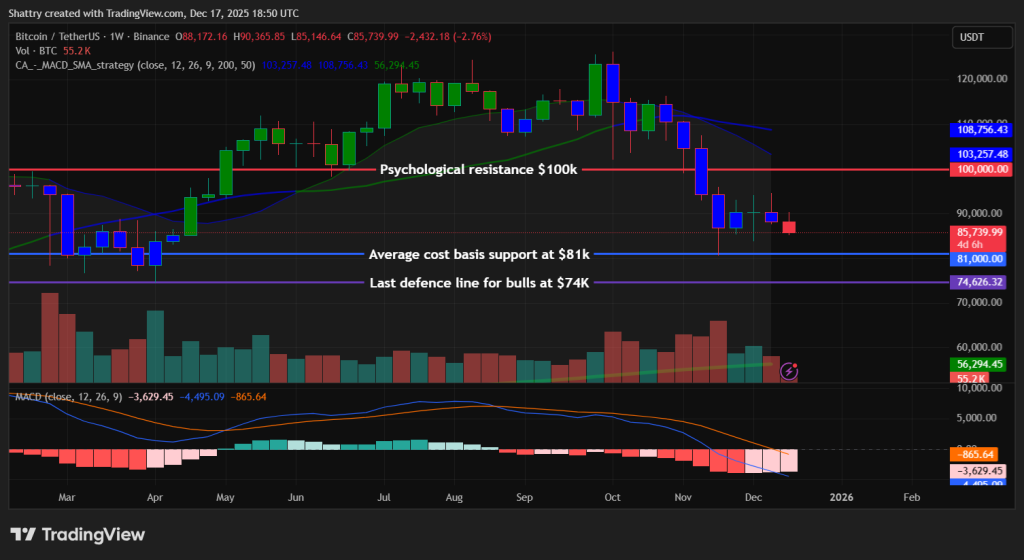
Bitcoin’s weekly chart displays a clear transition from expansion to correction following repeated failures above the $100,000 psychological resistance.

Price has definitively lost the $100,000 level and now trades below key moving averages, which have begun rolling over and functioning as dynamic resistance around the $103,000–$108,000 zone.

The most crucial structural level on the downside sits at $81,000, marked as the average cost basis support.

Bitcoin Price Prediction - Bitcoin Price Chart
Source: TradingView

Price currently hovers just above this zone, making it a critical inflection point for the broader market.

The MACD remains firmly bearish with expanding negative histogram bars, signaling downside momentum still dominates despite the recent slowdown in selling pressure.

Moreover, a sustained weekly close below $81,000 would expose the final bull-market defense near $74,000, where stronger long-term buyers are expected to emerge.

Conversely, reclaiming $100,000 and maintaining above it would be necessary to invalidate bearish momentum and reopen pathways for advancement back toward the $105,000–$110,000 range.

Pepenode Raises $2.3M Ahead of Bitcoin Post-Breakout Rally

If Bitcoin finally breaks the $100,000 resistance and initiates the 2026 bull run, meme coins like Pepenode (PEPENODE) would experience increased demand.

Pepenode is a new crypto project that’s already raised over $2.3 million despite the crypto market losing over 30% of its value since October.

It’s a game where you can mine coins without needing expensive hardware setups.

Bitcoin Price Prediction - Pepenode banner

You play the game in your web browser, set up virtual mining rigs, and upgrade your facilities to earn PEPENODE tokens.

Now that more people are investing in Pepenode’s mining rigs, the presale price is advancing rapidly.

To join the presale before the ongoing round sells out, go to the official Pepenode website, and connect a crypto wallet like Best Wallet.

You can then buy PEPENODE tokens for $0.0012016 and pay with crypto using ETH or USDT, or use a bank card for fast payment.

Visit the Official Pepenode Website Here

The post Bitcoin Price Prediction: Active Wallets Drop to 2023 Lows as Liquidity Thins — Can BTC Reclaim $100K and Invalidate the Bears? appeared first on Cryptonews.

💾

Tether Launches PearPass, a Peer-to-Peer Password Manager Without Cloud Storage

Tether unveiled PearPass, a peer-to-peer password manager that eliminates the need for cloud storage and centralized servers, amid major breaches that have exposed billions of credentials.

The stablecoin giant announced that its free application synchronizes encrypted passwords directly between user devices via a peer-to-peer architecture, removing traditional cloud infrastructure vulnerabilities that have plagued competitors.

PearPass addresses escalating cybersecurity threats as cloud-based password managers face persistent attacks from sophisticated hackers targeting centralized databases.

The application stores credentials exclusively on user devices while enabling encrypted synchronization across platforms without intermediaries, giving users complete control over digital security through locally stored data.

Introducing🍐🔒 PearPass — the password manager that keeps your data on your devices.

No servers to hack. No cloud to leak.

Just pure local security.

Follow @Pears_p2p & Download the App https://t.co/gP9FIPn2dW pic.twitter.com/ObIuyfToMo

— Tether (@Tether_to) December 17, 2025

Decentralized Architecture Removes Single Point of Failure

The password manager eliminates server dependencies through peer-to-peer synchronization, unlike traditional cloud-based competitors that store millions of credentials on centralized infrastructure.

PearPass employs end-to-end encryption powered by open-source cryptographic libraries, allowing users to recover their accounts using personal keys rather than relying on external systems that are vulnerable to breaches.

Every major breach proves the same point: if your secrets live in the cloud, they’re not really yours,” said Paolo Ardoino, CEO of Tether.

PearPass removes the single point of failure. No servers, no intermediaries, no back doors. Recovery and synchronization across users’ devices happens peer-to-peer, with your keys, under your control, without gatekeepers.

PearPass is the first super-secure password manager. 🍐🍐
It synchronizes your info across your devices, without the need of any server. No middlemen. No reliance on pinky swear security.
Fully peer-to-peer and open-source.
You can review it for yourself.

It's available for… https://t.co/sxHtBOyihK

— Paolo Ardoino 🤖 (@paoloardoino) December 17, 2025

The application underwent independent security auditing by Secfault Security, a specialist in offensive security and cryptographic analysis, to ensure resilience against real-world threats.

PearPass includes built-in password generation and continues to function during outages or in high-threat environments, maintaining operability when centralized systems fail.

The fully open-source code allows community auditing, enabling developers to review security implementations independently.

Growing Demand for Privacy-First Communication Tools

PearPass represents Tether’s first fully open-source application developed on the Pears ecosystem, which builds decentralized solutions for sovereignty, efficiency, privacy, and security.

The launch follows growing adoption of peer-to-peer technologies as users seek alternatives to centralized platforms facing regulatory pressure and surveillance concerns.

Jack Dorsey’s Bitchat messaging app recorded over 360,00 downloads since launch, with 48,781 downloads in Nepal during September protests against government corruption and social media bans.

The Bluetooth Low Energy mesh network application operates without an internet connection, enabling encrypted communication between devices within 30 meters during network shutdowns.

Madagascar experienced similar adoption spikes during violent protests over utility shortages, with Google Trends showing searches spiking from zero to 100 in Antananarivo as demonstrators sought censorship-resistant communication.

📱 Dorsey's Bitchat explodes in Madagascar as protesters adopt censorship-resistant messaging during violent protests over infrastructure failures.#BitChat #Madagascarhttps://t.co/oZS9WNukd2

— Cryptonews.com (@cryptonews) September 29, 2025

The peer-to-peer app recorded over 21,000 downloads within 24 hours during civil unrest that prompted government curfews across the capital.

Elon Musk also announced XChat, a development for the X platform featuring Bitcoin-style encryption, promising cross-platform communication without phone number requirements.

WhatsApp knows enough about what you’re texting to know what ads to show you,Musk alleged during a recent podcast interview. “That’s a massive security vulnerability.

The messaging service is expected to launch within months as part of Musk’s broader “everything app” ambitions.

Regulatory Scrutiny Intensifies Across Jurisdictions

Privacy-focused platforms face mounting regulatory pressure as governments demand access to encrypted communications for law enforcement purposes.

The European Union is advancing Chat Control regulations requiring messaging apps to scan content before encryption, with 15 countries currently supporting the controversial proposal despite privacy advocates warning of mass-surveillance implications.

Telegram CEO Pavel Durov remains out on bail of €5 million following a French arrest under warrants related to the encrypted messaging platform.

The 40-year-old billionaire criticized charges as “legally and logically absurd” while avoiding infrastructure deployment in jurisdictions with aggressive surveillance demands.

Despite this tightening of regulations across Europe, Worldcoin also introduced World Chat in March, integrating encrypted messaging with World ID verification and distinguishing verified users with blue chat bubbles.

🌎 @worldcoin has launched World Chat, an encrypted messaging feature within World App that enables users to communicate and send crypto.#worldcoin #wldhttps://t.co/uwWgL1r9bH

— Cryptonews.com (@cryptonews) March 6, 2025

The feature enables crypto transfers within conversations while supporting over 100 Mini Apps that launched more than 250 million times in early 2025.

For this new privacy app, Tether emphasized that PearPass represents technology designed to withstand future centralization pressures from governments, corporations, and intermediaries seeking to control data.

The company plans additional ecosystem applications restoring internet control to individual users through decentralized infrastructure resilient against external seizure or compromise.

The post Tether Launches PearPass, a Peer-to-Peer Password Manager Without Cloud Storage appeared first on Cryptonews.

💾

HashKey Shares Drop 3% in Disappointing Hong Kong Debut Despite $200M Raise

HashKey Holdings saw its shares slip 3% on Wednesday during its Hong Kong trading debut, closing at HK$6.51 after pricing near the top of its marketed range at HK$6.68, according to CNBC.

The crypto exchange raised $206 million in its initial public offering, marking the first public listing by a digital asset company in the city, even as bitcoin tumbled 36% from its October all-time high above $126,000.

The underwhelming performance came despite robust investor demand, with the institutional tranche drawing subscriptions 5.5 times the available stock and retail investors oversubscribing by nearly 394 times.

Cornerstone investors, including Fidelity, UBS, CDH Investments, and Cithara Fund, participated in the offering, while JPMorgan and Guotai Haitong served as joint bookrunners.

📉 HashKey’s Hong Kong debut briefly jumped 6% before slipping below its IPO price, as a $206M listing met cautious sentiment in a volatile crypto market. @HashKeyExchange #Hashkey #HongKong https://t.co/AHWJZQLtGQ

— Cryptonews.com (@cryptonews) December 17, 2025

Hong Kong’s Crypto Hub Ambitions Face Market Headwinds

Founded in 2018, HashKey operates the city’s largest licensed virtual asset trading platform and secured one of the earliest approvals under Hong Kong’s 2022 digital asset regime.

The company holds more than 75% of Hong Kong’s onshore digital asset trading volume, providing exchange services alongside over-the-counter trading, staking, tokenization, and asset management solutions for institutional and retail clients.

Speaking with Reuters, CEO Xiao Feng emphasized his long-term confidence despite near-term volatility.

My confidence is only growing stronger and I am more optimistic than 10 years ago because there’s more regulation and compliance guidelines for us to follow which will allow the industry to grow further,” he said at the listing ceremony.

The exchange facilitated HK$1.7 trillion in trading volume through September 2025, though first-half revenue fell 26% year over year to HK$284 million.

HashKey posted a HK$506.7 million loss during that period, narrowing from HK$772.6 million the previous year as the company invested heavily in compliance infrastructure and market expansion.

Mainland Ban Contrasts With Hong Kong’s Digital Asset Push

Hong Kong’s embrace of cryptocurrencies stands in sharp contrast to mainland China, which banned crypto trading in 2021 and recently renewed warnings about virtual assets.

The city launched a stablecoin licensing system this year and is considering allowing exchanges to connect local platforms with global operations, positioning itself as a testing ground for regulated digital asset adoption.

Xiao distinguished Hong Kong’s approach from Beijing’s crackdown, noting mainland measures targeted pyramid schemes and stablecoin fraud.

Hong Kong continues to promote policies regarding digital assets and we have benefited from that,” he said. “We should firmly adhere to ‘one country’, but wisely take advantage of ‘two systems.’

CFO Eric Zhu expressed confidence that the Asian market would catch up with U.S. crypto penetration rates.

We are confident that the penetration rate in Hong Kong, in the Asian market, is going to catch up with what happens in the U.S,” he told CNBC.

The company plans to deploy IPO proceeds toward technology infrastructure upgrades, market expansion partnerships, and enhanced risk management systems.

HashKey will prioritize cash flow over profitability in the near term while continuing investments as the sector develops, according to Xiao.

💰@HashKeyExchange is poised to price its Hong Kong IPO near the top of the range, with strong institutional demand suggesting the raise could reach about $206M.#HashKey #IPOhttps://t.co/cDu3Bqa2i9

— Cryptonews.com (@cryptonews) December 15, 2025

The listing arrived during a challenging period for global crypto equities.

As reported earlier by Cryptonews, stablecoin provider Circle lost 70% of its value since peaking in June, while exchanges Bullish and Gemini declined over 30% and 60% respectively, since their summer debuts.

Bitcoin has fallen roughly 30% from October highs amid concerns about geopolitical tensions and broader market jitters.

Hong Kong Financial Secretary Paul Chan attended the listing ceremony, which shows the city’s official support for its digital asset initiatives.

The debut contributed to Hong Kong’s strongest IPO year since 2021, with over $34 billion raised from new listings through December, according to data obtained by Reuters, reclaiming the top global ranking from U.S. exchanges for the first time since 2019.

The post HashKey Shares Drop 3% in Disappointing Hong Kong Debut Despite $200M Raise appeared first on Cryptonews.

💾

Bitcoin Price Prediction: Can the BTC Price Push Above $95,000 in December? American Bitcoin Stacks Up in Anticipation

Bitcoin price prediction indicates BTC is positioned to push above $95,000 before December’s end as American Bitcoin Corp (ABTC) accumulated another 54 bitcoin in anticipation of a Santa rally.

Eric Trump’s Firm Joins Top 20 Bitcoin Treasury Companies

The Nasdaq-listed firm, co-founded by Eric Trump, revealed Tuesday that recent acquisitions have expanded the company’s Bitcoin holdings beyond 5,000 BTC, placing it among the top 20 publicly traded bitcoin treasury firms, according to bitcointreasuries.net.

The company has achieved a 96.5% bitcoin yield since its Nasdaq debut, alongside 533 satoshis per share as of December 14.

Glassnode data reveals whales are aggressively buying the dip.

In the last 30 days alone, whales accumulated 269,822 BTC worth $23.3 billion, the largest monthly purchase in the last 13 years.

Analysts view this as a significant boost for Bitcoin price prediction as December progresses, with markets anticipating a bounce from the current $85,000-$87,000 level toward $95,000, with potential extension into six figures before year-end.

Bitcoin Price Prediction: Daily Chart Shows Compression Pattern Before Breakout

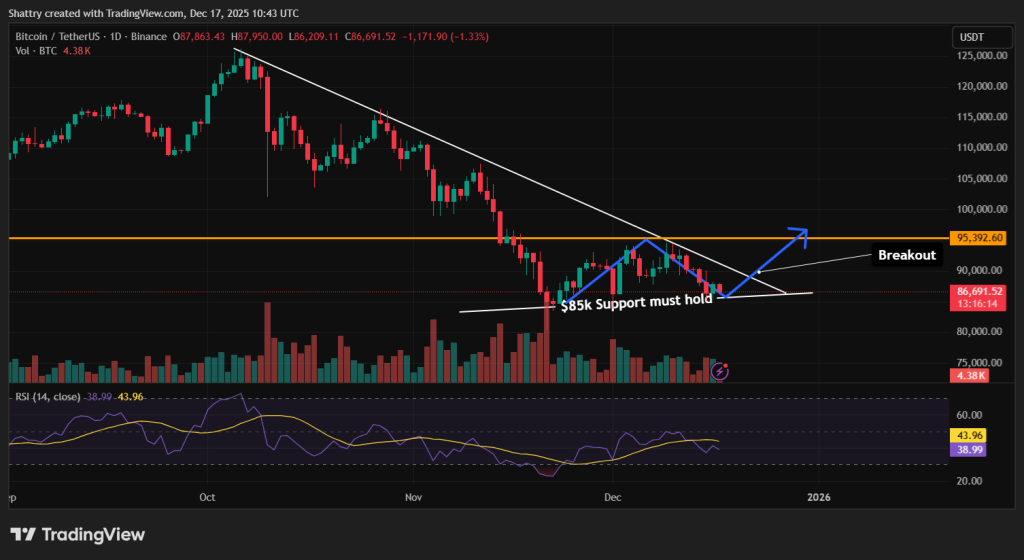
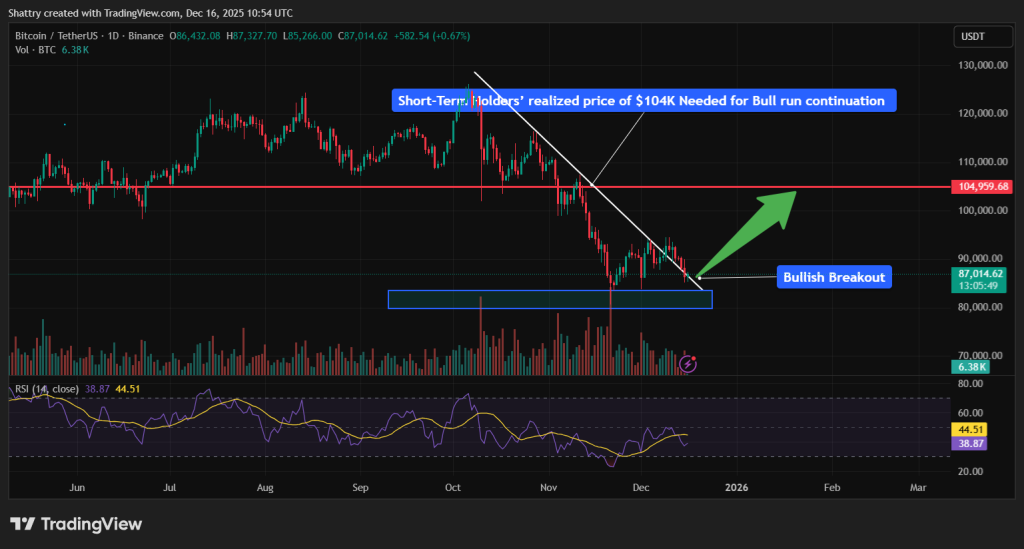
Bitcoin’s daily chart displays price compressing into a tightening structure following an extended downtrend, with the market now trading between a descending trendline from the cycle high and a rising base around the $85,000 support zone.

This price action suggests sellers are exhausting momentum, as each downward push is absorbed near the same demand area, forming a higher-low structure against the broader downtrend line.

Bitcoin Price Prediction - Bitcoin Price Chart
Source: TradingView

The $85,000 level represents the most crucial near-term support and must hold to preserve the developing reversal setup.

On the upside, the descending trendline and the $95,000 region act as confluence resistance, and a decisive daily close above this zone would confirm a bullish breakout from the compression pattern.

Volume has diminished during consolidation, typical behavior preceding a directional move, while the RSI remains below 50 but has stabilized and is attempting to curl higher, signaling fading bearish momentum rather than strong selling pressure.

Provided Bitcoin maintains above $85,000, the bias favors a continuation higher toward $95,000, with a successful breakout opening the door to a return to the upper-$90,000 region.

A breakdown below $85,000 would invalidate the bullish setup and redirect focus toward deeper support levels, preserving the broader corrective trend.

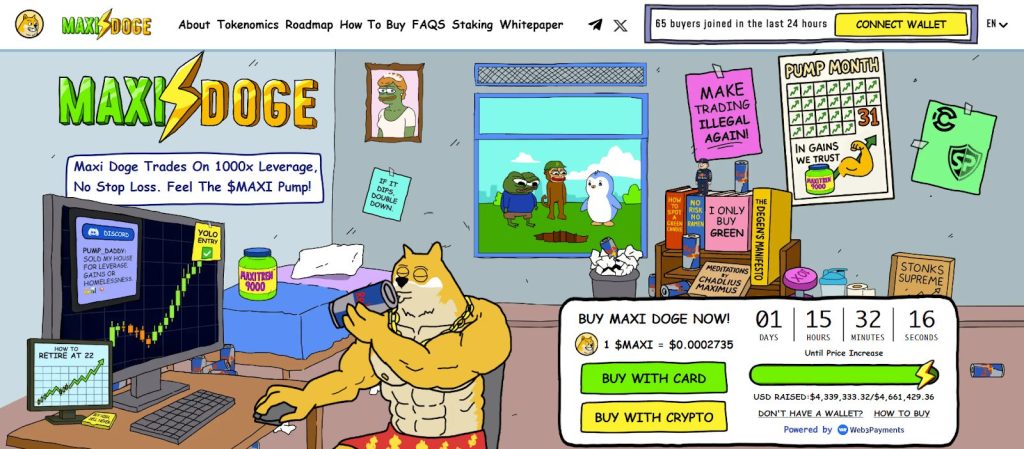
Maxi Doge Offers Investors Early Access Before Bull Market Returns

If Bitcoin finally breaks the $95,000 resistance and sets the stage for a 2026 bull run, presale projects like Maxi Doge ($MAXI) would benefit from the market revival.

Maxi Doge is an early-stage memecoin following the Dogecoin playbook, generating over 100x gains during the last bull run.

The MAXI presale has raised over $4.3 million and offers 72% annual staking rewards for those entering early at the current $0.000273 price before it increases.

Bitcoin Price Prediction - Maxi doge banner

The project has also established an alpha channel where traders exchange insider tips, share early trade ideas, and discover hidden opportunities to capitalize on the upcoming bull run.

To buy early, visit the official Maxi Doge website and connect a crypto wallet like Best Wallet.

You can pay with existing crypto like USDT and ETH, or use a bank card to complete your purchase immediately.

Visit the Official Maxi Doge Website Here

The post Bitcoin Price Prediction: Can the BTC Price Push Above $95,000 in December? American Bitcoin Stacks Up in Anticipation appeared first on Cryptonews.

💾

Bhutan Pledges $1 Billion in Bitcoin to Build ‘Mindfulness City’ Without Selling Reserves

Bhutan unveiled a national Bitcoin Development Pledge on Tuesday, committing up to 10,000 BTC, worth approximately $1 billion, to fund construction of Gelephu Mindfulness City without liquidating its sovereign digital asset reserves.

King Jigme Khesar Namgyel Wangchuck announced the allocation during his National Day Address, framing the commitment as a generational investment in youth employment and national prosperity tied to a new economic hub in southern Bhutan.

The pledge channels Bitcoin holdings into GMC development through mechanisms including collateralized lending, risk-managed yield strategies, and long-term holding approaches designed to preserve capital while financing infrastructure.

This development became possible due to a multi-year commitment to leverage Bitcoin’s compounding value over time, rather than converting reserves to cash.

Officials said the final implementation details are expected in the coming months, under governance frameworks that emphasize capital preservation, appropriate oversight, and transparency.

Bhutan Bitcoin Mindfulness City - King Jigme Khesar Namgyel Wangchuck image
Source: Breathe Bhutan

Sovereign Mining and Clean Energy Foundation

Bhutan ranks as the world’s fifth-largest government Bitcoin holder, having mined 13,011 BTC since 2021 using surplus hydroelectric power from Himalayan rivers.

The renewable energy-powered mining operation converts excess national grid capacity into digital assets without additional environmental impact, with crypto holdings now exceeding 11,286 BTC, valued at $1.28 billion, according to Bitbo data.

Bhutan Bitcoin Mindfulness City - Government Bitcoin Holder table
Source: Bitbo

The Kingdom’s hydroelectric resources at times exceed domestic demand, enabling clean energy to be converted into long-term national assets through the national power generation utility.

This mining strategy accounts for over 25% of Bhutan’s GDP while maintaining environmental sustainability commitments central to the nation’s development philosophy, which balances economic progress with ecological stewardship.

The Kingdom established Green Digital Ltd through GMC to develop blockchain infrastructure and, recently, partnered with Cumberland DRW on digital asset trading frameworks, sustainable mining expansion, AI compute facilities, and national stablecoin development.

Gelay Jamtsho, Green Digital chairman, said the collaboration connects Bhutan’s renewable energy infrastructure with institutional-grade liquidity to support the country’s diversification agenda beyond traditional economic sectors.

Blockchain Integration Across National Systems

Beyond mining, Bhutan has deployed blockchain-based national identity systems serving 800,000 citizens on Ethereum after migrating from Polygon, with the transition completed in October, enabling Verifiable Credentials and digital signing capabilities.

Prime Minister Tshering Tobgay said leveraging Ethereum’s globally distributed network strengthens the security, transparency, and resilience of digital infrastructure serving nearly the entire population.

🇧🇹 Bhutan has migrated its self-sovereign identity system to Ethereum, enabling 800K citizens to verify their identity on a public blockchain.#Bhutan #EthereumBlockchain #BhutanNDIhttps://t.co/GxMSpUcuN3

— Cryptonews.com (@cryptonews) October 14, 2025

Back in May, the Kingdom enabled crypto payments across tourism merchants through partnerships with DK Bank and Binance Pay, allowing visitors to use over 100 cryptocurrencies for everything from airline tickets and hotel stays to roadside fruit stalls.

Over 100 local merchants now accept digital assets, with Damcho Rinzin, tourism director, describing the system as advancing innovation and inclusion while supporting sustainable development goals.

Most recently, Bhutan launched TER, a Solana-based token backed by physical gold reserves distributed through DK Bank, positioning the nation among the few experimenting with state-backed tokenized assets.

Mindfulness City as Economic Catalyst

Gelephu Mindfulness City operates as a Special Administrative Region designed to attract international capital through regulatory clarity and modern financial connectivity while preserving cultural values.

King Jigme Khesar Namgyel Wangchuck framed GMC as a shared national enterprise in which citizens function as stakeholders, with new land policies ensuring that Bhutanese from all regions benefit from development proceeds, since most acreage remains state-owned.

As your King, I must ensure that every Bhutanese is a custodian, stakeholder, and beneficiary of GMC,” the monarch said. “Think of GMC as a company and landowners as its shareholders.

Market Outlook Supports Strategic Holding

Bitcoin traded at $87,274 today, up 1.9% in Asian hours as exchange reserves hit record lows and traders awaited US inflation data.

Major asset managers, including Bitwise and Grayscale, project that Bitcoin will exceed its previous all-time highs in 2026, despite traditional cycle theory predicting corrections, as institutional capital inflows through platforms like Morgan Stanley and Wells Fargo accelerate adoption.

🚀 Bitwise and Grayscale predict Bitcoin will break its four-year cycle and reach new all-time highs in 2026 driven by institutional capital and regulatory clarity.#Bitcoin #Bitwise #Grayscalehttps://t.co/mL6smmtfjl

— Cryptonews.com (@cryptonews) December 16, 2025

Bhutan’s pledge aligns with the growing sovereign and corporate adoption of digital assets, as global crypto ETPs have attracted $87 billion in net inflows since US products launched in January 2024.

The post Bhutan Pledges $1 Billion in Bitcoin to Build ‘Mindfulness City’ Without Selling Reserves appeared first on Cryptonews.

SBF’s Ex-Girlfriend Caroline Ellison Transferred to Early Community Confinement

Caroline Ellison has been transferred from federal prison to community confinement after serving approximately 11 months of her two-year sentence for her role in the $11 billion FTX fraud scheme.

The former Alameda Research CEO was moved from Danbury Federal Correctional Institution in Connecticut to either home confinement or a halfway house on October 16, according to Federal Bureau of Prisons records obtained by Business Insider.

Ellison’s projected release date is now February 20, 2026, nearly 9 months ahead of the completion of her original sentence.

The 31-year-old former Alameda executive, who served as a star witness against her ex-boyfriend, Sam Bankman-Fried, during his criminal trial, began her sentence at the low-security Connecticut facility in early November 2024 after receiving a two-year prison term from U.S. District Judge Lewis Kaplan.

Caroline Ellison Community Confinement - Caroline Ellison image
Bloomberg via Getty Images

Cooperation Earns Leniency Despite Serious Fraud Charges

Judge Kaplan praised Ellison’s “substantial” cooperation during Bankman-Fried’s prosecution while maintaining that the case’s severity still warranted incarceration.

Ellison had pleaded guilty in December 2022 to conspiracy charges, including wire fraud, money laundering, securities fraud, and commodities fraud, offenses carrying a potential maximum sentence of 110 years in prison.

During her September 2024 sentencing hearing, Ellison expressed deep remorse while holding back tears.

“On some level, my brain doesn’t even comprehend all the people I harmed,” she told the court. “That doesn’t mean I don’t try.”

Her attorneys had requested no prison time, but Kaplan rejected what he termed a “literal get-out-of-jail-free card” despite acknowledging her unprecedented cooperation.

Federal prosecutors emphasized Ellison’s critical testimony in their September 17 letter recommending leniency.

“The ‘what’ and ‘how’ of the crimes, as well as the ‘why,’ would have been difficult to prove without Ellison’s testimony,” they wrote, noting she endured extraordinary public attention and harassment for her cooperation.

During Bankman-Fried’s month-long October 2023 trial, Ellison testified for three days, painting the FTX founder as an image-conscious and power-hungry figure who orchestrated the fraudulent scheme.

Ellison revealed that Bankman-Fried instructed her and other executives to use Alameda Research to invest billions of dollars in customer assets that had been secretly siphoned from FTX.

She described feeling like an “unequal partner” in their romantic relationship due to his position of power.

I would always ultimately defer to Sam,” Ellison testified, explaining concerns about the intersection of their personal and professional relationship.

FTX Associates Face Divergent Legal Outcomes

Ellison’s early community placement follows contrasting fates for other FTX executives involved in the collapse.

Former FTX CTO Gary Wang and engineering director Nishad Singh both received time-served sentences with supervised release after testifying against Bankman-Fried, avoiding additional prison time entirely.

Both testified that Bankman-Fried directed them to create an “allow negative” feature on Alameda’s FTX-linked account, granting access to nearly unlimited customer funds.

Meanwhile, former FTX Digital Markets CEO Ryan Salame serves a seven-year sentence at a Maryland federal facility after pleading guilty to campaign finance violations and operating an unlicensed money transmitter.

Salame refused to cooperate with prosecutors and has vocally criticized the disparate treatment, claiming authorities offered “get out of jail free cards” to witnesses supporting their narrative.

The government hands get out of jail free cards if you parrot the narrative they want and everyone who would provide any counterpoint is frightened,Salame told journalist Tucker Carlson.

Bankman-Fried remains incarcerated at a California federal prison serving his 25-year sentence following conviction on all seven fraud and conspiracy counts.

The FTX founder’s appeal hearing was scheduled for November 4, as his legal team argues he was “presumed guilty” and denied a fair trial.

🏛 Sam Bankman-Fried (SBF) is pushing for a new trial this week following his 2023 conviction tied to his time at FTX.#SBF #FTXhttps://t.co/xEIAr7gcJE

— Cryptonews.com (@cryptonews) November 3, 2025

His family has called for presidential clemency while he continues to contest that FTX was never truly insolvent, claiming the exchange always had sufficient assets to repay customers in full.

Federal Bureau of Prisons spokesperson Randilee Giamusso declined to specify Ellison’s exact location or conditions within community confinement, citing privacy and security protocols.

Ellison’s attorneys have not commented on her early transfer to supervised community placement, as FTX creditors continue to receive bankruptcy distributions exceeding $16 billion in recovered funds.

The post SBF’s Ex-Girlfriend Caroline Ellison Transferred to Early Community Confinement appeared first on Cryptonews.

Bitcoin Price Prediction: Saylor Says Quantum Computing Will ‘Harden’ Bitcoin — Is the 2026 Bull Run Locked In?

Bitcoin billionaire and MicroStrategy executive Michael Saylor contends that, contrary to widespread fears, quantum computing won’t destroy Bitcoin but will instead “harden it.

Analysts view this as a significant boost for the Bitcoin price prediction heading into 2026, as many had dismissed next year’s bull run prospects due to quantum threats.

Saylor Says Network Upgrades Will Strengthen Bitcoin

In a December 16 X post, Saylor explained the Bitcoin network would upgrade following a quantum breakthrough, with active coins migrating while lost coins remain frozen.

The Bitcoin Quantum Leap: Quantum computing won’t break Bitcoin—it will harden it. The network upgrades, active coins migrate, lost coins stay frozen. Security goes up. Supply comes down. Bitcoin grows stronger.

— Michael Saylor (@saylor) December 16, 2025

He concluded, “Security goes up. Supply comes down. Bitcoin grows stronger.”

This statement counters numerous fearmongering predictions claiming Bitcoin encryption faces quantum hacking risks that could trigger network collapse.

However, when Cryptonews interviewed David Carvalho, CEO and chief scientist of Naoris’ post-quantum protocol, about quantum threats to traditional cryptography, the former ethical hacker predicted that 30% of all circulating BTC could face theft risk when “Q-Day” arrives.

Nevertheless, he stressed that “the timeline for such breakthroughs remains uncertain, and exchanges are unlikely to allow compromised coins to circulate freely.”

Bitcoin Price Prediction: Monthly Chart Mirrors 2022 Bottoming Pattern

Bitcoin’s monthly chart shows price consolidating below the critical $108,000–$110,000 resistance zone, which has capped upside and must be reclaimed to confirm continuation of the 2026 upward leg.

This level sits above recent cycle highs and aligns with historical areas where previous bull markets paused before accelerating.

Structurally, the chart highlights strong similarities to the 2022 bottoming phase.

Bitcoin Price Prediction - Bitcoin Price Chart
Source: TradingView

After a deep drawdown marked by consecutive red monthly candles, Bitcoin formed a base and delivered a near-2x rally from lows, followed by consolidation before the next expansion.

The current market appears to be repeating that sequence since October, with price holding well above long-term support and forming higher monthly closes despite recent volatility.

The RSI remains above the neutral 50 level, suggesting the long-term trend stays bullish.

Provided Bitcoin maintains above the mid-$80,000 region, the probability favors this consolidation resolving upward.

A decisive monthly close above $108,000 would likely open pathways to a renewed 2026 bull run rally toward the $140,000–$150,000 region.

Pepenode Raises $2.3M To Position for 2026 Meme Coin Season

If Bitcoin finally breaks the $108,000 resistance and begins the 2026 bull run, meme coins like Pepenode (PEPENODE) would see increased demand.

Pepenode is a new crypto project that’s already raised over $2.3 million despite the crypto market losing over $1.2 trillion of its value this Q4.

It’s a game where you can mine coins without needing expensive hardware setups. You play the game in your web browser, set up virtual mining rigs, and upgrade your facilities to earn PEPENODE tokens.

Bitcoin Price Prediction - Pepenode Banner

The project is copying PEPE’s success strategy, which contributed to its 1,000x rally during the 2023-24 run when Bitcoin broke out from bear market lows.

Now that more people are buying Pepenode’s mining rigs, the presale price is going up very fast.

To join the presale before the ongoing round sells out:

  • Go to the official Pepenode website.
  • Connect a crypto wallet like Best Wallet, and buy PEPENODE tokens for $0.0011968.
  • Then pay with crypto using ETH or USDT, or use a bank card in just a few clicks.
Visit the Official Pepenode Website Here

The post Bitcoin Price Prediction: Saylor Says Quantum Computing Will ‘Harden’ Bitcoin — Is the 2026 Bull Run Locked In? appeared first on Cryptonews.

Bitcoin Price Prediction: Cathie Wood Says the Bottom Might Be In – Are Institutions About to Trigger the Next Bull Run?

Cathie Wood, founder of ARK Invest, believes the post-October 10 crash bottom for Bitcoin may already be established as prices stabilize around $86,000.

Bitcoin price prediction metrics indicate institutions are positioned to lead the next bull cycle heading into 2026.

Institutions Now Hold Nearly 30% of Bitcoin Supply

Wood emphasized that Bitcoin represents a revolutionary global monetary system and asset class, functioning as institutions’ preferred gateway into cryptocurrency and deserving frontline status in institutional portfolios.

🚨 CATHIE WOOD SAYS THE BITCOIN $BTC 4 YEAR CYCLE IS DEAD AND THAT THE BOTTOM IS ALREADY IN

WE ARE BACK 🔥 pic.twitter.com/m21Y8riEx3

— BlockNews (@blocknewsdotcom) December 9, 2025

Glassnode data reveals institutions now control 29.8% of the total Bitcoin circulating supply. Public companies alone custody over 1 million BTC, U.S. spot ETFs hold 1.31 million, and exchanges maintain nearly 3 million BTC.

Despite Bitcoin trading beneath the Short-Term Holders’ realized price of $104,000, placing recent market participants under sustained loss pressure, institutions continue accumulating.

Just yesterday, Bitcoin advocate Michael Saylor’s MicroStrategy doubled down on its conviction, announcing another massive Bitcoin purchase worth nearly $1 billion.

In a Form 8-K filing dated December 15, MicroStrategy disclosed acquiring 10,645 BTC between December 8 and December 14, spending $980.3 million at an average price of $92,098 per coin.

Additionally, Eric Trump’s World Liberty Financial recently purchased 416 Bitcoin worth $38 million, expanding the company’s holdings to 5,000 BTC.

Bitcoin Price Prediction: Daily Chart Shows Early Stabilization Signs

Bitcoin’s daily chart displays price attempting recovery after a sharp corrective downtrend, with the market recently breaking above a short-term descending trendline.

This movement signals potential transition from bearish control to early stabilization, particularly as price maintains above the highlighted demand zone in the low-$80,000 region, which previously absorbed substantial selling pressure.

The most crucial overhead level sits at the short-term holders’ realized price near $104,000, aligning with prior range support turned resistance.

Bitcoin Price Prediction - Bitcoin Price Chart
Source: TradingView

While Bitcoin trades below this zone, upside attempts will likely encounter supply from trapped buyers, restricting follow-through.

The RSI has risen from oversold conditions but stays below the 50 midpoint, suggesting improving momentum without a complete bullish reset.

This favors a scenario where price can advance toward the $92,000–$98,000 region near term, but a sustained bull run remains unlikely unless Bitcoin reclaims and maintains above $100,000–$104,000 on strong volume.

Maxi Doge Offers Investors 72% APY Ahead of Institutional Rally

Increased institutional buying could drive Bitcoin above $100,000 soon, and when this occurs, presale projects like Maxi Doge ($MAXI) would benefit from the massive demand surge.

Maxi Doge is an early-stage meme coin following the Dogecoin playbook that generated over 1000x gains in the years since its launch.

The MAXI presale has raised over $4.3 million and offers 72% annual staking rewards for those entering early at the current price of $0.000273 per token.

Bitcoin Price Prediction - Maxidoge banner

The project offers an alpha channel where traders exchange insider tips, share early trade ideas, and discover hidden opportunities to capitalize on the upcoming bull run.

To buy early, visit the official Maxi Doge website and connect a crypto wallet like Best Wallet.

You can pay with existing crypto like USDT and ETH, or use a bank card to complete your purchase in seconds.

Visit the Official Maxi Doge Website Here

The post Bitcoin Price Prediction: Cathie Wood Says the Bottom Might Be In – Are Institutions About to Trigger the Next Bull Run? appeared first on Cryptonews.

Bitwise Chief: Bitcoin to Hit Fresh Records in 2026 and Break Four-Year Cycle

Major asset managers are forecasting that Bitcoin will shatter its traditional four-year cycle and reach new all-time highs in 2026, driven by massive institutional capital inflows and regulatory clarity.

Bitwise Chief Investment Officer Matt Hougan and Grayscale Research both project BTC will exceed its previous peak despite conventional wisdom suggesting 2026 should be a pullback year.

Bitcoin has historically followed a four-year cycle tied to halving events, with three significant up years followed by sharp corrections.

Bitcoin 2026 - Bitcoin Four Year Cycle Chart
Source: Cryptonews

Since the most recent halving occurred in April 2024, more than 18 months ago, traditional cycle theory would predict 2026 as a down year.

However, Hougan argues that the forces driving previous cycles have weakened substantially, while new structural dynamics are taking hold.

We believe the wave of institutional capital that began entering the space with the approval of spot bitcoin ETFs in 2024 will accelerate in 2026, as platforms like Morgan Stanley, Wells Fargo, and Merrill Lynch begin allocating,” Hougan wrote in Bitwise’s annual predictions report.

He expects Bitcoin to reach new all-time highs, relegating the four-year cycle to the dustbin of history.

Institutional Era Replaces Retail-Driven Volatility

Grayscale’s 2026 outlook echoes this transformation, projecting Bitcoin will set fresh records in the first half of next year as the market transitions into what it calls the institutional era.

The asset manager identifies two pillars supporting this view:

  • Macro demand for alternative stores of value amid rising public debt
  • Fiat currency risks, plus improving regulatory clarity that deepens blockchain integration with traditional finance.

The changing market structure has already altered Bitcoin’s price behavior. Previous bull markets saw gains exceeding 1,000% in a single year, while this cycle’s maximum year-over-year increase reached only 240% through March 2024.

Grayscale attributes this moderation to steadier institutional buying rather than retail momentum chasing, arguing the probability of deep, prolonged drawdowns has declined significantly.

Grayscale expects rising valuations in the crypto sector in 2026, and as a result, Bitcoin could exceed its previous high in the first half of the year.

Bitcoin 2026 - Digital Asset Market Capitalization
Source: GrayScale

Bitwise’s analysis also highlights how Bitcoin volatility has steadily decreased over the past decade, with BTC now less volatile than Nvidia throughout 2025.

Hougan predicts Bitcoin’s correlation with stocks will fall in 2026 as crypto-specific factors like regulatory progress and institutional adoption power the asset higher even if equities struggle.

Regulatory Clarity and Monetary Policy Alignment

Katherine Dowling, president of Bitcoin Standard Treasury Company, recently forecast that Bitcoin would reach $150,000 by the end of 2026, citing “the trifecta of a positive regulatory environment, quantitative easing, and institutional inflows.

President Trump recently signed the GENIUS Act, establishing stablecoin regulatory framework, while the Office of the Comptroller of the Currency permitted national banks to offer crypto brokerage services.

Just this month, Bank of America now allows its financial advisers to recommend Bitcoin ETFs, potentially channeling portions of the bank’s $3.5 trillion in client assets into digital assets.

The Federal Reserve cut rates three times in 2025 and expects to continue easing next year.

Notably, Grayscale expects bipartisan crypto market structure legislation to become US law in 2026, which will solidify blockchain-based finance in capital markets.

Since US Bitcoin ETPs launched in January 2024, global crypto ETPs have attracted $87 billion in net inflows, yet less than 0.5% of US advised wealth is allocated to crypto.

On the technical level, according to a CryptoQuant analyst, on-chain data shows long-term holders distributing coins at one of the largest 30-day rates in the past 5 years, typically indicating late-cycle behavior.

However, CryptoQuant data also shows short-term holders are facing pressure, as Bitcoin has traded below their $104,000 cost basis since October 30, resulting in unrealized losses averaging 12.6%.

As reported by Cryptonews today, Bitcoin dropped nearly 4% to approximately $85,940 amid investor risk reduction ahead of crucial US economic data.

Despite near-term volatility, like other major players, Bitfinex maintains that the groundwork is being laid for BTC to regain all-time highs in 2026, supported by looser monetary policy and steady adoption by ETFs, corporates, and sovereign entities that are absorbing multiples of the yearly mined supply.

The post Bitwise Chief: Bitcoin to Hit Fresh Records in 2026 and Break Four-Year Cycle appeared first on Cryptonews.

❌