As the market volatility continues, Bitcoin (BTC) has failed to hold its short-lived momentum and reclaim a key resistance level for the second time this week. Some market watchers have affirmed that the flagship crypto may continue to have a disappointing end-of-year rally and potentially reach new lows before the pain is over.
New Lows Before A 2026 Recovery?
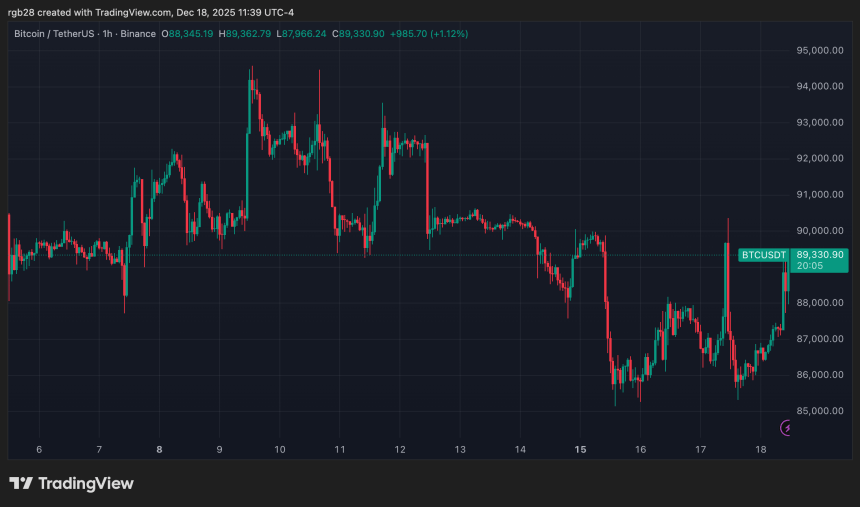
On Thursday, Bitcoin attempted to break past a crucial level after surging 2.9% from its daily opening. The cryptocurrency has been unable to reclaim $89,000-$90,000 area since the start-of-week correction, which sent the price to a two-week low of $85,145.
Notably, the flagship crypto retested the crucial resistance area twice in the past 24 hours but has been rejected, falling back to the local lows. Market observer Ted Pillows highlighted that BTC has been holding above the $85,000 support zone despite the volatility, which could lead to another retest of the key $90,000-$92,000 zone if it holds.
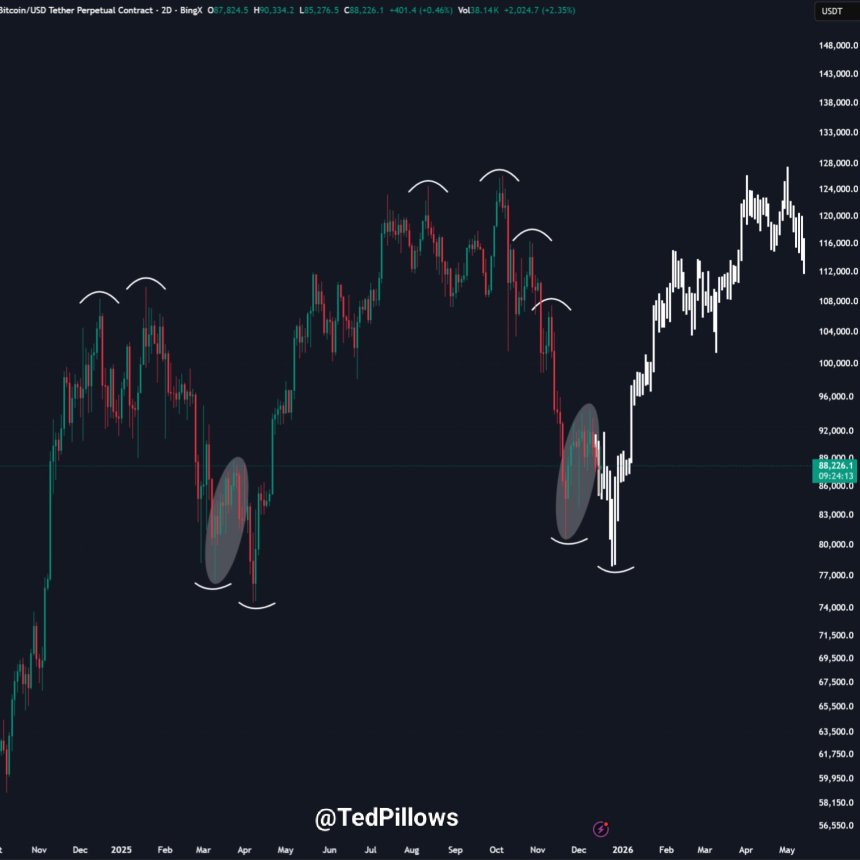
However, if price break below local support zone, Bitcoin would likely see a retest of the November lows, around the $80,000 mark. Ted also pointed out that the cryptocurrency may be mirroring its Q1 2025 price action, which suggests that a price drop below the recent lows could happen.
Per the chart, BTC briefly bounced in March from its early 2025 correction before recording a lower low in the next few weeks. This was then followed by the Q2 and Q3 recovery rallies that propelled the price to its latest all-time high (ATH) of $126,000.
Now, Bitcoin displays a similar performance, currently recovering from the initial corrective phase. If history repeats, the flagship crypto could see a 10%-15% drop to the $74,000-$76,000 area in the coming weeks before kicking off a rally toward new highs in 2026, the analyst suggested.
Bitcoin To Continue With ‘No Direction’
Similarly, Ali Martinez affirmed that the cryptocurrency is at an inflection point and risks dropping up to 20% if the $87,000 support doesn’t hold. He explained that BTC is breaking out of a bear flag, which could target the $70,000 level if selling pressure spikes.
Meanwhile, another analyst considers that “sentiment [is] flipping based on every last daily candle colour.” Daan Crypto Trades pointed out that Bitcoin has been trading within the $84,000-$93,500 for the past four weeks, “moving up and down in a choppy fashion, while trading in between these two larger levels.”
To the trader, the next few weeks will continue to be “generally very choppy and lack direction” due to lower liquidity and trading volume during the holiday season. “I don’t think you’d be missing much if you log off and come back somewhere early January,” he added.
On the contrary, analyst Crypto Jelle affirmed that despite the low-timeframe struggles, Bitcoin “still flat out refuses to drop lower, no matter how hard bears try.” He noted that price still sits “on a clear weekly support level” that has held since April, explaining that as long as this area holds, price can still reclaim the monthly opening, around the $90,300 area.
As of this writing, BTC trades at $86,138 a 5.3% decline in the weekly timeframe.
One of the most dangerous lies new traders believe is this: “The more trades I take, the more chances I have to win.”
It sounds logical. It feels empowering. It creates the illusion of productivity. But in trading, more is rarely better. More trades often mean more noise, more emotional decisions, more losses, more stress, and more chaos.
Top traders don’t win by trading more — they win by trading better. They understand a fundamental truth that the bottom 95% ignore: It’s the quality of your trades, not the quantity, that determines your success.
Trading is not about the number of opportunities you take, but the quality of the decisions you make.
In fact, the fastest way to blow an account is to trade too much. And the fastest way to grow one is to trade less, with exceptional precision, patience, and planning.
This article explores why high-quality trades outperform frequent trades every time — and how shifting your mindset around this single principle can transform your entire trading journey.
1. The Market Doesn’t Reward Activity — It Rewards Accuracy
Unlike a regular job, where working more hours means more pay, trading doesn’t work like that. In trading, you don’t get paid for activity. You get paid for accuracy.
Every trade you take either aligns with your system or goes against it. Every trade you take pulls emotional, psychological, and financial energy from you. Yet most retail traders behave as if trading more is automatically better.
This is a fundamental misunderstanding.
Professional traders might take only a handful of trades per week. Some even take one or two. And yet, they make far more money than someone taking 50 trades a day.
Why? Because pros don’t chase adrenaline — they chase precision. They don’t chase the market — they let it come to them.
Quality gives them consistency. Quantity gives most traders chaos.
2. Overtrading Is a Symptom of Emotional Trading
Overtrading rarely comes from strategy — it comes from emotion.
· Fear of missing out
· Fear of not making enough
· Frustration after a loss
· Boredom
· Ego
· Greed
These emotions push traders to take trades they shouldn’t — trades that don’t fit the plan, the setup, or the market conditions.
And every emotional trade you take weakens your discipline. It shifts your mindset from controlled execution to reckless reaction.
Mark Douglas taught that your job as a trader is not to control the market but to control yourself. Overtrading is the clearest sign that you’ve lost self-control.
Quality, on the other hand, requires emotional mastery. It requires patience, discipline, and the willingness to wait — even when the urge to trade is screaming inside you.
3. Every Trade Has a Psychological Cost
Traders think only in terms of financial risk — entry, stop-loss, lot size, leverage. But they forget the psychological risk attached to every trade they take.
Every trade you enter engages your emotions, your expectations, your attention, and your mental energy. It adds to your psychological load.
Too many trades drain your mental clarity and make it harder to make rational decisions.
Professional traders protect their mental capital even more fiercely than their financial capital. They know that once your mind is fatigued, discipline collapses.
Quality trades preserve your psychological energy. Low-quality trades drain it.
4. Quality Trades Come From a Tested Edge
A high-quality trade is one that aligns with:
· Your trading plan
· Your system’s edge
· Market structure
· Conditions favorable to your strategy
· Proper risk management
It’s a trade that has reason, logic, and probability behind it.
Quantity, however, often comes from randomness. Traders take setups that are “almost” valid, “kind of” good, or “maybe” will work. They force trades where none exist.
But in trading, “almost good” is bad. “Kind of valid” is invalid. “Maybe” is dangerous.
Professionals only take trades where the conditions match their edge with high clarity. They don’t compromise. They don’t negotiate with the market.
They wait for their setups the same way a sniper waits for the perfect shot.
5. More Trades Increase the Chance of Error
Each trade you take increases your exposure — not just to market risk, but to human error. The more trades you take:
· The more likely you misread a chart
· The more likely you enter impulsively
· The more likely you risk too much
· The more likely you violate your rules
· The more likely you miss something important
The human mind cannot process infinite decisions with consistency. Traders who take countless trades burn out quickly.
This is why professional traders:
· Automate
· Create strict rules
· Limit trade frequency
· Reduce decision fatigue
Quality reduces error. Quantity magnifies it.
6. High-Quality Trades Produce a More Predictable Equity Curve
A trader’s goal is not just profit — it’s consistent, controlled growth.
When you only take high-quality trades, your equity curve becomes:
· Smoother
· More predictable
· Easier to analyze
· Easier to improve
When you overtrade, your equity curve becomes a roller coaster — a chaotic mix of wins and losses with no structure or pattern.
This makes it:
· Hard to identify issues
· Hard to refine your system
· Hard to grow your account reliably
Your goal as a trader is to create a repeatable process — one that can be analyzed, reviewed, and improved. Quality creates repeatability. Quantity creates confusion.
7. High-Quality Trades Align With Market Conditions
Not all days are equal. Not all sessions are equal. Not all market environments are ideal for your system.
But traders who believe in quantity trade in every condition — trending, ranging, choppy, news-driven, erratic.
Taking a trade just because the market is open is like driving fast just because the road exists. It’s reckless.
Professional traders know that quality comes from timing. You trade only when:
· Volatility suits your style
· The structure is clear
· The setup is clean
· The conditions support your edge
This is what creates long-term profitability.
Trading in poor conditions is like fishing in muddy water — you might catch something, but it’s mostly luck, not skill.
8. Quality Trades Are Easier to Execute With Confidence
Confidence comes from clarity. When you take a trade that perfectly matches your rules, you feel calm, focused, and aligned. You’re not guessing — you’re executing.
Poor-quality trades create anxiety. You second-guess them. You manage them emotionally. You exit too early or too late. You stress over every candle.
When you choose quality, you choose peace. You eliminate doubt because the setup is clean. Your job becomes simple: Enter, manage, and exit — according to plan.
There’s a reason legendary traders like Mark Douglas, Paul Tudor Jones, and Jesse Livermore talk endlessly about patience. The market gives only a few truly great opportunities — the rest is noise.
One high-quality trade can outperform thirty low-quality trades. One clean swing can grow your account more than a week of scalping randomness.
Retail traders fall into the trap of thinking more trades = more profits. Professionals know that discipline creates profits — not the number of entries.
Quality ultimately leads to:
· Higher risk-to-reward
· Cleaner wins
· Smaller, controlled losses
· Fewer revenge trades
· Better long-term growth
If you improve your trade quality, your results improve automatically.
10. Quantity Leads to Emotional Burnout
Trading too often creates:
· Mental exhaustion
· Emotional fatigue
· Frustration
· Anxiety
· Loss of discipline
· Impulsive behavior
Burnout is one of the greatest silent killers of trading careers. Many traders don’t blow their accounts because of lack of skill — they blow them because they’re psychologically drained.
High-quality trading is sustainable. Low-quality trading is draining.
When you wait for high-quality setups, you reduce stress dramatically. You trade fewer hours but make better decisions. Your mind stays sharp, your discipline stays strong, and your trades stay focused.
11. Quality Teaches Patience — One of the Most Valuable Skills in Trading
Patience is hard because the market tempts you. Price wiggles and moves constantly, whispering, “Enter now. Don’t miss out.”
But the pros wait. They know that patience is not inaction — it is preparation. It is the filtering mechanism that separates randomness from opportunity.
Quality trains your mind to think long-term, while quantity trains your mind to think impulsively.
The more patient you become, the better your results get. The less patient you are, the faster you lose control.
12. High-Quality Trades Eliminate the Need for Revenge Trading
Revenge trading comes from frustration — often caused by poor-quality trades. When you enter bad setups and lose, your ego forces you to chase the loss.
But when you stick to high-quality trades, even your losses feel justified. You followed your plan. You executed correctly. You acted professionally.
There’s no emotional need to chase. Nothing to “get back.”
Quality is the antidote to chaos. It keeps you grounded.
13. Quality Helps You Build a Professional Mindset
When you begin to prioritize quality over quantity, your entire identity as a trader transforms. You stop being a gambler. You stop being impulsive. You stop chasing excitement.
You become deliberate. You become thoughtful. You become disciplined. You become patient.
You start thinking like a professional. You start behaving like a professional. You start trading like a professional.
And your results begin to mirror the mindset you’ve built.
14. The Fewer the Trades, the Easier the Analysis
If you take 2–5 high-quality trades a week, analyzing them becomes simple. You can review every detail with clarity. You can identify strengths and weaknesses. You can refine your edge.
But if you take 50–100 trades a week, your journal becomes a blur. Patterns disappear. Errors blend together. You can’t separate good decisions from bad ones.
Quality trading strengthens your feedback loop. And strong feedback loops accelerate your growth.
15. The Market Makes Big Moves — Not Constant Moves
The market doesn’t make you rich through constant small fluctuations. It makes you rich through major, high-probability moves — trends, breakouts, retests, clean reversals.
These moves don’t happen every hour. Sometimes they don’t happen every day. But when they do, they’re worth waiting for.
Quantity traders miss the big moves because they’re busy reacting to noise. Quality traders catch the big moves because they wait for signal.
Trading fewer, better trades puts you on the side of probability, not hope.
Conclusion: Slow Down to Speed Up
If you take one thing from this article, let it be this: Your trading success is determined not by how much you trade but by how well you trade.
Most retail traders fail not because they lack knowledge, but because they lack discipline and patience. They try to force the market to give them opportunities. They chase candles, signals, and excitement. They trade too much, too often, with too little clarity.
But the top 5% do something different. They slow down. They wait. They filter ruthlessly. They execute only the highest-quality trades.
That’s why they last. That’s why they win. That’s why their accounts grow consistently.
You don’t need more trades. You need better trades. You don’t need more action. You need more discipline.
Trading fewer, better trades isn’t a strategy — it’s a transformation. It’s the shift that takes you from losing trader to consistent trader.
And once you embrace it, everything changes.
— —
Your support helps this reach more traders! Hit 👏 and follow for more quality trading content.
As the crypto market recovers from the latest pullback, XRP is attempting to climb up from its recent lows. Some analysts have suggested that the cryptocurrency must defend its current levels or risk a 50% drop to levels not seen since 2024.
XRP At Make-Or-Break Level
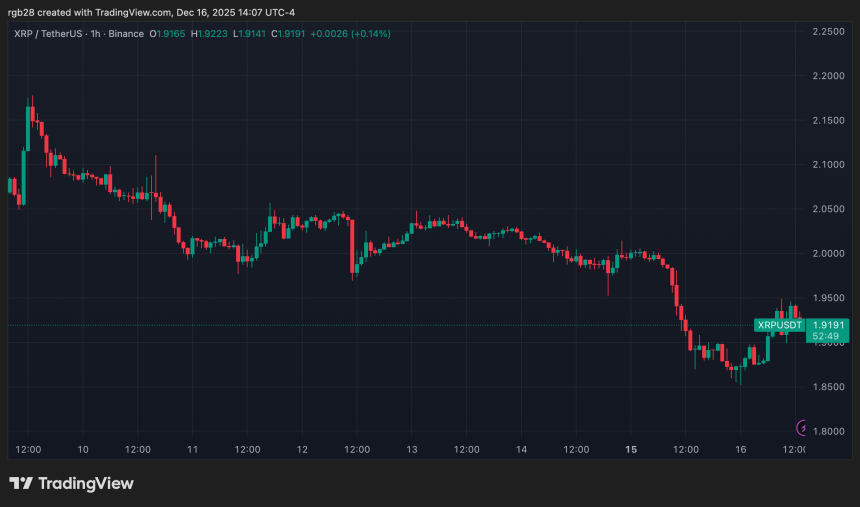
Amid the start-of-week market correction, XRP recorded a 6% drop toward its lowest level in weeks. The price lost $2.00 support on Monday morning and continued to lose key levels despite uninterrupted institutional interest.
The cryptocurrency has been trading within the $2.00-$2.25 price range over the past month, only losing its lower boundary during the late November pullback. Monday’s correction sent the altcoin below the range’s lower support again, hitting a multi-week low of $1.88 before bouncing around an area that has been crucial for the past year.
Notably, XRP has bounced from the $1.85-$1.90 support zone after every major correction since the November 2024 breakout, climbing back above the $2.00 level each time. However, some market observers have suggested that the price risks a significant correction if it is unable to hold the current levels.
Ali Martinez pointed out that the cryptocurrency has fallen below its one-year price range, between the $1.92-$3.27 levels, which could lead to a 50% drop below this area. To the analyst, XRP’s price must secure a daily close above $1.92 to prevent a drop to the $1.00 support, which has not been seen in over a year.
Similarly, Cheds Trading affirmed that XRP is “flirting with a high time frame breakdown.” Per the chart, the altcoin appears to be forming a high-timeframe rounding top or double top pattern with a higher high.
The analyst noted that in the case of the latter, the M formation would be confirmed if the $1.88 level, where the pattern’s neckline is situated, is lost. This could lead to a “measured move to roughly [the] MA 200 area/$1.00 range.”
Price Ready For 2026 Markup Phase?
Despite the warnings, other market watchers shared a positive outlook for XRP in the coming months. Trader Niels affirmed that the leading altcoin is “looking good” at the current levels.
According to the post, the cryptocurrency is “sweeping the $1.8 support zone again” while showing a bullish divergence on the daily timeframe, which suggests that the price could soon move to higher levels.
To the trader, once XRP breaks above $2.20 resistance, it could surge 27%-37% towards the $2.80-$3.00 area “within a month.”
Meanwhile, analyst ChartNerd highlighted that XRP appears to be repeating its 2023-2024 price action, which led to its massive breakout in November 2024. The chart shows that the altcoin accumulated for a year and a half, bouncing between the range’s lower and upper boundaries before its markup phase in late Q4 2024.
Following this expansion period, the cryptocurrency is showing a similar accumulation range, leading the analyst to suggest that XRP may continue consolidating within its current range before another markup phase occurs.
“Regardless of scenarios, or how ugly/beautiful it gets, a massive markup phase similar to November 2024 is likely between now and late 2026,” he stated.
As of this writing, XRP is trading at $1.92, a 1.65% increase in the daily timeframe.
As Bitcoin (BTC) tries to hold the $90,000 barrier, some analysts affirm that the flagship crypto’s bear market signals are becoming clearer, suggesting that a breakdown to new lows could be around the corner.
Bitcoin Bear Flag Raises Concerns
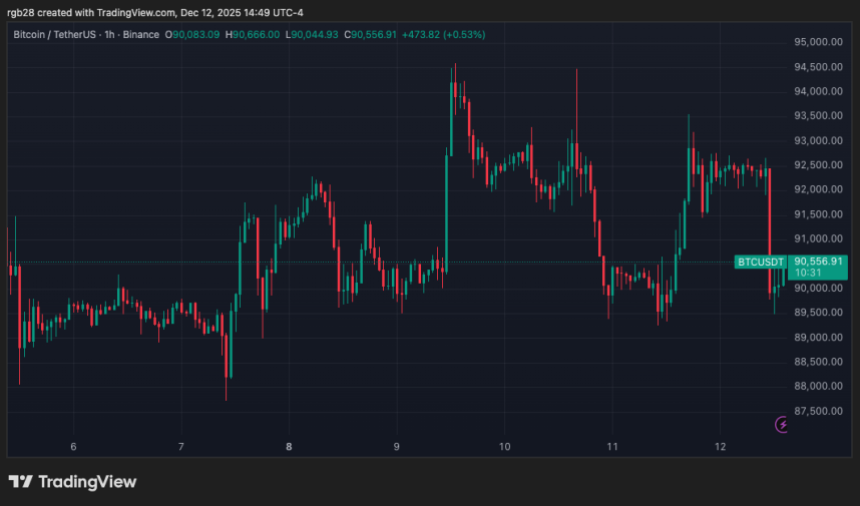
On Friday, Bitcoin shredded its Thursday gains, dropping 3.2% intraday to retest the $89,500-$90,500 support zone once again. The cryptocurrency has been trading between the $84,500-$94,500 range for the past four weeks, briefly falling to a seven-month low of $80,600 during the late November correction.
This week, the flagship crypto’s price has seen more volatility, fueled by the expectations of the Federal Reserve’s interest rate cut and positive regulatory developments in the US. However, BTC has failed to successfully break and hold above its local range’s upper boundary after multiple retests, ultimately falling to the mid-zone of its range.
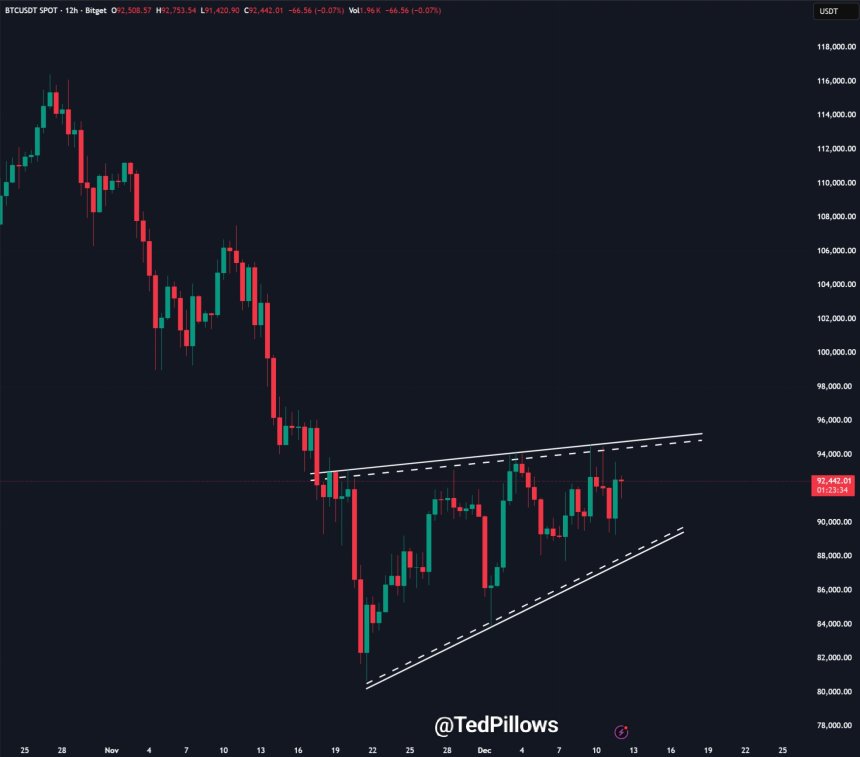
Analyst Ted Pillows highlighted a concerning pattern on Bitcoin’s chart, warning that the cryptocurrency risks a drop to new multi-month lows if the price fails to hold key support levels.
Per the post, BTC has been forming a bear flag for nearly a month, which “is too hard to ignore” after the price continues to be rejected from the formation’s upper boundary. The analyst affirmed that this pattern follows a trend that has been developing over the past two months.
As he pointed out, bearish flags have been continuously forming on BTC’s chart since the October 10 market pullback, with each pattern resolving in a breakdown to lower levels. To Ted, the new formation signals “that the overall trend is still to the downside.”
He suggested that a close above the $96,000 level would invalidate the bearish pattern. On the contrary, a drop to below the $86,000 support, where the formation’s lower boundary is located, could push Bitcoin to the April lows, around the $76,000 mark.
Is The 2022 Playbook Repeating?
The market observer also noted a resemblance between the last cycle and the current one, which could lead to a drop below the $70,000 level. The chart shows that after losing the 50-Week EMA indications, Bitcoin consolidated within a bear flag before breaking down and descending to the 2022 lows.
Now, BTC displays a similar performance after losing the 50-Week EMA and breaking down from its October bear flag. “If this plays out, a pump to $100,000 and then a dump below $70,000” would follow, the analyst added.
Meanwhile, Robert Mercer shared a similar perspective in a series of X posts. The analyst affirmed that the classic four-year cycle has not changed despite the significant increase in institutional adoption:
Bitcoin is breaking crucial supports one by one and entering a bear market. The same happened back in the end of 2021. At the moment, BTC is forming an ascending channel with the top near $100,000 – $104,000, you can see a clear Right Shoulder of H&S in this move. Something similar happened in the beginning of 2022.
He also asserted that Bitcoin shows a similar picture “from the 1W MA50 perspective,” as BTC has traded below this indicator for multiple weeks now for the first time in the bullish cycle.
Nonetheless, he concluded that “no such breakdown happens without a retest,” forecasting a relief bounce up to $98,000-$102,000, followed by a dump to the support level of $55,000-$60,000.
As of this writing, BTC Trades at $89,990, a 2.75% decline in the daily timeframe.
As the start-of-week momentum slows, Dogecoin (DOGE) dropped 5.5% on the daily timeframe, falling to the recent lows once again. Some analysts have suggested that the cryptocurrency is setting the stage for a massive short-term and mid-term rally if the retests of current levels hold.
Dogecoin Prepares For $1 Milestone
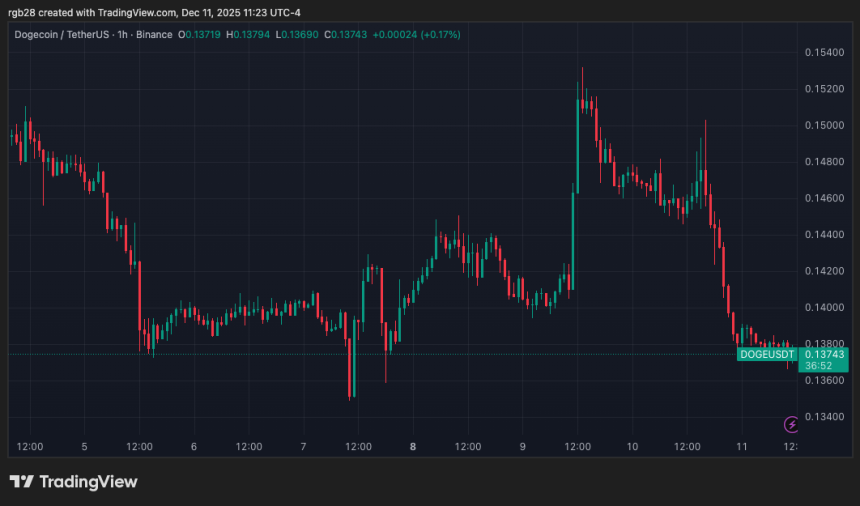
On Thursday, Dogecoin followed the rest of the crypto market and retraced to the $0.136-$0.138 levels. The cryptocurrency has retraced around 50% following the Q4 market downturn, trading within the $0.130-$0.155 price range over the past few weeks.
Amid this week’s recovery, DOGE’s price briefly tested the local range highs, trying to break out of this area for the second time this month. However, Wednesday’s volatility, driven by the expectations of the Federal Reserve’s rate cut announcement, led to a 4.6% intraday drop before continuing its descent to the current levels.
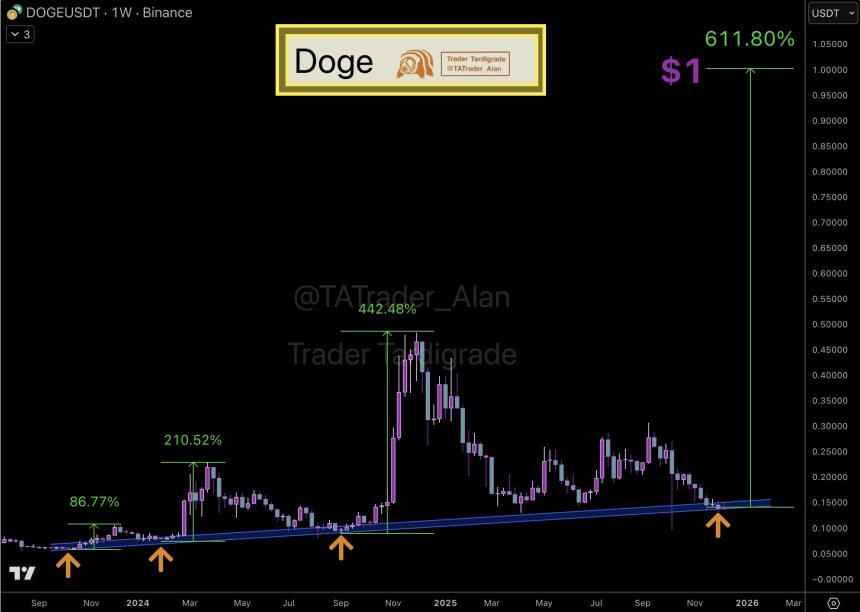
Market observer Trader Tardigrade highlighted the cryptocurrency’s performance, noting that Dogecoin is holding strong at a key support area despite the pullback, which could “potentially set the stage for a massive surge to $1” next year.
According to the chart, DOGE is retesting an ascending support zone that has preceded major moves over the past two years. Since late 2023, this support has been retested three times, marking the bottom of each major corrective phase and serving as a “launchpad” to new highs.
Notably, the subsequent rally’s size and duration have seen an increasing trend, with the bounces lasting longer and reaching higher levels after each retest of the two-year trendline.
During the first rebound, Dogecoin rallied 87% in eight weeks. Meanwhile, DOGE surged by over 210% in ten weeks after retesting this crucial level. Lastly, it registered a 14-week 442% run between Q3 and Q4, 2024, to its multi-year high of $0.48.
With the price currently retesting this level once again, the analyst suggested that a rally to the $1 mark could be brewing if the current levels hold. A bounce from this area could kick off a 610% jump at the start of 2026.
DOGE’s Rally To September Highs Imminent?
The trader also pointed out that DOGE’s MACD Bullish Crossover “is now happening.” He explained that the cryptocurrency’s trend began shifting from a downtrend to an uptrend on Wednesday, suggesting a significant price move is to follow.
He previously affirmed that this setup has preceded previous breakouts this year, with the price surging to new local highs in Q2 and Q3 after each MACD bullish cross. As this setup begins to unfold, the analyst’s chart suggests that the price could bounce to the October levels.
Similarly, other market observers hinted that Dogecoin could be preparing for a 60%-120% surge in the short term. Analyst Bitcoinsensus highlighted a classic bullish reversal pattern, a falling wedge pattern, that has been forming since October in DOGE’s chart.
After the recent price action, the “price has been slowly bleeding inside this structure and now potentially forming a nice rounded bottom. If we get a decent breakout above the upper yellow line, we could be targeting the 0.20$ area (+60%),” the analyst stated.
Meanwhile, AltCryptoTalk recently noted that Dogecoin is retesting “the same weekly demand zone that sparked every major rally in the past,” which could spark a 115% rally to the $0.30 September high if the area holds.
As of this writing, Dogecoin is trading at $0.137, an 8% decline in the weekly timeframe.
The Hidden Gold Trading Strategy That Professional Traders Use While You Sleep
Gold chart showing Asian session range box highlighted for analysis.
While most retail traders wait for the chaos of London and New York sessions, professional gold traders are quietly banking profits during the Asian session. This isn’t coincidence — it’s strategy. Smart money understands that gold trading during Asian hours offers unique advantages: lower noise, clearer patterns, and institutional positioning setups that savvy traders exploit for consistent wins. If you’ve been struggling with volatile sessions, overtrading, or inconsistent results, the answer might not be a new indicator — it could be trading at the right time. In this guide, we’ll reveal why the Asian session is the secret weapon for profitable gold trading and how you can leverage it too.
The Asian Session Gold Trading Advantage: What Makes It Different
Understanding Gold Trading Sessions and Market Behavior
Gold trading operates 24 hours across three major sessions: Asian (Tokyo), London, and New York. Each session has distinct characteristics, but the Asian session gold trading strategy offers something the others don’t — predictability within calm.
The Asian session, running approximately from 11 PM to 8 AM GMT, is often dismissed by amateur traders as “too quiet” or “low volatility.” But here’s what they’re missing: low volatility doesn’t mean low opportunity. For gold specifically, this session represents a critical period where institutional players reposition, liquidity is swept, and psychological traps are set for the upcoming European session.
Why Gold Behaves Differently During Asian Hours
Unlike currency pairs that may genuinely lack direction during off-peak hours, gold trading in the Asian session follows deliberate patterns tied to:
Overnight positioning from New York close — Banks and institutions adjust their gold positions
Asian market open dynamics — Tokyo, Hong Kong, and Singapore markets influence gold sentiment
Pre-London setup — Smart money establishes positions before European volatility hits
Lower retail participation — Less emotional trading, clearer institutional footprints
This creates an environment where a well-structured gold trading strategy for Asian session can thrive with higher probability setups and cleaner price action.
Gold price breakout and confirmation visual explanation
How Smart Money Operates in the Asian Gold Market
The Institutional Gold Trading Playbook
Professional traders and institutional desks don’t trade randomly. They follow time-based protocols, and the Asian session serves specific purposes in their gold trading strategy:
1. Liquidity Sweeps and Stop Hunts During Asian hours, smart money often targets stop losses left by retail traders from the previous New York session. These liquidity grabs create false moves that trap amateurs before the real directional move begins.
2. Range Establishment The Asian session frequently establishes the day’s trading range. Professional gold traders use this information to frame their London and New York session strategies. Understanding this range is crucial for any profitable gold trading strategy.
3. Time-Based Positioning Elite traders know that gold respects time more than indicators. Certain hours within the Asian session consistently produce specific behaviors — breakouts, reversals, or consolidations. Recognizing these gold trading patterns is what separates consistent winners from gamblers.
The Smart Money Asian Session Gold Trading Strategy Framework
While we can’t reveal proprietary systems like The Goldmine Strategy, we can share the framework professional traders use:
Higher timeframe analysis — Checking daily, 4-hour, or 1-hour candles for overall market structure
Time-specific entry zones — Not just “Asian session” but precise hours within it
Breakout methodology — Waiting for specific price patterns to confirm before entering
Risk management protocols — Position sizing based on Asian session volatility characteristics
This structure forms the backbone of successful Asian session trading strategies used by prop firm traders and professional gold specialists worldwide.
Why the Asian Session Is Perfect for Gold Trading (5 Key Reasons)
1. Reduced Market Noise for Cleaner Gold Trading Signals
High volatility sessions like London and New York overlap are filled with whipsaws, fake breakouts, and emotional price action. The Asian session gold strategy eliminates much of this noise, allowing traders to see true institutional intent.
With fewer participants and lower volume, gold trading signals become more reliable. Price doesn’t jump erratically on every news headline — it moves with purpose.
2. Ideal for Risk Management in Gold Trading
Every professional gold trading strategy prioritizes capital preservation. The Asian session’s tighter ranges allow for:
More precise stop loss placement
Better risk-to-reward ratios
Lower chance of catastrophic gap moves
Predictable volatility for position sizing
This makes the Asian session trading strategy particularly attractive for prop firm challenges where consistent, low-drawdown performance is required.
3. Time Freedom: The Best Gold Trading Strategy for Busy Traders
Not everyone can watch charts during peak London or New York hours. The Asian session gold trading approach allows traders in different time zones — or those with day jobs — to trade during early morning or late-night hours without sacrificing quality setups.
You don’t need to be glued to screens for 8 hours. A solid gold trading strategy Asian session can be executed in 1–3 hours with disciplined patience.
4. Higher Win Rate Potential with Structured Systems
Random trading produces random results. But when you apply a proven gold trading strategy specifically designed for Asian session characteristics, win rates improve dramatically.
Systems like The Goldmine Strategy have demonstrated up to 80% win rates by focusing exclusively on Asian session price behavior. This isn’t luck — it’s statistical edge created by understanding when gold moves predictably.
5. Less Competition from Retail Emotion
Retail traders love volatility. They chase breakouts during news events and London open chaos. But professional traders know: emotion is expensive.
The Asian trading session strategy attracts disciplined, methodical traders. Less emotional competition means better fills, fewer stop hunts by algos targeting retail clusters, and cleaner technical setups.
Premium branding image for The Goldmine Asian Session Gold Trading Strategy
The Goldmine Strategy: A Proven Asian Session Gold Trading System
What Makes This Gold Trading Strategy Different
Without revealing proprietary details, here’s what makes The Goldmine Strategy one of the most effective Asian session gold trading strategies available:
Time-Based Edge The system doesn’t rely on lagging indicators or subjective chart patterns. Instead, it uses specific time windows within the Asian session where gold historically shows predictable behavior. Think of it as trading with the clock, not against it.
Breakout Precision Not all breakouts are created equal. The Goldmine approach identifies high-probability breakout scenarios after analyzing higher timeframe structure — filtering out fakeouts that trap average traders.
Beginner-Friendly, Pro-Level Results You don’t need years of experience to execute this gold trading strategy. The system provides clear checklists, exact entry criteria, and risk parameters. Follow the blueprint, and you follow in the footsteps of traders passing prop firm challenges and building real accounts.
Proven Track Record Traders using The Goldmine Strategy have documented results including:
Single trades generating $30,000+ profits
80% win rate consistency over hundreds of trades
Successful prop firm challenge completions
Accounts grown from $500 to $5,000+ in weeks
This isn’t theoretical — it’s a working gold trading strategy with real receipts.
Who Benefits Most from Asian Session Gold Trading
The best gold trading strategy for Asian session works particularly well for:
Prop firm traders needing consistency and controlled drawdown
Part-time traders who can’t monitor charts during London/New York
Risk-averse traders preferring calm, strategic entries over volatile gambling
Beginners wanting a structured system instead of confusing indicator soup
Experienced traders tired of overtrading and seeking higher probability setups
If you recognize yourself in any of these categories, exploring an Asian session gold strategy could transform your trading results.
Common Mistakes Traders Make with Asian Session Gold Trading
Mistake #1: Treating It Like London or New York
The biggest error is applying high-volatility strategies to low-volatility sessions. The Asian session trading strategy requires patience, precision, and different risk parameters. Trying to scalp 10 trades like you would during London open is a recipe for frustration.
Mistake #2: Ignoring Time-Based Patterns
Gold doesn’t move randomly during Asian hours. There are specific times within the session where moves happen. Trading without understanding these windows means you’re guessing instead of executing a strategic gold trading plan.
Mistake #3: Using the Wrong Timeframes
Many traders zoom into 1-minute or 5-minute charts looking for action. Professional Asian session gold traders start with higher timeframes (daily, 4H, 1H) to understand context, then drill down to time-based entries. Context is everything in any successful gold trading strategy.
Mistake #4: No Structured System
Winging it works until it doesn’t. The difference between profitable traders and those who blow accounts is having a repeatable gold trading strategy with clear rules. Discretionary trading in the Asian session without structure is still gambling.
Community of traders learning the Goldmine Asian session gold trading strategy.
How to Start Trading Gold During Asian Hours (Step-by-Step Framework)
Step 1: Prepare Your Trading Environment
Broker Selection Choose a broker with tight spreads during off-peak hours. Asian session liquidity is lower, so spread costs matter more. Many traders using Asian gold trading strategies prefer brokers like Exness for reliable execution during Tokyo hours.
Timeframe Setup Configure your charts to show both higher timeframe context (daily, 4H) and your execution timeframe. Most effective gold trading strategies for Asian session use this multi-timeframe approach.
Economic Calendar Even though Asian session is calmer, check for high-impact news from China, Japan, or overnight US economic data releases. These can disrupt typical patterns.
Step 2: Analyze Higher Timeframe Structure
Before looking for entries, understand the bigger picture:
Is gold in an uptrend, downtrend, or range on the daily chart?
Where are key support and resistance zones?
What’s the previous session’s closing price action telling you?
This context informs your Asian session gold trading decisions and prevents counter-trend disasters.
Step 3: Identify Your Time-Based Entry Window
Not every minute of the Asian session is equal. Professional gold traders focus on specific hours where patterns consistently emerge. While the exact times are proprietary to systems like The Goldmine Strategy, the principle remains: trade when probability is highest, not just because markets are open.
Step 4: Wait for Confirmation
Patience separates professionals from amateurs. The best Asian session gold strategy involves waiting for:
Never force trades. The session will present setups if you’re prepared to wait.
Step 5: Execute with Discipline
Once your criteria align:
Enter at your predetermined price level
Set stop loss based on session volatility (tighter than London/NY)
Set take profit targets at logical zones (not random)
Don’t move stops or second-guess mid-trade
The profitable gold trading strategy you’re executing was designed before you entered. Trust the process.
Step 6: Journal and Refine
Every trade — win or lose — teaches something. Professional traders using Asian session strategies maintain detailed journals noting:
Time of entry
What pattern triggered the trade
How price behaved relative to expectations
Emotional state during the trade
Over weeks, patterns emerge showing what works best for your psychology and schedule.
The Goldmine Strategy: Your Blueprint for Asian Session Gold Trading Success
Why Traders Choose The Goldmine Strategy
Imagine having a proven gold trading system that:
Removes guesswork with clear entry and exit rules
Works specifically during low-stress Asian hours
Has been back-tested and forward-tested with documented results
Comes with risk management frameworks designed for consistency
That’s exactly what The Goldmine Strategy provides.
This isn’t just another generic “buy low, sell high” course. It’s a specialized Asian session gold trading strategy developed by Stephen Madu (FXM Brand) after years of trading, teaching, and refining what actually works during Tokyo hours.
Frequently Asked Questions About Asian Session Gold Trading
What is the best time to trade gold in the Asian session?
The Asian session runs approximately from 11 PM to 8 AM GMT, but the best gold trading opportunities typically occur during specific hours within this window when institutional activity increases and patterns complete. Professional systems like The Goldmine Strategy identify these precise time zones for optimal entry.
Can beginners use an Asian session gold trading strategy?
Absolutely. The Asian session is ideal for beginners because of lower volatility, clearer patterns, and less market noise. However, success requires following a structured gold trading strategy rather than trading randomly. Systems designed specifically for Asian hours (like The Goldmine Strategy) provide the framework beginners need to succeed without years of trial and error.
What makes Asian session gold trading different from London or New York sessions?
Asian session gold trading differs in volatility, participation, and price behavior. While London and New York sessions feature rapid, news-driven moves and high volume, the Asian session is characterized by deliberate institutional positioning, liquidity sweeps, and time-based patterns. This creates different opportunities requiring different strategies.
Is the Asian session profitable for gold trading?
Yes, when traded with an appropriate gold trading strategy. Professional traders and prop firm challengers regularly profit from Asian session setups because the reduced noise allows for higher-probability trades. The key is using a proven Asian session strategy rather than applying high-volatility tactics to low-volatility periods.
How much can you make trading gold in the Asian session
Profit potential depends on account size, risk management, and strategy effectiveness. Traders using The Goldmine Strategy have documented single trades ranging from a few hundred dollars to over $40,000. With an 80% win rate system and proper risk management, consistent monthly returns are achievable for traders of all experience levels.
What risk management should I use for Asian session gold trading?
Asian session gold strategies typically use tighter stop losses than volatile sessions due to smaller average ranges. Professional traders risk 0.5–1.5% of account balance per trade, with stop losses placed based on session-specific volatility. Target risk-to-reward ratios of at least 1:2, with some setups offering 1:3 or better. Always use a structured risk management framework rather than arbitrary percentages.
Do I need special indicators for Asian session gold trading?
The most effective Asian session gold trading strategies rely more on time-based analysis and price action than indicators. While some traders use basic tools for confirmation, systems like The Goldmine Strategy focus primarily on higher timeframe structure, specific time windows, and breakout patterns — not indicator overload. Simplicity often outperforms complexity in calm sessions.
Can I use Asian session strategies for prop firm challenges?
Yes. The Asian session gold trading approach is particularly effective for prop firm challenges because it emphasizes:
Consistency over home runs
Controlled risk and drawdown
High win rate setups
Time-efficient trading
Many traders have successfully passed challenges using The Goldmine Strategy specifically because of its risk-conscious, repeatable framework.
What’s the average win rate for Asian session gold trading?
Win rates vary by strategy and trader discipline. Random trading might yield 40–50% wins, while structured Asian session strategies can achieve 60–75%+ win rates. The Goldmine Strategy specifically has demonstrated 80% win rates when followed correctly, due to its focus on high-probability, time-based setups rather than constant trading.
How long does it take to learn Asian session gold trading?
With a structured gold trading strategy, you can begin executing trades within days. The Goldmine Strategy is designed for quick implementation — study the rules, practice identification on charts, then start with small position sizes. However, mastery comes from repetition. Expect 30–90 days of consistent application to develop intuition and confidence with any professional gold trading system.
What broker is best for trading gold during Asian hours?
The best brokers for Asian session gold trading offer tight spreads during off-peak hours, reliable execution, and low latency to Asian liquidity providers. Many professional traders prefer brokers like Exness for their consistent spreads and uptime during Tokyo hours. Whatever broker you choose, ensure they’re regulated and offer competitive conditions for XAUUSD during the Asian session.
Can I trade other assets using Asian session strategies?
While gold trading strategies can sometimes adapt to other assets, gold behaves uniquely during Asian hours due to its hybrid nature (commodity + currency + safe haven). Systems specifically designed for Asian session gold, like The Goldmine Strategy, are optimized for XAUUSD characteristics. Other assets may require different approaches even in the same time window.
Trader monitoring gold charts at night during Asian market hours.
Take Action: Start Your Asian Session Gold Trading Journey Today
The Smart Money Path Is Clear
You now understand why professional traders, institutional desks, and prop firm challengers focus on Asian session gold trading. The question isn’t whether this approach works — documented results prove it does. The question is: will you continue struggling with volatile, unpredictable sessions, or will you trade with the calm precision of smart money?
Your Next Steps
Step 1: Get the proven system Stop guessing and start following a documented gold trading strategy. The Goldmine Strategy provides everything you need: rules, timeframes, risk management, and ongoing support.
Step 2: Practice with discipline Even the best gold trading strategy requires execution. Spend time identifying setups on historical charts before risking real capital.
Step 3: Start small, scale smart Begin with conservative position sizes while building confidence. As your win rate confirms the strategy’s edge, gradually increase size according to your risk management plan.
Step 4: Join the community Surround yourself with traders using the same Asian session approach. The Goldmine Strategy includes access to a 2400+ member community for shared insights, accountability, and continued learning.
Limited-Time Opportunity
The Asian session gold trading edge exists because most traders don’t have access to proven systems. As more traders discover strategies like The Goldmine, market dynamics may shift. Early adopters gain the maximum advantage.
Don’t spend another month struggling with inconsistent results. Join the traders who’ve transformed their performance by trading gold when smart money operates — during the Asian session.
Trade smarter. Trade calmer. Trade like the professionals.
About the Author:This article was created to educate traders about Asian session gold trading opportunities and introduce The Goldmine Strategy, a proven system developed by Stephen Madu of FXM Brand. With over 2400 traders using this approach, The Goldmine Strategy represents one of the most comprehensive resources for mastering gold trading during Asian hours.
Disclaimer: Trading gold and other financial instruments involves risk. Past performance does not guarantee future results. Always trade with risk capital you can afford to lose and consider seeking advice from a licensed financial advisor.

 Login
Login