Login
LoginBitcoin Price Crashes to $84,000 – Is $70,000 Next?
Bitcoin Magazine

Bitcoin Price Crashes to $84,000 – Is $70,000 Next?
The bitcoin price dropped sharply today after a brief pump near $90,000, sliding to $84,544 as the price sell-off continued into its second month.
Bitcoin lost 2% over the past 24 hours. It remains 5% below its seven-day high of $89,220 and hovers near the week’s low of $84,596. Trading volume reached $56 billion. Bitcoin’s market capitalization stands at $1.69 trillion. The circulating supply is roughly 19.96 million BTC out of a total 21 million, according to Bitcoin Magazine Pro data.
The drop follows a brief rally that earlier saw the Bitcoin price test $89,000. The surge came after the U.S. released new Consumer Price Index data. Inflation rose 2.7% year over year in November, lower than expected. Core CPI, which excludes food and energy, fell to 2.6%, the lowest since early 2021.
Bitcoin jumped from intraday lows near $86,000 to challenge $89,000. Traders viewed the cooler inflation report as a potential signal for looser Federal Reserve policy in 2026. CME FedWatch data suggested slightly higher odds of a rate cut by March, though January moves remain unlikely.
The rally did not last. The bitcoin price failed to break $90,000 and slid to $84,4000. This pattern is familiar: sharp spikes followed by quick retracements.
What’s dragging down the bitcoin price?
A persistent challenge is U.S.-listed spot Bitcoin ETFs. These funds, once a major source of demand, have seen net redemptions. The outflows remove institutional support that previously helped stabilize the price. Without consistent ETF inflows, breakouts above $89,000 are harder to sustain.
Other economic indicators add uncertainty. Recent labor market data showed U.S. unemployment rising to 4.6%, its highest since 2021. Job growth remains uneven. The mixed signals complicate Federal Reserve policy, suggesting a cautious approach despite easing inflation.
Political factors add to market complexity. President Donald Trump has publicly urged lower interest rates and suggested nominating a Fed chair favoring aggressive easing. Markets have largely treated the comments as noise, but the statements add a variable to the macro picture.
Technically, the bitcoin price is consolidating rather than trending. Resistance forms just below $90,000. Supply above this level remains strong, held by investors who bought during prior rallies.
Analysts at Bitwise recently suggested Bitcoin could break its historical four-year cycle. The firm noted BTC might reach new all-time highs in 2026 with lower volatility and reduced correlation to equities.
The Bitcoin Fear and Greed Index currently sits at 17/100, signaling extreme fear. Historically, readings in this range have coincided with undervaluation. Contrarian investors see potential buying opportunities, though sentiment remains cautious.
Is $70,000 next?
Technical analysts from Bitcoin Magazine wrote earlier this week that the $84,000 support level is under pressure. If the bitcoin price falls below this point, it could test the $72,000 to $68,000 zone. Initial bounces are expected, but a break below $84,000 could trigger faster declines toward $70,000.
Bitcoin’s price may drop to the $72,000–$68,000 support zone after breaking the $84,000 level, with bears currently in control. A strong bounce is likely from that lower zone, potentially retesting $84,000, though the 4-Year Cycle suggests further downside could occur later in 2026.
Resistance extends from $94,000 to $118,000. Bulls will need substantial buying volume to break above these levels, per Bitcoin Magazine analysts.
Short-term momentum favors sellers. Last week, the Bitcoin price closed the weekly candle in red, failing to sustain gains near $94,000. Bears are well-positioned to push prices lower this week.
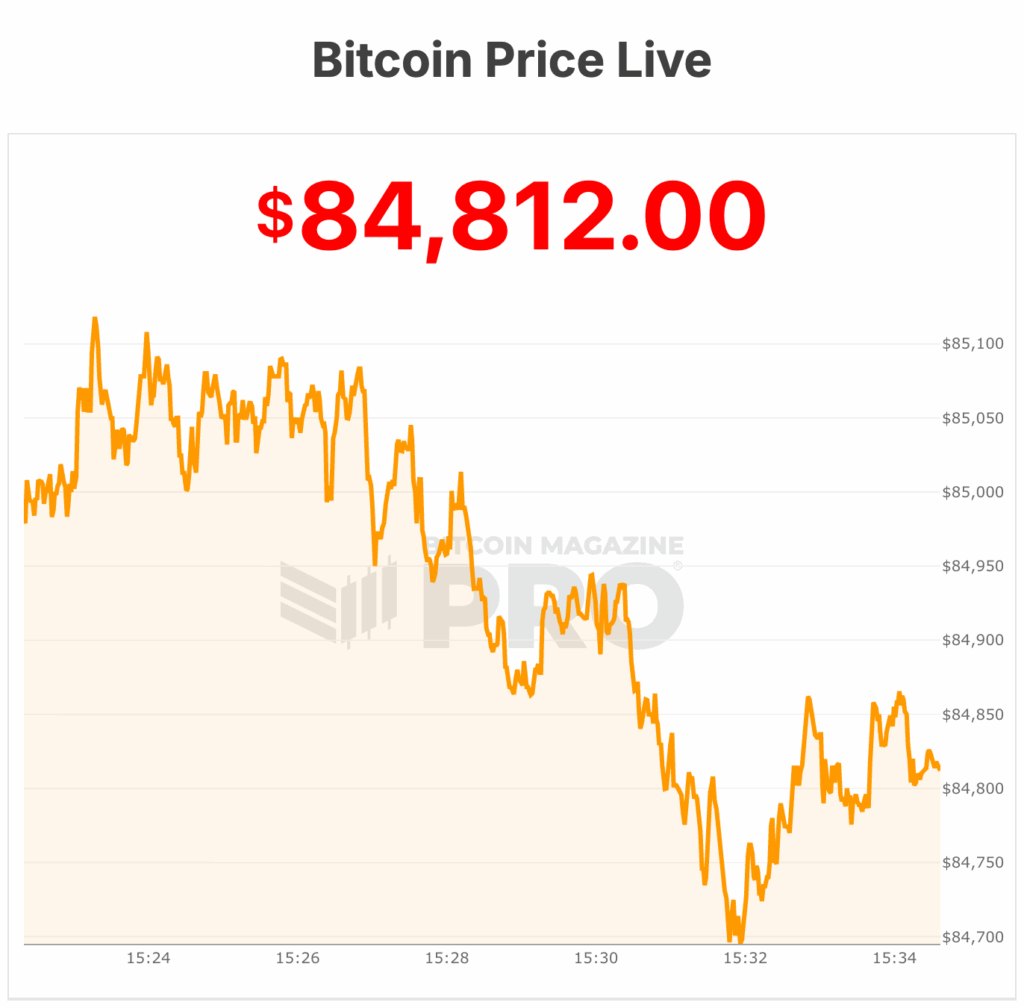
At the time of writing, the bitcoin price is $84,812. Trading volume reached $56 billion. Bitcoin’s market capitalization stands at $1.69 trillion. The circulating supply is roughly 19.96 million BTC out of a total 21 million, according to Bitcoin Magazine Pro data.
This post Bitcoin Price Crashes to $84,000 – Is $70,000 Next? first appeared on Bitcoin Magazine and is written by Micah Zimmerman.