Reading view

There are new articles available, click to refresh the page.

Cardano Enters New Phase, Hoskinson Touts ‘ChatGPT For Privacy’

Charles Hoskinson says Cardano is entering a new phase centered on what he described as a “ChatGPT for privacy,” positioning the Midnight project as a cross-ecosystem application layer designed to make advanced cryptography usable at scale.

Cardano Is Entering A New Phase

Speaking in a Dec. 18 livestream titled “Rays of Sunshine in 2026,” the Cardano founder argued that Midnight marks a shift away from incremental performance battles toward privacy-first, hybrid applications that can plug into Ethereum, Solana, Bitcoin, and beyond.

“I wanted to make a video to talk about the good stuff and talk about the fact that we’re leading the market for the first time in a long time,” Hoskinson said. “And it feels right. This time really does.”

The heart of the pitch was that Midnight’s early traction is not just a hype spike, but a sign the market is tired of the usual crypto incentive loop and looking for a new “paradigm.” “People deep down inside, they know that a new generation is starting,” he said. “We need a new paradigm and we have to have a reset and we have to launch things and do things differently. And they’re just tired of the way things have happened before. They’re tired of it.”

Hoskinson spent time distinguishing Midnight from the category it will inevitably be filed under. “When you looked at Midnight, Midnight is not a privacy coin,” he said. “Midnight is what will enable rational privacy and selective disclosure, but it’s so much more. It’s the platform for intents. It’s the platform for hybrid applications. It’s the platform for capacity exchange, for dual tokenomics. It’s the platform for multi-resource consensus.”

He acknowledged the underlying toolkit—“snarks,” “roll-ups,” “recursion and folding”—but argued those buzzwords miss the point. “It’s never been about roll-ups, recursion, folding, snarks from a scalability perspective,” he said. “It’s about real world applications.” The claim, in his telling, is that Midnight is one of the few projects positioned to handle “trillions of dollars worth of transactions,” precisely because it targets applications where selective disclosure and privacy are features, not trade-offs.

To make the case that Midnight is already outperforming comparable narratives, Hoskinson cited market-cap and volume figures for other ZK and privacy-adjacent projects and contrasted them with Midnight’s reported activity. He cited Starkware at $410 million market cap with $72 million volume, zkSync at $279 million market cap with $29 million volume, and Mina at $97 million market cap—before highlighting his own project: “Midnight, $1 billion market cap, $1.8 billion trading. It doesn’t even have Binance Spot yet.”

A major reason he believes the market has leaned in, Hoskinson argued, is launch structure—specifically, avoiding the standard fear that insiders will overwhelm liquidity. “And they said, well, can I believe in it? Is there an ICO? Is there an insider? Who the f*** is going to dump on me?” he said. “They just gave it away. Eight different ecosystems, seven chains. All the VCs wanted in, they got nothing. They didn’t get in. We gave it to the people.”

He later tied distribution directly to observed trading intensity. “We have about 1.5 million people that got night tokens,” he said. “That’s why the volume is so f***ing high.”

Midnight Is The ‘ChatGPT For Privacy’

For Cardano itself, Hoskinson’s most pointed strategic claim was that “better, faster, cheaper” is not a durable wedge—even if upcoming upgrades land. “Let’s say Leios ships and Hydra ships and we’re better, faster, and cheaper. Great,” he said. “What reason does someone have to leave Solana? And what reason does someone have to leave Ethereum? Because the transaction fee is 3% less. Okay.”

Instead, he argued Cardano can win by being first to build hybrid applications that route through Midnight and unlock privacy-first financial primitives. “They could go through midnight to Cardano and they get privacy,” he said. “They do something new and different […] private prediction markets, private DEXs, private stablecoins.”

He extended that thinking to Bitcoin-adjacent flows: “Maybe just maybe all those Bitcoin people are going to want to trade on a private DEX instead of a public DEX,” he said. “And maybe we’ll have volumes in the billions of dollars of turnaround every single day.”

Hoskinson repeatedly returned to a simplifying metaphor: Midnight as an abstraction layer that makes heavy cryptography usable. “Everybody else gets jealous. So they’ll go use Midnight too because it’s the ChatGPT of privacy,” he said. “Just send stuff and stuff comes out.” He later described a product-like cadence of improvement: “You basically just have this API. You send something in, you get something back. And every six months it gets better.”

He also framed 2026 as an execution year, sketching an outward-facing expansion plan where Midnight is integrated across major ecosystems in tight succession: “We’re going to do Cardano Midnight. Show them how it’s done. Then we’re gonna do Midnight Ethereum. Two months later, three months later, Midnight Solana… Midnight Avalanche… Midnight Bitcoin.”

The broader ambition, he said, is to move crypto past siloed tribal finance toward one interoperable market. “This is the last generation,” Hoskinson said. “It’s gonna unify the marketplaces and it’s gonna get rid of DeFi and TradFi. And there’s just going to be Fi.”

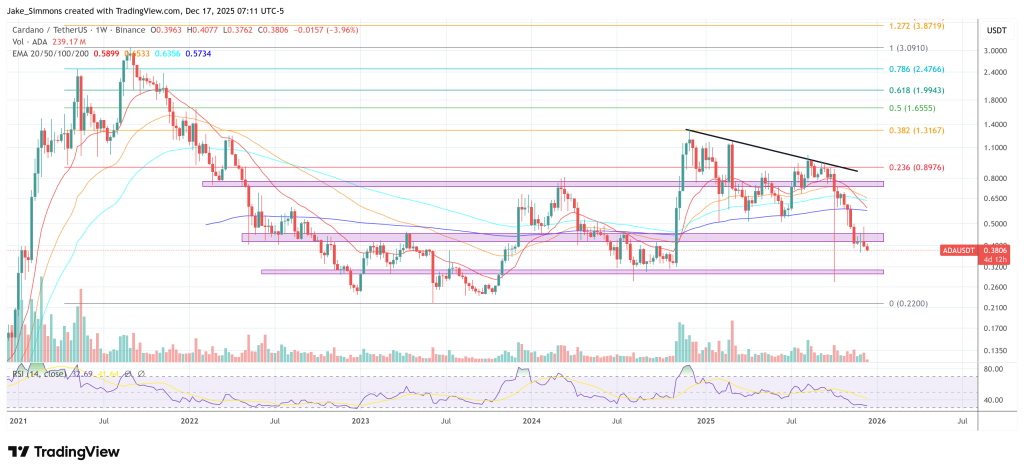
At press time, Cardano traded at $0.36.
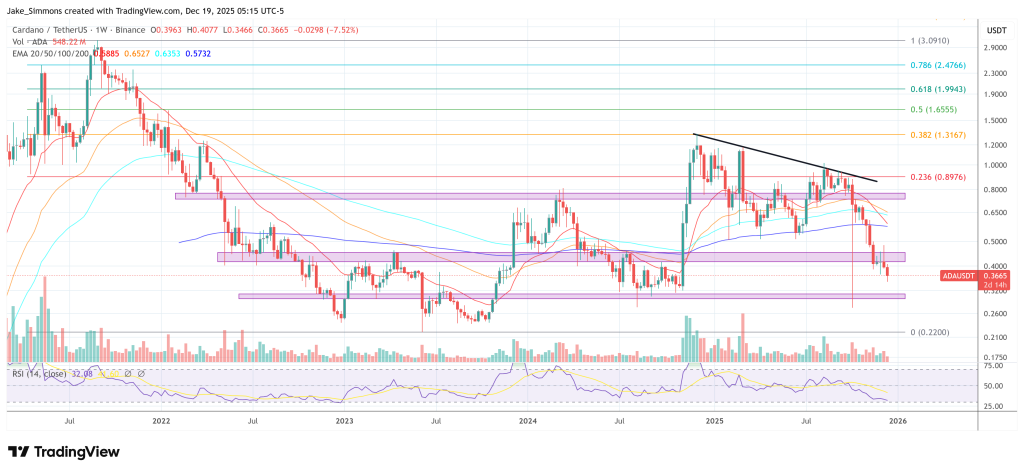
Cardano price

Analyst Maps Shiba Inu Roadmap With 1,800% Upside If Altseason Plays Out

Crypto analyst Quantum Ascend has published a weekly-chart “roadmap” for Shiba Inu (SHIB) in a new video, laying out three upside targets for a potential altcoin cycle, while warning that SHIB’s deep multi-year drawdown could cap the move if macro conditions deteriorate.

The Base Case For Shiba Inu Price

In his X post, Quantum Ascend listed “Altseason Targets” as a conservative level (“$0.47 e-8,” as written), a “Primary” target of $0.00014, and a “Blow-Off” target of $0.00035. In the video, the analyst anchored the roadmap to Elliott Wave-style structure and Fibonacci extensions, and emphasized that the bullish path is conditional, not guaranteed.

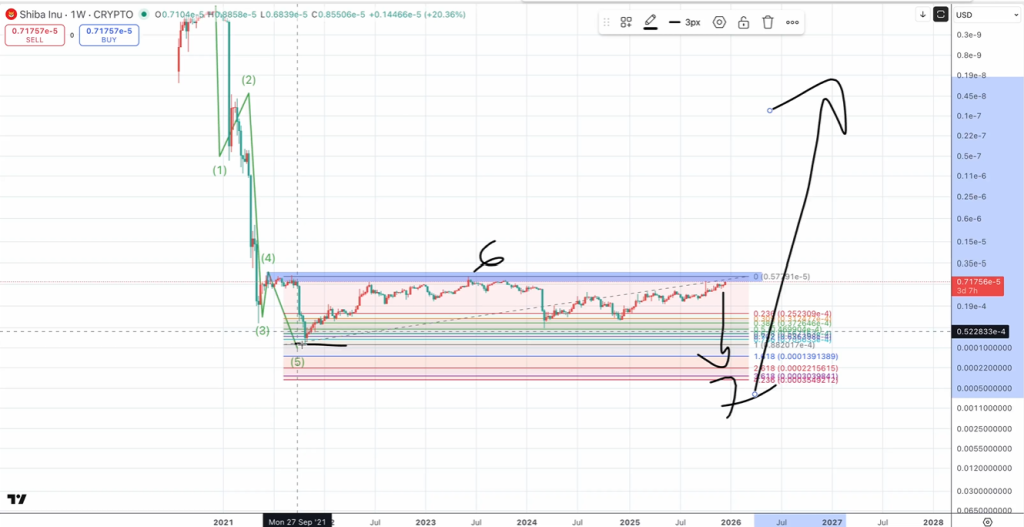
Starting from SHIB’s 2021 peak and the subsequent collapse, the analyst said the drawdown returned price to a historically meaningful zone: “Count out the five wave moves there pretty cleanly, but since then, nothing but a drawdown… Came back down right into this wave four low.”

From that setup, Quantum Ascend argued the decline can be read as a “crashing pattern” that often resolves with a reversal back toward prior highs.

“So you have your five waves down, and typically what’ll happen, price will roll back up to the fourth wave, and then what it does is it’s going to come take out this fifth wave. This is six, come take out that fifth wave, even if it’s just a little for a wave seven, then it’s done and it turns back the other direction, right? So when we’re looking at it from this perspective, we can see pretty textbook for the level it went to,” the analyst said.

Shiba Inu price analysis

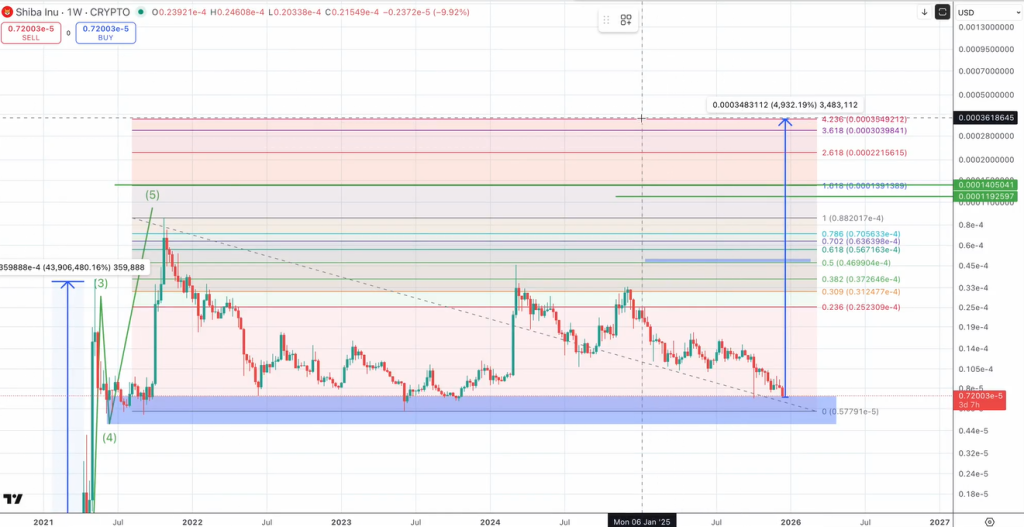
“So now that you see the case for a new high… we got to start taking these fibs into play here and figure out, all right, where’s some logical price levels for this thing to end up.”

Quantum Ascend then flagged the biggest constraint: SHIB’s magnitude of drawdown relative to prior-cycle behavior. “The one thing that’s stopping me from saying, yep, 100%, we’re going to see new highs, is going back to 2021, price is down 93% at the worst and right now down 92%,” the analyst said.

“Back in 2021, coins that set their highs in 2017 and had a 90% plus drawdown did not set new highs in the 2021 cycle… So this is a four-year range down 90 plus percent. It fits the parameter of some of those other coins that never ended up going off into a new all-time high.”

If that historical analog holds, the analyst said SHIB could be tracing a larger corrective structure rather than a fresh impulse. “If that’s the case, then this count would be five waves up and then we have an A, B into the retracements, and then C would start taking us much lower. That coincides with a recession-depression type feel,” the analyst said, adding: “And I do believe that that is the base case moving forward here… It’s just really important to understand the broader macro climate. Like this Shiba isn’t going unless everything else is lined up.”

The Bullish Case For SHIB Price

Even so, Quantum Ascend laid out upside zones using confluence between broader and nearer-term Fibonacci ranges. The analyst’s stated primary target for an “altseason environment” is the 1.618 Fibonacci extension at roughly $0.00014 which translates to a 1,800% rally from the current price. He added: “My blow-off is going to be a full 4.236 extension here of this range.” The blow-off scenario hits $0.00035, but was presented by him as technically possible but unlikely.

Shiba Inu Fibonacci analysis

Market-cap math was used as a reality check. “The thing I’ll say about SHIB is it’s at a $4.2 billion market cap right now. That’s pretty big, especially for what it is,” the analyst said, estimating that a move to the conservative area would imply roughly a $25 billion valuation and that the most extreme scenario would push into triple-digit billions. “That is massive getting up there… That’s like a 50x from where we’re at. And at that point, you’re talking 200 billion for a coin that doesn’t really do anything… In no way, shape, or form is this my base case.”

$SHIB | @Shibtoken 📽

Macro Structure Points to New Highs ↗

Altseason Targets🎯 ➤➤ Conservative: $0.47 e-8 ➤➤ Primary: $0.00014 ✅ ➤➤ Blow-Off: $0.00035

Here’s the Roadmap👇 pic.twitter.com/nWxQsVtLvv

— Quantum Ascend (@quantum_ascend) December 18, 2025

Despite publishing upside targets, Quantum Ascend stressed exit discipline over maximal upside capture, noting he does not hold SHIB. “I don’t own this coin, but if I did, I would be layered out all in this area [from the 0.5 Fibonacci level at $0.00004699] … I’d be done by the time it got up to that 1.618 Fibonacci at $0.00014,” the analyst said, arguing that “dollar cost averaging both in and out is a great strategy” in a meme-coin trade that ultimately depends on broader liquidity and risk appetite.

At press time, SHIB traded at $0.00000738.

Shiba Inu price chart

$415 Million Bitcoin Gamma Flush Looms: The Next 8 Days Are Crucial, Says Analyst

Bitcoin’s options market has a new obsession: Christmas week. In a post Thursday, energy-sector managing partner David Eng argued the next eight days (December 19 through December 26) could define the near-term cycle for BTC, not because of a macro headline or some sudden ETF stampede, but because a large chunk of dealer gamma exposure is scheduled to roll off the board in two shots.

At press time, bitcoin traded around $86,928, after swinging between roughly $84,461 and $89,230 intraday. Eng’s framing is blunt and very “options people”: the market is being mechanically pinned, and the pin has an expiry date

The Hidden Force Holding Back Bitcoin Price?

“The narrative isn’t just about tomorrow. We are staring down the barrel of a ‘Double-Barreled’ Liquidity Event that will wipe 67% of the entire derivatives board clean by December 26th,” Eng wrote. “Bitcoin is trading at $88,752, deep in the -25% Value Zone (Trend Value: $118k). The spring is coiled, but two massive structural weights are holding the lid down.”

Those “weights,” in his telling, are two expiries with meaningful gamma attached: roughly $128 million tied to Dec. 19 (21% of the total he tracks) and another $287 million at Dec. 26, which he calls the “boss level” ceiling. He labels the combined $415 million a coming “Gamma Flush,” arguing that once it clears, the hedging drag that’s been compressing spot price action should ease.

The practical point is less mystical than it sounds. If dealers are sitting on meaningful gamma around a tight cluster of strikes, their delta-hedging can dampen volatility and keep spot gravitating around certain levels until that exposure decays or expires — the kind of “why does this tape feel glued?” frustration traders know too well.

Eng’s map is built around very specific lines in the sand: $85k–$90k as the “mud” zone where hedging pressure keeps snapping price back, and $90,616 as the flip level he’s watching around the Dec. 19 expiry.

“Stage 1: The Spark (Tomorrow, Dec 19) — $128 Million in Gamma expires tomorrow (21% of total). This is the ‘Appetizer.’ It removes the immediate suppression pinning us below $90k,” he wrote. “Watch the $90,616 flip level. If we clear this, the intraday shackles fall off.”

But Eng is clearly more focused on the week after. “Stage 2: The Floodgate (Next Friday, Dec 26) — $287 Million in Gamma expires next week,” he continued. “A staggering 46.2% of all dealer gamma exposure sits on this single date… Dealers have a quarter-billion-dollar incentive to keep volatility crushed and price pinned near $85k-$90k through Christmas to harvest this premium.”

The claim, basically: pre-Dec. 26 is “thick mud,” post-Dec. 26 is the tape suddenly breathing again. “When you combine these two dates, $415,000,000 of gamma — two-thirds of the entire market structure — evaporates in the next 8 days,” Eng wrote. “Before Dec 26: The market is fighting through thick mud… After Dec 26: The mud dries up. The suppression mechanism is gone. The Power Law gravity ($118k) takes over without the dealer counter-flow.”

He also tossed out a provocative ratio that’s been circulating in derivatives circles all year: dealer mechanics versus ETF demand. “Dealer Gamma forces are currently ~13x stronger than ETF Flows,” he wrote. “Dealer ~$507.6M, ETF ~$38M. This is why the market is obeying the technical gamma levels ($85k/$90k) and ignoring the ETF volume.”

Dealer Gamma forces are currently ~13x stronger than ETF Flows

Dealer ~$507.6M ETF ~$38M

This is why the market is obeying the technical gamma levels ($85k/$90k) and ignoring the ETF volume.

— David 🇺🇸 (@david_eng_mba) December 18, 2025

And when critics in the replies questioned whether “$287M” is even meaningful, Eng clarified what the figure is — and what it isn’t. “The $287M figure refers to dealer gamma exposure (GEX), not total options size,” he wrote. “GEX measures how much spot Bitcoin dealers may need to buy or sell to stay delta-neutral as price moves. It reflects hedging pressure, not notional value.”

So the tradeable implication of Eng’s thesis is straightforward: expect the pinning games into Christmas, then watch whether a post-expiry regime shift actually shows up in realized volatility — and in price’s ability to stop bouncing off the same levels like it’s hitting invisible glass.

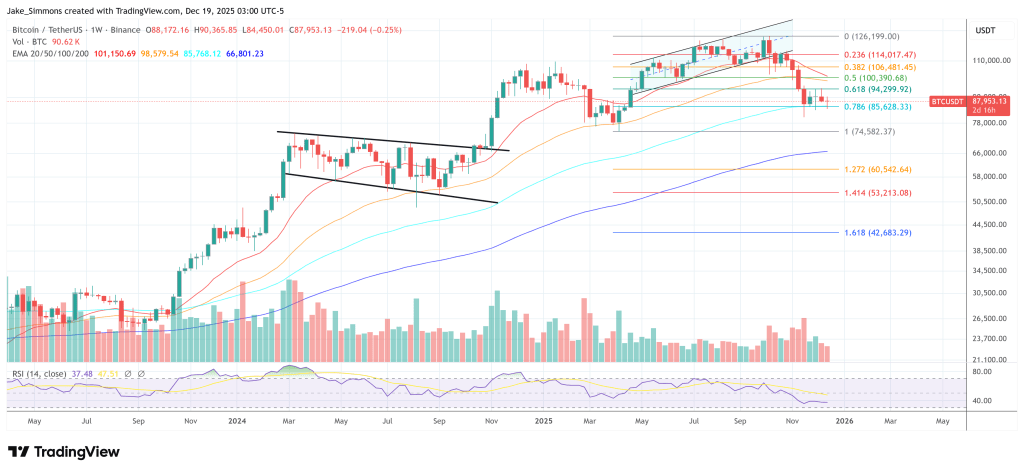
At press time, Bitcoin traded at $87,953.

Bitcoin price chart

Shiba Inu Project Calls Out SHIB X Account Over ‘Personal Financial Interests’

The Shiba Inu ecosystem’s long-running tension between “official messaging” and meme-coin marketing resurfaced this week after Oscar (@oscar_shibainu) published a public break with the @Shibtoken X account, accusing it of drifting into promotional behavior that benefits individuals rather than the broader SHIB community.

In a statement posted on X, Oscar said it had previously defended the Shiba Inu account “in good faith,” but now considers that effort misplaced.

OSCAR Blasts Shiba Inu Account

“For a long time, we believed that something positive could emerge from the SHIB account,” the Oscar team wrote. “We defended it in good faith, even at a high personal cost, trusting that past mistakes had been left behind and that something constructive could flow from that platform. Unfortunately, we were wrong. Nothing changed. For that, we sincerely apologize.”

The group then drew a hard line: “The OSCAR community — the same community that has consistently stood up for SHIB and, in many cases, personally financed initiatives to defend both SHIB and this specific account — no longer supports this account,” the statement said. “It does not represent Ryoshi’s vision, it is not aligned with the interests of the SHIB Army, and it has become a stage for personal financial interests. This is not SHIB. It never was.”

The immediate catalyst was a Dec. 17 post from the official @Shibtoken account amplifying a separate token, Hachiko (HACHI), with messaging that some Shiba Inu holders interpreted as promotional. The post read: “$HACHI X95 🤝 $SHIB 0X95,” referencing a superficial similarity between contract/address prefixes highlighted by the Hachiko account: “Only $HACHI contract created on November 2nd: … Starting X95 … $SHIB starts 0x95.”
@Shibtoken included a disclaimer underneath: “Friendly heads-up: This post is from a partner project, not an official Shib token. Always DYOR, frens.”

Even with that caveat, the reaction in the comment section was sharply negative, with several users arguing the account has increasingly functioned as a marketing channel rather than a source of official ecosystem updates.

“Very irritating to the Shib community,” one user wrote. “The reason I followed @shibtoken account many years ago because it stated it was the official account. I would be able to get official updates. Now it appears that it is marketing other projects. (for a while) Go back to your roots.”

Another commenter urged holders to ignore promoted projects altogether: “I encourage all #SHIBARMY to don’t buy anything that the @Shibtoken account promotes. Just give up on that account.”

Oscar’s statement attempted to separate the dispute from Shibarium-related efforts, saying it will continue building support infrastructure while distancing itself from the main account’s messaging strategy.

“That said, we want to make it clear that we will continue to support Shibarium through our charity portal, as we have done since day one,” the Oscar team wrote. “The SHIB community will always be welcome within our ecosystem. However, the time has come for us to follow our own path and focus on the interests and values of our own community.”

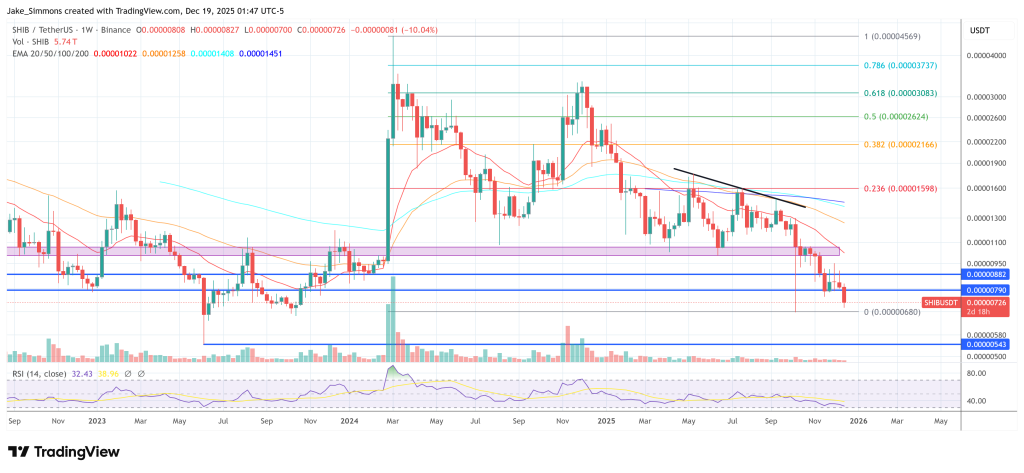
At press time, there was no visible public response from the official @Shibtoken account addressing the allegations, and no reaction from any Shiba Inu developer or marketing lead. SHIB traded at $0.00000726.

Shiba Inu price chart

XRP Ledger Upgrade Locks Out Almost Half Of Outdated Nodes

XRP Ledger operators are staring down a familiar kind of “deadline drama” on Thursday, after one community tracker warned that a large chunk of XRPL servers are about to get amendment blocked, basically pushed to the sidelines until they upgrade.

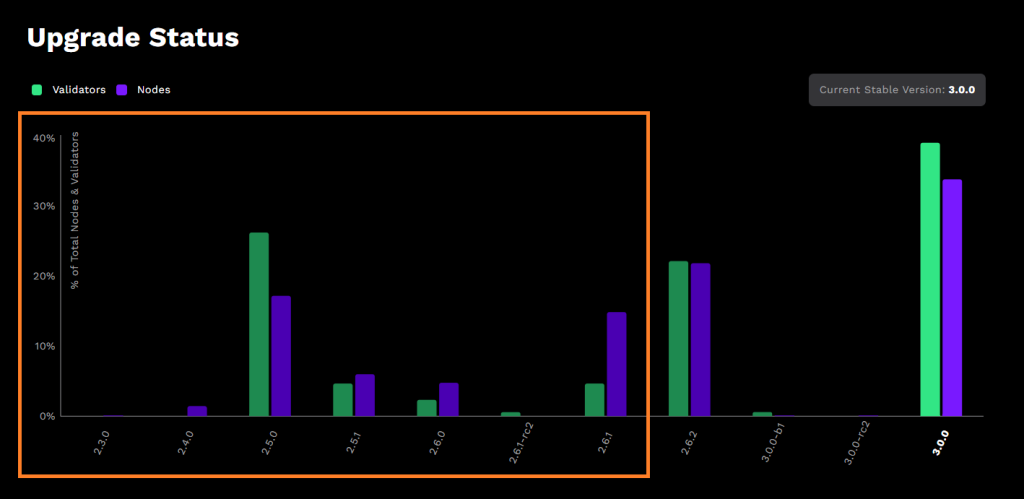
“In about ~10 hours 418 (!!) out of 999 XRPL servers will go DOWN as they become amendment blocked!” wrote X user Krippenreiter, adding that amendment-blocked rippled servers can’t “determine the validity of a ledger,” “submit transactions,” “process transactions,” or “participate in the consensus process.”

XRP validator and node upgrade status

Will This Impact The XRP Ledger?

That sounds catastrophic if you’ve never watched XRPL governance do its thing. But the important nuance is right there in the name: amendment blocking is a safety feature, not a network failure mode. When new protocol rules activate, old software can’t reliably interpret ledgers anymore, so the network forces those servers into a non-participating state rather than letting them guess.

So does “almost half the servers” going amendment-blocked matter if activity spikes? “Not at all,” Krippenreiter replied to one user. “All dUNL validators are safe, so all ‘trusted’ validators will continue to validate as expected. (and behave under load)… For everything else there is ‘FeeEscalation’.” The point he’s making: consensus comes from a trusted validator set, and fee escalation is designed to push transaction costs higher as the ledger gets busy, throttling spam and overload attempts.

Other XRPL watchers mostly treated it as routine maintenance, not an existential moment. “Is this unusual or dangerous? No. This happens almost every amendment cycle,” another user wrote, listing prior change windows and noting that lagging nodes typically upgrade later. The XRPL amendment process itself is built around a long lead time: an amendment needs sustained supermajority support from trusted validators for two weeks before it flips on.

Still, the optics aren’t nothing. Having hundreds of public servers fall behind at once can be a real-world nuisance for wallets, explorers, and businesses that lean on third-party infrastructure. Even if consensus is fine, fewer up-to-date nodes can mean less redundancy at the edges — more brittle public endpoints, more support tickets, more “why is my transaction not going through?” posts.

And there is a concrete upgrade path. XRPL.org’s release notes for rippled 2.6.2 describe a new fixDirectoryLimit amendment plus a critical bug fix — the kind of stuff you don’t want to procrastinate on if you run production infrastructure.

The short version: no, XRPL isn’t “going down.” But if you’re still running old rippled in late 2025, the network is about to remind you that upgrades aren’t optional.

At press time, XRP traded alongside the broader market wide sentiment, down -1.5% over the past 24 hours.

XRP price chart

Shiba Inu Whale With 16.4% Of Total Supply Breaks Multi-Year Silence

A long-dormant Shiba Inu wallet that on-chain watchers have tracked since the meme coin’s early days just pinged the market again — this time by sending a chunky clip of SHIB to an exchange.

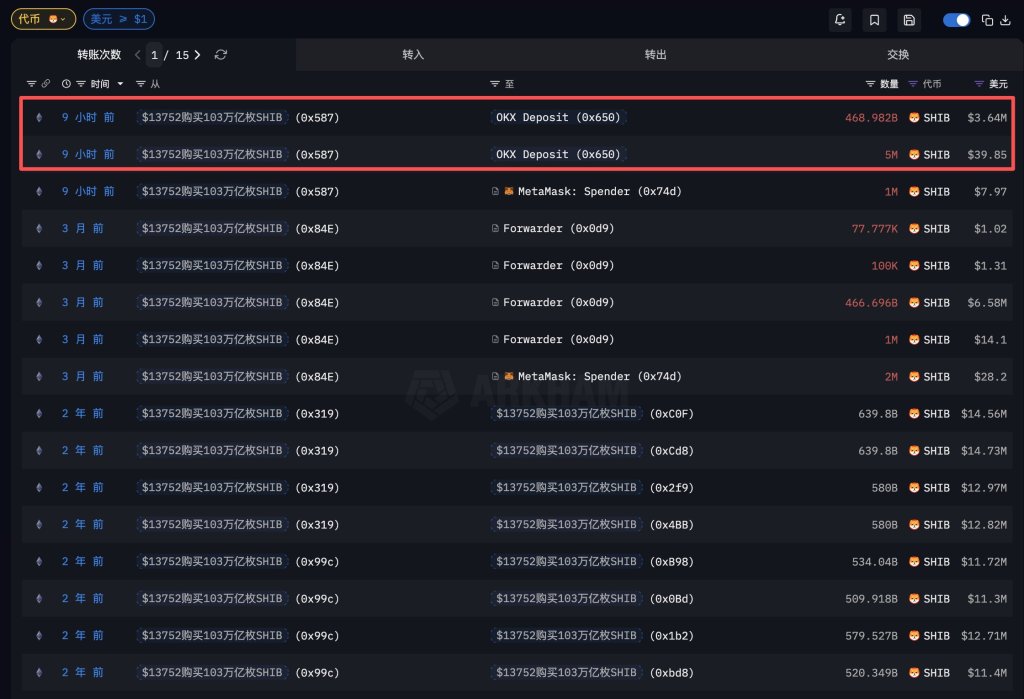
According to posts from on-chain analyst 余烬 (@EmberCN), the address moved roughly 469 billion SHIB (about $3.64 million) into OKX roughly nine hours before the post hit X on Dec. 18, 2025.

Shiba Inu top whale

Mega Whale Stuns Shiba Inu Community

In 2020, the “top whale” who bought 1.03 trillion $SHIB (17.4% of the total supply) using only 37.8 ETH ($13.7K), transferred 469 billion SHIB ($3.64 million) into #OKX 9 hours ago,” EmberCN wrote.

That “top whale” label is doing a lot of work here. The wallet is known for an almost absurd entry: buying roughly 103 trillion SHIB back in 2020 for just 37.8 ETH. Then the 2021 mania happened. At the cycle peak, that stake would have been worth around $9.1 billion. And the whale, famously, didn’t cash most of it.

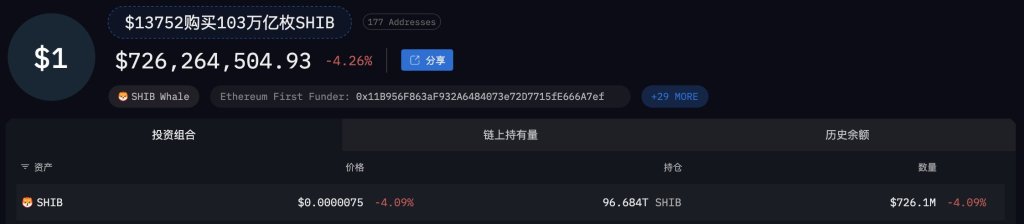
EmberCN says the address still controls about 96.684 trillion SHIB, or roughly 16.4% of total supply, valued around $722–$726 million depending on the price snapshot used. “At the 2021 price peak, his 1.03 trillion SHIB was worth $9.1 billion. He has not sold the vast majority of these coins yet, and currently still holds up to 96.684 trillion SHIB (16.4% of the total supply), worth $726 million,” @EmberCN explained.

Shiba Inu top whale

The reason traders care about “to OKX” is obvious: deposits to exchanges can be a prelude to selling, collateralizing, or rotating into something else. Still, a deposit is not a sale. Overall, it’s unclear whether the SHIB has been dumped yet.

Zoom out and it’s not the first time the wallet has stirred. EmberCN previously flagged activity in July 2023, describing transfers of 1.5 trillion SHIB split across three addresses (500 billion each) after a long dormant stretch.

On July 12, already alerted the Shiba Inu community when he posted: “After being dormant for 610 days, he made another move: 4 hours ago, he transferred 1.5 trillion SHIB to 3 addresses, with 500 billion SHIB ($3.75M) to each address. He bought 1.03 quadrillion $SHIB, and only sold 1.9 trillion SHIB ($18.79M) in 2021 at a price of 0.0000098. The remaining 1.01 quadrillion (17.2% of the total SHIB supply) is distributed across 17 addresses and held to this day, with a current total value of $760 million.”

So, is this “the” sell signal? Maybe. Maybe not. But when an entity sitting on 16.4% of supply starts routing size toward an exchange again, the market tends to stop scrolling.

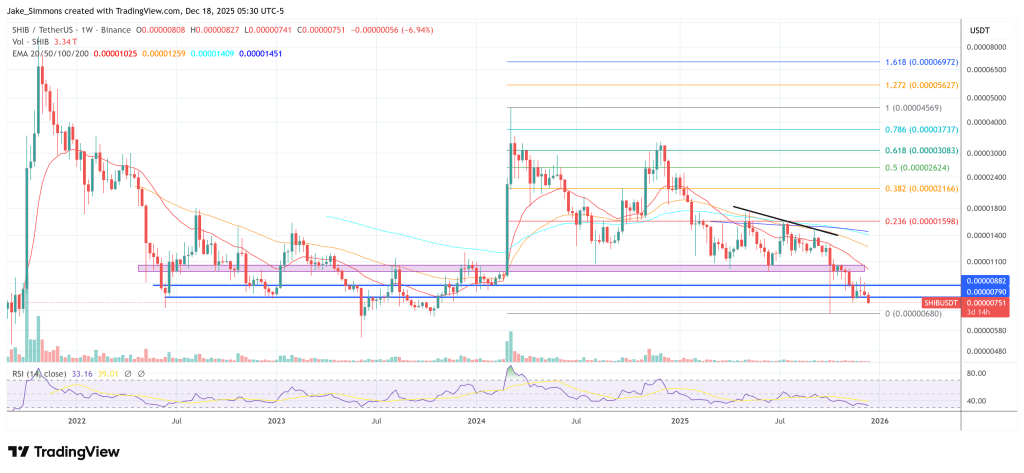
At press time, SHIB was down 3.9% over the past 24 hours, more or less tracking the broader market wide pullback in the same window. On the chart, it’s not pretty: the current weekly candle has broken below a key support zone around $0.00000790.

That puts the Oct. 10 low at $0.00000680 back in play as the next obvious downside check. If that level gives way, traders will likely start eyeing the June 2023 low near $0.00000543 as the next major reference point.

Shiba Inu price chart

Bitcoin Washout Points To $180,000 In 90 Days, GMI Says

Global Macro Investor (GMI) head of macro research Julien Bittel posted a bitcoin “oversold RSI” roadmap on X, arguing the market has tracked it closely and tying the setup to a broader view that the cycle could run into 2026—an outlook he says would render the traditional “four-year cycle” framework obsolete.

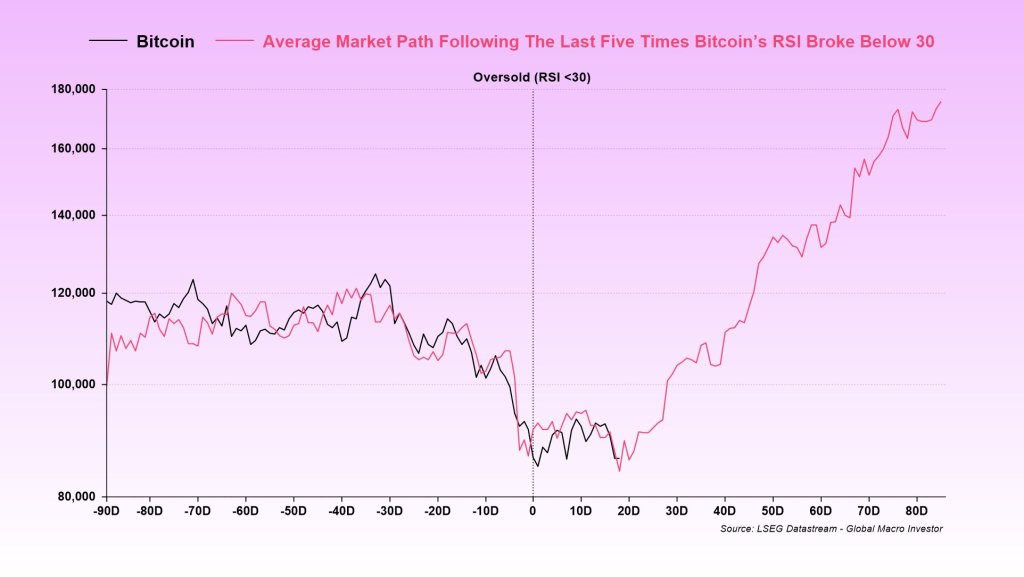
“A lot of people have been asking for an update on this chart, so I’ll just leave this here for anyone who needs to see it,” Bittel wrote, sharing a chart of bitcoin’s average price path after RSI falls below 30, with the RSI breach marked as t=0. “This shows the average BTC trajectory following an oversold RSI reading, with RSI falling below 30 at t=0.”

Can Bitcoin Skyrocket To $180,000 In Just 90 Days?

Bittel said the overlay has matched the current tape. “So far, it’s been pretty bang on,” he wrote. The “average market path” line rises sharply over the weeks that follow. The chart shows a steep rally within 90 days after t=0, with the BTC price potentially surging near the $180,000 area.

Still, Bittel emphasized the chart is not meant to be a precision forecast. “No, it won’t be perfect,” he wrote, adding that “assuming the bull market isn’t already over, it’s a useful chart to keep in mind.” He also warned that the rebound process can be uneven: “bases can take time to form and usually come with plenty of chop before the bigger up-move kicks in.”

verage Market Path Following The Last Five Times Bitcoin’s RSI Broke Below 30

He reiterated the conditional nature of the framework in blunt terms. “If you think the bull market is over and we are now facing twelve months of pain, this chart is not for you. Move along…”

The bigger point, Bittel said, is that the familiar cycle narrative should not be taken for granted. “Unless you believe the 4-year cycle is still in play, which we don’t, this chart should hold up contextually over time,” he wrote. “As we’ve outlined many times, based on our work on the business cycle, the current path of financial conditions, and our expectations for overall liquidity, the balance of probabilities is that this cycle extends well into 2026.” In that scenario, he added, “the 4-year cycle is dead.”

Bittel also challenged the common assumption that bitcoin’s rhythm is fundamentally “about the halving.” “Remember, the 4-year cycle was never about the halving, despite widespread belief that it is, but instead has always been driven by the public debt refinancing cycle,” he wrote, adding that post-COVID that dynamic “was pushed out by one year.” He now argues the cycle is “officially broken” because “the weighted average maturity of the debt term structure has increased.”

He framed the macro backdrop in terms of debt-service pressure and liquidity response. “The bigger picture is that there is still a vast amount of interest expense that needs to be monetized, which has far exceeded GDP growth,” Bittel wrote.

Reactions across crypto X ranged from enthusiastic to skeptical. The ₿itcoin Therapist replied: “$180,000 BTC in 90 days.”

LondonCryptoClub (@LDNCryptoClub) said the chart “lines up with our thinking,” tying the narrative to what it called the Fed’s “not QE QE” dynamics and “liquidity games” between the Treasury and the central bank. The account still anticipated turbulence into year-end—“noise and chop into year end (which is negative liquidity)”—before “these fundamental drivers start to see BTC reconnect with the bull trend,” adding that “sentiment appears sufficiently bad for a BTC move higher to be the most hated trade to start 2026!”

Others struck a more sardonic tone. “precision-grade hopium here,” wrote doug funnie (@cryptoklotz), while still sketching a conditional path forward: Still think as long as BTC survives (ie doesn’t close in the $70k’s and starts grinding down or accepting there), there’s a plausible path to new highs on the earlier side in 2026. Just need to survive the ‘transition zone’ of 4 year deterministic selloors exhausting, and then ending up in an awkward spot as the music keeps playing.”

Capriole Investments founder Charles Edwards was more critical of the statistical grounding, urging a broader test set: “Now re run this with 100 occurrences, not 5 during up only.”

For traders, Bittel’s post effectively combines a tactical signal with a regime call: the RSI sub-30 template may map the rebound path, but only “assuming the bull market isn’t already over,” and only in a world where, as he put it, “the balance of probabilities” favors a cycle that “extends well into 2026.”

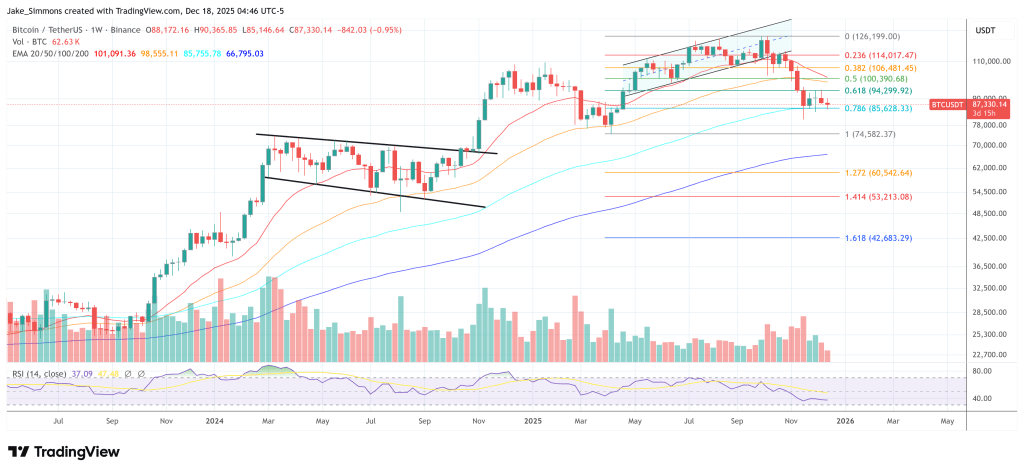
At press time, BTC traded at $87,330.

Bitcoin price

Jimmy Carr Tells UK To Mine Bitcoin With Wasted Night-Time Power

UK comedian and TV host Jimmy Carr suggested the British state should consider mining bitcoin using electricity that would otherwise go unused overnight, framing the idea as part of a broader push for more “radical” thinking about public finances.

Will The UK Mine Bitcoin With Excess Energy?

Carr made the comments in a Dec. 11 TRIGGERnometry interview recorded on “the day of the budget,” where he questioned why the UK has never created a sovereign wealth fund and argued that some revenue-generating assets should be treated as collectively owned.“

There are certain things that should belong to everyone,” he said, pointing to “the oil and gas that sit under the UK” and “the wind farms around the coast.” Carr claimed that “all of that money goes to the Crown,” and asked why it shouldn’t accrue more directly to the public.

He extended the argument to infrastructure such as “mobile phone masts,” while stressing he wasn’t making a socialist case. “I’m not a socialist. I’m not even for state capitalism,” Carr said, before arguing that some assets “should belong to everyone.”

From there, Carr offered bitcoin mining as a concrete example of a non-tax revenue lever the government could explore. “I would not mind it if our government said, yeah, we’re going to mine for Bitcoins,” he said. “Our power stations, they don’t do anything at night, so we’re going to mine for Bitcoins.” He added: “Great. New gold standard. Fine.”

Jimmy Carr is the United Kingdom’s most popular comedian and celebrity. Carr says, “I would not mind it if our government mines for bitcoins. Our power stations don’t do anything at night, so we’re going to mine for bitcoins. Great. New gold standard. Fine.” pic.twitter.com/GZRvQT8mua

— Documenting ₿itcoin 📄 (@DocumentingBTC) December 17, 2025

Carr did not propose a formal policy design, cite figures on spare capacity, or address governance questions around state-run mining. The point, as he presented it, was directional: use underutilized national infrastructure more aggressively and stop treating taxation as the default answer to funding pressures. “Do something radical, something interesting with the finances of the country,” Carr said. “Why does it all have to come from taxation?”

While the remarks come from an entertainer rather than a policymaker, the framing is notable for how it positions bitcoin in a nation-state register: not only as a tradable asset, but as something a government could plausibly produce using excess energy capacity, then hold as an alternative form of reserve value.

Carr’s “mine with spare power” idea has real-world analogs: Bhutan has quietly built a state-linked bitcoin mining operation powered largely by hydropower, a model often described as a way to monetize seasonal surplus generation.

El Salvador has also leaned into the “excess energy” narrative. The country mined nearly 474 BTC over roughly three years using 1.5 MW of geothermal energy from a state-owned plant tied to the Tecapa volcano. And in places like Iceland, miners have long been drawn by plentiful renewable supply (and the economics of cheap, clean power), making it one of the most mining-dense jurisdictions globally.

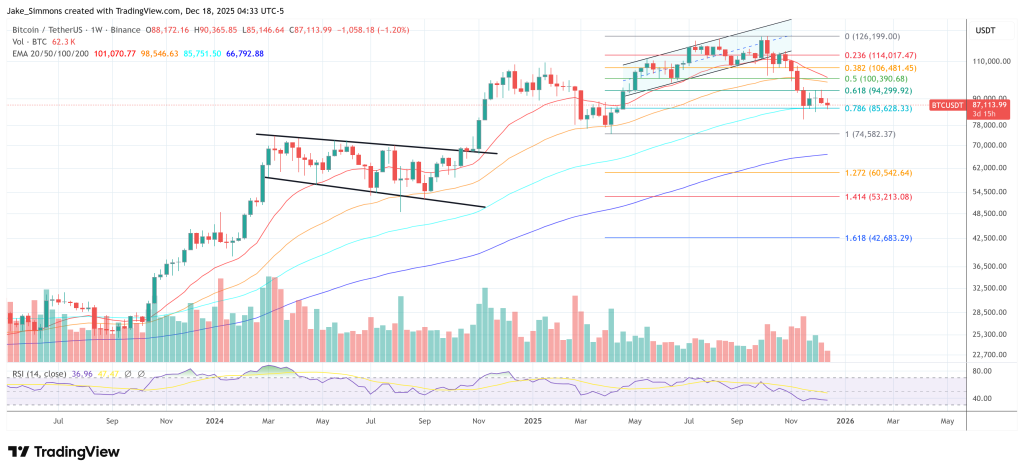
At press time, BTC traded at $87,113.

Bitcoin price

XRP Risks Double-Top Crash Toward $0.40, Peter Brandt Warns

Veteran chartist Peter Brandt is flagging what he calls a “potential double top” on XRP’s weekly chart, a classic reversal setup that, if confirmed, would argue for materially lower prices — even as other traders point to a washed-out weekly RSI reading that has historically aligned with prior bottom zones.

Peter Brandt Flags XRP Double Top Pattern

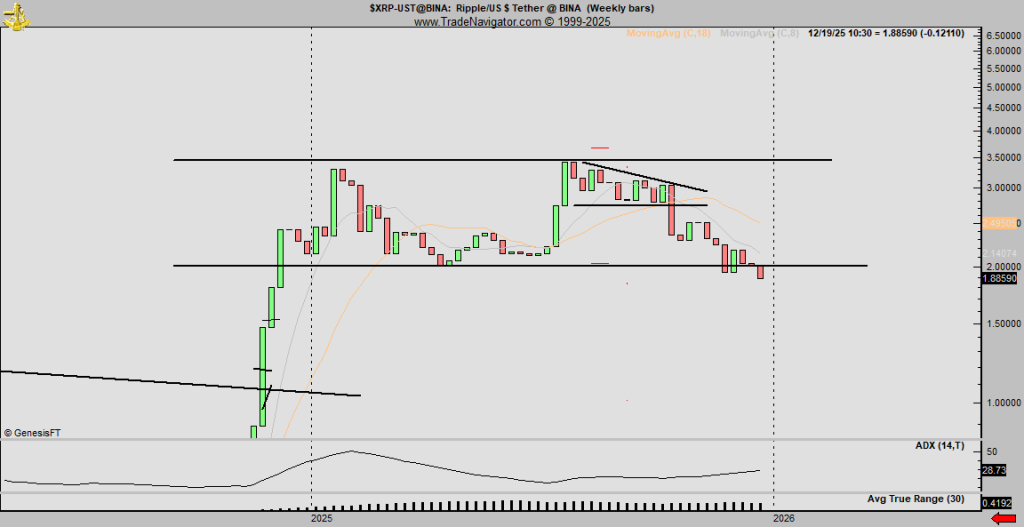
Brandt posted the chart to X on Dec. 17 and didn’t bother softening the message for XRP’s online faithful. “I know in advance that all you Riplosts $XRP will forever remind me of this post — ask me if I care,” he wrote, before adding: “This is a potential double top. Sure, it may fail, and I will deal with this if it does. But for now this has bearish implications. Love it or not — you need to deal with it.”

XRP double top pattern

The chart shows XRP-USDT on Binance in weekly bars, with two highs clustered around $3.40 and $3.66 and a clearly marked support shelf near $2.00. In classical chart terms, that $2 region functions as the neckline: lose it with follow-through, and the market is no longer in “pullback inside a range” territory — it’s in “failed structure” territory.

That distinction matters because double tops tend to be less about the second peak itself and more about what happens at the midpoint low between the two peaks. Brandt’s framing reflects that: the pattern is “potential” until either support holds and price reclaims prior levels, or the neckline breaks and the market accepts lower.

In this case, Brandt’s chart is already showing XRP trading below the $2.00 line, with the most recent marker around $1.8859. That puts the focus squarely on whether the breakdown becomes a sustained weekly close-and-hold below support, or whether the move gets reversed quickly enough to treat it as a bear trap.

Or Is The XRP Bottom In?

Not everyone reading the same tape is leaning into the bearish conclusion. Trader Cryptollica posted a separate XRP/USD weekly chart (Bitstamp) on Dec. 15 highlighting the weekly RSI at roughly 33, accompanied by the comment: “$XRP WEEKLY RSI : 33 💥”. The chart highlights that, in the past five cases, similarly low readings in XRP’s weekly RSI have tended to occur around market bottoming zones.
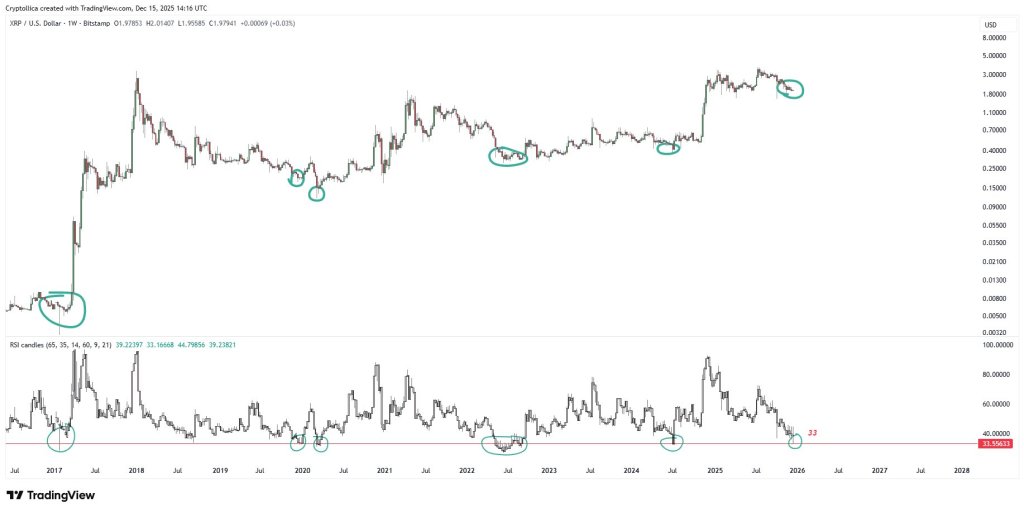
XRP weekly RSI

Brandt was receptive to the conditional logic — specifically, the idea that a failed double top can flip from bearish to bullish if the breakdown doesn’t stick. Responding, he wrote: “Yea, if this dbl top fails then this could become exciting. I agree. I am not championing a bear case — just showing charts for what they are.”

That exchange captures the actual tension here. Momentum measures like RSI can identify stretched conditions and recurring historical zones, but they do not, on their own, invalidate a price-structure breakdown.

Notably, Brandt did not provide a price target in his comment. But the chart he shared contains enough structure to infer the standard “textbook” projection many technicians would use. With peaks near $3.60 and a neckline near $2.00, the pattern height is about $1.60. The conventional measured move subtracts that height from the neckline after a break, implying a target in the neighborhood of $0.40 if the setup fully plays out.

That is not a forecast, and it’s not a promise the market will cooperate — it’s simply the arithmetic implied by the pattern Brandt is pointing at. The more immediate question is whether XRP can reclaim the $2.00 area decisively enough to turn the breakdown into a failed move. If it can’t, the chart conversation shifts from “potential double top” to “confirmed break,” and the downside math stops being hypothetical in traders’ positioning models.

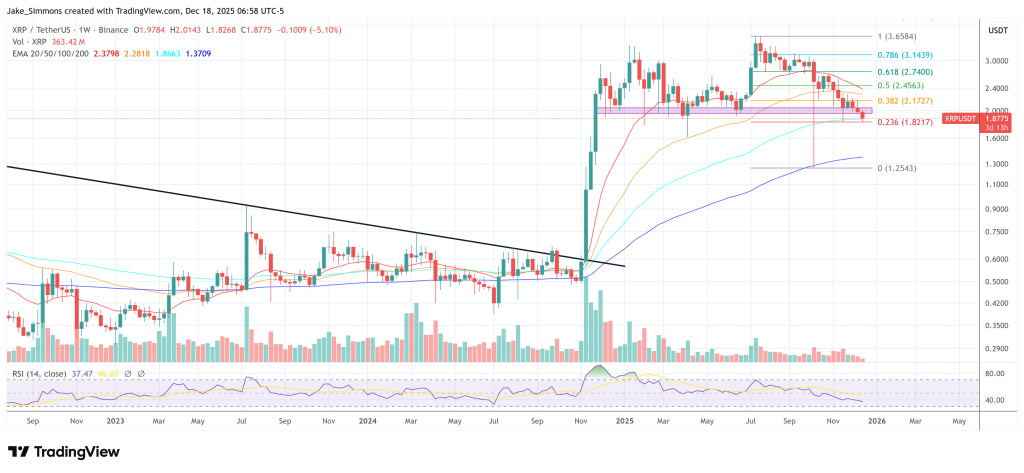
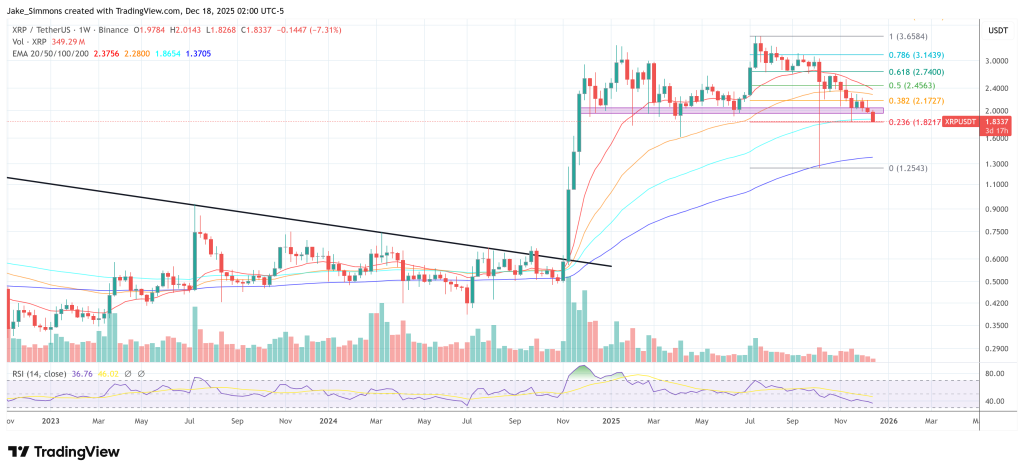
At press time, XRP traded at $1.83.

XRP price chart

XRP Ledger Adds Military-Grade Security Via Payments Engine Standard

Ripple has published the first formal specification of the XRP Ledger’s Payment Engine, positioning it as a foundational upgrade for protocol safety as XRPL moves into a more feature-dense era. The document was released in partnership with formal methods firm Common Prefix and is intended to become a canonical reference for how payments and cross-asset value transfer behave on-ledger.

The motivation is straightforward, and Ripple does not sugarcoat it. XRPL has operated for more than a decade without downtime, but the team argues that a long track record is still not the same as provable correctness. In the DEV Community post published Dec. 17 under the RippleX Developers banner, the authors write that “to prepare the ledger for the next generation of complex features, we must move beyond empirical success to mathematical certainty.”

A Turning Point For XRP Ledger Security

That is the tone throughout: less victory lap, more engineering debt disclosure. For much of XRPL’s life, the C++ implementation (xrpld) has effectively acted as the only definitive source of truth for core behavior. Ripple’s post calls out a practical problem with that model: “The code tells us, in very precise C++ terms, what it does. It does not always tell us why.” In other words, when code is the spec, it becomes difficult to separate intentional design choices from historical behavior that simply persisted because nothing broke.

That gap starts to matter more as new amendments arrive. Ripple points directly to a pipeline of complex features — including lending, DEX-related work tied to Multi-Purpose Tokens (MPTs), batch transactions, and permissioned DEX concepts — and warns that the number of possible system states expands quickly as new modules “weave into the decades-old logic of the ledger.”

The published specification is hosted on GitHub and labeled as work in progress, but it is already framed as a serious technical artifact: “a technical specification document intended for developers implementing or verifying XRPL payment system behavior.” It also spells out the heart of the system in plain language: the Payment Engine is what “figures out how value should travel and then carries out those moves,” enabling payments to draw across “trust lines, MPTs, order books, AMMs, and direct XRP.”

The deeper point, though, is what this enables next. Ripple’s post lays out a two-part target. First, a human-readable specification that reduces ambiguity and becomes the canonical reference for builders and researchers. Second, a machine-verifiable model — a mathematical representation of the spec — that can support mechanical proofs about system properties and whether proposed changes violate core safety guarantees.

It is also explicit about scope discipline. Ripple argues that specifying the entire ledger in one shot is not realistic: “It would be prohibitively expensive and time-consuming to specify the entire system at once.” So the work focuses on what it describes as the two most critical and complex components: the Payment Engine and the Consensus Protocol.

Consensus, in particular, is framed as non-negotiable infrastructure. Ripple describes it as “the heart of the ledger,” adding: “Its correctness is non-negotiable and underpins the safety and liveness of the entire network.”

The stated objective is to formally model the mechanism to prove properties such as liveness, safety, and finality. On timing, Ripple is clear that this is the starting line, not the finish. After publishing the Payment Engine specification, the team says it intends to begin formal verification work on the Payment Engine and the Consensus Protocol in 2026.

The closing line captures the direction of travel: “The shift from code-as-truth to mathematics-as-truth is underway.”

In the XRP community, the announcement landed with predictable euphoria. “Absolute freaking game changer! … Aerospace & military grade security incoming,” wrote XRPL validator and community member Vet, adding: “The XRP Ledger is receiving its first formal specification for the payments engine. By mathematically specifying key protocol components […] Basically, this is the enabler for the endboss of audits AND for other things like complex features or client diversity.”

At press time, XRP traded at $1.83.

XRP price chart

Cardano Breaks Governance Deadlock With New Constitutional Committee

Cardano has moved to resolve a governance bottleneck by ratifying an on-chain vote to restore its Constitutional Committee (CC) to functional capacity, a procedural step that matters because the CC is required to evaluate constitutionality and ratify many categories of governance actions, including upgrades, budgets, and parameter changes.

Intersect, which coordinates parts of Cardano’s governance process, said on X: “On the 7th day of GA… We hit the Epoch’s end. DReps at 80%. Stake pools supporting- It looks like we have a new CC. Ratified. Thank you to everyone who reviewed, voted, and wrote rationales,Santa has been notified.”

Why The Cardano Governance Was Stuck

Cardano’s governance model is tripartite: delegate representatives (DReps), stake pool operators (SPOs), and the Constitutional Committee. The CC plays a gatekeeping role: it judges whether on-chain actions are constitutional and ratifies decisions needed for the network to adapt.

That mechanism stalled after an unexpected mid-term departure left the CC below its minimum operational size. The Cardano Atlantic Council retired mid-term in epoch 597, opening a seat and reducing the committee below quorum. The consequence was that the Cardano CC could not ratify key actions, even as the chain continued to operate normally at the protocol level.

The vote asked DReps and SPOs to ratify a newly elected CC member and restore the committee to full capacity. The candidate, Cardano Curia, was selected off-chain through a DRep vote using the Ekklesia tool, with on-chain ratification required to formalize the result.

The governance materials described the restoration as bringing the CC back to seven members and activating a clarified alternate-member process to handle future vacancies with less disruption. Approval thresholds were set at 67% from DReps and 51% support from SPOs. Intersect’s update indicates those thresholds were met as the epoch ended.

Why This Was Treated As Urgent

The vote was framed as more than housekeeping because an undersized CC effectively blocks major governance flows. Without quorum: Treasury withdrawals couldn’t proceed, the Critical Integrations Budget could not pass, hard forks could not be ratified, delaying network upgrades and several categories of governance actions were blocked, leaving only a limited subset able to move forward.

There was also a timing element: delays risk actions expiring, which would force a repeat of the voting process and extend the governance backlog. With the restoration ratified, Cardano’s governance process can resume normal throughput — reopening the path for upgrades, budget approvals, and protocol changes that depend on a functioning Constitutional Committee.

At press time, Cardano traded at $0.38.

Cardano price chart

Best XRP Buy Zone? Analyst Breaks Down The Key Levels

Will Taylor, founder of CryptoinsightUK, frames XRP’s “best buy area” as a risk-to-reward question, not a certainty call. In his latest YouTube video from Dec. 17, he argues that XRP is trading back in the lower portion of a well-defined range, which is typically where entries make the most sense for range traders—because invalidation levels are clearer and upside targets are structurally defined.

“We’re at the bottom of the range […] this area, the bottom of the range, and the bottom of the range has been quite wide,” Taylor said. “So, I’d say between like $2.01, then all the way down to about $1.60. This has been the best area to enter […] for the last […] basically year and a bit.”

And his emphasis is that it’s attractive because the trade is measurable, not because it’s guaranteed. “Does this mean we can’t break down further? Does this mean we can’t lose support? No, that’s not what I’m saying at all,” he added. “But what I am saying is if you use range trading, if you want to know the best areas for risk-to-reward, we’re at them now.”

On lower timeframes, Taylor said XRP has already swept much of the downside liquidity, leaving a smaller pocket below that could still get tagged. He pointed to ~$1.83 as the remaining area of interest.

“XRP has taken most of this red liquidity to the downside. There’s a small pocket of liquidity below us still at $1.83,” he said. And crucially, that level is not academic for him — it’s tied to his own stop placement and whether the market is likely to wick lower before any sustained move up.

“This is something that I’m considering […] as to whether to move my stop loss below this liquidity down at like say $1.79,” Taylor said. “My stop loss [is] $1.834 at the minute. Do I take it to say like $1.79 […] give us […] the bottom of this wick as potential support and that liquidity. That’s a potential discussion.”

The Upside Trigger For XRP

Taylor’s near-term bullish trigger is a reclaim of ~$2.07. His reasoning is positioning-driven: he thinks the market has built a meaningful amount of short exposure during the drawdown, and a move back above that level could force covering.

“When you start to get a buildup of […] lower highs like this, all it takes is a bit of momentum to break us above,” he said. “So, say for XRP, if we start to get back above $2.07, you probably should see price squeeze to $2.58-$2.60 quite quickly […] as we squeeze out all of this […] open interest that’s been adding in as price has been coming down.”

Taylor’s XRP view is nested inside a broader “crypto is mispriced” thesis. When comparing crypto’s market cap performance against a basket of traditional assets, he argues that crypto has decoupled sharply since the Oct. 10 crash, while sentiment has deteriorated.

“Crypto has like decoupled from every other asset class […] crypto is about the only asset that has decoupled this hard,” he said. “I personally believe this is a deep value zone […] we’re clearly mispriced versus other assets.”

He also repeatedly leaned on the idea that positioning is skewed: rising open interest into downside, negative premium, and funding flipping between positive and negative — conditions that can set up a squeeze if price starts reclaiming levels.

“I think a lot of the market generally is setting up for a bit of a short squeeze to the upside,” Taylor said. “And I think that people are overly negative and […] the sentiment’s overly bearish compared to where the price is.”

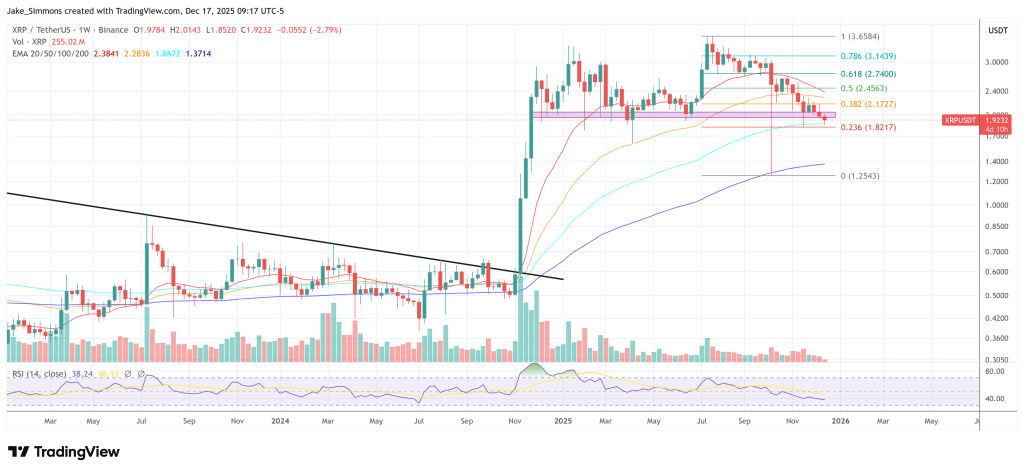
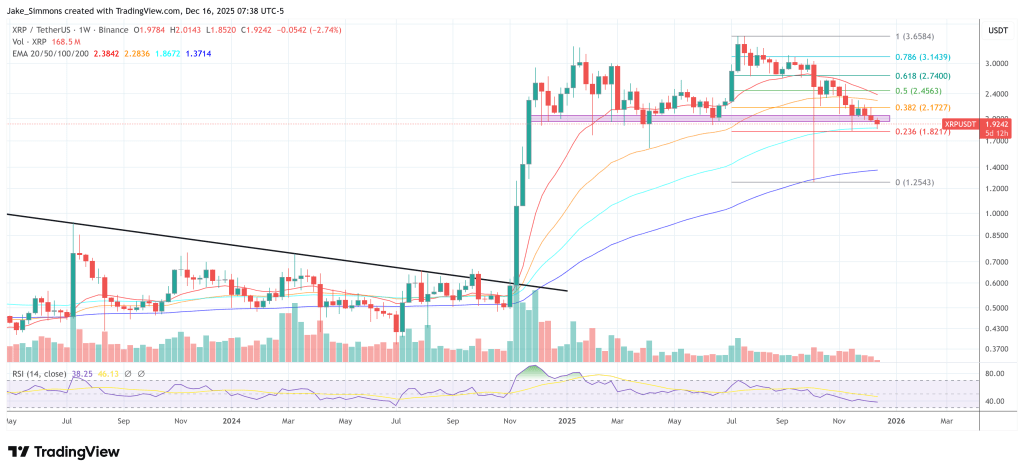
At press time, XRP traded at $1.92.

XRP price chart

Dogecoin Breakdown Ahead? Analyst Flags 2022-Style Signal

Dogecoin may be lining up for a deeper breakdown even if Bitcoin manages a short-term bounce, according to pseudonymous analyst VisionPulsed, who argues that a familiar 2022-style pattern is re-emerging across majors and memecoins.

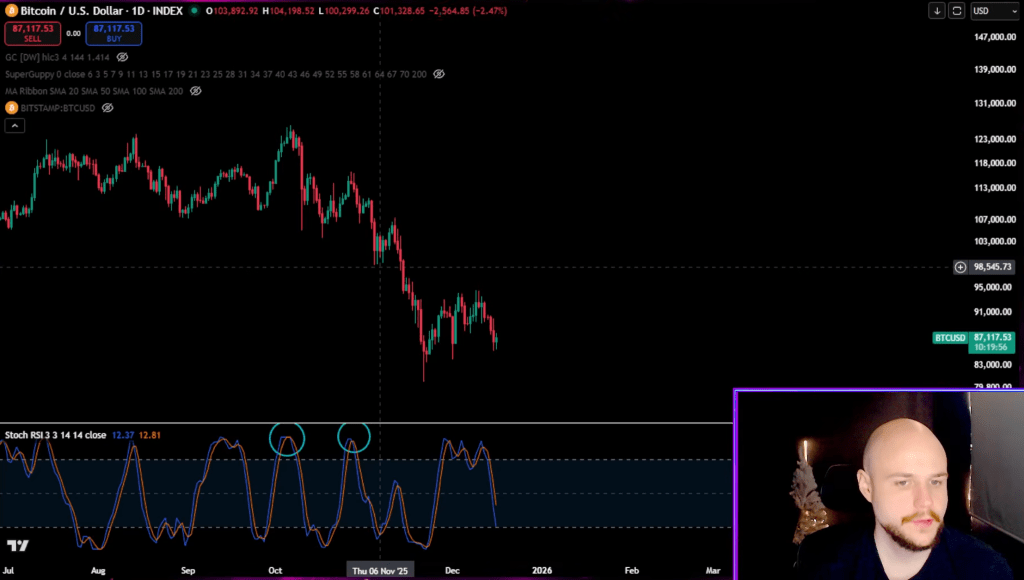
In a video published December 16, the analyst frames the near-term setup around Bitcoin’s daily stochastic RSI, which is moving from overbought back toward oversold. Over the past two months, every such reset on the daily chart has coincided with fresh lows in price. This time, he says, the structure is slightly different — and that matters for how Dogecoin trades the next leg.

Dogecoin Bull Need To Watch Bitcoin’s Stochastic Reset

On Bitcoin, VisionPulsed notes that the daily stochastic RSI is now “approaching oversold” after a stretch at elevated levels. In October, November and early December, similar full cycles from overbought to oversold on the daily timeframe were accompanied by Bitcoin making new lows.

Bitcoin Stoch RSI

“This is actually the first time that the stock RSI is going from overbought to oversold and we may not make a new low,” he says, emphasizing that it is still “too early” to call it. If price instead prints a higher low as the oscillator resets, he argues that would signal a short- to medium-term trend reversal rather than a macro regime change, opening the door for a relief rally.

“If we do see a higher low form on the price as the stock RSI resets, then you should get the green light for a relief rally,” he adds. If the current low breaks instead, the rally “is down to hell where you belong,” as he puts it, underscoring that the bullish case hinges on that higher-low structure holding on the daily chart.

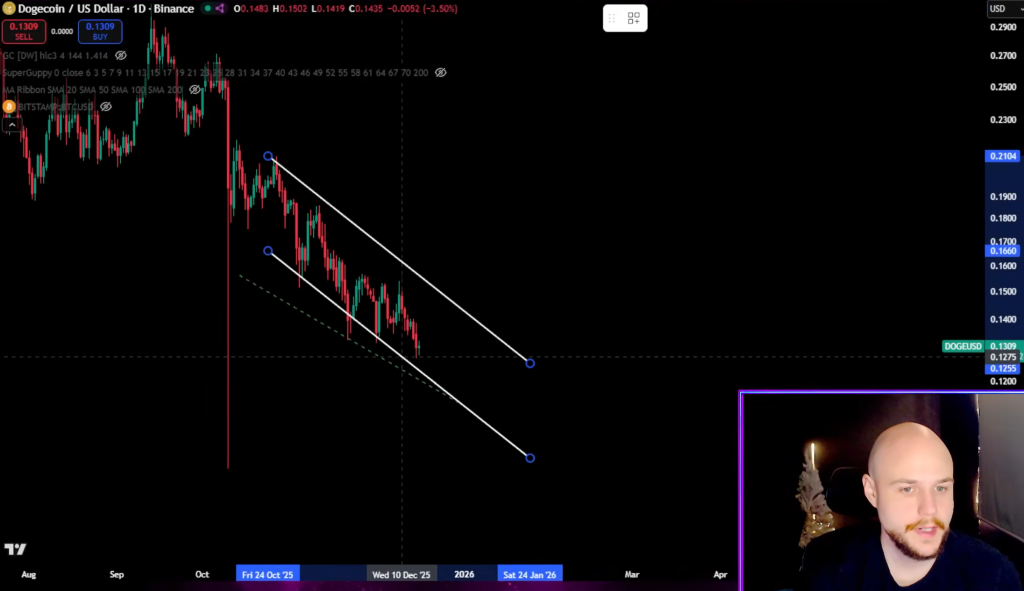
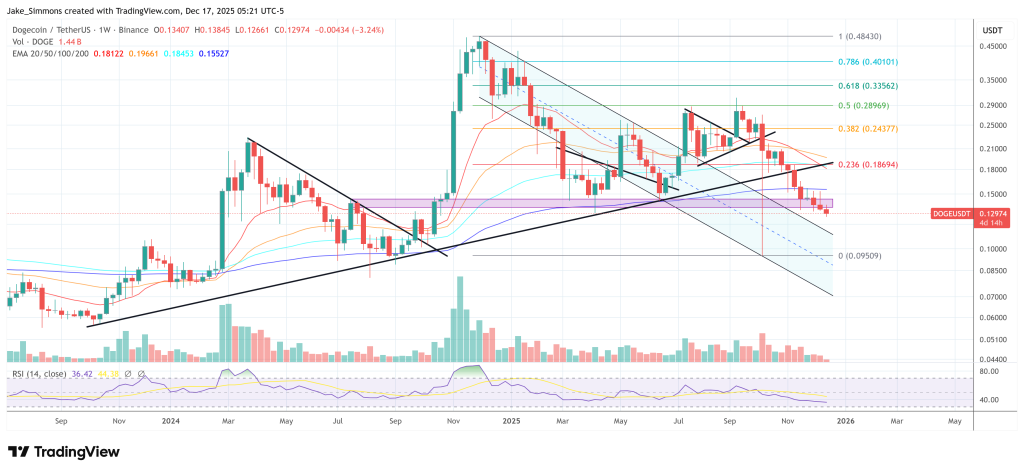
Dogecoin, in his view, is where the setup turns dangerous. While Bitcoin is attempting to carve out a higher low, Dogecoin continues to print lower lows on the same timeframe. VisionPulsed links this to a similar divergence in 2022, when Doge bled lower throughout the month while Bitcoin quietly based and formed higher lows.

Dogecoin marks lower lows

“Very similar to 2022,” he says, adding that Bitcoin is, as of the recording, making “a higher low even though Dogecoin is not.” That pattern, he argues, suggests Doge could still catch a relief move if Bitcoin rallies, but from a much weaker starting point.

How Low Can DOGE Price Go?

In such a scenario, he sketches a rally “probably somewhere up here to grab the peanut,” placing that so-called “peanut zone” roughly around the $0.20 area in January. He calls that level “probably your last chance to do whatever you’re going to do” before Dogecoin, in his base case, resumes its downtrend and heads “down to feed the pig pen” — his shorthand for a deeper capitulation move to new lows in the $0.05 to $0.06 area.

The base case for Dogecoin is a deeper retracement. He says. “We’re coming down to feed the little piggies. Oink oink.” Until Doge breaks its current downtrend, he sees “no reason to assume it’s bullish.”

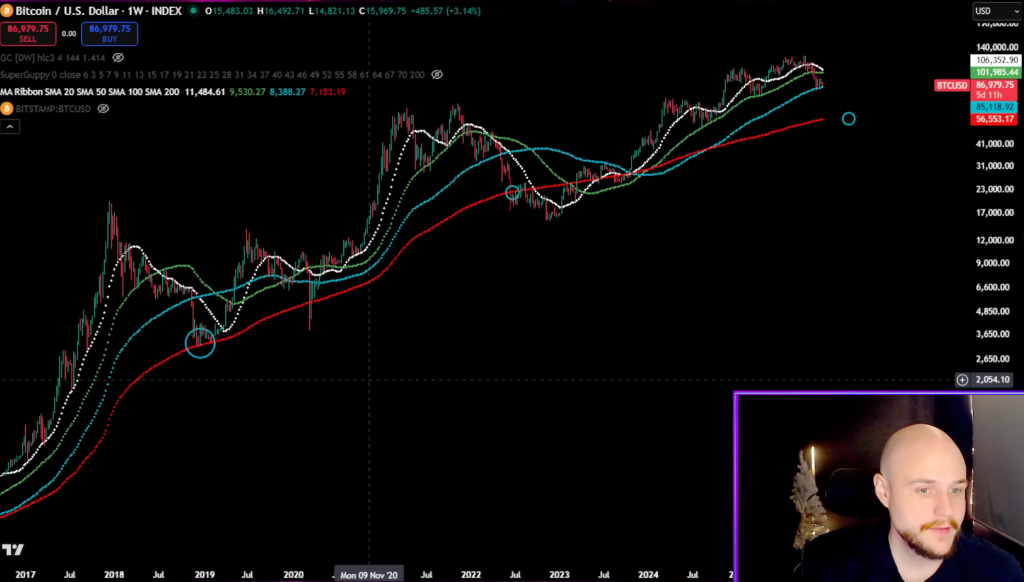
The timing, in his framework, is anchored on Bitcoin’s position inside the lower band of a 7–8 day Gaussian channel and the interaction of several moving averages. He notes that Bitcoin has already spent close to four weeks in this “peanut gallery” zone, versus roughly 63 days during the 2022 accumulation period.

If Bitcoin is still hovering near the upper range of the current structure by late January, he argues, “you’re pretty much recreating 2022,” which in his view would likely be followed by a capitulation leg lower.

A key signal to watch, he says, is the convergence of a white and a green moving average, which in the 2022 template marked the “point of no return before Bitcoin collapsed.” Those lines are now projected to converge in late January or early February.

Bitcoin MA Ribbon SMAs

Once they meet, his base case is that Bitcoin gets “sent through the blue moving average” to test a red moving average in the $50,000–$60,000 zone as a minimum downside target. That, in his scenario, is when Dogecoin finally goes down to the $0.05 area.

At press time, DOGE traded at $0.12974.

Dogecoin price

No Crypto Payments: Russia Draws Line On Bitcoin, Ethereum

Russia’s crypto payment rumor mill just got another hard “no.” Anatoly Aksakov, the chairman of the State Duma Committee on Financial Markets, said cryptocurrencies “will never” function as money inside Russia — and that if you’re paying for something domestically, it’s rubles or nothing.

“It must be understood that cryptocurrencies will never become money within our country. They can only be used as an investment tool. If you want to pay for something, you can only do so with rubles,” Aksakov said at a press conference hosted by TASS.

Russia Rejects Crypto Payments

That line lands because, for years, there’s been a steady drip of “maybe Russia will allow” crypto payments chatter — and it’s not always completely baseless. The country has been trying to route around sanctions pressure, and crypto keeps popping up in the conversation. When officials talk up “settlements” and “trade,” plenty of people hear “payments” and assume that means everyday retail use is next.

It isn’t. At least not in the way crypto Twitter likes to imagine. Aksakov’s comments track with the central bank’s position. Bank of Russia governor Elvira Nabiullina told lawmakers earlier this year that crypto can’t be used for domestic settlements, while also pointing to a separate experimental legal regime (ELR) that allows crypto to be used in foreign trade under controlled conditions.

That split — “no” at home, “maybe” abroad — is the whole story. Russia has been building carve-outs for cross-border use, including frameworks that allow exporters and importers to use crypto in international settlements under foreign trade contracts.

And officials have been unusually blunt about the motivation. In late 2024, Finance Minister Anton Siluanov said Russia had begun using bitcoin and other cryptocurrencies for international trade under a special legal regime. So yes, crypto gets used. Just not the “pay your landlord in ETH” version.

The other source of confusion is that policy tone has softened around investing — even while payment bans stay in place. In March that the central bank proposed an experimental program that would let “specially qualified” wealthy investors buy crypto, explicitly keeping the domestic payment ban intact.

And regulators have still shown they’re willing to swing a hammer at the retail plumbing when they want to, like the reported blocking of crypto-related services.

In other words: Russia’s message is basically “speculate if you must, trade if you’re authorized, settle cross-border if you’re inside the sandbox — but inside the country, the ruble stays the only checkout option.” And for anyone still clinging to the payment narrative: this was the door closing sound.

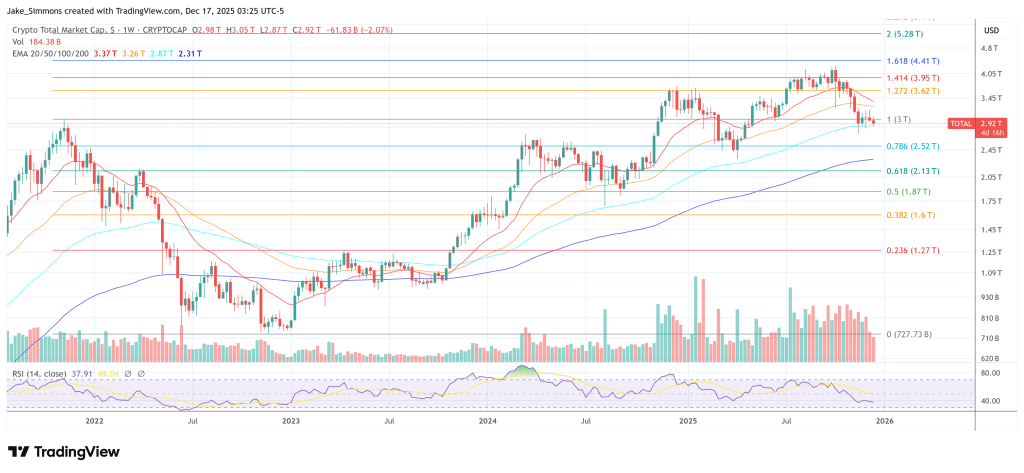
At press time, the total crypto market cap stood at $2.92 trillion.

Total crypto market cap chart

Saylor Says Lost Bitcoin May Need To Be Frozen As Quantum Risk Rises

Michael Saylor tossed a compact bit of Bitcoin game theory onto X on Tuesday and it set off the predictable kind of fight: technical details colliding with ideology.

“The Bitcoin Quantum Leap: Quantum computing won’t break Bitcoin—it will harden it,” Saylor wrote, adding: “The network upgrades, active coins migrate, lost coins stay frozen. Security goes up. Supply comes down. Bitcoin grows stronger.”

Short version: if quantum ever becomes real enough to threaten today’s signature schemes, Bitcoin can upgrade. Coins that are actively managed move to new, quantum-resistant output types. Coins that aren’t—because the keys are lost, the owner is gone, or the UTXOs are simply abandoned—should effectively get stuck. Frozen.

Bitcoin Developers And Community React

That’s the part people latched onto, because it’s not just a technical question. It’s a social one. Who gets to decide which coins are “lost” versus “just old”? Jameson Lopp, one of the loudest voices pushing for practical quantum-readiness, basically said: yes, and welcome aboard. “I agree, lost coins should stay frozen. Glad to hear you’ll support my BIP!”

Then the counterpunch arrived fast. “We have no right to freeze another man’s bitcoin,” wrote Wicked (@w_s_bitcoin), arguing any attempt to lock legacy coins could spark a contentious chain split. He also floated a more narrative-friendly twist: what if Satoshi left early keys exposed as a “bounty” for quantum computers?

Lopp’s answer wasn’t sentimental. It was node-level realism. “On the flip side, every node runner has the right to refuse to accept coins they believe are most likely to have been stolen by a quantum attacker,” he wrote, framing it less as confiscation and more as a defensive filter to preserve the integrity of circulating supply. Later, he conceded the uncomfortable core: “Correct, the best you can do is come up with an extremely lengthy migration window.”

That “migration window” is doing a lot of work here. The draft proposal described by Lopp and co-authors (Christian Papathanasiou, Ian Smith, Joe Ross, Steve Vaile, Pierre-Luc Dallaire-Demers) sketches a three-phase path: first a soft fork that nudges (or forces) new sends into proposed quantum-resistant outputs, then a later rule change that makes legacy ECDSA/Schnorr spends invalid after a long deadline, and an optional third phase to recover unmigrated coins if the rightful owner can prove control through some new mechanism.

It sounds orderly on paper. It never is in practice. Because you can’t prove theft in Bitcoin’s older UTXOs. Wicked hammered that point: there’s “no way to prove whether older coins were stolen or just forgotten and then moved later by the rightful owner.” The fear, in his view, is basically supply paranoia dressed up as security.

Lopp didn’t deny the incentives. He leaned into them. “I can assure you that many entities in the industry care about supply shocks causing the value of their coins to plummet; businesses still use dollars as their unit of account.” And then, in a line that reads like a homework assignment for anyone who thinks this ends cleanly: “Your homework is to figure out the power dynamics…”

Outside the Bitcoin-only trench fight, other corners of crypto mostly reacted with a raised eyebrow. Nic Carter, a founding partner at Castle Island Ventures, demanded specifics: “Explain in detail how all of those things will happen […] Which core devs has microstrategy funded to work on the multiple hard and soft forks that will be required for this plan? Which quantum researchers?”

BitMEX Research pushed back on the “hardfork” framing. “What makes you think we need a hardfork?” it asked, arguing the transition could be painful without literally being a hard fork. Another account summed up the mood: “You can freeze coins with a soft fork.”

Then again—soft fork or not—getting broad social consensus to lock unmoved coins is its own nightmare. “The idea that there would be social consensus over locking unmoved coins is crazy,” one user wrote. “In 1,000 realities that doesn’t happen once.”

And, quietly, a reminder from Willem Schroe (Botanix CEO): “Yes, there are quantum developments but nothing remotely close to a breakthrough. That said, our current cryptographic solutions are not even remotely close to ready or battletested so quantum resistance work is definitely worth it. Very small risk but would have a big impact.”

So overall, none of this is about quantum tomorrow. It’s about Bitcoin deciding what it is when faced with a threat that can’t be patched with vibes. The tech path is hard. The politics might be harder.

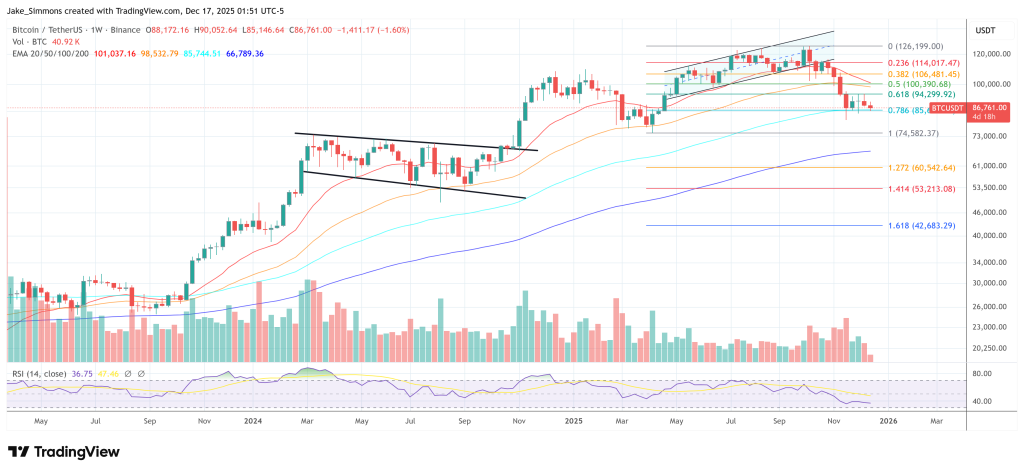
At press time, Bitcoin traded at $86,761.

Bitcoin price chart

Bitcoin ‘Death Cross’ Panic Returns: History Says It’s A Late Signal

Bitcoin’s “death cross” is back in the group chat. And yes, the emails too. Matthew Sigel, head of digital assets research at VanEck, said he’s been “getting questions from clients” about the latest death cross print — the 50-day moving average slipping under the 200-day — and answered with the kind of data dump that tends to calm people down.

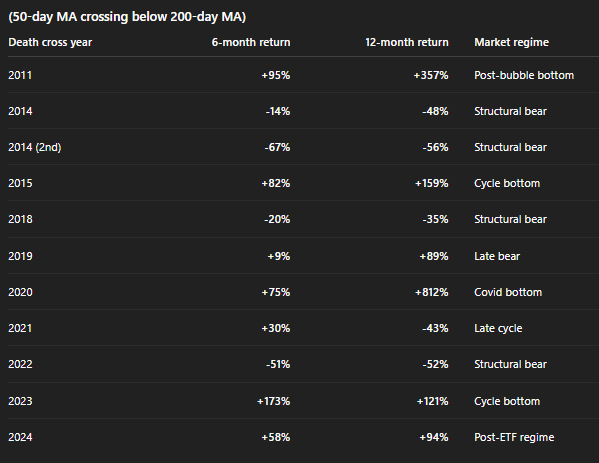
“Lagging indicator,” Sigel wrote on X, alongside a table of every Bitcoin death cross going back to 2011. The summary stats are clean: the 6-month median return after a death cross is +30%, the 12-month median is +89%, and the “positive hit rate” is 64%.

Another Bitcoin Death Cross, Another Missed Bottom?

But the interesting bit isn’t just the returns. It’s Sigel’s market regime column — basically a hint that the same technical signal can mean wildly different things depending on where you are in the cycle.

Bitcoin death cross history

Take the ones tagged as some version of “bottom.” In 2011 (“post-bubble bottom”), the death cross showed up around the wreckage of an early-cycle blow-off, and the next 12 months were +357%. In 2015 (“cycle bottom”), it was +82% at six months and +159% at 12 months — classic post-capitulation behavior where trend indicators catch up late, after price has already stabilized and started to turn.

2020 (“Covid bottom”) is the extreme example: forced liquidation, policy response, then a monster rebound (+812% over 12 months). And 2023 is also tagged “cycle bottom,” with +173% at six months and +121% at 12 months — the kind of “this is awful until it isn’t” regime crypto does better than any asset class.

Now look at “structural bear.” That label shows up in 2014 (twice), 2018, and 2022 — and the forward returns are mostly ugly: 2014 prints -48% and -56% over 12 months, 2018 is -35%, and 2022 is -52%. Different environment. Less “washout and bounce,” more “trend is down because the system is deleveraging,” whether that’s miners, credit, exchanges, or macro liquidity tightening. In those regimes, a death cross isn’t a late alarm — it’s the moving averages confirming that the downtrend is real and persistent.

The in-between tags matter too. 2019 is marked “late bear,” with +9% at six months and +89% at 12 — choppy, uneven, but improving as the cycle turns. 2021 is “late cycle”: +30% at six months, then -43% at 12, which fits a regime where trend signals can whipsaw while distribution and macro tightening creep in.

And then there’s 2024: “post-ETF regime,” with +58% at six months and +94% at 12. That tag is doing a lot of work. It suggests the backdrop isn’t just “price vs. moving averages,” but structural demand (ETFs), different liquidity plumbing, and a market that may behave less like pure reflexive leverage and more like a hybrid of trad-fi flows plus crypto-native positioning.

So the takeaway isn’t “death crosses are bullish.” That’s not true. It’s that the signal is mostly a trailing mirror — and the regime you’re actually in (bottoming, late bear, structural deleveraging, late cycle, post-ETF flow market) is what decides whether it’s a fake-out, a confirmation, or just noise with a scary name.

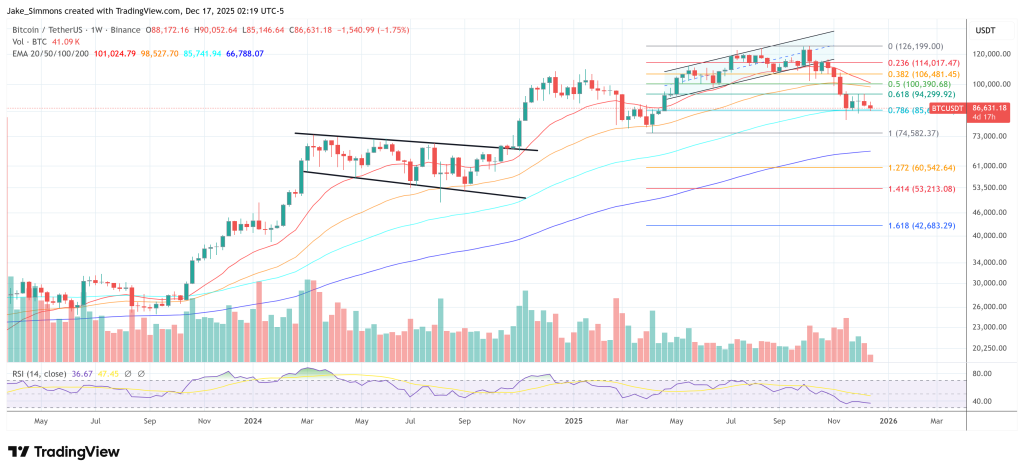
At press time, Bitcoin traded at $86,631.

Bitcoin price

Will Quantum Computing Suppress Bitcoin Prices In 2026? Grayscale Answers

Quantum risk has been getting louder in the Bitcoin conversation over the past few months. The question is whether that noise translates into price pressure in 2026.

Grayscale’s answer, in its updated 2026 Digital Asset Outlook: “Dawn of the Institutional Era” (last updated Dec. 15), is essentially no. Quantum belongs on the risk register and in the research pipeline, not on the list of themes the firm expects to steer Bitcoin’s valuation next year. In its view, it’s not “likely to move prices” in 2026.

Why The Quantum Computer Threat Won’t Move Bitcoin Price In 2026

That call matters because the quantum debate arrived while the market is already looking for new failure modes — everything from “the four-year cycle is dead” to renewed anxiety about large holders distributing supply. Grayscale’s framing is simpler: the threat is real in theory, but the relevant timelines don’t line up with a 2026 trading horizon.

The firm lays out the core concern in plain terms: “Theoretically, a sufficiently powerful quantum computer could derive private keys from public keys, which could then be used to create valid digital signatures to spend users’ coins. Therefore, Bitcoin and most other blockchains — and virtually everything else in the economy that uses cryptography — will eventually need to be updated for post-quantum tools.”

The key word is eventually. Grayscale points to expert estimates suggesting a machine capable of breaking Bitcoin’s cryptography is “unlikely before 2030 at the earliest.” That pushes 2026 into a preparedness bucket: more research, more coordination, more work on mitigation — but not a year where markets suddenly apply a quantum discount because a lab headline hit the wires.

Grayscale makes that explicit. “However, expert estimates suggest a quantum computer powerful enough to break Bitcoin’s cryptography is unlikely before 2030 at the earliest. Research on quantum risk and community preparedness efforts will likely accelerate in 2026, but this theme is unlikely to move prices, in our view,” the firm writes.

In the report’s taxonomy, quantum sits closer to “high attention, low near-term impact” than to a true 2026 catalyst. Grayscale groups it with other heavily discussed trades that may not drive returns on a one-year view, including the digital-asset-treasury (DAT) narrative that had its Michael Saylor copycat phase in 2025.

The broader outlook is firmly “institutional era” in tone. Grayscale expects 2026 to extend structural shifts in how digital assets are owned and allocated, driven by macro demand for alternative stores of value and an improving regulatory backdrop that reduces frictions for large investors. In that context, the firm is calling for Bitcoin to set a new all-time high in the first half of 2026, while arguing the classic four-year halving cycle is becoming less dominant as spot ETPs and slower-moving portfolio allocation play a bigger role.

That’s also why quantum looks like a mismatch for the 2026 price question. If the marginal buyer is an allocator working through due diligence checklists, the market’s response function changes. Those investors do not ignore tail risks — but they also tend not to liquidate positions on long-dated, low-probability scenarios unless the timeline becomes immediate.

Grayscale highlights one other, quieter point that fits the institutional framing: Bitcoin’s supply schedule. The report notes investors can be “highly confident” the 20 millionth bitcoin will be mined in March 2026 — a predictable, verifiable milestone that speaks to the protocol’s rule-based issuance.

So will quantum computing suppress Bitcoin in 2026? Grayscale’s base case is no — not because the problem is imaginary, but because it isn’t close on the timeline markets usually need before they reprice risk. For next year, the firm expects the bigger drivers to look familiar, even if they arrive in more institutional packaging: rates, regulation, ETP plumbing, and steady absorption of BTC into mainstream portfolios.

Quantum remains a theme to track. Just not, in Grayscale’s view, the theme that sets the price in 2026.

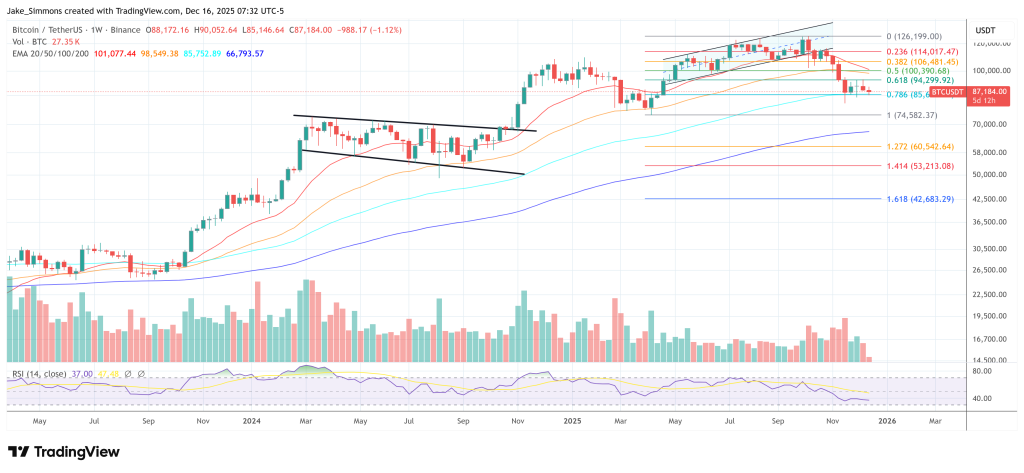
At press time, Bitcoin traded at $87,184.

Bitcoin price chart

XRP Falls Below $2 As $721 Million Profit-Take Hits Market

One of the cleaner tells in crypto is when the old supply decides it’s time. Not “made a quick 20% and clipped it” time — years old.

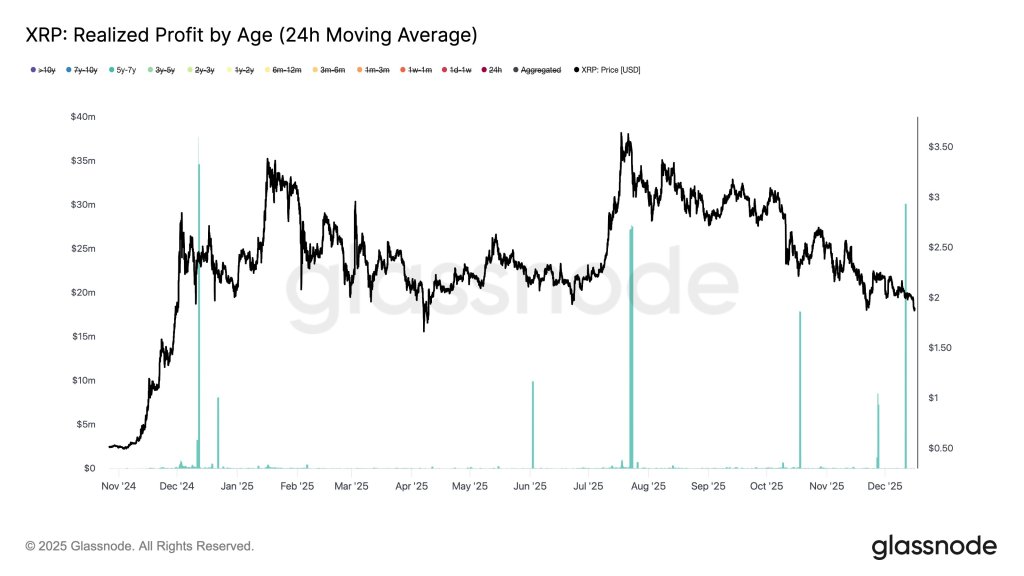
That’s basically what Glassnode researcher CryptoVizArt flagged after an XRP wallet aged roughly 5–7 years (with a cost basis around $0.40) realized more than $721.5 million in profit on Dec. 11.

A single wallet doesn’t “break” a market on its own. But the timing is the point: this wasn’t profit-taking into a rip. It landed while XRP was showing weakness right at the $2.0 key level.

CryptoVizArt wrote via X: “On December 11th, a 5-7 year old XRP wallet address (with a cost basis of $0.4) realized over $721.5M in profit! A rare sizable profit-taking while the price shows weakness right at the $2.0 key level.”

XRP Realized Profit by Age

What This Means For XRP Price

That $2 handle matters for the usual reasons — round number, obvious chart magnet, psychological line in the sand — but also because the market’s been treating it like a live wire lately. Since early December last year, the support zone between $2 and $1.90 has been tested endless times. XRP bulls always managed to close above the zone on the weekly timeframe.

So what does the $721M print mean? It’s a reminder that supply overhang isn’t theoretical. A 5–7 year wallet taking profits can be read as “de-risking,” sure. But in tape terms, it’s also distribution that the market has to absorb while price is already leaning. If bids are deep, it’s a shrug. If bids are thin, it turns $2 into a trapdoor. And right now, “thin” is kind of the vibe across crypto, not just XRP.

CryptoVizArt’s broader framing from Dec. 13 is that the $80K–$90K Bitcoin consolidation is producing stress “comparable to late Jan 2022.” Via X, he wrote: “The current $80K–$90K consolidation range is generating a magnitude of stress comparable to late January 2022, with Relative Unrealized Loss approaching ~10% of market cap. This places the market in a regime where liquidity is constrained, and sensitivity to macro shocks is elevated, yet still below the levels typically associated with full bear-market capitulation.”

That backdrop matters because alts don’t trade in a vacuum. When the whole complex is jumpy, big sell events at key levels have more punch. Not because every XRP holder suddenly panics, but because market-makers and discretionary traders tend to pull risk at the same time. Spreads widen, depth thins, and “one-off” flows start to move price more than they should.

Still, it cuts both ways. A single, chunky realization can also be the market clearing a problem — old supply exiting, new demand stepping in, the kind of transfer that (eventually) makes a base sturdier. The trick is whether $2 holds while that handoff happens.

At press time, XRP was trading at $1.89, which could make Sunday’s weekly close another extremely important event.

XRP price

Bitcoin Under Pressure As Yen Carry Trade Unwind Hits Global Markets

The yen carry trade unwind has been hovering over markets lately — the kind of “plumbing” story that most people ignore right up until volatility spikes and everything suddenly feels connected. Graham Stephan put it into a Bitcoin and crypto-friendly frame yesterday.

In a Dec. 15 post, the popular YouTuber described the yen carry trade as Wall Street’s long-running “infinite money glitch” — and argued it’s breaking down just as the Fed is signaling a shift in its outlook for next year. “Wall Street found an ‘infinite money’ glitch 20 years ago. They called it the Yen Carry Trade. It just broke, right when the Fed announced its plans for next year,” Stephan wrote.

What The Yen Carry Trade Unwind Means For Bitcoin

He presented it as a straightforward trade that scaled because the size was big enough to matter. “For decades, the ‘Yen Carry Trade’ has been the secret engine behind global liquidity. The mechanics were simple enough that a child could understand them, but profitable enough to move trillions of dollars.”

Stephan then laid out the basic steps in plain English: borrow cheaply in Japan, rotate into higher-yield US assets, keep the spread. “Borrow Cheap: Investors borrowed money in Japan, where interest rates were effectively 0%… Invest Abroad: They took that ‘free money’ and bought US Treasuries paying 4-5%… Profit: They pocketed the difference without using any of their own money.”

His argument is that the setup turns toxic when the rate differential compresses and the currency leg moves the wrong way. He framed the timing as especially awkward for risk assets: Japan tightening to support the yen while the Fed eases. “Japan is finally raising rates to save its own currency right at the time when the Fed has started slashing rates. The gap between the rates is getting squeezed. The ‘free money’ isn’t free anymore.”

From there, he leaned into the mechanical consequence: when funding gets more expensive and the currency shifts, leveraged positions don’t get a long debate window — they get cut. “As Japanese rates rise, that trade flips. Investors are now being forced to sell their US assets to pay back their Yen loans. Instead of money flowing into the US markets, it is being sucked out to pay debts in Tokyo. This is a massive liquidity drain happening right under our noses.”

That’s also where his Bitcoin read comes in. Not “Bitcoin is broken,” but that Bitcoin is where risk appetite and leverage tend to show up early — and where forced selling can look brutal when it hits.

Stephan expanded on the same theme in a Substack post, pulling the Fed into the timeline more directly and warning readers to brace for turbulence. “You better get ready for a bumpy ride,” he wrote, claiming the Fed cut rates “for the third time this year,” and that the central bank “has officially ended ‘Quantitative Tightening’ and is quietly moving back toward printing money.”

He added a “pilot flying blind” angle as well, arguing the Fed cut “without any inflation data whatsoever” due to shutdown-related disruptions. He attached a specific interpretation of balance-sheet policy, too: “Finally, the most important news of the day: Quantitative Tightening (QT) is over… They even announced they will buy $40 billion of Treasuries over the next 30 days. The tightening era is dead. The ‘stimulus’ era is now being rebooted, and the money printer is being turned on.”

Taken together, his thesis ends up with Bitcoin sitting between two forces that don’t necessarily move on the same clock: a potentially sharp deleveraging impulse from carry unwinds, and a slower easing impulse if policy conditions loosen. One can hit price violently in a short window; the other can take time to express itself cleanly.

Stephan closed with a familiar Bitcoin-with-training-wheels framing: volatility is normal, drawdowns happen, and mining economics create a reference point. “Bitcoin isn’t broken. It’s just volatile, and this isn’t the first time this is happening. Statistically, Bitcoin has seen drastic crashes of 50% or more, but it has never dropped below its “electrical cost” (the cost to mine one coin), which sits around $71,000 today. If we get close to that number, history suggests it’s a strong buy zone,” he concluded.

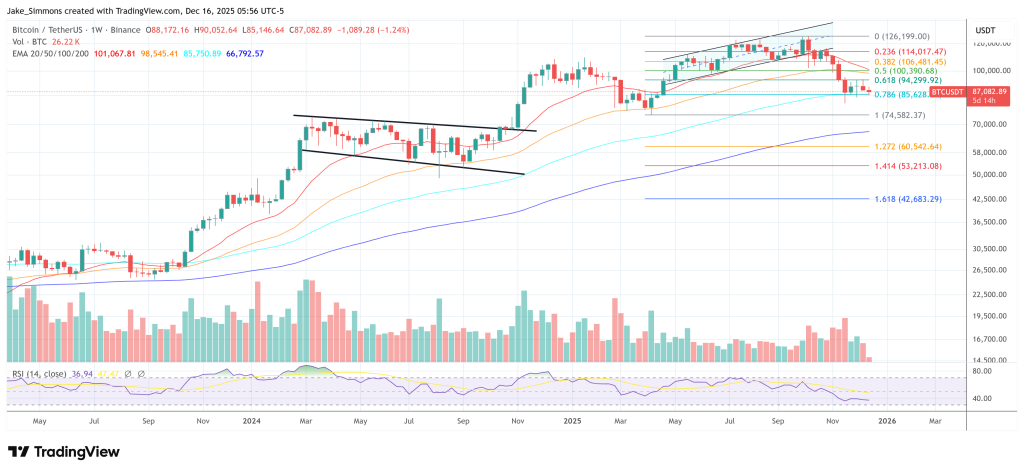
At press time, BTC traded at $87,082.

Bitcoin price

Solana Hit By One Of The Largest DDoS Attacks In Internet History

Solana has been battling what some ecosystem builders are calling an internet-scale DDoS campaign — and, despite the usual “Solana is fragile” jokes, the network seems to be shrugging it off.

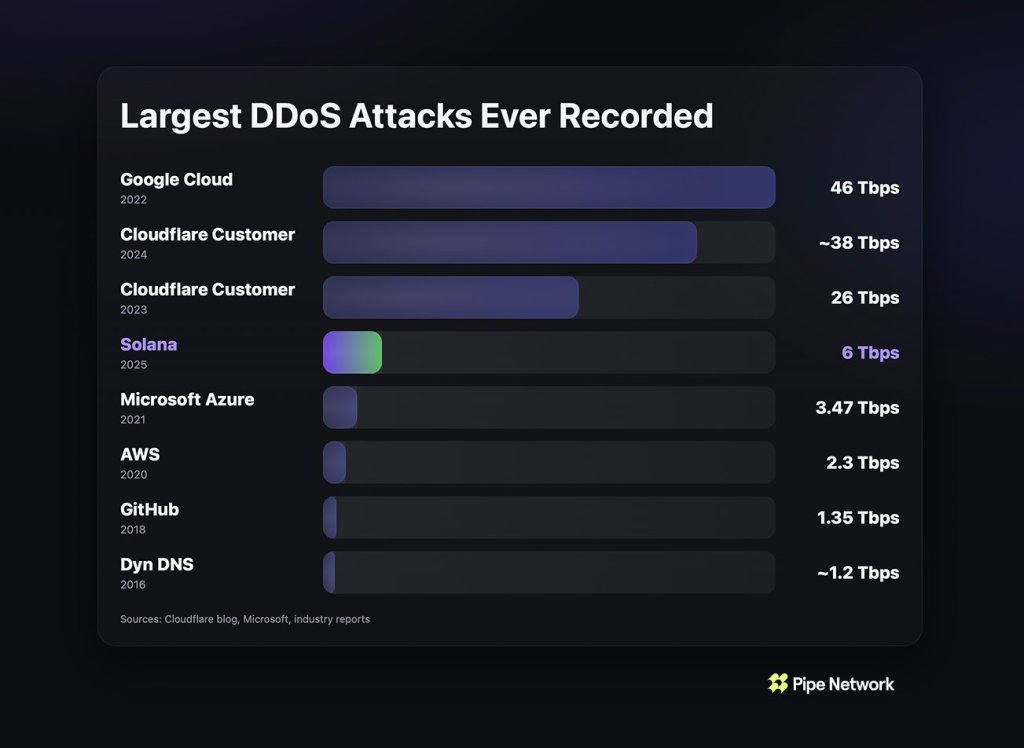
Pipe Network said of the ongoing attack via X today: “The ongoing DDoS attack on Solana is one of the largest in internet history. 6 Tbps volumetric attack translates to billions of packets per second. Under that kind of load, you’d normally expect rising latency, missed slots, or confirmation delays.”

Pipe further says that’s not what the data is showing. “Median tx confirmation ~450ms,” the team wrote, adding that p90 remains under 700ms and slot latency is holding at 0–1 slots. In other words, if you’re a regular user or trader, you might not even know anything’s happening. Which is kind of the point.

Largest DDos attacks in internet history

Reactions From The Solana Community

Raj Gokal, Solana Labs’ co-founder and COO, put it more bluntly in a reply to a broader DDoS debate: “have you heard about the ongoing DDOS against Solana that has had zero effect on performance?”

The backdrop here matters. Justin Bons had posted about Sui being DDoS’d yesterday, claiming it triggered “mass delays” and arguing that “127 validators is not enough,” with the broader warning: don’t let validator counts drift too low if you want a chain to be resilient.

Mert Mumtaz, CEO of Helius, largely agreed with the premise — but pushed back on the simplistic “more validators = solved” framing.

“I understand your point & mostly agree with you,” Mert wrote, before adding that “a chain is more resistant to DDoS with 100 professional high powered validators compared to 10k validators run by amateurs.” He also said there are scenarios where higher validator count can help, but emphasized it isn’t the core defense by itself. Then he dropped the key detail: Solana’s attack hasn’t been a one-day headline, it’s been going on for a while.

“And fyi there has been a colossal ddos attack on Solana for weeks now,” Mert wrote, later adding that Solana “has been under a colossal DDoS attack for at least over a week now btw” — and that the fact most users haven’t felt it is “a big testament to the level of engineering present here.”

Solana co-founder Anatoly Yakovenko chimed in with a more technical angle on why validator count can matter in specific leader-hand-off dynamics: “Validators count helps if the previous leader can finish their block while the current one is being hit. Then the cost of ddos approaches the cost of ddos the whole network.”

Translation: if an attacker wants to reliably disrupt block production, they may have to sustain pressure across more of the network, not just pick off a single leader at the wrong moment. That gets expensive fast.

SolanaFloor summed it up via X: “Solana has been under a sustained DDoS attack for the past week, peaking near 6 Tbps, the 4th largest attack ever recorded for any distributed system. Network data shows no impact, with sub second confirmations and stable slot latency. The Sui network was also targeted by a DDoS attack yesterday, resulting in delays in block production and periods of degraded network performance.”

And there’s a more strategic takeaway that’s starting to sound less theoretical each month: blockchains are now juicy targets. David Rhodus, founder of Permissionless Labs (and a contributor to Pipe Network), said: “This puts Solana among the most heavily DDoSed targets in internet history. It reinforces that blockchains are now Tier-1 DDoS targets. This is not “script kiddie” activity — 6 Tbps is industrial-scale.”

If you’re a validator, Mumtaz offered the practical advice you’d expect in a week like this: have backups across multiple hosting providers and regions. Because even if the chain holds, your own infrastructure might not.

The broader point, though, is the new baseline: these networks are getting stress-tested like mainstream internet services now. Solana’s claim today is that it passed — quietly, under load, and without users noticing. That’s the kind of victory that doesn’t look dramatic on a chart. It just […] works.

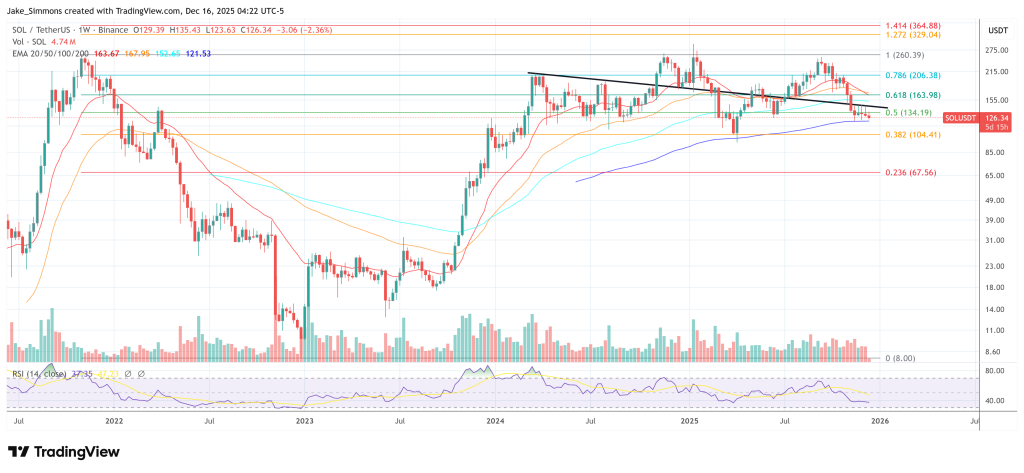
At press time, Solana traded at $126.

Solana price chart

❌