Reading view

There are new articles available, click to refresh the page.

Stablecoin Supply High, Liquidity Flow Low: Matrixport Flags Market Fatigue

Crypto’s primary liquidity gauge is flashing warning signs. According to a new market note from Matrixport, while total stablecoin supply remains near all-time highs, the pace of new capital inflows has peaked and is now slowing, considered a classic signal of buyer exhaustion.

The firm notes that the rolling 12-month growth rate of stablecoin issuance topped out in late October and has since rolled over. The deceleration coincides with a roughly 3% decline in Bitcoin, which was trading near $85,860 on Tuesday morning, struggling to reclaim key moving averages.

The Data: Liquidity Stock vs. Liquidity Flow

On the surface, crypto liquidity appears abundant. Tether (USDT) and Circle (USDC) together command a combined market capitalization exceeding $260 billion. However, Matrixport argues that headline supply figures obscure a more important signal: the marginal liquidity needed to sustain price momentum is drying up.

The firm attributes the slowdown primarily to the Federal Reserve’s shift toward a more cautious stance on future rate cuts.

“Political constraints may have a greater impact on market flows than investors’ perceptions,” Matrixport wrote, adding that liquidity conditions remain constrained by weak retail participation.

📊Today’s #Matrixport Daily Chart – December 16, 2025 ⬇

Stablecoin Growth Is Slowing—A Less Supportive Liquidity Backdrop for Crypto#Matrixport #Stablecoins #CryptoLiquidity #MarketLiquidity #Fed #Macro #CryptoMarket #OnChainData pic.twitter.com/JdtNW2AuKx

— Matrixport Official (@Matrixport_EN) December 16, 2025

Why Stablecoin Supply Is No Longer Driving Risk Appetite

Matrixport highlights a critical divergence shaping current market dynamics:

  • Liquidity Stock: Absolute stablecoin supply continues to rise, theoretically providing ample “dry powder.”
  • Liquidity Impulse: The velocity of that capital has collapsed. Instead of rotating into risk assets, funds are remaining idle or moving into yield-bearing instruments.

The firm links this behavior to growing uncertainty around the Fed’s policy path, as reinforced by recent FOMC minutes that offered little clarity on the timing or depth of easing.

Market Reaction: Technical Damage Builds

Price action has turned defensive. Matrixport notes that Bitcoin has lost its “bull market trend indicator” for the first time in several months, signaling weakening momentum beneath the surface.

With the Fed unlikely to deliver aggressive easing in Q1, the firm warns that the “correction phase forecast since October” is likely to persist unless a new macro or liquidity catalyst emerges.

Institutional View: Velocity Matters More Than Size

Matrixport emphasizes that the key distinction separating institutional positioning from retail narratives is the difference between liquidity stock and liquidity impulse.

A $260 billion stablecoin float may sound bullish, but without an accelerating rate of issuance and deployment, it acts more like a reservoir than a flood. Institutional desks are interpreting the Fed’s hesitation as a cap on leverage and risk-taking.

Until the cost of capital meaningfully declines or stablecoin issuance re-accelerates on a rolling basis, Matrixport expects choppy, range-bound conditions rather than sustained breakouts.

The post Stablecoin Supply High, Liquidity Flow Low: Matrixport Flags Market Fatigue appeared first on Cryptonews.


Hex Trust’s High-Stakes Wrapped XRP Gambit: $100M Liquidity Infusion Fuels Bridge Exploit Fears

Institutional custodian Hex Trust announced the launch of Wrapped XRP (wXRP) on Thursday, deploying the token across Ethereum, Solana, Optimism, and HyperEVM with $100 million in initial liquidity.

The move aims to anchor Ripple’s RLUSD stablecoin pairs on EVM chains. XRP remained flat on the news, while RLUSD supply held steady at 1.3 billion.

The Signal: XRP Liquidity vs. Security

Hex Trust’s wXRP enters a crowded market already fragmented by Coinbase’s cbXRP and Axelar’s eXRP. The $100 million seed capital is intended to support trading pairs immediately, thereby eliminating the “cold start” problem that typically accompanies new wrapped assets.

The structure is a standard 1:1 custodial model: Hex Trust holds the native XRP; users get the IOU. While this enables DeFi composability, it reintroduces the single point of failure—the custodian—that the XRP Ledger was built to eliminate.

The Risk Vector

The timing is precarious. Bridge and custodian exploits were the culprit behind over 50% of all crypto losses in the first half of 2025. By moving XRP off its native ledger, holders swap protocol security for smart contract risk.

Hex Trust attempts to mitigate this via LayerZero’s Omnichain Fungible Token (OFT) standard, which theoretically reduces attack surfaces compared to traditional “lock-and-mint” bridges. Yet, the big prize for hackers remains: $100 million sitting in a single custodial wallet.

The Institutional Take: Can XRP Really go to Zero?

While the headline is the $100M liquidity, the real story is the fragmentation of XRP liquidity. We now have three major synthetic XRP variants (cbXRP, eXRP, wXRP) competing for the same DeFi flows.

For desks, this creates arbitrage opportunities but fractures deep liquidity. Expect spreads to widen across these variants until a clear winner emerges. The real risk isn’t the wrapper—it’s the bridge. If the Hex Trust multisig is compromised, wXRP goes to zero, regardless of the underlying asset’s health.

The post Hex Trust’s High-Stakes Wrapped XRP Gambit: $100M Liquidity Infusion Fuels Bridge Exploit Fears appeared first on Cryptonews.

Bitcoin Stalls Near $90K as Holiday Lull Mutes Market

Bitcoin continues to trade in a narrow range just below the $90,000 level, reflecting a broader pause in market momentum as the year draws to a close. The world’s largest cryptocurrency was last hovering around $89,700, down roughly 1.2% over the past 24 hours, with price action largely subdued.

The lack of volatility reflects a wider consolidation phase, as institutional trading desks scale back activity ahead of the holidays. With liquidity thinning and risk appetite muted, market participants appear reluctant to take fresh directional bets.

Post-October Correction Sets a Defensive Tone

The current sideways movement follows a sharp correction from Bitcoin’s October highs. On October 10, BTC was trading above $113,000 before a steep sell-off reset market expectations. That drawdown has since fostered a more cautious tone, particularly as the market enters a traditionally low-liquidity period.

On-chain and derivatives data suggest participation has steadily weakened through the final quarter. A recent Glassnode report shows trading activity declining from November into December, alongside expectations that implied volatility will continue to compress toward year-end.

“The contraction in volume reflects a more defensive overall market positioning, with less liquidity-driven capital flow available to absorb volatility or sustain directional moves,” Glassnode noted.

Institutional Fatigue and a Wait-and-See Market

That assessment aligns with commentary from market analysts, including Markus Thielen of 10x Research, who has pointed to signs of “institutional fatigue.” Despite substantial spot Bitcoin ETF inflows earlier in the year, those allocations have yet to translate into sustained upside, prompting funds to de-risk and close books into year-end.

10x Weekly Crypto Kickoff – Why Year-End Risk Skews to the Downside

The report covers derivatives positioning, volatility trends, and funding dynamics across Bitcoin and Ethereum, along with sentiment, technical signals, ETF and stablecoin flows, option activity, expected… pic.twitter.com/4Pp3VyBX3h

— 10x Research (@10x_Research) December 14, 2025

With retail participation also subdued, analysts broadly agree that the conditions for a meaningful breakout are lacking. Even the Federal Reserve’s recent neutral stance on interest rates has failed to act as a catalyst for renewed institutional positioning.

For now, Bitcoin appears content to remain range-bound, with traders and investors alike waiting for clearer signals, and deeper liquidity, likely not until the New Year.

The post Bitcoin Stalls Near $90K as Holiday Lull Mutes Market appeared first on Cryptonews.

XRP Stalls Despite Ripple’s OCC Win – Here’s The Institutional Catch

The Office of the Comptroller of the Currency (OCC) conditionally approved national trust bank charters for five digital asset firms on Friday, including Ripple, Circle, and Fidelity Digital Assets. The move formally integrates these entities into the federal banking system, granting them direct access to the Federal Reserve’s payment rails and pre-empting state-level oversight.

New entrants into the federal banking sector are good for consumers, the banking industry and the economy. Read about the OCC’s conditional approval of five national trust bank charter applications. https://t.co/xF3GzoJXGf pic.twitter.com/NhV3HfoFNj

— OCC (@USOCC) December 12, 2025

“New entrants into the federal banking sector are good for consumers, the banking industry, and the economy,” Comptroller Jonathan Gould said in the release.

The Approved List:

  • New Charters: Circle’s First National Digital Currency Bank, Ripple National Trust Bank.
  • Conversions (State to National): Paxos Trust Co., BitGo Bank & Trust, Fidelity Digital Assets.

This marks the first expansion of federal crypto banking charters since Anchorage Digital’s approval in 2021.

Washington’s Regulatory Blueprint Takes Shape

The approvals follow the July 18 enactment of the ‘GENIUS Act’ (Guiding and Establishing National Innovation for U.S. Stablecoins), which mandated a federal framework for the $314 billion stablecoin market.

Additionally, the OCC released Interpretive Letter 1188 on Tuesday (Dec. 9), explicitly permitting national banks to trade crypto assets on a “riskless principal” basis.

OCC Interpretive Letter 1188 confirms that a national bank may engage in riskless principal crypto-asset transactions as part of the business of banking. https://t.co/gXirMExhCi pic.twitter.com/uPRFGqb2NZ

— OCC (@USOCC) December 9, 2025

Market Reaction

Despite the structural liquidity upgrade, XRP ($2.00, -2.19%) showed no immediate volatility. Traders appear to have priced in the approval following the GENIUS Act’s passage.

Circle CEO Jeremy Allaire noted the charter “deepens” the firm’s ability to settle USDC directly via the Fed, bypassing commercial bank intermediaries.

Institutional Shift: De-Risking Digital Finance

This is a liquidity infrastructure event, not a retail pump. By securing national charters, Circle and Paxos effectively remove the “commercial bank counterparty risk” that triggered the USDC depeg during the SVB collapse.

For desks, this means 24/7 settlement finality via FedMaster accounts is imminent. Expect the spread between onshore regulated stablecoins and offshore equivalents (USDT) to widen as institutions migrate capital to Fed-integrated rails.

The post XRP Stalls Despite Ripple’s OCC Win – Here’s The Institutional Catch appeared first on Cryptonews.

Bitcoin To Hit $150,000 By 2026, Treasury President Predicts

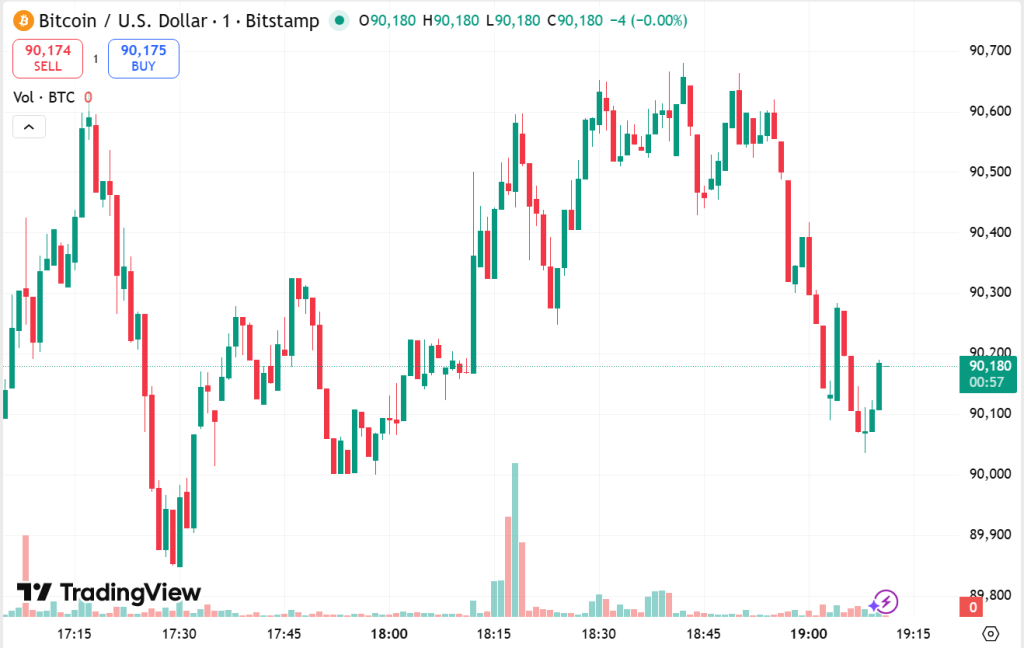
A Bitcoin Standard Treasury Company (BSTR) executive has predicted that Bitcoin will reach $150k by the end of 2026, citing a confluence of regulatory clarity, monetary easing, and Wall Street adoption. The forecast arrives even as Bitcoin is trading about 28% below its all-time high. BTC is currently trading at approximately $90,180, down about 0.59% in the last 24 hours.

Source: TradingView

Bitcoin Tipped for $150K High as Institutional Forces Align

Katherine Dowling, president of BSTR, outlined her bullish case in a DL News interview. “I am bullish on Bitcoin in 2026 despite the recent risk-off sentiment and price slide. Outside of the clear fundamentals, we also have the trifecta of a positive regulatory environment, quantitative easing, and institutional inflows.”

The prediction is anchored by major structural shifts in the U.S. financial environment.

For example, President Trump recently signed the ‘GENIUS Act‘ into law, establishing a regulatory framework for stablecoins. Concurrently, the Office of the Comptroller of the Currency (OCC) issued guidance permitting national banks to offer crypto brokerage services, removing a key barrier for traditional financial institutions.

Regulatory Tailwinds and Monetary Easing

Further momentum comes from the Federal Reserve, which has cut interest rates three times this year, a policy historically favorable to assets like Bitcoin. This accommodative stance is coupled with growing institutional acceptance.

🚨BREAKING:

FED MEETING MINUTES REVEAL ALMOST ALL MEMBERS AGREED ON A 25 BPS RATE CUT. 🇺🇸

THE PRINTING ERA IS BACK. MONEY HAS NO BRAKES.

BITCOIN HOLDERS ARE YOU READY? pic.twitter.com/Jw8hOGbN0q

— Merlijn The Trader (@MerlijnTrader) October 9, 2025

Bank of America now permits its 15,000+ financial advisers to recommend Bitcoin ETFs to clients, suggesting allocations between 1% and 4%. This move alone could channel a large portion of the bank’s $3.5 trillion in client assets toward the digital asset.

Brian Huang, CEO of investment platform Glider, echoed Dowling’s sentiment in an interview with DL News. “If we zoom out, the FED is lowering interest rates. That should bode well for risk assets like Bitcoin and ETH ETFs,” Huang stated. “Expect Bitcoin to reach $150k before year’s [2026] end.”

The Institutional Take

The BofA greenlight is more than just another headline. It indicates a procedural and compliance shift within a top-tier U.S. bank, moving Bitcoin from a client-inquiry-only asset to a proactively recommended portfolio component.

This change normalizes Bitcoin exposure for a massive pool of conservative capital, managed by advisers who now have a fiduciary framework for recommending it. The true sign is the operationalizing of Bitcoin access within legacy financial infrastructure, a far more durable catalyst than fleeting retail sentiment.

The post Bitcoin To Hit $150,000 By 2026, Treasury President Predicts appeared first on Cryptonews.

Bitcoin at $90K After House Letter – SEC Faces New 401(k) Crypto Deadline

The House Financial Services Committee sent a letter to the SEC on December 12, 2025, urging the regulator to amend existing rules to permit Bitcoin and other digital assets within 401(k) plans. The move seeks to formally integrate crypto into the U.S. retirement system, potentially unlocking a new capital source for the asset class.

House Committee Demands SEC Action on Crypto in Retirement Funds

The letter directly references President Trump’s August 7, 2025, executive order, “Democratizing Access to Alternative Assets for 401(k) Investors.” That order mandated the SEC and the Department of Labor to review and dismantle barriers preventing alternative investments from being included in retirement plans. Bitcoin (BTC), trading at $90,304 (+0.08%), saw a slight uptick following the news.

Congress pressuring SEC Chair Paul Atkins to allow Bitcoin in 401k accounts

Liquidity is coming pic.twitter.com/KjW9EJsPP8

— 0xMarioNawfal (@RoundtableSpace) December 11, 2025

Legislative support for the initiative is codified in the ‘Retirement Investment Choice Act’ (H.R. 5748), a bill introduced to legally cement the executive order’s directives. Proponents in Congress argue that current regulations are archaic, denying millions of American savers access to modern asset classes.

The Counter-Narrative: Fiduciary Risk and Volatility

Critics immediately pushed back, citing extreme volatility and fiduciary risks. The American Federation of Teachers has voiced strong opposition to similar measures, emphasizing the potential for fraud and the unsuitability of speculative assets for retirement security.

Financial analysts also share these concerns, pointing to the lack of long-term data and regulatory clarity. Warren Buffett has previously stated that Bitcoin produces no cash flow, making it more akin to gambling than a productive investment.

The Institutional Take

While direct retail access is the headline, the institutional impact is greater. This congressional pressure is not merely about adding a Bitcoin ETF to a 401(k) menu. It is about forcing a legal and fiduciary reclassification of digital assets.

If the SEC acts, it could provide legal air cover for plan administrators and asset managers who have been hesitant to touch crypto due to litigation risk under ERISA.

This shifts the conversation from ‘Is it allowed?’ to ‘What is the prudent allocation?’. Expect asset managers to accelerate the development of institutionally-packaged crypto products designed specifically for the defined-contribution market, regardless of the SEC’s immediate response.

The post Bitcoin at $90K After House Letter – SEC Faces New 401(k) Crypto Deadline appeared first on Cryptonews.

❌