
 Login
LoginWhy Bitcoin’s Current Weakness Is Structural, Not Emotional
Bitcoin has lost the critical $90,000 level and is now hovering near the $86,000 area, a zone that is quickly becoming the last meaningful support in the current structure. The recent decline has unfolded with little resistance from buyers, as bullish participation has largely disappeared from the market. Momentum-driven demand has faded, spot buying remains weak, and rallies are consistently being sold. As a result, a growing number of analysts are openly shifting their outlook toward a bear market scenario.
According to a recent report by on-chain analyst Axel Adler, conditions beneath the surface reinforce this pessimistic view. Derivatives positioning remains firmly negative, indicating that short sellers continue to dominate short-term market dynamics.
At the same time, market sentiment metrics have fallen to levels historically associated with major capitulation phases. Fear is widespread, confidence is fragile, and risk appetite across crypto markets is clearly deteriorating.
The combination of negative futures positioning and extreme investor fear creates a challenging environment for Bitcoin. Rather than signaling an immediate bottom, these conditions suggest that selling pressure remains structurally embedded in the market.
Futures Positioning And Sentiment Signal Deep Stress
Adler explains that the Bitcoin Positioning Index provides a clear view of who controls the derivatives market. The indicator aggregates changes in open interest and funding rates to identify the dominant direction of futures positioning.
At present, the index sits at -4, firmly in negative territory. This reading corresponds to a bearish regime and aligns with an active downtrend signal. Visually, the chart is dominated by purple bars over the past four weeks, highlighting sustained pressure from short positions and a lack of bullish conviction in derivatives markets.

Negative positioning combined with falling prices confirms that bears remain in control of short-term market dynamics. According to Adler, a meaningful regime shift will only occur if the index returns above zero and the price consolidates above local resistance levels. Without that confirmation, downside risk remains elevated.
The Bitcoin Fear and Greed Index reinforces this bearish backdrop. The index, which tracks market sentiment from extreme fear to extreme greed, has fallen deep into the extreme fear zone and well below the 25th percentile.
The 30-day SMA has dropped to 20, while the 90-day SMA sits near 32, signaling persistent sentiment deterioration since September. While extreme fear alone does not guarantee a reversal, its alignment with negative futures positioning suggests that selling pressure is structural rather than purely emotional.
Bitcoin Tests Critical Support As Downtrend Persists
The chart shows Bitcoin trading under sustained technical pressure after failing to reclaim higher levels. Price has decisively broken below the medium-term moving averages and is now consolidating around the $87,000–$88,000 zone, a level that previously acted as support during the mid-cycle advance. The rejection from the blue moving average signals that bullish momentum has weakened significantly, while the downward slope confirms a loss of trend strength.
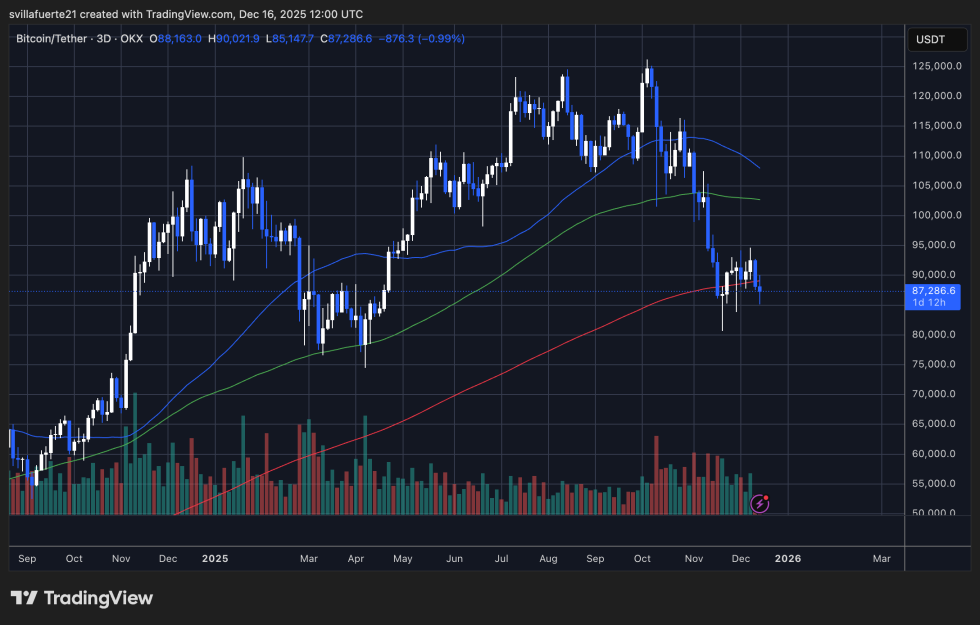
More importantly, Bitcoin is now hovering just above the red long-term moving average, a level that historically acts as a key structural support during broader corrections. The recent bounce from the $85,000–$86,000 area suggests that buyers are still present, but the response lacks conviction. Volume remains muted compared to earlier distribution phases, indicating hesitation rather than aggressive accumulation.
Structurally, the sequence of lower highs since the $120,000 peak remains intact. Until Bitcoin can reclaim the $92,000–$95,000 range and hold above the declining mid-term average, downside risks persist. A clean loss of the long-term support could expose deeper retracement levels toward the low $80,000s.
In the short term, this price behavior reflects a market in repair mode. Bitcoin is no longer trending, but it has not yet shown the strength required to invalidate the corrective structure.
Featured image from ChatGPT, chart from TradingView.com

