Reading view

There are new articles available, click to refresh the page.

Bitcoin Treasury Companies Are Undervalued

Bitcoin Magazine

Bitcoin Treasury Companies Are Undervalued

Bitcoin treasury companies have been hit hard by Bitcoin’s disappointing price action throughout 2025. Publicly traded firms holding significant BTC reserves are suffering the most, with leaders like (Micro)Strategy pushing aggressive accumulation amid headwinds—yet most now trade below net asset value, creating a rare opportunity for risk-tolerant strategic investors.
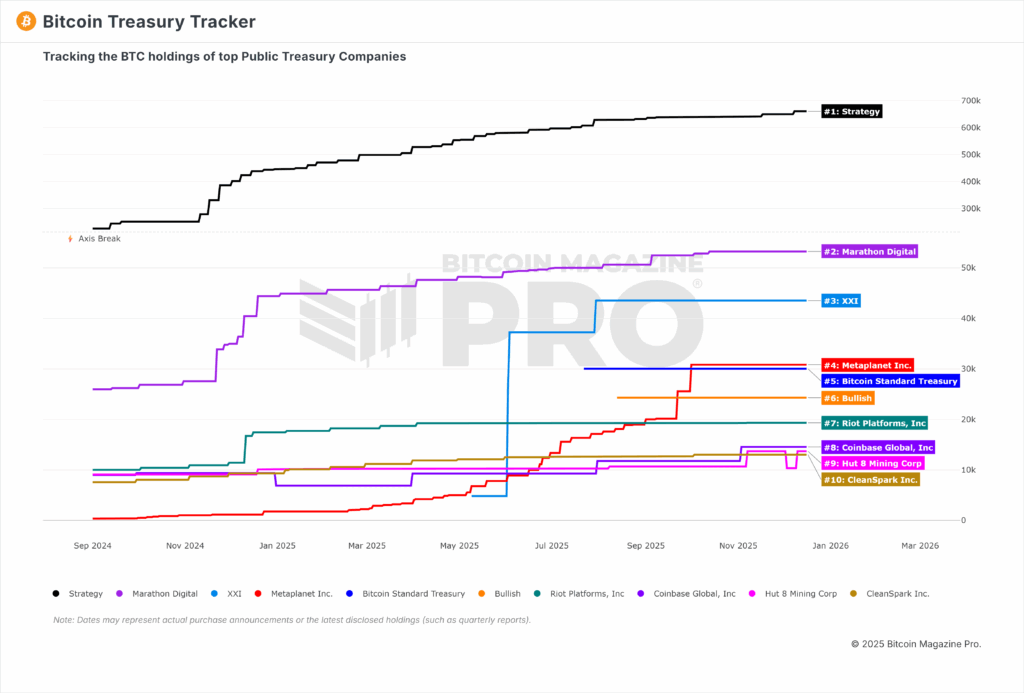
Tracking BTC holdings of the top public Bitcoin Treasury Companies.
Figure 1: Tracking BTC holdings of the top public Bitcoin Treasury Companies. View live chart.

The Bitcoin Treasury Companies Landscape

Not all Bitcoin treasury companies are created equally. Strategy stands apart as the industry standard-bearer, the “Bitcoin among treasury companies,” as it were. The company has maintained its accumulation discipline even as its stock has suffered, recently announcing a $1.44 billion USD reserve specifically designed to pay dividends and debt obligations without forcing Bitcoin sales.

This capital buffer theoretically eliminates the need for excessive dilutive share issuance or forced BTC liquidation, a critical distinction from weaker competitors. Many will likely face shareholder pressure and potential forced selling as their stock prices decline, creating a cascade of supply pressure that could paradoxically benefit the strongest players like MSTR.

Valuation Dynamics of Bitcoin Treasury Companies

The most compelling aspect of current treasury company valuations is that they now trade below net asset value on a per-share basis. In practical terms, you can currently purchase one dollar’s worth of Bitcoin for less than one dollar through treasury company stock. This represents an arbitrage opportunity for investors, though one accompanied by elevated volatility and company-specific risks.

Figure 2: Bitcoin Magazine Pro’s top 20 public Bitcoin Treasury Company HODLboard. View live table.

Strategy currently sits at a net asset value premium of less than 1, meaning the company’s market capitalization is below the value of its Bitcoin holdings alone. The upside scenario is striking. If Bitcoin reclaims its previous all-time high around $126,000, Strategy continues accumulating toward 700,000 BTC, and the market assigns even a modest 1.5x to 1.75x net asset value premium, Strategy could approach the $500 region per share.

From Weak to Strong: The Future of Bitcoin Treasury Companies

Examining Strategy’s performance during the previous Bitcoin bear market and overlaying it onto the current cycle reveals eerie alignment. The bar patterns suggest current price levels represent reasonable support, with only a catastrophic final flush justified by Bitcoin weakness providing reason to expect substantially lower levels.

As weaker treasury companies face forced selling, a consolidation thesis emerges, that Strategy and similar strong-positioned players will potentially accumulate cheap Bitcoin from distressed sellers, further concentrating holdings in the most disciplined accumulators. This dynamic mirrors Bitcoin’s own consolidation process, weaker hands sell, stronger hands accumulate, and the asset becomes more concentrated among conviction holders.

Conclusion: Opportunity in Bitcoin Treasury Companies

Bitcoin treasury companies have for the most part delivered disappointing returns in 2025, but this performance has created a window of exceptional opportunity for disciplined investors. At current valuations, Strategy is essentially selling one dollar of Bitcoin for approximately 90 cents, a discount that becomes even more attractive if Bitcoin experiences one final capitulation flush. The probability of this scenario combined with Strategy’s positioned upside creates asymmetric risk-reward worthy of small, carefully-sized positions within aggressive portfolios.


For deeper data, charts, and professional insights into bitcoin price trends, visit BitcoinMagazinePro.com. Subscribe to Bitcoin Magazine Pro on YouTube for more expert market insights and analysis!


Bitcoin Magazine Pro

Disclaimer: This article is for informational purposes only and should not be considered financial advice. Always do your own research before making any investment decisions.

This post Bitcoin Treasury Companies Are Undervalued first appeared on Bitcoin Magazine and is written by Matt Crosby.

Bitcoin Price Forecast Tools and Cycle Valuation Metrics

Bitcoin Magazine

Bitcoin Price Forecast Tools and Cycle Valuation Metrics

The Bitcoin Magazine Pro Price Forecast Tools chart provides a comprehensive framework for identifying potential price floors during bear cycles and forecasting upside targets based on on-chain fundamentals and network-derived data points. By aggregating multiple metrics, this methodology has historically called Bitcoin market cycle peaks and bottoms with remarkable accuracy. Can these tools continue to provide a basis for reliable BTC price forecasting over the next 12 months and beyond?

CVDD & Balanced Price: Bitcoin Price Cycle Low Indicators

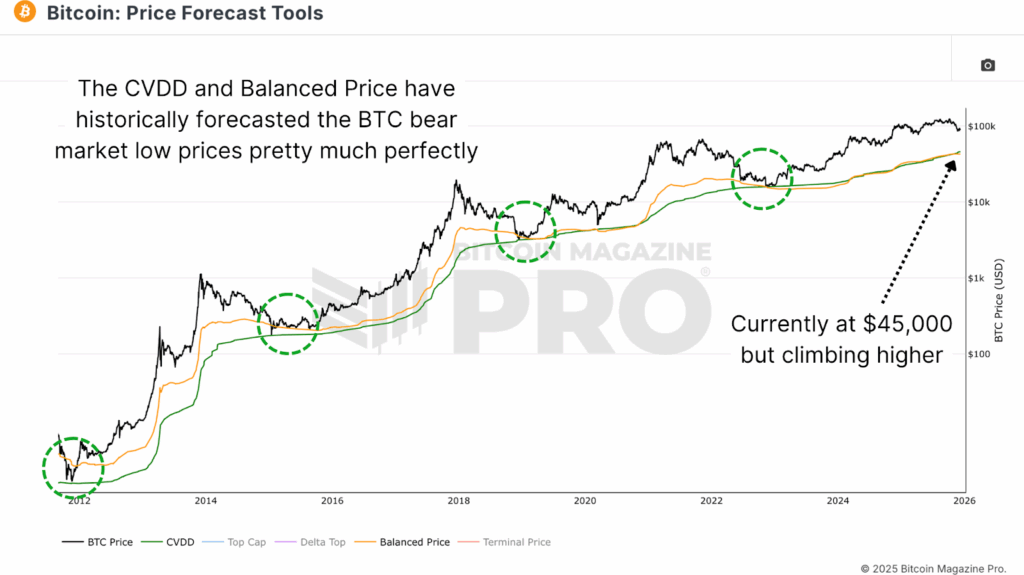
The Cumulative Value Days Destroyed (CVDD) metric has historically called Bitcoin price cycle lows almost to perfection across every cycle since Bitcoin’s inception. This metric begins with Coin Days Destroyed, a measure that weights Bitcoin transfers by the duration they were held before movement. For example, holding 1 Bitcoin for 100 days produces 100 coin days destroyed when transferred, while holding 0.1 Bitcoin for the same result requires 1,000 days of holding. Large spikes indicate that the network’s most experienced long-term holders are transferring significant amounts of Bitcoin.

Figure 1: The convergence of the CVDD and Balanced Price with BTC price has historically aligned with bear market lows. View Live Chart

The CVDD takes this one step further by measuring the USD valuation at the time of transfer rather than just the coin days destroyed quantity alone. This value is then multiplied by 6 million to produce the final metric. When examined across Bitcoin’s entire history, the CVDD has indicated bear market lows with accuracy extending across every cycle. Currently, the CVDD sits at approximately $45,000, though this level trends upward over time as the metric naturally evolves with new transfers and Bitcoin’s price appreciation.

The Balanced Price metric complements this downside projection by subtracting the Transferred Price (its calculation methodology is explained later) from the Realized Price, the cost basis or average accumulation price for all bitcoin holders, providing another historically accurate bear cycle low signal. 

Top Cap, Delta Top, & Terminal Price: Bitcoin Price Cycle Peak Signals

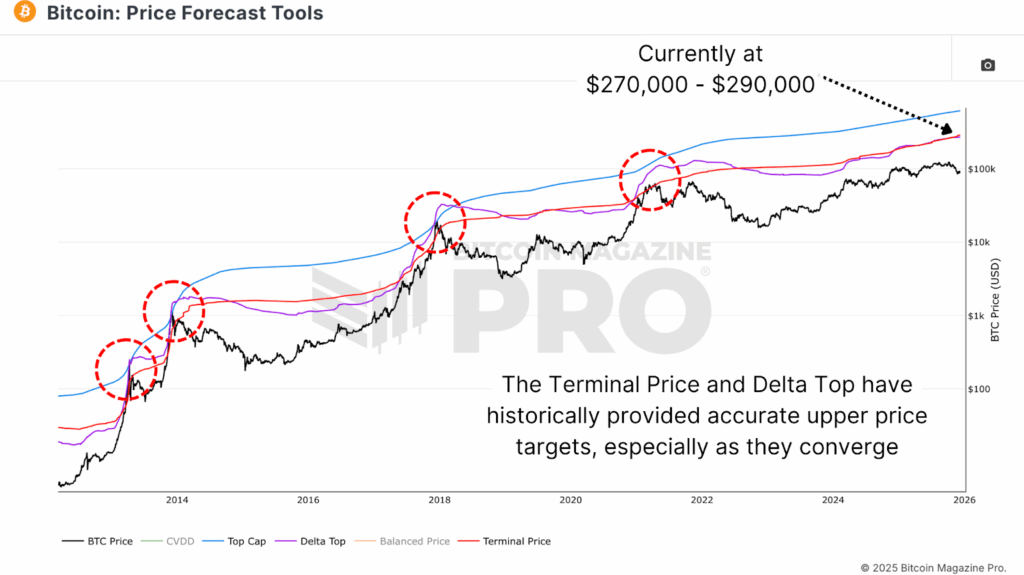
The Top Cap metric begins with the all-time average cap, the cumulative sum of Bitcoin’s market capitalisation divided by the number of days Bitcoin has existed. This all-time weighted moving average is then multiplied by 35 to produce the Top Cap. Historically, this metric has been remarkably accurate for calling bull market peaks, though in recent cycles it has exceeded actual price action, currently projecting to a seemingly unattainable ~$620,000.

The Delta Top refines this approach by using the realized cap. The realized cap currently stands at approximately $1.1 trillion. Delta Top is calculated by subtracting the average cap from the realized cap and multiplying by 7. This metric has been accurate historically, though it was slightly off during the 2021 cycle, and it is looking more likely that it will not be reached in the current cycle, currently sitting at approximately $270,000.

Figure 2: Delta Top and Terminal Price metrics have frequently aligned with market tops. View Live Chart

The Terminal Price metric provides another layer of sophistication. It calculates the Transferred Price, the sum of Coin Days Destroyed divided by the Circulating Bitcoin Supply, and multiplies this by 21 (the maximum Bitcoin supply). This produces a price level based on the fundamental assumption of total network value distributed across all 21 million Bitcoins. Historically, the Terminal Price has been one of the most accurate top-calling tools, marking previous cycle peaks nearly to perfection. This metric currently sits at approximately $290,000, not too far above Delta Top’s current value.

Bitcoin Cycle Master: Aggregated Bitcoin Price Fair Value Framework

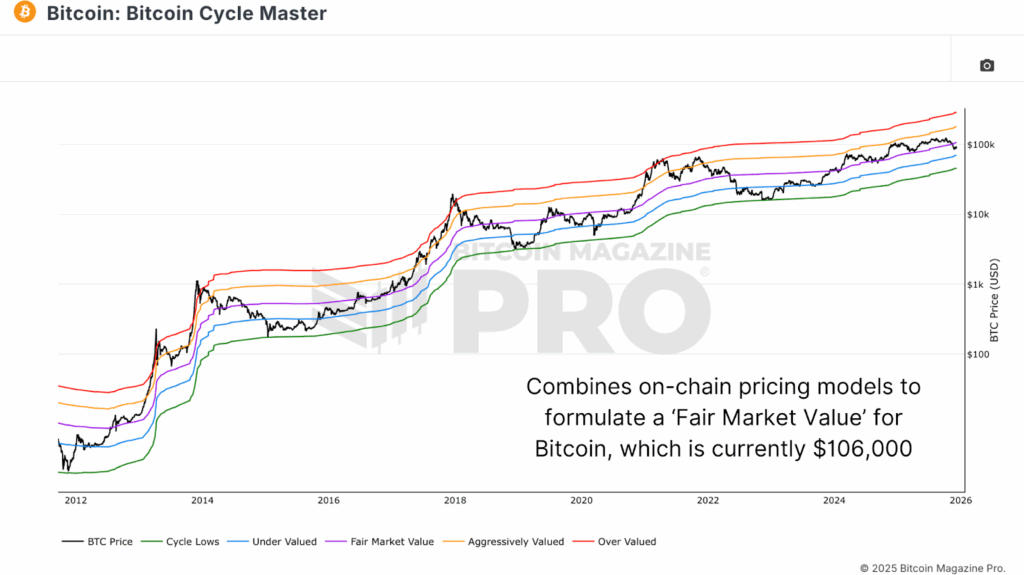
Integrating all these individual metrics into a unified framework produces the Bitcoin Cycle Master chart, which combines these on-chain forecast tools for confluence. This has helped to identify where Bitcoin may be in a cycle, either close to bull or bear market highs, or oscillating around its ‘Fair Market Value’.

Figure 3: The Bitcoin Cycle Master currently indicates a Fair Market Value of approximately $106,000. View Live Chart

Examining the past two cycles demonstrates the utility of this framework. When Bitcoin trades above the Fair Market Value band, bull markets have historically entered exponential growth phases. When beneath this band, Bitcoin typically signals bear market conditions where defensive positioning and aggressive accumulation become appropriate strategies. 

Projecting Bitcoin Price Forward: 2026 Cycle Scenarios

By extracting raw data from the price forecast tools and projecting the slope of both the CVDD and Terminal Price forward to the end of 2026, two scenarios emerge. The CVDD, which has moved at a predictable rate of change over the past 90 days, projects to approximately $80,000 by December 31, 2026. This level could represent a potential bear cycle floor, though Bitcoin has already traded beneath this level during recent downward moves, suggesting current prices may already offer compelling value.

Figure 4: Extrapolating the CVDD and Terminal Price metrics across 2026 provides a considerable range for potential BTC price action.

The Terminal Price, extrapolating its current upward trend, could reach over $500,000 by the end of 2026, though this projection could only be a realistic outcome with a bullish macro environment with significant liquidity injections and broad realization of Bitcoin’s fundamental value proposition. 

Conclusion: What Bitcoin Price Forecast Tools Are Signaling for 2025–2026

These Bitcoin price forecast tools, formulated using on-chain fundamental and network-derived data points rather than psychological levels or traditional technical analysis applicable to equities and commodities, have historically provided exceptional accuracy in calling market cycle peaks and bottoms. Forecasting based on their current values suggests a potential bear cycle floor in the $80,000 range by the end of 2026, with upside targets potentially reaching over $500,000, depending on macro conditions and capital flows. 

While these projections represent extrapolations of current trends rather than certainties, the historical accuracy and on-chain foundation of these metrics warrant serious consideration. Investors and traders should continue monitoring both the raw price forecast tools and the aggregated Bitcoin Cycle Master framework to identify fair valuation levels, extreme overvaluation warnings, and attractive accumulation zones within the current cycle. However, all projections change daily as new data emerges, making reactive analysis superior to long-term prediction.

For a more in-depth look into this topic, watch our most recent YouTube video here: Bitcoin: Using On-Chain Data To Value & Predict The Price


For deeper data, charts, and professional insights into bitcoin price trends, visit BitcoinMagazinePro.com. Subscribe to Bitcoin Magazine Pro on YouTube for more expert market insights and analysis!


Bitcoin Magazine Pro

Disclaimer: This article is for informational purposes only and should not be considered financial advice. Always do your own research before making any investment decisions.

This post Bitcoin Price Forecast Tools and Cycle Valuation Metrics first appeared on Bitcoin Magazine and is written by Matt Crosby.
Is Bitcoin Miner Capitulation A Golden Opportunity?

Bitcoin Magazine

Is Bitcoin Miner Capitulation A Golden Opportunity?

Bitcoin miner hash rate has experienced a significant decline since mid-October, falling sharply despite years of near-uninterrupted growth. This pullback reflects genuine bitcoin miner capitulation driven by deteriorating profitability in the face of Bitcoin’s recent price weakness. However, could this bitcoin miner shift actually provide a golden opportunity?

Bitcoin Miner Profitability

The Bitcoin network’s total computational hash rate has entered a notable downtrend since October 18th, reversing what has otherwise been a consistent multi-year climb. The hash ribbons indicator, which compares the 30-day moving average of hash rate against the 60-day moving average, has turned red, indicating miner capitulation. When the longer-term moving average crosses above the shorter-term one, it signals that miners are withdrawing computational power from the network, typically because profit margins have become too thin to justify continued operations at previous levels.

The Puell Multiple, which measures daily USD earnings for miners relative to their 365 day moving average, recently collapsed to approximately 0.67. This means miners are earning only two-thirds of their yearly average revenue. The metric reveals a concerning trend, as Bitcoin has matured and the network has grown, mining economics have become increasingly compressed.

Bitcoin Miner Revenue Under Pressure

A deeper issue lies in the composition of miner revenue. Bitcoin miners derive income from two sources: block subsidies and transaction fees. The current block subsidy stands at 3.125 BTC per block, representing the lion’s share of miner revenue. However, transaction fees, which could theoretically offset declining subsidies over time, have entered a long-term downtrend throughout this cycle. When measured in USD terms, miner fee revenue is now practically negligible compared to the block subsidy.

This creates an uncomfortable math problem. The block subsidy decreases by 50% every four years at the halving. For miner revenue to remain constant, Bitcoin’s price must reliably double every four years. This requirement becomes increasingly unrealistic as Bitcoin matures and approaches tens or hundreds of trillions in market capitalization. Within 20-30 years, the halvings would require Bitcoin prices of tens of millions of dollars per unit merely to maintain current revenue levels for miners.

Structural Hurdles for Bitcoin Miners

When block subsidies eventually decline toward zero over the coming decades, transaction fees must theoretically fill that gap. Yet the current cycle demonstrates that fee revenue is moving in the opposite direction and declining as users migrate to more efficient layer-two solutions like the Lightning Network and as on-chain transaction volume stagnates.

Layer-two scaling solutions are good for Bitcoin’s utility and lower users’ costs. Similarly, fewer on-chain transactions reducing congestion and fees is positive for accessibility. But these developments and improvements that make Bitcoin more practical as a payments layer simultaneously reduce the revenue available to secure the base layer long-term.

Conclusion: Bitcoin Miner Capitulation as Opportunity

Bitcoin miners are undoubtedly capitulating, driven by declining price action and deteriorating profit margins. For tactical traders and accumulation-minded investors, this represents a favorable window to scale into positions, particularly once the hash ribbons reversal signal emerges. History suggests such periods rarely persist without eventually producing sharp Bitcoin rallies.


For deeper data, charts, and professional insights into bitcoin price trends, visit BitcoinMagazinePro.com. Subscribe to Bitcoin Magazine Pro on YouTube for more expert market insights and analysis!


Bitcoin Magazine Pro

Disclaimer: This article is for informational purposes only and should not be considered financial advice. Always do your own research before making any investment decisions.

This post Is Bitcoin Miner Capitulation A Golden Opportunity? first appeared on Bitcoin Magazine and is written by Matt Crosby.
Why The Bitcoin Bear Market Is Almost Finished

Bitcoin Magazine

Why The Bitcoin Bear Market Is Almost Finished

Bitcoin has struggled to maintain a sustained correlation with Gold, recently only moving in unison during market downturns. However, examining Bitcoin’s price action through the lens of Gold rather than USD reveals a more complete picture of the current market cycle. By measuring Bitcoin’s true purchasing power against comparable assets, we can identify potential support levels and gauge where the bear market cycle may be approaching its conclusion.

Bitcoin Bear Market Officially Begins Below Key Support

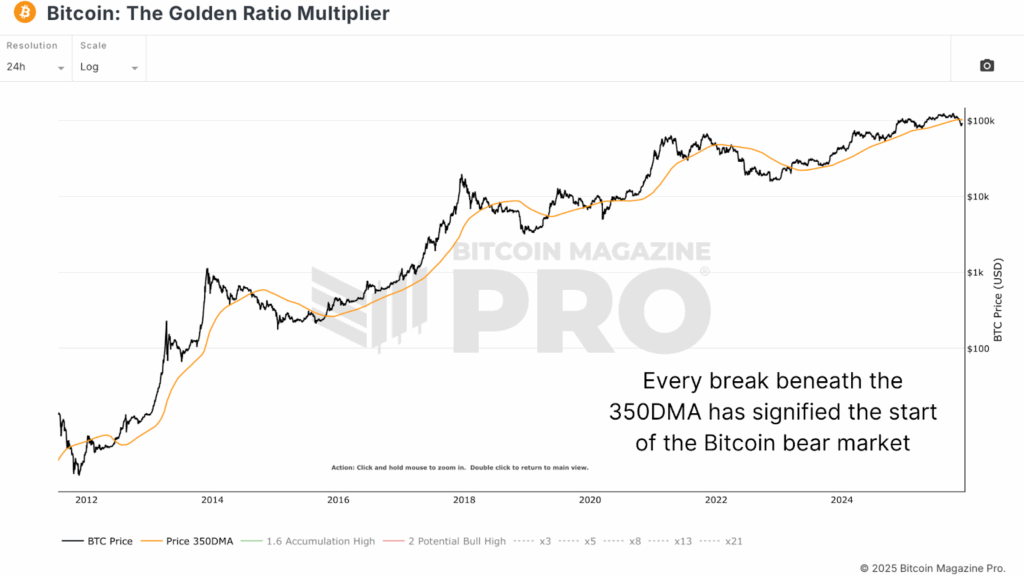
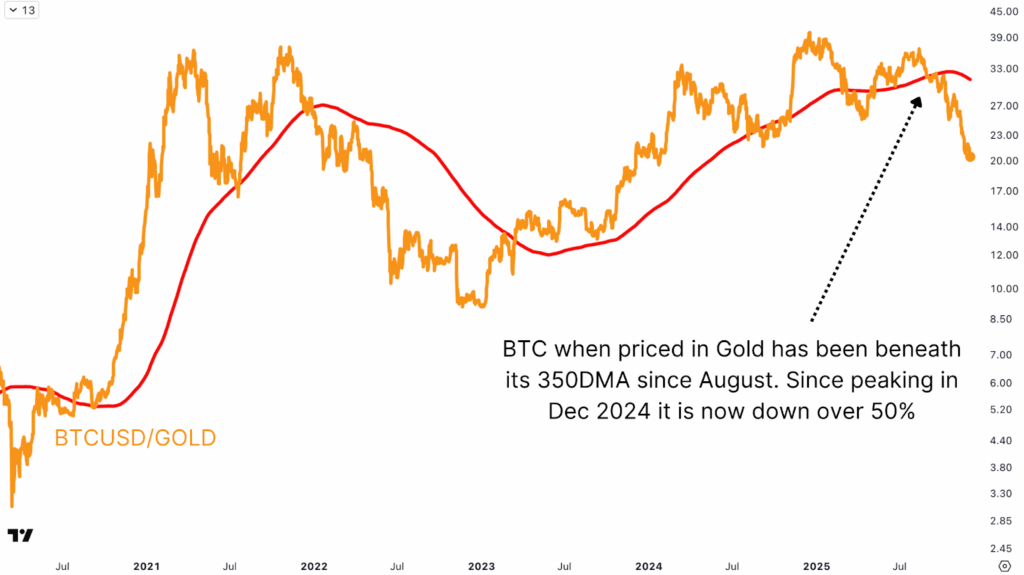
Breaking beneath the 350-day moving average at about $100,000 and the significant psychological 6-figure barrier marked the functional entry into bear market territory, with Bitcoin declining approximately 20% immediately thereafter. From a technical perspective, trading beneath The Golden Ratio Multiplier moving average has historically indicated Bitcoin entering a bear cycle, though the narrative becomes more interesting when measured against Gold rather than USD.

Figure 1: BTC breaking beneath the 350DMA has historically coincided with the start of bear markets. View Live Chart

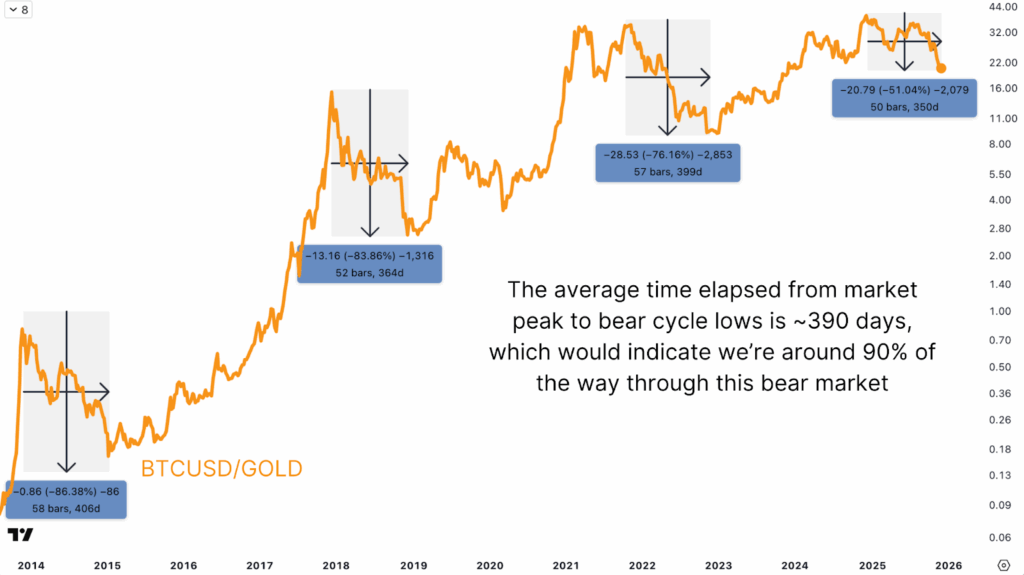
The Bitcoin versus Gold chart tells a notably different story than the USD chart. Bitcoin topped out in December 2024 and has since declined over 50% from that level, whereas the USD valuation peaked in October 2025, significantly beneath the highs set the prior year. This divergence suggests that Bitcoin may have been in a bear market for considerably longer than most observers realize. Looking at historical Bitcoin bear cycles when measured in Gold, we can see patterns that suggest the current pullback may already be approaching critical support zones.

Figure 2: When priced in Gold, BTC dropped beneath its 350DMA back in August.

The 2015 bear cycle bottomed at an 86% retracement lasting 406 days. The 2017 cycle saw 364 days and an 84% decline. The previous bear cycle produced a 76% drawdown over 399 days. Currently, at the time of this analysis, Bitcoin is down 51% in 350 days when measured against Gold. While percentage drawdowns have been diminishing as Bitcoin’s market cap grows and more capital flows into the market, this trend reflects the rising tide of institutional adoption and lost Bitcoin supply rather than a fundamental change in cycle dynamics.

Figure 3: Plotting BTC’s value in Gold reveals a cycle pattern that suggests we could already be 90% of the way through this bear market.

Multi-Cycle Confluence Signals Bitcoin Bear Market Bottom Approaching

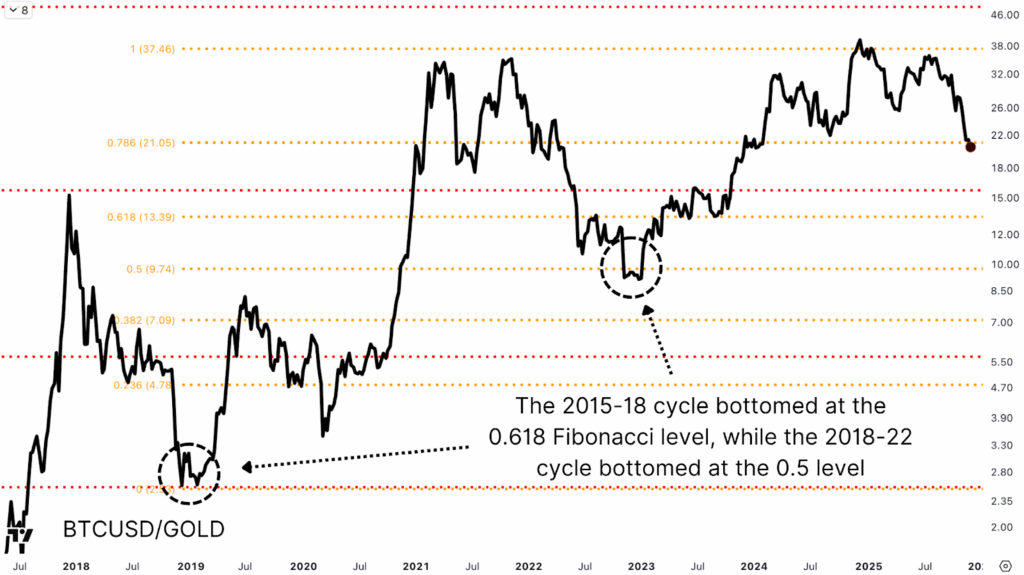
Rather than relying solely on percentage drawdowns and time elapsed, Fibonacci retracement levels mapped across multiple cycles provide greater precision. Using a Fibonacci retracement tool from bottom to top across historical cycles reveals striking levels of confluence.

Figure 4: In previous cycles, bear market bottoms have aligned with key Fibonacci retracement levels.

In the 2015-2018 cycle, the bear market bottom occurred at the 0.618 Fibonacci level, which corresponded to approximately 2.56 ounces of Gold per Bitcoin. The resulting price action marked the bottom with remarkable clarity, far cleaner than the equivalent USD chart. Moving forward to the 2018-2022 cycle, the bear market bottom aligned almost perfectly with the 0.5 level at approximately 9.74 ounces of Gold per Bitcoin. This level later acted as meaningful resistance-turned-support once Bitcoin reclaimed it during the subsequent bull market.

Translating Bitcoin Bear Market Gold Ratios Back to USD Price Targets

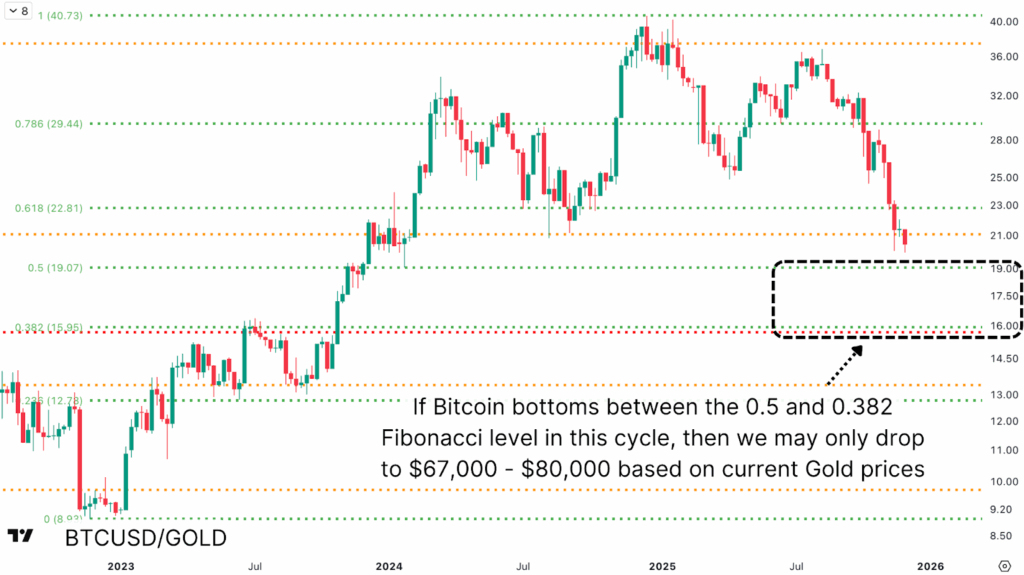
From the previous bear market low through the current bull cycle high, the 0.618 Fibonacci level sits at approximately 22.81 ounces of Gold per Bitcoin, while the 0.5 level rests at 19.07 ounces. Current price action is trading near the midpoint of these two levels, presenting what may be an attractive accumulation zone from a purchasing power perspective.

Figure 5: Applying Fibonacci levels to predict market lows for BTC versus Gold and subsequently pricing these back into USD, illustrates where Bitcoin’s price may bottom.

Multiple Fibonacci levels from different cycles create additional confluence. The 0.786 level from the current cycle translates to approximately 21.05 ounces of Gold, corresponding to a Bitcoin price around $89,160. The 0.618 level from the previous cycle aligns near $80,000 again. These convergence zones suggest that if Bitcoin were to decline further, the next meaningful technical target would be around $67,000, derived from the 0.382 Fibonacci retracement level at approximately 15.95 ounces of Gold per Bitcoin.

Conclusion: The Bitcoin Bear Market May Be 90% Complete Already

Bitcoin has likely been in a bear market for substantially longer than USD-only analysis suggests, with purchasing power already declining significantly since December 2024, when measured against Gold and other comparable assets. Historical Fibonacci retracement levels, when properly calibrated across multiple cycles and converted back into USD terms, point toward potential support confluence in the $67,000 to $80,000 range. While this analysis is inherently theoretical and unlikely to play out with perfect precision, the convergence of multiple data points across time horizons and valuation frameworks suggests the bear market may be approaching its conclusion sooner than many anticipate.

For a more in-depth look into this topic, watch our most recent YouTube video here: Proof This Bitcoin Bear Market May Be OVER Already


For deeper data, charts, and professional insights into bitcoin price trends, visit BitcoinMagazinePro.com. Subscribe to Bitcoin Magazine Pro on YouTube for more expert market insights and analysis!


Bitcoin Magazine Pro

Disclaimer: This article is for informational purposes only and should not be considered financial advice. Always do your own research before making any investment decisions.

This post Why The Bitcoin Bear Market Is Almost Finished first appeared on Bitcoin Magazine and is written by Matt Crosby.

A Pivotal Moment for Bitcoin Price

Bitcoin Magazine

A Pivotal Moment for Bitcoin Price

As the Federal Reserve prepares to end Quantitative Tightening (QT), the bitcoin price stands at a critical macroeconomic inflection point. With odds for a December rate cut now pricing it in as almost a certainty, the stage is set for a potential shift in monetary policy that could fundamentally alter the trajectory of Bitcoin and broader risk assets. History suggests that when the Fed’s balance sheet stops contracting, Bitcoin typically experiences significant bullish catalysts.

Balance Sheet Reversals and the Bitcoin Price

The Fed balance sheet versus Bitcoin chart reveals a compelling pattern. Over Bitcoin’s history, there have been only three previous instances where QT ended and the federal balance sheet began flatlining or expanding. The first occurred on October 27, 2010, followed almost immediately by a massive Bitcoin bull rally. The second instance on September 26, 2012, again resulted in an explosive rally into the 2013 double-peak cycle. The third signal came in 2019, though this one was complicated by the COVID-19 pandemic and initial market crash—yet it eventually drove Bitcoin from around $3,000 to over $67,000.

Business Cycle Impact on Bitcoin Price

Bitcoin’s recent stagnation despite rising Global M2 suggests that monetary liquidity alone isn’t driving prices. Instead, the asset appears increasingly correlated with traditional business cycle indicators, particularly the U.S. Purchasing Managers Index (PMI). This metric measures manufacturing confidence and economic activity, and its correlation with S&P 500 yearly returns is striking: when PMI rises, equities typically deliver outsized returns; when PMI falls, markets enter periods of underperformance or recession.

A leading indicator for PMI trends is the copper-to-gold ratio. This relationship is nearly perfectly correlated, but copper often leads, bottoming ahead of PMI rallies and topping before PMI declines. Currently, the Copper/Gold ratio appears to be bottoming out, aligning with the historical timeline of Fed balance sheet reversals. This suggests the traditional business cycle may be about to turn favorable again after a period of economic softening.

Conclusion: Next Move for Bitcoin Price

The end of QT, combined with a resurgent Copper/Gold ratio and historical precedent spanning Bitcoin’s entire existence, suggests that monetary conditions are about to become materially more favorable. While Bitcoin has recently lagged traditional assets, this underperformance appears tied to deteriorating economic confidence rather than fundamental weakness in Bitcoin itself. As both monetary policy and business cycle indicators potentially turn positive, the confluence of these forces could mark the beginning of a significant trend reversal. Bitcoin stands positioned to benefit from this dual tailwind, making the coming weeks and months critical for monitoring whether these historical signals finally translate into sustained price appreciation.


For deeper data, charts, and professional insights into bitcoin price trends, visit BitcoinMagazinePro.com. Subscribe to Bitcoin Magazine Pro on YouTube for more expert market insights and analysis!


Bitcoin Magazine Pro

Disclaimer: This article is for informational purposes only and should not be considered financial advice. Always do your own research before making any investment decisions.

This post A Pivotal Moment for Bitcoin Price first appeared on Bitcoin Magazine and is written by Matt Crosby.

Why Bitcoin Price Top Indicators Failed This Cycle

Bitcoin Magazine

Why Bitcoin Price Top Indicators Failed This Cycle

Bitcoin price’s most popular top-calling indicators failed to trigger during the latest bull market, leaving observers questioning whether the underlying data is now broken. This analysis examines several widely used tools, explores why they underperformed this cycle, and outlines how they can be adapted to Bitcoin’s evolving market structure.

Bitcoin Price Forecast Tools

On the Bitcoin Magazine Pro Price Forecast Tools indicator, the latest bull market never reached several historically reliable top models such as Delta Top, Terminal Price, and Top Cap, with the latter not even touched in the prior cycle. The Bitcoin Investor Tool, which uses a 2-year moving average multiplied by 5, also remained untested, and the Pi Cycle Top Indicator failed to provide precise timing or price signals despite being closely watched by many traders. This has led to understandable questions around whether these models have stopped working or whether Bitcoin’s behavior has outgrown them.

Figure 1: Historically reliable top models, such as Top Cap, Delta Top, and Terminal Price, were not attained in the bull cycle. View Live Chart

Bitcoin is an evolving asset with a changing market structure, liquidity, and participant mix. Rather than assuming the data is broken, it may be more appropriate to adapt the metrics to a different lens and time horizon. The goal is not to abandon these tools, but to make them more robust and responsive to a market that no longer delivers the same exponential upside and violent cycle tops as earlier years.

Bitcoin Price: From Fixed Thresholds to Dynamic Signals

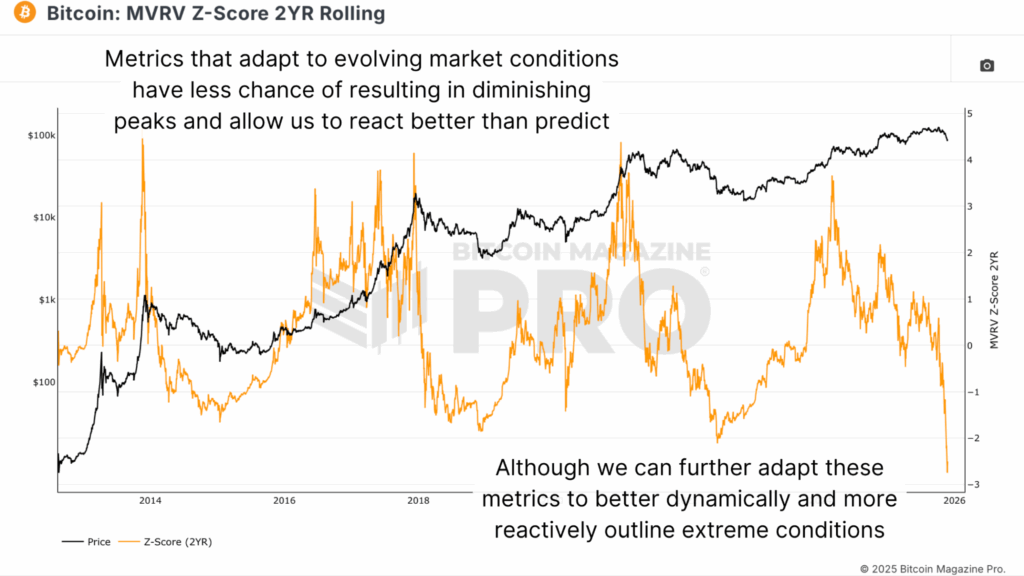
The MVRV Z-Score 2-Year Rolling metric has been a core tool for identifying overheated conditions, but in this cycle, it did not call the bull market peak particularly well. It registered a major spike as Bitcoin first pushed through the $73,000–$74,000 zone, yet failed to give a clean exit signal for the later stages of the advance. Currently, the metric is printing the most oversold readings on record.

Figure 2: The usually reliable MVRV Z-Score 2YR Rolling metric failed to trigger exit signals in the latter stages of the cycle.
View Live Chart

To address this shortcoming, the MVRV Z-Score can be recalibrated on a 6-month rolling basis rather than two years, making it more sensitive to recent conditions while still anchored in realized value dynamics. Alongside the shorter lookback, it is helpful to move away from fixed thresholds and instead use dynamic distribution-based bands. By mapping the percentage of days spent above or below different Z-Score levels, it becomes possible to mark zones such as the top 5%, as well as the bottom 5% on the downside. During this cycle, Bitcoin did register signals in the upper bands as it first broke above $100,000, and historically, moves into the top 5% region have coincided reasonably well with cycle peaks, even if they did not capture the exact tick high.

Figure 3: A recalibrated 6-month MVRV Z-Score with targeted upper and lower percentiles delivers more timely buy/sell signals.

Cyber Monday Sale: 40% Off Annual Plans!

The BEST saving of the year is here. Get 40% off all our annual plans.

  • Unlock +150 Bitcoin charts.
  • Access Indicator alerts – so you never miss a thing.
  • Private TradingView indicators of your favorite Bitcoin charts.
  • Members-only Reports and Insights.
  • API access & more all for a FRACTION of standard industry prices.

All for just $17/month with the Black Friday deal. This is our biggest sale all year!


Bitcoin Price: Faster-Reaction Metrics for Today’s Cycle

Beyond valuation tools, activity-based indicators like Coin Days Destroyed can be made more useful by shortening their lookback periods. A 90-day moving average of Coin Days Destroyed has historically tracked large waves of long-term holder distribution, but the more muted and choppy nature of the current cycle means that a 30-day moving average is often more informative. With Bitcoin no longer delivering the same parabolic moves, metrics need to react faster to reflect today’s shallower yet still important waves of profit-taking and investor rotation.

Figure 4: The 30DMA Coins Days Destroyed has proven to react faster to on-chain dynamics. View Live Chart

Excluding the latest readings and focusing on the advance up to the all-time high of this cycle, the 30-day Coin Days Destroyed metric flashed almost exactly at the cycle peak. It also triggered earlier as Bitcoin first crossed roughly $73,000–$74,000, and again when price moved through $100,000, effectively flagging all key distribution waves. While this is easy to observe in hindsight, it reinforces that on-chain supply and demand signals remain relevant; the task is to calibrate them to current volatility regimes and market depth.

Bitcoin Price Spent Output Profit Ratio (SOPR)

The Spent Output Profit Ratio (SOPR) provides another lens on realised profit-taking, but the raw series can be noisy, with sharp spikes, frequent mean reversion, and large moves both during rallies and during intra-bull capitulations. To extract more actionable information, a 28-day (monthly) change in SOPR can be used instead. This smoothed alternative highlights when the pace of profit realisation is accelerating to extreme levels over a short window, cutting through the noise of intra-cycle volatility.

Figure 5: Applying a 28DMA to the SOPR metric smooths the data, reduces unnecessary ‘noise’, and accurately identifies local tops.

Applied to the latest cycle, the monthly SOPR change produced distinct peaks as Bitcoin first moved through the $73,000–$74,000 zone, again above $100,000, and once more around the $120,000 region. While none of these perfectly captured the final wick high, they each marked phases of intense profit-taking pressure consistent with cycle exhaustion. Using monthly changes rather than the raw metric makes the signal clearer, especially when combined with cross-asset views of Bitcoin’s purchasing power versus equities and Gold.

Bitcoin Price Cycle Conclusion: Adapt or Fall Behind

In hindsight, many popular top-calling indicators did work throughout this bull market when measured through the right lens and on appropriate timeframes. The key principle remains: react to the data, do not attempt to predict. Rather than waiting for any single metric to perfectly call the top, a basket of adapted indicators, interpreted through the lens of purchasing power and changing market dynamics, can increase the probability of identifying when Bitcoin is overheating and when it is transitioning into a more favorable accumulation phase. The coming months will focus on refining these models to ensure they remain viable not just historically, but robustly accurate going forward.

For a more in-depth look into this topic, watch our most recent YouTube video here: Why Didn’t The Bitcoin Top Calling Metrics Work?


For deeper data, charts, and professional insights into bitcoin price trends, visit BitcoinMagazinePro.com. Subscribe to Bitcoin Magazine Pro on YouTube for more expert market insights and analysis!


Bitcoin Magazine Pro

Disclaimer: This article is for informational purposes only and should not be considered financial advice. Always do your own research before making any investment decisions.

This post Why Bitcoin Price Top Indicators Failed This Cycle first appeared on Bitcoin Magazine and is written by Matt Crosby.

Bitcoin Price Dip Or New Bear Market?

Bitcoin Magazine

Bitcoin Price Dip Or New Bear Market?

Bitcoin price has started to show clear signs of weakness, and the recent move back below six figures has forced a reassessment of the near-term outlook. With several important technical and on-chain levels now lost, I have recalibrated my base case so that the probability of retesting new all-time highs in the coming weeks has fallen below 50%. That can change quickly if major levels are reclaimed, but until then, the conditions resemble a market shifting away from trending strength and toward a deeper corrective phase.

Bitcoin Price: Is “Buying The Dip” Still the Right Move?

Bitcoin is already in a sizeable pullback, but buying every decline isn’t always the optimal approach outside of a confirmed bull trend. In a bear-market environment, what appear to be attractive dips can still lead to significantly lower prices. Short-term rallies and sharp retracements are typical in downtrending markets, so reacting to data rather than pre-emptively predicting a bottom becomes far more important.

This pattern of multiple dips is evident when we analyze the Short-Term Holder Realized Price chart during the last cycle. It is also clear to see how this metric acted as a key resistance throughout this phase, with sustained recovery only experienced once BTC reclaimed STH Realized Price levels.  

Figure 1: As observed in the last cycle, there were multiple dips before we reached the market bottom. View Live Chart

There is one caveat: if price meaningfully reclaims key levels, the entire picture shifts. That’s why a small allocation on this dip can make sense, while holding off on further buying until we see deeper macro confluence is a more defensive approach.


Black Friday Sale: 40% Off Annual Plans!

The BEST saving of the year is here. Get 40% off all our annual plans.

Unlock +100 Bitcoin charts.

  • Access Indicator alerts – so you never miss a thing.
  • Private TradingView indicators of your favorite Bitcoin charts.
  • Members-only Reports and Insights.
  • Many new charts and features coming soon.

All for just $17/month with the Black Friday deal. This is our biggest sale all year!


Bitcoin Price: Key Levels You Must Watch Right Now

The MVRV Z-Score and the Bitcoin Realized Price give a clearer sense of where the broader market’s cost basis sits. The realized cost basis of the network currently clusters around the mid-$50,000s, but this figure continues rising on a daily basis.

Figure 2: Historically, bear market bottoms occur when BTC’s price sits below the Realized Price. View Live Chart

A similar narrative emerges from the 200-Week Moving Average, as this also currently sits in the mid-$50,000. Historically, points where this metric meets price have presented strong long-term accumulation opportunities.

Figure 3: The 200WMA also suggests an accumulation point of $55k, albeit rising daily. View Live Chart

Those levels rise slowly each day, meaning a potential bottom could form at $60,000, $65,000, or higher, depending on how long Bitcoin spends trending downward. The important point is that value tends to emerge when spot price trades close to the average historical cost of the network, and confluence is provided from key levels of buy support.

Bitcoin Price: What Supply & Demand Signals Are Really Saying

Value Days Destroyed (VDD) Multiple remains an important metric in identifying stress points among long-term and experienced holders. Very low readings suggest large, old coins are not moving, which has often aligned with market bottoms. A sharp spike, however, can indicate capitulation pressure, which often accompanies or precedes significant market turning points.

Figure 4: Current VDD Multiple readings illustrate that the larger and more experienced players in the market are still very active. View Live Chart

Right now, the metric continues rising as price falls, suggesting many holders are distributing into weakness. That’s not characteristic of a cycle bottom, where forced selling is usually extreme and compressed into a short window. At this stage, the market still appears to be unwinding rather than exhausting. Alongside this, Long-Term Holder Supply has been in a downtrend. Ideally, this stabilises and begins to increase again before calling any major bottom, as bottoms form when the most patient participants begin holding, not exiting.

Bitcoin Price: What Funding Rates Reveal About Capitulation (Or Lack Thereof)

Periods of peak fear tend to show up clearly through heavy short positioning, negative funding as shown in the Bitcoin Funding Rates, and large realized losses. Those conditions signal that weaker hands have capitulated, and stronger hands are absorbing that supply.

Figure 5: Typically, occasions when BTC funding rates are heavily negative have signaled major market lows followed by price rallies. View Live Chart

The market has not yet shown the signature panic selling and shorting often associated with major cyclical lows. Without stress in derivatives and without a rush of loss-taking, it is difficult to argue that the market has fully flushed out.

Bitcoin Price: The Exact Levels That Must Be Reclaimed to Kill the Bear Case

Suppose the bearish scenario is wrong, which of course would be the preferred outcome. In that case, Bitcoin needs to begin reclaiming key structural levels, including the $100,000 psychological zone, the Short-Term Holder Realized Price, and the 350-day moving average as depicted in the Golden Ratio Multiplier chart.

Figure 6: BTC must demonstrate a sustained reclamation of its 350DMA to signify a return to bullish ways. View Live Chart

Temporary wicks or single-day closes are not enough. Sustained closes above these levels, along with strength in risk assets globally, would suggest the trend is shifting. But until that happens, the data leans cautious.

Bitcoin Price Outlook: Final Thoughts on Dip vs. New Bear Market

Since breaking below several important levels, the outlook has become more defensive. There’s no structural weakness in Bitcoin’s long-term fundamentals, but the short-term market structure doesn’t resemble a healthy bull trend.

For now, the recommended strategy consists of not buying at every dip, waiting for confluence before heavy scaling in, respecting macro conditions and ratio trends, and only turning aggressive once the market proves strength. Most investors never identify the exact top or bottom; the goal is to position near areas of high probability with enough confirmation to avoid months of unnecessary drawdown.

For a more in-depth look into this topic, watch our most recent YouTube video here: My Bitcoin Strategy Going Forward


For deeper data, charts, and professional insights into bitcoin price trends, visit BitcoinMagazinePro.com. Subscribe to Bitcoin Magazine Pro on YouTube for more expert market analysis!


Bitcoin Magazine Pro

Disclaimer: This article is for informational purposes only and should not be considered financial advice. Always do your own research before making any investment decisions.

This post Bitcoin Price Dip Or New Bear Market? first appeared on Bitcoin Magazine and is written by Matt Crosby.
Bitcoin Price Outlook for Reaching $1 Million Valuation

Bitcoin Magazine

Bitcoin Price Outlook for Reaching $1 Million Valuation

Bitcoin price long-term trajectory has been extraordinary. In just over a decade, it has risen from a few hundred dollars to more than $100,000, creating one of the most dramatic wealth transfers in modern history. But the question now dominating investors’ minds is whether BTC can extend this exponential growth, potentially even to seven figures. And if so, when?

Bitcoin Price Fundamental Value

Few models have generated as much controversy as Stock-to-Flow. Once hailed as the roadmap for Bitcoin’s price, it fell out of favor after failing to predict post-halving performance in recent cycles. But while the model itself may no longer hold predictive power, its core premise, that Bitcoin’s programmed scarcity drives long-term value, remains valid.

Rather than relying on rigid mathematical projections, a more grounded approach is to look at Bitcoin’s production cost: the estimated electrical expense required to mine one BTC. Historically, this metric has acted as a structural floor beneath price. Each halving doubles that cost, tightening the available supply and setting a new base for future appreciation.

Bitcoin Price Production Cost

Based on current efficiency trends and average energy prices, the production cost is expected to rise to around $175,000 per BTC by early 2028, following the next halving. This level has aligned closely with past cycle lows, suggesting that if Bitcoin remains above its cost basis, its fair valuation could approach $200,000 by that time.

Extending this trend, the projected cost to mine one BTC could reach approximately $675,000 by 2032, assuming moderate improvements in miner efficiency and no dramatic changes in Global energy costs. Historically, Bitcoin’s price has peaked at multiples of its production cost, around 9x in 2017, 4.5x in 2021, and roughly 2.25x this cycle. If that diminishing pattern continues, even a 1.5x multiple during the 2032 cycle would place BTC at around $1 million, suggesting that the next major peak could arrive sometime in the mid-2030s.

Bitcoin Price Growth Rate

Looking at Bitcoin’s compounded annual growth rate (CAGR) since its early exchange listings shows a consistent but gradually slowing curve. When modeled as a linear regression, this trend points to a BTC price of roughly $2 million by 2035, with diminishing returns thereafter. By 2040, the model places Bitcoin somewhere between $5 million and $10 million, depending on the starting data window used.

However, these regression-based models, like the “Power Law” or logarithmic growth curves, all suffer from the same flaw: they are backward-fitted. Their accuracy only exists in hindsight, not necessarily foresight. Even small deviations in data or timeframes can shift long-term projections by years or millions of dollars, making them useful for context but unreliable for precision.

Bitcoin Price Conclusion

While models can provide rough frameworks, Bitcoin’s price ultimately depends on the balance of supply and demand. As new issuance continues to fall and adoption grows, the production cost floor and liquidity environment are likely to remain the strongest long-term anchors. Macroeconomic forces, particularly real yields, monetary expansion, and capital rotation from traditional assets, will continue to determine the pace and scale of Bitcoin’s appreciation.

If Bitcoin follows its historical rhythm, the mid-2030s could mark the era where a seven-figure price becomes reality. But as every cycle has shown, models can guide expectations, they cannot dictate them. The best strategy remains the same as always: react to the data, don’t predict it.

For a more in-depth look into this topic, watch our most recent YouTube video here: Realistically, Could This Be When Bitcoin Reaches $1 Million


For deeper data, charts, and professional insights into bitcoin price trends, visit BitcoinMagazinePro.com.

Subscribe to Bitcoin Magazine Pro on YouTube for more expert market insights and analysis!


Bitcoin Magazine Pro

Disclaimer: This article is for informational purposes only and should not be considered financial advice. Always do your own research before making any investment decisions.

This post Bitcoin Price Outlook for Reaching $1 Million Valuation first appeared on Bitcoin Magazine and is written by Matt Crosby.
Mathematically Predicting Bitcoin Price Floor

Bitcoin Magazine

Mathematically Predicting Bitcoin Price Floor

While many are still focused on how high the bitcoin price could go during this current bull market (although given current price action, maybe not!), it’s equally important to prepare for what comes next. Here we’ll look at the data and mathematics that can help us estimate where Bitcoin’s next bear market low could occur — not as a prediction, but as a framework based on prior cycles, on-chain valuation metrics, and even the fundamental valuations of BTC.

Cycle Master: Modeling Historical Bitcoin Price Bottoms

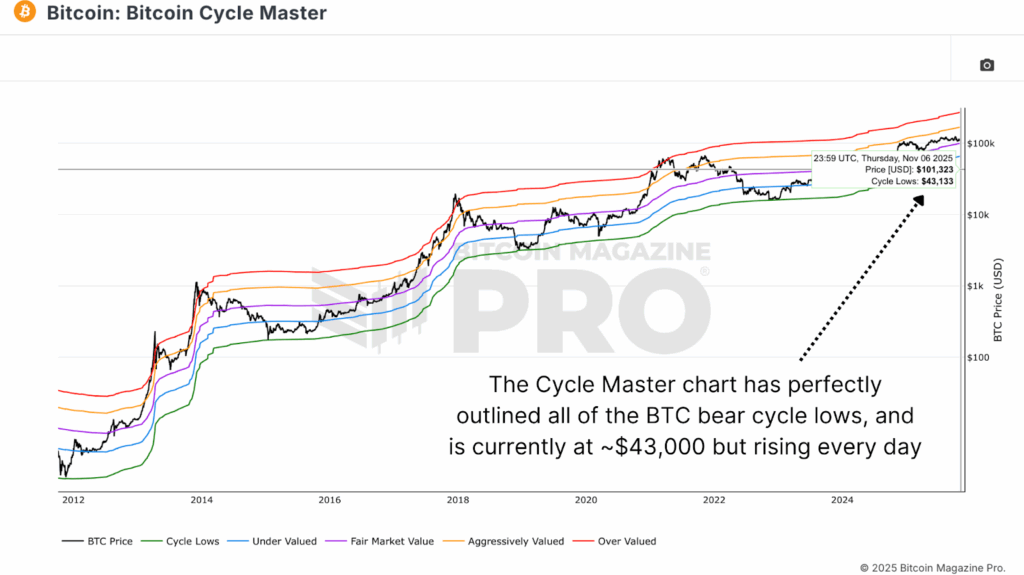
One of the most consistently accurate models for identifying Bitcoin’s cyclical bottoms is what we refer to as the Bitcoin Cycle Master chart, which collates a number of on-chain metrics to create bands around price with certain valuation levels.

Figure 1: The Cycle Lows line on the Bitcoin Cycle Master chart has accurately aligned with bear cycle lows. View Live Chart

Historically, this green “Cycle Lows” line has pinpointed Bitcoin’s macro bottoms with near perfection. From $160 in 2015 to $3,200 in 2018, and again at $15,500 in late 2022. As of today, this band sits around $43,000 and rising daily, which provides a useful baseline to estimate how far Bitcoin could decline in the next full cycle.

Diminishing Drawdowns: Why Each Bitcoin Price Bear Market Hurts Less

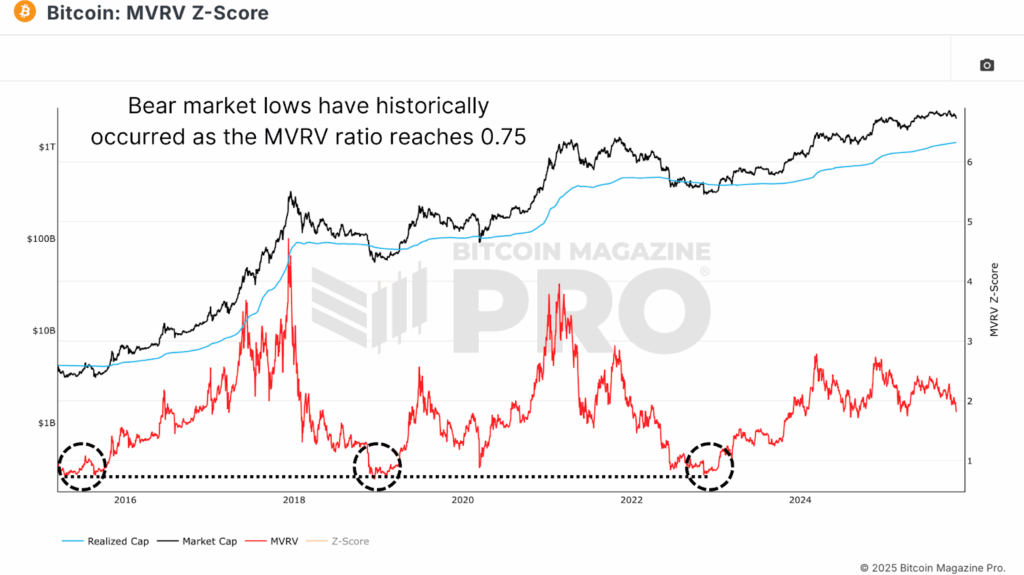
Alongside this, we can look at the raw MVRV Ratio, which measures Bitcoin’s market price versus its realized price (the average cost basis of all coins). Historically, during deep bear markets, Bitcoin tends to fall to 0.75x of its realized price, meaning the market price trades about 25% below the network’s aggregate cost basis.

Figure 2: Historically, bear market lows have occurred when the MVRV Ratio drops to 0.75. View Live Chart

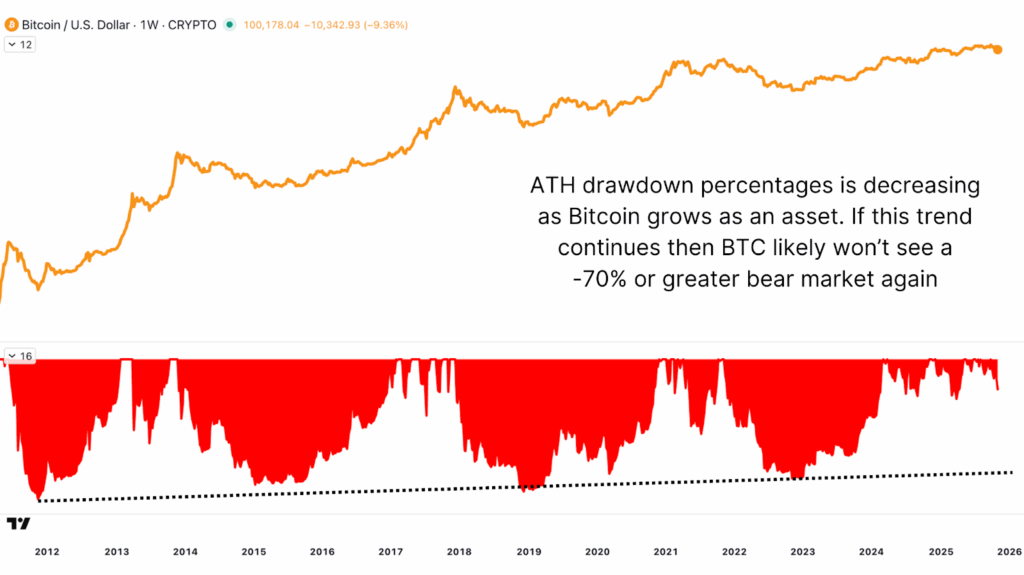
This repeatability gives us a powerful anchor for estimating potential downside when combined with the trend of diminishing drawdowns. While Bitcoin’s earliest cycles saw declines as deep as 88%, that figure has been steadily compressing, to 80% in 2018 and 75% in 2022. Projecting that same trend forward, a continuation of diminishing volatility would imply that the next bear market could bring a ~70% retracement from cycle highs.

Figure 3: The trend of diminishing bear cycle drawdowns suggests that the next retracement from the cycle high wouldn’t exceed 70%

Forecasting the Next Bitcoin Price Top and Bottom

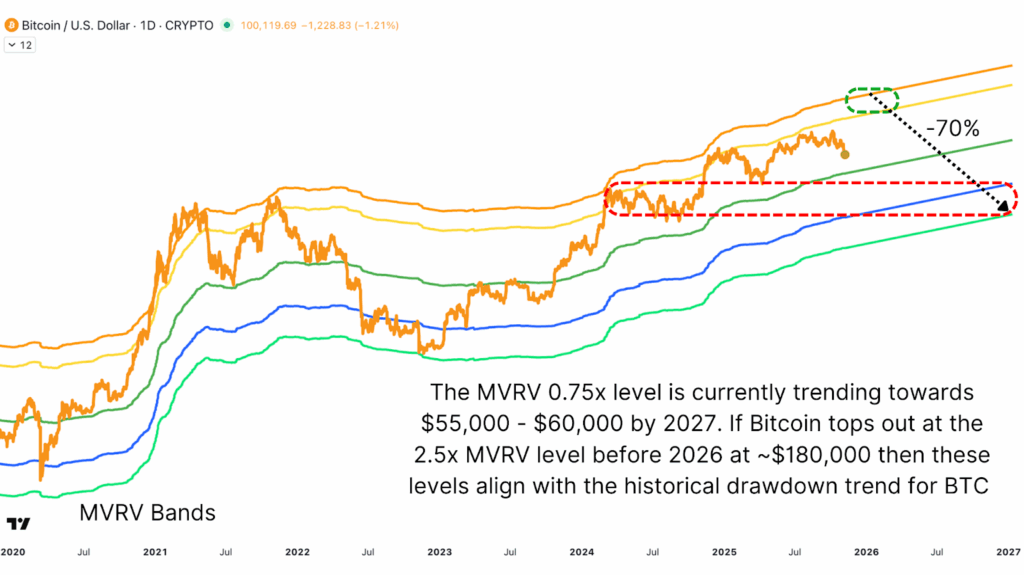
Before we estimate the next low, we need a reasonable assumption for where this bull market could peak. Based on historical MVRV multiples and slope-trended realized price growth, Bitcoin has recently tended to top at roughly 2.5x its realized price. If that relationship holds and the realized price continues trending upward, it suggests a potential top somewhere near $180,000 per BTC in late 2025.

Figure 4: Applying MVRV multiples and realized price projections, we could see a cycle top in the region of $180k, followed by bear cycle lows in the $55k-60k region in 2027.

If that’s the case, and Bitcoin were to follow its historical one-year bear market lag into 2027, a 70% retracement from that level would bring the next major cycle low to approximately $55,000–$60,000, based on the current realized price trajectory at that time. These prices also align nicely with Bitcoin’s choppy consolidation range from last year to give some technical confluence.

Bitcoin Price and the Rising Cost of Production

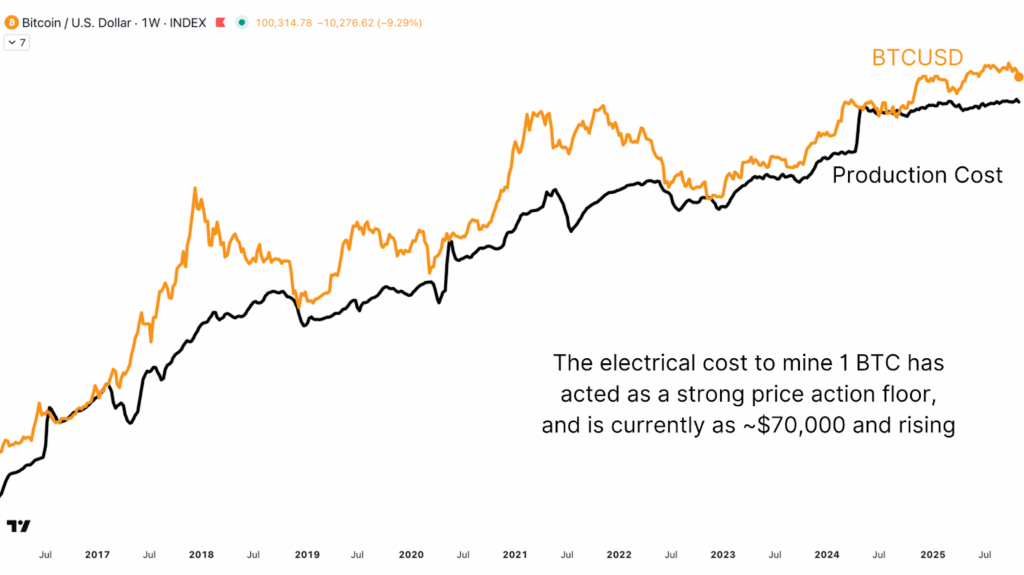
One of the most reliable long-term valuation metrics for Bitcoin is its production cost, the estimated electrical expense to mine one BTC. This metric has historically aligned closely with Bitcoin’s deepest bear market lows. After every halving, the production cost doubles, forming a rising structural floor under the price over time.

Figure 5: The estimated electrical cost to produce 1 BTC of approximately $70k acts as a strong price action floor.

When Bitcoin trades below its production cost, it signals miner stress and typically coincides with generational accumulation opportunities. As of the April 2024 halving, the new cost basis rose sharply, and each time Bitcoin has dipped near or slightly below it since, it has marked local bottoms and subsequent sharp reversals. This value currently sits at ~$70,000 but fluctuates daily.

Conclusion: The Next Bitcoin Price Cycle Will Likely Be Shallower

Every Bitcoin cycle has been accompanied by a wave of euphoria claiming, “This time is different.” But the data continues to show otherwise. While institutional adoption and broader financial integration have indeed changed Bitcoin’s structure, they haven’t erased its cyclicality.

The data suggests the next bear market will likely be shallower, reflecting a more mature and liquidity-driven environment. A retracement toward the $55,000–$70,000 zone would not signal collapse, but it would mark the continuation of Bitcoin’s historical rhythm of expansion and reset.

For a more in-depth look into this topic, watch our most recent YouTube video here: Using Math & Data To Predict The Bitcoin Bear Market Low


For deeper data, charts, and professional insights into bitcoin price trends, visit BitcoinMagazinePro.com.

Subscribe to Bitcoin Magazine Pro on YouTube for more expert market insights and analysis!


Bitcoin Magazine Pro

Disclaimer: This article is for informational purposes only and should not be considered financial advice. Always do your own research before making any investment decisions.

This post Mathematically Predicting Bitcoin Price Floor first appeared on Bitcoin Magazine and is written by Matt Crosby.
Bitcoin Price Slump Could Spark Next Bull Run

Bitcoin Magazine

Bitcoin Price Slump Could Spark Next Bull Run

Recent bitcoin price action has left many investors frustrated. Despite setting new all-time highs above $120,000 earlier this year, the bitcoin price has struggled to keep pace with equities and Gold in recent months. The S&P 500 and precious metals have surged to new records, while Bitcoin has remained range-bound, giving the impression that it’s lagging behind. But when analyzing the market through a lens of capital rotation, this period of underperformance may not last much longer.

Relative Gains in the Bitcoin Price

While Bitcoin has appeared weak in dollar terms, it remains one of the strongest performers over the past year. BTC has still outperformed both Gold’s 46% and the S&P 500, yet even with that outperformance, the structure of the market makes it feel as though Bitcoin is still under-delivering. Measuring Bitcoin against other assets like equities and Gold rather than the dollar, which is itself depreciating, gives a more accurate view of its purchasing power and real market standing.

When charted against the S&P 500, Bitcoin’s performance shows an interesting divergence. The BTC to S&P ratio reveals that while Bitcoin set new USD highs in 2024, its relative value against equities is only just above the previous cycle’s peak. In other words, Bitcoin’s additional purchasing power has barely expanded. If Bitcoin were to reclaim the previous S&P 500 ratio high of ~19.6, it would equate to a bitcoin price of roughly $135,000, given current equity levels.

Bitcoin Price vs Gold

The Bitcoin to Gold ratio tells a similar story. Despite reaching new highs in dollar terms, BTC actually remains well below its previous cycle’s all-time high when priced in Gold. A full recovery to that ratio would place the bitcoin price near $150,000, and reclaiming the brief 2024 high would push it closer to $160,000. These comparisons help explain why sentiment feels more muted despite record prices. Measured against real-world stores of value, Bitcoin’s performance still trails prior peaks.

However, an interesting dynamic has repeated across multiple cycles. Each time Gold has experienced a sharp rally, Bitcoin has followed with a major bull phase shortly after. The pattern appeared in 2012, 2016, and again in 2020 — Gold rallied first, then Bitcoin followed with exponential gains. These Gold spikes seem to mark the early stages of capital rotation, as liquidity moves from defensive safe havens into more speculative, higher-beta assets like BTC.

Capital Rotation and the Bitcoin Price

That rotation may already be underway again. Gold recently set new highs before losing momentum, while equities have begun to strengthen. Historically, when Gold begins to underperform the S&P 500 after a major rally, it has signaled the start of risk-on conditions in broader markets — the kind that favor Bitcoin.

The same capital rotation that occurs within crypto markets, from stablecoins into Bitcoin, then into large-cap and smaller speculative altcoins, may also occur in traditional markets. Liquidity often flows from fiat and bonds into Gold and then equities, before eventually into risk assets like Bitcoin as investor confidence rises.

Conclusion: The Bitcoin Price May Soon Lead Again

Bitcoin remains tightly correlated with the S&P 500, meaning sustained equity strength is one of the most reliable precursors to bitcoin price outperformance. With Gold potentially topping and equities gaining traction, the next few months could mark the beginning of a new phase of risk appetite.

While Bitcoin has felt stagnant and underwhelming in recent weeks, the broader context suggests otherwise. Capital is in motion. The same rotation that has defined every past cycle appears to be setting up once again — and the bitcoin price may soon move from laggard to leader.

For a more in-depth look into this topic, watch our most recent YouTube video here: Bitcoin Is Underperforming – But Maybe Not For Much Longer


For deeper data, charts, and professional insights into bitcoin price trends, visit BitcoinMagazinePro.com.

Subscribe to Bitcoin Magazine Pro on YouTube for more expert market insights and analysis!


Bitcoin Magazine Pro

Disclaimer: This article is for informational purposes only and should not be considered financial advice. Always do your own research before making any investment decisions.

This post Bitcoin Price Slump Could Spark Next Bull Run first appeared on Bitcoin Magazine and is written by Matt Crosby.
❌