Cardano has moved to resolve a governance bottleneck by ratifying an on-chain vote to restore its Constitutional Committee (CC) to functional capacity, a procedural step that matters because the CC is required to evaluate constitutionality and ratify many categories of governance actions, including upgrades, budgets, and parameter changes.
Intersect, which coordinates parts of Cardano’s governance process, said on X: “On the 7th day of GA… We hit the Epoch’s end. DReps at 80%. Stake pools supporting- It looks like we have a new CC. Ratified. Thank you to everyone who reviewed, voted, and wrote rationales,Santa has been notified.”
Why The Cardano Governance Was Stuck
Cardano’s governance model is tripartite: delegate representatives (DReps), stake pool operators (SPOs), and the Constitutional Committee. The CC plays a gatekeeping role: it judges whether on-chain actions are constitutional and ratifies decisions needed for the network to adapt.
That mechanism stalled after an unexpected mid-term departure left the CC below its minimum operational size. The Cardano Atlantic Council retired mid-term in epoch 597, opening a seat and reducing the committee below quorum. The consequence was that the Cardano CC could not ratify key actions, even as the chain continued to operate normally at the protocol level.
The vote asked DReps and SPOs to ratify a newly elected CC member and restore the committee to full capacity. The candidate, Cardano Curia, was selected off-chain through a DRep vote using the Ekklesia tool, with on-chain ratification required to formalize the result.
The governance materials described the restoration as bringing the CC back to seven members and activating a clarified alternate-member process to handle future vacancies with less disruption. Approval thresholds were set at 67% from DReps and 51% support from SPOs. Intersect’s update indicates those thresholds were met as the epoch ended.
Why This Was Treated As Urgent
The vote was framed as more than housekeeping because an undersized CC effectively blocks major governance flows. Without quorum: Treasury withdrawals couldn’t proceed, the Critical Integrations Budget could not pass, hard forks could not be ratified, delaying network upgrades and several categories of governance actions were blocked, leaving only a limited subset able to move forward.
There was also a timing element: delays risk actions expiring, which would force a repeat of the voting process and extend the governance backlog. With the restoration ratified, Cardano’s governance process can resume normal throughput — reopening the path for upgrades, budget approvals, and protocol changes that depend on a functioning Constitutional Committee.
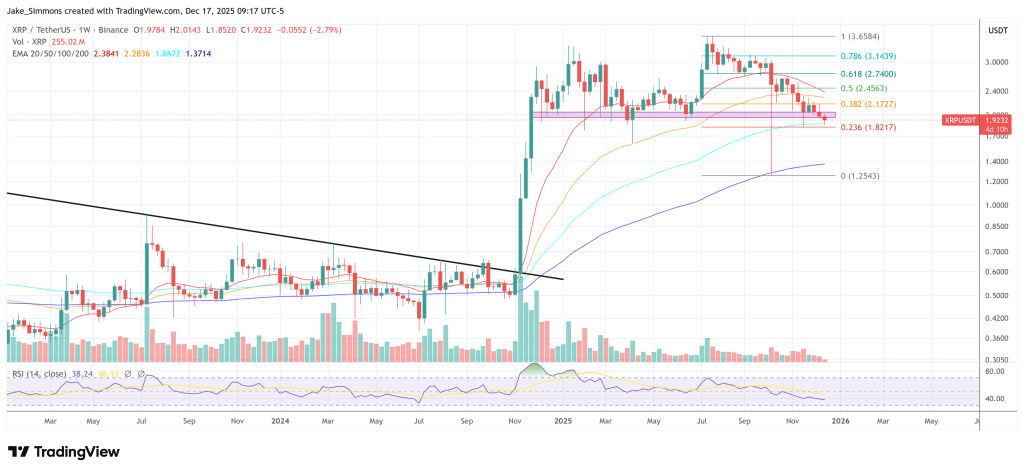
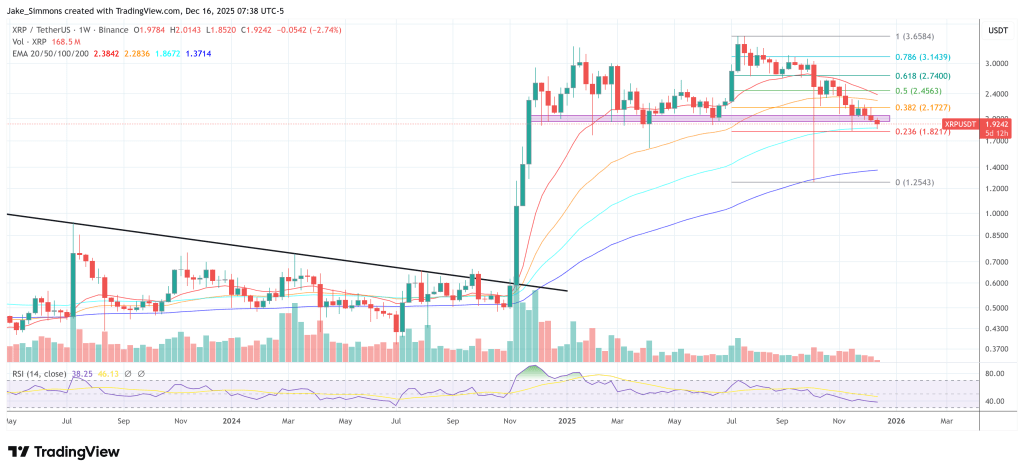
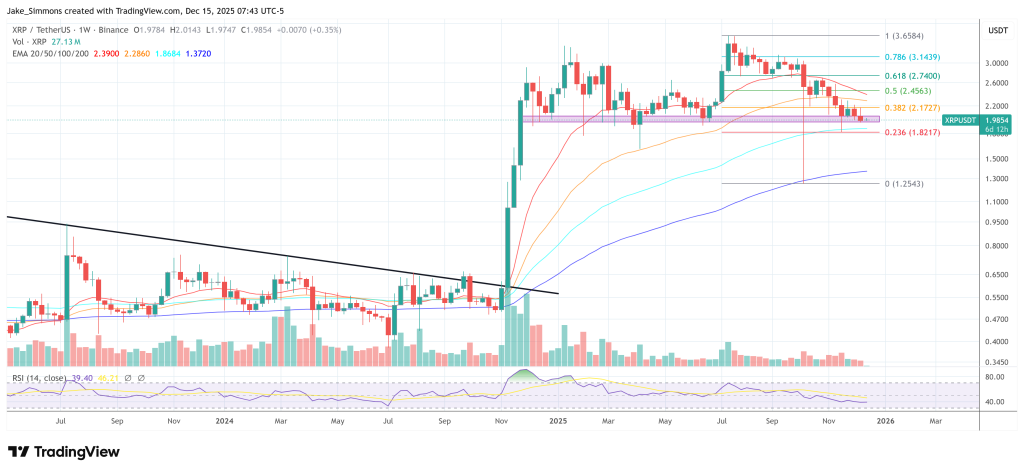
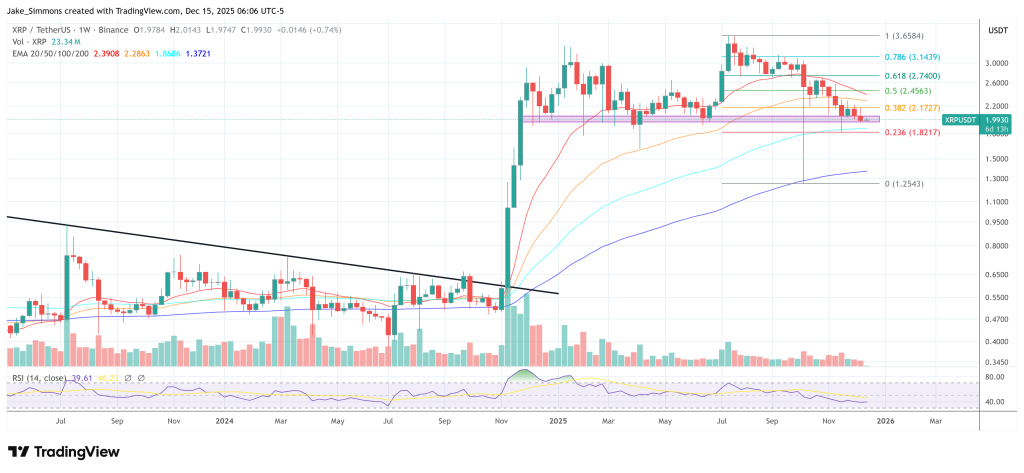
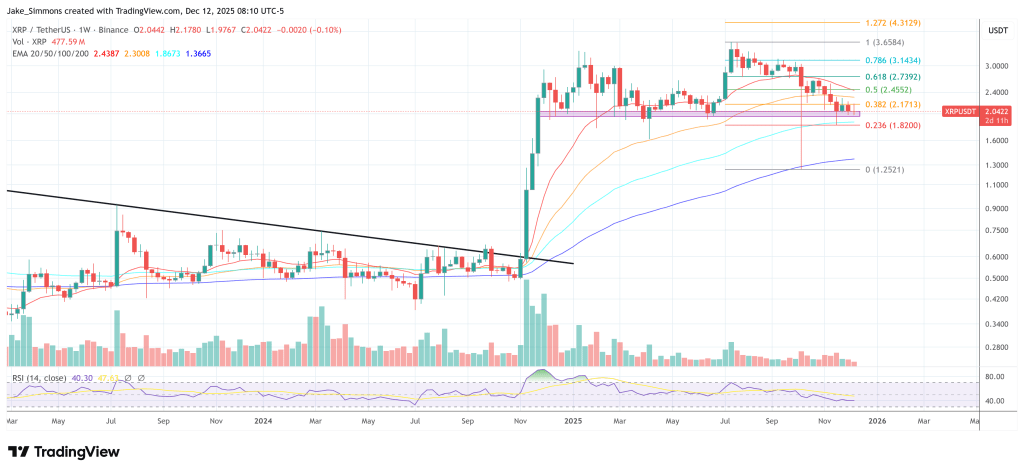
Will Taylor, founder of CryptoinsightUK, frames XRP’s “best buy area” as a risk-to-reward question, not a certainty call. In his latest YouTube video from Dec. 17, he argues that XRP is trading back in the lower portion of a well-defined range, which is typically where entries make the most sense for range traders—because invalidation levels are clearer and upside targets are structurally defined.
“We’re at the bottom of the range […] this area, the bottom of the range, and the bottom of the range has been quite wide,” Taylor said. “So, I’d say between like $2.01, then all the way down to about $1.60. This has been the best area to enter […] for the last […] basically year and a bit.”
And his emphasis is that it’s attractive because the trade is measurable, not because it’s guaranteed. “Does this mean we can’t break down further? Does this mean we can’t lose support? No, that’s not what I’m saying at all,” he added. “But what I am saying is if you use range trading, if you want to know the best areas for risk-to-reward, we’re at them now.”
On lower timeframes, Taylor said XRP has already swept much of the downside liquidity, leaving a smaller pocket below that could still get tagged. He pointed to ~$1.83 as the remaining area of interest.
“XRP has taken most of this red liquidity to the downside. There’s a small pocket of liquidity below us still at $1.83,” he said. And crucially, that level is not academic for him — it’s tied to his own stop placement and whether the market is likely to wick lower before any sustained move up.
“This is something that I’m considering […] as to whether to move my stop loss below this liquidity down at like say $1.79,” Taylor said. “My stop loss [is] $1.834 at the minute. Do I take it to say like $1.79 […] give us […] the bottom of this wick as potential support and that liquidity. That’s a potential discussion.”
The Upside Trigger For XRP
Taylor’s near-term bullish trigger is a reclaim of ~$2.07. His reasoning is positioning-driven: he thinks the market has built a meaningful amount of short exposure during the drawdown, and a move back above that level could force covering.
“When you start to get a buildup of […] lower highs like this, all it takes is a bit of momentum to break us above,” he said. “So, say for XRP, if we start to get back above $2.07, you probably should see price squeeze to $2.58-$2.60 quite quickly […] as we squeeze out all of this […] open interest that’s been adding in as price has been coming down.”
Taylor’s XRP view is nested inside a broader “crypto is mispriced” thesis. When comparing crypto’s market cap performance against a basket of traditional assets, he argues that crypto has decoupled sharply since the Oct. 10 crash, while sentiment has deteriorated.
“Crypto has like decoupled from every other asset class […] crypto is about the only asset that has decoupled this hard,” he said. “I personally believe this is a deep value zone […] we’re clearly mispriced versus other assets.”
He also repeatedly leaned on the idea that positioning is skewed: rising open interest into downside, negative premium, and funding flipping between positive and negative — conditions that can set up a squeeze if price starts reclaiming levels.
“I think a lot of the market generally is setting up for a bit of a short squeeze to the upside,” Taylor said. “And I think that people are overly negative and […] the sentiment’s overly bearish compared to where the price is.”
Dogecoin may be lining up for a deeper breakdown even if Bitcoin manages a short-term bounce, according to pseudonymous analyst VisionPulsed, who argues that a familiar 2022-style pattern is re-emerging across majors and memecoins.
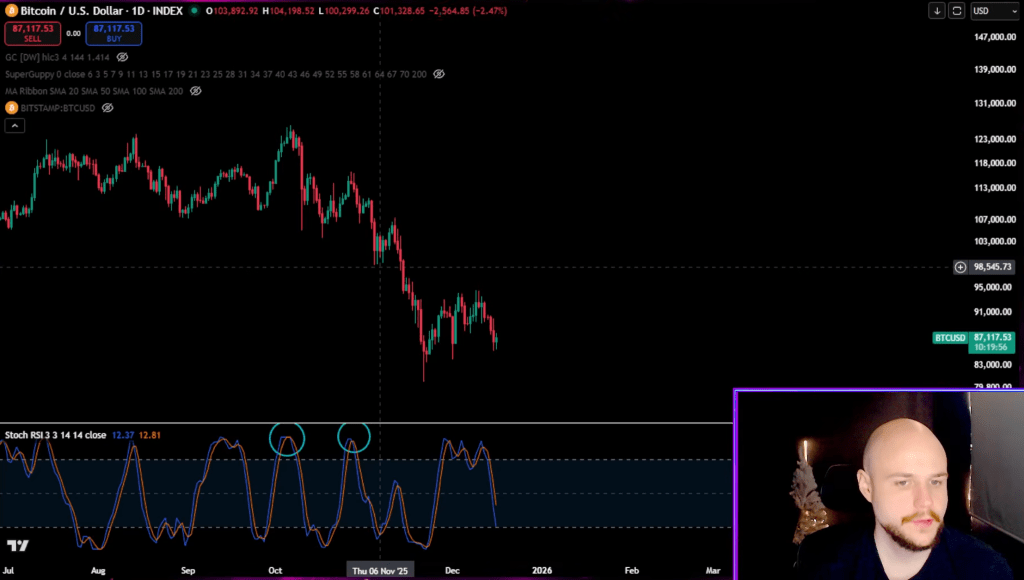
In a video published December 16, the analyst frames the near-term setup around Bitcoin’s daily stochastic RSI, which is moving from overbought back toward oversold. Over the past two months, every such reset on the daily chart has coincided with fresh lows in price. This time, he says, the structure is slightly different — and that matters for how Dogecoin trades the next leg.
Dogecoin Bull Need To Watch Bitcoin’s Stochastic Reset
On Bitcoin, VisionPulsed notes that the daily stochastic RSI is now “approaching oversold” after a stretch at elevated levels. In October, November and early December, similar full cycles from overbought to oversold on the daily timeframe were accompanied by Bitcoin making new lows.
“This is actually the first time that the stock RSI is going from overbought to oversold and we may not make a new low,” he says, emphasizing that it is still “too early” to call it. If price instead prints a higher low as the oscillator resets, he argues that would signal a short- to medium-term trend reversal rather than a macro regime change, opening the door for a relief rally.
“If we do see a higher low form on the price as the stock RSI resets, then you should get the green light for a relief rally,” he adds. If the current low breaks instead, the rally “is down to hell where you belong,” as he puts it, underscoring that the bullish case hinges on that higher-low structure holding on the daily chart.
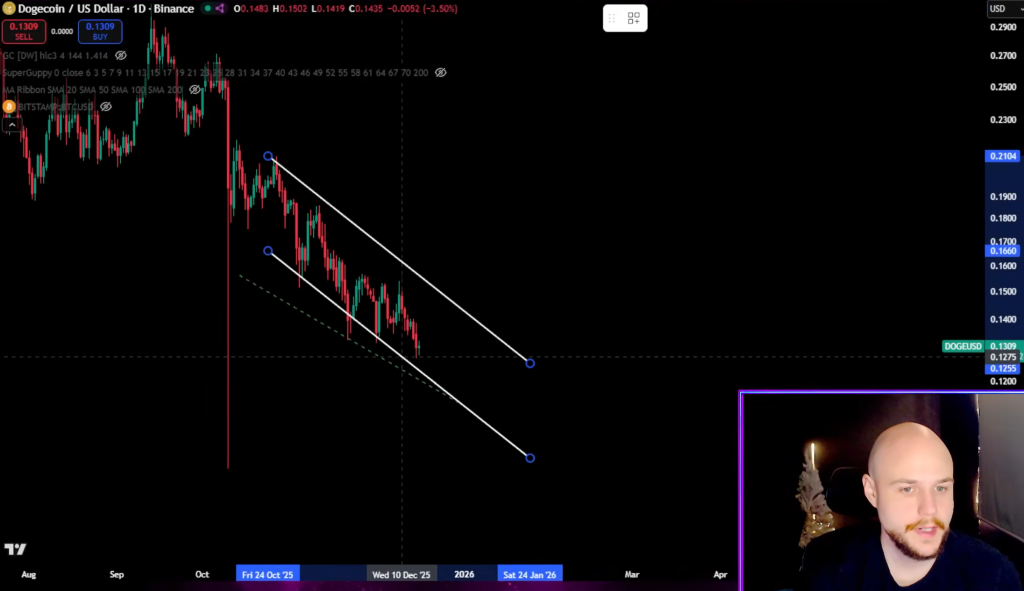
Dogecoin, in his view, is where the setup turns dangerous. While Bitcoin is attempting to carve out a higher low, Dogecoin continues to print lower lows on the same timeframe. VisionPulsed links this to a similar divergence in 2022, when Doge bled lower throughout the month while Bitcoin quietly based and formed higher lows.
“Very similar to 2022,” he says, adding that Bitcoin is, as of the recording, making “a higher low even though Dogecoin is not.” That pattern, he argues, suggests Doge could still catch a relief move if Bitcoin rallies, but from a much weaker starting point.
How Low Can DOGE Price Go?
In such a scenario, he sketches a rally “probably somewhere up here to grab the peanut,” placing that so-called “peanut zone” roughly around the $0.20 area in January. He calls that level “probably your last chance to do whatever you’re going to do” before Dogecoin, in his base case, resumes its downtrend and heads “down to feed the pig pen” — his shorthand for a deeper capitulation move to new lows in the $0.05 to $0.06 area.
The base case for Dogecoin is a deeper retracement. He says. “We’re coming down to feed the little piggies. Oink oink.” Until Doge breaks its current downtrend, he sees “no reason to assume it’s bullish.”
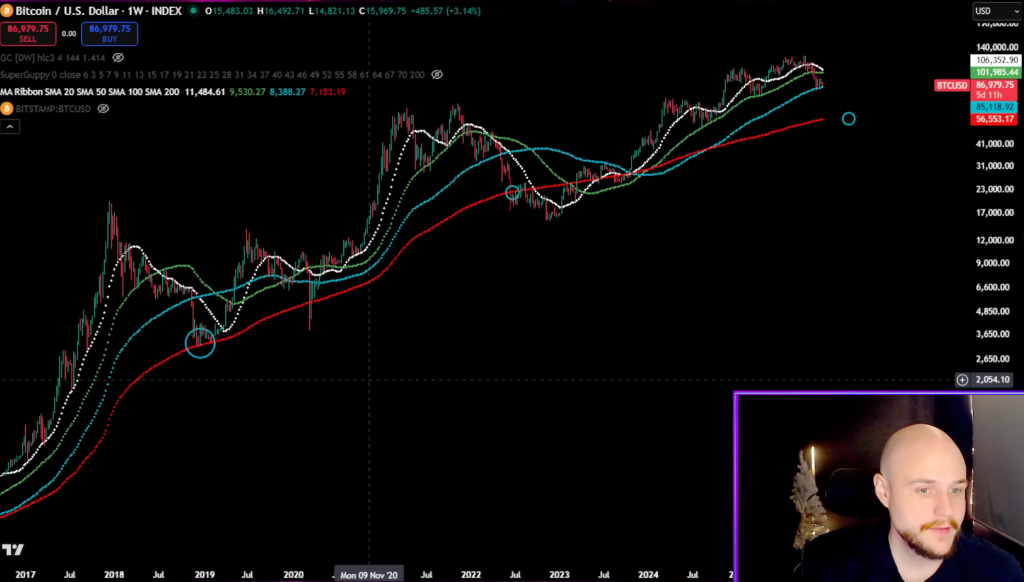
The timing, in his framework, is anchored on Bitcoin’s position inside the lower band of a 7–8 day Gaussian channel and the interaction of several moving averages. He notes that Bitcoin has already spent close to four weeks in this “peanut gallery” zone, versus roughly 63 days during the 2022 accumulation period.
If Bitcoin is still hovering near the upper range of the current structure by late January, he argues, “you’re pretty much recreating 2022,” which in his view would likely be followed by a capitulation leg lower.
A key signal to watch, he says, is the convergence of a white and a green moving average, which in the 2022 template marked the “point of no return before Bitcoin collapsed.” Those lines are now projected to converge in late January or early February.
Once they meet, his base case is that Bitcoin gets “sent through the blue moving average” to test a red moving average in the $50,000–$60,000 zone as a minimum downside target. That, in his scenario, is when Dogecoin finally goes down to the $0.05 area.
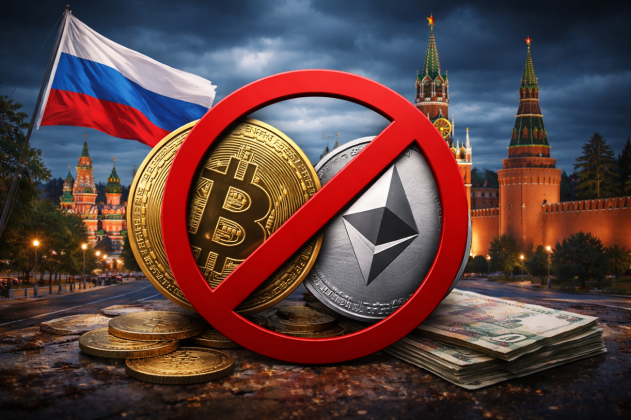
Russia’s crypto payment rumor mill just got another hard “no.” Anatoly Aksakov, the chairman of the State Duma Committee on Financial Markets, said cryptocurrencies “will never” function as money inside Russia — and that if you’re paying for something domestically, it’s rubles or nothing.
“It must be understood that cryptocurrencies will never become money within our country. They can only be used as an investment tool. If you want to pay for something, you can only do so with rubles,” Aksakov said at a press conference hosted by TASS.
Russia Rejects Crypto Payments
That line lands because, for years, there’s been a steady drip of “maybe Russia will allow” crypto payments chatter — and it’s not always completely baseless. The country has been trying to route around sanctions pressure, and crypto keeps popping up in the conversation. When officials talk up “settlements” and “trade,” plenty of people hear “payments” and assume that means everyday retail use is next.
It isn’t. At least not in the way crypto Twitter likes to imagine. Aksakov’s comments track with the central bank’s position. Bank of Russia governor Elvira Nabiullina told lawmakers earlier this year that crypto can’t be used for domestic settlements, while also pointing to a separate experimental legal regime (ELR) that allows crypto to be used in foreign trade under controlled conditions.
That split — “no” at home, “maybe” abroad — is the whole story. Russia has been building carve-outs for cross-border use, including frameworks that allow exporters and importers to use crypto in international settlements under foreign trade contracts.
And officials have been unusually blunt about the motivation. In late 2024, Finance Minister Anton Siluanov said Russia had begun using bitcoin and other cryptocurrencies for international trade under a special legal regime. So yes, crypto gets used. Just not the “pay your landlord in ETH” version.
The other source of confusion is that policy tone has softened around investing — even while payment bans stay in place. In March that the central bank proposed an experimental program that would let “specially qualified” wealthy investors buy crypto, explicitly keeping the domestic payment ban intact.
And regulators have still shown they’re willing to swing a hammer at the retail plumbing when they want to, like the reported blocking of crypto-related services.
In other words: Russia’s message is basically “speculate if you must, trade if you’re authorized, settle cross-border if you’re inside the sandbox — but inside the country, the ruble stays the only checkout option.” And for anyone still clinging to the payment narrative: this was the door closing sound.
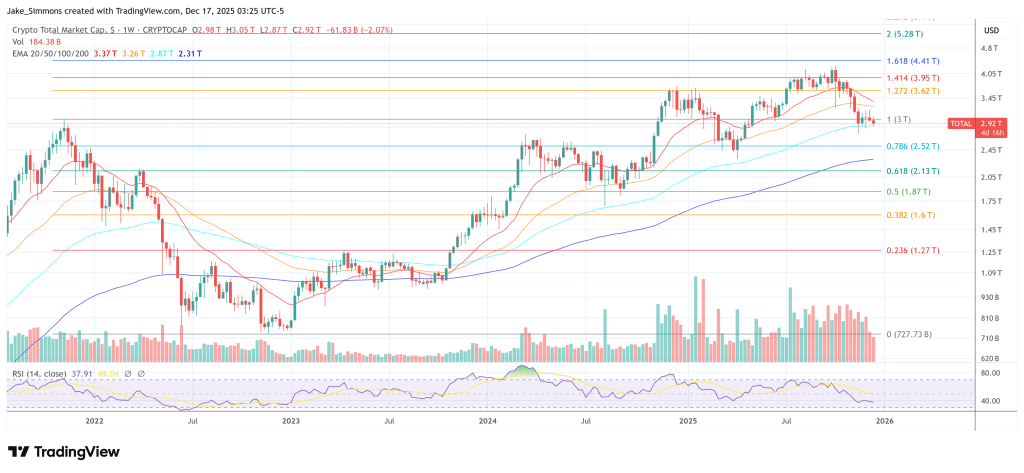
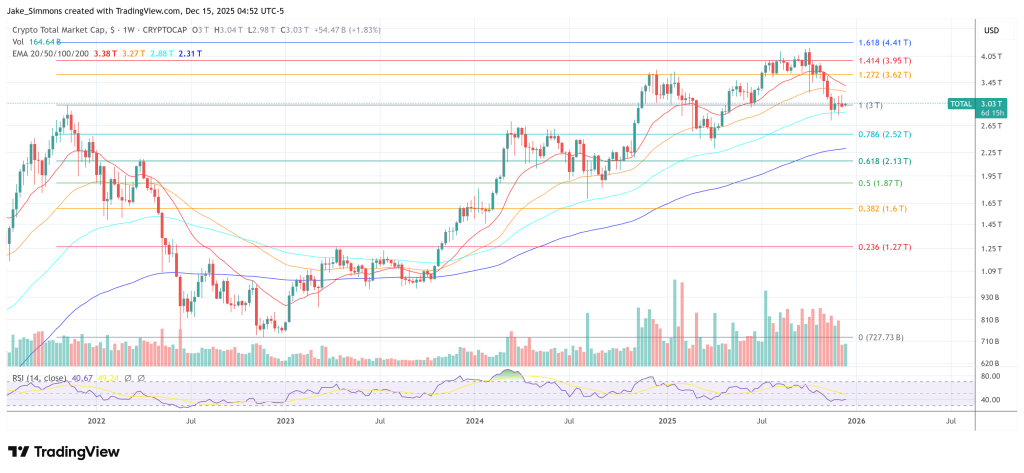
At press time, the total crypto market cap stood at $2.92 trillion.
Michael Saylor tossed a compact bit of Bitcoin game theory onto X on Tuesday and it set off the predictable kind of fight: technical details colliding with ideology.
“The Bitcoin Quantum Leap: Quantum computing won’t break Bitcoin—it will harden it,” Saylor wrote, adding: “The network upgrades, active coins migrate, lost coins stay frozen. Security goes up. Supply comes down. Bitcoin grows stronger.”
Short version: if quantum ever becomes real enough to threaten today’s signature schemes, Bitcoin can upgrade. Coins that are actively managed move to new, quantum-resistant output types. Coins that aren’t—because the keys are lost, the owner is gone, or the UTXOs are simply abandoned—should effectively get stuck.
Frozen.
Bitcoin Developers And Community React
That’s the part people latched onto, because it’s not just a technical question. It’s a social one. Who gets to decide which coins are “lost” versus “just old”? Jameson Lopp, one of the loudest voices pushing for practical quantum-readiness, basically said: yes, and welcome aboard. “I agree, lost coins should stay frozen. Glad to hear you’ll support my BIP!”
Then the counterpunch arrived fast. “We have no right to freeze another man’s bitcoin,” wrote Wicked (@w_s_bitcoin), arguing any attempt to lock legacy coins could spark a contentious chain split. He also floated a more narrative-friendly twist: what if Satoshi left early keys exposed as a “bounty” for quantum computers?
Lopp’s answer wasn’t sentimental. It was node-level realism. “On the flip side, every node runner has the right to refuse to accept coins they believe are most likely to have been stolen by a quantum attacker,” he wrote, framing it less as confiscation and more as a defensive filter to preserve the integrity of circulating supply. Later, he conceded the uncomfortable core: “Correct, the best you can do is come up with an extremely lengthy migration window.”
That “migration window” is doing a lot of work here. The draft proposal described by Lopp and co-authors (Christian Papathanasiou, Ian Smith, Joe Ross, Steve Vaile, Pierre-Luc Dallaire-Demers) sketches a three-phase path: first a soft fork that nudges (or forces) new sends into proposed quantum-resistant outputs, then a later rule change that makes legacy ECDSA/Schnorr spends invalid after a long deadline, and an optional third phase to recover unmigrated coins if the rightful owner can prove control through some new mechanism.
It sounds orderly on paper. It never is in practice. Because you can’t prove theft in Bitcoin’s older UTXOs. Wicked hammered that point: there’s “no way to prove whether older coins were stolen or just forgotten and then moved later by the rightful owner.” The fear, in his view, is basically supply paranoia dressed up as security.
Lopp didn’t deny the incentives. He leaned into them. “I can assure you that many entities in the industry care about supply shocks causing the value of their coins to plummet; businesses still use dollars as their unit of account.” And then, in a line that reads like a homework assignment for anyone who thinks this ends cleanly: “Your homework is to figure out the power dynamics…”
Outside the Bitcoin-only trench fight, other corners of crypto mostly reacted with a raised eyebrow. Nic Carter, a founding partner at Castle Island Ventures, demanded specifics: “Explain in detail how all of those things will happen […] Which core devs has microstrategy funded to work on the multiple hard and soft forks that will be required for this plan? Which quantum researchers?”
BitMEX Research pushed back on the “hardfork” framing. “What makes you think we need a hardfork?” it asked, arguing the transition could be painful without literally being a hard fork. Another account summed up the mood: “You can freeze coins with a soft fork.”
Then again—soft fork or not—getting broad social consensus to lock unmoved coins is its own nightmare. “The idea that there would be social consensus over locking unmoved coins is crazy,” one user wrote. “In 1,000 realities that doesn’t happen once.”
And, quietly, a reminder from Willem Schroe (Botanix CEO): “Yes, there are quantum developments but nothing remotely close to a breakthrough. That said, our current cryptographic solutions are not even remotely close to ready or battletested so quantum resistance work is definitely worth it. Very small risk but would have a big impact.”
So overall, none of this is about quantum tomorrow. It’s about Bitcoin deciding what it is when faced with a threat that can’t be patched with vibes. The tech path is hard. The politics might be harder.
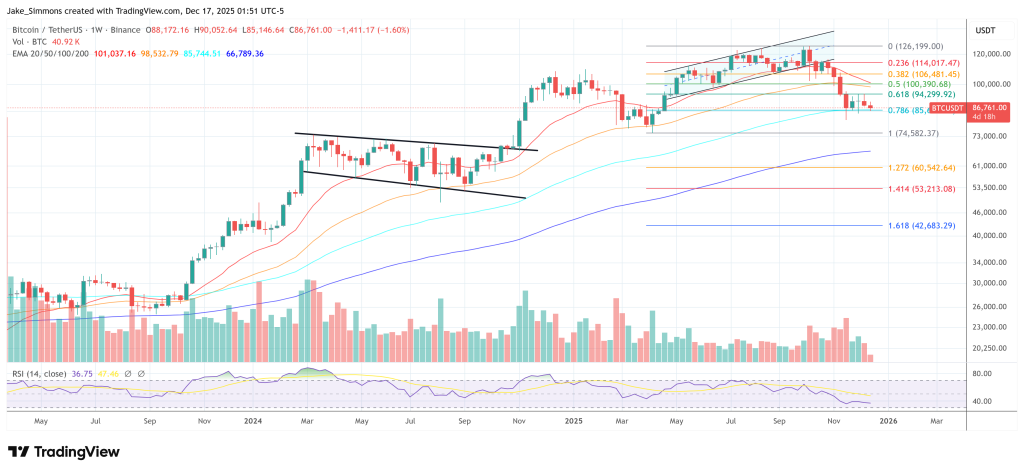
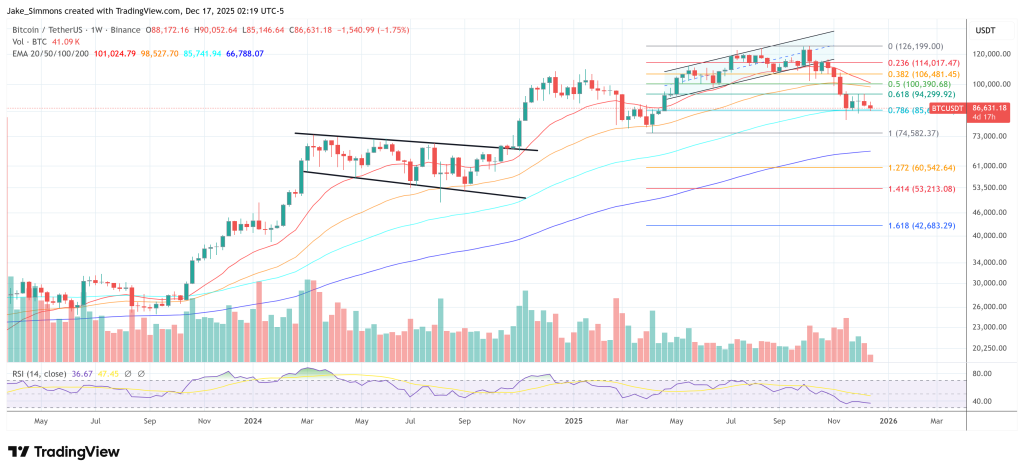
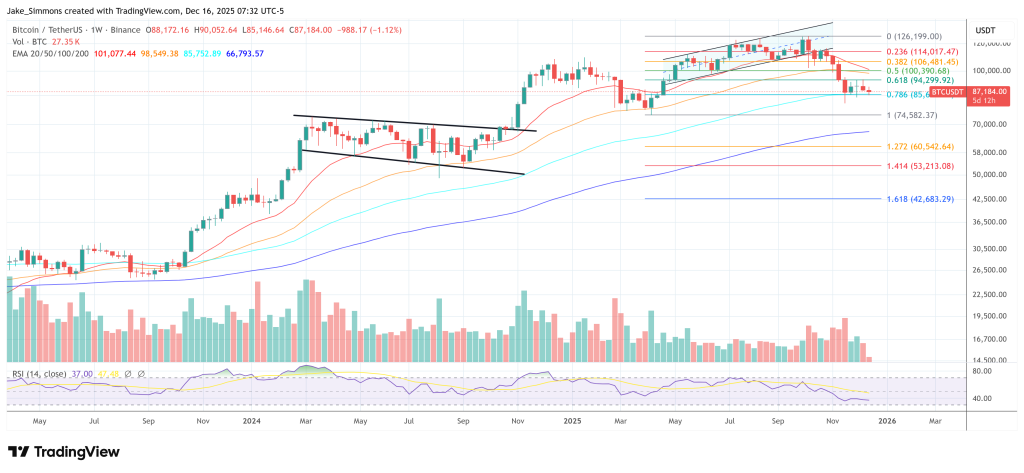
Bitcoin’s “death cross” is back in the group chat. And yes, the emails too. Matthew Sigel, head of digital assets research at VanEck, said he’s been “getting questions from clients” about the latest death cross print — the 50-day moving average slipping under the 200-day — and answered with the kind of data dump that tends to calm people down.
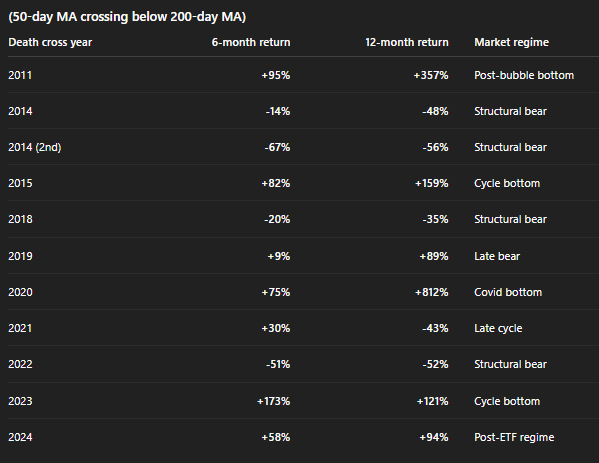
“Lagging indicator,” Sigel wrote on X, alongside a table of every Bitcoin death cross going back to 2011. The summary stats are clean: the 6-month median return after a death cross is +30%, the 12-month median is +89%, and the “positive hit rate” is 64%.
Another Bitcoin Death Cross, Another Missed Bottom?
But the interesting bit isn’t just the returns. It’s Sigel’s market regime column — basically a hint that the same technical signal can mean wildly different things depending on where you are in the cycle.
Take the ones tagged as some version of “bottom.” In 2011 (“post-bubble bottom”), the death cross showed up around the wreckage of an early-cycle blow-off, and the next 12 months were +357%. In 2015 (“cycle bottom”), it was +82% at six months and +159% at 12 months — classic post-capitulation behavior where trend indicators catch up late, after price has already stabilized and started to turn.
2020 (“Covid bottom”) is the extreme example: forced liquidation, policy response, then a monster rebound (+812% over 12 months). And 2023 is also tagged “cycle bottom,” with +173% at six months and +121% at 12 months — the kind of “this is awful until it isn’t” regime crypto does better than any asset class.
Now look at “structural bear.” That label shows up in 2014 (twice), 2018, and 2022 — and the forward returns are mostly ugly: 2014 prints -48% and -56% over 12 months, 2018 is -35%, and 2022 is -52%. Different environment. Less “washout and bounce,” more “trend is down because the system is deleveraging,” whether that’s miners, credit, exchanges, or macro liquidity tightening. In those regimes, a death cross isn’t a late alarm — it’s the moving averages confirming that the downtrend is real and persistent.
The in-between tags matter too. 2019 is marked “late bear,” with +9% at six months and +89% at 12 — choppy, uneven, but improving as the cycle turns. 2021 is “late cycle”: +30% at six months, then -43% at 12, which fits a regime where trend signals can whipsaw while distribution and macro tightening creep in.
And then there’s 2024: “post-ETF regime,” with +58% at six months and +94% at 12. That tag is doing a lot of work. It suggests the backdrop isn’t just “price vs. moving averages,” but structural demand (ETFs), different liquidity plumbing, and a market that may behave less like pure reflexive leverage and more like a hybrid of trad-fi flows plus crypto-native positioning.
So the takeaway isn’t “death crosses are bullish.” That’s not true. It’s that the signal is mostly a trailing mirror — and the regime you’re actually in (bottoming, late bear, structural deleveraging, late cycle, post-ETF flow market) is what decides whether it’s a fake-out, a confirmation, or just noise with a scary name.
Quantum risk has been getting louder in the Bitcoin conversation over the past few months. The question is whether that noise translates into price pressure in 2026.
Grayscale’s answer, in its updated 2026 Digital Asset Outlook: “Dawn of the Institutional Era” (last updated Dec. 15), is essentially no. Quantum belongs on the risk register and in the research pipeline, not on the list of themes the firm expects to steer Bitcoin’s valuation next year. In its view, it’s not “likely to move prices” in 2026.
Why The Quantum Computer Threat Won’t Move Bitcoin Price In 2026
That call matters because the quantum debate arrived while the market is already looking for new failure modes — everything from “the four-year cycle is dead” to renewed anxiety about large holders distributing supply. Grayscale’s framing is simpler: the threat is real in theory, but the relevant timelines don’t line up with a 2026 trading horizon.
The firm lays out the core concern in plain terms: “Theoretically, a sufficiently powerful quantum computer could derive private keys from public keys, which could then be used to create valid digital signatures to spend users’ coins. Therefore, Bitcoin and most other blockchains — and virtually everything else in the economy that uses cryptography — will eventually need to be updated for post-quantum tools.”
The key word is eventually. Grayscale points to expert estimates suggesting a machine capable of breaking Bitcoin’s cryptography is “unlikely before 2030 at the earliest.” That pushes 2026 into a preparedness bucket: more research, more coordination, more work on mitigation — but not a year where markets suddenly apply a quantum discount because a lab headline hit the wires.
Grayscale makes that explicit. “However, expert estimates suggest a quantum computer powerful enough to break Bitcoin’s cryptography is unlikely before 2030 at the earliest. Research on quantum risk and community preparedness efforts will likely accelerate in 2026, but this theme is unlikely to move prices, in our view,” the firm writes.
In the report’s taxonomy, quantum sits closer to “high attention, low near-term impact” than to a true 2026 catalyst. Grayscale groups it with other heavily discussed trades that may not drive returns on a one-year view, including the digital-asset-treasury (DAT) narrative that had its Michael Saylor copycat phase in 2025.
The broader outlook is firmly “institutional era” in tone. Grayscale expects 2026 to extend structural shifts in how digital assets are owned and allocated, driven by macro demand for alternative stores of value and an improving regulatory backdrop that reduces frictions for large investors. In that context, the firm is calling for Bitcoin to set a new all-time high in the first half of 2026, while arguing the classic four-year halving cycle is becoming less dominant as spot ETPs and slower-moving portfolio allocation play a bigger role.
That’s also why quantum looks like a mismatch for the 2026 price question. If the marginal buyer is an allocator working through due diligence checklists, the market’s response function changes. Those investors do not ignore tail risks — but they also tend not to liquidate positions on long-dated, low-probability scenarios unless the timeline becomes immediate.
Grayscale highlights one other, quieter point that fits the institutional framing: Bitcoin’s supply schedule. The report notes investors can be “highly confident” the 20 millionth bitcoin will be mined in March 2026 — a predictable, verifiable milestone that speaks to the protocol’s rule-based issuance.
So will quantum computing suppress Bitcoin in 2026? Grayscale’s base case is no — not because the problem is imaginary, but because it isn’t close on the timeline markets usually need before they reprice risk. For next year, the firm expects the bigger drivers to look familiar, even if they arrive in more institutional packaging: rates, regulation, ETP plumbing, and steady absorption of BTC into mainstream portfolios.
Quantum remains a theme to track. Just not, in Grayscale’s view, the theme that sets the price in 2026.
One of the cleaner tells in crypto is when the old supply decides it’s time. Not “made a quick 20% and clipped it” time — years old.
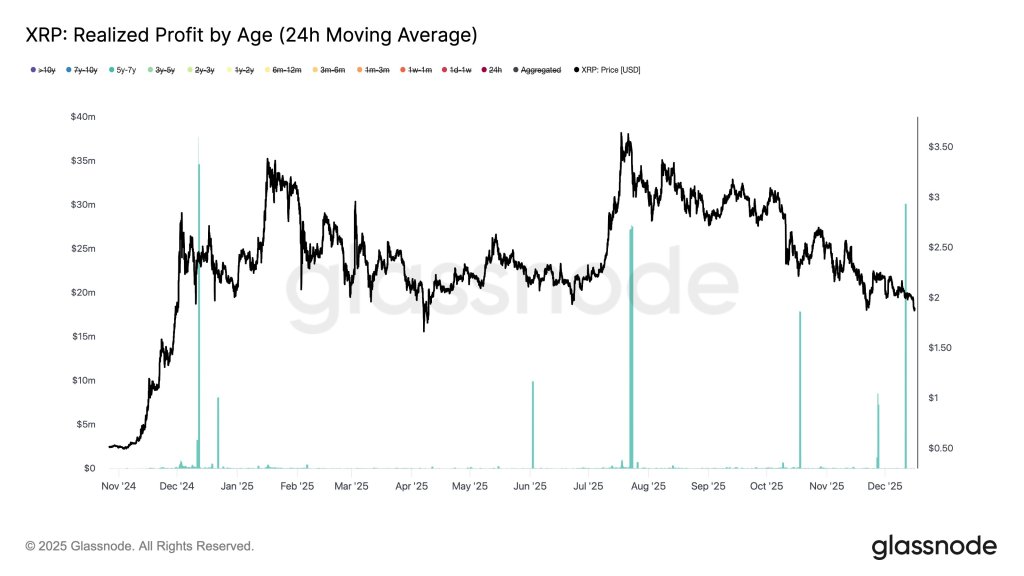
That’s basically what Glassnode researcher CryptoVizArt flagged after an XRP wallet aged roughly 5–7 years (with a cost basis around $0.40) realized more than $721.5 million in profit on Dec. 11.
A single wallet doesn’t “break” a market on its own. But the timing is the point: this wasn’t profit-taking into a rip. It landed while XRP was showing weakness right at the $2.0 key level.
CryptoVizArt wrote via X: “On December 11th, a 5-7 year old XRP wallet address (with a cost basis of $0.4) realized over $721.5M in profit! A rare sizable profit-taking while the price shows weakness right at the $2.0 key level.”
What This Means For XRP Price
That $2 handle matters for the usual reasons — round number, obvious chart magnet, psychological line in the sand — but also because the market’s been treating it like a live wire lately. Since early December last year, the support zone between $2 and $1.90 has been tested endless times. XRP bulls always managed to close above the zone on the weekly timeframe.
So what does the $721M print mean? It’s a reminder that supply overhang isn’t theoretical. A 5–7 year wallet taking profits can be read as “de-risking,” sure. But in tape terms, it’s also distribution that the market has to absorb while price is already leaning. If bids are deep, it’s a shrug. If bids are thin, it turns $2 into a trapdoor.
And right now, “thin” is kind of the vibe across crypto, not just XRP.
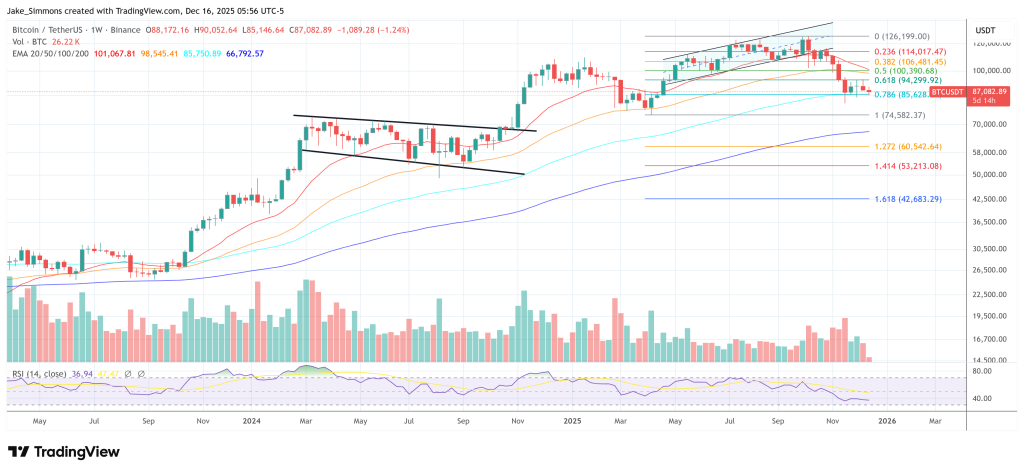
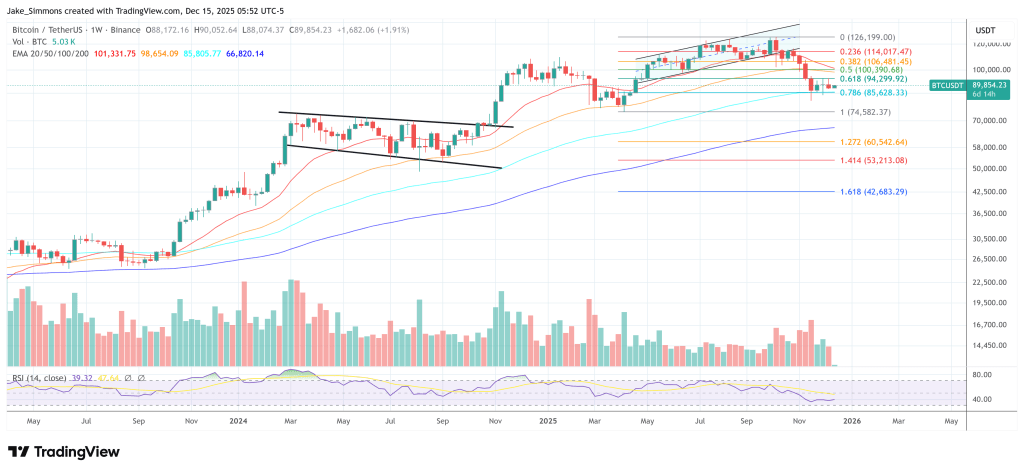
CryptoVizArt’s broader framing from Dec. 13 is that the $80K–$90K Bitcoin consolidation is producing stress “comparable to late Jan 2022.” Via X, he wrote: “The current $80K–$90K consolidation range is generating a magnitude of stress comparable to late January 2022, with Relative Unrealized Loss approaching ~10% of market cap. This places the market in a regime where liquidity is constrained, and sensitivity to macro shocks is elevated, yet still below the levels typically associated with full bear-market capitulation.”
That backdrop matters because alts don’t trade in a vacuum. When the whole complex is jumpy, big sell events at key levels have more punch. Not because every XRP holder suddenly panics, but because market-makers and discretionary traders tend to pull risk at the same time. Spreads widen, depth thins, and “one-off” flows start to move price more than they should.
Still, it cuts both ways. A single, chunky realization can also be the market clearing a problem — old supply exiting, new demand stepping in, the kind of transfer that (eventually) makes a base sturdier. The trick is whether $2 holds while that handoff happens.
At press time, XRP was trading at $1.89, which could make Sunday’s weekly close another extremely important event.
The yen carry trade unwind has been hovering over markets lately — the kind of “plumbing” story that most people ignore right up until volatility spikes and everything suddenly feels connected. Graham Stephan put it into a Bitcoin and crypto-friendly frame yesterday.
In a Dec. 15 post, the popular YouTuber described the yen carry trade as Wall Street’s long-running “infinite money glitch” — and argued it’s breaking down just as the Fed is signaling a shift in its outlook for next year. “Wall Street found an ‘infinite money’ glitch 20 years ago. They called it the Yen Carry Trade. It just broke, right when the Fed announced its plans for next year,” Stephan wrote.
What The Yen Carry Trade Unwind Means For Bitcoin
He presented it as a straightforward trade that scaled because the size was big enough to matter. “For decades, the ‘Yen Carry Trade’ has been the secret engine behind global liquidity. The mechanics were simple enough that a child could understand them, but profitable enough to move trillions of dollars.”
Stephan then laid out the basic steps in plain English: borrow cheaply in Japan, rotate into higher-yield US assets, keep the spread. “Borrow Cheap: Investors borrowed money in Japan, where interest rates were effectively 0%… Invest Abroad: They took that ‘free money’ and bought US Treasuries paying 4-5%… Profit: They pocketed the difference without using any of their own money.”
His argument is that the setup turns toxic when the rate differential compresses and the currency leg moves the wrong way. He framed the timing as especially awkward for risk assets: Japan tightening to support the yen while the Fed eases. “Japan is finally raising rates to save its own currency right at the time when the Fed has started slashing rates. The gap between the rates is getting squeezed. The ‘free money’ isn’t free anymore.”
From there, he leaned into the mechanical consequence: when funding gets more expensive and the currency shifts, leveraged positions don’t get a long debate window — they get cut. “As Japanese rates rise, that trade flips. Investors are now being forced to sell their US assets to pay back their Yen loans. Instead of money flowing into the US markets, it is being sucked out to pay debts in Tokyo. This is a massive liquidity drain happening right under our noses.”
That’s also where his Bitcoin read comes in. Not “Bitcoin is broken,” but that Bitcoin is where risk appetite and leverage tend to show up early — and where forced selling can look brutal when it hits.
Stephan expanded on the same theme in a Substack post, pulling the Fed into the timeline more directly and warning readers to brace for turbulence. “You better get ready for a bumpy ride,” he wrote, claiming the Fed cut rates “for the third time this year,” and that the central bank “has officially ended ‘Quantitative Tightening’ and is quietly moving back toward printing money.”
He added a “pilot flying blind” angle as well, arguing the Fed cut “without any inflation data whatsoever” due to shutdown-related disruptions. He attached a specific interpretation of balance-sheet policy, too: “Finally, the most important news of the day: Quantitative Tightening (QT) is over… They even announced they will buy $40 billion of Treasuries over the next 30 days. The tightening era is dead. The ‘stimulus’ era is now being rebooted, and the money printer is being turned on.”
Taken together, his thesis ends up with Bitcoin sitting between two forces that don’t necessarily move on the same clock: a potentially sharp deleveraging impulse from carry unwinds, and a slower easing impulse if policy conditions loosen. One can hit price violently in a short window; the other can take time to express itself cleanly.
Stephan closed with a familiar Bitcoin-with-training-wheels framing: volatility is normal, drawdowns happen, and mining economics create a reference point. “Bitcoin isn’t broken. It’s just volatile, and this isn’t the first time this is happening. Statistically, Bitcoin has seen drastic crashes of 50% or more, but it has never dropped below its “electrical cost” (the cost to mine one coin), which sits around $71,000 today. If we get close to that number, history suggests it’s a strong buy zone,” he concluded.
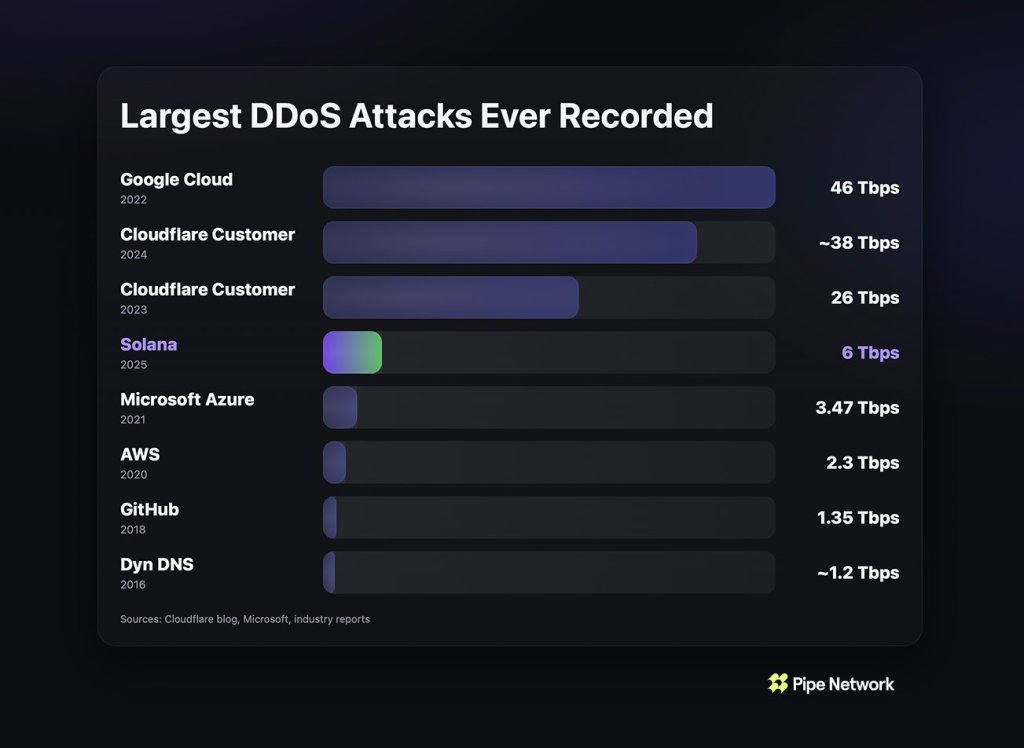
Solana has been battling what some ecosystem builders are calling an internet-scale DDoS campaign — and, despite the usual “Solana is fragile” jokes, the network seems to be shrugging it off.
Pipe Network said of the ongoing attack via X today: “The ongoing DDoS attack on Solana is one of the largest in internet history. 6 Tbps volumetric attack translates to billions of packets per second. Under that kind of load, you’d normally expect rising latency, missed slots, or confirmation delays.”
Pipe further says that’s not what the data is showing. “Median tx confirmation ~450ms,” the team wrote, adding that p90 remains under 700ms and slot latency is holding at 0–1 slots. In other words, if you’re a regular user or trader, you might not even know anything’s happening. Which is kind of the point.
Reactions From The Solana Community
Raj Gokal, Solana Labs’ co-founder and COO, put it more bluntly in a reply to a broader DDoS debate: “have you heard about the ongoing DDOS against Solana that has had zero effect on performance?”
The backdrop here matters. Justin Bons had posted about Sui being DDoS’d yesterday, claiming it triggered “mass delays” and arguing that “127 validators is not enough,” with the broader warning: don’t let validator counts drift too low if you want a chain to be resilient.
Mert Mumtaz, CEO of Helius, largely agreed with the premise — but pushed back on the simplistic “more validators = solved” framing.
“I understand your point & mostly agree with you,” Mert wrote, before adding that “a chain is more resistant to DDoS with 100 professional high powered validators compared to 10k validators run by amateurs.” He also said there are scenarios where higher validator count can help, but emphasized it isn’t the core defense by itself. Then he dropped the key detail: Solana’s attack hasn’t been a one-day headline, it’s been going on for a while.
“And fyi there has been a colossal ddos attack on Solana for weeks now,” Mert wrote, later adding that Solana “has been under a colossal DDoS attack for at least over a week now btw” — and that the fact most users haven’t felt it is “a big testament to the level of engineering present here.”
Solana co-founder Anatoly Yakovenko chimed in with a more technical angle on why validator count can matter in specific leader-hand-off dynamics: “Validators count helps if the previous leader can finish their block while the current one is being hit. Then the cost of ddos approaches the cost of ddos the whole network.”
Translation: if an attacker wants to reliably disrupt block production, they may have to sustain pressure across more of the network, not just pick off a single leader at the wrong moment. That gets expensive fast.
SolanaFloor summed it up via X: “Solana has been under a sustained DDoS attack for the past week, peaking near 6 Tbps, the 4th largest attack ever recorded for any distributed system. Network data shows no impact, with sub second confirmations and stable slot latency. The Sui network was also targeted by a DDoS attack yesterday, resulting in delays in block production and periods of degraded network performance.”
And there’s a more strategic takeaway that’s starting to sound less theoretical each month: blockchains are now juicy targets. David Rhodus, founder of Permissionless Labs (and a contributor to Pipe Network), said: “This puts Solana among the most heavily DDoSed targets in internet history. It reinforces that blockchains are now Tier-1 DDoS targets. This is not “script kiddie” activity — 6 Tbps is industrial-scale.”
If you’re a validator, Mumtaz offered the practical advice you’d expect in a week like this: have backups across multiple hosting providers and regions. Because even if the chain holds, your own infrastructure might not.
The broader point, though, is the new baseline: these networks are getting stress-tested like mainstream internet services now. Solana’s claim today is that it passed — quietly, under load, and without users noticing. That’s the kind of victory that doesn’t look dramatic on a chart. It just […] works.
Cardano founder Charles Hoskinson wants crypto to stop acting like it’s permanently stuck in 2021 brain.
In a Dec. 15 livestream titled “Some End of Year Thoughts,” the IOG CEO delivered a blunt year-end diagnosis of a market that, in his telling, lost its retail engine, let politics turn into a sideshow, and drifted back into the easiest (and laziest) narrative in the business: find the next 10x, then dump it on someone else.
“This has been a really [expletive] up year for our industry as a whole,” Hoskinson said from Colorado, describing 2025 as “a donkey of a year” — “an old donkey with a gas problem.”
Cardano’s Hoskinson Warns Of Retail Exodus
His first big complaint was structural, not emotional. The Cardano founder argued that institutional capital did arrive, but much of it got “locked into the Bitcoin layer,” and didn’t rotate into altcoins the way prior cycles did. “So we lost our trickle down effect that we enjoyed in 2021 and in 2017,” he said, framing it as a market-mechanics issue as much as a sentiment one.
Then he pivoted to politics. Hoskinson described a messy set of expectations heading into 2025 — hopes of a more constructive US regulatory posture, then disappointment as crypto became entangled in headline-grabbing memes and what he characterized as erratic signaling. He pointed to the launch of TRUMP coin at the inauguration (as he recounted it), followed by MELANIA, calling them “cash grab situations” that left the broader industry wearing the reputational fallout while still chasing regulatory relief.
The deeper problem, though, was retail. The Cardano founder argued the industry never rebuilt trust after the 2022 wipeout, and that 2025 didn’t offer a compelling reason for everyday participants to come back beyond speculative churn. “Retail showed up in 2021… and then they got screwed again and again and again,” he said. “And now you want them to come back so you can do it again. Will they? No.”
That sets up his core pitch for 2026: a reset framed as a return to “first principles,” with less reliance on governments, celebrity catalysts, or “the cavalry.” His language wasn’t subtle. “No government is coming to save us. No large company is coming to save us. No large investor is coming to save us,” he said. “We are on the island.”
He also tied that reset to a broader, darker worldview — AI, robotics, and a society he worries will drift into a “dystopian hellscape” without credible systems for agency, ownership, and verification. Whether you buy that framing or not, it’s clearly the rhetorical engine he wants crypto to run on: less number-go-up, more “what are we actually building, and who does it help?”
Hoskinson didn’t completely let his own camp off the hook, either. He acknowledged missed predictions — including his past expectation that bitcoin would reach $250,000 in 2025 — and the ongoing criticism he gets for timelines.
“I honestly believed [Bitcoin] would be back in December of 2024. Because I believed that Trump would be good for crypto. I was wrong. I believed it and I was wrong. I’ll admit that. But I do believe in 2026 there’s a path for it to get there. And I do believe we as an industry will pivot and return to retail and rebuild those relationships and get it done. It’ll be a difficult road, but I see a path to make that happen. Leios will ship. We know how to do it. We wrote all the code down. We got it done,” Hoskinson said.
Towards the end, he tried to anchor the “reset” in concrete ecosystem moments, pointing to Midnight’s launch mechanics as an example of retail-first distribution and highlighting heavy trading activity around the token. “The bullshit’s over,” he said. “We’re back to work… in 2026 it’s a return to first principles.”
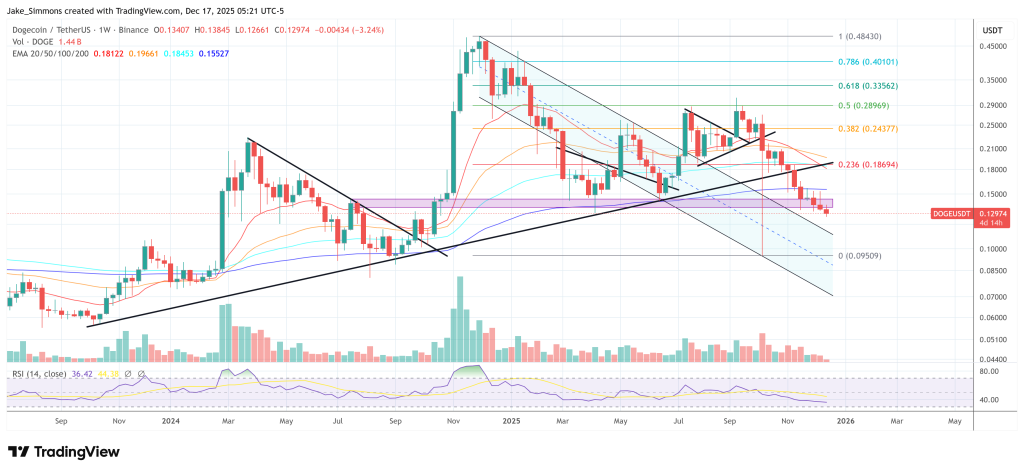
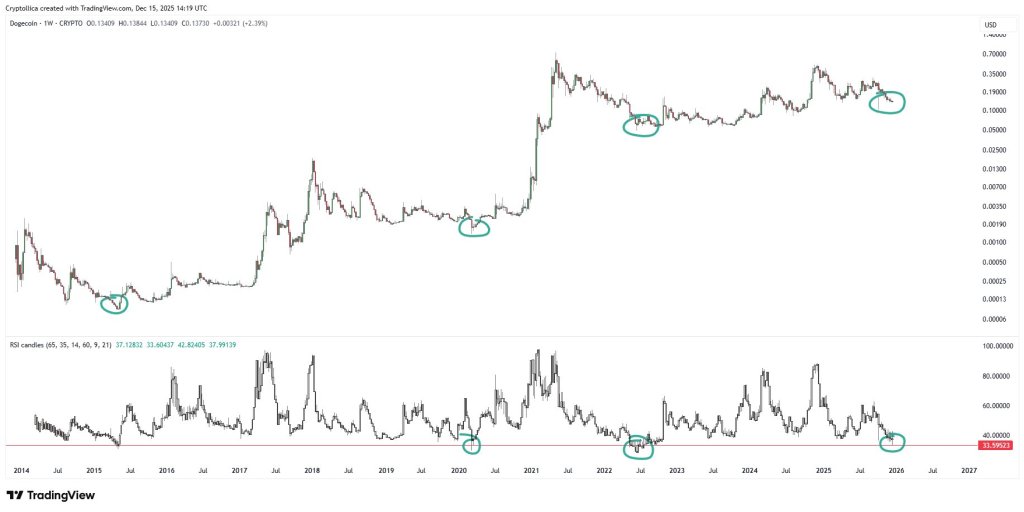
The weekly chart for Dogecoin shows a signal that could be of greater significance due to its rarity. Crypto analyst Cryptollica pointed to DOGE’s weekly RSI tagging roughly 33.6 and claimed that level has shown up only four times in 11 years. “DOGE WEEKLY RSI. 4 times in 11 years ..,” he posted.
What This Means For The Dogecoin Price
DOGE, for context, was trading around $0.129 at the time of writing, down roughly mid-single digits on the day.
The hook is simple: a weekly RSI that low usually means sellers have been in control for a while — and on a weekly timeframe, that kind of pressure tends to carry more weight than intraday noise. This isn’t “RSI brushed 30 on a 15-minute candle.” It’s slower, heavier, and tied to the bigger trend.
Still, it’s not quite as plug-and-play as the screenshot makes it look. Cryptollica’s point is that the same zone showed up around (1) early May 2015, (2) March 2020, (3) mid-June 2022, and (4) now. The post is the spark; what traders actually care about is what happened next. And this is where Dogecoin’s history gets… very Dogecoin.
On May 6, 2015, DOGE was quoted around $0.000087. Beyond the price being basically dust, the backdrop was messy: weeks earlier, Dogecoin co-founder Jackson Palmer said he was stepping away from the crypto community, calling out what he described as a “toxic” culture.
The bounce didn’t show up on schedule. DOGE drifted for a long time, then later caught the 2017–18 mania, briefly touching $0.017 on Jan. 7, 2018. From roughly $0.000087, that’s about +19,000% to that local-cycle high — a good reminder that “oversold” on a weekly chart can show up early and still end up pointing the right way.
In mid-March 2020 (peak COVID panic), DOGE traded around $0.001537. When the panic eased and liquidity returned to markets, DOGE went on to print its next cycle top at $0.7316 on May 8, 2021.
That’s roughly +47,000% from the March 2020 level to the 2021 high. It’s also the stretch where DOGE stopped being “just” a joke coin and started behaving like a retail risk-on barometer — with Musk-era attention pouring gasoline on it.
By mid-June 2022, the bear-market washout was in full effect. DOGE was around $0.053. The recovery came in waves: a late-2022 pop tied to Musk/Twitter speculation and broader risk-on bursts, then a bigger 2024 meme-led rip.
By March 28, 2024, DOGE was back around $0.220 — roughly +315% from the June 2022 level to the next notable local high. Not 2021-level insanity, but still a real multi-x.
And now, as of Tuesday, Dec. 16, 2025, Dogecoin was changing hands around $0.129. The “signal” crowd will look at that weekly RSI print and argue the market is back in the same psychological neighborhood as those prior exhaustion points.
The bullish case writes itself: if this weekly RSI zone has tended to show up near seller fatigue in the past, then seeing it again could mean risk/reward is quietly shifting. Not a promise — more like a reason to stop ignoring DOGE and start watching it.
But RSI isn’t a timing tool. Oversold can stay oversold. Weekly signals can hang around, whip traders around, or get flattened if broader risk keeps leaking.
For now, it’s a setup, not an outcome. If DOGE starts reclaiming levels and holding them, the “rare signal” crowd will take the victory lap. If it keeps bleeding, this gets filed under interesting, early, and painful — like a lot of trading ideas.
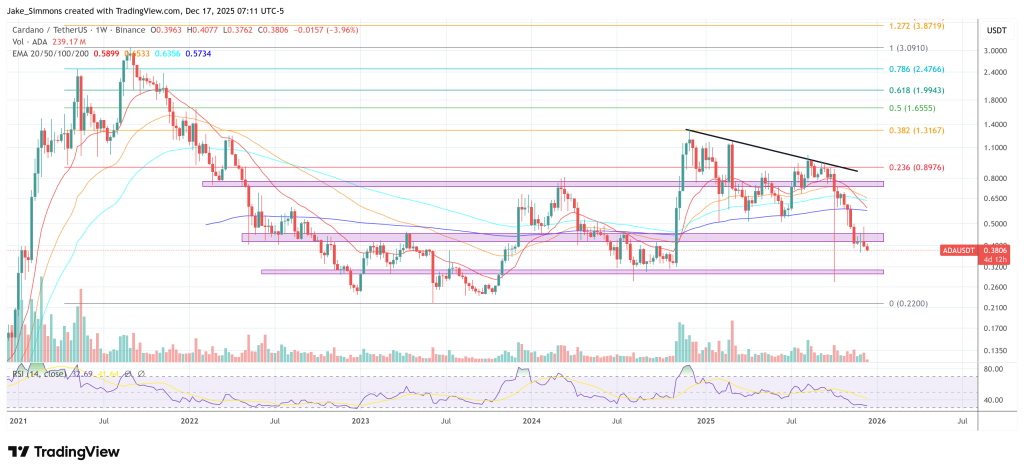
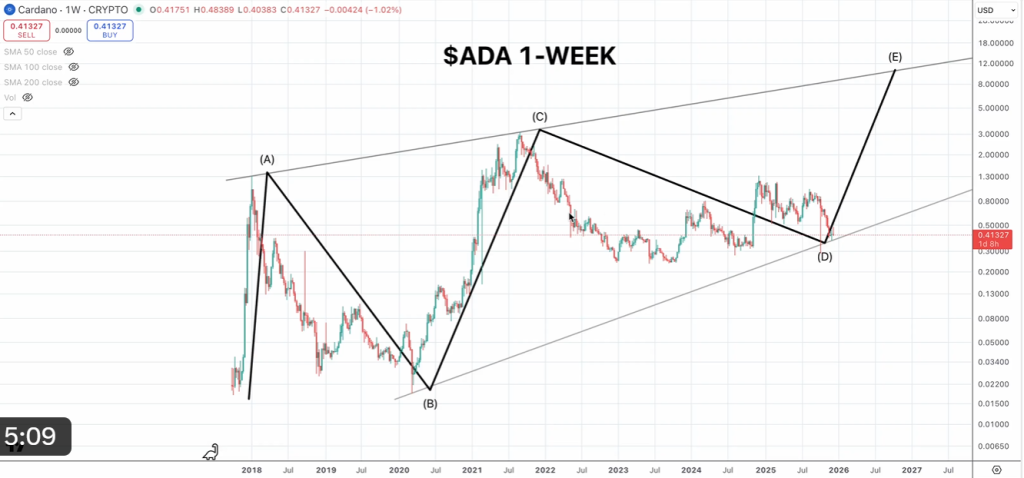
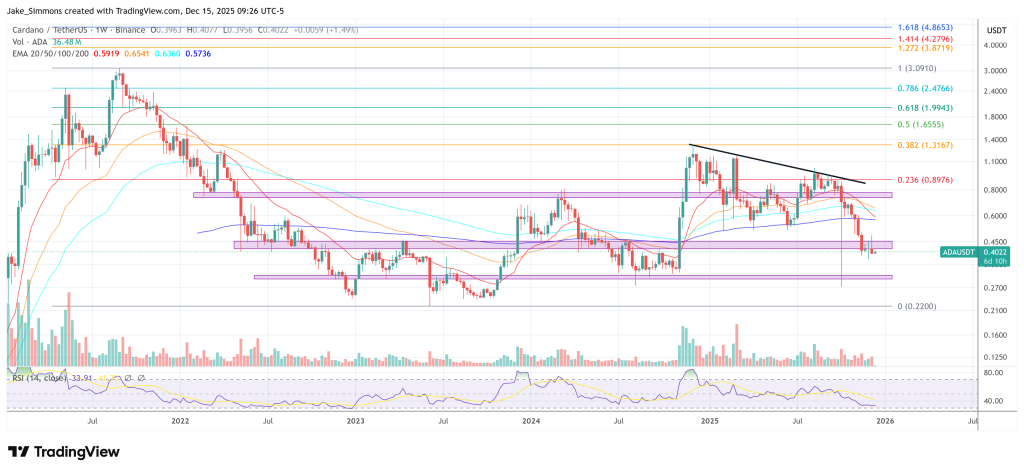
Cardano (ADA) is getting the “2020 blastoff” treatment again — at least if you ask Quantum Ascend, a technical analyst on X who says the chart is starting to rhyme with the setup that preceded ADA’s last major run.
In a Dec. 13 video shared on X, Quantum Ascend (@quantum_ascend) told followers he’s been working through a longer-term weekly count and thinks the market may be grinding toward the end of a drawn-out corrective structure. The punchline: a “conservative” target zone around $4.88–$5.50, and a “primary” bull-run target of $10.40.
“Cardano Mirroring 2020 Blastoff Moment,” his post read, before laying out the two tiers: “Conservative: $4.88-$5.50” and “Primary: $10.40.”
The Framework Behind The Cardano Price Prediction
The framework he’s leaning on isn’t a clean five-wave impulse, he said. Instead, he framed it as something slower and messier — “more of like a large time-based macro correction here on the D-wave,” he said, describing what he believes is a triangle structure developing on the weekly chart.
“We’re creating a triangle structure,” he said. “So I am going to be looking for the E-wave. That’s what ends up coming next.”
A big part of the argument is confluence. Quantum Ascend walked through multiple measurements and trendlines, pointing to price zones where different tools cluster. One reference point was a prior A-to-B drawdown range that, in his view, still hasn’t been fully “closed out,” with a key level “up there at the $5.50 mark.”
Then he zoomed out to the bigger structure, highlighting how an upper trendline from a C-to-D drawdown “converges with the 3.618 [Fibonacci extension] up here,” which he suggested adds weight to the $10 area. “So some confluence for that $10 area,” he said, pointing at the chart level he called out around $10.62.
He also reached for a relative-performance comparison — not to Ethereum itself, but to Ethereum Classic.
“I have another video from the past that compares Ethereum Classic to ADA,” he said. “And if it ends up doing a similar move to Ethereum Classic, that also puts us up into the $10 range.”
Still, the near-term “safe” target he kept circling back to was the $5 region. After walking through a more recent drawdown “going back to the top of the Trump pump to where we’re at now,” he said a “full extension gets us pretty close… around $4.88,” adding that the $5 zone shows “a lot of different signs of confluence.”
“For me, I’m going to say my conservative estimate for ADA is going to be that $5 range,” he said. Then he went straight to the headline number: “I think ADA gets up there around 10 bucks during this bull run.”
To make the comparison feel less abstract, Quantum Ascend argued the current chop looks structurally similar to a prior period before ADA’s last breakout — a fractal-style read. “You guys notice the similarities here?” he asked, describing how both moves get “stopped out a little bit above the 0.5,” roll over, then revisit the lower trendline before pushing back to the top of the range.
And then he widened the lens beyond Cardano, tossing in a fairly aggressive macro view that sits underneath the bullish alt targets. “I honestly, guys, across the board right now, I believe that these corrections are coming to an end,” he said. “I think we have a blow off top in stock markets, in crypto and all of that coming.”
But he also stressed he’s not married to a long-duration “supercycle” narrative. “I am not a long-term bull,” he said. “I am not [predicting a] Bitcoin super cycle to $400K.” His current bitcoin top, he added, is $155,000 — and he expects alts to “severely outperform” in the final leg before “it’s all over.”
On the math side, Quantum Ascend framed $10.40 as big, but not absurd in a market that has already produced outsized multiples. “If we were to get that 1040, 25X, right?” he said, comparing it to prior cycles where ADA saw moves he pegged at “168X” and “75X.”
“So we’re just talking about a 25er,” he added. “Not that crazy when you put it into perspective.”
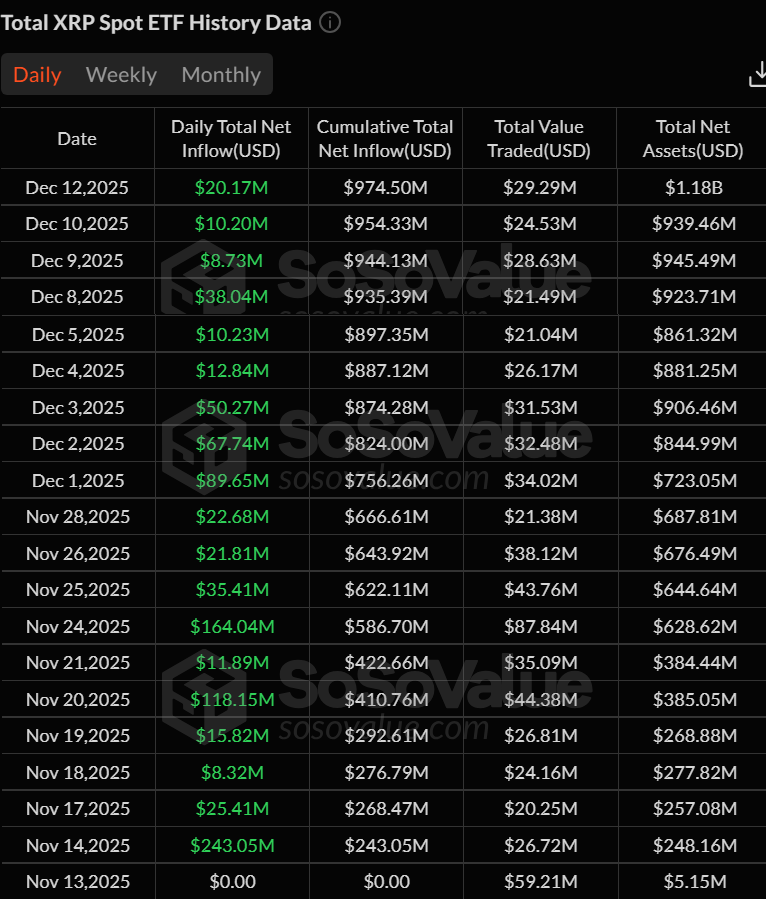
US-listed spot XRP ETFs just put together a streak that’s hard to ignore: 19 straight trading days of net inflows, with zero outflow sessions over the run, according to daily flow data compiled by Sosovalue.
The numbers add up quickly. By Dec. 12, cumulative net inflows sat at $974.50 million, while total net assets across the products were shown at roughly $1.18 billion.
XRP ETFs Log 19 Straight Trading Days Of Inflows
The early days did most of the heavy lifting. Sosovalue’s table shows $243.05 million of net inflow on Nov. 14, then another surge on Nov. 24 ($164.04 million). There were also chunky adds on Nov. 20 ($118.15 million) and Dec. 1 ($89.65 million). Even as the pace cooled, inflows didn’t flip—Dec. 8 posted $38.04 million, and Dec. 12 added another $20.17 million.
On X, Bitmern Mining founder and CEO Giannis Andreou framed it bluntly today: “19 consecutive trading days of inflows. Zero outflow days. Nearly $1B in net capital added.” He called it “sustained institutional positioning,” not retail froth.
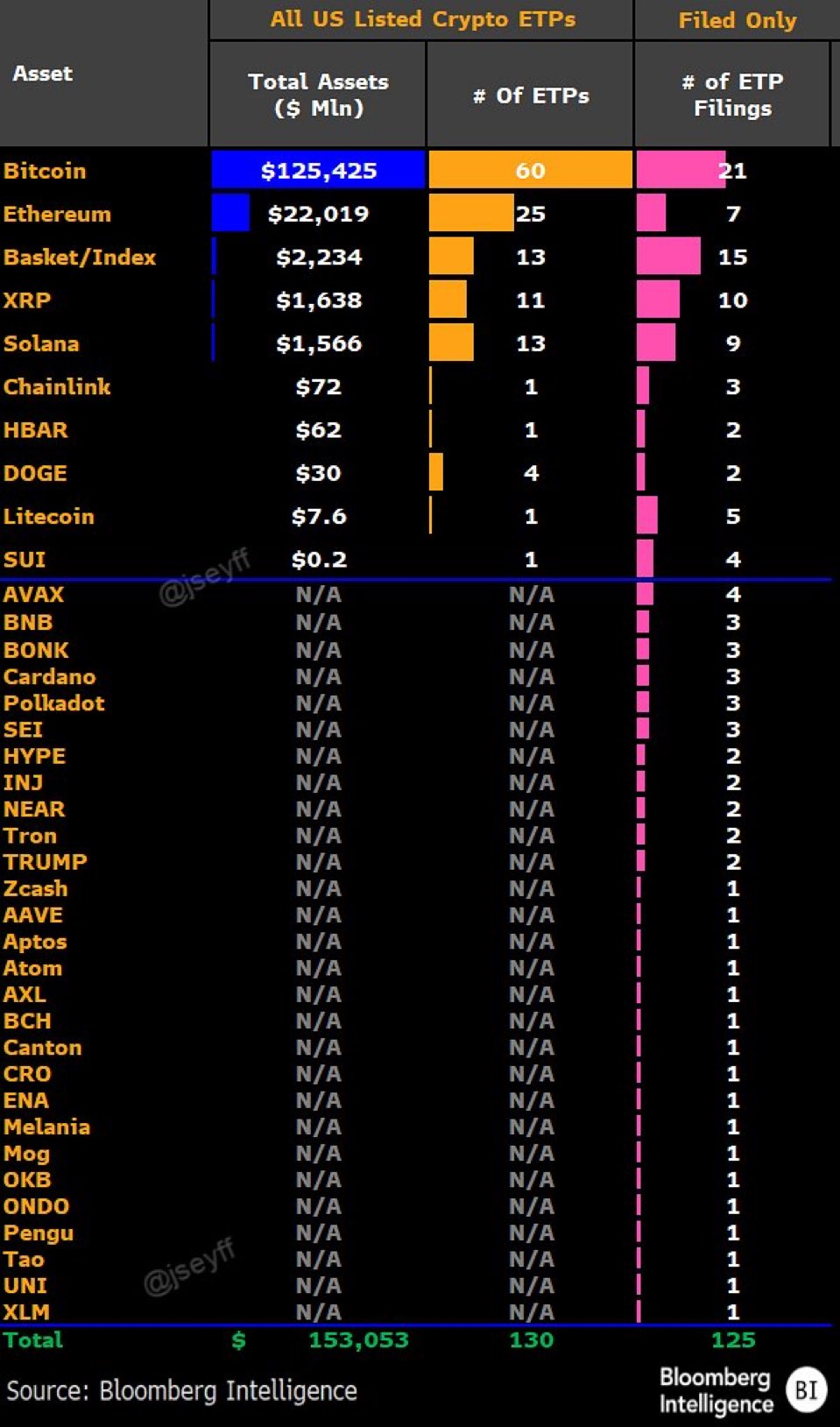
That “institutional bid” angle is also showing up in the asset rankings. In a Dec. 13 post, Canary Capital CEO Steven McClurg pointed to a separate snapshot of the US crypto ETP landscape showing XRP products now edging out Solana by total assets under management.
Bloomberg Intelligence data in the chart puts XRP ETP assets at about $1.638 billion, just ahead of Solana at $1.566 billion, in a market where Bitcoin still towers over everything at $125.425 billion and Ethereum sits at $22.019 billion.
McClurg’s explanation for the flip was less about Solana underperforming and more about where each asset “fits” in the wrapper trade.
“SOL ETFs launched before XRP, but XRP ETFs have now passed SOL in total AUM. I expected this,” McClurg wrote, adding “SOL is much more efficient to hold on-chain and to stake directly for retail audiences, whereas XRP has more institutional demand and no staking. As with everything, there will be an audience that prefers direct ownership, and an audience that prefers the ease of financial instruments. Some will do both.”
Notably, from Dec. 8 to Dec. 12, Bitcoin spot ETFs recorded net inflows of $287 million for the week, while Ethereum spot ETFs saw weekly net inflows of $209 million. SOL spot ETFs recorded net inflows of $33.6 million.
At press time, XRP once again fell below the $2 mark. The token traded at $1.98 and thus at the key support zone. A drop below the red support band could strengthen the bear case for a deeper crash to the 100-week or even 200-week Exponential Moving Average (EMA). XRP visited the latter during the October 10 crash.
Quantum risk has become a recurring stress point in Bitcoin discourse, often framed as an existential threat. The claim usually follows a familiar arc: quantum computing is advancing quickly, cryptography is vulnerable, and Bitcoin isn’t adapting fast enough.
Marty Bent doesn’t buy that framing. In his Dec. 14 episode, Bent acknowledged that quantum computing represents a genuine risk — not just for Bitcoin, but for any system built on modern cryptography — while pushing back on the idea that Bitcoin developers are ignoring the issue.
“Short answer is yes, it is a risk,” Bent said. “But it’s not only a risk for Bitcoin. It’s a risk for any system that depends on cryptography for security.”
What Developers Are Doing To Make Bitcoin Quantum-Safe
What tends to get lost, he argued, is the work already underway. Bent pointed to ongoing developer discussions and, more recently, a research paper published by Blockstream’s Jonas Nick and Mikhail Kutunov examining hash-based, post-quantum signature schemes tailored specifically for Bitcoin.
“I just wanted to make this video to push back on that notion,” Bent said, referring to claims that Bitcoin isn’t moving fast enough. “Because I think it’s pretty clear if you’ve been following Bitcoin development discussions over the last year, the quantum risk is certainly being taken seriously and the conversations have started.”
Nick summarized the paper in a Dec. 9 post on X, describing it as an analysis of post-quantum schemes optimized for Bitcoin’s constraints rather than generic cryptographic benchmarks. Bent described the work as a signal that research is shifting from abstract concern to concrete design space.
Hash-based signatures are conceptually simple and rely solely on hash functions, which is a primitive Bitcoin already trusts.
While NIST has standardized SLH-DSA (SPHINCS+), we investigate alternatives that are better suited to Bitcoin’s specific needs.
Nick wrote via X: “Hash-based signatures are conceptually simple and rely solely on hash functions, which is a primitive Bitcoin already trusts. While NIST has standardized SLH-DSA (SPHINCS+), we investigate alternatives that are better suited to Bitcoin’s specific needs. We explore in detail how various optimizations and parameter choices affect size and performance. Signature size can be reduced to ~3-4KB, which is comparable to lattice-based signature schemes (ML-DSA).”
The challenge, Bent emphasized, isn’t a lack of candidate solutions. It’s that Bitcoin is a globally distributed system with nearly 17 years of operational history, and changes at the protocol level come with heavy trade-offs.
“Bitcoin is a globally distributed peer-to-peer system that depends on consensus protocol rules that are very hard to change,” Bent said. “And you really don’t want to change them too often.”
That reality complicates any transition to quantum-resistant signatures. Existing address types, HD wallets, multisig setups, and threshold schemes all need to be considered. And beyond compatibility, there’s the question of performance.
“One of the biggest hurdles when approaching this problem in Bitcoin is that many quantum-resistant schemes are very data intensive,” Bent said. “Yes, there are many different schemes that can be implemented. However, they come with trade-offs — particularly verification and bandwidth trade-offs.”
Larger signatures can slow block propagation and make it more expensive to run a full node, which directly impacts decentralization. The Blockstream paper focuses heavily on that tension, exploring optimizations that could reduce signature sizes to a few kilobytes while keeping verification costs manageable.
“They feel pretty confident that they’ve done the research to find signature schemes that would have a nice trade-off balance,” Bent said. “You get quantum resistance, but at the same time it remains conducive for people to download full nodes and verify transactions without needing a significant amount of bandwidth and data storage.”
Bent was careful not to frame the research as a finished solution. Instead, he described it as groundwork — mapping the problem space early so the network isn’t caught flat-footed if quantum capabilities advance faster than expected.
“This is by no means like, ‘hey, we solved the problem,’” he said. “But we are taking this problem seriously, doing research and beginning to figure out ways in which we could solve the quantum risk that may or may not manifest in the medium to long term.”
He also noted that BTC tends to be singled out in quantum discussions, even though most of the internet relies on cryptographic assumptions that would face similar pressure in a true post-quantum scenario.
“If quantum computers do come, Bitcoin is not the only thing,” Bent said. “Almost everything you touch on the internet is depending on some cryptographic security at some point.”
Everyone’s panicking about quantum computing killing bitcoin.
For now, Bent’s takeaway was measured. Quantum risk exists. Progress in quantum computing is real. But the narrative that developers are ignoring the issue doesn’t align with what’s happening in technical circles.
“Very smart developers, cryptographers more importantly, are researching the problem,” he said. “If you know where to look, it’s pretty clear that people are preparing for this.” Not solved. Not ignored. Just quietly being worked on.
Young Hoon Kim — a social-media personality who describes himself on X as the “IQ 276” holder — said XRP could rise to $100 over the next five years, offering a fresh bullish target that drew a mix of enthusiasm and criticism across Crypto Twitter.
Kim Doubles Down On XRP
“Based on my personal view, XRP could potentially reach $100 over the next 5 years. (NFA/DYOR),” the superbrain posted via X on Dec. 14. The post showed roughly 133,300 views.
Based on my personal view, #XRP could potentially reach $100 over the next 5 years. (NFA/DYOR)
Notably, Kim didn’t stop at the five-year call, either. In an earlier post on Saturday, he said: “In my view, XRP has a strong possibility of reaching a new ATH by the end of this year.”
Neither post included a detailed methodology or valuation framework. The reaction, accordingly, centered less on the specific target and more on the absence of supporting analysis — and on Kim’s public persona, which has become part of the conversation around his market calls.
Software engineer Vincent Van Code responded by asking for the underlying math in a joking tone: “Ok mr brain, please share with us your calculations. I too agree, I have calcs I shared using my 20 IQ brain.”
JD (@jaydee_757), a chart analyst popular in the XRP community, framed the post as momentum-driven: “Sounds like this boy bought the hype lol!” Gordon (@GordonGekko) added: “The smartest man in the world says XRP could hit $100 by 2030. Do you think this is a possible target?”
Larger trading and chart-focused accounts were more direct. Ali Martinez (@alicharts) wrote, “You can have the highest IQ and still be dumb AF,” while IncomeSharks asked, “Has one prediction you’ve said come true?” Both comments were posted in response to Kim’s XRP-related statements circulating over the weekend.
The posts are a continuation of a narrative that gained traction at the end of last week. As reported on Dec. 12, Kim’s first ever XRP related post on X — “I buy #XRP from now on” — came after a period of frequent Bitcoin-related posting.
Notably, Kim not only posted about XRP but also World Liberty Financial, the decentralized finance (DeFi) platform backed by the Trump family, over the weekend. On Sunday, Kim posted via X: “I personally buy WLFI every day, because I believe it is significantly undervalued based on my own assessment.” Again, there was no explanation or technical analysis. Just a provocant claim.
Already on October 24, Kim claimed that WLFI is more valuable than Bitcoin. “As the World’s Highest IQ Record Holder (by World Memory Championships & Official World Record®), I predict WLFI will soon reach a market cap of $5B. WLFI is the only crypto more valuable than Bitcoin,” he wrote.
Meanwhile, his Bitcoin price prediction for 2026 is not less sensational. “My analysis suggests that Bitcoin reaching 300K in early 2026 is a logical scenario,” he wrote on Dec. 11.
Hashdex is out with its 2026 crypto investment outlook, and the vibe is pretty clear: stop treating crypto like a weird side-bet and start treating it like… an allocation. The firm’s CIO Samir Kerbage says “most investors” should be thinking in the 5–10% range, framing it as a pragmatic response to a messier macro regime (sticky inflation risk, debt burdens, the 60/40 portfolio looking less like a law of nature and more like a historical artifact).
Look, you can debate the exact number, but Hashdex’s point is that the underweight has become the active decision. Crypto is now “well above $3 trillion” in market cap and about 1% of the global investable market by its math—meaning a sub-1% allocation is basically a deliberate fade. They also cite a Charles Schwab survey where 45% of financial advisors said they planned to allocate to crypto ETFs over the next year.
And they’re not just waving their hands. Hashdex runs a simple portfolio thought experiment: adding crypto exposure (represented by the Nasdaq Crypto Index US) to a 60/40 improves risk-adjusted returns in their backtest window, with higher allocations juicing total return while, yes, drawdowns get uglier. That trade-off isn’t hidden — it’s the whole point of sizing the position instead of YOLO’ing it.
But the meat of the report isn’t “buy crypto because number go up.” It’s three themes, three predictions — basically a roadmap for what they think does the heavy lifting in 2026.
Top 3 Crypto Predictions For 2026
First up: the “cryptodollar”. Hashdex argues stablecoins are starting to do something geopolitically weird and financially consequential: while some sovereigns try to de-dollarize, stablecoins re-dollarize at the user and corporate level, with issuers recycling that demand into short-duration Treasuries. Their baseline is stablecoins going from roughly $295 billion to well over $500 billion in 2026.
If that accelerates, they suggest it changes the shape of Treasury demand — in one scenario, stablecoin growth could shorten the average duration of US debt by around four months (because the backing skews short). That’s the kind of detail bond people obsess over. Crypto people probably should, too.
Second: tokenization finally acting like a flywheel instead of a conference slide. Hashdex points to tokenized RWAs at roughly $36 billion as of late 2025 and says the market could grow 10x to about $400 billion by end-2026. They also flag that tokenized Treasury bills have already climbed to over $8 billion, from a little above $700 million two years earlier.
They namecheck real-world rollout examples — BlackRock’s liquidity fund, Franklin Templeton’s on-chain government money fund, UBS’s tokenized VCC fund in Singapore, Siemens’ on-chain bond — as proof this isn’t just crypto teams talking to themselves anymore. “We’re not spending enough time talking about how quickly we’re going to tokenize every financial asset.”
Third: AI, but not the “add AI to the pitch deck” version. Hashdex says decentralized AI networks pulled nearly $1 billion in venture funding in 2025, largely aimed at problems like verification, coordination, and compute cost. Their call is the “AI Crypto” segment growing from about $3 billion to $10 billion in 2026.
The throughline is simple even if the plumbing isn’t: stablecoins deepen on-chain liquidity, tokenization pulls more assets onto rails, and AI pushes demand for crypto-native infrastructure that can verify and coordinate without a single gatekeeper. Hashdex’s punchline is that 2026 is when “exploratory” turns into “strategic.” Not a tidy ending, sure — but markets rarely give you one.
At press time, the total crypto market cap stood at $3.03 trillion.
Former Terraform Labs developer Will Chen argued in a Dec. 13 X thread that the fraud case against Do Kwon was built on a “backwards” theory, days after a court sentenced Kwon to 15 years in prison on Friday, Dec. 15.
Chen framed his post as a critique of the legal mechanics, not a character defense. “I wanted Do to fail. I wanted him punished. I thought he was arrogant and reckless and I told him so to his face multiple times,” he wrote. “I’m not here to defend Do Kwon the person. But the legal case is broken.”
Do Kwon Conviction Misframed Terra’s Collapse
He described Judge Engelmayer as “sympathetic” and “extremely methodical,” but argued the guilty plea boxed Kwon into the government’s framing: “Do taking the guilty plea means admitting to the government’s charges as is. There’s no debating afterward.” Chen said he found it “incredibly ironic” that Do Kwon didn’t contest the case.
At the center of Chen’s critique is prosecutors’ theory around Terra’s May 2021 depeg. As Chen summarized it, the government argued that Kwon claimed the algorithm “self-healed” while failing to disclose that Jump Trading stepped in to buy UST and help restore the peg, making his public statements deceptive and therefore fraudulent.
Chen’s rebuttal is that this logic runs in the wrong direction. “Fraud is when you claim your system has safety mechanisms it doesn’t have, and people invest trusting that fake safety, and then they lose money when the danger you hid materializes,” he wrote, contrasting it with the allegation here: “But what the government is alleging is the inverse. Do said ‘no reserves, the algorithm alone handles it’ when he actually did have Jump as a backstop.”
In Chen’s view, that means Do Kwon was “claiming less safety than he actually had,” adding: “If he’d disclosed Jump, investors would have been more confident, not less.” He distilled his conclusion bluntly: “You don’t defraud someone by hiding additional safety mechanisms. The direction is backwards.”
Chen also disputed how prosecutors interpreted a reported private remark attributed to Do Kwon — that Terra “might’ve been fucked without Jump” — as proof Kwon knew the mechanism was broken. “Might’ve been fucked is uncertainty about an unknowable counterfactual,” Chen wrote. “Knew it would have failed is a claim of definite knowledge.”
He argued the only way to truly know the algorithm would not have recovered is to not intervene and watch it die, which he suggests is inconsistent with operating a live financial system. “The algorithm was working during that period,” Chen wrote. “Arbitrage was happening. UST was being burned for LUNA. Jump was also buying. Both things were true.”
Even the non-disclosure itself, Chen argued, could be framed as strategic rather than deceptive. “Algorithmic stablecoins operate in adversarial conditions,” he wrote, suggesting that publicizing the size and nature of defenses can make an attack easier to price. “If attackers know your exact defense capabilities, they can calculate whether an attack is profitable,” Chen said, arguing that “uncertainty about defense resources is itself a defense.”
He compared the idea to “strategic ambiguity” used by central banks and warned that public transparency around reserves can become a tactical disadvantage: “Would disclosing Jump have made Terra more or less secure? Attackers could have calculated exactly how much force was needed to overwhelm the defense.”
Chen then challenged whether the case established investor reliance and causation in a market saturated with information. “Do’s statements were one signal in an incredibly noisy channel,” he wrote, pointing to years of public debate around Terra’s risks, open-source code, and prominent critics. “The risk was described in the original white paper. The code was open source. The potential failure mode was publicly debated for years,” Chen wrote, arguing prosecutors “never established direct causation between Do’s specific statements and investor decisions.”
He also drew a sharp line between the May 2021 episode and the May 2022 collapse, arguing the information environment changed materially in between. “By May 2022, investors knew about backstops,” he wrote, pointing to Luna Foundation Guard’s public launch in January 2022 and the visibility of reserves on-chain. In Chen’s view, that breaks the causal chain: “The May 2021 non-disclosure about Jump is causally disconnected from May 2022 losses because the information environment had completely changed by then.”
One of Chen’s most forceful objections was the scope of losses attributed to Do Kwon. “One thing I can’t get over is the fact that Do signed off on pleading guilty to causing $40 billion in loss,” he wrote. “Market cap decline is not fraud loss.” He offered a simple example to illustrate what he sees as a category error: “If I buy LUNA at $1 and it goes to $100 and then back to zero, my loss is $1. The $99 was paper gains I never realized.” Treating peak-to-trough market cap evaporation as damages, he argued, “sets a terrible legal precedent for the industry.”
While disputing the overarching fraud theory, Chen did not claim Terraform Labs’ messaging was clean across the board. He said “the Chai stuff has more merit as an actual fraud claim,” while arguing the government’s portrayal was still overstated. “That’s not entirely accurate,” he wrote of claims Chai didn’t use Terra, adding that Chai “did use Terra for accounting,” that “Terra wallet was integrated into the app,” and “you could top up Chai with KRT,” while conceding Do Kwon “probably stretched the truth early on” about on-chain payment settlement.
Anchor, Chen wrote, was “harder to defend.” Promoting the roughly 20% yield as sustainable while reserves depleted was “reckless,” and he said Do Kwon knew “the 20% couldn’t last forever without a plan.” Still, Chen argued that even if yield marketing was misleading, the catastrophic losses were driven by the depeg: “If UST had held, people would’ve just earned less interest. They wouldn’t have lost their principal.”
The ex-Terra developer also contrasts Do Kwon to Sam Bankman-Fried: “SBF literally stole customer deposits and used them for other purposes. That’s why SBF victims are being repaid. The money was taken and still exists somewhere. Terra victims can’t be repaid because the value was destroyed in a crash, not stolen and moved to a different account. Treating these situations as equivalent is wrong.”
Chen closed with a broader warning about precedent and builder behavior. “If founder confidence plus project failure equals fraud, we’ve criminalized entrepreneurship,” he wrote, arguing it exposes founders who publicly express optimism about products that later fail. His final framing returned to process: whatever one thinks of Do Kwon personally, Chen argues the plea locked in prosecutors’ narrative without the kind of contested defense that might have narrowed both the theory and the scope of damages.
SEC Chair Paul Atkins is leaning into a message that would’ve sounded borderline heretical in Washington not that long ago: the rails are changing, and crypto-native infrastructure is going to be part of it.
“As I told @MariaBartiromo last week, US financial markets are poised to move on-chain,” Atkins wrote on X late Thursday, adding that the SEC is “prioritizing innovation and embracing new technologies to enable this on-chain future, while continuing to protect investors.”
Crypto Will Put The Future Of Finance On-Chain
Atkins didn’t leave it at vibes. Earlier in the day, Atkins pointed to a staff no-action letter out of the SEC’s Division of Trading and Markets tied to the Depository Trust Company’s (DTC) voluntary tokenization effort — a pilot that effectively gives the plumbing of US securities settlement a carve-out to experiment without immediately tripping over parts of the Exchange Act rulebook.
“Today, the Division of Trading and Markets issued a no-action letter to the Depository Trust Company (DTC) regarding DTC’s voluntary securities tokenization pilot program. DTC’s initiative marks an important step towards on-chain capital markets,” Atkins shared via X.
The letter dated Dec. 11 describes a “pilot version” of what it calls DTCC Tokenization Services — a preliminary, time-limited program that lets DTC participants elect to have certain security entitlements recorded using distributed ledger tech instead of relying solely on DTC’s centralized ledger.
In plain English: eligible participants can tokenize positions, hold them in registered wallets on approved blockchains, and transfer those tokenized entitlements directly to another participant’s registered wallet — with DTC’s official records still serving as the system of record for what’s real.
Atkins added: “On-chain markets will bring greater predictability, transparency, and efficiency for investors. DTC’s participants will now be allowed to transfer tokenized securities directly to the registered wallets of other participants, which will be tracked by DTC’s official records.I’m excited to see the benefits of this program to our financial markets and will continue to encourage market participants to innovate as we move towards on-chain settlement.”
Notably, the no-action relief itself is narrowly scoped: it’s centered on how the pilot interacts with Reg SCI, Section 19(b)/Rule 19b-4, and certain clearing-agency standards — and it’s structured to sunset three years after launch of the preliminary version, with DTC required to notify staff when that launch happens. So this isn’t “tokenized stocks for everyone next week.” It’s closer to a supervised sandbox with reporting hooks.
Notably, Atkins is already pitching what comes next. “But this is just the beginning,” he wrote, saying he wants the SEC to consider an “innovation exemption” that would let market participants begin transitioning on-chain “without being burdened by cumbersome regulatory requirements.”
That line is doing a lot of work, and it’s also where the fight (or at least the lobbying) is likely to concentrate. What qualifies as “innovation”? Who gets exempted, and from which obligations? And what’s the gating factor — investor protection, market integrity, operational resilience, or just politics?
Crypto watchers noticed the tone shift immediately. CryptoQuant CEO Ki Young Ju summed it up in one sentence: “SEC Chairman: The future of finance is on-chain.”
For now, the tangible takeaway is the DTC pilot: a regulated core market utility experimenting with tokenized representations under staff comfort. The rest — the “on-chain future” language, and the exemption talk — is the part that could either become a framework or just another ambitious headline that runs into the realities of US market structure.
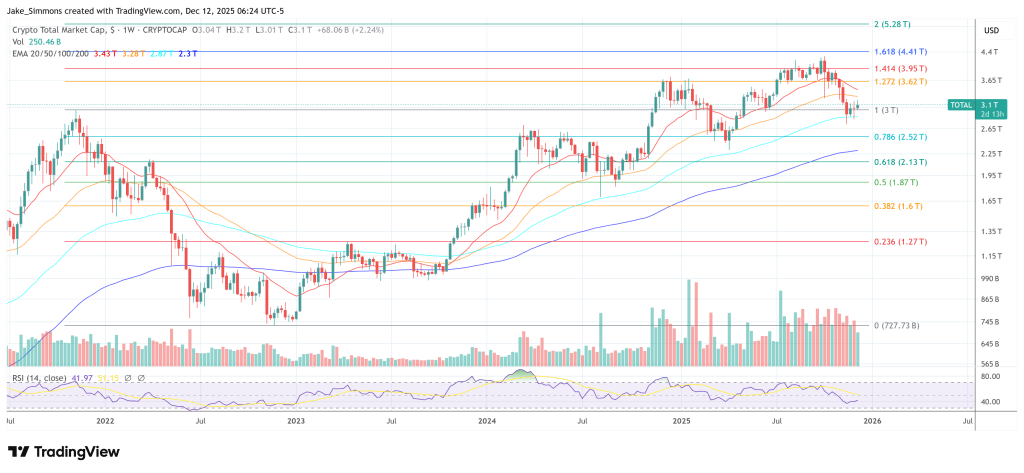
At press time, the total crypto market cap stood at $3.1 trillion.
Young Hoon Kim — the social-media personality who styles himself as the “IQ 276” record holder — just gave the XRP crowd a fresh piece of rocket fuel. “I buy XRP from now on,” Kim wrote on X on Friday, in what appears to be his first straight-up XRP shoutout after days of near-constant Bitcoin evangelizing.
And, yeah, the XRP Army did what it always does: it treated the post like a mini event. “The smartest man in the world is buying XRP,” one account, Gordon (@GordonGekko), replied — then immediately stapled the other big narrative of the day onto it: “XRP is now on Solana too. Is this the start of an XRP rally?”
That second line isn’t just vibes. Solana’s official account posted “BREAKING: XRP is coming to Solana,” pointing to a wrapped-asset setup that would let XRP trade and move inside Solana DeFi rails.
Hex Trust, which is positioning itself as issuer/custodian for the wrapped token (wXRP), says the product is designed to be 1:1 backed and redeemable for native XRP, using LayerZero’s OFT standard and launching “starting with Solana” (with more chains name-checked).
So Kim’s timing, intentional or not, landed right on top of a very convenient distribution channel: “XRP, but DeFi-ready.” If you’re an XRP holder who’s been watching Solana soak up memecoin liquidity and on-chain volume for the past year, that’s an easy story to forward to your group chat.
The funny part is Kim’s recent persona has leaned hard into Bitcoin-maxi prophecy. In the last week alone, he made dozens of Bitcoin posts via X. On December 7, he posted: “In my personal view, Bitcoin’s current price is just a temporary discount caused by what seems to be market manipulation. I think any such manipulation may disappear within a week, and then it could start accelerating toward a new ATH.”
Just a few days later, on December 10, he wrote: “My analysis suggests that Bitcoin may have set its bottom a few weeks ago, and we could now be entering a true supercycle.” One day later, he added: “”My analysis suggests that Bitcoin reaching 300K in early 2026 is a logical scenario.”
Yesterday, Kim posted: “Bitcoin looks ready to break every prediction ever written. The real bull run begins when people think it’s already over,” before adding today: “I think Bitcoin is the money of God” and “In my view, one of the fastest ways to get rich is to stack Bitcoin.”
So why the sudden XRP detour? No explanation yet, at least publicly.
There’s also the reality that Kim is, politely put, controversial. Korean coverage has described him as being reported as an “IQ 276” holder tied to mind-sports organizations, but the broader profile has drawn scrutiny and debate online, with questions about verifiability and sourcing trailing the “world’s highest IQ” framing.
Still, crypto doesn’t really wait for footnotes. A big claim, a big ticker, a hot comment section — and now an XRP-to-Solana headline to glue it together. That’s plenty for a one-day narrative.

 Login
Login