❌

Reading view

There are new articles available, click to refresh the page.

Why Bitcoin’s Quiet Price Action May Be β€˜Dangerous’ – IFP Signals Rising Structural Risk

Bitcoin continues to struggle below the $90,000 level, failing to reclaim higher ground as bulls focus on defending current demand zones. After a sharp correction from recent highs, price action has entered a consolidation phase that, on the surface, appears relatively calm. Volatility has compressed, and short-term price movements suggest a market pausing rather than decisively breaking down. However, this apparent stability may be misleading.

According to a CryptoQuant report from XWIN Research Japan, on-chain data is signaling growing structural risk beneath the surface. The Inter-Exchange Flow Pulse (IFP), a metric that tracks the movement of Bitcoin between exchanges and serves as a proxy for internal market liquidity, has turned red.

In such environments, price moves tend to be sharper and less orderly once direction is established. While reduced exchange balances can limit immediate selling pressure, they also amplify the impact of sudden demand or forced liquidations.

This shift indicates a clear slowdown in capital circulation across trading venues, suggesting that liquidity conditions are deteriorating.

Inter-Exchange Flow Pulse Signals Structural Fragility

The report explains that the Inter-Exchange Flow Pulse (IFP) measures how actively Bitcoin moves from one exchange to another, serving as a proxy for internal market liquidity and capital circulation. When IFP is elevated, capital rotates efficiently across venues, arbitrage opportunities are quickly absorbed, and liquidity providers keep order books deep.

Bitcoin Inter-exchange Flow Pulse | Source: CryptoQuant

In those conditions, price discovery is smoother, and volatility tends to remain contained. By contrast, when IFP declines, the market’s internal β€œblood flow” weakens. Capital becomes static, liquidity fragments, and prices grow increasingly sensitive to relatively small trades.

This deterioration in liquidity is unfolding alongside historically low exchange balances. While reduced sellable supply can initially act as price support, it also creates thinner order books. Once price begins to move decisively in either direction, slippage increases and volatility accelerates.

With leverage still elevated across derivatives markets, instability becomes driven less by directional conviction and more by the magnitude of forced reactions.

Historically, periods when IFP turned red produced abrupt corrections and sharp price swings, not clean trends. The central risk today is therefore not aggressive distribution, but structural fragility. Until inter-exchange liquidity improves, Bitcoin remains vulnerable to sudden, outsized moves, making leveraged positioning particularly risky in the current market structure.

Bitcoin Price Consolidates Below Key Moving Averages

The 4-hour Bitcoin chart highlights a market locked in consolidation after a sharp corrective move. Following the aggressive sell-off in late November, BTC found a local bottom near the $82,000–$83,000 zone, where strong demand stepped in and triggered a rebound. However, that recovery quickly lost momentum, and price is now ranging below the descending cluster of moving averages.

BTC consolidates in a short-term range | Source: BTCUSDT chart on TradingView

Bitcoin is currently trading around the $89,000–$90,000 level, repeatedly failing to reclaim the 200-period moving average on the 4-hour timeframe. The 50 and 100 moving averages are also sloping downward, acting as dynamic resistance and reinforcing the short-term bearish structure. Each attempt to push higher has been met with selling pressure, suggesting that bulls lack conviction at current levels.

Volume has noticeably contracted during this consolidation phase, indicating reduced participation and indecision among traders. This typically precedes a volatility expansion, especially when price compresses beneath major resistance. Structurally, BTC remains vulnerable as long as it trades below the $92,000–$94,000 zone, which previously acted as support and now caps upside attempts.

On the downside, the $87,000–$88,000 range is emerging as immediate support. A decisive breakdown below this area could reopen the path toward the $84,000 region. Until a clear breakout occurs, Bitcoin remains in a fragile balance between distribution and base-building.

Featured image from ChatGPT, chart from TradingView.com

Market Stress Continues As Bitcoin STH SOPR Dips Below 1– When Will The Pain End?

Bitcoin continues to struggle below the $90,000 level, failing to reclaim key resistance as bulls attempt to defend current demand zones. Price action reflects a market under pressure, with momentum fading after a prolonged correction. From its all-time high, Bitcoin has now retraced roughly 30%, placing the asset firmly in a corrective phase where uncertainty and caution dominate trading behavior.

According to a report from Axel Adler, on-chain data confirms that market stress is no longer limited to price alone. Two key indicatorsβ€”the Short-Term Holder Spent Output Profit Ratio (STH SOPR) and the P/L Blockβ€”are signaling broad loss realization among participants and a deterioration in overall market sentiment.

These metrics provide insight into the behavior of short-term holders, who are often the most sensitive to price swings and macro uncertainty. Together, these signals suggest that Bitcoin remains in a fragile state, where confidence has weakened, and recovery attempts face increasing resistance.

STH SOPR and P/L Block Confirm Capitulation Pressure

Adler explains that the Short-Term Holder Spent Output Profit Ratio (STH SOPR) measures whether coins held for less than 155 days are being sold at a profit or a loss. When the indicator falls below one, it signals that recent buyers are realizing losses.

Currently, the 7-day moving average of STH SOPR has slipped into the red zone, with a reading near 0.99. This confirms that short-term holders are, on average, selling Bitcoin below their acquisition priceβ€”a behavior typically associated with heightened stress and emotional selling.

Bitcoin Short-Term Holder SOPR Dashboard | Source: Axel Adler

Historically, similar SOPR conditions have marked local capitulation phases, when selling pressure peaks and weaker hands exit the market. As long as the SOPR 7-day average remains below one, short-term participants stay in β€œstress mode.”

Adler notes that a meaningful improvement would require a sustained move back above one on a daily close, signaling that sellers have exhausted supply and buyers are once again absorbing sell-side pressure.

Complementing this signal, the P/L Block indicator tracks the aggregated profit and loss state of market participants. The current red block reflects loss dominance, with a P/L Score of minus threeβ€”classified as pronounced stress.

With Bitcoin down 30% from its all-time high and 30-day returns negative, both indicators align, reinforcing a clear picture of capitulation among short-term holders.

Bitcoin Price Analysis: Weekly Structure Remains Critical

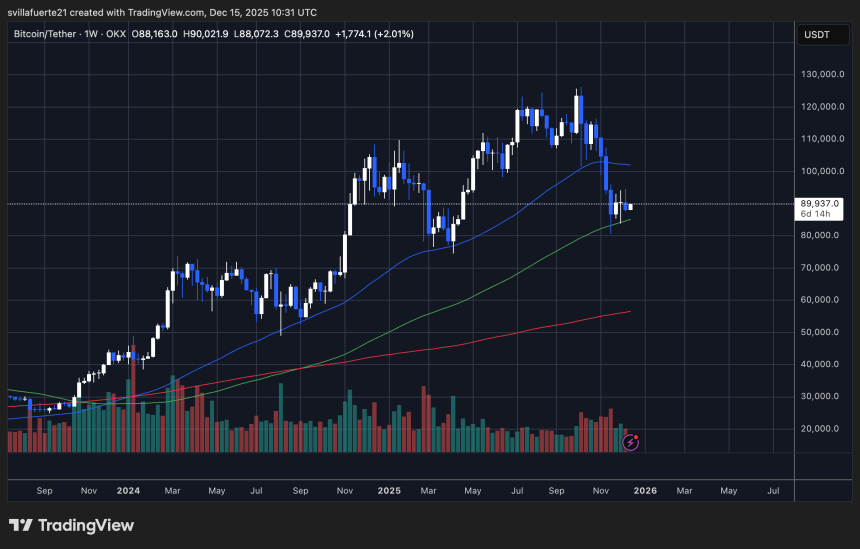
The weekly chart shows Bitcoin trading around the $89,900 level after a sharp rejection from the $120,000–$125,000 region. Price has retraced aggressively but is now attempting to stabilize above the rising 200-week moving average (green), a level that has historically defined long-term trend validity. So far, this area is acting as dynamic support, suggesting that buyers are defending higher-cycle structure despite broader market weakness.

BTC consolidates above key SMA | Source: BTCUSDT chart on TradingView

However, Bitcoin remains below the 50-week moving average (blue), which is now sloping downward. This configuration reflects a loss of medium-term momentum and confirms that the market is still in a corrective phase rather than a resumed uptrend.

The 100-week moving average (red) continues to rise well below price, reinforcing that the broader macro trend remains intact, but also highlighting how much excess was built during the prior rally.

Volume has declined during the recent consolidation, signaling indecision rather than aggressive accumulation. This typically precedes a volatility expansion. From a structural perspective, holding above the $85,000–$88,000 zone is critical. A sustained breakdown below the 200-week MA would increase the probability of a deeper retracement toward the $75,000–$80,000 region.

Conversely, reclaiming the 50-week MA near $95,000 would be an early signal that downside pressure is fading. Until then, Bitcoin remains range-bound, with long-term support holding but momentum still fragile.

Featured image from ChatGPT, chart from TradingView.com

❌