❌

Reading view

There are new articles available, click to refresh the page.

DMND Pool Now Open To All Miners, With SOC 2 Compliance and Stratum V2 Support

By: Shinobi

Bitcoin Magazine

DMND Pool Now Open To All Miners, With SOC 2 Compliance and Stratum V2 Support

DMND, a new mining pool built around Stratum V2 which began taking applicants for a soft private launch earlier this year, is now open for all miners to create accounts. Miners can register here to begin onboarding.Β 

DMND’s full public launch comes after a successful SOC 2 Type 2 audit, proving compliance with security policies necessary for large scale miners.Β 

β€œWith our SOC 2 Type 2 compliance and streamlined business verification practices, the DMND pool is built for operators who value security, transparency, and professional-grade standards,” said DMND Co-Founder & CEO, Alejandro De La Torre. β€œCombined with miner-controlled block construction, we’re enabling miners to reclaim meaningful control over the network.”

Stratum V2 support takes a significant step on the road to further decentralization of different functionality in the mining industry, namely block template construction, the process of selecting transactions to include in the block being mined.Β 

Stratum V2 provides a mechanism to defend Bitcoin’s censorship resistance, allowing individual miners to produce their own block templates while mining with supporting pools (as well as sourcing templates from any third party provider they choose who is operating Stratum V2). Additionally, Stratum V2’s end-to-end encryption protects miners from hashrate hijacking attacks which can silently siphon a miner’s revenue.Β 

DMND’s public launch provides miners with another step forward for Stratum V2 on the network, and for progress towards improving the mining ecosystem’s level of decentralization.Β 

This post DMND Pool Now Open To All Miners, With SOC 2 Compliance and Stratum V2 Support first appeared on Bitcoin Magazine and is written by Shinobi.

Brink Funds First Third Party Security Audit of Bitcoin Core By Quarkslab

By: Shinobi

Bitcoin Magazine

Brink Funds First Third Party Security Audit of Bitcoin Core By Quarkslab

Brink, the Bitcoin development organization, recently funded the first ever independent security audit of Bitcoin Core conducted by a third party (the full report is available here). The audit was conducted by Quarkslab, a software security firm, with the help of the Open Source Technology Improvement Fund (OSTIF) and collaboration with Bitcoin Core developers Niklas GΓΆgge, from Brink, and Antoine Poinsot, from Chaincode Labs.Β 

This security audit marks a milestone in the development history of Bitcoin Core, the most widely adopted and reference client of the Bitcoin network and protocol.Β 

While Bitcoin Core security policies and practices have been steadily hardened and revised to be more thorough and comprehensive over the last few years, an external audit by a third party specialized in security review is a new bar to meet. It was met.Β 

The audit involved manual code review, static and dynamic analysis with automated tools, and advanced fuzz testing, which takes automatically generated input and runs it through different code paths attempting to reveal unexpected or detrimental behavior.Β 

No critical, high, or medium-severity bugs were discovered in the audit. Two low-severity issues were different, and thirteen other issues that are not classified as vulnerabilities under Bitcoin Core’s vulnerability classification criteria.Β 

The entire process also resulted in improvements in Bitcoin Core’s testing infrastructure, including new fuzz testing infrastructure for block connection and chain reorganization scenarios, a new area to be covered by testing, file system improvements speeding up and improving fuzz testing in general, new utilities for testing back sliding code performance, and suggestions for improving code readability for reviewers and new developers.Β 

Some of these improvements are already being worked on for eventual review and merging into the Bitcoin Core repository.Β 

The results of this independent security audit have reinforced that Bitcoin Core’s improvements over recent years in security policy, testing, and overall quality review have had a meaningful impact on the project.Β 

This post Brink Funds First Third Party Security Audit of Bitcoin Core By Quarkslab first appeared on Bitcoin Magazine and is written by Shinobi.

What Has Bitcoin Become 17 Years After Satoshi Nakamoto Published The Whitepaper?

By: Shinobi

Bitcoin Magazine

What Has Bitcoin Become 17 Years After Satoshi Nakamoto Published The Whitepaper?

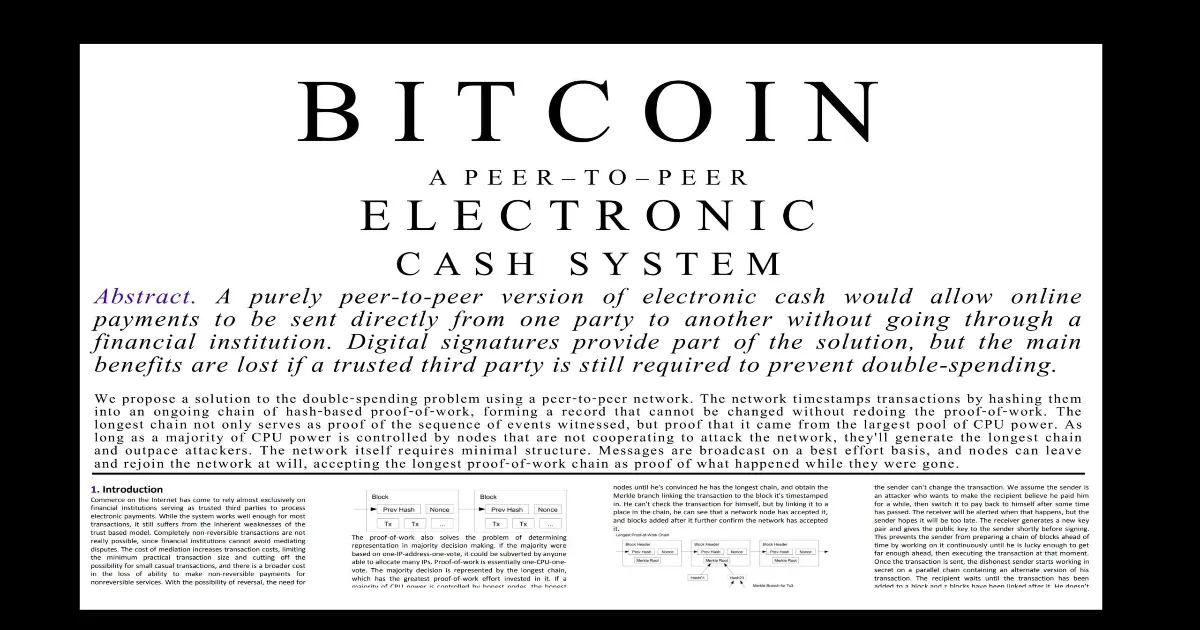
Today marks seventeen years since Satoshi Nakamoto’s publication of the Bitcoin Whitepaper on the cryptography mailing list in 2008. Back then Bitcoin was nothing more than a proposal for a new niche technology, the latest in a long lineage of niche technologies created by the cypherpunks of the 1990s.Β 

Bitcoin has gone through many massive transformations since that day 17 years ago. It went from a niche internet collectible, to a decentralized network powering illegal dark net markets, to a mainstream speculative investment for retail, to Wall Street and governments all over the world’s favorite new asset class. We have all had front row seats to the first explosive global technological revolution to the internet, and it’s been a wild ride.Β 

On this anniversary I think it’s important to touch on a concept that is very relevant, POSIWID, or the Purpose Of A System Is What It Does. The basic idea is that when you have a complex system, it is pointless to try to define it based on what you want it to do, what really matters is what the pieces of that complex system are actually doing. That is all that matters at the end of the day.Β 

We have once again found ourselves in a time period where people are calling back to the whitepaper as a placeholder for some kind of founding document, or definition, or blueprint. The whitepaper is none of those things. It is simply a high level abstract explanation of a Proof-of-Work blockchain being used to implement a digital currency. It is the idea of a cart with wheels, versus the actual blueprint of the cart (the source code).Β 

Bitcoiners seem to periodically fixate on the whitepaper in this manner, and inevitably use that as a justification for acting antagonistic towards some use case or idea of improving Bitcoin that they disagree with. Maybe we will eventually get past this, maybe we won’t, but it is an unhealthy attitude to have towards such a potentially impactful technology such as Bitcoin.Β 

People didn’t recite the writings and speeches of Alexander Graham Bell when digital modems were invented to allow the first tendrils of the early internet to reach out between devices and facilitate digital signals flowing between them. They embraced it as a valuable technological innovation, and in the world today that dynamic has completely inverted itself. Most telephonic signals are now actually conveyed by communication mediums specifically constructed for digital communications.Β 

Telephone networks were used to bootstrap the digital medium of the modern internet in a way that Alexander Graham Bell might have had only the barest inklings of, reshaping the entire world in ways that would have been impossible to conceive for people of his generation.Β 

Satoshi did not give us a founding document to be shackled and constrained by when he released the whitepaper, he gave us a high level description of the software that followed.Β 

That is the actual gift he gave us, the software. And he gave it to us completely freely, open-source, to do with what we decide to do.Β 

β€œBitDNS users might be completely liberal about adding any large data features since relatively few domain registrars are needed, while Bitcoin users might get increasingly tyrannical about limiting the size of the chain so it’s easy for lots of users and small devices.” -Satoshi Nakamoto, 2010

This quote is always brought up in the context of the blocksize limit, or Bitcoin enabling multiple functionalities, but the thing that has always stood out the most to me is β€œusers might get.” In the end before his disappearance, Satoshi is clearly being explicitly deferential to the wishes of users, and in the context of a critical and foundational decision like the blocksize limit.Β 

Bitcoin isn’t Satoshi’s anymore, it’s ours, and collectively with how we actually use our bitcoin, we decide what the purpose of the system is. It’s important to remember that.Β 

This post What Has Bitcoin Become 17 Years After Satoshi Nakamoto Published The Whitepaper? first appeared on Bitcoin Magazine and is written by Shinobi.

❌