Reading view

There are new articles available, click to refresh the page.

Bitcoin Mining Hit Hard: 10% Hashrate Loss Linked To China Shutdowns

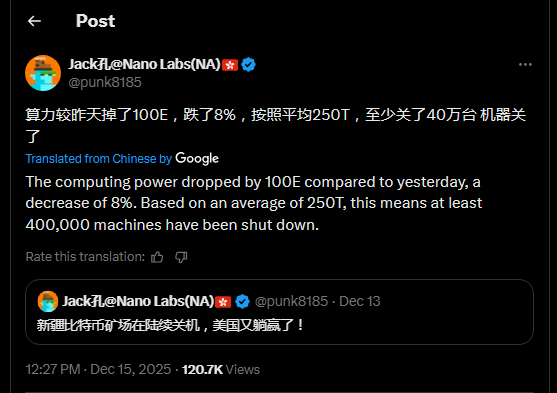
According to a post by former Canaan (a Chinese tech company) executive Jianping Kong, Bitcoin’s estimated hashrate fell roughly 10% in a single day, sliding from about 1,053 TH/s to just under 943 TH/s.

Kong said the decline equated to roughly 100 TH/s to 110 TH/s lost since Sunday and blamed the change on mining farms in China’s Xinjiang region shutting down.

He wrote that “at least 400,000 machines” were taken offline, using an assumed rate of 250 TH/s per ASIC as his basis.

China Mining Instability

Based on reports, China remains a volatile source of hashrate. Before 2021, China supplied a majority of the network’s computing power. Now estimates place its share closer to 14% to 20% depending on the data provider.
Cheap power has drawn miners back, but political and regulatory swings can push large clusters off the grid with little warning.

Kong framed the recent shutdowns bluntly, saying the temporary loss hands an advantage to other countries, adding that “the US wins without lifting a finger.”

Impact On Network

Data recorded the drop from 1,053 TH/s to about 943 TH/s, a decline of just over 110 TH/s and roughly 10%. That kind of move can change mining conditions.

Blocks may be found a little slower until the next difficulty adjustment. The network’s total hashrate is always an estimate inferred from on-chain data, so exact figures are not precise, but the size of this swing is large enough to show how concentrated pockets of mining can still move global metrics.

Kong’s machine-count estimate — and the 250 TH/s-per-ASIC figure he used — are his calculations, not a confirmed inventory count from operators on the ground.

Bitcoin Mining Operations And Market Shifts

Reports have disclosed that US mining companies are expanding capacity as global hashrate reallocates.

Hut 8 announced it is building four new mining sites in Texas, Louisiana and Illinois, adding 1.5 gigawatts of power capacity.

American Bitcoin, a company tied to the Trump family, is now part of that growth story; the firm acquired a fleet of 16,299 Antminer U3S21EXPH units from Bitmain and its board includes Eric Trump, the second-eldest of US President Donald Trump’s three sons. These moves underline a clear shift in where large-scale mining is happening.

Featured image from Unsplash, chart from TradingView

Crypto Firms Face Daily ‘Fake Zoom’ Attacks Linked To North Korea, Experts Say

North Korean-linked hackers are using fake Zoom calls to drain crypto wallets in what security researchers say has become a near-daily threat to the cryptocurrency community. According to multiple security reports, the campaign has already netted roughly $300 million in stolen funds and shows few signs of slowing.

Fake Zoom Meetings Used To Drain Wallets

According to Security Alliance (SEAL) and other researchers, attackers first contact targets through messaging apps such as Telegram. They then invite victims to a video call that looks legitimate.

During the call, the impostors claim there is a problem with sound or video and offer a “fix” — a file or a link that appears to be an official update. When the victim runs the file, malware installs and begins stealing credentials, browser data, and crypto keys.

Several attacks are reported every day, and many follow the same pattern. Researchers say these staged calls let attackers bypass normal caution because people tend to trust someone they see on camera.

SEAL is tracking multiple DAILY attempts by North Korean actors utilizing “Fake Zoom” tactics for spreading malware as well as escalating their access to new victims.

Social engineering is at the root of the attack. Read the thread below for pointers on how to stay secure. https://t.co/2SQGdtPKGx

— Security Alliance (@_SEAL_Org) December 13, 2025

NimDoor, Other Malware Strains Target macOS And Wallets

Based on reports, one strain tied to these schemes is NimDoor, a macOS backdoor that can harvest keychain items, browser-stored passwords, and messaging data.

Security teams link NimDoor and related tools to BlueNoroff, a group connected to the Lazarus Group network. BlueNoroff has a long record of attacking crypto firms and exchanges.

Once the malware is in place, wallets have been emptied within minutes. Victims often discover the theft only after seeing outgoing transactions on the blockchain.

Deepfakes And Calendar Invites Make Scams More Convincing

Researchers warn that attackers are not simply using fake names. They are also deploying AI-assisted deepfake video and voice tools to impersonate executives or known contacts.

Attackers sometimes send calendar invites that look like genuine meeting requests from platforms such as Calendly, directing targets to attacker-controlled Zoom links.

The level of social engineering makes the calls seem urgent and official, which reduces the time victims take to question what they are being asked to install.

Attackers Target Individuals And Small Firms Alike

Reports have disclosed that victims include individual traders, startup employees, and small teams at crypto companies. Losses are concentrated but widespread, with estimates around $300,000,000.

Some victims have lost funds tied to browser wallets and hot wallets; others had recovery phrases captured and used to drain accounts.

Security teams urge quick action when a suspicious update is offered during a remote session: They warn not to run it, verify separately, and treat unsolicited meeting fixes as high risk.

Featured image from Unsplash, chart from TradingView

Ethereum Meets Wall Street: JPMorgan Rolls Out Tokenized Fund

JPMorgan Asset Management has introduced a tokenized money-market fund built on the Ethereum blockchain, according to company filings and industry reports.

The fund, called My OnChain Net Yield Fund (MONY), issues shares as digital tokens that live on the public Ethereum network and are aimed at qualified investors through the bank’s Morgan Money platform.

JPMorgan Issues Tokenized Fund On Ethereum

Based on reports, MONY holds familiar, low-risk instruments such as US Treasury securities and repurchase agreements fully backed by Treasuries.

The bank says the token shares represent direct ownership of the fund and can be held at blockchain addresses, opening up on-chain settlement and recordkeeping for a product that normally sits in traditional custody systems.

Seeded With $100 Million

Reports have disclosed that JPMorgan seeded MONY with $100 million of its own capital at launch. The move is meant to kickstart liquidity and show institutional seriousness about putting cash management products on-chain.

The tokenization work is being handled by internal teams tied to JPMorgan’s digital-assets efforts, and the bank has been testing ways to move conventional securities into token form for several years.

How The Tokens Work And Who Can Use Them

Investors receive tokenized fund shares that may be transferred or recorded on Ethereum. Based on reports, access is limited: the fund is offered only to qualified clients via Morgan Money, not to the general retail public.

The token structure mirrors traditional fund economics — holders are exposed to the same short-term instruments that underpin money-market products — but the record of ownership is stored on a public ledger.

Qualified Investors And Access

According to coverage, institutional clients with asset levels above $25 million and accredited individuals with at least $5 million are among those eligible, and the minimum initial investment sits at roughly $1 million.

That narrow access aligns with regulatory guardrails for tokenized securities and with the bank’s goal of serving big, sophisticated cash managers first.

Analysts say the launch is part of a broader push by big asset managers to experiment with tokenized share classes and on-chain settlement.

Other firms have run pilots with similar ideas, and some have already put cash-like products on Ethereum. Based on reports, the move points to an industry desire to test whether blockchain can speed up settlement, increase transparency, or create new on-chain liquidity for institutional cash flows.

Featured image from Unsplash, chart from TradingView

UK To Bring Crypto Under Financial Services Laws By 2027

According to reports, the UK Treasury will extend existing finance laws to cover cryptoasset firms, with the new rules set to take effect in October 2027.

This means exchanges, wallet providers and other crypto service companies will move beyond current anti-money-laundering registration and into the same regulatory space as banks and brokers.

Regulators To Apply Existing Rules

Based on statements from ministers and officials, the Financial Conduct Authority will be the main supervisor for the sector. Firms will be required to meet standards on reporting, governance and customer protections similar to those applied in traditional finance.

The shift is described as bringing clarity for businesses that want to operate long term in the UK, while giving regulators tools to act against fraud and market abuse.

UK TO REGULATE CRYPTO UNDER FINANCIAL LAW FROM 2027

– The UK will bring cryptocurrencies like Bitcoin under full financial regulation from 2027, placing crypto alongside traditional financial products, per Reuters.

– The Treasury plans to extend existing financial laws to… pic.twitter.com/RhWK96NN51

— BSCN (@BSCNews) December 15, 2025

Consumer Safeguards And Market Integrity

Reports have disclosed that one of the core aims is stronger consumer protection. Officials say the changes will help block bad actors and reduce scams, and that the Treasury is also considering tighter rules around political donations made with crypto. The move follows a series of high-profile fraud cases and growing public concern about safety in crypto markets.

The road to full regulation will be gradual. The Treasury has circulated draft legislation and ministers expect complementary rules from the FCA and the Bank of England to be ready by the end of 2026, ahead of the legal regime going live in 2027. Consultations and regulatory sandboxes are under way, giving firms time to adjust.

How This Compares Internationally

Based on reports, the UK’s plan is being framed more like the US approach than the EU’s Markets in Cryptoassets (MiCA), which was introduced in 2024.

Officials say closer alignment with US practice should help international firms that operate across borders, but it also raises questions about how UK rules will differ from both US and EU requirements in practice.

A draft bill has been prepared and it has had only minor edits since first being published, according to government sources.

Industry responses are mixed: some firms welcome the certainty, while lawyers and trade groups want clearer detail on how existing conduct rules will apply to crypto business models. The FCA is running targeted workstreams, including tests for stablecoin issuers and custody providers.

Featured image from Unsplash, chart from TradingView

Shiba Inu Remains A Familiar Crypto Name As Losses Pile Up

Shiba Inu has kept a spot in crypto talk even as its price has slid sharply. According to reports, the network had a market cap of $5 billion as of Dec. 6, and it still draws attention because people know the name. That visibility, however, does not settle the debate over whether the token belongs in a long-term portfolio.

Shiba Inu’s Price And Market Size

Based on reports, Shiba Inu has seen massive moves over several years. Roughly five years ago it traded near $0.0000000001684; at the time of writing, it is quoted at about $0.000008439.

SHIB’s all-time high stands at $0.00008845, which means the token trades roughly 85% below that peak. Reports have disclosed that SHIB has tanked about 55% so far this year, and some data points show almost a 60% decline over a recent 12-month span. Those drops have pushed many investors to ask whether the story that once lifted SHIB has faded.

On-Chain Signals And Holder Counts

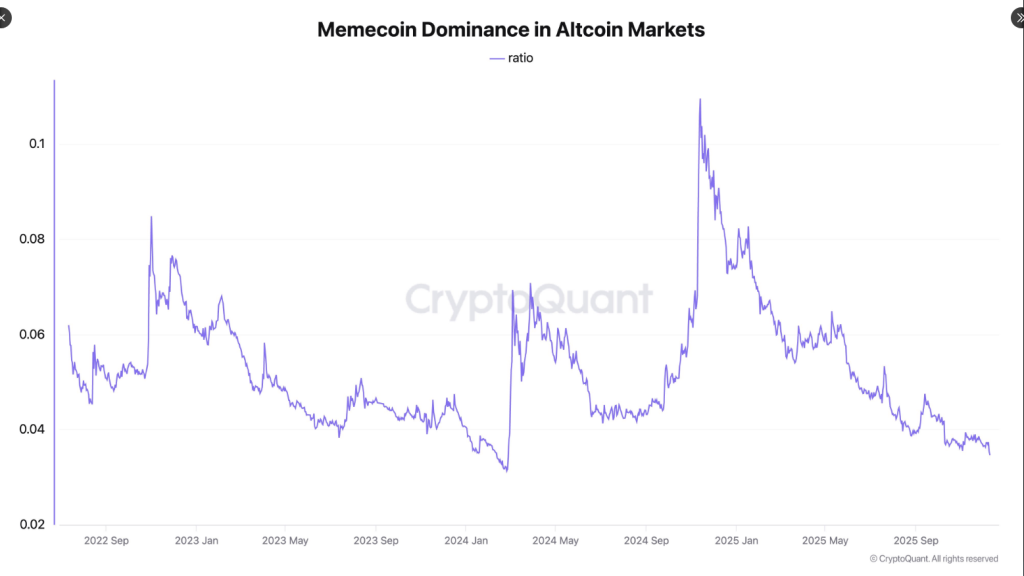
There are mixed signals on the chain. Data from CryptoQuant is reported to show memecoin dominance falling to its lowest level since early 2024, a sign that speculative interest across similar tokens has ebbed.

At the same time, the number of wallets holding SHIB moved from about 1.45 million at the start of the year to around 1.52 million more recently. That jump in holders was noted alongside the price slide. It suggests distribution rather than complete abandonment; small increases in holders do not always mean increased trading activity, but they can show steady retail interest.

Memecoin markets are dead. pic.twitter.com/6kymLWH4JX

— Ki Young Ju (@ki_young_ju) December 11, 2025

Pundit Views And The Utility Question

Meanwhile, crypto pundit Neil Patel has listed reasons he would not treat Shiba Inu as a proper investment. He argues the memecoin doesn’t solve a clear, large-scale problem and points out that developer activity for SHIB is limited compared with many other networks.

The claim is that much of SHIB’s value has been driven by hype cycles and not by broad real-world use. Those views were presented in firm terms, and they have been repeated across a range of commentaries that warn about hype-driven tokens.

Investor Takeaways And Risks

Investors who want exposure to crypto are often told to look at major networks such as Bitcoin for scarcity-driven arguments; that point was brought up in several reports. At the same time, SHIB’s supporting projects — a layer-two chain, a decentralized exchange, a metaverse concept — are real but appear to have small adoption so far.

Featured image from Unsplash, chart from TradingView
Bitcoin Could Drop To $70K As Bank Of Japan Rate Move Approaches—Analysts

Bitcoin risks a further drop toward the $70,000 area if the Bank of Japan follows through with an expected interest-rate rise on Dec. 19, analysts focused on macro forces warned.

According to multiple macro-focused voices, the move could sap global liquidity and put fresh downward pressure on risk assets, with some traders already bracing for a sharp pullback.

Japan’s policy shift matters because higher rates tend to strengthen the yen and raise the cost of borrowing. When that happens, traders who previously borrowed cheaply in yen to invest elsewhere are often forced to unwind those positions.

That process can pull money out of global markets in a short period of time, and Bitcoin has often felt that impact as investors cut exposure during risk-off stretches.

BOJ Tightening Drains Global Liquidity

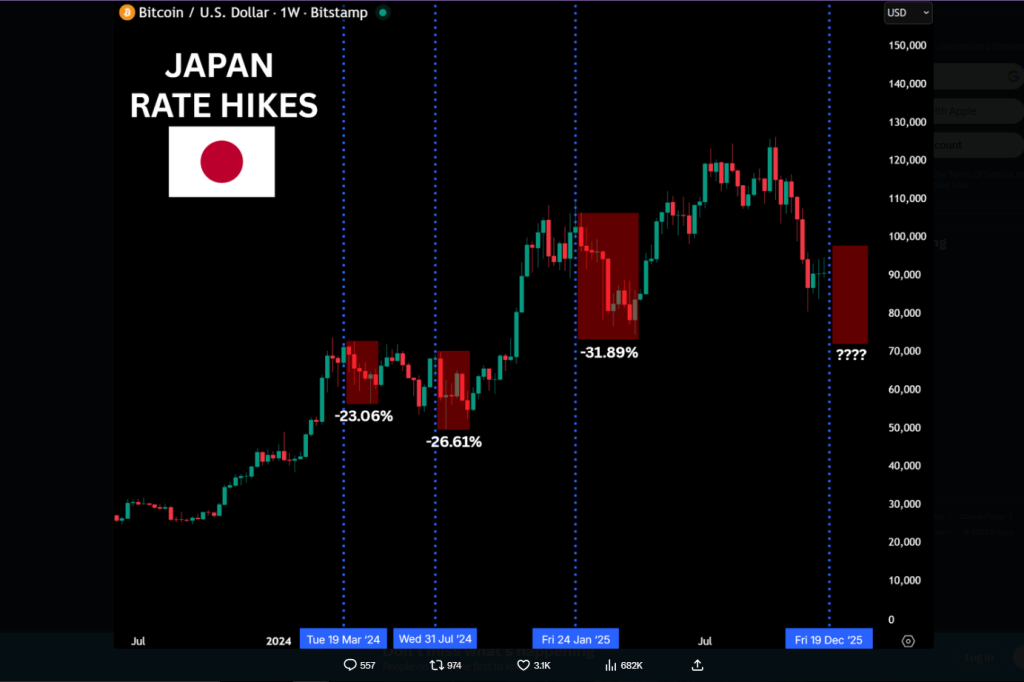
According to AndrewBTC, every BOJ hike since 2024 has coincided with Bitcoin drawdowns of more than 20%. Based on reports, the analyst pointed to declines of roughly 23% in March 2024, 26% in July 2024, and 31% in January 2025.

🚨 BREAKING: JAPAN WILL CRASH $BTC

Bank of Japan is set to hike rates +25 bps on Dec 19. Japan = largest holder of US government debt 🇯🇵

📉 Look at the $BTC chart:

Every BoJ rate hike → Bitcoin dumps over 20%+👇

• March 2024 → -23% • July 2024 → -26% • January 2025 →… pic.twitter.com/grN3QRNUg4

— AndrewBTC (@cryptoctlt) December 13, 2025

Traders are not only watching central bank calendars. Bitcoin’s daily chart also flashed a classic bear flag formation after a steep fall from the $105,000–$110,000 area in November.

Market Positioning Widens Ahead Of Key Data

Bitcoin slipped below $90,000 in thin trading on Sunday, a move that traders took as a cautionary sign rather than a definitive trigger. Based on reports, Ether held up better than many altcoins, suggesting selective risk taking in the market.

Traders are positioning before a busy slate of US data and central bank events that could sway flows. Analyst EX bluntly warned BTC will collapse “below $70,000” under the stated macro conditions, a stark forecast that highlights how crowded bets can amplify moves when liquidity is pulled.

EVERY TIME JAPAN HIKES RATES, BITCOIN DUMPS 20–25%

NEXT WEEK, THEY WILL HIKE RATES TO 75 BPS AGAIN.

IF THE PATTERN HOLDS, $BTC WILL DUMP BELOW $70,000 ON DECEMBER 19.

POSITION ACCORDINGLY. pic.twitter.com/IWU8JbXjn3

— ΞX (@rektbyEX) December 13, 2025

What This Means For Investors

The story tying BOJ policy to Bitcoin’s swings is simple in outline: when funding costs in Japan rise, global borrowing becomes pricier, and risk assets can be sold as positions are reduced.

That dynamic helps explain why past BOJ moves lined up with 20-30% declines in Bitcoin. Still, markets often try to price events ahead of time; a hike that’s already built into prices may have a smaller effect than one that comes as a surprise.

Featured image from Nikkei Asia, chart from TradingView

Crypto Wallets Targeted In JavaScript Library Exploit—Cybersecurity Firm

A critical flaw in React Server Components is being used by attackers to inject malicious code into live websites, and that code is siphoning crypto from connected wallets.

Reports note that the vulnerability, tracked as CVE-2025-55182, was published by the React team on December 3 and carries a maximum severity rating.

Cybersecurity firm Security Alliance (SEAL) has confirmed that multiple crypto websites are actively being targeted, and they urge operators to review all React Server Components immediately to prevent wallet-draining attacks.

Security teams say the bug allows an unauthenticated attacker to run code on affected servers, which has been turned into wallet-draining campaigns across several sites.

A Wide Risk To Sites Using Server Components

SEAL said the flaw affects React Server Components packages in versions 19.0 through 19.2.0, and patched releases such as 19.0.1, 19.1.2, and 19.2.1 were issued after disclosure.

Crypto Drainers using React CVE-2025-55182

We are observing a big uptick in drainers uploaded to legitimate (crypto) websites through exploitation of the recent React CVE.

All websites should review front-end code for any suspicious assets NOW.

— Security Alliance (@_SEAL_Org) December 13, 2025

The vulnerability works by exploiting unsafe deserialization in the Flight protocol, letting a single crafted HTTP request execute arbitrary code with the web server’s privileges. Security teams have warned that many sites using default configurations are at risk until they apply the updates.

Attackers Inject Wallet-Draining Scripts Into Compromised Pages

According to industry posts, threat actors are using the exploit to plant scripts that prompt users to connect Web3 wallets and then hijack or redirect transactions.

In some cases the injected code alters the user interface or swaps addresses, so a user believes they are sending funds to one account while the transaction actually pays an attacker. This method can hit users who trust familiar crypto sites and connect wallets without checking every approval.

Scanners And Proof-Of-Concepts Flooded Underground Forums

Security researchers report a rush of scanning tools, fake proof-of-concept code, and exploit kits shared in underground forums shortly after the vulnerability was disclosed.

Cloud and threat-intelligence teams have observed multiple groups scanning for vulnerable servers and testing payloads, which has accelerated active exploitation.

Some defenders say that the speed and volume of scanning have made it hard to stop all attempts before patches are applied.

More Than 50 Organizations Reported Compromise Attempts

Based on reports from incident responders, post-exploitation crypto activity has been observed at more than 50 organizations across finance, media, government, and tech.

In several investigations, attackers established footholds and then used those to deliver further malware or to seed front-end code that targets wallet users.

SEAL has emphasized that organizations failing to patch or monitor their servers could experience further attacks, and ongoing monitoring is essential until all systems are verified safe.

Featured image from Unsplash, chart from TradingView

Bitcoin Pulls Back Under $89K, Michael Saylor Smells Opportunity

Strategy chair Michael Saylor signaled that his firm may add to its Bitcoin holdings just as the market slid again on Sunday, a move that kept traders on edge and fed fresh debate over what is driving the declines.

Back To More Orange Dots

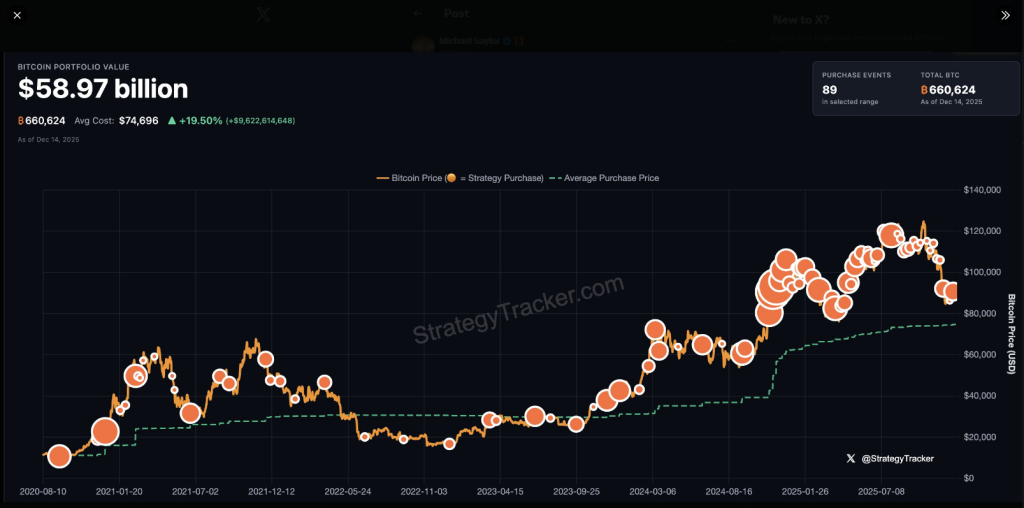
According to a post on X, Saylor shared a chart with the phrase “Back to More Orange Dots,” a shorthand that investors interpret as fresh buying.

Based on reports tracked by SaylorTracker, Strategy bought 10,624 BTC on Dec. 12 — its biggest single purchase since late July.

The firm now holds about 660,624 BTC, which at current prices is worth roughly $58.5 billion, and its average cost per coin stands at $74,696.

₿ack to More Orange Dots. pic.twitter.com/rBi1aagDVO

— Michael Saylor (@saylor) December 14, 2025

Sunday Wick, Low Liquidity

Bitcoin briefly dipped to a two-week low near $87,750 in late trading on Sunday, before climbing back above $89,000 by the time of writing.

Traders pointed to a familiar pattern: quick wick-downs on weekends when liquidity is thin. Ether showed relative strength while major altcoins lagged, and market participants were seen positioning ahead of a packed calendar of US data and central bank decisions this week.

Analysts Eye Bank Of Japan

According to analyst commentary, some market participants blame the selling on expectations around the Bank Of Japan.

People are seriously underestimating what the bank is about to do to crypto, said one analyst using the handle NoLimit.

Justin d’Anethan, head of research at Arctic Digital, said the slide toward $88,000 “feels like a defeat,” and linked the move to fear of a carry trade unwind tied to Japanese rate expectations.

Markets May Have Priced It In

Sykodelic, another market watcher, argued that Japan’s actions are largely priced in. “Markets are forward-thinking, forward-moving. They move in anticipation of events, not when those events happen,” they wrote.

Based on that view, the recent drop is less about a fresh shock and more about ordinary back-and-forth: macro funds trimming exposure, short-term traders taking profit, and buyers stepping in at lower levels.

That push-and-pull helps explain why Bitcoin keeps snapping lower on thin pockets of liquidity but does not break decisively below key support.

Meanwhile, the tension between long-term holders — represented by companies like Strategy — and short-term macro flows is shaping price action.

There is no sign yet of widespread liquidations or a funding crisis, which suggests the declines are measured rather than chaotic.

Featured image from Australian Farmers, chart from TradingView

Fanatics Launches Fanatics Markets Through Strategic Partnership With Crypto.com

Fanatics, a leading global sports platform, has launched Fanatics Markets, a fan-led prediction market platform developed through a strategic partnership with Crypto.com, bringing together sports, finance, and culture.

Fanatics Markets is a simple, user-friendly platform built to let people trade on the moments shaping sports, finance, and culture. Through the partnership, the platform introduces customers to markets and pricing offered by Crypto.com | Derivatives North America (CDNA), a CFTC-registered exchange and clearinghouse and affiliate of Crypto.com. The platform provides users with a way to pick a side and potentially profit on outcomes that matter most, including sporting events, movements in the price of gold, and cultural moments. The Fanatics Markets app is available on iOS and Android.

Users are able to trade contracts across sports, finance, economics, and politics, including event outcomes such as whether a team will score more than 20 points or whether a cultural storyline will unfold. Crypto.com’s CFTC-registered derivatives exchange provides institutional-grade security, while Fanatics Markets maintains control over the user experience and interface design. The platform features a sleek and intuitive design that reflects real-time market sentiment and is live in multiple U.S. states, including California, Texas, Florida, and Washington.

Travis McGhee, Global Head of Predictions at Crypto.com, said that Crypto.com was the first to launch sports prediction markets and continues to grow its reach through partnerships with platforms such as Fanatics. He added that the partnership provides fans with a safe and compliant way to access prediction markets.

Matt King, Chief Executive Officer of Fanatics Betting and Gaming, said Fanatics Markets offers fans a safe, intuitive, and rewarding way to engage with moments that move sports and culture, while allowing them to pick a side and potentially profit if their prediction is correct.

Fanatics Markets is launching in two phases. The first phase is live with event contracts across sports, finance, economics, and politics. The second phase, launching early next year, will expand the platform to include event contracts related to crypto, stocks and IPOs, climate, pop culture, technology and AI, movies, and music.

The Fanatics Markets app is available today in Alaska, Delaware, Hawaii, Idaho, Maine, New Hampshire, North Dakota, Rhode Island, South Dakota, and Utah. Additional launches are planned in states including Alabama, California, Florida, Georgia, Minnesota, Mississippi, Nebraska, New Mexico, Oklahoma, Oregon, South Carolina, Texas, Washington, and Wisconsin.

Fanatics Markets will include consumer protections and provide tools that allow customers to manage exposure, trade responsibly, and make informed trading decisions, including deposit limits, session limits, timeouts, and self-exclusion.

Fanatics joins other brands collaborating with Crypto.com to offer access to prediction markets, following recent partnerships announced with Underdog, Truth Social, Hollywood.com, and MyPrize.

Learn more at https://crypto.com.

Crypto.com Announces Updated App Referral Feature to Expand User Participation Across the Crypto.com Platform

Referral Feature to Enable Users to Earn and Track CRO Rewards Through App-Based Referrals

Crypto.com App Referral Feature December 2025 – Crypto.com, a global leader in cryptocurrency services, today announced an updated App Referral feature to expand user participation across the Crypto.com platform and enable users to earn CRO rewards through app-based referrals.

The updated App Referral feature, which aims to allow users to earn CRO by inviting friends to join the Crypto.com App, marks a significant step in broadening participation in Crypto.com’s ecosystem. The referral feature is designed to provide users with clearer visibility into referral activity and reward progression, while enabling both existing and newly referred users to track CRO rewards more effectively within the app. Additionally, the updated feature prioritizes ease of use, transparent tracking, and scalable participation, making it accessible for a broad range of users.

“We are pleased to introduce updates to the App Referral feature to help expand user participation across the Crypto.com platform through a more structured and transparent referral experience,” said a Crypto.com representative. “The updated referral feature reinforces our commitment to providing users with clear tools to track rewards and engage more actively with the Crypto.com App.”

“Providing more ways for users to engage with cryptocurrency services remains central to our vision of further mainstreaming crypto,” said Eric Anziani, President and COO of Crypto.com. “The App Referral feature update enables users to participate more directly in the growth of the Crypto.com ecosystem while earning CRO rewards tied to referral activity.”

Under the updated referral feature, users can earn up to US$100 in CRO for every friend successfully referred to the Crypto.com App. The feature includes a dedicated dashboard, which allows users to track referred friends, monitor earnings milestones, and view total CRO rewards earned through referrals, all in one place. The updated dashboard provides a consolidated view of referral activity, enabling users to monitor progress more efficiently.

The referral feature also introduces trading-based earning, under which CRO rewards increase based on the trading activity of referred users. As referred users generate trading volume within the Crypto.com App, referral rewards progress accordingly, allowing for smoother reward accumulation and structured milestone tracking.

In addition, the updated referral feature provides more personalised ways to share referral codes and links, enabling users to distribute referrals more easily across supported channels. These updates are intended to allow users to grow their referral networks while maintaining a consistent and streamlined sharing experience within the app.

The referral feature update applies to both existing Crypto.com users and newly referred users. Referred users are also eligible to earn up to US$100 in CRO, track their reward progress more easily, and begin referring additional users themselves once eligible, expanding participation across the Crypto.com ecosystem.

This referral feature update follows Crypto.com’s continued efforts to enhance user experience and expand access to cryptocurrency services across its platform.

About Crypto.com

Founded in 2016, Crypto.com is trusted by millions of users worldwide and is the industry leader in regulatory compliance, security and privacy. Our vision is simple: Cryptocurrency in Every Wallet™. Crypto.com is committed to accelerating the adoption of cryptocurrency through innovation and empowering the next generation of users to participate in a more accessible digital ecosystem.

Learn more at https://crypto.com.

Analyst: Bitcoin’s Cycle Is Intact, Yet No Longer Purely Market-Driven

According to Markus Thielen, head of research at 10x Research, Bitcoin’s familiar four-year cycle still exists, but what drives that rhythm has changed. He told listeners on The Wolf Of All Streets Podcast that the calendar timing of halvings is no longer the main force. Instead, election timing, central bank moves and where money flows now matter more.

Shift From Halving To Politics And Liquidity

Thielen highlighted that Bitcoin’s major peaks in 2013, 2017, and 2021 all happened in the fourth quarter, and he believes these highs match up more closely with election cycles and political uncertainty than with the timing of the halvings.

According to him, there is added market worry about whether the sitting president’s party will keep control of Congress. He said that could shape policy and investor choices, and he mentioned US President Donald Trump when discussing current political odds. The message was clear: politics changes expectations, and expectations move prices.


The four-year cycle is still intact, but it’s driven by midterm elections, not the halving.@markus10x pic.twitter.com/5td8bLgb20

— The Wolf Of All Streets (@scottmelker) December 13, 2025

Liquidity And Institutional Caution

The recent Fed rate cut did not spark the usual broad rally in risk assets. Institutional investors, who now have a larger role in crypto markets, are acting more guardedly as policy signals remain mixed and liquidity looks tighter.

Capital inflows into Bitcoin have slowed compared with last year, Thielen said, removing some of the buying pressure that helped push prices higher before. Arthur Hayes, the BitMEX co-founder, made a similar point in October, saying that global liquidity, not an automatic four-year clock, has always driven the main moves in cryptocurrency. According to Hayes, halvings may line up with rallies sometimes, but they are often coincidental.

Bitcoin slipped below $90,000 in thin Sunday trading, a sign of fragile demand when volumes are low. Ether showed relative strength while major altcoins lagged. Traders are positioning ahead of a busy week of US data and central bank events, putting premium on signals that affect liquidity and risk appetite. With institutional desks watching macro reads closely, momentum is likely to depend on flows rather than calendar dates.

What This Means For Investors

The clearest takeaway is simple. The four-year pattern can still help frame expectations, but it should not be treated as a rule. Halvings affect supply and miner economics, and they matter to some market actors, but in a market shaped by large funds and ETFs the real fuel is cash and credit conditions.

When liquidity loosens, prices can run. When it tightens, rallies can end. That lesson sits at the center of both Thielen’s and Hayes’s views.

Policy and liquidity are now central to Bitcoin’s cycles. Reports indicate that the pattern has shifted from a purely mechanical schedule to one influenced by broader money conditions and political timelines. Market participants appear to be responding to economic news and central bank signals alongside the block reward schedule.

Featured image from Unsplash, chart from TradingView

Bitcoin Makes The Cut As Brazil’s Largest Private Bank Issues 2026 Guidance

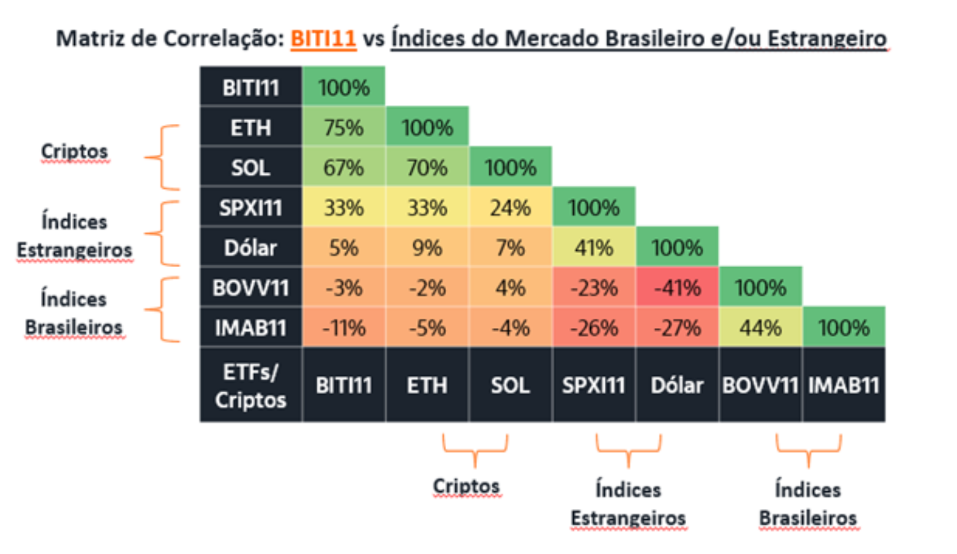
According to Itaú Asset Management, Brazil’s largest private bank, investors should consider holding 1%–3% of their portfolios in Bitcoin starting in 2026. The recommendation came in a research outlook released this week and frames Bitcoin as a small, complementary holding rather than a main bet.

Itaú Backs Small Bitcoin Positions

The bank’s note points to Bitcoin’s low correlation with many traditional assets and to currency risks that hit local investors hard this year. Itaú also moved to build the infrastructure behind that view: in September 2025 it created a dedicated crypto division and named former Hashdex executive João Marco Braga da Cunha to lead the team. That new unit sits alongside the bank’s existing products and is meant to help clients access regulated crypto tools.

Access Through Local Products

Brazilian savers can already reach Bitcoin via products tied to Itaú. The bank is part of the team that launched the IT Now Bloomberg Galaxy Bitcoin ETF, known by its ticker BITI11, which began trading on November 10, 2022. The ETF gives investors a spot-like route to Bitcoin inside the local market, and it sits alongside unit trusts and pension products that offer crypto exposure.

Small But Existing Crypto Footprint

Itaú says its regulated crypto suite manages roughly R$850 million across several funds and ETFs, a modest amount compared with its wider business but still a clear signal of product readiness. The bank’s asset arm is large: it manages more than 1 trillion reais for clients, which helps explain why its guidance on allocations draws wide attention.

Market Context And Timing

Itaú’s move arrives after a year in which currency swings amplified losses for some Brazilian holders of foreign assets. That reality appears to be part of the math behind recommending a 1%–3% position — a small buffer for those worried about local-currency shocks, not a bet meant to replace stocks or bonds. The bank frames the position as a disciplined, long-term allocation, not a short-term trade.

What This Means For Investors

For ordinary investors the guidance is simple to read: keep exposure small and controlled. A 1% position will hardly change a diversified portfolio on its own, while 3% is still within what many institutions have called a “satellite” slot. Based on reports, Itaú expects to offer more choices — from low-volatility wrappers to riskier strategies — through the new unit as demand grows.

Featured image from La Nación, chart from TradingView

XRP Holders Labeled ‘Uneducated Perma Bulls’ By Veteran Trader – Details

Veteran market trader Peter Brandt has reignited debate around XRP after issuing sharp remarks about the token’s most loyal supporters. Drawing from a career that spans more than five decades, Brandt grouped XRP alongside silver when describing markets where bullish belief often holds firm despite repeated price swings and long periods of disappointment.

According to people familiar with his comments, Brandt grounded his criticism in personal trading history. He said he has handled thousands of contracts across commodities, equity benchmarks, and digital assets, and argued that the “perma bulls who I find most uneducated and biased are those who trumpet Silver and XRP,” pointing to what he sees as a pattern of investors staying bullish even when price action and broader conditions turn against them.

Brandt Highlights Decades Of Experience

Brandt’s tone was blunt and personal. He has a long record of public commentary, and his criticisms of XRP are part of a pattern that stretches back years. Earlier this month he called XRP supporters “obsessed” and compared their conviction to that of silver bulls.

For 50 years I have traded many thousands of contracts of every commodity, stock indexes and as many cryptos as you can think of The perma bulls who I find most uneducated and biased are those who trumpet Silver and XRP

— Peter Brandt (@PeterLBrandt) December 12, 2025

At times he has made bearish forecasts — including predictions that XRP would slide toward zero against Bitcoin — while at other moments he identified bullish chart patterns and set higher targets that were later hit before the market reversed.

Community Pushback And Surprises

Responses came fast. Zach Rector, a known figure in the XRP space, pushed back on Brandt’s view. Reports disclosed that Bitcoin maximalist YoungHoon Kim said on December 12 that he would start buying XRP — a notable shift for someone who had favored Bitcoin exclusively.

Kim has claimed an IQ of 276, a detail many readers flagged as unverifiable, but it was repeated in social posts and prompted discussion. X Finance Bull accepted Brandt’s trading record but suggested that charts alone may miss broader structural moves in crypto markets. Dr. Don Woods, a self-described silver bull, joked that triple-digit returns had left him unbothered by labels of bias or ignorance.

XRP: Price Context And Market Moves

According to market snapshots tied to the exchanges, XRP traded above $3 at one point before slipping toward the lower end of the $2 region. Volume and broader crypto swings played parts in that move.

Brandt’s critics point to that resilience as proof his calls are sometimes off. His supporters say his track record over five decades still deserves weight. Both views are in circulation, and both are being used to argue different investment cases.

10,000 XRP And The Freedom Argument

Meanwhile, Edoardo Farina, founder of Alpha Lions Academy, has kept a steady bullish stance. Based on his past posts, he argued that holding 10,000 XRP could put an investor in a special position if prices rise enough.

“It’s hard to understand how free you’ll be,” he wrote in one message that was later shared widely. That claim contains no timeline or clear price targets. It is a conviction play, not a forecast built from disclosed assumptions.

The differing views is part of a wider debate about bias, data, and belief in crypto. Some traders treat Brandt’s words as a warning against unchecked optimism. Others treat community pushback as evidence that XRP’s story is not settled and that broader factors — legal, regulatory, and adoption-related — could change the math.

Featured image from Unsplash, chart from TradingView

Venezuela’s Currency Troubles Drive Stablecoin Use Higher — Research

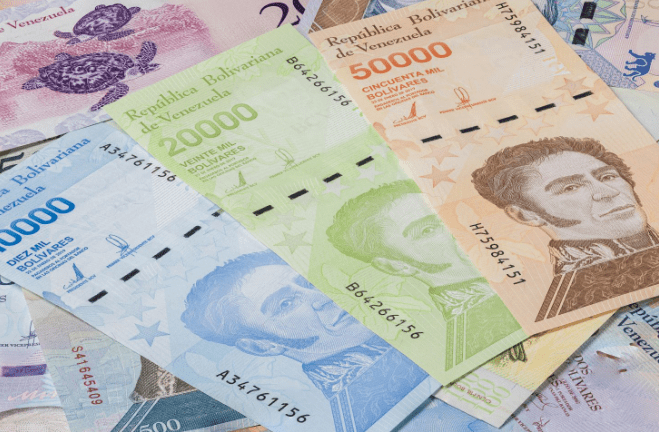
Venezuela’s cash is losing value quickly. People and businesses are shifting to US-dollar stablecoins, especially USDT, to protect savings and make everyday payments.

According to market data, the peso-like bolívar has quoted around 267 per US dollar on December 12, 2025, after roughly 254 on December 5, showing how fast the local currency can move.

Why The Shift Is Accelerating

Based on reports from exchanges and on-chain firms, inflation has been estimated in the 100s–200s% range year-on-year in 2025. Prices rise fast under those conditions.

Wages lose value within days, sometimes hours. To avoid that loss, workers, freelancers and small shops are turning to stablecoins tied to the US dollar, which hold value better than the local currency.

Stablecoins As Daily Money

USDT is now being used for groceries, rent and even salaries in several cities. Peer-to-peer platforms and small crypto desks help users swap between bolívars and stablecoins without relying on traditional banks.

In some neighborhoods, merchants accept stablecoins directly, cutting out currency exchange altogether. Payments that once required cash stacks or quick conversions are now handled through mobile wallets.

Rising On-Chain Flows And Regional Trends

Blockchain analytics firms tracking activity across Latin America have reported a sharp rise in stablecoin volumes during 2024 and 2025.

TRM Labs and similar groups point to higher transaction counts and more active wallets linked to dollar-backed tokens. These increases match what residents describe on the ground. Crypto is not just held. It is being spent, saved and passed along as money.

Many Venezuelans receive remittances from abroad and convert them into USDT before bringing value back home. Others sell goods or services and ask to be paid in stablecoins to avoid sudden losses.

Conversion usually happens through messaging apps, local brokers or P2P platforms. The process is simple, but it depends heavily on trust and access to liquidity.

Government Reaction And Market Risks

Authorities have responded in mixed ways. Some unofficial dollar markets have been targeted, while limited crypto-based currency conversions have been allowed in certain cases.

Reports have also linked state-owned firms to crypto use for accessing foreign funds. At the same time, sudden rule changes remain a risk. Crackdowns, new compliance demands or exchange restrictions can disrupt access overnight.

Featured image from Pexels, chart from TradingView

Bitcoin Headed For $200 Trillion? CEO Makes Bold Prediction

A new public company with a big Bitcoin stash is pitching a bold claim. Twenty One Capital, which listed on the New York Stock Exchange on December 9, arrived with close to $4 billion Bitcoin treasury and now holds the third-largest BTC reserve among public firms. According to the firm’s CEO, Jack Mallers, Bitcoin’s role could expand far beyond a speculative holding.

CEO Sees Bitcoin As A Reserve Asset

Mallers told viewers on theCUBE+NYSE Wired that Bitcoin has compounded holders’ portfolios at roughly 50% a year over the past five to 10 years. Based on reports, he expects that the current $2 trillion market for Bitcoin could grow to between $20 trillion and $200 trillion.

He argued Bitcoin might become the next global reserve asset as finance “recollateralizes” itself away from traditional treasuries and government debt. If supply then stood at 20 million tokens when a 100x market rise happened, Bitcoin would trade near $10 million per coin. At a present price of $92,270, that outcome would equal an increase of about 10,730%.

Market Signals Remain Mixed

Short-term market signs are not all in favor of a big rally. According to market watchers, the Federal Reserve’s recent rate cut barely moved Bitcoin, leaving price action largely flat and directionless.

The MACD histogram, however, is showing hints of bullish momentum in some technical reads, which suggests buyers may be warming up.

The dollar index is showing signs of weakness, which often helps assets like Bitcoin. ETF flows keep disappointing. Without steady inflows from funds, big narratives can struggle to turn into lasting price gains.

Product Push Aimed At Liquidity Without Selling

Twenty One Capital says it wants to offer services that let holders tap liquidity without selling their coins. The firm plans to start in credit and lending and has said it will roll out products in partnership with Tether.

Mallers described the company as more than a balance-sheet accumulator; he compared their ambitions to Coinbase while stressing a narrower focus on Bitcoin services. If executed, these offerings could change how holders manage risk and cash needs.

Big Numbers And Big Questions

The projection to $200 trillion is headline-grabbing. It is a vision, not a forecast, and it hinges on major shifts in global finance and adoption. Reports note that other industry figures have offered similar long-term targets, which means the idea is not unique but remains highly debated.

Featured image from Unsplash, chart from TradingView


Crypto’s Back-End Gets A Boost As Coinbase And Standard Chartered Join Forces

Standard Chartered and Coinbase announced an expanded collaboration on December 12, 2025, to develop a suite of services aimed at institutional investors.

Based on reports from both firms, the work will look at trading, prime services, custody, staking and lending for banks, funds and other large players.

Building On Existing Work

The firms said the push grows out of an existing arrangement in Singapore where Standard Chartered provides banking links that let customers move Singapore dollars in real time to and from Coinbase. That setup helped power Coinbase’s move into the island city’s business market on November 12, 2025.

What They Plan To Explore

Coinbase and Standard Chartered described five areas they will explore together: trading, prime services, custody, staking and lending. These cover order execution, financing and custody options that big clients typically demand.

Both sides framed the effort as trying to give institutional users safer, regulated ways to hold and move digital assets.

Why The Move Matters

Institutional investors have been asking for services that resemble what they get in traditional markets — custody with strong controls, credit and financing options, and execution tools tied to regulated banking rails.

Standard Chartered already rolled out spot trading for Bitcoin and Ether for its institutional clients earlier in the year, an effort that showed the bank is building its own crypto capabilities as demand grows.

Middle Ground For Banks And Crypto Firms

Coinbase brings its institutional trading platform and market access; Standard Chartered brings global payment rails, FX handling and a bank’s compliance framework.

The result, the partners say, should be a way for large investors to trade and custody digital assets while sticking to familiar banking rules and procedures.

Other banks and prime brokers are also striking ties with crypto firms or building in-house services, so this announcement is part of a broader push to give big clients regulated choices.

For institutional traders, having multiple, regulated routes to trade and settle crypto helps reduce single-point dependency and may lower operational risk.

Public Launch Date Or Pricing

Neither company provided a timetable or fee details when they announced the expansion. For now, the plan is to develop and test product ideas for institutional clients across regions where each firm operates.

The announcement underlines how more traditional finance players and crypto firms are working together to meet demand from large customers.

Featured image from Standard Chartered, chart from TradingView

Solana’s Long-Awaited Firedancer Launch Sparks 5% Rally

Solana’s network took a notable step this week as Firedancer, a validator client developed by Jump Crypto, began running on the mainnet, and markets reacted quickly.

According to Solana’s announcement, the client moved out of a controlled testing phase and is now active for real-world validation.

Traders pushed SOL up about 5%, with the token trading close to $140 during the initial move.

Firedancer Goes Live On Mainnet

During more than 100 days of controlled tests, a small set of validators produced more than 50,000 blocks without downtime, according to reports. Built in C and C++, Firedancer was made to handle heavy workloads and to lower the chance of network interruptions.

Test environments reportedly showed the client processing over 1 million transactions per second, a figure that far exceeds current mainnet throughput.

BREAKING: After 3 years of development, Firedancer is now live on Solana Mainnet, and has been running on a handful of validators for 100 days, successfully producing 50,000 blocks 🔥💃 pic.twitter.com/Y0WxxEj2WL

— Solana (@solana) December 12, 2025

That high number comes from lab-style tests, not live traffic, and should be read as experimental performance rather than everyday capability.

Solana co-founder Anatoly Yakovenko marked the transition as a step out of a long beta cycle for the network.

Early Adoption And Stake

Adoption is still small in terms of stake. The first Firedancer nodes hold under one percent of total staked SOL, and that share is expected to grow as operators add it to their setups.

Reports have disclosed that a December rollout prompted more than 20% of validators to move from earlier experimental clients, showing a rapid shift among some operators.

Running multiple validator clients reduces dependence on a single software implementation. If one client encounters a bug, others can keep block production running. That diversity mirrors how other large proof-of-stake chains operate.

Why This Matters For Validators And Apps

Validators and developers stand to benefit if Firedancer keeps meeting its goals. Faster or more reliable validation could mean more capacity for apps that need many transactions per second.

For node operators, the option to mix clients offers an added safety net. Still, the network’s real-world load will be the true test, and watchers say they will be looking at uptime and performance over the coming weeks.

Market Moves And Technical Signals

The announcement coincided with a clear market flow into SOL. Reports have disclosed $11 million in inflows to Solana ETFs on the day of the news, while Bitcoin saw outflows of $77.30 million and Ethereum $42.35 million.

Featured image from Phantom, chart from TradingView

Binance And HTX Get Regulatory Nod To Operate In Pakistan – Details

Pakistan’s Virtual Assets Regulatory Authority has issued “No Objection Certificates” (NOC) to Binance and HTX, allowing both platforms to begin formal steps to operate inside the country.

The clearances do not amount to full licenses. They instead permit preparatory work such as registering with the country’s anti-money-laundering system and setting up local units before full license applications are filed, reports disclosed.

Tokenization Deal And Local Ties

Based on reports, the finance ministry said the NOCs could cover government bonds, treasury bills and some commodity reserves. The move is aimed at creating new ways to raise liquidity and to open government assets to wider markets through blockchain-based tokens.

Pakistan takes a decisive step toward a regulated digital asset future.

Pakistan Virtual Assets Regulatory Authority (PVARA) has issued NOCs to Binance and HTX, launching a phased, FATF-aligned pathway toward full licensing. Strong governance, AML and CFT compliance remain… pic.twitter.com/jSk6JTqvFt

— Pakistan Virtual Assets Regulatory Authority (@PakistanVARA) December 12, 2025

A Shift Toward Formal Oversight

Officials from the virtual-assets authority said they examined governance, risk controls and compliance frameworks before granting the early approvals. These NOCs let the exchanges connect to Pakistan’s AML systems and coordinate with the Securities and Exchange Commission to set up regulated subsidiaries. That review was described as part of a phased licensing system meant to align local rules with global standards.

Partnerships And Local Players Move Fast

Local payments firms and government bodies are being brought into talks. One public statement from a Pakistan-based payments group said the aim is to study how regulated virtual-asset access could expand financial services for ordinary users, while keeping track of risks. Commercial ties like these could speed up customer access if full regulatory approval follows.

How Big Is Pakistan’s Crypto Scene?

Based on reports, Pakistan ranks third globally in retail crypto activity. That ranking has helped push the authorities to build a formal regime quickly.

Officials say the new framework will be backed by a Virtual Assets Act and other measures, including plans for a pilot central bank digital currency and closer work on stablecoins. The intent is to bring trading and payments under clearer oversight while attracting compliant investment.

What Comes Next

Binance and HTX must still meet full licensing conditions before they can offer trading to the public.

The NOCs are an opening move. Full permissions will depend on how well each firm satisfies the regulator’s detailed checks and how the proposed Virtual Assets Act is implemented.

Markets may react to progress on tokenization and any future licensing milestones, but for now the country has signaled a clear shift from informal activity to regulated market access.

Featured image from Unsplash, chart from TradingView

Binance’s USD1 Stablecoin Push Deepens Relationship With Trump’s Crypto Platform

Binance, the world’s largest crypto exchange, has broadened support for USD1, the stablecoin tied to World Liberty Financial and US President Donald Trump’s crypto ventures, reports disclosed. The exchange added new spot pairs including ETH/USD1, SOL/USD1 and BNB/USD1, and enabled fee-free swaps between USD1 and other major stablecoins.

Binance Will Shift Collateral Into USD1

The exchange will convert all collateral backing its Binance-Peg BUSD (B-Token) into USD1 at a 1:1 ratio, a process the company said should be completed within one week. This change means USD1 is being folded into its internal collateral and liquidity systems rather than remaining only a tradable token.

Market Reaction And Liquidity Effects

Traders reacted quickly. Price moves in BNB and other tokens showed more buying interest after the announcement. Market data snapshots suggested a short-term uptick in BNB as liquidity and trading routes were expanded by the new USD1 pairs. Reports put the token’s wider market use and the platform’s zero-fee swaps as the likely drivers.

Binance to Add BNB/USD1, ETH/USD1 Trading Pairs; B-Token Collateral to Be Converted to USD1

According to an official announcement, @binance will list new spot trading pairs BNB/USD1, ETH/USD1, and SOL/USD1 at 16:00 (UTC+8) on December 11, 2025. At the same time, Binance will… pic.twitter.com/mIPrkiR3Lj

— ME (@MetaEraHK) December 10, 2025

Backing, Size, And Recent Deals

According to public filings and market trackers, USD1 is backed by US Treasury bills, cash and equivalents and is redeemable at a one-for-one rate with the dollar.

The stablecoin has grown quickly and is now listed among the larger stablecoins by market cap, with figures around $2.7 billion cited in recent summaries. Reports have also linked USD1 to a major Abu Dhabi investment that used the token for a $2 billion deal.

Political Context And Scrutiny

These commercial moves come after a politically charged episode: Trump granted a pardon earlier this year to Binance’s former CEO, an action that critics say raises questions about ties between Binance and the Trump family’s crypto interests.

That sequence of events has drawn scrutiny from lawmakers and commentators, who are asking for more transparency around the deals and any possible conflicts of interest.

Company spokespeople have issued short statements denying that any political favors were sought or exchanged to secure deals. Binance said its public notices focused on product rollouts, trading schedules and incentives like zero fees for certain users, while World Liberty Financial emphasized the reserve backing behind USD1.

Featured image from Unsplash, chart from TradingView

Not Just Crypto: Research Says XRP Is Moving Into Bank-Grade Payment Infrastructure

XRP is being positioned as something more than a trading asset as analysts point to signs suggesting it may be shaped for financial infrastructure over time.

A report from Digital Asset Solutions (DAS) highlights three main points behind this shift, tying the altcoin’s technical setup to Ripple’s work on stablecoins and regulated payment rails.

Structural Edge For XRP

Reports have disclosed that XRP offers several qualities that matter to companies moving money across borders. It settles fast, costs little to send, and works as a neutral bridge asset between different currencies.

Ripple’s ledger is described as reliable and globally distributed, which is why some enterprises are testing it for predictable transfers. However, many firms still use RippleNet without using the crypto directly, so broad bank-level usage has not taken hold.

🚨 DAS Research just laid out the clearest confirmation yet of where XRP is heading

Their analysis shows XRP and Ripple are no longer competing in crypto. They are evolving into global payment infrastructure, the kind used by banks, fintechs, and cross border networks that… pic.twitter.com/ZwqUD68Qur

— Stern Drew (@SternDrewCrypto) December 9, 2025

The research frames these features as the first major factor behind the digital asset’s potential role in global payment flows. The traits are real, but adoption varies and has not yet reached large commercial scale.

Stablecoins And XRP Working Together

Ripple plans to use RLUSD as a fiat-backed anchor while relying on the crypto to provide liquidity between different corridors.

The concept is simple: Stablecoins maintain price stability tied to fiat, while XRP acts as the connector for moving value across currencies. This pairing is presented as the second major point in DAS Research’s findings.

Ripple Prime, ZK-enabled identity tools, and licensing efforts are being built to meet compliance requirements from regulated institutions.

Early RLUSD corridors have started to appear, but the level of real-world transaction volume remains small compared to the broader payments industry.

Catalysts Forming In The Background

The final point focuses on developments that analysts believe could help XRP move closer to regulated financial rails.

RippleNet partnerships are growing, institutional custody services are improving, RLUSD integrations are underway, and conversations around possible ETF structures have emerged.

Each of these adds some weight to the idea that XRP may gain a deeper role in payment systems in the future. Some of these steps are active today, while others remain early discussions. Custody upgrades, for example, are happening across the crypto sector, not only for the altcoin.

While procedural steps like exchange listings and filings have progressed for multiple XRP ETF proposals, the US Securities and Exchange Commission has not yet given formal approval to a spot XRP ETF. Even so, these developments show how Ripple is preparing for broader institutional use.

Featured image from Unsplash, chart from TradingView

❌