Reading view

There are new articles available, click to refresh the page.

XRP Price Is Not Going To $100 By End Of Year, ‘You Need A Reality Check’

Despite the recent crash that saw the XRP price fall below $2, many analysts claim that the cryptocurrency could still skyrocket to $100 by the end of the year. However, one expert has thoroughly dismissed these projections, urging investors to temper expectations and warning that those who believe such predictions need a “reality check.”

Why XRP Can Never Reach $100 By Year’s End

Crypto market expert Zach Humphries has delivered a detailed assessment of XRP, calling out extreme price predictions and overly optimistic expectations, especially during the current downtrend. In a video on X, he warns that claims suggesting XRP will reach $100 by the end of 2025 are unrealistic and potentially misleading for investors and traders. 

Humphries emphasized that while he supports XRP and believes in its long-term potential, the spread of exaggerated price targets in the crypto space is harmful. He explained that many investors assume that owning 100 XRP tokens will make them wealthy quickly, holding on to false hope and unrealistic financial expectations.

The analyst points out the need for realism in the crypto space, arguing that viral hype posts and overinflated price forecasts can hoodwink people into making genuine financial decisions that could lead to losses. He noted that investors need to understand market structure and the underlying math behind XRP’s price action before believing in any extreme predictions. 

Humphries stated a $100 XRP price would imply a $5 trillion market capitalization, surpassing the size of Apple, Microsoft, and even the entire crypto market at some historical peaks. He noted that reaching this seemingly impractical price target would require XRP achieving overnight global adoption, full-scale replacement of existing payment rails, and massive sustained institutional inflows.

The analyst also highlighted a common misunderstanding about liquidity. Humphries explained that for XRP to reach $100, it would require substantial global liquidity. He noted that despite XRP Spot ETFs recording over $1 billion in inflows recently, the cryptocurrency’s price did not rise; instead, it declined further. He highlighted that this is because institutional investors prioritize stability, deep liquidity, and predictability over volatile, high-risk payment assets. 

Although his statements may seem like a critique of XRP’s outlook, Humphries emphasized that the cryptocurrency has genuine strengths, including robust cross-border payment capabilities, strong enterprise relationships, and liquidity. He pointed out that, ironically, the more XRP succeeds as a payment rail, the less explosive its price becomes. 

Analyst Says XRP Could Still Outperform Many Assets

In his video, Humphries stated that XRP has survived many market cycles, making it one of the rare resilient cryptocurrencies. Under the right conditions, he believes that the XRP price could outperform many digital assets, which is why it remains a top altcoin in his portfolio. 

The analyst emphasized the importance of realistic growth driven by gradual institutional adoption, ETF integration, regulatory clarity, and steady price increases tied to actual usage and utility. He highlighted that these factors could help XRP perform very well, potentially reaching new all-time highs.

XRP

SWIFT’s Latest Announcement Raises Questions About Ripple’s XRPL Blockchain

Crypto pundit Chain Cartel has raised several key points following SWIFT’s latest comment on its move to adopt blockchain technology. The pundit claimed that Ripple’s XRPL network best suits what SWIFT is trying to achieve and suggested that the two firms collaborate. 

Pundit Points To Ripple’s XRPL After SWIFT’s Announcement

In an X post, Chain Cartel stated that SWIFT admitted they are building Ripple’s XRPL network, but did not explicitly say so in their announcement. The pundit was referring to an X post from SWIFT highlighting their earlier announcement to add a blockchain-based ledger to their infrastructure.

The pundit explained that SWIFT’s language in the X post suggests that they want to build something like Ripple’s XRPL. He declared that it is not Bitcoin, Ethereum, or any generic blockchain experiment but precisely what Ripple has been building for a decade. Chain Cartel noted that Ripple’s model has always been a neutral settlement layer, real-time atomic finality, shared ledger visibility for institutions, interoperability with legacy rails, and liquidity-first design. 

Chain Cartel then alluded to SWIFT’s statement about its plans to build a blockchain-based ledger to be included in its payment infrastructure and provide a single source of truth, enabling instant, 24/7 cross-border payments. He declared that this is Ripple’s blueprints with the XRPL, as the crypto firm uses the network for its payment services. 

In line with this, the pundit remarked that SWIFT doesn’t replace rails, but instead coordinates them, and that Ripple doesn’t replace banks, but instead connects them. He added that SWIFT is acknowledging that the future payment stack requires a ledger layer, not just messaging, and that the only model already battle-tested at scale is Ripple’s XRPL.

However, it is worth mentioning that SWIFT doesn’t plan to integrate Ripple’s Ledger. Instead, it is building this blockchain-based ledger in partnership with Consensys and Chainlink. As such, although SWIFT may plan to build a network similar to Ripple’s XRPL, it intends to do so without assistance from the crypto firm. 

Ripple Looking To Expand Its Payment Service

Ripple is looking to expand its payment service, as it recently announced plans to begin testing its RLUSD stablecoin on Ethereum layer-2 networks Base, Ink, Optimism, and Unichain. The move comes just days after the OCC granted Ripple a conditional approval to become a bank, which is also a major boost for the firm’s payment service. 

Ripple plans to expand its RLUSD stablecoin beyond the Ethereum and XRPL networks to these layer-2 networks through its partnership with Wormhole. The firm noted that the future of crypto is multichain, which is why it is adopting this strategy. This move gives Ripple’s clients greater options when using the RLUSD stablecoin, and it could also attract new users to the stablecoin, which is currently one of the fastest-growing stablecoins. 

XRP

Ethereum 2-Year Trend Maps Out This Unique Crash Path To Bottom At $2,187

Ethereum’s price action has weakened further over the past 24 hours, with the cryptocurrency falling below $3,000 and shedding about 6.8% in the last 24 hours alone. 

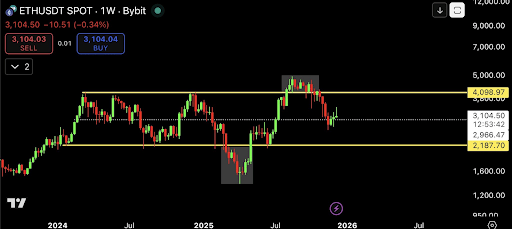
The immediate price action points to reclaiming this $3,000 support, but a longer-term technical view suggests the current decline may be part of a much larger and more defined price framework. A macro analysis shared by crypto analyst Dona examines Ethereum’s behavior over the past two years with a structured range that suggests that the cryptocurrency might bottom at $2,187.

Ethereum’s Two-Year Range Still Defines The Bigger Picture

According to the analysis, Ethereum has largely traded within a broad horizontal range for close to two years, aside from two notable fakeouts: one below resistance in the first half of 2025 and one above resistance in the second half of the year, which led to a new price high of $4,946 in August. On the weekly timeframe, price has repeatedly respected an upper boundary around $4,000 to $4,100, while finding consistent demand near the lower range support just above $2,100.

This price action has resulted in a structure that resembles an inverse head and shoulders pattern on a macro scale. Instead of signaling immediate upside, however, the formation shows how price has oscillated between these defined trendlines, with mid-range reactions often determining whether Ethereum pushes to resistance or slips back toward support. 

Ethereum

At the time of writing, Ethereum is trading within the mid-range of the two-year range. Based on this context, the recent bearish move can be viewed less as a breakdown and more as a rotation towards the lower trendline within the same long-standing range.

Why $2,187 Stands Out As A Critical Downside Target

The chart accompanying the analysis places particular emphasis on the lower boundary of the range near $2,187. This level has repeatedly acted as a bounce floor during prior downtrends in 2024 and another one in July 2025.

If Ethereum continues to trade below the mid-range support currently around $3,000, then the price could follow a familiar range rotation path toward this lower boundary. This move will see Ethereum fall to as low as $2,187. 

At the time of writing, Ethereum is trading at $2,928, and is still a 25% decline away from $2,187. Although this would be tragic for bullish traders, such a move would not necessarily invalidate the broader structure. Instead, it will complete another cycle within the range, similar to previous declines that eventually transitioned into a bounce for a rally phase.

One of the more notable aspects of the outlook from Dona is the expectation for subdued activity in the near term. Aside from range-bound trades, taking directional positions may be less attractive as liquidity thins into the end of the year. From this perspective, the next major move is more likely to arrive in January 2026.

Ethereum

Dogecoin Price Squeeze Maps Out Two Possible Scenarios From Here

Crypto analyst Erick Crypto has highlighted a Dogecoin price squeeze, which is currently playing out. Based on this, he mentioned two possible scenarios that could play out for the largest meme coin by market cap. 

Two Possible Scenarios as Dogecoin Price Squeezes

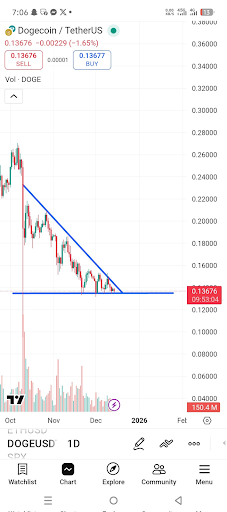
In an X post, Erick Crypto stated that the Dogecoin price is squeezing hard, with a descending triangle and strong horizontal support around $0.136. He added that DOGE is compressing at the apex, which means that a breakout ot breakdown is imminent. The pundit warned that there is high volatility ahead of the meme coin. 

Meanwhile, the crypto analyst stated that the Dogecoin price could see more downside if it loses the $0.13 support. On the other hand, it could record a relief rally if it breaks the trendline. He urged market participants to trade the breakout and not the noise. Erick Crypto’s analysis comes amid the crypto market downturn, which has already sparked a massive crash for DOGE. 

Dogecoin

Notably, the Dogecoin price is down over 20% in the last month, since around when the Bitcoin price first crashed below the psychological $100,000 level. The meme coin has also failed to gain traction despite the launch of two DOGE ETFs during this period. Bitcoinist reported that these Dogecoin ETFs have so far underperformed and failed to gain interest from institutional investors. 

Meanwhile, the Dogecoin price and the broader crypto market are at risk of further declines as the Bank of Japan (BOJ) is likely to raise interest rates this week. This could tighten liquidity in the market and also lead to a further unwinding of the yen carry trade, which is a negative for crypto assets, including DOGE. 

DOGE Is At A Crossroad

Crypto analyst CryptoCeek stated that the Dogecoin price is at that “classic meme coin fork-in-the-road.” The analyst explained that if the bears push and hold the price under $0.13, the door opens for a full retest of $0.10, where buyers historically aggressively buy the dip. On the other hand, CryptoCeek stated that reclaiming the 20D EMA near $0.14 would scream a bear trap, with $0.19 on the cards for “one of those classic DOGE squeezes.”

Crypto analyst Master remarked that between $0.8 and $0.10 seems likely for the Dogecoin price. He added that the base case is that the meme coin trades sideways until 2028, when the next bull run may start. However, as CryptoCeek suggested, DOGE may bounce from around $0.10 as the bulls step in to accumulate more coins at that price level. 

Dogecoin

Dogecoin Open Interest Crashes To April Levels, Here’s What Happened Last Time

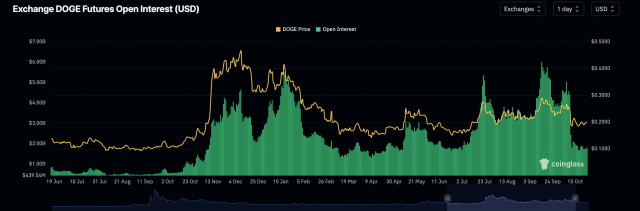
Dogecoin’s open interest has seen a significant decline over the past few months, and the latest push lower has sent the meme coin scraping April 2025 levels. The current trend mirrors the Dogecoin price decline that has persisted even during the Bitcoin price uptrend. Looking at the historical performance of Dogecoin over time, when the open interest has seen a significant crash, it is possible that the meme coin could see a quick bounce at current levels.

Where The Dogecoin Open Interest Is Sitting

Coinglass data points out how much the Dogecoin open interest has declined in recent times, after hitting new all-time highs back in the fourth quarter. The all-time high open interest for the cryptocurrency sits firmly at the $6.01 billion that was recorded back on September 13, showing the stark difference between where it was and where it’s sitting at right now.

The data aggregation website shows that the Dogecoin open interest is currently sitting at $1.8 billion, which shows a 70% decline over the last three months. The last time that the open interest was this low was back in April 2025, following Donald Trump’s tariff wars.

Crypto analyst KrissPas also highlights the Dogecoin open interest performance over this time, showing times where it has spiked this year. So far, the DOGE open interest has crossed the $5 billion mark a total of three times, but each time has ended up in a major crash.

KrissPax explains that the crash in open interest triggered by massive liquidations was a result of different developments. The first of these was the Donald Trump tariff announcements that triggered a major market crash. Next were exchanges and market makers, who inevitably triggered the second and third liquidations before the legendary October 10, 2025, crash.

Dogecoin open interest

There Is Still Hope

While the current trend points toward further decline in the Dogecoin price, historical performance suggests that it could bounce quickly. Looking back at the times when the Dogecoin open interest had trended this low, the resultant move has always been more of a bullish run.

This was the case following the April 2025 low, leading into another recovery that saw the price move from below $0.2 to $0.25 before the momentum weakened. Then again, a similar trend was recorded following the July 2025 low, with the Dogecoin price eventually rallying from below $0.2 to reach $0.29 before momentum ran out.

Going by the previous trend of at least a 20% increase in price following the open interest hitting a low, it could mean that the Dogecoin price could see another foray above $0.15. However, this also depends on the bitcoin market performance and how the broader crypto market responds.

Dogecoin price chart from Tradingview.com

XRP Hasn’t Entered A Bear Market Yet; Analyst Shares Why

Crypto analyst Dark Defender has been one of the most vocal supporters of XRP, and this stance has not changed despite the altcoin’s current price action. If anything, the analyst believes that the current downtrend actually plays into the XRP long-term target, claiming that the cryptocurrency remains inherently bullish. If the analyst is right, then it means that the XRP price could be gearing up for another major uptrend that could send it to new peaks.

XRP Price Is Only In Wave 4, Not A Bear Market

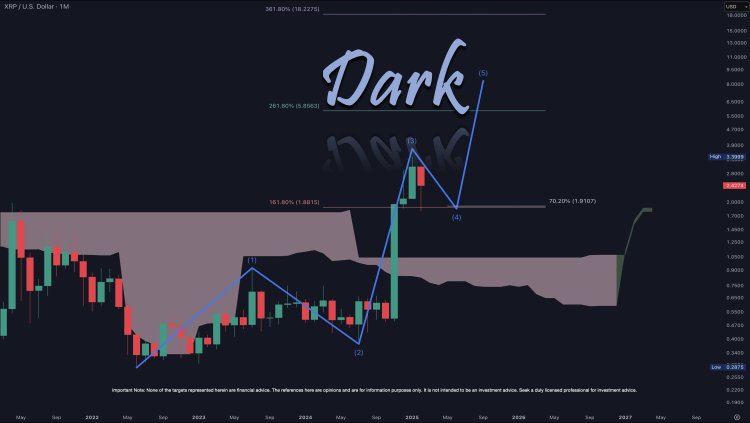
In the post that was shared on X, Dark Defender explained that the XRP cryptocurrency was not in any kind of bear market. Instead, the current downtrend is only a result of the altcoin entering Wave 4 of the Elliot Wave, leading to the decline.

Given that Wave 4 is a historically bearish wave, it would explain why the XRP price has dropped so quickly. However, the crypto analyst explained that this wave did not just start, as it has been in play since February 2025. Hence, it would need to play out completely before the next wave can begin.

Going by this analysis, it would mean that the last and final wave of the theory is yet to play out, which is often the most bullish of all the waves. As a result, the analyst urges XRP investors not to panic as the price continues to play out according to plan. In the end, the target remains $5.85, according to Dark Defender, beating its previous all-time high of $3.8.

XRP Price

Price Could Be Rounding A Bottom

Another analyst also contributes that the XRP price is not in a bear market, and could, in fact, be putting in a bottom. STEPH IS CRYPTO points out that the XRP RSI is actually showing a rare bullish divergence on the daily chart, one of the few times that this has happened over the years.

This is significant because back in 2022, a similar bullish divergence had appeared on the daily chart ,and the result was a rapid rise once the distribution was done. As the crypto analyst explains, the fact that this bullish RSI divergence has appeared on the XRP daily chart again suggests that the sellers are actually running out of steam.

While there is no set target for where the XRP price is headed, the prediction suggests that a rally could be in the works. “Nothing is guaranteed — but from a technical perspective, this is one of the strongest early reversal signals you can get,” the analyst stated.

XRP price chart from Tradingview.com

Crypto Analyst Predicts How Low The XRP Price Will Go Before Bouncing

XRP’s price action in recent days has led to speculations among crypto traders over whether it could fall below the $2 support zone and how deep any pullback might go before a bottom is established. 

Popular XRP analyst Zach Rector addressed this concern shared by many market participants during an interview on the Paul Barron Podcast as to how low XRP could realistically fall before buyers step in and whether a return to the $1 level is still possible under current conditions.

Zach Rector Says $1 XRP Is Virtually Impossible

Inflows into Spot XRP ETFs have been largely offset by selling pressure on centralized exchanges, keeping the cryptocurrency range-bound just above $2 even as long-term demand builds in the background. This range-bound trading has left the cryptocurrency at risk of losing $2 and breaking further downwards. The question now is whether this downward risk can cause the XRP price to return to $1. 

Addressing the question from Paul Barron directly, Zach Rector stated that an XRP price move back to $1 is effectively off the table under normal market conditions. He presented such a scenario as something that would only occur in the event of an extraordinary black swan. Current market structure, liquidity depth, and buyer behavior do not support the XRP price falling as low as that level.

According to Rector, XRP’s order book on crypto exchanges is now populated by a large base of passive buyers with limit orders already positioned well above $1. He also used his own trade orders to illustrate why he believes XRP is forming a higher long-term floor. 

He acknowledged entering an XRP long above $3.40 earlier in the year and confirmed that the position is still underwater. However, he explained that he has consistently dollar-cost averaged lower, bringing his average entry down to around $2.23. Keeping this in mind, Rector predicted a price low to watch out for before the XRP price bounces.

Higher Lows Says Support Is Between $1.90 And $1.80

XRP’s price structure over the past year points to a market that is gradually building strength rather than breaking down. Rector pointed to XRP’s price chart on Coinbase, which shows the creation of a sequence of higher lows, with price bottoming near $1.60 in April, recovering to form a higher low around $1.77 on October 10, and then holding even higher at approximately $1.81 in November.

That pattern is why the $1.90 to $1.80 range is viewed as the most realistic downside zone if XRP breaks below $2 and selling pressure resumes. According to Rector, a dip below $1.90 could open the door for a brief test of $1.80, and this is as low as the XRP price might go before a bounce. Such a move would still fit within the broader higher-low structure that has defined XRP’s price action throughout the year.

XRP

Pundit Reveals Why January Will Be A Month For Dogecoin, But Can DOGE Price Reach ATHs?

Dogecoin has spent much of the past year drifting without a clear narrative, but recent comments from prominent community voices have refocused attention on January as a potentially important period for the meme coin. 

A brief post on X by a Dogecoin supporter known as Jimmy, stating that utility for DOGE is coming in January, is notable because it echoed a longer message from another supporter, BuildrJ, who pointed out that crypto’s next phase must center on real usage rather than hype, and why adding utility to DOGE is overdue.

Focus Shifts To Utility For Dogecoin

The point made by BuildrJ reflects a sentiment that has been building across the market. Many traders now draw a clear line between holding crypto as a trade and actually using it as a tool. 

DOGE, which started its origins as a joke, already functions as a fast and inexpensive payment network. Supporters argue that this foundation gives Dogecoin an advantage over newer meme coins that exist largely as narratives without proven usage.

When Jimmy referred to utility arriving in January, the comment can be interpreted as confidence that Dogecoin’s role as a usable currency is about to gain more visibility, rather than a promise of a single dramatic feature release. 

Dogecoin’s clearest and most established use case is in payments. Over the past year, discussions within the DOGE community and around the Dogecoin Foundation have been focused on making the cryptocurrency more practical for everyday transactions and reinforcing the network’s relevance as a medium of exchange. One recurring theme in recent discussions has been the possibility of DOGE being integrated into X’s long-anticipated payments infrastructure, often referred to as X Money.

If DOGE is actively used rather than merely held, demand becomes more organic and less dependent on short-term enthusiasm. Another area that has featured prominently in community discussions is the arrival of Spot Dogecoin ETFs in the US, although inflows have been lower than expected.

Is A New All-Time High Realistic For DOGE?

From a price perspective, reaching a new all-time high in January would be an extraordinary move. Dogecoin’s previous peak at $0.73 was set during a period of extreme retail participation and euphoria. That environment no longer exists in the same form, as capital inflows are much more crypto selective. This is precisely why the discussion around Dogecoin’s utility has become more important to its price outlook.

January does not need to deliver a new record high for it to be a meaningful month for DOGE. At the time of writing, DOGE is trading around $0.137 and is at risk of losing $0.13 anytime soon. 

From a technical standpoint, sustained hold above the $0.14 price level, accompanied by inflows into Spot Dogecoin ETFs and interest tied to real usage, would already represent a meaningful change in trend for DOGE.

Dogecoin

Can Bitcoin Price Still Hit $140,000? What The Global M2 Money Supply Says

The Bitcoin price outlook remains under scrutiny as market analysts assess whether the world’s largest cryptocurrency can still reach $140,000. Given BTC’s recent downturn and fluctuating price, it’s understandable that a dramatic surge to $140,000 could be viewed skeptically. However, the analyst points to global M2 Money Supply, highlighting its correlation with Bitcoin and its support for a significant upside move.

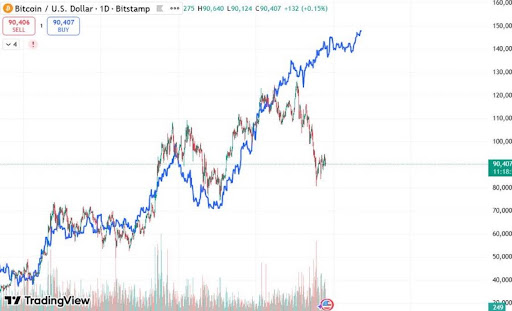
New discussions have emerged in the crypto space about the relationship between the Bitcoin price action and the global M2 Money Supply. Pseudonymous crypto analyst ‘MoneyLord’ has projected a massive price surge to $140,000 for BTC based on M2 data. The analyst noted that many people are skeptical about the relevance of M2 Money Supply, likely questioning whether it still holds predictive value for Bitcoin’s performance.

Global M2 Money Supply To Fuel $140,000 Bitcoin Price Surge

According to MoneyLord, the recent disconnect between Bitcoin and M2 data should not be viewed as a failure of the model, but rather as a consequence of aggressive market interference and increased stress across global financial systems. In his technical report released on X, he argued that, without heavy manipulation and the collapse and insolvency of major entities, Bitcoin would have continued to track global liquidity growth.

Related Reading: Is It More Profitable To Hold Bitcoin For The Short-Term? 2025 Numbers Are Here

MoneyLord believes that those shocks temporarily suppressed BTC’s price expansion, likely contributing to its recent decline and slow momentum. With market conditions somewhat stabilizing, the analyst suggests that Bitcoin is poised to realign with global M2 Money Supply trends, potentially setting the stage for renewed upward momentum. 

Bitcoin

From this perspective, the current phase is viewed as a delayed reaction rather than a failed cycle. MoneyLord predicts that if Bitcoin begins to catch up with M2 data, the cryptocurrency’s price could hit a target above $140,000 sooner than the market expects. The accompanying chart illustrates this bullish outlook, showing global liquidity, represented by the blue line, continuing to rise toward the projected price. 

With Bitcoin trading near $90,000 after a more than 6% decline this month, a rally to $140,000 would require a gain of at least 55%. Reaching this level would set a new all-time high, exceeding its present peak of over $126,000 by more than 10%. 

Bitcoin Shows Resilience Amid Market Sell-Offs

According to crypto analyst Don, Bitcoin has bounced back after a period of sharp sell-offs that shook out many traders and triggered widespread liquidations. The analyst noted that bulls have stepped in to reclaim critical support and restore confidence in the market as BTC resumes trading within a well-defined ascending triangle pattern

The chart shows that the triangle has an upper boundary near $94,324 and a lower boundary around $89,241. Price action inside the formation suggests that Bitcoin is consolidating and likely building momentum for a potential breakout. 

Bitcoin

Market Expert Says Ripple’s Biggest Win Is Not XRP Regulation, Here’s What It Is

The lawsuit between Ripple and the US Securities and Exchange Commission (SEC) had dominated headlines for years, with XRP in the spotlight over its potential classification as a security. Now that the legal dispute is over and XRP has been definitively cleared as non-security, experts argue that Ripple’s greatest success extends far beyond XRP regulation.  

Ripple’s True Victory Beyond XRP Regulation 

A crypto market expert operating under the name “Stellar Rippler” on X has shared a compelling report that reassesses what truly constitutes Ripple’s biggest win. The analyst highlighted that the real win for Ripple was not regulatory approval but an intellectual shift in how the project is perceived. 

The expert highlighted that while he favors XRP, he has historically been skeptical of Ripple’s intentions. However, he stated that the recent approval of the crypto company’s bank charter by the Office of the Comptroller of the Currency (OCC) speaks volumes about Ripple’s long-term vision in the financial sector. 

Last week, on December 12, the OCC granted conditional approval to five crypto-related firms, including Ripple, to obtain national trust bank charters. This achievement marked a significant milestone for Ripple, reinforcing its legitimacy in traditional finance despite the numerous oppositions

In his post, the analyst compares XRP and XLM, noting that the debate between the two cryptocurrencies has often been driven by emotion. He said that discussions were frequently centered on conflicts between retail and institutions, accusations of token dumpings, and differing visions for the future

According to the expert, XRP and XLM have always been structurally similar, both designed for fast, low-cost settlement, cross-border liquidity, interoperability, and real-world financial infrastructure. However, he notes that the primary difference between the two cryptocurrencies has always been strategy rather than values. 

He explained that while Ripple prioritized tackling regulatory hurdles, banking, and building institutional partnerships first, Stellar focused on grassroots adoption and open networks. With the new OCC bank charter, the expert emphasizes that Ripple’s strategic approach is now clearly validated and undeniable. 

Stellar Rippler highlighted that Ripple did not abandon its crypto principles but took on the regulatory responsibility to ensure its network could operate at scale. He stated that this milestone shows that history favors builders who solve foundational problems rather than those who focus on tribal disputes.  

Stellar Expert Shifts Stance After Ripple Gains OCC Approval 

In a previous post, Stellar Rippler publicly announced a significant change in perspective on Ripple following news that the company had received conditional approval for a national bank charter. He admitted he was wrong in his past views, describing the recent development as a full submission to the highest level of federal and state oversight in the United States. 

The Stellar expert now believes that Ripple is firmly committed to long-term global finance, stating that a company would not take such a path if it were not building something designed to last decades. He added that this milestone represents maturity and legitimacy for Ripple and strengthens confidence in XRP.

XRP

Why Did The Bitcoin, Ethereum, And XRP Prices Crash, And Will It Continue?

Crypto pundit Crypto Wimar has explained why the Bitcoin, Ethereum, and XRP prices crashed, highlighting the continuous selling pressure. The crypto market is also at risk of further downward pressure due to macro factors such as the impending Japan rate hike. 

Why The Bitcoin, Ethereum, And XRP Prices Crashed

In an X post, Crypto Wimar revealed that Wintermute has dumped 40% of its holdings over the last three weeks, which has contributed to the crash in Bitcoin, Ethereum, and XRP prices. The crypto pundit further noted that the market maker is still dumping millions in BTC and ETH on Binance, which puts these coins at risk of further declines. 

The Bitcoin, Ethereum, and XRP prices are also crashing as crypto market investors brace for a Japan interest rate hike by the BOJ at their December 19 meeting. Polymarket data shows that there is currently a 97.4% chance that the BOJ will increase rates by 25 basis points. A Japan rate hike impacts the crypto market as it puts the yen carry trade in focus, with investors moving to sell their assets before the yen strengthens and their debt becomes more expensive. 

Meanwhile, it is worth mentioning that the Bitcoin, Ethereum, and XRP prices have crashed after every Fed rate cut this year. This similar price action is playing out as the Fed lowered rates by 25 bps last week. These crypto assets had seen a notable rebound prior to the Fed rate decision last week, indicating that the cut was already priced in. 

Demand for Bitcoin, Ethereum, and XRP also appears to be dwindling, even among institutional investors. Crypto analytics platform CryptoQuant stated that Bitcoin treasury growth is losing momentum, noting that the accumulation pace is slowing despite the fact that 117 new companies added BTC to their treasuries this year. Ethereum treasury company BitMine is also the only company that has continued to accumulate ETH at an impressive pace amid this market downturn. 

BTC At Risk Of Drop Below $50,000

Crypto analyst Titan of Crypto has indicated that the Bitcoin price could still drop below $50,000, which also puts Ethereum and XRP at risk of crashing. In an X post, the analyst raised the possibility that a BTC bear pennant is forming.

He noted that this is not a structure that market investors will typically want to see in a bull market. Titan of Crypto added that the structure is still developing, but it is one that is worth monitoring closely. 

Bitcoin

Meanwhile, the analyst’s accompanying chart showed that the Bitcoin price could drop below $50,000 as soon as February next year. It is worth mentioning that veteran trader Peter Brandt had also earlier predicted that BTC could drop below $50,000 based on his belief that the flagship crypto is already in a bear market.

Bitcoin

Legendary Analyst Peter Brandt Calls XRP Investors “Uneducated,” Here’s Why

Legendary analyst Peter Brandt has criticized XRP investors, describing them as uneducated. His criticism comes amid the drop below the psychological $2 level, despite recent fundamentals that paint a bullish picture for the altcoin. 

Peter Brandt Describes XRP Investors As “Uneducated”

In an X post, Brandt stated that XRP investors, who are permabulls, are the most uneducated and biased set of people he has seen over his 50 years of trading. The veteran trader classified this set of investors alongside those who trumpet Silver. He also highlighted how this was a big deal considering that he has traded thousands of contracts of every commodity, stock indexes, and many cryptos. 

XRP has, over the years, been known to have one of the strongest crypto communities, which commonly refer to themselves as the ‘XRP Army.’ Brandt has, on several occasions, been criticized by some investors over some of his bearish predictions for the altcoin. This has led to him calling them out in the past whenever he makes such predictions. 

It is worth mentioning that Brandt had also earlier in the month asserted that the “most madly obsessed perma-bulls” on earth are bulls. Although the veteran trader didn’t state an exact reason for making these statements, some pundits have developed a knack for making outlandish price predictions

An example of such a pundit is Barry C, who recently stated that the price will skyrocket from $2 to $1,000 a lot sooner than people anticipate. The pundit has in the past alluded to banks’ potential adoption of the token as a factor that could spark the rally to $1,000. He recently highlighted the OCC’s grant of a conditional approval to Ripple to operate as a bank, which provides a boost for the altcoin. 

Largest IQ Holder Is Now A Bull

XRP pundit Zach Rector clapped back against Brandt’s statement, noting that the largest IQ holder is now an XRP bull. The largest IQ holder, Young Hoon Kim, recently revealed that he had started buying the token, having become bullish on the altcoin. He also predicted that the altcoin could reach a new all-time high (ATH) before the year ends. 

Meanwhile, in his latest X post, Kim opined that the price could potentially reach $100 over the next five years. However, he didn’t mention what could spark such a parabolic price surge for the altcoin. It is worth mentioning that such predictions have raised eyebrows because of what the altcoin’s market cap will be if it reaches such price targets. A $100 price target would give XRP a market cap of almost $10 trillion. 

At the time of writing, the token’s price is trading at around $1.98, down over 2% in the last 24 hours, according to data from CoinMarketCap.

XRP

Dogecoin Holds Demand Zone Above $0.13, What A Bounce Would Do

As the eventful year of 2025 draws to an end, crypto analysts are looking into what the Dogecoin price could hold for investors going into the end of the year. One of these analysts is BitGuru, who shared an interest in the Dogecoin price chart, highlighting the next possible roadmap that the meme coin could take. With the possibility of a bounce rising, the next targets have become increasingly important to identify in order to maximize gains.

Why The Dogecoin Price Could Recover Quickly

BitGuru’s analysis focuses on the rising demand surrounding the meme coin after finding support from the recent crash. The Dogecoin price had stopped above $0.13, suggesting that the demand at this level continues to hold strong as buyers return to the market.

Pointing out this demand, the crypto analyst explains that the Dogecoin price is actually holding the demand zone after a prolonged downtrend. This is often bullish for the digital asset as it shows rising interest in the cryptocurrency as it establishes new support levels.

This base formation, as the analyst calls it, could serve as the starting point for the next rally that could push the Dogecoin price higher. However, for this to happen, the Dogecoin bulls would have to maintain their position above this demand level.

If this support level is held, then BitGuru forecasts that the Dogecoin price could start to recover again. This bounce could lead to a 50% increase, with the analyst’s chart outline putting it as high as $0.188. The upper end of the rally shows the price climbing to $0.22 before hitting resistance.

Dogecoin price

End Of Year Could End Red

Interestingly, the last quarter of the year has often been reasonably bullish for the Dogecoin price, but the year 2025 has deviated hard. So far, the quarter is already 41.8% deep in the red, according to data from the CryptoRank website, and it doesn’t look like that would change anytime soon.

The Dogecoin price is already down more than 7.5% in the month of December so far, contributing to the decline that has been felt in the quarter. The months of October and November ended in the red with 20% and 21.3% losses, respectively, and if this trend continues, then the Dogecoin price could follow suit.

Dogecoin price chart from Tradingview.com

Bitcoin Price To See Massive Crash To $78,000 If This Happens

After hitting a new all-time high back in October 2025, the Bitcoin price has been in what appears to be a consistent downtrend, pushing it to new yearly lows. The first wave was triggered by sell-offs from large accounts, coinciding with the 10/10 crash. Since then, each recovery attempt has been met with more sell-offs, preventing the Bitcoin price from reclaiming $100,000. As sentiment continues to trend low, the chances of a meaningful recovery grow slimmer by the day.

Bitcoin Price Correction May Not Be Over

A crypto analyst on the TradingView website has highlighted where the Bitcoin price is and the next decision levels for the cryptocurrency. Right now, it continues to trend low, favoring the bears. Nevertheless, there is still the opportunity for the bulls to take over if momentum picks up.

The first major level that the Bitcoin price must reclaim lies at $90,000, which is now a stronghold for bears. As the crypto analyst explains, the digital asset would have to reclaim and hold this level for the price to bounce. In the case of a bounce, then the cryptocurrency is expected to maintain its bullish structure.

The bullish continuation would see the first major resistance being retested at $97,000. Once beaten, then the bulls could move on quickly to $100,000, a psychological level that could trigger the influx of investors back into the market.

However, with the Bitcoin price already falling below $90,000 over the weekend, it is more likely that the bearish part of the prediction will play out. As the post explains, failing to hold $90,000 is incredibly bearish for the price and would be the beginning of another decline.

Bitcoin price

Once the Bitcoin price begins to fall, there is not much holding it before it reaches the next major resistance at $78,000. This means it is likely that the Bitcoin price will fall by over 20% before eventually finding its footing above $78,000 and readying for another bounce. “This is the point where the next major direction gets decided,” the analyst said.

Bitcoin price chart from Tradingview.com

Japan’s Rate Hike In Focus: Bitcoin’s Past Reactions Make Traders Nervous

Bitcoin is heading into a critical window as the Bank of Japan prepares what could be its most consequential policy move in decades. The central bank is widely expected to raise interest rates by 25 basis points to 0.75% at its December 18-19 meeting, a level not seen since 1995 and a clear signal that Japan is continuing its exit from ultra-loose monetary policy. 

This upcoming event is causing a few conversations among crypto traders because similar policy moves from Japan have repeatedly coincided with the start of Bitcoin price crashes.

Japan’s Rate Hikes And The Repeating Bitcoin Sell-Off Pattern

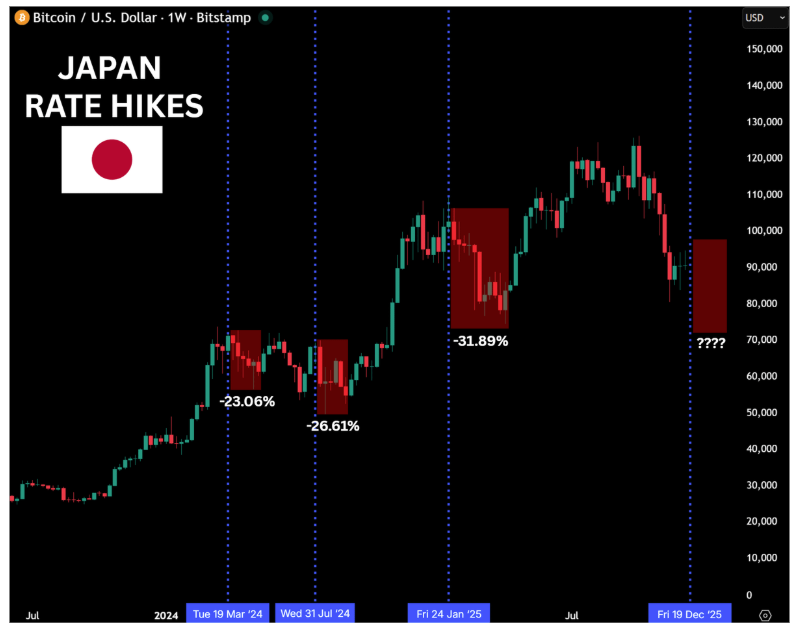
Crypto market observers have been quick to highlight an uncomfortable pattern relating to Bitcoin and the BOJ. Each time the bank has raised rates since 2024, Bitcoin’s price action has experienced a deep and relatively fast correction. 

For example, March 2024 saw Bitcoin fall by about 23% following Japan’s first rate hike since 2007. A similar rate spike move in July was followed by a drop of around 26%, while the January 2025 hike preceded a steeper decline of more than 30%.

Crypto analyst 0xNobler expressed concern, noting that if this historical trend repeats itself, Bitcoin could be headed below the $70,000 level shortly after the upcoming December decision. The chart he shared illustrates how each rate hike has aligned with a local market top, followed by a pronounced leg lower. The consistency of these moves has turned what might otherwise be dismissed as coincidence into a data point many traders are now taking seriously.

Japan’s interest rate

The pressure extends beyond reactions by the crypto industry alone. Japan is the largest foreign holder of US government debt, and any tightening from the Bank of Japan reverberates across global liquidity markets. Higher Japanese rates strengthen the yen, and this, in turn, reduces excess capital that might otherwise flow into risk assets.

Echoing this view, another crypto commentator known as AndrewBTC pointed to Bitcoin’s repeated 20% to 31% declines following each BOJ hike since 2024. He warned that another rate increase in December could produce a similar outcome and also identified $70,000 as the possible downside target if the pattern repeats itself.

Bitcoin/US Dollar. Source: @cryptoctlt On X

Bitcoin Above Long-Term Support: Not Everyone Is Bearish

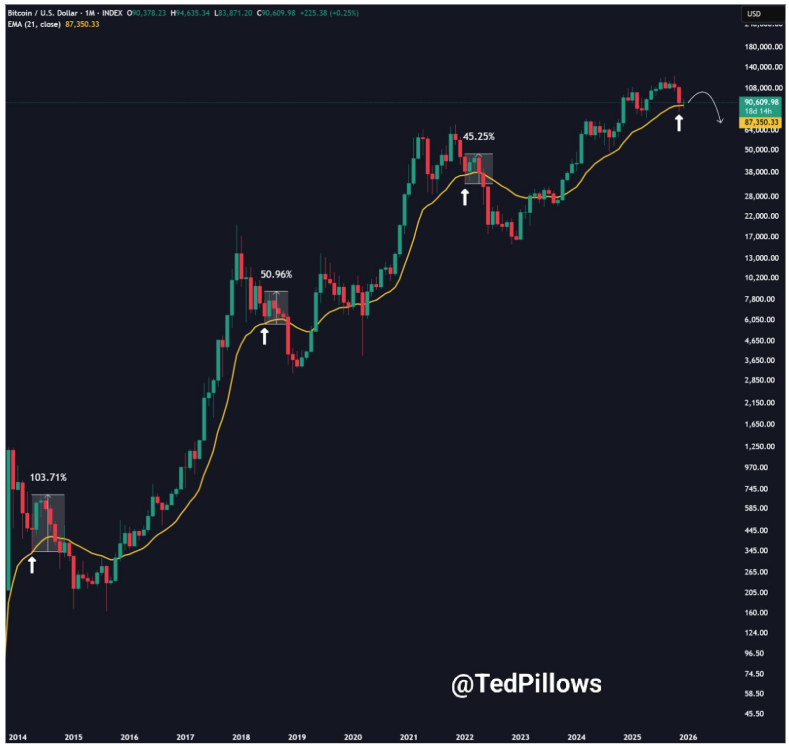
Despite the growing anxiety towards the Bank of Japan’s rate increase, the outlook for Bitcoin is not universally negative. For instance, analyst Ted Pillows pointed out that Bitcoin is currently interacting with its monthly EMA-21, a level that has always acted as a launchpad in prior cycles.

Based on this structure, Pillows predicted that Bitcoin could still surge to between the $100,000 and $105,000 range in the near term before there’s another price dump. 

As the December meeting approaches, Bitcoin finds itself caught between a troubling pattern and a resilient technical support. Whether Japan’s next rate hike leads to another immediate sell-off or allows for a temporary upside push may define how Bitcoin and the rest of the crypto market close out the year.

Bitcoin / U.S. Dollar. Source: @TedPillows on X

Featured image from Unsplash, chart from TradingView

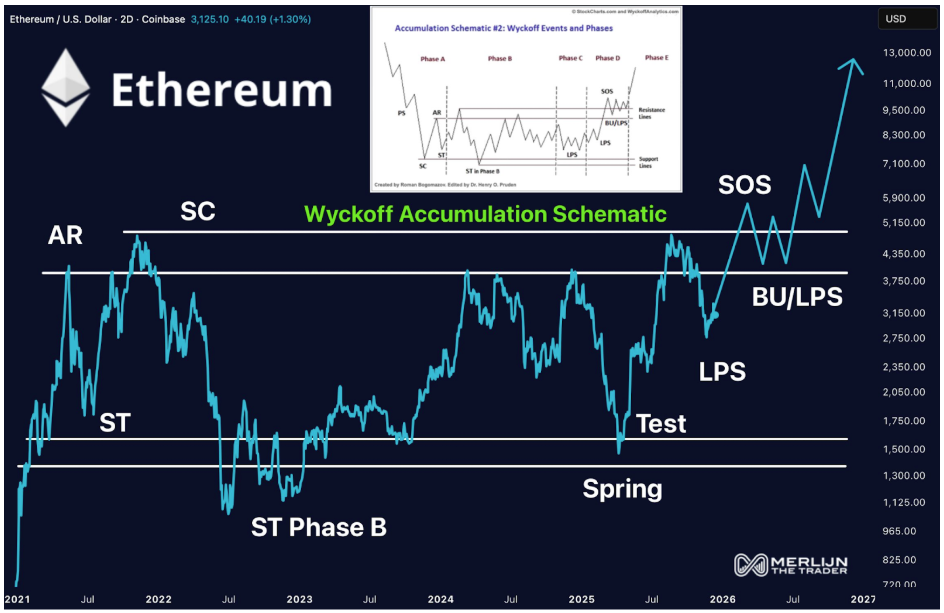
Ethereum Forms Wyckoff Breakout Setup: $10,000 Price Target Back In Focus

A recent technical analysis shared on X by crypto analyst Merlijn The Trader presents Ethereum’s price action on the 2-day candlestick chart as a textbook example of Wyckoff accumulation. In his assessment, Ethereum has already moved through several key stages of the model and is now approaching a powerful expansion phase, provided the structure stays intact.

Wyckoff Accumulation Structure Taking Shape On Ethereum Chart

Over the past several days, Ethereum has traded between roughly $3,050 and $3,400, repeatedly failing to secure a sustained move beyond either boundary. At the time of writing, Ethereum’s price action is trading around $3,100.

This prolonged standoff has reinforced the view that Ethereum has returned to consolidating rather than trading in a defined trend, a behavior that aligns closely with the accumulation phase highlighted in a technical analysis by Merlijn The Trader.

In his post, Merlijn described Ethereum’s chart as a “Wyckoff masterclass,” pointing to a sequence of events that align with textbook behavior from the Wyckoff accumulation schematic, which have been playing out for the entirety of 2025.

According to the annotated structure, the spring occurred when ETH briefly dipped below $1,500 in the first half of the year. Price did not linger below that level for long, reclaiming the range within days and going on a rally that eventually ended at a selling climax (SC) of $4,946

Within this structure, the initial selling climax and automatic downtrend reaction established a clear range in which the cryptocurrency has been trading up until now. The chart labels show this as Ethereum moving through Phase D, and this has been highlighted by a downtrend in recent months. 

However, based on the Wyckoff framework, Ethereum seems to now be approaching the breakout zone, with a transition into a full Phase E and a potential vertical markup coming next if the structure continues to play out.

Phase E Projection Points To Strong Upside Scenario

If the Wyckoff roadmap continues to unfold as outlined, Merlijn believes Ethereum is setting up for a full Phase E, the final stage of the accumulation process. This phase is characterized by a sustained markup, where price exits the selling climax (SC) decisively and trends higher with increasing momentum.

Ethereum / US Dollar: @MerlijnTrader on X

The projection on the chart shows a sharp upside expansion once overhead resistance is cleared, with Merlijn pointing to $10,000 and higher as a long-term objective if the structure completes. The path higher is not expected to be linear. The model anticipates an initial push into new all-time highs, followed by a modest rejection around the $5,000 area before the price pauses to consolidate towards the Backup and Last Point of Support

According to the chart, this BU/LPS would likely form around $3,750. If Ethereum holds above that level during the pullback, it would confirm structural strength, with the subsequent expansion targeting above $10,000.

Featured image from Unsplash, chart from TradingView

Reasons Why XRP’s Technical Structure Favors Upside Than Down Over Next 6 Months

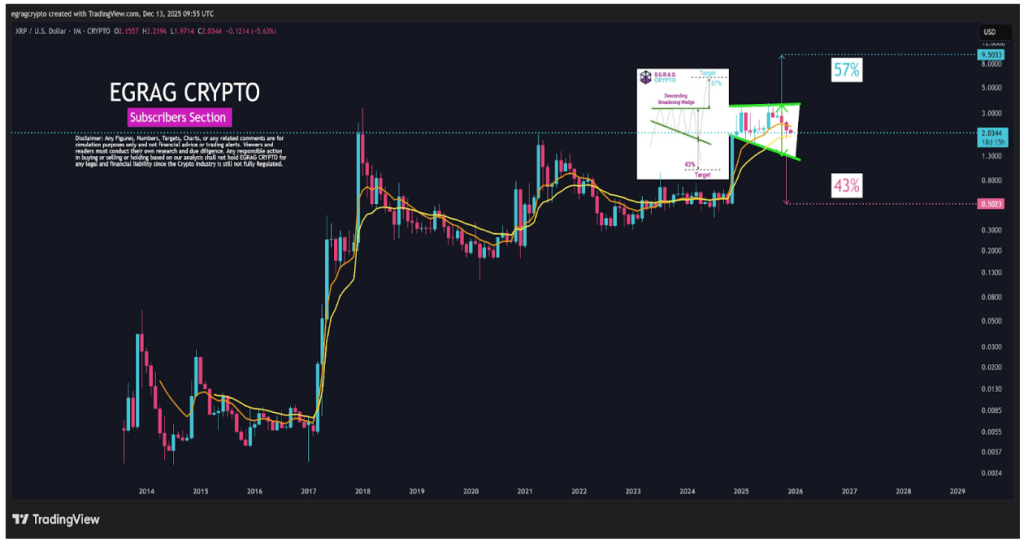
XRP’s recent pullback to $2 has not changed the broader technical picture, according to a new analysis shared on X by crypto analyst Egrag Crypto. Despite the lack of bullish price action in recent weeks, the technical analysis proposes that the market structure continues to favor an upside continuation rather than the trend ending. 

This outlook places the next three to six months in a constructive zone for XRP’s price action, where the probability of further upside is higher than the risk of a downward move.

XRP Currently In Consolidation, Not Distribution

The assessment of Egrag’s technical analysis is based on XRP’s price action currently ticking a list of boxes that points to the next move being up. The first of these boxes is what the analyst referred to as a regime shift, which occurred after the XRP price made a decisive breakout from a multi-year base around $0.5 last year.

This decisive breakout shifted the market from accumulation to expansion. Pullbacks in this phase are usually corrective, not trend-ending. In that context, the current price action can be viewed as part of a natural pause rather than a signal that the larger bullish move has failed.

Another central argument in the analysis is that the current price behavior represents consolidation rather than distribution. Egrag Crypto describes the market as being in a compression phase following an impulse, and this is a pause, not a top. Although XRP has spent about 13 months ranging within this structure, the analyst interpreted this as extended consolidation instead of a distribution process.

Chart Image From X. Source: @egragcrypto On X

EMA Structure Keeps Bullish Bias Intact

Another reason as to why the trend is more likely bullish is because XRP is still trading in alignment with its long-term exponential moving average, which remains above the 21 EMA. That relationship preserves the bullish bias, even though price currently sits below the faster 9 EMA, but this only reflects short-term weakness rather than a structural breakdown.

Beyond pure chart structure, fundamental developments have added weight to the case for longer-term appreciation. XRP is currently holding $2 as an important support zone, and recent developments have emerged that could increase bullish sentiment.

An example is Ripple’s conditional approval alongside other crypto firms for a national trust bank charter from the US Office of the Comptroller of the Currency.

Although the outlook is much more bullish, there is always the possibility of turning bearish within the next six months. According to Egrag, this outlook can only turn bearish if XRP records a sustained monthly close below the $1.80 to $1.60 region. 

Taken together, the analysis concludes that XRP is more likely to resolve higher than lower over the next three to six months, even if there is price volatility along the way.

Featured image from Unsplash, chart from TradingView

XRP Mirrors 2016 Trend That Led To 69% Crash Before 110,000% Rally

XRP has struggled to create any upside traction over the past few days, with the price rejecting above $2.15 in the middle of the week and now back to lingering just above the $2 level. 

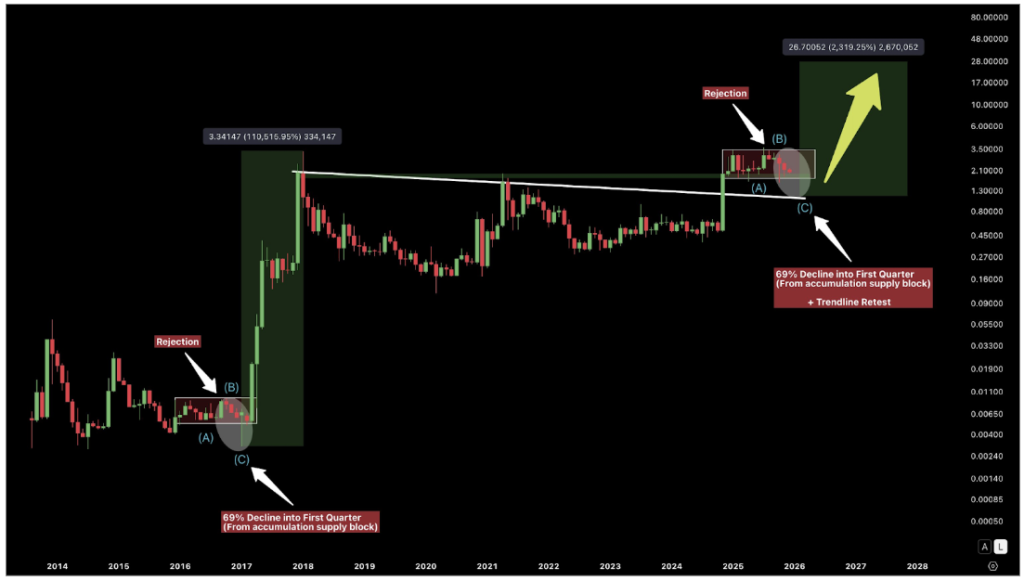
A new long-term technical comparison shared by crypto analyst ChartNerd places XRP’s price behavior since its July all-time high of $3.65 into an interesting context, implying that what XRP is doing now resembles a phase from its 2016 market cycle that points to an incoming huge rally.

Repeating 2016 Rejection And ABC Crash Structure

According to crypto analyst ChartNerd, XRP’s current structure matches a similar price action that unfolded in late 2016. when price rejected an accumulation supply block and rolled into an ABC corrective move. That correction ultimately produced a 69% flash-wick decline that extended into the first quarter of 2017. 

The drop was severe and unfolded over several months, eventually pushing XRP to as low as $0.00240, but it eventually represented the end of the correction rather than the end of the bullish cycle.

The chart accompanying the analysis, which is shown below, highlights a similar rejection pattern forming now. This pattern is based on how the XRP price rejected at its most recent all-time high in July. Since then, the monthly price chart has been printing consecutive red candles, with monthly closes consistently below opens.

At the time of writing, XRP is about a 44% correction from this all-time high. This means a 69% correction is yet to play out in its entirety. Therefore, if history repeats, a full 69% ABC-style move from the all-time high would drag XRP back below $1 and as low as $0.8. This move is expected to play out into the first quarter of 2026.

XRP Price Chart. Source: @ChartNerdTA

Potential Drop Could Be A Set-Up For A Much Larger Rally

XRP is currently trading at $2.04. Therefore, a deeper pullback below $1 will translate to a 51% decrease from the current price action. The idea of a deeper pullback from $2 is tough to imagine, especially given the inflows into Spot XRP ETFs. In fact, a pullback of that magnitude could test conviction across the market and cause many bullish traders to step aside.

However, the technical analysis frames it as a structural reset rather than anything else. In 2017, the post-crash consolidation laid the groundwork for one of XRP’s most explosive rallies on record, ultimately delivering gains in excess of 110,000%.

If this sequence plays out as expected, then the real bullish opportunity would develop later in 2026. From that reset zone, the chart projects a long-term advance to the 1.618 Fibonacci extension, placing a potential upside target around $27. The visual projection in the chart above shows a clean multi-month expansion zone that delivers a 2,300% gain after the corrective phase. 

Featured image from Unsplash, chart from TradingView

Is It More Profitable To Hold Bitcoin For The Short-Term? 2025 Numbers Are Here

Bitcoin’s 2025 price action has been anything but smooth, but one group of investors has quietly dominated the year’s profit statistics. Short-term holders, which are classified as addresses holding BTC for only one to three months, spent most of the year in the green amidst the push to multiple all-time highs and ensuing drawdowns throughout the year. 

On-chain data from 2025 now provides a clearer answer to whether short-term exposure to Bitcoin actually paid off for holders, even though conditions look far less comfortable at the time of writing.

Short-Term Holders Spent Most Of 2025 In Profit

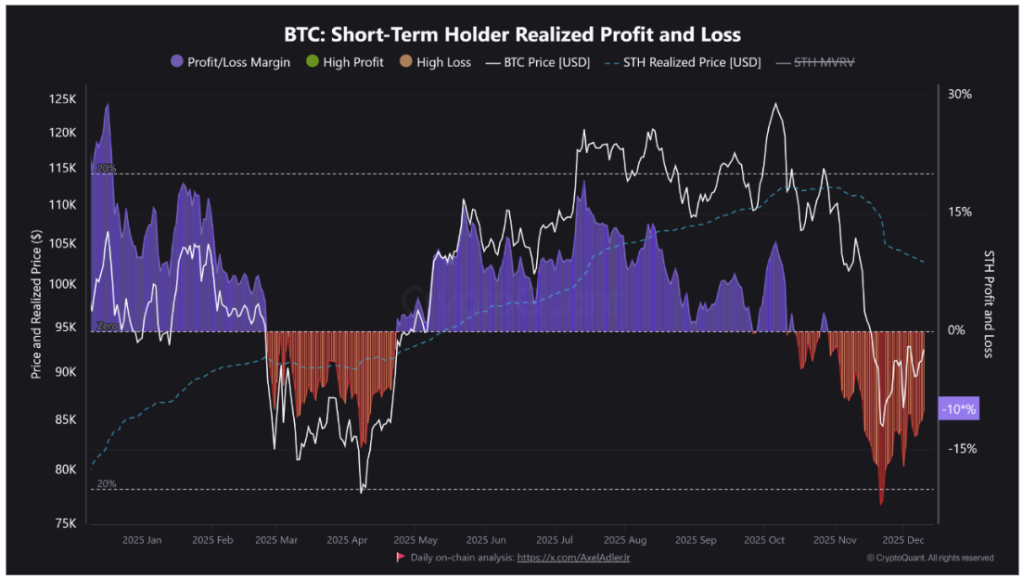
According to data from on-chain analytics platform CryptoQuant, Bitcoin short-term holders were in a profitable position for roughly two-thirds of 2025. On-chain profit and loss data shows that this cohort was in profit for about 66% of trading days, which translates to about 230 trading days. 

During the first half of 2025, Bitcoin’s price frequently traded above the average realized price of short-term holders, allowing recent buyers to lock in gains even as volatility remained elevated. This pattern became especially visible during mid-year rallies, when Bitcoin pushed above the $100,000 region and short-term profit margins expanded sharply. 

Each time the price reclaimed levels above the short-term realized price, realized gains dominated the distribution. Back in January, Bitcoin maintained a position above the short-term cost basis for nearly two consecutive months, creating the first extended window of sustained profitability for this cohort in 2025. 

A similar, and even more pronounced, phase unfolded between May and October, when short-term holders sat on substantial unrealized gains. During this period, the profit-and-loss margin climbed as high as 20 percent in July, coinciding with Bitcoin’s first breakout above $115,000. During this period, Spot Bitcoin ETFs were witnessing huge institutional inflows that cancelled out any profit-taking from short-term holders.

BTC: STH Realized Profit and Loss. Source: CryptoQuant

Current Picture Shows Short-Term Holders Underwater

That favorable backdrop has changed into losses in recent weeks. At the time of writing, Bitcoin is trading around the low-$90,000 range, while the short-term holder realized price is just above $100,000. This places the current profit/loss margin at a loss of about 10%. 

Interestingly, this margin recently fell to as low as negative 20% when the Bitcoin price broke below $85,000 in November, which is the deepest loss regime for short-term holders in 2025.

Nonetheless, the 2025 data shows that short-term holding was profitable for most of the year, but the outlook is not favorable right now. Structurally, these deep loss pockets usually show up closer to the late stages of a correction than the early ones.

Right now, the most important thing for short-term holders is for Bitcoin to reclaim the short-term realized price and push back above $100,000. Until then, short-term holders will stay under pressure, even with the yearly statistics leaning in their favor.

Featured image from Unsplash, chart from TradingView

Dogecoin Triangle Support Test Maps Out Recovery Roadmap And When To Sell

Dogecoin (DOGE) is testing the lower boundary of a long-term triangle pattern, a move that could determine its next major price direction. A new technical analysis highlights a roadmap with key recovery levels and outlines a potential timeframe when selling and profit-taking may become favorable.

Dogecoin Triangle Pattern Signals Recovery Path

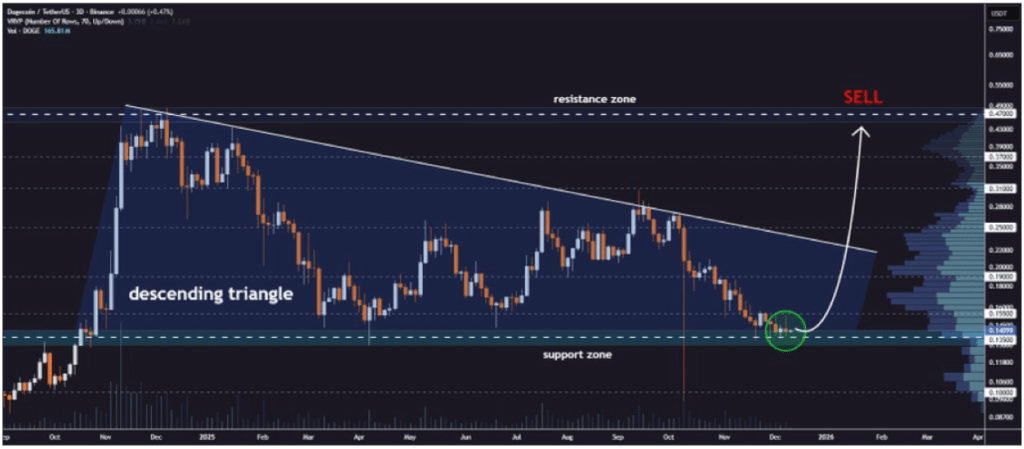
In a recent X post, crypto analyst Jonathan Carter presented a new analysis of Dogecoin’s price action, predicting that a potential recovery may be imminent. Carter explained that Dogecoin is currently testing a critical support area around $0.135 within a long-standing descending triangle chart structure. The setup is unfolding over the 3-day timeframe, with price action remaining above the pattern’s lower boundary. This zone has become a key battlefield between buyers and sellers. 

Carter highlights that the ongoing support area offers a favorable risk-reward profile for market participants. Buyers stepping in at this level are attempting to prevent a breakdown that could invalidate the broader recovery outlook. This means holding above this support zone could keep Dogecoin’s bullish scenario intact.

The descending triangle visible on the analyst’s shared chart shows a series of lower highs pressing against the stable support zone at $0.135. This compression often precedes a decisive move once the price reacts strongly at the base. Dogecoin’s current structure also suggests the market is steadily approaching that inflection point.

The volume data at the bottom of the chart has yet to show strong expansion near the support area. This indicates that Dogecoin’s trading activity has been relatively muted, suggesting that the market may be waiting for confirmation before committing to a significant upward move. 

If Dogecoin successfully rebounds from the $0.135 support zone, Carter’s chart maps out several upside levels to watch. Initial recovery targets are seen around $0.155 and $0.190, where previous price reactions occurred. Clearing these levels would signal growing momentum and a possible end to DOGE’s downtrend.

Further upside extensions projected on the chart include $0.250 and $0.310, which align with previous consolidation areas. A stronger continuation could open the path toward $0.370 and ultimately the resistance zone near $0.470.

Resistance Zone Reveals When To Sell DOGE 

Carter’s Dogecoin chart clearly shows the $0.47 resistance zone, where sellers are expected to become active again. A rally into the zone would likely face increased selling pressure based on historical price behaviour. As a result, the resistance area serves as a strategic level for profit-taking rather than for new entries in Dogecoin. 

Overall, Carter’s analysis suggests that Dogecoin’s price is sitting at a pivotal technical level that could shape its next major move. The meme coin’s price is currently down, having crashed by over 22% year-to-date, according to CoinMarketCap. Despite this slip, Carter remains optimistic about DOGE’s recovery path. The recovery timeline highlighted in the analysis suggests that by 2026, the meme coin may have emerged from its downturn. 

Featured image from Unsplash, chart from TradingView

❌