Reading view

There are new articles available, click to refresh the page.

Ethereum Active Address Count Hits Seven-Month Low — What This Means

While the Ethereum price still struggles to mount a sustained bullish momentum, an investigation into its on-chain activity has revealed a significant change in the behavior of its market participants. 

Active Addresses Decline To 327,000 From 483,000 August High 

In a Quicktake post on the CryptoQuant platform, market analyst CryptoOnchain shared that there has been a growing scarcity of activity within the Ethereum network. Specifically, the quant referenced data obtained from the Ethereum Active Addresses metric, observed on the 7-day Simple Moving Average. 

Since reaching its peak in August, the Active Addresses metric has declined steadily from about 483,000 to 327,000 — a level which marks the lowest reached since May this year. This downturn of more than 32% suggests an increasing exit of willing participants from the Ethereum network.

Ethereum

Interestingly, the aforementioned downturn is not a stand-alone phenomenon. Just around the same period where active addresses explored the southside of the charts, the Ethereum price also took on a bearish direction. This period saw the Ether token lose its $4,800 valuation and begin its descent to the current price around $3,100.

According to the analyst, this strong correlation between the falling Ethereum valuation and its contracting network usage points to something clear — that the recent price drop is likely a result of reduced network demand. This further shows that market participants are moving past speculation, and are in lieu adopting a broader outlook on the Ethereum blockchain. 

Ethereum Market Outlook

On the more positive side, CryptoOnchain explained how healthy bull cycles differ from the present market cycle. Typically, rising prices are not taken for granted as they often indicate a healthy bullish cycle.

An expansion of the cryptocurrency’s network usage also lends credence — enough to serve as confirmation — to suspicions of structural shifts into bullish phases. This theory holds true from a variety of historical occurrences.

So, a market would not qualify as bullish enough if the Ethereum price were on the rise without any parallel growth in on-chain activity. Hence, for a convincing price reversal to hold, there has to be a significant and sustained recovery of active addresses.

This would signal the return of on-chain demand and further heighten expectations of imminent momentum. Until those conditions are simultaneously met, the Ethereum market remains in a state of utmost caution, where prices could head towards either direction, with the major factor being the influx of network users. 

As of press time, the Ether token is valued at about $3,106, reflecting no significant movement since the past day. 

Ethereum

Bitcoin Price’s Next Move Could Be Below $80,000 — Here’s Why

The price action of Bitcoin has been somewhat limited in the past few weeks, as the bulls and bears battle for dominance in the market. This indecisiveness has had the premier cryptocurrency oscillating between the $89,000 and $93,000 levels in recent weeks.

According to the latest on-chain data, this sideways movement exhibited by the Bitcoin price is associated with the uneven distribution of the coin’s total supply around various levels. This recent on-chain evaluation has also identified the possible next stop for the market leader’s price.

BTC Price At Risk Of A 20% Decline? 

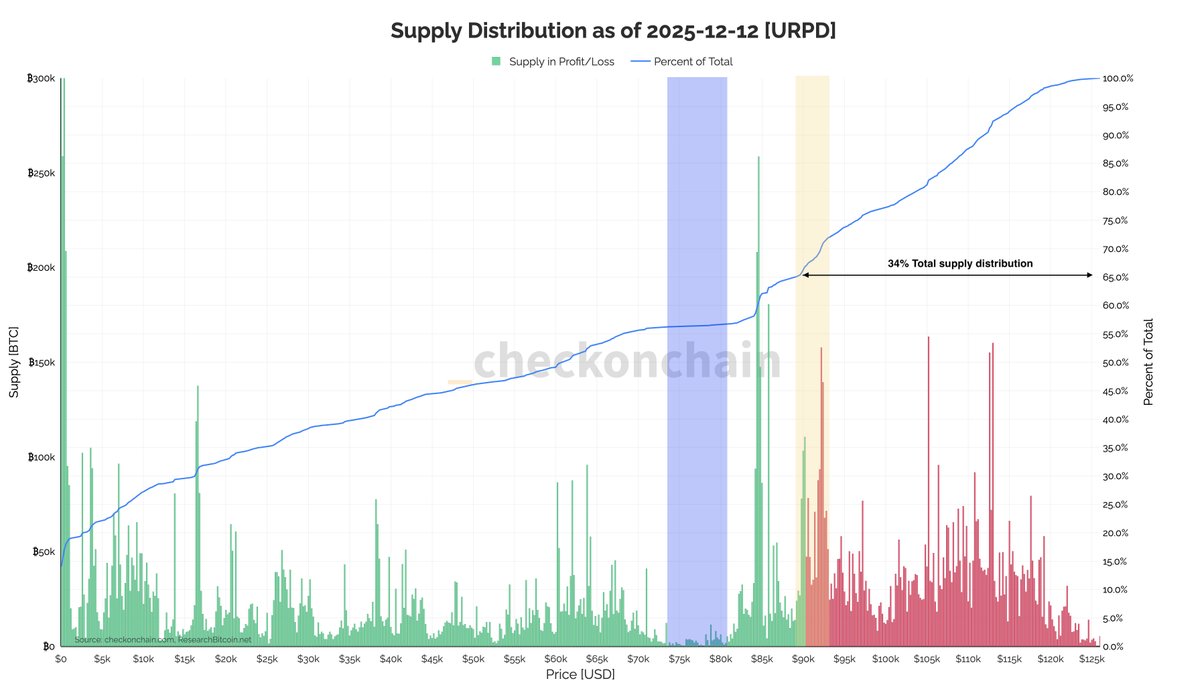
In a December 13 post on the X platform, pseudonymous analyst Darkfost explained that the Bitcoin price is locked in a battle between $89,000 and $93,000. This on-chain observation is based on the distribution of the BTC supply (using the URPD metric) around different price levels.

The URPD (UTXO Realized Price Distribution) metric tracks the amount of a particular cryptocurrency that was traded at a specific price level. When a large amount of coins is traded at a certain price level, the region tends to serve as support when the price trades above it and resistance when the price is beneath it.

According to Darkfost, this explains why the Bitcoin price seems stuck within the $89,000 – $93,000 region (the yellow area in the highlighted chart). The market analyst noted that the zone has seen significant trading activity, justifying the oscillation of the BTC price within the range.

What’s new is the “distribution gap” (blue area in the chart) in the $74,000 – $80,000 range, which represents a zone with relatively low historical trading activity. Darkfost explained that these low-liquidity regions tend to attract the Bitcoin price in a bid to rebalance supply and demand.

Bitcoin

As observed in the chart above, this distribution gap lies between the $74,000 – $80,000 range, meaning that the price of BTC could witness a correction to this level before bouncing back to a new high. A correction to this level could be equivalent to a nearly 20% downturn from the current price point.

Furthermore, Darkfost noted that 34% of the total BTC supply distribution is now above the psychological $90,000 level. This trend could make $90,000 a structural support level for the price of Bitcoin over time.

It is also worth noting that while a large distribution cluster can be seen around $84,000, it should not be over-interpreted. Darkfost mentioned that the distribution level is not as genuine as it looks, but rather a result of Coinbase’s recent Bitcoin movement.

Bitcoin Price At A Glance

As of this writing, the price of BTC stands at around $90,150, reflecting no significant change in the past 24 hours.

Bitcoin

Crypto Promoter Hit With New Indictment Over $1.8 Billion HyperFund Case

Crypto promoter Rodney Burton, popularly known as “Bitcoin Rodney,” is facing new charges for his alleged role in the $1.8 billion HyperFund pyramid scheme. This development comes almost two years after the US Department of Justice brought criminal charges against two of the co-founders of the crypto Ponzi scheme.

In January 2024, the US DOJ charged Xue Lee (Sam Lee) and Brenda Chunga (Bitcoin Beautee) for their roles in HyperFund. According to the prosecutors, the founders falsely claimed that the scheme’s investors would receive substantial returns paid from non-existent crypto mining operations.

The fraudulent scheme, which also drew the attention of the US Securities and Exchange Commission (SEC), collapsed in 2022, leaving investors unable to withdraw their money. The SEC filed a civil action against the founders, stating that HyperFund lacked any real revenue source apart from investors’ funds.

US DOJ Adds Wire Fraud Charge To HyperFund’s Promoter

On Friday, December 12, the US Attorney’s Office for the District of Maryland announced new indictment charges against 56-year-old Burton for actively promoting the fraudulent HyperFund scheme. The new charges include conspiracy to commit wire fraud, two counts of wire fraud, seven counts of money laundering, and one count of operating an unlicensed money transmitting business.

The 56-year-old crypto promoter, who was initially facing two counts related to unlicensed money transmission, is now staring down at a protracted prison sentence if found guilty on all counts; a maximum of 20 years in federal prison for the wire fraud conspiracy and each wire fraud count, 10 years for each money laundering count, and five years for the unlicensed money transmission enterprise.

The superseding indictment also accused Burton of misappropriating investors’ funds in the purchase of luxury condo homes, sports cars, and a yacht. The crypto influencer managed to build a crypto community following while hosting various celebrities, including Akon, Jamie Fox, and Rick Ross.

According to court filings, Burton claimed that he was made to believe that he was operating a legitimate enterprise, causing him to mislead investors. The crypto influencer’s trial is expected to start by March 2026.

Crypto Market At A Glance

As of this writing, the total cryptocurrency market is valued at around $3.05 trillion, reflecting a 0.2% jump in the past 24 hours.

Crypto

Strategy Maintains Nasdaq 100 Spot Despite MSCI Drama — Details

Strategy (formerly MicroStrategy) has kept its place in the Nasdaq 100 during this year’s reshuffling—its first since joining the index in a similar event last December. This comes as a piece of good news as the Bitcoin corporate buyer contends with the risk of possible exclusion from Morgan Stanley Capital International (MSCI)’s indexes.

MSTR Survives First Nasdaq 100 Reshuffling 

On Friday, December 12, Reuters revealed that Strategy (with the ticker MSTR), the largest corporate holder of Bitcoin, survived its first Nasdaq 100 rebalancing since joining the index. As its name suggests, the Nasdaq 100 tracks the performance of 100 of the largest non-financial companies listed on the Nasdaq stock exchange.

According to the report, this reshuffling saw Biogen, CDW, GlobalFoundries, Lululemon, On Semiconductor, and Trade Desk lose their places in the index. At the same time, Alnylam Pharmaceuticals, Ferrovial, Insmed, Monolithic Power Systems, Seagate, and Western Digital made it into the Nasdaq 100. 

These changes to the Nasdaq 100 index are expected to come into effect on Monday, December 22.

Despite the positive nature of this development, the MSTR price closed the day on a nearly 4% decline, which has been the theme for the stock as of late. According to the latest market data, the Strategy stock is down by almost 25% in the past month.

Strategy Urges MSCI To Reconsider Index Criteria 

Furthermore, this positive event comes at a time when other index providers are reevaluating their inclusion criteria. As Bitcoinist earlier reported, global index provider MSCI stated that it is considering the exclusion of companies with business models that focus heavily on holding crypto assets.

However, Strategy’s cofounder and chairman, Michael Saylor, stated that his firm is not merely a passive Bitcoin holding entity but rather a software firm with a proactive financial strategy. According to Saylor, the firm is in discussions with MSCI regarding its plans to exclude companies whose crypto holdings exceed 50% of total assets from its indices. 

In a recent letter endorsed by Saylor and CEO Phong Le, Strategy voiced its support for MSCI’s intentions to establish consistent eligibility criteria across its indices. Nevertheless, the firm urged MSCI to reconsider its plan to delist companies with over 50% digital asset holdings from its Global Investable Market Indexes. 

While Saylor has countered their evaluation, saying an exclusion “won’t make any difference,” JP Morgan analysts estimate that Strategy alone might face outflows of up to $2.8 billion as a direct consequence of MSCI’s decision. 

Strategy

Ethereum Price Falls To $3,000 As Taker Volume Spikes To New High — What’s Happening?

Ethereum was one of the best-performing cryptocurrencies in the market over the past week, with its price jumping mid-week to as high as $3,400. Interestingly, the “king of altcoins” is now barely hanging on to the psychological $3,000 price level.

On Friday, December 12, the crypto market felt a wave of bearish pressure, with most large-cap assets witnessing significant price corrections on the day. According to the latest on-chain data, the Ethereum market appears to be experiencing heavy selling pressure.

Ethereum Taker Volume Sees Notable Spike

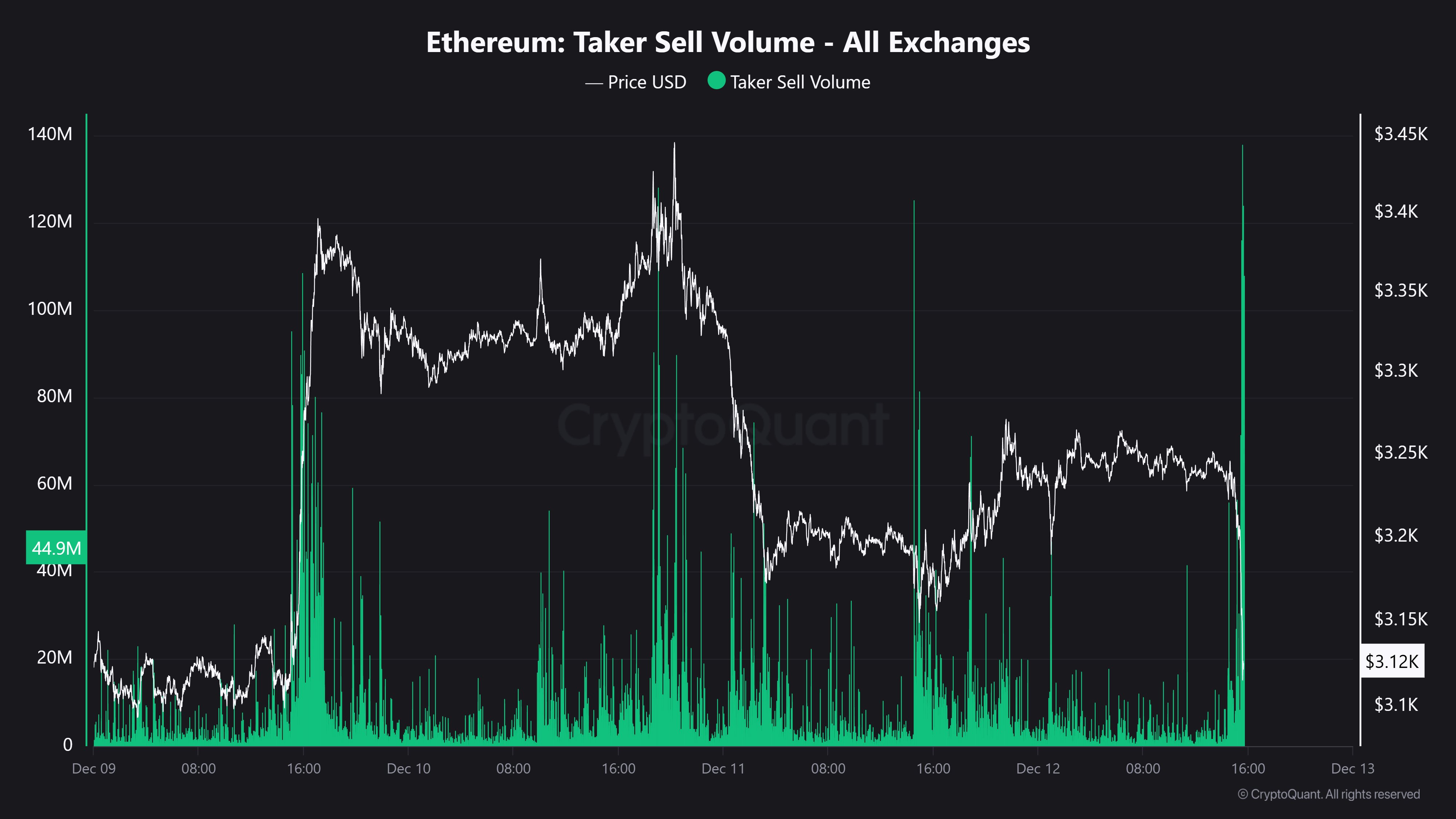
In a new post on the X platform, crypto analyst Maartunn revealed that the Ethereum price has been a victim of heavy selling pressure in the past day. This observation was based on the Taker Sell Volume metric, which saw a significant increase on Friday.

This on-chain metric estimates the total volume of sell orders filled by takers in perpetual swaps of a particular cryptocurrency (Ethereum, in this case). In crypto trading, a taker refers to a market participant who fills an existing order in an exchange’s order book.

Ethereum

Maartunn highlighted that the Taker Sell Volume across all centralized exchanges saw a notable uptick on Friday. Data from CryptoQuant shows that the metric rose to as high as 124.2 million ETH on the day.

According to Maartunn, this significant spike in the Ethereum Taker Sell Volume is a clear sign of aggressive selling in the market. This level of selling activity put bearish pressure on the Ethereum price, explaining the latest correction to $3,000.

60,000 ETH Flows Into Centralized Exchanges

Another on-chain signal that supports the theory of increased selling in the Ethereum market is the exchange inflow metric. According to data shared by Ali Martinez, significant amounts of ETH tokens have found their way onto centralized exchanges in the past day.

Santiment data shows that 60,000 ETH tokens, worth approximately $200 million, flowed onto exchanges on Friday. As expected, this inflow activity led to a spike in the Ethereum supply on exchanges and the open market.

With no adequate demand to mop up this increasing supply, this rising exchange inflow only puts downward pressure on the Ethereum price. As of this writing, ETH is valued at around $3,080, reflecting an over 4% decline in the past 24 hours.

Ethereum

If This Ethereum Bear Flag Pattern Holds, ETH Price Could Be On Its Way To $2,400

Since early October, when the Ethereum price began its dive into bearish territory, it has struggled to regain any of its significant price levels. The Ether token failed to hold at multiple support zones throughout November, as it plunged downwards. 

While Ethereum appears to be gaining bullish momentum to signal an imminent price reversal, a bearish continuation looks like the more probable scenario after the latest decline to $3,000. A popular analyst has recently put forward a prognosis, which paints a worrying picture for the second-largest cryptocurrency.

$2,400 Might Be The Next Price Cushion For ETH

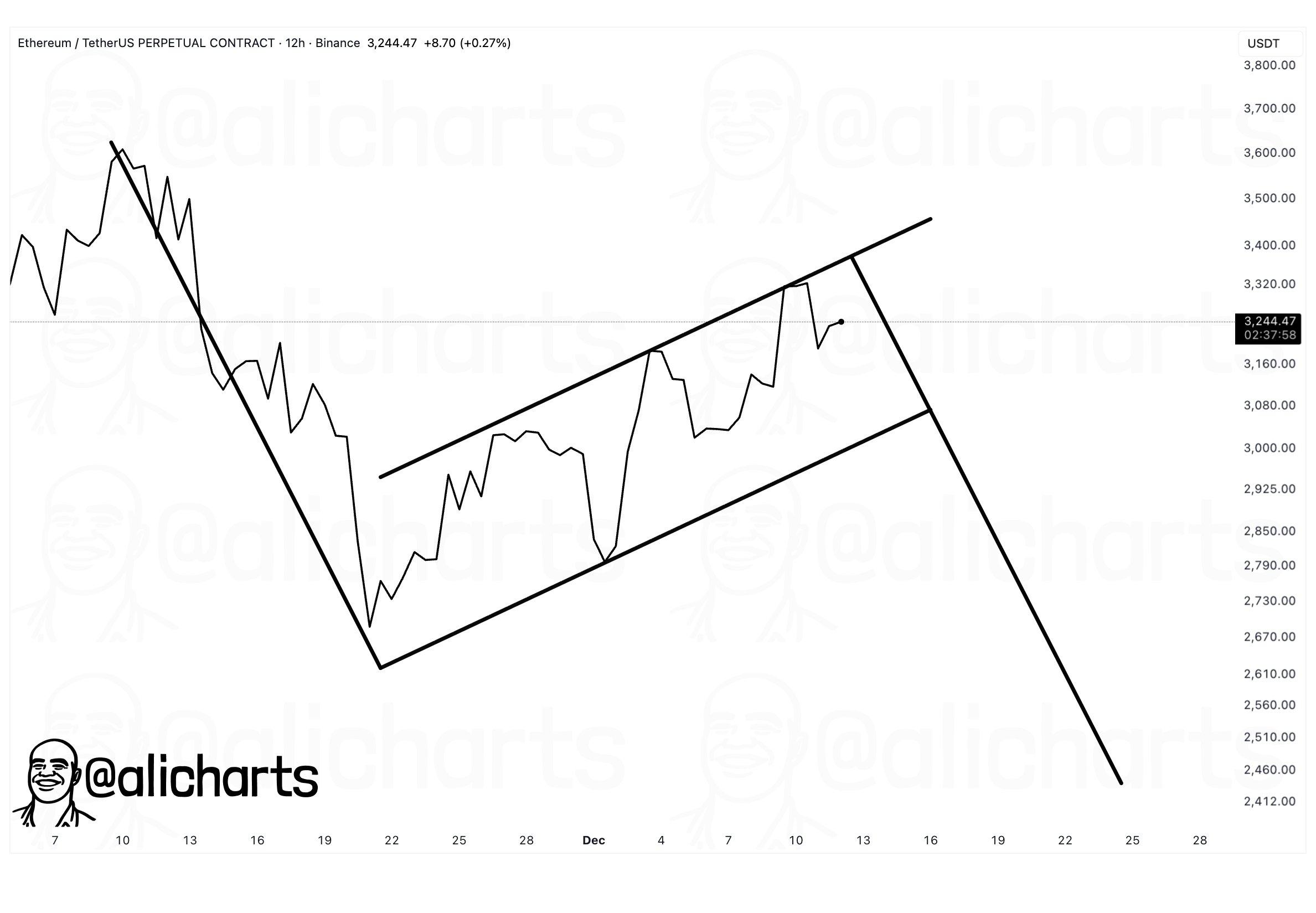
In a December 13 post on the social media platform X, market analyst Ali Martinez highlighted that the Ethereum price is showing an interesting sign of a potential bearish continuation over the coming weeks. Martinez’s analysis hinged on the bear flag pattern, a technical analysis pattern that is often used to confirm the continuation of a downtrend. 

Typically, the pattern has two components — the flag and the flag pole. Price initially displays a sharp downward move, forming the flagpole. Afterwards, there is usually a brief period where the price displays upward movement or even sideways consolidation; this period of choppy price action makes up ‘the flag.’

Ethereum

What gives the flag its integrity is its upper and lower boundaries, which serve as resistance and support zones. Because breakouts beneath support zones typically indicate that the market could be bearish, a failure of the flag’s support would then be the needed confirmation of the earlier-seen sell signal. 

In the scenario where this happens, the crypto pundit pointed out that Ethereum’s possible target could be the $2,400 price level. This is likely the case because all preceding regions may present with insufficient liquidity to sponsor any significant price reversal.

Ethereum Whales’ Realized Price Of $2,400 Comes In Sight — What To Expect 

Interestingly, on-chain data adds credence to $2,400’s reputation as a relevant price level. In a Quicktake post on the CryptoQuant platform, a pseudonymous pundit, OnChain, revealed that Ethereum is currently happens to be trading very close to a significant price level.

According to the analyst, Ethereum whales — with holdings of at least 100,000 ETH — mostly procured their coins close to $2,400. Interestingly, the Ether token barely ever falls to price levels close to the realized price of this group of investors. 

Since the last five years, there have only been four instances where the ETH price nearly reached the acquisition price of these whales, before eventually seeing major recoveries. If this historical pattern thus plays out, the second-largest cryptocurrency might have seen the beginning of yet another bullish rally. 

As of this writing, Ethereum holds a valuation of $3,086, reflecting a 4% price decline in the past day.

Ethereum

Bitcoin Is A ‘Digital Labubu’ With No Economic Value: Vanguard Quant Head

Vanguard, the world’s second-largest asset manager, enabled the trading of Bitcoin exchange-traded funds (ETFs) and other crypto-related products on its platform at the start of December. However, it appears that the firm’s overall view of crypto and the digital asset industry has not changed very much over time.

Hence, the reversal of its longstanding position on Bitcoin and other cryptocurrencies seems to be a purely business decision rather than a change in belief. This revelation came from one of the trillion-dollar company’s top executives at a Bloomberg conference on Thursday, December 11.

No Evidence BTC’s Technology Offers Economic Value: Vanguard’s Quant Head

According to a Bloomberg report, John Ameriks, Vanguard’s global head of quantitative equity, revealed that the asset management firm’s view of crypto remains unchanged despite recently offering its investors access to Bitcoin ETFs. The senior investment executive likened BTC to a speculative “digital Labubu”—a popular plush toy collectible.

Ameriks posited that Bitcoin could be seen as a speculative collectible rather than as a productive asset, as it lacks the income, compounding, and cash-flow properties Vanguard typically checks for in long-term investments. The global head of quant said there is no clear evidence that Bitcoin’s underlying technology delivers durable economic value.

It is for this not-so-optimistic view of cryptocurrencies that Vanguard has refrained from issuing its own crypto-linked exchange-traded funds. However, the asset management firm welcomed select crypto funds to its platform earlier this month after seeing the successful record of the US-based Bitcoin ETFs since their launch.

Ameriks said in a separate interview at the Bloomberg conference:

We allow people to hold and buy these ETFs on our platform if they wish to do so, but they do so with discretion. We’re going to not give them advice as to whether to buy or sell or which crypto tokens they ought to hold. That’s just not something we’re going to do at this point.

Nevertheless, the Vanguard global head of quantitative equity did admit that he sees Bitcoin potentially offering non-speculative value in certain contexts. The top executive listed high-inflation environments and periods of political instability as some of such scenarios.

Ameriks concluded:

If you can see reliable movement in the price in those circumstances, we can talk more sensibly about what the investment thesis might be and what role it could play in a portfolio. But you just don’t have that yet – you’ve still got too short of a history.

Bitcoin Price At A Glance

The price of BTC has been in a sustained downtrend over the past few months, sitting nearly 30% away from its all-time high of $126,080. As of this writing, the premier cryptocurrency is valued at around $90,380, reflecting an over 2% decline in the past day.

Bitcoin

XRP Price Holds Above $2 Again — What’s Next For The Altcoin?

The XRP price has been on a steep downward spiral throughout the second half of 2025, falling from its all-time high of around $3.65. However, finding support at the $2 mark has been a consistent theme during the altcoin’s period of decline.

Most recently, the XRP price fell this week from its local high close to $2.20 before bouncing back from the $2 mark. While the coin’s value continues to hover around this psychological price point, below is a look at other relevant levels that could determine its future trajectory.

Key On-Chain Levels For XRP

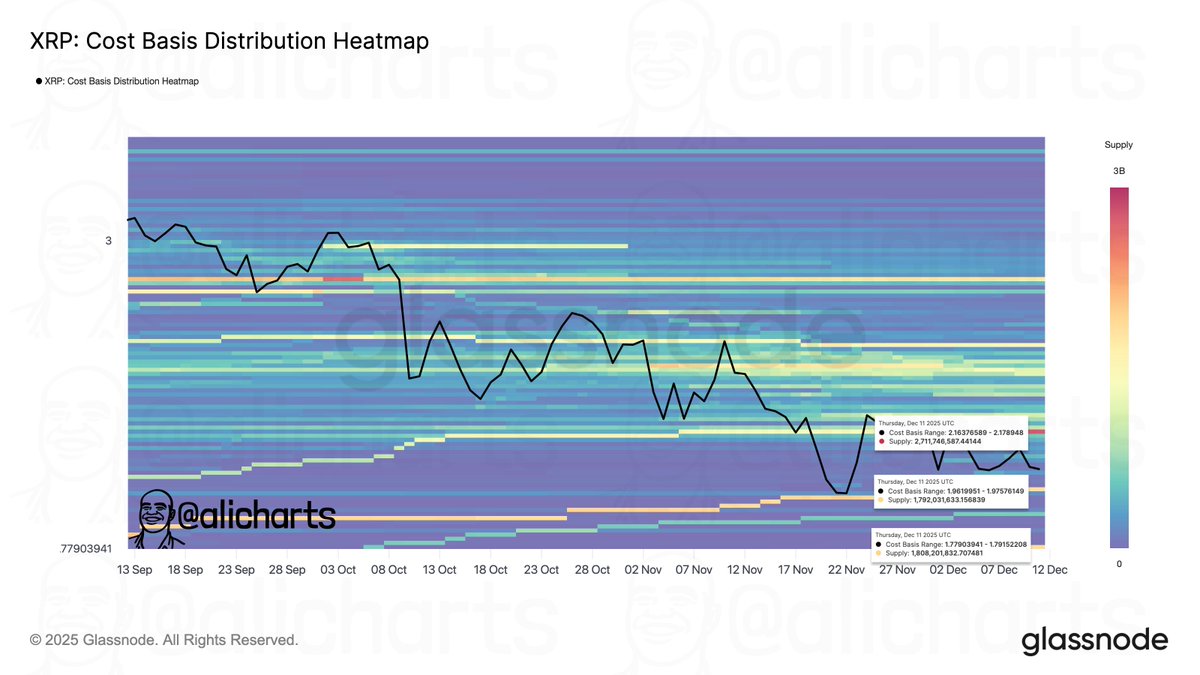
In a December 12 post on social media platform X, crypto analyst Ali Martinez shared on-chain insights into the current market outlook for the XRP token. Using Glassnode’s Cost Basis Distribution Heatmap, the market pundit identified three key levels for the XRP price.

The Cost Basis Distribution Heatmap tracks the average cost basis of the total XRP token supply. With the help of a heatmap, this metric highlights different price levels and the density of investors who purchased their tokens within and around these price levels.

The deep red shade on the heatmap indicates an investor cluster with their cost basis around the highlighted price regions. These zones often act as dynamic support and resistance, depending on whether the current XRP price is below or above them.

XRP Price

Martinez highlighted that the $1.96 and 1.78 zones are the next support cushions for the price of XRP. As seen with recent rebounds around the $1.96 level, the altcoin will likely also bounce back (if it loses the current immediate support) at $1.78, as investors tend to double down and defend their positions by buying more when the price returns to their cost basis, thereby keeping the token’s price afloat.

Meanwhile, Martinez noted that the $2.17 level is a resistance zone for the XRP price, as several investors with their cost basis around it are likely to sell when the price returns to this zone. This selling activity, in turn, puts downward pressure on the altcoin and prevents its price from breaking out.

Ultimately, this on-chain observation reveals that the XRP price needs to at least break the resistance at $2.17 to kickstart any fresh upward trajectory. On the flip side, a loss of the $1.96 support could see the fourth-largest cryptocurrency fall to as low as $1.78.

XRP Price At A Glance

As of this writing, the price of XRP stands at around $2.01, reflecting no significant change in the past 24 hours. Meanwhile, the altcoin is down by nearly 2% on the weekly timeframe, according to CoinGecko’s data.

XRP Price

Bitcoin Market Profitability Hits ‘Complete Reset’ — What’s Next For Price?

Following a fresh wave of bearish pressure on Friday, December 5, the price of Bitcoin has struggled beneath the psychological 90,000 level for much of the weekend. However, the latest on-chain data suggests that the premier cryptocurrency might be readying for its next healthy upward move.

BTC SOPR Drops To Lowest Level Since Early 2024

In a December 6 post on the X platform, CryptoOnchain hypothesized that a local bottom appears to be forming for the price of Bitcoin. According to the market pundit, the selling pressure, especially amongst long-term holders, seems to be fading off at the moment.

This market observation centers on the Spent Output Profit Ratio (SOPR) metric, which evaluates the profitability ratio of spent outputs for both long-term and short-term holders. This on-chain indicator evaluates whether market participants are selling their assets at a profit or at a loss.

Typically, when the Bitcoin Spent Output Profit Ratio has a value greater than 1, it indicates that the investors are selling at a profit. On the flip side, an SOPR value less than 1 implies that the market participants are offloading their coins while in the red.

Bitcoin

According to CryptoOnchain, the Bitcoin SOPR has now fallen to 1.35, its lowest level since early 2024. The market analyst noted that this metric’s latest movement suggests a complete reset in market profitability, especially as the price of BTC slid beneath the $90,000 mark.

Furthermore, CryptoOnchain highlighted that the heavy profit-taking phase by long-term holders appears to be coming to an end, as exhaustion and fatigue increasingly spread among the bears. From a historical perspective, the SOPR metric falling to this low signals a local bottom is forming for the BTC price, especially as the market cools down.

Ultimately, CryptoOnchain revealed that a price rebound at this point could set the stage for Bitcoin’s next healthy upward rally. 

Bitcoin Price At A Glance

As of this writing, the price of BTC stands at around $89,500, reflecting no significant changes in the past 24 hours. According to data from CoinGecko, the flagship cryptocurrency is down by nearly 2% in the last seven days. 

With the price of Bitcoin down year-to-date and from its all-time high of $126,080 by roughly 5% and 30%, respectively, the market leader looks set to end 2025 in the red—barring a sudden change in market momentum.

Bitcoin

Bitcoin Losses Surge To 3x Profits — Could Relief Be Near?

The Bitcoin market appears to be riddled with an increasing amount of sell-side pressure, as its recent price action reveals bears’ dominance. Interestingly, another on-chain evaluation suggests that the current market movement may be a direct effect of rising panic-induced sales. 

$1.7B Realized Losses Vs $605M Realized Gains

In a Quicktake post on the CryptoQuant platform, GugaOnChain shared that the Bitcoin market has been in a capitulation phase in recent days. This on-chain observation revolves around the Bitcoin Realized Profit and Loss ($) metric.

For context, this metric tracks the actual profits (in US dollars) and losses investors realize—or lock in—whenever they offload their Bitcoin holdings to exchanges. 

GugaOnChain highlighted that about $1.705 billion worth of BTC has been realized in losses by market participants. On the other hand, a relatively smaller amount, totaling approximately $605 million, was reportedly realized in gains.Bitcoin

Source: CryptoOnchainThis disproportionate distribution in losses, as against the profits acquired, puts the Loss/Gain ratio at a 2.82 reading. This means that, for every dollar made in profit, almost 3 dollars are lost. 

Looking at the bigger picture, the analyst pointed out that 74% of the total realized volume leans towards the red side of the market, leaving a mere 26% of the Bitcoin market in profits. When realized losses surge rapidly to overcome gains, it is often interpreted as a sign of capitulation.

Historically, extreme capitulation events tend to set the pace either for price recovery or even deeper downside movement. These two possibilities, however, remain dependent on the integrity of available inflection points. 

Bulls Must Defend These Price Levels Or Risk Deeper Corrections

Although the market odds currently seem stacked against the bulls, as the price takes on a bearish structure, the analyst also identified a few important zones that may determine Bitcoin’s next direction. GugaOnChain explained that, in the scenario where the bulls continue to bleed, the next price level presenting an opportunity of redemption lies around $71,450.

This specific price level is critical, as it represents the realized price for investors who have acquired Bitcoin for about 12–18 months. 

Citing a more extreme scenario, the online pundit revealed that the next key support sits at $58,940. This zone is important as it is the realized price for investors whose coins are within the 18-month to 2-year age range.  

On the weekly timeframe, however, price zones around $80,000 and $74,000 appear significant enough for a short-term price recovery. A bullish reversal could take place if these price levels were to meet the present downturn with significant opposing strength. 

As of this writing, Bitcoin is valued at around $89,331, reflecting no significant movement in the past 24 hours. 

Bitcoin


Ease Up, Bitcoin Investors – No More Negative Days For BTC In 2025 

The cryptocurrency market has had a year filled with ups and downs, with most large-cap digital assets turning in mixed performances in 2025. After a rough start to the year, things started to look up for the price of Bitcoin in the second and third quarters, as it set multiple all-time highs across the six-month period.

However, the flagship cryptocurrency has largely struggled in the final months of 2025, looking set to end the year in the red. Interestingly, the latest on-chain data and historical patterns suggest that the price of Bitcoin might be set for a fairly stronger yearly close than expected.

No Negative Days Left In 2025, But 2026 Could Feature A Deep Correction 

On Saturday, December 6, Alphractal CEO and founder Joao Wedson took to the X platform to share what to expect from the Bitcoin price in the last days of 2025. According to the on-chain expert, the market leader is likely to close the year in a sideways price range.

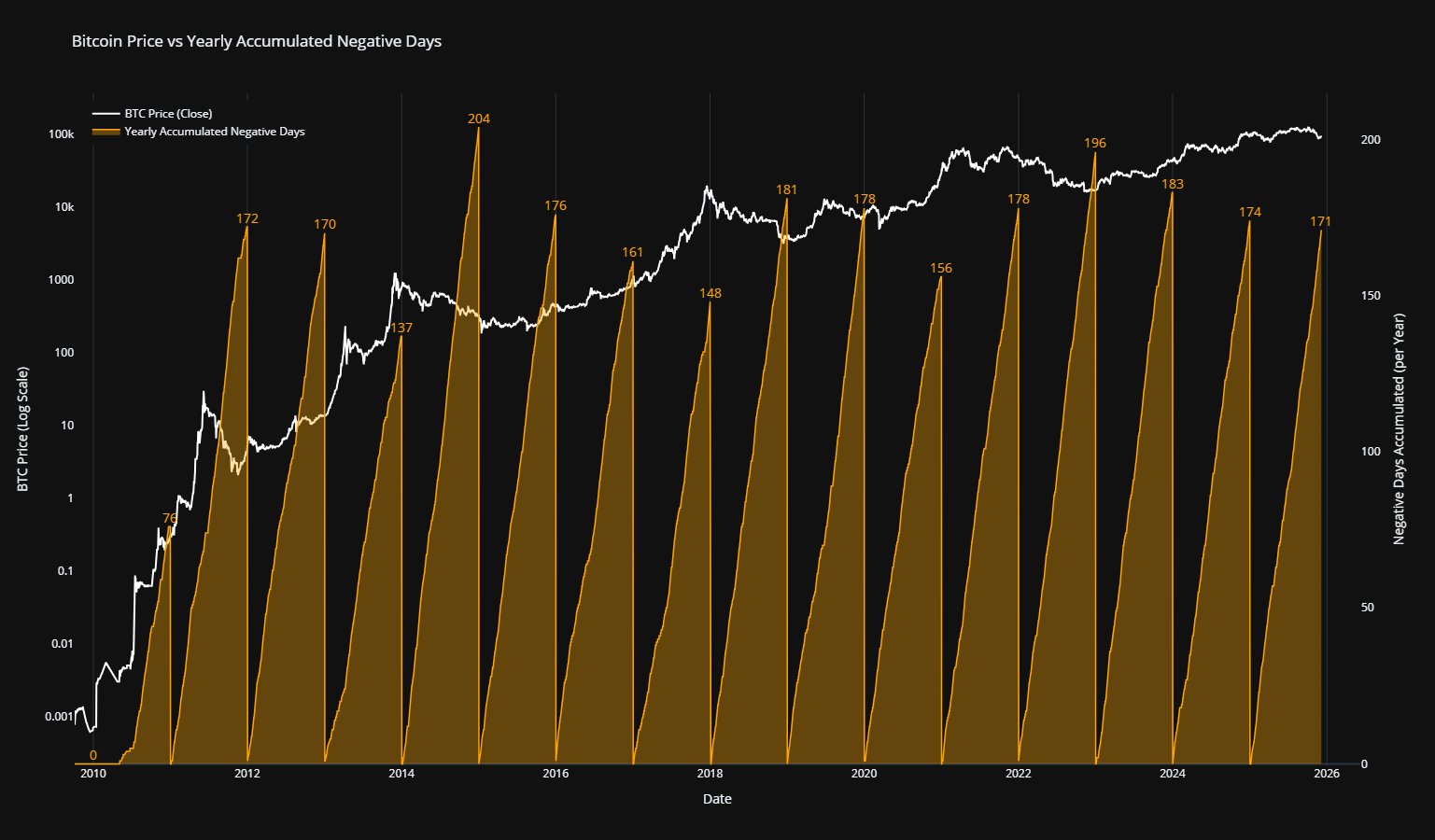
The relevant metric here is the Yearly Accumulated Negative Days, which tracks market resilience by measuring the number of days in a year where an asset’s daily price candlestick closed in the red. 

According to historical data and patterns, Bitcoin typically witnesses an average of 170 days of negative price movement in a year. This mean figure or level provides insight into the stress threshold for the world’s largest cryptocurrency by market cap. 

Bitcoin

When the number of negative days is approaching or exceeds this threshold of 170 days, as Bitcoin already has in 2025, the selling pressure in the market tends to wane as fatigue sets in among the bears. Wedson revealed that the premier cryptocurrency has already accumulated 171 negative days so far in 2025.

The on-chain expert noted that exceeding this threshold “strongly suggests” that the price of Bitcoin might not witness any more negative days in the final few weeks of 2025. Wedson said that if a deeper correction is imminent for the market leader, it will most likely happen in the next year.

However, as the Alphractal founder highlighted, the Bitcoin price is more likely to end the year within a consolidation range. Adding further credence to this postulation is the lack of market demand, as seen with reduced capital influx into spot Bitcoin exchange-traded funds.

Bitcoin Price At A Glance

As of this writing, the price of BTC stands at around $89,397, reflecting a mere 0.3% drop in the past 24 hours. 

Bitcoin

BitMine Buys The Dip: Treasury Firm Purchases $199M Worth Of Ethereum — Details

According to the latest on-chain data, BitMine viewed the latest market downturn as an opportunity to further increase its exposure to Ethereum, the second-largest cryptocurrency by market cap. In two separate fresh buys, the Ethereum treasury firm expanded its holdings by over $199 million worth of Ether tokens.

BitMine Now Holds 3.08% Of Total Ether Supply

In a recent post on the social media platform X, blockchain data firm Lookonchain revealed that BitMine acquired $199 million worth of Ethereum in the past two days. This fresh round of accumulation included two separate buys; 41,946 ETH equivalent to $130.78 million on Friday, December 5 and 22,676 ETH worth $68.67 million on Saturday, December 6.

This latest acquisition spree brings the Ethereum treasury firm’s holdings to around $11.3 billion, solidifying its position as the world’s largest corporate Ether holder. With its continued accumulation of the largest altcoin over the past few months, BitMine now holds about 3.08% of the total Ether supply.

It is worth noting that BitMine’s aggression in the market comes while the hype around digital asset treasuries (DATs) have died down. While crypto asset acquisitions have slowed down among treasury companies, shareholders are losing significant amounts in value—as the market downturn continues to also affect crypto-related stocks.

However, BitMine’s general performance has been quite impressive, with the firm announcing its intention to pay crypto’s first-ever dividend to shareholders. What’s interesting is that the Ethereum treasury firm sits on a cash reserve of nearly $900 million, which could go into additional ETH purchases.

BitMine Buys The Dip While Ethereum Whales Take Profit

BitMine’s continued accumulation of Ether is a proof of its faith in the token’s long-term promise. However, this aggressive purchasing activity has somewhat been opposite to what the market trend is suggesting.

The Ethereum price is hovering around the $3,000 mark after a mild correction from its recent local high around $3,200. According to on-chain data, mid-sized whales (holding between 1,000 and 10,000 ETH) have kept significant selling pressure on the market.

Meanwhile, Alphractal also revealed that the large whales (with over 10,000 ETH) have remained much more in a neutral and calm state, showing only light distribution.

Whales are typically regarded as some of the most influential investors in the market, as their moves often give insights on a coin’s trajectory. While BitMine counts as a whale—due to its significant holdings, it is interesting to see the firm move in the opposite direction of other relevant market participants.

Ethereum

Bitcoin ETF, Treasury Firms Might Have Stopped Buying — But How Much Have They Offloaded?

The Bitcoin market structure is believed to have undergone a massive shift since the significant price downturn seen on October 10, 2025. While the premier cryptocurrency has been on something resembling a recovery path since the market bloodbath, some sectors believe that the bear season has already kicked off.

With BTC sitting beneath its opening price of 2025, it is becoming increasingly difficult to make a bullish case for the world’s largest cryptocurrency. Moreover, an interesting data point about a relevant class of Bitcoin investors has emerged, further adding credence to the beginning of a possible bear market. 

Are Bitcoin Treasury Firms Offloading Their Coins?

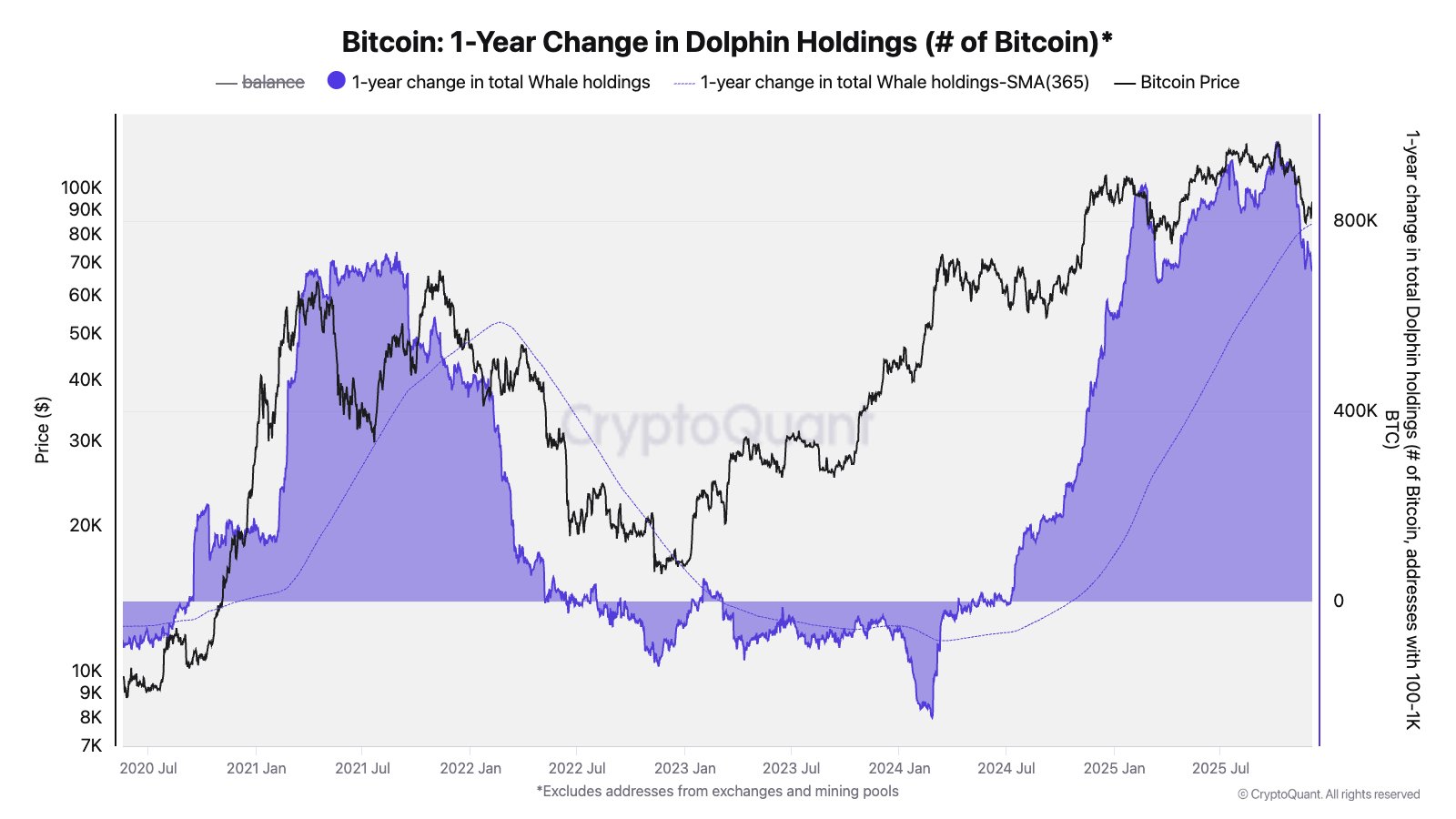
In a new post on X, CryptoQuant’s Head of Research, Julio Moreno, shared an on-chain insight to support the hypothesis that the Bitcoin bear market has started. This conclusion is based on the Balance Growth of an investor group known as the “dolphins.”

Dolphins refer to a group of crypto investors holding substantial amounts of a coin, placing them between small investors (shrimps) and the largest investors (whales). Specifically, Moreno described dolphins as wallet addresses with significant BTC holdings between 100 – 1,000 coins. 

According to the latest data from CryptoQuant, the growth in the Dolphins’ BTC holdings has slowed down in the past year and appears to be in a downward trend. Moreno believes that this negative change points to the emergence of a Bitcoin bear market.

Bitcoin

Moreno revealed that these Dolphin addresses had increased year-over-year by roughly 965,000 BTC when the BTC price hit its current all-time high around $125,000. Now that the BTC price is nearly 30% below its record high, the Bitcoin Dolphins’ balance stands at around 694,000 coins.

Moreno wrote on X:

This address cohort includes ETFs and Treasury companies, which have also stopped buying.

More interestingly, the CryptoQuant Head of Research revealed that this investor group consists of ETF issuers and Treasury companies, which have stopped purchasing Bitcoin. According to data from SoSoValue, the US-based Bitcoin exchange-traded funds have posted net outflows in five out of the last six weeks.

Meanwhile, BTC and crypto treasury companies have struggled in the past few months, with retail investors losing tens of billions to the hype. While there have been rarely reports of crypto treasury sell-offs, this decline in these Dolphins’ holdings tells an entirely different story.

Bitcoin Price At A Glance

As of this writing, the price of BTC stands at around $89,151, reflecting an over 3% decline in the past 24 hours.

Bitcoin

Polish Lawmakers Fail To Override President’s Veto On Crypto Market Bill — Report

According to the latest report, the lower house of Poland’s parliament has failed to overturn the President’s veto of the Crypto-Asset Market Act. Earlier this week, the Polish President, Karol Nawrocki, vetoed a bill aimed at setting strict rules in the country’s digital assets market.

Why Did The Polish President Veto The Digital Asset Bill?

On Friday, December 5, Bloomberg reported that the lower house of the Polish parliament couldn’t secure the required three-fifths majority vote to override the President’s veto of the Crypto-Asset Market Act. This bill, introduced in June 2025, aimed to align Poland with the European Union’s MiCA framework for the digital asset markets.

Related Reading: Key Updates On The US Crypto Market Structure Bill: What You Need To Know

However, President Nawrocki decided against signing the crypto market legislation due to concerns that it may pose a real threat to the freedom of Poles, their property, and the stability of the country. According to the country’s leader, “overregulation” is one way to drive away new companies and investors, while seriously slowing innovation.

As Bitcoinist earlier reported, the crypto community in Poland had already raised concerns about the regulation as early as September, especially as the bill surpassed the European Union (EU) minimum regulatory requirements. 

For instance, the bill’s messaging read that all Crypto Asset Service Providers are required to obtain a license from the Polish Financial Service Authority (KNF). Meanwhile, the bill proposed heavy fines and potential prison time for market participants who break the law.

According to the Bloomberg report, supporters of the bill have also voiced out the need to provide regulatory oversight of Poland’s digital assets industry. Their belief is that clear, comprehensive rules are critical to fight fraud and avoid potential misuse of digital assets by bad actors. 

Poland’s Presidency Calls Crypto Bill A Legal Fiasco

Rafael Leskiewicz, the press secretary of the President, took to the social media platform to react to the lawmakers’ failure to override the veto. The presidential spokesperson said the Crypto-Asset Market Act is a legal fiasco, while calling the attempt to overturn the president’s veto a political maneuver.

Leskiewicz said in a statement:

The President, by vetoing this act, exposed the low quality of the legislation being created. This market should be subject to monitoring and control, but certainly, bad law should not be created that restricts the freedom to conduct business activities.

President Nawrocki, who was elected earlier in June, had always portrayed himself as a pro-Bitcoin leader who would rather veto regulatory restrictions than create new digital asset laws. According to market data, the adoption of crypto assets by Polish households has continued to grow in recent years, with the number of domestic users expected to hit 7.9 million by this year’s end.

crypto

Analyst Points To $82,000 As Most Crucial Bitcoin Price Level — Here’s Why

In a not-so-surprising turn of events, the bearish orientation of the Bitcoin price has continued into the month of December, suggesting that the premier cryptocurrency could end the year in the red. Interestingly, recent on-chain data has offered insights into the likely direction of Bitcoin based on the integrity of an important price level.

Active Market Participants’ Cost Basis At $82,000

In a December 5 post on the X platform, market analyst Burak Kesmeci shared an interesting outlook on the direction of the Bitcoin price. 

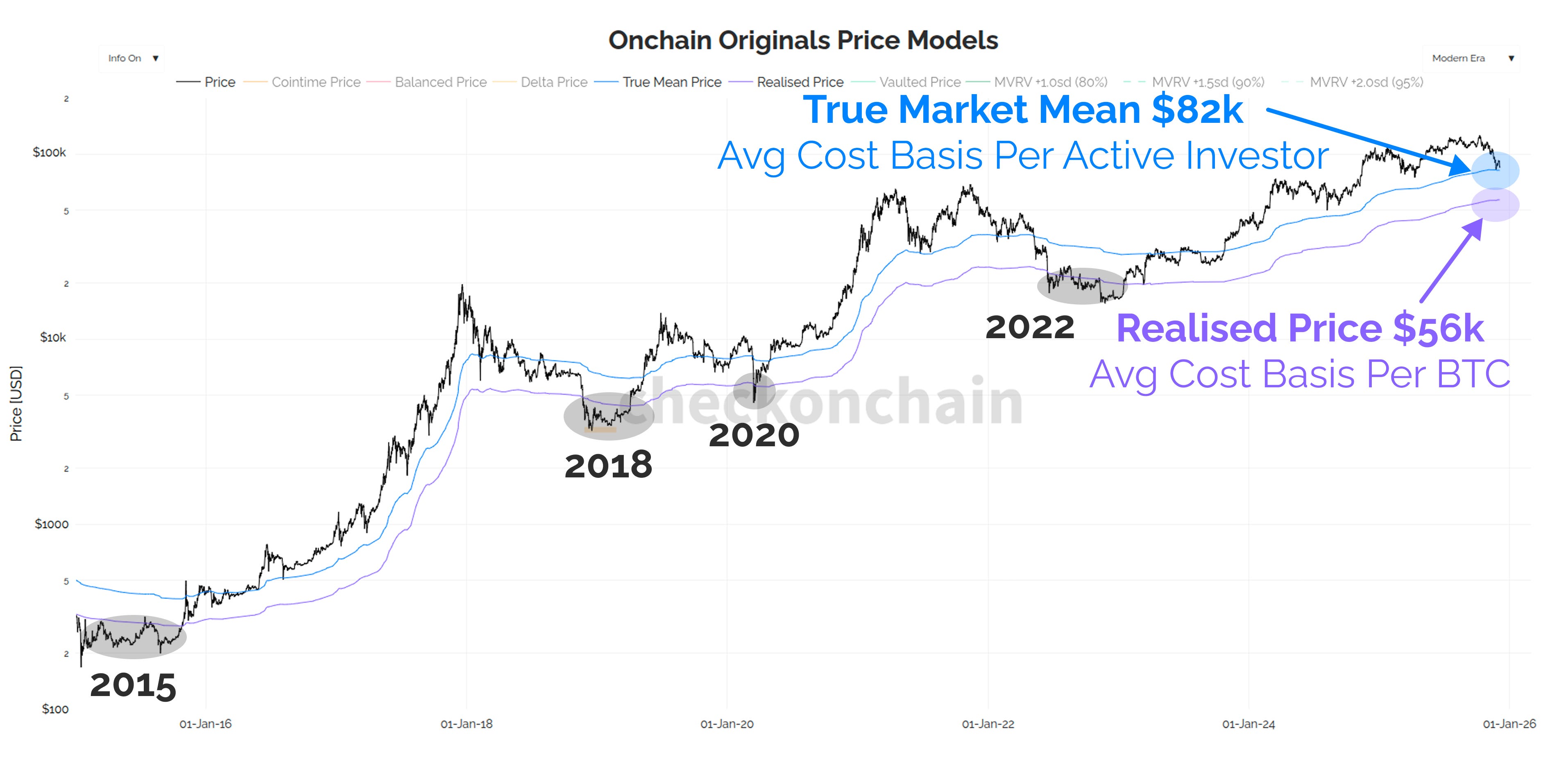
The analyst disclosed that whatever happens around the $82,000 mark could make or mar Bitcoin’s trajectory in the near term. To demonstrate why this price region is so important, Kesmeci pointed out that it appears to be the convergence point of two highly influential cost bases in Bitcoin’s history. 

Kesmeci revealed that the Bitcoin spot exchange-traded funds have an average purchase cost of approximately $82,000. Because ETFs are one of Bitcoin’s strongest demand sources, tracking the values of their average cost-basis could serve as a good means to tell where the market stands institutionally.

Bitcoin

The crypto pundit also referenced the Bitcoin True Market Mean metric, which monitors the cost at which active investors procured their holdings—except for mined or rarely-moved BTC. Notably, in the current market cycle, Bitcoin’s active participants mostly purchased their coins around a valuation of $82,000. 

What Happens If $82,000 Fails? 

Usually, when price slips beneath any major price support, there is, in turn, an increase in overall selling pressure, as buy-side liquidity is converted to bearish momentum via losses incurred by investors. Hence, in the scenario where $82,000 fails to hold, a wave of bearish pressure is expected to ensue, as Bitcoin’s active investors try to cut their losses. 

However, Kesmeci expects something even more specific to follow. According to historical data, whenever Bitcoin falls beneath its active market participant cost basis, it often falls further downwards, as though it is targeting its Realized Price.

At the moment, the Bitcoin Realized Price sits near $56,000 — a price level significantly beneath its investors’ average cost basis. Kesmeci therefore warned that a slip beneath $82,000 could precede Bitcoin’s sharp downturn towards $56,000.

This would represent an almost 40% decline from the current price point. As of this writing, the price of BTC stands at around $89,310, reflecting an over 3% dip in the past 24 hours. 

Bitcoin

Bitcoin Price Falls Below $90,000 — Is The Recovery Over?

The Bitcoin price has had a mixed performance over the past week, with both sides of the market divide struggling to establish dominance. In the latest battle between the bulls and bears, the premier cryptocurrency appears to be succumbing to pressure from the latter group.

As this weekend approached, the Bitcoin price retreated from its latest local high of around $94,000 to beneath the psychological $90,000 level. This latest correction has prompted questions in the crowd, with investors wondering whether it is just a brief obstacle or the end of the recovery.

Why $80,500 Could Be The Next Local Low For BTC

In a December 5 post on the social media platform X, Alphractal CEO and founder shared insight into the latest Bitcoin price decline below $90,000. The on-chain expert revealed that losing the $89,800 level is the more relevant occurrence in the latest price downturn.

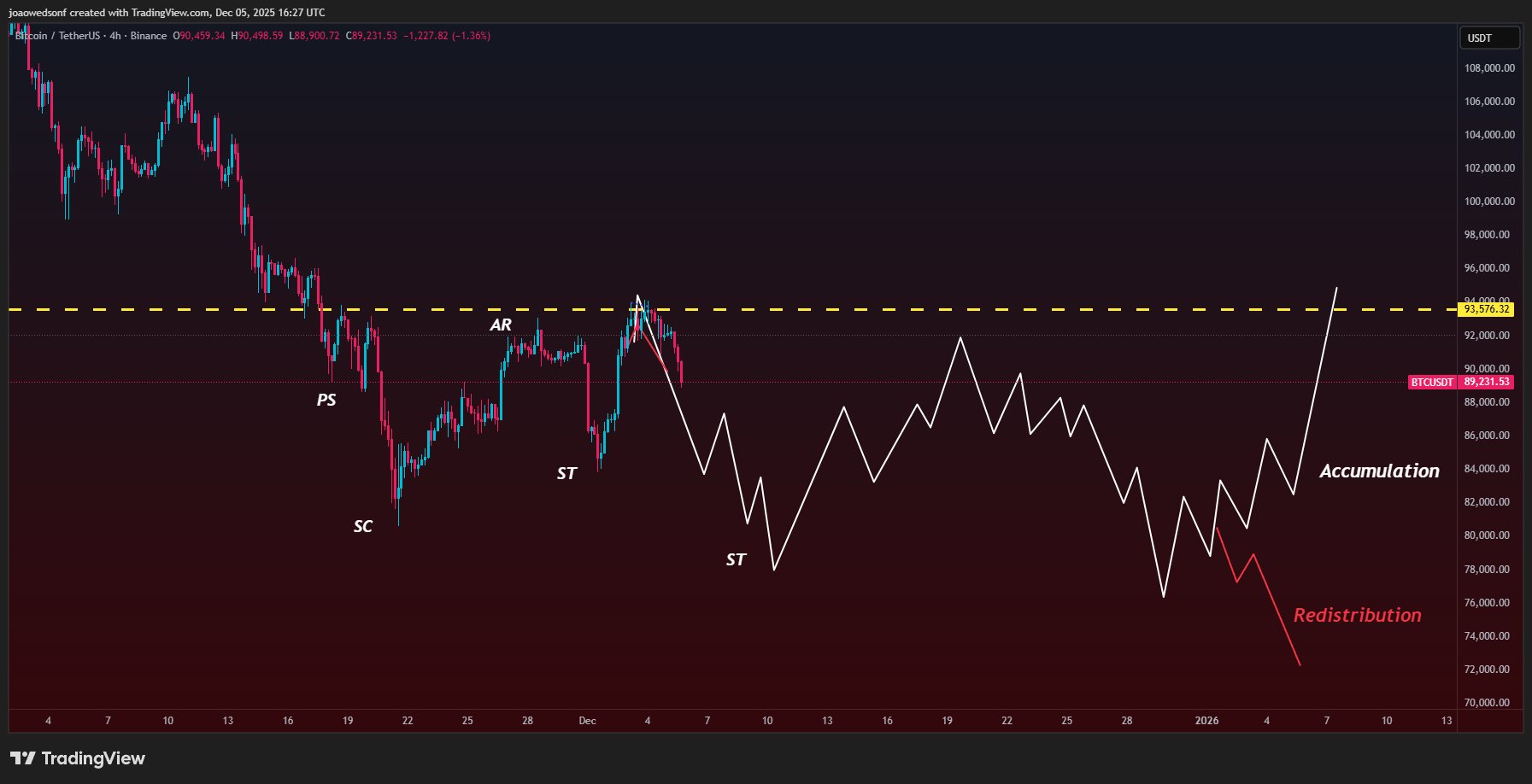
In a previous post on X, Wedson evaluated the likely trajectory of the Bitcoin price should it lose the $89,800 level. The crypto pundit revealed that losing this price mark could lead to an accumulation pattern for the bulls or a redistribution phase for the bears.

While the accumulation period for the bulls would initially coincide with lower prices, it eventually leads to a Bitcoin price return to above the latest local high. Meanwhile, a redistribution phase could see the bears push the flagship cryptocurrency to around the $70,000 mark.

Bitcoin price

According to the Alphractal CEO, the price of BTC also failed to hold the key on-chain levels, strengthening the probability of a broader price sideways phase. “Sideways action is the cause — the big pumps or dumps are just the effect,” Wedson had earlier stated in his previous X post.

Furthermore, Wedson noted that the next level to watch is $86,500, which, if lost, opens the very high possibility for the formation of a new local low around $80,500. This local low could provide a perfect spot for investors to buy the dip and enter the market.

Bitcoin Price Overview 

As mentioned earlier, the past week has been one of highs and lows for the premier cryptocurrency, plummeting to as low as $84,600 on Monday, December 1. After a shaky start to the month, the Bitcoin price recovered strongly to around $94,000 on Thursday, December 4.

As of this writing, the market leader is valued at around $89,415, reflecting an over 3% price decline in the past 24 hours. According to data from CoinGecko, the price of Bitcoin has been down by nearly 10% in the past year.

Bitcoin price

❌