Login
LoginWinter is Coming to Ukraine as it Faces a New Kind of War and Uncertainty About a Key Ally
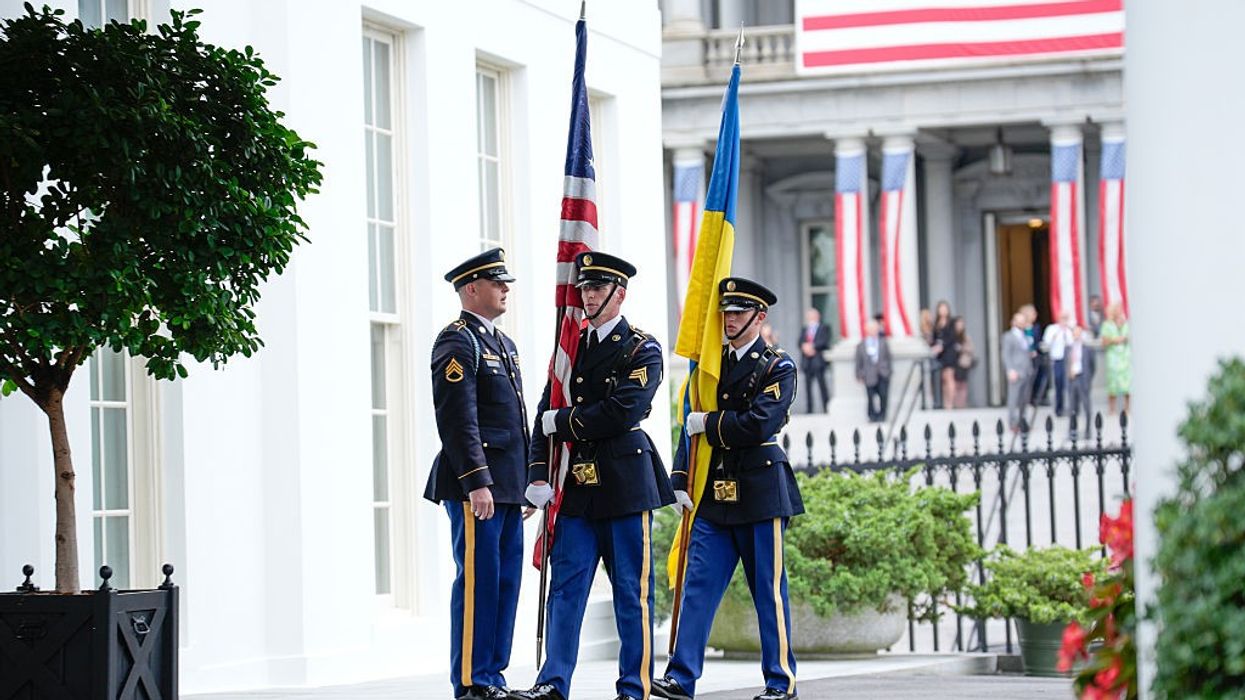
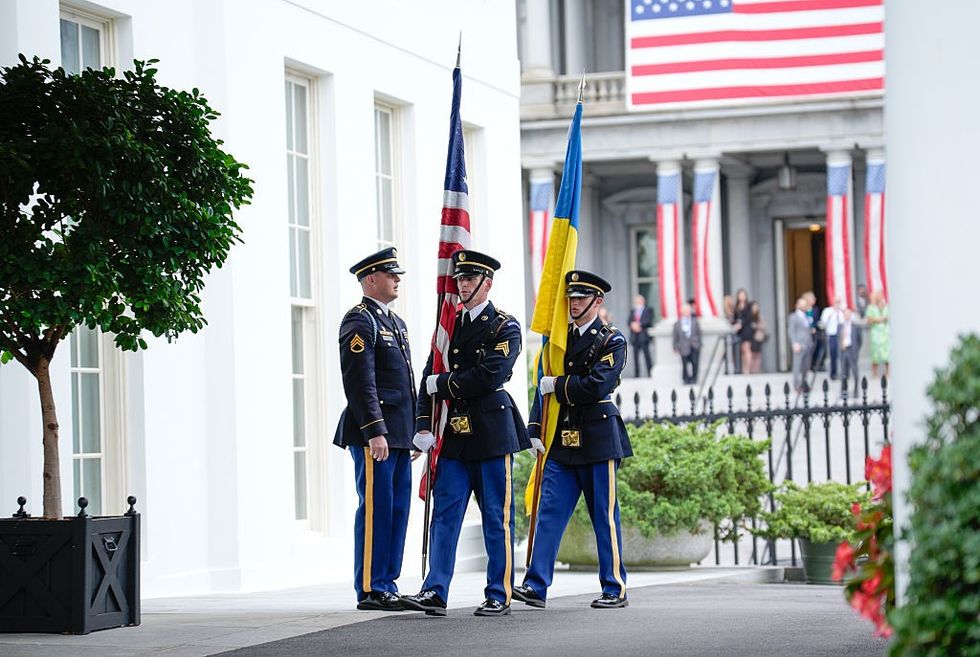
EXPERT INTERVIEW — Ukraine’s President Volodymyr Zelensky was in Berlin on Monday for an intense round of diplomacy with top U.S. and European officials, part of a fast-moving push to find a workable plan to end the war. His meetings follow an unusually long session on Sunday with President Donald Trump’s envoys, Jared Kushner and Steve Witkoff, who claimed significant progress in their discussions.
Meanwhile, a stream of European leaders - including Finland’s president, Britain’s prime minister, France’s president, and NATO’s secretary general are joining the talks. Russia was not invited.
The major sticking point among Western partners remains what concessions Ukraine might be asked to make. Washington has floated the idea of Kyiv giving up some territory Russia has not yet taken, a suggestion Ukraine rejects and most European leaders fear would reward Russian aggression.
Zelensky has signaled a willingness for Ukraine to pause its bid to join NATO if the U.S. provides firm security guarantees against future Russian attacks. European leaders are generally supportive of a deal that allows Ukraine to keep the territory it currently controls while securing long-term protection from Washington.
The mood in Ukraine, meanwhile, is bleak. Former Senior CIA Executives Ralph Goff and Glenn Corn, both of whom are also Cipher Brief Experts, just returned from a 5-day trip in the country. We caught up with them in Krakow, Poland for some on the ground insights about both the mood and maneuvering inside Ukraine, as President Zelensky navigates a harrowing political environment. Our interview has been lightly edited for length and clarity.
THE INTERVIEW
Kelly: Having traveled to Ukraine with you both in the past, I am imagining that this latest trip must have felt like some of the most difficult days that Ukraine has faced in terms of how this war may come to a conclusion. What is the mood like there? What are people talking about?
Corn: The mood in Ukraine is not great. The Ukrainians are very concerned about a number of issues. One, they feel a lot of pressure from the U.S. to make a deal, which many Ukrainians are confused about. They’re trying to understand what's going on. And of course, they're not pleased with their own internal political situation. The Operation Midas corruption scandal was a blow, so there's a lot swirling around and it's clearly impacting the people that we spoke with. They're trying to keep a brave face, given what they're facing. They’ve been at war since 2014, and since February 2022, they've been in a horrific war, a full scale war, and they're just trying to keep their nose above water right now. And as one Ukrainian officer told me, we just have to get through the winter and survive these dark times.
Goff: There's also disappointment amongst our Ukrainian allies with the United States. Not all of it is unexpected, but at the same time they've got this war to fight, so there's a very business-like attitude like, ‘Okay, we're still going to fight this thing’. And what's interesting is that they're not asking for anything new. They’ve made the same requests over and over. They need air defense weapons. There was a night when the Russians launched 84 missiles at Ukrainian territory and more than 500 drones in one night. We heard air raid sirens every night that we were there. The attacks are spread out across the country. It's clearly a campaign of terror by the Russian side.
And at the same time, the nature of the front - the battle - has changed completely from what it was just six months to a year ago. This is not the same war that was fought in 2022 or 2023 or 2024. This is a new war, and so the Ukrainians are asking for air defense weapons. They're asking for money. We can talk later about the idea of getting reparations money from the seized Russian assets, which they need. But at no point have they said they need troops. At no point have they asked for NATO’S Article Five to be invoked. They still want to fight this thing on their own, but they need help from the West.
Kelly: The battlefront has changed so much just in the past few months. Could you describe what it's like now?
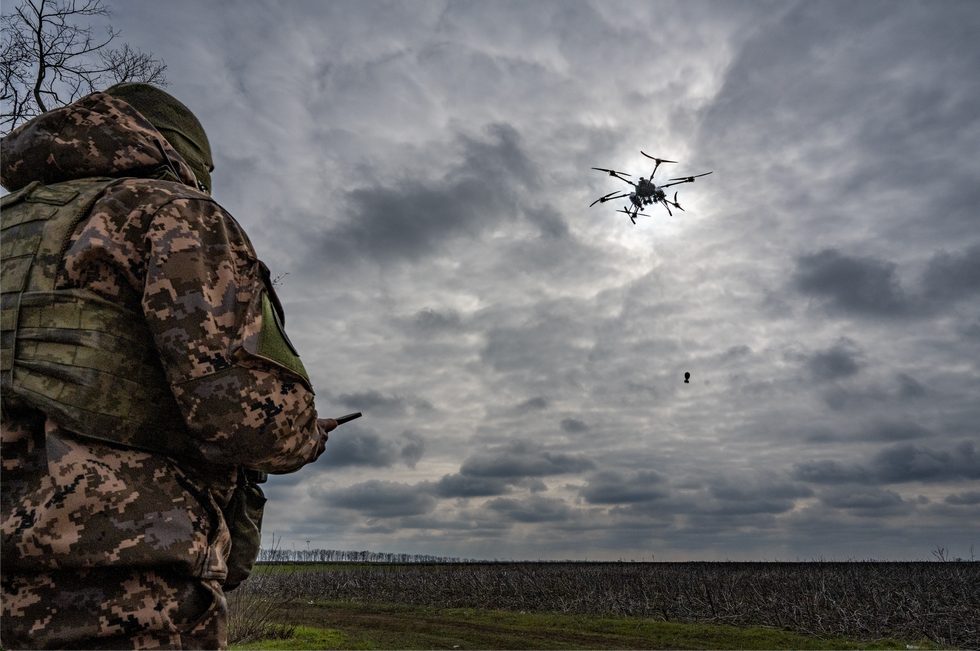
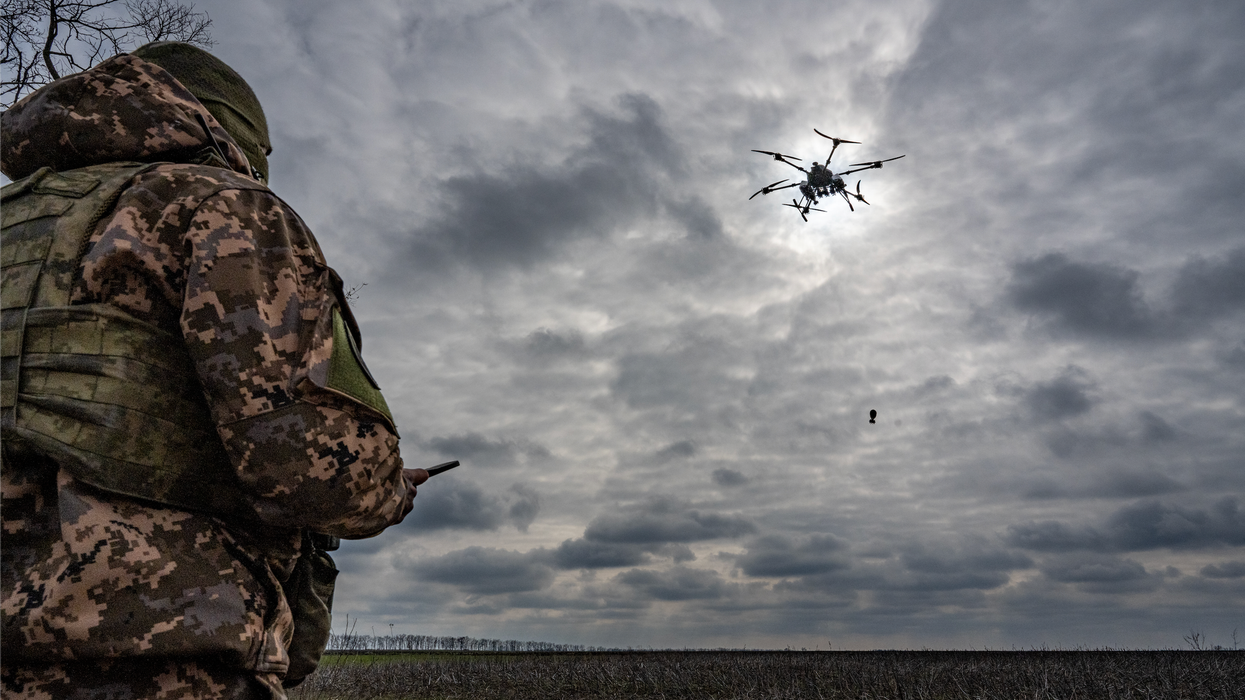
Corn: Every Ukrainian we spoke with, whether it was civilians, military people in the defense industry, they all said that this war is being fought by drones, by FPVs [first-person drones] and some artillery. Intelligence is critical, electronic warfare is critical. But the troops on the ground and the concept of infantry has changed completely. The Ukrainians continue to innovate very quickly, but as they've warned for the last year, the Russians are also innovating very quickly and they're scaling that innovation in a way that the Ukrainians can’t because of a lack of resources and maybe a lack of depth.
Goff: That's correct. It is no longer an infantry man's war. The front is changed considerably. For 20 kilometers on either side of the front line, it’s almost a no-go lethal zone for humans. It's all electronic warfare. All drones and counter drones. I spent a day near the Zaporizhzhia front and even 40 kilometers back from the front lines, you're seeing drone netting set up everywhere and military vehicles using camouflage and taking extra precautions. So it’s completely different from when we visited there just a few months ago. But the losses continue.
For instance, in a single day recently, the Russians lost close to 1,300 soldiers. In one day. So Putin is still using pure raw manpower to his advantage, whereas Ukrainians have a manpower shortage. In one month, they recruited over 30,000 fighters, but out of that number, they're lucky if they can produce even a small percent of that. I'm not going to say the number because it's classified, but they're very lucky if they can get a decent number out of that. So it's tough for Ukrainians and they have to conserve their troops. They have to fight in a combat style that preserves human lives.
Kelly: In another way that we know the battlefield has changed, soldiers are now verifying kills or takedowns of targets, whether they're other drones, whether they're tanks on the ground, and they're using points earned from those drone missions to purchase equipment that is then delivered to them on the front. What can you tell us about the other ways in which the battlefield is evolving?
Corn: Battlefield integration has got to be seamless. The Ukrainians are working on that. We've spoken to a couple of people that are directly involved with that, and they're doing an incredible job. And one thing I was struck by during our last two or three visits is that now, more than ever, almost everyone we spoke with in a leadership position has no prior military experience. They're coming from private industry. Bankers, investment bankers. One guy we spoke with was running a tour agency overseas when he came back to fight. Now it’s computer programmers, IT folks, and they're all in the fight now. I spoke with one guy who was in a very senior government position before the war, and he told that he was 47-years-old before he put on a uniform, and he is leading a lot of the innovation stuff, and it's really impressive to see. We heard last time we were in Ukraine in September that the United States needs to pay attention to this and figure out how to integrate civilians into the military structure very quickly like Ukrainians have had to do.
Need a daily dose of reality on national and global security issues? Subscribe to The Cipher Brief’s Nightcap newsletter, delivering expert insights on today’s events – right to your inbox. Sign up for free today.
Goff: Suzanne, this is all about data integration. This is all about integrating all the information that comes from your airborne sensors, your ground sensors, your human observation, pulling intelligence into that. Tracking the emitters on the Russian side and then putting that all into a combat picture, particularly for the Ukrainians because they're fighting with reduced resources. So like I said, every human life is precious, but every weapon, every shot is also precious. In the old days when an artillery piece could maybe fire a hundred rounds in a day, now because they have to be so careful about being spotted when they're in action, they might fire 30 or 40 rounds. That means those 30 or 40 rounds really have to be on target. So it's all about the data. It's all about data management. And the Ukrainians, as Glenn said, are doing amazing work in that field. The biggest problem is that they're undercapitalized.
Kelly: President Zelensky has been in Europe gathering support from the Europeans as he tries to navigate a complicated series of pressures to end this war. Is the feeling on the ground in Ukraine that that will be enough?
Corn: I would say that the Ukrainians are in a bit of shock to see that the United States seems to be walking away - or their sense is that the United States is walking away. Let's hope that's not the case. But they're concerned that there is a rift between Europe and the United States. I think they appreciate what the Europeans are doing, but almost every discussion we’ve had centers on the fact that they need the United States here. They need the United States to provide some kind of long-term security guarantees. And by the way, the Ukrainians have been saying for over a year that they are ready to come to an agreement. They are ready to be realistic and compromise. It's the Russians that are not doing that. It's the Russians that continue to push maximalist demands and that continue to scuttle the peace process, not the Ukrainians. And the Ukrainians are very frustrated that they seem to be being made the bad guys in this struggle when their country was the one that was attacked. Their cities are being bombed, their children are being killed, their schools are being destroyed, their infrastructure is being destroyed, and they don't really understand what's going on right now. And I hope that we can get back to the position of the United States where we've traditionally been, which is the U.S. standing with people who are fighting for their freedom and their sovereignty against a much larger and more dangerous dictatorship.
Goff: And of course, the recent high-level scandal involving the primary advisor to the President, Andriy Yermak, and his resignation has now been turned around by the Russians who are pointing a finger at this country, and it's resonating within certain circles in the United States. But that's laughable. This is coming from a country - Russia - which is a kleptocracy. Some have said that Ukraine is more corrupt than Russia. That's absurd. Russia is a kleptocracy. It's more like an organized criminal gang than anything else. And the idea that they would accuse Ukraine of being worse than them is crazy. But amongst Ukrainians, I think there's almost this kind of hope that this is some sort of a bad dream that will go away, that America will wake up at some point before it's too late and come riding to the rescue. But at the same time, the pragmatists here realize that maybe that's not going to happen, and it's time for Europe to step up. It's just like Putin gave the Ukrainians their national identity by invading them. The Trump administration is giving Europe the challenge to step up and take charge of their destiny.
Kelly: With Andriy Yermak stepping down as President Zelensky’s chief advisor we know that there's another way of looking at this, which is that Ukraine has set up these independent institutes to investigate and root out corruption at every level and it looks like they’re determined to do that which is an indicator that Ukraine's own anti-corruption efforts are working to some degree, but that message seems to be completely lost.
Corn: Yes. We've heard for a while now, that anyone who knows Ukraine, knows they have a problem with corruption. I've always said that it's baked into their system. The Russians baked this into the system going back hundreds of years, so you have to be realistic. They know it, and they talk about it, and they often talk about it openly. Having worked in Russia, it doesn't happen that way. People don't talk about it. They don't go to the streets and protest without being arrested and basically disappearing or being thrown out of windows. In Ukraine, there is a civil society element here. There is some control over the government, over the presidency, and there has been opposition and resistance to steps that were taken to try and squash the anti-corruption efforts. So, you have to give the Ukrainians credit because they're fighting a war, a horrendous war, and they are also trying to bring the country out of this ugly reality of corruption, which every country has and faces. But to deal with it, when you're in a full-scale war, it's something special. So in my opinion, we need to give 'em credit, and we also need to be clear-eyed and realistic and understand that without the United States' support, they're going to have a hell of a time making the changes that they need to make, and that many, many Ukrainians want to see made. They want their children to grow up in a country which has much less corruption and much more transparency.
Goff: This is a country where national polling has shown that people are more concerned about corruption than they are about the war at present. For the first time, polls have shown that corruption's a bigger problem than the war itself. That shows the awareness of the Ukrainian people. Corruption - we're not trying to downplay it - is a problem, clearly. But there are people who have exaggerated it to the point where if corruption were as bad as some would say it is, they would've lost this war three years ago, because that stuff has to get to the front. It's all going into the pockets of ministers.
Kelly: Has there been anything on this particular trip that surprised you or that you didn't expect?
Corn: Well, I mean for me personally, just I think the shock of the recent release of the National Security Strategy and the sense that somehow Europe is a problem or Europe is the enemy. I don't know if that was the intent of that document, but that worries the Ukrainians, and of course it worries many of our European partners. For those people, I have to say, yeah, we have our differences with Europe, and as an American I've often felt that the Europeans should be doing a lot more, but the Europeans have also done a lot with us over the years, and for all the Europeans out there, for those I've worked with over the years, I am very appreciative of everything that you did to support the United States in many, many hard parts of the world where we served side by side together. So, Europeans are not the enemy, and by the way, we've never done that with the Russians, and I doubt we ever will. I doubt the Russians will stand side by side with us on the battlefield and support us the way that our European partners have done.
Goff: I think my biggest surprise here was the fact that the lights are still on. With all the bombings, like I said, we had air raids every night. Every few nights the pattern seems to be that the Russians husband their missiles and drones so that at least once or twice every five to seven days, they have a massive attack of 50, 60 missiles accompanied by 400, 500, 600 drones. And they're going after the energy infrastructure here. The lights are still on but with reduced power. There are some places that are down to a few hours a day, but you know what? They've still put up Christmas lights. They've still put up decorations. People are still trying to cling to some sense of normalcy for the season to get through this winter, and that just shows that these people are incredibly resilient.
Kelly: What are you sensing will happen next based on who you've talked to and what you've seen since you've been on the ground in Ukraine?
Corn: I think the Russians are not going to make a peace agreement unless they get everything they want, and let's hope that we don't give them everything they want because they don't deserve it, they haven't earned it, and they're not in a position to accomplish it by the means that Putin keeps threatening to do it, which is military force. The Ukrainians have proven that they can hold the line. That's number one.
Number two, I hope that we come around to understanding that basically the right side here is the side of the Ukrainians. The Russians should be ashamed of themselves for what they're doing. They need to stop what they're doing, and we need to stand with the Ukrainians and teach Vladimir Putin a lesson as well as other dictators or potential autocrats like Putin and aggressors, that we're not going to stand on the sidelines, and we're not going to punish those people that try and defend themselves and support those people that aggress other people.
We have common values with the Ukrainians, which I was raised to believe in. I'm not speaking as a former intelligence professional. I'm speaking as an American, whose father served in the Army, whose brother served in the Army, and who dedicated his life to the United States of America. We did that because we believe in the values that the Ukrainians are fighting for right now, every day - in terrible conditions - and we shouldn't abandon them.
Goff: I think we're going to see some type of mobilization, an increased mobilization on the Russian side. Their losses are high while their territorial gains remain low and the Russian economy is faltering and Putin has not been able to browbeat the Ukrainians to give in and come to the table to seek just any deal. Ukrainians will come to the table. This is where I think the administration is making a mistake. The Ukrainians will come to the table if there is a more fair deal. The ideal arrangement will be where both sides are unhappy, but at this point, despite all the negative pressure on the Ukrainians, they're not going to just sign any deal that gets to the table, and that's going to put more pressure on Putin to continue the war. He's got to show some gains. So I think we're going to see some sort of mobilization on the Russian side.
Are you Subscribed to The Cipher Brief’s Digital Channel on YouTube? There is no better place to get clear perspectives from deeply experienced national security experts.
Read more expert-driven national security insights, perspective and analysis in The Cipher Brief because National Security is Everyone’s Business.