Reading view

There are new articles available, click to refresh the page.

Coinbase Expands Native Solana Support With In‑App DEX Trading After Bridge Backlash

Coinbase has expanded its Solana integration by activating native decentralized exchange trading inside its mobile application, giving users the ability to swap Solana-based tokens directly on-chain for the first time through the platform.

The update, confirmed by Coinbase protocol specialist Andrew, allows trades to be settled in USDC alongside standard payment options such as cash, bank accounts, and debit cards.

BREAKING: @coinbase to allow users to trade all Solana tokens through a DEX , without listings 🔥 pic.twitter.com/IyQ5IXHGgR

— Solana (@solana) December 11, 2025

It follows the company’s August rollout of DEX support for Base-network assets and fulfills its earlier promise to bring Solana into the lineup before the end of the year.

Solana Becomes Core to Coinbase’s Vision as On-Chain Trading Surges

The move arrives at a time when Coinbase is pushing to evolve into what it calls the “everything exchange,” a long-term plan to combine custodial and on-chain trading under one roof.

Earlier this month, the company revealed that it would acquire Vector, an on-chain trading platform built natively on Solana.

Coinbase said the deal, expected to close by year-end, will plug Vector’s infrastructure into its DEX architecture.

Vector’s tools specialize in identifying new Solana assets the moment they deploy on-chain or emerge from launchpads, a capability Coinbase believes will improve speed, liquidity, and asset discovery for retail traders.

Solana’s trading environment has become one of Coinbase’s strategic focal points. Data shows that Solana DEX volume has already surpassed $1 trillion in 2025, underlining the chain’s acceleration.

Source: Dune Analytics

A recent snapshot of the ecosystem shows more than $4 billion in 24-hour volume and nearly $94 billion over the past month

Platforms such as HumidiFi, Pump, Meteora, Raydium, Orca, and Tessera V now dominate activity, collectively accounting for more than 88 percent of daily trades.
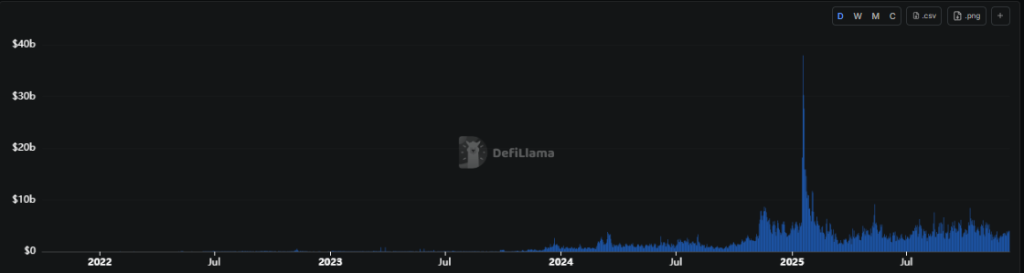
Source: DefiLlama

The dataset shows that newer entrants have carved out significant market share, reshaping a space once led by Orca and Serum.

Notably, in October, Coinbase quietly expanded its on-chain features by adding DEX trading to its mobile app for U.S. users. The update lets people swap tokens directly on-chain, including assets that haven’t yet made it onto Coinbase’s main listings.

🚀 @Coinbase has rolled out DEX trading directly within its mobile app for U.S. users, expanding the platform’s on-chain capabilities.#Coinbase #DEXhttps://t.co/rhNl9TEAuz

— Cryptonews.com (@cryptonews) October 9, 2025

New York users are still blocked due to local rules. The company had been testing the feature with a smaller group of users since August before rolling it out more widely.

Solana Community Voices Friction as Coinbase Rolls Out Base–Solana Bridge

Coinbase’s decision to deepen its Solana integration comes just days after the company faced criticism within the Solana community for launching a new cross-chain bridge between Base and Solana.

The bridge, secured by Chainlink’s Cross-Chain Interoperability Protocol, went live on December 5 and is designed to let users move SPL assets into Base environments and use them inside Base-native applications.

Base lead Jesse Pollak described the product as a two-way channel intended to unlock shared liquidity.

However, Solana co-founder Anatoly Yakovenko dismissed the framing and argued that bridges act as value-capture mechanisms rather than neutral infrastructure.

The problem is that alignment is bs. @ilblackdragon is working on near intents for near, and isn’t trying to sell me alignment bs. It’s a great competitive product that pushes the industry forward. It has solana tokens on it, but the value capture is on near. Good for him.…

— toly 🇺🇸 (@aeyakovenko) December 5, 2025

He urged Base developers to move computation to Solana if they expected economic alignment.

The tension escalated as Solana Foundation members criticized the bridge’s rollout, saying it bypassed their technical and marketing teams and lacked a single Solana-based launch partner.

Jesse — we’d be happy to engage you in a genuine commercial conversation… just not a performative one with platitudes that don’t mean much.

i’m sure you’ll appreciate that your past DMs (now made public), the comments from the recent panel about flipping solana, and base being…

— Akshay BD (@akshaybd) December 5, 2025

Pollak responded by pointing to nine months of development work and said demand from builders on both sides justified the connection.

Market observers noted that Coinbase and Base had followed a similar pattern during earlier outreach to Ethereum developers.

Coinbase Doubles Down on International Expansion

The DEX expansion also arrives as Coinbase attempts to recover from declining trading volumes and mounting competition from U.S. rivals like Robinhood and Kraken.

By allowing users to hold their own assets and execute trades on-chain, the company is trying to capture demand for self-custody and reduce reliance on traditional exchange infrastructure.

Coinbase’s broader international lineup has also expanded recently. In November, the company launched Coinbase Business in Singapore, and on December 8, the exchange reopened registration in India after a two-year hiatus, with plans to restore fiat support by 2026.

The post Coinbase Expands Native Solana Support With In‑App DEX Trading After Bridge Backlash appeared first on Cryptonews.

After years of resisting it, SpaceX now plans to go public. Why?

SpaceX is planning to raise tens of billions of dollars through an initial public offering next year, multiple outlets have reported, and Ars can confirm. This represents a major change in thinking from the world’s leading space company and its founder, Elon Musk.

The Wall Street Journal and The Information first reported about a possible IPO last Friday, and Bloomberg followed that up on Tuesday evening with a report suggesting the company would target a $1.5 trillion valuation. This would allow SpaceX to raise in excess of $30 billion.

This is an enormous amount of funding. The largest IPO in history occurred in 2019, when the state-owned Saudi Arabian oil company began public trading as Aramco and raised $29 billion. In terms of revenue, Aramco is a top-five company in the world.

Read full article

Comments

© JIM WATSON/AFP via Getty Images

Crypto Tax Bill Targeted for Passage by Next August, House Tax Writer Says

Talks over how the United States should tax digital assets are moving into a new phase, as Rep. Max Miller, a member of the House Ways and Means Committee, told attendees at the Blockchain Association’s policy summit on Tuesday that he believes the bill can move before the August 2026 recess.

He said the draft has already been circulated among several committee members and that he hopes to announce a lead Democratic co-sponsor soon.

Miller’s timeline marks the most concrete sign yet that Congress is preparing to revisit an issue that has lingered for nearly a decade, dating back to the IRS’s 2014 declaration that cryptocurrencies are taxed as property.

The decision created a system where every sale, swap, or payment counts as a taxable event.

Congress Moves Toward Long-Awaited Update to Crypto Tax Code

Miller and his Democratic counterpart, Rep. Steven Horsford of Nevada, say they are working on language to simplify reporting and give taxpayers clearer rules.

Miller said the 43-day government shutdown earlier in the fall wiped out nearly two months of legislative time, making it impossible to push the proposal before year-end.

🇺🇸 Trump signs bill ending 43-day shutdown. ETFs await approvals, and markets eye potential weekend momentum.#Shutdown #Bitcoinhttps://t.co/zzvrf2SqdN

— Cryptonews.com (@cryptonews) November 13, 2025

He added that the Ways and Means and Senate Finance committees, which held hearings in July and October, will use the first half of 2026 to firm up the framework.

A Republican on the Finance Committee, Sen. Steve Daines, echoed the timeline, noting that a draft should be ready by next August.

He also warned that ongoing uncertainty in the tax code is slowing down U.S. competitiveness, as digital-asset firms are hesitant to expand without statutory clarity.

Push for Small-Transaction Crypto Tax Relief Intensifies

Lawmakers are debating whether crypto should remain fully classified as property or if small everyday transactions could be treated more like currency.

Industry groups have long advocated for a de minimis rule, which would let people use crypto for small purchases without calculating capital gains.

A bill introduced earlier this year by Sen. Cynthia Lummis proposed a $300 exemption with a $5,000 annual cap.

✅ @SenLummis has responded to @jack's call for a Bitcoin tax exemption for small transactions, stating she is "Working on it." #CryptoTax #Bitcoinhttps://t.co/6S4GtW7Vpf

— Cryptonews.com (@cryptonews) October 9, 2025

Other technical issues under review include how exchanges should report cost basis, how foreign platforms should share data with the IRS, and whether staking rewards should be taxed when received or when sold.

The IRS currently treats staking rewards as ordinary income upon receipt, but the industry wants taxation deferred until disposition.

Stablecoin payments, business receipts over $10,000, and new international reporting standards under the Crypto-Asset Reporting Framework (CARF) are also part of the negotiations.

IRS Ramps Up Crypto Scrutiny as New Rules Near

Between May and June, crypto tax platforms and lawyers reported a sharp rise in IRS warning letters sent to U.S. investors.

The surge resembles earlier crackdowns in 2020 and 2021, when the agency secured transaction records from major exchanges.

With new third-party reporting requirements taking effect on January 1, 2026, centralized exchanges will issue 1099-DA forms for the first time, giving the government the clearest view yet of trading activity.

Congress is also juggling broader crypto policy efforts. Negotiations over a separate market-structure bill have slowed in recent weeks, with Sen. Bernie Moreno describing talks as “frustrating” and saying he will not support a weak compromise.

🇺🇸 Sen. Moreno warns U.S. lawmakers: “No deal is better than a bad deal.” U.S. crypto legislation may be delayed

#Regulation #CLARITYActhttps://t.co/Z9QlO4yiD4

— Cryptonews.com (@cryptonews) December 9, 2025

Lawmakers are still debating how to divide oversight between the SEC and CFTC, how to define non-security tokens, and how to regulate decentralized finance.

Several senators have warned that if progress stalls into February, the election season could freeze the agenda.

The post Crypto Tax Bill Targeted for Passage by Next August, House Tax Writer Says appeared first on Cryptonews.

OKX and Deltix Boost US Institutional Trading

Major crypto exchange OKX has joined hands with Deltix to expand institutional trading capabilities for clients across the U.S. Per the announcement, the companies in this country will be able to access, for the first time, regulated digital-asset liquidity via the same infrastructure they use for equities and FX.

Deltix is a division of EPAM Systems, which provides digital development, software engineering, and product design services among others.

Moreover, this particular division offers institutional-grade trading and quantitative research platforms to funds, brokers, and trading firms across markets.

According to Ilya Gorelik, CEO of Deltix, the integration provides clients with a unified trading experience across traditional and digital markets.

Also, per the OKX press release, the partnership connects the worlds of traditional and digital asset markets. The former brings “mature infrastructure, sophisticated risk management, and regulatory guardrails,” while the latter boasts “innovation, transparency, and opportunity.”

Moreover, “several” quant funds and algorithmic trading firms already use the integration to extend digital-asset exposure within their quantitative and execution frameworks, the companies note.

One of them is Windy Financial. Its Head of Digital Strategies, Brian Petersen, commented that the partnership provides “a seamless, institutional-grade solution that lets us execute digital strategies […] without venturing into offshore or unregulated markets. It’s a powerful step forward for quantitative and institutional firms seeking high-performance, compliant market access.”

Digital and Traditional Markets on the Same Infrastructure

Institutions increasingly look to participate in digital-asset markets, the partners say. They expect the same level of governance, reliability, and performance as in TradFi.

“This partnership brings digital assets directly into the same infrastructure that professional traders and funds already rely on every day,” says Roshan Robert, OKX US CEO. It gives U.S. institutional clients regulated, onshore access to digital-asset markets.

Download OKX in the US. Make them proud. pic.twitter.com/17oWCOR8AC

— OKX (@okx) December 9, 2025

At the same time, these institutions gain access to the liquidity and execution quality through OKX’s global shared order book.

U.S. institutional clients can now access OKX’s spot markets available via Deltix. They can integrate digital asset trading into existing quant and execution workflows.

Moreover, they can execute against OKX’s global shared order book. This way, they gain liquidity and performance necessary for institutional-grade trading, OKX says. They can test, trade, and deploy quantitative strategies for digital assets alongside their TradFi workflows.

Then, the clients can leverage the exchange’s APIs for execution and market-data connectivity.

Additionally, clients route activity through OKX’s licensed U.S. entity, which provides them with full regulatory compliance.

Finally, they can manage risk, analytics, and reporting within their native infrastructure.

“The partnership fills a critical gap in end-to-end infrastructure for quantitative, fund, and proprietary-trading firms seeking efficient digital-asset execution, research, and analytics,” the announcement concludes.

The post OKX and Deltix Boost US Institutional Trading appeared first on Cryptonews.

Xbox Is Bleeding Out

By: msmash
Microsoft's Xbox consoles were conspicuously absent from Black Friday's winners, failing to crack the top three in U.S. sales during one of the retail calendar's most important weeks. According to Circana analyst Mat Piscatella, the PlayStation 5 captured 47% of Black Friday week console sales ending November 29, followed by the Nintendo Switch 2 at 24% and -- somewhat remarkably -- the NEX Playground, a Kinect-like Android device aimed at children, at 14%. Microsoft ran no promotions on its consoles during the period. The Xbox Series X currently retails for $650 following this year's price increase, up from its $500 launch price in 2020. Sony, by contrast, discounted the PS5 by roughly 40% at some retailers. Piscatella noted on Bluesky that products without price promotions typically see no seasonal lift. Costco has removed Xbox consoles from its U.S. and UK websites.

Read more of this story at Slashdot.

Firefox 146 Now Available With Native Fractional Scaling On Wayland

By: BeauHD
Firefox 146 has been released with native fractional scaling support on Wayland -- finally giving Linux users crisp UI rendering. Other new additions include GPU process improvements on macOS, developer-focused CSS features, and broader access to Firefox Labs. Phoronix reports: Firefox 146 also now makes Firefox Labs available to all users, Firefox on macOS now has a dedicated GPU process by default, dropping Direct2D support on Windows, support for compressed elliptic curve points in WebCrypto, and updated the bundled Skia graphics library. Firefox 146 also has some fun developer enhancements like support for the CSS text-decoration-inset property, the @scope rule now being supported, CSS contrast-color() function being available, and several new experimental web features. The release notes and developer changes can be found at their respective links. Release binaries are available at Mozilla.org.

Read more of this story at Slashdot.

OKX CEO Star Xu Says 50% of Global Economy Will Run On Blockchain

During Abu Dhabi Finance Week, OKX Chief Executive Star Xu said, “approximately 50% of global economic activities will operate on blockchain” in the coming decades.

He framed the shift as demand from a generation raised on digital services, mobility, and artificial intelligence. Xu described blockchains as programmable financial rails that move value “freely, instantly, and globally, 24/7.”

He positioned the trend as infrastructure, not a trading call, pointing to stablecoin settlement growth, multi-trillion on-chain asset values, and expanding wallet counts. He also noted ongoing regulatory work in major markets that is building channels for compliant activity.

The next chapter of an onchain economy begins with trust.

Our Founder & CEO @Star_okx takes the stage at @ADFinanceWeek to discuss how blockchain can drive global economic empowerment.

🗓 8 Dec | 1:35pm
📍 Mainstage, ADQ Arena pic.twitter.com/jgq6MchLZz

— OKX (@okx) December 8, 2025

Why OKX’s Xu Sees Demand For On-Chain Finance

Xu linked the moment to past cycles in internet, mobile, and cloud, arguing the next step is a “financial internet” where storage, transfer, and settlement are software-driven and auditable.

He said current infrastructure can meet institutional needs, citing account integrations, low-friction user flows without gas fees, and throughput targets measured in millions of transactions per second.

Security goals mirror bank accounts, while on-chain identity, analysis, and audit features are intended to raise transparency. His view is that open and efficient systems tend to win over time, and that the internet generation is pressing finance toward an always-on standard.

He added that regulators in jurisdictions such as the United States and Singapore are building frameworks that move activity from pilots to production.

Bitcoin, Stablecoins, And Tokenization In Practice

Xu called Bitcoin “digital gold” for younger holders and pointed to institutions adding exposure on balance sheets. He portrayed stablecoins as a parallel payment channel that allows near real-time cross-border settlement, including units tied to the U.S. dollar and regional fiat.

He placed tokenization at the center of market structure change, with funds and government bonds entering continuous on-chain venues that offer transparent pricing and compliance controls.

Looking ahead, he outlined a model where users hold self-custody wallets, identity is portable, and issuance and settlement run on a single base layer.

“More open, transparent, and efficient systems will ultimately prevail,” Xu said, adding that the internet generation is already building toward that outcome.

The post OKX CEO Star Xu Says 50% of Global Economy Will Run On Blockchain appeared first on Cryptonews.

Mantra CEO Issues Urgent Warning: “Withdraw Your OM From OKX Now” – Migration Crisis Escalates

Tensions between blockchain platform Mantra and the crypto exchange OKX escalated sharply this week after Mantra CEO John Patrick Mullin accused the exchange of publishing “incorrect and misleading” information about the project’s upcoming token migration.

In a strongly worded statement posted on X, Mullin urged OM holders on the exchange to withdraw their tokens immediately and complete migration independently through official Mantra channels.

On December 5, 2025, OKX published a statement entitled “OKX to support OM crypto migration”. This statement contained multiple factual errors and misrepresentations not present in official MANTRA governance proposals. We are incredibly concerned by this development, which shows…

— JP Mullin (🕉, 🏘) (@jp_mullin888) December 8, 2025

Mantra Accuses OKX of Publishing “False” OM Migration Dates

The conflict surfaced on Monday after OKX released an announcement outlining its support for the OM migration, including a detailed schedule that placed the conversion window between December 22 and December 25, 2025.

The exchange said it planned to delist OM spot pairs, halt deposits and withdrawals, conduct an account snapshot, and process the conversion at a 1:4 ratio in line with what it described as Mantra’s Proposal 17 and Proposal 26.

OKX also said it would suspend futures, margin trading, and related services ahead of the migration.

Mullin disputed nearly every part of OKX’s timeline. He said the exchange had published dates that were “technically impossible.

He added that official governance documents state the migration can only begin after the ERC-20 OM token is fully deprecated on January 15, 2026.

According to him, this makes any December 2025 migration window unworkable.

He also argued that the exchange had rearranged the intended process by placing the token split ahead of deprecation, reversing the sequence outlined in Proposal 26.

He described the exchange’s timeline as “arbitrary,” noting that no final launch date has been announced because it depends on a pending technical review.

The CEO said the publication of what he called “demonstrably false information” raises concerns about negligence or possible malicious intent.

He added that OKX has not communicated with Mantra since April 13, the date of OM’s extreme market collapse that saw the token fall more than 90% in a single day.

📉 Mantra lost 90% of its value in just one hour — $6B gone. No hack, no clear reason. Just “liquidations,” team silence, and big wallet moves. What really happened, and which red flags did investors ignore?https://t.co/2HeL1ZiMhG

— Cryptonews.com (@cryptonews) April 14, 2025

He argued that the communication breakdown has now resulted in market confusion during a period in which other exchanges have coordinated closely with Mantra on migration details.

After $6B Collapse, OM Holders Face New Uncertainty Amid Exchange Frictions

The April collapse, which erased more than $6 billion from OM’s market capitalization within 24 hours, continues to cast a long shadow over the project.

Some traders described the crash as a rug pull, though Mantra denied wrongdoing and blamed the event on sudden liquidations during low-liquidity weekend trading.

A later post-mortem attributed the crash partly to aggressive leverage policies on centralized exchanges and said the incident exposed wider structural risks in the industry.

In its response at the time, the project pledged more transparency, reduced internal validator control, and a 150 million OM token burn by Mullin himself.

Since then, several exchanges have taken action around the token. INDODAX delisted OM during the initial shift away from ERC-20.

Meanwhile, Binance temporarily suspended OM deposits and withdrawals during network upgrades before relisting the redenominated MANTRA token.

Other platforms paused trading as part of broader migration adjustments.

In the same period, OKX removed multiple unrelated assets, such as BAL, PERP, FLM, PSTAKE, CLV, and RACA, because of low activity or listing-criteria issues, a trend that has raised wider questions about the exchange’s handling of assets undergoing structural changes.

The current dispute has left many OM holders trying to determine the safest migration path.

Mullin called on users to avoid depending on OKX during this phase and to maintain direct custody to ensure they do not act on incorrect timelines.

He said Mantra will continue coordinating with all other major exchanges and will support retail holders through the transition.

OKX, for its part, has indicated that its schedule may face delays due to coordination requirements, but it has not publicly addressed Mullin’s accusations or clarified its interpretation of the governance proposals.

The post Mantra CEO Issues Urgent Warning: “Withdraw Your OM From OKX Now” – Migration Crisis Escalates appeared first on Cryptonews.

Canada’s $72M Crypto Tax Crackdown Targets 2,500 Dapper Labs Users — But No Charges Yet

Canada’s tax authority has widened its crypto enforcement net, targeting 2,500 users of Vancouver-based NFT firm Dapper Labs in a probe tied to an estimated C$72 million ($54 million) in suspected unpaid taxes.

The probe sits within a larger Canada Revenue Agency (CRA) campaign that has already generated more than C$100 million in recovered taxes through crypto audits over the past three years, according to a report by The Canadian Press

Yet despite the growing sums involved, authorities confirm that no criminal charges have been laid in any crypto tax case since 2020, showing the gap between civil enforcement and criminal prosecution in Canada’s digital asset sector.

CRA Secures Rare ‘Unnamed Persons’ Order in Dapper Labs Tax Probe

The report stated that the CRA sought and received approval in September to compel Dapper Labs to disclose information tied to thousands of users under what is known as an “unnamed persons requirement.”

The legal tool allows tax authorities to obtain records on an identifiable group of taxpayers without accusing the company itself of wrongdoing.

Dapper, which operates one of the most prominent non-fungible token platforms and runs its own blockchain and digital wallets, did not oppose the application.

The report shows the CRA initially sought information on roughly 18,000 Dapper users, but following negotiations, the scope was narrowed to 2,500 accounts.

It marks only the second time Canadian courts have granted such an order against a domestic crypto firm, the first being issued against Coinsquare in 2020.

In an affidavit supporting the application, CRA project lead Predrag Mizdrak said crypto markets are deeply embedded in the underground economy and present “significant non-compliance” risks.

Internal agency figures show that about 15% of Canadian crypto users fail to file taxes on time or at all, while 30% of those who do file are classified as high risk for non-compliance.

The agency estimates that up to 40% of taxpayers using crypto platforms fall into non-filing or high-risk categories.

The CRA currently employs 35 dedicated cryptoasset auditors working across more than 230 files.

Since 2020, five criminal investigations involving digital assets have been launched, with four still ongoing as of March.

The agency says the cases are complex and often hinge on cross-border evidence and cooperation, contributing to long timelines and the absence of charges to date.

Canada Prepares New Crypto Reporting Rules as Federal Crackdown Widens

The crackdown on Dapper users comes as Canada tightens its wider crypto oversight. Under long-standing CRA policy, cryptocurrencies are treated as commodities rather than currencies.

Casual investors generally face capital gains tax, with only 50% of profits taxable at marginal rates, while frequent traders, miners, and crypto businesses are taxed on full business income.

Most crypto transactions, including sales, swaps, and crypto-based purchases, are treated as taxable dispositions under existing rules.

New reporting rules are also on the way as Canada is preparing to implement the OECD-backed Crypto-Asset Reporting Framework starting in 2026. The framework will require exchanges, brokers, and crypto ATM operators to report transaction data and customer information directly to the CRA.

Crypto firms in Canada will soon face increased disclosure obligations, per regulations introduced in Tuesday's 2024 federal budget.#Canada #crypto #CanadaBudgethttps://t.co/pkdV878DXM

— Cryptonews.com (@cryptonews) April 17, 2024

The 2024 federal budget set aside more than C$50 million over five years to support that effort.

At the same time, Ottawa plans to establish a national financial crimes agency by 2026 to focus on sophisticated money laundering and online financial fraud.

Finance officials describe it as the country’s first unit focused exclusively on sophisticated financial crime.

Beyond taxes, enforcement has intensified on the anti-money-laundering front. FINTRAC recently issued a record C$19.6 million fine against KuCoin for failing to register and report large transactions.

👨🏻‍⚖️ Canada’s financial intelligence agency @FINTRAC_Canada

has fined the operator of @kucoincom C$19.6 million (US$14.09 million).#KuCoin #Canadahttps://t.co/O2k1Fskkgd

— Cryptonews.com (@cryptonews) September 26, 2025

Meanwhile, another firm, Xeltox Enterprises, was hit with penalties totaling nearly C$177 million.

In September, the Royal Canadian Mounted Police shut down TradeOgre and seized more than C$56 million in assets, marking Canada’s first full crypto exchange takedown.

The post Canada’s $72M Crypto Tax Crackdown Targets 2,500 Dapper Labs Users — But No Charges Yet appeared first on Cryptonews.

New FreeBSD 15 Retires 32-Bit Ports and Modernizes Builds

FreeBSD 15.0-RELEASE arrived this week, notes this report from The Register, which calls it the latest release "of the Unix world's leading alternative to Linux." As well as numerous bug fixes and upgrades to many of its components, the major changes in this version are reductions in the number of platforms the OS supports, and in how it's built and how its component software is packaged. FreeBSD 15 has significantly reduced support for 32-bit platforms. Compared to FreeBSD 14 in 2023, there are no longer builds for x86-32, POWER, or ARM-v6. As the release notes put it: "The venerable 32-bit hardware platforms i386, armv6, and 32-bit powerpc have been retired. 32-bit application support lives on via the 32-bit compatibility mode in their respective 64-bit platforms. The armv7 platform remains as the last supported 32-bit platform. We thank them for their service." Now FreeBSD supports five CPU architectures — two Tier-1 platforms, x86-64 and AArch64, and three Tier-2 platforms, armv7 and up, powerpc64le, and riscv64. Arguably, it's time. AMD's first 64-bit chips started shipping 22 years ago. Intel launched the original x86 chip, the 8086 in 1978. These days, 64-bit is nearly as old as the entire Intel 80x86 platform was when the 64-bit versions first appeared. In comparison, a few months ago, Debian 13 also dropped its x86-32 edition — six years after Canonical launched its first x86-64-only distro, Ubuntu 19.10. Another significant change is that this is the first version built under the new pkgbase system, although it's still experimental and optional for now. If you opt for a pkgbase installation, then the core OS itself is installed from multiple separate software packages, meaning that the whole system can be updated using the package manager. Over in the Linux world, this is the norm, but Linux is a very different beast... The plan is that by FreeBSD 16, scheduled for December 2027, the restructure will be complete, the old distribution sets will be removed, and the current freebsd-update command and its associated infrastructure can be turned off. Another significant change is reproducible builds, a milestone the project reached in late October. This change is part of a multi-project initiative toward ensuring deterministic compilation: to be able to demonstrate that a certain set of source files and compilation directives is guaranteed to produce identical binaries, as a countermeasure against compromised code. A handy side-effect is that building the whole OS, including installation media images, no longer needs root access. There are of course other new features. Lots of drivers and subsystems have been updated, and this release has better power management, including suspend and resume. There's improved wireless networking, with support for more Wi-Fi chipsets and faster wireless standards, plus updated graphics drivers... The release announcement calls out the inclusion of OpenZFS 2.4.0-rc4, OpenSSL 3.5.4, and OpenSSH 10.0 p2, and notes the inclusion of some new quantum-resistant encryption systems... In general, we found FreeBSD 15 easier and less complicated to work with than either of the previous major releases. It should be easier on servers too. The new OCI container support in FreeBSD 14.2, which we wrote about a year ago, is more mature now. FreeBSD has its own version of Podman, and you can run Linux containers on FreeBSD. This means you can use Docker commands and tools, which are familiar to many more developers than FreeBSD's native Jail system. "FreeBSD has its own place in servers and the public cloud, but it's getting easier to run it as a desktop OS as well," the article concludes. "It can run all the main Linux desktops, including GNOME on Wayland." "There's no systemd here, and never will be — and no Flatpak or Snap either, for that matter.

Read more of this story at Slashdot.

Elon Musk’s X first to be fined under EU’s Digital Services Act

Elon Musk’s X became the first large online platform fined under the European Union’s Digital Services Act on Friday.

The European Commission announced that X would be fined nearly $140 million, with the potential to face “periodic penalty payments” if the platform fails to make corrections.

A third of the fine came from one of the first moves Musk made when taking over Twitter. In November 2022, he changed the platform’s historical use of a blue checkmark to verify the identities of notable users. Instead, Musk started selling blue checks for about $8 per month, immediately prompting a wave of imposter accounts pretending to be notable celebrities, officials, and brands.

Read full article

Comments

© NurPhoto / Contributor | NurPhoto

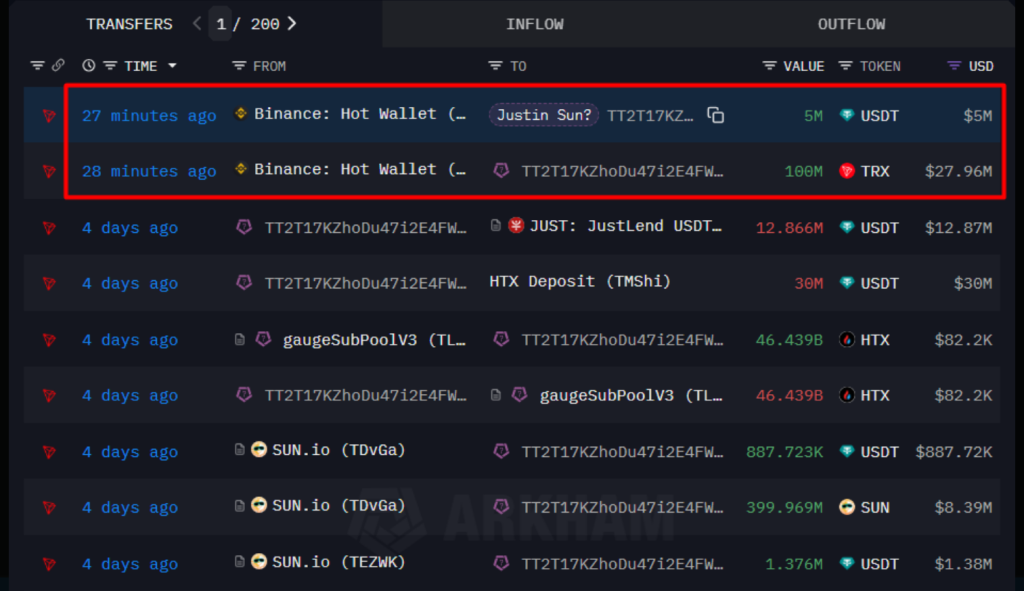
100 Million TRX Leaves Binance — Justin Sun Behind The Move

According to on-chain monitors, a wallet linked to TRON founder Justin Sun pulled 100 million TRX from Binance on December 3, 2025. Reports say the same address also moved $5 million USDT around the same time. These large transfers were flagged publicly by Onchain Lens and picked up by multiple crypto news outlets.

Transaction Values And Timing

Onchain tracking shows the 100 million TRX was worth close to $28 million at the time of the move. The USDT transfer of $5 million happened within a minute of the TRX withdrawal, which has led observers to call the action coordinated rather than routine.

Based on reports, the close timing and mixed asset types — token plus stablecoin — drew extra attention from traders and on-chain sleuths.

Data also shows the Justin Sun-linked wallet now holds a much larger TRX balance than just this single transfer. Tracking services report the address sits at about 492 million TRX, a holding with a notional value near $138 million based on market rates at the time. That swelling balance has prompted talk that accumulation of TRX has been steady in recent days.

A wallet linked to Justin Sun (@justinsuntron) withdrew 100M $TRX worth $27.96M from #Binance and also withdrew $5M $USDT.https://t.co/4d2utqwsv0 pic.twitter.com/k40pMUj15d

— Onchain Lens (@OnchainLens) December 3, 2025

Market Reaction And Liquidity

Initial market moves were muted. Some exchange data and commentaries noted a mild uptick in TRX price after the news, suggesting traders saw the outflow as removing sell pressure from exchange order books.

Analysts who track exchange liquidity say large withdrawals like this can shrink available sell-side supply and can support price stability if demand holds. Still, any clear price trend will depend on what happens next with the withdrawn tokens.

No Official Word Yet

There has been no public statement from Justin Sun or TRON explaining the transfers. Without confirmation, motives remain speculative. Observers are weighing a few common possibilities: long-term cold storage, staking or protocol use, or internal treasury moves. All of those ideas are possible, but none are confirmed by the team.

What Could Happen Next

If the tokens stay offline, some traders may view the move as bullish since it cuts the floating supply held on big exchanges. If the funds are later sold or used to provide liquidity, the effect could swing the other way.

Reports point out that similar moves by major holders have sometimes been followed by quiet accumulation and other times by large transfers into trading venues — timing and intent matter.

Featured image from Unsplash, chart from TradingView

Linux Kernel 6.18 Officially Released

From the blog 9to5Linux: Linux kernel 6.18 is now available for download, as announced today by Linus Torvalds himself, featuring enhanced hardware support through new and updated drivers, improvements to file systems and networking, and more. Highlights of Linux 6.18 include the removal of the Bcachefs file system, support for the Rust Binder driver, a new dm-pcache device-mapper target to enable persistent memory as a cache for slower block devices, and a new microcode= command-line option to control the microcode loader's behavior on x86 platforms. Linux kernel 6.18 also extends the support for file handles to kernel namespaces, implements initial 'block size > page size' support for the Btrfs file system, adds PTW feature detection on new hardware for LoongArch KVM, and adds support for running the kernel as a guest on FreeBSD's Bhyve hypervisor.

Read more of this story at Slashdot.

TRON price prediction as TRX hits $0.28 resistance

  • TRON price hovers above $0.28, largely unchanged in the past week.
  • Despite the consolidation, TRX looks poised to go higher.
  • Recent network developments, including stablecoin growth and partnerships, buoy bulls.

TRON (TRX) has shown limited upward momentum in recent sessions but continues to hold near the key $0.28 level, even as volatility across the crypto market keeps investors cautious.

TRX is trading around $0.28 after a modest 0.4% dip over the past 24 hours, reflecting broader market weakness and a lack of clear direction.

Sentiment remains fragile following Bitcoin’s slide to $80,000 last week before rebounding toward $92,000, a move that has kept traders on edge.

Still, TRON has managed a mild recovery from recent lows near $0.27, offering a tentative sign of strength despite the uncertain backdrop.

What could aid the TRX price?

The question of whether Tron could ignite a parabolic rally arises from TRON DAO’s growth and expansion across the market.

For instance, TRON has dominated the stablecoin market in terms of total transfers year-to-date. USDT supply on TRON surpassed $80 billion in July.

Leo Chan, a small business owner in Asia, recently highlighted why TRON is seeing huge adoption in stablecoins.

“When I need to make payments at traditional banks, I need to do some paperwork,” Leo said. “I may face delays and lose business. With TRON, recipients can instantly get the payment.”

While it sits above peers in global USDT activity, 2025 also boosts many other notable feats, including daily active users and integrations.

Platforms such as Chainlink and MetaMask have helped elevate TRON’s reach, expanding access beyond stablecoin transfers into decentralized finance, tokenized assets and retail payments.

In terms of adoption, the latest data shows TRON’s total accounts have surpassed 346 million.

This ecosystem growth speaks to rapid growth amid an explosion in decentralized finance.

🎉 TRON’s total accounts have now surpassed 346 million!

TRON ecosystem continues its rapid growth as we push forward on our mission to decentralize the future. pic.twitter.com/J5v0OFTasP

— TRONSCAN (@TRONSCAN_ORG) November 18, 2025

Recently, TRON’s DeFi arm, TRONBANK, secured $10 million in funding.

The strategic financing will help accelerate lending and staking innovations, likely bolstering total value locked in the protocol.

Tron rice prediction

TRON’s price outlook remains cautiously optimistic despite recent dips.

Notably, upside projections hinge on network adoption and macroeconomic shifts.

If bulls gain, the next targets could be $0.35 and $0.50.

TRON Price Chart
TRON price chart by TradingView

With a market cap exceeding $26 billion, TRX ranks as the eighth-largest cryptocurrency by market cap.

The token has seen over $535 million in intraday trading volume.

Bulls saw the token touch the all-time high of $0.44 in December 2024.

Technical indicators add fuel, such as a double-bottom pattern formed in early November, which signals a potential reversal from bearish depths.

As can be seen on the chart above, TRX has rebounded slightly but remains within a downtrend.

RSI is below 50  but suggesting an uptick, as is the MACD on the daily chart, indicating a potential bullish crossover.

The post TRON price prediction as TRX hits $0.28 resistance appeared first on CoinJournal.

RAIN price skyrockets 110% as Enlivex announces $212M Rain token treasury

  • The biopharma company plans to launch the first-ever crypto treasury around the Rain project.
  • Enlivex sees long-term potential in Rain’s open-prediction market.
  • Native RAI rallied after the news, up 110% within minutes.

The cryptocurrency market remained relatively stable on Monday, with Bitcoin holding above $86,000.

While most assets saw minor price actions, RAIN has decoupled with a sharp uptrend.

The altcoin has gained roughly 110% minutes after news that biopharmaceutical firm Enlivex Therapeutics plans to build a $212 million Rain-based crypto treasury.

NEWS: ENLIVEX completes a $212M digital asset treasury investment into $RAIN, a decentralized prediction markets protocol pioneering the next wave of prediction markets. Matteo Renzi, former Italian PM, joins the board.

— Ash Crypto (@AshCrypto) November 24, 2025

Reports suggest that the Nasdaq-listed company will complete the fundraise through PIPE (a private investment in public equity).

Notably, Enlivex will become the first institution to create a DAT (digital asset treasury) linked to a prediction-market crypto project.

The proposed raise involves Enlivex selling 212 million shares at $1 per share, with settlement in USDT and US dollars.

Meanwhile, the deal is expected to close by November 25, depending on final authorisations.

For a firm that focuses on immunotherapy research, dedicating millions to crypto reflects a bold move into the blockchain infrastructure.

Furthermore, the move adds credibility to RAIN as a legitimate token with serious value in the financial world.

The update flipped sentiments around the RAIN coin, catalysing a sharp rise minutes after the news surfaced.

Why the bold bet on Rain?

Talking with The Block, Enlivex board chairman Shai Novik highlighted Rain’s infrastructure as the scalable backbone that their firm has been pursuing.

He equalled Rain’s dominance in prediction markets to Uniswap in decentralised trading. Novik said:

For us, that open-architecture model represents the scalable growth engine we were looking for. We view Rain as the foundational infrastructure layer for the industry, similar to how Uniswap underpins decentralized trading.

That means Enlivex is more than just purchasing RAIN.

The biopharma is investing in a decentralized prediction-market model poised to transform on-chain information marketplaces.

A unique approach to reduce volatility

Indeed, cryptocurrency and volatility go hand in hand, and that has repelled many institutional players from interacting with digital tokens.

In that context, the Rain Foundation will back Enlivex’s DAT launch with a grant that adjusts the firm’s entry price, with 0.95 as the initial mNAV (modified net asset value).

That reduced early-stage volatility as the biopharma will have a stabilised baseline to start its DAT strategy.

RAIN price outlook

Rain’s native token led the gainers today.

The coin is trading at $0.007526 after a 110% uptick on its daily price chart.

The 66% surge in 24-hour trading volume indicates renewed appetite in RAIN.

While the alt eyes further uptrend, it can hardly decouple for long due to the prevailing broader selling pressure.

Therefore, RAIN remains prone to erasing part of its gains in the near term.

The post RAIN price skyrockets 110% as Enlivex announces $212M Rain token treasury appeared first on CoinJournal.

OKB price dips 20% as OKB Boost contract glitch drains entire reward pool

  • The malfunction allowed 32 wallets to claim 623M PYBOBO within 4 seconds.
  • The event emptied nearly all the 625M reward pool almost instantly.
  • The glitch coincides with OKB’s price underperformance.

The virtual currency sector recorded another sell-off on Friday as Bitcoin lost 10% in the past 24 hours to press time’s $81,865.

The global crypto market cap stands at $2.81 trillion after a 10% decline over the last day.

Amidst the broader bloodbath, OKX’s native token suffered the most as the downside coincided with OKX facing new scrutiny after an unexpected contract glitch in its recent Boost reward campaign.

A planned distribution of PYBOBO coins ended up with nearly all the pool drained within four minutes, and it wasn’t the massive demand as earlier thought.

🚨UPDATE: OKX’s PYBOBO Reward Pool drained in seconds.

Users report massive claims cleared almost instantly, showing the insane demand and liquidity frenzy. pic.twitter.com/mER1GrLeRJ

— The Crypto Times (@CryptoTimes_io) November 21, 2025

OKX’s token underperformed the overall cryptocurrency market in the past 24 hours.

It dipped from $115 to $94 during this writing, and over 18% dip on its daily price chart.

OKB experienced intensified selling pressure as the news of contract malfunctioning spread.

A 4-second glitch empties 99.68% of incentives

On-chain stats show that 32 addresses claimed 623 million PYBOBO coins, wiping nearly all the 625 million allocated for the distribution event.

The most striking thing is that the entire sweep took only four seconds, catching the team and participants unaware.

Notably, a multifunction within the OKX Boost claim contract seems to have permitted abnormal, rapid claims, allowing a few addresses to receive far more PYBOBO tokens than initially planned.

OKLink identified a particular wallet that claimed 37.847 million tokens, worth roughly $18,600.

Nevertheless, what’s striking is how fast the pool evaporated, with 99.68% of rewards gone by the time the ream noticed the glitch.

The event’s nature indicates an unintended move that propelled distributions well beyond their specified limits.

OKX Wallets halts claiming amid investigations

The team acknowledged the issue immediately after the reports emerged and confirmed delaying PYBOBO claiming until after resolving the contract issuer.

Claiming for PYBOBO rewards will be postponed.

We'll provide updates here once the issue has been resolved.

— OKX Wallet (@wallet) November 21, 2025

The temporary pause aims to prevent further potential damage as the project conducts a review.

The team has promised to publish more updates as they investigate the matter.

The incident sent ripples across the OKX ecosystem. OKB testified to that with its overwhelming selling pressure.

OKB price outlook

OKX’s token  hit a daily low of $94 after losing the $100 psychological mark.

It has dropped from a daily high of $115, losing over 18% of its value in the past 24 hours.

OKB has seen its daily trading volume surge 100%, signaling increased speculative activity.

The digital coin would likely slump further before regaining a dependable footing as sellers thrive in the current financial landscape.

The post OKB price dips 20% as OKB Boost contract glitch drains entire reward pool appeared first on CoinJournal.

Cyber Threat Intelligence (CTI): Finding C2 Servers, Malware and Botnets

By: OTW

Welcome back my cyberwarriors!

One of the key tasks for those defending a country’s, institution’s or corporation’s assets is to understand what threats exist. This is often referred to as Cyber Threat Intelligence or CTI. It encompasses understanding what the threat actors (hackers and nations) are doing and which are threats to your organization. In that regard, we have a new tool to identify and track command and control servers, malware and botnets using telltale fingerprinting from Shodan and Censys.

Command and Control Servers: History, Development & Tracking

In the fast-changing world of cybersecurity, Command and Control (C2) servers have been crucial. These servers are central to many cyber attacks and play a big role in the ongoing fight between offensive and defensive sides. To appreciate modern tools like C2 Tracker, let’s look back at the history and development of C2 servers.

Early days

The story of C2 servers starts in the early days of the internet, back in the 1990s. Hackers used Internet Relay Chat (IRC) channels as their first basic command centers. Infected computers would connect to these IRC channels, where attackers could send commands directly. The malware on the compromised systems would then carry out these commands.

The following figure shows the Hoaxcalls bot’s C2 communication with its C2 server over IRC.

The Web Era and the Art of Blending In

As detection methods got better, attackers changed their tactics. In the early 2000s, they started using web-based C2 systems. By using HTTP and HTTPS, attackers could hide their C2 traffic as regular web browsing. Since web traffic was everywhere, this method was a clever way to camouflage their malicious activities.

Using basic web servers to manage their command systems also made things simpler for attackers. This period marked a big step up in the sophistication of C2 methods, paving the way for even more advanced techniques.

Decentralization: The Peer-to-Peer Revolution

In the mid-2000s, C2 systems saw a major change with the rise of peer-to-peer (P2P) networks. This shift addressed the weakness of centralized servers, which were easy targets for law enforcement and defensive security teams.

In P2P C2 systems, infected computers talk to each other to spread commands and steal data. This decentralized setup made it much harder to shut down the network. Examples like the Storm botnet and later versions of the Waledac botnet showed how tough this model was to tackle, pushing cybersecurity experts to find new ways to detect and counter these threats.

Machines infected by Storm botnet:

Hiding in Plain Sight: The Social Media and Cloud Era

In the 2010s, the rise of social media and cloud services brought a new shift in C2 tactics. Cyber attackers quickly started using platforms like Twitter, Google Docs, and GitHub for their C2 operations. This made it much harder to spot malicious activity because commands could be hidden in ordinary tweets or documents. Additionally, using major cloud providers made their operations more reliable and resilient.

The Modern C2 Landscape

Today’s C2 systems use advanced evasion techniques to avoid detection. Domain fronting hides malicious traffic behind legitimate, high-reputation websites. Fast flux networks constantly change the IP addresses linked to C2 domains, making it difficult to block them. Some attackers even use steganography to hide commands in images or other harmless-looking files.

One of the latest trends is blockchain-based C2 systems, which use cryptocurrency networks for covert communication. This approach takes advantage of blockchain’s decentralized and anonymous features, creating new challenges for tracking and identifying these threats.

Blockchain transaction diagrams used by Glupteba botnet

The Rise of C2 Tracking Tools

With C2 servers being so crucial in cyber attacks, developing effective tracking tools has become really important. By mapping out how different attackers set up their C2 systems, these tools provide insights into their tactics and capabilities. This helps link attacks to specific groups and track changes in methods over time.

Additionally, this data helps with proactive threat hunting, letting security teams search for signs of C2 communication within their networks and find hidden compromises. On a larger scale, C2 tracking tools offer valuable intelligence for law enforcement and cybersecurity researchers, supporting takedown operations and the creation of new defense strategies.

C2 Tracker

C2 Tracker is a free, community-driven IOC feed that uses Shodan and Censys searches to gather IP addresses of known malware, botnets, a
nd C2 infrastructure.

This feed is available on GitHub and is updated weekly. You can view the results

here: https://github.com/montysecurity/C2-Tracker/tree/main/data

The tool tracks an extensive list of threats, including:

  • C2 Frameworks: Cobalt Strike, Metasploit, Covenant, Mythic, Brute Ratel C4, and many more.

  • Malware: A variety of stealers, RATs, and trojans such as AcidRain Stealer, Quasar RAT, ShadowPad, and DarkComet.

  • Hacking Tools: XMRig Monero Cryptominer, GoPhish, Browser Exploitation Framework (BeEF), and others.

  • Botnets: Including 7777, BlackNET, Doxerina, and Scarab.

To run it locally:

kali> git clone https://github.com/montysecurity/C2-Tracker.git

kalI> cd C2-Tracker

kali> vim .env

Add your Shodan API key as the environment variable SHODAN_API_KEY, and set up your Censys credentials with CENSYS_API_ID and CENSYS_API_SECRET.

kali> python3 -m pip install -r requirements.txt

kali> python3 tracker.py

In the data directory, you can see the results:

Let’s take a look at some of the IP addresses of GoPhish servers.

Shodan shows that the default port 3333 is open.

When opened, we can see the authorization form.

Now, let’s move on to our main objective, finding command and control (C2) servers.

For instance, let’s look at the cobalt Strike IP addresses.

We have 827 results!

Each of these IP addresses represents a Cobalt Strike C2 server.

Summary

Cyber Threat Intelligence is crucial to stay ahead of the bad guys. Tools like C2 Tracker are essential to providing you a clear picture of the threat landscape. They help by spotting threats early, aiding in incident response, and supporting overall security efforts. These tools improve our ability to detect, prevent, and handle cyber threats.

The post Cyber Threat Intelligence (CTI): Finding C2 Servers, Malware and Botnets first appeared on Hackers Arise.

❌