Reading view

There are new articles available, click to refresh the page.

CFTC Scraps ‘Outdated and Overly Complex’ Crypto Guidance as U.S. Regulations Evolve

Bitcoin Magazine

CFTC Scraps ‘Outdated and Overly Complex’ Crypto Guidance as U.S. Regulations Evolve

The Commodity Futures Trading Commission (CFTC) is rolling back legacy policy on digital assets, marking another step in its reorientation toward regulated crypto markets. 

Acting CFTC Chairman Caroline D. Pham said the agency is withdrawing its years-old guidance on the “actual delivery” of virtual currencies, a document that had shaped how firms could custody and settle digital asset transactions since 2020.

The decision clears a path for new guidance that reflects the rise of tokenized markets, recent legislation and the CFTC’s growing oversight of spot crypto trading.

“Eliminating outdated and overly complex guidance that penalizes the crypto industry and stifles innovation is exactly what the Administration has set out to do this year,” Pham said. 

Pham added that the move shows the agency can protect U.S. traders while supporting broader access to regulated markets.

The withdrawn advisory outlined the conditions under which virtual currency could be considered “delivered” in retail commodity transactions. The framework was drafted in an era when regulated digital asset infrastructure was limited and focused on Bitcoin custody and settlement. 

Since then, Congress passed the GENIUS Act, the CFTC opened the door to regulated spot trading, and tokenization has become a core focus across major financial institutions. Staff now views the 2020 advisory as out of step with current market realities.

The withdrawal also advances the CFTC’s effort to implement recommendations from the President’s Working Group on Digital Asset Markets. 

The CFTC’s broader crypto policy turn

The announcement builds on a series of steps taken in early December that signal an effort to bring crypto activity onshore and under federal supervision. 

Earlier this month, the agency launched a pilot program that permits Bitcoin and other crypto to serve as collateral in regulated derivatives markets. The program includes detailed reporting and risk-management requirements for futures commission merchants, along with updated guidance on how tokenized assets fit within existing CFTC rules.

Under the pilot, firms must submit weekly reports that itemize the digital assets held in customer accounts and notify regulators of any material incidents tied to tokenized collateral. 

The structure is meant to provide the CFTC with visibility into operational and custody risks while firms test the use of crypto in margin accounts.

The agency also issued a no-action position for FCMs that accept non-securities digital assets, including payment stablecoins, clarifying how capital and segregation requirements apply. At the same time, staff withdrew restrictions from 2020 that had limited the use of digital assets as collateral.

CFTC’s guidance with U.S. spot crypto markets 

The CFTC also approved federally regulated spot Bitcoin and crypto trading for the first time. Bitnomial, a U.S. derivatives platform, will begin offering spot, perpetuals, futures and options on a single exchange under full CFTC supervision next week. 

The exchange’s structure supports unified margin and net settlement across product types, reducing redundant collateral requirements for traders.

Pham said the expansion of spot trading under CFTC oversight offers U.S. traders a secure alternative to offshore venues and creates an environment where domestic firms can operate without state-by-state uncertainty.

The agency’s shift extends beyond trading. Polymarket, a crypto-based prediction market, secured approval to relaunch in the U.S. after upgrading its compliance systems and acquiring a registered platform. 

The CFTC has said its broader goal is to strengthen oversight of digital markets without blocking the adoption of new technology.

In other news, the CFTC has approved Gemini’s application for a Designated Contract Market license, clearing the way for the exchange to launch a prediction market and potentially expand into crypto futures, options, and perpetual swaps.

Gemini first applied for the license in 2020, well before the recent surge of interest in prediction markets and platforms.

This post CFTC Scraps ‘Outdated and Overly Complex’ Crypto Guidance as U.S. Regulations Evolve first appeared on Bitcoin Magazine and is written by Micah Zimmerman.

Bitcoin Price Fights For $90,000 Despite Fed Rate Cuts

Bitcoin Magazine

Bitcoin Price Fights For $90,000 Despite Fed Rate Cuts

The bitcoin price fell on Wednesday night into Thursday, even after the U.S. Federal Reserve lowered interest rates, as Fed Chair Jerome Powell signaled a cautious approach heading into 2026.

On Wednesday, the Fed cut its benchmark rate by 25 basis points to 3.50%–3.75%, a move widely expected by markets. However, the 9–3 split among Federal Open Market Committee (FOMC) members and Powell’s hawkish remarks during the press conference tempered investor enthusiasm for risk assets, including cryptocurrencies. 

One official favored a deeper 50-basis-point cut, while two voted against any reduction.

The Bitcoin price briefly jumped over $94,000 but then dropped below $90,000 and stabilized  around $89,730 at the time of writing. 

Bitfinex analysts shared with Bitcoin Magazine that the Fed’s unexpectedly hawkish tone surprised markets, causing a price reversal and kept risk appetites in check. 

The Fed’s updated “dot plot” shows little consensus for more than a single 25-basis-point cut in 2026, with stronger growth forecasts and shifting tax policy limiting near-term easing.

Timot Lamarre, director of market research at Unchained, wrote to Bitcoin Magazine that “
There is so much to be bullish about in the bitcoin space – from Square facilitating bitcoin payments to large institutions like Vanguard now allowing their clients access to bitcoin ETFs to quantitative tightening coming to an end.”

Lamarre said that bitcoin’s recent price movements show a gap between growing adoption and the price increase that usually comes with higher demand.

Bitcoin price decline and broader market pullback 

Bitcoin price’s recent pullback also reflects broader market concerns. Technology stocks, including Oracle, suffered after disappointing earnings and warnings about slower-than-expected AI-related profits. 

Oracle shares fell 11% in after-hours trading following revenue and profit forecasts below analysts’ expectations.

The Fed’s outlook for 2026 suggests only one additional rate cut, fewer than markets had anticipated. Asian stock markets declined, and U.S. equity futures pointed lower, while European trading remained subdued. 

Standard Chartered recently revised its year-end Bitcoin forecast, lowering its target from $200,000 to $100,000, citing a slowdown in corporate treasury buying and reliance on ETF inflows to support future price gains.

Bernstein analysts recently said that they see a structural shift in Bitcoin’s market cycle, meaning that the traditional four-year pattern has broken. They forecast an elongated bull cycle driven by steady institutional buying, which offsets retail selling, and minimal ETF outflows. 

The bank raised its 2026 price target to $150,000 and expects the cycle to peak near $200,000 in 2027, maintaining a long-term 2033 target of roughly $1 million per BTC. 

Meanwhile, JPMorgan remains bullish over the next year, projecting a gold-linked, volatility-adjusted Bitcoin target of $170,000 within six to twelve months, factoring in market fluctuations and mining costs.

Analysts say Bitcoin’s decline after the Fed announcement reflects a “sell the fact” dynamic. “The market had fully priced in the cut ahead of time,” said Tim Sun, senior researcher at HashKey Group. “Concerns over political and economic developments in 2026, combined with potential inflation from AI-driven capital expenditure, are weighing on risk sentiment.”

Last week, Bitcoin price saw a volatile ride, dipping to $84,000 before bulls pushed it up to $94,000, then dropping slightly below $88,000, and closing the week at $90,429.

The market now faces key support at $87,200 and $84,000, with deeper support zones around $72,000–$68,000 and $57,700. 

Resistance levels stand at $94,000, $101,000, $104,000, and a thick zone between $107,000–$110,000, with momentum likely slowing above $96,000.

Typically, rate cuts lead to bullish momentum, but the market may have already priced in this month’s rate cut. The bitcoin price has fallen roughly 28% since its October all-time high. 

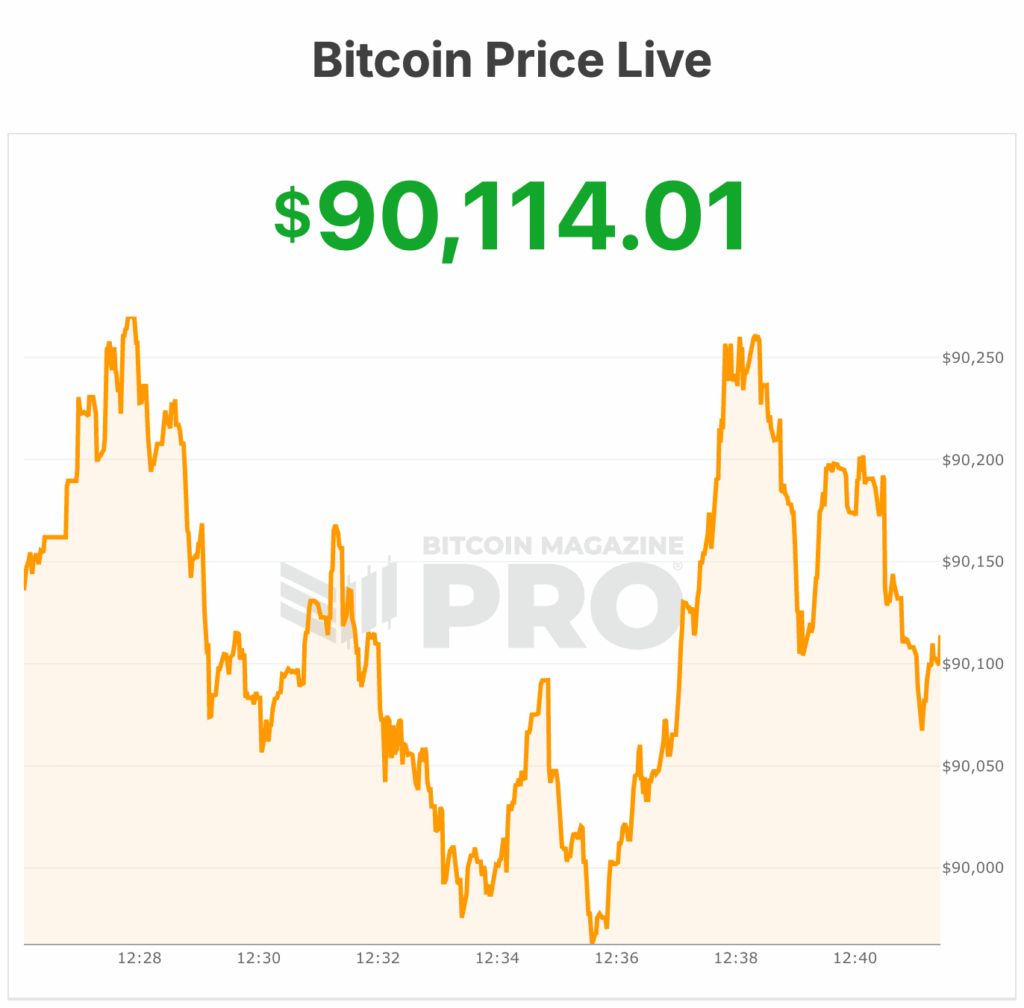
At the time of publishing, the bitcoin price is at $90,114.

bitcoin price

This post Bitcoin Price Fights For $90,000 Despite Fed Rate Cuts first appeared on Bitcoin Magazine and is written by Micah Zimmerman.

Klarna Partners With Privy to Explore Use of Crypto Wallets

Bitcoin Magazine

Klarna Partners With Privy to Explore Use of Crypto Wallets

Just weeks after announcing a stablecoin, Swedish fintech giant Klarna is taking another step into crypto. The company has teamed up with Privy, a wallet infrastructure platform owned by Stripe, to explore digital asset solutions for its users.

The partnership will focus on research and development of crypto wallet features, the company said. The two aim to make it easier for everyday users to store, use, and send digital assets. The move builds on the company’s recent launch of KlarnaUSD, a U.S. dollar-backed stablecoin issued on the Tempo blockchain.

“Millions already trust Klarna to manage everyday spending, saving, and shopping,” said Sebastian Siemiatkowski, CEO and co-founder. “That puts us in a unique position to bring crypto into the financial lives of normal people, not just early adopters. With Privy, we plan to build products that feel as intuitive as any other Klarna feature.”

KlarnaUSD was launched with Tempo and Bridge, a Stripe-backed stablecoin infrastructure provider. 

The token is live on Tempo’s testnet and expected to launch on mainnet in 2026. The fintech giant said the stablecoin could reduce global cross-border payment costs, currently estimated at $120 billion annually.

JUST IN: Fintech giant Klarna to develop #Bitcoin and crypto wallet features within its financial products.

Bullish 🚀 pic.twitter.com/UChKCUyOzZ

— Bitcoin Magazine (@BitcoinMagazine) December 11, 2025

100 million accounts coming to crypto via Klarna

Privy powers over 100 million accounts for more than 1,500 developers. The platform supports crypto-native applications like OpenSea and Hyperliquid. 

Henri Stern, CEO and co-founder of Privy, said the partnership will allow users to hold a wide variety of digital assets, trade safely, and transact with friends anywhere in the world.

“We’re proud to partner with world-class fintechs like Klarna, providing the secure, enterprise-ready infrastructure they need,” Stern said. “Privy aims to be the backbone for any business that wants to harness the exciting capabilities crypto and stablecoins offer.”

The initiative reflects a growing trend. Traditional fintechs are now testing ways to integrate crypto tools into everyday consumer finance. The company said any future wallet or crypto product would require the necessary regulatory approvals before launch.

Venture capital firm a16z estimates that 716 million people globally hold cryptocurrencies. Between 40 million and 70 million transact with crypto each month. That figure grows by roughly 10 million users a year.

Klarna’s push into crypto marks a sharp turn for the company. CEO Siemiatkowski was once a vocal skeptic of digital currencies. 

He said the market’s maturity and Klarna’s global reach now justify this entry. Klarna serves 114 million customers and processes $112 billion in annual gross merchandise volume.

The company plans to explore further crypto initiatives. A blog post on Thursday hinted at a new announcement “in a week or so,” suggesting more developments are coming soon.

This post Klarna Partners With Privy to Explore Use of Crypto Wallets first appeared on Bitcoin Magazine and is written by Micah Zimmerman.

Satsuma Technology Sells 579 Bitcoin Ahead of Planned LSE Uplisting

Bitcoin Magazine

Satsuma Technology Sells 579 Bitcoin Ahead of Planned LSE Uplisting

Satsuma Technology (LSE: SATS) sold nearly half its bitcoin treasury and announced major board changes as it prepares for a planned uplisting to the London Stock Exchange’s main market.

The U.K.-based company sold 579 BTC out of its 1,199 BTC holdings, raising about £40 million ($53 million) in net proceeds, according to a Thursday announcement. The move leaves Satsuma with 620 BTC and roughly £90 million in cash.

The sale is designed to ensure the company has enough liquidity to repay £78 million in convertible loan notes due on Dec. 31, 2025. 

Some noteholders have not yet committed to converting their debt into equity once Satsuma publishes its prospectus for the uplisting. The company said it wants to hold sufficient cash in case those conversions do not occur.

Alongside the treasury move, Satsuma proposed appointing Ranald McGregor-Smith as Chair and Clive Carver as Senior Independent Director. Both would join upon completion of the uplisting.

McGregor-Smith spent his career advising FTSE100 and FTSE250 firms and co-founded corporate broker Whitman Howard. He also sits on the board of Sabien Technology Group. Carver, a chartered accountant, has chaired and served as a non-executive director at several listed companies over the past decade and will also chair Satsuma’s Audit Committee.

Current Chair Matt Lodge will step down after the uplisting but remain on the board. Non-executive director Darcy Taylor resigned immediately as part of the restructuring.

CEO Henry K. Elder said the board changes bring stronger PLC governance at a key transition point. He also said the bitcoin sale positions the company for “stability and growth” as it advances its broader strategy.

Satsuma shares edged up to 1.05 pence following the announcement. The stock remains down nearly 30% over the past month.After the sale, Satsuma ranks as the 61st largest publicly traded bitcoin holder.

65% of Bitcoin treasuries in the red 

In November, roughly 65% of corporate Bitcoin treasuries were in unrealized losses after Bitcoin briefly fell below $90,000, per the Bitcoin Treasuries Corporate Adoption Report. 

The report, covering 100+ companies, shows large treasuries like Strategy and Strive dominated net purchases, while early signs of selling emerged, led by Sequans. 

Quarterly accumulation slowed but remains steady, with Q4 2025 on track for ~40,000 BTC added. Mining companies now hold 12% of corporate BTC. 

Public and private treasuries bought over 12,644 BTC in November, bringing total holdings past 4 million BTC. Global diversification and disciplined buying continue despite volatility.

This post Satsuma Technology Sells 579 Bitcoin Ahead of Planned LSE Uplisting first appeared on Bitcoin Magazine and is written by Micah Zimmerman.

65% of Corporate Bitcoin Treasuries Are Underwater: Report

Bitcoin Magazine

65% of Corporate Bitcoin Treasuries Are Underwater: Report

Corporate Bitcoin treasuries faced mark-to-market losses in November, according to an exclusive Corporate Adoption Report from Bitcoin Treasuries

The report, covering more than 100 companies, offers a systematic look at how last month’s price drop affected public company holdings.

Bitcoin briefly fell below $90,000 in late November. The decline pushed many 2025 buyers into the red. Of the 100 companies for which cost basis is measurable, about two-thirds now sit on unrealized losses at current prices, per the report.

Despite the volatility, large balance sheets continued to dominate net Bitcoin buying. Strategy, Strive, and a small cohort of high-conviction buyers accounted for most net additions. 

Strategy alone represented roughly 75% of net new buying after sales.

Public Bitcoin treasury equities remain weak versus BTC and broad indices. Still, a minority of companies delivered at least 10% gains over the past 6–12 months. 

Early signs of corporate Bitcoin selling also emerged. At least five companies reduced BTC exposure in November. Sequans led the group, selling roughly one-third of its holdings. While small in aggregate, these moves suggest some management teams are willing to crystallize losses or de-risk when volatility spikes.

Quarterly Bitcoin accumulation is slowing, but not collapsing. Q4 2025 is on track for roughly 40,000 BTC in net additions to public company balance sheets. This is below the last four quarters but broadly in line with Q3 2024, as companies normalize to a slower, more selective accumulation pace.

In November, public and private treasuries purchased, added, or disclosed over 12,644 BTC in November and the total BTC held across all tracked entities surpassed 4 million by month’s end. 

Bitcoin purchases

Big treasuries know for their bitcoin buying continue to dominate purchases. Strategy added 9,062 BTC across three transactions in November, per the report.

Its largest buy, 8,178 BTC, came on Nov. 17. Strategy ended the month with 649,870 BTC, worth about $59 billion. Currently, the company has 660,624 after some December purchases

Strive added 1,567 BTC at an average price of $103,315 per BTC in November. The purchase brought its month-end holdings to 7,525 BTC, or $684 million. The company funds its Bitcoin strategy primarily through perpetual preferred equity.

Mining companies remain significant players. Cango and Riot added 508 BTC and 37 BTC, respectively, from mining operations. American Bitcoin added 139 BTC through combined purchase and mining strategies. 

Per the report, mining companies now account for 12% of public company BTC holdings.

Bitcoin selling and rebalancing

Sales were limited but notable. As mentioned earlier, Sequans sold nearly one-third of its holdings, to reduce convertible debt. Hut 8 reduced holdings by 389 BTC. KindlyMD and Genius Group also trimmed exposure.

Some companies added small amounts even amid the downturn. DDC Enterprise Limited picked up 100 BTC during the pullback. 

Metaplanet continued “additional purchase” filings on the Tokyo exchange. ETF flows returned to net inflows after a month of redemptions.

The data suggests a barbell pattern: small distressed sellers versus programmatic buyers and disciplined treasuries. Investors see BTC increasingly used as collateral or for cash flow, rather than just as a speculative asset.

Global trends and future outlook

Corporate Bitcoin holdings are increasingly global. U.S. companies dominate the top 20, but Japan, China, Europe, and other regions are growing. 

Non-U.S. public company holdings rose 3,180 BTC from two months prior, now representing about 9% of all public company BTC. Analysts say this geographic diversification reduces regulatory risk.

Despite November’s volatility, corporate adoption of Bitcoin continues. Large treasuries are still buying aggressively. The quarterly pace of accumulation is slower than earlier in 2025, the report noted, but steady growth persists. 

Those interested in reading the full report can do so below:

This post 65% of Corporate Bitcoin Treasuries Are Underwater: Report first appeared on Bitcoin Magazine and is written by Micah Zimmerman.

Bitcoin Price Briefly Pumps Above $94,000 As Fed Cuts Rates

Bitcoin Magazine

Bitcoin Price Briefly Pumps Above $94,000 As Fed Cuts Rates

Bitcoin price surged above $94,000 today following a 25-basis-point rate cut by the Federal Reserve.

The Fed lowered its benchmark interest rate to 3.50%–3.75% to support maximum employment and contain somewhat elevated inflation amid moderate economic growth and slowing job gains.

This is the Fed’s third rate cut this year and the first since October. Most officials backed the move, while three dissented — one favoring a larger cut, two preferring no change.

Fed forecasts for 2026 and 2027 remain modest, with expectations for small rate reductions, 4.4% unemployment, and 2.4% PCE inflation.

The rate decision pushed the Bitcoin price higher, although markets had largely priced in the cut. BTC briefly hit $94,500, reaching a seven-day high. 

Trading volume over the last 24 hours totaled roughly $46 billion. The cryptocurrency’s market cap stands near $1.86 trillion, with a circulating supply of just under 20 million BTC, according to Bitcoin Magazine Pro data.

Bitcoin’s recent rally reflects broader adoption trends and institutional interest. PNC Bank became the first major U.S. bank to offer direct spot bitcoin trading to eligible Private Bank clients using Coinbase’s infrastructure.

Last week, Bank of America advised its wealth management clients to allocate 1%–4% of portfolios to digital assets.

Coinbase Institutional highlighted that speculative leverage has fallen from 10% to 4%–5% of total market capitalization, signaling a potential end to extreme volatility. Ark Invest CEO Cathie Wood suggested the market may have already seen its four-year cycle lows.

The Fed’s decision came amid mixed signals from broader financial markets. The 10-year Treasury yield has risen, reflecting investor concern that easing policy now could spur inflation later. 

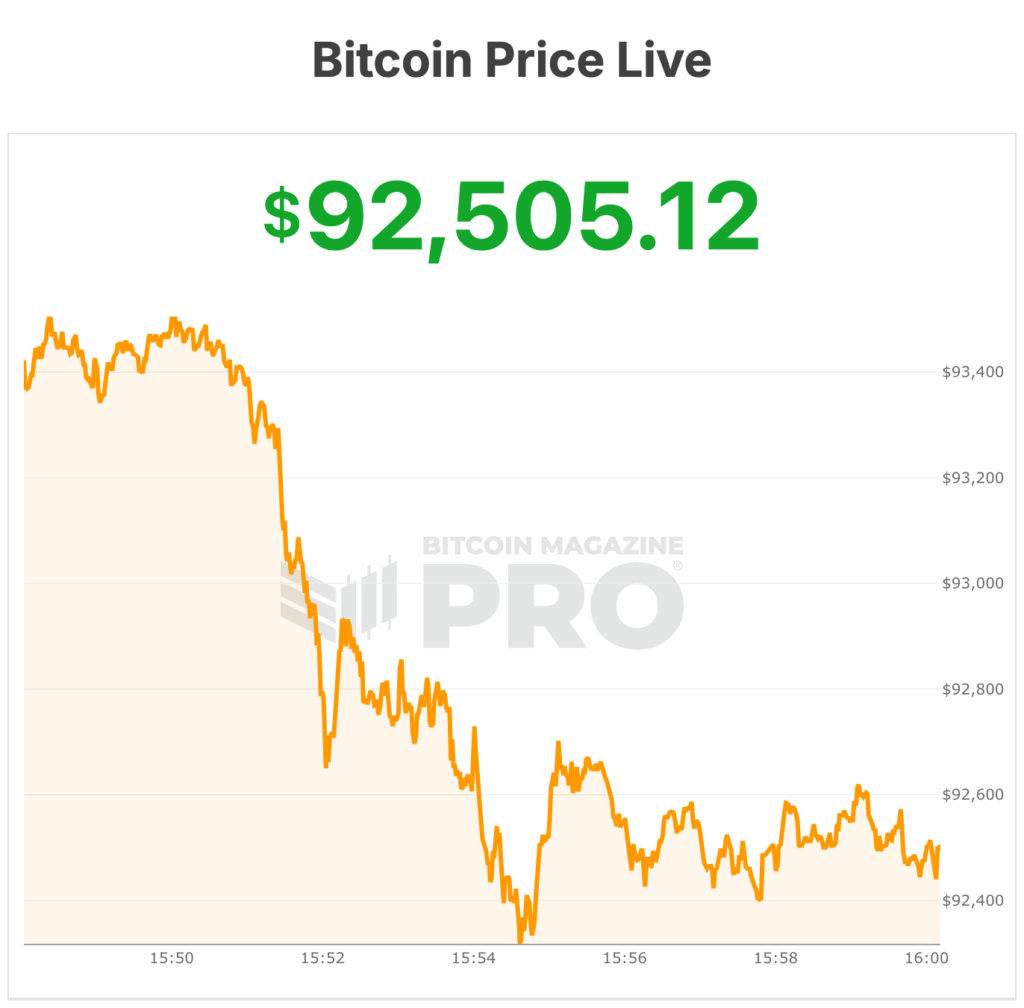
At the time of writing, Bitcoin trades around $92,505, up roughly 3% in the last 24 hours.

bitcoin price

Bitcoin price analysis

Last week, Bitcoin price saw a volatile ride, dipping to $84,000 before bulls pushed it up to $94,000, then dropping slightly below $88,000, and closing the week at $90,429.

 The market now faces key support at $87,200 and $84,000, with deeper support zones around $72,000–$68,000 and $57,700. 

Resistance levels stand at $94,000, $101,000, $104,000, and a thick zone between $107,000–$110,000, with momentum likely slowing above $96,000.

Typically, rate cuts lead to bullish momentum, but the market may have already priced in this month’s rate cut.

Bitcoin is down close to 25% from its all-time highs.

This post Bitcoin Price Briefly Pumps Above $94,000 As Fed Cuts Rates first appeared on Bitcoin Magazine and is written by Micah Zimmerman.
Federal Reserve Cuts Interest Rates by 25 Basis Points

Bitcoin Magazine

Federal Reserve Cuts Interest Rates by 25 Basis Points

The Federal Reserve cut its benchmark interest rate by 25 basis points today, lowering the federal funds target range to 3.50%–3.75%. The move marked the central bank’s third rate cut of the year and its first since October.

The Federal Reserve said they made the cuts to support maximum employment and return inflation to 2%. Economic activity is expanding moderately, job gains have slowed, and inflation remains somewhat elevated, the Fed said.

Most officials voted for the cut, with three dissenting—one preferring a larger cut and two preferring no change. Policymakers said the decision reflects easing inflation pressures and a desire to support economic activity as growth moderates. The Fed had kept rates unchanged for several meetings after its October cut.

Fed officials also left their rate forecasts unchanged, signaling modest 25-basis-point cuts in 2026 and 2027, with expected 2026 unemployment at 4.4%, PCE inflation at 2.4% and GDP growth at 2.3%.

The 10-year Treasury yield has climbed this month even as expectations for a rate cut grew, signaling investor concern that easing policy now could reignite inflation and force rates higher later. 

The Fed’s internal divisions add to that tension, as Jerome Powell heads up what is probably his final meeting as chair before President Trump names a successor, ending a tenure defined by consensus-building amid unusual discord.

Lower interest rates reduce borrowing costs for households and businesses. They can encourage spending, investment, and risk-taking across financial markets. 

BREAKING: 🇺🇸 Federal Reserve cuts interest rates by 25bps. pic.twitter.com/kiXG9hhVXM

— Bitcoin Magazine (@BitcoinMagazine) December 10, 2025

Before these cuts, some said that inflation was easing, but regardless, the market widely expected a 25 basis-point rate cut.

At the same time, rate cuts can also signal concern about the economy’s trajectory.

The Fed’s last rate cut

In October, The Federal Reserve cut its benchmark interest rate by 25 basis points to a range of 3.75%–4% at its October meeting, following its previous cut in September. At the time, the Bitcoin price slipped from around $116,000 to lows of $111,000 that week.

Since then, Bitcoin has plunged to lows of $80,000. 

Bitcoin’s response to rate cuts has varied in the past, with sharp volatility during the Fed’s emergency easing in 2020 and a more muted reaction to the September 2025 cut.

At the time, Chair Jerome Powell also signaled that the central bank is nearing the end of its quantitative tightening program, with balance-sheet runoff expected to stop by December. QT has been draining liquidity by allowing bonds to mature without reinvestment, pushing yields higher and tightening financial conditions. 

At the time of writing, Bitcoin is showing lots of volatility and is trading near $92,500. 

This post Federal Reserve Cuts Interest Rates by 25 Basis Points first appeared on Bitcoin Magazine and is written by Micah Zimmerman.
SpaceX Moves $95M in Bitcoin Ahead of Potential Mega IPO

Bitcoin Magazine

SpaceX Moves $95M in Bitcoin Ahead of Potential Mega IPO

SpaceX moved another 1,021 bitcoin on Wednesday, worth about $94.5 million.

The transfer was split between two unlabeled addresses via Coinbase Prime custody. One address received 614 BTC, the other 407 BTC.

This marks the ninth such transfer by SpaceX this year. Recent movements total around 8,910 BTC, valued near $924 million. Analysts say the company is consolidating its holdings and upgrading from legacy bitcoin addresses. 

SpaceX’s bitcoin holdings were tagged on-chain by Arkham Intelligence. The company currently controls about 3,991 BTC, worth roughly $367 million at current prices. Holdings have fluctuated over the past several years. 

The total once peaked above $1.6 billion during the 2021 bull market. In mid-2022, SpaceX reportedly reduced its stake by about 70% after shocks from the Terra-Luna collapse, FTX bankruptcy, and market-wide turbulence.

SpaceX has made no public statement about the transactions. Tesla, another Elon Musk-run company, currently holds 11,509 BTC, worth about $1.24 billion.

SpaceX IPO? 

The bitcoin reshuffle comes as SpaceX advances plans for a massive initial public offering. Bloomberg reported the company aims to raise more than $30 billion in its IPO. The target valuation is near $1.5 trillion, potentially surpassing Saudi Aramco’s record $29 billion fundraise in 2019.

SpaceX’s IPO could take place as early as mid-to-late 2026. Sources say the timing could slip into 2027 depending on market conditions. If successful, it would be the largest listing in history by valuation.

The offering would give investors exposure not only to rockets, satellites, and Starlink internet services but also to SpaceX’s crypto holdings. Musk’s companies were among the earliest institutional bitcoin adopters. 

SpaceX has also used dogecoin to fund its DOGE-1 lunar mission, highlighting Musk’s influence in crypto markets.

Prediction market data show growing confidence in SpaceX’s valuation. Polymarket traders assign a 67% probability that the IPO will exceed a $1 trillion market cap. 

The IPO could provide capital for Starlink expansion, space-based data centers, and other ventures intersecting with AI and crypto infrastructure, according to Bloomberg.

Analysts note the on-chain reshuffle aligns with the company’s broader treasury strategy. Moving funds to modern addresses can reduce transaction costs, improve security, and consolidate management of multiple wallets.

Most of SpaceX’s remaining bitcoin is expected to be migrated as the consolidation completes.

This post SpaceX Moves $95M in Bitcoin Ahead of Potential Mega IPO first appeared on Bitcoin Magazine and is written by Micah Zimmerman.

Strategy Formally Urges MSCI to Keep Digital Asset Treasury Companies on Global Indexes

Bitcoin Magazine

Strategy Formally Urges MSCI to Keep Digital Asset Treasury Companies on Global Indexes

Strategy, the world’s largest Bitcoin treasury company, has submitted a formal response to MSCI’s consultation on digital asset treasury companies (DATs), urging the index provider not to exclude companies whose digital asset holdings exceed 50% of total assets.

In its detailed letter to the MSCI Equity Index Committee, Strategy argued that the proposed threshold is “misguided” and would have “profoundly harmful consequences” for both investors and the broader digital asset industry.

Founded in 1989, the company operates as a corporate treasury and capital markets business with significant Bitcoin holdings, offering investors a range of equity and fixed-income securities backed by its digital assets. 

According to the company, its model is fundamentally different from a passive investment fund. Strategy actively uses its Bitcoin reserves to generate returns for shareholders, providing novel financial instruments akin to traditional bank and insurance products. 

The company emphasized that “DATs are operating companies, not investment funds,” noting that its operational flexibility allows it to adapt its business model as the technology evolves.

Strategy calls MSCI’s logic “arbitrary, and unworkable.”

Strategy criticized MSCI’s proposal for introducing a digital-asset-specific 50% threshold, calling it “discriminatory, arbitrary, and unworkable.” 

The company highlighted that many traditional businesses — including oil companies, timber operators, REITs, and media firms — also maintain concentrated holdings in single asset types but are not treated as investment funds. 

The company warned that price volatility, differing accounting standards, and asset valuation changes would create index instability, causing DATs to whipsaw in and out of MSCI’s indices.

The letter further argued that the proposal would inappropriately inject policy considerations into index construction.

“MSCI has consistently held itself out as providing indices that accurately and objectively measure market performance,” Strategy wrote.

JUST IN: Strategy officially asks MSCI to revoke its proposal to exclude #Bitcoin treasury companies like $MSTR from its indexes. pic.twitter.com/3k1RlJDZjX

— Bitcoin Magazine (@BitcoinMagazine) December 10, 2025

Excluding DATs based on the type of assets they hold, rather than the underlying business model, could compromise MSCI’s neutrality and mislead investors about how these companies operate. 

Strategy noted that its investors buy exposure to the company’s management and innovation capabilities, not merely to Bitcoin itself, citing historical trading patterns in which the company’s stock often outperformed the underlying value of its digital holdings.

Strategy: Digital assets are popular in government policy

The company also framed the debate in the context of U.S. economic policy. Strategy noted that the federal government, under President Trump, has made digital assets central to national economic endeavors, including the establishment of a Strategic Bitcoin Reserve and promoting access to digital assets in retirement accounts. 

Excluding DATs from MSCI indices would, the letter argued, conflict with these policies and chill innovation in a nascent sector. 

Analysts cited in the letter estimate that Strategy alone could face up to $2.8 billion in stock outflows if MSCI implements the exclusion, with broader implications for the emerging digital asset economy.

Strategy positioned itself within a historical context, comparing the rise of digital asset treasuries to earlier industrial leaders. 

The letter highlighted examples like Standard Oil, AT&T, Intel, and NVIDIA, noting that these companies made concentrated investments in emerging technologies that were initially viewed as risky but ultimately became foundational to economic growth. 

Similarly, the letter argued, digital asset treasuries are building critical infrastructure for a new financial system.

Don’t succumb to ‘short-sightedness’

The letter concluded by urging MSCI to reject the 50% threshold, citing the risk of stifling innovation, damaging index integrity, and undermining federal strategy. Strategy recommended that MSCI allow the market to continue evolving and conduct more thorough consultation before considering any policy that would differentiate DATs from other operating companies. 

The company invoked MSCI’s precedent in reorganizing the Communication Services sector after nearly two decades of industry evolution, suggesting a measured, deliberative approach.

“History shows that when foundational technologies have emerged, institutions that prospered allowed markets to test them rather than throttling them in advance,” Strategy wrote. “MSCI can either succumb to short-sightedness or allow its indices to reflect, neutrally and faithfully, the next era of financial technology.”

Elsewhere, companies like Strive and Bitcoin For Corporations also challenged MSCI’s decision.

Strategy
Michael Saylor, Strategy Chairman

This post Strategy Formally Urges MSCI to Keep Digital Asset Treasury Companies on Global Indexes first appeared on Bitcoin Magazine and is written by Micah Zimmerman.

American Bitcoin Adds 416 BTC, Holdings Near 4,800; ProCap Hits 5,000 Bitcoin Club

Bitcoin Magazine

American Bitcoin Adds 416 BTC, Holdings Near 4,800; ProCap Hits 5,000 Bitcoin Club

American Bitcoin Corp. (Nasdaq: ABTC) continued to expand its BTC treasury, adding roughly 416 BTC over the past week and lifting total holdings to about 4,783 BTC as of Dec. 8, according to a company update released Wednesday. 

The latest additions bring American Bitcoin’s reserve to one of the largest among U.S.-listed companies focused on BTC accumulation. The holdings were built through a mix of in-house mining and strategic market purchases, the company said. 

The total also includes BTC held in custody or pledged as collateral for miner purchases under a supply agreement with hardware manufacturer Bitmain.

American Bitcoin, which listed on Nasdaq earlier this year, also reported an increase in its proprietary “Satoshis Per Share” metric, or SPS. 

As of Dec. 8, SPS stood at 507, up more than 17% in just over a month. The measure reflects the amount of BTC attributable to each outstanding common share and is intended to give equity investors clearer visibility into their indirect exposure to BTC through the company’s stock.

Eric Trump, American Bitcoin’s co-founder and chief strategy officer, said the pace of accumulation reflects the company’s operating model and cost structure. 

In comments included with the update, Trump said the firm has built “one of the largest and fastest growing bitcoin accumulators” within three months of listing, supported by margins designed to favor long-term value creation rather than short-term price moves.

JUST IN: 🇺🇸 Eric Trump and Donald Trump Jr. backed American Bitcoin, acquires an additional 416 BTC.

They now hold 4,784 Bitcoin 🙌 pic.twitter.com/Uo5aKLAfri

— Bitcoin Magazine (@BitcoinMagazine) December 10, 2025

Shares of ABTC were modestly higher in early Wednesday trading, though the stock remains well below recent highs following a sharp selloff earlier this month. 

On Dec. 2, ABTC shares fell roughly 50% in a session after pre-merger private placement shares became freely tradable, increasing supply and pressure on the stock.

Anthony Pompliano’s ProCap Financial buys more Bitcoin 

American Bitcoin’s expansion comes as other newly listed firms also grow their BTC reserves. ProCap Financial (Nasdaq: BRR), led by Anthony Pompliano, said this week it increased its holdings to 5,000 bitcoin, adding 49 BTC following the completion of its SPAC merger. 

ProCap said the purchase was structured to realize a tax loss that could offset future gains, a strategy the firm framed as shareholder-friendly capital allocation.

Pompliano described the move as part of a broader plan to maximize long-term BTC accumulation while maintaining balance-sheet flexibility. ProCap reported holding more than $175 million in cash, which it said provides capacity for additional purchases and operations.

Despite recent buying activity, shares of both companies remain under pressure. BRR stock has fallen more than 60% over the past several days. 

According to data from bitcointreasuries.net, ProCap and American Bitcoin now rank among the top publicly traded companies holding BTC, placing 21st and 22nd, respectively. 

This post American Bitcoin Adds 416 BTC, Holdings Near 4,800; ProCap Hits 5,000 Bitcoin Club first appeared on Bitcoin Magazine and is written by Micah Zimmerman.

Strive Lines Up $500 Million Stock Offering to Buy More Bitcoin

Bitcoin Magazine

Strive Lines Up $500 Million Stock Offering to Buy More Bitcoin

Strive, a publicly traded bitcoin treasury and asset-management firm, said it has arranged a $500 million at-the-market offering to help fund more bitcoin purchases.

The company plans to sell Variable Rate Series A Perpetual Preferred Stock, known as SATA. The offering allows Strive to issue shares into the market at prevailing prices rather than through a single sale. The structure gives the firm flexibility to raise capital as demand allows.

SATA carries a 12% dividend and an effective yield near 13%. The preferred stock is modeled on Strategy’s STRC perpetual preferred equity, which has been used as a funding tool for bitcoin accumulation. 

SATA currently trades around $91, below its $100 par value.

Strive said proceeds may be used for a range of purposes. These include buying bitcoin, purchasing income-generating assets, supporting working capital, repurchasing common shares, or pursuing acquisitions. 

JUST IN: 🇺🇸 Vivek Ramaswamy's Strive to raise $500 million to buy more #Bitcoin

Nothing stops this train 🙌 pic.twitter.com/I2ZStdFYBX

— Bitcoin Magazine (@BitcoinMagazine) December 10, 2025

The company did not specify how much of the raise would be allocated to bitcoin purchases.

The 14th-largest corporate bitcoin holder

Strive currently holds about 7,525 bitcoin, valued at roughly $695 million at recent market prices. That positions the firm as the 14th-largest publicly traded corporate holder of bitcoin. 

The company has leaned into a bitcoin-focused treasury strategy following a public reverse merger earlier this year.

The company was co-founded in 2022 by entrepreneur and political figure Vivek Ramaswamy. Since launching its first exchange-traded fund in August 2022, Strive Asset Management has grown to oversee more than $2 billion in assets, according to company disclosures. 

The firm markets itself as an alternative asset manager with a focus on aligning capital with long-term investment themes.

In September, Strive agreed to acquire Semler Scientific, a transaction that increased the combined entity’s bitcoin exposure. The move placed the company among a growing group of public companies that use equity markets to build large bitcoin positions, a strategy popularized by Michael Saylor’s Strategy.

Shares of its common stock, ASST, trade near $1 today.

Strive calls out MSCI on bitcoin beliefs 

The company has also taken an active role in market structure debates tied to bitcoin treasury firms. Earlier this month, Strive called on index provider MSCI to avoid excluding companies with large digital asset holdings from major equity benchmarks. 

MSCI is reportedly consulting investors on whether firms with balance sheets dominated by crypto assets should remain eligible for inclusion.

The company argued that such exclusions would limit investor choice and reshape capital flows across passive funds. The review could have broad implications for companies that hold bitcoin as a core treasury asset.

This post Strive Lines Up $500 Million Stock Offering to Buy More Bitcoin first appeared on Bitcoin Magazine and is written by Micah Zimmerman.

22-Year-Old Pleads Guilty in $263 Million Bitcoin and Crypto Theft

Bitcoin Magazine

22-Year-Old Pleads Guilty in $263 Million Bitcoin and Crypto Theft

A 22-year-old California resident has pleaded guilty to his role in a multi-state social engineering scheme that stole roughly $263 million in crypto.

Evan Tangeman of Newport Beach, California, admitted laundering $3.5 million in crypto for the criminal enterprise, the U.S. Attorney’s Office announced Monday.

Tangeman pleaded guilty to participating in a Racketeer Influenced and Corrupt Organizations (RICO) conspiracy before U.S. District Court Judge Colleen Kollar-Kotelly. 

Sentencing is scheduled for April 24, 2026. He is the ninth defendant to enter a guilty plea in this specific investigation.

The court also unsealed the Second Superseding Indictment, adding three more defendants. Nicholas Dellecave, also known as “Nic” or “Souja,” Mustafa Ibrahim, also known as “Krust,” and Danish Zulfiqar, also known as “Danny” or “Meech,” face charges of RICO conspiracy along with the other members of the Social Engineering Enterprise (SE Enterprise). 

Dellecave was arrested in Miami on Dec. 3, 2025. Ibrahim and Zulfiqar were recently arrested in Dubai.

According to prosecutors, the enterprise began in October 2023 and continued through at least May 2025. It originated from friendships formed on online gaming platforms. The group included individuals in California, Connecticut, New York, Florida, and abroad.

Details of the rampant crypto crime

The scheme involved database hackers, organizers, target identifiers, callers, and residential burglars who targeted hardware wallets containing cryptocurrency. Hackers used stolen databases to identify high-value targets. 

Callers impersonated crypto exchange staff or email providers to trick victims into revealing account credentials. 

Burglars physically broke into homes to steal hardware wallets.

Tangeman acted as a money launderer. He converted stolen cryptocurrency into cash using a bulk-cash converter. Tangeman then used the cash to obtain rental homes for members of the group, often listing false names on the leases. 

Some properties rented for $40,000 to $80,000 per month. He secured homes in Los Angeles and Miami.

The largest known theft occurred on Aug. 18, 2024. Tangeman’s co-conspirators, including Malone Lam and Danish Zulfiqar, deceived a victim in Washington, D.C., into transferring over 4,100 Bitcoin. At the time, the crypto was valued at $263 million. The same amount is now worth more than $368 million.

Tangeman also helped Lam obtain roughly $3 million in cash from stolen cryptocurrency to secure a rental property. 

After Lam’s arrest on Sept. 18, 2024, Tangeman accessed home security systems to screenshot FBI agents during searches. He also asked another member to retrieve and destroy digital devices from Lam’s Los Angeles residence.

Prosecutors said the enterprise spent stolen funds on a lavish lifestyle. Purchases included nightclub services up to $500,000 per night, luxury handbags, watches valued between $100,000 and $500,000, designer clothing, rental homes, private jets, security guards, and a fleet of at least 28 exotic cars ranging from $100,000 to $3.8 million.

Three additional defendants unsealed

With Tangeman’s guilty plea, prosecutors have unsealed charges against three additional defendants. The Second Superseding Indictment shows the investigation is ongoing. Authorities have not disclosed whether any of the stolen Bitcoin has been recovered or whether restitution will be sought.

The SE Enterprise relied on social engineering rather than sophisticated hacking techniques. The group’s operations originated from online friendships, but the stolen funds funded high-profile purchases and drew attention. 

Authorities said the defendants’ extravagant spending played a role in exposing their activities.

Tangeman remains free pending sentencing. 

Federal penalties for RICO conspiracy and money laundering carry significant prison terms. The Justice Department has indicated that additional charges may follow as the investigation continues.

A RICO conspiracy occurs when individuals agree to take part in a pattern of criminal activity, or racketeering, through an ‘enterprise.’ Under the Racketeer Influenced and Corrupt Organizations Act (RICO), prosecutors can connect separate crimes and individuals under a single charge.

The focus is on proving a shared criminal objective, not that every participant committed every act.

This post 22-Year-Old Pleads Guilty in $263 Million Bitcoin and Crypto Theft first appeared on Bitcoin Magazine and is written by Micah Zimmerman.

Bitcoin Bulls Trim Near-Term Price Targets as BTC Demand Slows

Bitcoin Magazine

Bitcoin Bulls Trim Near-Term Price Targets as BTC Demand Slows

Wall Street’s biggest Bitcoin bulls are cutting near-term price targets after the latest market pullback. Their longer-term outlook remains intact. Standard Chartered, one of crypto’s most prominent backers, halved its Bitcoin forecasts in a note published Tuesday. 

The bank now sees Bitcoin reaching $100,000 by the end of 2025, down from $200,000, and $150,000 by the end of 2026. 

Its long-term target of $500,000 remains, though the timeline has been pushed to 2030 from 2028.

The downgrade reflects a shift in demand. Corporate treasury buying, once a major driver, has faded. Exchange-traded fund flows have slowed. 

Geoffrey Kendrick, Standard Chartered’s global head of digital asset research, said aggressive corporate accumulation has “run its course.”

“Future price gains will be driven by one leg only,” Kendrick wrote, referring to ETF inflows. He expects consolidation rather than broad selling.

Bernstein analysts struck a similar tone. They forecast Bitcoin at $150,000 by the end of next year and near $200,000 by late 2027, according to Bloomberg.

The firm dropped its call for a $200,000 peak this year but argues Bitcoin is no longer bound by its historical four-year cycle. Analysts say institutional participation has added durability to the market.

The revisions follow a rough stretch for prices. Bitcoin has fallen almost 30% from its October peak above $126,000. 

Spot Bitcoin ETFs posted $60 million in net outflows on Monday. BlackRock’s iShares Bitcoin Trust lost about $2.3 billion in November, its largest monthly redemption since launch.

Those outflows represent about 3% of the fund’s assets. Bernstein notes that total ETF withdrawals remain below 5% of assets under management. Retail investors still hold most ETF shares, though institutional ownership has climbed to 28%.

Bitcoin price rebound 

Despite these predictions, Bitcoin rose more than 4% today to near $94,640, pushing market capitalization to about $1.86 trillion as trading volume climbed to $46 billion and prices hit a seven-day high. 

Institutional momentum continued with Twenty One ringing the NYSE opening bell holding over 43,500 BTC, while PNC became the first major U.S. bank to offer direct spot bitcoin trading to private clients and Bank of America encouraged limited digital asset allocations.

Investors are also weighing supportive macro signals, with expectations of Federal Reserve rate cuts and comments from Cathie Wood suggesting Bitcoin’s cycle lows may already be in.

At the time of writing, Bitcoin is trading near $94,000. 

This post Bitcoin Bulls Trim Near-Term Price Targets as BTC Demand Slows first appeared on Bitcoin Magazine and is written by Micah Zimmerman.

OCC Confirms Banks Can Act as Intermediaries in Crypto Transactions

Bitcoin Magazine

OCC Confirms Banks Can Act as Intermediaries in Crypto Transactions

The Office of the Comptroller of the Currency (OCC) has clarified that national banks may engage in “riskless principal” transactions involving crypto-assets.

In its new Interpretive Letter 1188, the OCC explained that such transactions allow a bank to act as a principal between two customers, buying crypto from one while simultaneously selling it to another. 

The bank does not hold the assets in inventory, effectively serving as a broker acting on behalf of clients.

This guidance follows a broader regulatory trend to ease restrictions on crypto activities within the traditional banking sector. In March, the OCC removed prior requirements for banks to seek advance approval before engaging in certain crypto operations, signaling growing acceptance of digital assets in mainstream finance.

In other words, U.S. banks can now offer crypto services in a manner similar to traditional brokerage activities. 

Last week, Bank of America announced it would allow wealth management clients to allocate 1%–4% of their portfolios to digital assets.

The guidance applied across Merrill, Bank of America Private Bank, and Merrill Edge, enabling more than 15,000 advisers—previously restricted—to recommend crypto proactively. 

Also, earlier today, PNC Bank became the first major U.S. bank to offer eligible Private Bank clients direct bitcoin trading through its own platform, powered by Coinbase’s infrastructure. The service allowed qualified clients to buy, hold, and sell bitcoin without using an external exchange. 

The launch followed a strategic partnership with Coinbase announced in July.

Full OCC letter details

In essence, the letter basically confirmed that national banks may engage in ‘riskless principal transactions’ in crypto-assets. 

Per the letter, a riskless principal transaction occurs when a bank buys an asset from one counterparty with the simultaneous agreement to sell it immediately to another, without holding the asset in inventory except in rare cases like settlement failures. 

In this role, the bank functions similarly to a broker, taking on limited settlement, market, and credit risk.

The letter made a distinction between crypto-assets that are securities and those that are not. Riskless principal transactions in crypto-assets classified as securities are already permissible under existing law, as the bank acts without recourse, meaning it does not assume customer risk.

The OCC extends this reasoning to crypto-assets that are not securities, framing the activity as part of the broader “business of banking.” 

Under U.S. law, the business of banking is not narrowly defined, allowing banks to engage in new activities that logically extend their traditional functions.

The OCC analyzed the activity using four factors: its similarity to recognized banking activities, its benefit to banks and customers, the nature of the risks involved, and whether state-chartered banks are authorized to perform it. 

Riskless principal crypto-asset transactions align with traditional brokerage and custody services, benefit customers by providing regulated access to crypto-assets, and carry risks familiar to banks, such as settlement risk. 

State regulatory frameworks do not prohibit similar activity, supporting the federal permissibility.

This post OCC Confirms Banks Can Act as Intermediaries in Crypto Transactions first appeared on Bitcoin Magazine and is written by Micah Zimmerman.

Jack Mallers’ Twenty One Capital Vows to Buy ‘As Much Bitcoin as Possible’

Bitcoin Magazine

Jack Mallers’ Twenty One Capital Vows to Buy ‘As Much Bitcoin as Possible’

Twenty One Capital, the Bitcoin-native company co-founded by Jack Mallers, officially began trading on the New York Stock Exchange today under the ticker XXI, following a business combination with Cantor Equity Partners.

The firm debuted with a BTC treasury of 43,514 BTC, valued at roughly $3.9 billion, immediately making it the world’s third-largest publicly traded Bitcoin holder.

Speaking live on CNBC, Mallers said the company plans to “buy as much Bitcoin as [they] possibly can”. He emphasized that the firm is not simply a treasury holder but intends to build businesses around BTC, including capital markets advisory, lending models, and educational media. 

JUST IN: 🇺🇸 Public company Twenty One Capital CEO Jack Mallers says: We're going to buy "as much Bitcoin as we possibly can" 🚀 pic.twitter.com/7jdRAiOZjr

— Bitcoin Magazine (@BitcoinMagazine) December 9, 2025

Mallers described Bitcoin as “honest money” and said Twenty One aims to give it “the place it deserves in global markets.”

The NYSE launch is backed by major institutional players, including Tether, Bitfinex, Cantor Fitzgerald, and SoftBank, reflecting a growing wave of institutional adoption of BTC.

Twenty One’s PIPE financing included $486.5 million in senior convertible notes and roughly $365 million in common equity commitments.

Analysts note the launch signals a new model for public Bitcoin companies. Mitchell Askew, head of Blockware Intelligence, said the firm’s institutional connections could position Twenty One as “a major player not only in Bitcoin, but in the grand arc of financial history.”

Twenty One plans to pair its treasury with operating businesses that generate recurring revenue while supporting BTC adoption. 

Shareholders will have access to on-chain verification of holdings, ensuring transparency. Mallers highlighted that the firm’s value comes not only from its BTC holdings but also from the cash flows and infrastructure it builds around the asset.

Shares of XXI opened with volatility, trading down over 23% at $10.97 following the debut, reflecting typical market reactions to new listings. Since opening, shares have stabilized to 

With this launch, Twenty One Capital aims to establish itself as both a leading institutional BTC holder and a financial ecosystem around the cryptocurrency, offering investors direct exposure to BTC alongside innovative business models built on the asset.

Bitcoin as money, not just an asset

At Bitcoin Amsterdam, Jack Mallers reaffirmed his belief that BTC’s ultimate purpose is to function as money, not just as an asset. 

He criticized traditional financial narratives, saying, “People have convoluted the concept of money to benefit them… The dollar is money? No, how about f*** you?” 

For Mallers, money is what you save to later exchange for goods and services, and BTC fulfills that role regardless of whether merchants directly accept it. 

“What I used as money was Bitcoin because I exchanged the work I’m doing for those around me for Bitcoin and later exchange it for the things I want,” he explained.

Mallers also addressed external pressures from powerful figures and media outlets to temper his message. He recalled being advised, “Don’t say that on CNBC,” but emphasized, “Sorry, good thing I’m me and you’re you… you say whatever you want.” 

He framed his stance as a matter of integrity and honesty, saying, “I was born to love others, to contribute to something bigger than myself.”

This post Jack Mallers’ Twenty One Capital Vows to Buy ‘As Much Bitcoin as Possible’ first appeared on Bitcoin Magazine and is written by Micah Zimmerman.

Bitcoin Price Skyrockets to $94,000 as Banks Start to Embrace Bitcoin  

Bitcoin Magazine

Bitcoin Price Skyrockets to $94,000 as Banks Start to Embrace Bitcoin  

The bitcoin price is currently pumping and hit highs of $94,640 today, climbing over 4% in the last 24 hours. Bitcoin’s 24-hour trading volume reached $46 billion. It stands at its seven-day high.

The total circulating supply of Bitcoin is 19,959,806 BTC, with a maximum supply of 21 million. Today’s market capitalization is roughly $1.86 trillion, reflecting the 4% daily gain.

The broader bitcoin space is experiencing some momentum. The Bitcoin MENA conference in Abu Dhabi just wrapped up, full of bank leaders and industry thought leaders sharing their thoughts on Bitcoin’s future. 

Earlier today, Jack Mallers’ Bitcoin company, Strike, and Twenty One rang the opening bell at the New York Stock Exchange. The company holds over 43,500 BTC — around $4 billion — making it the world’s third-largest publicly listed Bitcoin holder. 

Majority-owned by Tether Investments and Bitfinex, with SoftBank as a significant minority investor, the company blends a Bitcoin treasury strategy with operational Bitcoin-focused financial services under CEO Jack Mallers.

Investors are also paying close attention to macroeconomic signals. Ark Invest CEO Cathie Wood said that the Bitcoin price’s four-year cycle may shift. She suggested the market may have already seen its lows.

Neuberger CIO Shannon Saccocia also noted that expected Federal Reserve rate cuts and gains in AI-driven productivity could lift equities and other risk assets. Stocks often perform well when the economy avoids recession and the Fed is easing.

JUST IN: Bitcoin pumps to $94,000! pic.twitter.com/ek3C26RhSu

— Bitcoin Magazine (@BitcoinMagazine) December 9, 2025

Bitcoin price rally

Bitcoin price’s recent rally comes amid growing adoption and institutional interest. Large players are integrating Bitcoin into payments and financial products.

For example, earlier today, PNC Bank became the first major U.S. bank to offer direct spot bitcoin trading to eligible Private Bank clients through its digital platform, using Coinbase’s Crypto-as-a-Service infrastructure. 

The service allows qualified clients to buy, hold, and sell bitcoin without relying on external cryptocurrency exchanges. 

Coinbase provides the trading, custody, and settlement infrastructure, while PNC retains the direct client relationship and regulatory oversight.

The launch follows a strategic partnership announced in July and reflects a growing trend among U.S. banks to integrate bitcoin into wealth management services.

Also last week, the Bank of America urged its wealth management clients to allocate 1% to 4% of their portfolios to digital assets, signaling a major shift in its approach to Bitcoin exposure. The move allowed over 15,000 advisers across Merrill, Bank of America Private Bank, and Merrill Edge to proactively recommend crypto to clients.

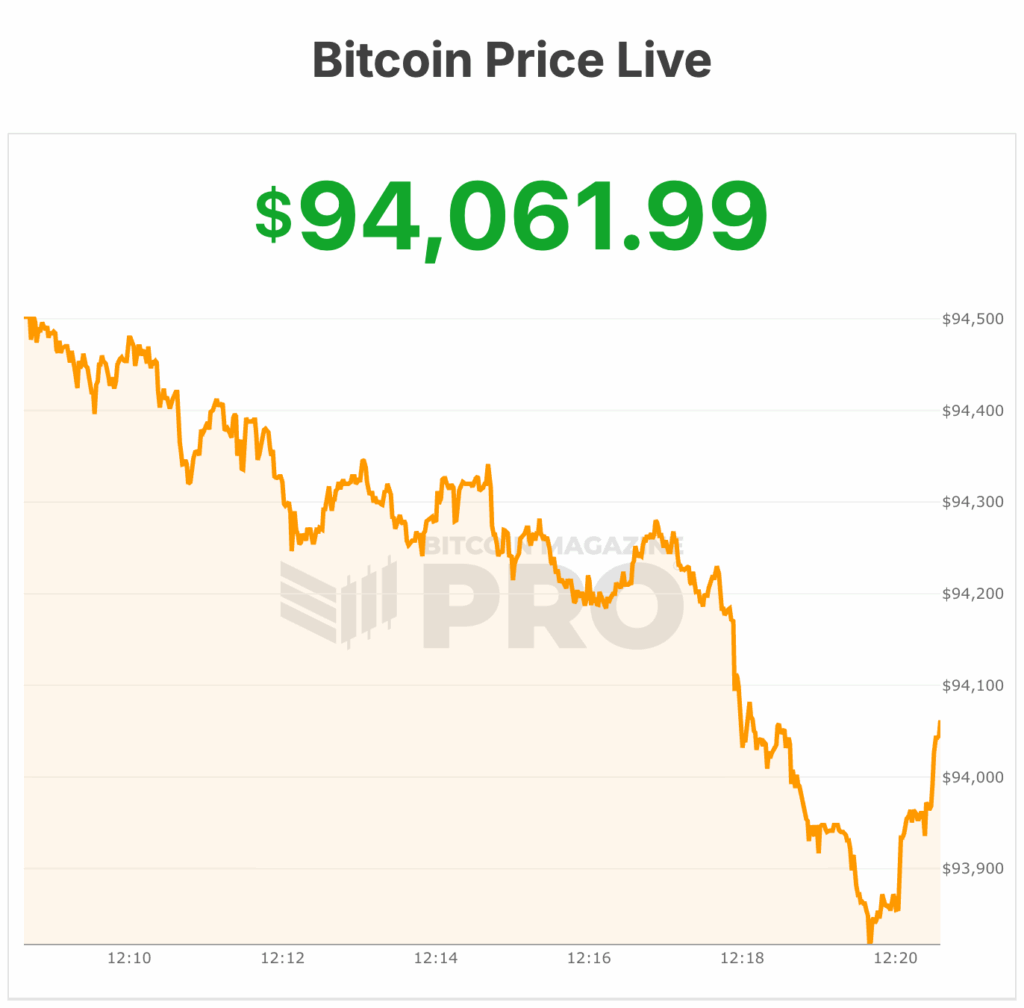
At the time of writing, the bitcoin price is $94, 061.

bitcoin price

This post Bitcoin Price Skyrockets to $94,000 as Banks Start to Embrace Bitcoin   first appeared on Bitcoin Magazine and is written by Micah Zimmerman.

‘We are going to buy all of it’: Michael Saylor talks Bitcoin Strategy at Bitcoin MENA Conference

Bitcoin Magazine

‘We are going to buy all of it’: Michael Saylor talks Bitcoin Strategy at Bitcoin MENA Conference

Michael Saylor, executive chairman of Strategy, delivered a sweeping keynote at the Bitcoin MENA conference earlier today, framing Bitcoin not just as an investable asset, but as the foundation of a new era in digital capital and credit.

Speaking to an audience of sovereign wealth funds, banks, conference attendees, and investors, Saylor outlined how his company is leveraging Bitcoin to create the world’s first digital Treasury and build a global system of Bitcoin-backed credit.

“Bitcoin is digital capital,” Saylor said, opening his talk.

He contrasted Bitcoin with traditional forms of capital such as gold, real estate, and equities, emphasizing its potential as a foundational store of value in the digital economy. 

“We are going to buy all of it,” he declared, highlighting Strategy’s ongoing acquisition program, which now totals 660,624 Bitcoin, including 10,600 acquired last week.

The purchases, he explained, range from $500 million to $1 billion weekly, underscoring the company’s aggressive accumulation strategy.

Banks are meeting with Saylor to discuss Bitcoin 

Saylor stressed the importance of recent institutional and regulatory shifts. He said that over the past year, major U.S. banks including Bank of America, Wells Fargo, JP Morgan, and Citi have moved from cautious observers to active participants, offering custody solutions and credit facilities tied to Bitcoin. 

“All of the large banks in the United States have gone from not banking Bitcoin 12 months ago to issuing credit against Bitcoin or Bitcoin derivatives,” he noted. 

JUST IN: Michael Saylor says he got approached by all the major banks recently to launch #Bitcoin products and services.

Banks are here 🙌 pic.twitter.com/AcHQRCaP7y

— Bitcoin Magazine (@BitcoinMagazine) December 9, 2025

He also highlighted bipartisan U.S. government support for Bitcoin, citing figures from the Treasury, SEC, and CFTC.

Bitcoin as a yield-generating credit

Central to Saylor’s thesis is the conversion of Bitcoin’s volatile digital capital into predictable, yield-generating credit. 

Strategy has launched a series of Bitcoin-backed credit instruments designed to provide steady cash flows while preserving exposure to the asset’s long-term appreciation. 

“If you have a short time horizon, you buy the credit,” he said. “If you trust Bitcoin and have a long horizon, you buy the equity.”

Saylor described how these instruments work. Using over-collateralization, Strategy transforms Bitcoin holdings into digital credit with lower volatility and reliable yields. 

The firm has introduced products like STRK, a preferred stock paying an 8% dividend backed by Bitcoin, and STRF, a perpetual bond yielding 10% that funds long-term investment in digital assets. 

“We convert 120 months or 240 months of duration into one month,” Saylor explained, emphasizing the ability to deliver near-immediate cash flows from long-term capital.

He also outlined Strategy’s approach to amplifying equity performance. By issuing credit instruments and reinvesting proceeds in Bitcoin, the company effectively enhances its Bitcoin holdings per share over time.

“Every seven years, we double our Bitcoin per share,” he said. 

The result, Saylor claims, is a corporate structure that aligns long-term Bitcoin growth with investor returns while creating unprecedented liquidity in credit markets.

Saylor framed these innovations in historical context. Just as gold served as the foundation for centuries of credit instruments—from mortgages to sovereign debt—Bitcoin, he argued, will form the backbone of a digital credit system. 

“If we have digital gold, it’s very logical that the world’s going to run on digital gold-backed credit,” he said, noting the potential for Bitcoin to underpin global financial systems.

Throughout his keynote, Saylor emphasized both scale and vision. He described a tour of the Middle East, meeting investors across Dubai, Bahrain, Kuwait, and Abu Dhabi, presenting a unified vision of digital capital and credit. 

“The opportunity for Treasury companies is to accumulate pools of capital and issue credit that meets regulatory requirements, integrates into the banking system, and absorbs currency risk,” he said.

At the time of writing, Bitcoin is ripping past $94,000. 

Saylor

This post ‘We are going to buy all of it’: Michael Saylor talks Bitcoin Strategy at Bitcoin MENA Conference first appeared on Bitcoin Magazine and is written by Micah Zimmerman.

Binance Founder CZ Says the 4-Year Bitcoin Cycle Is Over — Predicts a Potential Bitcoin Supercycle

Bitcoin Magazine

Binance Founder CZ Says the 4-Year Bitcoin Cycle Is Over — Predicts a Potential Bitcoin Supercycle

At the Bitcoin MENA conference, Binance founder Changpeng Zhao (CZ) offered an pretty expansive view of Bitcoin’s evolving role in global finance.  

While he touched on personal experiences, from his legal challenges in the United States to his pardon from President Donald Trump, his remarks consistently returned to the trajectory and potential of Bitcoin.

Speaking alongside BTC Inc CEO Brandon Green, CZ described the current adoption cycle as distinct from previous waves. While earlier cycles were dominated by retail investors, this cycle reflects significant institutional engagement

Bitcoin’s institutional adoption 

From Bitcoin ETFs to corporate strategic reserves, Wall Street and large financial institutions are participating in the crypto ecosystem. 

“We have seen more institutions come in than probably previous cycles,” CZ said. This bridging between grassroots movements and institutional finance, he argued, positions Bitcoin for broader integration into the global financial system.

The conversation highlighted the inherent unpredictability of Bitcoin’s adoption path. CZ sees potential for growth through integration with traditional payment infrastructure. 

Tools like crypto cards, where users pay in cryptocurrency but merchants receive fiat, allow demand to grow on the user side and lay the groundwork for more widespread adoption. 

Stablecoins, he noted, will also play a key role in facilitating transactions without undermining Bitcoin’s investment appeal.

CZ’s take on Bitcoin’s 4-year cycle 

CZ also offered perspective on how macroeconomic conditions and policy shifts can influence Bitcoin’s trajectory. 

While the four-year cycle has long guided expectations for bull and bear markets, he suggested that external forces, including government monetary policies, may now have equal or greater influence. 

CZ even said that bitcoin and crypto may be entering a “super cycle”

JUST IN: Binance founder CZ says the 4-year #Bitcoin cycle might be dead, and we may see a supercycle 🚀 pic.twitter.com/rl4Ie6JoQQ

— Bitcoin Magazine (@BitcoinMagazine) December 9, 2025

He pointed to potential U.S. rate cuts and quantitative easing as factors that could drive liquidity into crypto markets, suggesting the next cycle could diverge from historical patterns.

Institutionalization of Bitcoin, however, does not replace the grassroots origins of the network. CZ emphasized that retail holders remain the majority and that the international nature of Bitcoin is integral to its identity.

He described the institutional participation as complementary, not transformative, to the global movement that has propelled Bitcoin from a niche technology to a widely recognized asset class.

CZ’s personal journey

Throughout the discussion, CZ reflected on his personal journey, from ‘growing up on a farm in China’ to serving jail time, all while being intertwined closely with Bitcoin’s evolution. 

He shared his experiences facing U.S. regulatory scrutiny, including potential imprisonment, and his eventual pardon by President Trump. The pardon drew criticism from Democrats like Sen. Elizabeth Warren, who called it corruption, while the Trump administration framed it as correcting an “overreach” by the Biden administration against crypto.

Even as he stepped back from day-to-day operations at Binance, CZ has remained engaged in advancing the industry. He has focused on advising governments on how to regulate crypto. 

Beyond regulation, CZ has turned attention to education and innovation. He founded Giggle Academy, a free, gamified, digital education platform that now reaches approximately 90,000 children, emphasizing accessibility and positive societal impact. 

CZ’s reflections on legacy and impact returned repeatedly to Bitcoin. While he admires other industry figures, like Michael Saylor, for their single-minded focus on Bitcoin, CZ sees his own role as complementary: attempting to foster innovation across multiple chains while championing Bitcoin’s primacy. 

“Bitcoin itself is great. It is the global reserve currency in crypto, probably soon in the world,” he said. 

🇦🇪 MICHAEL SAYLOR JUST HAD A MEETING WITH CZ AT BITCOIN MENA

₿ULLISH 🚀 pic.twitter.com/si6FuJAIJD

— Bitcoin MENA Conference (@bitcoinmenaconf) December 9, 2025

In closing, CZ reiterated that his goal remains clear: driving adoption and awareness of crypto worldwide. Whether through institutional engagement, policy advising, or fostering innovation, he positions himself as a conduit between the grassroots and the broader financial ecosystem.

At the time of writing, Bitcoin is skyrocketing towards $93,000.

CZ

This post Binance Founder CZ Says the 4-Year Bitcoin Cycle Is Over — Predicts a Potential Bitcoin Supercycle first appeared on Bitcoin Magazine and is written by Micah Zimmerman.

PNC Becomes First Major U.S. Bank to Offer Direct Bitcoin Trading to Clients via Coinbase

Bitcoin Magazine

PNC Becomes First Major U.S. Bank to Offer Direct Bitcoin Trading to Clients via Coinbase

PNC Bank has launched direct spot bitcoin trading for eligible PNC Private Bank clients, becoming the first major U.S. bank to offer native bitcoin access directly through its own digital banking platform.

The new service allows qualified private banking clients to buy, hold, and sell bitcoin without using an external cryptocurrency exchange. 

The offering is powered by Coinbase’s Crypto-as-a-Service (CaaS) infrastructure, which provides trading, custody, and settlement capabilities embedded directly within PNC’s Private Bank Online platform via its Portfolio View interface.

The launch follows a strategic partnership between the bank and Coinbase announced in July and marks one of the clearest steps yet by a major U.S. bank toward integrating spot bitcoin trading into core wealth management services. 

JUST IN: 🇺🇸 $400 billion PNC Private Bank partners with Coinbase to launch #Bitcoin trading.

The first major U.S. banks to market with such an offering 🚀 pic.twitter.com/K5XtBHphr6

— Bitcoin Magazine (@BitcoinMagazine) December 9, 2025

Bitcoin allocation to wealthy PNC clients

Last week, Bank of America began allowing its 15,000 wealth management advisers to recommend a 1%–4% allocation to crypto for clients, signaling a broader Wall Street shift toward mainstream Bitcoin exposure. 

The guidance, effective next year, focuses on regulated bitcoin ETFs from Bitwise, Fidelity, Grayscale, and BlackRock, with the bank emphasizing a measured approach and clear expectations around volatility.

Similarly, PNC Private Bank serves high- and ultra-high-net-worth individuals and family offices across more than 100 offices nationwide.

“As client interest in digital assets continues to grow, our responsibility is to offer secure and well-designed options that fit within the broader context of their financial lives,” said Chairman and CEO William Demchak. 

He added that the collaboration enables clients to access bitcoin trading “in a controlled and familiar environment” consistent with the bank’s regulatory and risk standards.

Under the arrangement, Coinbase provides the institutional-grade infrastructure that powers execution and custody, while the bank retains the direct client relationship. 

Coinbase Institutional co-CEO Brett Tejpaul said the partnership demonstrates how traditional financial institutions and crypto-native companies can work together to expand access to digital assets safely and compliantly, according to Bloomberg reporting.

Tejpaul likened Coinbase’s role to that of cloud providers such as Amazon Web Services, supplying the underlying technology while banks focus on client services.

The service is currently limited to PNC’s private bank clients, whose bitcoin purchases can be funded through their existing PNC investment management and checking accounts. 

PNC executives said the rollout represents an early phase of a broader digital asset strategy.

PNC has previously offered clients indirect exposure to bitcoin and ether through ETFs, but this marks the bank’s first move into direct spot trading.  According to PNC, the bank plans to expand access to additional client segments, including institutional investors such as nonprofits, endowments, and foundations, in future phases.

This post PNC Becomes First Major U.S. Bank to Offer Direct Bitcoin Trading to Clients via Coinbase first appeared on Bitcoin Magazine and is written by Micah Zimmerman.

Bitcoin Is a Relief, Not a Theory: Pakistan’s Case for Crypto Adoption

Bitcoin Magazine

Bitcoin Is a Relief, Not a Theory: Pakistan’s Case for Crypto Adoption

At the Bitcoin MENA conference, Bilal Bin Saqib, chairman of the Pakistan Virtual Assets Regulatory Authority, delivered a message that framed bitcoin not as a speculative asset, but as a practical solution to structural economic problems facing millions of people in Pakistan.

One of Bin Saqib’s most striking takeaways was how grounded his argument in lived reality. In Pakistan, bitcoin is less about ideology and more about necessity. 

Bitcoin as a financial relief

As Bin Saqib put it, for many Pakistanis “bitcoin is not theory, it’s a relief,” a response to problems traditional financial systems have failed to solve for decades.

He pointed first to savings. Pakistan’s currency has lost more than half its value over the past five years, eroding purchasing power for ordinary citizens. In that environment, Bin Saqib argued, people are not looking for explanations of monetary theory. They are looking for protection.

Bitcoin, he said, provides a way to store value outside inflation driven by political decisions, money printing and currency mismanagement. “You don’t need a lecture,” he noted. “You need a hedge.”

Access was the second pillar of his case. Despite Pakistan being home to roughly 240 million people, more than 100 million remain unbanked. 

JUST IN: 🇵🇰 Minister of State Bilal Bin Saqib says, “#Bitcoin gives people a way to store value outside politics, printing and inflation.”

Pakistan is coming 🚀 pic.twitter.com/5YJSyKfibT

— Bitcoin Magazine (@BitcoinMagazine) December 9, 2025

For this population, traditional finance has simply never arrived. Bitcoin, according to Bin Saqib, offers a financial identity without the need for permission, paperwork or intermediaries that may never open the door. 

That permissionless access, he argued, is especially powerful for young people encountering true financial ownership for the first time.

The third pillar was cross-border earnings. Pakistan has one of the largest freelance workforces in the world, yet freelancers often struggle to receive international payments quickly, cheaply and transparently. 

Bitcoin and blockchain-based payment rails enable Pakistani workers to get paid globally without friction, delays or excessive fees. For many, this has meant a direct connection to the global economy for the first time.

Bin Saqib tied these grassroots use cases to a broader national strategy. Pakistan, he said, is not trying to “chase the future” but to build a new one. With roughly 70% of the population under the age of 30, the country cannot rely on outdated economic models. 

Digital assets, and bitcoin in particular, are being viewed as infrastructure rather than speculation—new financial rails for the Global South.

He outlined his mandate since being appointed seven months ago: to transform one of the world’s largest unregulated crypto markets into a compliant, investment-friendly ecosystem. 

Pakistan has already moved to establish a virtual asset regulatory framework, issue provisional licenses for exchanges, and develop regulatory sandboxes for mining, tokenization and fintech.

The goal, Bin Saqib said, is to bring activity onshore rather than push it underground, protecting users without suffocating builders.

Bin Saqib’s discussion of energy 

Energy played a central role in the discussion. Pakistan paradoxically suffers from both power shortages and massive excess capacity, paying for electricity that goes unused. 

Bin Saqib described bitcoin mining and artificial intelligence as tools to convert that “wasted economic oxygen” into productive output. 

Every unused megawatt, he argued, could be turned into bitcoin mining or AI compute, effectively transforming stranded energy into digital exports.

In that framework, bitcoin mining becomes less about consumption and more about industrial renewal. 

Rather than exporting only commodities or labor, Pakistan could export compute—what Bin Saqib called one of the most valuable resources of the 21st century. He framed this not as a narrow energy policy, but as part of a broader industrial rebirth.

Looking ahead, Bin Saqib predicted that the next wave of bitcoin adoption will not be led by Wall Street, but by emerging markets where economic pain is real and the upside is massive. 

This post Bitcoin Is a Relief, Not a Theory: Pakistan’s Case for Crypto Adoption first appeared on Bitcoin Magazine and is written by Micah Zimmerman.

❌