
Reading view

There are new articles available, click to refresh the page.

Ask Hackaday: Solutions, or Distractions?
The “Long Dark” is upon us, at least for those who live north of the equator, and while it’s all pre-holiday bustle, pretty lights, and the magical first snow of the season now, soon the harsh reality of slushy feet, filthy cars, and not seeing the sun for weeks on end will set in. And when it does, it pays to have something to occupy idle mind and hands alike, a project that’s complicated enough to make completing even part of it feel like an accomplishment.

But this time of year, when daylight lasts barely as long as a good night’s sleep, you’ve got to pick your projects carefully, lest your winter project remain incomplete when the weather finally warms and thoughts turn to other matters. For me, at least, that means being realistic about inevitabilities such as competition from the day job, family stuff, and the dreaded “scope creep.”

It’s that last one that I’m particularly concerned with this year, because it has the greatest potential to delay this project into spring or even — forbid it! — summer. And that means I need to be on the ball about what the project actually is, and to avoid the temptation to fall into any rabbit holes that, while potentially interesting and perhaps even profitable, will only make it harder to get things done.

Pushing My Buttons

For my winter project this year, I chose something I’ve been itching to try for a while: an auto-starter for my generator. Currently, my solar PV system automatically charges its battery bank when the state of charge (SOC) drops below 50%, which it does with alarming frequency during these short, dark days. But rather than relying on shore power, I want my generator to kick on to top off the batteries, then turn itself off when the charge is complete.
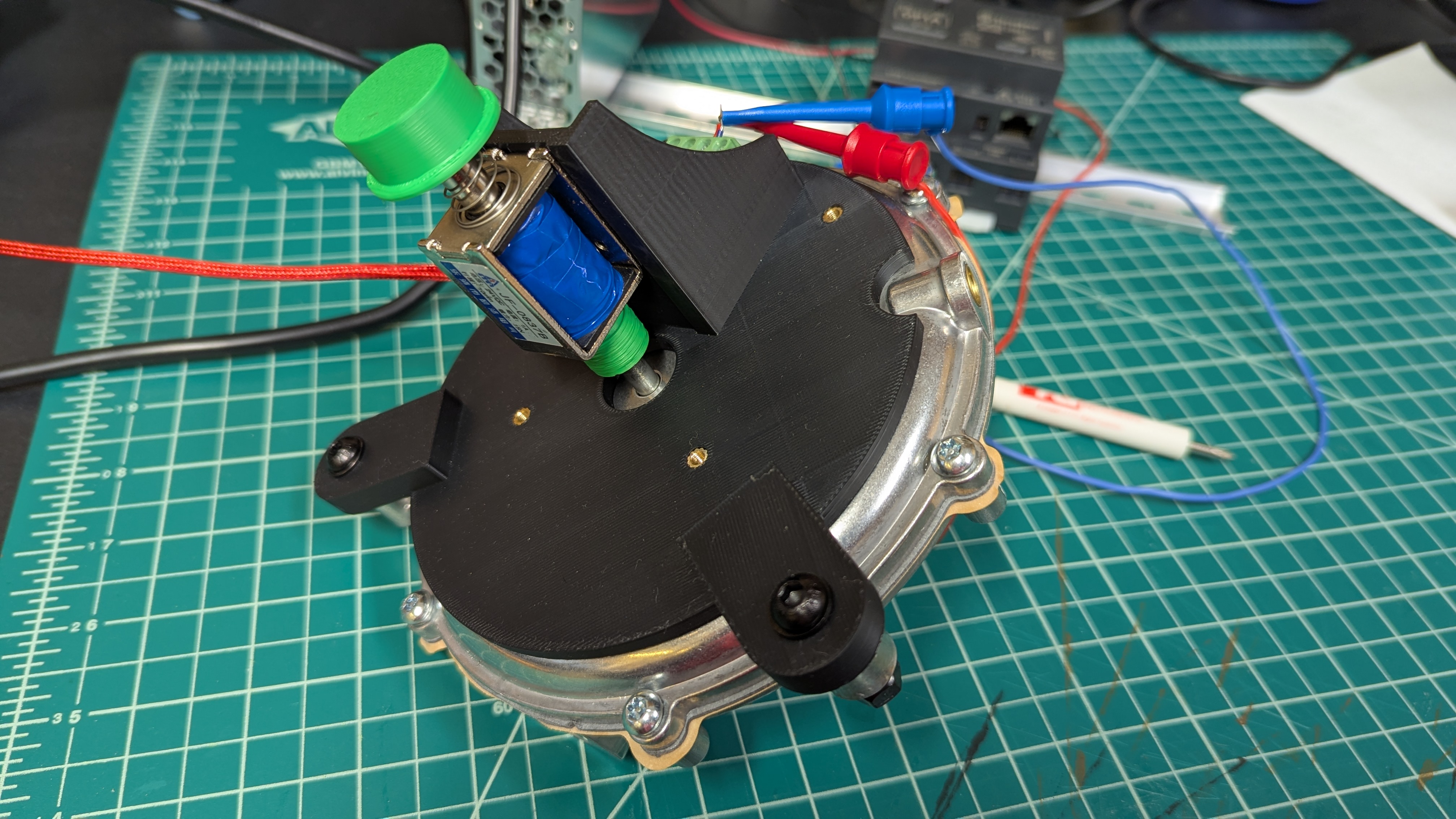
Primer assembly for the generator auto-start. The silver part is the regulator; the solenoid pushes the primer button when it fires. All the parts needed to be custom-made.

In concept, it’s a simple project, since the inverter panel I chose has dry contacts that can trigger based on SOC. It seems like a pretty easy job, just a microcontroller to sense when the inverter is calling for a charge and some relays to kick the generator on. It’s a little — OK, a lot — more complicated than that when you think about it, since you have to make sure the generator actually cranks over, you’ve got to include fail-safes so the generator doesn’t just keep cranking endlessly if it doesn’t catch, and you have to make everything work robustly in an electrically and mechanically noisy environment.

However, in my case, the most challenging aspect is dealing with the mechatronics of the project. My generator is fueled by propane, which means there’s a low-pressure regulator that needs to be primed before cranking the starter. When cranking the generator manually, you just push the primer button a few times to get enough propane into the fuel intake and turn the key. Automating this process, though, is another matter, one that will surely require custom parts, and the easiest path to that would be 3D printing.

But, up until a couple of weeks ago, I didn’t own a 3D printer. I know, it’s hard to believe someone who writes for Hackaday for a living wouldn’t own one of the essential bits of hacker kit, but there it is. To be fair to myself, I did dip my toe into additive manufacturing about six or seven years ago, but that printer was pretty awful and never really turned out great prints. It seemed like this project, with its potential need for many custom parts, was the perfect excuse to finally get a “big boy” printer.

Pick Your Project

And that’s where I came upon the first potential rabbit hole: should I buy an out-of-the-box solution, or should I take on a side-quest project? I was sorely tempted to take the latter course by getting one of those used Enders returned to Amazon, having heard that they’re about half the price of new and often need very little work to get them going. But then again, sometimes these printers have gone through a lot in the short time they were in a customer’s hands, to the point where they need quite a bit of work to get them back in good order.

While I like the idea of a cheap printer, and I wouldn’t mind tinkering with one to get it going again, I decided against the return route. I really didn’t like my odds, given that our Editor in Chief, Elliot Williams, says that of the two returned printers he’s purchased, one worked basically out of the box, while the other needed more work to get in shape. I wanted to unbox the printer and start making parts right away, to get this project going. So, I took the plunge and bought a Bambu P1S on a pre-Black Friday sale that was much less than list price, but much more than what I would have paid for a returned Ender.

Now, I’m not going to turn this into a printer review — that’s not really the point of this article. What I want to get across is that I decided to buy a solution rather than take on a new hobby. I got the Bambu up and running in about an hour and was cranking out prototype parts for my project later that afternoon. Yes, I might have had the same experience with a returned printer at about half the price of the Bambu, but I felt like the perceived value of a new printer was worth the premium price, at least in this case.

I think this is a pretty common choice that hackers face up and down the equipment spectrum. Take machine tools, for instance. Those of us who dream of one day owning a shop full of metalworking tools often trawl through Facebook Marketplace in search of a nice old South Bend lathe or a beautiful Bridgeport milling machine, available for a song compared to what such a machine would cost new. But with the difficulty and expense of getting it home and the potential for serious mechanical problems like worn ways or broken gears that need to be sorted before putting the machine to use, the value proposition could start to shift back toward buying a brand new machine. Expensive, yes, but at least you stand a chance of making parts sooner.

Your Turn

Don’t get me wrong; I’d love to find a nice old lathe to lovingly restore, and I just may do that someday. It’s like buying a rusty old classic car; you’re not doing it to end up with a daily driver, but rather for the joy of restoring a fine piece of engineering to its former glory. In projects like that, the journey is the point, not the destination. But if I need to make parts right away, a new lathe — or mill, or CNC router, or 3D printer — seems like the smarter choice.

I’ll turn things over to you at this point. Have you come up against this kind of decision before? If so, which path did you choose? Has anyone had a satisfying out-of-the-box experience with returned printers? Was I unnecessarily pessimistic about my chances in that market? What about your experience with large machine tools, like lathes and mills? Is it possible to buy used and not have the machine itself become the project? Sound off in the comments below.

Hackaday Links: December 7, 2025

Hackaday Links Column Banner

We stumbled upon a story this week that really raised our eyebrows and made us wonder if we were missing something. The gist of the story is that U.S. Secretary of Energy Chris Wright, who has degrees in both electrical and mechanical engineering, has floated the idea of using the nation’s fleet of emergency backup generators to reduce the need to build the dozens of new power plants needed to fuel the AI data center building binge. The full story looks to be a Bloomberg exclusive and thus behind a paywall — hey, you don’t get to be a centibillionaire by giving stuff away, you know — so we might be missing some vital details, but this sounds pretty stupid to us.

First of all, saying that 35 gigawatts of generation capacity sits behind the big diesel and natural gas-powered generators tucked behind every Home Depot and Walmart in the land might be technically true, but it seems to ignore the fact that backup generators aren’t engineered to run continuously. In our experience, even the best backup generators are only good for a week or two of continuous operation before something — usually the brushes — gives up the ghost. That’s perfectly acceptable for something that is designed to be operated only a few times a year, and maybe for three or four days tops before grid power is restored. Asking these units to run continuously to provide the base load needed to run a data center is a recipe for rapid failure. And even if these generators could be operated continuously, there’s still the issue of commandeering private property for common use, as well as the fact that you’d be depriving vital facilities like hospitals and fire stations of their backup power. But at least we’d have chatbots.

Well, that won’t buff right out. Roscosmos, the Russian space agency, suffered a serious setback last week when it damaged the launchpad at Site 31/6 during a Soyuz launch. This is bad news because that facility is currently the only one in the world capable of launching Soyuz and Progress, both crucial launch vehicles for the continued operation of the International Space Station. As usual, the best coverage of the accident comes from Scott Manley, who has all the gory details. His sources inform him that the “service cabin,” a 20-ton platform that slides into position under the rocket once it has been erected, is currently situated inside the flame trench rather than being safely tucked into a niche in the wall. He conjectures that the service cabin somehow got sucked into the flame trench during launch, presumably by the negative pressure zone created by the passage of all that high-velocity rocket exhaust. Whatever the cause of the accident, it causes some problems for the Russians and the broader international space community. An uncrewed Progress launch to resupply the ISS was scheduled for December 20, and a crewed Soyuz mission is scheduled for July 2026. But without that service cabin, neither mission seems likely. Hopefully, the Russians will be able to get things tidied up quickly, but it might not matter anyway since there’s currently a bit of a traffic jam at the ISS.

We saw a really nice write-up over at Make: Magazine by Dom Dominici about his impressions from his first Supercon visit. Spoiler alert: he really liked it! He describes it as “an intimate, hands-on gathering that feels more like a hacker summer camp than a tech expo,” and that’s about the best summary of the experience that we’ve seen yet. His reaction to trying to find what he assumed would be a large convention center, but only finding a little hole-in-the-wall behind a pizza place off the main drag in Pasadena, is priceless; yes, that mystery elevator actually goes somewhere. For those of you who still haven’t made the pilgrimage to Pasadena, the article is a great look at what you’re missing.

And finally, we know we were a little rough on the Russians a couple of weeks back for their drunk-walking robot demo hell, but it really served to demonstrate just how hard it is to mimic human walking with a mechanical system. After all, it takes the better part of two years for a new human to even get the basics, and a hell of a lot longer than that to get past the random face-plant stage. But still, some humanoid robots are better than others, to the point that there’s now a Guinness Book of World Records category for longest walk by a humanoid robot. The current record was set last August, with a robot from Shanghai-based Agibot Innovations going on a 106-km walkabout without falling or (apparently) recharging. The journey took place in temperatures approaching 40°C and took 24 hours to complete, which means the robot kept up a pretty brisk walking pace over the course, which we suppose didn’t have any of the usual obstacles.

Hackaday Links: November 23, 2025

Hackaday Links Column Banner

Remember the Key Bridge collapse? With as eventful a year as 2025 has been, we wouldn’t blame anyone for forgetting that in March of 2024, container ship MV Dali plowed into the bridge across Baltimore Harbor, turning it into 18,000 tons of scrap metal in about four seconds, while taking the lives of six very unlucky Maryland transportation workers in the process. Now, more than a year and a half after the disaster, we finally have an idea of what caused the accident. According to the National Transportation Safety Board’s report, a loss of electrical power at just the wrong moment resulted in a cascade of failures, leaving the huge vessel without steerage. However, it was the root cause of the power outage that really got us: a wire with an incorrectly applied label.

Sal Mercogliano, our go-to guy for anything to do with shipping, has a great rundown of the entire cascade of failures, with the electrically interesting part starting around the 8:30 mark. The NTSB apparently examined a control cabinet on the Dali and found one wire with a heat-shrink label overlapping the plastic body of its terminating ferrule. This prevented the wire from being properly inserted into a terminal block, leading to poor electrical contact. Over time, the connection got worse, eventually leading to an undervoltage condition that tripped a circuit breaker and kicked off everything else that led to the collision. It’s a sobering thought that something so mundane and easily overlooked could result in such a tragedy, but there it is.

We’ve been harping a bit on the Flock situation in this space over the last month or so, but for good reason, or at least it seems to us. Flock’s 80,000-strong network of automated license plate readers (ALPRs), while understandably attractive from a law-and-order perspective, is a little hard to swallow for anyone interested in privacy and against pervasive surveillance. And maybe all of that wouldn’t be so bad if we had an inkling that the security start-up had at least paid passing attention to cybersecurity basics.

But alas, Benn Jordan and a few of his cybersecurity pals have taken a look inside a Flock camera, and the news isn’t good. Granted, this appears to be a first-pass effort, but given that the “hack” is a simple as pressing the button on the back of the camera a few times. Doing so creates a WiFi hotspot on the camera, and from there it’s off to the races. There are plenty of other disturbing findings in the video, so check it out.

Sufficiently annuated readers will no doubt recall classic toys of the ’60s and ’70s, such as Lite-Brite and Rock ‘Em Sock ‘Em Robots, and games like Mouse Trap and Toss Across. We recall owning all of those at one time or another, and surprisingly, they all sprang from the inventive mind of the same man: Burt Meyer, who died on October 30 at the age of 99. We have many fond memories of his inventions, but truth be told, we never much cared for Mouse Trap as a game; we just set up the Rube Goldberg-esque trap and played with that. The rest, though? Quality fun. RIP, Burt.

Last week, we featured the unfortunate story about a Russian humanoid robot that drunk-walked its way into “demo hell” history. And while it’s perhaps a bit too easy to poke fun at something like this, it’s a simple fact of life that the upright human form is inherently unstable, and that any mechanism designed to mimic that form is bound to fall once in a while. With that in mind, Disney Research engineers are teaching their humanoid bots to fall with style. The idea is for the robots to protect their vital parts in the event of a fall, which is something humans (usually) do instinctively. They first did hundreds of falls with virtual robots, rewarding them for correctly ending up in the target pose, and eventually worked the algorithms into real, albeit diminutive, robots. The video in the article shows them all sticking the landing, and even if some of the end poses don’t seem entirely practical, it’s pretty cool tech.

And finally, this week on the Hackaday Podcast was discussed the infuriating story of an EV-enthusiast who had trouble servicing the brakes on his Hyundai Ioniq. Check out the podcast if you want the full rant and the color commentary, but the TL;DL version is that Hyundai has the functions needed to unlock the parking brakes stuck behind a very expensive paywall. Luckily for our hacker hero, a $399 Harbor Freight bidirectional scan tool was up to the task, and the job was completed for far less than what the officially sanctioned tools would have cost. But it turns out there may have been a cheaper and more delightfully hackish way to do the job, with nothing but a 12-volt battery pack and a couple of jumper wires. Lots of vehicles with electric parking brakes use two-wire systems, so i’s a good tip for the shade tree mechanic to keep in mind.

❌