Reading view

There are new articles available, click to refresh the page.

Shiba Inu’s Shibarium Is In Trouble As Leading DeFi Platform Threatens Exit

Shiba Inu’s Layer-2 network, Shibarium, is facing a serious challenge after a prominent decentralized finance platform within its ecosystem publicly warned that it may abandon the chain entirely. K9 Finance DAO, a liquid staking protocol built on Shibarium, announced it has set a firm deadline to resolve outstanding issues linked to September’s bridge exploit.

The announcement, which was shared on the social media platform X, points to a breakdown in communication between ecosystem builders and the Shibarium development team. According to K9 Finance, private discussions that had been ongoing for months following the hack have now stalled, and this is why the DAO is addressing the matter publicly.

K9 Finance Brings Dispute Into the Open

In its statement, K9 Finance DAO said it had complied with every request made by the Shibarium team in the aftermath of the bridge exploit and had acted in good faith throughout the process. The DAO noted that it maintained several private communication channels with the Shib team in an effort to reach closure and ensure affected users were compensated.

That process has now reached a standstill. K9 Finance disclosed that it has received no further communication or guidance from the Shibarium team, leading it to move the discussion into the public timeline. However, this step was taken by the K9 Finance DAO to provide clarity to its holders and uphold responsible governance, not to provoke drama or controversy.

As part of its announcement, K9 Finance set January 6, 2026 as the final deadline for users impacted by the Shibarium bridge incident to be fully and verifiably made whole. If restitution is not completed by that date, the DAO says it will convene and vote on its future relationship with Shibarium, including whether continuing to operate on the chain makes sense for the long-term health of the K9 ecosystem.

K9 Finance is a decentralized finance protocol built on Shibarium that focuses on liquid staking within the Shiba Inu ecosystem. The platform operates as a decentralized autonomous organization, with governance decisions made by token holders through the K9 Finance DAO. 

K9 Finance is one of the most visible DeFi platforms on the Shibarium chain, and its stance could influence sentiment among other builders.

The Main Issue: September’s Bridge Hack

The dispute traces back to the Shibarium bridge exploit in September 2025, when attackers used a flash-loan-based strategy to drain assets from the bridge. The incident forced emergency pauses across parts of the network and security updates by the Shiba Inu team.

During that incident, roughly $4.1 million in assets, including ETH, SHIB, and other tokens, were taken, and around $717,000 worth of KNINE tokens were affected. However, the stolen KNINE tokens could not be sold from the attacker’s wallet because they were frozen by K9 Finance. 

Although the Shibarium team later restored network functionality and introduced additional security measures, the recent announcement shows that compensation discussions have continued behind the scenes without a final resolution.

Shiba Inu price chart from Tradingview.com

Silk Road Bitcoins Are On The Move Again, Is The BTC Price Ready For Another Dump?

After nearly five years of dormancy, a cluster of Silk Road–linked wallets just moved 33.7 Bitcoin—roughly $3 million—in a sudden on-chain resurgence that immediately brought the BTC price back into focus. While the volume is modest, the combination of its origin, timing, and institutional destination gives it an outsized narrative impact. With Bitcoin already navigating a fragile price range, this development raises concerns about renewed downward pressure.

The 33.7 BTC Silk Road BTC Transfer And Its Potential Impact On Bitcoin’s Price

The movement began with a series of small outputs originating from early-era Silk Road addresses, all using the old “1…” legacy format. These wallets had last shown activity on February 2, 2021, before abruptly pushing out 176 tiny transactions that were subsequently consolidated into the bech32 address bc1qnysx9sr0s7uw39awr3hh099d5m0lvrnxz7ga54. Roughly a day later, that entire 33.7 BTC was moved again through an intermediary hop and then flagged by chain-analysis dashboards as a Coinbase Prime deposit.

The first alert about the movement came from the X account DarkWebInformer, which spotted the burst of micro-transactions. Even after this transfer, about 416 BTC—roughly $37.5 million—remains untouched in the wider group of connected addresses. This supports the idea that the 33.7 BTC shift was simply a dust-sweep or cleanup action, not a full-scale release of seized holdings.

With the operational picture clear, the focus shifts to the price impact. In terms of liquidity, 33.7 BTC is far too small to trigger a market-wide dump. What matters more is the psychological effect. Bitcoin is already trading in a corrective range, and activity linked to Silk Road history can make traders cautious. Although the Coinbase Prime routing points to OTC or custodial handling rather than a spot-market sale, the optics alone can tighten risk models and stoke volatility in the BTC price

Dormant Wallets And Market Sensitivity

Dormant Silk Road wallets have a history of resurfacing. In May 2025, two such wallets moved over 3,400 BTC—worth roughly $322 million—after nearly a decade of inactivity. The funds were transferred into new addresses rather than exchanges, showing that these movements do not automatically trigger selling and are more notable for their on-chain and narrative significance than for their impact on liquidity.

While these transfers have little direct effect on liquidity, Bitcoin’s current price action makes the market more sensitive to any headline. After approaching $94,000 earlier this month, BTC slipped back to $90,000–$92,000. On X, bearish analysts have highlighted a continuation pattern, with some projecting potential downside toward $88,000 – $89,000. This environment primes traders to react strongly to even minor negative catalysts, including long-dormant wallet activity.

Overall, the recent Silk Road transfer is unlikely to trigger a standalone dump. The main pressure stems from Bitcoin’s fragile technical posture, making even small but symbolically significant moves capable of increasing short-term volatility.

Bitcoin price chart from Tradingview.com

Why This Market Analyst Is Warning Crypto Investors To Stop Buying XRP

The XRP price could be on the verge of a massive crash, as a crypto analyst has identified a key technical pattern in the cryptocurrency’s structure that signals a potentially severe downturn. According to the analyst, this formation has appeared only twice in XRP’s history, and each time has preceded a devastating loss. If the pattern were to repeat, the cryptocurrency could be headed for more pain. The analyst warns traders and investors to stop buying XRP at this time, citing heightened risk. 

Analyst Advices Against Buying XRP As Price Crash Looms

An urgent warning from market analyst Steph is Crypto has spread across the community, as he advises traders and investors to “not touch XRP anymore.” The analyst shared a video of his XRP price forecast on a recent X post, revealing that the altcoin’s long-term indicators point to a troubling setup that could mirror downturns observed during past market cycles. 

Steph Is Crypto shared that his study of the monthly Moving Average Convergence Divergence (MACD) for XRP has revealed a new bearish crossover taking shape, signaling declining momentum. The analyst stated that XRP had formed a bearish crossover on the chart only twice since its inception in 2012. Both times this pattern appeared, the cryptocurrency underwent one of the most dramatic price crashes ever, losing over half its value right after. 

He explained that during the first bearish crossover in 2019, XRP crashed by more than 84%. Similarly, a second crossover reemerged in 2022, triggering a deep price decline of about 67%. It’s worth highlighting that each time XRP formed this bearish signal, it was after a major bull market. 

In 2018, the cryptocurrency staged a historic rally that sent its price to its current all-time high above $3.84. Likewise, the steep correction in 2022 came on the heels of an explosive 2021 bull market, one of the most powerful in crypto’s history.  

Just as in the past, Steph Is Crypto sees a bearish crossover forming once again in the current cycle, suggesting that the conditions are aligning for another devastating price crash. He admitted that he wishes he had not spotted this formation on XRP’s chart, underscoring his usually bullish stance on the cryptocurrency. The analyst has cautioned traders to take this historical setup seriously and to consider the possibility that XRP could revisit significantly lower price ranges if the pattern plays out. 

XRP Price Momentum Remains Weak

XRP remains in a downward trend, with its price barely holding above $2.00. The cryptocurrency has dropped by over 15% so far this month, declined about 2.2% over the past week, and has crashed approximately 16% year to date, according to CoinMarketCap. 

XRP’s price momentum is weak, with little indication of a near-term recovery. The cryptocurrency’s Fear and Greed Index has slipped to 42, edging closer to the “fear” zone. This market uncertainty is being driven by the cryptocurrency’s sluggish price action, despite having passed $3.00 earlier this year and nearly challenging its all-time high

XRP price chart from Tradingview.com

XRP Wallet Founder Warns Investors Of Dangerous Scam Targeting The Community

Leading XRP wallet founder, Wietse Wind, has issued a direct warning about a fast-moving impersonation scam targeting XRP users. The alert highlights an escalating threat vector already linked to material losses, with attackers posing as official support and attempting to harvest seed phrases by framing it as wallet assistance. Their operations are expanding in scope and speed, and the XRP community is now a primary target.

Coordinated Impersonation Playbooks Are Now Targeting XRP Users

The founder’s advisory highlights an operationally disciplined scam pattern designed to exploit trust at scale. Threat actors position themselves as recovery specialists, wallet engineers or ecosystem support staff. They approach users through direct messages, E-mails, cloned profiles and polished customer-service language to create a façade of legitimacy. Once initial rapport is established, they deploy scripted escalations — often framed as urgent account recovery needs — to extract seed phrases under the guise of technical troubleshooting.

The risk exposure is significant because XRP transactions are irreversible, and wallets secured with 12- or 24-word keys become instantly compromised once those keys are shared. The scam is engineered to bypass technical safeguards by attacking the human layer, and the founder’s message underscores the scale of user losses already reported across the community. 

XRP holders can mitigate this risk by operationalizing strict key-management discipline. Seed phrases must never be disclosed under any circumstance, regardless of how convincing a support agent appears. Platform teams never request private keys, and no legitimate recovery workflow requires the user to surrender control of their wallet. Users should validate identities through official channels, avoid engaging with unsolicited inbound messages and escalate any suspicious outreach to community security hubs. Maintaining a hardened posture is now mandatory as attackers increasingly weaponize user vulnerability and real-time monitoring of social platforms.

Community Reports Confirm The Escalating Threat Environment

Broader sentiment from ecosystem leaders indicates that this is not an isolated event but part of a growing pattern. A prominent developer highlighted a wave of phishing attempts circulating on X that leveraged deceptive links and direct messages to lure users into engagement, undermining trust and exploiting those seeking help.

Moreover, community members have documented multiple incidents in which attackers consistently target users seeking support. Another well-known community member reported a doubling-down scam, where victims were approached with offers to “assist” with account issues but were instead redirected to fraudulent sites and Telegram channels requesting sensitive information. In a separate case on Reddit, a fake “recovery agent” tricked an XRP holder into granting access, resulting in the theft of tokens, while a recent incident saw an XRP user lose $3,000,000 from a compromised cold wallet.

These examples reinforce the community’s assessment that attackers are systematically monitoring public discussions about wallet concerns, impersonating official support channels, and manipulating interactions to extract credentials. Together, they illustrate the scale and sophistication of the threat environment facing XRP users.

XRP price chart from Tradingview.com (Ripple)

Ripple’s Bank Is About To Be A Reality – Here’s The Next Important Date For XRP

Ripple, a crypto payments company, is edging closer to a milestone that could redefine its role and XRP’s position in the global finance industry and the US banking sector. New reports reveal that the national banking charter, which the crypto firm had applied for earlier this year, could be approved soon, potentially turning Ripple’s dream of establishing a US bank a reality.

Ripple Could Secure National Bank Charter Soon

Market expert ‘Steph is Crypto’ announced on X this Wednesday that Ripple’s long-awaited national bank license is “imminent,” implying an approval could be granted soon. The analyst described this possibility as bullish. His optimism about the banking charter raised the expectations of crypto community members under his post, most of whom also agreed that the potential approval could be bullish for XRP.

Ripple Labs first revealed plans to establish a National Trust Bank in July 2025 when CEO Brad Garlinghouse confirmed that an application had been submitted to the US Office of the Comptroller of the Currency (OCC). If approved, the proposed bank will reportedly be headquartered in New York and operate as a wholly owned subsidiary of Ripple. 

Typically, the OCC spends about 120 days reviewing a bank charter application. Based on Ripple’s submission timing, the US regulator’s decision on the crypto company’s banking license was expected around October 2025. However, the process was delayed, and an official approval or rejection has been postponed until further notice. 

At the time of writing, the OCC has not provided an official statement confirming the approval date of a Ripple banking license. Nevertheless, some members of the crypto community speculate that approval could be made by the end of this month, while others expect it within six months.  

If the OCC grants the license, Ripple would officially function as a national trust bank under direct federal oversight. This status would give the company the authority to offer custody and settlement services for both digital and traditional assets. Experts also believe it could allow the company to integrate the RLUSD stablecoin, potentially driving a significant rise in institutional use of XRP in US financial markets. 

New OCC Ruling Strengthens Ripple’s Bank Plans And XRP Utility

In a recent post on X, crypto analyst X Finance Bull highlighted a new ruling by the US OCC that clears the last major barrier keeping traditional banks hesitant to get involved in cryptocurrencies. According to the OCC’s official report, the new ruling allows US banks to use digital assets and currencies in their operations and to engage in riskless principal crypto transactions. 

This new guidance comes at a perfect time for Ripple’s regulatory plans. The company positioned itself firmly within the compliance perimeter by applying for an OCC-regulated national bank license. The ruling also makes it fully permissible for national banks to use XRP and RLUSD for settlement and payment activities. Although the OCC’s decision applies only to national banks, it represents a foundational step toward Ripple’s potential entry into the US banking system

XRP price chart from Tradingview.com (Ripple)

Why Now Is The Perfect Opportunity To Short Bitcoin Down To $40,000

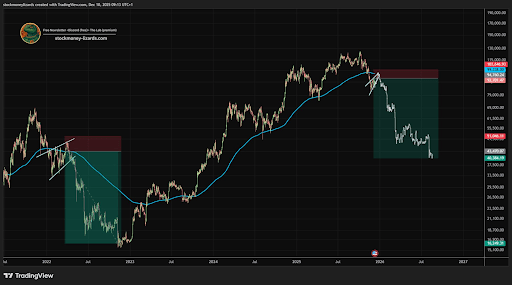
A recent post by crypto analyst Stockmoney Lizards on X suggests that the current Bitcoin structure is giving bears “the perfect opportunity” to short the market down to $40,000. His message was paired with a chart showing Bitcoin falling below an important resistance ever since it broke below $100,000, creating what appears to be a clean continuation setup for traders expecting deeper losses. 

However, although the chart highlights a similar bearish structure in 2022, the analysis behind his post points to a more layered interpretation of what may come next for Bitcoin.

The Setup Bears Believe Is Finally Here

In the chart he shared, Stockmoney Lizards showed how Bitcoin’s latest breakdown resembles the 2022 pattern, when the price action rejected a major resistance level and fell sharply into what later became a large accumulation zone.  The current structure shows a similar rejection just above the $100,000 zone, followed by a drop below the weekly EMA50. This move has brought Bitcoin into a region that is similar to the range where accumulation formed in the earlier cycle. 

An overlay of the new price action on top of the previous one shows the path downward seems almost predetermined, creating the impression that the Bitcoin price is setting up a natural decline to as low as $40,000 in the coming weeks and months. Bitcoin is currently trading at $90,240. A crash to $40,000 would mean wiping out roughly 55% of its value from here, effectively erasing the entire progress it has built over the past two years.

Bitcoin price 1

Bitcoin Price Chart. Source: @StockmoneyL On X

Why The Perfect Short Is Not The Analyst’s Real Message

After the post gained traction, Stockmoney Lizards stepped in to clarify that his message had been taken too literally. His invitation for traders to short down to $40,000 was intentionally exaggerated, and the market does not behave this way. 

He clarified that he does not foresee a collapse into a deep bear market. Instead, he believes Bitcoin may consolidate, possibly sweep local lows, but not have a prolonged breakdown. Furthermore, he noted that the worst-case scenario would be a touch of the weekly EMA200, and this is not a place where bull markets end. The real midterm prediction is a higher move for the Bitcoin price.

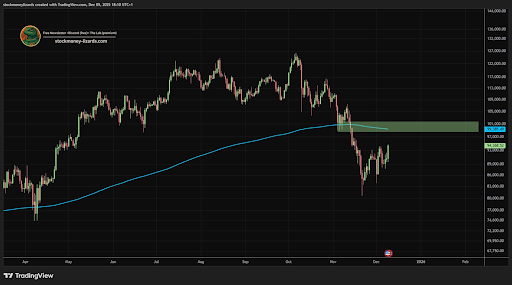
Before posting the supposedly bearish prediction, Stockmoney Lizards had shared another analysis describing Bitcoin as being close to the endboss at the weekly EMA50 indicator. 

Bitcoin price 2

Bitcoin Price Chart. Source: @StockmoneyL On X

That earlier chart offered a clearer view of his actual stance. In it, he predicted that Bitcoin was approaching a major technical pivot and that he expected upward movement into the end of December and Q1 2025. Therefore, the weekly EMA50 is the barrier that Bitcoin needs to reclaim in order to launch its next phase of bullish momentum.

Bitcoin price chart from Tradingview.com

Here’s Why Strategy’s $1 Billion Bitcoin Purchase Did Not Trigger A Price Rally

When Strategy disclosed its acquisition of more than 10,000 Bitcoin worth $1 billion, market watchers anticipated an immediate rally. Instead, Bitcoin’s price barely moved. The muted response was not a reflection of weak demand but the result of how the purchase was executed. In response to the confusion surrounding the stagnant price action, Quinten Francois explained the mechanics behind the transaction, clarifying why such a large buy left no visible impact on the chart.

The Invisible Plumbing Behind Institutional Bitcoin Accumulation

On 9 December 2025, Andrew Tate questioned why a massive 10,000 BTC buy failed to nudge the market. The answer, as analyst Francois explained, lies in the operational backbone of over-the-counter (OTC) desks—an ecosystem designed to absorb billion-dollar flows while keeping price action stable. These desks operate entirely outside exchanges. When a firm wants thousands of BTC, nothing is executed against the real-time order book. Instead, OTC operators start sourcing supply quietly from large holders looking to offload position size.

This pipeline includes deep private liquidity that retail traders never see: miners selling block rewards, VCs rotating out of token allocations, market makers rebalancing inventory, and even corporate treasuries restructuring reserves. None of these trades appear on exchange feeds. According to Francois, they do not trigger volatility, sweep liquidity pools, or create the upward pressure that retail investors typically expect from large buys.

More critically, Francois notes that these transactions do not occur in a single block. A 5,000–10,000 BTC order is never filled all at once. Instead, OTC desks spread procurement over days or even weeks, accumulating inventory piece by piece. Only when enough matched supply is gathered do they finalize the transaction, resulting in a smooth settlement with no visible footprint on price charts.

Why No Price Rally Emerges From Shadow-Side Demand

Shadow-side demand refers to large-scale institutional buying that occurs entirely outside public exchanges. These hidden transactions do not trigger price rallies because OTC infrastructure is designed to prevent slippage, volatility, and market distortion. Institutions acquiring strategic size deliberately avoid pushing prices higher, while liquidity providers are incentivized to maintain stability. By keeping trades off public exchanges, both sides protect execution quality and preserve overall market integrity.

A rally only emerges when open-market demand exceeds visible liquidity. In this case, the demand never hit the open market. OTC desks tap private channels first and only touch exchanges if supply dries up—and that is considered a last resort. If enough sellers are found privately, no exchange-side buying occurs at all.

This is why public charts often show sell pressure but rarely show institutional demand. The buys happen in the shadows, the sells appear on-chain, and the price remains anchored. Strategy’s $1 billion allocation did not fail to move the market; it was intentionally engineered not to.

Bitcoin price chart from Tradingview.com (Strategy)

Shibarium Stages Comeback With Latest Development, Shiba Inu Whales Return – Details

Following its launch in 2023, Shibarium, a Layer-2 blockchain network for the Shiba Inu ecosystem, was widely seen as a major catalyst that could propel SHIB to new levels and potentially lift its price. However, over the past few months, activity and adoption on Shibarium have remained disappointingly quiet. Now, with the potential advancement and growing interest in the new ShibOS platform, momentum for a comeback could be building. Adding to this possible shift, SHIB whales have noticeably returned, with on-chain activity beginning to climb. 

Shibarium Revival Could Take Shape With The Adoption Of ShibOS

For most of the year, Shibarium has struggled to gain meaningful traction, unable to revive and return to the level of activity investors once expected. As the number of active users decreased, developers were slow to build on it, and the price of SHIB saw little to no reaction despite its strong community backing and Shibarium’s promise of greater utility and faster transactions. 

Although conditions look rather bleak, the narrative could shift as the new ShibOS platform grows and is increasingly adopted. ShibOS is a new Operating System designed to serve as the backbone of the Shiba Inu ecosystem. Rather than positioning SHIB as a simple meme-driven asset, ShibOS aims to create a functional environment where applications, utility, and identity features can thrive. 

The operating system provides a framework that connects traditional businesses and Web3 developers, enabling seamless integration of blockchain features. The concept behind ShibOS places the Shiba Inu community at the center of a broader technological transformation. It introduces a structure that supports Decentralized Applications (dApps) and self-governed digital identities while offering a gateway for Web2 brands interested in experimenting with blockchain technology. 

If developers and businesses begin adopting ShibOS and integrating it into their products, Shibarium could naturally benefit from the surge in activity. More applications would mean more transactions, increased users, and a healthier on-chain economy. This type of organic growth could, in turn, drive the demand for SHIB, potentially influencing its price. 

Shiba Inu Whale Activity Hits Six-Month High

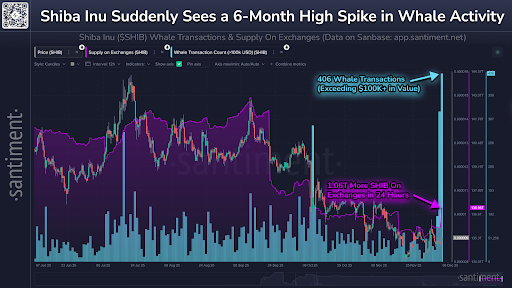
Shiba Inu is also showing signs of renewed activity in terms of on-chain transactions. According to fresh data and a chart shared by SanSights on Santiment, SHIB whale activity has surged to its highest level since early June 2025. Over the last day or so, multiple accounts have reportedly made 406 transactions, each moving more than $100,000 in SHIB. 

Shibarium

At the same time, crypto exchanges have seen a net increase of 1.06 trillion SHIB, valued at roughly $15 million to $20 million—all deposited within 24 hours. This sudden increase in supply comes as prices surge unexpectedly this week, highlighting a rare convergence of bullish factors. 

Typically, when whale activity, large deposits, and price movements happen at the same time, it can signal upcoming big changes. It could either be that whales are accumulating for a stronger price rally or preparing to sell into the current momentum. 

Shiba Inu price chart from Tradingview.com

Dogecoin Price Set To Surge As Sellers Show Signs Of Exhaustion

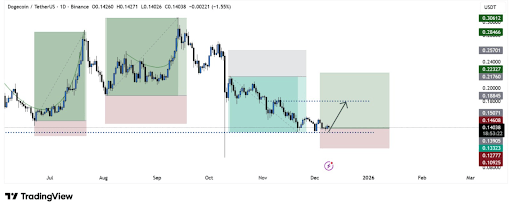
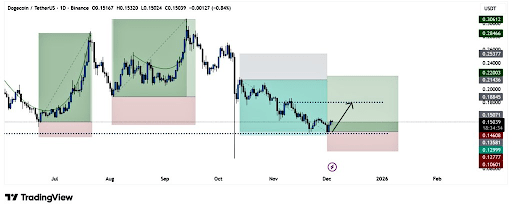
A new technical analysis shared by crypto analyst BitGuru on the social media platform X shows that Dogecoin is trading at an important price level that could set the stage for an upward shift. His chart shows a familiar structure forming at a major support level, one that has acted as the starting point for a previous rally in the year. The price action now developing is similar to this earlier setup, showing that Dogecoin may be preparing for another recovery move above $0.2.

Dogecoin Returns To An Important Support Zone

Dogecoin has spent the past few weeks trading between $0.13 and $0.15 without a clear path to bullish price action. This recent price action is an extension of a downturn that has been taking effect since mid-September from the $0.3 price level.

Notably, technical analysis of Dogecoin’s daily candlestick timeframe chart shows that the cryptocurrency is currently positioned on a significant historical support level, the same area that sparked previous rallies. This support is shown on the chart as between $0.139 and $0.141, the lower boundary of a wide accumulation zone, where price repeatedly stabilized before surging. 

Despite the broader market’s recent weakness, this price support range has held up. Price action in December has led to the creation of a few transition candles on the daily timeframe chart. This, in turn, has led to the creation of a higher low relative to the November breakdown, which had caused Dogecoin to break below $0.135.

Dogecoin price

Dogecoin Daily Candlestick Chart. Source: @bitgu_ru On X

Another notable feature highlighted by the analyst is the tight compression forming around Dogecoin’s candles. The chart shows a sequence of narrow movements, indicating that selling momentum has thinned out. 

BitGuru interpreted this as exhaustion from sellers, meaning the Dogecoin price is no longer displaying the heavy downward pressure seen in November. This type of narrowing range is expected to be the final stage of the downtrend and buyers are beginning to regain control.

Buyers Begin To Step In, Mid-Range Target Next

Early signs of buyer strength are now visible within this compressed zone. This is reflected in the price action in the past 24 hours, which has seen Dogecoin bounce from its intraday low of $0.14 and increase by 4.1%. That rebound is the first meaningful pushback from buyers after days of bearish activity.

The projected arrow in BitGuru’s chart points to the mid-range area around $0.188 as the first destination now that Dogecoin is rebounding from its support base. However, another higher price target is highlighted around $0.223 if Dogecoin completes its projected bounce from the support.

Depending on how Dogecoin reacts here, a bullish move will target the order block around $0.25, before further price targets at $0.284 and $0.306.

Dogecoin price chart from Tradingview.com

Institutional Investors Are Leaving Ethereum And Buying XRP – Here Are The Figures

The newest Digital Asset Fund Flows Weekly Report from CoinShares paints a picture of shifting institutional preferences toward XRP, and Ethereum is no longer attracting the level of attention it once did. The report shows that Ethereum’s weekly inflows came in far behind other major assets, even as overall sentiment in the crypto market improved.  Meanwhile, XRP surged to the second-highest inflow position behind Bitcoin, and large investors are reallocating capital away from Ethereum and into funds linked to XRP.

Ethereum Inflows Lose Momentum

Ethereum’s position in institutional portfolios has weakened noticeably in recent weeks. This was evident in a four-week stretch of outflows throughout November. Notably, a recent broader market recovery pushed total digital asset inflows to $716 million last week, bringing the inflow stretch to two consecutive weeks.

However, Ethereum captured only a small share of that capital. The report shows Ethereum with just $39.1 million in weekly inflows, a subdued figure compared to the sizeable movements seen in other assets. This soft performance follows months of cooling demand, and it suggests that institutional conviction in Ethereum is fading.

Even the month-to-date figure trails behind expectations, coming in at $41.2 million, far below the institutional numbers of Bitcoin XRP, and even Chainlink.

XRP Pulls In Massive Institutional Demand

XRP ranked as the second-largest inflow recipient last week, drawing $245 million, more than six times what Ethereum received. This surge builds on strong year-to-date activity, lifting XRP’s total inflows for 2025 to over $3.1 billion, far above the $608 million recorded in 2024. 

CoinShares’ report shows that XRP’s inflows are a sustained trend rather than a one-off spike. Inflows into XRP-linked products have jumped massively since the introduction of Spot XRP ETFs in the US. Interestingly, these ETFs have witnessed consistent days of inflows since their launch.

These figures indicate that institutions view XRP as a more attractive allocation than Ethereum at this stage of the market cycle. XRP’s strong accumulation coincides with improving sentiment across the derivatives market, where products linked to Bitcoin have also recovered. 

Speaking of Bitcoin, the leading cryptocurrency remained the dominant inflow magnet, with $352 million entering its investment products last week. However, the more notable story lies in the sequence of inflows just behind Bitcoin. Bitcoin continues to anchor portfolios, but capital that would have traditionally flowed into Ethereum is now finding its way into XRP, alongside other new institutional favorites such as Chainlink, which posted a record weekly inflow of $52.8 million, representing more than half of its year-to-date inflows.

Across the geographic breakdown, inflows from the US, Germany, and Canada contributed heavily to this realignment. The US received the most inflows of $483 million last week. Germany, Canada, and Switzerland-based funds came in behind with $96.9 million, $80.7 million, and $34.4 million, respectively.

XRP price chart from Tradingview.com (Ethereum)

Popular Crypto Analyst Reveals New Bitcoin Price Target That Has Got The Community Moving

Renowned analyst Peter Brandt has unveiled a new set of Bitcoin price targets that have quickly sparked discussion across trading communities. His updated technical roadmap comes as BTC shows signs of cooling, prompting traders to reassess its recent price movement. With Bitcoin slipping beneath the structure that supported its multi-month climb, Brandt’s projected corrective zones have become a central focus in the market’s debate over where the asset may be headed next.

Bitcoin Price’s Structural Breakdown Raises The Stakes For Crypto Traders

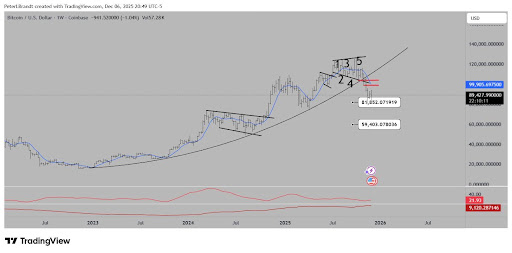
In a recent post on X, Brandt outlined his latest outlook, highlighting a completed five-leg advance — a classic sequence often linked to trend exhaustion when price stretches too far without meaningful resets. In this case, the formation appears as a rising wedge, a pattern known for producing sharp shifts once its lower boundary is breached. That breach has now happened, marking what Brandt interprets as a structural turning point rather than a panic-driven drop.

Bitcoin price

From the breakdown, two corrective regions emerge: near $81,852 and $59,403. These targets are drawn directly from the proportions of Bitcoin’s recently completed structure, giving them a grounded, technical foundation. Brandt frames the pullback as a normalization event, one that fits neatly into Bitcoin’s historical rhythm of expansions followed by methodical cooldowns. Instead of portraying the situation as a threat to long-term strength, the analysis positions the zones as potential resting points where the market could stabilize before setting its next course.

There is also a familiar pattern echoing through the charts — a reminder of late 2021, when sentiment surged ahead of structural reality and the market eventually recalibrated. While conditions today are not identical, the resemblance underscores how expectations and chart formations often move in parallel. In both scenarios, a strong run gave way to a controlled corrective period.

Brandt’s roadmap follows a clear sequence: formation completion, slope-line violation, and defined landing zones. Each step reinforces the next, forming a cohesive narrative that explains why this chart has quickly gained traction among crypto traders monitoring short-term volatility.

Brandt’s Targets Offer Strategic Guidance For Crypto Traders

Bitcoin is currently trading at $90,175, reflecting a 1.9% dip over the past 24 hours alongside a 4.4% gain across the last seven days. The price sits close to the level where the structural break first appeared, amplifying interest in Brandt’s outlined targets. Traders are now assessing whether the asset is preparing for a deeper corrective sweep or simply entering a consolidation phase before another directional move.

Ultimately, Brandt’s targets are intended to guide traders rather than alarm them. They highlight likely equilibrium zones during routine market resets, offering reference points where Bitcoin could stabilize after extended rallies. By framing the analysis this way, traders are encouraged to approach the market with a measured strategy and sharper precision, rather than reacting impulsively to short-term fluctuations.

Bitcoin price chart from Tradingview.com

Pundit Highlights The Condition That Will Trigger A 2,300% XRP Rally To $50

The XRP price is currently more than 45% below its all-time high and continues to decline amid broader market uncertainty. Despite the slow price action and weak momentum, a crypto analyst has projected that XRP could explode to $50 soon, providing reasons for his ambitious forecast. He boldly stated that the cryptocurrency will not experience a gradual climb to $5 or $10 first, but will instead jump straight to $50.

XRP To Hit $50 With A Ripple Bank Charter 

Crypto analyst Pumpius has outlined a compelling scenario that could dramatically transform XRP’s market outlook. The market expert claims that a single regulatory event could catapult XRP’s price to $50, representing more than a 2,300% increase from current levels around $2. In his thread post on X, he explained the reasons for his bold prediction and the trigger behind this parabolic surge .

Pumpius believes that XRP could skyrocket to $50 once Ripple secures a national trust bank charter from the United States Office of the Comptroller of the Currency (OCC). According to him, approval of this banking license would give Ripple the same powers as major US banks, as well as direct access to the Federal Reserve (FED). 

The analyst noted that through the charter, Ripple could gain the authority to custody crypto and tokenized assets, issue stablecoins, and settle securities under complete regulatory oversight. He described the potential approval of the banking license as a foundational move that could establish  Ripple as a leading force in US tokenized finance. 

Pumpius highlighted that XRP remains at the centre of the changes, positioned as the native bridge asset in this potential structure. He suggested that with a charter in place, banks, brokers, and funds could bypass intermediaries and interact directly with Ripple to move value into tokenized markets

According to the analyst’s predictions, the result of this shift could be a massive, sustained surge in liquidity and institutional demand for XRP, creating the ideal conditions for an unprecedented price rally. He explains that with $6.6 trillion moving through banks each day in global settlements, even a small fraction routed through XRP’s limited supply could drive its price higher toward $50. 

While the market expert’s forecast is ambitious, it hinges entirely on the OCC’s decision, which is not guaranteed and could be influenced by compliance standards, risk assessments, and broader financial policy considerations. Even with approval, actual integration by major institutions would likely take considerable time and depend on competition with existing settlement networks. 

Ripple Legal Victory Paves Way For $50 XRP Price

In his post, Pumpius suggested that Ripple’s prolonged legal battle with the US Securities and Exchange Commission (SEC) was part of a broader strategy to secure regulatory clarity. He viewed the former lawsuit as a smokescreen intended to delay, filter, and prepare the path for a national trust bank charter under the OCC. With the case now resolved, the analyst indicates that the timing is perfect for Ripple to pursue full regulatory approval and integrate XRP into mainstream banking channels.

Pumpius boldly declared that the day the OCC approves Ripple’s banking license will mark a turning point for XRP, transforming it from a cryptocurrency to “the rails of US finance.” At that point, the analyst argues that a $50 price target would be significantly undervalued. 

XRP price chart from Tradingview.com

Here’s How High The Dogecoin Price Will Go Once The MACD Bullish Cross Happens

The Dogecoin price has been drifting through a subdued stretch over the past few days, holding around the mid-$0.13 to $0.14. The recent decline has slowed down in the past 48 hours, and the chart now shows the meme coin attempting to steady itself after weeks of persistent selling pressure.

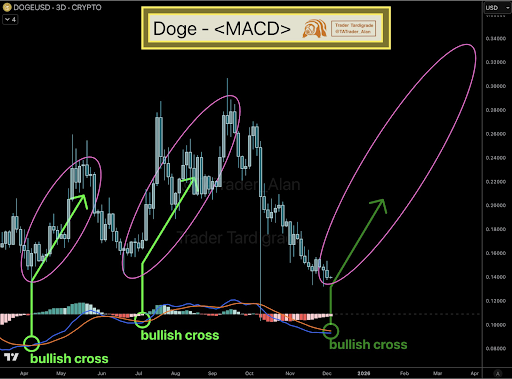
Trader Tardigrade, a well-known crypto analyst on X, shared a new three-day chart suggesting that an important MACD signal is on the verge of forming, and historical performance shows that Dogecoin tends to move bullish once this signal appears.

Approaching The MACD Bullish Cross

Dogecoin’s quiet phase in the past 48 hours has become increasingly important because one of Dogecoin’s higher-timeframe indicators is beginning to show early signs of life.  According to Trader Tardigrade, Dogecoin’s MACD indicator on the 3-day candlestick price chart has not yet confirmed a bullish cross, but it is very close to doing so. 

The chart he shared shows the MACD lines converging at the lower boundary of the recent downtrend, and the blue line is approaching the red line. The blue line is about to cross over the red one, mirroring the exact setup that preceded previous breakouts earlier this year. 

Even with Dogecoin trading quietly in recent days, the compression of the MACD indicator hints that bearish momentum is fading. Once the cross officially forms, the trend will shift into a bullish one. This gradual tightening of price movement is also characteristic of an accumulation phase, and this is shown by an important Dogecoin metric.

Dogecoin price

Dogecoin Price Chart, MACD Cross. Source: @TATrader_Alan On X

How High The Dogecoin Price Could Go

The chart reveals a clear pattern: every time Dogecoin printed a three-day MACD bullish cross in 2025, the price responded with a significant upward move. The first cross was in April, and this preceded a rally that pushed Dogecoin’s price from below $0.14 into a breakout to $0.26. 

A second cross followed during mid-summer in July, and once again the price climbed aggressively shortly afterward. This saw the Dogecoin price rally from around $0.16 to $0.30 very briefly. 

Both events are circled on the chart above, showing how the momentum flipped swiftly once the MACD crossed above the signal line. These repeated reactions strengthen the case that Dogecoin could be preparing for another sizeable run if the indicator confirms a cross in the coming days.

The projection area drawn on the right side of the chart points to a climb that extends well above $0.20. This suggests that the next wave may revisit the upper levels where Dogecoin last traded during its late-summer rally.

The analyst’s chart outlines a wide upward arc, indicating that the expected move would not be a minor rebound but a structured uptrend similar to the earlier surges this year. In terms of a price target, the projection shows Dogecoin reaching a price target around $0.35 in the next few weeks. This would translate to a 140% increase from Dogecoin’s current price of $0.142.

Dogecoin price chart from Tradingview.com

Will Ripple Dump 25% Of Its 45 Billion XRP Holdings Soon? Here’s The 411

Ripple currently controls a staggering amount of XRP, and now questions from market experts are mounting over whether the crypto payments company may be forced to sell 25% of its 45 billion token holdings. Analysts suggest that a possible selloff could have major implications. At the same time, they question the pathways through which Ripple could sell its holdings and who the potential buyers might be. 

Ripple To Face Pressure To Sell 25% Of XRP Holdings 

Ripple may soon need to drastically reduce more than half of its substantial XRP reserves as regulatory discussions over the proposed CLARITY Act intensify. In a recent post on X, market expert Crypto Sensei shared a video, drawing attention to a provision in the CLARITY Act that would prevent any company from controlling more than 20% of a blockchain’s native asset’s total supply. 

Currently, Ripple owns 45 billion XRP, split between escrow and direct reserve, representing 45% of the cryptocurrency’s total supply of 100 billion tokens. This indicates that the company controls nearly half of the total XRP supply—a level of concentration that typically runs counter to the decentralization narrative of crypto and blockchain technology. 

Crypto Sensei suggests that US lawmakers are seemingly focused on preventing excessive accumulation of supply, and Ripple’s holdings stand out as one of the clearest examples of a single entity controlling a large portion of a network’s token. According to the analyst, if the CLARITY Act is implemented in 2026, Ripple may need to sell at least 25% of its holdings to comply with the legislation. 

A reduction of this magnitude would lower the crypto company’s XRP reserves to 20 billion tokens, or 20% of the cryptocurrency’s total supply. At the current price of $2.0 per token, this would amount to roughly $40 billion. Notably, such a sell-off would likely require coordination with liquidity providers and partnering institutions to avoid unnecessary market disruption. 

Potential Selling Paths And Institutional Speculation 

In his X video, Crypto Sensei outlined several potential paths Ripple could take to reduce its substantial XRP reserves. One option is to sell the rights to future escrow releases instead of the tokens themselves. Another involves selling the accounts into which the escrowed XRP completes while preventing the tokens from circulating.  

According to the market expert, these possibilities have sparked widespread speculation that major financial players, such as BlackRock, could already be involved or poised to purchase future XRP escrow rights. The idea continues to circulate because it would allow institutions to gain exposure to the cryptocurrency without immediately affecting the circulating supply. 

Crypto Sensei also notes that Ripple locks about 700 million XRP in escrow each month, raising questions about whether these transfers may represent sales. The analyst argues that if sales were occurring, the on-chain trail would clearly show tokens moving to buyers’ wallets, but the data does not reflect this. He highlighted that the current evidence points to a far more controlled internal process rather than large-scale institutional distributions

XRP price chart from Tradingview.com (Ripple)

Ethereum Founder Breaks Silence With Major Upgrade Proposal

Ethereum co-founder Vitalik Buterin has unveiled a major proposal that could fundamentally reshape how the network handles transaction fees. His new design aims to replace unpredictable costs with a system that lets users plan and budget more effectively, signaling one of the most significant shifts in Ethereum’s economic framework in years.

Ethereum Gas Fees As Predictable, Prepaid Resources

Buterin’s proposal centers on a new on-chain gas futures market. Today, gas fees rise and fall based on network congestion and users have no way to know in advance what they will pay, which complicates planning for developers, businesses, and high-volume platforms.

The new model reshapes that dynamic by allowing users to purchase a defined amount of gas at a fixed price for future use. Rather than hoping the network will be affordable at the moment they need to transact, they can lock in their costs in advance. This moves Ethereum from a system dominated by short-term fee volatility to one anchored in stable, forward-looking pricing

Under the proposed design, these futures contracts would be traded directly on-chain. Their prices would naturally reflect expectations of future demand. When demand is expected to increase, futures prices rise; when expected to fall, they drop. This creates a transparent, market-driven view of upcoming network activity, giving developers and organizations a more reliable basis for planning their operations.

The structure also builds on the foundation set by EIP-1559, which introduced the base fee mechanism. Buterin’s futures market doesn’t replace that system—it extends it. It transforms gas from reactive cost into a resource that can be managed in advance, similar to how businesses lock in costs for electricity, bandwidth, or other essential inputs.

Operational Benefits For Developers, Businesses, And The Network

The most immediate benefit is cost certainty. High-volume users—exchanges, rollups, wallets, and automation services—often operate on tight margins, and sudden gas fee spikes disrupt operations and planning. By locking in future gas costs, this uncertainty is removed, supporting consistent service delivery. Developers also gain a stable environment, enabling them to schedule upgrades, plan deployments, and manage workloads without worrying about fee surges. This predictability strengthens project roadmaps and enhances user experience.

For enterprises integrating Ethereum into payments, verification, or data-processing workflows, predictable fees are essential. Buterin’s model addresses this barrier, positioning Ethereum as a more reliable foundation for long-term, large-scale adoption.

At the network level, the futures market introduces clearer economic signals. Rising futures prices indicate increasing demand for blockspace, guiding scaling decisions and resource allocation. Falling prices signal lower demand, enabling more efficient development and infrastructure planning.

The proposal does not lower gas fees but makes them manageable, converting an unstable cost into a predictable one. This enhances Ethereum’s appeal for serious applications, institutional activity, and reliable operational planning. By introducing a gas futures mechanism, the ecosystem can better manage costs and prepare for growth, marking a decisive step toward a more professional-grade Ethereum.

Ethereum price chart from Tradingview.com

Bitcoin Treasury Company Is About To List on The New York Stock Exchange

On 3rd December, official filings and press releases announced Twenty One Capital’s upcoming debut on the New York Stock Exchange (NYSE), positioning the company as one of the largest Bitcoin treasury firms ever to enter public markets. The listing brings a dedicated Bitcoin balance sheet into Wall Street’s core ecosystem, signaling a structural shift in how institutional investors can gain long-term BTC exposure.

A Bitcoin Treasury Giant Steps Onto The NYSE Stage

Twenty One Capital’s NYSE entry is anchored by its business combination with Cantor Equity Partners (CEP), the SPAC serving as the public-market vehicle for the transaction. CEP shareholders have already approved the merger, and the deal is expected to close around December 8. Once completed, the combined entity will operate as Twenty One Capital, Inc. and begin trading on December 9 under the ticker XXI. 

The original announcement, released through official press channels and SEC-related filings, emphasized CEP’s central role in enabling the listing and establishing the company’s public-market structure. CEO Jack Mallers also highlighted the milestone on X, noting the company’s readiness for its debut.

According to this press announcement, Twenty One Capital will debut with an estimated 43,500 BTC, a reserve valued near $4 billion at recent market levels. This immediately places it among the top corporate Bitcoin treasuries globally. Unlike companies that hold Bitcoin as a secondary reserve, Twenty One is specifically engineered around a Bitcoin-native model. The firm intends to report “Bitcoin-per-share,” providing investors a transparent look at how much BTC each equity unit represents. It also pledges full, on-chain proof-of-reserves, positioning itself as a high-transparency asset custodian at launch.

This model effectively transforms Twenty One into a regulated balance-sheet wrapper for Bitcoin. It lowers operational friction for institutional allocators who want direct BTC exposure without the complexities of crypto custody, self-storage, or exchange-based acquisition. By listing on the NYSE rather than relying on ETFs or derivatives, Twenty One creates a regulated public equity vehicle that holds, safeguards, and transparently tracks Bitcoin for institutional and retail investors alike.

Wall Street’s New On-Ramp To Institutional BTC Exposure

The market impact of Twenty One’s listing reflects the accelerating integration of Bitcoin into mainstream financial architecture. The company’s backers—including Tether-linked entities, Bitfinex-aligned interests, SoftBank-connected capital, and Cantor’s public-markets network—provide a cross-sector foundation aimed at bridging crypto-native philosophies with institutional liquidity channels. 

Under this structure, Twenty One aims to become a long-term institutional treasury vessel—a regulated balance sheet that accumulates BTC and gives investors an equity-linked way to participate in Bitcoin’s upside without engaging directly with crypto custody or trading infrastructure.

As the NYSE debut approaches, Twenty One Capital embodies a pivot point where BTC’s role in capital markets shifts from speculative asset to institutional treasury instrument. If XXI attracts sustained flow, it could set a new blueprint for how corporate entities engage with Bitcoin—anchoring Wall Street’s next phase of digital-asset adoption.

Bitcoin price chart from Tradingview.com

Solana Vs. XRP: Clear Winner Emerges With ETF Net Flow Numbers

With the crypto market showing signs of recovery, both the XRP and Solana Exchange Traded Funds (ETFs) have attracted significant investor interest. The rivalry among major crypto ETFs has intensified, with XRP taking the spotlight amid its consistent surge in daily inflows and the Solana ETF recording significant outflows.

Solana ETFs See Largest Outflow Yet

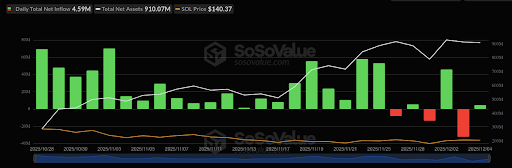
Solana has entered a surprising phase of turbulence as its recently launched US Spot ETF struggles to maintain momentum after weeks of inflows. The latest data from Sosovalue reveal a sizable setback with a fresh withdrawal of $32.19 million, marking the third and largest outflow recorded since the investment product debuted in late October 2025. 

The outflow, registered on December 3, came as a major surprise, especially given that the broader crypto market had been enjoying a slight reprieve from the bearishness weighing it down. Notably, Sosovalue’s data shows that the entire Solana ETF outflow originated from the 21Shares TSOL offering, which shed $41.79 million in a single session. Minor inflows into the remaining six Solana ETFs had softened the blow, reducing total outflow to $32.19. 

Solana XRP 1

Since the launch of Solana ETFs, TSOL has been responsible for all negative flows posted, including the $13.55 million pullback on December 1 and the $8.10 million decline in late November. Across all sessions, 21Shares Solana ETF has now seen total outflows reach $101.51 million. 

The weakness in TSOL stands in sharp contrast to Bitwise’s Solana ETF, BSOL. BSOL continues to outpace other investment products, with impressive cumulative inflows of $580.72 million, making it the most successful Solana ETF. Grayscale’s GSOL follows at a distant $89.01 million. Overall, the net cumulative inflows for the Solana ETF have reached $623.21 million. While this is impressive, it is still significantly behind the XRP ETF. 

XRP Overtakes Solana ETF As It Nears $1 Billion Inflows

The latest on-chain numbers show the XRP ETF pulling ahead of the Solana ETF with surprising speed and volume. Analyst Neil Tolbert highlighted the rise in XRP ETF inflow this week, noting that growing institutional interest indicates the trend is only getting started. With more XRP ETFs expected to debut soon, Tolbert anticipates a significant rise in demand and inflows as traditional finance finally wakes up. 

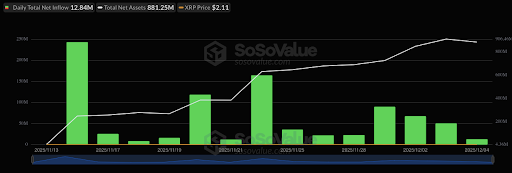
Five Spot XRP ETFs collectively hold more than $984 million in assets, with less than $16 million to reach the $1 billion inflow milestone. Canary Capital’s XRPC leads with $358.88 million, followed by Grayscale’s GXRP, Bitwise’s ETF, Franklin Templeton’s XRPZ, and finally REX-Osprey’s XRPR.  

Solana XRP 2

According to SosoValue, the total XRP ETFs, excluding that of REX-Osprey, have attracted approximately $887.12 million in net cumulative inflows. Since its launch in November, the XRP ETF has recorded 15 days of positive inflows, in stark contrast to Solana ETFs, which have seen multiple outflows. 

Despite Solana launching seven ETFs as early as October 2025 and XRP only introducing four last month, XRP ETFs have already surpassed Solana ETFs in total inflows by almost 30%. With fewer products and a later debut, XRP has emerged as the clear winner amongst the newest ETF entrants in 2025. 

XRP price chart from Tradingview.com

Trend Reversal Puts Dogecoin On A Path To $0.188

Dogecoin has quietly been trying to find its footing again. The price has started to firm up after a period of declines that dragged the meme coin to as low as $0.134 in early December, trading around $0.14 to $0.15 and showing signs that bearish pressure might be easing. 

In that backdrop, a recent chart analysis shared by crypto analyst BitGuru on X shows that Dogecoin could be forming a bullish base, and it offers a possible setup for a rebound towards $0.2.

A Recovery Attempt Begins To Take Shape

The daily candlestick price chart shows Dogecoin rebounding from the lower boundary of its demand zone after briefly dipping beneath it on December 1. That bounce is significant because it represents the willingness to defend the area that held price earlier in July and again during the October pullback. This playout means that Dogecoin has now created a higher low relative to the November breakdown, and this detail means that bullish movement might be moving in.

As it stands, Dogecoin’s price is now pushing back toward the middle of the broader range highlighted in green and teal on the chart below. Recent bullish candle closes on the daily timeframe show that the Dogecoin price is trying to push into that region once again, suggesting that buyers have begun testing the strength of mid-range resistance.

The chart reflects this pattern by displaying earlier price expansions in July and September, both of which unfolded after the Dogecoin price created a higher low.

Dogecoin prIce

Dogecoin Price Chart. Source: @bitgu_ru On X

Dogecoin On A Path To $0.188

Dogecoin’s higher-low structure is the signal BitGuru highlights as the earliest sign that momentum may be shifting. Now that the price is now climbing away from the demand zone, the first area to watch is the dotted mid-range line on the chart, which is at $0.188. 

A clean move above that level would mean that buyers have regained control of the market structure. This could open the door for a broader recovery and see Dogecoin returning above $0.20.

At its current price of $0.148, the targets at $0.188 and $0.20 represent gains of roughly 27% and 35%. These levels fall within a range of short-term price targets that Dogecoin could realistically reach before the end of the year if there’s even a little bullish momentum.

However, Dogecoin’s near-term outlook isn’t just about its own chart. Its fate is linked to the broader crypto market, especially Bitcoin. Therefore, Dogecoin’s price action might remain vulnerable to more declines and consolidations unless the wider crypto market turns bullish again. On the other hand, tentative signs of recovery, including rising trading volume, point to a bullish setup for Dogecoin.

Dogecoin price chart from Tradingview.com

The MicroStrategy Of Asia: Japanese Company Announces Plan For Bitcoin And XRP Treasury

Bitcoin and XRP have become central to a bold corporate shift in Japan, with AltPlus announcing that both digital assets will be formally incorporated into its long-term treasury strategy. The publicly listed company disclosed the move in its recent shareholder filing, outlining a multi-layered plan that positions cryptocurrencies as foundational components of its future financial and operational framework.

Bitcoin And XRP Lead Treasury

According to a post by “BankXRP” on X (formerly Twitter), AltPlus is expected to purchase and hold Bitcoin and XRP through a newly established cryptocurrency purchase and management division. The company frames this step as part of a long-horizon capital strategy supported by blockchain transparency, expanding global regulatory clarity, and the growing institutional acceptance of digital assets. In the filing, Bitcoin and XRP are highlighted for their scarcity, decentralization, predictability, and fast, low-cost transactional capabilities—attributes AltPlus expects will contribute to long-term value growth and broader financial-market utility.

Moreover, the treasury initiative is designed to strengthen the company’s financial base, diversify revenue streams, and establish a stable earnings engine through staking-based income. AltPlus presents the move as a structured method to enhance capital efficiency and reinforce corporate value over time. The company notes that holding both Bitcoin and XRP aligns its balance-sheet strategy with emerging global trends in digital-asset management and institutional-grade treasury practices.

AltPlus also outlines its risk-management system to address crypto-market volatility, liquidity risks, cybersecurity threats, regulatory changes, and speculative trading patterns. The company plans to implement investment-scale limits, a controlled holding-ratio strategy, and a proprietary internal asset-management system to govern acquisition, custody, tracking, and treasury integration. These measures are designed to maintain governance discipline, ensure compliance, and safeguard digital-asset operations as part of the broader corporate structure.

AltPlus’ Web3 And Digital-Asset Expansion

Beyond treasury allocation, AltPlus frames Bitcoin and XRP as key elements in a broader transition into digital-asset operations and Web3-enabled business development. The filing situates this shift within a global context, noting that major financial institutions and listed companies worldwide are increasingly incorporating crypto assets into holding, settlement, and capital-management functions.

Building on this trend, AltPlus plans to integrate blockchain infrastructure into its Entertainment and Solutions business. This includes exploring Web3 functionality, token-based engagement models, and digital-asset utilities across its gaming and IP ecosystem. These initiatives are intended to unlock new business models, enhance operational flexibility, and develop internal expertise for a digital-native market environment.

The company’s decision to include XRP directly in its treasury strategy is one of the standout elements of the announcement. AltPlus positions XRP as a long-term corporate asset alongside Bitcoin, marking a notable step forward for institutional crypto adoption in Japan. Through treasury transformation, staking-driven income generation, and Web3 ecosystem expansion, AltPlus is creating a strategic framework similar to the high-conviction treasury approach seen at MicroStrategy. At the same time, it is establishing a distinctly Japanese model focused on utility, diversification, and forward-looking corporate innovation.

Bitcoin price chart from Tradingview.com (XRP)

Expert Says An XRP Supply Shock Will Only Happen In These Conditions

A leading market expert argues that most investors misunderstand what would need to happen for an XRP supply shock to unfold. The analyst stressed that a true supply shock is driven by measurable XRP absorption, with early signs showing how quickly tokens are removed from circulation relative to how quickly they return. 

How A Real XRP Supply Shock Forms

Crypto analyst Pumpius took to X this Wednesday to outline the conditions he believes must align before XRP can experience an actual supply shock. The expert noted that many in the community often talk about an explosive squeeze that could drive XRP’s price higher, yet few understand the mechanics behind such a shock.

Pumpius argued that a real supply shock is not driven by speculation or hype, but by a measurable reduction in the amount of XRP available on the open market. In his view, such an event only occurs when tokens are absorbed faster than they can be replenished, creating an imbalance between circulating supply and future buyers. 

The analyst explained that the first big trigger for a supply shock would be the launch of Exchange-Traded Funds (ETFs). Once all ETFs go live, their issuers will need to buy real XRP rather than derivatives or IOUs, which could gradually drain the amount of available tokens on crypto exchanges. 

Pumpius added that institutional participation would amplify the supply impact of ETFs, since banks and large asset managers typically custody assets rather than actively trade them. He explained that XRP set aside for settlement purposes, treasury management, or long-term liquidity planning would be removed from day-to-day circulation, further contributing to a potential supply shock.   

Another point Pumpius mentioned in his post was that companies could start holding XRP in their corporate treasuries to support international payments and XRP Ledger (XRPL) based settlement corridors. If this occurs, the analyst suggests that these operational XRP balances would remain in working capital accounts rather than flowing back to exchanges.  

He added that Ripple’s management of its escrow further limits XRP’s supply. Currently, Ripple has little to no incentive to oversupply the market, and unused escrow releases are often returned, keeping the amount of net new XRP entering circulation tightly controlled.

On-Chain Utility And ZK Identity Drive Supply Crunch

In his post on X, Pumpius highlighted two other factors needed for XRP to experience a real supply shock. He stated that growing on-chain utility will further reduce the supply of XRP, ultimately contributing to a supply crunch. These include tokenized funds built on the XRPL, such as RLUSD, liquidity pools, identity layers, and payment rails—all of which rely on XRP as a core asset.

A Zero Knowledge identity infrastructure on the XRP Ledger could also lock away more tokens. Pumpius emphasized that these systems link XRP to identity-verified flows and validation processes, which naturally tighten supply. 

Together, these forces create the ideal conditions for a real XRP supply shock. Pumpius notes that as exchange balances drop and OTC desks hold less inventory, overall liquidity becomes thinner. Buyers are then forced to compete for the shrinking supply of tokens, potentially driving prices higher as demand outweighs supply.

XRP price chart from Tradingview.com

❌