Dogecoin is entering a pivotal phase as its price action tightens within a symmetrical triangle, aligning with a high-timeframe Wyckoff setup. The combination of higher lows, compressed structure, and developing Wyckoff signals suggests growing strength beneath the surface, raising the possibility that DOGE is quietly preparing for its next major move.
MTF Range Strategy: Longs At Discount, Shorts At Premium
According to an update by Wyckoff Insider via the lens of a multi-timeframe (MTF) range, the focus is on seeking long positions in areas of extreme discount and short positions in areas of extreme premium. When an MTF range is present, it often develops a Wyckoff structure near both the range highs and lows, providing clearer points of interest for traders.
Dogecoin is currently forming an 8H Bojan pivot in the extreme discount zone of this MTF range. The key to trading a Bojan pivot is identifying the Sign of Strength (SOS) that forms on the third candle. Bitcoin displayed a similar 8H Bojan recently, but trading it was more challenging due to deviations on both sides of the range, making DOGE difficult to trade also.
On the lower timeframes, Dogecoin is also showing a Wyckoff Model 1 range. When the third candle opens, and price pulls down, traders look for an LPS, BOS, and internal BOS pattern. Valid entries include taking the breakout on the 3-minute BOS with a stop below the M1 low, or entering on the LPS after the internal BOS, with a stop placed beneath the LPS itself.
In terms of trade management, Wyckoff Insider outlines a clear plan: risk should be kept at 2% per setup, with TP1 at the Wyckoff target zone (40%), and TP2 at the first range supply, fully closing the trade once a Sign of Weakness (SOW) appears. This structured approach helps navigate DOGE’s multi-layered Wyckoff-driven price action with discipline and clarity.
Daily Structure Shows Strength Despite Downtrend
Trader Tardigrade revealed that the daily chart provides clear indications that Dogecoin is actively building a stronger market structure despite the recent overall downtrend. This strength is apparent when comparing the current price action to past cycles.
Historically, when the broader market is weak, DOGE typically reinforces its bearish trend by forming lower lows following a distinct new swing low. However, in a significant departure from this pattern, DOGE is now attempting to establish a higher lows structure within a symmetrical triangle pattern.
This formation is key, as the analyst suggests the symmetrical triangle structure indicates that Dogecoin has been rejected from trading further downward. Such a development signals that selling exhaustion is setting in, preparing the market for a potential directional breakout.
A new analyst shares their Cisco Live SOC experience, covering quick onboarding, using Cisco XDR and Endace for incident investigation, and building confidence in threat response.
Windows clients expose Active Directory DNS queries on public Wi-Fi, risking OSINT and credential leaks. Learn from Cisco Live SOC observations how to protect clients with VPNs .
Learn how Cisco Live SOC uses Splunk SPL and Endace PCAP to investigate exposed HTTP authentication and Kerberos activity, securing sensitive data on public Wi-Fi networks.
Cisco Security and Splunk protected Cisco Live Melbourne 2025 in the Security Operations Centre. Learn about the latest innovations for the SOC of the Future.
Explore a Cisco TME's experience in the Cisco Live SOC, detailing efficient onboarding, incident escalation, and a real-world DDoS attack investigation and response.
Splunk's coalesce function treats empty fields as non-null. Learn to use Splunk macros to convert empty strings to nulls for accurate data selection and reliable detections.
Cisco Live SOC adapted Splunk ESCU detections for Cisco Secure Firewall syslog. Learn to modify macros and promote EVE events to incidents for enhanced threat visibility and response.
Recap Cisco Live Melbourne SOC tours: See how Cisco XDR and Splunk Enterprise Security integrate for rapid threat containment, enhanced visibility, and analyst empowerment.
Learn how Cisco XDR, Splunk, and Firewall were used at Cisco Live Melbourne to rapidly investigate and resolve a malicious traffic spike incident on attendee Wi-Fi.
NASA astronaut Jonny Kim poses inside the International Space Station’s cupola as it orbits 265 miles above the Indian Ocean near Madagascar.
Credit: NASA
NASA astronaut Jonny Kim will recap his recent mission aboard the International Space Station during a news conference at 3:30 p.m. EST Friday, Dec. 19, from the agency’s Johnson Space Center in Houston.
Media interested in participating in person must contact the NASA Johnson newsroom no later than 5 p.m. Thursday, Dec. 18, at 281-483-5111 or jsccommu@mail.nasa.gov.
Media wishing to participate by phone must contact the Johnson newsroom no later than two hours before the start of the event. To ask questions by phone, media must dial into the news conference no later than 15 minutes prior to the start of the call. NASA’s media accreditation policy is available online.
Kim returned to Earth on Dec. 9, along with Roscosmos cosmonauts Sergey Ryzhikov and Alexey Zubritsky. He logged 245 days as an Expedition 72/73 flight engineer during his first spaceflight. The trio completed 3,920 orbits of the Earth over the course of their nearly 104-million-mile journey. They also saw the arrival of nine visiting spacecraft and the departure of six.
During his mission, Kim contributed to a wide range of scientific investigations and technology demonstrations. He studied the behavior of bioprinted tissues containing blood vessels in microgravity for an experiment helping advance space-based tissue production to treat patients on Earth. He also evaluated the remote command of multiple robots in space for the Surface Avatar study, which could support the development of robotic assistants for future exploration missions. Additionally, Kim worked on developing in-space manufacturing of DNA-mimicking nanomaterials, which could improve drug delivery technologies and support emerging therapeutics and regenerative medicine.
Learn more about International Space Station research and operations at:
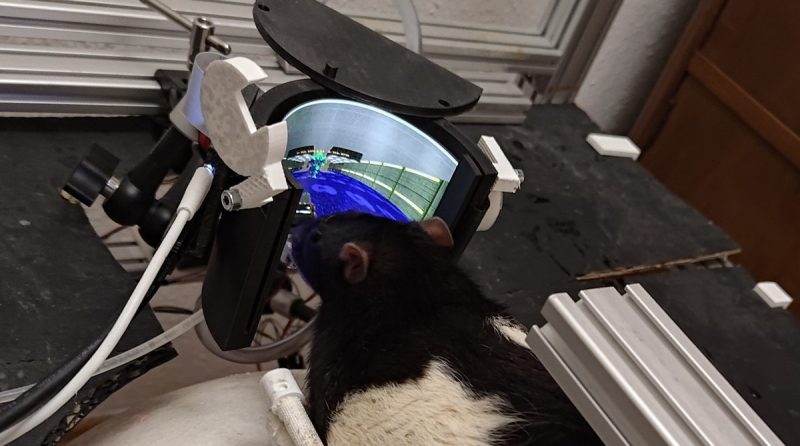
We all know that you can play DOOM on nearly anything, but what about the lesser known work being done to let other species get in on the action? For ages now, our rodent friends haven’t been able to play the 1993 masterpiece, but [Viktor Tóth] and colleagues have been working hard to fix this unfortunate oversight.
If you’ve got the feeling this isn’t the first time you’ve read about rats attempting to slay demons, it’s probably because [Victor] has been working on this mission for years now — with a previous attempt succeeding in allowing rats to navigate the DOOM landscape. Getting the rodents to actually play through the game properly has proved slightly more difficult, however.
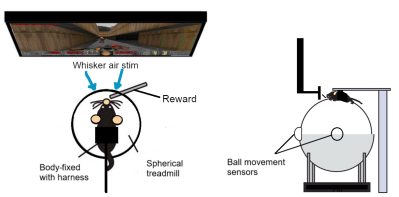
Improving on the previous attempt, V2 has the capability to allow rats to traverse through levels, be immersed in the virtual world with a panoramic screen, and take out enemies. Rewards are given to successful behaviors in the form of sugar water through a solenoid powered dispenser.
While this current system looks promising, the rats haven’t gotten too far though the game due to time constraints. But they’ve managed to travel through the levels and shoot, which is still pretty impressive for rodents.
DOOM has been an indicator of just how far we can take technology for decades. While this particular project has taken the meme into a slightly different direction, there are always surprises. You can even play DOOM in KiCad when you’re tired of using it to design PCBs.
Israeli cybersecurity firms raised $4.4B in 2025 as funding rounds jumped 46%. Record seed and Series A activity signals a maturing, globally dominant cyber ecosystem.
NASA’s James Webb Space Telescope and NASA’s Curiosity rover, have earned places in TIME’s “Best Inventions Hall of Fame”.
NASA GSFC, NASA JPL
Two icons of discovery, NASA’s James Webb Space Telescope and NASA’s Curiosity rover, have earned places in TIME’s “Best Inventions Hall of Fame,” which recognizes the 25 groundbreaking inventions of the past quarter century that have had the most global impact, since TIME began its annual Best Inventions list in 2000. The inventions are celebrated in TIME’s December print issue.
“NASA does the impossible every day, and it starts with the visionary science that propels humanity farther than ever before,” said Nicky Fox, associate administrator, Science Mission Directorate, NASA Headquarters in Washington. “Congratulations to the teams who made the world’s great engineering feats, the James Webb Space Telescope and the Mars Curiosity Rover, a reality. Through their work, distant galaxies feel closer, and the red sands of Mars are more familiar, as they expanded and redefined the bounds of human achievement in the cosmos for the benefit of all.”
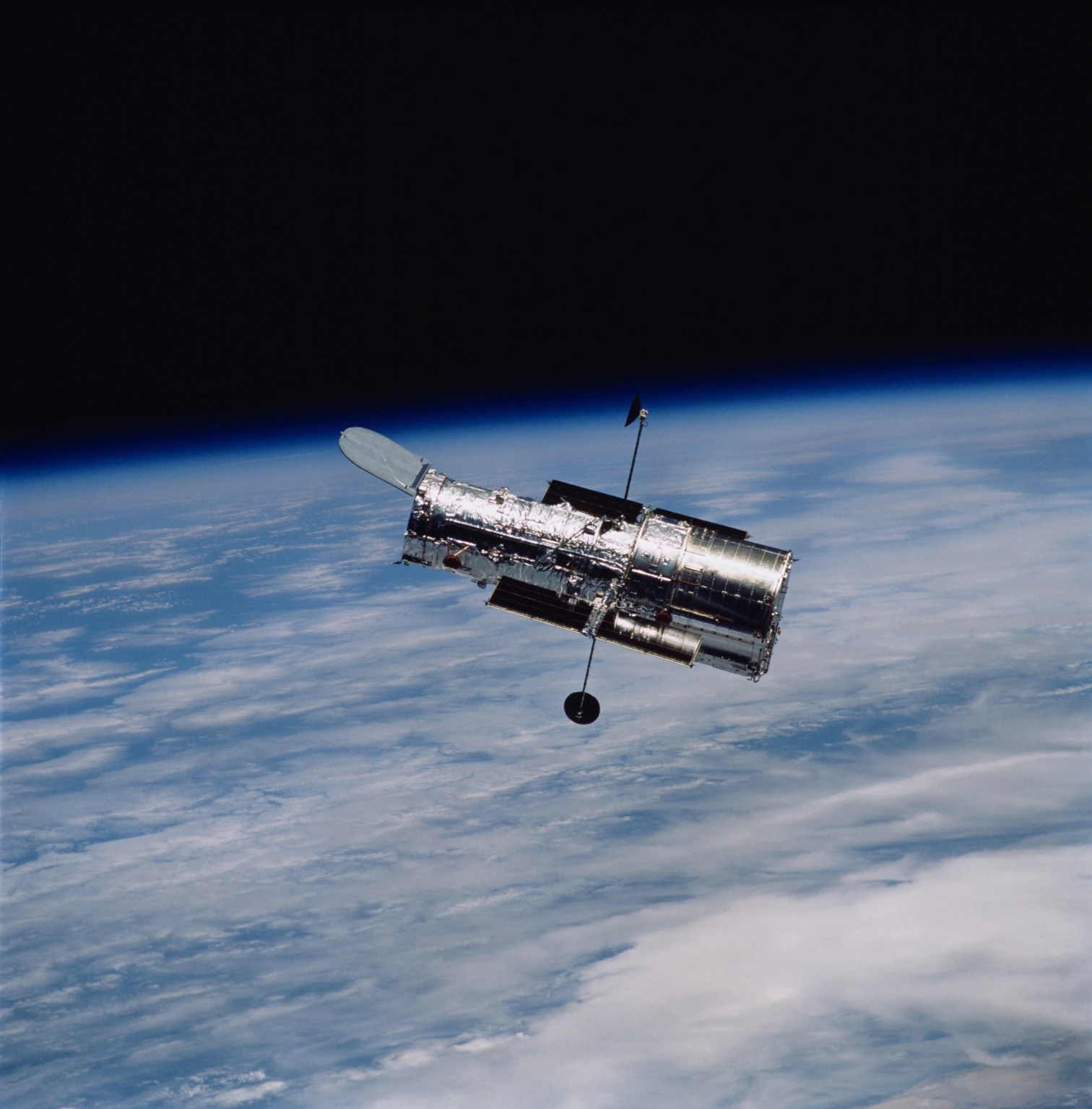
Decades in the making and operating a million miles from Earth, Webb is the most powerful space telescope ever built, giving humanity breathtaking views of newborn stars, distant galaxies, and even planets orbiting other stars. The new technologies developed to enable Webb’s science goals – from optics to detectors to thermal control systems – now also touch Americans’ everyday lives, improving manufacturing for everything from high-end cameras and contact lenses to advanced semiconductors and inspections of aircraft engine components.
This landscape of “mountains” and “valleys” speckled with glittering stars is actually the edge of a nearby, young, star-forming region called NGC 3324 in the Carina Nebula. Captured in infrared light by NASA’s James Webb Space Telescope, this image reveals for the first time previously invisible areas of star birth.
NASA, ESA, CSA, and STScI
Meanwhile on Mars, the unstoppable Curiosity rover, NASA’s car-size science lab, has spent more than a decade uncovering clues that the Red Planet once could have supported life, transforming our understanding of our planetary neighbor. These NASA missions continue to make breakthroughs that have reshaped our understanding of the universe and our place in it. Curiosity has also paved the way for future astronauts: Its Radiation Assessment Detector has studied the Martian radiation environment for nearly 14 years, and its unforgettable landing by robotic jetpack allowed heavier spacecraft to touch down on the surface — a capability that will be needed to send cargo and humans to Mars.
NASA’s Curiosity Mars rover used two different cameras to create this selfie in front of Mont Mercou, a rock outcrop that stands 20 feet (6 meters) tall. The panorama is made up of 60 images taken by the Mars Hand Lens Imager (MAHLI) on the rover’s robotic arm on March 26, 2021, the 3,070th Martian day, or sol, of the mission. These were combined with 11 images taken by the Mastcam on the mast, or “head,” of the rover on March 16, 2021, the 3,060th Martian day of the mission.
NASA/JPL-Caltech/MSSS
To compile this “Hall of Fame” list, TIME solicited nominations from TIME editors and correspondents around the world, paying special attention to high-impact fields, such as health care and technology. TIME then evaluated each contender on a number of key factors, including originality, continued efficacy, ambition, and impact.
The James Webb Space Telescope is the world’s premier space science observatory. Webb is solving mysteries in our solar system, looking beyond to distant worlds around other stars, and probing the mysterious structures and origins of our universe and our place in it. Webb is an international program led by NASA with its partners, ESA (European Space Agency) and CSA (Canadian Space Agency).
The Curiosity rover was built by NASA’s Jet Propulsion Laboratory, which is managed by Caltech in Pasadena, California. JPL leads the mission on behalf of NASA’s Science Mission Directorate in Washington as part of NASA’s Mars Exploration Program portfolio.
To learn more about NASA’s science missions, visit:
Jupiter announced seven coordinated platform upgrades at Breakpoint, headlined by JupUSD, a new stablecoin developed with Ethena that will integrate across the entire Jupiter ecosystem to allow rewards during DCA orders, limit orders, and prediction market participation.
The Solana-based decentralized exchange, which has processed $1.08 trillion in combined spot and perpetuals volume year-to-date while maintaining $2.7 billion in total value locked, framed the upgrades as solutions to fragmented data, fraudulent assets, and the absence of professional-grade tools needed for institutional adoption.
It is fundamentally a better system, with open rails, transparent logic, self-custody as a default, and verifiable rules which apply equally to everyone.
JupUSD launches next week with deep protocol-level integration that isolated stablecoins cannot replicate.
According to Jupiter executives, controlling both the dollar and the transaction platform allows synergies across use cases, creating a self-reinforcing flywheel effect.
The stablecoin will route through Jupiter’s existing infrastructure, handling billions in stablecoin volume via swap aggregation, perpetuals, and lending, completing what the company called an end-to-end stack.
The launch arrives as Solana’s stablecoin infrastructure expands through institutional partnerships, with Western Union planning to launch its US Dollar Payment Token through Anchorage Digital Bank in the first half of 2026 for international remittances.
The Solana Foundation also partnered with Korean blockchain infrastructure company Wavebridge to build a compliance-ready KRW-pegged stablecoin following South Korea’s preparation of regulatory framework legislation, with Wavebridge CEO Jongwook Oh stating the collaboration seeks to create structures where the stablecoin is “not only issued but also verified, controlled, and fit for institutional use.“
Additionally, Jupiter Lend exited beta and became fully open source after reaching $1 billion in total supply within eight days, the fastest growth rate for any Solana protocol in history.
Now, the lending protocol is built with Fluid and introduced tick-based liquidity, allowing all risky positions to be liquidated in a single transaction and allowing Jupiter to offer the highest loan-to-value ratios and the lowest liquidation penalties in decentralized finance.
Developer Tools and Data Infrastructure
The newly launched Developer Platform consolidates real-time analytics across all Jupiter APIs, giving builders visibility into logs, usage patterns, and performance metrics through a unified dashboard that tracks every swap, pricing call, and token API request.
Developers can now debug issues by investigating 429 errors, 500 errors, and downtime events through comprehensive logs designed to help teams ship more efficiently.
Yesterday, @kashdhanda announced a huge bullish moment for developers: @JupiterExchange just launched the Jupiter Developer Platform.
This isn’t just another home for mediocre or garbage APIs, it’s the new home for the best APIs on Solana, complete with everything you need to… pic.twitter.com/3AHVFV65oF
Jupiter Terminal consolidated trading for all asset classes into a single platform featuring real-time wallet tracking, Alphascan’s analytics across 61-plus launchpads with developer blacklisting, and professional execution tools, including one-cancels-other orders and partial fills.
The terminal leverages Ultra v3, Jupiter’s proprietary end-to-end trading engine that powers features like Jupiter Beam and Predictive Execution, technology adopted by Robinhood for its own operations.
Meanwhile, VRFD expanded beyond token verification into a full, trusted data layer to address Solana’s challenge of 30,000 daily token launches, most of which are scams or imposter tokens.
VRFD now verifies metadata and provides high-signal insights across all surfaces, including Jupiter mobile and APIs, building on Jupiter Verify’s position as the most trusted token verification system powering nearly every wallet, terminal, and explorer in decentralized finance.
Acquisition Strategy Extends Lending Capabilities Beyond Traditional Assets
To amplify adoption and scalability, Jupiter acquired Rain.fi to expand its money market capabilities to off-chain, long-tail, and long-duration assets that previously lacked viable on-chain pathways.
Rain.fi’s Offer Book, a specialized orderbook launching in Q1, will enable simpler, more transparent liquidity access without price-based liquidations, making every on-chain asset productive through peer-to-peer lending models that scale through Jupiter’s integration infrastructure.
Rain was built to scale and accelerate the credit market on Solana, powered by fixed-term loans.
As credit markets evolve, timing and distribution are key.
We’re proud to announce that Rain is joining the Jupiter ecosystem to accelerate on-chain credit market growth. pic.twitter.com/qe3NbcWLRo
The Rewards Hub unified rewards, trading activity, and referrals into one system with a $1 million pool tied to real contributions, addressing what Jupiter called fragmented on-chain incentives disconnected from actual usage.
Jupiter’s coordinated upgrades across data infrastructure, execution tools, lending protocols, and developer resources represent what executives called “deliberate upgrades to systems already powering hundreds of millions of users, traders, and builders” rather than entirely new products.
Terry Gerton It has been a tough year for the federal workforce. I don’t think that’s an understatement, but here on the Federal Drive, we focused a lot on the impacts on individuals. And with you I want to take it up a level and really talk about leaders and managers. What have been the biggest challenges for federal managers throughout this year?
Laurin Parthemos I would say without a doubt, it’s the uncertainty that people are seeing within the day to day. As a leader, having to navigate a field where you don’t know what is going to come next is increasingly difficult, especially in times where you don’t have necessarily the number of resources that you truly need to get the job done. And we’re seeing that really play out in terms of both performance, in terms of how things are getting produced, how quickly they’re getting produced, but also just on the health from a psychological standpoint of the individual employees that are within the workforce and especially on the federal side. And how do we really make sure that we create, as leaders, a space where we can allow them to thrive as much as possible in this particular scenario? And how do we suppress that survive response to all the uncertainty and all of the nuance that is happening in the day to day that we’re seeing?
Terry Gerton We have talked a lot here about organizational health and how organizational health depends on individual worker health and how that health often depends on mental health. Seems like all of those connection points are under a lot of stress.
Laurin Parthemos I, Yeah, unequivocally agree with that. Realistically speaking, at Kotter, our research validates that point that organizations that are anchored in adaptability and resilience are those ones that outperform. And as we see, especially in the federal space, it’s difficult to build that resiliency consistently because of the amount of uncertainty that we’re seeing. And so because there’s that pull dragging people down, the level of anxiety, the lack of ability to actually meet your day to day needs as we’re seeing shutdowns happen, there’s an end-level performance there that’s happening at the department and agency level that as leaders, it’s [about] trying to figure out how we can give as much stability as possible to our teams without necessarily knowing what we’re capable of promising. And how do we make sure that we’re communicating in a way that we’re not just waiting until we have a definitive answer, but we’re walking alongside our team saying, I also don’t know. But here’s what we’re going to do.
Terry Gerton You mentioned a term earlier, psychological safety. Can you break that out for us and tell us what it means both from the employee perspective and the leader-manager perspective?
Laurin Parthemos Absolutely. From that psychological safety perspective, we see the massive erosion in the sense that as people are showing up to work, what was once seen as an incredibly stable job and a mission-driven job working for the federal workforce. Some of those tenets about why people joined the service are no longer there because that stability is no longer there. Don’t know if layoffs are coming. We don’t know if we’ll be in another shutdown. And what that really boils down to is how do I feed my family? How do I make sure that I can pay my own bills? And without that level of safety, of knowing that I have stability in my job and I can think through how do I perform and I can think through creative, innovative ways to get things done. Without that, you won’t see any level of performance. And it’s really been a sticking point for many people that I’ve been speaking to within the agencies.
Terry Gerton Are you seeing that agencies have groups of employees maybe pitted against each other? We had furloughed and accepted folks. So many people worked but without pay and others didn’t work and, you know, are there internal issues that leaders and managers are going to need to deal with?
Laurin Parthemos None that anyone has openly admitted to me. I will leave it at that. But it is a natural feeling to say, if we’re working on a skeleton crew, so to speak, and some of our team is furloughed while others are not, what does that look like when we all rejoin together? There’s going to be those who are frustrated because they’ve had to work so hard during that furlough time without pay. There’s those that are — that were not furloughed that had to depend on each other that maybe their teammates weren’t showing up in a way that they necessarily resonated with because they might not have been giving their full selves because of the frustration of what they were dealing with. So I wouldn’t say it’s necessarily that people are pitted against each other, but more so that there’s an understandable level of frustration given the ecosystem that they were subjected to. And how do you work through that as a leader saying, for this time, we are all together. There is a potential that we will be in another shutdown. And what does that look like? And how can you really work with your team to make sure that you’re front-running any of those issues and thinking through the scenario planning to make sure that you have what you need and your team members understand the purpose and what we’re really trying to accomplish at its core so you can prevent any of those frustrations as they bubble up.
Terry Gerton I’m speaking with Laurin Parthemos. She’s a principal and public sector lead at Kotter. Laurin, the shutdown has come up a couple of times in our conversation. We’re deep into the holiday season that comes with its own kind of stress. And when everybody’s sort of fully back in January, they’ll be staring potentially at another shutdown across several agencies. So if you’re a leader in this scenario, maybe what’s on your New Year’s resolution list to think about how do you reset for the work beginning in January?
Laurin Parthemos I think that’s a great question because as I’ve talked to many leaders throughout this time, a lot of people are talking through what does Q1 look like or what does it immediately look like for what I need to accomplish? But we really need to be thinking longer term than that. And we really need to be thinking through what are our priorities and what are we deprioritizing? Because as we think about the impact that the shutdown had, I believe it was the Professional Services Council that has a statistic that it takes three to five days, not business days, but days to reset for each day of shutdown in terms of an agency’s performance, considering that it was 43 days. That’s up to seven months in order to get back to a stable state. So we’re going to be working in an environment that is over capacity and behind with significant backlog. So making sure that if you’re anchoring on a, why are we doing what we do, what is our goal as a team and anchoring each task underneath that to that why, it will help prioritize what needs to be accomplished while simultaneously actively advocating for what no longer needs to be done during this time of prioritization. And that act of advocating needs to happen within your own team. Across teams and also going up the chain as well to make sure that there’s a consistent understanding of what are we trying to accomplish? Because if you only focus on one small group, there’s going to be a lack of understanding more broadly. And that will help teams as they go into January with the potential of another shutdown. So knowing what are we trying to accomplish, what happens if we do, what happens if we do not shut down? And how can we come together to make sure that despite the headwinds, we are going to accomplish whatever we can. And I will say a key for this is it’s not just the priorities that we need to accomplish, but it’s also how do we, as leaders, implant short-term wins, as we like to call them at Kotter. So what are some small things to show that we’ve accomplished something? We’ve been successful. No matter how big or small, it does not matter, but it’s something that you can celebrate around and rally around to get people energized. So it’s not just a heavy weight of a continual backlog, but saying we did something and we’re making progress.
Terry Gerton What might be one or two things that a team leader or a mid-level manager could actually do to get their team refocused on the why, on the priorities, on the outcomes? Should they have a potluck? Should they like have a team day? What are some things that you recommend, actual steps?
Laurin Parthemos What I would say is it’s very team dependent, to be quite honest with you, because you could say, let’s do a pizza party. And that will resonate so well with some groups, and others will see it as tone-deaf in a way, saying, that’s great that there’s food here, but do you not see what’s happening around us? And so I would say, first and foremost, as you’re thinking about the state that individuals are in, it’s that heavy survive of freeze, likely. And it’s making sure that as you think through what state these individuals are in, you’re going on a listening tour, so to speak, to figure out what they actually need and want and then respond in kind to the culture of that particular group. So it very much could be a potluck. It could be that part of your planning as you’re thinking about going into January, you know your team will have heavy amounts of furloughs. And realistically speaking, the median federal employee only has about a week of pay in their bank account. So is it that we know this team is going to be furloughed? So let’s think about meal trains. Let’s think about how we can support each other in ways that are not just from a work perspective, but from a human element, because we are here for a mission. You’re not joining the federal service to become the most rich and famous. You’re doing it because you believe in the cause. So come together around that cause and find ways to truly support your people in the ways that you’ve find that they need to be supported as a leader.
Terry Gerton I’ve been speaking with Laurin Parthemos. She’s a principal and public sector lead at Kotter. Laurin, thanks so much for grounding us back in what’s really important. Absolutely. Thank you for having me. We’ll post this interview at federal newsnetwork.com slash Federal Drive. Listen to the Federal Drive on your schedule and on your device. Subscribe wherever you get your podcast.
Fulu sets repair bounties on consumer products that employ sneaky features that limit user control. Just this week, it awarded more than $10,000 to the person who hacked the Molekule air purifier.
Trump signed an AI executive order targeting state laws and promising one national rulebook. Critics warn it could trigger court battles and prolong uncertainty for startups while Congress debates federal rules.

 Login
Login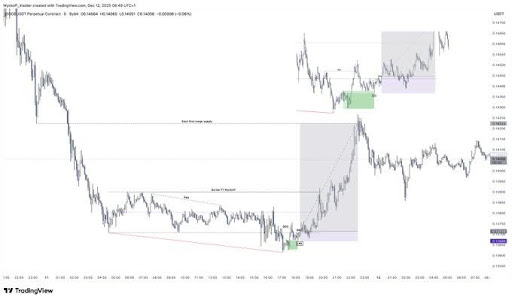










 ,
,  ) (@JupiterExchange)
 (@RainFi_)