Reading view

There are new articles available, click to refresh the page.

What The Conditional Approval Means For Ripple’s Bank And XRP

The Office of the Comptroller of the Currency (OCC) has granted Ripple a conditional approval to become a national trust bank. Crypto pundit Stern Drew highlighted what this means for the crypto firm and also XRP, which it uses for its payment services. 

What The OCC Approval Means For Ripple And XRP

In an X post, Stern Drew stated that Ripple just broke the system following the OCC’s grant of a conditional approval to the crypto firm. He further noted that Ripple now has federal and regulatory oversight locked in with this approval. The pundit added that the RLUSD stablecoin has become the gold standard for compliant stablecoins, while XRP has stepped straight into the heart of the U.S. financial system.  

Ripple CEO Brad Garlinghouse also reacted to the OCC’s grant of a conditional approval, stating that it was huge news. He remarked that this was a massive step forward, mainly for the RLUSD stablecoin, which is setting the highest standard for stablecoin compliance with both federal and state oversight. 

In a press release, the firm also indicated how this development positions RLUSD and XRP by extension for greater adoption. The firm stated that as traditional finance firms continue to enter the crypto market, they will look to leverage stablecoins with the highest regulatory rigor and compliance, which offer the trust and reliability required for enterprise adoption. 

Meanwhile, the payment firm confirmed that its banking services will also extend the same regulatory rigor behind RLUSD into its broader payments and institutional service offerings, which utilize XRP. The firm further noted that utility is already driving adoption as its stablecoin has surpassed $1 billion in market cap in less than a year. The company added that the stablecoin is actively used in its payment solutions and as collateral by prime brokers, including its prime brokerage

An “XRP Wake Up Call”

Crypto pundit BarriC described the OCC’s grant of a conditional approval to Ripple as an XRP wake-up call for those who may still be skeptical of the altcoin. He stated that for those who said that banks would never use XRP or partner with Ripple, the crypto firm has now also been granted a banking license.

The pundit noted that this is significant as over half of Ripple’s transactions for its payment services go through XRP. The altcoin has also received a huge boost as Swiss bank AMINA bank has become the first European bank to integrate Ripple’s payment services. BarriC highlighted that the bank will ultimately use XRP through its integration with Ripple payments. Meanwhile, crypto analyst Dark Defender indicated that Ripple’s status as a Trust bank could be one of the catalysts that lead to higher prices for XRP. 

At the time of writing, the XRP price is trading $2.01, down in the last 24 hours, according to data from CoinMarketCap.

Ripple

XRP Price To Reach $27: The Technical Formation That Paints 1,300% Surge

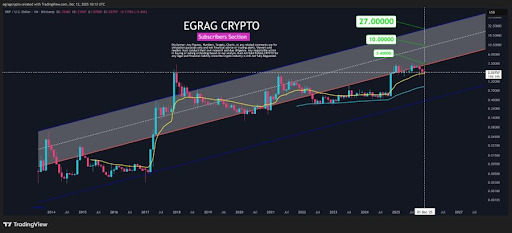
Crypto analyst Egrag Crypto has again predicted that the XRP price could reach $27. This time around, he outlined the technical formation that could spark a parabolic surge for the altcoin as it eyes the $27 target. 

How The XRP Price Could Reach $27

In an X post, Egrag Crypto stated that the Linear Regression targets for the XRP price are $3.4, $10, and $27. He further explained that, as of this month, these three major price levels stand out based on the long-term Logarithmic Linear Regression Channel. The analyst then touched on each price target and how XRP could reach there. 

Egrag Crypto described the $3.40 target for the XRP price as the mean reversion. He stated that a retest and rejection from $3.40 would be one of the strongest bearish TA signals for the altcoin. The analyst further remarked that this target is based solely on chart structure, not fundamentals. He added that a close above this level means that XRP is officially back in macro bullish territory. 

XRP

Furthermore, the analyst stated that the $10 target for the XRP price is the upper midline. He explained that this is where full bull expansion normally accelerates and that the target rises with time because this channel is logarithmic. Lastly, Egrag Crypto highlighted $27 as the top of the channel. He noted that multiple long-term confluences point to this target for the altcoin. 

Notably, this XRP price prediction comes amid several bullish fundamentals for the altcoin. Ripple was just granted a conditional approval for its national trust bank charter, which could boost XRP’s adoption. XRP also just expanded to Solana with Hex Trust’s launch of its wrapped XRP token for DeFi purposes. Meanwhile, Swiss bank AMINA Bank has integrated Ripple payments, which utilize XRP.  

The Major Levels To Watch Haven’t Changed

Crypto analyst CasiTrades stated that the major levels for the XRP price haven’t changed. The macro supports are $2.03 and $1.64. On the other hand, the macro resistance is $2.41, which a break above would confirm a bullish scenario for the altcoin. The analyst remarked that if a break above $2.41 happens, the next measured targets stand around $2.75 and $2.90. 

However, if the XRP price breaks below the macro support at $2.03, CasiTrades predicts that the altcoin could fall below $1.97 and decline towards the $1.64 major support. She reiterated that there is no official confirmation yet on the next potential move for XRP. Interestingly, the world’s largest IQ holder, YoungHoon Kim, stated that XRP has a strong possibility of reaching a new ATH by the end of this year. 

At the time of writing, the XRP price is trading at around $2.01, down in the last 24 hours, according to data from CoinMarketCap.

XRP

Did Amazon Strike A 5 Billion XRP Deal With Ripple? Expert Answers

Crypto expert Crypto Sensei has drawn attention to rumors that Amazon struck a 5 billion XRP deal with Ripple. The expert explained what the deal is really about and what Ripple’s end goal is using the altcoin. 

Expert Clarifies Rumors Of Amazon’s 5 Million XRP Deal With Ripple

In an X post, Crypto Sensei addressed whether rumors that Amazon struck a 5 million XRP deal with Ripple were true. The rumors surfaced as Kendra Hill claimed that Ripple’s endgame is to run the entire derivatives market using the altcoin and that the cross-border transactions are simply a test.  

Related Reading: XRP Rising Against All Odds: Ripple CEO Celebrates These Achievements

However, Crypto Sensei noted that there is no public evidence of Ripple’s 5 million XRP deal with Amazon and that there has been no public announcement from the crypto firm. As such, the expert remarked that this rumored deal remains pure community speculation.  

Meanwhile, he explained that Hill’s core claim was that cross-border payments are just a testing ground and that Ripple ultimately intends to use XRP to process 100% of the transactions on the global derivatives market. Notably, the global derivatives market is said to be a trillion-dollar industry, meaning this move could boost adoption significantly. 

Meanwhile, as to how a rumored Amazon relates to this, Crypto Sensei explained that a screenshot of an old Amazon partnership had resurfaced. Furthermore, Hill had allegedly claimed that another partnership between the two firms has yet to be revealed. Amazon’s AWS had, in 2020, revealed that it was integrating Ripple’s payment system for its rewards program. 

Crypto Sensei also mentioned that Ripple’s CTO, David Schwartz, has stated that there is no evidence that Amazon owns this amount of XRP. There is also no evidence on the XRP Ledger that the company holds this amount in escrow.

Major Adoption News For The Token

In an X post, Hex Trust announced a partnership with LayerZero to launch wrapped XRP (wXRP) across multiple networks, starting with the Solana network. This is expected to boost the altcoin’s adoption as it gains new holders and new liquidity flows into it. Hex Trust noted that the wXRP is designed for DeFi use across these networks. 

Related Reading: Ripple Secures 4 Groundbreaking Wins That Mark An Exciting Phase For XRP

The firm has launched this Wrapped XRP with over $100 million in Total Value Locked (TVL). Hex Trust also explained that the wrapped token’s utility is that it makes it easy to trade XRP alongside Ripple’s RLUSD stablecoin as a trading pair on supported chains. As such, the firm believes this move could expand liquidity and utility between XRP and RLUSD. Notably, there are also plans to launch this wrapped token on Ethereum soon. 

At the time of writing, the XRP price is trading at around $2.03, up in the last 24 hours, according to data from CoinMarketCap.

XRP

Dogecoin Three Bullish Drives Pattern Shows Where The Next Buying Point Is

A developing Three Bullish Drives pattern has just been identified on the Dogecoin price chart. According to the analyst’s report, this new technical pattern suggests the meme coin could be on the verge of a bottom, potentially marking its next key buying point for market watchers. This projected decline could extend the downtrend Dogecoin experienced over the past few months, which already wiped out most of the gains made earlier this year during the meme coin hype.

Dogecoin Bullish Reversal Setup Reveal Buying Point

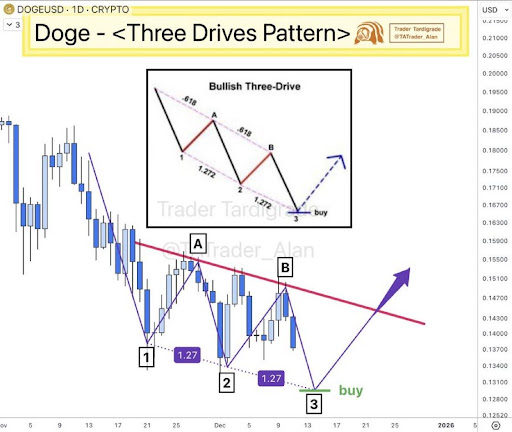
Crypto analyst Trader Tardigrade has stated that Dogecoin may be close to forming a bottom on the daily chart, as it develops what appears to be a classic Bullish Three Drives pattern. He points out that the first 1.272 Fibonacci extension near $0.137, measured from Point 1 to Point 2, lines up with the descending resistance line formed by Points A and B. This alignment is significant, as it suggests that Point 3 may represent the next buying opportunity, potentially marking Dogecoin’s lowest level before a reversal. 

Trader Tardigrade’s chart shows the full Three Bullish Drives pattern taking shape, with three apparent dips labeled Points 1, 2, and 3. Each downward move follows the same harmonic rhythm seen in the sample pattern shown in the chart’s inset. Points A and B, between $0.159 and $0.155, form lower highs, creating a strong resistance line that the Dogecoin price continues to respect throughout the pattern. 

Dogecoin

The repeated appearance of the 1.272 Fibonacci extension reinforces the setup, showing that the market is following the expected price behavior of this chart formation. Point 3, which sits between $0.131 and $0.124, stands out as a major turning point for investors. What this means is that Trader Tardigrade expects Dogecoin to temporarily decline to this lower buy point before moving back upwards.

The momentum from DOGE’s projected rebound is expected to push its price toward $0.155. Although the analysis initially forecast that Dogecoin would hit a bottom, it also suggests that the recent downtrend, which has seen the meme coin’s price crash by roughly 20% this month, may be approaching its end.

Falling Wedge Signals Strong Upside For DOGE

A market expert identified as ‘Crypto King’ on X suggests that Dogecoin has strong bullish potential, as a clean Falling Wedge pattern is forming on the daily chart. He highlighted that the DOGE price is currently compressing against the trendline, signaling that the market may be gearing up for a significant move

According to Crypto King, once the market structure is broken and the diagonal resistance is reclaimed, a rapid surge toward $0.27 could unfold for Dogecoin. At its current price of $0.14, this would represent a staggering 92.86% gain.

Dogecoin

Ripple Makes Major Announcement: Important Dates For The XRP Community

Ripple has announced the dates for its next flagship event, giving the XRP community and institutional partners an early look at what lies ahead. In a post shared on social media platform X, the company confirmed that Swell will return to New York City from October 27 to October 29, 2026.

The update comes after a high-profile Swell 2025 conference in New York that placed Ripple at the center of discussions around institutional adoption, stablecoins, and blockchain infrastructure of the XRP ecosystem.

Ripple Confirms Swell 2026 Dates

Ripple’s announcement confirmed that Swell will once again be hosted in New York City, this time spanning three days from October 27 to October 29, 2026. The company encouraged its community to mark their calendars early; more information will follow in the new year.

The announcement carries added significance, as Ripple also revealed a major change to the structure of its annual events, setting the stage for what it describes as a larger and more unified gathering. Apart from the dates and location, Ripple noted that the 2026 edition is designed to be larger in scope. “Builders, financial leaders, and industry partners will be together under one roof, creating an unforgettable experience,” the announcement noted. 

One of the most notable elements of the announcement is the decision to merge Swell and Apex into a single event. Swell events have always been focused on institutional finance, payments, and policy discussions, while Apex catered more directly to developers building on the XRP Ledger. The most recent Swell 2025 event was hosted in New York, while the Apex 2025 event was hosted in the first half of the year in Singapore. 

However, by combining the two, Ripple appears to be planning to promote a better alignment between institutional adoption and on-chain development of the XRP Ledger. This unified format is something to look forward to, as the event is expected to bridge the gap between financial institutions and technical builders, rather than treating them as separate audiences.

Looking Back At Swell 2025

The announcement also draws added weight from how Swell 2025 unfolded. The 2025 event in New York was widely viewed as one of Ripple’s most consequential conferences to date, featuring strong institutional representation and focused discussions on stablecoins, tokenized assets, and cross-border settlement.

The event took place on November 4 and November 5, 2025. Not long after the event, the first Spot XRP ETF was launched in the US.

Ripple Swell 2025 drew a high-profile mix of Ripple executives, institutional leaders, and policymakers. Ripple’s leadership was represented by CEO Brad Garlinghouse, Executive Chairman Chris Larsen, and President Monica Long, all of whom took part in key sessions. 

Notable attendees from traditional finance included Nasdaq Chair and CEO Adena Friedman and BlackRock’s Director of Digital Assets Maxwell Stein. The event also featured David Ripley, Co-CEO of Kraken; Sandy Kaul of Franklin Templeton; US Representative Ritchie Torres; and Patrick Witt from the White House’s President’s Council of Advisors for Digital Assets, to name a few.

Ripple

XRP Price Needs To Hold This Macro Support For Hope Of Revival

XRP has spent the past 48 hours grinding lower, with its price gradually retreating to $2 after failing to sustain the rally above $2.10 at the beginning of the week. Selling pressure has been mostly controlled rather than aggressive, but each attempt to push higher has been met with a local trendline resistance near $2.165.

Technical analysis shared by crypto analyst CasiTrades outlines an important macro support level that may determine whether XRP can stabilize and attempt another bullish recovery or fall into another bearish corrective phase below $2.

XRP Defends An Important Macro Support Zone Around $2.03

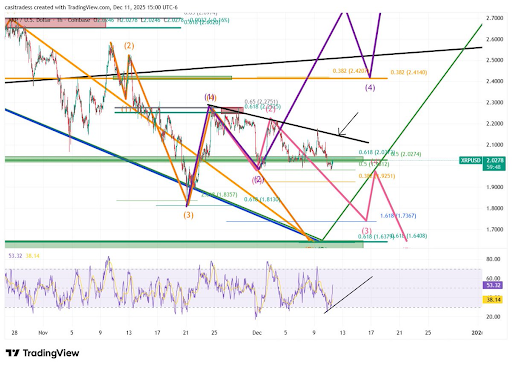
According to CasiTrades’ analysis, XRP is still defending the macro 0.5 Fibonacci retracement level, which sits around $2.03 and has acted as a key structural support on the chart. This is visible in the recent price action, as the cryptocurrency is currently trading at $2.04, having rebounded from a low of $1.99 in the past 24 hours.

The analyst noted that XRP recently reacted strongly from this level, showing its importance as a demand zone. The accompanying chart shows price repeatedly returning to this region, with buyers stepping in to prevent a sustained breakdown.

XRP

Although XRP has briefly dipped below the 0.5 Fib level, the move lacked follow-through. The most important thing is that the XRP price did not lose the $1.97 level, which CasiTrades identified as the threshold that would confirm a deeper bearish scenario. As long as XRP is trading above this zone, the analyst suggests that the price action still has a chance of increasing rather than heading lower to other downside targets.

Clearly Defined Bullish And Bearish Scenarios

The analysis outlines two distinct paths forward, and both depend on how XRP reacts to the macro support level at $1.97. On the bullish side, holding above $1.97 keeps the door open for a continuation higher. As long as $1.97 holds, the deeper retracement scenario is not confirmed.

 From here, we can see XRP continue moving bullish, but only a decisive break above the macro resistance near $2.41 would serve as confirmation of a stronger upside structure. If that level is cleared, the next projections are in the $2.75 to $2.90 range, as shown in the purple bullish scenario in the chart above.

On the other hand, a loss of $1.97 would invalidate the current support structure and shift focus toward the macro 0.618 retracement around $1.64. The chart shows this as the pink scenario and $1.64 as another major support level that could come into play to stop the intensifying selling pressure. 

No official confirmation has occurred in either direction, leaving XRP at an important point where holding macro support is the main requirement for any meaningful revival attempt.

XRP

Banking Giant JPMorgan Takes On Solana In Grand Style – Here’s What They Did

America’s largest bank, JPMorgan, has taken a bold step into the future of finance by issuing commercial debt on the Solana blockchain. This move has caught the attention of the broader crypto and traditional markets, as it marks one of the first times a US commercial debt was brought into a public blockchain.

JPMorgan Brings Commercial Debt Papers To Solana

According to a press release published on December 11, JPMorgan has successfully arranged a US Commercial Paper (USCP) Issuance for Galaxy Digital Holdings LP, an affiliate of Galaxy Inc., on the Solana blockchain. The issuance represents one of the earliest debt offerings executed on a public blockchain in the US.

JPMorgan had served as the arranger, creating the on-chain USCP token and managing the delivery-versus-payment settlement for the issuance. Meanwhile, Galaxy Digital Partners LLC had structured the offerings, while US technology company Coinbase Global Inc. and global investment management firm Franklin Templeton had purchased the issuance. 

Scott Lucas, the Head of Markets Digital Assets at JPMorgan, emphasized that the new commercial debt transaction was a key demonstration of institutional demand for digital assets and the transformative potential of blockchain technology in the future of financial markets. He added that, as a user-focused banking institution, JPMorgan is committed to meeting the evolving demand for digital asset exposures

Notably, the USPC token issuance is the first commercial paper offered by Galaxy, enhancing the company’s short-term funding capabilities and providing access to a broader institutional investor base interested in blockchain-based money-market instruments. Details from the press release reveal that both the issuance and the redemption proceeds will be paid in USDC stablecoins issued by Circle, marking a first for the US commercial paper market. 

What Other Executives Have To Say

In the press release, Jason Urban, Global Head of Trading at Galaxy, stated that the issuance demonstrates how public blockchains can enhance the functioning of capital markets. He emphasized that bringing Galaxy’s first commercial paper offering on-chain and structuring one of the earliest US transactions of its kind are significant milestones. 

It underscores Galaxy’s vision of using open and programmable infrastructure to support institutional-level financial products. Urban also expressed satisfaction in collaborating with JPMorgan, Coinbase, Solana, and Franklin Templeton to integrate these innovations into daily market operations.

Sandy Kaul, Head of Innovation at Franklin Templeton, highlighted that institutions are moving from experimenting to actively transacting on the blockchain. She noted that deals like Galaxy’s on-chain issuance help build a more open, efficient, and resilient financial system while supporting broader adoption of digital infrastructures in traditional markets

Nick Ducoff, Head of Institutional Growth at the Solana Foundation, described the issuance as a key step in bringing the security and efficiency of blockchains to institutional finance. Brett Tejpaul, the Co-CEO of Coinbase Institutional, stated that the transaction shows how institutional finance is embracing public blockchain technology, with Coinbase playing a foundational role as an investor, wallet provider, and custodian for the USPC token.

Solana

What’s Happening With The Bitcoin, Ethereum, And Dogecoin Prices Recently?

Crypto pundit NoLimit has explained why the Bitcoin, Ethereum, and Dogecoin prices have been dumping recently. He specifically raised claims of manipulation, with these crypto prices recording gains and then fully retracing those gains. 

In an X post, No Limit stated that the Bitcoin price is dumping because Binance is buying and that Coinbase is dumping a large amount of BTC. The Bitcoin decline has also sparked declines for the Ethereum and Dogecoin prices, which are known to mirror the flagship crypto. Meanwhile, the crypto pundit raised claims of BTC being manipulated. 

Pundit Explains What Is Happening With The Bitcoin, Ethereum, And Dogecoin Prices

NoLimit pointed out something weird that happened on the order books, noting a massive spike in Binance’s CVD, which didn’t come from retail suddenly buying millions of dollars in BTC. On the other hand, he stated that Coinbase’s CVD fell at the exact same time, indicating that the crypto exchange dumped some BTC, which sparked declines in Bitcoin, Ethereum, and Dogecoin prices. 

Related Reading: Bitcoin Price Can Hit These ‘Realistic’ Bullish Targets Before The Bear Market Begins

The crypto pundit highlighted the sharp decline in Bitcoin’s price as liquidity was yanked, creating a thin order book. He further remarked that one venue is getting aggressively bid up while the other is getting drained. NoLimit explained that this is not a normal spot flow and that it is likely coordinated positioning, hedging, arbitrage, or pure manipulation. 

Bitcoin

NoLimited pointed out that the Bitcoin price reacted instantly to this alleged manipulation, dropping, then pushing to $94,000, and then dropping again. This also dragged down the Ethereum and Dogecoin prices. The crypto pundit asserted that a group of people is playing with the market and that most people won’t notice until it is too late. 

He stated that when crypto exchanges completely disagree on net flow like this, it is usually a warning. NoLimit added that the next big move is being set up before the public catches on. The crypto pundit urged market participants to pay attention because things are about to get interesting. 

Another Pundit Raises Manipulation Claims

Crypto pundit Vivek also indicated that the Bitcoin, Ethereum, and Dogecoin prices may be manipulated at the moment. He noted that BTC round-tripped from $94,000 to $88,000 three times in the last few days, liquidating both longs and shorts worth over $200 million. The pundit added that this is an example of clear market manipulation to wipe out both leveraged longs and shorts. 

Crypto pundit Bull Theory also recently accused Wall Street trading firm Jane Street of manipulating the Bitcoin price. This came as the pundit noted that BTC, alongside Ethereum and Dogecoin, usually declines at the market open before recovering later. Bull Theory suggested that the firm may be manipulating the market in order to buy at lower prices.

Bitcoin

Pundit Highlights Major XRP Development That Could Happen By March 2026

Vincent Van Code, a well-known commentator on X, has outlined a projection that XRP could undergo a major shift in its pricing structure by March 2026. 

His view is built on three trends developing for the altcoin. These are the steady decline of XRP held on centralized exchanges, rising demand from institutional-grade Spot ETF products that move large volumes of the tokens into regulated custody, and the gradual rollout of more advanced arbitrage systems that link ETF pricing with exchange markets. 

Predicting Major Development For March 2026

Van Code’s prediction of a major XRP development coming up in March 2026 is based on the observable trend of reserves on major centralized exchanges dropping to multi-month lows, a pattern verified by recent on-chain data showing exchange balances contracting significantly as institutional vehicles accumulate tokens. This reduction in liquid supply has coincided with sustained inflows into multiple Spot XRP ETFs launched in 2025, which now hold hundreds of millions of the token under management.

This has led to a highly volatile price action for the token, as we’ve seen in recent days. The interplay of this supply squeeze and growing institutional appetite feeds into Van Code’s prediction about a change in price dynamics ahead of 2026.

According to Van Code, sophisticated arbitrage should come online sometime around March 2026, and this will be the game-changer for price movement. Once that framework is in place, ETF trades and institutional flows could begin anchoring the altcoin’s price across the broader market, leading to steadier movement as more of the circulating supply sits in the hands of large, long-term holders.

This means that by March 2026, institutional ETF pricing could begin to set the benchmark for valuations across order books on crypto exchanges, rather than retail markets. 

Spot XRP ETFs In The US

Since the launch of the first US-listed spot XRP exchange-traded fund by Canary Capital on November 13, these products have attracted substantial institutional demand, feeding a growing accumulation of the altcoin into regulated custody and moving tens of millions of tokens out of the trading pool on crypto exchanges. 

Spot XRP ETFs, those from Canary Capital, Franklin Templeton, Bitwise and Grayscale, are on track to collectively exceed $1 billion in assets under management in just a few weeks, with inflows now on a streak of 18 consecutive trading sessions. According to data from SoSoValue, these ETFs have now received a cumulative inflow of $954.33 million as of December 10. 

Interestingly, a new entrant is also preparing to join this growing lineup. Asset manager 21Shares is on the verge of finalizing its own Spot XRP ETF, which has been approved by the Cboe BZX Exchange and is going to trade under the ticker TOXR.

XRP

Shiba Inu Lead Dev Reacts To Wild Development On Coinbase Involving $35 Million In SHIB

The Shiba Inu community was jolted by an unexpected surge of whale activity this week, involving a staggering $35 million worth of SHIB. The large-scale whale movement not only caught the community’s attention but also prompted a rare public reaction from Shiba Inu’s lead developer, Shytoshi Kusama. After months of silence, Shytoshi has seemingly resurfaced to acknowledge the massive transfer. 

Shiba Inu Lead Dev Breaks Silence After Massive Whale Move

After over three months of silence, Kusama reappeared on X as the Shiba Inu community reacted to a substantial whale movement. His return followed a repost by World Blockchain Capital about the unusually large transfer of 4,136,208,073,220 SHIB from the crypto exchange Coinbase to a private key wallet. 

World Blockchain Capital tagged several members of the Shiba Inu community in the transaction, urging them to take note and highlighting how rare such a move has been recently. The transaction was first identified by market analyst Del Crxpto, who reported that the more than 4 trillion SHIB transfer was worth about $35 million. 

Typically, when tokens are removed from exchanges and moved to a private wallet address, it often signals strategic accumulation or long-term holding by major investors rather than immediate trading activity. In this case, the size of the transaction ignited bullish sentiment from market watchers, especially in a period where the price is experiencing significant volatility and choppy action.

Excluding the shock of the transfer, what really caught the interest of the community was Kusama’s unexpected reappearance. The lead developer had previously explained in an earlier post that his reduced visibility was due to a shift in focus toward other new projects. 

At the time, he disclosed a new interest in Artificial Intelligence (AI) initiatives aimed at advancing the ecosystem. Kusama emphasized that, despite exploring new directions, he continues to work with SHIB developers, including Kaal Dhairya and others, to shape Shiba Inu’s next phase. 

Analyst Eyes $0.0002 SHIB As Whales Return

A new report by market analyst ‘SHIB Crack’ on X reveals that the price of Shiba Inu is showing signs of a massive breakout amid rising market activity. Currently, the SHIB price is in a downtrend, dropping by more than 6% this week and over 16% in the past month. 

Despite this severe downturn, SHIB Crack believes that the cryptocurrency is gearing up for a massive rise $0.00002. At the time of writing, the meme coin is trading at $0.0000082, meaning a surge to the analyst’s projected target would require a gain of over 142%

SHIB Crack has attributed his bullish forecast to the recent sharp surge in whale activity. According to the post on X, SHIB whales have reemerged and are silently accumulating tokens, signaling confidence in the token’s potential to rally.

Shiba Inu

XRP Exchange Balances Just Set A Brand-New Record Since Its Launch

New reports reveal that XRP exchange balances have experienced an uncharacteristic decline in recent weeks, recording a brand new low since the cryptocurrency’s launch in June 2012. While XRP’s price action has posted notable losses this year, the decline in exchange-held tokens appears to be much greater.

XRP Supply On Exchanges Falls To Historic Lows

Crypto market expert Chad Steingraber drew attention this week to fresh data from Glassnode, highlighting an unusual divergence in XRP’s market behavior. The analytics firm shared a chart tracking the amount of XRP held on crypto exchanges alongside the asset’s market price. 

According to Steingraber, the chart’s readings show that exchange balances have fallen well below the XRP’s price structure for the first time since the cryptocurrency’s inception. Glassnode highlighted XRP’s exchange supply with a green line on the chart and its price with a black line. At the start of the year, the supply on exchanges was around 3.8-4 billion XRP. However, through the middle, reserves gradually trended downward but mostly stayed within the 3.2-3.6 billion range. 

XRP

Notably, a Glassnode chart shared by crypto analyst ChartNerd reveals that XRP exchange balances dropped sharply from around 3.95 billion XRP to 2.6 billion XRP from November to December 2025. About 1.35 billion XRP was removed from public order books recently, representing a staggering 45% decrease in under 60 days. 

Usually, exchange supply and price move together without significant divergence because the former tends to influence sell-side liquidity, which, in turn, can affect market movements. When more XRP is held on these crypto platforms, traders have a larger pool of tokens to sell, which can increase market pressure

Conversely, when reserves shrink, it often signals that investors are withdrawing their assets, either for long-term storage or profit-taking after recent price moves. While the vast gap between XRP’s exchange balances and its price action raises concerns, whales have reportedly been selling off their holdings amid ongoing market volatility and as prices struggle to stage a meaningful rebound.

Glassnode Reports Massive Collapse In Daily XRP Fees

In addition to the collapse in XRP exchange balances, Glassnode’s data shows a steep drop in the cryptocurrency’s network activity, with average total fees falling dramatically. Since early February, the 90-day SMA of daily fees paid has decreased from about 5,900 XRP to only 650 XRP. This marks an estimated 89% drop and brings activity to its lowest point since December 2020. 

The decline in daily fees suggests a cooling in on-chain demand for XRP transactions, even as the price has remained weak amid broader market uncertainty. The cryptocurrency is currently trading around $2.00, reflecting a 7.7% weekly decline and a much larger 18% crash over the past month, according to CoinMarketCap.

XRP

Analyst Predicts XRP Price Will Rise To $14 By Frontrunning Bitcoin By Over 600%

Crypto analyst Javon Marks has provided a bullish outlook for the XRP price, predicting that it could rally to $14, frontrunning Bitcoin in the process. He alluded to a historical trend in which XRP outperformed BTC, which is why the analyst is confident that such price action can play out again. 

Analyst Predicts XRP Price To Rise To $14, Frontrunning Bitcoin

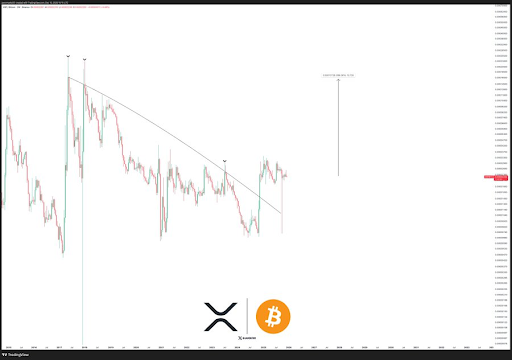
In an X post, Javon Marks stated that the XRP price is set to outpace Bitcoin by over 600% this time around, which could spark a rally to over $14 for the altcoin. He noted that when XRP previously outran Bitcoin by over 240%, its price rose by over 570%. As such, he is confident that this can play out again. 

The analyst’s accompanying chart shows that this XRP price rally could happen between now and mid-2027, with the altcoin outperforming Bitcoin during this period. Marks, however, failed to mention what could trigger such a price rally for the altcoin, considering that it has mirrored the flagship crypto so far in this market cycle

XRP

The XRP price notably has a year-to-date (YTD) loss of just over 7% while Bitcoin has a YTD loss of just under 2%. However, XRP is seeing renewed bullish momentum thanks to the spot ETFs, which launched between last month and this month. The XRP ETFs recently hit $1 billion in assets under management (AuM), becoming the fastest crypto asset to hit this milestone since Ethereum. 

As Ripple CEO Brad Garlinghouse noted, this highlights the demand for these crypto products, which could serve as a catalyst for a higher XRP price. Meanwhile, the XRP Ledger could soon see increased adoption following the release of the v3.0.0 upgrade, which could, in turn, boost XRP’s utility. 

XRP Still At “Decision Point”

Crypto analyst CasiTrades noted that the XRP price is still at a decision point. She explained that until XRP breaks above the $2.41 resistance and pushes toward $2.65, the bullish scenario isn’t confirmed. On the other hand, the analyst stated that if the price drops back below $2.04 support, the more bearish path opens toward $1.73 and potentially $1.64, which is the .618 macro support. 

CasiTrades reiterated that nothing has been confirmed for the XRP price as both scenarios are still fully in play. She indicated that this $2.04 is the best price level for traders to enter a position, as it positions them for either scenario. The analyst explained that if the price holds and runs upward, then these market participants are in before the confirmation. Meanwhile, if the price breaks down, they can place a stop just below support or at break-even. 

At the time of writing, the XRP price is trading at around $2.01, down over 3% in the last 24 hours, according to data from CoinMarketCap.
XRP

Are Dogecoin ETFs Dead On Arrival? Dwindling Volume Suggests Investors Are Not Interest – Details

The Dogecoin ETFs have continued to record low demand since they launched last month, indicating the lack of interest from institutional investors in the meme coin. Notably, DOGE has also seen the lowest demand through these ETFs among the top coins by market cap. 

Dogecoin ETFs Record Dwindling Volume And Inflows

SoSoValue data shows that the Dogecoin ETFs have continued to see their daily volume and inflows decline since they launched last month. On December 10, the Grayscale and Bitwise DOGE ETFs recorded a trading volume of $125,100. Meanwhile, these funds as a group saw a total net inflow of $171,920 on the day. 

Further data from SoSo Value shows that the Dogecoin ETFs trading volume has been on a decline since December 2, when they recorded a daily trading volume of $1.09 million. These funds have recorded only three 7-figure trading volume days out of 12 trading days since November 24, when Grayscale’s Dogecoin fund launched. 

Dogecoin

This is relatively low and signifies little demand for the DOGE ETFs among institutional investors. For context, Grayscale’s Chainlink ETF, the only LINK fund at the moment, has outperformed the Dogecoin ETFs despite launching at the start of this month. Grayscale’s LINK ETF has a total net asset of $77.71 million, while the DOGE ETFs have total net assets of $6.01 million. 

The net flows also highlight the underperformance of these Dogecoin ETFs. Since launching, Bitwise’s DOGE fund has recorded a net outflow of $972,840. Meanwhile, Grayscale’s fund has taken in just over $3 million. The funds, as a group, have recorded net inflows on five of 12 trading days. 

Possible Reason For The Underperformance

Bloomberg analyst Eric Balchunas had warned before now that crypto ETFs like the Dogecoin ETFs would record fewer assets given their distance from Bitcoin in terms of market cap. “’The further away you get from BTC, the less asset there will be,’ he said. Notably, DOGE funds have the lowest net assets among the top 10 cryptos by market cap with ETF wrappers. 

The Solana and XRP ETFs, which also just launched last month, have outperformed the Dogecoin ETFs, although there are more funds offering SOL and XRP. Meanwhile, Balachunas’ theory hasn’t applied to the LINK ETF, as it has outperformed DOGE funds despite Chainlink having a lower market cap than Dogecoin. 

Furthermore, the Hedera and Litecoin ETFs also boast larger net assets than the Dogecoin ETFs, indicating that institutional investors are simply not bullish on DOGE, possibly due to its meme coin status and lack of utility. DOGE is, so far, the only meme coin with an ETF wrapper. 

At the time of writing, the DOGE price is trading at around $0.138, down over 6% in the last 24 hours, according to data from CoinMarketCap.

Dogecoin

Bitcoin Realized Losses From Entities Surges To 2022 Levels Following Crash Below $90,000

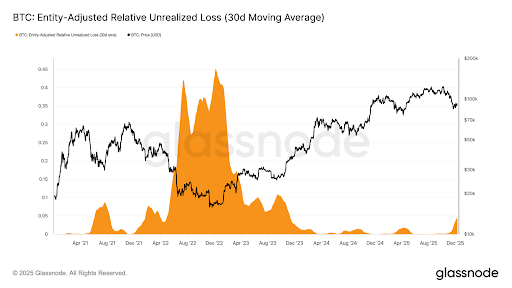
Bitcoin’s price action in the past two weeks has opened a new phase of stress among traders, with on-chain data showing realized losses climbing to heights last observed in 2022. 

Glassnode’s latest Week-On-Chain report shows Bitcoin is trading above an important cost-basis level but is also visibly straining under intensified loss realization, fading demand and weakening liquidity, which has placed short-term investors in a difficult position. 

Realized Losses Return To Deep Territory

According to Glassnode, realized losses among Bitcoin entities have risen massively, and is now almost at the same magnitudes recorded during the deep retracements of the 2022 bear market. Particularly, the Relative Unrealized Loss (30D-SMA) has climbed to 4.4% after nearly two years below 2%.

The escalation in loss realization reflects how the recent drawdown below $90,000 has forced a large number of market participants to offload coins at prices below their acquisition cost. This, in turn, has disrupted the gradual improvement in profitability seen earlier in the year. 

Bitcoin’s recent bounce from the November 22 low to above $92,000 hasn’t eased the strain on holders. Glassnode noted that entities are still locking in losses at an increasing pace, with the 30-day average of realized losses now at around $555 million per day. 

Bitcoin

These conditions mean that investors are losing confidence in short-term upside prospects for Bitcoin and choose to reduce exposure, even at unfavorable prices. Therefore, the report noted that resolving it will require a renewed wave of liquidity and demand to rebuild confidence.

Glassnode also highlights a sharp rise in profit-taking among long-term holders, whose realized gains have climbed to roughly $1 billion per day and briefly set a new record above $1.3 billion. 

Even with this elevated level of distribution, Bitcoin is currently positioned just above the True Market Mean, which is a long-standing cost-basis benchmark that serves as a point of structural support. The recent price downturn below $90,000 has pushed this zone close to its limits, but the glimpse of demand reflected around it suggests that price could revisit the 0.75 quantile near $95,000 and possibly approach the short-term holder cost basis as well.

Spot ETF, Futures, And Options Markets Indicate Weakness

Glassnode’s report points to persistent softness across ETF flows, which have cooled notably after a period of strong inflows earlier in the year. This slowdown represents a reduction in one of the largest and most immediate sources of buy-side liquidity for Bitcoin.

Spot market liquidity has also faded, with order books on major exchanges near the lower bound of their 30-day range. This has created an environment where trading activity has weakened through November and into December, and fewer liquidity flows are available to absorb volatility or sustain directional moves.

Derivatives positioning reflects similar caution, with funding rates pinned near neutral. Futures open interest has also been subdued and has failed to meaningfully rebuild since the breakdown below $90,000. 

Across all major venues, the tone is the same: liquidity is lighter, sentiment is softening, and participants are leaning defensive rather than pursuing short-term rallies. The attention is now on how Bitcoin will respond in the aftermath of the Federal Reserve’s recent rate cut.

Bitcoin

Pundit Explains What Happened With The XRP-Solana Integration

The unexpected “589” post from Solana’s official X account quickly opened up new discussions about whether something significant is forming between Solana and the XRP ecosystem. One of the reactions came from a community figure known as Cobb, who openly wondered if Ripple had just secured a major deal with Solana.

Nothing official has been announced, but a detailed breakdown from crypto commentator SonOfaRichard has brought clearer context to the situation. His explanation outlines what may be taking shape with the XRP-Solana connection and why the two networks could end up working together in a structured way.

Solana And XRPL Operate On Opposite Ends

In his response, SonOfaRichard noted how we’ve seen talks about Solana and XRPL integrations for a while, but then it has gone quiet. The pundit explained that Solana and the Ledger are often seen as competitors, yet their strengths sit in completely different areas. 

Solana is known for dominating the consumer-facing side of crypto for fast applications, active DeFi projects, and high-volume execution. What it lacks is corridor depth in regulated markets, a strong connection to compliant liquidity.

XRP and the XRPL fill that gap. Ripple focuses on enterprise channels, settlement, compliance, and liquidity, while the Ledger acts as the underlying banking layer that institutions depend on.

This creates a situation where Solana brings the activity and the audiences, and the Ledger brings the settlement and regulatory foundation. Rather than overlapping or competing, the two ecosystems form a natural and optimal design pair: one pushes value into the economy, and the other provides the framework that allows that value to move safely and at scale.

Another major part of the pundit’s explanation is also the role of RLUSD, Ripple’s regulated USD stablecoin. Solana, despite its massive activity, does not yet have a strong, compliant USD pathway. 

RLUSD could fill that need, acting as the channel through which consumer activity on Solana connects to regulated corridors worldwide. Under that arrangement, XRP becomes the collateral and final settlement layer sitting beneath both networks.

Explaining The “589” Message

The strong reaction to the post came from the fact that “589” is a well-known marker in the community. Solana followed it with another post showing the number in Morse code, paired with the flags of Solana, XRP, and Bitcoin, along with the caption “Time to flip the switch,” and even tagged Ripple’s CTO, David Schwartz.

Together, those posts have had more than six million views, making them the most-engaged content Solana has ever shared on the platform. The attention stemmed from the history of “589” itself, a number tied to long-running XRP memes and bold price expectations that have circulated within the community for years. Even so, there is still nothing concrete to confirm deeper intentions, and the posts could simply be part of a broader social media strategy.

XRP

Why Is The Bitcoin Price Down Again? Analyst Calls Out Trading Desk For Triggering Crashes

Crypto analyst Bull Theory has explained why the Bitcoin price has been crashing recently. The analyst pointed out that Wall Street traders were responsible for the price declines, indicating that these trading desks were manipulating the market for their own benefit.  

Analyst Explains Why The Bitcoin Price Is Crashing

In an X post, Bull Theory blamed Jane Street for the Bitcoin price’s constant crash at 10 a.m. ET when the U.S. market opens. The analyst pointed out that BTC erased 16 hours of gains in just 20 minutes after the U.S. market opened. This has notably been happening since early November, when the flagship crypto fell below $100,000. Meanwhile, a similar price action also played out in the second and third quarters of this year. 

Bull Theory noted that another analyst, Zerohedge, has claimed that Jane Street is most likely the entity responsible for this Bitcoin price crash. The analyst stated that the chart shows a pattern that is too consistent to ignore, with a clean wipeout within an hour of the market opening, followed by a slow recovery. He added that this is classic high-frequency execution and that it fits Jane Street’s profile. 

Bitcoin

Bull Theory stated that Jane Street is one of the largest high-frequency trading firms in the world and that they have the speed and liquidity to move markets for a few minutes. The analyst claimed that their behavior is simple: dump BTC at the market open, push the Bitcoin price into liquidity pockets, and then re-enter at a lower price. 

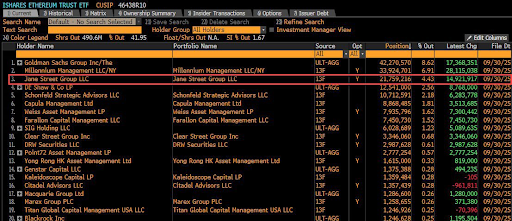
By doing this, the analyst claimed that Jane Street has accumulated billions in BTC. The trading firm is said to hold $2.5 billion worth of BlackRock’s Bitcoin ETF, which is its 5th-largest position. Bull Theory added that this means most of the dump in the Bitcoin price isn’t due to macro weakness but manipulation by this entity. He expects that BTC will continue its upward momentum once these big players are done buying. 

Bitcoin At Risk Of A Decline Post-FOMC

Crypto analyst Ali Martinez indicated that the Bitcoin price was at risk of a significant decline following today’s FOMC meeting. He pointed out that BTC has consistently reacted negatively to FOMC meetings, with six out of seven meetings this year leading to corrections for the flagship crypto. 

The Bitcoin price had rallied to as high as $94,500 yesterday in anticipation of a third rate cut this year from the Fed. According to CME FedWatch, there is currently a 90% chance that the Fed will lower rates by 25 basis points (bps). A CryptoQuant report noted how these rate cuts have turned out to be a ‘sell the news’ event on the two occasions the Fed lowered rates this year, with the probability of this price action playing out again. 

At the time of writing, the Bitcoin price is trading at around $92,600, down in the last 24 hours, according to data from CoinMarketCap.
Bitcoin

The 40-Year Bitcoin Hold: Strategy Exec Reveals How Long The Company Will Hold Over 600,000 BTC

The Chief Executive Officer (CEO) of Strategy, Phong Le, has revealed the company’s long-term approach to its staggering Bitcoin (BTC) holdings. According to the Strategy executive, the firm currently has no immediate plans to sell any of its 650,000 BTC soon. He emphasized that only dire circumstances could force a Bitcoin sell-off—a scenario he projects will not occur for at least 40 years.   

Strategy CEO Confirms 40-Year Bitcoin Hold

In an interview with CNBC on December 6, Le addressed questions about Strategy’s approach to Bitcoin and the future of its massive BTC bet. When asked whether the firm would ever sell its BTC stash of 650,000 tokens ($60.29 billion), Le emphasized that they intended to hold onto their holdings for as long as possible.

The Strategy CEO emphasized that selling would only occur under extreme market conditions, such as losing access to liquidity or US dollars, or if Bitcoin derivatives could no longer be traded. He noted that such a scenario is unlikely until 2065 and, even then, would be considered only in the event of a prolonged 40-year market downturn. 

In another interview earlier this month, Le stated that if there is a sustained 3-year down cycle in Bitcoin in which the mNAV of MSTR trades below 1x, MicroStrategy may have to sell BTC. This means the earliest the company could sell a portion of its massive holdings is in 2029. 

Moving on, the CNBC interview touched on Strategy’s role in public capital markets and whether the company has become a proxy for BTC. Le explained that their Bitcoin treasury strategy, which began in 2020, was designed to give investors access to BTC through public equities. He noted that while the introduction of Spot Bitcoin ETFs in 2024 slightly changed the landscape, Strategy remains a significant part of the crypto and BTC ecosystem. 

Growing FUD And Long-Term BTC Growth

In the interview, Le revealed that Strategy had recently raised $1.44 billion in just over a week for its US dollar reserve, covering 21 months of dividends. The CEO explained that they raised substantial capital to address rising Fear, Uncertainty, and Doubt (FUD) about the company’s ability to meet dividend obligations

Le stressed that, despite the current market downturn, the company had no plans to sell its Bitcoin stash to cover dividends, reassuring investors that its long-term holding strategy remains intact. He supported his views with a historical review of BTC’s broader performance, emphasizing that the leading cryptocurrency has grown by an average of 45% per year over the past five years. 

When asked about his price outlook for Bitcoin, the Strategy CEO expressed confidence in the cryptocurrency’s future, predicting that BTC will likely continue to rise over the next 20 years. He acknowledged that after 20 years, the market could evolve and innovations might emerge, but for now, Bitcoin has a long runway.

Bitcoin

Solana Network Sees 68% Crash In 3 Years, What’s Going On?

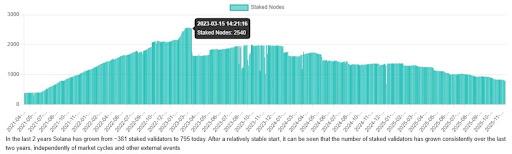
The Solana network has seen its validator count crash by more than 68% over the past three years, falling from thousands of active nodes to just around 800. The massive decline in validators has sparked discussions about whether this could become a threat to the blockchain network or a natural pruning of inactive nodes to increase efficiency. 

Solana loses 68% Of Its Validators In 3 Years

A new report from Criptonocias reveals that Solana has experienced a dramatic decline in the number of its validators, active and non-active, since March 2023. This decrease has raised concerns across the crypto community about the network’s overall health and security

Over the last three years, the Solana network has steadily lost validators, going from 2,500 to 2,100 in November 2022 and now hovering around 800. This decline means the blockchain has lost a total of 1,700 validators. Although this considerable decrease should trigger warning alerts, it could be a result of ledger pruning, which involves removing inactive or redundant nodes to streamline a network and improve its performance without compromising security. 

Notably, validators are crucial for the operation of a blockchain network, as they run nodes, confirm transactions, and help maintain the integrity of the system. Each validator adds to the diversity of the network and reduces the risk of any single entity gaining excessive control.  

Solana

According to the report, some voices in the Solana ecosystem see the reduction of validators in a positive light. They argue that losing “Sybil validators,” which are nodes pretending to be multiple independent operators but are actually controlled by a single party, can be beneficial. Based on this perspective, having a smaller number of reliable and active validators is healthier than maintaining thousands of nodes that do not contribute meaningfully to the blockchain network.

Criptonocias revealed that teams such as Layer 33, which develops infrastructure node tools and provides network services for Solana, point out that many of the validators leaving the blockchain are not Sybils but legitimate node operators. This suggests that the drop in numbers does not automatically equate to improved network quality despite widespread talks about ledge pruning.  

Notably, the potential impact on the Solana network, whether negative or positive, depends on the independence of the remaining validators and the distribution of power among them. An updated report of the validator count reveals that it has dropped again from 800 to 795. 

Solana Faces Liquidity Crunch As Profitability Declines

Amidst its decline in validators, the Solana network is showing signs of strain as liquidity dries up and profitability declines. On-chain data from Glassnode highlights a troubling trend in the network’s trading activity, with the 30-day average realized profit-to-loss ratio remaining below 1 since mid-November. 

This level is typically associated with bear market conditions and points to a growing imbalance between gains and losses among traders. A ratio below 1 also indicates that traders are realizing losses more frequently than profits, underscoring the cryptocurrency’s weakening market sentiment.

Solana

What Ripple’s CEO Appearance At The Banking Committee Means For XRP

Crypto pundit JackTheRippler recently drew the community’s attention to Ripple CEO Brad Garlinghouse’s appearance at the Senate Banking Committee hearing. The CEO spoke about XRP amid his talk on how his company is building the “internet of value.”

Ripple CEO Talks About XRP During Banking Committee Appearance

In an X post, JackTheRippler shared a video of the Ripple CEO at the Banking Committee hearing, where he spoke about Ripple and XRP. Garlinghouse stated that they were building the internet of value, where money moves as easily as information. He added that their payment services were made possible through the use of the XRP Ledger (XRPL) and its native token XRP. 

The Ripple CEO further noted that XRP is built to enable fast, low-cost, and highly scalable transactions, which makes it suitable as the bridge currency for their cross-border payment services. Garlinghouse made these comments in relation to his testimony on the need for “smart” crypto regulations, including market-structure legislation, to eliminate regulatory uncertainty and advance innovation in the U.S. 

The CEO mentioned that his company was among the notable victims of the previous SEC administration’s regulation-by-enforcement approach. The commission had sued the crypto firm, arguing that XRP was a security and that the firm had violated securities laws through institutional sales of the token. 

However, as the CEO noted, Judge Torres ruled that XRP was not a security in itself. Garlinghouse believes that the crypto market structure legislation will help the crypto industry progress while also protecting consumers, like XRP holders, who were affected by the SEC vs. Ripple lawsuit. XRP’s price was affected by uncertainty about its legal status at the time of the lawsuit, which spanned over four years. 

DAS Research Provides Bull Case For XRP

In an X post, market expert Stern Drew highlighted a report from DAS Research, which provided a bull case for XRP. Drew highlighted how the report stated that XRP and Ripple are no longer competing in crypto. Instead, they are evolving into a global payment infrastructure, which will be adopted by banks, fintechs, and cross-border networks that demand speed, scale, and settlement certainty. 

Drew further pointed out three core realities highlighted by the report. The first is that XRP is said to have the structural advantage with fast settlement, low cost, being a neutral bridge asset on a globally distributed ledger, and with institutional-grade reliability. 

The expert noted that this is why adoption is rising among enterprises that need predictable value transfer. The other two realities are Ripple’s integration of the RLUSD stablecoin and its institutional partnerships, which will help boost XRP’s utility. 

At the time of writing, the XRP price is trading at around $2.08, up in the last 24 hours, according to data from CoinMarketCap.
XRP

More Details On The Wall Street $500 Million Investment In XRP

Ripple’s most recent funding round has become one of the biggest crypto-related deals of the year, mainly because of who joined in and how the deal was structured. 

According to details shared in Bloomberg’s report, major Wall Street names, including affiliates of Citadel Securities, Fortress Investment Group, Brevan Howard, and Galaxy Digital, put $500 million into Ripple, giving the company a valuation of around $40 billion. This instantly turned the round into one of the strongest signs yet that traditional finance is taking a serious interest in the XRP ecosystem.

How Wall Street Structured The Deal To Protect Themselves

In early November 2025, Ripple closed a major private equity round that injected $500 million into the company, resulting in a valuation of roughly $40 billion. However, new details show that the most surprising part of the transaction is not the amount raised but the agreement behind it. Bloomberg reports that investors in this round did not simply buy Ripple shares and hope the value rises. Instead, they secured built-in protections that guarantee them profits later.

They were given the right to sell their shares back to Ripple in three to four years at a 10% yearly return, unless Ripple goes public before then. At that rate, Ripple would need to pay roughly $732 million to buy the shares back after four years. That means even if Ripple’s valuation stays flat or drops, the investors still walk away with guaranteed gains.

However, if Ripple decides to buy the shares back earlier, the investors get an even higher payout of around 25% annualized rate. A liquidation preference was also included, meaning these investors get paid first if anything goes wrong. Ripple noted in its announcement of the investment round that it has repurchased more than 25% of its outstanding shares over the past few years.

Why The Deal Is Really A Bet On XRP

Even though the investors bought equity in Ripple, not XRP itself, most of Ripple’s value still comes from its massive XRP holdings. According to Bloomberg, two of the funds that put in money noted that at least 90% of Ripple’s net value is tied to XRP. As of July 2025, Ripple held around $124 billion worth of XRP, although most of its XRP holdings are held in escrow.

This means the investment round, in reality, is also a bet on XRP’s long-term relevance and future market strength. If the price of XRP grows, Ripple benefits, and so do the investors who now hold equity backed by a company sitting on one of the world’s largest digital asset reserves. 

However, the $500 million investment does show that serious investors believe Ripple will continue growing, but just that Ripple’s success is still directly linked to the XRP price.

XRP

❌