Reading view

There are new articles available, click to refresh the page.

Solana’s Long-Awaited Firedancer Launch Sparks 5% Rally

Solana’s network took a notable step this week as Firedancer, a validator client developed by Jump Crypto, began running on the mainnet, and markets reacted quickly.

According to Solana’s announcement, the client moved out of a controlled testing phase and is now active for real-world validation.

Traders pushed SOL up about 5%, with the token trading close to $140 during the initial move.

Firedancer Goes Live On Mainnet

During more than 100 days of controlled tests, a small set of validators produced more than 50,000 blocks without downtime, according to reports. Built in C and C++, Firedancer was made to handle heavy workloads and to lower the chance of network interruptions.

Test environments reportedly showed the client processing over 1 million transactions per second, a figure that far exceeds current mainnet throughput.

BREAKING: After 3 years of development, Firedancer is now live on Solana Mainnet, and has been running on a handful of validators for 100 days, successfully producing 50,000 blocks 🔥💃 pic.twitter.com/Y0WxxEj2WL

— Solana (@solana) December 12, 2025

That high number comes from lab-style tests, not live traffic, and should be read as experimental performance rather than everyday capability.

Solana co-founder Anatoly Yakovenko marked the transition as a step out of a long beta cycle for the network.

Early Adoption And Stake

Adoption is still small in terms of stake. The first Firedancer nodes hold under one percent of total staked SOL, and that share is expected to grow as operators add it to their setups.

Reports have disclosed that a December rollout prompted more than 20% of validators to move from earlier experimental clients, showing a rapid shift among some operators.

Running multiple validator clients reduces dependence on a single software implementation. If one client encounters a bug, others can keep block production running. That diversity mirrors how other large proof-of-stake chains operate.

Why This Matters For Validators And Apps

Validators and developers stand to benefit if Firedancer keeps meeting its goals. Faster or more reliable validation could mean more capacity for apps that need many transactions per second.

For node operators, the option to mix clients offers an added safety net. Still, the network’s real-world load will be the true test, and watchers say they will be looking at uptime and performance over the coming weeks.

Market Moves And Technical Signals

The announcement coincided with a clear market flow into SOL. Reports have disclosed $11 million in inflows to Solana ETFs on the day of the news, while Bitcoin saw outflows of $77.30 million and Ethereum $42.35 million.

Featured image from Phantom, chart from TradingView

Binance And HTX Get Regulatory Nod To Operate In Pakistan – Details

Pakistan’s Virtual Assets Regulatory Authority has issued “No Objection Certificates” (NOC) to Binance and HTX, allowing both platforms to begin formal steps to operate inside the country.

The clearances do not amount to full licenses. They instead permit preparatory work such as registering with the country’s anti-money-laundering system and setting up local units before full license applications are filed, reports disclosed.

Tokenization Deal And Local Ties

Based on reports, the finance ministry said the NOCs could cover government bonds, treasury bills and some commodity reserves. The move is aimed at creating new ways to raise liquidity and to open government assets to wider markets through blockchain-based tokens.

Pakistan takes a decisive step toward a regulated digital asset future.

Pakistan Virtual Assets Regulatory Authority (PVARA) has issued NOCs to Binance and HTX, launching a phased, FATF-aligned pathway toward full licensing. Strong governance, AML and CFT compliance remain… pic.twitter.com/jSk6JTqvFt

— Pakistan Virtual Assets Regulatory Authority (@PakistanVARA) December 12, 2025

A Shift Toward Formal Oversight

Officials from the virtual-assets authority said they examined governance, risk controls and compliance frameworks before granting the early approvals. These NOCs let the exchanges connect to Pakistan’s AML systems and coordinate with the Securities and Exchange Commission to set up regulated subsidiaries. That review was described as part of a phased licensing system meant to align local rules with global standards.

Partnerships And Local Players Move Fast

Local payments firms and government bodies are being brought into talks. One public statement from a Pakistan-based payments group said the aim is to study how regulated virtual-asset access could expand financial services for ordinary users, while keeping track of risks. Commercial ties like these could speed up customer access if full regulatory approval follows.

How Big Is Pakistan’s Crypto Scene?

Based on reports, Pakistan ranks third globally in retail crypto activity. That ranking has helped push the authorities to build a formal regime quickly.

Officials say the new framework will be backed by a Virtual Assets Act and other measures, including plans for a pilot central bank digital currency and closer work on stablecoins. The intent is to bring trading and payments under clearer oversight while attracting compliant investment.

What Comes Next

Binance and HTX must still meet full licensing conditions before they can offer trading to the public.

The NOCs are an opening move. Full permissions will depend on how well each firm satisfies the regulator’s detailed checks and how the proposed Virtual Assets Act is implemented.

Markets may react to progress on tokenization and any future licensing milestones, but for now the country has signaled a clear shift from informal activity to regulated market access.

Featured image from Unsplash, chart from TradingView

Binance’s USD1 Stablecoin Push Deepens Relationship With Trump’s Crypto Platform

Binance, the world’s largest crypto exchange, has broadened support for USD1, the stablecoin tied to World Liberty Financial and US President Donald Trump’s crypto ventures, reports disclosed. The exchange added new spot pairs including ETH/USD1, SOL/USD1 and BNB/USD1, and enabled fee-free swaps between USD1 and other major stablecoins.

Binance Will Shift Collateral Into USD1

The exchange will convert all collateral backing its Binance-Peg BUSD (B-Token) into USD1 at a 1:1 ratio, a process the company said should be completed within one week. This change means USD1 is being folded into its internal collateral and liquidity systems rather than remaining only a tradable token.

Market Reaction And Liquidity Effects

Traders reacted quickly. Price moves in BNB and other tokens showed more buying interest after the announcement. Market data snapshots suggested a short-term uptick in BNB as liquidity and trading routes were expanded by the new USD1 pairs. Reports put the token’s wider market use and the platform’s zero-fee swaps as the likely drivers.

Binance to Add BNB/USD1, ETH/USD1 Trading Pairs; B-Token Collateral to Be Converted to USD1

According to an official announcement, @binance will list new spot trading pairs BNB/USD1, ETH/USD1, and SOL/USD1 at 16:00 (UTC+8) on December 11, 2025. At the same time, Binance will… pic.twitter.com/mIPrkiR3Lj

— ME (@MetaEraHK) December 10, 2025

Backing, Size, And Recent Deals

According to public filings and market trackers, USD1 is backed by US Treasury bills, cash and equivalents and is redeemable at a one-for-one rate with the dollar.

The stablecoin has grown quickly and is now listed among the larger stablecoins by market cap, with figures around $2.7 billion cited in recent summaries. Reports have also linked USD1 to a major Abu Dhabi investment that used the token for a $2 billion deal.

Political Context And Scrutiny

These commercial moves come after a politically charged episode: Trump granted a pardon earlier this year to Binance’s former CEO, an action that critics say raises questions about ties between Binance and the Trump family’s crypto interests.

That sequence of events has drawn scrutiny from lawmakers and commentators, who are asking for more transparency around the deals and any possible conflicts of interest.

Company spokespeople have issued short statements denying that any political favors were sought or exchanged to secure deals. Binance said its public notices focused on product rollouts, trading schedules and incentives like zero fees for certain users, while World Liberty Financial emphasized the reserve backing behind USD1.

Featured image from Unsplash, chart from TradingView

Not Just Crypto: Research Says XRP Is Moving Into Bank-Grade Payment Infrastructure

XRP is being positioned as something more than a trading asset as analysts point to signs suggesting it may be shaped for financial infrastructure over time.

A report from Digital Asset Solutions (DAS) highlights three main points behind this shift, tying the altcoin’s technical setup to Ripple’s work on stablecoins and regulated payment rails.

Structural Edge For XRP

Reports have disclosed that XRP offers several qualities that matter to companies moving money across borders. It settles fast, costs little to send, and works as a neutral bridge asset between different currencies.

Ripple’s ledger is described as reliable and globally distributed, which is why some enterprises are testing it for predictable transfers. However, many firms still use RippleNet without using the crypto directly, so broad bank-level usage has not taken hold.

🚨 DAS Research just laid out the clearest confirmation yet of where XRP is heading

Their analysis shows XRP and Ripple are no longer competing in crypto. They are evolving into global payment infrastructure, the kind used by banks, fintechs, and cross border networks that… pic.twitter.com/ZwqUD68Qur

— Stern Drew (@SternDrewCrypto) December 9, 2025

The research frames these features as the first major factor behind the digital asset’s potential role in global payment flows. The traits are real, but adoption varies and has not yet reached large commercial scale.

Stablecoins And XRP Working Together

Ripple plans to use RLUSD as a fiat-backed anchor while relying on the crypto to provide liquidity between different corridors.

The concept is simple: Stablecoins maintain price stability tied to fiat, while XRP acts as the connector for moving value across currencies. This pairing is presented as the second major point in DAS Research’s findings.

Ripple Prime, ZK-enabled identity tools, and licensing efforts are being built to meet compliance requirements from regulated institutions.

Early RLUSD corridors have started to appear, but the level of real-world transaction volume remains small compared to the broader payments industry.

Catalysts Forming In The Background

The final point focuses on developments that analysts believe could help XRP move closer to regulated financial rails.

RippleNet partnerships are growing, institutional custody services are improving, RLUSD integrations are underway, and conversations around possible ETF structures have emerged.

Each of these adds some weight to the idea that XRP may gain a deeper role in payment systems in the future. Some of these steps are active today, while others remain early discussions. Custody upgrades, for example, are happening across the crypto sector, not only for the altcoin.

While procedural steps like exchange listings and filings have progressed for multiple XRP ETF proposals, the US Securities and Exchange Commission has not yet given formal approval to a spot XRP ETF. Even so, these developments show how Ripple is preparing for broader institutional use.

Featured image from Unsplash, chart from TradingView

Crypto Has Changed — CFTC Withdraws Years-Old Virtual Currency Rules

The Commodity Futures Trading Commission announced on Dec. 11, 2025 that it has withdrawn its 2020 interpretive guidance on when a crypto trade counts as “actual delivery,” a move the agency said responds to major changes in crypto markets and trading practices.

According to the CFTC press release, Acting Chairman Caroline D. Pham called the guidance “outdated and overly complex” and said removing it will help promote access to safer US markets.

Actual Delivery And The 28-Day Test

According to the 2020 rulebook and federal filings, the CFTC’s earlier guidance treated a retail crypto trade as excluded from futures-style rules if the asset reached the buyer’s control within 28 days of the transaction — a technical standard used to decide whether a deal was a spot sale or a regulated futures-style transaction.

That guidance included examples showing when transfer on a public ledger or control over a wallet would or would not count as actual delivery. The 28-day reference is rooted in the Commodity Exchange Act’s existing exceptions and was central to how many platforms structured retail offerings.

More news from the CFTC! It previously published guidance the interpretation of “actual delivery” in the context of retail commodity transactions in crypto. This is imp because if a trans qualifies as AD, it is NOT regulated as a futures contract. /1 https://t.co/L2U46VRbQl

— Katherine Kirkpatrick Bos (@kkirkbos) December 11, 2025

Industry Reaction And Risk

Reports have disclosed that many market participants greeted the withdrawal with relief, saying it gives exchanges more room to design products and operate without a narrow staff interpretation dictating settlement timing.

Some lawyers and platform staff argued the 2020 tests made it hard for venues to offer certain customer-facing services unless they met strict delivery steps.

At the same time, legal observers warned that pulling the guidance without a clear replacement leaves open questions about how regulators will treat similar trades going forward, and which platforms must register as futures venues.

How The Move Fits In Politically

Based on reports, the action was framed as part of policy priorities under US President Donald Trump’s administration to modernize rules that affect digital asset markets.

The CFTC said the change lines up with broader interagency efforts and public engagement initiatives the agency has been running this year. That framing has prompted renewed attention from exchanges, trading firms, and lawmakers who are watching for any follow-up steps.

The CFTC signaled it may seek public input and consider new materials to replace the withdrawn guidance, including FAQs or fresh interpretive notes.

Market operators will now weigh operational changes and legal advice as they decide whether to alter product design or customer terms.

Some firms are expected to adjust custody and transfer procedures, while others may wait for clearer written standards before making big changes.

Featured image from Quality Company Formations, chart from TradingView

Fed Cut Lights The Fuse: Bitcoin Rebounds And Bulls Predict More Upside

Crypto markets saw a modest lift after the US Federal Reserve made another move on rates, and traders are watching for a clearer follow-through. According to reports, the Fed has carried out three consecutive interest rate cuts totaling 0.75% from September to December. The move was widely expected. Still, market responses have been mixed and somewhat choppy.

Fed Moves And Market Takeaway

According to CoinEx chief analyst Jeff Ko, much of the Fed’s action was already priced in, and the updated dot plot leaned a bit more hawkish than some had hoped.

Ko pointed to $40 billion in short-term Treasury purchases as a technical step to ease liquidity and lower short-term rates, not as a broad stimulus program.

Markets took the measures as mildly positive. US stocks rose, and that helped Bitcoin find some footing after an early dip.

Santiment And The Short-Term Reaction

Based on reports from onchain analytics firm Santiment, each cut has prompted a classic “buy the rumor, sell the news” move where initial optimism is followed by short selling.

🇺🇸 The US Fed made three strategic cuts over the past 3 months, resulting in a total of an 0.75% reduction to interest rates.
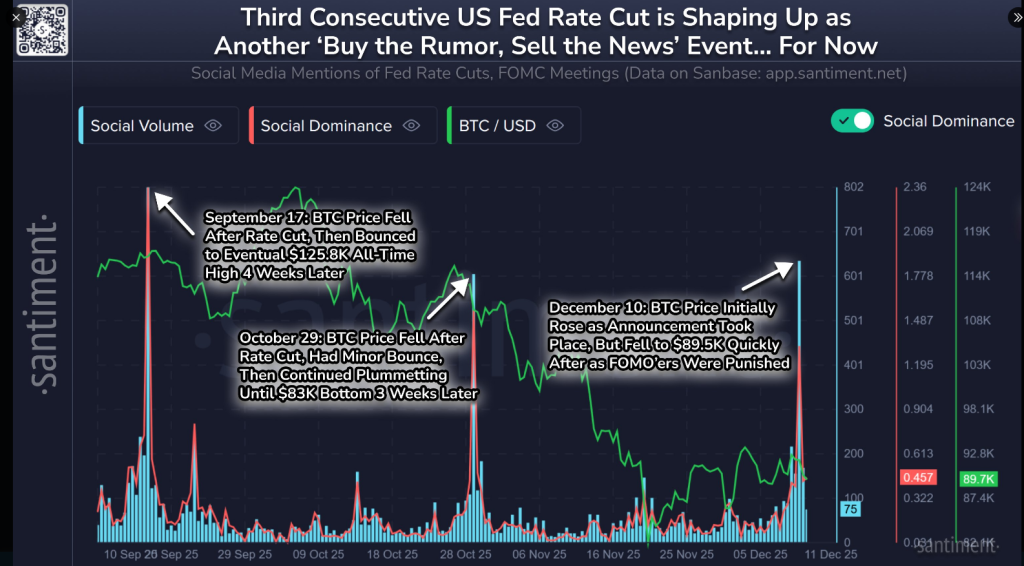
1⃣ September 17, 2025: Fed lowered the target range to 4.00 %–4.25 % (from 4.25 %+) at the 16–17 Sep meeting.

2⃣ October 29, 2025: Fed cut the rate to… pic.twitter.com/X6DWypvq5t

— Santiment (@santimentfeed) December 11, 2025

Cuts are seen as bullish for crypto over the long haul, yet they have triggered brief pullbacks in practice. Santiment adds that a small wave of FUD or retail selling often signals that the mild post-cut downswing is finished and a bounce may follow once things calm down.

Technical Levels Traders Are Watching

Bitcoin was volatile in the aftermath. It fell under $90,000 then popped to $93,500 on Coinbase before settling near $92,300 at the time of reporting. Key resistance sits between $97,000 and $108,000.

On the daily chart, BTC remains inside a small rising channel that sits within a larger downtrend, and technical traders note that a MACD histogram is approaching a positive crossover — a sign some see as possible renewed momentum.

ETF activity has been tepid, with only $219 million in net inflows since late November, which keeps some investors cautious.

Dollar Weakness And Equity Signals

A weaker dollar has been part of the backdrop; the DXY index fell to 98.36 and is showing bearish momentum on its own MACD.

Nasdaq’s move back above its 50-, 100- and 200-day simple moving averages helped lift risk assets briefly, and that has supported Bitcoin’s rebound attempts.

Yet correlation with equities remains uneven — losses in stocks tend to hit Bitcoin harder than gains help it, creating an asymmetric risk profile for traders.

Featured image from Impossible Images, chart from TradingView

YouTube Goes Crypto: PYUSD Stablecoin Payout Option Now Live For US Creators

YouTube has quietly added a new payout option that lets creators in the US receive earnings in PayPal’s dollar-pegged token, PYUSD. According to several reports, the change appears to be active now and is being offered through PayPal’s payout rails rather than through any direct crypto custody by YouTube.

How The Option Works

PayPal’s head of crypto, May Zabaneh, confirmed the setup to Fortune and said the company uses its existing payout network to deliver PYUSD to recipients who opt in.

That means YouTube will still calculate and send creator earnings in dollars to PayPal’s system, and PayPal is then responsible for the conversion to the stablecoin and distribution to creators. The move builds on PayPal’s broader push to offer stablecoin tools to businesses and individual users.

PYUSD was introduced by PayPal in 2023 and has since been plugged into services such as Venmo and PayPal’s merchant tools. Reports have made clear that YouTube itself is not holding or moving crypto on behalf of creators; PayPal handles the token side.

Scope And Availability

For the moment, the option is available only to creators based in the US. A Google spokesperson confirmed the rollout but declined to share a schedule for any expansion beyond American users.

Creators who qualify for YouTube’s monetization programs may be able to opt into the new payout method for monthly earnings like ad revenue and paid memberships.

Some creators will value the extra choice. Receiving PYUSD could let a creator hold a dollar-pegged token onchain, spend it where PayPal tools accept it, or convert back to fiat through PayPal.

There are tradeoffs: holding a stablecoin brings different custody and tax considerations than a straight bank transfer. Reporting systems and bank rules may differ depending on how the creator finally cashes out.

What Creators Should Expect

The signup step should be familiar to anyone who already uses PayPal payouts on YouTube; it will likely appear as an alternative payment method in creator settings.

Once chosen, payments will flow through PayPal’s established payout system and show up as PYUSD in the recipient’s compatible wallet or PayPal balance, per the descriptions circulating in the trade press.

PYUSD In Numbers

PYUSD’s onchain presence has grown rapidly. Market trackers list the stablecoin with close to $4 billion in circulating value and roughly 3.8 billion tokens in supply at the moment, figures that underline how much the token has expanded since launch.

Featured image from Unsplash, chart from TradingView

Do Kwon Falls Hard — Terraform Labs Chief Gets 15 Years For Wire Fraud

Do Kwon, the South Korean co-founder of Terraform Labs, was sentenced to 15 years in prison on December 11, 2025 in a Manhattan federal court after pleading guilty to fraud tied to the collapse of the TerraUSD stablecoin and its sister token, Luna.

According to court documents and news reports, the judge described the scheme as a massive fraud that left thousands of investors facing heavy losses.

Sentence And Court Ruling

Judge Paul A. Engelmayer handed down the 15-year term after prosecutors urged for a sentence of up to 12 years and the defense asked for a much lighter term.

Do Kwon pleaded guilty in August 2025 to conspiracy to defraud and wire fraud, and as part of the plea he agreed to forfeit roughly $19 million.

The US Attorney’s office says the guilty plea admits he misled investors about how the stablecoin kept its $1 peg.

Scale Of The Losses

Reports have placed the market fallout from the Terra collapse at about $40 billion in erased value. Many ordinary investors lost life savings and some victims gave emotional testimony at sentencing, describing real financial ruin.

News outlets and court filings tie the crash in May 2022 to a sudden loss of confidence that cascaded through markets and hurt other crypto firms.

Civil Penalties And Settlements

Before the criminal case reached this point, Kwon and Terraform faced a major civil action from the US Securities and Exchange Commission.

According to the SEC, Terraform Labs and Kwon agreed to pay more than $4.5 billion in disgorgement, interest and penalties, while Kwon personally faced an $80 million civil fine and a ban from crypto trading.

That civil judgment was filed in 2024 and has been used by regulators as part of the overall effort to make investors whole.

International Arrest And Extradition

Kwon was arrested in Montenegro in March 2023 after leaving Singapore; authorities say he was using forged travel documents when detained.

He fought extradition in Montenegrin courts but was eventually transferred to the US late in 2024 to face federal charges. Reports outline a long legal fight across borders that ended with his return to New York to answer criminal counts.

What The Sentence Means

Legal analysts say a 15-year term signals the court’s view that the fraud caused wide damage and that punishment should deter similar schemes. Victims’ statements at sentencing appear to have weighed heavily.

Kwon still faces separate probes and possible charges in other countries, and the civil judgment means substantial sums are earmarked for recovery efforts tied to Terraform’s bankruptcy.

Featured image from Getty Images, chart from TradingView

Satoshi Lives Again: NYSE Unveils Statue That Vanishes Before Your Eyes

Satoshi Nakamoto, the pseudonymous creator of Bitcoin, has been honored with a new “disappearing” statue installed at the New York Stock Exchange this week.

According to reports, the piece was placed by investment firm Twenty One Capital and is part of a broader public art effort linking Bitcoin’s cultural presence with major financial sites.

Installation And The Artist

The sculpture was made by Italian artist Valentina Picozzi and is built so that it appears nearly invisible from certain angles, then clearly forms when seen from the side.

“Satoshi Nakamoto” Valentina Picozzi – @satoshigallery

Twenty One Capital places a statue of Satoshi Nakamoto, the inventor of bitcoin, in NYSE. Its new home marks a shared ground between emerging systems and established institutions. From code to culture, the placement… pic.twitter.com/sTiNq3h5HY

— NYSE 🏛 (@NYSE) December 10, 2025

The work took about 21 months to design and build, and this NYSE placement is the sixth of a planned series of 21 monuments scattered around the globe. The layered-metal technique creates the optical effect that mirrors Satoshi’s elusive identity.

Past Incidents And Recovery

The statue’s arrival at Wall Street follows earlier headlines tied to the same design. In August, a version of the disappearing Satoshi in Lugano was briefly missing after being taken and later recovered from Lake Lugano, with the recovery drive boosted by a 0.1 BTC reward offered by the art collective behind the pieces.

This is such an achievement, even in our wildest dream we wouldn’t think about placing the statue of Satoshi Nakamoto in this location!

The 6th/21 statues of Satoshi Nakamoto found its home in the NYSE.

Thank you 🤩 https://t.co/iIEvZawAte

— Satoshigallery (@satoshigallery) December 10, 2025

Reports have disclosed that municipal workers found the sculpture in pieces, and the episode drew attention to the artwork’s symbolic value and physical fragility.

Market Reaction To The Installation

Trading and market news have shown a mixed response to the spectacle. Reports indicate that Twenty One Capital, which organized the NYSE installation, saw its shares fall about 19% during its trading debut, an early sign that symbolic moves do not always calm investor nerves. Some coverage framed the firm as a multibillion-dollar company while noting the sharp initial swing in its stock.

Where is Satoshi?

We are offering 0.1 btc to whoever will help us recovering the Statue of Satoshi Nakamoto that was stolen yesterday in Lugano.

You can steal our symbol but you will never be able to steal our souls.

Thank you all for the nice messages.

We are all in this… https://t.co/cAGCqg4CuP pic.twitter.com/iGrBOdVYhe

— Satoshigallery (@satoshigallery) August 3, 2025

What This Means For Cultural Adoption

According to market and cultural commentators, placing the Satoshi statue at the NYSE signals growing acceptance of Bitcoin imagery by established institutions.

The move places a public symbol of the cryptocurrency inside one of the oldest trading venues in the US, and that contrast is being read as an example of how ideas from digital currency culture are entering mainstream spaces.

Observers say the artwork functions as both tribute and provocation, inviting debate about anonymity, value, and public memory.

What To Watch Next

Reports have noted that more of the planned installations will appear in other cities, bringing the total project aim to 21 locations.

Other institutions’ reactions remain to be seen, including whether additional major venues will host similar statues and how public opinion may shift following the recent theft and recovery in Switzerland.

The disappearing sculpture now stands as a real-world example of how art connected to the cryptocurrency world interacts with public spaces.

Featured image from Advance Innovations, chart from TradingView

UAE Telecom Powerhouse Embraces Dirham Stablecoin In New Payment Trial

e& UAE, United Arab Emirates’ telecom giant, has signed a memorandum of understanding with Al Maryah Community Bank to trial AE Coin, a Central Bank-licensed stablecoin, as a payment option across the telco’s services.

According to company statements, the plan would let customers use an AED-backed token to pay for mobile and home-service bills, prepaid and postpaid recharges, and purchases on e& digital platforms.

Integration Across Consumer Touchpoints

Reports have disclosed that e& Group aims to plug AE Coin into its existing payment systems. The move would add the stablecoin as an alternative to cards and bank transfers on e&’s mobile apps and at smart self-service kiosks.

e& UAE’s CEO, Hatem Dowidar, said the partnership with Al Maryah Community Bank will allow “instant settlement, complete transparency, and frictionless access” — language that signals the operator expects quicker finality and clearer audit trails for transactions.

For many users, that could mean fewer delays and simpler proof of payment when calling or browsing for services.

What The Partners Say

Based on reports, Al Maryah Community Bank’s chief executive, Mohammed Wassim Khayata, said the collaboration widens real-world uses for licensed virtual assets and opens the door to faster, more secure options for everyday payments.

Ramez Rafeek, General Manager of AED Stablecoin LLC, described AE Coin as created to support regulated and transparent digital payments.

Those comments frame the trial as an attempt to move a regulated token from niche experiments into mass consumer use. The pilot will start within selected e& channels; no national rollout timetable has been disclosed.

Potential Impact On Users And The Market

Analysts and payments experts say a telecom of e&’s size could quickly expose millions of customers to stablecoin payments if the test succeeds.

According to the companies involved, integrating AE Coin would cover prepaid top-ups and postpaid billing, which are high-frequency transactions that could provide an immediate test bed for volume and reliability.

Observers note that real adoption will hinge on how easy customers find the process, how wallets are managed, and whether merchants accept the token beyond e&’s own services.

Alignment With National Goals

Reports indicate the trial fits into the UAE’s push for regulated blockchain payments and a less cash-dependent economy.

Regulators have been encouraging licensed solutions, and using a Central Bank-approved stablecoin inside a major consumer network sends a clear signal that authorities are open to controlled innovation.

If adopted more widely, the token could serve as another regulated payment choice alongside existing systems.

Featured image from Unsplash, chart from TradingView

SpaceX $94M Bitcoin Move Triggers Questions About IPO Timing

SpaceX moved 1,021 Bitcoin worth about $94.48 million on December 10, according to on-chain alerts from blockchain trackers. The transfer was sent to wallets tied to Coinbase Prime, raising questions about whether the company is reshaping part of its treasury while attention grows around its potential public listing.

Ledger Shuffle Raises Questions

Reports have disclosed that this move is only the latest in a series of large bitcoin transfers involving wallets believed to be linked to SpaceX.

Analysts tracking the transactions say the pattern looks more like a shift into institutional custody rather than an immediate market sale, since Coinbase Prime is commonly used for storage and structured trades by large companies.

SpaceX is estimated to hold around 8,285 BTC, a stash worth roughly $770 million based on recent market prices. That amount places the company among the biggest private holders of bitcoin.

Records show the balance was once higher during 2022, though part of it has been reduced over time as transfers continued.

SpaceX(@SpaceX) just transferred out another 1,021 $BTC($94.48M), to possibly Coinbase Prime for custody.https://t.co/zW62EKM2RD pic.twitter.com/PwBIvD5RaR

— Lookonchain (@lookonchain) December 10, 2025

SpaceX: IPO Talk Adds Pressure

At the same time, reports from major outlets say SpaceX is preparing for an initial public offering that could take place in 2026.

Coverage has suggested the fundraising round may target tens of billions of dollars, and estimates of the company’s possible valuation range from $800 billion to more than $1.5 trillion.

Elon Musk reacted on social media to one of the reports, saying the information was accurate, which added more weight to expectations that a listing is being planned.

Because companies often adjust their balance sheets ahead of a public offering, analysts say moving crypto into institutional platforms would not be unusual. It can be done for audits, custody needs, or overall treasury preparation before large financial transactions.

What The Move Might Signal

A transfer into Coinbase Prime does not automatically mean a bitcoin sale is underway. Institutional accounts can hold assets for long periods without sending them directly to the open market.

Traders watching the activity say that only an actual sale — not a custody transfer — would create immediate pressure on Bitcoin prices.

Still, the timing stands out. The latest 1,021 BTC move comes during a period where SpaceX’s on-chain activity has increased. More transfers may follow if the company continues preparing documents and financial disclosures linked to a potential public listing.

The main question now is whether the recent shift was routine treasury work or part of a larger strategy connected to the IPO.

SpaceX has not issued a public statement on the transaction, leaving analysts to rely on blockchain data and regulatory reporting to understand what comes next.

Featured image from Unsplash, chart from TradingView

Is Dogecoin Waking Up? Critical On-Chain Metric Explodes Higher

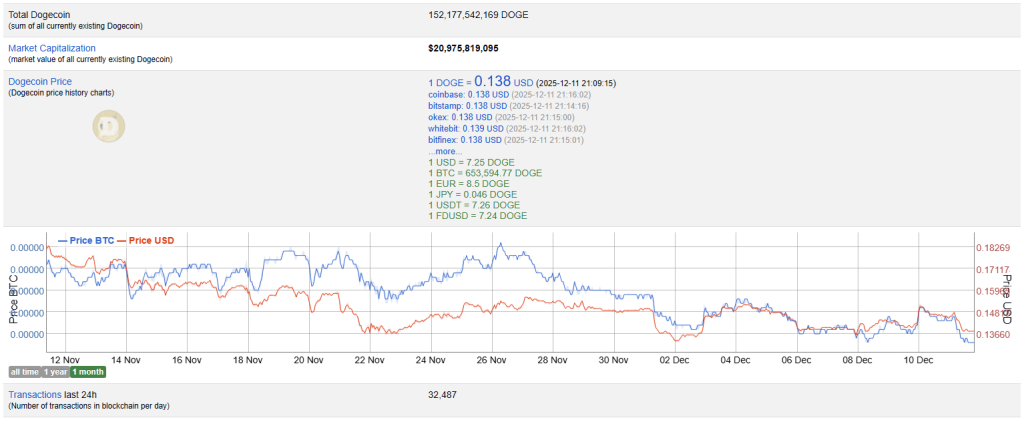
Dogecoin rose 4% to trade at $0.14 Thursday, according to market reports. Market capitalization was about $21 billion while 24-hour trading volume hovered near $1.6 billion. The move followed renewed on-chain activity that has drawn attention from traders and analysts.

Spike In Active Wallets

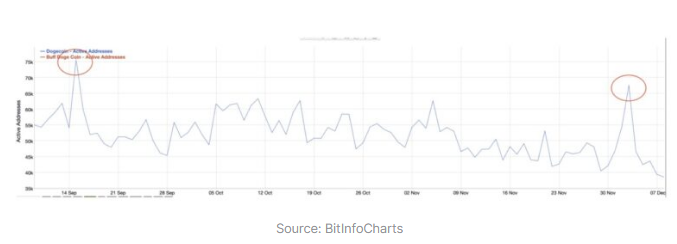
Based on reports from BitInfoCharts, the number of daily active addresses on the Dogecoin network jumped to over 67,500 on December 3, marking the second-highest reading in the past three months.

That earlier spike on September 15 came as DOGE briefly approached a local top near $0.30. At that time, network activity rose as prices climbed; today, rising wallet activity is being watched closely as prices test a familiar zone after a long slide.

Support Holding Near $0.14

Dogecoin is sitting above an important area around $0.138–$0.14, which has been tested and defended multiple times. Reports show the token has bounced off that level before, and trading volume has more than doubled during the most recent uptick, a sign that buying interest is growing.

Market feeds also report mixed short-term figures: one line shows the token down by 5% in a week while another notes a 7.5% decline over the last week; those numbers do not align and highlight some reporting inconsistencies. Longer-term data show the token has lost roughly 60% over the past year and is about 50% off its recent highs.

Volume And Technical Targets

Traders are eyeing $0.16 as the next meaningful resistance. Based on reports, a decisive move above that zone would be the first clear break in the short-term bearish pattern. Beyond that, the 200-day exponential moving average sits as a broader target, often watched for signals that medium-term momentum has shifted.

A break above the 200-day EMA would be treated by many as confirmation that a recovery could gain traction, although history shows these signals sometimes reverse quickly.

Signals Are Mixed

Daily active address spikes can point to rising interest. They can also reflect simple transfers, bot traffic, or wallet reshuffles by large holders. Increased volume helps the case for buyers, but active-address readings alone are not foolproof.

The current setup looks like a battleground: both bulls and bears are more active than they were a few weeks ago. That activity makes the coming days important for traders who favor short-term moves.

Fed Meeting Adds A Macro Angle

Meanwhile, this week’s Federal Reserve meeting has added an extra element of uncertainty. Market participants are parsing comments for signs of a rate cut, which many expect would lift risk assets, including cryptocurrencies.

A shift in rate policy would likely move the broader market more than any single on-chain metric for one token.

Featured image from Unsplash, chart from TradingView

MSCI Criticized For Bitcoin Omission: “It’s Like Faulting Chevron For Oil”

MSCI has launched a consultation on whether companies with significant cryptocurrency or Bitcoin holdings should be excluded from some of its main indices, sending waves through markets that track those indexes.

According to reports, the consultation targets firms whose balance sheets are more than 50% invested in digital assets. Phong Le, CEO of Strategy, argued in interviews that the move is “like penalizing Chevron for oil,” saying that holding an asset should not disqualify an operating company from broad market indices.

Impact Estimates Suggest Billions Could Move

Based on reports from banks and analysts, the potential impact could be large. JPMorgan estimates show that MSCI-only adjustments might trigger forced selling of about $2.8 billion, while the figure could climb to $8.8 billion if other index providers follow suit.

Stocks of companies holding Bitcoin have already felt pressure. Strategy (ticker MSTR), the largest corporate Bitcoin holder, has been in direct talks with MSCI, seeking to clarify its position and prevent removal from key indexes.

Phong Le joined @SchwabNetwork to discuss the $60T digital credit opportunity and response to MSCI. Restricting passive index investment in bitcoin today would be like restricting investment in oil and oil rigs in the 1900s, spectrum and cell towers in the 1980s, or compute and… pic.twitter.com/3VcYnF5nE4

— Strategy (@Strategy) December 10, 2025

Who Could Be Affected And Why

The review focuses on so-called “digital-asset treasury” firms — companies that might behave more like investment vehicles if a large portion of their assets sits in cryptocurrency.

According to circulated consultation documents, the 50% threshold defines the most extreme cases. Some analysts warn the cutoff is blunt and could misclassify companies that run genuine businesses while using crypto as a treasury reserve.

Industry Groups Mobilize

A coalition of bitcoin-focused companies and trade associations has publicly opposed the move. They argue that excluding these firms would force passive funds tied to MSCI indexes to sell holdings mechanically, even when they are part of operational businesses.

Reports have disclosed letters, interviews, and lobbying efforts aimed at influencing MSCI’s final decision. Market participants say the pushback highlights the tension between traditional index rules and companies with unconventional asset allocations.

Decision Timeline Could Trigger Market Moves

The consultation window is expected to close around Dec. 31, 2025, with some reports suggesting MSCI could announce a decision by mid-Jan 2026.

If the exclusions are enforced, passive funds tracking MSCI indexes may need to rebalance, which could create mechanical selling pressures for affected stocks. However, feedback during the consultation could still alter the outcome before any final rules are adopted.

Bitcoin Investors Face Key Questions

Beyond short-term market moves, investors now face questions about which listed firms cross the 50% threshold, how indices should treat non-traditional assets, and whether other index providers will adopt similar rules.

The choices MSCI makes could affect billions of dollars in flows and reshape how publicly traded companies approach holding cryptocurrency.

Featured image from Unsplash, chart from TradingView

American Bitcoin Makes Big Buy, Adds 416 BTC To Its Stack

American Bitcoin Corp. reported a fresh addition to its Bitcoin reserve after buying 416 BTC, bringing its total holdings to around 4,783 coins.

According to company disclosures and market reports, American Bitcoin (NASDAQ: ABTC) acquired about 416 BTC in the week ending December 8, increasing its on-balance stash to roughly 4,783 BTC. The purchase came from a combination of mined coins and selective market acquisitions, the company said.

American Bitcoin Boosts Holdings

The cash value of the latest pick-up was roughly in the $38 million range when reported, based on market prices at the time. That addition places the firm among the larger corporate BTC holders and increases the amount of Bitcoin the company holds for treasury purposes.

Reports have linked the buying to the firm’s stated strategy of growing its reserve alongside ongoing mining operations.

Shares Slide While Reserves Grow

While the balance sheet shows accumulation, the stock has struggled. Since ABTC’s market debut in September, shares have fallen by more than 70% from earlier highs, and the company has faced volatile trading as lock-up periods and market swings played out.

Some analysts continue to cover the name, but investors watching the share price have been cautious even as the firm expanded its Bitcoin holdings.

Mining, Custody And Pledges

Based on reports, the newly reported total includes coins held in custody and some that are pledged under agreements tied to miner purchases. The company noted that a portion of its BTC comes directly from mining operations while other pieces were bought on the market.

That mixed supply route means not all additions are simple open-market buys; some are internal production converted to treasury stock.

Satoshis Per Share And What Investors See

According to the company’s latest breakdown, its Satoshis Per Share (SPS) metric rose as a result of the accumulation, giving investors a clearer read on how much Bitcoin each share represents.

The metric is being used by some market watchers to compare ABTC’s treasury strength against other public firms. Analysts have pointed to the SPS figure in their notes while also flagging the stock’s recent pressure.

Family Backing And Public Profile

American Bitcoin was launched with backing from the Trump family and other partners, and the firm’s public profile has been higher than many peers because of that link.

Reports have highlighted the involvement of Eric Trump and Donald Trump Jr., while also referring to US President Donald Trump as part of the broader family context that has helped draw attention to the business.

Featured image from Unsplash, chart from TradingView

Forget Bitcoin’s Old Cycle—A New Institutional Era Has Begun: Cathie Wood

Ark Invest CEO Cathie Wood says Bitcoin’s long-running four-year pattern may be losing its grip as big financial players buy and hold more of the supply, a shift that could tame price swings and change how investors plan ahead.

Institutional Buying Is Changing Markets

According to Wood, large firms and spot ETFs are slowly locking up coins that used to flow in and out of retail hands. The most recent halving, on April 20, 2024, cut the miner reward to 3.125 BTC.

On a daily basis, that reduction translated to about a 450 Bitcoin drop in supply each day, a figure some analysts call small compared with the trillions attributed to the market’s value and the billions moving into ETFs.

Ark has been active too, buying shares in Coinbase, Circle and its own Ark 21Shares Bitcoin ETF (ARKB), a signal that institutional demand is more than a rumor.

Cycle Rules Are Being Questioned

Based on reports from banks and crypto firms, the familiar cycle—rises tied to halvings followed by deep crashes of 75–90%—is under debate.

Standard Chartered cut its 2025 price forecast from $200,000 to $100,000, arguing ETF inflows weaken the halving’s price punch.

Bitwise’s Matt Hougan and CryptoQuant founder Ki Young Ju have said institutional flows have changed or even erased the classic rhythm.

Markets hit a peak near $122,000 in July, and some analysts now say future drawdowns may be shallower, in the 25% to 40% range rather than the extreme collapses seen earlier.

Market Structure Still Shows Old Patterns

Not all evidence points to a finished cycle. Reports published by on-chain analytics firms such as Glassnode show behaviors among long-term holders that look like past up-and-down swings.

Demand from late-cycle buyers has softened in ways that mirror prior years, according to that research. It is being argued that halvings remain meaningful interruptions inside a longer trend, not irrelevant events.

Macro observers add that broader economic forces—rates, fiat liquidity, and institutional appetite—are increasingly important in the price story.

Investors should expect longer moves more often, with rallies stretching over more months and volatility generally lower, analysts say.

Wood suggested volatility is falling and that markets may already have hit a low a couple of weeks earlier.

Featured image from Unsplash, chart from TradingView

Crypto Giant a16z Sets Up Shop In South Korea In Major Asia Push

Crypto venture capital firm Andreessen Horowitz (A16z) has opened its first Asian office in Seoul, South Korea, signaling a deeper push into the region where on-chain activity and user adoption have surged. According to the firm, the new hub will support portfolio companies and help build local partnerships and communities.

A16z Moves Into Seoul

The office will be led by Sungmo Park, who has held roles at Monad and Polygon, and who joins a16z as Head of APAC go-to-market. Reports have disclosed that Anthony Albanese, the fund’s chief operating officer, announced the move and framed it as a way to put teams closer to where users and builders are located.

I’m honored to share that I will be joining @a16zcrypto as Head of APAC go-to-market.

a16z crypto backs exceptional founders, providing not just capital but also hands-on support to help them grow into transformative companies.

Now, a16z crypto is opening an office in Seoul and…

— sungmo (@sungmo_apac16z) December 10, 2025

A16z said Seoul will act as a gateway for interacting with companies across Asia and for giving portfolio firms local support on partnerships, marketing and expansion. Park will focus on regional strategy and on helping founders navigate local markets. This is not described as a small PR outpost; it is positioned as a real operating base for the region.

Excited to announce that @a16zcrypto is expanding into Asia and opening our first office in Seoul, South Korea. As part of this, we’re thrilled to have @sungmo_apac16z join our team as Head of APAC go-to-market to lead the Seoul office and start building our presence in the… pic.twitter.com/KBljioBCqx

— Anthony Albanese (@AAlbaneseNY) December 10, 2025

Based on reports, Asia-Pacific recorded about US$2.36 trillion in on-chain value over the 12 months ending June 2025, an increase of close to 70% from the prior year. That growth helped convince a16z that Asia needs a local presence. Chainalysis and several industry trackers show heavy on-chain flows and deep retail participation across the region.

Our latest State of Crypto report shows that onchain users are widely distributed around the world, with a particularly strong concentration in Asia. It now represents a significant share of global crypto activity, for example:

🇰🇷 South Korea is the second-largest crypto market…

— Anthony Albanese (@AAlbaneseNY) December 10, 2025

Why Korea Matters To Crypto

South Korea itself is highlighted as one of the largest national crypto markets. According to a16z and other coverage, nearly one in three adults in South Korea hold crypto assets — a rate that in some measures is higher than local stock ownership. That level of retail use, plus a thriving developer community, made Seoul an attractive choice for the firm.

What The Move Could Mean

The entry of a major US venture firm into Seoul may boost interest among local startups seeking international partners and could make capital more accessible for teams in South Korea and nearby markets. Several news outlets describe the office as focused on go-to-market support rather than immediate, large-scale local investing, at least at launch.

Competition For Deals

Reports note that other global funds and crypto firms have been increasing activity in Asia this year. A16z’s decision comes as several markets across the region report rising developer activity and fresh funding rounds. For founders, having an established US investor with a local office may speed introductions to global customers and partners.

Featured image from Unsplash, chart from TradingView

Shiba Inu Declared ‘Dead’—Unless This Game-Changer Arrives, Expert Says

A noted Bitcoin adviser has warned that Shiba Inu faces an uphill climb unless it retakes a prior support band, a call that has stirred debate across crypto social channels.

According to posts by BingX Bitcoin adviser Nebraskan Gooner, the token must return above a horizontal region he marked between $0.000014 and $0.00001 to avoid a “dead” outlook.

Key Support Level Under Scrutiny

Gooner’s chart points to a multi-year zone that once acted as firm support. Reports show SHIB touched that band and later surged to about $0.000045 in early March 2024.

The importance of the area is highlighted by the token’s price action: it has spent much of Q4 2025 below that range, and at the time of reporting SHIB was trading around $0.000008618.

That places the coin roughly 33–38% below the $0.000013–$0.000014 region that many traders watch as critical.

$SHIB

Dead unless it reclaims red. pic.twitter.com/LOllFuyPYv

— Nebraskangooner (@Nebraskangooner) December 9, 2025

Technical Traders See Trouble Ahead

Breaking a long-held support level often flips buying interest into resistance, and that scenario is what traders fear here. Based on reports from market commentators, a failure to climb back into the red band would make upward moves harder and likely sap momentum.

Gooner used blunt language, saying “Dead unless it reclaims red” unless the token reclaims the zone. The phrase was repeated widely, feeding both bearish calls and pushback from supporters.

Community Response And Roadmap Calls

Across social threads, many users argued that SHIB is not unique; several altcoins appear stalled in the current phase. A number of holders said SHIB’s recovery chances may hinge on a wider altcoin rebound, sometimes called altcoin season.

According to Zach Humphries, members of the Shiba Inu project must refocus every ecosystem initiative around SHIB, reposition the token to attract renewed retail interest, and publish a clear, actionable roadmap to restore earlier momentum.

Bitcoin’s Role In A Possible Comeback

Some analysts pointed to Bitcoin as the likely spark for any broad recovery, expecting the alpha coin to rebound toward $125,000 from around $90,000, while others have projected a new peak near $150,000 in 2026. If Bitcoin climbs above $100,000, traders say speculative flows could return and lift meme tokens including SHIB.

Price Snapshot And What Comes Next

Short-term price moves show SHIB up 0.95% in the past 24 hours but down 4.8% over the last week. Many market observers emphasize that a return into the highlighted $0.000014–$0.00001 area would improve technical odds for a rally.

At the same time, others warn that even with historical liquidity and a large community, reclaiming a broken support is often difficult and can take time. The coming weeks will likely test whether market-wide momentum or renewed project direction can change SHIB’s path.

Featured image from Unsplash, chart from TradingView

Public Asset Manager Strive Launches $500M Plan To Load Up On Bitcoin

Strive, the bitcoin-focused issuer backed by Vivek Ramaswamy, launched an at-the-market plan to sell up to $500 million of its Variable Rate Series A Perpetual Preferred Stock.

Reports have disclosed the offering was filed on December 9, 2025 and that net proceeds may be used for general corporate purposes, including buying Bitcoin and Bitcoin-related products.

Strive Launches $500M Program

The public asset manager signed a sales agreement that names Cantor Fitzgerald, Barclays and Clear Street as placement agents for the program.

Based on reports, the ATM structure lets Strive sell SATA shares into the open market over time rather than in a single block. The prospectus supplement tied to the program makes clear how the offering fits into Strive’s capital toolbox.

Strive’s Announcement In Context

Strive has been steadily adding Bitcoin to its balance sheet this year. Reports show the firm bought about 1,567 BTC between October 28 and November 9 at an average price near $103,315 per coin, bringing total holdings to roughly 7,525 BTC as of early November.

These figures place Strive among the larger public corporate holders of Bitcoin and help explain why it is tapping preferred equity rather than other funding routes.

Bitcoin Holdings And Recent Buys

Based on reports, Strive’s stated goal is to increase Bitcoin per share over time. The company has framed preferred equity products like SATA as a way to fund future crypto buys while offering investors a different payout structure than common stock.

That mix — treasury Bitcoin plus income assets — is what Strive has pitched to shareholders in recent filings and investor updates.

Semler Deal And Earlier Purchase Plan

Reports have also tied Strive’s acquisition strategy to an earlier announcement to buy hundreds more coins as part of a corporate deal.

Reuters reported that in September Strive said it would buy 5,816 BTC for $675 million as part of its planned Semler acquisition, a move that would push combined holdings above 10,900 BTC if completed.

That disclosure underscores how the ATM program could fit into a broader plan to grow Bitcoin reserves.

Market Response

Stocks tied to Strive moved on the news. Some market pages recorded modest upticks in SATA and in Strive’s Class A common shares after the filing went public.

Investors and analysts will watch execution closely: an ATM sale can be gradual, and timing matters when buying a volatile asset like Bitcoin.

The preferred-stock route also has payout and conversion features that investors will weigh against dilution and cost of capital.

Featured image from Unsplash, chart from TradingView

America’s Largest Banks Quietly Embrace Bitcoin Loans, Saylor Says

Michael Saylor, executive chairman of Strategy, told attendees at Binance Blockchain Week that the wall of skepticism inside big banks is breaking down faster than he once expected.

He said he had thought it might take four to eight years for major financial firms to move fully into Bitcoin. Now, he says, that timeline is compressing and the shift is visible right away.

Banking Giants Reverse Course

According to Saylor, the past 12 months have seen heavy hitters — including Citibank, BNY, Bank of America, PNC, JPMorgan, Wells Fargo and Vanguard — shift from hostility to a more welcoming stance on crypto.

Reports have disclosed that Vanguard has enabled clients to trade ETF shares linked to XRP and Bitcoin through its platform. Saylor added that internal plans are in motion at several institutions to roll out custody services and credit lines tied to crypto holdings.

Loans Backed By Bitcoin

Based on Saylor’s remarks, Charles Schwab is preparing to offer Bitcoin custody and to extend credit against BTC as soon as next year, and Citibank is said to be moving in a similar direction.

He recalled earlier struggles to secure bank loans using Bitcoin as collateral and said lenders have flipped their approach within roughly six months.


According to him, eight of the top 10 US banks are now issuing credit backed by Bitcoin, a claim that highlights how quickly attitudes appear to be changing inside the industry.

Political Climate Could Be Speeding Things Up

Saylor pointed to policy shifts under US President Donald Trump as a factor that has encouraged banks to leave the sidelines.

Many firms were already experimenting with blockchain years ago — Goldman Sachs, for example, issued one of the first Bitcoin-backed loans in 2022 — but a friendlier regulatory tone, he said, has accelerated planning and product development.

Still, banks face legal, operational and risk hurdles before these services reach broad retail customers.

Markets Watching Fed Announcement

Meanwhile, traders and analysts are watching the Federal Open Market Committee. The Fed is expected to cut rates by 0.25%, bringing the target to 3.5%–3.75%, a move that often boosts risk assets like Bitcoin. Volatility is likely around the announcement, and some market players warn that early rallies can reverse quickly when the Fed provides forward guidance.

Technical Signals And Sentiment

Bitcoin’s own moves were discussed alongside the banking story. The crypto fear gauge hit 10 this week, signaling extreme fear, and price rebounded from $86,700 to roughly $92,300.

One analyst flagged resistance near $94,200 and suggested a clean breakout could open a path toward $103,000. Another observer noted Bitcoin has lagged the Nasdaq’s recovery, a divergence that could work in either direction if markets shift.

Featured image from The Information, chart from TradingView

Is Trump About To Shake Up Crypto Gaming? New ‘Billionaires Club’ Set For Release

US President Donald Trump’s name is back in the headlines this week as a Trump-branded mobile game tied to the TRUMP memecoin prepares to go live at the end of the month.

The title, called Trump Billionaires Club, is being marketed as a board-style mobile game that will let players buy virtual properties, trade NFT collectibles and use the TRUMP token inside the app.

Launch Set For December 30 On App Stores

According to the game’s public pages and several crypto outlets, the developer expects an App Store release on December 30, 2025, with pre-registration already open for players who want early access.

Reports have disclosed that the project is led by Bill Zanker and built by a studio using the name Freedom 45 Games, with licensing that allows use of Trump’s branding while noting the product is not created or distributed by his businesses.

$1,000,000 in $TRUMP Coin Rewards! Join the waitlist.

Roll the dice. Make huge deals. Build your empire!

The Official Trump Mobile Game Is COMING SOON!

Go To https://t.co/3GPTowXqFj NOW! Don’t Miss Out! pic.twitter.com/o6vcj11Wbn

— TrumpMeme (@GetTrumpMemes) December 9, 2025

A $1M Token Pool To Draw Players

The launch campaign will include a $1 million pool of $TRUMP tokens set aside for early players and leaderboard winners as part of pre-launch promotions and airdrops.

The game’s marketing highlights play-to-earn style rewards and tradable NFT items such as statues and pins, which are billed as in-game collectibles that can be bought and sold.

Crypto Connection: Game Tied Directly To TRUMP Coin

The title is explicitly linked to the TRUMP Coin ecosystem: users will be able to fund accounts with cash, crypto, or the TRUMP token, and in-game transactions are expected to use that token as currency.

That integration is part of an effort by promoters to give the memecoin “utility” beyond simple trading. Some early demos show a digital New York board where players roll dice, build and trade, while token balances move behind the scenes.

Token’s Sharp Drop Raises Questions

Reports have also pointed out that the TRUMP token has shed much of its market value since launch, with coverage noting an about 87% decline from peak levels — a collapse that adds urgency to promoters’ push to revive interest via gaming.

Observers and some crypto market analysts warn that giveaways and gimmicks can boost short-term attention but do not guarantee lasting demand or fair returns for buyers.

Featured image from Gemini, chart from TradingView

💾

Pre-register NOW:TrumpBillionairesClub.com
❌