Reading view

There are new articles available, click to refresh the page.

SEC Chair Touts Crypto-Led Shift To On-Chain Finance

SEC Chair Paul Atkins is leaning into a message that would’ve sounded borderline heretical in Washington not that long ago: the rails are changing, and crypto-native infrastructure is going to be part of it.

“As I told @MariaBartiromo last week, US financial markets are poised to move on-chain,” Atkins wrote on X late Thursday, adding that the SEC is “prioritizing innovation and embracing new technologies to enable this on-chain future, while continuing to protect investors.”

Crypto Will Put The Future Of Finance On-Chain

Atkins didn’t leave it at vibes. Earlier in the day, Atkins pointed to a staff no-action letter out of the SEC’s Division of Trading and Markets tied to the Depository Trust Company’s (DTC) voluntary tokenization effort — a pilot that effectively gives the plumbing of US securities settlement a carve-out to experiment without immediately tripping over parts of the Exchange Act rulebook.

“Today, the Division of Trading and Markets issued a no-action letter to the Depository Trust Company (DTC) regarding DTC’s voluntary securities tokenization pilot program. DTC’s initiative marks an important step towards on-chain capital markets,” Atkins shared via X.

The letter dated Dec. 11 describes a “pilot version” of what it calls DTCC Tokenization Services — a preliminary, time-limited program that lets DTC participants elect to have certain security entitlements recorded using distributed ledger tech instead of relying solely on DTC’s centralized ledger.

In plain English: eligible participants can tokenize positions, hold them in registered wallets on approved blockchains, and transfer those tokenized entitlements directly to another participant’s registered wallet — with DTC’s official records still serving as the system of record for what’s real.

Atkins added: “On-chain markets will bring greater predictability, transparency, and efficiency for investors. DTC’s participants will now be allowed to transfer tokenized securities directly to the registered wallets of other participants, which will be tracked by DTC’s official records.I’m excited to see the benefits of this program to our financial markets and will continue to encourage market participants to innovate as we move towards on-chain settlement.”

Notably, the no-action relief itself is narrowly scoped: it’s centered on how the pilot interacts with Reg SCI, Section 19(b)/Rule 19b-4, and certain clearing-agency standards — and it’s structured to sunset three years after launch of the preliminary version, with DTC required to notify staff when that launch happens. So this isn’t “tokenized stocks for everyone next week.” It’s closer to a supervised sandbox with reporting hooks.

Notably, Atkins is already pitching what comes next. “But this is just the beginning,” he wrote, saying he wants the SEC to consider an “innovation exemption” that would let market participants begin transitioning on-chain “without being burdened by cumbersome regulatory requirements.”

That line is doing a lot of work, and it’s also where the fight (or at least the lobbying) is likely to concentrate. What qualifies as “innovation”? Who gets exempted, and from which obligations? And what’s the gating factor — investor protection, market integrity, operational resilience, or just politics?

Crypto watchers noticed the tone shift immediately. CryptoQuant CEO Ki Young Ju summed it up in one sentence: “SEC Chairman: The future of finance is on-chain.”

For now, the tangible takeaway is the DTC pilot: a regulated core market utility experimenting with tokenized representations under staff comfort. The rest — the “on-chain future” language, and the exemption talk — is the part that could either become a framework or just another ambitious headline that runs into the realities of US market structure.

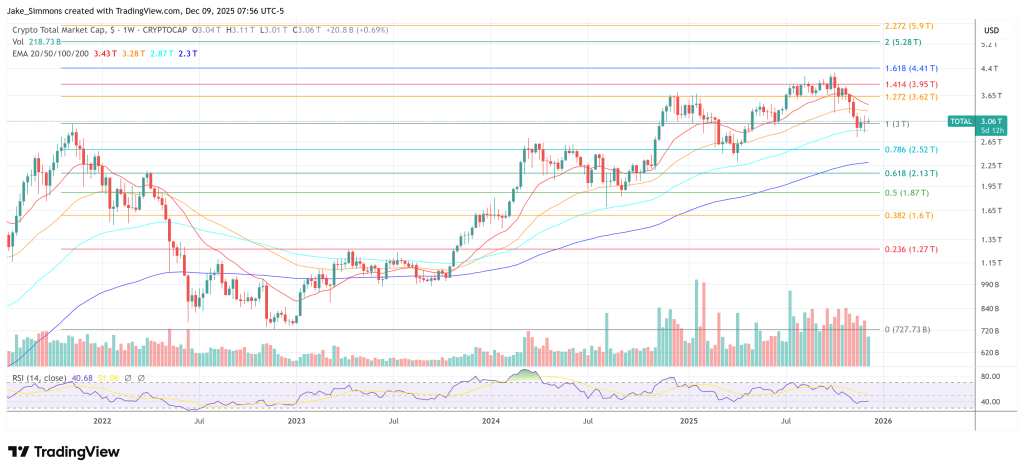
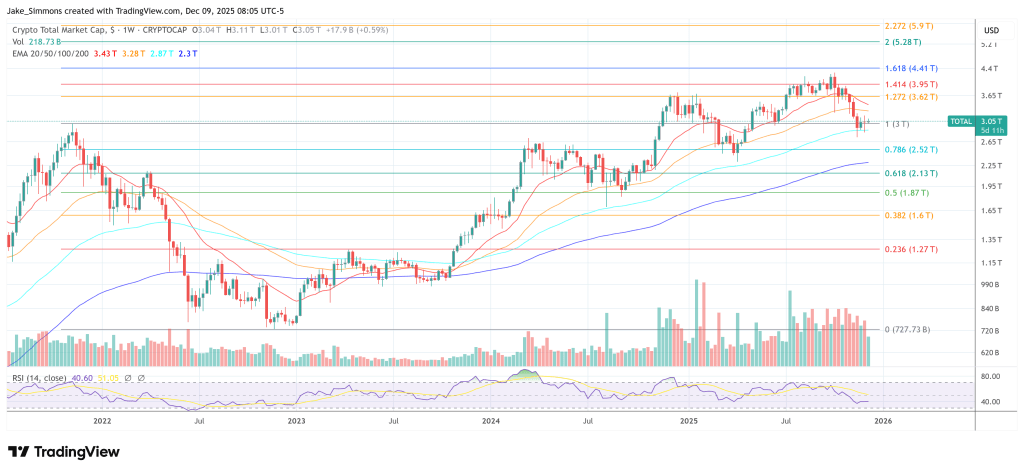
At press time, the total crypto market cap stood at $3.1 trillion.
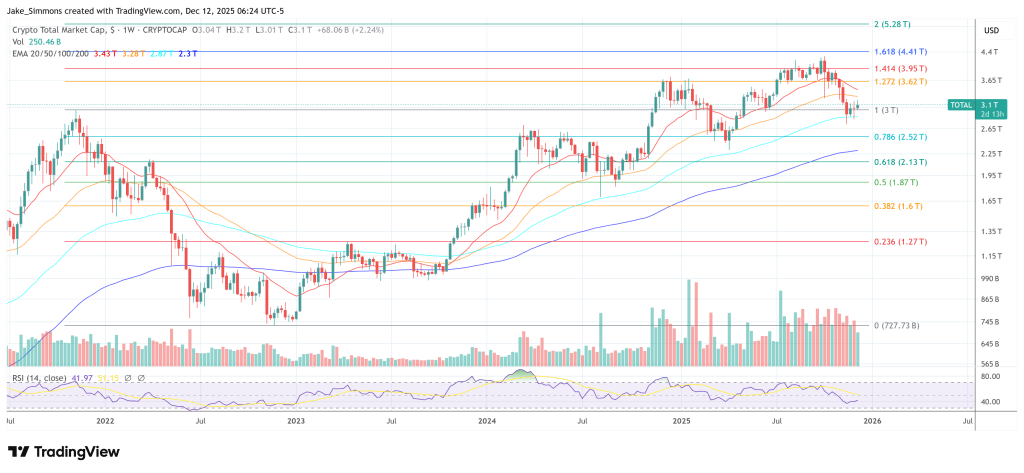
Total crypto market cap

‘I Buy XRP From Now On,’ Says World’s Highest-IQ Claimant

Young Hoon Kim — the social-media personality who styles himself as the “IQ 276” record holder — just gave the XRP crowd a fresh piece of rocket fuel. “I buy XRP from now on,” Kim wrote on X on Friday, in what appears to be his first straight-up XRP shoutout after days of near-constant Bitcoin evangelizing.

I buy #XRP from now on.

— YoungHoon Kim, IQ 276 (@yhbryankimiq) December 12, 2025

Why The XRP Endorsement Now?

And, yeah, the XRP Army did what it always does: it treated the post like a mini event. “The smartest man in the world is buying XRP,” one account, Gordon (@GordonGekko), replied — then immediately stapled the other big narrative of the day onto it: “XRP is now on Solana too. Is this the start of an XRP rally?”

That second line isn’t just vibes. Solana’s official account posted “BREAKING: XRP is coming to Solana,” pointing to a wrapped-asset setup that would let XRP trade and move inside Solana DeFi rails.

Hex Trust, which is positioning itself as issuer/custodian for the wrapped token (wXRP), says the product is designed to be 1:1 backed and redeemable for native XRP, using LayerZero’s OFT standard and launching “starting with Solana” (with more chains name-checked).

So Kim’s timing, intentional or not, landed right on top of a very convenient distribution channel: “XRP, but DeFi-ready.” If you’re an XRP holder who’s been watching Solana soak up memecoin liquidity and on-chain volume for the past year, that’s an easy story to forward to your group chat.

The funny part is Kim’s recent persona has leaned hard into Bitcoin-maxi prophecy. In the last week alone, he made dozens of Bitcoin posts via X. On December 7, he posted: “In my personal view, Bitcoin’s current price is just a temporary discount caused by what seems to be market manipulation. I think any such manipulation may disappear within a week, and then it could start accelerating toward a new ATH.”

Just a few days later, on December 10, he wrote: “My analysis suggests that Bitcoin may have set its bottom a few weeks ago, and we could now be entering a true supercycle.” One day later, he added: “”My analysis suggests that Bitcoin reaching 300K in early 2026 is a logical scenario.”

Yesterday, Kim posted: “Bitcoin looks ready to break every prediction ever written. The real bull run begins when people think it’s already over,” before adding today: “I think Bitcoin is the money of God” and “In my view, one of the fastest ways to get rich is to stack Bitcoin.”

So why the sudden XRP detour? No explanation yet, at least publicly.

There’s also the reality that Kim is, politely put, controversial. Korean coverage has described him as being reported as an “IQ 276” holder tied to mind-sports organizations, but the broader profile has drawn scrutiny and debate online, with questions about verifiability and sourcing trailing the “world’s highest IQ” framing.

Still, crypto doesn’t really wait for footnotes. A big claim, a big ticker, a hot comment section — and now an XRP-to-Solana headline to glue it together. That’s plenty for a one-day narrative.

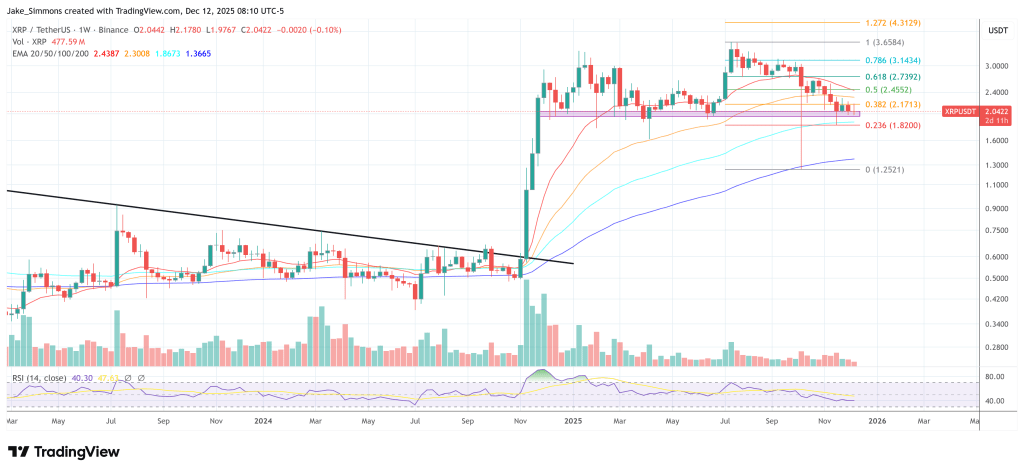
At press time, XRP traded at $2.04.

XRP price chart

Can Dogecoin Really Fall To $0.05 In 2026? This Analyst Thinks So

Dogecoin traders have heard the “five-cent” call before. It’s the kind of number that sounds like bait until price action starts behaving like it might actually get there.

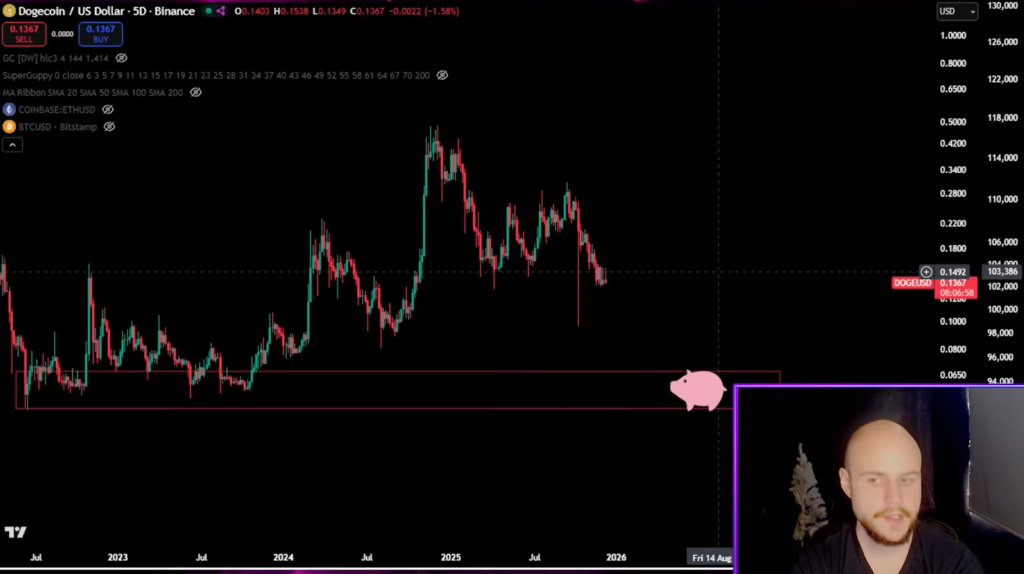
On Friday, DOGE was changing hands around $0.140, up slightly on the day, while bitcoin hovered near $92,300. That’s the backdrop for a fresh warning from YouTube analyst VisionPulsed, who told viewers his “base case” is that Dogecoin revisits the $0.05–$0.06 zone over the next 12 months — a window that drags the target straight into 2026.

Will Dogecoin Crash To $0.05 In 2026?

In the video posted on December 11 and titled “WHY IS DOGECOIN CRASHING!? BITCOIN RALLY COMING OR BULL TRAP FOR 5 CENT DOGE in 2026!?, the gist of his argument is pretty simple: if bitcoin is in a bear regime, DOGE doesn’t need an extra reason to bleed.

“The base case here is that Bitcoin has entered a bear market,” he said, pointing to a cluster of indicators he watches, including an 8-day moving average near $102,000 and the Gaussian Channel. As long as BTC sits below those levels — he cited roughly $103,000 as a line in the sand — he thinks the path of least resistance for Dogecoin trends down toward five cents.

And he wasn’t exactly selling it as a clean, one-way trip. There’s a lot of “chop zone” talk in the video — his term for the period where traders get whipsawed trying to long bounces and short dips. “The peanut gallery,” he called it.

His chart-based rationale leans on a familiar pattern from 2022: even when bitcoin managed a relief rally, DOGE still printed lower lows at points. “There is no guarantee that Dogecoin will have a relief rally. As you can see, in 2022, Dogecoin did indeed have a relief rally for the final pump with Bitcoin, […] but you can also see that Bitcoin made higher lows throughout the spring as Dogecoin made lower lows,” he said.

In his view, one of those “unfinished” spots sits closer to $0.10 first — and then the uglier number comes back into play depending on how bitcoin behaves.

That sequencing matters because it’s exactly where traders get themselves into trouble. If bitcoin bounces, DOGE might bounce too. Or it might not. VisionPulsed kept hammering that there are “many indicators” suggesting a BTC relief rally is possible, but “no guarantees” Dogecoin participates — a point he tried to underline by comparing the current tape to MicroStrategy’s tendency to go flat for weeks before a sharp move.

Then there’s his timing framework, which is more narrative than math but still widely used in crypto circles: the idea that around 140–150 days from a major top, markets often produce a final meaningful rally — and then price doesn’t revisit those levels for a long time. He cited examples across prior cycles (2014, 2018, 2019, 2022) to argue that once bitcoin falls into that “channel” regime, it tends to stay there until the broader downtrend has done its work.

So what does $0.05 actually mean from here? From roughly $0.14, it’s a drawdown of about 64%. That’s violent, but not exactly exotic in DOGE history — which is why the call lands with some traders even if they hate hearing it.

The big escape hatch, per VisionPulsed, is a bitcoin breakout: if BTC makes a new all-time high by February, he argues the bearish “base case” gets invalidated and DOGE can do what DOGE does when the market turns risk-on. Until then, he framed $0.05–$0.06 as the boring, brutal probability-weighted outcome.

Dogecoin price analysis

“So the base case for the next 12 months is essentially at some point Doge will most likely come down to these five to six cent range unless Bitcoin goes up and makes a new alltime high before February. If Bitcoin makes a new all-time high by February, then Doge will avoid that [$0.05 target] and start pumping to the moon like everybody wants,” he concluded.

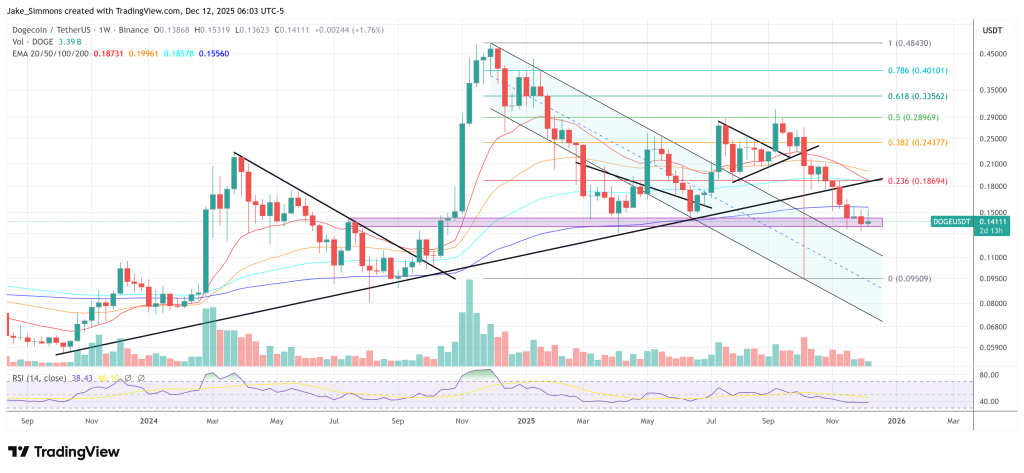
At press time, DOGE traded at $0.14.

Dogecoin price chart

XRP Is Coming To Solana Via Hex Trust And LayerZero Bridge

Solana is making a straight-for-the-liquidity play: bring XRP on-chain in a way that looks familiar to DeFi users, but legible to institutions. In a series of posts on X early Friday, Solana said XRP is “coming to Solana,” with Hex Trust and LayerZero set to bridge and issue a wrapped version of the token—wXRP—designed to be “DeFi-ready” on Solana while staying redeemable 1:1 for native XRP on the XRP Ledger.

XRP Heads To Solana As Wrapped Token

That “redeemable 1:1” line is doing a lot of work. According to Hex Trust, wXRP will be issued only when an equivalent amount of XRP is deposited into custody, and it will be burned when redeemed—classic wrapped-asset mechanics, but with a compliance wrapper aimed squarely at bigger balance sheets. The firm said it will act as issuer and custodian for the underlying XRP, describing wXRP as a 1:1-backed representation of native XRP built to support cross-chain utility and DeFi activity.

“XRP has stood the test of time and cemented itself as one of crypto’s preeminent and most liquid currencies. XRP’s long standing utility meets Solana’s high-performance execution. With significant day one liquidity, traders, holders, and institutions can use XRP within leading Solana DEXes, lending markets, and liquidity protocols, while maintaining exposure to the underlying asset and 24/7 XRPL redemption rights,” the Solana Foundation stated in a thread via X on December 12.

The other headline claim: liquidity, immediately. Hex Trust said wXRP is expected to launch with over $100 million in total value locked, framing it as “day one” depth that should help with pricing and market health once the token starts circulating across venues.

LayerZero’s role is the plumbing. Hex Trust said wXRP will be issued on LayerZero’s Omnichain Fungible Token (OFT) standard, positioning it to move across multiple networks rather than live as a one-off wrapper on a single chain. Solana is first, with Hex Trust also naming Optimism, Ethereum, and HyperEVM among initial targets, plus additional chains later.

Why now? Solana’s pitch is basically: XRP is old-school liquid, Solana is high-throughput, and the combination should unlock new use cases without forcing holders to exit the asset. The practical version of that is straightforward—wXRP becomes usable inside Solana’s DEXs, lending markets, and liquidity protocols while keeping a standing redemption path back to XRPL.

The subtle version is about who’s allowed through the door: Hex Trust says minting and redemption is designed for “authorized merchants” in a KYC/AML-compliant environment, which is the kind of sentence that tends to show up when the target user is a market maker, not a meme trader.

And yes, the messaging is trying to thread the custody needle. Solana Foundation product marketing lead Vibhu Norby described the bridge as “self-custodial from end to end” while emphasizing 1:1 redemption back to the ledger—language meant to reassure crypto-native users that this isn’t “paper XRP,” even if the underlying asset is sitting with a regulated custodian.

Via X, Norby commented on the story behind the partnership: “In November, I unexpectedly became enemy #1 of the XRP Army. Through the resulting public learning process, I had a chance to meet many OG devs, core community members, memelords, and the team at Ripple itself, and I came to an understanding of the uniqueness of XRP as an asset, and its community.”

More color is expected on Day 3 of Solana Breakpoint, where RippleX’s Luke Judges is listed on the agenda for a short “Product Keynote: Hextrust” session moderated by Norby. If this rollout goes the way Solana is implying, that slot is less ceremonial than it sounds.

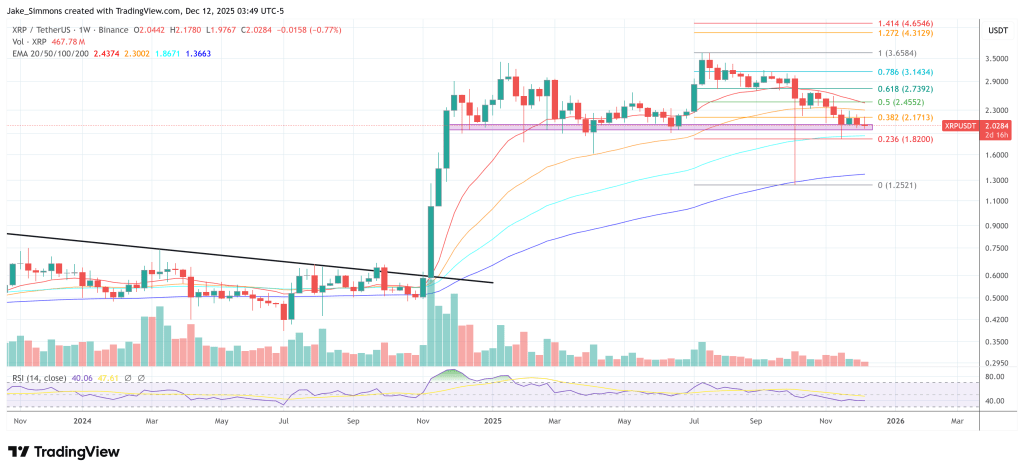
At press time, XRP traded at $2.0284.

XRP price

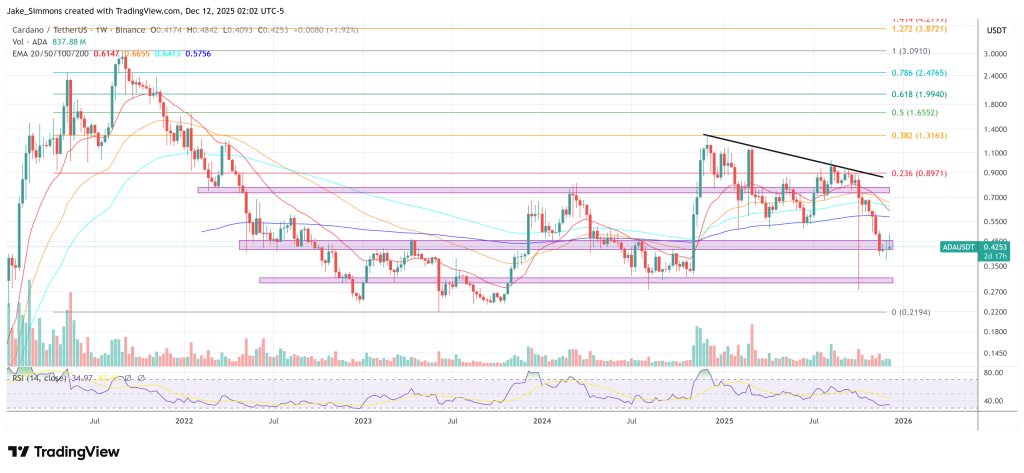
Cardano Brings Pyth Oracles On-Chain In First Pentad Integration

Cardano is finally doing the unsexy but absolutely necessary plumbing work: getting serious, external oracle infrastructure wired in, with a governance wrapper that looks a lot more like “adult supervision” than the old ad-hoc ecosystem scramble.

On a Dec. 11 livestream, Charles Hoskinson said the ecosystem’s new “Pentad” structure — the coordination bloc spanning Input Output, the Cardano Foundation, EMURGO, the Midnight Foundation, and Intersect — has approved its first major integration under the “critical integrations” framework: bringing Pyth’s Lazer oracle to Cardano, with deployment targeted for early 2026.

Pyth Deal Kicks Off Cardano’s Critical Integrations Push

“This is the appetizer announcement,” Hoskinson said, framing Pyth as the first of what he expects to be a broader menu: bridges, stablecoins, analytics, custodians — the stuff that turns a chain into a DeFi venue people actually build on, not just a community that argues about roadmaps.

Hoskinson didn’t really sugarcoat why this matters. “Oracles are really the first part of major integrations,” he said, because you need reliable data coming in and you need credible pathways to the rest of the industry. He also admitted the in-house approach hasn’t landed the way it should’ve: Cardano “tried to build an indigenous oracle solution and it hasn’t worked out as well as it should.” So […] Pyth. That’s the pivot.

Pyth, in its own marketing, has been pushing Lazer as an ultra-low latency product designed for speed-sensitive trading use cases — basically, price updates fast enough that perps and other twitchy DeFi apps don’t feel like they’re operating on last cycle’s data. Hoskinson called Pyth “one of the most advanced Oracle solutions on market,” and emphasized the practical angle: lots of feeds, lots of publishers, and broad distribution across chains.

Intersect’s announcement (the one Hoskinson pulled up mid-stream) from X states: “One of the first concrete outcomes of the Critical Cardano Integrations workstream is now in place! The Steering Committee […] has approved the first major integration under this framework: bringing Pyth Lazer oracle to Cardano. Pyth provides low-latency, institutional-grade market data across thousands of price feeds spanning crypto, equities, FX, commodities and ETFs, already used by hundreds of DeFi applications across 100+ blockchains to power trading, lending and risk management.”

Hoskinson argued, “[Pyth] effectively attaches Cardano now to the information networks of the entire cryptocurrency space.” He said the team is already exploring whether it can switch parts of the ecosystem — including Djed — over to Pyth, and he wants Cardano dapp teams to seriously evaluate the integration once it’s available.

“Pyth is just the appetizer in the Cardano critical integrations,” he said. “There are many more things to come.”

The broader context is that Cardano’s new “Pentad” has been positioning “critical integrations” as a coordinated, treasury-backed effort to “prime Cardano for 2026,” including a budget proposal tied to ecosystem-wide enablers. If Pyth is the first concrete output, it’s also a signal the Pentad model is going to be judged on execution, not vibes.

Hoskinson, closing out, put it in his usual rally language: “Cardano is not an island anymore […] the cavalry has come.” The market can do what it wants in the short term. But getting credible oracle rails in place is the kind of boring upgrade that tends to matter later — when teams are deciding where to deploy, and where liquidity is willing to live.

At press time, ADA traded at $0.4253.

Cardano price

Solana Will ‘Flip’ Ethereum, Predicts Skybridge Capital’s Scaramucci

Anthony Scaramucci showed up to Solana Breakpoint in Abu Dhabi wearing a tie — a small act of rebellion in a sea of hoodies — and then proceeded to make a much bigger one on stage: Solana is going to “flip” Ethereum.

Scaramucci’s Solana Prediction

Not in the Twitter-war, zero-sum, “ETH is dead” kind of way. More like: same league, different growth curve, and Solana ends up with the bigger market cap. “I think it will flip Ethereum, but that doesn’t mean Ethereum’s going down or anything like that. I think there’s going to be market share for Ethereum. I think they could both grow, but I think from a market capitalization perspective, I think Solana will end up growing faster,” Scaramucci told CoinDesk Live on Dec. 11.

That’s been his line for a while. This time it came with a prop: his new book, Solana Rising, which dropped Dec. 9 and — according to Scaramucci — quickly hit the top of Amazon’s “new releases” list for investment management/investment strategy. He framed the book as something for the skeptics, or at least for the friends of the believers.

The pitch is familiar if you’ve been anywhere near crypto conferences this year, but Scaramucci’s version is unusually blunt: Solana is the fastest-growing chain, it’s stacked with activity, it’s cheap to use, and it’s easy to build on. Then you add staking, and you’ve got what he keeps calling “great tokenomics.”

And yes, he’s heavily aligned. “Full disclosure,” he said, “I have a large personal holding in Solana. I have it on the firm’s balance sheet.” How large? On SkyBridge’s balance sheet, he put it at “probably 60%,” with the firm sitting on “north of a nine figure balance sheet.” His personal portfolio allocation, he estimated, is around “6% 7%.” Big, but not “I sold the house for SOL” big.

Notably, Scaramucci emphasized that he’s not “chain monogamous.” He likes Avalanche. He likes Ethereum. He’s not doing maximalism. He’s doing a portfolio. “In fact, who is chain monogamous?” he joked.

The Skybridge Capital founder added: “It’s not an amorous thing. It just has to do with the realities of investing. It’s like owning a lot of stocks in your portfolio. But to me, I just think that it is the fastest growing chain. That’s the most activity of like the top 50 chains combined. It’s got lots of use cases, lots of versatility. It’s easy to develop on and it’s very low fees to transact on and it’s got great tokenomics if you want to stake your Solana like I do.”

He also pointed to the debut of the first spot Solana ETF in the United States — “first staking ETF,” in his words — as another signal that we’re still early. Then came the price talk, because of course it did.

Could SOL hit $300–$400 by the end of next year? “Sure,” he said, tying it to a more constructive US regulatory backdrop — specifically his hope that the CLARITY Act gets passed and unlocks “the full utilization of tokenization.” Longer term, he went bigger: “Is Solana go to $1,000 over the next five years? I really do believe that.”

He also revisited Bitcoin. Same vibe: right call, wrong calendar. “I’ve been right about Bitcoin, but I’ve been wrong about timing,” Scaramucci said, sticking with a $150,000–$200,000 target, and arguing a friendlier rate environment next year could help.

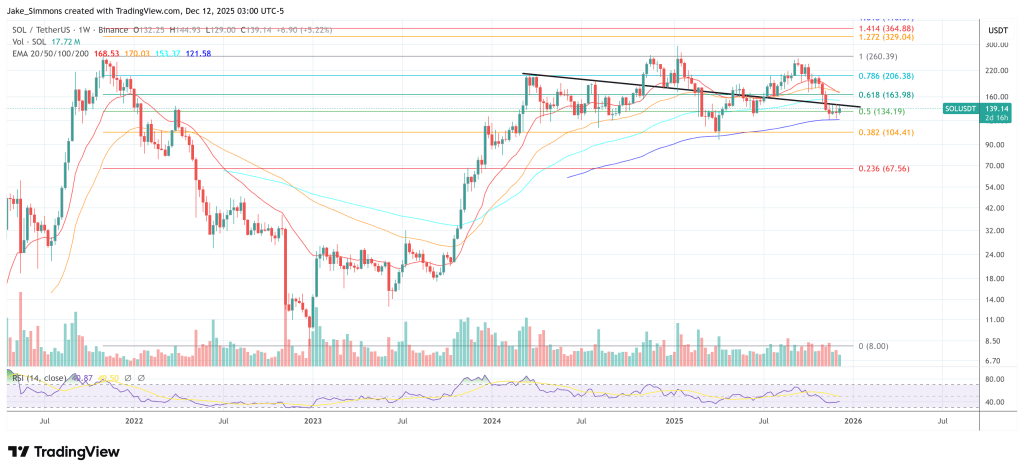
At press time, SOL traded at $139.14.

Solana price

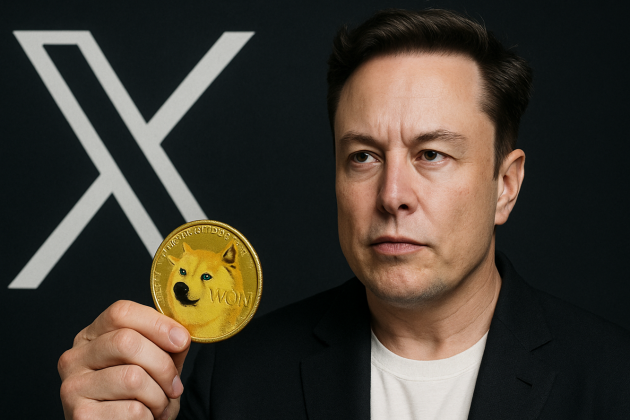
Dogecoin Barely Blinks As Musk Confirms X Money Is Running Internally

Elon Musk has confirmed that X’s long-promised payments layer, X Money, is already running inside the company — but Dogecoin, his on-again-off-again favorite meme coin, has barely twitched.

Replying to developer and X feature-watcher Nima Owji on December 10, Musk dropped a characteristically terse update: “It has been launched internally.” Within hours, promoter Mario Nawfal was broadcasting that “X MONEY IS LIVE BEHIND CLOSED DOORS, PUBLIC LAUNCH NEXT,” describing the system as “quietly tested by employees and early users while the rest of the world waits for access.”

It has been launched internally

— Elon Musk (@elonmusk) December 10, 2025

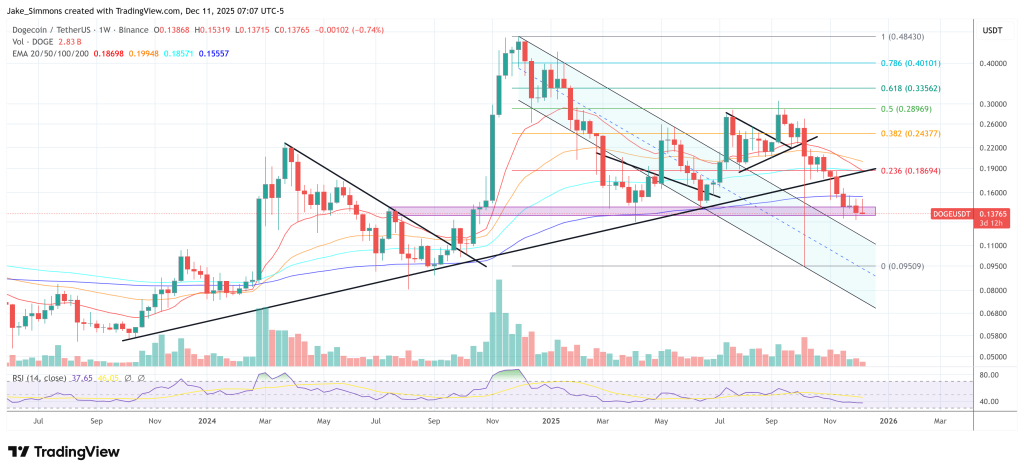
The market, however, did not exactly wait breathlessly. As of press time, Dogecoin traded around $0.137, down less than 0.1% on the day — essentially noise, given an intraday range between roughly $0.137 and $0.150. For a coin that once ripped 20–30% on a single Elon meme, this is… subdued.

Why Is The Dogecoin Price Not Reacting?

The contrast with earlier X Money headlines is stark. When Musk first framed the payments stack as part of a broader relaunch of XChat in mid-November, he boasted that X had “just rolled out an entire new communications stack with encrypted messages, audio/video calls and file transfer,” adding pointedly: “Money comes out soon… X will be the everything app.”

Dogecoin and other high-beta names squeezed higher on that story, if only briefly. Back in May, when Musk confirmed that a beta version of X Money was coming, DOGE jumped from about $0.08 to $0.09 on the announcement — a double-digit percentage move triggered by one more hint that the dog might be wired into X’s rails.

Today’s non-reaction lands against a deeper build-out of X Money in the background. According to a recent job posting, X Money is hiring a technical lead to design a payments platform “from the ground up” for more than 600 million monthly users, with an emphasis on distributed systems and secure transactions.

The description notably does not mention crypto or Dogecoin at all. Notably, X Money already announced a partnership with Visa earlier this year for an “X Money Account” that would fund wallets and peer-to-peer payments, while Solana figures — including ecosystem advisor Nikita Bier, now at X — have publicly signaled they are eager to help.

Crucially, Musk has not exactly gone quiet on Dogecoin in general. On November 3 he posted “It’s time” on X, reviving his old promise to “put a literal Dogecoin on the literal moon” via a SpaceX mission, as reported by Bitcoinist.

In mid-October he waded into the “energy money” debate, backing Bitcoin as impossible to “fake” because it is grounded in energy and then replying with an approving emoji when a Dogecoin community account insisted that “Dogecoin is also based on energy” — his “first explicit nod toward DOGE in a while,” as reported on NewsBTC.

Even more recently, on October 11 and again on November 15, Musk posted Doge-coded content — a Shiba Inu mascot image, then a meme of a Shiba playing a banjo — that historically would have lit up DOGE order books. However, this time, Dogecoin’s response was muted to outright negative.

In other words, the last few times Musk has talked about or referenced Dogecoin on X, the market reaction has been steadily decaying. So when he now says X Money “has been launched internally,” the absence of a pump in DOGE looks less like a mystery and more like a trend.

At press time, DOGE traded at $0.13765.

Dogecoin price chart

Bitcoin Is Neither In A Bull Nor Bear Market: Expert Explains The Setup

Bitcoin is trading in a world where headlines still scream “bull” or “bear” while the underlying structure quietly refuses to play along. After spiking to an all-time high in the $124,000–$126,000 zone in early October and then shedding roughly a third of its value into November, BTC now sits in the low-$90,000s, still dominant but clearly winded.

Into that confusion steps pseudonymous renowned crypto industry veteran plur daddy (@plur_daddy) who suggests the market may be in neither regime at all. “Because of the 4 year cycle, all crypto market participants are primed to view the market as either in a bull or bear phase,” he wrote on X. “What if, as a part of the market maturing, we are simply in an extended consolidation window where overhead supply is being absorbed?”

It is a simple framing shift with fairly big implications. He points to gold, which “chopped between $1,650–2,050 from April 2020 to March 2024,” and argues it is “logical to assume that as BTC evolves, it will exhibit more gold-like behaviors.” In other words: not dead, not euphoric, just… stuck in a fat, liquidity-soaked range where supply changes hands from weak to strong for longer than traders raised on clean halving cycles are emotionally prepared to tolerate.

The range dynamics are already visible at the top end. According to plur, “sellers emerged aggressively whenever price entered the $120k range.” He notes there are “strong arguments” those sellers were driven by the four-year cycle meme, but “equally good arguments” they were reacting to more prosaic considerations: age, price, liquidity, thesis change, and “emerging tail risks.” If BTC revisits that zone, he thinks it is “rational for people to front run that, which helps reinforce the range.” Classic reflexivity: people remembering the last top create the next one.

On the downside, he is not in the doom camp. “This also dovetails with my intuitive feeling that the lows may be in, or at the least not significantly lower than what we have seen, but upside also being capped,” he wrote, adding that liquidity conditions are “poised to moderately improve,” creating room for a bounce – just not necessarily a new regime. Or as he put it with some restraint, he’d “be cautious about betting on regime change.”

Bitcoin Market Puzzled: QE Or Not QE?

That “moderate improvement” is not theoretical. Yesterday’s FOMC meeting delivered a 25-basis-point rate cut, taking the Fed funds target to 3.50–3.75%, alongside a surprise announcement: roughly $40 billion a month in “reserve management purchases” (RMPs) of short-dated Treasuries, starting December 12 and guided to remain elevated for several months.

The official line is that this is a technical step to keep reserves “ample” and repo markets functioning, not a new round of QE.

Macro voices on X are, unsurprisingly, not unified on that distinction. Plur Daddy added via X: “This is different from QE because the main way that QE works is through pulling duration out of the market, forcing market participants to move up the risk curve. However, they snuck in there that they may buy up to 3 year treasury notes, which means some duration will be getting taken out. This is more bullish than expected, and helps bridge market liquidity into the new year.”

Miad Kasravi (@ZFXtrading) insists, “FED is NOT doing QE. Just expanding balance sheet via Money-market displacement,” arguing that when the Fed buys bills, the prior holder gets cash that “has to go somewhere” and “some of it seeps into credit, equities, crypto.”

LondonCryptoClub takes the gloves off. In his view, the Fed is “basically going to print money to keep funding this deficit for as long and as large as needed,” adding that “the debasement trade is on autopilot mode.” He backs Lyn Alden’s earlier remark that “it’s money printing. Whether it’s QE or not is more semantics. Fed won’t call it QE since it’s not duration and it’s not for economic stimulus.”

Lyn Alden nails it

Markets are going to tie themselves up arguing over the semantics and overcomplicating it

Yet they’re printing money and monetising the deficit

It’s all the same thing. Admittedly, this is QE-lite…for now at least

Believe it or not, market participants… https://t.co/cf7QLogWom

— LondonCryptoClub (@LDNCryptoClub) December 10, 2025

Peter Schiff, predictably but not entirely irrationally, commented via X: “QE by any other name is still inflation. The Fed just announced it will be buying T-bills “on an ongoing basis.” Given that long-term rates will rise on this inflationary policy shift, it won’t be long before the Fed expands and extends QE5 to longer-dated maturities. Got gold?”

So The Takeaway Is?

As Plur notes, these operations expand bank reserves and ease repo stress; the Fed will primarily buy T-bills, but “they may buy up to 3 year treasury notes, which means some duration will be getting taken out.” That edges the program closer to “QE-lite” than pure plumbing. It is supportive for risk assets and it arrives precisely during the year-end liquidity doldrums, with further balance-sheet expansion mechanisms waiting in the wings.

For Bitcoin, the uncomfortable answer right now is that both things can be true: the “debasement trade” is structurally alive, while price action behaves like a large, semi-institutional asset digesting a brutal rally and a fresh macro shock. Another six to eighteen months of rangebound churn, as plur suggests, “wouldn’t be strange at all.” Whether you label that bull, bear, or just purgatory is mostly a narrative choice. Markets, frankly, will trade it the same either way.

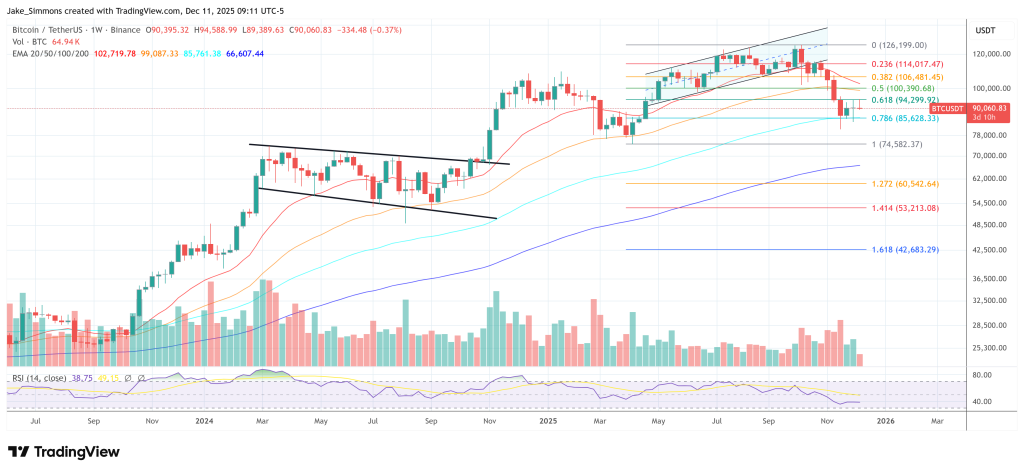
At press time, BTC traded at $90,060.

Bitcoin price

Ripple Exec Warns: Banks Without A Stablecoin Strategy ‘Will Get Left Behind’

Ripple’s Middle East and Africa boss has a blunt message for the banking sector: if you still do not have a stablecoin strategy, you are already behind the curve.

“Look, I think there’s no bank, financial institution, payment entity that is not thinking, talking or incorporating a stablecoin strategy,” Ripple’s Reece Merrick told CNBC in Abu Dhabi. “And quite frankly, if they’re not, they will get left behind.”

Ripple’s Advantage In The Stablecoin Space

The interview came right after a significant regulatory win. Ripple’s USD-backed stablecoin, RLUSD, has been recognized by Abu Dhabi’s Financial Services Regulatory Authority (FSRA) as an “Accepted Fiat-Referenced Token,” allowing ADGM-licensed institutions to use it for regulated financial activity. For Ripple, this is less about marketing and more about foothold: it embeds RLUSD inside one of the Gulf’s most aggressively pro-crypto regulatory hubs.

“Firstly, what this does is it further validates Ripple’s value proposition here in the region and a compliance-first approach as it relates to issuing our own stablecoin, RLUSD, at the back end of last year,” Merrick said. The approval means ADGM entities can “utilize RLUSD within their flows, within their operations,” which he called “a great step forward for Ripple, great step forward for the region.”

The compliance drumbeat is deliberate. Before pushing RLUSD globally, Ripple went to what Merrick described as “the gold standard of regulators,” the New York Department of Financial Services, which oversees RLUSD issuance. The combination of NYDFS in the US and FSRA (plus Dubai’s DFSA, which earlier approved Ripple as the first blockchain-enabled payment solution provider) is meant to send a clear signal: this is an institutional product, not a fly-by-night dollar token.

The hard numbers are more modest. RLUSD has about 1.2 billion dollars in circulation, tiny next to Tether’s roughly 120 billion. Merrick did not try to spin that away; instead he pointed at the direction of travel. The stablecoin market is around 300 billion dollars today, he noted, dominated by USDT and USDC, but Ripple expects it “to be moving into the trillions” with “share for everyone.”

How to carve out that share is where Ripple’s strategy gets more specific. Merrick said Ripple wants RLUSD “to be the gold standard for institutions to adopt this stablecoin,” and he anchored that in concrete rails: recent acquisitions and existing payment volume.

He highlighted G-Treasury, a treasury management platform that sees “how Fortune 500 businesses are moving trillions of dollars between their own operations,” and Hidden Road, now rebranded as Ripple Prime, a prime broker that “turn[s] over three trillion in prime brokerage.” Ripple’s plan is to bake RLUSD directly into those flows. Since announcing GTreasury, Merrick said, the company has seen “so much inbound” from institutions exploring RLUSD for their internal operations.

Underneath sits Ripple’s long-running cross-border payments business, which has processed about 95 billion dollars in turnover using XRP and the XRP Ledger. RLUSD, Merrick argued, is a “natural step” after persistent customer demand for stablecoin payouts. With roughly half of global cross-border payments made in dollars and many of those not actually destined for the US, he called existing channels “inefficient and slow,” and positioned regulated dollar tokens as a cleaner alternative.

Trust and understanding are still the industry’s biggest problems, as CNBC’s Dan Murphy noted, citing boardroom confusion and skepticism even at Abu Dhabi Finance Week. Merrick’s response was predictable but also, frankly, the only credible one: stack regulation, collateral transparency and real-world utility until the narrative changes.

“Trust is paramount,” he said, pointing again to NYDFS, ADGM and DFSA approvals as the anchor. Once “large financial institutions, these large corporates” see the impact on their own business, he expects “that kind of hockey stick growth.”

He also highlighted the GENIUS Act in the US as having “paved the way for some of the largest global financial institutions to kind of play in this space,” shorthand for the broader legislative shift toward regulated stablecoin frameworks.

. @Ripple‘s Reece Merrick Highlights RLUSD Regulatory Milestone and Global Expansion on CNBC https://t.co/0KR2BQNZHU pic.twitter.com/H39BdnX4Wf

— 𝗕𝗮𝗻𝗸XRP (@BankXRP) December 10, 2025

Taken together, Merrick’s remarks sketch a simple line in the sand. Stablecoins are no longer a side experiment; they are becoming core payments and treasury infrastructure. And for banks still stuck at the “internal working group” stage, the message from Ripple’s regional chief could not have been clearer: get a stablecoin strategy, or get comfortable watching your customers migrate to those who already do.

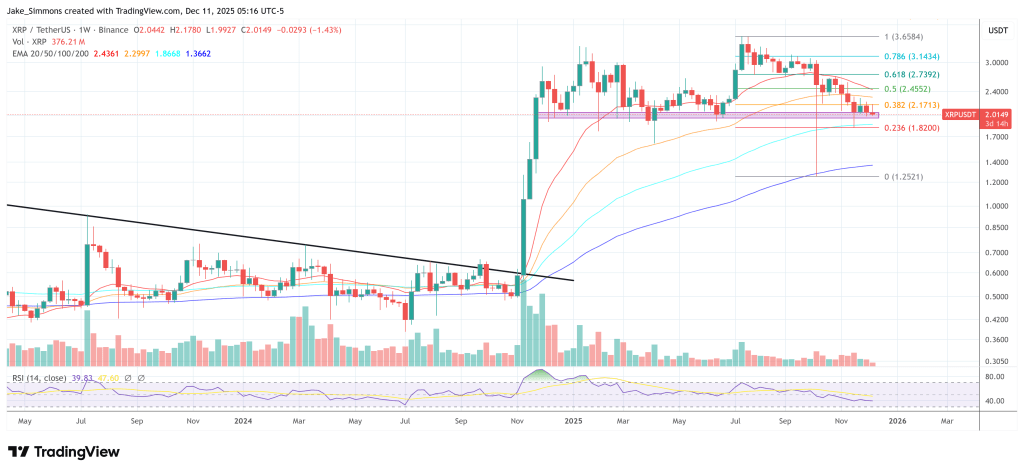
At press time, XRP traded at $2.0149.

XRP price

More Eurozone Countries Will Buy Bitcoin, Says Coinbase’s Institutional Chief

An experiment in Prague might end up mattering more for Bitcoin than the usual ETF inflow chart.

Speaking on the “Crypto In America” show on 10 December, Coinbase Head of Institutional John D’Agostino highlighted that the Czech National Bank has begun testing Bitcoin in its national treasury and for payments, and argued that this sort of move by a Eurozone central bank is likely to spread.

Czech Bitcoin Pilot Could Spread Across Eurozone

“The Czech national bank chose very well in their service providers,” he said, adding that the central bank is “putting Bitcoin on their national treasury and they are experimenting with and learning in real time using Bitcoin for payments.” The pilot is small — “a million dollars of Bitcoin” — but for D’Agostino the signal is not in the size, it is in who is doing it and why.

He drew a deliberate contrast with earlier sovereign experiments: “No disrespect to El Salvador… this wasn’t a ‘I want to shake up my economy because I’m heading in the wrong direction’… This is, we are a stable Euro zone country… we don’t have to do this.”

Instead, the Czech move followed “all the bells and whistles” of a traditional process: RFPs, vendor selection, formal adoption into policy. That, he suggested, is exactly what makes it dangerous — for the status quo. “That type of thing is contagious and I can see more Euro zone [countries] following suit very very shortly,” he said.

The comment did not come in isolation. Throughout the interview, D’Agostino hammered a consistent thesis: institutional adoption has always been less about perfect regulatory clarity and more about liquidity, credible market structure and having the “right” types of participants in the pool.

“I’ve always been a bit of a skeptic on the argument that the reason institutions haven’t invested… is regulatory clarity,” he said. Clarity is “top three,” but in his ranking it comes after liquidity and sits alongside alpha potential. If two of the three are present, “people will find a way.”

Bitcoin’s spot ETFs, in his view, have already created something the asset previously lacked: a cohort of structurally compelled participants. “The ETFs, in my view, are kind of the surrogate commercial users of Bitcoin,” he argued. They “have to rebalance… it’s codified into their business model,” acting as a stabilizing force similar to industrial users in commodities markets.

A Eurozone central bank experimenting with Bitcoin on its balance sheet pushes that logic one step further up the food chain. D’Agostino did not spell out a grand theory of “Bitcoin as reserve asset” — he was careful, almost lawyerly, about what he could say — but the implication is not terribly subtle: when a central bank with access to normal EU funding “doesn’t have to do this” and still chooses to, it normalizes Bitcoin inside the most conservative layer of the monetary system.

That sits alongside a broader reputational repair job he thinks the industry still has to finish. Crypto, he argued, has had no more structural failures than other markets — he pointed to the London Metal Exchange’s cancellation of billions in nickel trades as an under-discussed parallel to FTX — but “we tend to push the jokers to positions of prominence,” whereas TradFi “does a good job of hiding their jokers.”

Between cleaner narratives, ETF-driven “surrogate” demand and now a Eurozone central bank quietly wiring a million dollars into Bitcoin, D’Agostino’s message was that the institutional story is less about a sudden wave and more about erosion. “There’s no wave,” he said earlier in the conversation. “It’s this gradual erosion as opposed to this crashing wave.”

If he is right about the Czech experiment being contagious, that erosion may soon be happening from the inside of the Euro system as well, not just from asset managers in New York.

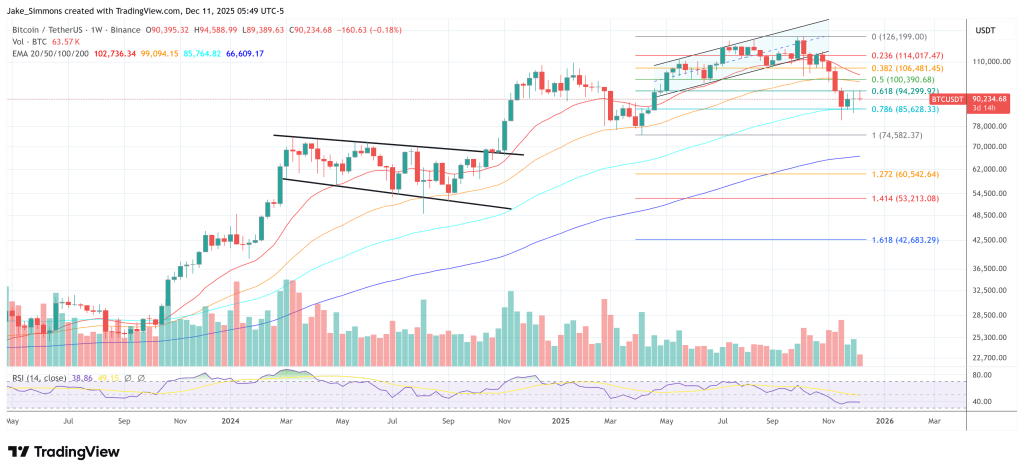
At press time, BTC traded at $90,234.

Bitcoin price

Crypto Tanks After Fed Cut: Santiment Breaks Down The Trap

Crypto markets lurched lower after the Federal Reserve delivered exactly what everyone said they wanted: the third straight 25bps cut to close out 2025. Santiment’s latest deep dive makes a simple, slightly uncomfortable point: retail treated it as a green light, whales treated it as exit liquidity.

Bitcoin shortly rallied to $94,044, Ether surged to $3,433, XRP hit $2.10 and Solana managed to reach $142, but the momentum was short-lived. The BTC price fell by more than 5% at one point, ETH even fell by more than 8.5%.

What Caused The Crypto Market Plunge?

On 11 December, the FOMC confirmed another quarter-point reduction, completing what Santiment calls the “trifecta of cuts at the end of 2025.” Lower rates mean cheaper borrowing, more risk-taking, and—on paper—a friendlier backdrop for crypto. The Fed still describes an economy growing at a “moderate” pace with inflation above target, and in both the October and December meetings it cut because “the balance of risks (like slowing job growth) supported easing policy.”

The key shift is liquidity. On 29 October, the Fed decided to slow the reduction of its securities holdings from 1 December, easing the pace of balance-sheet runoff. By 10 December, it went further, saying bank reserves had fallen “too much” and announcing renewed purchases of short-term Treasury bills to keep reserves “ample.” That is a move from shrinking the balance sheet to quietly adding money back into the system. As Santiment notes, the Fed is still data-dependent but clearly more willing to lean dovish to protect financial conditions.

Markets, however, front-ran the story. Prediction platform Polymarket showed an “overwhelming amount of optimism” in the hours before Jerome Powell spoke. At the same time, on-chain data flagged abnormal activity: @DeFiTracer spotted a whale selling roughly 100 million dollars’ worth of Bitcoin within an hour, triggering “a healthy mix of sensationalized panic.” The expected outcome—another cut—arrived, but positioning around it was anything but balanced.

Bitcoin’s price reaction looked bullish at first. BTC spiked to about $94,044 after the announcement. Yet Santiment’s social data shows that the positive-versus-negative commentary ratio for Bitcoin had already peaked well before Powell’s remarks. The crowd’s emotional high came in anticipation; when the actual rally hit, traders were “quite modestly reactive” despite the move to 94K. Sentiment was spent.

Ethereum was worse. Over the same 24-hour window, ETH surged to around $3,433, and the positive comment ratio “was a LOT more interesting.” Santiment describes “a lot of FOMO after a mini surge immediately after Powell spoke,” with many traders who bought the breakout “eventually [getting] burned when ETH fell back down to 3,170.” It is the textbook “buy the rumor, sell the news” pattern: bullish macro headline, short-term bearish price action, retail buying the spike while larger holders “gladly” offload into the mini-rally.

Structurally, though, the report is not outright bearish. Year-to-date, Santiment notes, Bitcoin is down about 3.6%, versus a 17.6% gain for the S&P 500 and a striking 61.1% for gold. “It’s quite the dramatic difference,” the team writes, arguing that “a regression to the mean for BTC would be justified.”

With three cuts now locked in and reserves being topped up via T-bill purchases, the “catch-up” case for crypto versus equities and metals “becomes even stronger.” Historically, crypto “has reacted later than equities or commodities when macro trends shift.”

On-chain, so-called smart money appears to be acting as if that delayed reaction is coming. Wallets holding 10–10,000 BTC have added 42,565 Bitcoin since 30 November. What is “still [remaining],” Santiment says, is “a notable dump from retail, which would be indicative of the perfect recipe for a major bull run.” For now, they expect smaller traders to “run on fumes from this positive news of rates getting cut, for at least a couple of days.”

The bottom line of the report is deliberately sober. The final FOMC decision of 2025 “reinforces a narrative of gradual easing, improving liquidity, and a cautiously supportive environment for risk assets.”

After a rough year, “ending the year with three consecutive rate cuts from the Fed is a strong sign.” If inflation drifts toward target and economic data stays stable, Santiment argues, 2026 could finally give digital assets “the breathing room they’ve been waiting for.” Just do not confuse that with an invitation to chase the first post-Fed spike—because, as this week just reminded everyone, that is still where crypto tourists go to get burned.

At press time, the total crypto market cap was at $3.04 trillion.

Total crypto market cap

Cardano Founder Reacts As NIGHT Token Crashes From $150 To $0.02

Cardano founder Charles Hoskinson has hailed the launch of Midnight and its native token NIGHT as the strongest in the network’s history, arguing that it proves Cardano can now host and distribute multi-billion-dollar assets at scale.

NIGHT Token Plunges After Midnight Launch

In his December 10 livestream “Midnight Launch AAR,” Hoskinson opened with the volatile price action that dominated social media. NIGHT initially spiked to what he called an “insane” level: “It launched at almost a $150, which is just insane […] it just went way, way, way up.” Once trading opened on Binance Alpha, the move reversed violently. “As soon as it got on Binance Alpha – oh god, why, why, oh why – all the way down to two cents. They dumped on us. That’s what they do. That’s what the DGENs over in that market do.”

He framed this as typical exchange-distribution dynamics, not a structural failure: recipients with no real connection to the ecosystem “regardless of the price, they just dump the token. They probably didn’t even know what NIGHT was.”

According to Hoskinson, such launches usually endure 48–72 hours of “high volatility” before a stable range emerges. He reiterated that he had expected NIGHT to trade in a “5 cents to 15 cents” band and said it was sitting around 6–6.5 cents with a fully diluted valuation of roughly $1.5 billion and around $150 million in trading volume. For a brand-new Cardano-native asset in current conditions, he called that “a really solid launch.”

What made the debut historically significant in his view was the combination of tier-one listings and on-chain metrics. “This is the first time in history that Cardano right out the gate can launch a $1.5 billion product, be listed on Binance Alpha and Kraken and OKX and everybody else at the start,” he said, stressing that much of the required infrastructure “wasn’t there” and had to be built during the run-up.

Cardano’s Best Launch Ever

On Cardano itself, he highlighted that Midnight immediately became the dominant token by trading activity. Citing TapTools, he said NIGHT was “sitting [at] an overwhelming level of volume, and it’s actually greater than the volume of every other Cardano native token combined,” adding that its FDV is “worth more than all the other CNTs combined as well.”

For the first time, he argued, DEXs such as Minswap and SundaeSwap carried a “meaningful percentage of trading volume […] with respect to large exchanges,” helping “prime the pump on Cardano DEXes” and pull more stablecoins into the ecosystem.

Distribution was another focal point. Hoskinson praised the Glacier Drop mechanism and its gradual “thawing,” saying it creates “a nice steady emission and a nice steady flow for the system as opposed to a jagged thing where the insiders all dump.”

He contrasted Midnight’s retail-heavy, exchange-plus-airdrop distribution with VC-led launches elsewhere: “This is the first time since Bitcoin that a launch has been done the way that Midnight did it. It was complete retail, completely fair, and none of those damn VCs got their grubby hands on it. Instead, it went right to you, the people.”

He tied that to a broader “return to first principles,” arguing that 2026 should reward projects with fair launches and fixed-supply, deflationary monetary policies: “There’s a fixed supply NIGHT, by the way […] it’s going to be a good year for everybody who’s betting on you, the consumer, and not betting on the banks.”

Looking forward, Hoskinson positioned Midnight as Cardano’s first “partner chain” and the “tip of the spear” for a hybrid DApp model spanning multiple ecosystems: “You talk about Midnight Cardano, Midnight Ethereum, Midnight Solana, Midnight Avalanche, Midnight Binance.” He said that after the first four phases of the roadmap, “every two months a new ecosystem gets activated,” with recurring feature drops “every six to eight weeks.”

He also cast Midnight as a competitive wedge for Cardano DApps. With tier-one integrations and privacy-preserving capabilities, he argued, “we have privacy before [Ethereum and Solana] do,” giving Cardano–Midnight hybrid apps a differentiator that can help grow TVL, MAU and transaction volume.

Hoskinson insisted that the launch pressure-tested and validated the base protocol: “Cardano network handled it. The exchanges handled it. And Midnight is here to stay.” The ambition from here is explicit. “We’re going to march Midnight up as an ecosystem to that $10 billion mark. That’s the goal. Let’s keep going. Let’s get her done,” he said, adding that “these are the best numbers we’ve ever seen in the history of Cardano” – and, in his view, only the beginning.

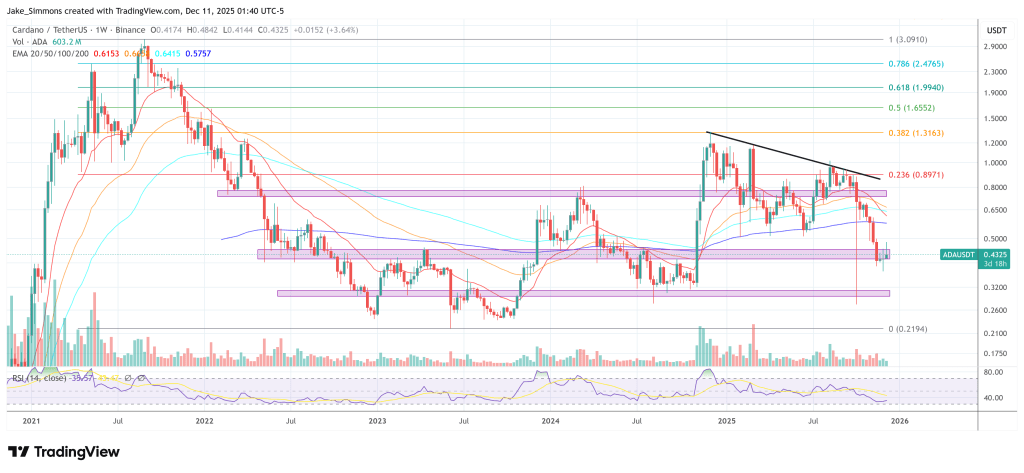
At press time, ADA traded at $0.4325.

Cardano price

Ethereum Should Be Valued Like Amazon, Says Dragonfly’s Qureshi

Dragonfly managing partner Haseeb Qureshi has sharpened his defense of Ethereum’s valuation, arguing that critics are using the wrong financial framework and that ETH should be analyzed more like an early-stage Amazon than a mature “value” stock.

Speaking on the Milk Road Show on 9 December 2025, Qureshi revisited his now-viral valuation clash with investor Santiago “Santi” Santos, hosted by ThreadGuy, which reignited the debate over how to price layer 1 blockchains. At the core of Qureshi’s thesis is a simple but controversial claim: fee revenue on Ethereum is effectively pure margin and should be treated as profit, not as “revenue” in the traditional corporate sense.

“Blockchains don’t have revenue. They have profit,” he said. “When chains charge fees, that’s profit. There’s no expenses for a chain. Chains don’t pay expenses, right? There’s no AWS hosting cost for Ethereum.”

Qureshi Pushes Back On Claims Ethereum Is Overvalued

Santos had argued that Ethereum is trading at “300 plus” times sales, calling these price-to-sales (P/S) levels “embarrassing” relative to traditional companies and suggesting valuations are “way ahead of their skis.” Qureshi did not contest the magnitude of the multiples but rejected P/S as the right lens.

“He was insisting in the debate that the right way to look at these things is price of sales. So if you look at price sales for Ethereum, it’s something like 380. If you look at Amazon, I think Amazon topped out at price of sales of 42. And this was during the bubble,” Qureshi said.

He countered that for a blockchain, what equity investors would call “sales” is closer to the GDP or GMV of the on-chain economy, which is not directly measured at the protocol level. The only clean, observable line is fee income, which he treats as net income.

“The sales in some sense is like the GDP of the blockchain which we’re not measuring,” he argued. “The right thing to understand for a chain is the profit… The right thing to understand is what is the profit of Ethereum relative to the profit of Amazon.”

That opens the door to the Amazon analogy. Qureshi emphasized that Amazon delayed profitability for almost two decades to prioritize growth, yet public markets still assigned it extremely high earnings multiples.

“Amazon literally made no profit, no profit until basically about 20 years in as a business,” he said. “In the year I think it was 2013… Amazon had a PE ratio… over 600 whereas today the PE ratio of Ethereum of course is something like 380.”

Because Ethereum’s P/S and P/E converge under his “fees = profit” assumption, Qureshi’s argument is that investors should compare ETH’s 300–380x multiple to Amazon’s P/E history, not to its much lower P/S, if they are going to use a single headline ratio at all.

The broader context, he stressed, is that Ethereum and other L1s are still in an exponential build-out phase, more akin to early internet or e-commerce infrastructure than to late-cycle dividend payers.

“This technology has been getting bigger and bigger over time. It’s gobbling up the entire world of finance from where it started,” he said, referencing his essay “In Defense of Exponentials.” “None of [these technologies] started printing a bunch of profit immediately in the first five or even 10 years.”

Despite choppy price action and underperformance of altcoins versus AI equities and gold, Qureshi said his conviction in the long-dated Ethereum thesis has increased, not weakened, through the public debate.

“If anything, I have become more confident in my view,” he said, adding that nothing material had changed in the last months to justify a major portfolio rethink. “What exactly has changed in the last 2 months between, you know, ETH going to like $4,800 and ETH being at $3,000? The answer is basically nothing.”

Shared some post-debate reflections on my L1 debate with @santiagoroel, my rebuttal against the “crypto is all a big casino” doomers, and where I think we are in the crypto macro cycle 👇 https://t.co/9uMJFuLVrX

— Haseeb >|< (@hosseeb) December 9, 2025

For Qureshi, a genuine repositioning would require a clear invalidation of core assumptions—such as a quantum break of cryptography or a structural collapse in on-chain stablecoin demand. Short-term swings, in his view, are simply the pendulum of sentiment moving around a still-fixed fundamental anchor.

His message to skeptics is that if markets tolerated Amazon at 600x earnings while it scaled into a dominant platform, dismissing Ethereum at roughly 300–380x on a “too high on P/S” argument alone is analytically inconsistent.

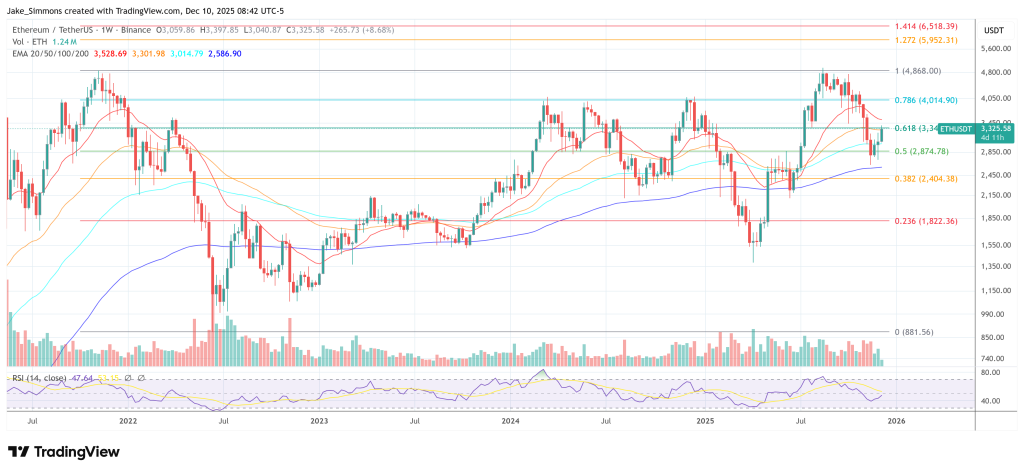
At press time, ETH traded at $3,325.

Ethereum price

Ethereum Founder Buterin Slams Elon Musk As Anti-Europe Attacks Ignite

Ethereum founder Vitalik Buterin has issued a sharp public warning to Elon Musk over how X is being used to direct increasingly aggressive rhetoric at Europe, arguing that the platform is drifting from a free-speech ideal toward orchestrated hostility.

Ethereum Founder Calls Out Elon Musk

In a series of posts on X, Buterin said that “the attacks on Europe I’ve seen here the last couple of days, including from people I’ve generally considered interesting and sophisticated, have been getting unhinged.”

He acknowledged that the European Union has serious shortcomings, listing “GDPR clickthroughs are dumb, Chat Control is awful, they need to be less bureaucratic and supportive toward entrepreneurs,” and criticizing what he called Europe’s selective moral stance, noting that its “kindness toward Ukraine often doesn’t extend well to Gaza or Sudan or other places.” He also described “people saying mean things about criminals getting longer sentences than the criminals” as “just crazy.”

Despite that, the Ethereum founder argued that the way some users on X are talking about Europe has moved well beyond legitimate criticism. He described “the apocalyptic attitude about the issues, evoking imagery of barbarians pillaging Rome etc,” as “really over the top” and said it “feels more like a coordinated attempt to delegitimize than constructive criticism.”

He rejected the idea that the real target is only Brussels-based institutions, writing: “I don’t believe the line that ‘the target is not Europe, it’s the EU’: I’ve seen many instances of London specifically being targeted in the hate session, so no, much of it is an attack on Europe.” This, he argued, does not match his experience from “spending an average of two months every year there for the last decade.”

The central confrontation came in a direct reply to Musk. Addressing the X owner’s self-positioning as a defender of free speech, the Ethereum founder wrote: “I think you should consider that making X a global totem pole for Free Speech, and then turning it into a death star laser for coordinated hate sessions, is actually harmful for the cause of free speech. I’m seriously worried that huge backlashes against values I hold dear are coming in a few years’ time.”

Buterin Hints At Russian Involvement

The thread sparked pushback from some users who argued that his framing underplays European complicity in current conflicts. One critic responded that “’not extending kindness’ is an incredible way to frame funding, arming and politically backing a genocide,” and claimed that it is “hilarious to think the US doesn’t suffer from many of the same things or worse that Americans say about the EU.”

The Ethereum founder replied that Europe is “a genuinely mixed bag,” emphasizing that “different countries in Europe have very different policies,” and pointing out that the continent “also hosts ICC, which is under a lot of pressure (see: judges being financially deplatformed).”

Other replies widened the lens to geopolitics. Commenting on a suggestion that the current discourse looks like “a coordinated campaign due to the Kremlin liking the new US ‘going back to Monroe’ global security policy,” Buterin answered “yeah basically” and added that “a lot of powerful people really like the vision that the world should just be 5–20 adults who have their spheres and sometimes get together in a room to hash out any differences, and everyone else can be shut out because they are annoying and inconvenient.”

At the same time, Buterin restated his support for the European project as an institutional experiment. “I have a lot of respect for the idea of EU, as an experiment in trying to get the benefits of a superstate, without the homogenization, becoming an aggressive ‘great power’, and other downsides,” he wrote, while stressing that “the experiment does need to be adjusted in a lot of ways; eg. we see not enough unity in its external policy and too much unity on top-down bureaucracy and surveillance at the same time.” If improved, he argued, “it’s a model that could set a really good example for the world.”

On the technical side, the Ethereum founder used the debate over “gdpr clickthroughs” to propose a different approach to online control, calling for “more sophisticated user-side software (browsers, local LLMs…) that helps the user navigate the internet and make intelligent decisions about what requires confirmations from the user.” In contrast to the centralized dynamics he criticizes on X, he is effectively pointing back to user-empowering, decentralized tools as the way to reconcile regulation, usability and free expression.

Musk Vs. The European Union

Notably, Musk’s anti-EU outburst comes after the Commission has issued a fine of €120 million to X for breaching its transparency obligations under the Digital Services Act (DSA). Musk wrote via X that “The ‘EU’ imposed this crazy fine not just on @X, but also on me personally, which is even more insane!” and says it would be “appropriate to apply our response not just to the EU, but also to the individuals who took this action against me.”

In subsequent posts he escalated further, declaring that “The EU should be abolished and sovereignty returned to individual countries,” calling to “Dissolve the EU and return power to the people,” and even asserting that “The EU commissars are responsible for the murder of Europe.”

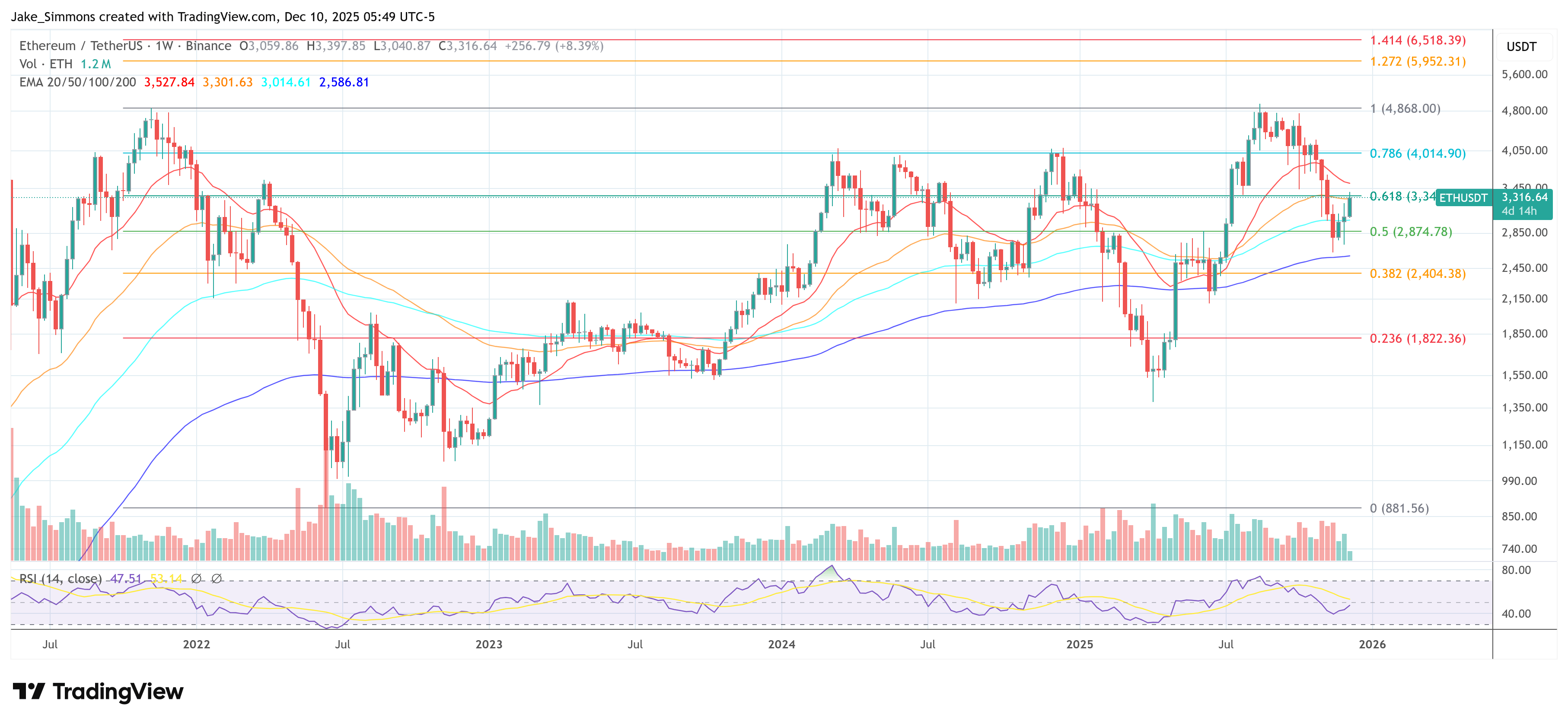
At press time, Ethereum traded at $3,316.

Ethereum price

US Banking Giants Are Quietly Piling Into Bitcoin Credit, Claims Michael Saylor

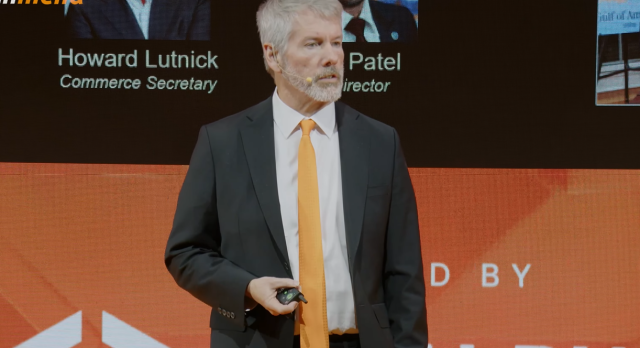
At Bitcoin MENA 2025 in Abu Dhabi, Michael Saylor used his keynote to deliver a clear message: major US banks have quietly pivoted from excluding Bitcoin to actively building products on top of it – and they are now coming directly to him.

“In the past six months I have noted and been approached by BNY Mellon, by Wells Fargo, by Bank of America, by Charles Schwab, by JP Morgan, by Citi,” the Strategy (MSTR) executive chairman said. “They are all starting to issue credit against either Bitcoin or against Bitcoin derivatives like IBIT.”

JUST IN: Michael Saylor says he got approached by all the major banks recently to launch #Bitcoin products and services.

Banks are here 🙌 pic.twitter.com/AcHQRCaP7y

— Bitcoin Magazine (@BitcoinMagazine) December 9, 2025

Big Banks Now Want Bitcoin Exposure

Saylor contrasted that with the situation a year earlier, when “all of the large banks in the United States” still refused to bank Bitcoin. Now, he said, the sector is moving toward custody and credit. “Wells Fargo and Citi have both public announced intent to allow the custody of Bitcoin within the banks and in the year 2026 they’ll start to extend credit,” he told the audience.

Saylor framed this as the institutional expression of a broader policy shift in Washington, which he described as treating BTC as “digital gold” and, more broadly, “digital capital.” He claimed there is now “a profound consensus amongst everyone running the United States” – from the president and vice president to the Treasury, SEC and other top officials – that Bitcoin is a strategic digital asset.

“The United States is the most influential financial regulator in the world,” he said. “Whatever the US banking system does and the US security market does ripples through South America […] Europe […] the Middle East […] even Hong Kong. Even the Chinese will copy what the US is doing.”

Against that backdrop, Saylor positioned Strategy as “the world’s first digital treasury company,” whose business model is to industrialize BTC-backed credit. He reported that the company now holds 660,624 BTC, including 10,600 BTC acquired “yesterday,” and is currently buying “in the range of $500 million to a billion a week” in Bitcoin. “We’re not stopping,” he said. “I think that we can buy more Bitcoin than the sellers can sell. And we’re going to take it all. And we’re going to take it out of circulation.”

The core of his argument is the conversion of volatile “digital capital” into more stable “digital credit.” Strategy over-collateralizes its credit instruments “five-to-one or ten-to-one,” aiming to protect principal even if BTC falls 90%. In return, it targets yields around 8–12.5% in its preferred and note structures, funded by BTC’s expected long-term appreciation.

Saylor presented MSTR equity as “amplified Bitcoin” because issuing credit and reinvesting in BTC can, in his model, double BTC-per-share roughly every seven years. For investors who “don’t trust anybody,” he argued, holding BTC directly remains rational; for those wanting yield and lower volatility, he pitched BTC-backed credit as the superior choice.

He then extended the logic further, outlining a path from digital credit to “digital money.” By constructing a fund that is mostly composed of short-duration BTC-backed credit (such as his “Stretch” structure), buffered with fiat instruments and cash, Saylor claimed one can create a $1 instrument with near-zero volatility and an estimated yield around 8%, distributed as tax-deferred dividends. “I could create what looks like a stablecoin […] a $1 stablecoin stable to six significant digits that pays you 8% yield tax-deferred but powered by Bitcoin,” he said, adding that banks, asset managers or crypto firms could wrap this into coins, funds or deposit-like accounts.

The speech ended as a direct appeal to sovereign wealth funds and regulators in the region. Saylor urged nations that “want to be the Switzerland of the 21st century” to let banks custody Bitcoin, extend BTC-backed credit and ultimately offer digital-money accounts that pay several hundred basis points above the risk-free rate. “If you give people money that’s better than every other bank on Earth, all of the capital in the world will flow into that country, that bank,” he said.

At press time, BTC traded at $92,700.

Bitcoin price

XRP Breakout Enters Critical Phase As Chart Targets $9–$13 Zone

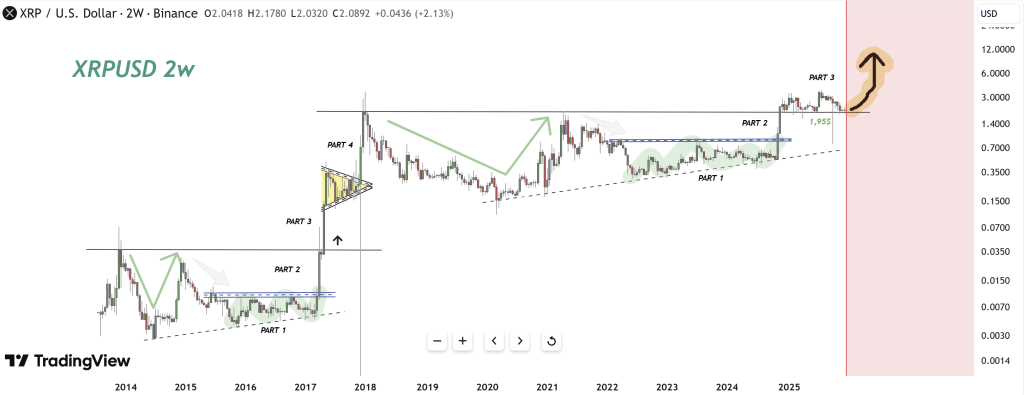
Crypto analyst Cryptollica published a new XRP/USD 2-week chart on December 8 via TradingView, arguing that the altcoin may be replaying the same structural pattern that preceded its explosive 2017 rally. With current price action pivoting around the key $1.95 level and technical targets projected as high as $9–$13.

What Happens If XRP Repeats The 2017 Fractal?

The analysis uses a long-range log chart from Binance, where the latest candle in the screenshot shows XRP trading around $2.0892. In this timeframe, the analyst divides XRP’s history into mirrored cycles: 2014–2017 on the left and 2021–2025 on the right, each broken into labeled segments “Part 1,” “Part 2” and “Part 3.”

According to Cryptollica, “the cycle experienced by XRP between 2014 and 2017 is almost an identical copy of the current cycle spanning 2021 to 2025.” In both cases, Part 1 is described as an accumulation phase, with XRP suppressed below a dashed blue resistance band for an extended period while forming higher lows along a rising dotted trendline.

XRP/USD 2-Week Chart Analysis

The current Part 1, roughly 2022–2024, is said to have lasted substantially longer than in the earlier cycle. The analyst cites the rule that “the bigger the base, the higher in space,” arguing that this extended sideways structure signals a large build-up of potential energy.

Part 2 is defined as the breakout and retest of that blue resistance band. Once XRP closes decisively above this zone and consolidates there, the chart treats the area as a new support and as confirmation that “the official end of the downtrend and the start of a bull market” has been registered. Cryptollica suggests XRP is now at the final stage of, or has just completed, this breakout phase on the 2-week timeframe.

The pivotal reference point for the entire setup is the $1.95 level, drawn in green on the chart. “The $1.95 level, marked in green, is of vital importance,” the analyst writes, emphasizing the classic principle that “once resistance is broken, it turns into support.” In this framework, XRP “currently holding above this level (performing a successful retest) is the most crucial confirmation point for the continuation of the uptrend.”

If that confirmation holds, the analysis moves to Part 3, labeled the “Parabolic Rise – Discovery Phase.” In 2017, this segment corresponded to a near-vertical advance that pushed XRP into its all-time high zone. Cryptollica argues that XRP now stands “right on the precipice of this ‘vertical lift-off’ in the current cycle,” illustrated by a steep yellow arrow on the logarithmic chart. The first major objective is the region around the prior all-time high at roughly $3.30–$3.84. If the 2017 fractal “plays out precisely,” the post projects an “implied target” between $9.00 and $13.00.

The analyst tempers this with several cautions. The crypto market is far larger than in 2017, and a move to $10+ would imply a “colossal market capitalization,” making a repeat of the exact 2017 multiple “mathematically more challenging,” even if “logic often takes a backseat in crypto mania.” The scenario also assumes supportive fundamentals, including the resolution of regulatory overhangs, potential XRP ETF developments and Ripple’s stablecoin strategy.

Parabolic phases, Cryptollica warns, are typically accompanied by “sudden drops of 30–40%,” making them “the most dangerous territory for leveraged trading.” The analyst characterizes the overall outlook as “extremely positive (bullish)” as long as the $1.95 support holds, concluding that XRP is at the moment of “breaking its chains” and that, if broader market conditions remain constructive, “double-digit targets ($10+) for XRP are technically on the table.”

At press time, XRP traded at $2.07.

XRP price

Midnight Goes Live As Cardano Founder Targets A $10 Billion Ecosystem

Cardano founder Charles Hoskinson has declared Midnight officially launched, describing it as the “first fourth generation cryptocurrency” and claiming it has already become “a billion dollar ecosystem heading to a $10 billion ecosystem.”

In a December 9 livestream from Colorado, recorded after he was forced to cancel an appearance at Abu Dhabi Finance Week due to severe food poisoning and a jet malfunction, Hoskinson framed the launch as both a technical milestone and an ideological statement about how cryptocurrencies should be built and distributed.

Cardano Founder Touts Midnight’s Fair Launch

Despite saying he had “not eaten in two days” and was “a little faded,” the Cardano founder focused on the scale and duration of the effort behind Midnight. “We worked on it for six years,” he said, noting “many false starts” and several technology changes before the team converged on “a roadmap and a technology stack that we feel is going to be the tech stack of the future.” Midnight’s rollout, he stressed, is structured in four phases, with the project now “in the very first phase” of that plan.

The next stage, according to the Cardan founder, will significantly expand Midnight’s capabilities. Over the coming months, the team intends to bring up a federated mainnet and an incentivized testnet, then activate “hybrid DApps with each ecosystem.”

He said “the next nine months is going to be a lot of fun” but also “a lot of work for all of us,” pointing to features such as “true hybrid applications, true multi-resource consensus, [and] true post-quantum folding schemes” that aim to “advance the state-of-the-art of all of the zero knowledge stacks.” The overarching goal, he argued, is “creating a natural easy way for people [to] get their privacy back.”

Privacy and chain-agnostic interoperability are at the core of how Hoskinson positioned Midnight. He said users are “starting to realize and starting to wake up that their privacy is not a guarantee and it’s not a given,” and criticized existing systems as “designed from the ground up to take your privacy from you.”

Midnight, by contrast, is framed as infrastructure that can be used by “every single blockchain in the space.” “What makes Midnight so special is the fact that Midnight is for everyone,” he said. “It has equal application to Solana users and Avalanche users and Ethereum users and Binance users and Cardano users and Bitcoin users and everyone else in between.”

The Cardano repeatedly emphasized distribution and launch mechanics as a deliberate rejection of the venture-driven model that dominates much of the industry. He highlighted that Midnight was brought to market “in a completely decentralized way” with “no ICO, no insiders, no VC participation.”

The outcome, in his view, is that “every single user enjoys the fact that it had a fair launch and a fair distribution and every single person was on equal footing through the Glacier Drop, the Scavenger Hunt, and now the exchange distributions.”

On that basis, he argued that “it’s still possible in 2025 to launch a cryptocurrency the way Satoshi did it” and “still possible to build something with vision and values where we can do better and not hand the world over to centralized actors, the finance of old.”

Hoskinson Warns Of Regulatory Overreach

He also used the Midnight launch to issue a broader warning about regulation and the direction of the industry if privacy-preserving infrastructure is not defended. “Right now the laws are being written. They’re written the wrong way,” he said. “If the rulemaking is done the wrong way, every single thing that makes cryptocurrency special will be taken from us.”

Hoskinson rejected a future where “only custodial wallets” exist, “every single person has to be KYC and AML,” and “only five or 10 protocols are pre-selected” and “armchair controlled by a small cabal of international bankers.” Instead, he said, “I want to live in a world where the protocols preserve and protect your rights as a human, your agency as a human, your economic identity as a human.”

Hoskinson described Midnight as “probably the fastest growing and most vocal project we’ve ever built,” pointing to “hundreds of ambassadors” coming online and a rapidly filling Discord, which he framed as a gathering point for those who believe in “freedom of association, commerce, and expression.”

He ended with a direct call to action: “I want you to join the Discord. I want you to become an ambassador and tell each and every person that we can do better. And I want you to build on Midnight.” Whatever network developers come from, he said, “just build something and show the world that you can do interesting and cool things,” adding that for him and his team, “we’re in it for life.”

At press time, Cardano traded at $0.4621.

Cardano price

Standard Chartered Cuts 2026 Bitcoin Price Prediction By 50%

Standard Chartered has sharply reduced its famously bullish Bitcoin roadmap, cutting its 2026 price target in half and acknowledging that its previous near-term projections were too aggressive, even as it keeps an ultra-optimistic long-term view intact.

Standard Chartered Downgrades Bitcoin Price Predictions

In a note shared on X by VanEck head of research Matthew Sigel, Standard Chartered argues that Bitcoin’s traditional halving cycle has been overtaken by ETF-driven flows. The bank writes: “With the advent of ETF buying, we think the BTC halving cycle is no longer a relevant price driver. The logic in previous cycles (when US ETFs did not exist) – i.e., prices would peak about 18 months after each halving and decline thereafter – is no longer valid, in our view.”

The report adds that it will “take a break of the current all-time high ($ 126,000 on 6 October 2025) to prove that; we expect this to happen in H1-2026.”

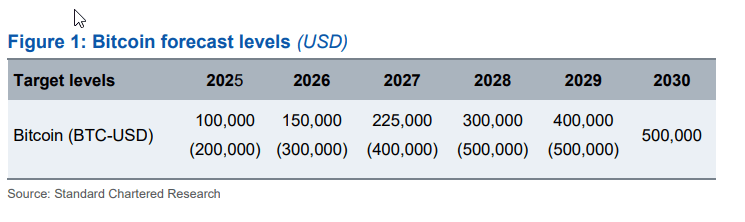
Alongside that shift in framework, the bank re-profiled its multi-year Bitcoin targets. According to the figures shared by Sigel, Standard Chartered has lowered its 2025 forecast from $200,000 to $100,000, its 2026 target from $300,000 to $150,000, its 2027 projection from $400,000 to $225,000, its 2028 estimate from $500,000 to $300,000, and its 2029 prediction from $500,000 to $400,000 while keeping a $500,000 target for 2030.

Bitcoin price predictions by Standard Chartered

Geoff Kendrick, Standard Chartered’s head of digital assets research, characterises the recent drawdown as painful but not structural. He describes the current phase as “a cold breeze,” explicitly rejecting the notion of a new crypto winter and noting that the magnitude of the pullback remains consistent with corrections seen in past bull cycles.

At the same time, he points out that weaker valuations for listed Bitcoin treasury companies have curtailed their ability to act as major marginal buyers, leaving spot ETFs as the primary driver of near-term gains.

Wall Street Giant Bernstein Agrees

The downgrade also lands in the context of a broader rethink on Wall Street. One day earlier, on December 8, Sigel shared a separate note from Bernstein that reached a similar conclusion about Bitcoin’s market structure.

Bernstein wrote that “the Bitcoin cycle has broken the 4-year pattern (cycle peaking every 4 years) and is now in an elongated bull-cycle with more sticky institutional buying offsetting any retail panic selling.”

Despite an approximately 30% correction, the firm notes that “we have seen less than 5% outflows via ETFs.” On that basis, Bernstein now moves its 2026 Bitcoin price target to $150,000, sees the cycle “potentially peaking in 2027E at $200,000,” and keeps its long-term 2033 target at roughly $1,000,000 per BTC.

Both Standard Chartered and Bernstein are converging on the same structural message: the halving alone no longer explains Bitcoin’s trajectory. ETF flows, institutional positioning and balance-sheet dynamics are now the core variables, even if their precise price targets and timelines diverge.

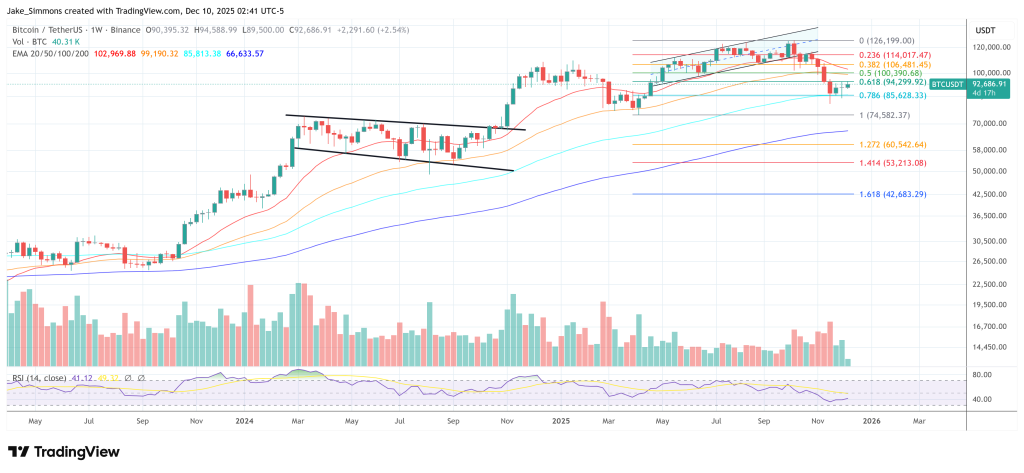
At press time, Bitcoin traded at $92,686.

Bitcoin price

Why 2026 Is Unlikely To Be Crypto’s Next Bust Year: Bitwise CIO

Bitwise CIO Matt Hougan says the crypto market is anchored to the wrong mental model. Speaking on the Empire podcast recorded 5 December and released on 8 December, he argued that the traditional “four-year Bitcoin cycle” has lost its explanatory power – and that 2026, which many expect to be a brutal post-halving down year, is far more likely to be an “up year” driven by institutional flows and regulatory tailwinds.

“2026 will not be a bad year, Jason,” Hougan told host Jason Yanowitz. “I think 2026 will be a good year […] I just don’t understand the logical reason why [the four-year cycle] would repeat again. It’s not like built into a mechanical clock. It was driven by specific factors and those factors no longer exist, so it won’t keep happening.”

He acknowledged that recent price action has unnerved investors, with Bitcoin giving back a “Vanguard pump” and selling off into a weekend on no obvious news. But he framed that as positioning and microstructure, not the start of a structural unwind.

“People in crypto over the last two months have learned to be nervous on weekends,” he said, pointing to thin weekend liquidity and Friday macro headlines. He noted that sentiment is depressed even though “the market is flat for the year,” adding: “We’re freaking out about a market that is flat for the year.”

Why The 4-Year Crypto Cycle Is Dead

Hougan broke down the four main explanations traditionally used to justify the Bitcoin cycle and argued each is now materially weaker.

First is the halving itself. “The halving cycle is just not that important,” he said. “It’s half as important as it was four years ago […] a fraction of, you know, a quarter as important as it was eight years ago, a sixteenth, etc. There’s just not that much supply being removed.” As issuance becomes a smaller fraction of total supply and ETF and derivatives flows grow, the mechanical supply shock carries less weight.

Second is the rate cycle. Prior “down years” such as 2018 and 2022 coincided with aggressive rate hikes. “Interest rates are going down,” he said. “So that thesis is just completely invalidated, right? It’s completely different.”

Third is the “blow-up” pattern – Mt. Gox, ICOs, FTX – that historically capped euphoric phases. Hougan allowed that balance-sheet stress in parts of the market is “the strongest case for the four-year cycle repeating,” but he does not expect forced liquidations on the scale of prior collapses. In his view, potential problem entities are more likely to “just not buy as much in the future” rather than being compelled sellers.

Fourth is simple randomness: three similar cycles do not make a law of nature. “Across those four, they’re all much weaker than they were in the past,” he summarised.

Why 2026 Is Poised To Be Better Than 2025

Against that, Hougan set what he sees as a once-in-a-generation shift in regulation and institutional behaviour. “You have a once-in-a-generation regulatory change from severe regulatory headwinds to strong regulatory tailwinds,” he said, and “more importantly, you have this institutional adoption narrative that’s going to overwhelm everything.”

In the last six months, he noted, major US wirehouses have “green-lit crypto exposure.” He singled out Bank of America: “They have $3.5 trillion in assets. One percent is $35 billion. Four percent is like $140 billion. That’s more than the total flows into Bitcoin ETFs so far.” He stressed it is not just one bank: “There are four wirehouses. They’re basically all on now […] the biggest advisory groups all managing many trillions of dollars.”

The catch is timing. Institutional allocations are slow and process-driven. “The average Bitwise client, I think, invests after eight meetings with us,” he said, and some of those are quarterly. That “eight-meeting” lag means the ETF era is still in its early innings; the full impact of platforms being switched on is more likely to manifest through 2026 than in a single explosive quarter.

Hougan also emphasised that advisers optimise for client retention, not absolute performance. “The one thing a financial adviser doesn’t want to do is have a meeting with their client where something is down 50% and their client fires them,” he said. That is why reduced volatility, cleaner regulation and mainstream narratives like “Bitcoin as digital gold” and “stablecoins and tokenization as new financial rails” matter so much.

On supply dynamics, he pushed back on two recurring fears: “OG whales dumping” and MicroStrategy as a forced seller. He argued that much of the apparent “selling” by long-term holders is actually upside being sold via covered calls. Whales come to Bitwise and similar firms, he said, saying: “I have a hundred million of Bitcoin […] can you write covered calls against this?” That “effectively introduces new supply into the market” without coins moving on-chain.

On MicroStrategy, he was categorical: “From a data perspective [it is] just strictly untrue that it will be forced to sell its Bitcoin.” The company has meaningful cash to service interest, no principal due until 2027, and manageable maturities relative to its Bitcoin holdings. He agreed with Jeff Dorman’s framing that MicroStrategy is no longer a major marginal buyer but also “not a forced seller.”

Too much pessimism on the timeline.

Brought on @Matt_Hougan to tell us why 2026 will be FAR better than 2025.

Tons of good nuggets in here related to institutions, financial advisors, cycles, and more.

Enjoy the optimism!pic.twitter.com/WZJb55yENF

— Yano 🟪 (@JasonYanowitz) December 8, 2025

Looking ahead, Hougan expects investors to eventually reframe the current period not as a failed bull cycle but as a behavioural transition through a key level. “We might look back at 2025 at some point and say, ‘Huh, you know what? $100,000 was like a big behavioral cliff we had to get over. Took us like a year,’” he said.

For 2026 specifically, his message is clear: the old four-year pattern “won’t keep happening,” and the combination of regulatory clarity and institutional inflows sets up what he calls an “extraordinarily strong” backdrop rather than a programmed bust.

At press time, the total crypto market cap stood at $3.06 trillion.

Total crypto market cap

Featured image from YouTube, chart from TradingView.com

Will The Crypto Market Benefit From The Trump Fed Takeover?

The prospect of a “Trump Fed takeover” is rapidly becoming a central macro theme for 2026, with some traders arguing that markets still underestimate how radical the shift could be for global liquidity – and by extension for crypto.

Macro commentator plur daddy (@plur_daddy) describes it bluntly via X: “The Trump Fed takeover being underpriced is my primary theme going into 2026 (hence my gold bet). This is a momentous shift: the bigger and more convex the catalyst, the more difficult it is for markets to price it in properly.”

Former Fed trader Joseph Wang known as “Fed Guy” echoes the concern from inside the plumbing, warning: “The market underestimates the likelihood of a Trump Fed. The Administration is showing resourcefulness and determination for lower rates. That could set off the blow off top in equities, where implied vol shows speculation still has room to run.”

The Trump Fed Takeover Isn’t Price In

That determination is colliding with a bond market that appears to be pushing back via term premium. Plur highlights the spread between the 12-month T-bill and the 10-year Treasury as a clean gauge of that tension. He notes that the spread “peaked right before inauguration on the generic ‘Trump will run it hot’ viewpoint,” then “got crushed lower as DOGE and Tariffs got priced in.” It bottomed near the tariff lows and “is now back to the highs,” a pattern he reads as term-premium expansion as “a form of protest to [Kevin] Hassett,” Trump’s presumed Fed pick.

Against that backdrop, the administration still has powerful tools to compress term premium without formally announcing quantitative easing. Plur identifies three levers. First, de-regulating banks so they are allowed – in practice, pressured – to hold more Treasuries, boosting structural demand for government paper.

Second, reducing the Treasury’s weighted-average maturity by shifting issuance “to bills over longer dated notes,” which cuts the duration the market has to absorb. Third, specifically for mortgages, “lever up the GSEs to buy MBS,” narrowing mortgage spreads and transmitting easier policy to the housing market even if the policy rate moves more slowly. He argues that “all of these are quite bullish for risk overall but will take time to play out.”

For now, the environment remains awkward for directional risk bets, including crypto. “In the meantime, it has been a choppy and difficult market, across the board. Equity indices have grinded higher but the underlying rotations have been tricky to navigate. QT ended but liquidity is still relatively thin, and the fact that we are going into year end does not help. Better times will come.”

The bullish pivot in his framework arrives with the calendar. “In the new year, fiscal accommodation will re-expand on the implementation of OBBBA (+$10–15bn/mo). Meanwhile we have sell-side macro teams calling for $20–45bn/mo in T-bill repurchasing by the Fed, as soon as Jan 1.”

This mix would directly ease pressures visible in funding markets: “This would go a long way towards easing the current liquidity issues (see the SOFR–IORB spread chart below). This is not classic QE in that there is very little duration being absorbed from the private sector, and mainly has the effect of expanding bank reserves. This is still bullish because bank reserves are tight at the time, which is tied to the repo liquidity issues.”

Will The Crypto Market Rise Again?

On that basis, Plur expects the macro backdrop in 2026 to look “better than H2 ’25 has been, perhaps more on par with parts of 2024.” His expression of the trade is clear: “This should be enough for strong performance on gold given the Fed takeover angle, and continued melt-up in equities and select commodities.”

For Bitcoin and the broader crypto market, however, his stance is notably more cautious. “For BTC it is more difficult to say. My base case continues to be a frustrating period of chop and re-accumulation.” Improved liquidity “should be favorable for BTC,” but he questions whether there will be “a material shift in the supply/demand imbalances we have been seeing,” concluding: “I will keep watching it for now.”

In other words, the Trump Fed trade is already driving high-convexity bets in gold, equities and commodities. Crypto stands to benefit indirectly from easier reserves and lower term premium, but in this framework, the key constraint is no longer just macro liquidity – it is whether fresh demand is strong enough to meet an increasingly inelastic supply in the crypto market.

At press time, the total crypto market cap stood at $3.05 trillion.
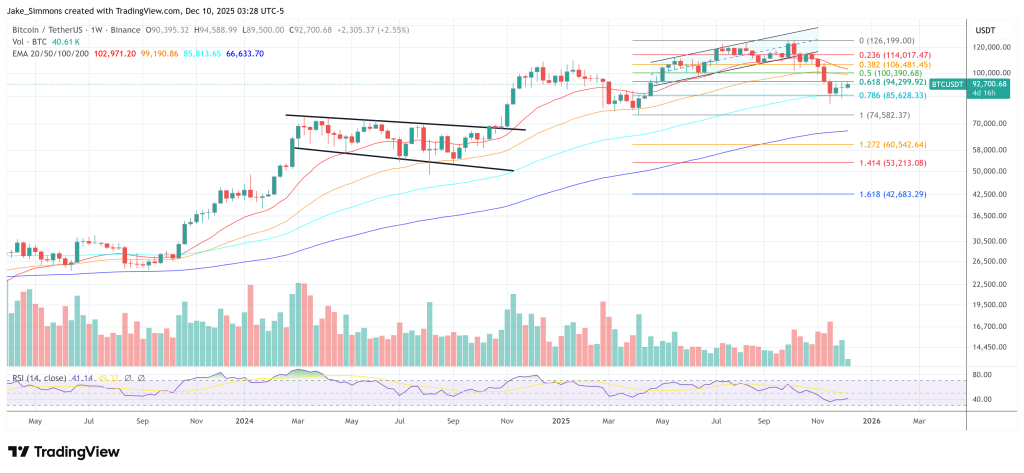
Total crypto market cap

❌