Reading view

There are new articles available, click to refresh the page.

OCC Highlights Major Concerns Over Crypto Debanking Practices Among Major Banks

On Wednesday, the Office of the Comptroller of the Currency (OCC) released findings that have raised alarm bells regarding crypto debanking, reigniting fears of what some are dubbing “Operation Chokepoint 2.0” within the financial sector. 

This supervisory review focused on nine of the largest national banks under OCC supervision, including JPMorgan Chase, Bank of America, Citibank, Wells Fargo, US Bank, Capital One, PNC Bank, TD Bank, and BMO Bank.

‘Harmful Debanking Policies’

The preliminary findings from the OCC reveal troubling trends: between 2020 and 2023, these banks appeared to make unwarranted distinctions among customers based on their legal business activities. 

Specifically, many of these institutions maintained policies that either restricted access to financial services or required heightened scrutiny and approvals for certain clients. 

The OCC identified examples where at least one bank imposed limitations on various sectors, including crypto, due to their engagement in activities considered “contrary to [the bank’s] values,” even though those activities were not illegal.

Sectors affected by these policies included oil and gas exploration, coal mining, firearms, private prisons, tobacco and e-cigarettes, adult entertainment, and notably, digital assets

The findings indicated that many banks placed strict limitations on crypto-related activities as well, which often stemmed from concerns about financial crime.

These practices, the OCC confirmed, were prevalent at each of the banks examined in the review. Comptroller Jonathan V. Gould expressed frustration regarding the situation, stating: 

It is unfortunate that the nation’s largest banks thought these harmful debanking policies were an appropriate use of their government-granted charter and market power. 

Gould noted that while many of these policies were publicly announced, some banks have maintained that they did not participate in debanking.

In his comments, Comptroller Gould emphasized the OCC’s commitment to eliminating practices that would “weaponize finance,” whether instigated by regulators or the banks themselves. 

National Banks To Facilitate Crypto Transactions

The agency disclosed that it is still evaluating “thousands of complaints” related to allegations of political and religious debanking, with plans to report on these findings “in due course.” The OCC aims to hold banks accountable for these actions and ensure that unlawful debanking practices do not persist. 

This follows Tuesday’s letter from the banking regulator that allows national banks to participate in “riskless principal transactions” involving cryptocurrencies. This permits national banks to buy and sell cryptocurrencies for their customers’ accounts. 

This new structure allows users to transact in crypto-assets through established national banks, resulting in a more regulated environment than exchanges that operate outside of strict oversight regulation. 

Crypto

Featured image from DALL-E, chart from TradingView.com 

Upcoming Crypto Market Structure Bill Markup Likely Pushed To Post-Holiday

The much-anticipated crypto market structure bill, intended to establish a clearer regulatory framework for digital assets in the United States, appears to be facing significant delays. 

Recent discussions among a bipartisan group of pro-crypto senators suggest that a markup, initially expected before Christmas, may be postponed until after the holiday season.

Negotiations Stalled For Crypto Bill

According to a report by Eleanor Terret from Crypto In America, a closed-door meeting on Tuesday revealed that advancing the bill before Christmas is becoming increasingly unlikely. 

The significant hurdle lies in the ongoing negotiations between Republican and Democratic lawmakers, who remain divided on several critical issues. 

A leaked three-page compromise proposal from Senate Banking Republicans to their Democratic counterparts, reported by Politico, offered some insights into the negotiation process.

Among the provisions highlighted in the proposal was an assurance to Democrats that front-end sanctions compliance for certain decentralized finance (DeFi) platforms would be integrated into the bill. In exchange, the proposal sought to preserve protections for software developers and self-custody. 

Two major points for Democrats were included in this offer: a requirement for Democratic commissioners to be involved in agencies overseeing crypto and ethics language aimed at preventing high-ranking government officials from profiting from digital assets. 

Bipartisan Support Remains Elusive

As lawmakers continue to grapple with the complexities of the negotiations, there is a sense of fatigue among those involved. At this week’s BA Policy Summit, Senator Bernie Moreno described the bargaining process as “decently frustrating.” 

Senator Cynthia Lummis, one of the top supporters of the industry and the passage of the market structure bill, and chair of the Senate Banking’s Subcommittee on Digital Assets, noted that the staff members working on the bill are feeling “exhausted.”

With only seven working days remaining before members depart for the Christmas break, negotiations are expected to persist. Senator Lummis has indicated her desire to release a draft of the bill by the end of this week, allowing the industry a chance to review it ahead of a potential markup next week. 

According to Terret, Senate Banking Chair Tim Scott could still convene a markup next week and likely push the bill through along party lines. However, securing bipartisan support would greatly enhance the final bill’s chances of passing in the full Senate next year, potentially explaining a decision to delay the markup until January.

Meanwhile, the Senate Agriculture Committee, which previously released an incomplete draft of its own market structure bill last month, may also hold its markup next week. 

However, committee Chairman John Boozman suggested to Bloomberg Tax that he would likely postpone such a decision until next year, citing several “difficult issues” that need resolution.

A spokeswoman for the committee later confirmed to Crypto In America that a markup would be scheduled “soon,” indicating that discussions are still ongoing. 

Crypto

Featured image from DALL-E, chart from TradingView.com

Strategy Calls For Withdrawal Of MSCI’s Exclusion Plan For Digital Asset Treasury Companies

Strategy, formerly known as MicroStrategy, has expressed strong opposition to a proposal by the Morgan Stanley Capital International (MSCI) to exclude digital asset treasury companies (DATs) from its indexes. 

Calls For Fair Treatment Of Digital Asset Companies

In a recent letter signed by Michael Saylor and the firm’s CEO Phong Le, Strategy highlighted its support for MSCI’s efforts to establish consistent eligibility criteria across its indices. 

However, the company criticized the proposed threshold for excluding firms with more than 50% digital assets on their balance sheets, calling it “misguided.” The company argued that this measure could have negative implications not only for Strategy’s operations but also for the broader cryptocurrency market.

Strategy emphasized that, unlike traditional investment funds, it maintains the operational agility to adapt its value-creation strategies in tune with the evolving technology underlying Bitcoin. 

The firm asserts that this flexibility is a critical asset for investors and distinguishes Strategy and other DATs from traditional digital asset investment vehicles

The firm likened its investment approach in a singular asset class to that of real estate investment trusts (REITs) or oil companies, stating that MSCI categorizes those entities correctly without labeling them as investment funds. Therefore, it argued, DATs should be afforded similar treatment.

‘Discriminatory And Arbitrary’

The letter criticized the proposed 50% digital asset threshold as “discriminatory and arbitrary,” suggesting that it imposes uniquely unfavorable conditions on digital asset companies while allowing other industries—like oil, timber, and real estate—to maintain concentrated asset holdings without similar scrutiny. 

Strategy raised concerns that enforcing this rule would necessitate MSCI to create new methods for measuring balance sheet concentration, complicating the indexing process unnecessarily due to varying accounting principles across asset classes and jurisdictions.

Additionally, Strategy elaborated on how the exclusion of DATs could substantially inhibit innovation within the digital asset industry, which the current administration strongly promotes as part of its economic strategy. 

The company said that digital assets like Bitcoin have the potential to become foundational elements of global financial systems, but the proposed measures could limit access to these transformative technologies for pension plans and 401(k)s, ultimately redirecting billions away from the sector.

Strategy cautioned that a hasty exclusion of DATs could be based on misconceptions about their business models, asserting that it reflects a misunderstanding of the nature of these entities. 

The firm advocated for a more measured approach similar to MSCI’s past handling of the “Communication Services” sector, which underwent extensive consultation and a thorough review before reorganizing traditional telecom, media, and internet companies.

Strategy Urges MSCI To Reconsider

If implemented, Strategy warns that MSCI’s proposal could lead to the delisting of numerous companies heavily involved in digital assets. JPMorgan analysts estimate that Strategy alone might face liquidations of up to $2.8 billion as a direct consequence of this exclusion.

Such a move is also expected to potentially distort market dynamics by incentivizing Bitcoin miners to sell their assets immediately instead of holding them as part of their business strategy.

In light of these concerns, Strategy urged MSCI to withdraw the proposal for excluding companies with over 50% digital asset holdings from its Global Investable Market Indexes. 

The firm asserted that the proposal is rooted in a flawed understanding of DATs and would impose conditions unaligned with national interests, particularly those advocating for the responsible growth of the digital asset space.

Strategy

As of this writing, the company’s stock, trading under the ticker symbol MSTR, is trading at $185. There has been almost no difference since Tuesday’s trading session amid consolidating crypto prices. 

Featured image from DALL-E, chart from TradingView.com 

American Federation Of Teachers Opposes Crypto Market Structure Bill In New Letter

The American Federation of Teachers (AFT) has formally added its voice to the growing opposition against the proposed crypto market structure bill, urging the Senate Banking Committee to reconsider the legislation. 

In a letter obtained by CNBC, AFT President Randi Weingarten described the bill as “as irresponsible as it is reckless,” citing the alleged dangers it poses to working families’ pensions and the overall economy.

AFT Calls Out Loopholes In Crypto Legislation

In her correspondence with Senate Banking Committee Chairman Tim Scott and Ranking Member Elizabeth Warren, who is known for her consistent skepticism toward digital assets, Weingarten expressed significant concern about the implications of the proposed legislation. 

She stated that the current draft gives the AFT “deep concern” over the risks posed to retirement plans, including the union’s own pensions. Weingarten argued that advancing the crypto legislation could open the door to “widespread fraud” and “unethical practices” within retirement schemes.

Weingarten alleged that the bill “misleadingly” portrays cryptocurrencies as stable and mainstream, despite their volatility. She argued that rather than providing necessary safeguards. “If passed, it will undercut the safety of many assets and cause problems across retirement investments,” she noted.

Among the specific concerns raised by the AFT was a provision allowing non-crypto companies to issue their stock on the blockchain, thus evading existing regulatory frameworks for securities. 

Weingarten warned that this loophole and the corresponding erosion of traditional securities laws could have “disastrous outcomes.” She noted that pensions and 401(k) plans may end up invested in unsafe assets, even when they are nominally traditional securities. 

Additionally, she criticized the legislation for inadequately addressing the fraud and illegal activities that Weingarten believes remain prevalent in crypto markets, labeling it “irresponsible” and “reckless.”

Delays And Heightened Concerns

In the letter, Weingarten also stressed that if the bill were to become law, it could potentially set the stage for the next financial crisis. The AFT’s stance aligns with concerns previously expressed by the AFL-CIO, the nation’s largest labor union, which also opposed a draft of the crypto bill in October.

In line with Weingarten’s opposition, Democratic senators, including Warren, have raised concerns regarding the balance of regulatory oversight between the Commodity Futures Trading Commission (CFTC) and the Securities and Exchange Commission (SEC). 

Massachusetts Secretary of State William Galvin reiterated these concerns in a letter, highlighting that the proposed legislation could exclude significant portions of the financial industry from state oversight, creating risks for millions of savers.

Progress on the Senate’s version of the crypto market structure bill has faced delays, partly attributed to the recent lengthiest government shutdown in US history. 

Senator Lummis recently provided insight into potential timelines, indicating that her goal is to share a new draft by the end of the week. She plans to allow both the crypto industry and lawmakers from both parties to review the draft before moving forward with markup next week.

Crypto

Featured image from DALL-E, chart from TradingView.com 

Bitcoin Outlook Post Fed’s 0.25% Rate Cut: Historical Patterns And Predictions

In a move that could signal a bullish shift for Bitcoin (BTC) and the broader cryptocurrency market, the Federal Reserve (Fed) announced a 25 basis points (bps) interest rate cut, bringing the new rate range to 3.5% to 3.75%. 

Bitcoin Poised To Surge Toward $100,000?

Kevin Hassett, the White House economic adviser and a leading candidate to become the next Fed chair, commented to the Wall Street Journal CEO Council that there is “plenty of room” for additional interest rate cuts. 

He stated, “If the data suggests that we could do it, then — like right now, I think there’s plenty of room to do it.” Hassett, who is President Donald Trump’s preferred choice for the Fed chair position after Jerome Powell’s tenure concludes, has been critical of Powell for being “too late” in lowering rates.

While the last rate cut in October had minimal impact on the Bitcoin price, analyst Michael van de Poppe believes that the current rate cut could significantly benefit the cryptocurrency. He characterized it as a “great move” for Bitcoin and noted that a breakout above $92,000 might be indicative of future bullish momentum. 

Van de Poppe expressed optimism about Bitcoin’s ability to maintain the support level between $91,500 and $92,000, suggesting that if it does, there could be a pathway for Bitcoin to approach the $100,000 mark.

Can BTC Avoid Historical 10% Decline?

Market expert Ash Crypto pointed out that historically, each of the last four times the Fed slashed rates by 25 bps, Bitcoin experienced a 5% to 10% decline shortly thereafter. Despite this pattern, Ash noted that the current market setup differs from previous scenarios, suggesting that different dynamics could be at play.

Several positive factors underpinning this optimism include the conclusion of quantitative tightening (QT) after a three-year period. Should Powell hint at the possibility of quantitative easing (QE) in his forthcoming remarks, it could spur a further bullish trend in the market. 

Additionally, with this being the third rate cut, Ash asserted that there is potential for increased liquidity to flow back into the markets, which historically benefits risk assets like Bitcoin.

Bitcoin

Featured image from DALL-E, chart from TradingView.com 

Bitwise Rolls Out New ETF For Broad Crypto Exposure, Including BTC, XRP, And ADA

On Tuesday, Bitwise announced the launch of the Bitwise 10 Crypto Index ETF (BITW) on the New York Stock Exchange (NYSE), allowing investors to gain exposure to a diverse range of cryptocurrencies in a single investment vehicle. 

This ETF includes ten digital assets: Bitcoin (BTC), Ethereum (ETH), XRP, Solana (SOL), Chainlink (LINK), Litecoin (LTC), Cardano (ADA), Avalanche (AVAX), Sui (SUI), and Polkadot (DOT). 

Notably, BITW marks the first exchange-traded fund by a major crypto asset manager to incorporate Avalanche, Sui, and Polkadot into its portfolio, as highlighted by Bitwise CEO and co-founder Hunter Horsley in a recent interview with CNBC.

Bitwise ETF Launches With Over $1 Billion In Assets

“This development significantly broadens the audience that can access these various assets, particularly for those digital currencies that lack a spot ETF,” Horsley explained on Monday. 

The fund is tailored for both financial advisors and smaller investors looking to utilize funds from individual retirement accounts (IRAs) or other retirement savings, where ETFs serve as the main investment option.

BITW represents a conversion from a prior index fund that encompassed the same digital currencies and has launched with over $1 billion in assets. 

The approval of Bitcoin and Ethereum ETFs back in January 2024 has led asset managers to compete for the chance to introduce ETFs that track a broader range of digital assets, including altcoins like Sui and Aptos, as well as memecoins such as TRUMP and Dogecoin (DOGE). 

However, these investment vehicles experienced major withdrawals in October and November, particularly for Bitcoin- and Ethereum-focused ETFs. These withdrawals reached record levels amid a broader sense of caution due to falling crypto prices. 

“The timing is ideal for many investors who have been paying attention since the Bitcoin ETF launch and are now looking for a more comprehensive way to allocate to digital assets without the need to select individual assets,” Horsley noted.

BITW Allocates 90% To Major Cryptos 

It’s important to emphasize that while BITW offers exposure to smaller cryptocurrencies in terms of market capitalization, its allocation to these assets is proportionately limited. 

Specifically, the ETF dedicates 90% of its holdings to Bitcoin, Ethereum, Solana, and XRP, with the remaining 10% allocated to the other tokens in the fund. 

The fund will undergo monthly rebalancing, a more frequent schedule compared to many exchange-traded funds in the market that typically rebalance quarterly or semi-annually. 

Bitwise further expressed its commitment to expanding access to cryptocurrency opportunities, stating in a social media post

At Bitwise, we’ve been working tirelessly since 2017 to expand access to the opportunities in crypto. Countless investors have requested an index ETP, and we’re thrilled that NOW, with BITW’s listing on NYSE, you have that option. We believe 2025 is a breakout year for this space, and we are more optimistic than ever about the opportunities ahead.

Bitwise

As of this writing, Ethereum is the best-performing asset in Bitwise’s new fund. It is trading at $3,323 and has recorded gains of up to 6% in the past 24 hours as it approaches key resistance levels. 

Featured image from DALL-E, chart from TradingView.com 

Ethereum Price Climbs Toward $3,300 For The First Time Since November: What’s Driving The Surge?

On Tuesday, the Ethereum price experienced a notable surge, climbing by 6.5% and reclaiming the critical $3,300 mark for the first time in nearly a month. This has allowed Ethereum to outpace its peers among the top ten cryptocurrencies by market capitalization, showcasing a nearly 12% recovery for the leading altcoin over the past week.

ETH Grows In Demand 

Analysts from Bull Theory attribute this resurgence to several key factors, including significant institutional interest in Ethereum. The firm highlighted BitMine, which holds the largest public company collection of ETH, as a major player in this recovery phase. 

In a recent social media update on X (formerly Twitter), the analysts pointed out that demand for ETH is on the rise as Wall Street quietly builds on the Ethereum platform.

Notably, major financial institutions are beginning to make substantial moves in the Ethereum space. BlackRock, which manages $13.5 trillion, is launching tokenized funds and has filed for a staked Ethereum exchange-traded fund (ETF). 

Other notable players include JPMorgan with $4 trillion in assets, Deutsche Bank at $1.1 trillion, and Standard Chartered with $800 billion. These firms are developing tokenization and decentralized finance (DeFi) infrastructure specifically on Ethereum and its Layer 2 (L2) solutions.

In addition, well-known financial entities such as Amundi, HSBC, BNY Mellon, Coinbase (COIN), Kraken, and Robinhood (HOOD) are incorporating Ethereum into their operations for functions like custody, settlement, and rollup infrastructure. 

As a result, these large companies are holding and staking ETH to generate yield, significantly increasing the altcoin’s demand. BitMine, for instance, anticipates earning over $400 million annually from its staking position.

Could The Ethereum Price Hit $12,000?

Such institutional involvement has led market experts like Tom Lee to speculate that the Ethereum price could potentially reach $12,000 by 2026, driven by growing staking demand and the scaling of tokenization efforts. 

Adding to the momentum, Arkham reported that Tom Lee’s Ethereum treasury firm acquired 138,452 ETH since last week, valued at approximately $431.97 million. BitMine currently holds $12.05 billion in ETH and has an additional $1 billion allocated for further purchases. 

In a different development that could bolster the Ethereum price further, Chris MacDonald, an analyst for The Motley Fool, highlighted reports indicating that the Office of the Comptroller of the Currency (OCC) confirmed US banks can now legally conduct “riskless principal” transactions in crypto assets. 

The analyst asserted that this new regulatory approval may lead to an influx of capital into digital assets, which would likely benefit the Ethereum price and holders, as well as other top cryptocurrencies.

Ethereum price

As of this writing, the Ethereum price is trading at $3,325. Despite recent gains, the price is still nearly 33% below the all-time high of $4,946, which was reached earlier this year. 

Featured image from DALL-E, chart from TradingView.com 

Expert Declares Bitcoin Has Reached Midpoint Of Bear Cycle: What Lies Ahead?

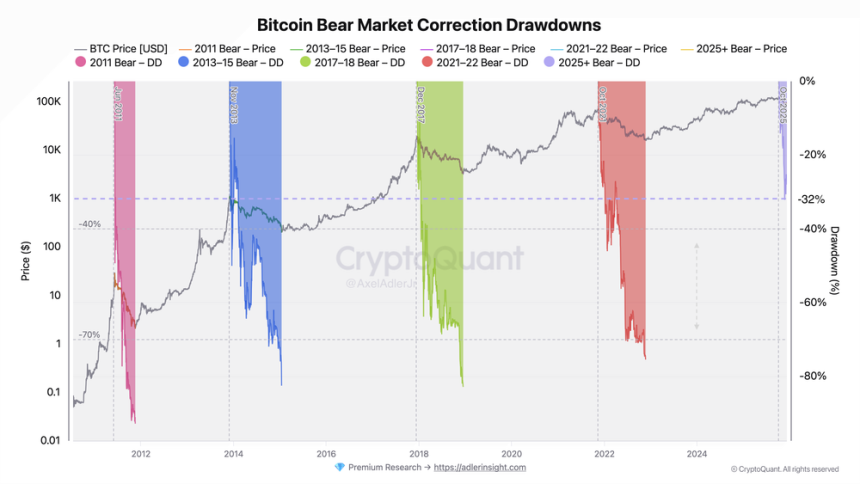
During what many anticipated would be the year of a major Bitcoin (BTC) bull run, market expert Axel Adler has revealed that the leading cryptocurrency finds itself at the midpoint of a bear cycle. 

A Mild Bear Cycle Compared To History

As of now, Bitcoin has recorded a modest year-to-date decline of 4%. However, the cryptocurrency has shown some stability this week, consolidating in the range of $89,000 to $94,000, with the latter figure serving as immediate resistance. 

According to Adler, this current correction, which stands at approximately -32%, is considered less severe compared to previous bear cycles. He emphasizes that approximately 88% of Bitcoin holdings remain in unrealized profit, while only about 12% of the total supply is currently at a loss.

Adler points out that Bitcoin’s price action has remained relatively steady within the $90,000 zone, reflecting a mild drawdown in historical context. 

The crucial question as the year approaches its end is whether this correction will stabilize between -35% and -40% from its all-time high, indicating a new, more “flattened” cycle, or if the market will follow historical trends that typically lead to deeper declines of -60% to -70%.

Analyzing past cycles, Adler notes that major bear markets in 2011, 2016, 2019, and 2023 were characterized by a significant increase in the percentage of coins at a loss, often rising to around 60%. These levels typically marked capitulation points in the market. 

Bitcoin

In contrast, the current landscape shows only 12% of holders experiencing unrealized losses, which diverges sharply from the patterns observed during past bear markets.

Can Bitcoin Avoid Deeper Declines?

The expert further noted that during recent local cycle peaks, only about 17% of coins were in the red, a figure that remains three to four times lower than traditional capitulation levels. 

This unusual configuration suggests that the current market may resemble a correction within a bullish supercycle rather than the final downturn of a full-blown bear market.

Adler believes that the market appears to be testing the resilience of this correction structure, which stands at -32% from its peak, while maintaining a high ratio of profitable positions. 

He argues that if Bitcoin can sustain this maximum drawdown above the -35% zone alongside moderate unrealized losses, it could bolster the case for a shift towards more “flat” corrections influenced by institutional demand and a structural supply deficit.

On the contrary, should Bitcoin’s correction extend beyond the -40% mark, the likelihood of entering a classic bear market increases significantly. Such a scenario would pave the way for deeper declines, potentially reaching the -60% to -70% range, and could trigger a full capitulation phase in terms of unrealized loss metrics.

Bitcoin

At the time of writing, the market’s leading cryptocurrency is trading at $93,000, marking gains of 5% and nearly 9% in the 24-hour and 14-day time frames, respectively.

Featured image from DALL-E, chart from TradingView.com 
Crypto Market Structure Talks: Senator Lummis Addresses Latest Legislation Plans

Senators engaged in bipartisan discussions regarding the anticipated crypto market structure bill met on Tuesday amid ongoing disagreements about the timing of a committee vote on the legislation. 

According to a report from Politico, Sen. Cynthia Lummis, a key negotiator for the Republican side, expressed optimism that a new draft of the bill could be released this week. 

Lummis aims to have the bill ready for markup before Congress adjourns for the holiday break, stating, “Knock on wood, I hope to share a draft at the end of this week that reflects our best efforts to date.”

Lummis Urges Swift Progress On Crypto Legislation

During a panel discussion hosted by the Blockchain Association, Sen. Lummis emphasized the urgency of progressing with the legislation. She remarked that it might be advantageous for lawmakers to finalize a product and proceed with the markup next week, allowing everyone to take a break for the Christmas holidays. 

In related developments, Politico reported that Senate Banking Republicans submitted a proposal to their Democratic counterparts last week, suggesting over 30 amendments to a previous draft of the legislation. 

The three-page document, which comes from GOP senators on the Banking Committee, seeks to maintain certain elements of the original bill while incorporating adjustments acceptable to Democratic lawmakers.

Senate Banking Committee Chair Tim Scott and other Republicans are eager to finalize the markup next week, although some Democrats have expressed skepticism about this ambitious timeline. Following a meeting on Monday, Democrats sent a response to the GOP offer, but details of their feedback remain unclear.

Concessions In GOP’s Proposal 

The GOP’s proposal outlines the aspects from a September crypto market structure framework that they agree to integrate into a bipartisan bill, hoping to reconcile differences with their Democratic colleagues. 

The proposal includes a two-column table delineating 38 concessions the Republicans are willing to make, in exchange for retaining or modifying 32 sections of the original Responsible Financial Innovation Act discussion draft.

Among the concessions is language that reflects White House approval, which could address Democratic concerns regarding appointments to the Securities and Exchange Commission (SEC) and the Commodity Futures Trading Commission (CFTC). 

Additionally, the proposal contains ethics provisions aimed at addressing scrutiny over the Trump family’s business connections in the crypto sector. 

However, Lummis noted a previous ethics proposal she negotiated with Sen. Ruben Gallego was rejected by the White House, and she plans to collaborate further with Democrats to revisit the issue.

Other notable concessions from the Republicans include a section on consumer protection standards for digital assets, proposed language regarding bankruptcy, the establishment of a federal baseline for crypto ATMs, and risk management standards for digital asset intermediaries. 

Crypto

Featured image from DALL-E, chart from TradingView.com 

US Banks Cleared For ‘Riskless’ Crypto Transactions Following OCC Letter

In a new major breakthrough for the digital asset industry in the United States, the Office of the Comptroller of the Currency (OCC) announced on Tuesday that national banks are permitted to engage in “riskless principal transactions” involving crypto-assets. 

This confirmation comes through the issuance of Interpretive Letter 1188, which outlines the guidelines for such activities.

OCC’s New Framework

According to the OCC’s guidance, acting as a riskless principal for crypto-assets aligns with the services that national banks already offer to custody customers. 

National banks are now allowed to buy and sell both financial and non-financial assets held in custody based on customer directions, adhering to existing agreements and legal requirements. 

Therefore, facilitating the buying and selling of digital assets for custody customers in a riskless principal capacity is essentially the same as acting as an agent for those customers, and it is acknowledged as a legitimate banking activity.

This new framework means that customers can transact in crypto-assets through established national banks, providing a more regulated environment compared to exchanges that operate outside the purview of strict financial oversight. 

Key Concern For Banks In Crypto Transactions

The OCC also distinguished between riskless principal transactions in digital assets and those in traditional securities. The primary differences lie in the underlying assets and the technology used to facilitate these transactions. 

The main concern associated with riskless principal transactions is counterparty credit risk, especially settlement risk. Similarly, in customer-driven, perfectly matched derivative transactions that utilize transitory title transfer, credit risk is the predominant factor. In the letter, the OCC concluded the following:

As with any activity, a bank that conducts riskless principal crypto-asset transactions must do so in a safe and sound manner and in compliance with applicable law. The OCC will examine riskless principal crypto-asset activities as part of its ongoing supervisory process.

Crypto

Featured image from DALL-E, chart from TradingView.com 

New CFTC Crypto Initiative: Bitcoin, Ethereum, To Serve As Collateral In Derivatives Trading

Caroline Pham, the acting chair of the US Commodity Futures Trading Commission (CFTC), has announced the launch of a pilot program allowing Bitcoin (BTC), Ethereum (ETH), and USD Coin (USDC) to be utilized as collateral in US derivatives markets. 

New CFTC Guidance For Crypto

The pilot program was unveiled on Monday, accompanied by new guidance regarding the use of tokenized collateral. The CFTC’s Market Participants Division, Division of Market Oversight, and Division of Clearing and Risk outlined their stance on tokenized assets in today’s announcement, emphasizing that the agency’s regulations are technology-neutral. 

Key topics covered in the guidance include eligible tokenized assets, legal enforceability, custody arrangements, valuation methods, and operational risks. The new directives also encompass tokenized real-world assets (RWAs), like US Treasury securities and money market funds. 

In a move designed to provide regulatory clarity, the CFTC issued a no-action position regarding certain requirements for Futures Commission Merchants (FCMs) that accept non-securities crypto assets as customer margin collateral or that hold stablecoins in segregated accounts. 

This position aims to promote a clearer understanding of the application of segregation and capital requirements for FCMs integrating digital assets into their operations.

CFTC Withdraws Outdated Advisory

Under this pilot program, FCMs will be permitted to accept BTC, ETH, and USDC as margin collateral for an initial three-month period. During this time, the firms must provide weekly reports on the amount of digital assets held in customer accounts, detailing each asset type. 

Additionally, they are required to inform CFTC staff of any significant issues that arise concerning the use of these digital assets as collateral. 

The CFTC has also withdrawn Staff Advisory No. 20-34, which previously restricted FCMs from accepting cryptocurrencies as customer collateral. 

The statement asserts that the advisory had become outdated due to the substantial advancements in the digital asset landscape and the enactment of the GENIUS Act, making it no longer relevant. Acting Chair Pham emphasized the importance of these changes, stating:

Under my leadership this year, the CFTC has led the way forward into America’s Golden Age of Innovation and Crypto. This imperative has never been more important given recent customer losses on non-U.S. crypto exchanges. Americans deserve safe U.S. markets as an alternative to offshore platforms.” 

Pham added that the initiative to allow spot crypto trading on CFTC-registered exchanges and the establishment of a digital assets pilot program set clear guardrails for protecting customer assets, while enhancing the monitoring and reporting capabilities of the CFTC.

Through these initiatives, Pham aims to provide regulatory clarity for tokenized collateral related to real-world assets and respond to the needs of the broader cryptocurrency market.

Crypto

Featured image from DALL-E, chart from TradingView.com 
CEOs Of Leading Banks To Discuss Crypto Market Structure With US Senators This Week

In the wake of the GENIUS Act, which was signed into law by President Donald Trump in July, attention is now turning to the CLARITY Act, commonly known as the crypto market structure bill. This legislation has encountered substantial delays, exacerbated by the recent government shutdown and a lack of consensus in Congress.

Bank Leaders To Engage With Congress On Key Crypto Topics

This week, the CEOs of Citigroup, Wells Fargo, and Bank of America are scheduled to meet with both Republican and Democratic senators to discuss the evolving legislation surrounding crypto market structure. 

The meetings are set for Thursday, and congressional staff have indicated that the CEOs would welcome the chance to share insights on US Global Systemically Important Bank (GSIB) market structure priorities.

The bank leaders are anticipated to hold separate discussions with lawmakers from both parties, emphasizing collaboration to shape effective policies that position the United States as a leader in crypto assets. Among the topics on the agenda are bank permissibility, interest payments, and concerns surrounding illicit finance. 

Senate Faces Hurdles

Recent updates on social media platform X (previously Twitter) from Eleanor Terret of Crypto In America, also indicate that obtaining a markup for the crypto market structure bill before the Christmas break poses challenges. 

Senator Mark Warner has expressed concerns about pending language from the White House regarding two critical components of the bill—ethics and quorum. 

Warner noted the importance of addressing these issues thoughtfully, stating that bipartisan discussions are ongoing, yet productive progress is essential.

The Senate’s approach to the legislation is further complicated by its division into two committees: the Banking Committee, which oversees securities laws, and the Agriculture Committee, which focuses on commodities law

Both committees have released drafts of their work during the fall, with markup sessions—the process for voting on amendments before a full Senate vote—upcoming. However, both committees are proceeding cautiously due to unresolved issues.

Senators Demand Conflict Of Interest Provisions

The most pressing concerns include the treatment of stablecoin yields, potential conflicts of interest, and the regulatory approach to decentralized finance (DeFi). 

Some Democratic senators have indicated that they will not support the legislation unless it includes provisions addressing any possible conflicts relating to the President’s family and their business involvements in the crypto realm. 

Moreover, while market structure legislation primarily targets centralized platforms managing user funds, there is a push from the traditional finance sector to classify virtually all crypto-related entities, including developers and validators, as intermediaries.

Market analyst MartyParty provided an encouraging update on December 4, noting that the bipartisan crypto market structure bill is gaining momentum in Congress. 

A markup session with the Senate Banking Committee has been tentatively scheduled for December 17-18, just prior to the holiday recess.

Crypto

Featured image from DALL-E, chart from TradingView.com 

New Bitcoin Crash Incoming? Twenty One Capital Moves 43,500 BTC Amid Major Losses

Twenty One Capital, a major player in the Bitcoin (BTC) treasury sector founded by Jack Mallers, is on the verge of going public in the United States. However, ahead of its highly anticipated debut on December 9, the company has moved a substantial sum of 43,500 BTC—approximately worth $4.5 billion—into an escrow wallet. 

This move has sparked market concerns about a potential sell-off, which could create major selling pressure for the leading cryptocurrency as it attempts to consolidate above the key $90,000 support level.  

$1.5 Billion Loss In Bitcoin Investments

Experts on the social media platform X (formerly Twitter), such as OxNobler, have pointed out that the company is currently grappling with a significant $1.5 billion loss on its Bitcoin investment. 

He warned that this financial pressure could potentially lead to a new crash for Bitcoin and adversely affect the broader cryptocurrency market as well. 

The apprehension surrounding this situation is reflected in Bitcoin’s price action, as the leading cryptocurrency dipped below $90,000 earlier on Monday amid growing uncertainty about its future trajectory.

Bitcoin

However, Jack Mallers had previously addressed the reasoning behind this monumental Bitcoin transfer. According to him, this step is part of the preparations for Twenty One Capital’s upcoming listing on the New York Stock Exchange (NYSE). 

As part of the transaction, the company is transitioning 43,500 BTC from third-party custody to a self-custody account, ensuring transparency by updating its proof of reserves accordingly.

The firm, backed by major players like Tether and SoftBank, aims to take on Michael Saylor’s Bitcoin proxy firm Strategy (previously MicroStrategy) in the competitive Bitcoin treasury sector. 

A significant milestone was reached on December 3, when shareholders of CEP approved a business merger with Twenty One Capital, paving the way for the company’s initial public offering (IPO).

Once the transactions are finalized, the combined entity will operate as Twenty One Capital, Inc., with its shares expected to begin trading on the NYSE under the ticker symbol “XXI.” 

Twenty One Capital Gears Up For IPO

Amid the preparations for its anticipated debut in the US, the firm has indicated that it will focus exclusively on Bitcoin-related ventures, offering shareholders new opportunities to gain exposure to BTC through equity markets. 

With a Bitcoin-native operating framework and a long-term strategy designed for value creation, Twenty One intends to establish itself as a leading platform for capital-efficient Bitcoin accumulation and related business initiatives.

This move to go public follows a tumultuous period for Mallers, who disclosed that JPMorgan Chase had abruptly closed his accounts in September without explanation. 

“Last month, J.P. Morgan Chase threw me out of the bank… Whenever I asked them why, I received the same response: ‘We aren’t allowed to tell you,’” Mallers recounted on November 23. The closure letter cited “concerning activity” and referenced the Bank Secrecy Act, preventing him from reopening accounts at the bank.

Featured image from DALL-E, chart from TradingView.com 

Did 2025 Mark A Bear Market For Bitcoin? Predictions Point To A $150,000 Rally In 2026

As Bitcoin (BTC) experienced significant volatility throughout the year, reaching new all-time highs (ATHs) before enduring sharp corrections of up to 30%, the cryptocurrency community has become increasingly polarized regarding its future direction. 

Many analysts are raising concerns about a potential bear market emerging in 2026; however, market expert Shanaka Anslem has offered a different perspective on social media platform X (formerly Twitter), questioning whether 2025 has already represented the real bear market.

A Sign Of Cycle Change

In his analysis, Anslem highlights key evidence. For the first time in history, Bitcoin breached its all-time high prior to the Halving event in April of this year, which he argues isn’t a bullish signal but rather an indication of the cycle inverting. 

According to him, 2024 should not be viewed as the beginning of a new bull run; instead, it was a period of what he calls “political repricing” as the market factored in a pro-crypto administration with President Donald Trump’s reelection. 

The characteristics of a bear market have been evident in 2025, according to Anslem. Bitcoin’s dominance has reached multi-year highs while altcoins continue to struggle, leading to quarter-after-quarter declines in their values. 

Additionally, a massive $3.5 billion in exchange-traded fund (ETF) outflows occurred within just one month. This year saw a significant 29% drawdown from its October highs, paired with extreme fear readings on various sentiment indices.

Anslem insists that while the four-year Halving cycle remains relevant, its impact has evolved. With $120 billion in ETF interconnected with the Federal Reserve’s (Fed) liquidity, the Halving continues to dictate BTC’s supply, but demand now aligns with broader economic narratives rather than the more crypto-specific factors.

Major Bitcoin Rally Ahead? 

What does Anslem’s “cycle inversion” theory implies for 2026? If the bear market has already transpired, masked by nominal highs, the next logical phase might be a genuine blow-off top. 

His predictions suggest Bitcoin’s price could soar to between $150,000 and $200,000, particularly as global liquidity continues to expand and directs capital toward hard assets. Anslem believes that many in the market are currently positioned for a downturn that has already occurred.

However, dissenting opinions exist. Analyst Mr. Wall Street argues that the bottom for Bitcoin has not yet arrived and won’t be realized in the coming weeks or months. 

He highlights that the critical support level has been breached, indicated by the weekly exponential moving-average (EMA50) closing below the threshold. 

He asserts that the market has entered the early stages of a substantial bear market, predicting that it will only abate once Bitcoin reaches the $54,000 to $60,000 range, which he expects might occur in the fourth quarter of 2026. 

Despite this bearish outlook, he remains cautiously optimistic about Bitcoin in the short term. He expects a potential upward movement to retest the EMA50 Weekly, which currently stands at approximately $100,000, while maintaining that mid-term targets are much lower. 

Bitcoin

At the time of writing, BTC was trading at $90,352, which represents a 28% difference between current valuations and ATH levels. 

Featured image from DALL-E, chart from TradingView.com 

Binance Initiates Investigation Into Employee Accused Of Insider Trading

Binance (BNB), the world’s largest cryptocurrency exchange, has initiated an investigation following allegations of insider trading involving one of its employees. 

Binance Uncovers Alleged Misuse Of Insider Information

On December 7, Binance’s internal audit team received a report claiming that an employee had exploited insider information to make posts on official social media, thereby gaining personal profits. 

In a recent communication shared on the social media platform X (previously known as Twitter), Binance outlined the immediate steps taken in response to these allegations.

The preliminary findings of the investigation revealed that the employee in question had connections to a token that was issued on-chain on December 7. Less than a minute later, they allegedly used details, including text and images relating to this token, in a tweet published by the Binance Futures account. The exchange noted:

These actions constitute abuse of their position for personal gain and violate our policies and code of professional conduct.

Whistleblower Bounty Of $100,000 Announced

In light of these findings, the employee whose name was not disclosed in the information provided by the exchange has been suspended immediately pending further disciplinary action. 

Furthermore, Binance has communicated its intent to engage with relevant authorities in the employee’s jurisdiction, pledging full cooperation and pursuing appropriate legal action in line with applicable laws.

While emphasizing its commitment to transparency, fairness, and user welfare, the exchange has also announced a total bounty reward of $100,000, which will be equally distributed among the earliest valid whistleblowers. 

Binance

The exchange’s native token, Binance Coin (BNB), is trading at $896.50 when writing. This means BNB is down over 34% from the all-time high of $1,369 reached earlier this year. 

Featured image from DALL-E, chart from TradingView.com 

SEC Chair Paul Atkins Advocates For Modernizing Crypto Regulations– Here’s How

In remarks made on December 4, US Securities and Exchange Commission (SEC) Chair Paul Atkins expressed an optimistic outlook for the cryptocurrency industry. Atkins emphasized the SEC’s intent to modernize its rules to facilitate an on-chain market environment, leveraging distributed ledger technology and the tokenization of financial assets.

SEC Chair Advocates For Crypto Tokenization

Atkins highlighted the transformative potential of these technologies for the capital markets. He stressed that enhancing these markets is essential for US firms and investors to maintain their leadership on a global scale. 

The chair underscored that the advancements in blockchain technology could streamline not only trading processes but also the entire issuer-investor relationship, which would enable a more efficient and transparent financial ecosystem.

Tokenization, according to Atkins, goes beyond merely changing the mechanics of trading. He pointed out that it can foster direct connections for various important functions such as proxy voting, dividend payments, and shareholder communications, all while reducing the reliance on multiple intermediaries. 

In his address, Atkins acknowledged several innovative models that deserve consideration. He noted that some companies are directly issuing equity on public distributed ledgers in the form of programmable assets. 

These assets can integrate compliance features, voting rights, and governance capabilities, allowing investors to hold securities in a digital format that promotes transparency and reduces the number of intermediaries involved.

Additionally, he mentioned that third parties are engaging in the tokenization of equities by generating on-chain security entitlements that represent ownership stakes in traditional equities. 

The emergence of synthetic exposures—tokenized products designed to reflect the performance of public equities—was also highlighted. While many of these offerings are currently being developed offshore, they showcase the international interest in US market exposure supported by distributed ledger technology.

Atkins Critiques Past SEC Strategies

However, Atkins cautioned that transitioning to on-chain capital markets entails more than just issuance. He stated that it is essential to address various stages of the securities transaction lifecycle effectively. 

For instance, if tokenized shares cannot be traded competitively in liquid on-chain environments, they risk becoming little more than conceptual assets without practical utility. 

The chair also criticized the previous SEC’s approach toward the crypto industry under the agency’s former chair Gary Gensler, which attempted to adapt to on-chain markets through an expansive redefinition of “exchange.” 

This earlier strategy enforced a broad regulatory framework that ultimately created uncertainty and stifled innovation, Atkins stated. He said that it is vital to avoid repeating such mistakes in order to stimulate innovation, investment, and job creation in the United States.

To foster a conducive environment for growth, Atkins called for compliant pathways that can enable market participants to capitalize on the unique benefits of new technologies like crypto. 

In light of this conviction, he has instructed SEC staff to explore recommendations for utilizing the agency’s exemptive authorities, permitting on-chain innovations while the Commission works toward developing long-term, effective crypto regulatory frameworks.

Crypto

Featured image from DALL-E, chart from TradingView.com

Crypto Sell-Off: Binance, Coinbase, Dump Over $2 Billion In Bitcoin As Prices Dip Below $90,000

The cryptocurrency market experienced another wave of liquidations on Friday, with Bitcoin (BTC) prices dipping below the critical support level of $90,000. This decline followed a brief rally that had seen its price rise approximately $3,000 above this threshold earlier in the week.

Crypto Market Faces $430 Million In Liquidations 

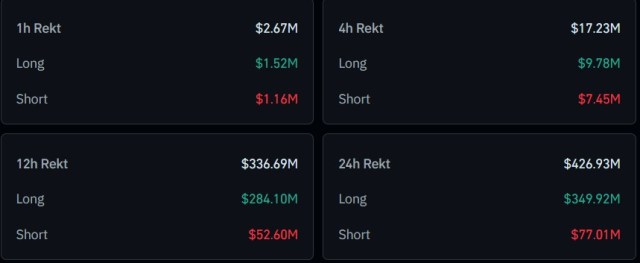
Data from CoinGlass reveals that nearly $430 million in liquidations occurred across the crypto market over the past 24 hours, predominantly affecting leveraged long positions, which accounted for about $350 million. 

During this period, Bitcoin underwent a 3.5% retracement, with its price settling at just above $89,120—a stark 29% below its all-time high of over $126,000 reached in October.

Crypto

Market expert OxNobler recently highlighted the role of both retail and institutional investors in this downturn. In a post on social media platform X, OxNobler detailed the reason behind Bitcoin’s decline: significant sell-offs by major players. 

According to the analyst, the world’s largest cryptocurrency exchange, Binance, sold 4,000 BTC; U.S.-based Coinbase (COIN) liquidated 5,675 BTC; and traditional finance giant Fidelity sold 3,288 BTC. Additionally, market maker Wintermute offloaded 1,793 BTC. 

Notably, the analyst pointed out that Strategy, formerly MicroStrategy, which is the largest public company holder of Bitcoin with over 650,000 coins, has also sold over 3,820 coins in this same time frame.

The firm’s sell-off comes on the heels of speculation regarding Strategy’s potential to liquidate some of its holdings due to the substantial losses affecting its financial performance amid declining Bitcoin prices. 

When Strategy CEO Phong Le was questioned about the possibility of selling off Bitcoin, he acknowledged that while the firm’s former CEO, Michael Saylor, has consistently opposed selling, circumstances may change if the company’s stock trades below the net value of its Bitcoin holdings, which aligns with the recent actions taken by the firm.

Coinbase Analysts Predict December Recovery 

Interestingly, while these institutional sell-offs have contributed to the current market dip, Coinbase’s institutional division has projected a potential recovery for the crypto market in December, citing improving liquidity, a 92% probability of the Federal Reserve (Fed) cutting rates, and supportive macroeconomic conditions.

Analysts have pointed out several reasons for optimism, including the recovery of liquidity, the resilience of the “AI bubble,” and the attractiveness of short US dollar trades at current levels. 

However, OxNobler warned that the situation may not be so straightforward. Alongside the activities of major institutions, he noted that BlackRock, the world’s largest asset manager, had recently sold $130 million worth of Bitcoin and Ethereum (ETH).

Furthermore, Vitalik Buterin, one of Ethereum’s co-founders, seems to have resumed selling Ethereum, with millions of ETH being moved from the foundation’s wallet through Gnosis Safe.

Ultimately, OxNobler asserts that these institutional activities may have a hand in manipulating crypto prices and preventing them from climbing to higher levels and key resistance points. 

Crypto

Featured image from DALL-E, chart from TradingView.com 

Bernstein Forecasts Coinbase (COIN) To Surge 90%, Setting $510 Price Target

Coinbase (COIN), the largest cryptocurrency exchange in the US, has experienced a significant decline in its stock valuation, dropping nearly 40% from its peak of $444 in July to its current trading level of around $271 per share. This, amid market fluctuations and heightened volatility in the broader crypto market, impacting the exchange’s stock performance.

Bernstein Forecasts New Bullish Phase For Coinbase

Despite these challenges, analysts at Bernstein hold an optimistic outlook on Coinbase’s stock price, suggesting a potential new bullish phase that could propel COIN to surpass previous all-time highs and reach levels above $500. 

Bernstein maintains a price target of $510 on Coinbase, underlining the exchange’s shift from a trading-centric platform to what analysts dub an emerging “everything exchange.”

Analysts led by Gautam Chhugani highlighted the delicate market conditions, citing crypto price fluctuations influencing listed crypto-exposed equities

However, Bernstein distinguishes the current market environment from past crypto downturns, noting that speculative excess primarily affects what they refer to as “MSTR copycats,” referencing Strategy’s (previously MicroStrategy) stock performance. 

Central to Bernstein’s bullish thesis is Coinbase’s strategic diversification away from volatile spot trading revenue. They assert that exchange is evolving into a comprehensive financial platform.

The analysts emphasize that clearer regulatory guidelines in the US could drive a revaluation of these business lines, bridging the gap with offshore competitors benefiting from faster token listings and fundraising fees. 

Coinbase’s foray into token issuance through a launchpad-style model, exemplified by Monad’s (MON) recent listing, demonstrates growing market interest. Bernstein notes that these launches, directly influencing trading activity, can stimulate a cycle of issuance, listing, and heightened trading volume.

Confident Ratings For COIN

Looking ahead, one of the exchange’s most notable catalysts is the upcoming product showcase on December 17, anticipated to unveil developments in tokenized equities, prediction markets, and other tools expanding the exchange’s offerings beyond spot crypto trading. 

The integration with Deribit is also expected to further bolster Coinbase’s derivatives expansion, positioning the exchange closer to platforms like Robinhood as both entities diversify their product offerings.

On the consumer front, the exchange’s Base app, focusing on wallet services, payments, and social features, acts as a centralized access point for the broader token markets, reaffirming the analysts’ bullish predictions

Bernstein’s reaffirmed “Buy” rating on Coinbase with a massive $510 price target underscores the firm’s confidence in COIN’s growth trajectory. Monness Crespi’s recent upgrade from “Neutral” to “Buy” with a $375 target further adds to the bullish sentiment surrounding the stock’s valuation amid falling prices. 

Coinbase

Featured image from DALL-E, chart from TradingView.com 
Bitcoin Bull Run Set To Last Until 2027, Analysts Highlight Influential Factors

Many in the crypto space have echoed a familiar sentiment over recent months: “The four-year crypto market cycle is dead.” Experts from the Bull Theory assert that while the four-year cycle may have come to an end, the Bitcoin bull run itself is merely delayed and could stretch until 2027.

Why The Four-Year Cycle May Be Ending

In a recent post on social media platform X, formerly known as Twitter, the Bull Theory analysts noted that the concept of Bitcoin adhering to a neat four-year cycle is weakening. 

They highlighted that significant price movements over the last decade weren’t solely driven by Halving events; rather, they were influenced by shifts in global liquidity. 

The analysts pointed to the current landscape of stablecoin liquidity, which remains high despite recent downturns, indicating that larger investors are still engaged in the market, poised to invest when appropriate macroeconomic conditions arise.

In the US, Treasury policies are emerging as pivotal catalysts. The recent buybacks are notable, but the analysts emphasize that the larger narrative lies in the Treasury General Account (TGA) balance, which is currently around $940 billion—almost $90 billion above its normal range. 

This surplus cash is likely to flow back into the financial system, enhancing financing conditions and adding liquidity that typically gravitates toward risk assets.

Globally, the trends appear even more promising. China has been injecting liquidity for several months, while Japan recently announced a stimulus package worth approximately $135 billion, alongside efforts to simplify cryptocurrency regulations. 

Canada is also moving toward easing its monetary policy, and the US Federal Reserve (Fed) has officially halted its quantitative tightening (QT) measures—a historical precursor to some form of liquidity expansion.

Political And Monetary Factors Align To Create Bullish Condition

The analysts explained that when major economies adopt expansive monetary policies simultaneously, risk assets like Bitcoin tend to respond more rapidly than traditional stocks or broader markets. 

Additionally, potential policy tools, such as the Supplementary Leverage Ratio (SLR) exemption—implemented in 2020 to allow banks more flexibility in expanding their balance sheets—could return, resulting in increased credit creation and overall market liquidity.

There is also a political dimension to consider. President Trump has discussed potential tax reforms, including abolishing income tax and distributing $2,000 tariff dividends. 

Furthermore, the likelihood of a new Federal Reserve chair who supports liquidity assistance and is constructive toward cryptocurrency could bolster conditions for economic growth.

Extended Bitcoin Uptrend

Historically, whenever the Institute for Supply Management’s Purchasing Managers’ Index (ISM PMI) surpasses 55, it has been followed by periods of altcoin season. The probability of this occurring in 2026 appears high, according to the Bull Theory.

The convergence of rising stablecoin liquidity, the Treasury’s injection of cash back into markets, global quantitative easing, the cessation of QT in the US, potential bank-lending relief, pro-market policy shifts in 2026, and major players entering the crypto sector suggests a very different scenario than the old four-year halving model. 

The analysts concluded that if liquidity expands concurrently across the US, Japan, China, Canada, and other significant economies, Bitcoin is unlikely to move counter to that trend.

Therefore, rather than experiencing a sharp rally followed by a prolonged bear market, the current environment indicates a more extended and broader uptrend that could span through 2026 and into 2027.

Bitcoin

Featured image from DALL-E, chart from TradingView.com

US Seeks 12-Year Sentence For Terraform Labs Co-Founder Do Kwon

Do Kwon, the troubled co-founder of Terraform Labs based in Singapore, is facing a possible 12-year prison sentence in the United States due to his role in the collapse of the TerraUSD stablecoin, which resulted in significant losses within the cryptocurrency market.

Do Kwon Seeks Reduced Sentence Of Five Years

Bloomberg reported that in a court filing late Thursday, US prosecutors described the Terraform Labs co-founder’s fraudulent actions as “colossal in scope.” 

They emphasized that his “misleading statements to customers” triggered a domino effect of crises across the crypto landscape, culminating in the downfall of notable entities such as Sam Bankman-Fried’s FTX.

This comes amid a regulatory environment that has grown increasingly lenient under the Trump administration. In late October, President Trump pardoned Binance founder Changpeng Zhao (CZ), who had been convicted for failing to uphold proper anti-money laundering measures.

In a recent court filing, Terraform Labs co-founder expressed a desire for a reduced sentence of five years. His legal team asserted that he has already “suffered substantially” for his actions, noting that he has spent nearly three years in detention conditions described as “brutal” in Montenegro. 

Kwon’s lawyers argued that a five-year prison term would be sufficient and that the prosecutors’ recommendation of 12 years is “far greater than necessary” for justice to be served.

Potential For Sentence Transfer For Terraform Labs Co-Founder

Initially, Kwon pleaded not guilty in January to a nine-count indictment that charged him with securities fraud, wire fraud, commodities fraud, and conspiracy to commit money laundering. However, he changed his plea in August to guilty for conspiracy to defraud and wire fraud. 

During this change, Terraform Labs’ leader acknowledged that his actions included making “false and misleading statements” regarding the restoration of TerraUSD’s peg in 2021, admitting, “What I did was wrong.”

As part of his plea agreement, Kwon has consented to forfeit $19.3 million and some properties. Prosecutors have chosen not to demand restitution for the millions of investors who collectively lost $40 billion, citing that calculating individual losses would be too complicated.

Kwon faces charges in both the US and his native South Korea, where prosecutors are also pursuing a lengthy prison sentence potentially reaching up to 40 years. 

He was arrested in Montenegro in 2023 while using a fake passport, and following a protracted legal battle, he was extradited to the United States in January after spending nearly two years in a Balkan jail.

US prosecutors have indicated they would support Kwon’s opportunity to serve the second half of his sentence in South Korea, provided he adheres to the terms of his plea deal and qualifies for a transfer program. Kwon is scheduled for sentencing by US District Judge Paul Engelmayer on December 11.

Terraform Labs

When writing, Terraform Labs’ native token Luna Classic (LUNC) saw a 75% increase in response to Do Kwon’s probable sentence, trading at $0.000050 and placing it at the helm of the market’s top performers on Friday. 

Featured image from DALL-E, chart from TradingView.com 

❌