Reading view

There are new articles available, click to refresh the page.

Speculation Rises Around XRP After MoonPay Purchase and Cboe Greenlight for New Spot ETF

XRP is going through the week under a renewed wave of speculation as two separate developments, a MoonPay purchase that revived a long-running community meme and the Cboe approval of a new spot ETF, pushed the token back into the spotlight.

Related Reading: More Eurozone Countries Will Buy Bitcoin, Says Coinbase’s Institutional Chief

Together, these events have fueled debate about whether XRP is on the cusp of new institutional momentum or simply caught in another cycle of community-driven enthusiasm.
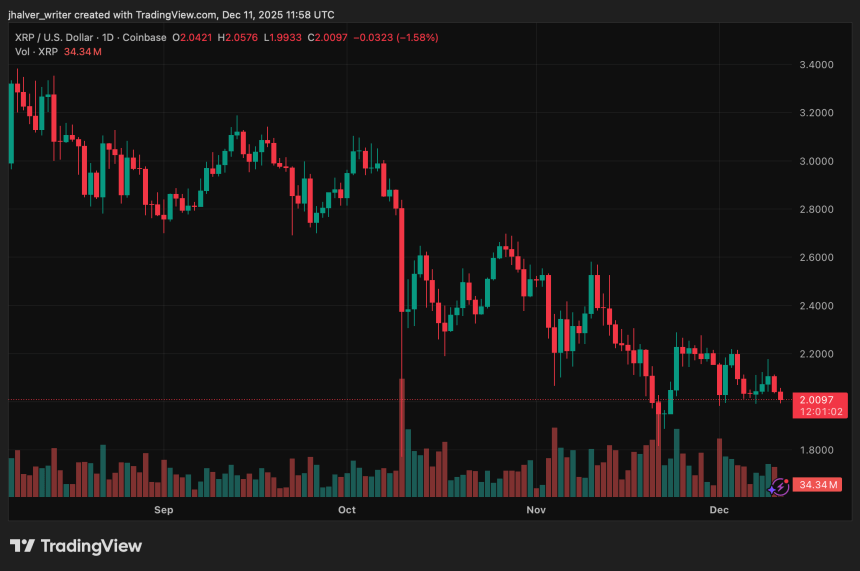
Ripple XRP XRPUSD_2025-12-11_12-58-58

Community Signals Collide With Market Memes

A routine Apple Pay purchase posted by MoonPay, showing a buy of exactly 589 XRP, triggered renewed excitement across XRP circles. The figure “589” has carried symbolic weight since 2018, when an anonymous user promoted the number as a future price target.

Its reappearance, coming shortly after the Solana Foundation also posted “589” without context, set off widespread speculation about potential hidden messaging or coordinated marketing.

The resurgence of the meme also comes amid new discussions around XRP’s long-term value. Several analysts, including the anonymous educator X Finance Bull, argue that the shift toward tokenized financial markets could significantly increase demand for XRPL-based settlement.

SEC Chair Paul Atkins recently reinforced the idea that U.S. markets will move fully on-chain within a few years, a statement that many in the XRP community interpreted as validation of XRPL’s positioning in enterprise-grade infrastructure.

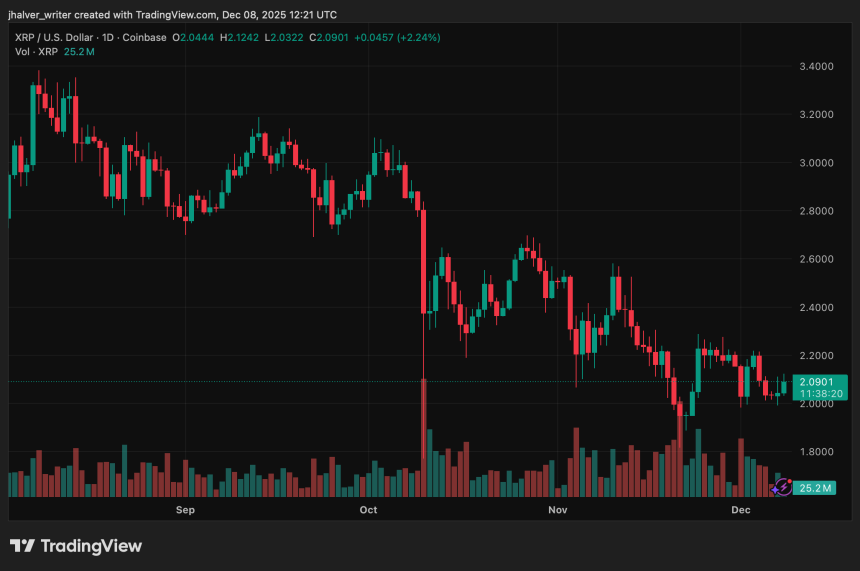
Still, XRP’s price action remains under pressure. After a Federal Reserve rate cut accompanied by a hawkish outlook, ETF inflows slowed sharply, and XRP slipped below key moving averages, trading near the critical $2 support zone.

Cboe Clears XRP’s Next ETF, And Institutional Interest Builds

While community narratives dominated social media, regulatory progress offered a more tangible catalyst. The Cboe BZX Exchange approved the listing of the 21Shares XRP ETF (TOXR), moving it closer to launch.

The fund carries a 0.3% fee, uses a multi-custodian security model, and has been seeded with 100 million XRP, roughly $226 million, from Ripple Markets.

The approval comes as XRP-focused ETFs gain traction in the U.S., with at least four funds now active and inflows exceeding $900 million in recent weeks. Analysts note that institutional engagement has grown since regulators formally recognized that secondary-market XRP transactions do not constitute securities trades.

Momentum around the ETF space intensified further after FalconX acquired 21Shares, giving the issuer expanded access to institutional distribution, market-making, and liquidity infrastructure. Market observers say the merger could accelerate capital inflows if TOXR begins trading in the coming days.

Analysts Split on Outlook as XRP Holds Key Levels

Despite the renewed attention, analysts remain divided. EGRAG Crypto maintains a bullish long-term view, citing consolidation patterns reminiscent of XRP’s previous accumulation phases. Others caution that expectations, particularly around community-driven targets, remain far ahead of current fundamentals.

Broader adoption through RippleNet, expanding partnerships, and growing interest in XRP-based products such as ETFs and stablecoins continue to strengthen XRP’s institutional narrative. Still, macro uncertainty, legislative delays in the U.S., and competition in the digital-asset payments space present ongoing challenges.

Related Reading: Forget Bitcoin’s Old Cycle—A New Institutional Era Has Begun: Cathie Wood

As both cultural and regulatory forces converge, XRP finds itself influenced by two very different engines, market infrastructure gradually opening new pathways for institutional capital, and a community whose symbolic narratives continue to shape sentiment.

Cover image from ChatGPT, XRPUSD chart from Tradingview

Dogecoin Price Volatility Returns as Market Weighs Bullish Indicators Against Recent Dip

The Dogecoin price has entered another period of volatility as traders attempt to weigh improving technical signals against renewed short-term weakness. The memecoin has been shifting between modest recoveries and sudden pullbacks, creating a landscape where both bullish and bearish narratives remain active.

With macro uncertainty, DOGE ETF inflows, exchange outflows, and key chart patterns emerging at the same time, the market is now deciding which direction will dominate heading into late December.

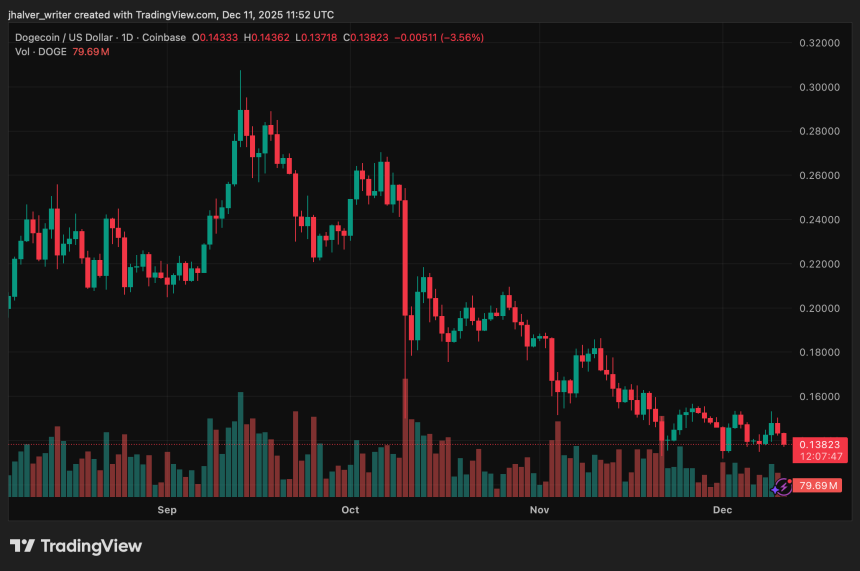
Dogecoin DOGE DOGEUSD_2025-12-11_12-52-13

Mixed Trading Conditions Shape Short-Term Direction for Dogecoin

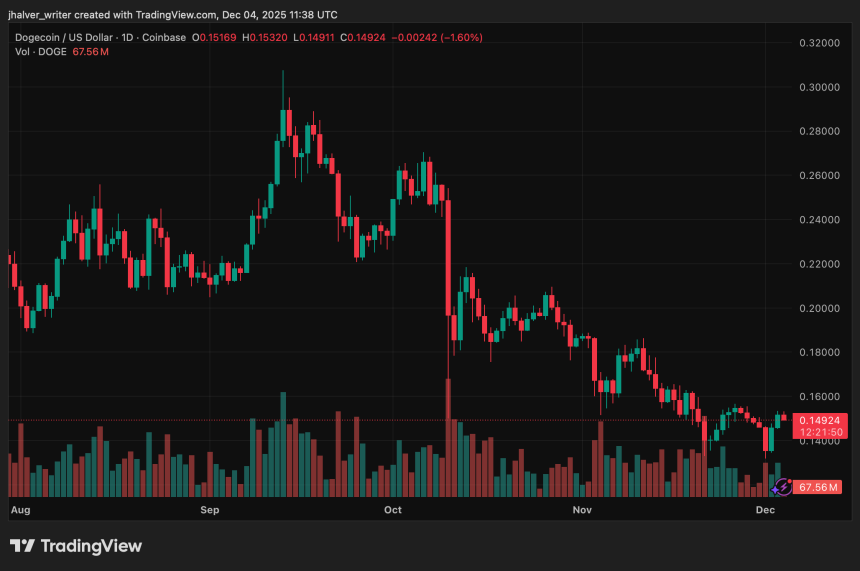
The Dogecoin price slipped back below the $0.145 region after failing to hold above $0.150 earlier in the week. The latest dip saw price break below an hourly trend line, touching lows near $0.131 before stabilizing. DOGE now trades below $0.140 on lower timeframes, with immediate resistance forming around $0.142 and $0.145.

Yet the broader view remains less gloomy. The weekly chart shows a developing MACD bullish crossover, complemented by rising histogram bars. Historically, this signal has marked early phases of momentum recovery.

The Dogecoin price continues to defend the long-standing $0.13–$0.15 support band, a range that has held for nearly two years. Repeated rebounds from the $0.135 zone highlight ongoing buyer activity despite intraday volatility.

Traders are also watching the upper boundary of the recent range at $0.155–$0.156. A close above this area would signal a break from the consolidation pattern that has persisted since late November.

ETF Volume and Exchange Outflows Show Accumulation

While the spot price fluctuates, underlying market activity points to steady participation. The Dogecoin ETF has recorded $3.23 million in daily trading volume, adding a layer of institutional-style flows that did not exist in previous cycles.

Similarly, exchange data shows between $20 million and $60 million in recent outflows, suggesting large holders continue moving tokens off trading platforms.

This combination, ETF demand and declining exchange balances, implies accumulation, particularly during price weakness. With fewer tokens available for immediate sale, selling pressure could ease if these trends continue.

Traders Await Breakout Signals as Volatility Tightens

Dogecoin’s trading volume has surged more than 60% at times this week, reflecting renewed interest ahead of broader market catalysts, including the Fed Reserve’s policy decision. DOGE now trades in a tightening range between $0.131 – $0.156, with analysts noting that prolonged compression often precedes larger moves.

Technical targets remain unchanged: $0.18–$0.20 as the first major resistance, followed by $0.21 and $0.27. A move toward the broader $0.30 barrier would require a break above short-term resistance and confirmation that buyers can sustain momentum.

The Dogecoin price sits at the center of contrasting signals, accumulation on the one hand and near-term weakness on the other, leaving the market to determine which will take priority as volatility returns.

Cover image from ChatGPT, DOGEUSD chart from Tradingview

Technical Wave Patterns Turn Bullish for Ethereum as Price Reaction Intensifies Before Fed Decision

Ethereum (ETH) is under a pivotal week as traders weigh a mix of macroeconomic expectations, institutional developments, and strengthening technical signals.

Related Reading: Midnight Goes Live As Cardano Founder Targets A $10 Billion Ecosystem

With the Federal Reserve set to deliver its next rate decision, market participants are watching how Ethereum’s recent momentum interacts with a broader risk-on environment.

The second largest cap cryptocurrency has already staged a notable rebound, breaking key resistance levels and drawing renewed interest from both retail and institutional investors.

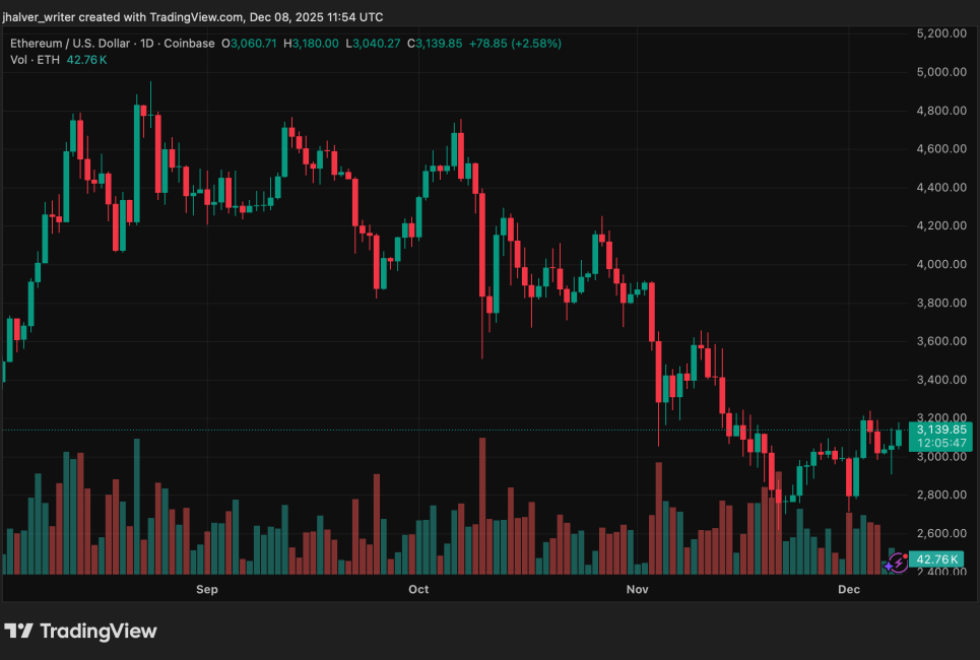
Ethereum ETH ETHUSD ETHUSD_2025-12-10_12-38-55

Fed Expectations Drive Ethereum Position Repricing

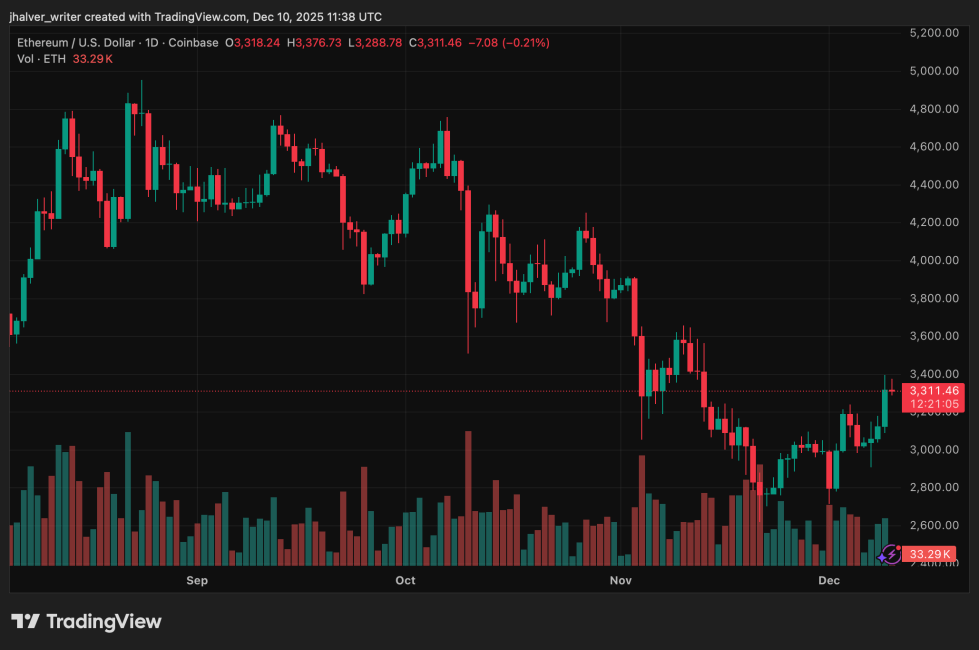
Ethereum surged past $3,300 and briefly approached $3,400 after recording a 6% jump over the past 24 hours.

The rally comes as traders price in a high probability, close to 90%, that the Federal Reserve will announce a 25-basis-point rate cut. Lower interest rates tend to improve liquidity conditions, a factor that has historically supported digital assets.

Bitcoin’s recovery above $94,000 added further confidence to the market, though Ethereum outperformed on a relative basis. The ETH/BTC ratio reached its strongest point since late October, indicating a shift of capital from Bitcoin to Ethereum.

Spot Ethereum ETFs also saw $177.7 million in inflows on December 9, surpassing Bitcoin’s inflows on the same day.

Institutional Moves Add to Bullish Sentiment

One major catalyst behind this shift has been BlackRock’s filing for the iShares Ethereum Staking Trust ETF. The fund would offer exposure not only to ETH’s price but also to staking rewards, expanding access to yield-bearing strategies.

Analysts note that such products could increase liquidity inflows into Ethereum, especially as institutional portfolios diversify beyond Bitcoin. This filing arrives at a time when the amount of ETH held on centralized exchanges has fallen to its lowest level since 2015, roughly 8.7% of the total supply.

Large buyers, including Bitmine Immersion, have accumulated billions of dollars’ worth of ETH in recent months. Combined, these developments indicate a tightening of supply conditions.

Technical Breakouts Reinforce the Trend

Chart analysts highlight that Ethereum has broken above a downward trendline that previously capped rallies for nearly two months.

Momentum indicators, including MACD and RSI, show increasing buyer strength despite approaching overbought territory. Ethereum’s break above the $3,300 zone has shifted focus toward the next resistance level at $3,500, with wave-pattern analysis suggesting potential upside toward $3,600.

Related Reading: Bitwise Rolls Out New ETF For Broad Crypto Exposure, Including BTC, XRP, And ADA

Analysts such as Captain Faibik argue that a confirmed breakout could support a rally of up to 30%, targeting the $4,200–$4,300 region if bullish conditions persist. However, the Fed’s upcoming decision remains a key variable in determining whether momentum continues or cools.

Cover image from ChatGPT, ETHUSD chart from Tradingview

Market Stress Intensifies for Solana as Liquidity Drops to Cycle Lows and Volatility Builds

Solana’s (SOL) market structure is entering a tense phase, shaped by thinning liquidity, elevated leverage, and conflicting signals across institutional flows and derivatives markets.

Related Reading: The Current Bitcoin Price Pump Will End In A Crash – Here’s When To Start Selling

While price movements remain within familiar ranges, the underlying conditions paint a more complex picture, one that traders are watching closely for signs of either exhaustion or a sharp reversal.

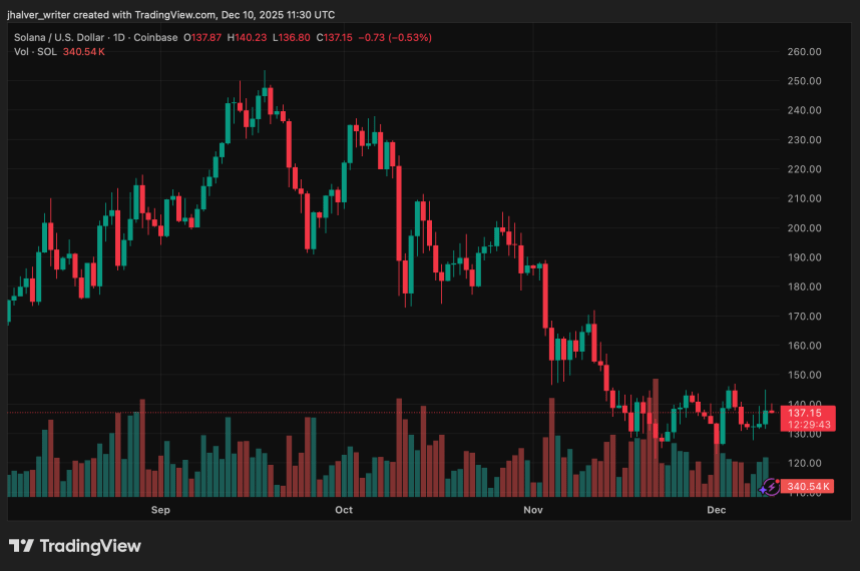
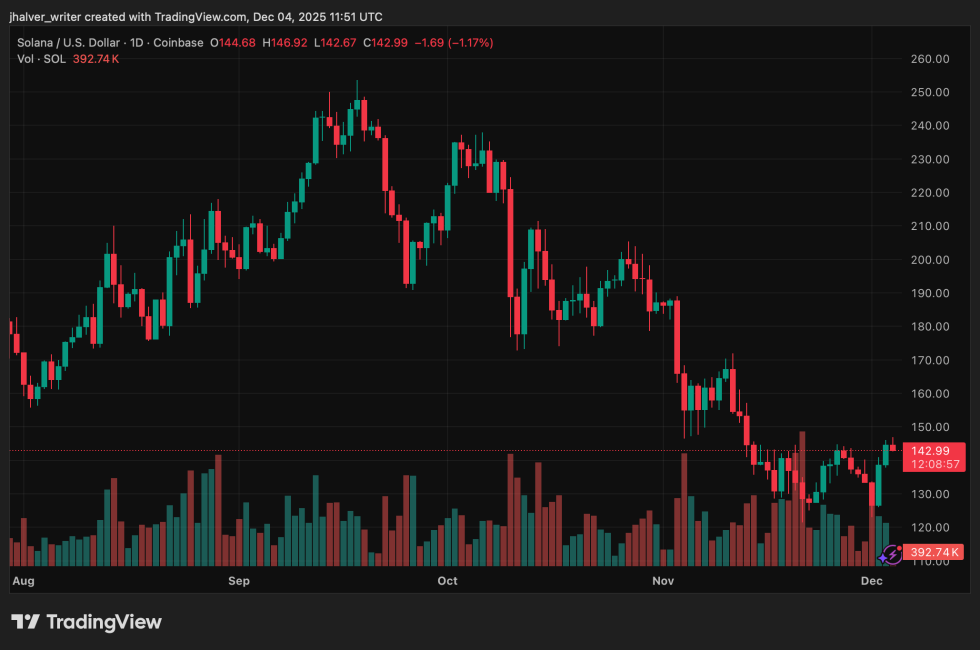
Recent sessions have seen Solana drift between $128 and $145, with brief rebounds lifting it toward the upper end of this range. However, liquidity indicators suggest a deeper reset is taking shape. Analysts note that these conditions often precede turning points, though they can amplify volatility in the short term.

Solana SOL SOLUSD SOLUSD_2025-12-10_12-30-17

SOL Liquidity Drops to Bear-Market Levels

On-chain data shows Solana’s 30-day realized profit-to-loss ratio has stayed below 1 since mid-November. This pattern, more losses being realized than gains, typically marks a liquidity contraction similar to historical bear-market phases.

Analysts at Altcoin Vector describe the current setup as a “full liquidity reset,” a process that typically takes several weeks to resolve.

That backdrop aligns with observations from SynFutures, whose team cites realized losses, declining futures open interest, and fragmented liquidity pools as contributing factors.

Market-makers have also pulled back, thinning order books even as realized volatility increases. The effect is a market highly sensitive to sharp moves, particularly around key liquidation clusters.

A notable risk is emerging around the $129 level, where nearly $500 million in long positions would be liquidated if the price retests that zone. With $15.6 million in SOL contracts wiped out in the last 24 hours alone, the market remains vulnerable to cascades.

Similarly, exchange balances continue to drop, and spot ETFs have brought in more than $17 million this week, signaling accumulation despite broader stress.

Volatility Builds as Derivatives and Spot Activity Diverge

Derivatives data reflect a cautious but engaged trading environment. Open interest has climbed back above $7.2 billion, rising in tandem with a rebound in daily volume.

This type of build-up during a quiet price phase often signals positioning ahead of a larger move. Long-to-short ratios have shifted bullish in recent days, and funding rates remain positive, although traders are becoming increasingly sensitive to macroeconomic catalysts.

Spot markets tell a different story. Liquidity is thin, and deep-cycle reset metrics point to selling exhaustion rather than active expansion. This divergence, characterized by high derivative activity against weakening spot liquidity, typically precedes volatility spikes.

Key Solana Levels Ahead as Market Awaits a Cycle Turn

Technically, Solana remains stuck between established boundaries. The $145 resistance zone has capped multiple attempts to break higher, while support around $135 and deeper levels near $129 hold significance for traders monitoring liquidation risk.

Momentum indicators are stabilizing, and the MACD is edging toward a potential positive crossover. Analysts note that past liquidity resets have been followed by rapid upside moves once conditions improved; however, the timing remains uncertain.

Related Reading: NFT Slump Worsens With Monthly Sales Hitting Rock Bottom

Currently, Solana sits at the center of a tug-of-war between cautious sentiment, thinning liquidity, and steady institutional flows. Whether these opposing forces resolve into a recovery or further volatility may depend less on price action alone and more on how quickly liquidity returns to the ecosystem.

Cover image from ChatGPT, SOLUSD chart from Tradingview

Upbit Shifts Nearly All Assets to Cold Storage as Exchange Responds to Security Concerns

In the aftermath of a hack that saw attackers steal 44.5 billion won (approximately $30 million) from a Solana hot wallet, Upbit has begun shifting nearly all customer assets into cold storage, a move that now places it among the most conservative platforms globally in terms of online asset exposure.

This transition marks one of the strongest security pivots by a major exchange, signaling a broader industry conversation about balancing rapid withdrawals with the need to reduce attack surfaces.

As digital asset markets continue to expand, Upbit’s response provides a real-time glimpse into how platforms balance operational liquidity against systemic cyber risks.

Stellar XLM XLMUSD BTCUSD_2025-12-10_12-23-17

Upbit Pushes Hot Wallet Usage Toward Zero

Following its internal review and system overhaul, Upbit confirmed that it now stores approximately 99% of user assets in cold wallets, with hot wallet exposure reduced to about 1% and expected to decrease further.

As of late October, the exchange held 98.33% of customer funds offline, a rate already well above the 80% minimum required under South Korea’s Virtual Asset User Protection Act.

This shift follows a pattern of rising caution. The recent breach was Upbit’s second significant attack, occurring on November 27, mirroring a 2019 incident that saw more than 342,000 ETH drained from its systems.

This year’s Solana-based attack resulted in withdrawals across 24 tokens within less than an hour, prompting an immediate shutdown of hot wallet operations and emergency transfers to cold storage. Upbit has pledged to fully reimburse affected users from corporate reserves.

Domestic data suggests that the exchange already leads the market in cold storage usage, maintaining the lowest hot wallet ratio among local competitors, whose cold wallet shares range from 82% to 90%.

Security Benchmark Sets Pressure on Global and Local Exchanges

Upbit’s near-99% cold wallet ratio surpasses the standards of major global exchanges. Coinbase stores about 98% of its funds offline, while Kraken’s ratio sits between 95% and 97%.

Several Asian exchanges, including OKX and Gate.io, maintain similar levels. With Upbit’s latest update, the platform now stands at the forefront of global cold storage practices.

Industry observers note that the move aligns with broader regulatory momentum. South Korea’s Financial Services Commission is considering new rules that would require exchanges to compensate users for losses resulting from hacks, regardless of fault, similar to the standards imposed on banks.

Liquidity Questions Linger in a Restricted Market

While security is at the center of Upbit’s restructuring, analysts caution that running with minimal hot wallet reserves may slow withdrawals during periods of heightened market volatility.

South Korea’s crypto market is largely closed to foreign participants, restricting arbitrage and creating conditions where delays can exacerbate price discrepancies, commonly known as the “Kimchi premium.”

During last month’s temporary withdrawal suspension, liquidity was effectively trapped, resulting in sharply widening price gaps between the Korean and global markets. Still, Upbit maintains that its rebuilt systems and predictive models will ensure sufficient liquidity under normal trading conditions.

Cover image from ChatGPT, BTCUSD chart from Tradingview

Stellar’s December Outlook Brightens as Network Use Cases Grow, but Major Resistance Still Looms

Surging about 4% in the past 24 hours, Stellar (XLM) goes through December with a mix of optimism and caution as new payment integrations and institutional pilots draw attention back to the network’s utility.

However, despite signs of growing real-world use, XLM continues to trade near a critical long-term support level, leaving traders divided on whether the token is preparing for a recovery or facing another downward leg.

Recent activity across payments, banking pilots, and data-infrastructure upgrades show how Stellar’s ecosystem is expanding at a time when the token sits at a pivotal market position. The tension between strengthening fundamentals and fragile price structure is shaping the month’s outlook.

Stellar XLM XLMUSD XLMUSD_2025-12-10_11-49-55

Rising Utility Gives Stellar a Boost

Network usage has climbed following several developments in November. Wirex activated USDC and EURC card-settlement on Stellar for more than seven million users, shifting everyday transactions onto the blockchain and increasing stablecoin throughput.

Days later, U.S. Bank began testing a programmable stablecoin on Stellar, adding an institutional layer to the network’s growing settlement activity.

The recent integration of Space and Time (SxT), which now indexes the full Stellar network and provides cryptographically verified data to institutions, also strengthens the chain’s infrastructure.

Together, these upgrades position Stellar as a functioning payments network rather than a speculative asset alone. Early market reaction has been modest, but analysts note that expanding stablecoin flows could support stronger demand for XLM over time.

Price Holds Key Support as Traders Watch $0.245

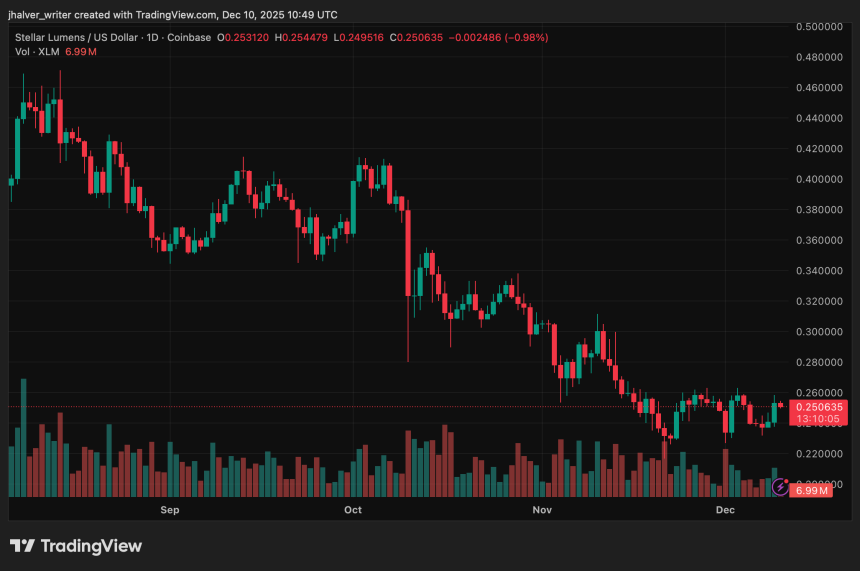
Despite the momentum in utility, XLM continues to sit at one of its most important technical zones. The token has trended downward since November 2024 and now trades just above the $0.245 horizontal support, an area that has repeatedly prevented deeper losses over the past year.

Weekly indicators remain bearish, with RSI below 50 and MACD negative, suggesting that long-term momentum still leans downward. Short-term charts show a contained bounce within an ascending channel, which analysts view as corrective rather than a new uptrend.

A decisive break below $0.245 could open the door to new lows, while holding this level would give bulls another chance to challenge overhead resistance.

Resistance Blocks Cap Upside Expectations

Even with potential catalysts from network growth, analysts remain cautious about XLM’s ability to retest previous highs. Multiple reports highlight the $0.26–$0.27 range as the first major resistance zone, followed by a broader cluster near $0.28–$0.31.

Some forecasts suggest a possible move toward $0.31 by year-end if momentum strengthens, though this outlook carries medium confidence given the broader market’s uncertainty.

Stellar’s December narrative is supported by two opposing forces, rising real-world adoption and a price chart still struggling against long-standing resistance. Whether utility gains translate into market recovery will depend on XLM’s ability to hold its support level and reclaim key technical thresholds in the weeks ahead.

Cover image from ChatGPT, XLMUSD chart from Tradingview

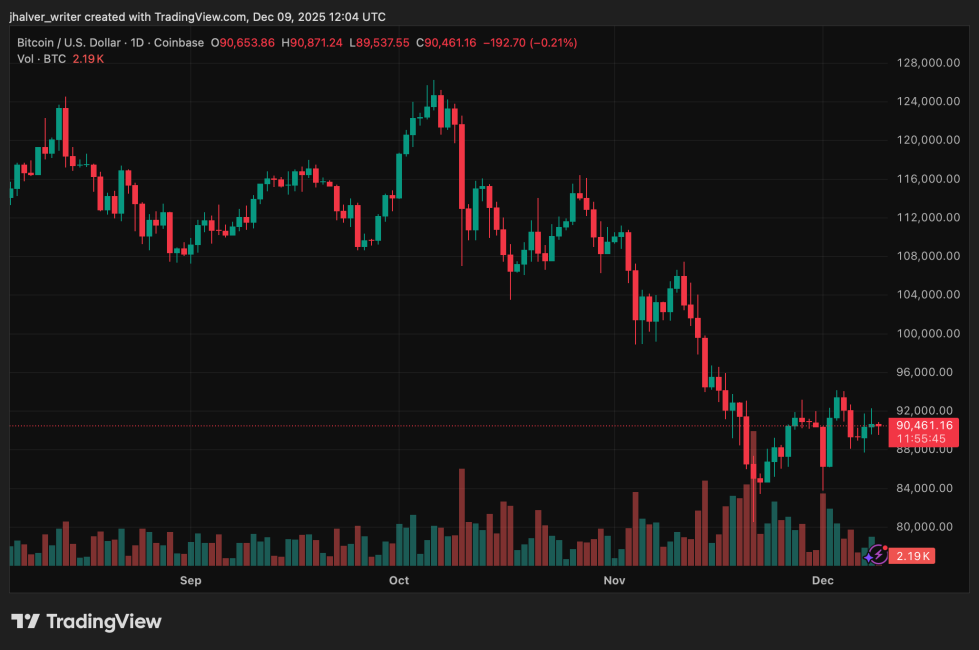
Bitcoin Struggles Near $90K as ETFs Absorb Retail Demand and On-Chain Activity Drops

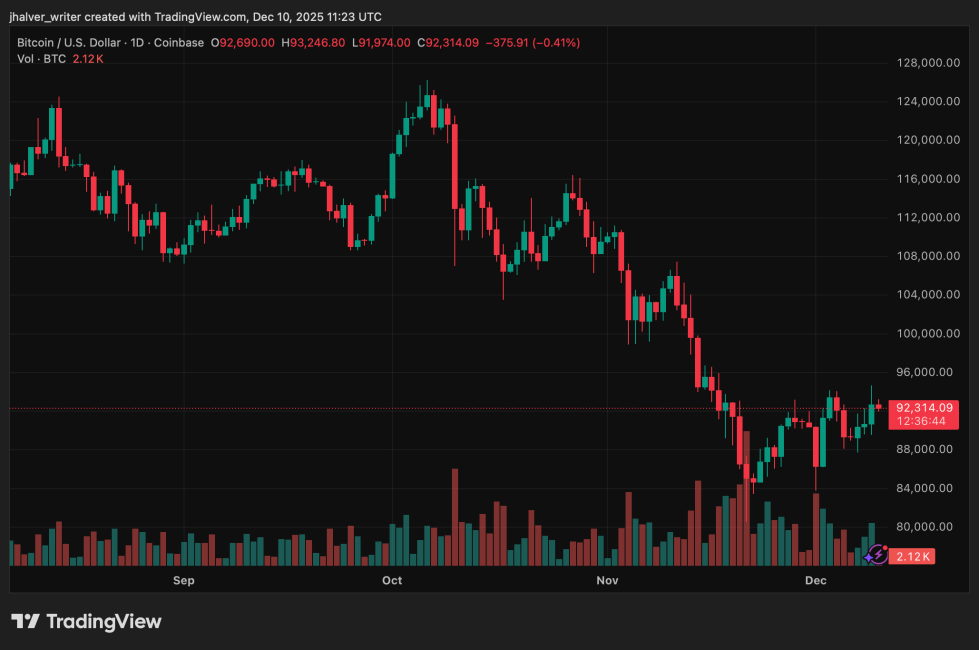
Bitcoin (BTC) is trading uncomfortably close to the $90,000 mark, as a mix of macro caution, thinning liquidity, and shifting market structure continues to weigh on price action.

Related Reading: Wall Street Storms Ripple In Explosive $500 Million Deal

What was once a retail-driven ecosystem is now increasingly shaped by institutional flows, with U.S. spot Bitcoin ETFs attracting substantial assets, while on-chain activity trends in the opposite direction. The result is a market that moves, but with participation patterns very different from those seen in earlier cycles.

Bitcoin BTC BTCUSD BTCUSD_2025-12-09_13-04-15

Bitcoin ETF Flows Rise as Retail Activity Falls

Since the launch of U.S. spot Bitcoin ETFs in early 2024, the network has experienced a steady decline in active on-chain addresses. Analysts attribute this partly to the “convenience trade,” in which retail investors opt for exposure through traditional brokerage accounts rather than managing their own Bitcoin wallets.

BlackRock’s IBIT and similar products now capture a growing share of BTC demand, even as the blockchain itself shows a decline in grassroots participation.

Industry experts argue that this shift fundamentally changes how value circulates in the Bitcoin economy. ETF issuers, not miners or network users, are now capturing a higher share of revenue.

SwanDesk CEO Jacob King describes this as a structural pivot toward off-chain monetization, with Bitcoin functioning more as a financial instrument than a peer-to-peer asset.

BTC Price Pressure Intensifies Around Macro Events

Bitcoin’s recent price behavior reflects both macro uncertainty and intraday volatility patterns. BTC has repeatedly slipped below $90,000 despite developments that historically would support bullish sentiment, such as Strategy’s (formerly MicroStrategy) latest purchase of over 10,600 BTC.

Traders remain cautious ahead of the Federal Reserve’s policy decision, where expectations for a quarter-point rate cut are high. Yet the hesitation is evident: rallies toward $92,000 continue to meet resistance, and liquidity remains thin across spot and derivatives markets.

Consequently, analysts warn that Bitcoin must hold above a key support level near $88,000 to avoid a deeper downside.

Institutional Trading Dynamics Shape Market Movements

A growing number of analysts suggest that predictable sell-offs around the U.S. market open reflect coordinated execution rather than organic selling.

Market watchers point to high-frequency firms, such as Jane Street, which hold large ETF positions, as possible contributors to these recurring patterns. While unproven, the consistency of these drops has added to trader frustration.

Meanwhile, miners face their own pressures. Hashprice has fallen to near-record lows, prompting operators to pivot toward AI infrastructure as mining profitability erodes.

Related Reading: CEOs Of Leading Banks To Discuss Crypto Market Structure With US Senators This Week

With ETFs absorbing demand, macro signals driving sentiment, and miners restructuring their businesses, Bitcoin now sits at a pivotal moment, supported by institutional capital but missing the retail pulse that once defined its cycles.

Cover image from ChatGPT, BTCUSD chart from Tradingview

Dogecoin Stabilizes Above Key Support as Adoption Rises and Long-Term Outlook Strengthens

Dogecoin (DOGE) is, in another consecutive week, settling into a familiar pattern: holding firm at a crucial support zone while market participants weigh technical signals, shifting adoption trends, and the ever-present influence of its community.

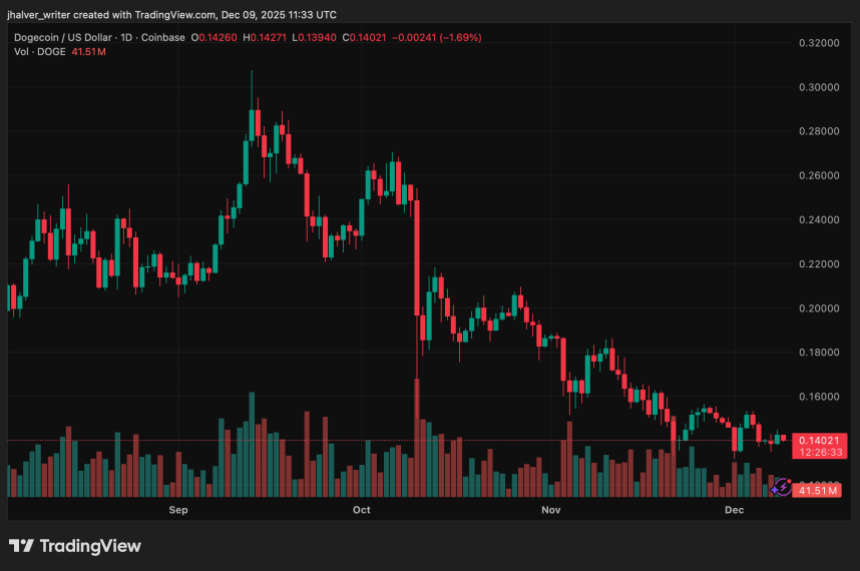
As the token trades around $0.14, its price behavior reflects a broader phase of consolidation, characterized by tighter volatility and increasing on-chain engagement. With new real-world use cases emerging and traders watching for a breakout, DOGE’s long-term trajectory is becoming a point of renewed discussion.

Dogecoin DOGE DOGEUSD DOGEUSD_2025-12-09_12-33-27

Network Activity Strengthens as Dogecoin Price Holds Key Support

Despite muted market reaction to Dogecoin’s 12th anniversary, activity on the network continues to rise.

Daily active addresses reached over 67,000 earlier in December, marking the second-highest level in three months. This increase comes as DOGE repeatedly defended the $0.14 support, forming a tight compression range between $0.1406 and $0.1450.

Short-term charts indicate multiple rebounds from the $0.14 level, accompanied by decreasing sell volume, an early sign of accumulation.

Analysts identify $0.16 as the threshold that would shift DOGE from range-bound movement into a potential trend continuation. Failure to hold support, however, could expose deeper downside toward $0.081, an area highlighted by realized on-chain distribution clusters.

Adoption Expands Beyond Market Narratives

Recent developments show Dogecoin slowly expanding beyond its memecoin label. In Argentina, certain taxes can now be paid using DOGE, while Alternative Airlines has begun accepting the token for ticket purchases. These integrations, although still modest, indicate real-world traction that supports a longer-term use case narrative.

Broader sentiment, however, remains closely tied to macroeconomic conditions. Analysts note that liquidity trends, regulatory developments, and institutional risk appetite continue to shape DOGE’s outlook.

The launch of the first Dogecoin ETF in November drew little initial inflow, signaling that large investors remain cautious despite the token’s growing visibility.

Long-Term Structure Points to Potential Upside

From a structural standpoint, Dogecoin continues to follow a multi-year pattern that some analysts view as constructive. Long-term charts show price action moving within a large triangle formation dating back to 2021, with a cup-and-handle structure still intact on higher timeframes.

Weekly RSI levels near 50 resemble conditions seen before DOGE’s 2021 rally, while MACD indicators approach bullish crossovers on both weekly and monthly charts.

Forecasts place Dogecoin’s path toward $1 as a possibility later in the decade, with projections suggesting a climb toward that level by 2030. In the near term, the $0.145–$0.16 zone remains the defining barrier that could determine whether DOGE transitions into a stronger upward phase or remains confined to its current band.

As Dogecoin stabilizes above key support and real-world adoption increases, traders are closely watching for the next catalyst, whether it be network expansion, macroeconomic shifts, or renewed community-driven momentum.

Cover image from ChatGPT, DOGEUSD chart from Tradingview

Week of Heavy ETF Inflows Pushes XRP Into Compression Zone, Is a Major Move Coming?

XRP spent the past week caught between rising institutional demand and stagnant price action, creating a compression zone that traders say is becoming increasingly difficult to ignore.

Even as U.S. spot XRP ETFs approach the $1 billion AUM milestone, the asset continues to trade within a narrow band, leaving market participants to question whether the prolonged consolidation is setting the stage for a larger move.

The disconnect between inflows and price has become one of the week’s most notable themes. Analysts note that while institutional capital continues to accumulate, XRP’s chart remains muted, indicating heavy profit-taking following November’s rally and lingering sell-side pressure across higher timeframes.

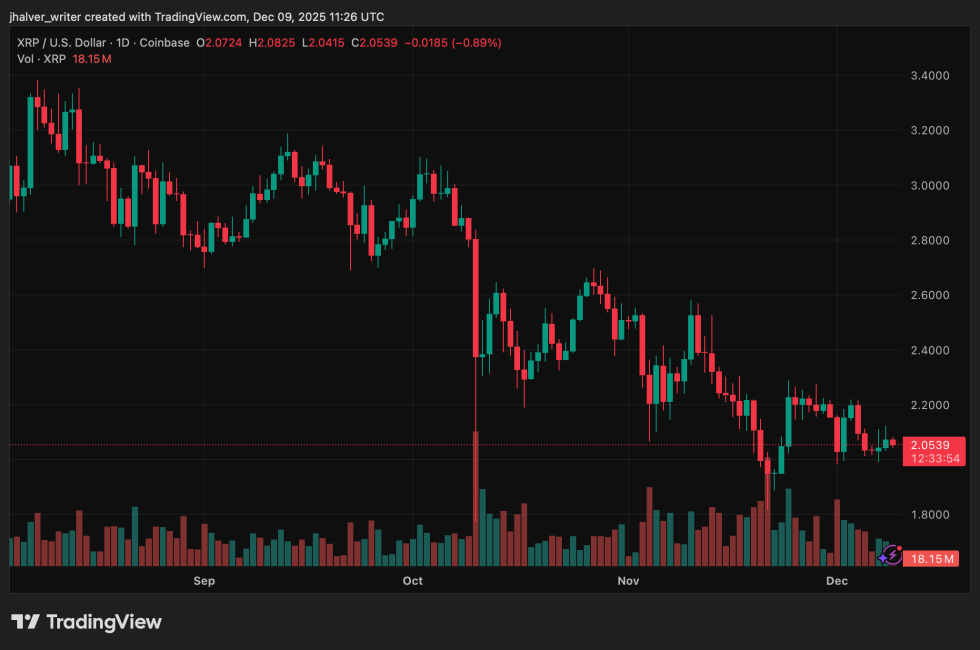
Ripple XRP XRPUSD XRPUSD_2025-12-09_12-26-06

ETF Momentum Builds as XRP Price Stalls

The XRP price is hovering near $2.06, slipping slightly despite consecutive days of ETF inflows. Analysts highlight that large holders likely sold into strength, offsetting the fresh demand entering through regulated products.

Even so, XRP ETFs have outperformed Bitcoin ETFs in terms of relative inflow strength, indicating that institutions are positioning themselves early.

Ripple CEO Brad Garlinghouse noted that XRP became one of the fastest-growing U.S. crypto ETFs of the year, arguing that broader access through traditional investment accounts is expanding the asset’s investor base.

The market reaction remains mixed, with some traders viewing ETFs as a stabilising force, while others see them as limiting upside volatility.

Regulatory and Structural Developments Add New Variables

Beyond market flows, regulatory commentary added another layer of attention. Former SEC Chair Paul Atkins emphasized tokenization as a practical path forward, highlighting its benefits, including increased transparency and faster settlement.

His remarks sparked debate within the XRP community, particularly among those who argue that the XRP Ledger is well-positioned for enterprise-grade tokenization systems.

Meanwhile, Ripple’s recent $500 million equity round, structured with downside protection for Wall Street investors, reinforced how closely the company’s valuation is tied to its XRP holdings.

Funds reportedly concluded that around 90% of Ripple’s net worth derives from its XRP treasury, underscoring the token’s central role in the firm’s long-term outlook.

Technical Picture Shows Compression, Not Capitulation

On the charts, XRP remains locked between the $2.07 support level and the $2.18 and $2.30 resistance levels.

Analysts note weakening momentum indicators but stable underlying demand. If XRP breaks above these levels, a move toward Wave 3 targets near $2.73 becomes more likely, though failure to do so could trigger another retest of lower support.

The XRP price continues to compress, supported by some of the strongest ETF inflows of the year, but constrained by steady selling and broader market caution. Whether this tension resolves upward or downward is the question traders will carry into the next week.

Cover image from ChatGPT, XRPUSD chart from Tradingview
Circle Gains Major Regulatory Foothold in UAE With ADGM License to Scale Stablecoin Adoption

Circle’s slow but steady expansion into the Middle East has taken a decisive step forward, as the USDC issuer secured a Financial Services Permission (FSP) license from Abu Dhabi Global Market (ADGM).

The move positions the company at the center of the UAE’s growing digital-asset ecosystem, strengthening its ability to scale stablecoin adoption across the region.

For a market actively developing clearer regulatory frameworks and attracting global crypto players, Circle’s entry underscores the central role stablecoins have come to play in payment infrastructure and cross-border finance.

Circle Ethereum ETH ETHUSD ETHUSD_2025-12-09_12-58-28

Circle Secures ADGM Approval and Expands Regional Strategy

The license, granted by ADGM’s Financial Services Regulatory Authority, permits Circle to operate as a regulated Money Services Provider within the financial free zone.

This follows preliminary approval earlier this year and gives the firm formal permission to offer USDC-powered payment, settlement and on-chain financial tools to businesses and institutions across the UAE.

Alongside the approval, Circle appointed Dr. Saeeda Jaffar as managing director for the Middle East and Africa. A long-time payments executive with leadership experience at Visa and major consulting firms, she will guide Circle’s expansion efforts, deepen local partnerships, and help integrate USDC into regional prospects.

Her appointment reflects Circle’s intent to localize operations and strengthen ties with banks, enterprises, and government entities.

UAE Supports Push Toward Regulated Digital Finance

Circle’s regulatory milestone comes as the UAE increases its efforts to build an institutional-grade digital asset ecosystem. ADGM and Dubai’s DIFC have both issued stablecoin and token frameworks designed to offer clarity for companies operating in the sector.

USDC and EURC were recognized earlier this year under Dubai’s crypto token regime, providing Circle with visibility across both major financial zones in the country.

The approval also coincides with a wave of regulatory progress for other major players. Binance received full authorization to operate its global platform under ADGM oversight this week, while Tether secured recognition for USDT across multiple blockchain networks.

These developments show how Abu Dhabi is positioning itself as a global hub for regulated stablecoin activity, driven by remittance demand, trade flows, and a growing emphasis on compliance.

Stablecoin Adoption Enters New Phase

The UAE’s structured approach comes at a time when stablecoins are gaining broader acceptance in global finance.

With regulatory guardrails expanding internationally and stablecoins increasingly used for cross-border payments, Circle’s license opens the door for wider USDC adoption in corporate finance, developer applications, and digital-asset settlement.

Related Reading: Bitcoin Speculation Muted: Glassnode Analyst Calls Perps A ‘Ghost Town’

For Circle, the ADGM license marks a pivotal foothold in one of the world’s fastest-moving regulatory environments. For the UAE, it reinforces an ambition to lead in compliant digital-asset innovation while shaping standards for a rapidly evolving sector.

Cover image from ChatGPT, ETHUSD chart from Tradingview

Wall Street Turns Ultra-Bullish on Ethereum as Institutional Demand Rises and Fee Reform Advances

Ethereum (ETH) is entering a phase that analysts say resembles the early stages of its strongest market cycles, driven by institutional accumulation, shrinking exchange supply, and new proposals aimed at stabilizing the network’s economics.

Related Reading: ‘Something Big’ Is Coming For XRP, Says Toroso Investments Portfolio Manager

As large investors deepen their presence and developers explore changes that could make transaction fees more predictable, sentiment on Wall Street has shifted sharply recently. For many, the combination of tightening supply and improving fundamentals has created conditions that could support a meaningful repricing.

Ethereum ETHUSD_2025-12-08_12-54-13_620ab9

Exchange Supply Tightens as Institutions Accelerate Accumulation

Ethereum held on centralized exchanges has fallen to its lowest level since the network launched in 2015. Glassnode data shows that balances dropped to 8.7% of the total supply last week, marking a 43% decline since July.

The reduction is tied to staking, layer-2 migration, institutional custody, and long-term treasury allocations, destinations that rarely send tokens back to exchanges.

BitMine Immersion Technologies, now the largest corporate holder of Ether, expanded its position by another $199 million over the weekend. The firm controls $11.3 billion in ETH, representing about 3.08% of supply, and continues buying toward its 5% target.

ETFs have also contributed to the drawdown, with cumulative inflows now above $12 billion. Analysts note that nearly 40% of all ETH is locked in staking or institutional products, creating one of the tightest supply environments the asset has experienced.

Technical analysts point to hidden signs of accumulation. Recent On-Balance Volume readings have broken above resistance, even as the price lingers near $3,050, a divergence that some interpret as indicating buying pressure.

Fee Reform Pushes Forward as Vitalik Buterin Proposes Gas Futures Market

Alongside market activity, a new economic proposal from Vitalik Buterin is drawing attention. The Ethereum co-founder outlined a system for onchain gas futures that would allow users to lock in transaction fees for future time periods.

The mechanism resembles traditional futures markets and is designed to help traders and developers hedge against sudden increases in network demand.

Buterin argues that clearer forward pricing could support businesses that rely on predictable costs, particularly as activity expands across staking, tokenization, and decentralized applications. Although still in its early stages, the idea is viewed as part of a broader effort to make Ethereum more stable as it scales.

Analysts See Conditions Forming for a Larger Cycle

Market commentators increasingly cite a combination of shrinking supply, rising institutional involvement, and improving network efficiency as reasons Ethereum may outperform in the next major cycle.

Some compare current dynamics to Bitcoin eight years ago, noting that Ethereum’s evolving economic model and expanding role in tokenized finance give it a broader set of drivers than in previous cycles.

Related Reading: Trump’s New Security Strategy Leaves Crypto And Blockchain Out

Whether these developments immediately translate into price gains remains uncertain. But with exchange balances at record lows and institutions steadily accumulating, analysts agree that Ethereum is entering a structurally different phase, one defined less by speculation and more by sustained demand.

Cover image from ChatGPT, ETHUSD chart from Tradingview

Crypto Community Reacts as U.S. Strategy Push AI While Leaving Digital Assets Undefined

The United States’ new national security strategy has renewed debate across the crypto community after omitting any direct reference to digital assets or blockchain technology.

Released by the Trump administration, the document outlines the nation’s long-term security priorities and technological ambitions, yet its silence on crypto stands in contrast with both market momentum and recent political statements.

As global financial systems increasingly integrate digital assets, many observers see the absence as a signal of policy uncertainty at a time when regulatory clarity is becoming more important for industry growth.

Crypto Ethereum ETH ETHUSD ETHUSD_2025-12-08_12-54-13

Why Has AI Taken the Spotlight

Across its 33 pages, the strategy places artificial intelligence, biotechnology, and quantum computing at the center of America’s next-generation competition.

The administration states that U.S. technology and standards must “drive the world forward,” underscoring a focus on advanced computing rather than decentralized finance. Digital assets, which had gained prominence through previous remarks from officials, receive no explicit mention.

This stands at odds with comments from President Trump in recent months. In a CBS 60 Minutes interview, he warned that China should not become the global leader in virtual assets and insisted that Bitcoin mining should remain within U.S. borders.

A Subtle Reference, but No Clear Policy

While crypto is not named in the strategy, the document does reference strengthening American “leadership in digital finance and innovation.”

Analysts view this as a broad gesture rather than a firm policy direction, but it leaves open the possibility that digital assets may still influence future regulatory or economic strategies.

This ambiguity comes despite a year of significant pro-crypto actions. Measures such as the GENIUS Act for stablecoin oversight, the formation of a crypto enforcement task force, reduced regulatory pressures on exchanges, and opposition to a central bank digital currency have all shaped expectations.

The establishment of a national Bitcoin reserve, funded through forfeited digital assets, further signals that crypto remains a strategic consideration even if not formally acknowledged in the latest blueprint.

Market Response and Broader Implications

Currently trading around $91,900, Bitcoin briefly fell below $90,000 following the release of the strategy, a move compounded by broader macroeconomic pressures and anticipation of a Federal Reserve rate decision.

The administration’s call for increased defense spending among NATO allies has also raised questions about inflation and monetary policy, factors that could influence investor appetite for digital assets.

For now, the omission leaves the industry navigating a familiar gap of strong political rhetoric, scattered policy initiatives, but no comprehensive framework. As the U.S. centers its priorities around AI and quantum computing, crypto’s position in national strategy remains undefined. Is this the end of the ‘Crypto Administration’?

Cover image from ChatGPT, ETHUSD chart from Tradingview

Solana Price Faces Critical Test Near $140 While Analysts Track KOL Indicators and Liquidity Shifts

The Solana price is entering a decisive phase as its action tightens below the $140 barrier, a level that has repeatedly capped attempts at recovery. After months of sustained selling pressure and increased whale activity, the market is now watching whether Solana can hold its recent gains or slip back toward lower support zones.

Related Reading: What’s Happening With XRP And Why Did Its Spot ETF Crash 20%?

This comes at a time when analysts, on-chain trackers, and market participants are also assessing the broader influence of KOL (Key Opinion Leader) predictions, many of which have dramatically misaligned with Solana’s actual price trajectory over the past two months.

Solana SOLUSD_2025-12-08_13-43-26

Solana Price Stalls Below Key Resistance

SOL is currently trading just under $138 after a modest recovery from the $128 low. Technical data indicates that the Solana price is struggling beneath a dense cluster of moving averages, with the 20-day EMA at $138 repeatedly rejecting upward attempts.

The intraday structure remains corrective, as rallies tend to fade before gaining traction. A sustained close above $140 remains the key threshold. Clearing it could open immediate targets near $142 and later $150. However, failure at this level risks renewed pullbacks toward $132, and deeper weakness could revisit $128 region.

Short-term indicators offer mixed signals. The hourly RSI remains above 50, while the MACD leans slightly bullish, suggesting that momentum exists but lacks conviction.

KOL Predictions Scrutinized as Market Cap Declines

Solana’s market cap has fallen roughly 40.5% over the past two months, contradicting bullish influencer claims made earlier in the quarter. Data from Santiment shows how traders predict a near-term all-time high, only for SOL to continue its downward slide.

This divergence is leading analysts to lean more heavily on tools like the KOLs_Tracker, which ranks influencer performance and helps identify when certain calls may function as contrarian signals.

The gap between predictions and actual performance has added an extra layer of volatility to Solana’s narrative, as traders use social sentiment data alongside traditional indicators to gauge market direction. With network activity and flows still subdued, traders are approaching such predictions with increased caution.

Liquidity Shifts Highlight Whale Influence

On-chain activity shows notable movement from large holders, including a whale that recently transferred 100,000 SOL to Binance, part of a broader trend that has seen over 600,000 SOL moved to exchanges since April.

While not enough to move the market on its own, such consistent selling reinforces resistance zones and limits recovery momentum. The address still holds more than 700,000 SOL, meaning additional liquidity could enter the market if the Solana price approaches previously favored selling levels.

Related Reading: Ethereum Founder Breaks Silence With Major Upgrade Proposal

As the Solana price deals with this tight range, market participants remain focused on whether buyers can establish a base above $138–$140. Until then, resistance remains firm, sentiment remains cautious, and the path forward depends on both technical confirmation and the broader crypto market direction.

Cover image from ChatGPT, SOLUSD chart from Tradingview

Analysts Split on XRP Future Outlook as Centralization Debate Intensifies

The outlook for XRP is becoming increasingly polarized as traders, analysts, and industry critics weigh in on its price trajectory, governance model, and growing institutional interest.

Recent market activity reflects a complex environment where both technical signals and structural concerns are shaping sentiment. As whale sell-offs, ETF inflows, and a revived decentralization debate collide, XRP finds itself at a critical moment that is testing assumptions about its long-term viability.

Ripple XRP XRPUSD XRPUSD_2025-12-08_13-21-40

New Participation Models and Market Volatility

A wave of alternative yield platforms, including BlackchainMining, has entered the market offering “XRP mining” rewards, despite XRP not being a mineable asset. These models rely on token lock-ups rather than computational work, with platforms distributing returns from liquidity operations or other investment strategies.

While they appeal to holders seeking passive income, they introduce counterparty and operational risks, especially given their reliance on centralized management rather than transparent network mechanics.

At the same time, XRP’s spot price continues to react to whale activity. Recent sell-offs pushed the token toward the $2 level before stabilizing, reflecting short-term volatility driven by large holders. In contrast, long-term investors appear unfazed, maintaining positions that help steady the circulating supply.

Institutional demand through XRP ETFs adds yet another dimension. U.S.-listed funds have seen nearly $900 million in inflows, indicating that larger players are continuing to build exposure despite market turbulence.

Technical Setups and Derivatives Data Show Mixed Sentiment

Analysts tracking XRP’s long-term chart structure note parallels with the 2017 bull cycle. A multi-year symmetrical triangle forming between 2018 and 2025 has created expectations of a breakout, with some projecting potential upside should historical patterns repeat.

The current price action around $2.05 reflects a tightening consolidation, and a 16% move in either direction is considered possible after the pattern resolves.

However, derivatives markets present a contrasting picture. Coinglass data shows that XRP is the most aggressively shorted major asset, with roughly 96% of open interest positioned against it.

Despite this, XRP has held modest gains, supported by sustained ETF inflows. Analysts warn that such extreme positioning increases the likelihood of a short squeeze if even minor catalysts shift sentiment.

Centralization Concerns Resurface

Beyond price action, structural criticism has resurfaced following sharp commentary from analyst Justin Bons, who argues that XRP is “centralized in every way,” citing validator distribution and governance limitations.

Supporters counter that XRP’s model is designed for institutional settlement rather than maximal decentralization, but the debate highlights a longstanding divide between crypto-native expectations and enterprise-focused blockchain design.

Whether XRP evolves through technical breakouts, institutional adoption, or renewed scrutiny over its governance will determine how the asset is perceived moving forward. Currently, the market remains divided, with both opportunity and uncertainty moulding the path ahead.

Cover image from ChatGPT, XRPUSD chart from Tradingview

Solana Mobile Announces 2026 Token Launch Despite Security Concerns Around Seeker Chip

Solana Mobile’s push into decentralized mobile technology is approaching a new chapter, with the company confirming that its SKR token will launch in January 2026. The token is meant to anchor the Solana Seeker ecosystem, supporting governance, staking, rewards, and developer incentives.

Related Reading: Crypto Gets Legal Recognition: UK Enacts Property Act 2025 For Digital Assets

But this milestone comes at a complicated moment: a newly disclosed hardware vulnerability in the Seeker’s core chip has raised questions about device security just as Solana prepares for broader adoption.

The timing highlights the tension between Solana Mobile’s rapid ecosystem expansion and the security challenges tied to hardware beyond its control.

Solana SOL SOLUSD_2025-12-04_12-51-03

SKR Set to Power Governance and Rewards Across Solana’s Mobile Ecosystem

The SKR token, with a total supply of 10 billion, will serve as the governance and coordination asset for Solana’s mobile platform. Solana Mobile confirmed that 30% of the supply will go toward airdrops and early unlocks for Seeker users and active dApp participants.

Additional allocations include 25% for ecosystem growth and partnerships, 10% for liquidity, 10% for a community treasury, 15% for Solana Mobile, and 10% for Solana Labs.

SKR is designed to integrate deeply with Solana’s mobile ecosystem. Holders will be able to stake the token with designated “guardians,” including Solana Mobile at launch, and later partners such as Helius, DoubleZero, Jito, Anza, and Triton One.

These guardians will verify device authenticity, moderate apps on the Solana dApp Store, and uphold community standards.

Solana Mobile says SKR will act as the engine behind incentives and ownership across the platform, moving beyond the reward-focused design associated with the earlier Saga model.

Security Flaw in Seeker Chip Raises Concerns

The excitement around SKR’s launch has been met with concern following a report from Ledger security researchers revealing an unfixable vulnerability in the MediaTek Dimensity 7300 chip used in the Seeker smartphone.

According to the researchers, electromagnetic fault injection during the chip’s boot process can bypass memory protections and give attackers full device control, including access to private keys.

The flaw cannot be addressed through software patches because it is physically embedded in the chip’s silicon. While the likelihood of success per attempt is low, between 0.1% and 1%, the attack can be repeated once per second, potentially allowing a breach within minutes.

MediaTek acknowledged the vulnerability but noted that the chip was not designed to defend against such high-level physical attacks.

Rollout Plans Continue as Security Questions Emerge

Despite the concerns, interest in Solana’s mobile efforts remains strong. The Seeker has reportedly surpassed 150,000 pre-orders, and Solana Mobile plans to reveal full SKR tokenomics and ecosystem updates at the Solana Breakpoint Conference in Abu Dhabi from December 11–13.

As Solana prepares for SKR’s rollout, the company faces a delicate balancing act. This includes advancing its mobile-first Web3 vision while addressing security limitations tied to third-party hardware.

Related Reading: Taiwan Eyes First Stablecoin Debut In 2026 As Regulatory Framework Advances

The coming months will reveal whether the SKR token can accelerate ecosystem growth or if the unresolved chip vulnerability will overshadow the momentum Solana Mobile has built.

Cover image from ChatGPT, SOLUSD chart from Tradingview
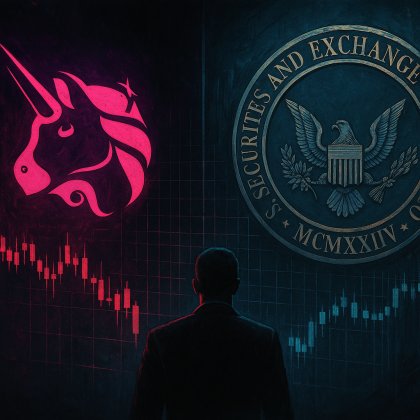
Debate Erupts as Uniswap’s Adams Accuses Citadel of Driving Aggressive SEC Oversight on DeFi

The tension between decentralized finance and traditional Wall Street players resurfaced this week after Uniswap founder Hayden Adams publicly accused Citadel Securities of influencing U.S. regulators to impose stricter rules on the DeFi sector.

Adams’ comments, shared across social media, sparked a wide-ranging debate over who should be considered a financial intermediary in blockchain-based markets, and whether the rules of traditional finance should apply to open-source developers.

Adams claimed that Citadel, led by CEO Ken Griffin, has been lobbying the U.S. Securities and Exchange Commission (SEC) to classify DeFi developers, validators, liquidity providers and even front-end operators as broker-dealers.

Uniswap UNI UNIUSD_2025-12-04_12-08-55

Citadel’s Filing Raises Concerns Over Tokenized Markets

At the center of the dispute is Citadel’s December 2 filing to the SEC. The document argues that many blockchain-based systems effectively bring together buyers and sellers in ways that resemble traditional exchanges.

As such, Citadel says they should be regulated under the same standards, even if those systems operate through smart contracts rather than centralized infrastructure.

Citadel warned that tokenized U.S. equities trading on DeFi platforms could create a “shadow equity market” outside the national market system, reducing regulatory oversight and fragmenting liquidity.

The firm’s letter also rejects the idea that technology differences justify regulatory exemptions, insisting that “the same activity should face the same rules” regardless of whether it is powered by algorithms or legacy systems.

DeFi advocates counter that this perspective ignores the design of decentralized protocols, which can function without centralized control and often rely on open-source contributions rather than corporate governance.

Adams Pushes Back Against “Fair Access” Claims

Adams criticized Citadel’s assertion that DeFi systems cannot provide “fair access,” calling the argument inconsistent with how traditional market makers operate. He argued that open-source protocols can lower barriers to participation, unlike centralized trading venues where access is limited by intermediaries.

Developers and community members echoed this point, noting that the DeFi ecosystem encompasses a broad range of models, from fully permissionless exchanges to platforms that rely on more centralized components.

Some community voices added that regulatory conversations often lack clarity because “DeFi” itself encompasses many different structures.

Regulatory Pressure Builds as SEC Signals Broader Scrutiny

The exchange comes at a time when the SEC has repeatedly taken enforcement action against DeFi teams. The agency has emphasized that it assesses economic realities rather than decentralization labels, citing past cases such as the Rari Capital settlement in 2024.

If regulators adopt Citadel’s framing, entities involved in developing or maintaining DeFi protocols could face registration requirements designed for traditional broker-dealers.

Industry participants warn that such a shift could make open-source projects difficult to operate, raising questions about the future of permissionless finance in the United States.

As the debate continues, the clash highlights a deeper divide between emerging decentralized systems and established financial institutions, one that is increasingly shaping regulatory policy discussions in Washington.

Cover image from ChatGPT, UNIUSD chart from Tradingview
Fusaka Upgrade Reignites Confidence in Ethereum, Analysts Eye $3,500 Target

Ethereum (ETH) is topping talks once again as its Fusaka upgrade goes live and the ETH price returns firmly above the $3,200 mark. After weeks of choppy trading and lingering fear across the broader crypto market, the combination of a major technical overhaul and rising on-chain activity is giving traders a fresh narrative to follow.

Related Reading: Eric Trump Says Bitcoin Could Hit $500,000, Stands By ABTC Strategy

In the last 24 hours, ETH has climbed around 4–5%, outperforming most large-cap cryptos and reclaiming a key psychological zone near $3,200. Market data shows rising volumes and a noticeable pickup in accumulation from larger holders, even as sentiment indicators still sit in “Fear” territory.

Ethereum ETH ETHUSD ETH price

Fusaka Upgrade Shifts Focus Back to Ethereum’s Scaling Roadmap

The Fusaka upgrade, Ethereum’s second major network update of 2025, activated at block height 18,200,000. At its core is PeerDAS, a data availability sampling system that lets nodes store only slices of blob data instead of entire payloads.

This change is estimated to expand blob throughput by roughly eight times, easing congestion and helping layer-2 networks push more transactions through Ethereum’s base layer.

Developers describe Fusaka as another step in Ethereum’s long-term scaling roadmap, aligning the main chain with growing layer-2 activity.

Beyond PeerDAS, the upgrade bundles a series of Ethereum Improvement Proposals that tweak gas limits, transaction sizes, cryptographic support, and block configuration, aiming to improve efficiency while keeping validator requirements manageable.

Whales, ETFs and Technical Signals Cluster Around $3,500

On-chain data shows “shark” wallets holding between 1,000 and 10,000 ETH have ramped up accumulation in recent weeks, buying aggressively on dips around $2,700–$3,000.

Institutional interest also appears to be rising. BitMine has reportedly added more than 18,000 ETH to its treasury ahead of Fusaka, while U.S. spot Ethereum ETFs have recorded notable net inflows.

Technically, ETH is trading around $3,200 with analysts watching resistance between $3,300 and $3,500. Short-term models project a move toward roughly $3,537 within days, implying upside of about 10% if the current trend holds.

However, indicators remain mixed. The broader setup is still labelled “bearish,” and any pullback could see ETH retesting support around $3,100, $3,000, or even the $2,850 zone.

Related Reading: XRP Price Is Performing As Expected; Analyst Reveals What Comes Next

For now, the Fusaka upgrade has shifted the conversation back to fundamentals, with Ethereum’s price action testing whether renewed confidence is enough to carry it through the $3,500 barrier.

Cover image from ChatGPT, ETHUSD chart from Tradingview
Bullish Setup Emerges for Dogecoin as Price Action Tightens and Market Signals Turn Positive

The Dogecoin (DOGE) price movement is entering a phase that traders often watch closely, a stretch of tightening action that usually precedes a decisive move.

After several days of elevated activity, shifting ETF flows, and a rare alignment of technical indicators, the memecoin is now sitting at a point where sentiment and structure appear to be converging.

The conversation around Dogecoin is beginning to shift from short-term speculation to whether the asset is preparing for a larger breakout as the year closes.

Recent trading sessions have highlighted a steady rise in activity, driven initially by an 8% price jump that pushed DOGE to the $0.15 region. The move came alongside a 242% surge in volume, reflecting strong participation from retail investors.

Dogecoin DOGE DOGEUSD_2025-12-04_12-38-10

DOGE ETF Momentum Builds as Market Structure Tightens

A major catalyst behind recent volatility has been the rollout of multiple DOGE-related exchange-traded products.

Grayscale’s GDOG and Bitwise’s BWOW have recorded early but steady inflows, now totaling nearly $2.9 million since launch. Although the numbers remain modest, analysts view these products as important steps toward bringing Dogecoin into mainstream financial products.

At the same time, technical structure on the charts has narrowed into a symmetrical triangle, a pattern that forms when lower highs and higher lows converge. Current support sits in the $0.145–$0.150 range, with the upper boundary near $0.165. A breakout above this ceiling could open the door to targets between $0.18 and $0.20.

Indicators such as RSI, MACD, and the TD Sequential tool show early signs of shifting momentum, though signals remain mixed and require confirmation through stronger volume.

Retail Traders Lead as Analysts Reassess

Despite rising optimism, institutional traders have taken a more cautious stance. Futures open interest and derivatives volume have cooled, pointing to a market waiting for a clearer direction.

Still, retail participation has continued to rise, and analysts note that Dogecoin’s ascending channel remains intact as long as price holds above the $0.1470 level.

Across higher timeframes, DOGE has also reclaimed a series of higher lows, reinforcing the possibility that the meme token is attempting to build a more sustainable bullish structure.

Some analysts project a potential move toward $0.42 over the coming months if current patterns persist, while more aggressive models leave room for a retest of psychological levels in the $1 range, though such targets remain highly speculative.

Traders are closely watching $0.1470 and $0.1500, as losing these levels could invite a deeper pullback toward $0.138. For now, the market remains compressed, with both sides preparing for the next decisive break.

Cover image from ChatGPT, DOGEUSD chart on Tradingview

Bitcoin Rally Strengthens With Renewed $100K Targets Following Key Institutional Policy Change

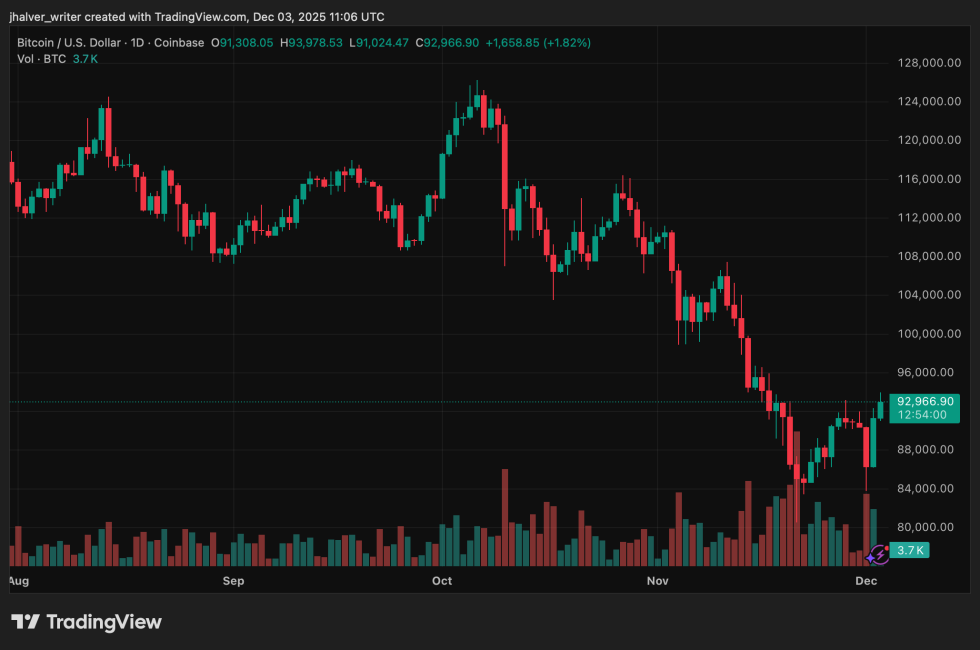
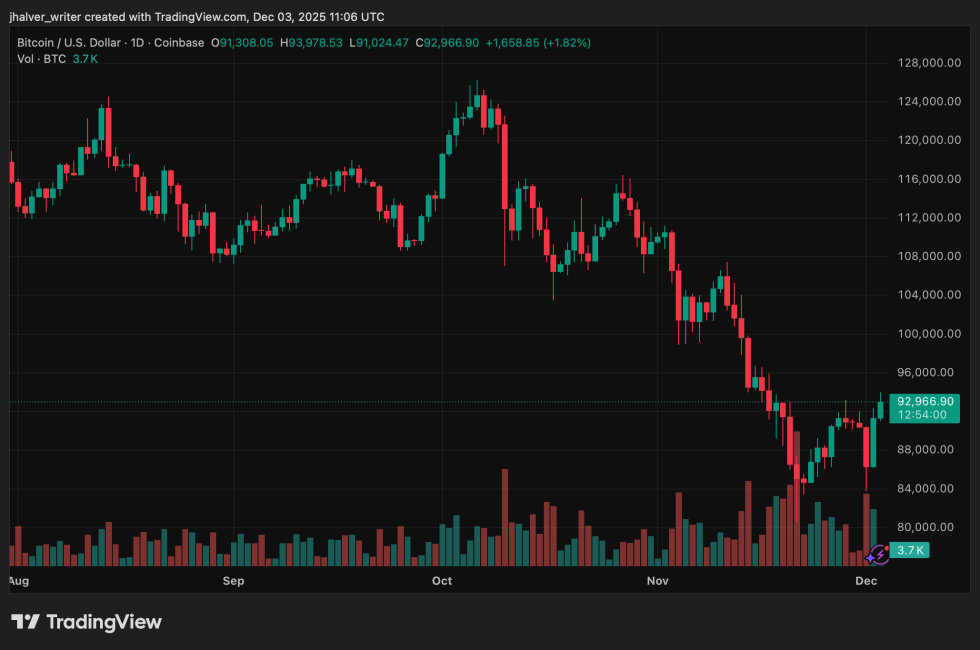
Bitcoin (BTC) climbed back above the $93,000 level this week as improving liquidity conditions and a major shift in institutional policy helped stabilize market sentiment following sharp volatility.

Related Reading: Crypto Investors Brace As Japan Proposes 20% Tax By 2027

The move follows a month-long slide that erased nearly 20% from recent highs and raised questions about whether the broader uptrend was losing strength. Consequently, about $250 million in BTC short positions have been liquidated.

Bitcoin BTC BTCUSD BTCUSD_2025-12-03_12-06-00_e6a7e5

Institutional Access Expands as Vanguard Lifts ETF Ban

The most notable catalyst for the rebound came from Vanguard, which reversed its long-standing ban on Bitcoin ETFs. The decision immediately opened access to tens of millions of retail accounts and allowed products such as BlackRock’s IBIT to trade on the platform, generating more than $1 billion in volume on day one.

The policy shift triggered a rapid surge in demand and helped fuel more than $400 million in short liquidations as Bitcoin jumped from the mid-$88,000 area to above $93,000 within hours.

Analysts note that several major firms, including Robinhood and Fidelity, added significant BTC exposure during the session. Combined with stablecoin issuers expanding supply in recent weeks, liquidity across the crypto market has broadened.

Macro Shifts and Technical Levels Support the Recovery

The rebound coincided with the U.S. Federal Reserve ending its quantitative tightening programme and injecting fresh funds into short-term markets. Repo facility usage also increased, improving liquidity for risk assets. Traders now assign high probability to a rate cut at the Fed’s December meeting.

Across the market, major assets followed Bitcoin higher. Ethereum traded near $3,000, Solana reached $142, and XRP climbed back above $2.18. Market indexes tracking large-cap cryptocurrencies rose around 7%, while the Crypto Fear & Greed Index moved off extreme fear levels.

Technical indicators are showing early signs of stabilisation. Analysts highlight the $86,000–$88,000 range as a key support zone that has held through repeated tests in recent months. Bitcoin is also pressing against resistance between $92,500 and $94,000, forming an ascending triangle pattern.

Renewed $100K Bitcoin Targets, but Debate Over Trend Strength Remains

Despite the strong bounce, analysts remain divided on whether Bitcoin is entering a renewed expansion phase or simply retracing after a sharp correction.

Some warn that deeper downtrends historically unfold over longer periods. Others argue that rising institutional participation and on-chain activity resemble previous mid-cycle resets rather than the start of a prolonged decline.

Related Reading: Bank Of America Opens Up To Bitcoin, Recommends Up To 4% Crypto Allocation

For now, BTC’s ability to maintain levels above $92,000 is viewed as critical. A sustained move higher would keep $100,000 firmly in focus, while failure to break resistance could send the market back into the high-$80,000 range.

Cover image from ChatGPT, BTCUSD chart from Tradingview
Crypto Gains Strong Legal Protection in the UK as Lawmakers Finalize Digital Asset Property Rules

The UK has reached a defining moment for its digital economy, introducing legal clarity that crypto users and businesses have long sought. For a long time, cryptocurrencies, stablecoins, and other digital tokens existed in a grey legal zone, recognised by courts in practice but not formally defined in statute.

That uncertainty shaped how disputes were settled, how assets were recovered, and how companies approached innovation. Now, with Parliament passing the Property (Digital Assets, etc.) Act and securing royal assent, the UK has made a deliberate shift toward a more structured digital asset framework.

The new rules are designed to do more than refine legal language. It is believed that they will help how English law categorises emerging technologies, laying the groundwork for clearer ownership rights, smoother dispute resolution, and broader institutional participation.

Crypto Bitcoin UK BTCUSD_2025-12-03_12-06-00

UK Issues Digital Assets Firm Legal Ownership Status

The legislation confirms that digital or electronic “things” qualify as personal property, placing cryptocurrencies on the same legal footing as traditional assets.

Previously, courts treated crypto as property through case-by-case rulings, relying on common law. Parliament’s decision now writes this position into statute, following a 2024 recommendation from the Law Commission.

Digital assets had long challenged existing classifications. UK law traditionally recognised two forms of personal property: physical items (“things in possession”) and enforceable rights (“things in action”).

Crypto fits neither category neatly. The new law resolves this by creating space for a distinct type of property that reflects how digital tokens behave and are used in modern markets.

Industry groups welcomed the change, stating that it will help courts deal with theft, fraud, insolvency, and inheritance cases involving crypto with greater consistency. Users now have a clearer pathway for proving ownership and recovering lost or stolen digital funds.

Stronger Protections as Adoption Rises

The shift arrives as crypto participation continues to grow in the UK. According to financial regulators, around 12% of adults now hold some form of crypto, up from 10% in earlier findings. Policymakers have argued that this rising adoption makes legal certainty essential for both consumer protection and market stability.

The new statute also aligns with the government’s broader plan for a regulated crypto regime that would bring exchanges and service providers under rules similar to those applied to traditional financial firms. Lawmakers aim to support innovation while introducing clear standards for accountability.

Cover image from ChatGPT, BTCUSD chart from Tradingview

❌