Reading view

There are new articles available, click to refresh the page.

Chainlink and Mastercard Join Swapper Finance To Bring Direct Deposits To 3.5B Users

Swapper Finance has launched Direct Deposits in collaboration with Chainlink and Mastercard, aiming to bring global payments directly into the on-chain economy to more than 3.5 billion users worldwide.

Swapper Finance Launches Direct Deposits With Chainlink, Mastercard

On Tuesday, Swapper Finance, a next-generation payments infrastructure layer that connects global users to on-chain applications, announced the launch of Direct Deposits in collaboration with Chainlink, Mastercard, and multiple key partners.

Direct Deposits, which are live now, are set to bring “the global payments world directly into the on-chain economy through a unified, secure, and compliant flow,” powered by Chainlink Runtime Environment (CRE) and Mastercard’s recognized global network.

According to the announcement, users will be able to deposit into Decentralized Finance (DeFi) protocols using payment cards, crypto transfers, or Web3 wallets inside a single, end-to-end on-chain workflow for the first time.

Swapper’s Direct Deposits aim to unlock instant access to DeFi for billions of people worldwide by eliminating traditional bottlenecks, exchanges, and multi-step onboarding. This has historically required stitching together isolated systems, including Know Your Client (KYC) requirements, compliance, card payments, fiat conversion, settlement, and liquidity routing, which has created friction, high drop-off rates, and inconsistent security across the process.

Direct Deposits are set to replace this old-fashioned flow through one “unified, verifiable, on-chain orchestration layer,” with every component of the process executed inside a secure on-chain environment.

Roman Tirone, Senior Manager, Chainlink Build at Chainlink Labs, affirmed that “by unifying identity, compliance, token swaps, settlement, and more in a single orchestration layer, CRE is enabling the onboarding of billions of cardholders into the onchain economy.”

This creates a simple and familiar checkout experience that quickly moves a user from traditional finance to on-chain, supported by institutional-grade security and global reach. Meanwhile, the launch represents another step in Mastercard’s efforts to integrate traditional payment infrastructure with blockchain-based applications, helping it expand its digital asset strategy.

‘The Onboarding Layer For Web3’

Swapper’s launch will see multiple leading Web3 platforms integrate the Direct Deposits technology directly into their user flows, including Pi Squared, Stake.link, KyberSwap, AITECH, NPC, Teneo, BigWater, Rhuna, TrebleSwap, MyStandard, Landwolf, Dolomite, HyperSwap, Turbo, APU, and Radiant Capital, among others.

This signals strong demand for a unified card-to-on-chain standard, the announcement added, which suggests that Direct Deposits “are quickly becoming a foundational component for user acquisition across Web3.”

The launch also represents “deep technical collaboration across Mastercard, Chainlink, Swapper Finance, and key partners” to bring together payment authorization, compliance, execution, and liquidity routing in a single verifiable workflow powered by CRE and Swapper Finance.

Arthur, CTO of Swapper Finance, affirmed that “this is the onboarding layer we always believed the industry needed,” adding that Direct Deposits represent a “turning point” for how people enter the space as “the first truly unified onboarding layer for Web3.”

“Our goal has always been to remove the barriers that keep billions of people from accessing DeFi, and with this launch, that future becomes real,” Arthur stated, concluding that “Direct Deposits represent a turning point for how people enter Web3. For the first time, the process feels intuitive rather than intimidating. We expect this launch to dramatically expand the number of users who can participate in onchain markets.”

chainlink, link, linkusdt

How to stay online during an internet outage

A few weeks ago, my internet went down. Thankfully, my mobile internet was still working, so I was able to use my phone as a hotspot. Looking online, however, I found that many people who used the same provider for both their broadband and mobile internet had lost access to both and could not get online at all. There's always a risk that this could happen, but the good news is that an internet outage doesn't have to leave you offline.

The New Math of Global Citizenship: PoP × HCS × DAO

Why Global Citizenship Is No Longer Defined by Physical Borders in the Digital Era

In the Web3 era, citizenship is evolving beyond geography. We analyze the architecture of a Digital Nation: Zero-Knowledge Passports (PoP), On-Chain Credit (HCS), and Community Governance (DAO).

Citizenship Was Once a Geographical Lottery

For centuries, citizenship was a geographical lottery. It was decided by where you were born, and it granted you three critical rights:

  • Identity (Entry)
  • Economy (Credit)
  • Voice (Governance)

If you were born on the wrong side of a border, you were locked out. If you lacked banking history, you were economically invisible. If you disagreed with monetary policy, you were politically powerless.

But in the digital age, we are now facing a fundamental question:

Must these rights always come from a Nation-State?

We are witnessing the emergence of what can only be called “The Digital Nation.”

This is not about replacing countries. It is about creating a parallel society built on code, one that must be just as structurally complete as the physical one.

The formula for this new civilization is precise:

Digital Nation = PoP (Passport) + HCS (Economy) + DAO (Parliament)

Let’s analyze this architecture through the lens of a human-verified Web3 network that is actively implementing this civic stack.

⠀⠀⠀⠀⠀

1. The Border — PoP as the “Digital Passport”

The Function: Replacing Physical Borders with Cryptographic Verification

Every functioning society must know who its citizens are. In the physical world, we use passports. In the Digital Nation, we use Proof of Personhood (PoP).

The challenge is subtle but critical: How do you prove you are a unique human without surrendering your privacy to a central authority?

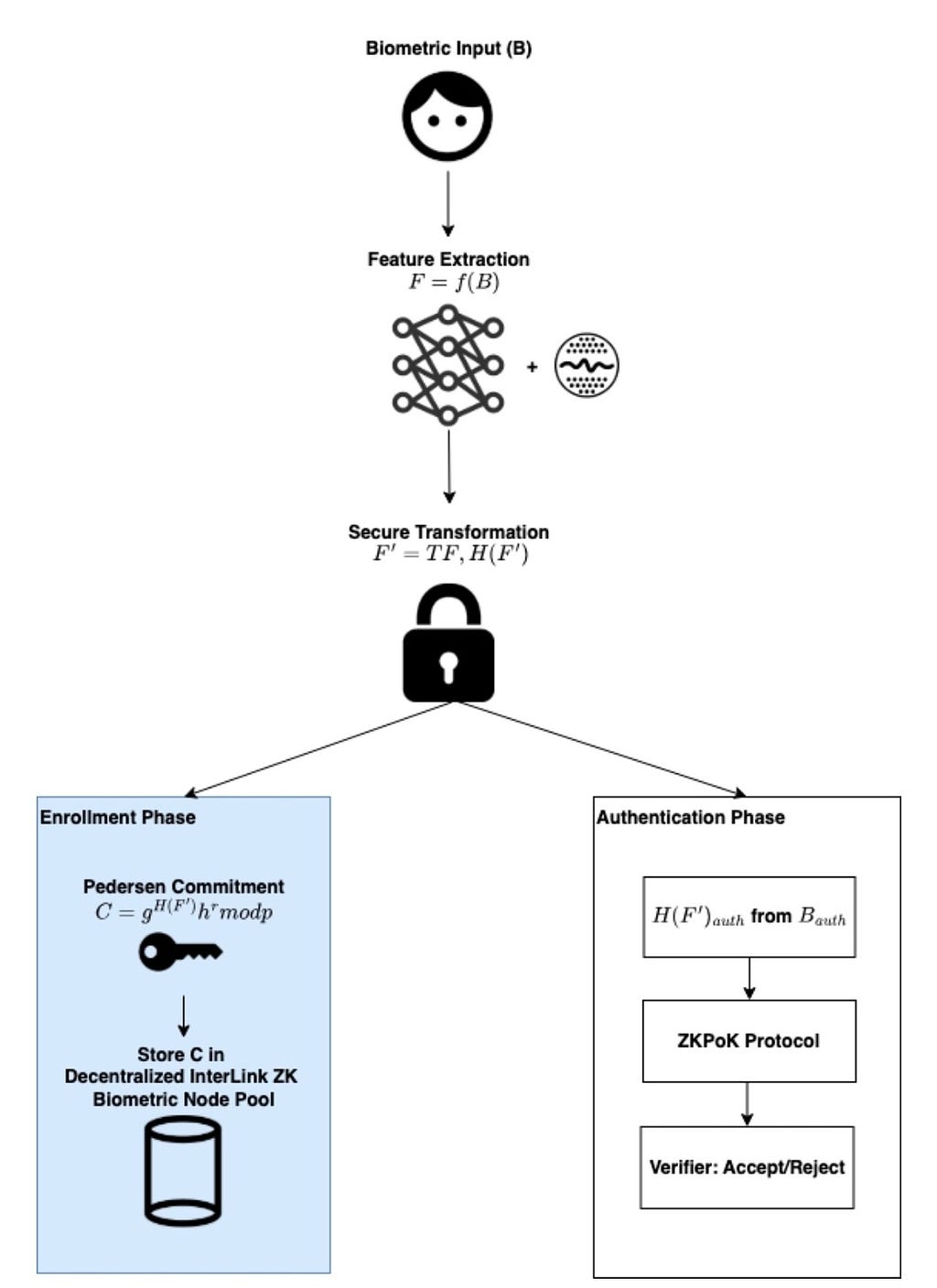
The solution lies in advanced mathematics. PoP systems utilize Zero-Knowledge Proofs (ZKP) and Homomorphic Encryption to solve the identity paradox.

  • Privacy First: Instead of storing your face or biometric data, the system stores a mathematical proof that you exist.
  • Compliance: Because no raw biometric data is ever stored, the system aligns with global privacy standards like GDPR, protecting users from surveillance while blocking bot farms and Sybil attacks.

This is not merely “login.” It is digital naturalization. A digital passport that only you control.

2. The Economy — HCS as the “Credit System”

The Function: Building Opportunity Without Banks

No nation can function without economic mobility. Traditional banking relies on institutional history. If you lack a bank account, you are invisible. This has excluded billions of people globally.

The Digital Nation replaces this with the Human Credit Score (HCS) — an on-chain reputation system that evaluates:

  • Reliability
  • Contribution
  • Behavioral consistency
  • Network Strength

In this system, credit is not a favor granted by a bank based on inherited wealth. It is an asset minted by your own integrity.

⠀⠀

This allows individuals in emerging markets to access financial tools purely based on proven reliability, not geographic privilege. HCS becomes the economic engine of digital citizenship.

3. The Parliament — DAO as the “Legislative Body”

The Function: Moving from “Users” to “Legislators”

The final pillar of any nation is governance.

Most Web2 platforms treat people as users — products to be monetized. A true Digital Nation treats them as citizens with legislative power.

The InterLink DAO represents a shift in authority away from corporations and toward communities. Crucially, it prevents plutocracy (rule by the rich) by tying governance power to verified human identity.

Citizens participate directly in:

  • Economic Rules: Deciding on reward structures and token burn mechanisms.
  • Fiscal Decisions: Voting on treasury allocation for ecosystem growth.

This ensures that economic law is written by the people who participate in the economy itself.

📌 Final Equation Recap

PoP ⠀ gives you identity.
HCS ⠀ gives you economic credibility.
DAO ⠀ gives you legislative power.

⠀Together, they form the full civic infrastructure of the Digital Nation.

Conclusion: The Architecture is Ready

The definition of citizenship is expanding.

Once, your rights were stamped into a physical passport. Your credit was locked inside a national banking system. Your voice existed only within geographic borders.

This is not the end of the Nation-State. It is the birth of a parallel layer of civilization.

⠀The equation is set. The only variable left is your decision.

About the Author

Done.T is a Web3 analyst focusing on the intersection of Mobile Mining, UBI, and Decentralized Finance. He separates signal from noise to provide logical insights for the global crypto community.

The equation is set. The only variable left is your decision.


The New Math of Global Citizenship: PoP × HCS × DAO was originally published in Coinmonks on Medium, where people are continuing the conversation by highlighting and responding to this story.

Digital Asset ETPs Record $716M Weekly Inflows as AuM Reaches $180B: CoinShares

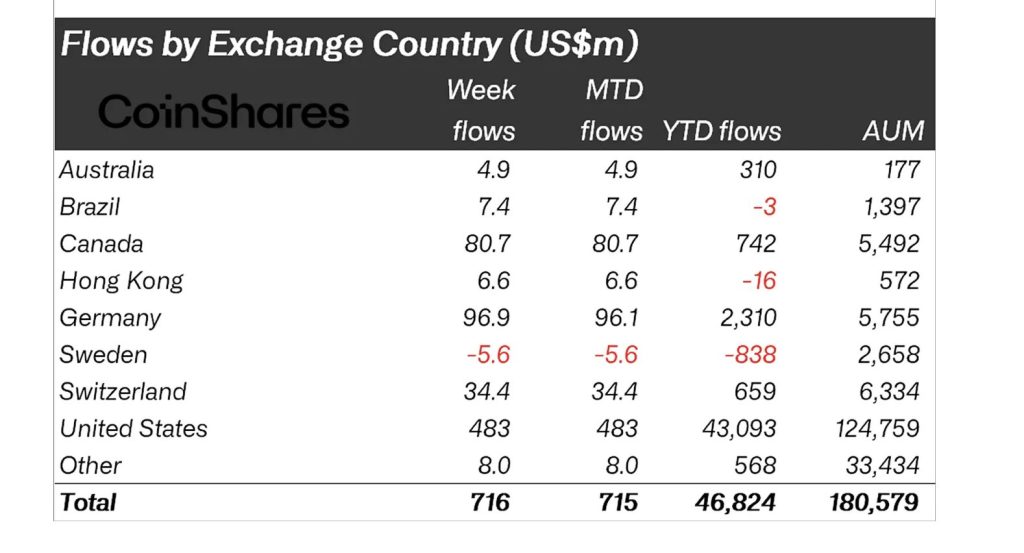
Digital asset investment products recorded a second consecutive week of inflows, totalling $716M, showing improving sentiment across institutional and retail investors after a volatile period in crypto markets, according to the latest report from CoinShares.

CoinShares reports total assets under management rose 7.9% from their November lows to $180B, though this figure remains below the all-time high of $264B. Daily flow data indicated minor outflows toward the end of the week, which analysts believe reflected macroeconomic uncertainty and market reactions to U.S. inflation-related data.

Despite those short-term jitters, the week’s net performance highlights renewed confidence in digital asset exposure through exchange-traded products.

A notable trend was the geographic spread of inflows, suggesting renewed interest globally rather than activity concentrated in a single region. The United States led with $483M in inflows, followed by Germany at $96.9M and Canada at $80.7M, demonstrating that institutional re-engagement with crypto markets is widening across regulated investment platforms.

Bitcoin Leads Inflows While Short Products Reverse

Bitcoin remained the primary focus for investors, recording $352M in inflows last week, contributing to year-to-date (YTD) inflows of $27.1B. This remains below the record $41.6B seen in 2024; however, continued inflows suggest persistent appetite for exposure despite reduced volatility and slower price momentum compared to previous cycles.

In contrast, short-Bitcoin investment products saw outflows of $18.7M — the largest since March 2025. Analysts note that the previous occurrence coincided with price lows and later recovery, hinting that current negative sentiment may have exhausted itself, with investors positioning for a more favourable outlook.

The reversal in short-Bitcoin demand could be interpreted as a tactical shift, where investors are less confident in prolonged downside risk and increasingly reassessing the potential for stabilization or upside in digital asset markets.

XRP Sees Strong Momentum as Institutional Interest Accelerates

XRP continued to draw attention, with $245M flowing into ETPs last week, bringing YTD inflows to $3.1B — a dramatic increase compared to $608M in 2024. The surge reflects heightened institutional engagement following greater clarity around its legal and regulatory landscape, which has broadened access and improved sentiment.

The continued rise in XRP ETP demand marks one of the strongest comparative growth stories in the digital asset space this year, suggesting that investors may now be reassessing exposure beyond Bitcoin and Ethereum as the market diversifies.

Chainlink Records Largest Inflows on Record

Chainlink registered $52.8M in weekly inflows, representing over 54% of its total assets under management — the largest on record for the token. The surge highlights growing institutional and developer interest in the tokenized asset and oracle infrastructure ecosystem that Chainlink underpins.

As tokenization of real-world assets expands and demand for reliable data connectivity increases across blockchains, Chainlink’s growth may indicate a long-term thematic trend rather than short-term speculation.

Digital asset ETPs saw US$716m in weekly inflows, lifting total AuM to US$180bn, though still well below the US$264bn all-time high. Bitcoin attracted US$352m while XRP (US$245m) and Chainlink (US$52.8m) also saw strong demand. Short-Bitcoin products saw outflows of US$18.7m, the…

— Wu Blockchain (@WuBlockchain) December 8, 2025

The post Digital Asset ETPs Record $716M Weekly Inflows as AuM Reaches $180B: CoinShares appeared first on Cryptonews.

Chainlink Bullish Path – This Zone Will Decide The Next Big Move

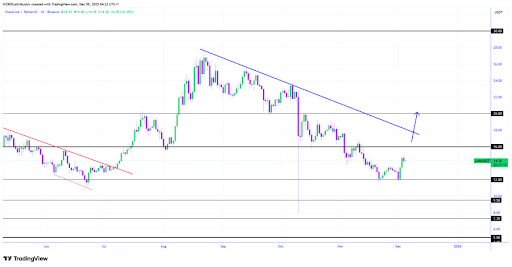
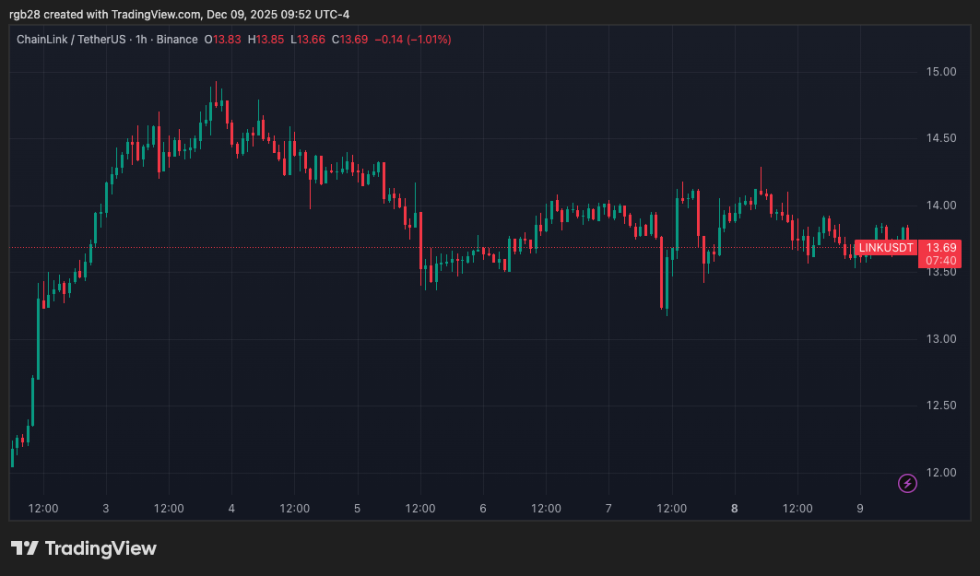
Crypto analyst CryptoWzrd, in a recent Chainlink daily technical outlook, noted that the candle closed slightly bearish, but the overall structure remains constructive and pushes toward the key $16.00 resistance, where momentum could shift quickly. According to the analyst, a retest of the $13.50 support or a break above the $15.20 resistance will be the critical trigger for the next major trade setup.

Indecisive Daily Close Sets the Stage For A Critical Trendline Test

CryptoWzrd noted that both LINK and LINKBTC closed the daily candle in an indecisive manner, reflecting uncertainty in the short-term market direction. Despite this hesitation, the broader structure remains intact, and price action is approaching a technically significant point that will play a crucial role in determining the next major move for Chainlink.

According to the analyst, LINKBTC is now testing its daily lower-high trendline. A series of bullish candles emerging from this zone would be a strong signal that buyers are re-entering the market. If this momentum builds, it is likely to spill over into Chainlink, potentially triggering an impulsive rally.

Chainlink

Should bullish confirmation appear, LINK could drive toward the $16 resistance level, a region that has been tested multiple times in the past. A clean breakout above $16 would open the door for a swift extension toward the next major hurdle for the bulls $20 resistance, marking a significant continuation of upward momentum.

On the downside, CryptoWzrd emphasized that the $12 level stands as the primary support. A daily close below this level would weaken the bullish structure and could signal a deeper correction. Until then, the trendline test remains a critical focal point where LINK’s uptrend will continue or reverse.

ChainLink Choppy Intraday Movement Signals Caution

Conclusively, the analyst highlighted that the intraday chart was characterized by being somewhat choppy and trading within a very tight, small range. This consolidation phase often precedes a significant directional move, but it has made short-term trading decisions challenging without a clear trigger.

The analyst defined a specific setup to watch for: a bearish pullback towards the $13.50 support level, followed by a decisive bullish reversal, would serve as the ideal trigger for a long position. Such a trade would initially target the $15.20 resistance and potentially move toward higher levels thereafter.

By confirming immediate strategic focus, the analyst stated that his attention “tomorrow will remain on the lower time frame chart development” to scout the next optimal scalp opportunity. This indicates a short-term, opportunistic trading mindset by waiting for the confined range to break or for the identified mean-reversion setup at $13.50 to play out.

Chainlink

Grayscale’s Spot Chainlink ETF Pulls $41M on Debut Despite Market Uncertainty

By: Amin Ayan

Grayscale’s first US spot exchange-traded fund tied to Chainlink opened with solid demand, adding another data point to the debate over whether appetite for altcoins can survive a cooling crypto market.

Key Takeaways:

  • Bloomberg’s Eric Balchunas says the Chainlink ETF opened with $41M in inflows and $13M in volume.
  • The debut beat Solana’s launch, but trailed XRP’s $243M Day-1 inflow reported by SosoValue.
  • ETF analyst James Seyffart cautioned it wasn’t a blockbuster.

Despite a pullback across major tokens in recent weeks, the new fund attracted sizable capital on its first trading day.

Chainlink ETF Debut Draws $41M, Signaling Demand for Regulated Altcoins

According to Bloomberg ETF analyst Eric Balchunas, the product ended its debut session with $41 million in net inflows and about $13 million in trading volume.

The figures placed Chainlink among the stronger ETF launches this year and suggested that, at least for some investors, regulated vehicles remain the preferred route into higher-risk digital assets.

The showing stands well above the opening day for the Solana ETF, which recorded just $8.2 million in volume based on data from Farside Investors.

Still, the XRP ETF remains the category’s heavyweight, registering $243 million in first-day inflows, according to SosoValue.

Even so, analysts urged restraint. James Seyffart said the launch was not a “blockbuster,” though he noted that the fund quickly reached about $64 million in assets under management, including an $18 million seed allocation.

“Chainlink shows that less liquid products can still attract attention in an ETF wrapper,” he wrote, pointing to the role exchange-traded funds can play in widening market access.

So, $GLNK took in ~$42 million on day 1. Not "blockbuster" success but very good for a new launch. Volume was strong. The fund currently sits at $64 million in assets. Chainlink showing that longer tail assets can find success in the ETF wrapper too. https://t.co/CgVCxlykGr

— James Seyffart (@JSeyff) December 3, 2025

For Chainlink itself, the debut offered little immediate relief. The LINK token is up nearly 10% over the past week but remains down more than 39% over the past year, according to price data cited by Cointelegraph.

Chainlink’s appeal lies in its infrastructure role. The network supplies on-chain applications with external data, enabling price feeds, cross-chain transfers and tokenized assets to function reliably.

As demand for decentralized finance and real-world asset tokenization grows, investors appear willing to give even second-tier tokens a closer look.

New Altcoin ETFs Steal Spotlight as Bitcoin Funds Struggle

The new Chainlink ETF comes amid the rollout of a wave of new altcoin ETFs.

Over the past month, issuers have launched products tied to Solana, XRP, and Dogecoin, with more XRP and Dogecoin funds set to list next week.

The Canary Capital XRP ETF (XRPC) debuted with $58 million in net inflows, the highest opening-day haul for any ETF this year, edging out the Bitwise Solana Staking ETF (BSOL), which launched with $57 million.

BSOL has quickly become one of the early success stories of 2025, accumulating over $660 million in assets within three weeks and avoiding a single day of outflows.

As reported, the New York Stock Exchange has approved the listing of Grayscale’s XRP and Dogecoin exchange-traded funds, clearing both products to begin trading on Monday.

NYSE Arca, the exchange’s ETF-focused subsidiary, filed certifications on Friday confirming the listing and registration of the Grayscale XRP Trust ETF Shares and the Grayscale Dogecoin Trust ETF Shares under the Securities Exchange Act of 1934.

Bitwise Asset Management has also unveiled the Bitwise Dogecoin ETF as investor appetite for altcoin exposure continues to increase.

The post Grayscale’s Spot Chainlink ETF Pulls $41M on Debut Despite Market Uncertainty appeared first on Cryptonews.

Chainlink Approaches Key Breakout Levels as ETF Launch Triggers Market-Wide Buzz

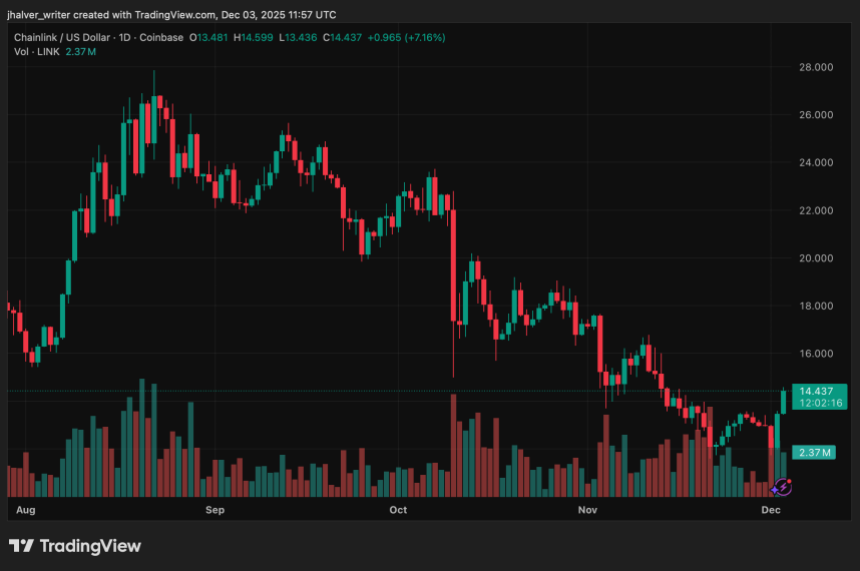
Chainlink (LINK) is once again in the spotlight across the cryptosphere after the launch of the first U.S. Chainlink-focused ETF sparked a sharp price rebound and renewed institutional interest. LINK surged more than 20% in 24 hours, trading around $14.4 as volumes and market participation accelerated.

Chainlink ETF Launch Sparks Strong Market Reaction

Grayscale launched the GLNK ETF on December 2, converting its previous private Chainlink trust into a publicly traded product on NYSE Arca.

The ETF opened with zero fees and recorded more than 1.17 million shares traded on its first day, far above historical averages. Trading volume reached roughly $13.8 million, while early inflows were reported near $43 million, reflecting strong initial demand.

The ETF gives institutions regulated exposure to LINK without requiring direct token custody. With access through major platforms such as Fidelity and Robinhood, Chainlink is receiving increased visibility among traditional investors.

Grayscale currently holds about 1.3 million LINK tokens through the product. Derivatives data also shows rising interest, with LINK futures open interest climbing more than 20% and funding rates turning positive as traders add long positions.

Chainlink LINK LINKUSD LINKUSD_2025-12-03_12-57-44

Technical Signals Point Toward Breakout Potential

Beyond ETF-driven momentum, the LINK chart is drawing attention from technical analysts.

Several analysts have emphasized a rare four-year descending wedge pattern, typically associated with long-term compression before a breakout. LINK recently bounced from the $12.50 support level, forming higher lows and regaining key Fibonacci levels.

Momentum indicators are turning positive as well. The daily RSI has recovered to around 53, while MACD signals improving strength. LINK is now approaching the $14.96 Supertrend level and remains below the 50-day and 200-day EMAs, both key levels the market is watching for confirmation of a trend shift.

If the token holds above $13, analysts expect a possible move toward the $18–$20 resistance range. A break above these zones could open the path toward the higher targets mentioned by long-term analysts.

Year-End Targets Strengthen as Market Sentiment Improves

Crypto analyst Ali Martinez notes that LINK is currently sitting on an important long-term support trendline, which could act as a foundation for a move toward $26 and potentially $47 if momentum continues.

Rising institutional inflows, accelerating derivatives activity, and a new spot ETF creating a steady channel for capital have strengthened market expectations.

For now, traders are watching the $12–$13 support area for signs that LINK can sustain its recovery. A decisive move above $14.50–$15 would mark the next major step toward a full bullish breakout.

Cover image from ChatGPT, LINKUSD chart from Tradingview

Planned satellite constellations may swamp future orbiting telescopes

On Wednesday, three NASA astronomers released an analysis showing that several planned orbital telescopes would see their images criss-crossed by planned satellite constellations, such as a fully expanded Starlink and its competitors. While the impact of these constellations on ground-based has been widely considered, orbital hardware was thought to be relatively immune from their interference. But the planned expansion of constellations, coupled with some of the features of upcoming missions, will mean that at least one proposed observatory will see an average of nearly 100 satellite tracks in every exposure.

Making matters worse, some of the planned measures meant to minimize the impact on ground-based telescopes will make things worse for those in orbit.

Constellations vs. astronomy

Satellite constellations are a relatively new threat to astronomy; prior to the drop in launch costs driven by SpaceX’s reusable rockets, the largest constellations in orbit consisted of a few dozen satellites. But the rapid growth of the Starlink system caused problems for ground-based astronomy that are not easy to solve.

Read full article

Comments

© NASA

Chainlink At A Turning Point: Triangle Pattern Holds, But One Line Must Break

Chainlink is approaching a decisive moment as its price compresses within a well-defined triangle structure. The pattern remains strong, but the market is signaling that a major move is imminent. Everything now hinges on a single trendline break, one that will determine whether LINK is ready to reverse higher or sink into a deeper correction.

B-Wave Extension Back In Focus: Is The Triangle Still Intact?

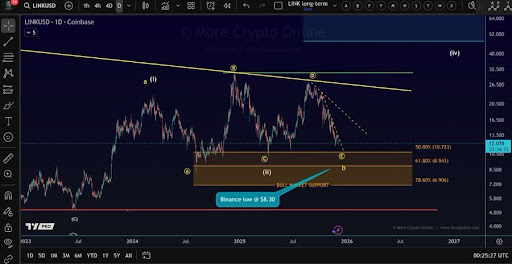
According to crypto analyst More Crypto Online in a recent update on Chainlink, it is crucial to step back and examine the bigger picture of the asset’s price action. The analyst believes the market is likely still extending the yellow B-wave correction. At the moment, the analyst is considering that this B-wave may be unfolding as a complex triangle pattern, as seen in the “yellow scenario.”

Despite the triangle hypothesis, the analyst emphasizes that there is currently no evidence that a definitive low has formed. To confirm a structural reversal, LINK requires a clear 1-2 setup to the upside, which would signal the start of a new impulsive trend. As stated in previous updates, a confirmed bottom hinges on a break above the first yellow trendline.

Chainlink

The triangle pattern, which typically unfolds as a 5-wave structure (A–B–C–D–E), remains valid for now, without a confirmed low. This pattern suggests that the price will continue to consolidate sideways, trapping both bulls and bears. 

More Crypto Online defined the critical invalidation point for the primary count. If the price were to break below the Monday, April 4th, low at $10.20, the current triangle microstructure would be entirely invalidated. Meanwhile, the broader B-wave correction would still be theoretically possible, but would likely unfold in a different structural path.

Critical Support Cluster: $10.70, $8.94, And $6.90 In Focus

More Crypto Online went further to highlight the next crucial support levels if the current triangle structure fails, which are located at $10.70, $8.94, and $6.90. The analyst cautioned that a definitive break below the $6.90 mark would significantly increase the probability of an alternative scenario for Chainlink: the unfolding of a larger degree Wave 4.

For now, the immediate focus is on how the price reacts within the key Fibonacci support zone defined by the boundaries of $6.90 and $10.70. The analyst concluded by stating the necessary condition for a structural low: the earliest sign of a reversal would be a break above the yellow trendline. Until that happens, the trendline continues to act as firm resistance, keeping the local downtrend structurally intact and signaling that caution remains necessary.

Chainlink

Russian recon drone found with Starlink terminal

A Ukrainian military specialist has published photographs of a downed Russian reconnaissance drone allegedly equipped with a Starlink satellite terminal and a locally manufactured onboard systems. The images, shared by Serhiy Beskrestnov—also known by the callsign “Serhiy Flesh”—provide further evidence that Russia may be using civilian satellite internet services to conduct battlefield surveillance. “Now I […]
❌