Reading view

There are new articles available, click to refresh the page.

Crypto Watchlist: Key Events To Watch In The Week Ahead

The coming week concentrates macro and protocol-specific catalysts into a tight window, with the Federal Reserve’s FOMC decision and several high-profile project events landing between December 10 and 12.

#1 Crypto On Alert: Fed’s Dec. 10 Rate Decision

The US Federal Reserve’s FOMC interest rate decision on Dec. 10 looms as a key macro catalyst for crypto. Markets overwhelmingly expect a 25 bps rate cut – about an 87% probability according to Fed funds futures– which would lower the target rate to ~3.5–3.75%. Such a move would be the third cut in as many meetings, signaling a pivot to easing as the Fed prioritizes a faltering job market over inflation.

Bitcoin (BTC) has historically reacted sharply to Fed surprises: BTC often faces downward pressure into FOMC announcements, then significant volatility as markets parse the Fed’s language. Indeed, ahead of this meeting, BTC dipped below $88,000 over the weekend on “FOMC nerves” but quickly jumped back above $91,000.

If the Fed delivers the expected 0.25% cut, it could bolster crypto by improving liquidity conditions and risk appetite. Easing financial conditions have been core to the recent crypto rebound. Any dovish signals may prompt a relief rally in BTC and the broader crypto market.

However, a hawkish surprise – if the Fed were to hold rates steady or sound cautious – risks upsetting this fragile optimism. As reported on NewsBTC, a special focus will be on whether the Fed announces a new program for Treasury bill purchases.

#2 Solana’s Breakpoint (Dec. 11–13)

Solana’s Breakpoint conference kicks off Dec. 11 in Abu Dhabi, and traders are eyeing SOL’s price action around this flagship event. Breakpoint has a track record of stirring excitement – and volatility – in SOL. At the 2023 conference in Amsterdam, for example, SOL surged over 20% to a 14-month high (~$45) as a “flurry of announcements” (like Jump Crypto’s Firedancer client and Google Cloud integrations) dropped during the event.

This year, investors are anticipating major updates once again. The full launch of Firedancer (a high-performance Solana validator) and new ecosystem partnerships are rumored, and Breakpoint acts on investors like a magnet, usually triggering strong FOMO ahead of anticipated news.

If Solana’s team delivers headline-worthy developments, SOL could rally, as happened last year when announcements at Breakpoint corresponded with a price spike. Conversely, if the conference hype fades without new catalysts, short-term traders might take profit. Still, sentiment is clearly bullish going in.

#3 Do Kwon Sentencing (Dec. 11)

The long-awaited sentencing of Terraform Labs co-founder Do Kwon on Dec. 11 could mark a climactic chapter in the Terra/Luna saga. Kwon’s legal fate is largely sealed after he pleaded guilty to fraud in August, but the severity of punishment matters for the market psyche.

US prosecutors have asked for the maximum 12-year prison term for Kwon’s role in the $40 billion Terra meltdown. Paradoxically, traders have taken this bad news as bullish fuel: when the DOJ’s 12-year recommendation hit headlines, LUNC spiked 130% in a day, suggesting speculators see a tough sentence as a form of closure.

The actual sentencing on Dec. 11 could thus be a “sell the news” moment if those gains are purely hype-driven. Any outcome within expectations may prompt profit-taking after the event.

#4 Bittensor’s First TAO Halving (Dec. 12)

Bittensor (TAO), an AI-focused blockchain network, will undergo its inaugural token halving around Dec. 12–14, a pivotal event that echoes Bitcoin’s quadrennial cycle. After this “maturation milestone”, TAO’s issuance rate will be cut from 7,200 tokens per day to 3,600.

The halving cements Bittensor’s hard cap of 21 million TAO (just like BTC’s 21M) and is seen as a key milestone in the network’s maturation”. In the community, bulls have been hyping the “halving = scarcity” narrative for months – daily supply dropping 50% overnight is expected to “fuel scarcity narratives” and amplify TAO’s appeal as the base asset of a decentralized AI economy.

#5 Avalanche Spot ETF Decision

Avalanche (AVAX) could make history this week, as the US SEC faces a Dec. 12 deadline to approve or reject VanEck’s spot Avalanche ETF. This is the final decision date after multiple delays. Approval would mark one of the first mainstream investment vehicles for a “Ethereum-killer” layer-1 token, potentially unlocking new capital for AVAX.

Regulatory watchers are optimistic – Bloomberg ETF analysts Eric Balchunas and James Seyffart put the odds around 90% for approval. They argue that a spot AVAX fund would likely follow the path of recent Bitcoin and Ether ETFs.

#6 Aster’s S4 Buyback Program (Dec. 10)

Aster (ASTER), a DeFi protocol on BNB Chain, is commencing its Season 4 (S4) token buyback program on Dec. 10. Under this program, Aster will allocate 60–90% of all fees collected in Season 4 to buying back ASTER tokens from the open market.

This aggressive buyback scheme is designed to reduce supply and support the token’s price. In fact, the team announced it is accelerating the Phase 4 buybacks, with execution ramped up to roughly $4 million worth of ASTER purchases per day as of Dec. 8. Aster’s developers stated that this acceleration allows them to quickly deploy the fees accumulated since Nov. 10 onto the blockchain to prop up the market “during periods of volatility.”

By their estimates, it will take 8–10 days of these heightened buybacks to catch up, after which daily buybacks will continue at a steady 60–90% of the prior day’s fee revenue for the remainder of Season 4. A dedicated on-chain wallet for the buybacks is to be made public, ensuring transparency as the protocol executes what is essentially a large-scale, programmatic share (token) repurchase.

At press time, the total crypto market cap stood at $3.09 trillion.
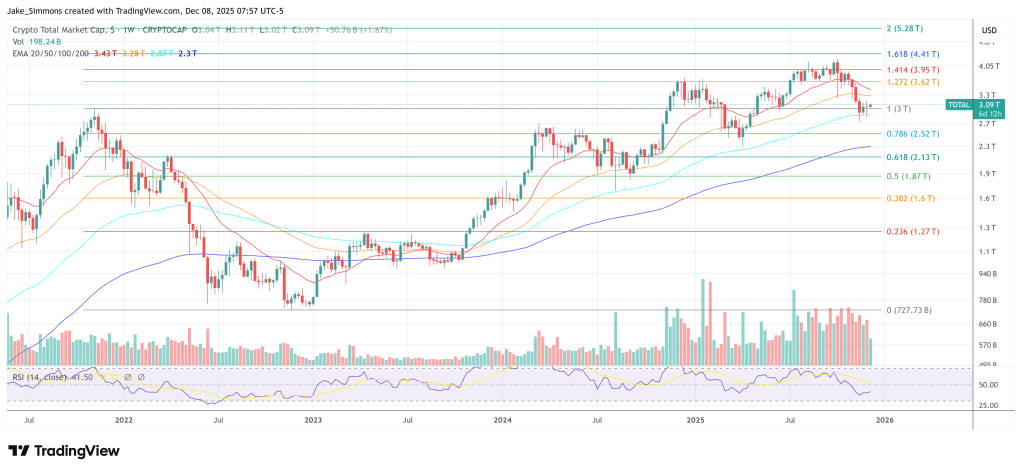
Total crypto market cap

Aster (ASTER) price rebounds as 2026 roadmap unveiled: will bulls target $1.50 next?

  • Aster price could rally above $1 as the team unveils its 2026 roadmap.
  • The token hit highs of $2.42 as the decentralized exchange platform outpaced its peers.
  • Aster eyes a testnet, real-world asset upgrade, and native token staking.

Decentralized exchange platform Aster sees its price change hands at $1.04, having bounced off lows of $0.88.

While the DEX token is down 2% in the past 24 hours, buyers might target fresh upside action after the Aster team unveiled its highly anticipated roadmap for the first half of 2026.

The roadmap’s ambitious plans, with a focus on infrastructure, token utility, and community engagement, have the market excited about the token’s price potential.

Significantly, these new network goals come after a year of notable achievements for Aster.

Aster releases outline for 2026 roadmap

Aster has a robust ecosystem and community, despite being a relatively new project across the market.

Partnerships and key buyback initiatives have helped ASTER price, and on December 4, the team announced its upcoming roadmap.

The perpetuals and spot trading platform’s plan highlights a series of milestones starting in late 2025.

It includes the introduction of Shield Mode for private high-leverage trading and TWAP (Time-Weighted Average Price) strategy orders in early December.

Mid-December will see an upgrade to real-world asset (RWA) trading with deeper stock perpetual markets, followed by the launch of the Aster Chain testnet by the end of the month.

In 2026, the Aster Chain Layer 1 (L1) mainnet rolls out. This Q1 launch will be accompanied by fiat on/off-ramp capabilities and the Aster Code platform for developers.

According to the project, Q2 will introduce ASTER staking, on-chain governance, and smart-money tools to replicate top traders’ strategies.

“2025 was about proving Aster can ship: we merged Astherus & ApolloX, launched multi-asset margin, released our mobile app, completed TGE, listed on major CEXs, and introduced features like Hedge Mode, Trade & Earn, and our buyback program, and more,” the team wrote. “Now we’re doubling down on three foundational engines—Infrastructure, Token Utility, and Ecosystem & Community—each reinforcing the others in a continuous cycle.”

Aster sees this multifaceted approach as part of the commitment to build a scalable network that evolves with its users.

What’s the potential impact on Aster price?

ASTER exploded to an all-time high of $2.42 in September 2025, and the current price is off this peak by about 56%. Despite sell-off risk to under $1, bulls are up more than 1,140% since touching lows of $0.084 on Sept. 17, 2025.

Notably, the unveiling of Aster’s 2026 roadmap for Q1 and Q2 has ignited speculation about the potential impact on the token’s price.

From a technical analysis point of view, the DEX token looks to be poised for an upward move.

The daily chart shows a breakout from a key downtrend line.

Aster Price Chart
Aster price chart by TradingView

Both RSI and MACD indicators on the daily chart indicate a bearish outlook.

However, with the price above the downtrend line, fresh momentum could allow bulls to target $1.38. A potential surge toward $1.50 and $2.06 will open up a run to a new all-time high.

Should bullish momentum dissipate, flipped sentiment could allow for a revisit of the lows of $0.81.

The post Aster (ASTER) price rebounds as 2026 roadmap unveiled: will bulls target $1.50 next? appeared first on CoinJournal.

Altcoins today: Grayscale’s LINK ETF debuts; HYPE and ASTER soar up to 13%

  • Grayscale has launched the first US spot LINK ETF today.
  • HYPE rallies after Sonnet shareholders authorize Hyperliquid DAT’s merger.
  • ASTER gains more than 13% on a new collaboration with WLFI.

Cryptos rebounded on Tuesday as the value of all tokens increased by more than 6% to $3.06 trillion.

Bitcoin has reclaimed $90,000 as Ethereum trades above $3,000.

This article evaluates three altcoins, Chainlink, HYPE, and ASTER, that remained in the spotlight today for various reasons.

Grayscale’s spot Chainlink ETF goes live

Grayscale has officially converted its Chainlink Trust to an ETF today, introducing the first-ever US exchange-traded fund.

The debut has met considerable anticipation among the cryptocurrency community as many view Chainlink’s oracle infrastructure as crucial to tokenized real-world assets (RWA) and decentralized finance (DeFi).

Commenting on GLINK’s debut, Grayscale’s ETF official Inkoo Kand said:

Chainlink’s decentralized oracle network is setting the market standard for verifiable data and cross-chain connectivity that underpins tokenization and DeFi across public blockchains. With GLINK, investors can gain exposure to this foundational infrastructure in the familiar ETP wrapper.

Meanwhile, GLINK will simplify institutional access to Chainlink, allowing traditional investors to interact with crypto without directly handling the token.

LINK reacted positively to the ETF news, gaining more than 12% to trade at $13.32.

HYPE gains 10% after key milestone

HYPE soared more than 10% over the past 24 hours after Sonnet confirmed a crucial structural breakthrough.

According to today’s, December 2, press release, the company’s shareholders have approved the decision to introduce Hyperliquid Decentralized Autonomous Treasury (DAT).

Sonnet BioTherapeutics Holdings, Inc. Announces Stockholder Approval of Proposed Business Combination with Hyperliquid Strategies Inchttps://t.co/tzF9O6EgSM $SONN pic.twitter.com/cOT6JSp2ai

— Sonnet Bio (@SonnetBio) December 2, 2025

The plan involves Sonnet merging with Rorschach I LLC to form a unified entity called Hyperliquid Strategies.

Most importantly, the new firm plans to raise $1 billion to buy HYPE.

The massive bet signals unwavering institutional trust in the altcoin.

HYPE is hovering at $33.03 after gaining over 10% within the past 24 hours.

ASTER rallies after WLFI alliance

Aster’s native coin also recorded impressive price actions, gaining over 13% within the last 24 hours.

The upside momentum coincided with a strategic collaboration with Donald Trump-affiliated World Liberty Financial.

Aster founder and CEO Leonard announced the alliance at the fintech and crypto conference in Dubai.

Under this agreement, the decentralized exchange will integrate WLFI’s USD1 – a move designed to enrich the stablecoin’s adoption.

The altcoin is trading above the $1 psychological level after gaining over 13% on its daily price chart.

ASTER eyes further rallies, but declining 24-hour trading volumes highlight weakness.

Meanwhile, the broader crypto market remained elevated today, recovering from sharp dips in the past few sessions.

Bitcoin has gained over 7% on its daily price chart, while Ethereum increased by 10%.

Quantitative tightening ending and renewed ETFs interest fuel the current upside momentum.

The post Altcoins today: Grayscale’s LINK ETF debuts; HYPE and ASTER soar up to 13% appeared first on CoinJournal.

U.S. Marines test uncrewed Rheinmetall vehicles in Japan

United States Marines from the 4th Marine Regiment, 3rd Marine Division, are operating Rheinmetall’s Mission Master Silent Partner autonomous ground vehicles during field operations at Camp Schwab, Okinawa, Japan, the service confirmed. The uncrewed systems, supplied by American Rheinmetall, are being integrated into training scenarios to support a range of logistics and casualty evacuation tasks, […]

Doubled Smoked Ham

By: Charlie

Double smoking a ham might seem like extra work, but it’s actually one of the easiest ways to elevate a holiday meal. You’re taking a fully cooked ham and smoking it to add layers of flavor that oven-baking just can’t achieve. The diamond scoring creates pockets for the glaze to settle and caramelize into a […]

The post Doubled Smoked Ham appeared first on Simply Meat Smoking.

Must-know ways to overcome the much-dreaded ‘freeze’ response

By: slandau

EXECUTIVE SUMMARY:

Despite CISOs’ formidable training efforts on behalf of teams, a commonly overlooked phenomenon is the human tendency to freeze amidst a crisis. Building your incident response operations around this ingrained aspect of psychology can help prevent your teams from seizing up during intense and urgent situations.

In the event of an intrusion or ransomware attack, how exactly will your security team respond? Will they take an aggressive approach, pass the potato, or involuntarily experience fear-based paralysis?

While CISOs commonly contend that their staff has the expertise and training required to fight off a cyber attack, there’s still a chance that staff will freeze up when the pressure is on.

Fight, flight, freeze

Director of Human Science at Immersive Labs, Bec McKeown, says that “You may have a crisis playbook and crisis policies, and you may assume those are the first things you’ll reach for during an incident. But that’s not always the case because the way [in which] your brain works isn’t just fight or flight. It’s fight, flight or freeze.”

According to Chief Information Security Officers, freezing during a high-stakes moment isn’t so unusual. But when a security staff member or team freezes, rather than acts, it can give hackers an edge, enabling them to inflict further damage or export additional data. At the end of the day, it can also culminate in higher regulatory penalties and loss of business.

Preventing freeze

Given the very real possibility of a ‘freeze’ reaction and its negative repercussions, analysts and long-time CISOs suggest that security leaders spend time implementing new practices that can reduce the chances of occurrence. In addition, CISOs should know how to identify and dissolve the freeze response if it does occur during a security incident.

In-depth insights

Any person or team can experience what is known as ‘cognitive narrowing,’ where they are so focused on the present situation that they cannot contextualize the event. In short, cognitive narrowing prevents people from thinking in the way that they usually do, creating the ‘freeze’ response. It’s just part of human nature.

Cyber security leader Neil Harper, who now serves as a board director with ISACA, observed a team freeze in response to a ransomware attack. Says Harper, “They literally did not know what to do, even though they had some experience with [incident response] walkthroughs…They were in panic mode.”

In some instances, teams that freeze are afraid that their actions will come across as overreactions. In other cases, teams are paralyzed by the fear of being blamed. In yet other situations, no team members have had real-world cyber event experience, meaning that no one feels sufficiently confident to lead an attack response.

Actionable takeaways

Prevent the freeze effect. Here’s how:

1. Examine your drills and add components that can better enable teams to prepare for real cyber attacks. As you team moves through drills, bring up new things that aren’t normally in your playbook. For example, ahead of time, discretely request for an employee to deliberately make a wrong move during the drill. This will help your team work through an unexpected or deteriorating situation.

2. Try out a countdown clock during drills. This forces teams to make progress against adversaries under intense pressure – the kind of pressure that they would feel during a real cyber security incident. While it might feel like an uncomfortable exercise, it builds muscle memory that can help incident responders swiftly squash an actual cyber attack.

3. Consider involving enterprise executives in cyber security drills, as they too are liable to experience the ‘freeze’ phenomenon during an incident. For example, you may see your CFO withhold financial information that is needed as an incident unfolds.

4. If possible, you may want to hire cyber security staff members who have experience working through breaches and hacks. Alternatively, consider a contract with an outside incident response team that does this type of work on a routine basis.

5. Further, consider creating channels that would allow for security employees to suggest creative solutions to problems during a live incident. Employees should feel comfortable enough to suggest solutions under even the most stressful of security situations.

For more cyber security insights, please see CyberTalk.org’s past coverage. Lastly, unpack transformative insightsand learn about how to make your organization more agile and secure when you subscribe to the Cybertalk.org newsletter.

The post Must-know ways to overcome the much-dreaded ‘freeze’ response appeared first on CyberTalk.

❌