Reading view

There are new articles available, click to refresh the page.

Institutional Investors Are Leaving Ethereum And Buying XRP – Here Are The Figures

The newest Digital Asset Fund Flows Weekly Report from CoinShares paints a picture of shifting institutional preferences toward XRP, and Ethereum is no longer attracting the level of attention it once did. The report shows that Ethereum’s weekly inflows came in far behind other major assets, even as overall sentiment in the crypto market improved.  Meanwhile, XRP surged to the second-highest inflow position behind Bitcoin, and large investors are reallocating capital away from Ethereum and into funds linked to XRP.

Ethereum Inflows Lose Momentum

Ethereum’s position in institutional portfolios has weakened noticeably in recent weeks. This was evident in a four-week stretch of outflows throughout November. Notably, a recent broader market recovery pushed total digital asset inflows to $716 million last week, bringing the inflow stretch to two consecutive weeks.

However, Ethereum captured only a small share of that capital. The report shows Ethereum with just $39.1 million in weekly inflows, a subdued figure compared to the sizeable movements seen in other assets. This soft performance follows months of cooling demand, and it suggests that institutional conviction in Ethereum is fading.

Even the month-to-date figure trails behind expectations, coming in at $41.2 million, far below the institutional numbers of Bitcoin XRP, and even Chainlink.

XRP Pulls In Massive Institutional Demand

XRP ranked as the second-largest inflow recipient last week, drawing $245 million, more than six times what Ethereum received. This surge builds on strong year-to-date activity, lifting XRP’s total inflows for 2025 to over $3.1 billion, far above the $608 million recorded in 2024. 

CoinShares’ report shows that XRP’s inflows are a sustained trend rather than a one-off spike. Inflows into XRP-linked products have jumped massively since the introduction of Spot XRP ETFs in the US. Interestingly, these ETFs have witnessed consistent days of inflows since their launch.

These figures indicate that institutions view XRP as a more attractive allocation than Ethereum at this stage of the market cycle. XRP’s strong accumulation coincides with improving sentiment across the derivatives market, where products linked to Bitcoin have also recovered. 

Speaking of Bitcoin, the leading cryptocurrency remained the dominant inflow magnet, with $352 million entering its investment products last week. However, the more notable story lies in the sequence of inflows just behind Bitcoin. Bitcoin continues to anchor portfolios, but capital that would have traditionally flowed into Ethereum is now finding its way into XRP, alongside other new institutional favorites such as Chainlink, which posted a record weekly inflow of $52.8 million, representing more than half of its year-to-date inflows.

Across the geographic breakdown, inflows from the US, Germany, and Canada contributed heavily to this realignment. The US received the most inflows of $483 million last week. Germany, Canada, and Switzerland-based funds came in behind with $96.9 million, $80.7 million, and $34.4 million, respectively.

XRP price chart from Tradingview.com (Ethereum)

Popular Crypto Analyst Reveals New Bitcoin Price Target That Has Got The Community Moving

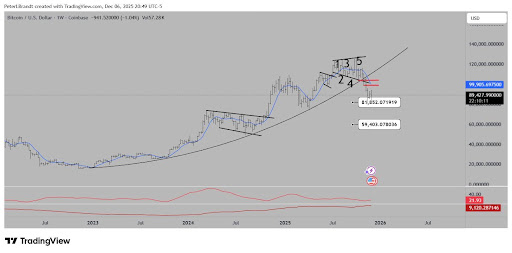
Renowned analyst Peter Brandt has unveiled a new set of Bitcoin price targets that have quickly sparked discussion across trading communities. His updated technical roadmap comes as BTC shows signs of cooling, prompting traders to reassess its recent price movement. With Bitcoin slipping beneath the structure that supported its multi-month climb, Brandt’s projected corrective zones have become a central focus in the market’s debate over where the asset may be headed next.

Bitcoin Price’s Structural Breakdown Raises The Stakes For Crypto Traders

In a recent post on X, Brandt outlined his latest outlook, highlighting a completed five-leg advance — a classic sequence often linked to trend exhaustion when price stretches too far without meaningful resets. In this case, the formation appears as a rising wedge, a pattern known for producing sharp shifts once its lower boundary is breached. That breach has now happened, marking what Brandt interprets as a structural turning point rather than a panic-driven drop.

Bitcoin price

From the breakdown, two corrective regions emerge: near $81,852 and $59,403. These targets are drawn directly from the proportions of Bitcoin’s recently completed structure, giving them a grounded, technical foundation. Brandt frames the pullback as a normalization event, one that fits neatly into Bitcoin’s historical rhythm of expansions followed by methodical cooldowns. Instead of portraying the situation as a threat to long-term strength, the analysis positions the zones as potential resting points where the market could stabilize before setting its next course.

There is also a familiar pattern echoing through the charts — a reminder of late 2021, when sentiment surged ahead of structural reality and the market eventually recalibrated. While conditions today are not identical, the resemblance underscores how expectations and chart formations often move in parallel. In both scenarios, a strong run gave way to a controlled corrective period.

Brandt’s roadmap follows a clear sequence: formation completion, slope-line violation, and defined landing zones. Each step reinforces the next, forming a cohesive narrative that explains why this chart has quickly gained traction among crypto traders monitoring short-term volatility.

Brandt’s Targets Offer Strategic Guidance For Crypto Traders

Bitcoin is currently trading at $90,175, reflecting a 1.9% dip over the past 24 hours alongside a 4.4% gain across the last seven days. The price sits close to the level where the structural break first appeared, amplifying interest in Brandt’s outlined targets. Traders are now assessing whether the asset is preparing for a deeper corrective sweep or simply entering a consolidation phase before another directional move.

Ultimately, Brandt’s targets are intended to guide traders rather than alarm them. They highlight likely equilibrium zones during routine market resets, offering reference points where Bitcoin could stabilize after extended rallies. By framing the analysis this way, traders are encouraged to approach the market with a measured strategy and sharper precision, rather than reacting impulsively to short-term fluctuations.

Bitcoin price chart from Tradingview.com

Pundit Highlights The Condition That Will Trigger A 2,300% XRP Rally To $50

The XRP price is currently more than 45% below its all-time high and continues to decline amid broader market uncertainty. Despite the slow price action and weak momentum, a crypto analyst has projected that XRP could explode to $50 soon, providing reasons for his ambitious forecast. He boldly stated that the cryptocurrency will not experience a gradual climb to $5 or $10 first, but will instead jump straight to $50.

XRP To Hit $50 With A Ripple Bank Charter 

Crypto analyst Pumpius has outlined a compelling scenario that could dramatically transform XRP’s market outlook. The market expert claims that a single regulatory event could catapult XRP’s price to $50, representing more than a 2,300% increase from current levels around $2. In his thread post on X, he explained the reasons for his bold prediction and the trigger behind this parabolic surge .

Pumpius believes that XRP could skyrocket to $50 once Ripple secures a national trust bank charter from the United States Office of the Comptroller of the Currency (OCC). According to him, approval of this banking license would give Ripple the same powers as major US banks, as well as direct access to the Federal Reserve (FED). 

The analyst noted that through the charter, Ripple could gain the authority to custody crypto and tokenized assets, issue stablecoins, and settle securities under complete regulatory oversight. He described the potential approval of the banking license as a foundational move that could establish  Ripple as a leading force in US tokenized finance. 

Pumpius highlighted that XRP remains at the centre of the changes, positioned as the native bridge asset in this potential structure. He suggested that with a charter in place, banks, brokers, and funds could bypass intermediaries and interact directly with Ripple to move value into tokenized markets

According to the analyst’s predictions, the result of this shift could be a massive, sustained surge in liquidity and institutional demand for XRP, creating the ideal conditions for an unprecedented price rally. He explains that with $6.6 trillion moving through banks each day in global settlements, even a small fraction routed through XRP’s limited supply could drive its price higher toward $50. 

While the market expert’s forecast is ambitious, it hinges entirely on the OCC’s decision, which is not guaranteed and could be influenced by compliance standards, risk assessments, and broader financial policy considerations. Even with approval, actual integration by major institutions would likely take considerable time and depend on competition with existing settlement networks. 

Ripple Legal Victory Paves Way For $50 XRP Price

In his post, Pumpius suggested that Ripple’s prolonged legal battle with the US Securities and Exchange Commission (SEC) was part of a broader strategy to secure regulatory clarity. He viewed the former lawsuit as a smokescreen intended to delay, filter, and prepare the path for a national trust bank charter under the OCC. With the case now resolved, the analyst indicates that the timing is perfect for Ripple to pursue full regulatory approval and integrate XRP into mainstream banking channels.

Pumpius boldly declared that the day the OCC approves Ripple’s banking license will mark a turning point for XRP, transforming it from a cryptocurrency to “the rails of US finance.” At that point, the analyst argues that a $50 price target would be significantly undervalued. 

XRP price chart from Tradingview.com

Here’s How High The Dogecoin Price Will Go Once The MACD Bullish Cross Happens

The Dogecoin price has been drifting through a subdued stretch over the past few days, holding around the mid-$0.13 to $0.14. The recent decline has slowed down in the past 48 hours, and the chart now shows the meme coin attempting to steady itself after weeks of persistent selling pressure.

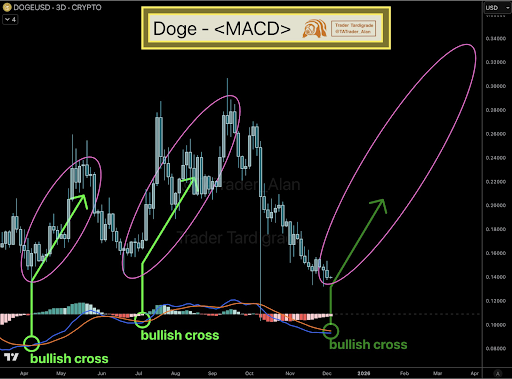
Trader Tardigrade, a well-known crypto analyst on X, shared a new three-day chart suggesting that an important MACD signal is on the verge of forming, and historical performance shows that Dogecoin tends to move bullish once this signal appears.

Approaching The MACD Bullish Cross

Dogecoin’s quiet phase in the past 48 hours has become increasingly important because one of Dogecoin’s higher-timeframe indicators is beginning to show early signs of life.  According to Trader Tardigrade, Dogecoin’s MACD indicator on the 3-day candlestick price chart has not yet confirmed a bullish cross, but it is very close to doing so. 

The chart he shared shows the MACD lines converging at the lower boundary of the recent downtrend, and the blue line is approaching the red line. The blue line is about to cross over the red one, mirroring the exact setup that preceded previous breakouts earlier this year. 

Even with Dogecoin trading quietly in recent days, the compression of the MACD indicator hints that bearish momentum is fading. Once the cross officially forms, the trend will shift into a bullish one. This gradual tightening of price movement is also characteristic of an accumulation phase, and this is shown by an important Dogecoin metric.

Dogecoin price

Dogecoin Price Chart, MACD Cross. Source: @TATrader_Alan On X

How High The Dogecoin Price Could Go

The chart reveals a clear pattern: every time Dogecoin printed a three-day MACD bullish cross in 2025, the price responded with a significant upward move. The first cross was in April, and this preceded a rally that pushed Dogecoin’s price from below $0.14 into a breakout to $0.26. 

A second cross followed during mid-summer in July, and once again the price climbed aggressively shortly afterward. This saw the Dogecoin price rally from around $0.16 to $0.30 very briefly. 

Both events are circled on the chart above, showing how the momentum flipped swiftly once the MACD crossed above the signal line. These repeated reactions strengthen the case that Dogecoin could be preparing for another sizeable run if the indicator confirms a cross in the coming days.

The projection area drawn on the right side of the chart points to a climb that extends well above $0.20. This suggests that the next wave may revisit the upper levels where Dogecoin last traded during its late-summer rally.

The analyst’s chart outlines a wide upward arc, indicating that the expected move would not be a minor rebound but a structured uptrend similar to the earlier surges this year. In terms of a price target, the projection shows Dogecoin reaching a price target around $0.35 in the next few weeks. This would translate to a 140% increase from Dogecoin’s current price of $0.142.

Dogecoin price chart from Tradingview.com

Will Ripple Dump 25% Of Its 45 Billion XRP Holdings Soon? Here’s The 411

Ripple currently controls a staggering amount of XRP, and now questions from market experts are mounting over whether the crypto payments company may be forced to sell 25% of its 45 billion token holdings. Analysts suggest that a possible selloff could have major implications. At the same time, they question the pathways through which Ripple could sell its holdings and who the potential buyers might be. 

Ripple To Face Pressure To Sell 25% Of XRP Holdings 

Ripple may soon need to drastically reduce more than half of its substantial XRP reserves as regulatory discussions over the proposed CLARITY Act intensify. In a recent post on X, market expert Crypto Sensei shared a video, drawing attention to a provision in the CLARITY Act that would prevent any company from controlling more than 20% of a blockchain’s native asset’s total supply. 

Currently, Ripple owns 45 billion XRP, split between escrow and direct reserve, representing 45% of the cryptocurrency’s total supply of 100 billion tokens. This indicates that the company controls nearly half of the total XRP supply—a level of concentration that typically runs counter to the decentralization narrative of crypto and blockchain technology. 

Crypto Sensei suggests that US lawmakers are seemingly focused on preventing excessive accumulation of supply, and Ripple’s holdings stand out as one of the clearest examples of a single entity controlling a large portion of a network’s token. According to the analyst, if the CLARITY Act is implemented in 2026, Ripple may need to sell at least 25% of its holdings to comply with the legislation. 

A reduction of this magnitude would lower the crypto company’s XRP reserves to 20 billion tokens, or 20% of the cryptocurrency’s total supply. At the current price of $2.0 per token, this would amount to roughly $40 billion. Notably, such a sell-off would likely require coordination with liquidity providers and partnering institutions to avoid unnecessary market disruption. 

Potential Selling Paths And Institutional Speculation 

In his X video, Crypto Sensei outlined several potential paths Ripple could take to reduce its substantial XRP reserves. One option is to sell the rights to future escrow releases instead of the tokens themselves. Another involves selling the accounts into which the escrowed XRP completes while preventing the tokens from circulating.  

According to the market expert, these possibilities have sparked widespread speculation that major financial players, such as BlackRock, could already be involved or poised to purchase future XRP escrow rights. The idea continues to circulate because it would allow institutions to gain exposure to the cryptocurrency without immediately affecting the circulating supply. 

Crypto Sensei also notes that Ripple locks about 700 million XRP in escrow each month, raising questions about whether these transfers may represent sales. The analyst argues that if sales were occurring, the on-chain trail would clearly show tokens moving to buyers’ wallets, but the data does not reflect this. He highlighted that the current evidence points to a far more controlled internal process rather than large-scale institutional distributions

XRP price chart from Tradingview.com (Ripple)

Ethereum Founder Breaks Silence With Major Upgrade Proposal

Ethereum co-founder Vitalik Buterin has unveiled a major proposal that could fundamentally reshape how the network handles transaction fees. His new design aims to replace unpredictable costs with a system that lets users plan and budget more effectively, signaling one of the most significant shifts in Ethereum’s economic framework in years.

Ethereum Gas Fees As Predictable, Prepaid Resources

Buterin’s proposal centers on a new on-chain gas futures market. Today, gas fees rise and fall based on network congestion and users have no way to know in advance what they will pay, which complicates planning for developers, businesses, and high-volume platforms.

The new model reshapes that dynamic by allowing users to purchase a defined amount of gas at a fixed price for future use. Rather than hoping the network will be affordable at the moment they need to transact, they can lock in their costs in advance. This moves Ethereum from a system dominated by short-term fee volatility to one anchored in stable, forward-looking pricing

Under the proposed design, these futures contracts would be traded directly on-chain. Their prices would naturally reflect expectations of future demand. When demand is expected to increase, futures prices rise; when expected to fall, they drop. This creates a transparent, market-driven view of upcoming network activity, giving developers and organizations a more reliable basis for planning their operations.

The structure also builds on the foundation set by EIP-1559, which introduced the base fee mechanism. Buterin’s futures market doesn’t replace that system—it extends it. It transforms gas from reactive cost into a resource that can be managed in advance, similar to how businesses lock in costs for electricity, bandwidth, or other essential inputs.

Operational Benefits For Developers, Businesses, And The Network

The most immediate benefit is cost certainty. High-volume users—exchanges, rollups, wallets, and automation services—often operate on tight margins, and sudden gas fee spikes disrupt operations and planning. By locking in future gas costs, this uncertainty is removed, supporting consistent service delivery. Developers also gain a stable environment, enabling them to schedule upgrades, plan deployments, and manage workloads without worrying about fee surges. This predictability strengthens project roadmaps and enhances user experience.

For enterprises integrating Ethereum into payments, verification, or data-processing workflows, predictable fees are essential. Buterin’s model addresses this barrier, positioning Ethereum as a more reliable foundation for long-term, large-scale adoption.

At the network level, the futures market introduces clearer economic signals. Rising futures prices indicate increasing demand for blockspace, guiding scaling decisions and resource allocation. Falling prices signal lower demand, enabling more efficient development and infrastructure planning.

The proposal does not lower gas fees but makes them manageable, converting an unstable cost into a predictable one. This enhances Ethereum’s appeal for serious applications, institutional activity, and reliable operational planning. By introducing a gas futures mechanism, the ecosystem can better manage costs and prepare for growth, marking a decisive step toward a more professional-grade Ethereum.

Ethereum price chart from Tradingview.com

Bitcoin Treasury Company Is About To List on The New York Stock Exchange

On 3rd December, official filings and press releases announced Twenty One Capital’s upcoming debut on the New York Stock Exchange (NYSE), positioning the company as one of the largest Bitcoin treasury firms ever to enter public markets. The listing brings a dedicated Bitcoin balance sheet into Wall Street’s core ecosystem, signaling a structural shift in how institutional investors can gain long-term BTC exposure.

A Bitcoin Treasury Giant Steps Onto The NYSE Stage

Twenty One Capital’s NYSE entry is anchored by its business combination with Cantor Equity Partners (CEP), the SPAC serving as the public-market vehicle for the transaction. CEP shareholders have already approved the merger, and the deal is expected to close around December 8. Once completed, the combined entity will operate as Twenty One Capital, Inc. and begin trading on December 9 under the ticker XXI. 

The original announcement, released through official press channels and SEC-related filings, emphasized CEP’s central role in enabling the listing and establishing the company’s public-market structure. CEO Jack Mallers also highlighted the milestone on X, noting the company’s readiness for its debut.

According to this press announcement, Twenty One Capital will debut with an estimated 43,500 BTC, a reserve valued near $4 billion at recent market levels. This immediately places it among the top corporate Bitcoin treasuries globally. Unlike companies that hold Bitcoin as a secondary reserve, Twenty One is specifically engineered around a Bitcoin-native model. The firm intends to report “Bitcoin-per-share,” providing investors a transparent look at how much BTC each equity unit represents. It also pledges full, on-chain proof-of-reserves, positioning itself as a high-transparency asset custodian at launch.

This model effectively transforms Twenty One into a regulated balance-sheet wrapper for Bitcoin. It lowers operational friction for institutional allocators who want direct BTC exposure without the complexities of crypto custody, self-storage, or exchange-based acquisition. By listing on the NYSE rather than relying on ETFs or derivatives, Twenty One creates a regulated public equity vehicle that holds, safeguards, and transparently tracks Bitcoin for institutional and retail investors alike.

Wall Street’s New On-Ramp To Institutional BTC Exposure

The market impact of Twenty One’s listing reflects the accelerating integration of Bitcoin into mainstream financial architecture. The company’s backers—including Tether-linked entities, Bitfinex-aligned interests, SoftBank-connected capital, and Cantor’s public-markets network—provide a cross-sector foundation aimed at bridging crypto-native philosophies with institutional liquidity channels. 

Under this structure, Twenty One aims to become a long-term institutional treasury vessel—a regulated balance sheet that accumulates BTC and gives investors an equity-linked way to participate in Bitcoin’s upside without engaging directly with crypto custody or trading infrastructure.

As the NYSE debut approaches, Twenty One Capital embodies a pivot point where BTC’s role in capital markets shifts from speculative asset to institutional treasury instrument. If XXI attracts sustained flow, it could set a new blueprint for how corporate entities engage with Bitcoin—anchoring Wall Street’s next phase of digital-asset adoption.

Bitcoin price chart from Tradingview.com

Solana Vs. XRP: Clear Winner Emerges With ETF Net Flow Numbers

With the crypto market showing signs of recovery, both the XRP and Solana Exchange Traded Funds (ETFs) have attracted significant investor interest. The rivalry among major crypto ETFs has intensified, with XRP taking the spotlight amid its consistent surge in daily inflows and the Solana ETF recording significant outflows.

Solana ETFs See Largest Outflow Yet

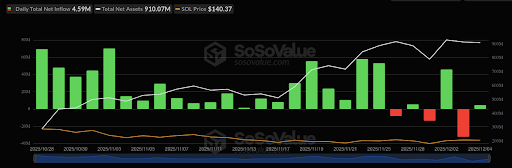
Solana has entered a surprising phase of turbulence as its recently launched US Spot ETF struggles to maintain momentum after weeks of inflows. The latest data from Sosovalue reveal a sizable setback with a fresh withdrawal of $32.19 million, marking the third and largest outflow recorded since the investment product debuted in late October 2025. 

The outflow, registered on December 3, came as a major surprise, especially given that the broader crypto market had been enjoying a slight reprieve from the bearishness weighing it down. Notably, Sosovalue’s data shows that the entire Solana ETF outflow originated from the 21Shares TSOL offering, which shed $41.79 million in a single session. Minor inflows into the remaining six Solana ETFs had softened the blow, reducing total outflow to $32.19. 

Solana XRP 1

Since the launch of Solana ETFs, TSOL has been responsible for all negative flows posted, including the $13.55 million pullback on December 1 and the $8.10 million decline in late November. Across all sessions, 21Shares Solana ETF has now seen total outflows reach $101.51 million. 

The weakness in TSOL stands in sharp contrast to Bitwise’s Solana ETF, BSOL. BSOL continues to outpace other investment products, with impressive cumulative inflows of $580.72 million, making it the most successful Solana ETF. Grayscale’s GSOL follows at a distant $89.01 million. Overall, the net cumulative inflows for the Solana ETF have reached $623.21 million. While this is impressive, it is still significantly behind the XRP ETF. 

XRP Overtakes Solana ETF As It Nears $1 Billion Inflows

The latest on-chain numbers show the XRP ETF pulling ahead of the Solana ETF with surprising speed and volume. Analyst Neil Tolbert highlighted the rise in XRP ETF inflow this week, noting that growing institutional interest indicates the trend is only getting started. With more XRP ETFs expected to debut soon, Tolbert anticipates a significant rise in demand and inflows as traditional finance finally wakes up. 

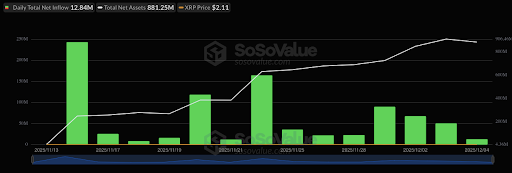
Five Spot XRP ETFs collectively hold more than $984 million in assets, with less than $16 million to reach the $1 billion inflow milestone. Canary Capital’s XRPC leads with $358.88 million, followed by Grayscale’s GXRP, Bitwise’s ETF, Franklin Templeton’s XRPZ, and finally REX-Osprey’s XRPR.  

Solana XRP 2

According to SosoValue, the total XRP ETFs, excluding that of REX-Osprey, have attracted approximately $887.12 million in net cumulative inflows. Since its launch in November, the XRP ETF has recorded 15 days of positive inflows, in stark contrast to Solana ETFs, which have seen multiple outflows. 

Despite Solana launching seven ETFs as early as October 2025 and XRP only introducing four last month, XRP ETFs have already surpassed Solana ETFs in total inflows by almost 30%. With fewer products and a later debut, XRP has emerged as the clear winner amongst the newest ETF entrants in 2025. 

XRP price chart from Tradingview.com

Trend Reversal Puts Dogecoin On A Path To $0.188

Dogecoin has quietly been trying to find its footing again. The price has started to firm up after a period of declines that dragged the meme coin to as low as $0.134 in early December, trading around $0.14 to $0.15 and showing signs that bearish pressure might be easing. 

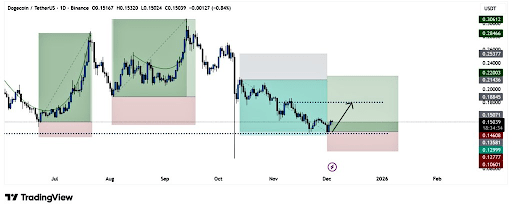
In that backdrop, a recent chart analysis shared by crypto analyst BitGuru on X shows that Dogecoin could be forming a bullish base, and it offers a possible setup for a rebound towards $0.2.

A Recovery Attempt Begins To Take Shape

The daily candlestick price chart shows Dogecoin rebounding from the lower boundary of its demand zone after briefly dipping beneath it on December 1. That bounce is significant because it represents the willingness to defend the area that held price earlier in July and again during the October pullback. This playout means that Dogecoin has now created a higher low relative to the November breakdown, and this detail means that bullish movement might be moving in.

As it stands, Dogecoin’s price is now pushing back toward the middle of the broader range highlighted in green and teal on the chart below. Recent bullish candle closes on the daily timeframe show that the Dogecoin price is trying to push into that region once again, suggesting that buyers have begun testing the strength of mid-range resistance.

The chart reflects this pattern by displaying earlier price expansions in July and September, both of which unfolded after the Dogecoin price created a higher low.

Dogecoin prIce

Dogecoin Price Chart. Source: @bitgu_ru On X

Dogecoin On A Path To $0.188

Dogecoin’s higher-low structure is the signal BitGuru highlights as the earliest sign that momentum may be shifting. Now that the price is now climbing away from the demand zone, the first area to watch is the dotted mid-range line on the chart, which is at $0.188. 

A clean move above that level would mean that buyers have regained control of the market structure. This could open the door for a broader recovery and see Dogecoin returning above $0.20.

At its current price of $0.148, the targets at $0.188 and $0.20 represent gains of roughly 27% and 35%. These levels fall within a range of short-term price targets that Dogecoin could realistically reach before the end of the year if there’s even a little bullish momentum.

However, Dogecoin’s near-term outlook isn’t just about its own chart. Its fate is linked to the broader crypto market, especially Bitcoin. Therefore, Dogecoin’s price action might remain vulnerable to more declines and consolidations unless the wider crypto market turns bullish again. On the other hand, tentative signs of recovery, including rising trading volume, point to a bullish setup for Dogecoin.

Dogecoin price chart from Tradingview.com

The MicroStrategy Of Asia: Japanese Company Announces Plan For Bitcoin And XRP Treasury

Bitcoin and XRP have become central to a bold corporate shift in Japan, with AltPlus announcing that both digital assets will be formally incorporated into its long-term treasury strategy. The publicly listed company disclosed the move in its recent shareholder filing, outlining a multi-layered plan that positions cryptocurrencies as foundational components of its future financial and operational framework.

Bitcoin And XRP Lead Treasury

According to a post by “BankXRP” on X (formerly Twitter), AltPlus is expected to purchase and hold Bitcoin and XRP through a newly established cryptocurrency purchase and management division. The company frames this step as part of a long-horizon capital strategy supported by blockchain transparency, expanding global regulatory clarity, and the growing institutional acceptance of digital assets. In the filing, Bitcoin and XRP are highlighted for their scarcity, decentralization, predictability, and fast, low-cost transactional capabilities—attributes AltPlus expects will contribute to long-term value growth and broader financial-market utility.

Moreover, the treasury initiative is designed to strengthen the company’s financial base, diversify revenue streams, and establish a stable earnings engine through staking-based income. AltPlus presents the move as a structured method to enhance capital efficiency and reinforce corporate value over time. The company notes that holding both Bitcoin and XRP aligns its balance-sheet strategy with emerging global trends in digital-asset management and institutional-grade treasury practices.

AltPlus also outlines its risk-management system to address crypto-market volatility, liquidity risks, cybersecurity threats, regulatory changes, and speculative trading patterns. The company plans to implement investment-scale limits, a controlled holding-ratio strategy, and a proprietary internal asset-management system to govern acquisition, custody, tracking, and treasury integration. These measures are designed to maintain governance discipline, ensure compliance, and safeguard digital-asset operations as part of the broader corporate structure.

AltPlus’ Web3 And Digital-Asset Expansion

Beyond treasury allocation, AltPlus frames Bitcoin and XRP as key elements in a broader transition into digital-asset operations and Web3-enabled business development. The filing situates this shift within a global context, noting that major financial institutions and listed companies worldwide are increasingly incorporating crypto assets into holding, settlement, and capital-management functions.

Building on this trend, AltPlus plans to integrate blockchain infrastructure into its Entertainment and Solutions business. This includes exploring Web3 functionality, token-based engagement models, and digital-asset utilities across its gaming and IP ecosystem. These initiatives are intended to unlock new business models, enhance operational flexibility, and develop internal expertise for a digital-native market environment.

The company’s decision to include XRP directly in its treasury strategy is one of the standout elements of the announcement. AltPlus positions XRP as a long-term corporate asset alongside Bitcoin, marking a notable step forward for institutional crypto adoption in Japan. Through treasury transformation, staking-driven income generation, and Web3 ecosystem expansion, AltPlus is creating a strategic framework similar to the high-conviction treasury approach seen at MicroStrategy. At the same time, it is establishing a distinctly Japanese model focused on utility, diversification, and forward-looking corporate innovation.

Bitcoin price chart from Tradingview.com (XRP)

Expert Says An XRP Supply Shock Will Only Happen In These Conditions

A leading market expert argues that most investors misunderstand what would need to happen for an XRP supply shock to unfold. The analyst stressed that a true supply shock is driven by measurable XRP absorption, with early signs showing how quickly tokens are removed from circulation relative to how quickly they return. 

How A Real XRP Supply Shock Forms

Crypto analyst Pumpius took to X this Wednesday to outline the conditions he believes must align before XRP can experience an actual supply shock. The expert noted that many in the community often talk about an explosive squeeze that could drive XRP’s price higher, yet few understand the mechanics behind such a shock.

Pumpius argued that a real supply shock is not driven by speculation or hype, but by a measurable reduction in the amount of XRP available on the open market. In his view, such an event only occurs when tokens are absorbed faster than they can be replenished, creating an imbalance between circulating supply and future buyers. 

The analyst explained that the first big trigger for a supply shock would be the launch of Exchange-Traded Funds (ETFs). Once all ETFs go live, their issuers will need to buy real XRP rather than derivatives or IOUs, which could gradually drain the amount of available tokens on crypto exchanges. 

Pumpius added that institutional participation would amplify the supply impact of ETFs, since banks and large asset managers typically custody assets rather than actively trade them. He explained that XRP set aside for settlement purposes, treasury management, or long-term liquidity planning would be removed from day-to-day circulation, further contributing to a potential supply shock.   

Another point Pumpius mentioned in his post was that companies could start holding XRP in their corporate treasuries to support international payments and XRP Ledger (XRPL) based settlement corridors. If this occurs, the analyst suggests that these operational XRP balances would remain in working capital accounts rather than flowing back to exchanges.  

He added that Ripple’s management of its escrow further limits XRP’s supply. Currently, Ripple has little to no incentive to oversupply the market, and unused escrow releases are often returned, keeping the amount of net new XRP entering circulation tightly controlled.

On-Chain Utility And ZK Identity Drive Supply Crunch

In his post on X, Pumpius highlighted two other factors needed for XRP to experience a real supply shock. He stated that growing on-chain utility will further reduce the supply of XRP, ultimately contributing to a supply crunch. These include tokenized funds built on the XRPL, such as RLUSD, liquidity pools, identity layers, and payment rails—all of which rely on XRP as a core asset.

A Zero Knowledge identity infrastructure on the XRP Ledger could also lock away more tokens. Pumpius emphasized that these systems link XRP to identity-verified flows and validation processes, which naturally tighten supply. 

Together, these forces create the ideal conditions for a real XRP supply shock. Pumpius notes that as exchange balances drop and OTC desks hold less inventory, overall liquidity becomes thinner. Buyers are then forced to compete for the shrinking supply of tokens, potentially driving prices higher as demand outweighs supply.

XRP price chart from Tradingview.com

XRP Price Is Performing As Expected; Analyst Reveals What Comes Next

The XRP price has staged a strong rebound in recent days, rising from early-December weakness and climbing back above $2. The recovery comes just after crypto analyst CasiTrades published a detailed technical outlook on the social media platform X, where she outlined a scenario that anticipated both the initial decline and the current bounce.  Now that XRP has begun moving upward towards $2.2, the focus is on what the next phase of this pattern could bring next.

Subwave 3 Targets Hit As Structure Plays Out

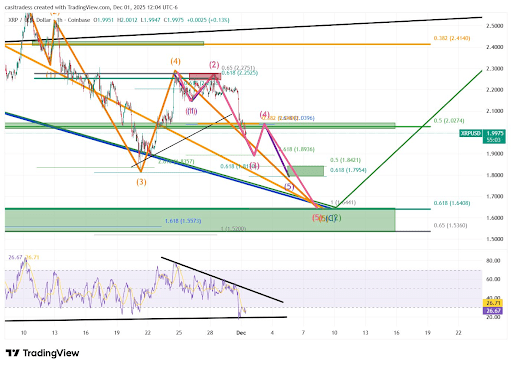
CasiTrades explained that XRP’s early-December drop was part of a subwave 2 setup that had been discussed during her previous livestream. When XRP fell to $2.03 in early December, it confirmed the transition into a subwave 3 extension, and the next projected target sat near $1.90. That level was important not only as a Fibonacci extension but also because it corresponded with Bitcoin reaching its macro 0.382 level around the $79,000 region.

The chart attached to her analysis illustrated this path clearly. A sequence of orange, pink, and black wave structures converged toward the same support region, all pointing toward $1.90 as the initial landing zone. As shown in the chart image below, there’s another green accumulation block between $1.80 and $1.64 as the deeper support level that could still come into play. 

XRP Price

XRP Chart Analysis. Source: @CasiTrades On X

At the time of her analysis, selling pressure was already slowing down, and momentum indicators like the RSI were building a bullish divergence. Since then, XRP’s price action has turned bullish, and this supports the idea that a reaction was always likely to occur in the $1.90 zone.

CasiTrades noted that once the price reached this level, she expected a bounce back toward $2.04 to retest resistance for a new Wave 4 formation. Over the past few days, XRP has done exactly that, rising from its lows and reclaiming momentum as buyers returned.

Two Final Scenarios Still In Play For XRP

According to CasiTrades, there are two possible outcomes for the XRP price against the backdrop of retesting $2.04. The first outcome is a double bottom forming around the $1.80 to $1.88 region, depending on the exchange. The chart she shared includes a mid-range support box that captures this possibility, with wave markings showing how price could rotate downward before a larger breakout.

The second potential outcome is a deeper sweep to $1.64, which is based on the macro 0.618 support. This zone forms the lower boundary of the green accumulation block on her chart, representing the final area where a full Wave 2 or Wave C completion could occur before XRP attempts a larger impulsive breakout.

XRP price chart from Tradingview.com

XRP ETFs Have Overtaken Bitcoin And Ethereum In Inflows – Here Are The Numbers

Since launching in mid-November 2025, institutional demand for XRP ETFs has climbed beyond the inflows recorded for the crypto market’s two largest assets, Bitcoin and Ethereum. The latest numbers show how quickly capital allocation has shifted, placing XRP at a defining advantage in an increasingly competitive market.

XRP ETFs Inflow Profile Establishes Category Leadership

The first wave of US spot XRP ETFs launched on November 13, led by Canary Capital’s XRPC, which opened with $243.05 million in first-day inflows and has since maintained consistent positive flows, frequently exceeding $100 million in single-day inflows. Across the four active issuers—Canary Capital (XRPC), Bitwise (XRP), Grayscale (GXRP), and Franklin Templeton (XRPZ)—cumulative net inflows have now surpassed $756 million, according to SoSoValue data. 

Daily performance across the broader market has followed the same strong pattern. XRP ETFs saw $243.05 million in inflows on November 14, $118.15 million on November 20, and $164.04 million on November 24. By December 1, it secured another $89.65 million, reinforcing the steadiness of demand throughout the launch phase.

Together, these numbers place XRP ahead of every other non-stablecoin asset in ETF inflows over the same period. Independent reports also show that the category gathered $587 million within its first ten trading days, surpassing early benchmarks set by previous altcoin ETF rollouts—including those tied to Bitcoin and Ethereum.

Institutional Capital Flows Favor XRP Over Bitcoin And Ethereum

XRP ETFs’ inflow performance becomes even more pronounced when compared with contemporaneous Bitcoin and Ethereum ETF inflows. On December 1, Bitcoin ETFs recorded $8.48 million in net inflows—roughly one-tenth of XRP’s same-day figure. By contrast, Ethereum ETFs reported more than $79 million in net outflows, continuing a multi-week trend of capital rotation away from ETH-linked products.

This divergence underscores a clear reallocation dynamic in the US market. While Bitcoin and Ethereum remain the dominant assets by AUM, inflow velocity has shifted decisively. XRP’s ability to attract more cumulative net inflows than the leading two crypto assets—despite launching later and holding a smaller market capitalization—marks a material development in ETF-driven capital flows.

The launch sequencing provides additional clarity. Franklin Templeton’s XRPZ and Grayscale’s GXRP both delivered standout debuts, recording $62.6 million and $67.4 million in first-day inflows, respectively, marking the strongest ETF launches of 2025 to date. This surge contributed to a broader inflow cycle that added roughly $300 million across the XRP ETF ecosystem, propelling XRP into the top tier of crypto ETFs by net new capital, despite the underlying asset remaining below key price resistance levels.

Data from multiple independent trackers shows that XRP ETFs have recently recorded higher net inflows than Bitcoin and Ethereum ETFs. Across the tracked XRP ETF issuers, inflows have been consistently strong, indicating a notable shift in investor capital allocation among newly launched digital-asset ETFs.

XRP price chart from Tradingview.com (XRP ETFs)

Are Dogecoin Whales Leaving The Meme Coin? Large Transactions Crash To 2-Month Lows

Dogecoin’s recent price action has taken an unexpected turn as on-chain data shows whale transactions collapsing to levels not seen in two months. This lack of activity from whale addresses has seen the meme coin falling to an important support area, and it raises the question about whether big players are stepping back from the meme coin.

Dogecoin Whale Activity Falls To Its Lowest Level In 60 Days

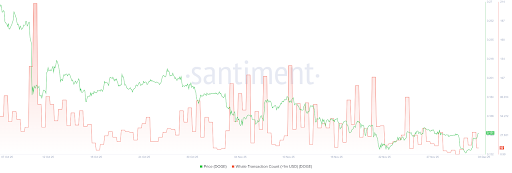
Data from on-chain analytics platform Santiment reveals that large transactions on the Dogecoin blockchain recently fell to as low as just 4 in a single day, marking a two-month low in whale participation. Santiment classifies whale transaction count as transactions with a value of $1 million or greater. This drop is notable, as it is a drastic change from the high levels of participation of whale traders in October and early November, which reached as high as 212 whale transactions on October 11. 

This drop is an extension of a steady Dogecoin cooldown that has persisted through the past few weeks. Large-holder activity can serve as a proxy for institutional or high-volume investors. Therefore, the current decline suggests that big players are either waiting for better entry conditions or scaling back exposure.

At the time of writing, Santiment data shows that there were 11 Dogecoin whale transactions in the past 24 hours. Although this is a rebound from the alarming four-transaction low, the current level is far below what is considered a healthy range for a cryptocurrency that relies heavily on sentiment bursts of activity. The reduction in transfers is especially notable at a time when Dogecoin’s price action in the past 24 hours is attempting to maintain an important level above $0.15.

Dogecoin whales 1

Dogecoin Whale Transaction Count. Source: Santiment

DOGE Holds Support, But Technical Momentum Weakens

Price action in the past few weeks has been mostly bearish price action, and technical analysis shows that the meme coin is now in its longest accumulation phase since its inception. 

Dogecoin whales 2

Dogecoin Price Accumulation. Source: @galaxyBTC On X

Notably, Dogecoin is going through a spark of strength over the past 24 hours as it bounced from $0.134 and climbed about 11%, but the recovery appears to be generated by retail traders rather than a meaningful return of whale activity. That estimation aligns with the weak inflows into Spot Dogecoin ETFs and the overall quietness from major holders.

It is difficult for the price to build a strong upward trend without whales participating on the buy side. It’s not just the presence of whales that matters, but  the nature of their activity. Earlier in the year, on October 11, whale transactions surged to 212, but most of those were sell orders. The result was immediate and painful, as the Dogecoin price dropped from $0.25 to $0.18 in a single day.

Dogecoin price chart from Tradingview.com

Here’s Why The Bitcoin Price Jumped Above $92,000, And Ethereum Price Reclaimed $3,000

The crypto market delivered a dramatic rebound this week, with the Bitcoin price vaulting above $92,000 and Ethereum climbing back over $3,000. The sharp recovery in both leading cryptocurrencies has caught the market’s attention, with analysts now sharing the major reason for the unexpected pump. 

Why The Ethereum And Bitcoin Price Are Rebounding

Bitcoin is currently trading above $93,000 after experiencing a period of accelerated selling and heavy long liquidations that had briefly pushed its price down over the past few weeks. Now that forced selling has eased, the cryptocurrency has recovered significantly, adding an astonishing $75 billion to its market capitalization within 10 hours. 

Ethereum has followed the same upward swing. Data from CoinMarketCap shows that ETH has gained more than 9% in the past 24 hours, with steady accumulation pushing its price above $3,050. 

Crypto market analyst Wimar.X has explained the reason behind the sudden surge in both Bitcoin and Ethereum prices. He framed the resurgence as a rapid wave of high-volume coordinated institutional buying. In his words, the market pumped because a massive round of accumulation occurred within a single hour. 

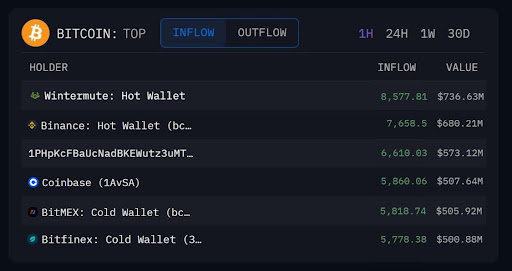
Data from Arkham Intelligence shows that Wintermute, a leading algorithmic trading firm, had bought 8,577 BTC ahead of the market surge. Binance, the world’s largest crypto exchange, also acquired 7,658 BTC, while a major whale wallet added 6,010 BTC to its portfolio. Finally, BitMEX, a crypto exchange co-founded by Arthur Hayes, reportedly accumulated 5,818 BTC, while Bitfinex absorbed 5,778 BTC. 

Bitcoin price 1

According to Wimar.X analysis, the sudden accumulation and its timing appear coordinated. He described the activity as manipulation, implying that it was intended to influence market perception and artificially sway prices. 

Analysts Share Outlook For Bitcoin And Ethereum Price After Pump

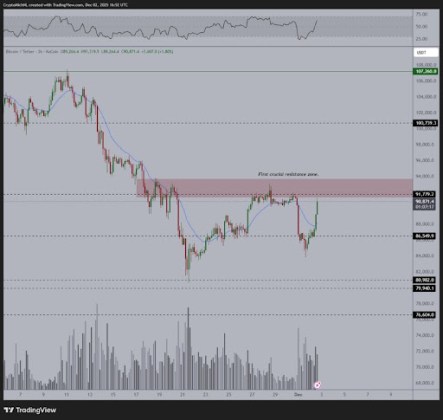
As the crypto market showed renewed strength and BTC recovered above $90,000, crypto expert Michael van de Poppe took to X to highlight the significance of the rebound. He noted that the recent dip in Bitcoin’s price at the start of the month appeared unusual but was followed by a strong bounce. According to the analyst, surpassing $92,000 will be critical for Bitcoin and could pave the way for a new all-time high and a potential test of $100,000. 

Bitcoin price 2

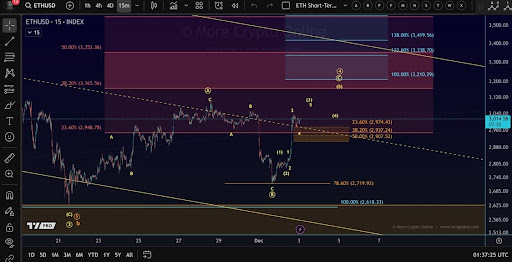
On the other hand, a market analyst identified as ‘More Crypto Online’ on X has stated that Ethereum is currently testing the micro support zone between $2,907 and $2,974. He noted that holding this support area is crucial for sustaining the upward momentum that began earlier this week.

Bitcoin Price 3

As a result, the analyst has predicted that Ethereum’s next upside window sits between $3,165 and $3,210. He cautioned that a breach below the lower support level could trigger a deeper corrective wave. However, current trends suggest that ETH is mainly aiming higher. 

Bitcoin price chart from Tradingview.com (Ethereum)

What Are The Odds Of Satoshi’s $130 Billion Bitcoin Fortune Being Hacked With Quantum Computing?

Concerns have emerged over whether Bitcoin creator Satoshi Nakamoto’s 1 million BTC fortune could be hacked. Crypto analyst Camol claims that advanced quantum computing could eventually crack Nakatomo’s wallet, draining it entirely. The analyst’s argument has sparked heated debate across the crypto community, with many critics dismissing the claims as unfounded and misleading. 

Will Quantum Computing Crack Nakamoto’s Bitcoin?

In an X post released on Monday, December 1, Camol predicted that Nakamoto’s BTC wallet will be drained within the next 10 years as quantum computing power advances exponentially. He called this rapid, annual double acceleration Neven’s Law, warning that the Bitcoin creator’s over $131 billion BTC stash could eventually be exposed to unprecedented risks and hacks. 

Camol’s argument focuses on Bitcoin’s secp256k1 elliptic curve and ECDSA signatures, which are used to secure wallets. He claims that these could eventually be reversed using Shor’s Algorithm, a quantum algorithm that, in theory, can break elliptic curve cryptography once sufficiently powerful quantum hardware exists. The analyst warns that if such a technology becomes viable, it could compromise the security of even the most well-protected Bitcoin holdings—in this case, Nakamoto’s. 

In his post, Camol also stated that Satoshi’s 1 million BTC fortune could face additional vulnerability because the wallet address is protected by a 160-bit hash that has never been exposed through spending activity. He claims that a powerful quantum attack could crack the hash and reveal the public key, eventually uncovering the private key through multiple attempts. The analyst also pointed out that sophisticated bad actors, such as state-sponsored groups and wealthy cybercriminals, could access Nakamoto’s BTC wallet. 

Experts And AI Dismiss BTC Quantum Hacking Claims

Crypto analyst @level941 on X sharply rebuked Camol’s claims, emphasizing that Satoshi’s BTC holdings are fundamentally more secure than most coins in circulation. He surmised that because Satoshi’s BTC is stored in early P2PKH addresses, the public keys will remain hidden and the wallet will stay locked unless the Bitcoin creator manually removes his coins. 

@level941 called Camol’s statements “false” and “incorrect,” noting that Quantum computers can only break RSA or ECC systems when the public key is known. This means that Satoshi’s BTC is protected by a 160-bit RIPED160 hash that quantum machines cannot brute force in any foreseeable timeline. 

The analyst also argued that if the Bitcoin network ever migrated to a quantum-safe signature scheme, Satoshi’s unmoved coins would become permanently locked rather than hacked or drained. Independent analysis from advanced AI systems further rejects Camol’s quantum-hacking narrative as scientifically unsupported. 

According to reports, present-day quantum computers have fewer than 1,000 noisy qubits, far short of the millions of error-corrected qubits required to break Bitcoin’s cryptography. AI systems also highlight that there is no evidence suggesting that a Bitcoin-breaking quantum machine will appear within ten years. It also revealed that Neven’s Law, which Camol referenced, is no longer considered a reliable predictor of long-term growth in quantum computing. In conclusion, the odds of Nakamoto’s BTC fortune being hacked are extremely low for at least the next few decades. 

Bitcoin price chart from Tradingview.com

Here’s What To Expect If The XRP Price Holds $2

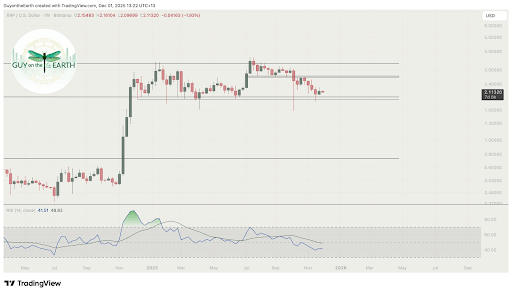
The XRP price has spent the past several days in a fragile position after falling from $2.20 and retesting $2, which has now become the most closely watched level on its price chart. The weekly candle has managed to close slightly green for the first time in more than a month, yet the rebound has not erased the weakness created by the recent sell-off. 

The latest technical analysis from Guy on the Earth focuses on this exact moment, noting that XRP’s entire structure now depends on whether this $2 zone can keep functioning as the pivot that stops further downside.

Holding $2 As The Important Bull Support

Guy on the Earth describes the $2 price level as the line separating resilience from a potentially long period of stagnation. His analysis shows XRP holding this level despite several weeks of bearish candles, a sign that sellers have not managed to gain full control even after the broader market’s pullback. 

The weekly chart he shared displays a cluster of past support zones roughly aligned between $2 and $1.95, making this area the foundation of the current trend. According to the analyst, losing the $2 price level could leave XRP drifting for months or even years with little upside movement, aside from isolated opportunities when temporary lows form. For now, the fact that XRP ended the past week in the green, even slightly, keeps the structure intact.

XRP’s reaction around $2 cannot be understood without watching Bitcoin. In his view, the best scenario for XRP is for Bitcoin to bounce back above $100,000, and a subsequent fall in BTC dominance. The chart’s declining RSI on the XRP weekly timeframe also hints at momentum changing, but its path will ultimately follow whatever direction Bitcoin chooses next.

XRP Price

XRP Price Chart. Source: @guyontheearth On X

Two Diverging Paths From Here

Guy on the Earth outlines two possible outcomes as the market enters a critical phase. The first is a recovery from current levels that allows altcoins to outperform again, opening the door for XRP to revisit the mid-range zone around $2.60 before making any attempt at its previous highs. 

The second is a deeper market drop that drags XRP below the $2 price level. This move would flip its most important support into resistance and set up a prolonged stretch of declining price action. Nothing inspiring will happen below there except well-timed buys when the lows appear to be in.

Both scenarios are realistic, and $2 is the dividing point that will determine which one unfolds. The analyst’s bias leans toward a move higher, but he warns that traders must be aware of the risks if Bitcoin does not stabilize soon.

At the time of writing, XRP is trading at $2.02 after a 1.2% fall in the past 24 hours and is at risk of losing this $2 support level.

XRP price chart from Tradingview.com

Ripple Marks Another Milestone In Bid To Dominate Global Payments With XRP

On December 1, 2025, Ripple announced a major regulatory upgrade in Singapore, reinforcing its ambition to make XRP a central instrument for global payments. The expanded license allows the company to streamline cross-border money transfers, expand its payments infrastructure, and provide faster, more transparent settlements to financial institutions worldwide.

Ripple Intensifies Its Global Payments Playbook

The Singapore regulatory upgrade extends the scope of Ripple’s Major Payment Institution (MPI) license, giving its subsidiary, Ripple Markets APAC Pte. Ltd., authority to operate a fully regulated, end-to-end payments platform. The license enables Ripple to handle fund collection, secure custody, token conversion, and final payouts within a single operational framework. XRP and Ripple’s stablecoin RLUSD are embedded into the system, consolidating complex cross-border processes into a fast, compliant, and transparent environment.

This upgrade positions Ripple as a turnkey solution for banks, corporates, and fintechs. By managing both regulatory compliance and the technology infrastructure, Ripple removes the fragmentation that slows legacy systems. These institutions now have a single point of contact, reducing complexity and making operations more efficient.

Ripple is also expanding its geographic reach through strategic partnerships. Its collaboration with Bahrain Fintech Bay allows the company to run pilot programs, real-world payment trials, and early deployment of token-driven services in the Gulf region. These initiatives help Ripple establish liquidity corridors, embed its infrastructure into local financial ecosystems, and build familiarity with regional regulators.

Financially, Ripple strengthened its position with a $500 million funding round in November 2025, which valued the company at roughly $40 billion. The capital is being directed toward scaling payment infrastructure, enhancing enterprise tools, and expanding its stablecoin program. With these resources, Ripple can roll out its technology faster, integrate with new partners more efficiently, and advance its dominance in the institutional payments market.

XRP’s Expanding Utility In Ripple’s Global Framework

XRP remains the settlement engine of Ripple’s infrastructure, providing instant liquidity, rapid transaction settlement, and multi-currency interoperability. This functionality allows Ripple to address high-friction payment corridors, such as those in Africa, where it works with regional providers to replace slow correspondent banking chains with XRP-enabled settlements. In the Asia-Pacific region, growing on-chain activity and rising institutional demand create favorable conditions for token-based cross-border payments. The Singapore MPI upgrade now offers a regulated launchpad to deliver XRP-powered rails across these high-growth regions.

Building on this foundation, Ripple is creating a vertically integrated ecosystem where fiat, stablecoins, and digital assets operate through a unified platform. Within this framework, XRP bridges currencies, provides deep liquidity, and executes transactions faster than traditional systems. Each regulatory approval, partnership, and infrastructure deployment further embeds XRP into the backbone of global financial infrastructure.

Together, these milestones illustrate Ripple’s multi-market strategy: expanding regulatory clarity, deploying robust infrastructure, and demonstrating real-world XRP utility. The Singapore upgrade is a decisive step in this progression, reinforcing Ripple’s steady movement toward making XRP a central tool for cross-border payment systems.

XRP price chart from Tradingview.com (Ripple)

Ripple Exec Sounds Warning: XRP Must Learn This From Solana Or Risk Damage

XRP and Solana share the opening line of a direct industry alert from a senior Ripple executive who argues that technical maturity alone will not guarantee XRP’s relevance in the next competitive cycle. He points to Solana’s execution style as a benchmark that XRP must study and internalize to stay competitive, drive innovation, and avoid strategic setbacks.

Solana’s Edge And The Core Lessons For Ripple

Luke Judges draws on his experience in the Solana ecosystem to highlight operational lessons for XRP. Before joining Ripple, he built two startups on Solana and ran a validator managing over $30 million in staked tokens. He personally navigated the network’s full market swings from its peak near $200 to a collapse below $10 and its eventual recovery—gaining insights into infrastructure demands, validator economics, and developer dynamics that go beyond theory.

According to Judges, Solana’s growth reflects a combination of speed, practical engineering decisions, and developer-friendly onboarding. He acknowledges Solana’s weaknesses, including a falling validator count that could raise decentralization concerns, but emphasizes that these do not negate the network’s operational strengths. High transaction throughput and pragmatic design choices, he notes, continue to attract builders and support adoption, demonstrating that efficiency and practical execution can drive results even when a system is imperfect.

Judges link these observations directly to XRP’s path forward. He suggests that overlooking the strengths of competing networks creates blind spots that hinder ecosystem development. Studying Solana’s approach can help the network refine its operations, accelerate development cycles, improve tooling for builders, and align technical decisions with real-world usage patterns. These, he indicates, are essential steps for XRP to maintain competitiveness in a fast-evolving layer-1 landscape.

XRP’s Strategic And Competitive Focus

Ripple’s internal roadmap already includes critical enhancements—smart contracts, native staking primitives, and the AlphaNet rollout for XRP Ledger Smart Contracts. However, Judges’ comments signal that technical capability without a sharpened go-to-market strategy is insufficient. He points to the Ethereum Foundation’s recent tightening of its GTM approach after losing market share to Solana as an example of the stakes involved.

To address these challenges, XRP’s competitive focus comes down to three main areas. First, the ecosystem must augment its programmability track with clearly packaged developer value propositions that demonstrate tangible differentiation. Second, validator economics require forward-looking structuring to avoid the attrition dynamics now visible in Solana’s network. Third, go-to-market alignment must accelerate, converting technology milestones into momentum-building enterprise and retail narratives.

Judges’ message ultimately operates as both caution and catalyst. He frames Solana’s strengths not as threats but as operational lessons, while its weaknesses provide a blueprint for pitfalls XRP should avoid. His message is clear: the blockchain space is shifting, and Ripple’s executive team signals that the window to capture the next market cycle demands adaptation, not insulation. The underlying mandate is to learn fast, move faster, and ensure XRP remains structurally relevant in the next phase of blockchain adoption.

XRP price chart from Tradingview.com

Dogecoin Opens The Floodgates: Here’s The Update On Shiba Inu And BONK ETFs

Dogecoin’s entry into the ETF market has changed the tone of the entire meme-coin sector, possibly opening the door for the likes of Shiba Inu and BONK. What began as a community hype token is now tied to a fully regulated product, and that achievement has pushed attention toward other popular meme coins. BONK and Shiba Inu are now the next names being discussed as institutions explore broader exposure to alternative cryptocurrencies.

BONK Moves Ahead With A Fully Listed ETP In Europe

Although the early inflows into Dogecoin’s ETF launch have been largely more underwhelming than what most expect, the establishment of an exchange-traded product for the king of meme coins opens up conversations about other meme coins. 

BONK is a standout example, taking a decisive step forward with the launch of an exchange-traded product tied to the meme coin on the SIX Swiss Exchange. The debut immediately led to an intraday rally as traders reacted to the token gaining a presence on one of Europe’s most established regulated markets. 

SIX is Switzerland’s largest and Europe’s third-largest stock exchange. Therefore, the ETP gives investors access to BONK without having to manage custody themselves, making it far easier for traditional market participants to gain exposure.

This development builds on BONK’s rising activity within the Solana ecosystem. Its trading volume and market capitalization have been climbing for weeks, and the ETP adds a form of legitimacy rarely given to meme coins. BONK now joins a very small group of community hype tokens that have crossed into regulated investment territory, giving it a stronger foundation as demand from new classes of investors grows.

The new BONK ETP was issued by Bitcoin Capital, a firm known for launching multiple cryptocurrency ETPs across major European markets. “With the Bonk ETP now listed on SIX Swiss Exchange, investing in Bonk has never been easier. Investors don’t need crypto expertise; they can trade Bonk just like any other stock. We’re making community-driven digital assets accessible to everyone, while meeting high security and regulatory standards,” added Marcel Niederberger, CEO of Bitcoin Capital 

Shiba Inu Attracting Institutional Interest

Shiba Inu has not yet secured an exchange-traded product of its own, but the token is steadily carving out its place in the wider fund landscape as major institutions begin weaving it into their early product designs. Even as Shibarium’s activity has cooled in recent weeks, SHIB is still part of broader conversations about regulated exposure.

One of the clearest examples comes from T. Rowe Price, a heavyweight in traditional finance with more than $1.7 trillion in assets under management. The firm recently submitted a filing for an actively managed crypto ETF that lists SHIB among its holdings.

Shiba Inu also appeared in Grayscale’s assessment of cryptocurrencies viewed as structurally viable for future spot-ETF models. These developments indicate that long-term positioning for Shiba Inu is becoming stronger as institutions evaluate which assets fit into their next generation of crypto funds.

Shiba Inu price chart from Tradingview.com (BONK Dogecoin)

❌