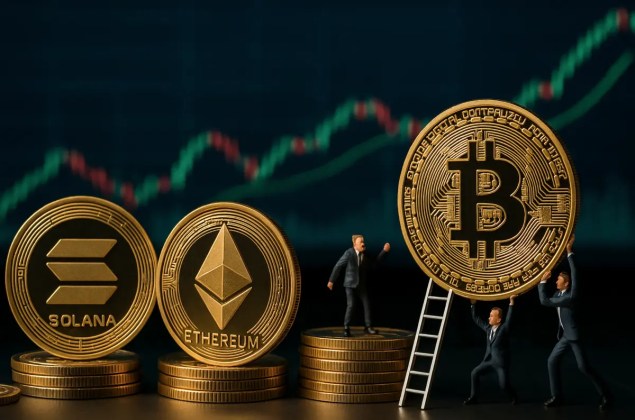
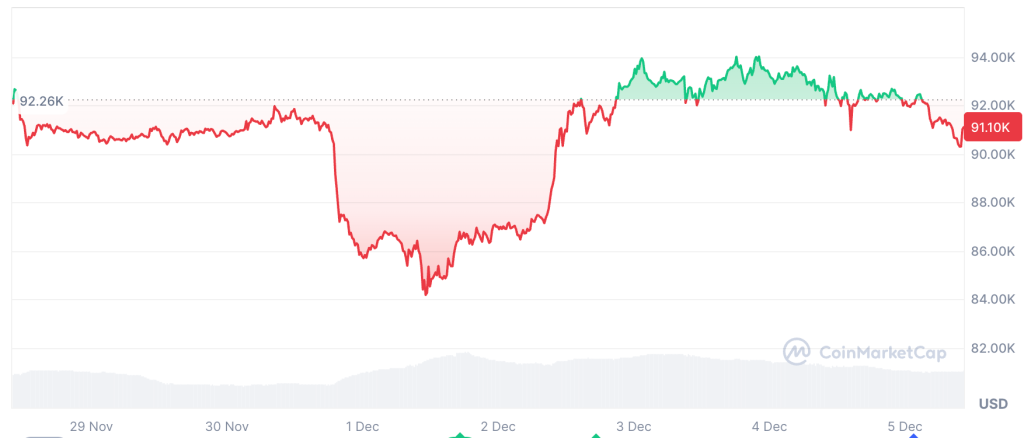
The crypto market continues to operate under a cautious tone, yet today shows a small improvement. The Fear and Greed Index sits near 24, a level that keeps sentiment inside the fear range but still marks progress from last week’s deeper lows.
Bitcoin is now trading around $90,000 with a gain of about 1% over 24 hours, and that move has eased some of the pressure that defined recent sessions.
Bitcoin Price (Source: CoinMarketCap)
Most large caps remain quiet, although several mid-caps are advancing. Canton, Ethena, and Ondo stand out with steady climbs that align with a backdrop where traders engage selectively while still avoiding widespread risk-taking. These moves do not indicate a broad altcoin season, but they reveal where participation resumes when the market shifts from extreme stress to controlled caution.
Canton Shows Renewed Interest In Its Network Activity
Canton (CC) is trading around $0.074, up by roughly 19% in 24 hours. Liquidity has improved across major venues, and order flow is more balanced than earlier this week.
Privacy should be the foundation. Not an update to the system.
On-chain activity around its coordination and settlement functions continues to draw attention from users who track enterprise-oriented experiments, and this interest appears to support today’s rise. The price structure suggests a transition from quiet trading toward a more stable upward pattern.
Ethena Lifts As Its Synthetic Dollar System Steadies
Ethena (ENA) is trading near $0.28, up by about 11% in 24 hours. Recent data show a more consistent balance between funding costs and open interest, which indicates that its synthetic dollar framework is operating without the uneven spikes seen in previous weeks.
Spot flows lean toward accumulation and remain spread across several active venues. The token continues to act as a reference point for yield-related designs during periods when the market prefers moderate exposure.
Ondo Climbs On Ongoing Interest In Tokenized Yield
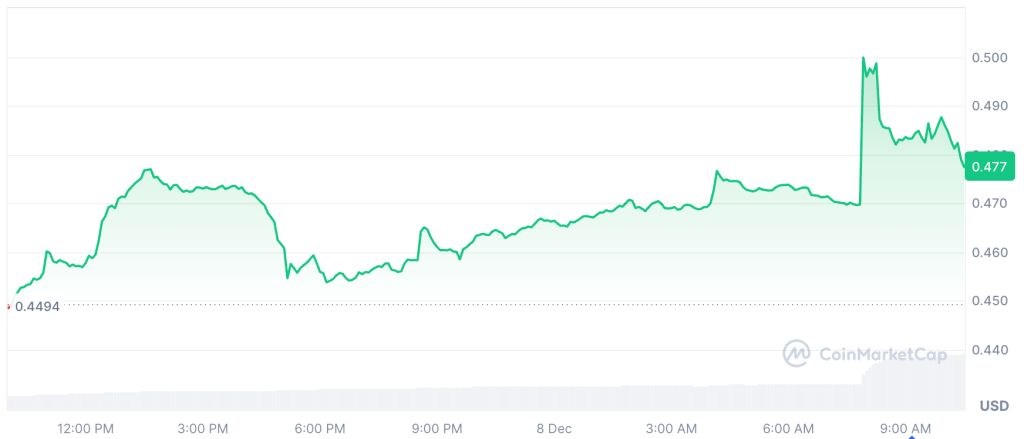
ONDO is trading near $0.48 with an increase of about 8% over 24 hours. Trading activity suggests continued interest in tokenized treasury products, supported by steady demand for yield that connects crypto infrastructure with traditional markets.
ONDO Price (Source: CoinMarketCap)
Liquidity on major pairs remains firm, and turnover now exceeds levels recorded in recent sessions. This behaviour keeps Ondo inside rotation lists whenever market tension eases.
Altcoin Season Still Limited, but No Longer Suffocated
Altcoin season remains distant, yet the rise from extreme fear levels has lowered stress across the market. Bitcoin’s ability to remain above $90,000 reduces forced selling and gives the market enough space for selective rotation.
The strength in Canton, Ethena, and Ondo shows that capital is returning slowly to tokens with steady activity and clear user bases, even though most participants still prefer caution.
For now, the environment remains defensive, but the combination of a higher Fear and Greed reading and several advancing names indicates a market that has moved from severe pressure to a quieter, more balanced phase.
The regulator has closed its probe without filing any charges.
The move removes a cloud of uncertainty that had lingered since 2024.
ONDO price jumped as the community welcomed regulatory clarity.
The cryptocurrency industry exhibited a bullish stance on Monday as Bitcoin steadied above $91,500.
While the altcoin space recorded brief gains in the past day, ONDO jumped sharply on its 24-hour price chart, gaining more than 6% within minutes.
The uptick emerged after Ondo Finance confirmed that the United States Securities & Exchange Commission has concluded its Biden-era probe into the RWA company.
Most importantly, the regulator has ended the investigation without enforcement actions or charges against Ondo Finance.
The clean outcome renewed optimism across markets, with traders perceiving the move as a rare development in regulatory clarity within a turbulent market.
Meanwhile, the team promises to leverage this moment to democratize the US capital markets with tokenization.
Today’s announcement read:
The path is now clearer than ever for tokenized Treasuries and tokenized equities to become core components of US capital markets. The future of global finance will be on-chain, and Ondo will help lead the transition.
ONDO’s price jumped from $0.4697 to $0.4999, an over 6% increase, almost immediately after the X post.
Notably, the scrutiny began last year, in 2024, and focused on whether native ONDO violated securities laws and whether the company’s tokenization of real-world assets and US Treasuries adhered to the federal financial rules.
A shift in regulatory stance
Indeed, the US SEC has been crypto-friendly under the Trump administration and the new chair, Paul Atkins.
The regulator has closed multiple high-profile cases recently, including those tied to Ripple and Coinbase.
Also, Donald Trump pardoned Binance founder CZ for wrongdoings that saw him spend four months in prison.
These developments confirmed a shift in the United States regulatory tone, from constant clampdowns to clarity.
Rather than resorting to enforcement actions, officials are now willing to accommodate blockchain and crypto projects while exploring models that support innovative markets.
Ondo’s latest purchase of licensed Oasis Pro Markets aligns with the ongoing regulatory transitions.
Moreover, these trends suggest that American capital markets could be preparing to migrate to on-chain assets at a significant scale.
The Ondo Finance team highlighted the accelerating demand for tokenization, with US regulators displaying interest in the sector’s future potential to enhance transparency, market efficiency, and transaction speed.
They said:
The SEC is openly engaging with industry to unlock the promise of tokenization for US capital markets, global adoption continues to accelerate, and US infrastructure is evolving to support the category.
Now that the investigation has ended, all eyes remain on February 3, 2026, when Ondo Finance will host the New York Summit.
Expectations around the conference have increased as the community expects the project to introduce its long-term mission without the SEC’s uncertainty.
ONDO price outlook
The altcoin displayed a bullish performance, trading at $0.4843 after a brief dip from its intraday high.
ONDO’s 24-hour trading volume has increased by more than 300% amid renewed interest in the altcoin.
Bitcoin’s recent movement has left many traders waiting for signs of an altcoin season, and a post shared by crypto analyst Crypto Nova offers a different way to understand when this will actually begin.
The explanation, supported by charts from 2017 and 2021, shows that altcoins have historically performed their best while Bitcoin’s price action was already climbing, not after it had reached its peak. The charts she shared show how those earlier cycles unfolded and why the timing of Bitcoin’s surge has been the important factor each time.
Altseasons Form During Bitcoin’s Strongest Surges
This outlook goes against the projection of many crypto analysts, who have been waiting for a downturn in the Bitcoin dominance characterized by outflows from Bitcoin and into the altcoin market.
However, careful technical analysis shows that the largest and most explosive altcoin seasons did not occur after Bitcoin had completed its run. Instead, they developed while Bitcoin was already pushing to new price highs.
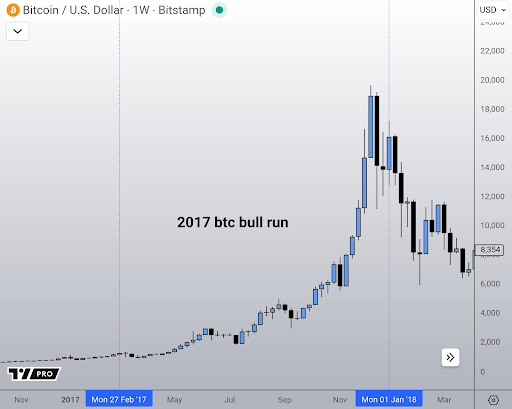
The 2017 cycle illustrated this the most clearly. Bitcoin dominance began to decline during an altcoin season, even as BTC surged from around $1,000 to nearly $20,000. The chart shows a waterfall-like collapse in dominance from 95% in early 2017 to below 40% in early 2018, happening at the exact moment when Bitcoin was rising massively. Altcoins were already outperforming the leading cryptocurrency long before Bitcoin topped just below $20,000.
A similar pattern played out in 2021. Bitcoin dominance peaked in January of that year and started falling while the Bitcoin price climbed from roughly $30,000 to its mid-cycle high above $60,000. Although altcoins took a little longer to increase compared to 2017, the bulk of their performance still arrived during Bitcoin’s rapid upward trajectory, not after it had stalled or reversed.
The charts below highlight this synchronicity clearly: dominance moves lower while Bitcoin candles continue to stretch higher.
Bitcoin Needs A Confirmed Bottom And A New Surge
Nova noted that traders are making a mistake by focusing solely on Bitcoin dominance without considering Bitcoin’s broader market structure. It is important to note that dominance does not drop simply because Bitcoin moves sideways or reaches a peak.
Instead, dominance mostly declines when Bitcoin is in a strong, sustained uptrend, but the altcoin niche is witnessing more inflows compared to the leading cryptocurrency. This means an altcoin season is unlikely to start until Bitcoin prints a confirmed bottom and its rally convinces inflows into altcoins.
As noted by the analyst, Bitcoin is currently in a downtrend, and without a shift in trend, dominance metrics alone cannot trigger altcoin momentum. This viewpoint challenges the frequent claims circulating online that altseason is here or just about to begin.
GoTyme Bank, one of the Philippines’ fastest-growing digital banks, has launched crypto trading for its 6.5 million customers through a new partnership with US fintech firm Alpaca.
Key Takeaways:
GoTyme Bank has launched in-app crypto trading for 6.5 million users, offering 11 assets including BTC, ETH, SOL and DOT.
The service is designed for beginners, emphasizing simplicity and seamless access without external exchanges.
GoTyme plans regional expansion to Vietnam and Indonesia as it prioritizes rapid user growth over short-term profitability.
The rollout allows users to buy and store 11 crypto assets directly inside the GoTyme mobile app, with purchases auto-converted from Philippine pesos to US dollars.
Supported assets include Bitcoin (BTC), Ether (ETH), Solana (SOL), Polkadot (DOT) and several other major altcoins.
GoTyme Targets Beginners With Simple In-App Crypto Trading
While GoTyme has not indicated whether more advanced trading tools will be added later, the bank says the service is intentionally designed for newcomers.
“Our product focuses on simplicity and reliability, designed for people who want to buy crypto confidently without complicated technical analysis or managing multiple apps,” CEO Nate Clarke said.
GoTyme, launched in October 2022 through a joint venture between Singapore’s Tyme Group and the Philippines’ Gokongwei Group, has seen rapid user growth.
The bank promotes a frictionless onboarding process, allowing users to open a bank account and debit card in as little as five minutes, a feature that now extends to crypto access as well.
The digital bank is also setting its sights beyond the Philippines. Clarke recently said GoTyme plans to expand into Vietnam and Indonesia, aiming to capture a larger share of Southeast Asia’s fast-growing digital banking market.
He noted that profitability is not yet a priority. “We are very much still in a growth phase. We are not optimizing for profitability at the moment.
What matters to us is building a growing and engaged customer base,” Clarke told The Digital Banker.
The Philippines continues to be one of the most active crypto markets globally. It ranks ninth on Chainalysis’ 2025 Global Crypto Adoption Index, while local policymakers are considering a proposal to create a national strategic reserve backed by 10,000 BTC.
Philippine Senator Pushes to Put National Budget on Blockchain
As reported, Philippine Senator Bam Aquino is preparing a bill that would place the country’s entire national budget and government financial transactions on a blockchain system, aiming to make public spending fully transparent and easily traceable by citizens.
In August, Aquino said the proposal would allow “every peso” to be logged on-chain, creating what he hopes will become the world’s first fully blockchain-based national budget.
The Philippines is emerging as a testing ground for public-sector blockchain initiatives.
Congressman Miguel Luis Villafuerte recently introduced a separate bill to establish a strategic Bitcoin reserve of up to 10,000 BTC over five years.
According to the bill, the holdings could only be sold under strict conditions, such as retiring sovereign debt, and no more than 10% of the reserve may be liquidated in any two-year period after the minimum holding period expires.
As of November 2024, the Philippines’ debt had risen to ₱16.09 trillion ($285 billion), with domestic obligations accounting for nearly 68% of the total.
The euro stablecoin market has staged a sharp rebound in the year since the EU’s Markets in Crypto-Assets Regulation (MiCA) took effect, doubling in size as new rules for issuers came online.
Key Takeaways:
The euro stablecoin market has doubled since MiCA’s rollout, reaching roughly $680 million in market cap.
Growth is concentrated in major issuers like EURS, EURC and EURCV, with transaction volumes surging nearly ninefold.
Public interest is rising across the EU, signaling growing adoption.
According to Decta’s Euro Stablecoin Trends Report 2025, the sector’s market capitalization has surged from last year’s slump, reversing a 48% contraction and outpacing the broader stablecoin market’s 26% growth rate.
Euro Stablecoins Hit $680M After MiCA
Decta’s report says euro-denominated stablecoins climbed to roughly $500 million by May 2025 following MiCA’s June 2024 rollout, a shift credited to clearer issuer obligations and standardized reserve rules.
Today, the market sits at around $680 million, per CoinGecko. However, the market is still tiny compared with the nearly $300 billion locked in US dollar-backed tokens, a space dominated by USDT and USDC.
Much of the growth came from a handful of standout issuers. Stasis’ EURS posted the strongest expansion, soaring 644% to $283.9 million as of October 2025.
Circle’s EURC and Societe Generale’s EURCV also saw meaningful increases as regulated issuers began to capitalize on MiCA’s clarity around custody, reserves and public disclosures.
Activity on-chain grew alongside market cap. Monthly transaction volume for euro stablecoins jumped nearly ninefold to $3.83 billion after MiCA implementation, the report found.
JUST IN: Ten European banks are building a euro stablecoin under Dutch Central Bank oversight.
EURC and EURCV led the surge, with volumes climbing 1,139% and 343%, supported by greater use in cross-border payments, fiat on-ramps and crypto trading pairs, areas previously dominated by dollar stablecoins.
The regulatory shift also appears to be stimulating public interest. Decta recorded sharp spikes in search activity across EU markets, including a 400% jump in Finland and more than tripling in Italy.
Interest rose across smaller economies as well, suggesting broader consumer awareness as euro-denominated tokens begin carving out a clearer role in Europe’s digital-asset landscape.
Poland Remains Last EU State Without MiCA Rules
As reported, Poland’s push to bring its crypto sector in line with the EU’s MiCA framework collapsed after lawmakers failed to overturn President Karol Nawrocki’s veto of a major digital-asset bill.
The vote fell short of the required three-fifths majority, leaving Poland as the only EU member without a national MiCA-style regulatory regime and forcing the government to restart the legislative process.
Prime Minister Donald Tusk had argued that the bill was necessary for national security, warning that unregulated crypto activity had become a channel for money laundering and foreign interference, including covert financing linked to Russia and Belarus.
Authorities have connected these concerns to several recent security incidents, including alleged sabotage plots in Poland reportedly funded through cryptocurrencies.
The veto has intensified political tensions between Nawrocki and Tusk’s pro-EU coalition.
The president rejected the bill on grounds that it overreached EU requirements and posed risks to civil liberties and property rights.
MetaMask, the most widely used Ethereum wallet, is moving directly into the prediction market arena through a new integration with Polymarket, giving users the ability to trade event outcomes from inside their wallets.
Key Takeaways:
MetaMask has integrated Polymarket, allowing users to trade real-world event outcomes.
The integration adds one-tap funding from any EVM chain.
Polymarket’s rapid growth continues amid a potential $15 billion valuation.
“You can now trade on the future outcome of real world events inside your wallet,” Consensys’ Gabriela Helfet wrote, adding that users will also earn MetaMask Rewards points for every prediction placed.
MetaMask Becomes New Gateway to Polymarket With One-Tap Funding
The integration creates a new on-ramp for Polymarket and introduces “one tap funding,” allowing users to deposit with any token from any EVM-compatible chain.
The move further tightens the link between everyday crypto wallets and decentralized betting platforms, positioning MetaMask as a gateway not only to Web3 apps but also to real-world event speculation.
Polymarket has surged in popularity over the past year, fueled in part by heightened attention during the 2024 US election cycle.
Former President Donald Trump’s embrace of crypto and a more relaxed regulatory climate helped push the platform back into the US market.
The company is now reportedly exploring a valuation of up to $15 billion, following a $2 billion strategic investment from Intercontinental Exchange, the parent of the NYSE.
Predicting on MetaMask only takes a few seconds.
We've enabled 1-click funding with any EVM token, or you can get started instantly if you have an existing @polymarket account! pic.twitter.com/zZtrQPDu3m
For MetaMask, the move comes as the wallet expands beyond its Ethereum-focused roots. In October, it launched multichain accounts that support both EVM and non-EVM networks, including Solana.
The move comes as Polymarket is recruiting staff for an internal market-making team that would trade against its own customers, mirroring a controversial feature already used by rival Kalshi that has drawn criticism and legal challenges.
As reported, the New York-based prediction market startup has approached traders, including sports bettors, to join the new unit, people familiar with the matter said, requesting anonymity because the plans remain private.
Prediction Markets Hit $13B in Record Activity
Prediction markets have crossed $13 billion in cumulative trading volume, marking a record high even as broader crypto markets cool.
The surge has drawn in major players across tech and finance, including Fanatics, Coinbase, and MetaMask, all of which have recently launched or expanded event-trading platforms.
Against this backdrop, YZi Labs, the venture firm founded by Binance co-founder Changpeng “CZ” Zhao, has been intensifying its involvement in the sector.
YZi-backed Opinion has emerged as one of the most surprising breakout platforms. Launched on BNB Chain in October, it recorded nearly $1.5 billion in weekly trading volume within its first month, briefly overtaking established names such as Kalshi and Polymarket.
Meanwhile, prediction markets platform Kalshi has secured a major media breakthrough after signing a partnership with CNN, making the company the network’s official prediction markets partner while closing a $1 billion funding round at an $11 billion valuation.
Fear still hangs over altcoin season, but the sharp edge of panic has softened. The Crypto Fear and Greed Index is now 25, a modest recovery from November’s plunge near 10, yet the mood remains unsettled, and traders continue to move with hesitation rather than conviction.
Altcoins move inside that same heavy climate. Most large names sit in the red today, liquidity stays present, but flows lean toward defense, and new money prefers short-dated trades instead of long commitments.
Against that background, Zcash is one of the few popular tokens in positive territory, while Ethereum, Solana and Hyperliquid track the downtrend, which gives a clean snapshot of where capital still experiments and where it pulls back.
Bitcoin And Sentiment After November’s Shock
Bitcoin continues to dictate the tone. Derivatives screens show a reduction in leverage across both long and short positions, while spot flows lean toward sellers who continue to trim exposure after several weeks of steady declines.
Price action carries the look of a market still searching for stability, not one ready for a quick reversal.
Bitcoin Price (Source: CoinMarketCap)
Ethereum, Solana, and Hyperliquid Track The Pullback
Major altcoins follow that direction. Ethereum is trading near $3,090 after falling by roughly 2.5% in 24 hours, with order book activity showing more supply than demand at current levels. Solana sits near $134 after a 5.5% drop, extending the cooling that began once traders reduced exposure to high beta assets.
Hyperliquid is trading around $31, down by about 8%, and activity on its perpetual pairs has slowed compared with the pace seen in early November. These moves together show how broad the retracement remains, even as volatility cools relative to last week.
Zcash Holds A Bounce After Its November Peak
Zcash breaks from the trend. ZEC is trading near $384, up by about 10% in 24 hours, marking one of the few gains across large liquid names. The token had fallen steadily from its November peak near $700, yet recent market data show more active positioning at current levels and enough liquidity across venues to support a modest rebound.
Zcash@Zcash shared a series of updates covering key developments across the ecosystem. Highlights include:
• @ZcashFoundation released its Q3 2025 report, highlighting engineering progress and the launch of the Shielded Aid Initiative to support privacy-preserving digital aid… pic.twitter.com/Nc06Yo759I
The move does not form a new upward trend on its own, but it demonstrates the way privacy focused tokens can draw interest during quieter, defensive phases when traders search for assets with a historical pattern of occasional outperformance.
What This Phase Means For Altcoin Season
The current market still lacks the conditions for a broad altcoin season. Sentiment has improved from last week’s extreme lows, yet positioning remains conservative, and flows continue to concentrate in larger, more liquid assets.
Until Bitcoin can stabilize over a longer stretch and macro uncertainty eases, rotation is likely to stay narrow and sporadic. For now, the market sits in a phase where isolated tokens can rise on their own dynamics, but the overall environment still leans toward caution rather than a full risk recovery.
HashKey Holdings, one of Asia’s most prominent cryptocurrency-exchange operators, is preparing to open its order books next week for a Hong Kong initial public offering that aims to raise at least $200 million.
Key Takeaways:
HashKey plans to open orders next week for a Hong Kong IPO targeting at least $200 million.
The exchange now operates across multiple global hubs and recently secured a $30 million investment at a valuation above $1 billion.
HashKey has cleared its Hong Kong listing hearing and reported HK$1.3 trillion in spot-trading volume.
The listing could take place before the end of the month, though final details, including deal size and timing, remain subject to change, Bloomberg reported, citing people familiar with the matter.
HashKey’s Ethereum-Era Roots Propel It Into Global Crypto Expansion
Founded in 2018, HashKey grew out of chairman Xiao Feng’s early involvement in Ethereum through Wanxiang Group, where he was among the protocol’s first corporate investors.
The firm has since expanded into trading, venture investments and digital-asset management, operating across Hong Kong, Singapore, Bermuda, Japan, the UAE and Ireland.
Earlier this year, Gaorong Ventures, known for backing Chinese tech groups such as Meituan and PDD, invested $30 million at a valuation exceeding $1 billion, sources said.
Despite its regional footprint, HashKey has faced financial pressures. The company posted a HK$506 million ($65 million) loss in the first half of 2025, though the deficit narrowed from a year earlier.
Revenue dropped 26% to HK$384 million, according to its listing documents.
Even so, trading activity on the platform has been substantial, with HK$1.3 trillion in cumulative spot-market volume recorded by September.
A platform with HK$1.3T flow + 99.9% retention still burn HK$23.5B—you sure you want this IPO?
reading this HashKey IPO filing. How the hell do you push HK$1.3 trillion in spot flow, lock 290B in staking, run 199B AUA, onboard 1.44M users(from literally 18 people in 2022 ),… pic.twitter.com/76jl13sDWq
The planned IPO represents a significant test for Hong Kong’s push to cement itself as a digital-asset hub. Authorities rolled out a new licensing regime last year and are preparing additional measures to encourage broader participation after crypto activity lagged behind expectations.
The city’s positioning has drawn interest from mainland Chinese investors, even though Beijing maintains a sweeping ban on crypto trading.
The company disclosed the outcome in its Post Hearing Information Pack published on Monday, confirming that the listing committee of the Hong Kong Stock Exchange has completed its review of HashKey’s application.
Before that, BitGo officially filed for an initial public offering, becoming the first dedicated crypto custodian to pursue a listing on a US stock exchange.
BitGo’s IPO filing came amid renewed momentum for crypto-related public offerings.
The digital asset space has seen several notable public listings in 2025. Stablecoin issuer Circle made a splash with its IPO in June, surging more than sevenfold since going public.
Online trading platform Etoro, which offers crypto trading among its services, debuted in May.
In addition, Galaxy Digital, led by Mike Novogratz, moved its listing from the Toronto Stock Exchange to Nasdaq earlier this year.
Gemini, the exchange founded by the Winklevoss twins, filed confidentially for a U.S. IPO in June, signaling strong market confidence in crypto exchanges going public.
Consob has urged VASPs to secure CASP approval or shut down by December 30, 2025.
This comes as the deadline for transitioning to new MiCAR policies approaches.
Unauthorised operators will halt their services and return user assets.
Italy’s financial regulator Consob has issued an urgent call to digital assets investors and operators as the nation moves closer to adopting MiCAR policies.
According to the late yesterday press release, Consob emphasised December 30, 2025, as the last day VASPs (Virtual Asset Service Providers) operating under the existing regime will be able to serve without full approval.
Consob has warned that operators who fail to follow this transition risk a ban.
Thus, any VASP operating in Italy should adhere to the EU’s Markets in Crypto-Assets Regulation or exit the marketplace.
30 December 2025 is the last day on which Virtual Asset Service Providers (VASPs, operators currently offering virtual asset services, such as cryptocurrency exchanges) registered with the OAM (the Organismo Agenti e Mediatori, or Agents and Brokers Organisation) can continue to operate.
MiCAR resets Italy’s regulatory rulebook
Italian regulators have only wanted VASPs to secure the OAM (Organismo Agenti e Mediatori) certificate to operate seamlessly over the years.
Meanwhile, MiCAR brings tougher rules, with only fully licensed Crypto-Asset Service Providers (CASPs) permitted to serve the European Union.
Meanwhile, the authorisation procedure involves operational checks, client protection requirements, supervisory controls, and existing monitoring. That’s far stricter than the previous model.
Consob stressed that VASPs will only operate if they apply for CASP certification in Italy or any other European Union Member State by December 30.
Operators who submit applications by this deadline can keep offering services until the final decision, but all entities should adhere to MiCAR by June 30, 2026.
What’s next for investors?
Consob has warned both operators and day-to-day cryptocurrency users.
Investors should promptly confirm whether their desired service provider plans to adhere to the new policies and requirements.
Here, they can monitor two crucial things.
First and foremost, investors should check whether the operator has published its MiCAR transition plans.
Secondly, investors should verify the provider’s regulatory status after the deadline.
VASPs that don’t apply or fail to secure approval will not operate in Italy after December 30, and customers can request a return of their assets upon such developments.
Meanwhile, Consob confirmed warning operators multiple times during the transition phase, highlighting updates in September last year, July 2025, and the October 31 notice to companies still holding only the OAM certificate.
While some operators view MiCAR as the pathway for regulated, international operations, others consider the new regulation as the end of the road.
Meanwhile, digital assets investors should stay alert, check the provider’s regulatory status, and act before the new MiCAR regulations lock them out or pressure them with last-minute withdrawals.
Former leaders of the shuttered crypto-friendly Signature Bank have returned with a new venture built around always-on settlement.
Key Takeaways:
N3XT is a Wyoming-chartered, fully reserved blockchain bank built for institutional clients.
The bank uses a private blockchain with programmable smart-contract payments and will not offer lending.
N3XT has secured backing from major crypto investors including Winklevoss Capital, Paradigm and HACK VC.
Their new institution, N3XT, is a state-chartered, blockchain-based bank designed to move money at any hour, with near-instant finality.
N3XT Unveils 24/7 Payments Platform Built on Private Blockchain
Announced on Thursday, N3XT says it will operate on a private blockchain that allows transactions to clear around the clock.
The platform supports programmable payments through smart contracts and is built to work alongside stablecoins, utility tokens and other digital assets.
The institution will run under Wyoming’s Special Purpose Depository Institution framework, a charter that allows fully reserved, non-lending banks designed to custody digital assets.
The effort is led by Signature Bank founder Scott Shay, whose former institution was one of three crypto-linked banks that collapsed during the 2023 banking turmoil.
Signature, alongside Silicon Valley Bank and Silvergate, fell after deposit outflows accelerated and market confidence evaporated.
The Federal Deposit Insurance Corporation seized Signature in March 2023, citing liquidity pressure, concentration risks and a rapid run by large uninsured depositors.
N3XT’s leadership includes another Signature veteran, Jeffrey Wallis, previously the bank’s director of digital asset and Web3 strategy. Wallis will serve as CEO and president. He said the new institution is built around the idea that financial transfers should be as frictionless as sending digital information.
“We’re applying crypto innovations to banking to deliver instant, programmable payments for institutional clients,” Wallis said.
To avoid the vulnerabilities that contributed to Signature’s downfall, N3XT will not offer lending. The bank says all deposits will be backed one-to-one by cash or short-term U.S. Treasurys, with daily disclosures of reserve holdings.
It’s been a long time coming. Today, I am extremely excited to announce the launch of N3XT.
As CEO, I could not be prouder of the team that brought this vision to life. Together, we've built a safer, faster, more modern foundation for how businesses move money. https://t.co/TrDpVJYIo5
That structure mirrors elements of stablecoin issuers, while keeping the institution within the contours of a regulated bank charter.
The firm is currently onboarding businesses from several industries, including crypto, foreign exchange, shipping, logistics and other sectors that depend on continuous settlement.
N3XT has drawn notable support from the venture community. The company completed three funding rounds with backing from Winklevoss Capital, Paradigm, and HACK VC.
HACK co-founder Alexander Pack wrote on X that the firm is backing N3XT as it emerges from stealth, praising its founders for returning to the industry after Signature’s closure.
European Banking Giants Unite to Launch Euro Stablecoin
As reported, ten of Europe’s largest banks have formed a consortium to issue a euro-backed stablecoin by mid-2026, marking the region’s strongest attempt yet to push back against U.S. dollar dominance in digital finance.
The group, which includes BNP Paribas, ING, UniCredit, CaixaBank, Danske Bank and others, has created an Amsterdam-based entity, Qivalis, to develop a MiCA-compliant digital payment instrument.
Euro-denominated stablecoins remain negligible today, representing just $649 million compared to a market almost entirely controlled by dollar-pegged tokens.
Qivalis has put together a heavyweight leadership team as it moves through regulatory approvals. Former Coinbase Germany chief Jan-Oliver Sell will serve as CEO, with ING veteran Floris Lugt as CFO.
The group has already applied for an electronic money institution license with the Dutch Central Bank, and says more European lenders may still join the initiative.
Ripple’s native token XRP was trading near $2 on Friday as traders wade through another wave of fear and doubt, with new data from Santiment showing social chatter around the token turning sharply negative after a two month slide of about 31%.
The crypto analytics firm posted a chart from its platform that tracks XRP’s price against total positive and negative comments, along with a combined sentiment line.
Recent readings show social chatter around XRP tilting heavily bearish, a clear shift from the more even mix of views seen earlier in the year.
Santiment’s sentiment gauge tracks price alongside streams of positive and negative comments, and its latest signals show the balance tipping into what it labels the fear zone as bearish messages start to dominate.
XRP (-31% in the past 2 months), unlike Bitcoin, is seeing the most fear, uncertainty, & doubt (FUD) since October, according to our social data.
Traders Watch For A Repeat Of November’s Reflexive Rebound
On this model, red circles mark days when optimism overwhelms pessimism, the greed zone, while green circles mark sessions when negative commentary swamps bullish talk, a fear zone that often lines up with capitulation by weaker holders.
The firm pointed traders back to late November. It wrote, “The last time we saw near this level of fear from the crowd was Nov. 21st, and $XRP’s price immediately rallied +22% over the next 3 days. After that, greed took over and the rally came to a quick halt. As of now, an opportunity appears to be emerging just like 2 weeks ago.”
Santiment urged followers to keep an eye on the same dashboard, saying, “Monitor how sentiment continues to shift here on this chart, and see what others in crypto can’t.”
The suggestion is that crowd psychology around XRP may once again be setting up a reflexive move, where extreme pessimism creates fuel for a short squeeze.
XRP Extends Losses As Market Drift Pressures Major Altcoins
In price terms, XRP was last down about 4.5% at $2.09, extending a loss of roughly 7% over the past month. The total crypto market value slipped about 1% to $3.22 trillion on the day, a pullback that has weighed on major altcoins even as liquidity remains concentrated in the largest names.
XRP shows relative stability compared with some smaller tokens, although it still feels the drag from thinning order books and cautious positioning. These moves unfold against a backdrop of uncertainty around upcoming US policy decisions, softer global risk appetite and rapid position cuts by leveraged traders who had crowded into earlier rallies.
Analysts watching the token say XRP can still grind toward the $2.50 to $2.75 area if cross border liquidity flows improve and momentum builds around stablecoin projects on the XRP Ledger.
Away from the charts, Ripple has been working to deepen its institutional reach. Last month, the company said it was expanding in the US with the launch of digital asset spot prime brokerage services.
The move follows its acquisition of multi asset prime brokerage firm Hidden Road, which has been folded into Ripple Prime, combining regulatory and operational setups from both groups into a single trading and custody platform for professional clients.
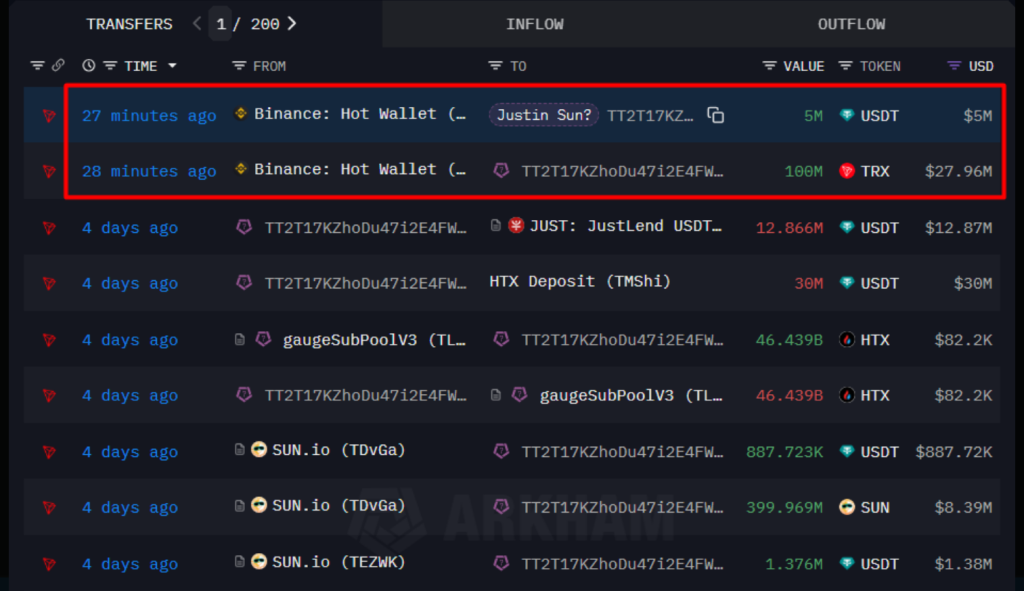
According to on-chain monitors, a wallet linked to TRON founder Justin Sun pulled 100 million TRX from Binance on December 3, 2025. Reports say the same address also moved $5 million USDT around the same time. These large transfers were flagged publicly by Onchain Lens and picked up by multiple crypto news outlets.
Transaction Values And Timing
Onchain tracking shows the 100 million TRX was worth close to $28 million at the time of the move. The USDT transfer of $5 million happened within a minute of the TRX withdrawal, which has led observers to call the action coordinated rather than routine.
Based on reports, the close timing and mixed asset types — token plus stablecoin — drew extra attention from traders and on-chain sleuths.
Data also shows the Justin Sun-linked wallet now holds a much larger TRX balance than just this single transfer. Tracking services report the address sits at about 492 million TRX, a holding with a notional value near $138 million based on market rates at the time. That swelling balance has prompted talk that accumulation of TRX has been steady in recent days.
Initial market moves were muted. Some exchange data and commentaries noted a mild uptick in TRX price after the news, suggesting traders saw the outflow as removing sell pressure from exchange order books.
Analysts who track exchange liquidity say large withdrawals like this can shrink available sell-side supply and can support price stability if demand holds. Still, any clear price trend will depend on what happens next with the withdrawn tokens.
No Official Word Yet
There has been no public statement from Justin Sun or TRON explaining the transfers. Without confirmation, motives remain speculative. Observers are weighing a few common possibilities: long-term cold storage, staking or protocol use, or internal treasury moves. All of those ideas are possible, but none are confirmed by the team.
What Could Happen Next
If the tokens stay offline, some traders may view the move as bullish since it cuts the floating supply held on big exchanges. If the funds are later sold or used to provide liquidity, the effect could swing the other way.
Reports point out that similar moves by major holders have sometimes been followed by quiet accumulation and other times by large transfers into trading venues — timing and intent matter.
Featured image from Unsplash, chart from TradingView
Sentiment continues to ease after last week’s extreme fear, with the Fear and Greed Index climbing to 27 and moving the market further away from the intense stress that defined recent sessions.
Bitcoin is trading near $92,000 with steadier ranges and lower liquidation pressure, which improves conditions across major spot venues and reduces the abrupt volatility that shaped the past two weeks.
This shift does not yet create the conditions for a full altcoin season, although it does support selective rotation into projects that maintain clear usage or active development tracks. Curve DAO Token, Bittensor, and Avalanche fit that profile today with moves that align with themes still drawing attention despite restrained risk appetite.
Curve DAO Token Sees Quiet Repricing
Curve DAO Token (CRV) is trading near $0.42, up by about 8% in 24 hours, supported by deeper liquidity and higher participation across stablecoin pools. The token’s position inside large liquidity routes keeps it relevant when traders prefer tokens linked to functional DeFi infrastructure rather than speculative stories.
Recent volumes show more consistent order flow after a stretch of uneven activity, and the market continues to monitor Curve’s incentive structure and ongoing work on pool adjustments. These elements form a practical base for CRV during a period when many DeFi tokens are still recovering from last week’s pressure.
Bittensor Steadies With Ongoing AI Network Activity
Bittensor (TAO) is now trading around $299, up by roughly 6%. Activity across its subnet ecosystem remains healthy, and staking and validator metrics show stable engagement with decentralized compute work.
TAO Price (Source: CoinMarketCap)
The token benefits from continuing interest in open artificial intelligence networks that provide measurable output rather than relying entirely on narrative-driven momentum.
This stability has helped TAO avoid the deeper swings seen in other high-profile tokens during the recent fear phase. The current move aligns with gradual repositioning toward networks supported by ongoing participation and verifiable utility.
Avalanche Improves As Liquidity Returns
AVAX is near $14.7, up by about 5% in 24 hours. The token moves with recovering liquidity across its major pairs and with activity linked to subnets and scaling efforts. While overall rotation remains selective, Avalanche continues to draw interest from participants who want exposure to layer one ecosystems that still report consistent development and deployment.
The token’s climb remains measured but fits today’s environment, which favors projects that maintain active pipelines and steady integration work rather than those driven only by short-term sentiment.
Altcoin Season Outlook As Pressure Fades
The shift from extreme fear to a reading near 27 creates slightly better conditions for altcoins, although markets still operate within cautious ranges. Bitcoin’s stable behavior near 92000 reduces the abrupt swings that halted rotation last week and allows flows to return gradually to DeFi, artificial intelligence, and layer one networks.
CRV, TAO, and AVAX show how the earliest stages of rotation can form when sentiment improves at the margins. While this is not yet a full altcoin season, the combination of reduced volatility and clearer engagement across these networks indicates that market structure is steadier than during last week’s low point.
Grayscale’s first US spot exchange-traded fund tied to Chainlink opened with solid demand, adding another data point to the debate over whether appetite for altcoins can survive a cooling crypto market.
Key Takeaways:
Bloomberg’s Eric Balchunas says the Chainlink ETF opened with $41M in inflows and $13M in volume.
The debut beat Solana’s launch, but trailed XRP’s $243M Day-1 inflow reported by SosoValue.
ETF analyst James Seyffart cautioned it wasn’t a blockbuster.
Despite a pullback across major tokens in recent weeks, the new fund attracted sizable capital on its first trading day.
Chainlink ETF Debut Draws $41M, Signaling Demand for Regulated Altcoins
According to Bloomberg ETF analyst Eric Balchunas, the product ended its debut session with $41 million in net inflows and about $13 million in trading volume.
The figures placed Chainlink among the stronger ETF launches this year and suggested that, at least for some investors, regulated vehicles remain the preferred route into higher-risk digital assets.
The showing stands well above the opening day for the Solana ETF, which recorded just $8.2 million in volume based on data from Farside Investors.
Still, the XRP ETF remains the category’s heavyweight, registering $243 million in first-day inflows, according to SosoValue.
Even so, analysts urged restraint. James Seyffart said the launch was not a “blockbuster,” though he noted that the fund quickly reached about $64 million in assets under management, including an $18 million seed allocation.
“Chainlink shows that less liquid products can still attract attention in an ETF wrapper,” he wrote, pointing to the role exchange-traded funds can play in widening market access.
So, $GLNK took in ~$42 million on day 1. Not "blockbuster" success but very good for a new launch. Volume was strong. The fund currently sits at $64 million in assets. Chainlink showing that longer tail assets can find success in the ETF wrapper too. https://t.co/CgVCxlykGr
For Chainlink itself, the debut offered little immediate relief. The LINK token is up nearly 10% over the past week but remains down more than 39% over the past year, according to price data cited by Cointelegraph.
Chainlink’s appeal lies in its infrastructure role. The network supplies on-chain applications with external data, enabling price feeds, cross-chain transfers and tokenized assets to function reliably.
As demand for decentralized finance and real-world asset tokenization grows, investors appear willing to give even second-tier tokens a closer look.
New Altcoin ETFs Steal Spotlight as Bitcoin Funds Struggle
The new Chainlink ETF comes amid the rollout of a wave of new altcoin ETFs.
Over the past month, issuers have launched products tied to Solana, XRP, and Dogecoin, with more XRP and Dogecoin funds set to list next week.
The Canary Capital XRP ETF (XRPC) debuted with $58 million in net inflows, the highest opening-day haul for any ETF this year, edging out the Bitwise Solana Staking ETF (BSOL), which launched with $57 million.
BSOL has quickly become one of the early success stories of 2025, accumulating over $660 million in assets within three weeks and avoiding a single day of outflows.
As reported, the New York Stock Exchange has approved the listing of Grayscale’s XRP and Dogecoin exchange-traded funds, clearing both products to begin trading on Monday.
NYSE Arca, the exchange’s ETF-focused subsidiary, filed certifications on Friday confirming the listing and registration of the Grayscale XRP Trust ETF Shares and the Grayscale Dogecoin Trust ETF Shares under the Securities Exchange Act of 1934.
Bitwise Asset Management has also unveiled the Bitwise Dogecoin ETF as investor appetite for altcoin exposure continues to increase.
Crypto mining should be treated as a form of export in Russia’s official trade accounts, according to senior Kremlin official Maxim Oreshkin, who argued that large volumes of mined digital assets effectively flow abroad even if they never cross a physical border.
Key Takeaways:
Senior Kremlin official Maxim Oreshkin wants crypto mining to be counted as an export.
Industry leaders say Russia already produces tens of thousands of Bitcoins yearly, generating roughly 1 billion rubles per day in revenue.
Tighter rules now impose up to 25% corporate tax on mining income.
Speaking at the Russia Calling! investment forum, Oreshkin said the industry generates “enormous sums” that remain outside formal statistics despite influencing the foreign-exchange market and the balance of payments.
Russia Moves to Classify Crypto Mining as a New Export
Russia legalized cryptocurrency mining on November 1, 2024, and Oreshkin described the sector as a “new export item” that the country “doesn’t value very well.”
Because crypto can be used to pay for imports through alternative channels, he said, those transactions should be counted when the state measures trade flows and currency dynamics.
Industry figures say the scale is already material. Oleg Ogienko, chief executive of Via Numeri Group, estimates that Russia’s output of proof-of-work assets this year could equal “tens of thousands” of Bitcoins.
Sergey Bezdelov, head of the Industrial Mining Association, put production at about 55,000 BTC in 2023 and roughly 35,000 BTC in 2024, citing the network’s halving as a drag on miner rewards.
The revenue impact is also significant. Mikhail Brezhnev, co-founder of mining supplier 51ASIC, estimates daily mining income across the country at around 1 billion rubles, a figure he links to Russia’s share of global computing power and Bitcoin’s price.
Because mined coins can be used directly to settle import bills, Brezhnev says the case for recording those flows in official statistics is straightforward.
Regulators, meanwhile, are tightening oversight. Legal entities and sole proprietors must register with the Federal Tax Service to mine, and hosting providers are listed in a separate registry.
Household miners are exempt from registration only if they consume less than 6,000 kWh a month, though all income must be reported.
Corporate mining is taxed at 25%, while individuals face progressive rates of 13–22%; non-residents pay 30%.
Illegal Crypto Mining Drains Russia’s Power Grid and Tax Base
As reported, a recent Russian media investigation revealed that illegal and semi-legal crypto mining is costing the country millions of dollars each year through stolen electricity and unpaid taxes.
Broadcaster Ren TV reports that many miners avoid registering their operations to escape high power tariffs and tax obligations, pushing large parts of the industry into the shadows and creating billion-ruble losses for the state budget.
Although Russia now permits industrial crypto mining and offers legal status to registered operators, smaller miners are reportedly refusing to comply.
While major firms such as BitRiver and Intelion work within the system, many independent operators are accused of resorting to meter manipulation, bribery, and secret agreements with utility workers.
As a result, households and legitimate businesses are said to be absorbing the cost of stolen electricity.
A critical hardware flaw has been discovered in a smartphone chip used by the Solana Seeker and other devices, potentially exposing crypto holders to complete device takeover and private key theft, according to a new report from Ledger.
Key Takeaways:
Ledger found an unfixable flaw in the MediaTek Dimensity 7300 chip that can lead to full device takeover and private key theft.
The attack targets the phone’s boot process, allowing hackers with physical access to bypass security controls in minutes.
No software update can fix the issue, as the vulnerability is built into the chip’s hardware.
In findings published Wednesday, researchers at the hardware wallet maker said they successfully compromised the MediaTek Dimensity 7300, bypassing built-in protections and gaining what they described as “full and absolute control” of an affected handset.
The vulnerability, they warned, allows attackers with physical access to extract sensitive data, including cryptographic keys used to secure digital assets.
Solana Seeker Chip Exposed by Boot-Phase Attack, Ledger Finds
The chip powers a range of smartphones, including the crypto-centric Solana Seeker, which markets itself as a mobile gateway for decentralized applications.
Ledger security engineers Charles Christen and Léo Benito said the exploit hinges on electromagnetic fault injection during the chip’s earliest boot phase.
By carefully disrupting that process, the team was able to circumvent memory protections and overwrite security controls inside the system-on-chip.
“The result is total compromise,” the researchers said, adding that once the attack is successful, there is no technical barrier left to prevent access to data stored on the device.
Most importantly for crypto users, the vulnerability cannot be resolved through updates or software patches.
The weakness is embedded in the silicon itself, making it permanent for all devices built on the affected chipset. “Users remain exposed even after disclosure,” the researchers wrote.
The Seeker is just a collection of different bugs
I can't connect my Seeker Vault with most apps, the Seeker Vault loses my private key every other week and it won't recognize my device activities for the SKR airdrop.
While the chance of success in a single attempt is relatively low, estimated between 0.1% and 1%, the attack can be executed repeatedly in quick succession.
Ledger estimates that with enough attempts, compromise can occur in a matter of minutes.
MediaTek told Ledger the issue lies outside the design scope of the Dimensity 7300.
In a statement, the company said the chip was developed for consumer smartphones, not for environments requiring secure enclaves comparable to financial infrastructure or hardware security modules.
“For products handling sensitive cryptographic material, manufacturers should implement specific protections against physical attacks,” MediaTek said.
Ledger disclosed the flaw to MediaTek in early May after beginning tests in February. The chipmaker subsequently notified device vendors believed to be affected.
Solana Mobile to Launch SKR Governance Token in 2026
Solana Mobile plans to launch SKR, a native token tied to its Seeker phone, at the start of 2026, positioning it as the governance token for its mobile ecosystem.
Les chiffres sont tombés. Les volumes de trading sur les échanges crypto ont reculé en novembre à environ 1,59 milliard de dollars, leur plus bas niveau depuis juin. Une baisse d’environ 26,7 % par rapport à octobre, qui interroge autant les traders que les investisseurs à long terme.
Des volumes au plus bas depuis juin : un marché crypto qui appuie sur pause
Les échanges centralisés ont vu leurs volumes passer de 2,17 milliards de dollars en octobre à 1,59 milliards en novembre. C’est un recul brutal, proche d’un tiers de l’activité qui disparaît en un mois, et le niveau le plus faible depuis juin 2025.
Binance reste en tête avec près de 599 milliards de dollars de volume, mais là aussi la baisse est marquée par rapport au mois précédent, autour de –26 %. Bybit, Gate.io et Coinbase suivent derrière, tous touchés par la même contraction. On ne parle donc pas d’un problème propre à une plateforme, mais bien d’un phénomène global.
Côté DeFi, le tableau n’est pas plus réjouissant. Les DEX affichent environ 397,8 milliards de dollars de volume en novembre, contre 568,4 milliards en octobre, là encore au plus bas depuis juin. Uniswap et PancakeSwap, leaders du secteur, voient tous deux leurs volumes reculer d’environ un tiers.
Volatilité en berne, traders refroidis et capitaux en retrait
Pourquoi cette chute soudaine alors que la crypto reste au cœur de l’actualité financière ? La probabilité s’est évaporée après le rallye des derniers mois. Le marché est passé d’une phase d’euphorie à une phase de digestion. Les traders qui avaient joué la hausse sur leurs profits. Puis ils ont simplement levé le pied, en attendant un nouveau signal fort.
Par ailleurs, les flux institutionnels se sont retournés. Les ETF spot Bitcoin aux États-Unis ont enregistré en novembre des sorties nettes d’environ 3,5 milliards de dollars. C’est le plus gros mois de retraits depuis février. Cela pèse mécaniquement sur la profondeur du marché, surtout sur les grandes paires comme BTC et ETH.
Spot Bitcoin ETFs just proved they are the new price-setters.November’s sell pressure didn’t weaken their influence; it confirmed it.
U.S. spot Bitcoin ETFs posted $3.48B in net outflows for the month, their weakest since February.
Le contexte macro n’aide pas aussi. Après avoir flirté avec des records au-delà des 110 000 dollars, le Bitcoin a violemment corrigé pour revenir vers la zone des 80–90 000 dollars. Cette baisse a provoqué des liquidations en chaîne sur les positions très levier. De quoi refroidir les traders de court terme et inciter les market makers à réduire leur exposition et leurs carnets.
Baisse des volumes : comment un investisseur crypto peut s’adapter ?
Quand l’activité se contracte, forcer les métiers devient dangereux. Les écarts s’élargissent, le glissement augmente, et le moindre faux mouvement coûte cher. Dans ce type de marché, la patience devient un avantage. Mieux vaut laisser le bruit s’éteindre et se concentrer sur quelques niveaux techniques clés plutôt que de multiplier les ordres par ennui.
Les stratégies d’accumulation progressive comme le DCA représentent tout leur sens. Acheter à intervalles réguliers, sur un marché en consolidation, permet de lisser le prix d’entrée sans chercher à « timer » le point bas parfait. Ce n’est ni spectaculaire ni excitant, mais historiquement, ce sont ces phases de creux qui construisent les meilleures positions à long terme.
Autre axe souvent négligé : utiliser ces périodes de latence pour faire travailler son capital autrement. Staking, prêt, rendement sur protocoles éprouvés ou même exposition à des projets en prévente bien sélectionnés. Plutôt que de subir un marché plat, l’investisseur peut transformer ce temps mort en phase de préparation. C’est exactement dans ce genre de climat que certains projets alternatifs se démarquent.
PepeNode ($PEPENODE) : le minage virtuel 2.0 qui profite des phases creuses
Le succès de RollerCoin a prouvé qu’il existait une énorme demande pour le minage virtuel. Des centaines de milliers de joueurs ont montré qu’ils étaient prêts à miner sans jamais acheter de machines ni payer une facture d’électricité. Mais le modèle avait deux failles majeures : un gameplay basé sur des mini-jeux répétitifs, et une expérience qui ne démontre pas vraiment au vrai minage crypto.
PepeNode ($PEPENODE) arrive précisément là où RollerCoin s’essouffle. Le projet place la stratégie au centre du jeu. Chaque décision compte : quels nœuds acheter, comment les combiner, à quel moment agrandir sa salle de serveurs, quand réaliser sa puissance de calcul. On ne clique plus seulement pour grind des points. On construit un système cohérent qui conditionne directement la quantité de crypto gagnée.
Surtout, PepeNode s’attache à simuler le vrai minage, mais dans un environnement 100 % virtuel. Ce concept lui vaut déjà une place sur les radars des meilleurs memecoins auprès des joueurs friands de GameFi.Les joueurs gèrent leur hashrate, optimisent leurs rigs, améliorent leurs configurations. Plus tard, ils pourront même intervenir sur le refroidissement, la gestion de l’énergie et d’autres paramètres inspirés des fermes de minage professionnelles. Le ressenti se rapproche de celui d’un mineur réel, mais sans le moindre coût matériel ni contrainte technique.
Cette approche tombe à point nommé dans un marché où les volumes d’échange sont en berne. Pendant que les carnets d’ordres des échanges crypto se vident, les joueurs-investisseurs peuvent rediriger une partie de leur attention vers un écosystème gamifié, pensé pour générer des flux en PEPE, FARTCOIN et autres tokens partenaires, simplement en optimisant leur infrastructure virtuelle. Aux yeux de nombreux chasseurs de rendement, le projet s’impose déjà parmi les nouvelles préventes memecoins à surveiller. La prévente de PepeNode devient alors une porte d’entrée pour se positionner tôt sur cet univers de « mining-game » nouvelle génération.
Quand le marché s’endort, les bâtisseurs s’activent
L’effondrement des volumes sur les échanges crypto ne signifie pas que le marché est mort. Il indique surtout que le trading frénétique fait une pause. Les mains fortes accumulent, les ETF se réajustent, les market makers recalibrent leurs risques. En surface, tout semble figé. En profondeur, le capital se repositionne.
Pour l’investisseur, l’enjeu est simple. Profiter de cette accalmie pour revoir sa stratégie, renforcer ses convictions, et explorer des projets qui ne dépendent pas uniquement de la vulnérabilité quotidienne. Les préventes solides et les modèles hybrides entre jeu, minage et rendement comme PepeNode s’inscrivent exactement dans cette logique.
The market has moved out of extreme fear for the first time in days. The Crypto Fear and Greed Index now sits at 22 after spending most of last week between 10 and 17.
Bitcoin has climbed above $92,000 with a 5% gain over 24 hours, easing the pressure that defined recent trading. Sentiment is still fragile, but the rebound removes some of the strain that built during last week’s selloff.
This shift creates an environment where a few altcoins can advance even though the market has not fully recovered. DoubleZero, Sui, and Chainlink are among the strongest performers today, each rising on increased participation and renewed interest in specific themes.
Their moves sit in contrast to the wider market, where most assets remain cautious, and liquidity concentrates around established names.
Fear and Greed Index (Source: CoinMarketCap)
Sui: New Market Access Drives Activity
SUI is currently trading near $1.71 after rising 21% in the past 24 hours. The move comes after new access opened for New York-based users, which expanded available liquidity and increased inflows from regions that previously could not participate.
From seamless assets to fast-reflex gameplay, Sui is powering a new standard for shooters.@xocietyofficial is now live in Early Access on the Epic Games Store.
Powered by Sui for speed and scale. Play it on SuiPlay0X1.
Spot data shows activity spread across large venues rather than pushed by a single impulse. The recent supply unlock of more than $80 million in tokens did not suppress demand, and today’s move indicates that the market has absorbed that event more comfortably than expected.
Chainlink: Utility Driven Engagement
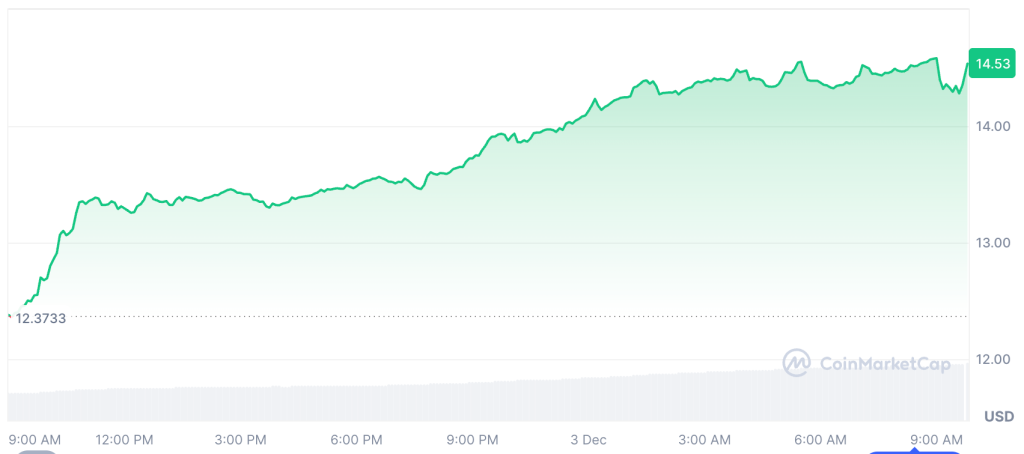
Chainlink (LINK) is now trading around $14.5 after gaining 17% on the day. It remains one of the more liquid assets outside the largest layer ones, which often helps it perform when traders return to names with established use cases.
LINK Price (Source: CoinMarketCap)
Data feeds and Oracle integrations continue to anchor its role in various applications. This stability keeps LINK active during sessions where the market is still recovering from the aftereffects of fear.
DoubleZero: Rotation Into Mid Caps
DoubleZero (2Z) is trading near $0.137 with a 25% gain in 24 hours. Market data points to rotation into mid-cap tokens after Bitcoin’s rebound. Depth across active pairs has increased, and volume sits above last week’s averages.
The project continues to benefit from attention around tokens linked to liquidity incentives and early-stage trading models. There is no single catalyst today, but sentiment toward smaller structured products has improved after last week’s panic selling.
Altcoin Season Still Restricted
Even with today’s gains, the current phase does not resemble a full altcoin season. The index remains in fear, rotation is selective, and liquidity concentrates around tokens that already have strong market structures or clear engagement routes.
Last week’s severe reading of 10 shaped expectations, and the move to 22 shows some recovery but not a return to risk-seeking behavior.
For now, the market rewards tokens with distinct use cases, firm liquidity, or new access events. The wider environment remains cautious, shaped by recent liquidations and mixed macro signals.
Altcoin season is still distant, but isolated pockets of strength show that the market is no longer locked in the extreme fear that dominated late November and early December.
Taiwan could roll out its first domestically issued stablecoin by the second half of 2026 as lawmakers move forward with legislation to regulate digital assets, though key design choices, including which currency the token will track, remain unresolved.
Key Takeaways:
Taiwan is targeting a late-2026 launch for its first domestic stablecoin pending passage of a new crypto law.
Banks will lead initial issuance as regulators coordinate closely with Taiwan’s central bank.
The choice of peg remains open, with a US dollar tie seen as easier than linking it to the Taiwan dollar.
According to local media, Financial Supervisory Commission chair Peng Jin-long told lawmakers this week that the draft Virtual Assets Service Act has cleared initial cabinet reviews and could pass its third reading in the next legislative session.
Rules specific to stablecoins would follow within six months of approval, pointing to a possible late-2026 release at the earliest.
Taiwan to Let Banks Lead Stablecoin Rollout as Regulators Tighten Controls
The draft law does not confine issuance to banks, but Peng said financial institutions will take the lead in the early stages, reflecting a cautious approach as regulators open the door to domestic digital tokens.
The FSC is coordinating policy development with the Central Bank of the Republic of China (Taiwan), which has long enforced strict controls to keep the Taiwan dollar from circulating overseas.
That constraint is shaping the stablecoin debate. A token pegged to the Taiwan dollar would collide with existing foreign-exchange rules, as the currency is not allowed to circulate offshore.
A US dollar-backed stablecoin, by contrast, would avoid the thorniest regulatory issues and align more closely with global settlement use cases tied to cross-border payments.
Stablecoins, by design, move value across borders with speed and low cost, features that could undercut decades of policy aimed at keeping the local currency onshore and preventing unofficial offshore pricing.
Regulators are now drafting guardrails requiring full reserve backing, strict segregation of client assets and domestic custody to limit risk at launch.
What remains undecided is the anchor currency itself. Peng said the final choice will depend on market demand, with no commitment yet to either the US dollar or the Taiwan dollar.
Taiwan Weighs Adding Bitcoin to National Reserves
As reported, Taiwan’s government is moving closer to integrating Bitcoin into its national reserve strategy, with the island’s Executive Yuan and Central Bank agreeing to evaluate Bitcoin as a potential strategic asset and explore pilot holdings using seized BTC currently awaiting auction.
BREAKING: TAIWAN'S CENTRAL BANK TO OFFICIALLY PILOT A STRATEGIC #BITCOIN RESERVE
The operation, led by Shi Qiren, ran more than 40 storefronts under names like “CoinW” and “BiXiang Technology,” posing as licensed exchanges while secretly funneling investor funds into overseas crypto accounts.
Authorities seized cash, crypto, and luxury assets worth over NT$100 million, while Shi faces up to 25 years in prison for fraud, money laundering, and organized crime.
The group’s success hinged on exploiting regulatory blind spots in Taiwan’s crypto oversight. By claiming false approval from the Financial Supervisory Commission, the network built investor trust, collected hefty franchise fees, and used “deposit machines” to mimic legitimate exchange operations.
Prosecutors described the scheme as “systematic fraud” that leveraged Taiwan’s crypto curiosity and weak enforcement.
Oslabujúci dolár, očakávané zníženie úrokových sadzieb americkým Fedom a rastúca aktivita na spotových ETF fondoch formujú nové podmienky pre decembrový trh. Bitcoin sa opäť obchoduje nad úrovňou 92 000 $ a aj altcoiny naznačujú zmenu trhovej dynamiky. Je december vhodným časom na nákup?
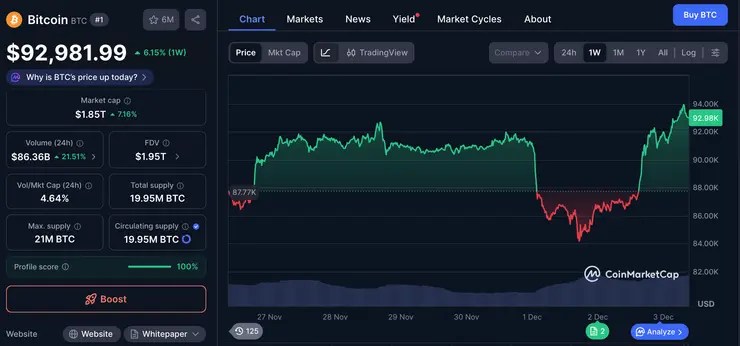
Cena Bitcoinu stúpla o viac ako 6 % za posledný týždeň
Bitcoin sa dnes obchoduje za 92 981 $. V priebehu posledných 7 dní posilnil o 6,15 % a zotavil časť novembrových strát, ktoré patrili k najvýraznejším od roku 2021. Nárast objemov v spotových ETF, najmä po tom, čo Vanguard zrušil obmedzenie obchodovania s Bitcoin ETF, podporil nový prílev kapitálu do trhu.
Len samotný fond IBIT spoločnosti BlackRock dosiahol miliardové objemy už v prvých minútach obchodovania po otvorení amerického trhu.
Zdroj: coinmarketcap.com
Prelomenie hranice 93 000 dolárov by podľa analytikov Glassnode mohlo vyvolať krátkodobý short squeeze, ktorý by cenu vystrelil smerom k 95-100 tisíc $. Zároveň platí, že pokiaľ Bitcoin zostane nad úrovňou 80 tisíc $, trh si udrží býčí výhľad. Makro faktorom dominuje očakávanie, že Fed už budúci týždeň pristúpi k zníženiu sadzieb, ktoré tradične podporuje rizikové aktíva vrátane kryptomien.
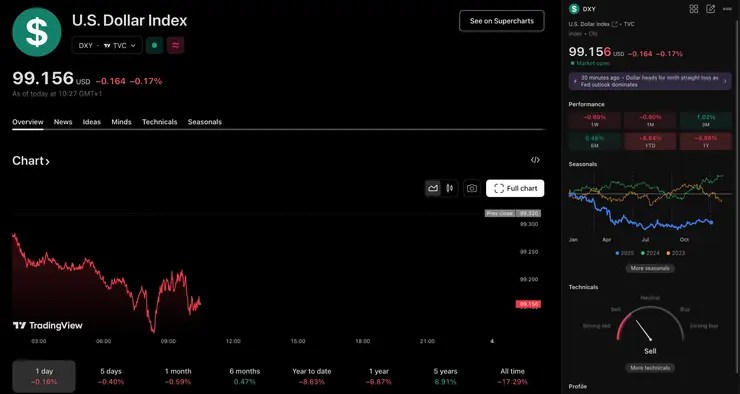
Euro posilňuje v očakávaní rozhodnutia americkej centrálnej banky. Dolár oslabil tento rok o takmer 7 %
Euro v úvode decembra posilňuje a prelomilo svoj 50-dňový kĺzavý priemer po tom, čo inflácia v eurozóne mierne prekonala očakávania. Spoločná mena sa aktuálne obchoduje pri úrovni 1,1640 dolára a smeruje k najlepšiemu ročnému výkonu od roku 2017. Trh tak reaguje na kombináciu priaznivých európskych makrodát a slabnúceho amerického dolára, ktorý v tomto roku stratil takmer 7 % hodnoty na indexe DXY.
Investori sa zároveň pripravujú na zasadnutie Federálneho rezervného systému, ktorý sa uskutoční už budúci týždeň. Podľa údajov platformy Polymarket vyskočila pravdepodobnosť, že Fed pristúpi k ďalšiemu zníženiu sadzieb až 93 %.
Práve toto očakávanie patrí medzi hlavné dôvody oslabenia dolára. Americká mena sa totiž stáva menej atraktívnou v prostredí, kde sa úrokový diferenciál medzi USA a ostatnými ekonomikami rýchlo zužuje. Odborníci upozorňujú, že aj malé náznaky holubičej rétoriky Fedu by mohli spôsobiť ďalší pokles dolára v druhej polovici decembra.
Zdroj: tradingview.com
Naopak, Európska centrálna banka neplánuje bezprostredné znižovanie sadzieb a trhy započítavajú iba približne 25 % pravdepodobnosť uvoľnenia menovej politiky v roku 2026. Tento kontrast medzi Fedom a ECB hrá v prospech eura, ktoré zostáva podporované stabilnou politikou ECB a slabnúcou americkou menou.
Makro pohyby na devízových trhoch tak vytvárajú prostredie priaznivé pre rizikové aktíva vrátane kryptomien. Slabší dolár totiž historicky podporuje dopyt po Bitcoine, altcoinoch a ďalších volatilnejších aktívach.
Altcoiny naznačujú budúci rast. Ethereum si polepšilo o 9 %
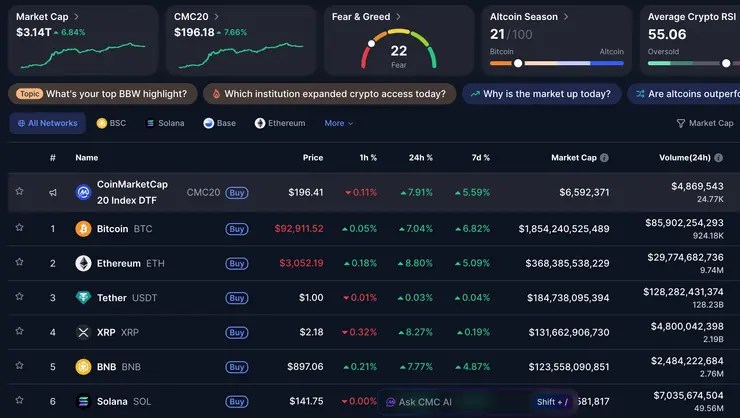
Popri Bitcoine sa nálada zlepšuje aj v segmentealtcoinov. Celková trhová kapitalizácia kryptomien stúpla na 3,14 bilióna dolárov, čo predstavuje 6,84 % denný nárast. A práve altcoiny ťahajú značnú časť tohto impulzu. Ethereum (ETH) vzrástlo za posledných 24 hodín o 8,80 % a jeho cena sa drží nad 3 052 dolármi. Rast podporuje návrat likvidity na trh a klesajúca dominancia Bitcoinu, ktorá vytvára priestor pre širšiu altcoinovú rally.
Zdroj: coinmarketcap.com
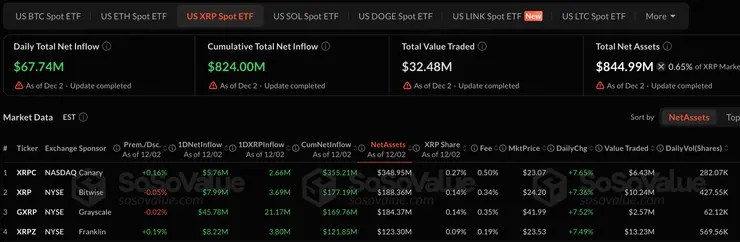
XRP taktiež potvrdzuje posilnenie sentimentu. S 8,27 % denným nárastom patrí medzi najvýkonnejšie veľké altcoiny, pričom jeho trhová kapitalizácia presiahla už 131,6 miliardy dolárov. Súčasne rastie aj dopyt po XRP ETF fondoch, ktoré pritiahli tento týždeň už viac ako 157 miliónov dolárov.
Súčasne, natívna kryptomena populárneho blockchainu pre meme coiny Solana (SOL), si pripísala za posledný deň 12 %. Celkovo si tak polepšila o takmer 4 % za týždeň. Záujem investorov podporuje vysoká aktivita v DeFi a rastúce množstvo nových aplikácií v jej ekosystéme.
Zdroj: sosovalue.com
Stablecoin Tether (USDT) zostáva najväčším zdrojom likvidity na trhu, čo je viditeľné z vysokého 24-hodinového objemu 128,2 miliardy dolárov Ide o jasný signál, že obchodníci aktívne rotujú kapitál medzi hlavnými altcoinmi. Súčasné trhové ukazovatele vytvárajú konzistentný obraz prostredia, v ktorom sa altcoiny presadzujú čoraz výraznejšie.
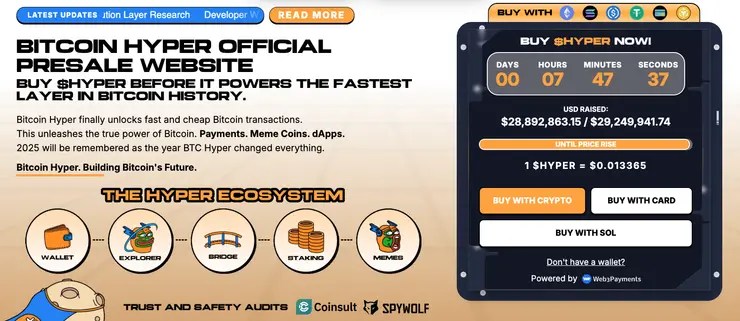
Rastový impulz v segmente altcoinov zároveň vytvára priaznivé podmienky pre nové kryptomeny, ktoré práve v tomto období vstupujú na trh. Investori po mesiacoch opatrnosti opäť rozširujú expozíciu voči projektom s vyšším potenciálom, čo zvyšuje záujem o kvalitné predpredaje. V tejto skupine aktuálne dominuje projekt Bitcoin Hyper, ktorý počas prebiehajúceho predpredaja už získal viac než 28 miliónov dolárov.
Layer 2 architektúra Bitcoin Hyper prináša pre BTC novú úroveň využitia
Základom projektu Bitcoin Hyper (HYPER) je snaha prepojiť vysokú bezpečnosť Bitcoinovej siete s výkonnosťou moderných blockchainových architektúr. HyperChain používa Solana Virtual Machine (SVM) ako výpočtovú vrstvu, no finálne osadenie transakcií sa rieši na Bitcoinovom Layer 1.
V praxi to znamená, že DeFi aplikácie môžu využívať nízke poplatky a vysoké TPS, kým Bitcoin zostáva konečnou autoritou pre zúčtovanie. Súčasťou riešenia je aj mechanizmus canonical bridge, v ktorom sa BTC uzamkne na základnej vrstve a jeho zabalená verzia sa následne používa v prostredí Bitcoin Hyper. Tým sa otvára priestor pre reálne ekonomické aktivity, ktoré Bitcoin doteraz nepodporoval.
Zdroj: bitcoinhyper.com
Natívny token HYPER zohráva v ekosystéme ústrednú úlohu. Držitelia ho využijú ako:
platidlo na úhradu transakčných poplatkov
zdroj pasívnych príjmov za staking (aktuálne ponúka 40 % APY)
hlasovacie právo pri rozhodovaní o budúcom vývoji ekosystému v rámci DAO
investičný nástroj na zhodnotenie kapitálu v trhovom prostredí
Aktuálna cena kryptomeny HYPER v predpredaji je 0,013365 $, pričom do uzavretia predpredaja zostáva už len niekoľko dní. Silný záujem retailových investorov dopĺňajú aj výrazné kapitálové vstupy zo strany veľrýb, čo zvyšuje dôveru v dlhodobejšiu víziu projektu.
Pre mnohých investorov predstavuje Bitcoin Hyper riešenie, ktoré môže Bitcoinu priniesť funkcionalitu, aká mu doteraz chýbala. Nová Layer-2 vrstva umožňuje obchodníkom aj vývojárom využívať BTC v moderných decentralizovaných aplikáciách, pokročilých DeFi riešeniach, ekosystémoch založených na meme tokenoch či v rámci smart kontraktov.
Tvorcovia projektu zároveň stavili na výraznú vizuálnu identitu, ktorá pracuje s hravým a virálnym potenciálom značky. Novú sieť reprezentuje postava Hyper, využívaná v meme formáte s estetikou superhrdinu, ktorá sprevádza jednotlivé fázy vývoja projektu.
Tento prístup podporuje aktívnu a angažovanú komunitu, uľahčuje odlíšenie od ostatných projektov a prispieva k rýchlemu budovaniu povedomia ešte pred uvedením tokenu na trh.
Token nájdete na domovskej stránke projektu a tiež priamo v aplikácii kryptopeňaženky Best Wallet. Nákupný widget akceptuje kryptomeny ETH, BNB, USDT a tiež platbu kartou.

 Login
Login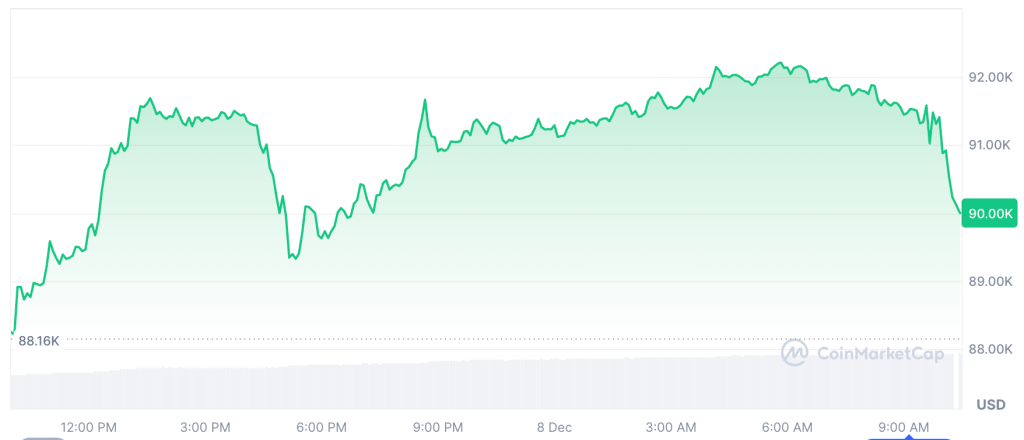





 Ten European banks are building a euro stablecoin under Dutch Central Bank oversight.

 (@MetaMask)
 ),…
),… 


 XRP (-31% in the past 2 months), unlike Bitcoin, is seeing the most fear, uncertainty, & doubt (FUD) since October, according to our social data.
 Circles indicate days where there are abnormally higher BULLISH comments compared to BEARISH comments, about XRP (Greed Zone)…

 (@avax)








 Zdroj: coinmarketcap.com
 Zdroj: tradingview.com
 Zdroj: coinmarketcap.com
 Zdroj: sosovalue.com
 Zdroj: bitcoinhyper.com