❌

Reading view

There are new articles available, click to refresh the page.

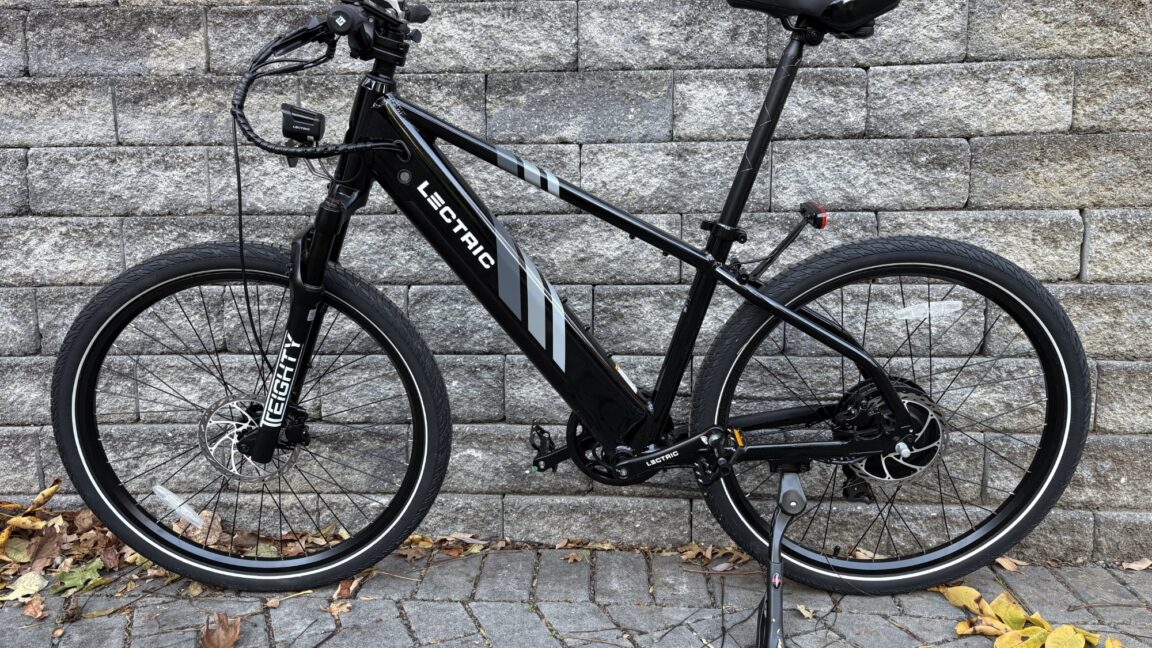
A big bike on a budget: Lectric’s XPress 750

Almost every bit of bike testing I’ve done starts out the same way. After assembling the bike, I set the seatpost to its maximum possible height, take it on a short test ride, and try to figure out new and creative phrasing to describe the same old problem: The frame isn’t quite big enough to accommodate my legs. While I’m on the tall side at a bit over 6 feet (~190 cm), I’m definitely not abnormally large. Yet very few e-bike manufacturers seem to be interested in giving people my height a comfortable ride.

So imagine my surprise when, within two blocks of my first ride on the XPress 750, I had to pull off to the side of the street and lower the seat. This was especially notable given that the XPress is a budget bike (currently on sale for just under $1,000.00) that is only offered in a single frame size. So kudos to Lectric for giving me a comfortable and enjoyable ride, and doing so with a lot of features I wouldn’t expect at this price point.

That said, hitting that price necessitated some significant compromises. We’ll discuss those in detail so you can get a sense of whether any of them will get in the way of your riding enjoyment.
Read full article

Comments

Β© John Timmer

Hydrofoil Bikes Are Harder To Build Than You Think

By: Lewin Day

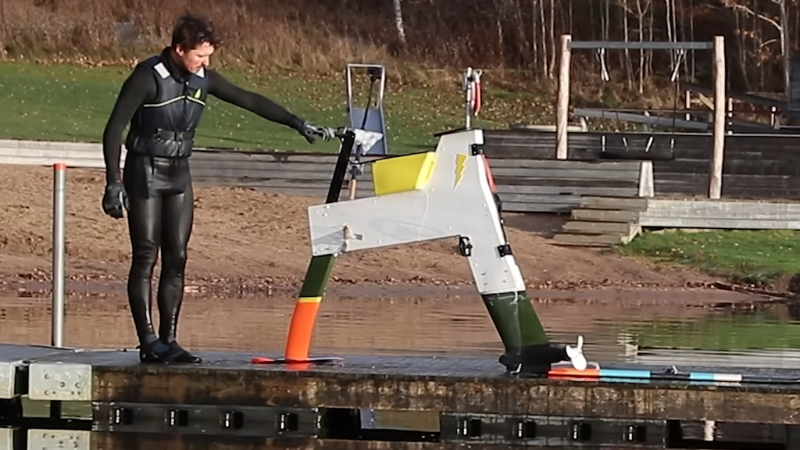
Hydrofoils are perhaps best known for their application on boring ferries and scary boats that go too fast. However, as [RCLifeOn] demonstrates, you can also use them to build fun and quirky personal watercraft. Like a hydrofoil bike! Only, there are some challenges involved.

Hydrofoils work much like airfoils in air. The shape of the foil creates lift, raising the attached vehicle out of the water. This allows the creation of a craft that can travel more quickly because the majority of its body is not subject drag from the water. The key is to design the craft such that the hydrofoils remain at the right angle and depth to keep the craft lifted out of the water while remaining stable.

The hydrofoil bike is created out of a combination of plywood, foam, and 3D printed components. It uses a powerful brushless motor for propulsion, and that’s about it. Sadly, despite the simplicity, it wasn’t an instant success. As you might expect, balancing on the bike is quite difficult, particularly when trying to get it startedβ€”as the foils need some speed to actually start generating meaningful lift.

After further research into commercial hydrofoil bikes, [RCLifeOn] realized that the buoyancy of the bike made it too hard to straddle when starting out. Some of the 3D printed foils also proved more than a little fragile.Β It’s back to the drawing board for nowβ€”the power system is likely up to snuff, but the dynamics of the platform need work. It’s perhaps no surprise; we’ve covered the challenges of hydrofoil stability before. If you want to go fast on water, you could go the easier route and just build an electric surfboard. Video after the break.

Using the Pyroelectric Effect to Identify Broken MLCC Capacitors

Vintage computer hardware can fail in a variety of fascinating ways, with [Bits und Bolts] dealing with an interesting failure mode, in the form of degraded MLCC capacitors on Voodoo 2 graphics cards. These little marvels of miniaturized surface-mount technology enable the placement of ceramic capacitors with very little space required, but as they degrade over time or due to physical damage, they can cause big issues in a circuit.

In the case of the two Voodoo 2 GPUs that [Bits und Bolts] was trying to fix, the clue that something was wrong was graphical glitches, which seemed to be related to something dragging down the 5V rail. Using the standard β€˜inject voltage and see what gets hot’ method, he discovered a couple of dead MLCCs and replaced them. But something was still dragging the rail down. Unfortunately, whatever it was wasn’t enough to heat up the part in question, and no sane person wants to desolder hundreds or even thousands of MLCCs on a PCB and see whether it makes a difference.

Ultimately, the pyroelectric effect was used to hunt down the culprit, saving countless hours of work. This is a property of certain naturally electrically polarized crystals, in which the material generates a voltage when heated or cooled. Materials like that used in MLCCs, for example.

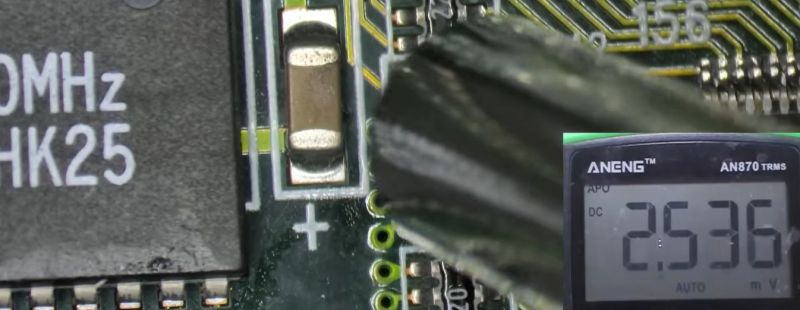
With a hot air gun set to 200 Β°C and aimed at a specific MLCC, it was possible to measure changes not only in resistivity but also in voltage between the 5V rail and ground. The voltage spike was relatively minor for the smaller MLCCs, but the larger ones showed a significant voltage swing of around 2.5mV.

The culprit turned out to be a large MLCC, which showed only a weak pyroelectric effect and a resistivity that didn’t drop as quickly as that of similar MLCCs on the same board. After replacement, the faulty MLCC did indeed measure as faulty, and the card’s 5V rail now showed a healthy resistance level to ground.

In addition to knowing what kind of resistivity you should measure on a PCB’s voltage rails relative to ground, this method provides a fairly painless way to quickly find a dodgy MLCC. Just make sure not to try this method on electrolytic or tantalum. Heating those up won’t go well.

We often treat decoupling capacitors as more art than science, but of course, we shouldn’t. MLCCs can even exhibit the piezoelectric effect, too.

❌