Reading view

There are new articles available, click to refresh the page.

OPM’s plan to unify disparate HR systems taking shape

The government’s dispersed systems for managing human resources for the federal workforce are on the verge of a major transformation, according to the Office of Personnel Management.

By January, OPM said it expects to award a federal contract that will eventually result in a cohesive HR system for all agencies to use. But in the short term, creating a governmentwide HR entity will mean working to consolidate the more than 100 systems agencies currently use for workforce management.

It’s not the first time OPM has attempted to merge the disparate HR IT systems across government. But Dianna Saxman, OPM’s associate director of HR Solutions, said the effort currently underway is “different.”

“We’re really leveraging the collective wisdom of the entire federal community,” Saxman said Tuesday during a public meeting of the Chief Human Capital Officers (CHCO) Council. “We’ve already brought experts from many different agencies into a steering committee that is helping us to set the strategy up front.”

Along with employing a steering committee at OPM, Saxman said many federal human capital leaders have started collaborating internally with other agency executives, like chief information officers and chief data officers, to plan the integration of the upcoming HR system.

“What we’re seeing in these agency engagements is a lot of enthusiasm and support for the overall effort,” Saxman said.

Once implemented, the new system will be the source for agencies, HR offices and federal employees to manage personnel records, payroll systems and performance data, while also having the capability to provide federal workforce analytics.

After OPM awards the HR IT contract in January, the agency will spend the next several months implementing the core HR system by the end of April. From there, OPM plans to work one-on-one with agencies to configure the platform to meet their unique needs.

All told, OPM’s end goal is to have the HR IT system fully adopted governmentwide by September 2027.

The value of the anticipated contract award in January is not yet clear. But it comes after OPM released a request for proposals (RFP) in October, detailing a specific plan of action to modernize and centralize the more than 100 current federal HR systems.

In May, OPM had previously released its initial RFP through the General Services Administration schedules program, which emphasized the need for interoperability in governmentwide human capital systems. The May RFP came just weeks after OPM initially announced a sole source award to Workday in early May, but then quickly canceled that award.

The expected timing for awarding the HR IT contract also “aligns beautifully” with the Trump administration’s newly released President’s Management Agenda, Saxman said. She highlighted three key goals in the new agenda that dovetail with the HR IT consolidation effort.

For one, a centralized HR IT platform would underly the administration’s goal of fostering a “merit-based” federal workforce, Saxman explained.

“As we look to foster greater merit, we’re able to do that by having an end-to-end HR IT capability that allows us really to see what’s happening with the federal workforce, with skillsets we have available [and] how people are being promoted and evaluated,” Saxman said. “This gives us that visibility.”

The Trump administration’s goal of making “buying power” more efficient calls for consolidated contract opportunities that are “smarter, faster, cheaper,” according to another component of the new PMA.

“A lot of the contracting processes in government are really decentralized, and there’s a lot of repetitive action there,” Saxman said. “This effort seeks to centralize the purchasing of a private sector core human capital capability at OPM — we would have one entity buying it on behalf of the entire federal government.”

On top of that, Saxman noted that OPM’s effort aligns with the goal of leveraging technology, as the PMA seeks to “consolidate and standardize systems,” while also incorporating “digital-first” government services and eliminating data siloes.

“We’re going to be consolidating over 100 systems into one, reducing the number of system integrations that are required and the complexity of managing all of these systems,” she said.

Saxman outlined what she said will eventually be an array of benefits for agencies, HR offices, federal employees and external stakeholders, once legacy HR systems are decommissioned and the new system is fully implemented.

“There are many manual data requests that come out from OPM, many different stakeholder groups,” she said. “But we’ll have an opportunity where the data will be readily available in dashboards, so we can have a real view of what’s happening with the federal workforce at any point in time.”

OPM also hopes to ease the workload for HR employees by eventually moving all personnel records to single files, even when employees transition between multiple agencies throughout their career. Currently many federal employees have personnel records that span across multiple different HR systems.

“Our goal here is to have one system that they can manage their employee record,” Saxman said.

For signs of success, Saxman said OPM will be measuring and looking for improvements in employee experience, cost savings and better data overall.

“A lot of our HR professionals are working with outdated, disparate technologies that are not serving them well, that are not serving our employees well,” Saxman said. “As a federal community, this is something that we have wanted to do for a long time.”

The post OPM’s plan to unify disparate HR systems taking shape first appeared on Federal News Network.

© Getty Images/VectorInspiration

Human resources search, resume and recruitment, human resources department holding magnifying glass to select resume

Bitcoin Addresses Holding Over 0.1 BTC Haven’t Grown in Two Years, What Does This Mean?

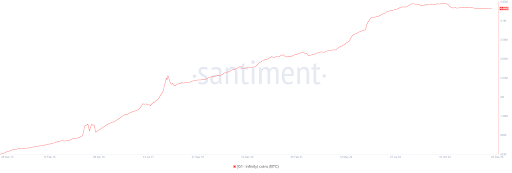
Since Bitcoin’s launch, the number of addresses holding more than 0.1 BTC has climbed steadily through every market cycle, until now. Data shows that addresses in this cohort haven’t grown at all over the past two years, breaking a trend that held for more than a decade. 

The stagnation indicates a change in how smaller and mid-sized investors engage with Bitcoin, even as broader institutional activity in the market continues to rise.

Small Holder Participation Reaches A Standstill

The 0.1 BTC threshold has historically represented an important milestone for retail holders, large enough to signal commitment but small enough to remain widely attainable. For more than a decade, wallets crossing that line grew year after year, even during drawdowns when long-term buyers were accumulating quietly.

That pattern is no longer intact. The number of addresses with more than 0.1 BTC has flattened since 2023 and is showing no signs of returning to its previous trajectory. Particularly, data from the on-chain analytics platform Santiment shows that the number of these addresses has stalled at around 4.44 million for the past year. This suggests that fewer new participants are choosing to build self-custodied Bitcoin positions at this level.

Bitcoin

The stagnation becomes more notable considering Bitcoin’s rising mainstream visibility and repeated pushes toward new all-time highs this year. In earlier cycles, such conditions have led to a surge in retail accumulation. This time, the address count has stayed frozen, and this means retail addresses holding Bitcoin might actually be plateauing. 

How Bitcoin’s Holder Base Is Changing

Although on-chain data points to a slowdown in the growth of overall Bitcoin addresses holding more than 0.1 BTC, it doesn’t necessarily signal a decline in overall adoption. For many market participants, Bitcoin exposure now happens entirely off-chain.

Larger investor cohorts, from high-net-worth individuals to funds and corporate entities, are buying huge amounts of Bitcoin. For instance, Santiment data shows that large Bitcoin holders controlling more than 100 BTC have increased their balances throughout 2024 and 2025, even as smaller address cohorts have stalled.

At the same time, more investors are choosing to access Bitcoin through custodial avenues instead of managing their own wallets. Spot Bitcoin ETFs have become one of the most important gateways for new BTC exposure. In the US alone, Spot Bitcoin ETFs now control almost $120 billion worth of Bitcoin, with BlackRock’s IBIT consistently recording the strongest demand. 

Together, these developments point to a new phase in Bitcoin’s development. What was once dominated by individual self-custodied users is now increasingly shaped by institutions, ETFs, funds, and professionally managed capital. Therefore, the numbers from on-chain wallet metrics reflect a smaller portion of the actual user base.

Bitcoin

Court: “Because Trump said to” may not be a legally valid defense

On Monday, US District Court Judge Patti Saris vacated a Trump executive order that brought a halt to all offshore wind power development, as well as some projects on land. That order had called for the suspension of all permitting for wind power on federal land and waters pending a review of current practices. This led states and an organization representing wind power companies to sue, claiming among other things that the suspension was arbitrary and capricious.

Over 10 months since the relevant government agencies were ordered to start a re-evaluation of the permitting process, testimony revealed that they had barely begun to develop the concept of a review. As such, the only reason they could offer in defense of the suspension consisted of Trump’s executive order and a Department of the Interior memo implementing it. “Whatever level of explanation is required when deviating from longstanding agency practice,” Judge Saris wrote, “this is not it.”

Lifting Trump’s suspension does not require the immediate approval of any wind projects. Instead, the relevant agencies are likely to continue following Trump’s wishes and slow-walking any leasing and licensing processes, which may force states and project owners to sue individually. But it does provide a legal backdrop for any suits that ultimately occur, one in which the government’s actions have little justification beyond Trump’s personal animosity toward wind power.

Read full article

Comments

© PHILIP FONG

Shiba Inu’s Volume Explosion: Leading Meme Coin Barrels Ahead In This Metric

Shiba Inu has recorded a notable surge in spot trading activity on several exchanges over the last seven days. This provides a bullish outlook for the second-largest meme coin by market cap, which has been one of the underperformers in this market cycle

Shiba Inu Sees Surge In Spot Trading Activity

CoinGlass data show a 154% surge in Shiba Inu USD spot trading volume on Kraken over the last seven days. There has also been a significant surge on other major exchanges, such as Binance, Bybit, OKX, and Gemini, during the same period. This indicates that spot buyers may be stepping in to defend the SHIB price at a critical support amid the broader crypto market decline

Notably, Shiba Inu is one of the altcoins that are in the green over the last week, suggesting that the bulls may be in control at the moment. CoinMarketCap data shows that the second-largest meme coin by market cap is up almost 7% during this period despite Bitcoin’s choppy price action. 

Meanwhile, further data from CoinGlass also shows that most leverage traders are currently betting on an increase in the Shiba Inu price, with the long/short ratio currently above 1. However, it is worth noting that derivatives volume is down by over 10% and open interest is down by almost 4%, which presents a bearish outlook for the meme coin. 

Another positive for Shiba Inu, besides the surge in spot trading volume, is that the Fed is likely to cut interest rates again at this week’s FOMC meeting. This could inject more liquidity into the crypto market, with altcoins like SHIB benefiting from it. Meanwhile, Bitcoin is currently looking to hold above the psychological $90,000 level, which could pave the way for higher prices for SHIB given their positive correlation.  

Community Gives Update On SHIB’s Progress

In an X post, Shiba Inu community member Shibizens gave an update on SHIB’s progress over the last few days. The community member noted that over 45 billion SHIB have been moved off exchanges, indicating that holders are accumulating. Shibizens also alluded to a $35 million whale transfer into a private wallet, suggesting that SHIB whales are also bullish. 

Furthermore, Coinbase is set to launch Shiba Inu futures on December 12 for institutional and retail investors, which could boost the meme coin’s adoption. Meanwhile, NYSE Arca has filed the 19b-4 for T. Rowe’s Shiba Inu ETF, bringing the ETF one step closer to launch. 

Shibuzens also highlighted upgrades on the Shibarium network, which could provide a major boost for SHIB. This includes the RPC upgrade, while a full privacy upgrade has been confirmed using encrypted tech. There are plans to roll this out by next year. 

At the time of writing, the Shiba Inu price is trading at around $0.000008498, up in the last 24 hours, according to data from CoinMarketCap.

Shiba Inu

Green AI: A complete implementation framework for technical leaders and IT organizations

When we first began exploring the environmental cost of large-scale AI systems, we were struck by a simple realization: our models are becoming smarter, but our infrastructure is becoming heavier. Every model training run, inference endpoint and data pipeline contributes to an expanding carbon footprint.

For most organizations, sustainability is still treated as a corporate initiative rather than a design constraint. However, by 2025, that approach is no longer sustainable, either literally or strategically. Green AI isn’t just an ethical obligation; it’s an operational advantage. It helps us build systems that do more with less (less energy, less waste and less cost) while strengthening brand equity and resilience.

What if you could have a practical, end-to-end framework for implementing green AI across your enterprise IT? This is for CIOs, CTOs and technical leaders seeking a blueprint for turning sustainability from aspiration into action.

Reframing sustainability as an engineering discipline

For decades, IT leaders have optimized for latency, uptime and cost. It’s time to add energy and carbon efficiency to that same dashboard.

A 2025 ITU Greening Digital Companies report revealed that operational emissions from the world’s largest AI and cloud companies have increased by more than 150% since 2020. Meanwhile, the IMF’s 2025 AI Economic Outlook found that while AI could boost global productivity by 0.5% annually through 2030, unchecked energy growth could erode those gains.

In other words, AI’s success story depends on how efficiently we run it. The solution isn’t to slow innovation, it’s to innovate sustainably.

When sustainability metrics appear beside core engineering KPIs, accountability follows naturally. That’s why our teams track energy-per-inference and carbon-per-training-epoch alongside latency and availability. Once energy becomes measurable, it becomes manageable.

The green AI implementation framework

From experience in designing AI infrastructure at scale, we’ve distilled green AI into a five-layer implementation framework. It aligns with how modern enterprises plan, build and operate technology systems.

1. Strategic layer: Define measurable sustainability objectives

Every successful green AI initiative starts with intent. Before provisioning a single GPU, define sustainability OKRs that are specific and measurable:

  • Reduce model training emissions by 30% year over year
  • Migrate 50% of AI workloads to renewable-powered data centers
  • Embed carbon-efficiency metrics into every model evaluation report

These objectives should sit within the CIO’s or CTO’s accountability structure, not in a separate sustainability office. The Flexera 2025 State of the Cloud Report found that more than half of enterprises now tie sustainability targets directly to cloud and FinOps programs.

To make sustainability stick, integrate these goals into standard release checklists, SLOs and architecture reviews. If security readiness is mandatory before deployment, sustainability readiness should be, too.

2. Infrastructure layer: Optimize where AI runs

Infrastructure is where the biggest sustainability wins live. In our experience, two levers matter most: location awareness and resource efficiency.

  • Location awareness: Not all data centers are equal. Regions powered by hydro, solar or wind can dramatically lower emissions intensity. Cloud providers such as AWS, Google Cloud and Azure now publish real-time carbon data for their regions. Deploying workloads in lower-intensity regions can cut emissions by up to 40%. The World Economic Forum’s 2025 guidance encourages CIOs to treat carbon intensity like latency, something to optimize, not ignore.
  • Resource efficiency: Adopt hardware designed for performance per watt, like ARM, Graviton or equivalent architectures. Use autoscaling, right-sizing and sleep modes to prevent idle resource waste.

Small architectural decisions, replicated across thousands of containers, deliver massive systemic impact.

3. Model layer: Build energy-efficient intelligence

At the model layer, efficiency is about architecture choice. Bigger isn’t always better; it’s often wasteful.

A 2025 study titled “Small is Sufficient: Reducing the World AI Energy Consumption Through Model Selection” found that using appropriately sized models could cut global AI energy use by 27.8% this year alone.

Key practices to institutionalize:

  • Model right-sizing: Use smaller, task-specific architectures when possible.
  • Early stopping: End training when incremental improvement per kilowatt-hour falls below a threshold.
  • Transparent model cards: Include power consumption, emissions and hardware details.

Once engineers see those numbers on every model report, energy awareness becomes part of the development culture.

4. Application layer: Design for sustainable inference

Training gets the headlines, but inference is where energy costs accumulate. AI-enabled services run continuously, consuming energy every time a user query hits the system.

  • Right-sizing inference: Use autoscaling and serverless inference endpoints to avoid over-provisioned clusters.
  • Caching: Cache frequent or identical queries, especially for retrieval-augmented systems, to reduce redundant computation.
  • Energy monitoring: Add “energy per inference” or “joules per request” to your CI/CD regression suite.

When we implemented energy-based monitoring, our inference platform reduced power consumption by 15% within two sprints, without any refactoring. Engineers simply began noticing where waste occurred.

5. Governance layer: Operationalize GreenOps

Sustainability scales only when governance frameworks make it routine. That’s where GreenOps comes in — the sustainability counterpart to FinOps or DevSecOps.

A GreenOps model standardizes:

  • Energy and carbon tracking alongside cloud cost reporting
  • Automated carbon-aware scheduling and deployment
  • Sustainability scoring in architecture and security reviews

Imagine a dashboard that shows Model X: 75% carbon-efficient vs. baseline: Inference Y: 40% regional carbon optimization. That visibility turns sustainability from aspiration to action.

Enterprise architecture boards should require sustainability justification for every major deployment. It signals that green AI is not a side project, it’s the new normal for operational excellence.

Building organizational capability for sustainable AI

Technology change alone isn’t enough; sustainability thrives when teams are trained, empowered and measured consistently.

  1. Training and awareness: Introduce short sustainability in software modules for engineers and data scientists. Topics can include power profiling, carbon-aware coding and efficiency-first model design.
  2. Cross-functional collaboration: Create a GreenOps guild or community of practice that brings together engineers, product managers and sustainability leads to share data, tools and playbooks.
  3. Leadership enablement: Encourage every technical leader to maintain an efficiency portfolio: a living document of projects that improve energy and cost performance. These portfolios make sustainability visible at the leadership level.
  4. Recognition and storytelling: Celebrate internal sustainability wins through all-hands or engineering spotlights. Culture shifts fastest when teams see sustainability as innovation, not limitation.

Measuring progress: the green AI scorecard

Every green AI initiative needs a feedback loop. We use a green AI scorecard across five maturity dimensions:

DimensionKey metricsExample target
Strategy% of AI projects with sustainability OKRs100%
InfrastructureCarbon intensity (kg CO₂e / workload)−40% YoY
Model efficiencyEnergy per training epoch≤ baseline − 25%
Application efficiencyJoules per inference≤ 0.5 J/inference
Governance% of workloads under GreenOps90%

Reviewing this quarterly, alongside FinOps and performance metrics, keeps sustainability visible and actionable.

Turning sustainability into a competitive advantage

Green AI isn’t just about responsibility — it’s about resilience and reputation.

A 2025 Global Market Insights report projects the green technology and sustainability market to grow from $25.4 billion in 2025 to nearly $74 billion by 2030, driven largely by AI-powered energy optimization. The economic logic is clear: efficiency equals competitiveness.

When we introduced sustainability metrics into engineering scorecards, something remarkable happened: teams started competing to reduce emissions. Optimization sprints targeted GPU utilization, quantization and memory efficiency. What began as compliance turned into competitive innovation.

Culture shifts when sustainability becomes a point of pride, not pressure. That’s the transformation CIOs should aim for.

Leading the next wave of sustainable AI innovation

The next era of AI innovation won’t be defined by who has the biggest models, but by who runs them the smartest. As leaders, we have the responsibility and opportunity to make efficiency our competitive edge.

Embedding sustainability into every layer of AI development and deployment isn’t just good citizenship. It’s good business.

When energy efficiency becomes as natural a metric as latency, we’ll have achieved something rare in technology: progress that benefits both the enterprise and the planet.

The future of AI leadership is green, and it starts with us.

This article is published as part of the Foundry Expert Contributor Network.
Want to join?

Bitcoin Active Addresses Slide As ETF Era Rewires Market Participation — Here’s Why

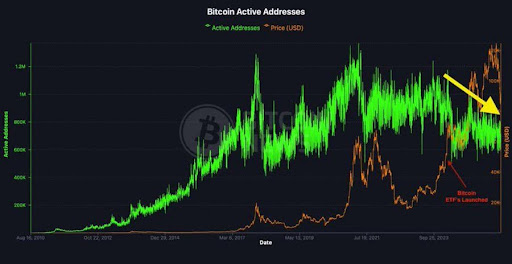
Bitcoin’s on-chain activity has shown a sharp slowdown since spot Bitcoin exchange-traded funds (ETFs) launched. While institutional inflows into these products have accelerated, the number of active BTC addresses has declined. As Wall Street embraces BTC exposure, the network’s grassroots participation appears to be undergoing a significant transformation.

In an X post, the CEO of SwanDesk, financial analyst Jacob King, pointed out that Bitcoin active addresses have been in a steady decline since the US spot BTC ETFs launched in January 2024, and the irony is obvious.

Why Retail Participation Shows Signs Of Fatigue

 For years, BTC maximalists have pushed for Wall Street adoption, believing institutional involvement would unlock the next wave of mass usage. Instead, on-chain participation has dropped sharply as retail lost interest.

King noted that these Bitcoiners have piled into the ETF for a quick, early FOMO bump, and then bailed, leaving behind a market where the asset is increasingly traded by proxy. According to King, ETF investing kills BTC’s core principles. While investors no longer hold or control their own assets as banks do, which is the very system BTC was designed to challenge, greed always beats ideology.

Bitcoin

Market watcher Crypto Seth has revealed that the net inflows into BlackRock and Fidelity’s spot BTC ETFs have been relatively subdued since October 10, when the largest liquidation events happened. Seth believes that this might turn into a momentum reversal soon, as the US stock market is at 1% below new highs despite retail sentiment remaining stuck in extreme fear.

Seth also pointed out that the macro backdrop is shifting in BTC’s favor. This is because the Federal Reserve ended its Quantitative Tightening (QT) program on December 1, 2025, wrapping up a multi-year effort that shaved nearly $3 trillion from the balance sheet since 2022. 

Since the US Fed rate is still at 4.00%, more interest rate cuts are on the horizon, which is higher than both Europe and China. The BlackRock iShares BTC Trust (IBIT), which was launched in January 2024, is currently the firm’s most profitable exchange-traded fund (ETF) based on annual fee revenue, despite being less than two years old.

Unlocking Bitcoin Without Compromising Its Core Principles

Bitcoin is seeing key initiatives that improve its ecosystem. Every market cycle that has promise to unlock Bitcoin for decentralized finance (DeFi), RioSwap is one of the few products built on infrastructure that was capable of unlocking it in a truly decentralized way. 

According to Mintlayer, this was powered by Mintlayer’s native HTLC architecture, as RioSwap introduces a Decentralized Exchange (DEX) that allows BTC to move directly into decentralized markets without wrapping, unbridging, and is fully in the user’s control. With the RioSwap testnet now live, Mintlayer sees this as the start of a new liquidity phase for BTC where the asset will become an active participant in the decentralized market on its own terms.

Bitcoin

DoD goal for clean 2028 audit in jeopardy, IG finds

  • There's more discouraging news for the Pentagon’s prospects of obtaining a clean financial audit by the current 2028 deadline. A new evaluation by the Defense Department inspector general found the department’s plan to remediate one of its key, longstanding material weaknesses — an inability to keep track of government property in the possession of contractors — doesn’t appear to be working. DoD intended to fix the problem largely by tracking the contractor-managed property in a software module within the Procurement Integrated Enterprise Environment. But according to the IG, key DoD leaders haven’t mandated the use of that module, and the military services haven’t updated their own systems to properly interface with it.
  • Today marks the final day of Open Season. Enrollees in the Federal Employees Health Benefits Program have until midnight tonight to make any desired changes to their health insurance options. The open enrollment period also applies to Postal Service employees, as well as those with dental and vision coverage. Any changes made during Open Season will take effect in January.
    (Final day of Open Season - Office of Personnel Management)
  • Army Cyber Command has a new leader. Lt. Gen. Christopher Eubank officially assumed command during a ceremony on Dec. 3 at Fort Gordon, Georgia. Eubank took over for Lt. Gen. Maria Barrett, who is retiring after nearly 38 years of service and three years leading Army Cyber Command. Eubank previously served as special assistant to the commander of Army Space and Missile Defense Command. He also led the Army’s Network Enterprise Technology Command. In his new role, Eubank will lead Army cyber operations and provide Army forces to U.S. Cyber Command.
  • The Program Executive Office Command, Control, Communications and Network, or PEO C3N, is undergoing another major reorganization. As part of the Army and Defense Department-wide acquisition reform efforts, the program executive office is changing its name to the "Capability Program Executive Command, Control, Communications and Network,” or CPE C3N. The office is realigning its structure to better support the Army’s Next Generation Command and Control effort. Brig. Gen. Jack Taylor will continue to lead the organization as the capability program executive. As part of the overhaul, the organization is standing up new project offices focused on C2 applications, data and AI, infrastructure and transport.
  • An appeals court has ruled in favor of President Donald Trump’s firings of two Democratic board members. The split 2-to-1 decision of the appeals court panel has no immediate effect, since the removals of Cathy Harris at the Merit Systems Protection Board, and Gwynne Wilcox at the National Labor Relations Board, were already finalized. But Friday’s decision comes as the Supreme Court is expected to hear arguments on whether to overturn a 90-year-old ruling known as Humphrey’s Executor. If the decision is overturned, it has the potential to expand the president’s power in shaping independent agencies and may further reinforce the outcomes of Harris' and Wilcox’s terminations.
  • Palo Alto Networks is joining the ever-growing list of vendors signing up for GSA's OneGov program. The cybersecurity company will now offer agencies up to a 60% discount from its schedule prices for three of its cyber tools. Agencies can now buy Palo Alto's software next generation firewall, its secure access service edge (SASE) solution and its code to cloud platform for deep discounts through January 2028. This is GSA's fifteenth OneGov agreement since it launched the program in April. Last week, GSA also signed a similar deeply discounted deal with SAP.
    (Palo Alto Networks joins GSA's OneGov program - General Services Administration)
  • Small businesses in the 8(a) program will now have a busy holiday season. The Small Business Administration is asking participants in the 8(a) contracting program for a trove of data as part of the agency's ongoing audit of the long-standing socioeconomic initiative. In a letter sent to more than 4,300 8(a) firms, SBA set a deadline of Jan. 5, 2026, for these companies to deliver 13 data sets. These include everything from a copy of the all 8(a) contracts for the last three fiscal years to full financial statements to their full general ledger. SBA said firms that fail to meet the deadline may lose their eligibility to participate in the 8(a) program and could face further investigative or remedial actions.
  • A top human resources official at the State Department who played a major role in the agency’s widespread reduction in force this summer is moving on to a new role. Lew Olowski, the chief human capital officer in the Bureau of Personnel and Training, is stepping down from that role to become the senior bureau official for the Office of Foreign Missions, according to two sources. The State Department declined to provide an on-the-record comment.

The post DoD goal for clean 2028 audit in jeopardy, IG finds first appeared on Federal News Network.

© Getty Images/Westy72

River entrance of the Department of Defense building.

Lenovo's Next Gaming Laptop May Have a Rollable OLED Screen That Stretches Ultrawide

By: msmash
Lenovo may be preparing to unveil a gaming laptop that uses rollable OLED technology to expand horizontally into an ultrawide 21:9 display, according to a Windows Latest report suggesting the device could appear at CES 2026 in January. The Lenovo Legion Pro Rollable would differ from the company's existing ThinkBook Plus Gen 6, which expands its screen vertically. The new gaming-focused design would see the left and right edges of the display extend beyond the laptop's base chassis when unrolled. Specific details remain scarce. Windows Latest doesn't know the display resolution, refresh rate, screen dimensions in either state, pricing, or release timing -- though it does mention an Intel Core Ultra processor. The ThinkBook Plus Gen 6 currently sells for $3,500.

Read more of this story at Slashdot.

Meta offers EU users ad-light option in push to end investigation

Meta has agreed to make changes to its “pay or consent” business model in the EU, seeking to agree to a deal that avoids further regulatory fines at a time when the bloc’s digital rule book is drawing anger from US authorities.

On Tuesday, the European Commission announced that the social media giant had offered users an alternative choice of Facebook and Instagram services that would show them fewer personalized advertisements.

The offer follows an EU investigation into Meta’s policy of requiring users either to consent to data tracking or pay for an ad-free service. The Financial Times reported on optimism that an agreement could be reached between the parties in October.

Read full article

Comments

© Derick Hudson

XRP Mixed Signals: Latest Metrics Point To A Market At Crossroads

On Sunday, XRP staged a bounce to the $2.1 price level, flipping the market into a bullish atmosphere. However, on-chain metrics are flashing conflicting signals as the market splits between bullish and bearish narratives due to a disparity in investors’ actions on major exchanges.

A Two-Sided XRP Market Mood Emerges

XRP, a leading altcoin, has sent one of its most perplexing signals in recent months, leaving traders unsure about what to expect next in the market or price. Arthur, a market expert and official partner of the BingX crypto exchange, has outlined a distinct behavior among investors in two regions.

According to the market expert, the altcoin is exhibiting a mixed signal right now after examining the activity of investors on the Binance and Bithumb exchanges. Currently, investors on the Binance exchange are demonstrating bullish activity while those on Bithumb are displaying signs of weakening sentiment and uncertainty.

On the Binance side, Arthur noted that the supply of XRP on the exchange is experiencing a steady decline. This persistent withdrawal from the largest cryptocurrency exchange in the world is mostly carried out by large investors known as whale holders, which is causing a tightening supply.

XRP

Such a pattern extends beyond simple reshuffling from these key investors. Furthermore, it points to a strategic move by wealthy investors, who usually take action ahead of more general market trends. Historically, the movement of these high-value wallets’ assets away from centralized exchanges is a sign that the cohort could be getting ready for an impending market catalyst.

Meanwhile, on Upbit and Bithumb, the expert reported that there is a steady flow of XRP into the two largest crypto exchanges in South Korea. When coins flow into exchanges, it usually points to short-term selling pressure, suggesting that investors in the Asian region are currently locking in profits.

Heightened Demand For The Altcoin Via ETFs

Demand for XRP is still waxing strong in certain key areas, especially the Spot Exchange-Traded Funds (ETFs). Following weeks of market turbulence, institutional appetite for the altcoin appears to have increased, creating a strong new tailwind.

In another X post, Arthur reported that the altcoin has experienced steady inflows over the last 15 days, signifying the longest continuous run since funds tracking the token started trading. Within this timeframe, the expert highlighted that the funds have recorded a whopping $900 million Asset Under Management (AUM). 

Despite modest price movement, this consistent flow of funds indicates that big investors are discreetly increasing exposure, indicating growing confidence in XRP’s long-term prospects. With the Clarity Act set to gain approval, the expert is confident that the development could attract more inflows into the funds. It may also see retail investors, institutional investors, and ETFs moving in a single direction.

XRP

Please send help. I can’t stop playing these roguelikes.

It’s time to admit, before God and the good readers of Ars Technica, that I have a problem. I love roguelikes. Reader, I can’t get enough of them. If there’s even a whisper of a hot new roguelike on Steam, I’m there. You may call them arcane, repetitive, or maddeningly difficult; I call them heaven.

The second best part of video games is taking a puny little character and, over 100 hours, transforming that adventurer into a god of destruction. The best thing about video games is doing the same thing in under an hour. Beat a combat encounter, get an upgrade. Enter a new area, choose a new item. Put together a build and watch it sing.

If you die—immediately ending your ascent and returning you to the beginning of the game—you’ll often make a pit stop at a home base to unlock new goodies to help you on your next run. (Some people distiguish between roguelikes and “roguelites,” with the latter including permanent, between-run upgrades. For simplicity’s sake, I’ll use “roguelike” as an umbrella term).

Read full article

Comments

© Supergiant Games

Bybit partners with Circle to scale USDC access across trading and settlement

  • Bybit and Circle deepen USDC integration to boost liquidity, fiat access, and cross-chain support.
  • USDC nears $80B market cap in 2025 as regulated stablecoins gain global momentum.
  • Partnership comes amid fierce stablecoin competition, with Tether and USDC both expanding rapidly.

Circle and cryptocurrency exchange Bybit have entered a new phase of collaboration aimed at expanding how USDC operates across global markets.

The announcement was made on Monday and reflects a rising emphasis on regulated stablecoins as users demand clearer liquidity pathways, stronger compliance standards, and faster settlement.

The partnership arrives during a period when USDC is approaching an $80 billion market cap, marking one of the fastest expansions in the stablecoin sector this year.

Broader USDC access across Bybit’s ecosystem

Bybit has partnered with an affiliate of Circle to widen the reach of USDC within its trading and payment infrastructure.

The exchange plans to strengthen how users access the stablecoin across spot markets, derivatives platforms, and payment channels.

This marks a continuation of Bybit’s long-running effort to integrate USDC into its core systems, supporting more predictable liquidity and creating a consistent experience across multiple products.

The goal is to refine the underlying rails that allow users to trade, store, and move USDC with improved stability.

Improving liquidity, fiat connectivity, and cross-chain support

A major part of the collaboration focuses on enhancing how users convert between fiat and USDC.

Bybit and Circle are working on expanding both on-ramps and off-ramps so customers can move funds more efficiently.

The partnership also aims to raise liquidity quality, which is increasingly important as stablecoins become embedded in everyday trading activity.

Alongside this, the firms plan to expand cross-chain support for USDC, allowing the stablecoin to operate across more networks with higher reliability.

These upgrades align with Circle’s regulatory framework in the EEA under MiCA, giving the company a stronger position in regions that prioritise compliance.

Deepening integration after years of stablecoin expansion

USDC has been part of Bybit’s trading infrastructure for several years.

The exchange first introduced the stablecoin through spot and perpetual trading pairs, then expanded it to savings products, institutional settlement features, conversion channels, and fiat payment tools.

The new partnership builds on this foundation by improving liquidity provisioning and strengthening the systems that support settlement and use cases.

With USDC now operating across a wide range of services on the platform, the added infrastructure is designed to support growth in both retail and institutional demand.

USDC posts rapid market cap growth in 2025

The timing of the partnership aligns with a strong year of expansion for USDC.

The stablecoin’s market cap has increased by 77% since 1 January 2025, rising from about $44 billion to $78 billion.

USDC
Source: CoinGecko

This surge has been supported by Circle’s engagement with traditional finance through collaborations with organisations such as Deutsche Börse and Mastercard.

The trend highlights the growing role of regulated stablecoins in both decentralised and institutional environments, as users look for predictable and transparent digital dollar instruments.

Stablecoin competition rises as Tether also expands

Bybit’s partnership with Circle unfolds within a competitive stablecoin landscape.

Tether, the largest stablecoin by market capitalisation, has seen its supply increase from $137 billion to $185.6 billion since the beginning of the year, a rise of about 36%.

The sector’s rapid expansion is pushing exchanges to refine their stablecoin strategies and strengthen the systems that support them.

Bybit maintains support for multiple stablecoins and continues to emphasise user choice as it updates its architecture for global markets.

The post Bybit partners with Circle to scale USDC access across trading and settlement appeared first on CoinJournal.

Cloudflare Forces Widespread Outage to Mitigate Exploitation of Maximum Severity Vulnerability in React2Shell 

Lazarus Andariel Log4j flaw RAT malware

A critical React2Shell (CVE-2025-55182) RCE flaw in React and Next.js is being actively exploited by China-nexus threat groups, prompting urgent patching and global mitigations.

The post Cloudflare Forces Widespread Outage to Mitigate Exploitation of Maximum Severity Vulnerability in React2Shell  appeared first on Security Boulevard.

Ex-Employee Sues Washington Post Over Oracle EBS-Related Data Breach

food stamp fraud, Geofence, warrant, enforcement, DOJ AI crime

The Washington Post last month reported it was among a list of data breach victims of the Oracle EBS-related vulnerabilities, with a threat actor compromising the data of more than 9,700 former and current employees and contractors. Now, a former worker is launching a class-action lawsuit against the Post, claiming inadequate security.

The post Ex-Employee Sues Washington Post Over Oracle EBS-Related Data Breach appeared first on Security Boulevard.

Why Meetings Can Harm Employee Well-Being

Phys.org republishes this article from The Conversation: On average, managers spend 23 hours a week in meetings. Much of what happens in them is considered to be of low value, or even entirely counterproductive. The paradox is that bad meetings generate even more meetings... in an attempt to repair the damage caused by previous ones... A 2015 handbook laid the groundwork for the nascent field of "Meeting Science". Among other things, the research revealed that the real issue may not be the number of meetings, but rather how they are designed, the lack of clarity about their purpose, and the inequalities they (often unconsciously) reinforce... Faced with what we call meeting madness, the solution is not to eliminate meetings altogether, but to design them better. It begins with a simple but often forgotten question: why are we meeting...? The goal should not be to have fewer meetings, but better ones. Meetings that respect everyone's time and energy. Meetings that give a voice to all. Meetings that build connection. Slashdot reader ShimoNoSeki shares an obligatory XKCD comic...

Read more of this story at Slashdot.

Why is my dog like this? Current DNA tests won’t explain it to you.

Popular genetics tests can’t tell you much about your dog’s personality, according to a recent study.

A team of geneticists recently found no connection between simple genetic variants and behavioral traits in more than 3,200 dogs, even though previous studies suggested that hundreds of genes might predict aspects of a dog’s behavior and personality. That’s despite the popularity of at-home genetic tests that claim they can tell you whether your dog’s genes contain the recipe for anxiety or a fondness for cuddles.

A little gray dog with his tongue sticking out tilts his head backwards as he looks sideways at the camera. This is Max, and no single genetic variant can explain why he is the way he is. Credit: Kiona Smith

Gattaca for dogs, except it doesn’t work

University of Massachusetts genomicist Kathryn Lord and her colleagues compared DNA sequences and behavioral surveys from more than 3,000 dogs whose humans had enrolled them in the Darwin’s Ark project (and filled out the surveys). “Genetic tests for behavioral and personality traits in dogs are now being marketed to pet owners, but their predictive accuracy has not been validated,” wrote Lord and her colleagues in their recent paper.

Read full article

Comments

© Alberto Menendez Cervero

❌