Reading view

There are new articles available, click to refresh the page.

Bitcoin “Liveliness” Indicator Rises, Hinting the Bull Cycle May Not Be Over

By: Amin Ayan

A key on-chain indicator known as Bitcoin “liveliness” is climbing again, a pattern historically associated with bull market activity, raising the possibility that the current cycle still has room to run, according to analysts tracking long-term blockchain metrics.

Key Takeaways:

  • Bitcoin’s “liveliness” metric is rising despite stagnant prices, signaling renewed underlying demand.
  • Analysts say dormant coins are moving at unprecedented scale, suggesting a major capital rotation.
  • The indicator’s breakout from a years-long range hints the current bull cycle may not be finished.

Technical analyst TXMC said on Sunday that liveliness has been “marching higher despite lower prices,” a divergence that suggests steady underlying demand for spot Bitcoin even as market sentiment remains subdued.

Bitcoin’s Rising “Liveliness” Metric Points to Renewed Bull-Market Demand

The metric, described as an “elegant” long-term gauge of chain activity, measures the ratio of coins being transacted relative to those being held, weighted by their age.

It increases when older coins are spent more frequently, and falls when long-term holders accumulate.

“Liveliness usually rises in bull runs as supply changes hands at higher prices, indicating a flow of newly invested capital,” TXMC explained, noting that the latest upward trend contradicts the muted price action seen in recent weeks.

Glassnode data shows liveliness pushing into a new peak range, breaking out of the corridor it remained stuck in from the 2017 all-time-high through earlier cycles.

Analyst James Check said the current spike in liveliness reflects an unprecedented reactivation of dormant Bitcoin supply, surpassing patterns seen during the 2017 bull run, the first cycle characterized by “widespread participation” and a dramatic parabolic surge.

Liveliness has been range bound since the 2017 peak, up until now.

The 2017 Bull was special in that it was the first epic parabola with widespread participation, but was also when many old coins transacted to capture the BCH dividend.

New Liveliness ATHs shows how extreme the… https://t.co/aoVFr2jOsR

— _Checkmate 🟠🔑⚡☢🛢 (@_Checkmatey_) December 6, 2025

This time, however, the scale is far larger. While 2017 typically saw transfers measured in the thousands of dollars, Check noted that today’s on-chain value flows often reach into the billions, signaling one of the largest capital rotations Bitcoin has experienced.

“We have seen an extraordinary volume of coin days destroyed,” Check said. “I am of the view we have just watched one of the greatest capital rotations and changing of the guard in Bitcoin history.”

BTC Price Stalls, Analysts Eye Breakout Levels

Bitcoin’s price action remains subdued despite the on-chain strength. BTC briefly dipped below $89,000 early Sunday before recovering to around $89,500, largely unchanged over 24 hours.

Analyst Michaël van de Poppe said the market is stuck in a consolidation band: “Anything between $86,000 and $92,000 is pretty much noise.”

Anything between $86-92K is pretty much noise. Not much will happen for $BTC.

If $92K gets tested, I think we'll break it, but if not, brace yourself for a test at the low $80K range for some sort of double-bottom pattern.

Again, I don't think we're far off bottoming for… pic.twitter.com/6acTFBAZk4

— Michaël van de Poppe (@CryptoMichNL) December 6, 2025

He added that a test of $92,000 could lead to a breakout, while failure could push BTC toward the low $80,000s for a potential double-bottom formation.

“I don’t think we’re far off bottoming for Bitcoin,” van de Poppe said, predicting a stronger rally heading into late Q4 and early Q1.

Last week, Bitfinex said the market is showing “seller exhaustion” following a period of heavy deleveraging and panic-driven exits by short-term holders.

“The combination of extreme deleveraging, capitulation among short-term holders, and early signs of seller exhaustion has created the conditions for a stabilisation phase and a relief bounce,” the firm wrote.

The post Bitcoin “Liveliness” Indicator Rises, Hinting the Bull Cycle May Not Be Over appeared first on Cryptonews.

Euro Stablecoin Market Doubles to $680M A Year After MiCA

By: Amin Ayan

The euro stablecoin market has staged a sharp rebound in the year since the EU’s Markets in Crypto-Assets Regulation (MiCA) took effect, doubling in size as new rules for issuers came online.

Key Takeaways:

  • The euro stablecoin market has doubled since MiCA’s rollout, reaching roughly $680 million in market cap.
  • Growth is concentrated in major issuers like EURS, EURC and EURCV, with transaction volumes surging nearly ninefold.
  • Public interest is rising across the EU, signaling growing adoption.

According to Decta’s Euro Stablecoin Trends Report 2025, the sector’s market capitalization has surged from last year’s slump, reversing a 48% contraction and outpacing the broader stablecoin market’s 26% growth rate.

Euro Stablecoins Hit $680M After MiCA

Decta’s report says euro-denominated stablecoins climbed to roughly $500 million by May 2025 following MiCA’s June 2024 rollout, a shift credited to clearer issuer obligations and standardized reserve rules.

Today, the market sits at around $680 million, per CoinGecko. However, the market is still tiny compared with the nearly $300 billion locked in US dollar-backed tokens, a space dominated by USDT and USDC.

Much of the growth came from a handful of standout issuers. Stasis’ EURS posted the strongest expansion, soaring 644% to $283.9 million as of October 2025.

Circle’s EURC and Societe Generale’s EURCV also saw meaningful increases as regulated issuers began to capitalize on MiCA’s clarity around custody, reserves and public disclosures.

Activity on-chain grew alongside market cap. Monthly transaction volume for euro stablecoins jumped nearly ninefold to $3.83 billion after MiCA implementation, the report found.

JUST IN: 💶 Ten European banks are building a euro stablecoin under Dutch Central Bank oversight.

They’re targeting regulatory approval in late 2026 pic.twitter.com/8zZv4d8Q5t

— Futures (@FuturesDotNYC) December 3, 2025

EURC and EURCV led the surge, with volumes climbing 1,139% and 343%, supported by greater use in cross-border payments, fiat on-ramps and crypto trading pairs, areas previously dominated by dollar stablecoins.

The regulatory shift also appears to be stimulating public interest. Decta recorded sharp spikes in search activity across EU markets, including a 400% jump in Finland and more than tripling in Italy.

Interest rose across smaller economies as well, suggesting broader consumer awareness as euro-denominated tokens begin carving out a clearer role in Europe’s digital-asset landscape.

Poland Remains Last EU State Without MiCA Rules

As reported, Poland’s push to bring its crypto sector in line with the EU’s MiCA framework collapsed after lawmakers failed to overturn President Karol Nawrocki’s veto of a major digital-asset bill.

The vote fell short of the required three-fifths majority, leaving Poland as the only EU member without a national MiCA-style regulatory regime and forcing the government to restart the legislative process.

Prime Minister Donald Tusk had argued that the bill was necessary for national security, warning that unregulated crypto activity had become a channel for money laundering and foreign interference, including covert financing linked to Russia and Belarus.

Authorities have connected these concerns to several recent security incidents, including alleged sabotage plots in Poland reportedly funded through cryptocurrencies.

The veto has intensified political tensions between Nawrocki and Tusk’s pro-EU coalition.

The president rejected the bill on grounds that it overreached EU requirements and posed risks to civil liberties and property rights.

The post Euro Stablecoin Market Doubles to $680M A Year After MiCA appeared first on Cryptonews.

Michael Saylor’s Bitcoin Playbook Backfires on 100+ Companies

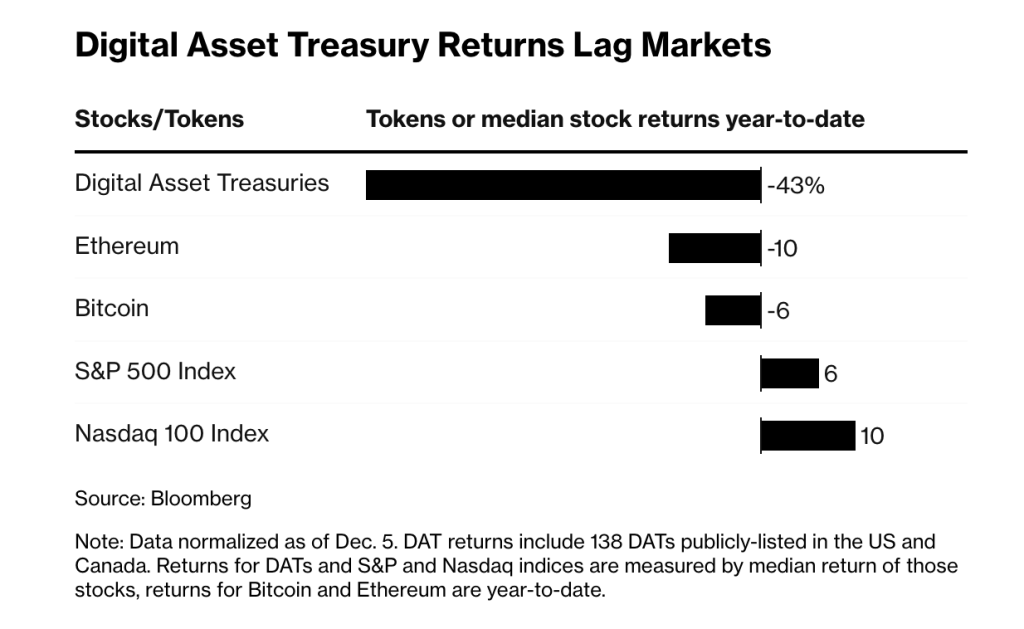
Digital asset treasury companies that rushed to copy Michael Saylor’s Bitcoin strategy are now hemorrhaging shareholder value, with median stock prices down 43% year to date, even as the broader market climbs higher, as per Bloomberg.

Michael Saylor's Bitcoin Strategy - DAT Returns Chart
Source: Bloomberg

More than 100 publicly traded companies transformed themselves into cryptocurrency-holding vehicles in the first half of 2025, borrowing billions to buy digital tokens while their stock prices initially soared past the value of the underlying assets they purchased.

The strategy seemed unstoppable until market reality delivered a harsh correction.

Strategy’s Model Spawns Industry-Wide Collapse

Strategy Inc.’s Michael Saylor pioneered the approach of converting corporate cash into Bitcoin holdings, transforming his software company into a publicly traded cryptocurrency treasury.

The model worked spectacularly through the mid-2025, attracting high-profile investors, including the Trump family.

SharpLink Gaming epitomized the frenzy. The company pivoted from traditional gaming operations, appointed an Ethereum co-founder as chairman, and announced massive token purchases.

💰Sharplink Gaming added $80M in Ether to its reserves, lifting total holdings to $3.6B and cementing its spot as the second-largest corporate holder of ETH.#Sharplink #Ether https://t.co/ADz76OeiCn
— Cryptonews.com (@cryptonews) October 27, 2025

Its stock exploded 2,600% within days before crashing 86% from peak levels, leaving total market capitalization below the value of its Ethereum holdings at just 0.9 times crypto reserves.

Bloomberg data tracking 138 U.S. and Canadian digital asset treasuries shows the median share price has fallen 43% year-to-date, dramatically underperforming Bitcoin’s modest 7% decline.

In comparison, the S&P 500 gained 6% and the Nasdaq 100 rose 10%.

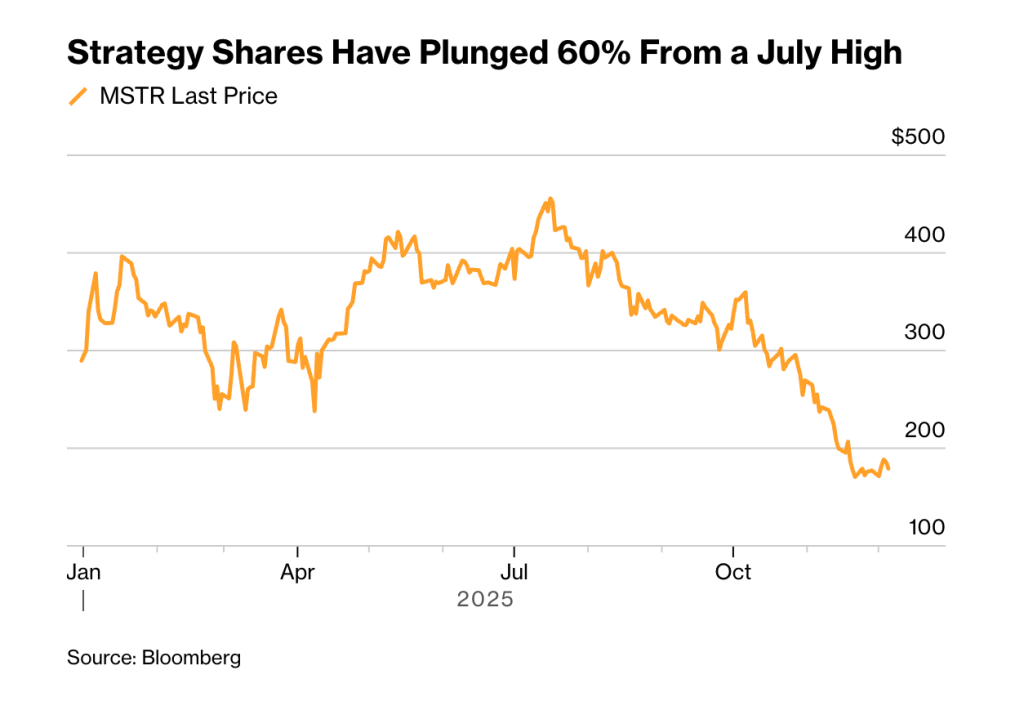
Strategy shares have dropped 60% from their July highs, even as they have risen by more than 1,200% since the company began buying Bitcoin in August 2020.

Michael Saylor's Bitcoin Strategy - Strategy Shares Chart
Source: Bloomberg

Investors took a look and understood that there’s not much yield from these holdings rather than just sitting on this pile of money,” B. Riley Securities analyst Fedor Shabalin told Bloomberg.

Debt Obligations Expose Structural Flaws

The fundamental problem plaguing these companies stems from how they fund cryptocurrency purchases.

Strategy and its imitators issued massive amounts of convertible bonds and preferred shares, raising over $45 billion across the industry to acquire digital tokens that generate no cash flow.

These debt instruments carry substantial interest and dividend obligations that cryptocurrency holdings cannot service, creating a structural mismatch between liabilities that require regular payments and assets that produce zero income.

Strategy faces annual fixed obligations of approximately $750 million to $800 million tied to preferred shares.

Companies that avoided Bitcoin for smaller, more volatile cryptocurrencies suffered the steepest losses.

Alt5 Sigma, backed by two Trump sons and planning to purchase over $1 billion in World Liberty Financial’s WLFI token, has crashed more than 85% from its June peak.

Strategy attempted to address funding concerns by raising $1.44 billion in dollar reserves through stock sales, covering 21 months of dividend payments.

Saylor Admits Potential Bitcoin Sales

The industry now faces its defining moment. Strategy CEO Phong Le acknowledged the company would sell Bitcoin if needed to fund dividend payments, specifically if the firm’s market value falls below its cryptocurrency holdings.

Those comments sent shockwaves through the digital asset treasury sector, given Saylor’s repeated insistence that Strategy would never sell, famously joking in February to “sell a kidney if you must, but keep the Bitcoin.

At December’s Binance Blockchain Week, Saylor outlined the revised approach, stating that “when our equity is trading above the net asset value of the Bitcoin, we just sell the equity,” but “when the equity’s trading below the value of the Bitcoin, we would either sell Bitcoin derivatives, or we would just sell the Bitcoin.

The reversal raises fears of a downward spiral where forced crypto sales push token prices lower, further pressuring treasury company valuations and potentially triggering additional selling.

Strategy’s monthly Bitcoin accumulation has collapsed from 134,000 BTC at the 2024 peak to just 9,100 BTC in November, with only 135 BTC added so far in December.

The company now holds approximately 650,000 BTC, valued at over $56 billion, representing more than 3% of Bitcoin’s maximum supply.

Market participants worry that leveraged traders using borrowed money to invest in these companies could face margin calls, forcing broader market selloffs.

Strategy has created a $1.4 billion reserve fund to cover near-term dividend payments, but shares remain on track for a 38% decline this year despite the company’s massive Bitcoin holdings.

The post Michael Saylor’s Bitcoin Playbook Backfires on 100+ Companies appeared first on Cryptonews.

Bitcoin Market Profitability Hits ‘Complete Reset’ — What’s Next For Price?

Following a fresh wave of bearish pressure on Friday, December 5, the price of Bitcoin has struggled beneath the psychological 90,000 level for much of the weekend. However, the latest on-chain data suggests that the premier cryptocurrency might be readying for its next healthy upward move.

BTC SOPR Drops To Lowest Level Since Early 2024

In a December 6 post on the X platform, CryptoOnchain hypothesized that a local bottom appears to be forming for the price of Bitcoin. According to the market pundit, the selling pressure, especially amongst long-term holders, seems to be fading off at the moment.

This market observation centers on the Spent Output Profit Ratio (SOPR) metric, which evaluates the profitability ratio of spent outputs for both long-term and short-term holders. This on-chain indicator evaluates whether market participants are selling their assets at a profit or at a loss.

Typically, when the Bitcoin Spent Output Profit Ratio has a value greater than 1, it indicates that the investors are selling at a profit. On the flip side, an SOPR value less than 1 implies that the market participants are offloading their coins while in the red.

Bitcoin

According to CryptoOnchain, the Bitcoin SOPR has now fallen to 1.35, its lowest level since early 2024. The market analyst noted that this metric’s latest movement suggests a complete reset in market profitability, especially as the price of BTC slid beneath the $90,000 mark.

Furthermore, CryptoOnchain highlighted that the heavy profit-taking phase by long-term holders appears to be coming to an end, as exhaustion and fatigue increasingly spread among the bears. From a historical perspective, the SOPR metric falling to this low signals a local bottom is forming for the BTC price, especially as the market cools down.

Ultimately, CryptoOnchain revealed that a price rebound at this point could set the stage for Bitcoin’s next healthy upward rally. 

Bitcoin Price At A Glance

As of this writing, the price of BTC stands at around $89,500, reflecting no significant changes in the past 24 hours. According to data from CoinGecko, the flagship cryptocurrency is down by nearly 2% in the last seven days. 

With the price of Bitcoin down year-to-date and from its all-time high of $126,080 by roughly 5% and 30%, respectively, the market leader looks set to end 2025 in the red—barring a sudden change in market momentum.

Bitcoin

Bitcoin Losses Surge To 3x Profits — Could Relief Be Near?

The Bitcoin market appears to be riddled with an increasing amount of sell-side pressure, as its recent price action reveals bears’ dominance. Interestingly, another on-chain evaluation suggests that the current market movement may be a direct effect of rising panic-induced sales. 

$1.7B Realized Losses Vs $605M Realized Gains

In a Quicktake post on the CryptoQuant platform, GugaOnChain shared that the Bitcoin market has been in a capitulation phase in recent days. This on-chain observation revolves around the Bitcoin Realized Profit and Loss ($) metric.

For context, this metric tracks the actual profits (in US dollars) and losses investors realize—or lock in—whenever they offload their Bitcoin holdings to exchanges. 

GugaOnChain highlighted that about $1.705 billion worth of BTC has been realized in losses by market participants. On the other hand, a relatively smaller amount, totaling approximately $605 million, was reportedly realized in gains.Bitcoin

Source: CryptoOnchainThis disproportionate distribution in losses, as against the profits acquired, puts the Loss/Gain ratio at a 2.82 reading. This means that, for every dollar made in profit, almost 3 dollars are lost. 

Looking at the bigger picture, the analyst pointed out that 74% of the total realized volume leans towards the red side of the market, leaving a mere 26% of the Bitcoin market in profits. When realized losses surge rapidly to overcome gains, it is often interpreted as a sign of capitulation.

Historically, extreme capitulation events tend to set the pace either for price recovery or even deeper downside movement. These two possibilities, however, remain dependent on the integrity of available inflection points. 

Bulls Must Defend These Price Levels Or Risk Deeper Corrections

Although the market odds currently seem stacked against the bulls, as the price takes on a bearish structure, the analyst also identified a few important zones that may determine Bitcoin’s next direction. GugaOnChain explained that, in the scenario where the bulls continue to bleed, the next price level presenting an opportunity of redemption lies around $71,450.

This specific price level is critical, as it represents the realized price for investors who have acquired Bitcoin for about 12–18 months. 

Citing a more extreme scenario, the online pundit revealed that the next key support sits at $58,940. This zone is important as it is the realized price for investors whose coins are within the 18-month to 2-year age range.  

On the weekly timeframe, however, price zones around $80,000 and $74,000 appear significant enough for a short-term price recovery. A bullish reversal could take place if these price levels were to meet the present downturn with significant opposing strength. 

As of this writing, Bitcoin is valued at around $89,331, reflecting no significant movement in the past 24 hours. 

Bitcoin


Ease Up, Bitcoin Investors – No More Negative Days For BTC In 2025 

The cryptocurrency market has had a year filled with ups and downs, with most large-cap digital assets turning in mixed performances in 2025. After a rough start to the year, things started to look up for the price of Bitcoin in the second and third quarters, as it set multiple all-time highs across the six-month period.

However, the flagship cryptocurrency has largely struggled in the final months of 2025, looking set to end the year in the red. Interestingly, the latest on-chain data and historical patterns suggest that the price of Bitcoin might be set for a fairly stronger yearly close than expected.

No Negative Days Left In 2025, But 2026 Could Feature A Deep Correction 

On Saturday, December 6, Alphractal CEO and founder Joao Wedson took to the X platform to share what to expect from the Bitcoin price in the last days of 2025. According to the on-chain expert, the market leader is likely to close the year in a sideways price range.

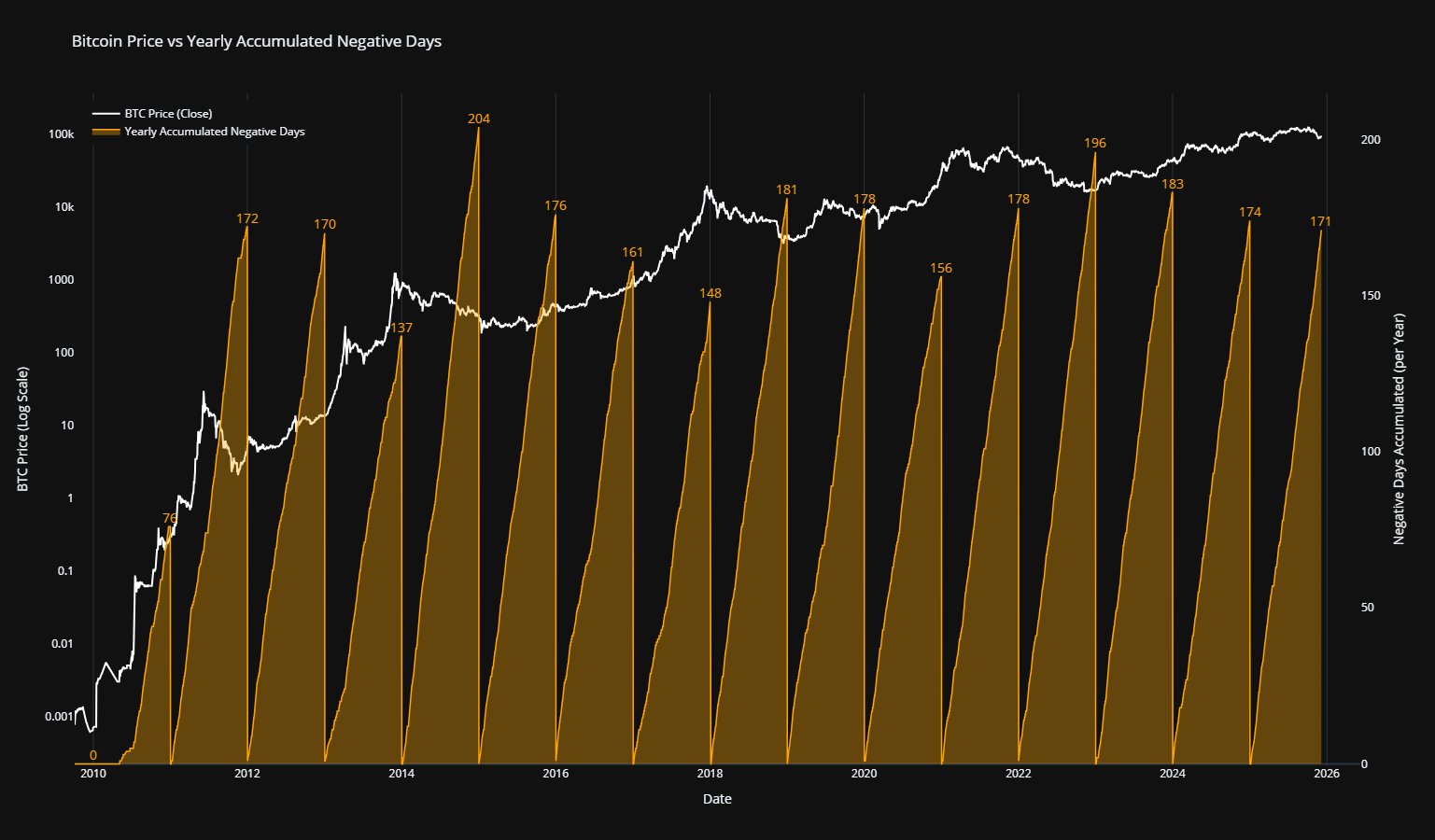
The relevant metric here is the Yearly Accumulated Negative Days, which tracks market resilience by measuring the number of days in a year where an asset’s daily price candlestick closed in the red. 

According to historical data and patterns, Bitcoin typically witnesses an average of 170 days of negative price movement in a year. This mean figure or level provides insight into the stress threshold for the world’s largest cryptocurrency by market cap. 

Bitcoin

When the number of negative days is approaching or exceeds this threshold of 170 days, as Bitcoin already has in 2025, the selling pressure in the market tends to wane as fatigue sets in among the bears. Wedson revealed that the premier cryptocurrency has already accumulated 171 negative days so far in 2025.

The on-chain expert noted that exceeding this threshold “strongly suggests” that the price of Bitcoin might not witness any more negative days in the final few weeks of 2025. Wedson said that if a deeper correction is imminent for the market leader, it will most likely happen in the next year.

However, as the Alphractal founder highlighted, the Bitcoin price is more likely to end the year within a consolidation range. Adding further credence to this postulation is the lack of market demand, as seen with reduced capital influx into spot Bitcoin exchange-traded funds.

Bitcoin Price At A Glance

As of this writing, the price of BTC stands at around $89,397, reflecting a mere 0.3% drop in the past 24 hours. 

Bitcoin

Bitcoin Structure Tightens: One Break Above This Zone Could Ignite A Run To $107,000

Bitcoin finds itself at a critical crossroads, hovering between two major price zones that could define its next big move. Buyers and sellers are locked in a tight battle, and the market now waits for a decisive break. A push above key resistance could open the door to $107,000, while weakness at support risks a deeper slide toward $71,000.

Bounce Scenario: A Return Toward The Pink Box And Descending Trendline

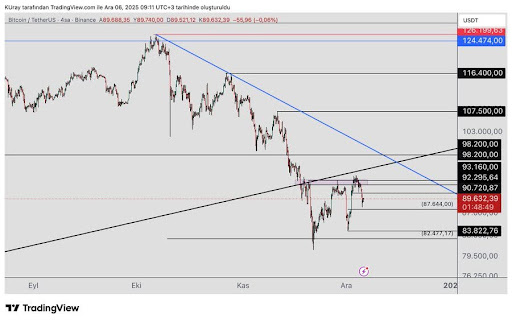
Kamile Uray, in her latest update on Bitcoin, noted that BTC failed to hold above the $90,720 level on the hourly chart, triggering the expected decline. The first immediate support now sits at $87,644, while the deeper support range lies between $83,822 and $82,477. If buyers defend this zone successfully, Bitcoin could attempt another climb toward the pink box region and retest the descending trendline overhead.

Uray explained that a sustained move above the pink box resistance on the daily timeframe would open the door for Bitcoin to challenge the descending blue trendline. A confirmed breakout from this area could strengthen bullish momentum, pushing the price toward the next major resistance levels at $98,200 and $107,500. A break above $107,500 alongside the descending trendline would serve as a strong signal that the broader uptrend is ready to continue.

Bitcoin

However, she warned that a daily close below $82,477 would shift the market structure toward further weakness, placing Bitcoin at risk of revisiting lower levels. Even so, Uray highlighted one critical area of strength: the $74,496–$71,237 zone. This region represents the key breakout top from November 2024 and is considered a strong historical support. In this area, buyers may step in aggressively, potentially setting the stage for an upward reversal.

Bitcoin Price Rejection At $93,000–$95,000 Zone

According to Crypto Candy, Bitcoin’s latest price action has been unfolding precisely in line with expectations. After facing rejection in the $93,000–$95,000 resistance zone, BTC dipped sharply and nearly touched the anticipated support range at $86,000–$87,500. This move reflects the broader market’s reaction to heavy selling pressure near the upper resistance band.

Crypto Candy emphasized that the $86,000–$87,500 zone now serves as a crucial pivot area. If buyers successfully defend this support and the price stabilizes above it, Bitcoin could once again revisit the $93,000–$95,000 range, or even push beyond it.

Such a rebound would signal renewed bullish momentum and set the stage for another attempt at breaking higher resistance levels. However, the analyst also warned that failure to hold the $86,000–$87,500 support could trigger deeper downside movement. If the level gives way, Bitcoin may slide to lower price zones in the coming days as bearish pressure strengthens.

Bitcoin

Bitcoin ETF, Treasury Firms Might Have Stopped Buying — But How Much Have They Offloaded?

The Bitcoin market structure is believed to have undergone a massive shift since the significant price downturn seen on October 10, 2025. While the premier cryptocurrency has been on something resembling a recovery path since the market bloodbath, some sectors believe that the bear season has already kicked off.

With BTC sitting beneath its opening price of 2025, it is becoming increasingly difficult to make a bullish case for the world’s largest cryptocurrency. Moreover, an interesting data point about a relevant class of Bitcoin investors has emerged, further adding credence to the beginning of a possible bear market. 

Are Bitcoin Treasury Firms Offloading Their Coins?

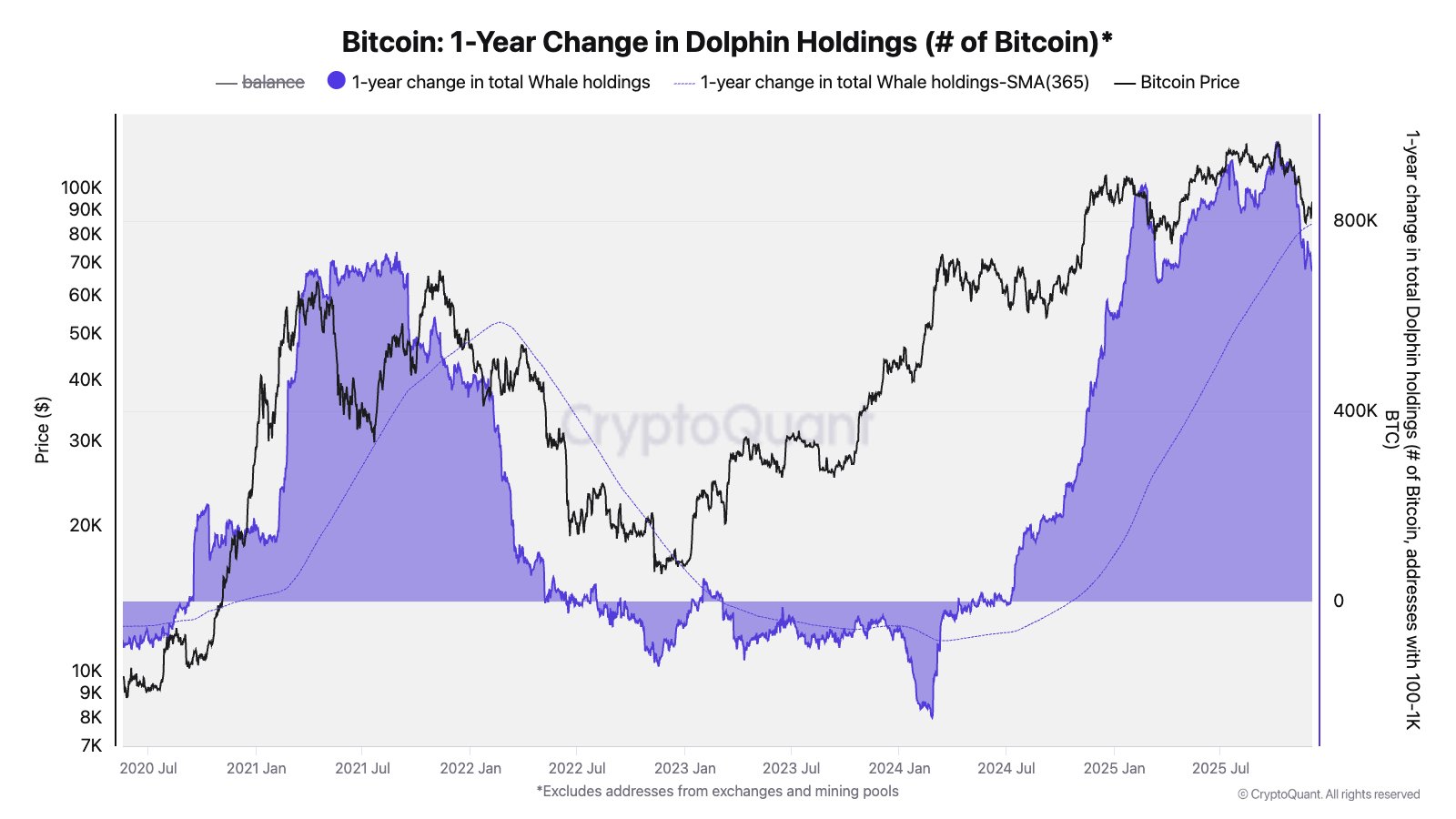
In a new post on X, CryptoQuant’s Head of Research, Julio Moreno, shared an on-chain insight to support the hypothesis that the Bitcoin bear market has started. This conclusion is based on the Balance Growth of an investor group known as the “dolphins.”

Dolphins refer to a group of crypto investors holding substantial amounts of a coin, placing them between small investors (shrimps) and the largest investors (whales). Specifically, Moreno described dolphins as wallet addresses with significant BTC holdings between 100 – 1,000 coins. 

According to the latest data from CryptoQuant, the growth in the Dolphins’ BTC holdings has slowed down in the past year and appears to be in a downward trend. Moreno believes that this negative change points to the emergence of a Bitcoin bear market.

Bitcoin

Moreno revealed that these Dolphin addresses had increased year-over-year by roughly 965,000 BTC when the BTC price hit its current all-time high around $125,000. Now that the BTC price is nearly 30% below its record high, the Bitcoin Dolphins’ balance stands at around 694,000 coins.

Moreno wrote on X:

This address cohort includes ETFs and Treasury companies, which have also stopped buying.

More interestingly, the CryptoQuant Head of Research revealed that this investor group consists of ETF issuers and Treasury companies, which have stopped purchasing Bitcoin. According to data from SoSoValue, the US-based Bitcoin exchange-traded funds have posted net outflows in five out of the last six weeks.

Meanwhile, BTC and crypto treasury companies have struggled in the past few months, with retail investors losing tens of billions to the hype. While there have been rarely reports of crypto treasury sell-offs, this decline in these Dolphins’ holdings tells an entirely different story.

Bitcoin Price At A Glance

As of this writing, the price of BTC stands at around $89,151, reflecting an over 3% decline in the past 24 hours.

Bitcoin

Analyst Says Dogecoin Price Is Ready To Fly, Here’s Why

Dogecoin has been bleeding lower in recent days, grinding back toward the mid-$0.13 band. Sellers have been in control of most candles in the past 24 hours, and each attempt at a rebound has faded quickly, leaving Dogecoin stuck near the bottom of a range.

One crypto analyst on X has focused attention on an important technical level on the 2-day chart. Even though price action looks weak, Dogecoin is now sitting right on a long-term support zone inside a descending triangle pattern, and this area could become the launchpad for a strong upside move if buyers react from here. The chart shared with the analysis highlights exactly where Dogecoin is resting and why this region matters.

Dogecoin Sitting On Major Descending Triangle

Technical analysis of Dogecoin’s price action on the 2-day candlestick timeframe chart shows the meme coin has been trading in a clear descending triangle since December 2024. A downward-sloping trendline has capped every rally this year, leading to the creation of a series of lower highs that reflect persistent selling pressure throughout the year. At the same time, a horizontal support zone underneath in the mid-$0.135 to $0.14 region has caught multiple drops and prevented a deeper breakdown.

Right now, Dogecoin is pressing that lower border again. The candles on the 2-day chart cluster just above the dashed support band, and the analyst, who goes by Butterfly on X, circled this cluster in green to show how closely the price is hugging the level. 

Dogecoin

Each prior visit to this zone has produced at least a temporary bounce, which is why the current test is notable. The price action is tightening, and there is less room left for sideways movement before a decisive break happens.

Dogecoin Is “Ready To Fly”

In the post on X, the analyst notes that this support has been “respected multiple times” and that bulls are “getting ready to step in.” The most important thing is for the lower support to hold again, and the descending triangle may flip from a slow grind lower into a springboard for a strong reaction.

A firm defense of this zone would mean that sellers are running out of momentum at these prices. From there, even a modest wave of buying could drive Dogecoin back toward the descending resistance line that cuts across the chart from the $0.25 to $0.26 area. A break and close above that trendline would mark the first clean higher high in months and would confirm that the triangle has resolved to the upside.

The analyst’s green arrow on the chart sketches out this potential path. The path shows Dogecoin lifting from the current support band, breaking above resistance, and reaching as high as $0.4 in one swift move.

Dogecoin

Analyst Points To $82,000 As Most Crucial Bitcoin Price Level — Here’s Why

In a not-so-surprising turn of events, the bearish orientation of the Bitcoin price has continued into the month of December, suggesting that the premier cryptocurrency could end the year in the red. Interestingly, recent on-chain data has offered insights into the likely direction of Bitcoin based on the integrity of an important price level.

Active Market Participants’ Cost Basis At $82,000

In a December 5 post on the X platform, market analyst Burak Kesmeci shared an interesting outlook on the direction of the Bitcoin price. 

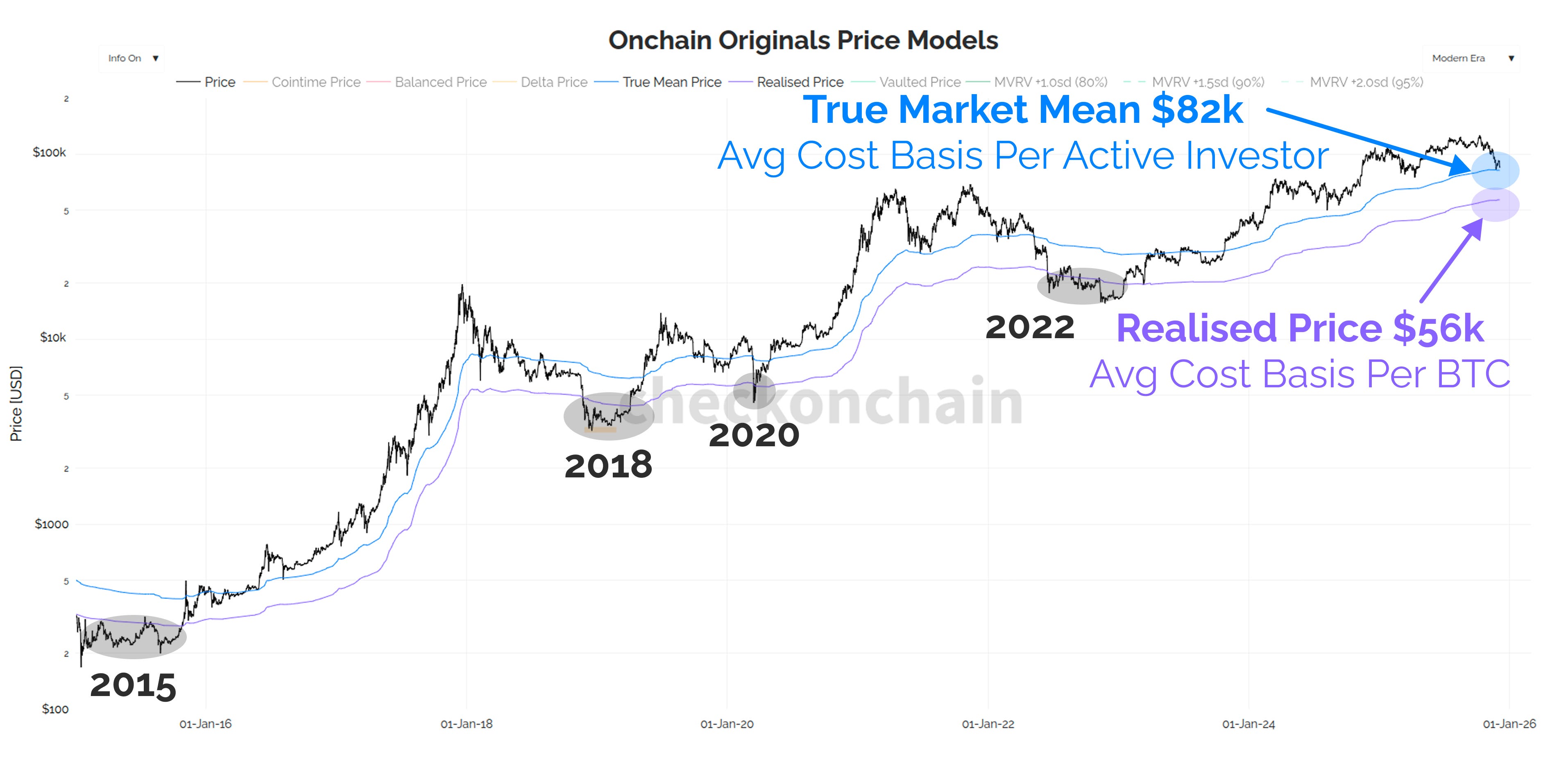
The analyst disclosed that whatever happens around the $82,000 mark could make or mar Bitcoin’s trajectory in the near term. To demonstrate why this price region is so important, Kesmeci pointed out that it appears to be the convergence point of two highly influential cost bases in Bitcoin’s history. 

Kesmeci revealed that the Bitcoin spot exchange-traded funds have an average purchase cost of approximately $82,000. Because ETFs are one of Bitcoin’s strongest demand sources, tracking the values of their average cost-basis could serve as a good means to tell where the market stands institutionally.

Bitcoin

The crypto pundit also referenced the Bitcoin True Market Mean metric, which monitors the cost at which active investors procured their holdings—except for mined or rarely-moved BTC. Notably, in the current market cycle, Bitcoin’s active participants mostly purchased their coins around a valuation of $82,000. 

What Happens If $82,000 Fails? 

Usually, when price slips beneath any major price support, there is, in turn, an increase in overall selling pressure, as buy-side liquidity is converted to bearish momentum via losses incurred by investors. Hence, in the scenario where $82,000 fails to hold, a wave of bearish pressure is expected to ensue, as Bitcoin’s active investors try to cut their losses. 

However, Kesmeci expects something even more specific to follow. According to historical data, whenever Bitcoin falls beneath its active market participant cost basis, it often falls further downwards, as though it is targeting its Realized Price.

At the moment, the Bitcoin Realized Price sits near $56,000 — a price level significantly beneath its investors’ average cost basis. Kesmeci therefore warned that a slip beneath $82,000 could precede Bitcoin’s sharp downturn towards $56,000.

This would represent an almost 40% decline from the current price point. As of this writing, the price of BTC stands at around $89,310, reflecting an over 3% dip in the past 24 hours. 

Bitcoin

Bitcoin Price Falls Below $90,000 — Is The Recovery Over?

The Bitcoin price has had a mixed performance over the past week, with both sides of the market divide struggling to establish dominance. In the latest battle between the bulls and bears, the premier cryptocurrency appears to be succumbing to pressure from the latter group.

As this weekend approached, the Bitcoin price retreated from its latest local high of around $94,000 to beneath the psychological $90,000 level. This latest correction has prompted questions in the crowd, with investors wondering whether it is just a brief obstacle or the end of the recovery.

Why $80,500 Could Be The Next Local Low For BTC

In a December 5 post on the social media platform X, Alphractal CEO and founder shared insight into the latest Bitcoin price decline below $90,000. The on-chain expert revealed that losing the $89,800 level is the more relevant occurrence in the latest price downturn.

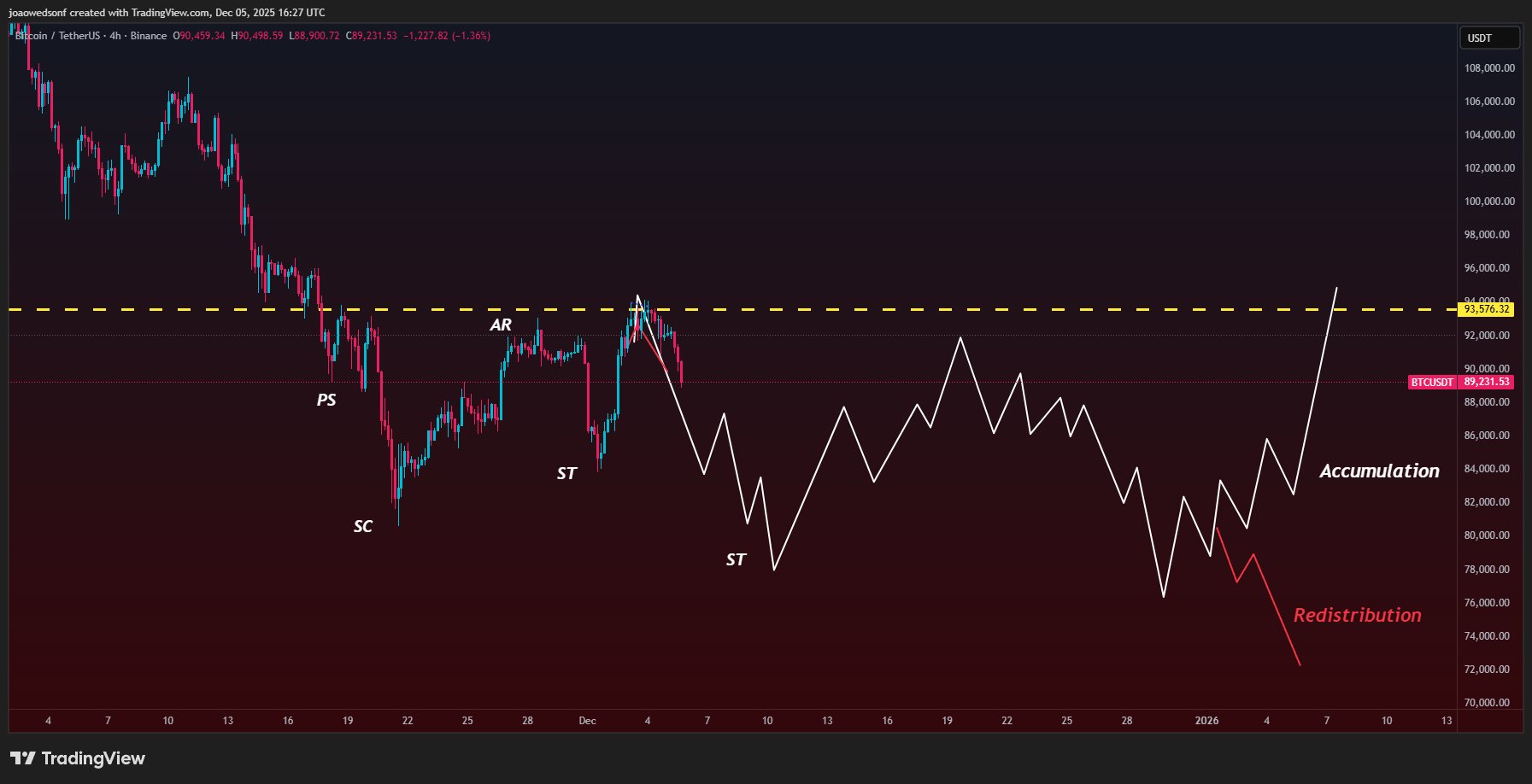
In a previous post on X, Wedson evaluated the likely trajectory of the Bitcoin price should it lose the $89,800 level. The crypto pundit revealed that losing this price mark could lead to an accumulation pattern for the bulls or a redistribution phase for the bears.

While the accumulation period for the bulls would initially coincide with lower prices, it eventually leads to a Bitcoin price return to above the latest local high. Meanwhile, a redistribution phase could see the bears push the flagship cryptocurrency to around the $70,000 mark.

Bitcoin price

According to the Alphractal CEO, the price of BTC also failed to hold the key on-chain levels, strengthening the probability of a broader price sideways phase. “Sideways action is the cause — the big pumps or dumps are just the effect,” Wedson had earlier stated in his previous X post.

Furthermore, Wedson noted that the next level to watch is $86,500, which, if lost, opens the very high possibility for the formation of a new local low around $80,500. This local low could provide a perfect spot for investors to buy the dip and enter the market.

Bitcoin Price Overview 

As mentioned earlier, the past week has been one of highs and lows for the premier cryptocurrency, plummeting to as low as $84,600 on Monday, December 1. After a shaky start to the month, the Bitcoin price recovered strongly to around $94,000 on Thursday, December 4.

As of this writing, the market leader is valued at around $89,415, reflecting an over 3% price decline in the past 24 hours. According to data from CoinGecko, the price of Bitcoin has been down by nearly 10% in the past year.

Bitcoin price

Crypto Sell-Off: Binance, Coinbase, Dump Over $2 Billion In Bitcoin As Prices Dip Below $90,000

The cryptocurrency market experienced another wave of liquidations on Friday, with Bitcoin (BTC) prices dipping below the critical support level of $90,000. This decline followed a brief rally that had seen its price rise approximately $3,000 above this threshold earlier in the week.

Crypto Market Faces $430 Million In Liquidations 

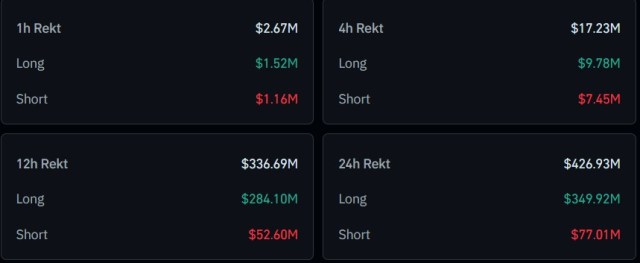
Data from CoinGlass reveals that nearly $430 million in liquidations occurred across the crypto market over the past 24 hours, predominantly affecting leveraged long positions, which accounted for about $350 million. 

During this period, Bitcoin underwent a 3.5% retracement, with its price settling at just above $89,120—a stark 29% below its all-time high of over $126,000 reached in October.

Crypto

Market expert OxNobler recently highlighted the role of both retail and institutional investors in this downturn. In a post on social media platform X, OxNobler detailed the reason behind Bitcoin’s decline: significant sell-offs by major players. 

According to the analyst, the world’s largest cryptocurrency exchange, Binance, sold 4,000 BTC; U.S.-based Coinbase (COIN) liquidated 5,675 BTC; and traditional finance giant Fidelity sold 3,288 BTC. Additionally, market maker Wintermute offloaded 1,793 BTC. 

Notably, the analyst pointed out that Strategy, formerly MicroStrategy, which is the largest public company holder of Bitcoin with over 650,000 coins, has also sold over 3,820 coins in this same time frame.

The firm’s sell-off comes on the heels of speculation regarding Strategy’s potential to liquidate some of its holdings due to the substantial losses affecting its financial performance amid declining Bitcoin prices. 

When Strategy CEO Phong Le was questioned about the possibility of selling off Bitcoin, he acknowledged that while the firm’s former CEO, Michael Saylor, has consistently opposed selling, circumstances may change if the company’s stock trades below the net value of its Bitcoin holdings, which aligns with the recent actions taken by the firm.

Coinbase Analysts Predict December Recovery 

Interestingly, while these institutional sell-offs have contributed to the current market dip, Coinbase’s institutional division has projected a potential recovery for the crypto market in December, citing improving liquidity, a 92% probability of the Federal Reserve (Fed) cutting rates, and supportive macroeconomic conditions.

Analysts have pointed out several reasons for optimism, including the recovery of liquidity, the resilience of the “AI bubble,” and the attractiveness of short US dollar trades at current levels. 

However, OxNobler warned that the situation may not be so straightforward. Alongside the activities of major institutions, he noted that BlackRock, the world’s largest asset manager, had recently sold $130 million worth of Bitcoin and Ethereum (ETH).

Furthermore, Vitalik Buterin, one of Ethereum’s co-founders, seems to have resumed selling Ethereum, with millions of ETH being moved from the foundation’s wallet through Gnosis Safe.

Ultimately, OxNobler asserts that these institutional activities may have a hand in manipulating crypto prices and preventing them from climbing to higher levels and key resistance points. 

Crypto

Featured image from DALL-E, chart from TradingView.com 

MetaMask Enters Prediction Markets With Polymarket Integration

By: Amin Ayan

MetaMask, the most widely used Ethereum wallet, is moving directly into the prediction market arena through a new integration with Polymarket, giving users the ability to trade event outcomes from inside their wallets.

Key Takeaways:

  • MetaMask has integrated Polymarket, allowing users to trade real-world event outcomes.
  • The integration adds one-tap funding from any EVM chain.
  • Polymarket’s rapid growth continues amid a potential $15 billion valuation.

“You can now trade on the future outcome of real world events inside your wallet,” Consensys’ Gabriela Helfet wrote, adding that users will also earn MetaMask Rewards points for every prediction placed.

MetaMask Becomes New Gateway to Polymarket With One-Tap Funding

The integration creates a new on-ramp for Polymarket and introduces “one tap funding,” allowing users to deposit with any token from any EVM-compatible chain.

The move further tightens the link between everyday crypto wallets and decentralized betting platforms, positioning MetaMask as a gateway not only to Web3 apps but also to real-world event speculation.

Polymarket has surged in popularity over the past year, fueled in part by heightened attention during the 2024 US election cycle.

Former President Donald Trump’s embrace of crypto and a more relaxed regulatory climate helped push the platform back into the US market.

The company is now reportedly exploring a valuation of up to $15 billion, following a $2 billion strategic investment from Intercontinental Exchange, the parent of the NYSE.

Predicting on MetaMask only takes a few seconds.🔮

We've enabled 1-click funding with any EVM token, or you can get started instantly if you have an existing @polymarket account! pic.twitter.com/zZtrQPDu3m

— MetaMask.eth 🦊 (@MetaMask) December 5, 2025

For MetaMask, the move comes as the wallet expands beyond its Ethereum-focused roots. In October, it launched multichain accounts that support both EVM and non-EVM networks, including Solana.

The wallet is also preparing for the rollout of a native MASK token, as parent company Consensys gears up for a potential IPO.

The move comes as Polymarket is recruiting staff for an internal market-making team that would trade against its own customers, mirroring a controversial feature already used by rival Kalshi that has drawn criticism and legal challenges.

As reported, the New York-based prediction market startup has approached traders, including sports bettors, to join the new unit, people familiar with the matter said, requesting anonymity because the plans remain private.

Prediction Markets Hit $13B in Record Activity

Prediction markets have crossed $13 billion in cumulative trading volume, marking a record high even as broader crypto markets cool.

The surge has drawn in major players across tech and finance, including Fanatics, Coinbase, and MetaMask, all of which have recently launched or expanded event-trading platforms.

Against this backdrop, YZi Labs, the venture firm founded by Binance co-founder Changpeng “CZ” Zhao, has been intensifying its involvement in the sector.

YZi-backed Opinion has emerged as one of the most surprising breakout platforms. Launched on BNB Chain in October, it recorded nearly $1.5 billion in weekly trading volume within its first month, briefly overtaking established names such as Kalshi and Polymarket.

Meanwhile, prediction markets platform Kalshi has secured a major media breakthrough after signing a partnership with CNN, making the company the network’s official prediction markets partner while closing a $1 billion funding round at an $11 billion valuation.

The post MetaMask Enters Prediction Markets With Polymarket Integration appeared first on Cryptonews.

Indiana Bill Would Mandate Bitcoin in Pensions and Shield Self-Custody Rights

A newly introduced bill in Indiana would require public retirement programs to offer Bitcoin-related investment options and would also limit how much power local governments have to restrict the use of digital assets.

The proposal was filed on Thursday by State Representative Kyle Pierce, a Republican from Anderson. Known as House Bill 1042, the legislation was presented during a meeting of the House Financial Institutions Committee.

It focuses on giving public workers access to cryptocurrency investments while setting clear legal boundaries around digital asset use, custody, payments, and mining.

Indiana Targets First-in-the-Nation Mandate for Bitcoin in Public Pensions

Under the bill, administrators of several state-run retirement and savings plans would be required to include cryptocurrency exchange-traded funds as standard investment choices.

It would also permit certain public pension funds to invest directly in crypto-linked ETFs and give the state treasurer authority to place funds from specific accounts into stablecoin-based ETFs.

Pierce said the bill is designed to give Indiana residents more financial flexibility as digital assets become a larger part of the broader economy.

He added that the legislation is intended to balance investment choice with regulatory guardrails while allowing the state to explore potential government use of blockchain technology through pilot programs.

Source: Indiana House Republicans

The legislation goes beyond retirement investing and takes aim at local regulation. Cities and counties would be prohibited from passing rules that place “unreasonable” limits on digital assets if similar rules do not apply to traditional financial activity.

That protection would extend to crypto payments, private ownership of digital wallets, and mining operations.

The bill adds clear safeguards for self-custody. It states that private digital asset keys could only be demanded through a court order and only when no other legal method of access is available.

It would also prevent local governments from zoning out mining facilities from industrial zones and would protect properly zoned residential mining activity.

If enacted, Indiana would become the first state in the country to require publicly managed retirement programs to provide Bitcoin exposure as a standard option.

While some states permit limited crypto investment flexibility, none currently mandate it.

U.S. States Expand Crypto Access in Pensions, Payments, and Property Laws

Other states have taken related but narrower steps. Oklahoma passed a law in 2024 protecting residents’ right to hold crypto in self-custody wallets and blocking special taxes on Bitcoin transactions.

In 2025, Kentucky followed by formally recognizing self-custody as a protected property right. Wyoming has also approved laws that allow public pension funds to invest in digital assets.

Elsewhere, Arizona introduced legislation that would allow Bitcoin ETFs in retirement accounts, while Florida outlined legal pathways for holding digital assets through ETFs in certain state funds.

✅ Arizona’s push to integrate digital assets into state financial infrastructure is nearing a critical milestone. #Arizona #Bitcoinhttps://t.co/jNb7UnYvX1

— Cryptonews.com (@cryptonews) April 18, 2025

Indiana’s proposal stands apart by making crypto ETF access a requirement rather than a choice.

Momentum around crypto-linked retirement exposure continues to build nationwide. In August, Michigan’s state retirement system tripled its Bitcoin ETF holdings to 300,000 shares, valued at about $11.4 million, according to regulatory filings.

📈 The State of Michigan Retirement System has increased its exposure to Bitcoin, tripling its holdings in the @ARKInvest 21Shares Bitcoin ETF.#Michigan #Bitcoinhttps://t.co/lUxWycmp4A

— Cryptonews.com (@cryptonews) August 6, 2025

The fund also holds roughly $13.6 million in Ethereum through the Grayscale Ethereum Trust. Wisconsin’s state investment board has also disclosed more than $387 million in Bitcoin ETF exposure.

States are also widening their use of digital assets outside of investing. In September, Ohio finalized plans to accept Bitcoin and other cryptocurrencies for official state payments.

In October, California updated its Unclaimed Property Law to ensure dormant crypto is not automatically converted into cash when

transferred to state custody.

✅ California has become the first US state to formally protect unclaimed crypto from being forcibly converted to cash.#California #Bitcoinhttps://t.co/PoV40lmZi9

— Cryptonews.com (@cryptonews) October 14, 2025

New York City has taken its own steps by setting up a municipal Office of Digital Assets and Blockchain.

The move followed an executive order from Mayor Eric Adams aimed at coordinating crypto policy and encouraging blockchain development.

🗽 Bitcoin NYC Mayor Adams established the “nation’s first-ever” municipal office for crypto and blockchain to position the city as the global crypto hub.#EricAdams #NYCMayor #CryptoOfficehttps://t.co/oVEBRTRp5y

— Cryptonews.com (@cryptonews) October 15, 2025

At the federal level, broader regulatory efforts are also underway. Lawmakers are preparing new frameworks that could shape how states approach crypto policy, including updated guidance on 401(k) crypto exposure expected in 2026.

The post Indiana Bill Would Mandate Bitcoin in Pensions and Shield Self-Custody Rights appeared first on Cryptonews.

Strategy CEO Says $1.44B Cash Reserve Aims to Calm Bitcoin-Slump Fears

By: Amin Ayan

Strategy CEO Phong Le says the company’s newly built $1.44 billion cash reserve is designed to quiet investor anxiety over its ability to withstand a sharp downturn in Bitcoin.

Key Takeaways:

  • Strategy built a $1.44B cash reserve to ease investor fears about its ability to meet dividend and debt obligations.
  • The firm raised the funds in just eight and a half days, aiming to show it can still attract capital without selling any Bitcoin.
  • Strategy says it will only consider selling BTC if its stock falls below NAV.

Speaking on CNBC’s Power Lunch, Le said the move followed weeks of speculation about whether the firm could continue meeting its dividend and debt commitments if market conditions worsened.

“We’re very much a part of the crypto ecosystem and Bitcoin ecosystem,” Le said. “Which is why we decided a couple of weeks ago to start raising capital and putting US dollars on our balance sheet to get rid of this FUD.”

Strategy Builds Cash Buffer to Avoid Selling Bitcoin in Market Slump

The reserve, announced Monday and funded via a stock sale, is intended to secure at least 12 months of dividend payments, with plans to stretch that buffer to 24 months.

The company emphasized that the stock-funded buildup gives Strategy breathing room without having to sell any Bitcoin during a turbulent period for the market.

Concerns over Strategy’s dividend stability had grown louder in recent weeks as Bitcoin retreated from its highs.

Le acknowledged the market chatter but dismissed it as exaggerated. “We weren’t going to have an issue paying dividends, and we weren’t likely going to have to tap into selling our Bitcoin,” he said.

“But there was FUD that was put out there that we wouldn’t be able to meet our dividend obligations, which causes people to pile into a short Bitcoin bet.”

This afternoon, Phong Le, CEO of @Strategy, joined @CNBC @PowerLunch to discuss how $MSTR moves with bitcoin, how our USD reserve addresses recent FUD, the shifting Overton Window, key volatility drivers, and why bitcoin’s long-term outlook remains strong. pic.twitter.com/1t5hsfov0m

— Strategy (@Strategy) December 5, 2025

The CEO said raising $1.44 billion in just eight and a half days was intended as a direct response, showing the firm can still attract capital even in a downcycle.

“We did it to address the FUD, and to show people we’re still able to raise money when Bitcoin is under pressure.”

Last week, Le said Strategy would only consider selling Bitcoin if the stock dropped below net asset value and the company lost the ability to raise additional funds.

Strategy has also introduced a new “BTC Credit” dashboard, which it says shows the company holds enough assets to service dividends for more than 70 years.

Strategy Adopts Dual-Reserve Model as BTC Buying Slows

As reported, Strategy has shifted from its long-standing “buy Bitcoin at all costs” approach to a dual-reserve treasury model that pairs long-term BTC holdings with a growing dollar buffer.

The move follows a dramatic slowdown in the firm’s accumulation pace, from 134,000 BTC per month at its 2024 peak to just 9,100 BTC in November, signaling preparation for a potentially prolonged bear market.

Despite the slowdown, the company remains one of the world’s largest Bitcoin holders, with roughly 650,000 BTC on its balance sheet.

The post Strategy CEO Says $1.44B Cash Reserve Aims to Calm Bitcoin-Slump Fears appeared first on Cryptonews.

Strive Urges MSCI to Scrap Proposal Excluding Major BTC Holders

By: Amin Ayan

Strive, a Nasdaq-listed firm and the 14th-largest public holder of Bitcoin, is pushing back against MSCI’s plan to remove companies with significant digital-asset exposure from its global indexes.

Key Takeaways:

  • Strive says MSCI’s plan to exclude crypto-heavy firms would shut investors out of key growth sectors.
  • JPMorgan warns Strategy could face up to $2.8B in losses under the proposal.
  • Strive argues BTC-focused firms are vital to AI infrastructure and structured finance, making the cutoff unfair.

In a letter addressed to MSCI chairman and CEO Henry Fernandez, the company warned that the proposal, which would exclude firms whose crypto holdings exceed 50% of total assets, risks shutting passive investors out of fast-growing corners of the market.

JPMorgan Warns Strategy Could Lose $2.8B Under MSCI Proposal

JPMorgan analysts recently cautioned that Strategy, a prominent Bitcoin treasury company included in the MSCI World Index, could face as much as $2.8 billion in losses if the exclusion moves forward.

Strategy’s chair, Michael Saylor, has confirmed that discussions with MSCI are ongoing as the company attempts to head off the decision.

Strive CEO Matt Cole argued that the proposal misunderstands the role large Bitcoin-focused firms play in emerging industries, particularly artificial intelligence.

He noted that miners such as MARA Holdings, Riot Platforms, and Hut 8, all potential exclusion targets, are rapidly expanding into AI infrastructure by retooling data centers for high-intensity compute workloads.

“Many analysts argue that the AI race is increasingly limited by access to power, not semiconductors,” Cole wrote, adding that miners are uniquely positioned to meet those needs.

https://t.co/5gdKWpFATh

— Matt Cole (@ColeMacro) December 5, 2025

Even as AI revenue increases, he said, companies will continue holding sizable Bitcoin reserves, meaning MSCI’s exclusion would permanently wall off a sector positioned at the intersection of digital assets and next-generation computing.

Cole also pointed to the rising demand for Bitcoin-linked financial products. Firms such as Strategy and Metaplanet function similarly to banks offering structured BTC notes, providing equity-based access to Bitcoin performance without requiring investors to hold the asset directly.

Excluding these treasury companies, he argued, would give traditional financial institutions, including JPMorgan, Morgan Stanley, and Goldman Sachs, an uneven playing field, as index-linked capital would become biased against firms whose business models center on Bitcoin exposure.

Strive Says MSCI’s 50% Rule Would Cause Index “Whiplash”

Strive further challenged the practicality of MSCI’s 50% threshold, noting that tying index eligibility to a volatile asset would cause companies to drift in and out of benchmarks, increasing tracking errors for funds that follow them.

Cole highlighted Trump Media & Technology Group as an example. Despite holding one of the largest public Bitcoin treasuries, it narrowly avoided MSCI’s preliminary exclusion list because its BTC exposure currently sits just under the cutoff.

Instead of a blanket rule, Strive proposed a parallel “ex-digital asset treasury” version of MSCI’s indexes.

This would allow asset managers who wish to avoid crypto-heavy companies to do so, while others could maintain exposure to the full investable universe.

MSCI has not yet indicated whether it will revise its proposal, but industry pressure is mounting as treasury-heavy firms await a final decision.

The post Strive Urges MSCI to Scrap Proposal Excluding Major BTC Holders appeared first on Cryptonews.

Bernstein Forecasts Coinbase (COIN) To Surge 90%, Setting $510 Price Target

Coinbase (COIN), the largest cryptocurrency exchange in the US, has experienced a significant decline in its stock valuation, dropping nearly 40% from its peak of $444 in July to its current trading level of around $271 per share. This, amid market fluctuations and heightened volatility in the broader crypto market, impacting the exchange’s stock performance.

Bernstein Forecasts New Bullish Phase For Coinbase

Despite these challenges, analysts at Bernstein hold an optimistic outlook on Coinbase’s stock price, suggesting a potential new bullish phase that could propel COIN to surpass previous all-time highs and reach levels above $500. 

Bernstein maintains a price target of $510 on Coinbase, underlining the exchange’s shift from a trading-centric platform to what analysts dub an emerging “everything exchange.”

Analysts led by Gautam Chhugani highlighted the delicate market conditions, citing crypto price fluctuations influencing listed crypto-exposed equities

However, Bernstein distinguishes the current market environment from past crypto downturns, noting that speculative excess primarily affects what they refer to as “MSTR copycats,” referencing Strategy’s (previously MicroStrategy) stock performance. 

Central to Bernstein’s bullish thesis is Coinbase’s strategic diversification away from volatile spot trading revenue. They assert that exchange is evolving into a comprehensive financial platform.

The analysts emphasize that clearer regulatory guidelines in the US could drive a revaluation of these business lines, bridging the gap with offshore competitors benefiting from faster token listings and fundraising fees. 

Coinbase’s foray into token issuance through a launchpad-style model, exemplified by Monad’s (MON) recent listing, demonstrates growing market interest. Bernstein notes that these launches, directly influencing trading activity, can stimulate a cycle of issuance, listing, and heightened trading volume.

Confident Ratings For COIN

Looking ahead, one of the exchange’s most notable catalysts is the upcoming product showcase on December 17, anticipated to unveil developments in tokenized equities, prediction markets, and other tools expanding the exchange’s offerings beyond spot crypto trading. 

The integration with Deribit is also expected to further bolster Coinbase’s derivatives expansion, positioning the exchange closer to platforms like Robinhood as both entities diversify their product offerings.

On the consumer front, the exchange’s Base app, focusing on wallet services, payments, and social features, acts as a centralized access point for the broader token markets, reaffirming the analysts’ bullish predictions

Bernstein’s reaffirmed “Buy” rating on Coinbase with a massive $510 price target underscores the firm’s confidence in COIN’s growth trajectory. Monness Crespi’s recent upgrade from “Neutral” to “Buy” with a $375 target further adds to the bullish sentiment surrounding the stock’s valuation amid falling prices. 

Coinbase

Featured image from DALL-E, chart from TradingView.com 

From Top To Bottom: Bitcoin’s Largest & Smallest Hands Both Now Accumulating

Data shows distribution on the Bitcoin network has dropped off, with both the largest of whales and small retail hands taking to accumulation.

Bitcoin Accumulation Trend Score Shows Shift Toward Buying

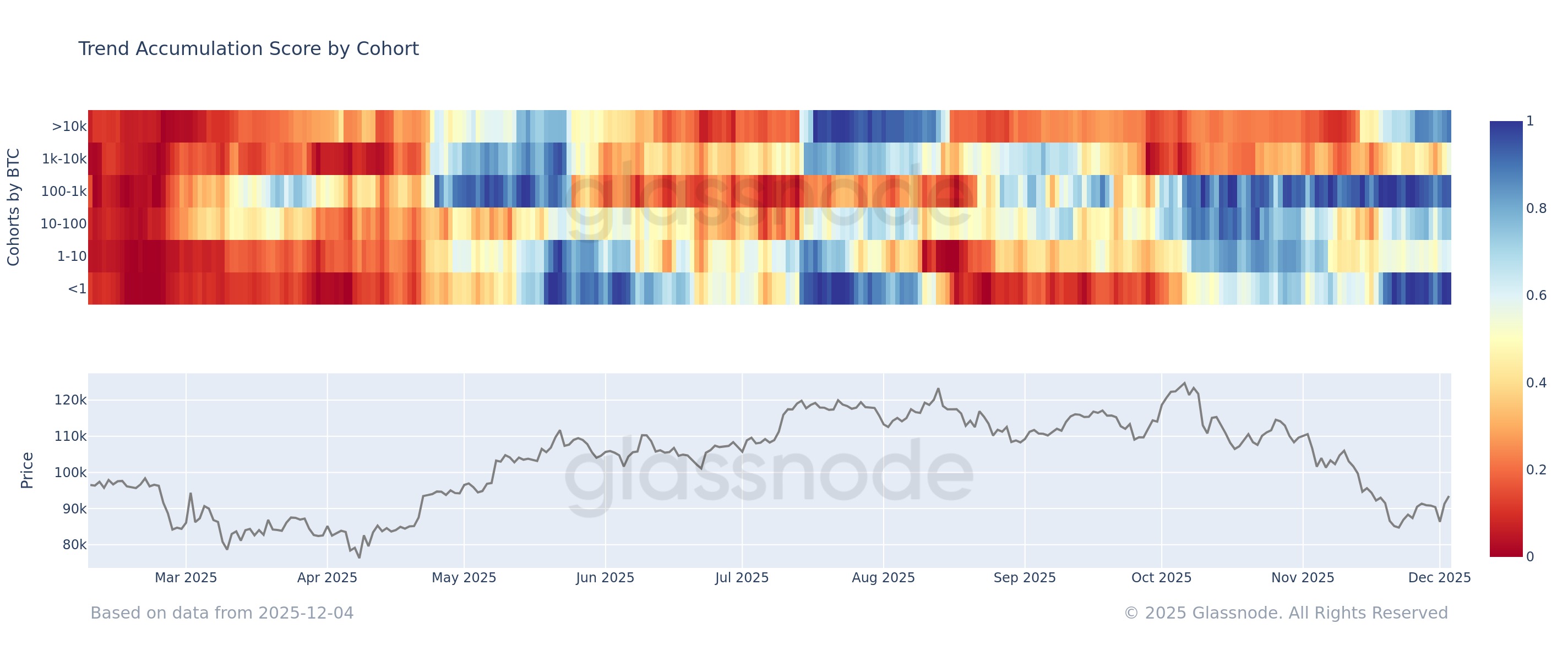
As explained by Glassnode analyst Chris Beamish in an X post, Bitcoin investors have been showing a lot less distribution at the recent price levels. The on-chain indicator of relevance here is the “Accumulation Trend Score,” which tells us about whether BTC holders are buying or selling.

The metric tracks investor behavior using not just the changes happening in their wallet balance, but also accounting for the size of their wallets. This means that larger entities have a higher influence on the score.

When the value of the Accumulation Trend Score is greater than 0.5, it means the investors are displaying a net trend of accumulation. On the other hand, it being under the threshold suggests the dominance of distribution.

Now, here is the chart shared by Beamish that shows how the Accumulation Trend Score has changed for the different Bitcoin investor segments over the last few years:

Bitcoin Accumulation Trend Score

As displayed in the above graph, the Bitcoin Accumulation Trend Score has reflected a varied behavior for the different investor segments during the last couple of months, but very recently, a uniform picture has started to develop.

The smallest of investors in the market, those holding less than 1 BTC, started participating in aggressive accumulation around the time of BTC’s low in November and have since maintained the indicator nearly at a perfect value of 1. This suggests that retail investors have been buying the dip.

Meanwhile, the 100 to 1,000 BTC traders, popularly called the sharks, have been accumulating throughout the drawdown that has followed since the early October peak, indicating that these investors haven’t lost conviction despite the deep decline.

The story is a bit different for the whale cohorts, however. The 10,000+ BTC holders, corresponding to the largest of hands on the network, were in a phase of distribution between August and November, but they have finally started accumulating since the price low, although the Accumulation Trend Score isn’t as high as the retail investors in their case.

The 1,000 to 10,000 BTC whale group didn’t stop distributing even after the bottom, but very recently, their score has just breached the 0.5 mark. With this, a uniform behavior has begun to appear on the Bitcoin blockchain, with investors as a whole opting to expand their wallet balance.

It now remains to be seen how long this trend of accumulation will continue.

BTC Price

Bitcoin has faced a drop of more than 3% over the last 24 hours that has taken its price to $89,300.

Bitcoin Price Chart

Bitcoin Bull Run Set To Last Until 2027, Analysts Highlight Influential Factors

Many in the crypto space have echoed a familiar sentiment over recent months: “The four-year crypto market cycle is dead.” Experts from the Bull Theory assert that while the four-year cycle may have come to an end, the Bitcoin bull run itself is merely delayed and could stretch until 2027.

Why The Four-Year Cycle May Be Ending

In a recent post on social media platform X, formerly known as Twitter, the Bull Theory analysts noted that the concept of Bitcoin adhering to a neat four-year cycle is weakening. 

They highlighted that significant price movements over the last decade weren’t solely driven by Halving events; rather, they were influenced by shifts in global liquidity. 

The analysts pointed to the current landscape of stablecoin liquidity, which remains high despite recent downturns, indicating that larger investors are still engaged in the market, poised to invest when appropriate macroeconomic conditions arise.

In the US, Treasury policies are emerging as pivotal catalysts. The recent buybacks are notable, but the analysts emphasize that the larger narrative lies in the Treasury General Account (TGA) balance, which is currently around $940 billion—almost $90 billion above its normal range. 

This surplus cash is likely to flow back into the financial system, enhancing financing conditions and adding liquidity that typically gravitates toward risk assets.

Globally, the trends appear even more promising. China has been injecting liquidity for several months, while Japan recently announced a stimulus package worth approximately $135 billion, alongside efforts to simplify cryptocurrency regulations. 

Canada is also moving toward easing its monetary policy, and the US Federal Reserve (Fed) has officially halted its quantitative tightening (QT) measures—a historical precursor to some form of liquidity expansion.

Political And Monetary Factors Align To Create Bullish Condition

The analysts explained that when major economies adopt expansive monetary policies simultaneously, risk assets like Bitcoin tend to respond more rapidly than traditional stocks or broader markets. 

Additionally, potential policy tools, such as the Supplementary Leverage Ratio (SLR) exemption—implemented in 2020 to allow banks more flexibility in expanding their balance sheets—could return, resulting in increased credit creation and overall market liquidity.

There is also a political dimension to consider. President Trump has discussed potential tax reforms, including abolishing income tax and distributing $2,000 tariff dividends. 

Furthermore, the likelihood of a new Federal Reserve chair who supports liquidity assistance and is constructive toward cryptocurrency could bolster conditions for economic growth.

Extended Bitcoin Uptrend

Historically, whenever the Institute for Supply Management’s Purchasing Managers’ Index (ISM PMI) surpasses 55, it has been followed by periods of altcoin season. The probability of this occurring in 2026 appears high, according to the Bull Theory.

The convergence of rising stablecoin liquidity, the Treasury’s injection of cash back into markets, global quantitative easing, the cessation of QT in the US, potential bank-lending relief, pro-market policy shifts in 2026, and major players entering the crypto sector suggests a very different scenario than the old four-year halving model. 

The analysts concluded that if liquidity expands concurrently across the US, Japan, China, Canada, and other significant economies, Bitcoin is unlikely to move counter to that trend.

Therefore, rather than experiencing a sharp rally followed by a prolonged bear market, the current environment indicates a more extended and broader uptrend that could span through 2026 and into 2027.

Bitcoin

Featured image from DALL-E, chart from TradingView.com

Bitcoin Price Faces Potential 60% Decline As Expert Warns Of ‘Major Bull Trap’

Despite the Bitcoin price recovery above the crucial $90,000 threshold—a level that has historically served as a supportive floor for the cryptocurrency—the market is exhibiting signs that a further correction may be imminent. 

Bitcoin Price Recovery At Risk?

Market expert Rekt Fencer recently shared insights on social media platform X, formerly known as Twitter, suggesting that the Bitcoin price might be forming what he calls a “massive bull trap.” 

This term refers to a deceptive bullish signal in which the price briefly surpasses a resistance level, in this case, the $90,000 mark, only to reverse into a decline. Such movements can entrap investors who bought in during the peak, leading to significant losses.

Fencer pointed out a troubling pattern reminiscent of early 2022 when Bitcoin reclaimed its 50-week moving average (MA)—currently positioned above $102,300—before experiencing a severe decline of roughly 60%, plummeting below $20,000 by June of that year. 

Bitcoin price

He indicated that the recent price recovery following major drops to $84,000 should not be interpreted as a signal of near-term success, especially since the Bitcoin price is currently trading under the 50-week MA.

If historical trends repeat, this could mean that Bitcoin might see a significant drop, potentially reaching around $36,200, which could potentially represent the low point of the bearish cycle for the cryptocurrency. On the other hand, there are analysts who retain a bullish outlook. 

BTC Bottom In Sight? 

Market researcher and analyst Miles Deutscher expressed a confident sentiment, stating he believes there is a 91.5% likelihood that the Bitcoin price has hit its bottom, based on his analysis of key developments. 

He noted that recent weeks have been dominated by negative news stories, including concerns surrounding Tether (USDT) and the implications of China’s actions on crypto, which he asserts often mark local price bottoms.

Moreover, Deutscher pointed out a shift in market flows from predominantly bearish to bullish. He explained that the trading environment has recently seen a resurgence in buying momentum, with large investors, or “OG whales,” ceasing their selling. This change has been reflected in the order books, indicating a possible stabilization in market sentiment.

Additionally, the liquidity landscape appears to be shifting, with market conditions tightening in recent months. The potential appointment of a new Federal Reserve chair known for dovish policies, coupled with the official end of quantitative tightening (QT), could further influence market dynamics in favor of buyers.

Deutscher concluded by emphasizing that given the extreme levels of fear, uncertainty, and doubt (FUD) in the market, combined with improvements in trading flows, he believes that the odds favor the notion that the Bitcoin price has indeed reached its bottom.

Featured image from DALL-E, chart from TradingView.com 

❌