Sometimes hitting pause means staying present, not zoning out — and that’s where Urmawm comes in. Life can feel relentless, but finding balance doesn’t have to mean losing focus. Enter Urmawm (pronounced “Your Mom”), a brand of low-dose gummies, balms, and tinctures formulated with hemp-derived CBD, THC, and supportive botanicals for those looking for functional […]
Our bodies all have a network of cannabinoid receptors that is vital to the health of all mammals: the endocannabinoid system. The ECS is a vast network of chemical compounds and receptors (namely CB1 and CB2) that regulate our most basic functions – sleep, appetite, mood, the immune system, inflammatory response, aging and memory. Endocannabinoids even produce feelings of relaxation and euphoria similar to those which come from ingesting cannabis.
Aside from regulating essential everyday functions, the ECS maintains the body’s homeostasis down to the cell level by reversing damage in whatever way necessary. In cancer patients, for instance, cancer cells can be programmed to kill themselves when endocannabinoid levels increase.
But as with most things, balance within this system is key. An overly inhibited CB1 receptor may lead to moodiness, depression and a suppressed immune system. On the other hand, an over-activated CB1 can increase risk of psychoactivity, inflammation, diabetes, obesity and cardiovascular problems. One study found that a highly sensitive endocannabinoid system is linked to almost all chronic diseases. So, a balanced ECS is fundamental to good health.
Consuming cannabis is one fun and easy way to optimize the ECS. But not everyone has the freedom to enjoy this medicinal plant. Here are our top five simple ways to boost the endocannabinoid system without the aid of marijuana.
Drink Less Alcohol
Martin Lee, director of Project CBD and author of “Smoke Signals: A Social History of Marijuana – Medical, Recreational and Scientific,” explained the problem with drinking:
“Alcohol is a poison that causes an acute stress response upon occasional consumption, which, in turn, provokes a temporary uptick of endocannabinoid activity as a protective response against stress,” Lee said. He added that while occasional drinking probably wouldn’t harm the ECS, “chronic alcoholism has the opposite effect, resulting in a depletion of endocannabinoid tone due to the wear and tear of too much stress. A low endocannabinoid baseline level makes a person more vulnerable to disease.”
Get Bodywork Treatments
A study by Auckland’s Unitec Institute of Technology showed that levels of anandamide — a cannabinoid responsible for feelings of bliss and joy — more than doubled after patients received osteopathic manipulative medicine treatments. This therapy can take various forms, including chiropractic, physical therapy and massage. Even acupuncture has a positive effect on the endocannabinoid system, so there’s never been a better excuse to take a spa day.
Eat Leafy Greens
If smoking frosty greens is not an option, then eating leafy greens will suffice. Along with oregano and black pepper, leafy greens contain beta-caryophyllene, a terpene that activates the CB2 receptor and is believed to have high potential for combatting inflammatory conditions and autoimmune disorders.
Eat More Omega-3s
Omega-3 fatty acids are essential for a well functioning ECS. Some scientists say that without them, CB1 receptors may not form correctly, which could lead to “impaired emotional behavior.” While fish oils are widely considered one of the best sources of omega-3s, hemp is an excellent alternative. Whether in seed, oil or protein form, hemp’s omega-3s can help keep your ECS functioning properly.
Exercise
German researchers have shown that “runner’s high” is not actually caused by an endorphin rush, but instead is a result of an increase in endocannabinoid production. And running isn’t the only activity that produces this effect. Any exercise can lead to an increase in endocannabinoids, so long as the activity doesn’t feel forced. The body interprets forced exercise as a stressor, which can actually produce the opposite effect and decrease endocannabinoid receptor signaling. So, dust off the yoga mat, jump up and down on a trampoline or even go out dancing to maintain a healthy endocannabinoid system.
Originally published in the print edition of Cannabis Now.LEARN MORE
TELL US, how do you combine cannabis with other wellness techniques?
Younger Americans are increasingly using cannabis-infused beverages as a substitute for alcohol — with one in three millennials and Gen Z workers choosing THC drinks over booze for after-work activities like happy hours, according to a new poll.
The survey from Drug Rehab USA assessed the recreational preferences of 1,000 employed adults, finding more evidence that as the marijuana legalization movement achieves greater success and as awareness of alcohol-related harms has spread, a significant portion of those generations are opting for cannabis over booze.
All told, 66 percent of American adults say they've tried alcohol alternatives over the past six months. And 24 percent of respondents said they've “at least partially” replaced alcohol with non-alcoholic or cannabis-based drinks.
Millennials and Gen Z are leading that trend, as one in three said they used THC beverages instead of alcohol drinks.
“To unwind after work, 45 percent drink alcohol, while 24 percent use nicotine, 20 percent turn to cannabis, and 16 percent choose alcohol alternatives like mocktails, non-alcoholic beer, or CBD,” the survey found.
“When it comes to winding down after a long day, Americans are reaching for a mix of familiar comforts and emerging alternatives,” Drug Rehab USA said. “While alcohol still dominates, the competition between nicotine and cannabis shows how habits are evolving across generations.”
“After-work rituals are no longer limited to a nightly drink — or even to alcohol at all. From THC-infused beverages to nicotine pouches and non-alcoholic alternatives, today's habits reflect a broader redefinition of what it means to unwind. While motivations vary — stress, routine, social connection — the through-line is clear: Americans are turning to consumable rituals to draw a line between work and rest. For many, those rituals begin within the hour and recur multiple times a week.”
The survey findings largely track with other research assessing emerging trends in cannabis and alcohol use.
Results of a separate study published in the journal Molecular Psychiatry also indicated that a single, 800-milligram dose of CBD can help manage certain alcohol cravings among people with alcohol use disorder (AUD), supporting the use of the marijuana component as a potential treatment option for problem drinkers.
The report from Bloomberg Intelligence (BI) found that, across various demographics, cannabis is increasingly being used as an alternative to alcohol and even non-alcoholic beverages as more companies — including major multi-state marijuana operators (MSOs) — expand their offerings.
The findings were largely consistent with a growing body of studies indicating that cannabis — whether federally legal hemp or still-prohibited marijuana — is being utilized as a substitute for many Americans amid the reform movement.
Another BI analysis from last September projected that the expansion of the marijuana legalization movement will continue to pose a “significant threat” to the alcohol industry, citing survey data that suggests more people are using cannabis as a substitute for alcoholic beverages such as beer and wine.
Yet another study on the impact of marijuana consumption on people's use of other drugs that was released in December suggested that, for many, cannabis may act as a less-dangerous substitute, allowing people to reduce their intake of substances such as alcohol, methamphetamine, and opioids like morphine.
The analyses are consistent with other recent survey data that more broadly looked at American views on marijuana versus alcohol. For example, a Gallup survey found that respondents view cannabis as less harmful than alcohol, tobacco, and nicotine vapes — and more adults now smoke cannabis than smoke cigarettes.
Meanwhile, a leading alcohol industry association is calling on Congress to dial back language in a House committee-approved spending bill that would ban most consumable hemp products, instead proposing to maintain the legalization of naturally derived cannabinoids from the crop and only prohibit synthetic items.
Written by Kyle Jaeger for Marijuana Moment | Featured image by Gina Coleman/Weedmaps
A new study supported by AARP shows that marijuana use by older people in the U.S. has nearly doubled in the last three years—with most saying they use cannabis to relieve pain, help with sleep, improve mental health, and achieve other benefits.
More than 1 in 5 Americans aged 50 and older now say they've used marijuana at least once in the past year, according to the survey conducted by the University of Michigan, while more than 1 in 10 consumed cannabis at least monthly. Researchers say they expect use rates among older adults to continue to increase as more states legalize.
Gina Coleman/Weedmaps
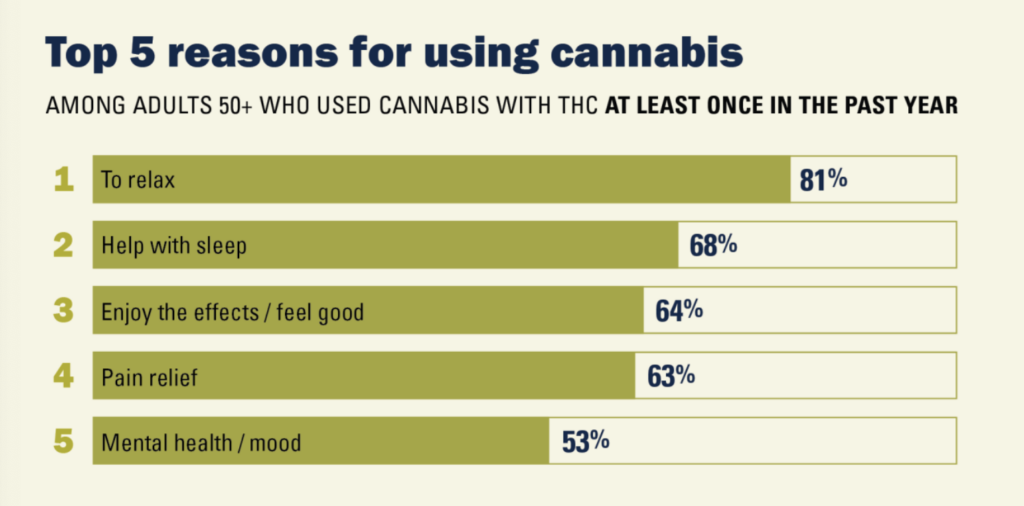
Among respondents who did use cannabis within the past year, 81 percent said it was to relax, 68 percent reported using the drug as a sleep aid, and 64 percent said it was simply to enjoy marijuana's effects and feel good. Another 63 percent said they used cannabis for pain relief, while 53 percent said they used it to promote mental health.
AARP, which supported the study, noted that the 21 percent of Americans over 50 who now report using marijuana in the past year represents an increase in use among older adults nationally—nearly double the 12 percent who said in the prior edition of the poll in 2021 that they consumed cannabis in the past 12 months.
In the latest survey, 12 percent said they used cannabis at least once a month, and 9 percent of people nationally said they consumed marijuana on a weekly basis, while 5 percent said they were daily users.
According to the new survey, the younger segment of older adults—ages 50 to 64—were more likely to use on a monthly basis, as were people in fair or poor health and low-income households.
University of Michigan National Poll on Healthy Aging via Marijuana Moment
In Michigan, which opened adult-use cannabis sales in December 2019, use rates were notably higher, with 27 percent reporting past-year use, 14 percent reporting weekly use, and 9 percent using cannabis daily or almost daily.
The data from the Michigan Poll on Healthy Aging asked 1,079 older adults in Michigan and 3,012 non-Michigan adults about their cannabis habits, focusing on THC-containing products in particular.
Authors of the new report say their findings underscore the need for further cannabis education.
“Our findings, in Michigan and nationally, show the need for more education and awareness, especially among those who choose to use cannabis more frequently,” Erin E. Bonar, a researcher and addiction psychologist, said in a statement.
“With some form of cannabis use now legalized in 38 states and on the ballot this November in several others, and the federal rescheduling process underway, cannabis use is likely to grow,” she added. “But as this poll shows, it is not risk-free, and more attention is needed to identify and reduce those risks.”
More than half (56 percent) of regular cannabis consumers—those who reported using at least monthly—said they'd discussed cannabis use with a healthcare provider, and nearly 4 in 5 (79 percent) said they believe marijuana is stronger than it was in decades past.
Bonar, however, noted that those numbers mean that 21 percent of older adults may not be aware of increases in THC levels since the 1990s and earlier. She also emphasized that while 72 percent of people believe that cannabis can be addictive, that means more than a quarter are at least skeptical.
“We see more people using cannabis as it's legalized, and we don't have enough information yet to know: Are there safe ways of using? Are there recommended guidelines?” Bonar told AARP. “So seeing the number creep up like that in the absence of really good scientific data to help guide people's decisions with this, that's a little bit concerning.”
Jeffrey Kullgren, an internal medicine professor at the University of Michigan and a doctor at the Veterans Affairs Ann Arbor Healthcare system, directed the newly released poll. In a statement, he underscored the importance of people talking to healthcare providers about their cannabis use, which can help identify possibly risky drug interactions as well as signs of problem use.
“Even if your doctor, nurse practitioner or pharmacist doesn't ask if you're using cannabis products, it's important to offer this information, no matter whether you're using it to address a physical or mental health concern, or simply for pleasure,” says Kullgren, a primary care physician at the VA Ann Arbor Healthcare System and associate professor of internal medicine at U-M. “Many prescription medications and over-the-counter drugs, as well as alcohol, can interact with cannabis and cause unexpected or unwanted effects. And there are only a few conditions where we have good evidence of a medical benefit from cannabis, though this could change with time.”
The University of Michigan also noted in a description of the findings that federal rescheduling of cannabis to Schedule III under the Controlled Substances Act (CSA) “may free more researchers to do studies of cannabis-derived products in clinical trials involving human volunteers.”
“Right now,” it adds, “such research is very limited because of federal restrictions.”
Authors of that study, published in the journal Drugs and Aging, also observed “sizable reductions in pain severity and pain interference among older aged patients [reporting] chronic pain as their primary condition.”
Gina Coleman/Weedmaps
Researchers said that the investigation was meant to address “a general paucity of high-quality research” around cannabis and older adults “and a common methodological practice of excluding those aged over 65 years from clinical trials” at a time when older patients are increasingly turning to medical marijuana for relief.
“International evidence that older individuals may be the fastest-growing increase in the use of medical marijuana, coupled with their frequent exclusion from controlled trials, indicates a growing need for real-world evidence to assess the effectiveness and safety of these drugs for older individuals,” the paper said.
A government notice about the grant program says the research can include “classic” psychedelics—including psilocybin, DMT, LSD, and mescaline—as well as similar compounds such as MDMA. Cannabis and ketamine are not considered psychedelics for the purposes of the clinical trials.
If you’re feeling that the world feels a little too loud and finding a moment of peace seems impossible, you’re not alone. A lot of people feel that same way and are searching for a way to reconnect with their core selves, to find some real clarity and navigate life’s ups and downs. For many, that path to a more centered life is being discovered through the gentle, yet powerful, practice of microdosing. For the team at Mama Dose, this isn’t just a business; it’s a way of life. They believe that true healing comes from within, guided by the wisdom of natural plant medicine.
Founded by Mark and Michele Medal, the company’s mission is to “empower individuals to take charge of their mental clarity and well-being through knowledge, guidance and community.” Think of Mama Dose as a trusted guide for anyone seeking personal transformation and spiritual wellness.
Mama Dose Offers a Gentle Hand for Mindful Mental Health
These days, more and more people are talking openly about mental health and exploring holistic ways to care for their minds and spirits. For those looking for new options, the practice of microdosing psilocybin is showing real promise as a tool for finding inner peace and balance. Unlike a full psychedelic experience, microdosing means taking a tiny amount—just enough to feel the benefits without any sort of “trip.”
Folks in the Mama Dose community often share that microdosing helps them feel a greater sense of mental clarity, emotional balance and presence in their day-to-day lives. It can quiet the constant chatter in a busy mind, making space for more focus and creativity. Mindful and intentional practice is a deliberate way to build a mindful mental health routine that supports long-term growth.
Your Journey, Your Way: The Mama Dose Product Lineup
Mama Dose knows that everyone’s healing journey is unique. They’ve created a thoughtful lineup of products for different intentions that help aid different experiences. Whether you’re looking for a little daily support or a deeper, more transformative moment, there’s an option tailored for your desired experience.
If you want to commit to a sustained healing journey, the Mama’s 90-Day Microdose Program is a powerful choice. These 200mg capsules are designed for a consistent practice that can lead to meaningful, long-term shifts.
If you prefer something sweet and convenient, the functional mushrooms are available as delicious mushroom gummies. There’s a Mini Microdose Pineapple Eclipse Gummy (100mg) for a gentle start and a Mama’s Organic Psilocybin Gummy (300mg) for a more pronounced microdose.
If you’re ready to dive into a deep, intentional experience, the 5 Gram Chocolate Journey Bar can help you connect with your inner self on a deeper level, brining together ancient wisdom and modern healing.
What really makes Mama Dose different is their total commitment to quality, ethics and community. They believe the source of their medicine is just as important as the medicine itself. That’s why they only use ethically sourced, organic psilocybin from the respected Mother Earth PE strain. Every single product is lab-tested, so customers can feel confident about the purity and strength of what they’re taking.
The team sees their products as sacred tools for personal growth. They’re a 508(c)(1)(A) spiritual organization, which means they operate under the Religious Freedom Act to help people connect with their higher selves using sacred medicine. They practice a deep respect for the Earth and a genuine desire to help others live more fulfilling lives.
The Mama Dose approach to psychedelic healing is all about intention. As a spiritual church, their goal is to provide these tools in a way that’s respectful, responsible and empowering. To honor the deep roots of this medicine, they donate 5% of all their sales to indigenous communities, creating a cycle of giving that supports the very source of these profound traditions.
Beyond the Dose: A Community to Lean On
The team at Mama Dose understands that real healing requires support, knowledge and connection. Their platform, The Plant Medicine Path, is a thriving community where people can share their experiences, learn from one another and feel supported on their journey.
Their dosing guides are based on a mix of modern science and real-world experience, so customers have the knowledge they need to use the products safely and effectively. The testimonials from their growing community are proof of the powerful transformations that can happen when you approach this work with intention and a strong support system.
Founders Mark and Michele also host a podcast, “Medicine With The Medals,” where they cover a wide range of topics from herbs and botanicals to psychedelic substances and are joined by guest speakers to talk about these powerful plant remedies.
If you’re seeking a path to self-discovery, mental clarity, healing, or personal transformation, Mama Dose’s sacred tools can help you find the psilocybin path that’s right for your journey. Use code codemama20 for 20% off your first purchase.
The therapy combines various techniques, including body awareness, movement, breathwork, and psychological processing, to address the root causes of trauma and encourage healing.
The Daily Hit is a recap of the top financial news stories for February 9, 2023.
On the Site
Canopy Slashes 800 From Payroll After Revenues Slide
Canopy Growth Corp. (TSX: WEED) (Nasdaq: CGC) reported slumping revenues on Thursday and signaled a new cost-savings era that includes cutbacks on cultivation and 800 layoffs. The stock fell more than 8% in early trading on the news to lately sell at $2.52, a big drop from its year high of $9.61. Read more here.
Aurora Cannabis Revenue Boosted by Strong Euro
Aurora Cannabis Inc. (Nasdaq: ACB) (TSX: ACB) achieved positive adjusted EBITDA and reduced its debt even though it still recorded a net loss in its latest quarterly earnings. Aurora attributed the rising revenue to “growth across all cannabis business segments” as well as a full-quarter contribution of C$6.6 million from Bevo Farms. Read more here.
How Much Adult-Use Cannabis Has New York Sold? Who Knows?
While many other states quickly release sales figures for new cannabis markets, New York has been conspicuously silent. Inquiries to the New York Office of Cannabis Management and the existing stores regarding sales figures have been met with silence. Read more here.
Cannabis Dispensary Deals Show How Prices Are Falling
The value of a cannabis dispensary just isn’t what it used to be. Six months ago, Planet 13 (OTC: PLNHF), a Las Vegas-based marijuana company, announced it would pull the trigger on its option to buy out its social-equity partner in an Illinois cannabis dispensary in a $2.9 million transaction. By the time the deal closed yesterday, the value had dropped by $1 million because of the steep downdraft in the stocks of cannabis companies. Read more here.
In Other News
Pineapple Express Cannabis Co.
Minaro Corp. (OTC Pink: MNAO) (the “Company”), a publicly traded company, announced the execution of a share exchange, the change of its name to Pineapple Express Cannabis Company, and an application to change the company’s current ticker symbol. Read more here.
Halo Collective
Halo Collective Inc. (NEO: HALO) (OTCQB: HCANF) expanded the company’s cannabis genetics and strain portfolio within its Oregon operations. With the expansion, Halo Collective now offers a wide range of unique and rare strains, sourced from some of the top growers and breeders in the state. Read more here.
BioHarvest Sciences
BioHarvest Sciences Inc. (CSE: BHSC) (OTCQB: CNVCF) reported sales orders of $6.1 million in 2022 , representing a 160% increase over 2021. Fourth-quarter sales orders of $2.7 million were more than triple the sales orders from the same quarter in 2021. Read more here.
Ayr Wellness Inc. (CSE: AYR.A) (OTCQX: AYRWF) is exiting Arizona and turning its attention to Ohio.
The multistate cannabis operator signed a definitive agreement to sell its Arizona assets, Blue Camo LLC, to AZ Goat LLC, a group consisting primarily of the former owners of Blue Camo, who sold the business to Ayr in 2021.
The sale includes three Oasis-branded dispensaries in the greater Phoenix area, a 10,000 sq. ft. cultivation and processing facility in Chandler, an 80,000 sq. ft. cultivation facility in Phoenix, and Willcox OC LLC, a joint venture developing an outdoor cultivation facility.
Ayr will receive $20 million in cash, with additional cash proceeds from net working capital to be received within six months of closing the transaction. In addition, AZ Goat will assume lease obligations from Ayr that will result in the elimination of $15 million in long-term lease liabilities for Ayr.
Ayr will also be reducing its long-term debt obligations related to the original Blue Camo acquisition.
“Ayr’s proposed sale of Arizona assets represents the latest in a series of optimizations focused on simplifying our business and prioritizing existing and future markets where we can build depth,” said David Goubert, president at Ayr. “Today’s action allows Ayr to focus on key markets for growth and profitability, adds cash to our balance sheet, and reduces outstanding debt.”
Ayr also entered into option agreements related to two entities provisionally licensed to operate medical marijuana dispensaries in Ohio. The arrangement includes Daily Releaf’s dispensary in Riverside, Ohio, and Heaven Wellness’ in Clermont County. Neither location is operational at this time.
“Ayr is excited to invest further into the Ohio market and looks forward to establishing a fully vertical presence once permissible under Ohio regulations,” Goubert said.
In addition to the option agreements, the company entered into a support services agreement and a working capital loan agreement with Daily Releaf and Heaven Wellness.
Ayr Wellness Inc. (CSE: AYR.A)(OTCQX: AYRWF) is killing its plan to buy Chicago-based Gentle Ventures also known as Dispensary 33. According to the company statement, Ayr will no longer be required to pay the previously announced purchase consideration of $55 million upfront, including $12 million of cash, $3 million of seller notes, and $40 million of stock.
“The cannabis market has changed significantly in the 15 months since we agreed to acquire Dispensary 33. Both parties have acknowledged this reality and engaged in good faith dialogue as we came to the mutual decision to terminate the proposed arrangement,” said David Goubert, President at Ayr. “We are focused on optimizing our business and will prioritize our efforts in markets where we can build meaningful depth and drive strong revenue and cash flow in the near term. Additional plans for optimization include implementation of operating efficiencies, lowering costs across our business, and reorienting our investments into the markets, segments and activities that are most impactful for our growth and profitability.”
Expansion Continues
The company hasn’t slowed its expansion. It recently opened two new retail locations in Florida: Tarpon Springs and Orlando. Both stores feature the AYR retail design concept and operate under the Liberty Health Sciences banner. The new stores offer many of Ayr’s national brands and products and feature a “bud bar,” providing customers with a sensory experience showcasing samples of whole flower strains currently available for purchase.
In New Jersey, its three retail locations, formerly known as Garden State Dispensary, are now operating under the AYR dispensary name. Since acquiring Garden State Dispensary in September 2021, Ayr said it has made significant progress in elevating key facets of the business, including improvements to the menu and overall retail experience. In 2022 the company opened a large-scale cultivation expansion, launched adult-use sales at its three retail locations, the maximum allowed in the state, and introduced its national brand portfolio in the wholesale market and its retail stores.
Latest Earnings
Ayr Wellness reported its third-quarter earnings in November revenue rose 24% to $119 million over last year’s revenue of $96 million and an increase of 8.6% sequentially. The operating loss grew to $20.7 million over last year’s loss of $8.9 million. It improved by 17% over the second quarter. The company had a comfortable cash cushion of $100 million.

 Login
Login
 Gina Coleman/Weedmaps
 University of Michigan National Poll on Healthy Aging via Marijuana Moment
 Gina Coleman/Weedmaps