Panic has gripped XRP holders after the token slid back to the $2 mark, triggering a fresh wave of fear across the market.
But when sentiment hits extremes like this, it often signals the opposite of what traders expect and could favor a bullish XRP price prediction.
Santiment data shows social sentiment has plunged into “Extreme Fear,” while CoinMarketCap’s Fear and Greed Index dropped to just 16.
From Wednesday to Friday, XRP slipped from $2.20 to $2, capping off three days of selling pressure.
Yet behind the scenes, investor interest appears to be building.
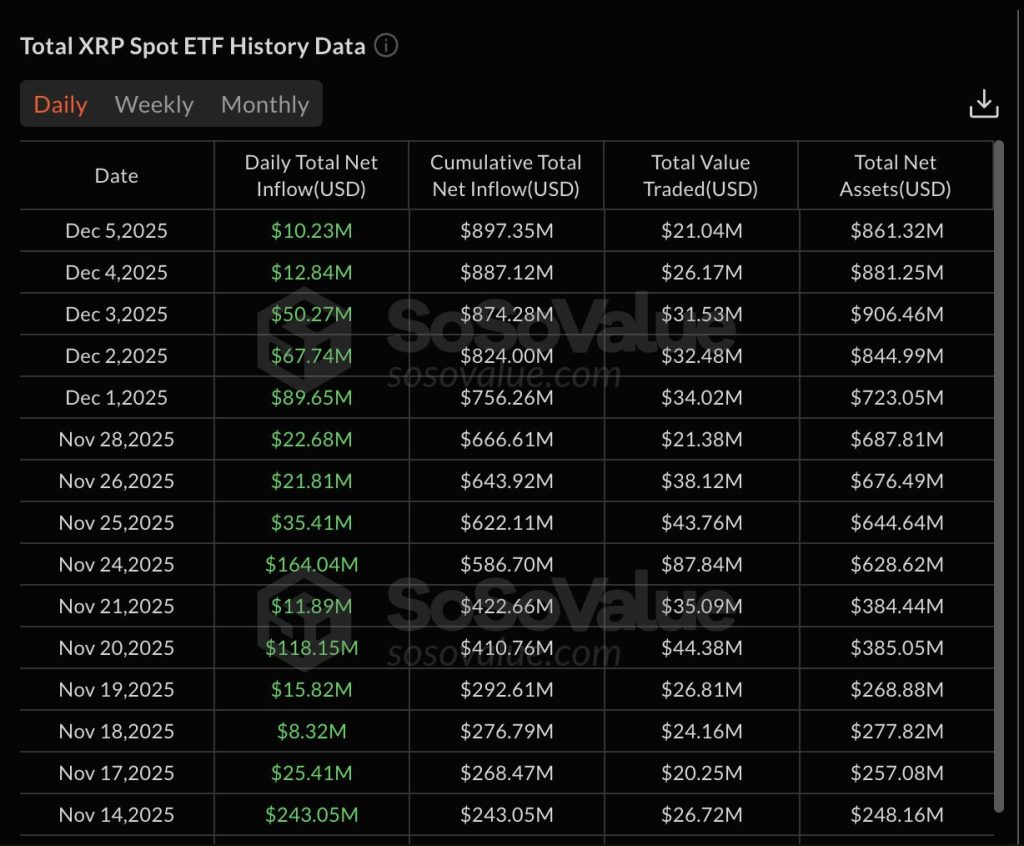
XRP-linked ETFs have now recorded 15 consecutive days of net inflows, according to SoSo Value, totaling nearly $900 million in fresh capital.
Combined assets under management for these funds now sit at $861 million, suggesting that both retail and institutional investors are positioning for a rebound.
With fear rising and big money flowing in, this could be the early stage of a major reversal.
XRP Price Prediction: XRP Is Forming a Bullish Falling Channel Pattern
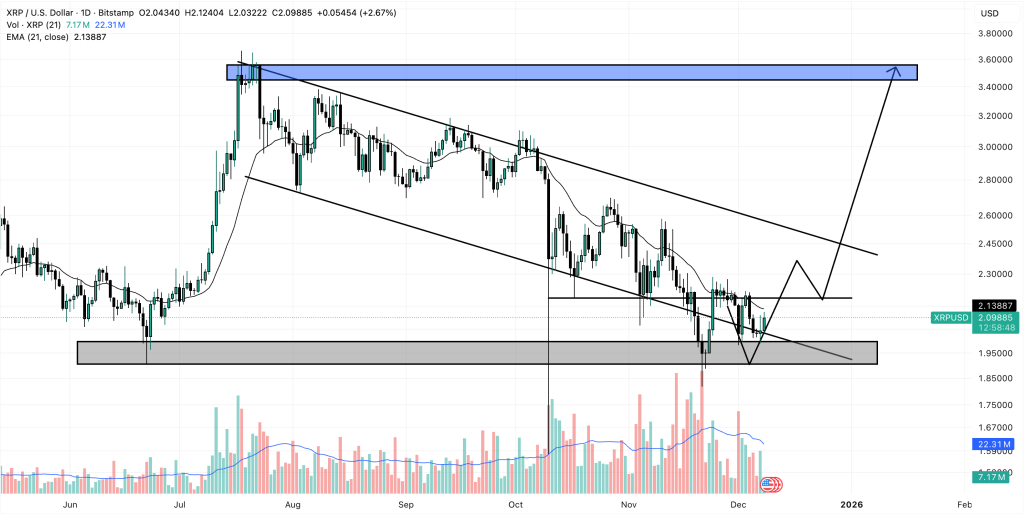
XRP has bounced off the $1.95 support zone and is now forming a series of higher lows, signaling a potential trend reversal.
The next key level to watch is $2.20. A breakout above this resistance, followed by a successful retest, could confirm a bullish reversal pattern and open the door to a rally toward $3+.
In the past 24 hours, XRP has gained 3.3%, with trading volume jumping nearly 90%.
With momentum building, the token could be positioning itself for a major breakout.
As broader crypto sentiment begins to shift, some of the most promising new projects have continued to gain traction.
One project in particular is Bitcoin Hyper ($HYPER), a presale project building a Solana-powered layer-2 solution for Bitcoin.
By combining Bitcoin’s security with Solana’s speed and scalability, $HYPER is creating a new level of utility for Bitcoin, and investors have taken notice, with millions raised so far.
Bitcoin Hyper ($HYPER) Lets Investors Earn Passive Income on BTC
Bitcoin Hyper ($HYPER) was created to address the Bitcoin blockchain’s long-standing scalability issues by introducing a Solana-powered infrastructure that reduces transaction fees and speeds up transaction speeds.
What makes Bitcoin Hyper so powerful is its seamless bridge between Bitcoin and next-gen applications.
Using the Hyper Bridge, BTC holders can safely send tokens from the Bitcoin blockchain and instantly receive an equivalent amount on Hyper’s high-speed Layer 2.
This unlocks access to lightning-fast DeFi tools, payment platforms, and more, all without ever leaving the original Bitcoin network.
For developers, it means the ability to build scalable dApps on Bitcoin for the first time, powered by Solana-grade performance.
As adoption spreads across major wallets and exchanges, demand for $HYPER could skyrocket.
The cryptocurrency market has rebounded by 3% today, with investors eagerly awaiting this week’s FOMC meeting.
Economists are betting on a rate cut come Wednesday, which has helped to lift prices after a difficult few weeks for crypto.
Bitcoin is up by 3% today, while altcoins such as Ethereum, Solana, and Cardano have posted gains closer to 4%, while Canton and Zcash are up by more than 13%.
Now is therefore a good time to be reentering the market, and we’ve accordingly picked our next altcoin to turn $100 into $10,000, which is the exciting new ERC-20 token PEPENODE ($PEPENODE).
Next Altcoin to Turn $100 into $10,000 – 8 December
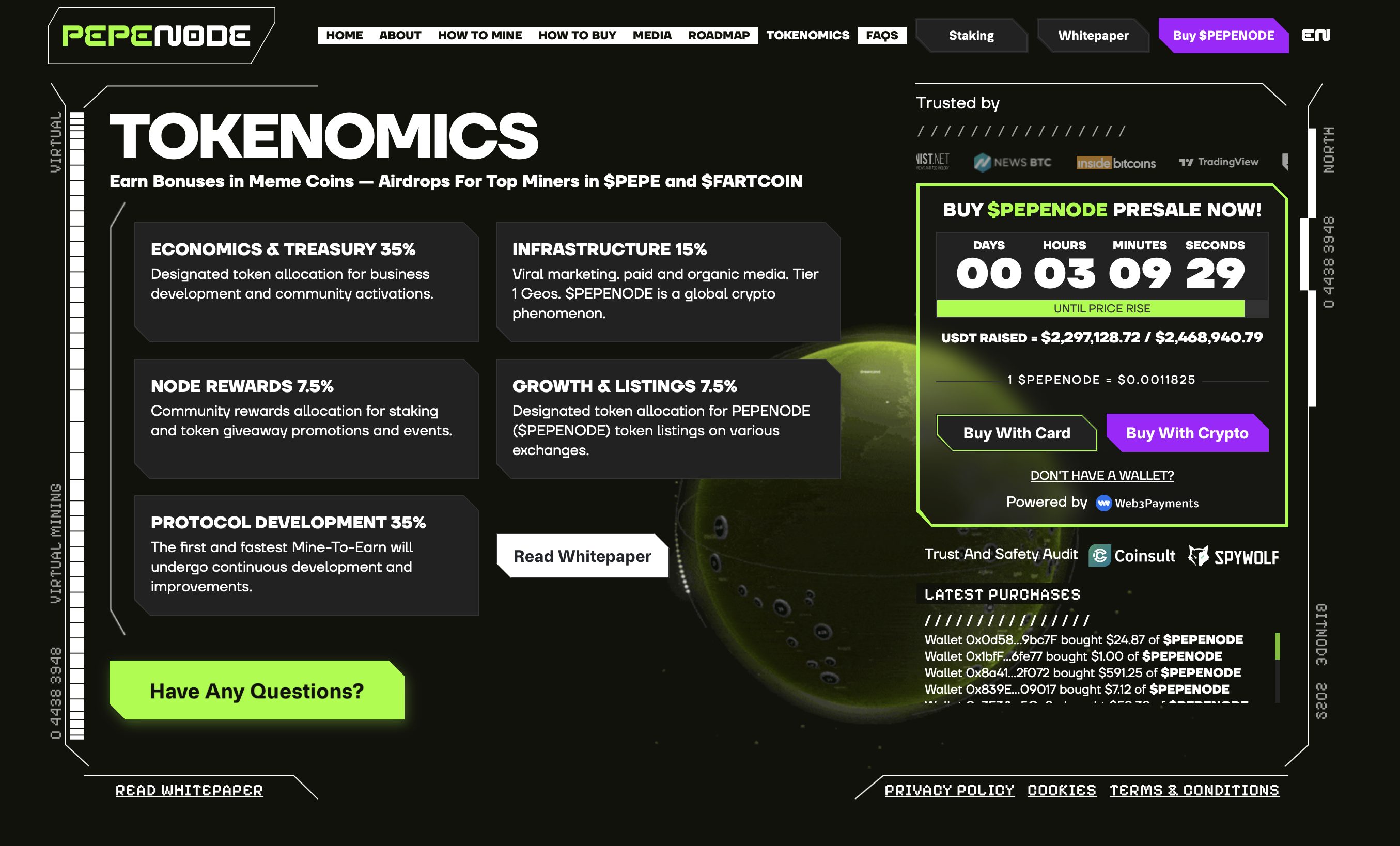
This figure provides a strong vote of confidence in the new project, which is aiming to make cryptocurrency mining more accessible to average investors.
It will do this by enabling users to build and run their own virtual mining rigs, instead of requiring them to invest in expensive mining hardware, as proof-of-work cryptocurrencies do.
By spending PEPENODE tokens on new virtual nodes and by upgrading and combining these nodes, users can earn greater mining rewards.
PEPENODE pays out mining rewards in external tokens such as Fartcoin and Pepe, providing users with a very strong incentive to acquire more PEPENODE tokens in order to enhance their mining rigs.
There may be multiple paths but they always lead back to one thing…
This is hugely generous, and arguably makes PEPENODE one of the most attractive new tokens to invest in at the moment.
PEPENODE Will Launch Soon: Here’s How to Buy Early
Traders can invest in PEPENODE by going to its official website and joining its presale, which will run for several more weeks, at which point the coin will list on exchanges.
PEPENODE will have a max supply of 210 billion tokens, with its allocation divided between development, marketing, node rewards, liquidity, and its treasury.
It’s currently selling at a price of $0.0011825, although this price will continue to rise every three days until the same comes to an end.
Investors can use ETH, USDT, BNB, or fiat to buy whatever amount of the token they want, and will receive their coins once the sale closes.
Given the market appears to be preparing for a big comeback, now may be an ideal time for a new token launch.
And because it has such strong fundamentals, PEPENODE is our next altcoin to turn $100 into $10,000.
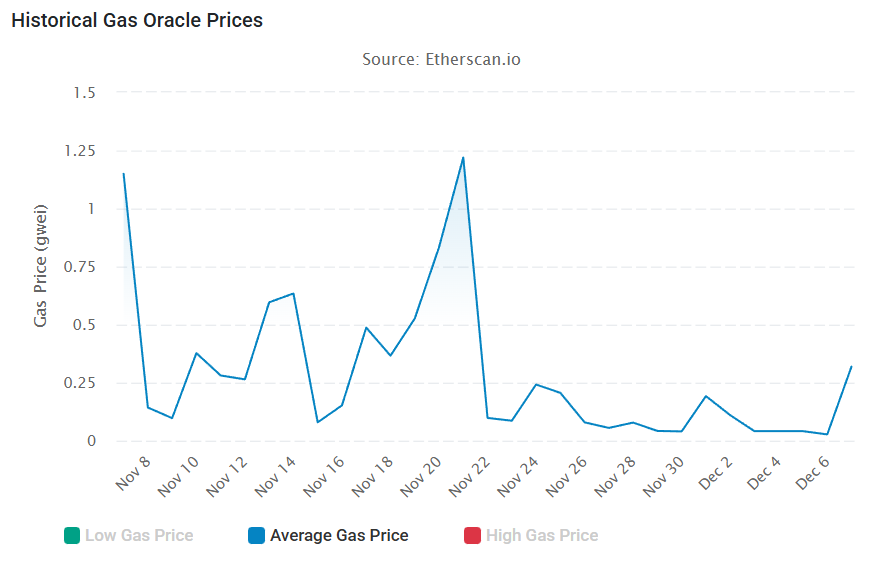
Vitalik Buterin is pushing for a market to predict future gas costs, a problem that has long overshadowed bullish Ethereum price predictions.
He argues that multi-year low gas fees have bred complacency, with a massive shift in retail activity to cheaper Layer 2 networks like Base and Arbitrum sidelining the altcoin’s issue.
His solution: an on-chain prediction market designed to help users secure future gas prices and mitigate sudden spikes in transaction costs on the network.
We need a good trustless onchain gas futures market.
(Like, a prediction market on the BASEFEE)
I've heard people ask: "today fees are low, but what about in 2 years? You say they'll stay low because of increasing gaslimit from BAL + ePBS + later ZK-EVM, but do I believe you?"…
An on-chain futures curve would provide a clear signal of long-term market expectations. It would permit users to prepay for block space and lock in costs regardless of future spikes.
With a shared reference point for future network conditions, developers could buy gas insurance to cap operating costs ahead of critical events, while heavy users could also offset future fee spikes by taking the opposite market position.
This all amounts to a more favourable platform for users, facilitating the transition from web-2 to web-3 as blockchain technology needs the reliability expected at the institutional level.
Ethereum Price Predictions: Adoption Could Fuel New All-Time Highs
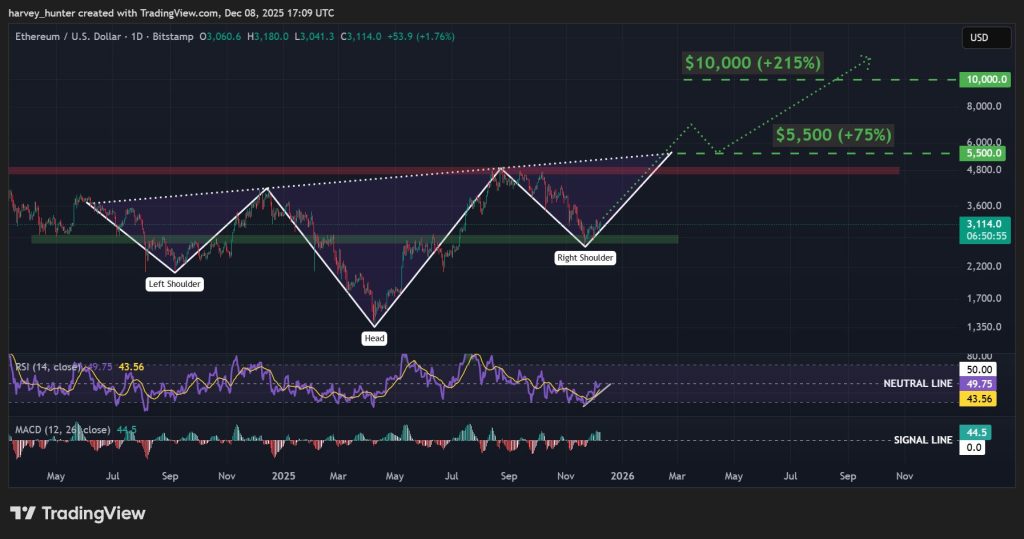
The potential adoption of controlled gas fees could bring to Ethereum could help fuel the breakout of a bullish 19-month head-and-shoulder pattern, now unfolding.
The Ethereum price has confirmed a local bottom after with higher highs forming after its bounce from a historical demand zone around $2,750, and with it the right shoulder.
ETH USD 1-day chart, bullish head-and-shoulders pattern. Source: TradingView.
Momentum indicators show this bullishness is now being realised. The RSI is closing in on the 50 neutral line, forming several higher lows as buyers step in.
The MACD also displays a growing lead on the signal line, suggesting a sustained bullish trend.
A fully realised pattern breakout could see the neckline reclaimed around $5,500, reclaiming past all-time highs and entering new price discovery in a 90% move.
But as the bull market matures, if Ethereum finds a bigger part to play in the transition from Web2 to Web3, the move could extend 250% to $10,000.
SUBBD: A Web3 Solution to an $85 Billion Industry
With a shift to pro-crypto regulation, the transition to Web3 has been accelerated. And with it, platforms based in real-world utility like SUBBD ($SUBBD) are gaining traction.
Positioned as an AI-powered content platform, SUBBD is redefining the $85 billion subscriber economy by giving creators true ownership and fans genuine access.
Never miss a sale again.
As a top creator, your audience is global. It's just not possible to cater to everyone – you can't be online 24/7
That's where your personal AI Assistant comes in, to handle requests and secure payments. Sleep peacefully knowing you're making money… pic.twitter.com/ju9VjLBmea
By cutting out the middlemen, $SUBDD puts control back in the hands of those who create real value.
Creators can monetize directly, while fans gain access to exclusive content, early releases, and meaningful interactions through token-gated perks.
The concept is already gaining traction. $SUBBD has surpassed $1.3 million in presale, as investors back the shift toward a decentralized creator economy.
With SUBBD, both sides of the community win — creators earn more, and fans get closer while embracing the decentralization use cases crypto was built for.
Cyberthreats don’t stop nor do they stop evolving (and at a dizzying pace). Federal agencies are responding with smarter strategies, stronger partnerships and a focus on mission resilience.
Our latest ebook brings together insights from top government and industry experts shared on Day 1 of our Cybers Leaders Exchange 2025, presented by Carahsoft and Cisco. You’ll find tips, strategies and tactics on how to tackle today’s most complex cybersecurity challenges.
Featured voices include:
Nick Andersen, executive assistant director for cybersecurity, CISA
Darren Death, chief information security officer, Export–Import Bank
Ollie Gagnon, chief homeland security advisor, Idaho National Laboratory
Bart Larango, strategic industry advisor for federal, Splunk
Michael Overstreet, director of security solutions engineering, U.S. public sector, Cisco
Matthew Rogers, OT cyber lead, CISA
Madhuri Sammidi, deputy associate CIO, Bureau of Safety and Environmental Enforcement, Interior Department
Jason Warfield, head of solutions and adoption engineering, Cisco ThousandEyes
Explore how Carahsoft and its partners — Cisco, Splunk and Cisco ThousandEyes — are helping agencies stay secure, agile and mission ready.
In the Army, a new acquisition bureaucracy is starting to take shape. It means new names for some longstanding Army organizations. But at its core, the reorganization is about letting Army officials manage the acquisition system as portfolios of capabilities with less of a focus on individual programs.
That idea’s been championed by outside reform advocates for years, including when the “Section 809 panel” on acquisition reform released its final report in 2019. The Congressional panel on Planning, Programming, Budgeting and Execution Reform echoed the call as part of its recommendations. So did both the House and Senate in their respective versions of the latest Defense authorization bill. And last month, it got the explicit endorsement of the secretary of Defense.
“We will leverage taxpayer dollars in a more accountable, flexible and deliberate manner to maximize their value across capability portfolios,” Defense Secretary Pete Hegseth said during an address at the National War College. “We will shift funding within portfolios’ authorized boundaries swiftly and decisively to maximize mission outcomes. If one program is faltering, funding will be shifted within the portfolio to accelerate or scale a higher priority. If a new or more promising technology emerges, we will seize the opportunity and not be held back by artificial constraints and funding boundaries that take months or even years to overcome.”
In that address, Hegseth credited the military services with laying the groundwork for some of the reforms he wants to make department-wide. And the Army started its implementation work last month, naming six new “portfolio acquisition executives.” Each of those PAEs will oversee different “capability areas” with programs managed by what had, up until now, been called program executive offices (PEOs), and will now be called capability program executives (CPEs).
But there’s more in those portfolios than just the former PEOs, said Brig. Gen. Christine A. Beeler, the capability program executive for Simulation, Training and Instrumentation (CPE STRI).
“The PAE is going to be able to wrangle all of those enablers, and we are just one enabler to the PAE,” said Beeler during a staff town hall late last month. “There are also folks up at big Army that are going to help us on the programming side … and you’ve got requirement folks. That can get combined and come to us in a single requirements community of practice, so that things that get decided at the PAE level will be easier to understand and make trades on.”
Last week, another of those former PEOs announced the details of its own internal reorganization. Leaders of the newly-dubbed Capability Program Executive for Command, Control, Communications, and Network say most of their changes will be at the program manager level — both to align with the Army’s broader acquisition “transformation” agenda, and to orient the office more explicitly around the Army’s plans for Next Generation Command and Control.
The changes there include four new program offices — one each for applications, data and AI, infrastructure and transport, plus changing roles for several other offices. CPE C3N officials expect to detail the changes during the next Army technical exchange meeting at Aberdeen Proving Ground next month.
Beeler said there will be program office changes within her organization as well, but the reorganization will take until the summer of 2027 to fully unfold. Along with that, she said, will be a reduction in senior officer positions.
“The key changes were a mandated reduction of command select list billets by 30% at both the O-6 and the O-5 level,” she said. “So that means, over time, we’re going to transition from three CSL billets to two CSL billets at the O-6 level, and from eight CSL billets eventually to five CSL billets at the O-5 level.”
And at the even more senior levels, Beeler says the end state of the Army’s acquisition reorganization is that the new PAEs will be two-star generals or the civilian SES equivalents. And the CPEs will be one-star positions.
But those details — like many others in the reorganization — are still subject to change.
“This is a very time and event-driven process,” she said. “We’re not jumping in tomorrow, both feet and everything’s changed. That wouldn’t make any sense, and we would lose the discovery part of how these pathfinder adjustments to the acquisition process are actually going to work. For the time being, we will be the Capability Program Executive STRI. We believe in the future we’re going to change the logo and we’ve got some ideas out there for how we’re going make other changes over time, but at the end of the day, this is what we’re going to do. We simulate the fight, we replicate the threat, and we’re going to make sure that the Army can win across all domains.”
U.S. Army soldiers walking along Constitution Ave., on the National Mall ahead of a parade commemorating the Army's 250th anniversary and coinciding with President Donald Trump's 79th birthday, Saturday, June 14, 2025, in Washington. (AP Photo/Pablo Martinez Monsivais)
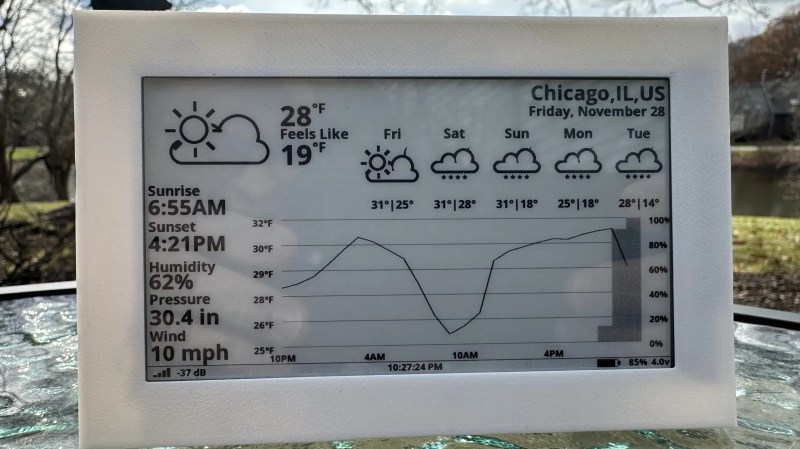
These days, Internet connectivity is ubiquitous, so you can look up live weather data on just about any device around you. Regardless, [Jozerworx] wanted a simple, clean, independent weather display, and came up with this simple design.
The build is based on the Lilygo T5 EPD devboard, which combines an ESP32-S3 microcontroller with a nice 4.7-inch e-paper display. This display has the benefit that it only uses power when it’s being updated, making it particularly suitable to run off a battery for extended periods of time. Meanwhile, the ESP32 and its inbuilt Wi-Fi connectivity allow it to query the internet for updated weather forecasts. Weather data is sourced via the OpenWeather API, which [Jozerworx] notes comes with the caveat of requiring an API key. It’s a little fussy, but if you want good weather data, there are few easier ways to get it. The display shows a forecast for the next five days, while also showing graphs of ambient temperature and humidity along with useful information like the sunset and sunrise schedule.
Files are on Github for those eager to learn more. [Jozerworx] also notes that getting started with the display is particularly easy with the inclusion of a setup mode. This allows the display to act as a Wi-Fi access point with a web page that you use enter your home Wi-Fi connection details.
Startup wagers the path to sustainable AI might be found in nature’s most amazing design - the brain
Interview Naveen Rao founded AI businesses and sold them to Intel and Databricks. He’s now turned his attention to satisfying AI's thirst for power and believes his new company, Unconventional AI, can do it by building chips inspired by nature.…
Recent benchmarks from Ars Technica show that SteamOS' performance advantage over Windows 11 largely evaporates and sometimes reverses on devices with discrete graphics. Moreover, Valve's Linux distro and compatibility layer appear to worsen performance issues on GPUs with just 8GB of VRAM.
A SpaceX Falcon 9 has launched and landed a record 32 times following a successful mission on Monday night. The Falcon 9 first-stage booster — listed as B1067 — lifted off at 5:26 p.m. ET from Launch Complex 39A (LC-39A) at NASA’s Kennedy Space Center in Florida. Shortly after deploying 29 Starlink internet satellites to […]
New technological developments in recent years has made it possible to build a private cellular network at very low cost. This can be useful to many organizations who place their privacy at a premium such as firms engaged in research and development of intellectual property (IP) or law firms, to name but a few.. You can read here how the Mexican drug cartels built their own private cellular network to evade both law enforcement and competitors snooping.
This article was written by one of our most advanced students, Astra. Astra is an ardent supporter of Ukraine’s freedom and an advanced student of low cost cellular networks.
If you want to learn more about setting up a private 4G LTE network, enroll in our SDR for Hackers: Building a Private 4G Network!
In this article, he will demonstrate how to build your own 4G LTE network!
LTE Networks
The concept of private LTE itself is not new. There are ready-made solutions that allow you to lease frequencies and deploy such network at your enterprise. But, of course, all this equipment is not suitable for a one-time testing experience, so we will launch a network based on SDR.
If in the world of open-source stacks GSM is ruled by Osmocom, then here in 4G LTE the undoubted leader is srsRAN. This is a completely open-source software that with minimum configuration allows us launching this kind of network.
srsRAN can be built from source, but I recommend using DragonOS, which has already been mentioned many times by OTW, where this software is already included in the distribution.
There is also another similar project which is LibreCellular that uses slightly different hardware, but the key concept is the same of srsRAN.
How LTE works
Let’s understand how this network (RAN, Radio Access Network) works.
It is a network that utilizes frequencies more efficiently and provides much faster performance compared to GSM and 3G.
It consists of three key components:
EPC (Evolved Packet Core)
This the operator’s core network. Its main component is the MME (Mobility Management Unit), through which all signaling traffic from UEs (User Equipment) passes. This node is responsible for service transfer, calling, authentication and many other operations. Its other parts are the billing service and gateways (service and packet), which provide data exchange between parts of the network and other networks. Connected to the core network is the HSS (Home Subscriber Server), a secure database where encryption keys and subscriber information are stored. In a GSM network, the role of this node is played by the home register (HLR).
eNBs (eNodeB).
These are the base stations. LTE operates in a wide range of frequencies, from 450 to 2600 MHz. Their use varies from country to country, as some of these frequencies are already reserved for something else. Like GSM, there are channel numbers here too – the E-UTRA Absolute Radio Frequency Channel Number (EARFCN).
The whole spectrum of frequencies is divided into broad sections (LTE bands), the choice of which differs from country to country.
UE (User Equipment).
These are the devices that connect to the network such as phones and modems.
What does it take to get your own LTE network up and running?
In order to reproduce everything that I will be describing below, you will require some specific hardware and specific configuration.
For this test you will need:
1) A linux and a windows machine.
2) A full duplex SDR with proper antennas. B210, BladeRF, and LimeSDR are suitable.
3) A sim card reader
4) Programmable LTE USIM cards
5) An android smartphone
Let’s start
Boot into DragonOS and plug in the SDR.
Navigate to the /etc/srsran folder.
dragonos> cd /etc/srsan
You’ll find the configuration files there.
dragonos > ls -l
In the enb.conf file we will modify two parameters: MCC and MNC
These parameters are identical to those used in GSM networks – they are country code and network code. Normally, we should use some arbitrary values, but the problem is that most phones refuse to work when they see strange values for network. That’s why we need to specify the MCC of the country we live in or use the 999 which is the value for private enterprise networks. With regards the network code (MNC) make sure to set one that doesn’t belong to any operator working in your country.
[enb]
enb_id = 0x19B
mcc = 999
mnc = 01
mme_addr = 127.0.1.100
gtp_bind_addr = 127.0.1.1
s1c_bind_addr = 127.0.1.1
s1c_bind_port = 0
n_prb = 50
#tm = 4
#nof_ports = 2
Modify the epc.conf file in the same way:
[mme]
mme_code = 0x1a
mme_group = 0x0001
tac = 0x0007
mcc = 999
mnc = 01
mme_bind_addr = 127.0.1.100
apn = srsapn
dns_addr = 8.8.8.8
encryption_algo = EEA0
integrity_algo = EIA1
paging_timer = 2
request_imeisv = false
lac = 0x0006
full_net_name = astra00011
short_net_name = astra00011
Now in two separate terminal run first sudo srsepc and then sudo srsenb.
Now take your phone and go to search for networks manually. If we are lucky we’ll see a network, depending on which values you set, starting with 99913. If we try to connect to this network, we will surely fail – the phone will connect a bit and then give a sad “No service”.
It’s all about authentication. That is what we are going to deal with now.
Fire up a windows machine and plug in the sim card reader. Insert a blank sim into the reader.
I am using a non open source software to read/write on sims. There are other options such as pysim.
Once the sim card is read, we can proceed writing the required parameters.
The key parameters required by srsRAN are the IMSI, KI and OPC.
The first field to fill in is to write value for ICCID. The ICCID number should be a unique 19 digit identifier for the SIM card itself. It should composed by the following:
Field
Description
Example
Major Industry Identifier
Always set 89 for telecommunication purposes
89
Country Code
2 or 3 digit country code as defined by by ITU-T recommendation E.164.
Account identifier (usually the same as the one in the ICCID but chopped here to stay in the 15 digit limit)
0000000001
Next step is to generate the KI value (subscriber key), which is known only by the subscriber and network and used to authenticate the device on the network. We also need to generate a OPC (operator code derived) value.
I used the following script to generate 128-bit values for both Ki and OPC:
Then fill in the last parameters which consists in:
PLMNwAct: A user-managed list of preferred Public Land Mobile Networks (PLMNs) ranked by priority, along with the corresponding access technologies (2G/3G/4G/5G, etc.).
OPLMNwAct: An operator-controlled version of the user-preferred PLMN list mentioned above.
HPLMNwAct: The Home PLMN, including the specified access technology, identifies the network associated with the subscriber’s identity, represented as a combination of Mobile Country Code (MCC) and Mobile Network Code (MNC) with the access technology included.
EHPLMN: A list of Equivalent Home PLMNs. Networks in this list are treated as equivalent to the home network, meaning the device won’t consider itself roaming when connected to them. This field can be useful, for example, when operators merge, allowing each to include the other’s
PLMN in this list (though the original source for this suggestion could not be verified).
FPLMN: A list of forbidden PLMNs that the device should not automatically attempt to register with. This can be used to avoid all specified local public mobile networks.
If everything was correctly set up, once you insert your programmed sim card in your smartphone, you should be able to see something like this in the network parameters:
Notice that we still don’t have any mobile connection (top right corner icon)
Lastly, we need to choose the radio frequency for transmission and reception, which is conveniently represented by an EARFCN (Evolved-UTRA Absolute Radio Frequency Number). srsRAN supports exclusively FDD (Frequency Division Duplexing), where the mobile device’s downlink and uplink operate on separate frequencies. By specifying the downlink EARFCN, srsRAN can determine the corresponding downlink frequency. This can be done in the /etc/srsran configuration folder in the rr.conf file.
The final step to complete the whole configuration is edit the user_data.csv file. This file includes the SIM card identity that we previously configured. This file is utilized by the Home Subscriber Service (HSS). The information programmed into the SIM cards is now necessary for operation.
Keep in mind that srsRAN does not support calls and SMS, only internet connectivity. Calls are possible with VoLTE but this involves additional components such as the IP Multimedia Subsystem (IMS) that srsRAN does not natively include.
Now’s the time to raise our 4G LTE network:
In two separate terminals type:
>sudo srsepc
followed by
sudo srsenb
Success! We have our own private 4G LTE network!
Summary
It is now possible to create your own 4G LTE network with low cost components and a bit of expertise! These networks can be invaluable to those who place a high priority upon privacy and confidentiality. This is key in a era where competitors or nation state actors may be inside your mobile carrier’s system.
To learn more about SDR (Signals Intelligence), join our SDR (Signals Intelligence) program or our Subscriber Pro training package.
Ripple’s $500 million share sale in November raised its valuation to $40 billion, with institutional investors taking a cautious approach amid crypto volatility.
 Login
Login




https://t.co/FaKIaBoHfa pic.twitter.com/L6mF94nPB9



 Kumar Tanishk / Reuters: