 Login
LoginJudge Says ICE Used ChatGPT to Write Use-of-Force Reports

ChatGPT for Fascists.


The Trump administration is looking to hire thousands of federal law enforcement personnel, as part of expanded immigration enforcement efforts.
But the courts handling these cases aren’t seeing the same surge in resources. Several immigration judges recently fired by the Justice Department say the court system is losing staff, and is unable to address a multi-million case backlog.
Immigration and Customs Enforcement has intensified operations across the country, and detention facilities are full of individuals waiting for their cases to be heard.
The One Big, Beautiful Bill Act passed this summer gave the Department of Homeland Security billions of dollars to hire 10,000 new ICE agents, as well as 5,000 customs officers and 3,000 Border Patrol agents.
The legislation bill also authorized DOJ to hire about 100 new immigration judges, bringing their total headcount to about 800 nationwide.
But the total number of immigration judges is dwindling under the Trump administration, according to data tracked by the International Federation of Professional and Technical Engineers and its affiliate, the National Association of Immigration Judges.
According to the unions, the total number of immigration judges this year has dropped from 700 to 600. The Trump administration terminated more than 80 immigration judges since taking office, while others have retired or accepted voluntary separation incentives.
Recently terminated immigration judges say their colleagues still on the job don’t have the resources needed to address a backlog of about 3.4 million cases.
Before he was fired in September, Ted Doolittle, a former immigration judge at the immigration court in Hartford, Connecticut, was one of two judges handling about 46,000 cases.
Doolittle said he received his termination email one afternoon, as he was preparing for a docket of 57 cases the next day.
“The caseload is crushing. I think it’s probably one of the most overburdened court systems,” Doolittle said Thursday at an event at the National Press Club.
In order for the Justice Department to meaningfully address the backlog, Doolittle said the department needs about 2,000 or 3,000 immigration judges — not the few hundred currently working.
“That’s what’s going away, is the right of these people to have their cases heard fairly,” he said.
Emmett Soper, a former immigration judge in Virginia, who was fired in August after serving nine years on the job, said the widespread terminations are leading to a “chaotic situation,” where courts are scrambling to reassign cases to remaining judges.
“Each immigration judge is responsible for hundreds or thousands of these cases, and every time the administration unlawfully fires an immigration judge, they’re no longer there. Their cases have to be redistributed to the judges who remain at the court,” Soper said. “This is not a fair way to run a court system.”
Anam Petit, former immigration judge in Virginia, who was fired in September, said judges are hearing, at a minimum, 25 cases a day — sometimes 50 or more cases — in multiple languages.
“You can have a docket with five different languages,” she said.
Matt Biggs, president of the International Federation of Professional and Technical Engineers, said that the “lion’s share” of firings have been targeted at immigration judges who were hired during the Biden administration.
“Immigrants in this country are entitled to due process, and by firing these judges, you’re denying them their due process,” Biggs said.
To address the backlog, DOJ is training hundreds of military lawyers to temporarily serve as immigration judges. But Biggs said most of these don’t have a background in immigration law.
“We appreciate their service to our nation, and it’s no disrespect to them, but they should not be in these positions,” he said.
Federal News Network reached out to DOJ and DHS for comment.
The former judges said defendants are also failing to show up for court dates this year, because they are afraid of being detained by ICE agents afterward. Petit said that it was a “daily occurrence” for defendants in her courtroom.
“It has a huge chilling effect,” she said. “People are afraid to come to court because they’re seeing people get detained in the hallways.”
Defendants who don’t appear for their court date automatically receive a removal order, and have no legal avenue to appeal that decision.
Doolittle said ICE agents prefer making arrests in courthouses, because individuals have gone through security and been screened for weapons. He recalled that toward the end of his tenure, ICE agents repeatedly tased a suspect in the court’s lobby before bringing him into custody.
“Many of the court staff lost sleep — like physically, weren’t able to sleep for a period afterwards. And of course, it makes them question whether that’s a job they want to continue,” he said.
The post Immigration courts understaffed and overwhelmed, as Trump administration surges enforcement hiring first appeared on Federal News Network.

© The Associated Press
Democrats in Congress are pressing Immigration and Customs Enforcement to restore oversight staff who were furloughed at the start of the government shutdown.
In a Nov. 6 letter to Homeland Security Secretary Kristi Noem, the lawmakers said that staff at the Office of Detention Oversight are crucial to ensuring safety at ICE detention centers. Staff at ODO were furloughed at the outset of the shutdown.
“Without ODO staff actively performing these duties, there is a heightened risk that detention facilities fail to meet required standards, compromising detainee safety, access to medical care, and legal protections,” the lawmakers wrote to Noem.
The lawmakers also point out that the Department of Homeland Security’s shutdown contingency plan includes exceptions for the safety of human life and protection of property.
“This is not hypothetical – ICE has publicly reported that at least twenty people have died in its custody since January,” they added.
The letter points to reports of overcrowding and other unsafe conditions at ICE detention facilities, as immigration enforcement operations have continued through the shutdown.
“Given these developments, we are deeply concerned about the health and safety of detainees and staff at ICE facilities during the ongoing lapse in appropriations,” the letter states. “The decision to furlough the entire ODO is a clear attempt to sabotage oversight into the conditions of ICE facilities and the wellbeing of detainees.”
The letter was led by Rep. James Walkinshaw (D-Va.) and also signed by Sen. Mark Warner (D-Va.) and Reps. Don Beyer (D-Va.) and Suhas Subramanyam (D-Va.).
In a separate Oct. 31 letter to Noem and acting ICE Director Todd Lyons, Rep. Maxine Dexter (D-Ore.) pointed out that ICE furloughed ODO staff despite receiving an influx of funding under the One Big Beautiful Bill Act.
“I recognize that certain nonessential functions must pause during a lapse in appropriations,” Dexter wrote. “However, a lack of funding cannot be used as justification to strip away any measure of accountability. To safeguard the health, safety, and dignity of my constituents, I urge you to reinstate necessary staff for the Office of Detention Oversight, immediately restore communication channels between ICE and congressional offices, and ensure Members of Congress have access to all ICE facilities.”
In an Oct. 17 letter, Rep. Raja Krishnamoorthi (D-Ill.) said DHS furloughing ODO employees while retaining all press and communications staffers raises “serious questions about the department’s priorities during this shutdown.”
“ODO’s inspectors are responsible for ensuring that facilities meet federal health, safety, and humane treatment standards,” Krishnamoorthi wrote. “With detention levels now among the highest in more than a decade, suspending this critical oversight function while enforcement operations proceed uninterrupted is indefensible and represents a profound failure of priorities.”
The ODO furloughs come as the number of ICE detainees reach record high levels. As of Sept. 21, there were nearly 60,000 people in ICE custody.
ODO was created in 2009 to inspect ICE detention facilities. The office conducts a separate set of inspections independent from inspections run by ICE Enforcement and Removal Operations’ Custody Management Division.
The furloughs at ODO come after DHS also fired most staff at several oversight offices earlier this year.
The reductions-in-force at those offices – the Office for Civil Rights and Civil Liberties, the Office of the Immigration Detention Ombudsman, and the Office of the Citizenship and Immigration Services Ombudsman – are now at issue in an ongoing lawsuit.
The post Lawmakers ramp up scrutiny of ICE oversight staff furloughs first appeared on Federal News Network.

© AP Photo/Stephen Smith
Newly released documents show U.S. immigration authorities have used a secretive cell phone snooping technology hundreds of times across the U.S. in the past three years.
The documents, obtained through a public records lawsuit by the American Civil Liberties Union and seen by TechCrunch, show that U.S. Immigration and Customs Enforcement (ICE) deployed cell site simulators — known as stingrays — at least 466 times between 2017 and 2019, which led to dozens of arrests and apprehensions. Previously obtained figures showed ICE used stingrays more than 1,885 times over a four-year period between 2013 and 2017.
The documents say that stingrays were not deployed for civil immigration investigations, like removals or deportations.
Although the numbers offer a rare insight into how often ICE uses this secretive and controversial technology, the documents don’t say how many Americans also had their phones inadvertently ensnared by these surveillance devices.
“We are all harmed by government practices that violate the Constitution and undermine civil liberties,” said Alexia Ramirez, a fellow with the ACLU’s Speech, Privacy, and Technology Project. “ICE’s use of cell site simulators affects all people, regardless of their immigration status.”
“When cell site simulators search for an individual, they necessarily also sweep in sensitive, private information about innocent bystanders,” said Ramirez. “This is part of the reason courts have said there are serious Fourth Amendment concerns with this technology.”
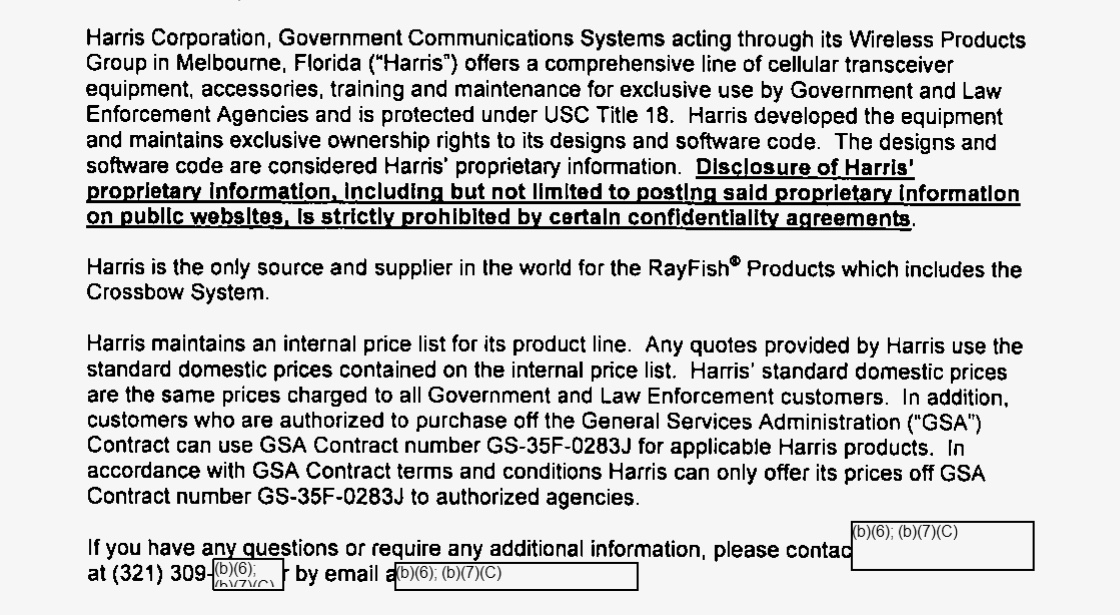
A letter from Harris Corp., which builds cell site simulators — known as “stingrays,” describing the non-disclosure terms for its Crossbow cell site simulator. (Source: ACLU)
Stingrays impersonate cell towers and capture the calls, messages, location and in some cases data of every cell phone in their range. Developed by Harris Corp., stingrays are sold exclusively to law enforcement. But their purchase and use are covered under strict non-disclosure agreements that prevent police from discussing how the technology works. These agreements are notoriously prohibitive; prosecutors have dropped court cases rather than disclose details about the stingrays.
The newly released documents are heavily redacted and offer little more about what we know of how stingrays work. One document did, however, reveal for the first time the existence of Harris’ most recent stingray, Crossbow. An email from 2012 refers to Crossbow as the “latest, most technologically up-to-date version of a Stingray system.”
But the civil liberties group said its public records lawsuit is not over. Customs and Border Protection (CBP), which was also named in the suit, has not yet turned over any documents sought by the ACLU, despite spending $2.5 million on buying at least 33 stingrays, according to a 2016 congressional oversight report.
“We are deeply skeptical of CBP’s assertion that they do not possess records about cell site simulators,” said Ramirez. “Given public information, the agency’s claim just doesn’t pass the sniff test.”
CBP has until June 12 to respond to the ACLU’s latest motion.
When reached, a spokesperson for CBP was unable to comment by our deadline. ICE did not respond to a request for comment.
ICE used ‘stingray’ cell phone snooping tech hundreds of times since 2017 by Zack Whittaker originally published on TechCrunch
