Reading view

There are new articles available, click to refresh the page.

Solana Network Sees 68% Crash In 3 Years, What’s Going On?

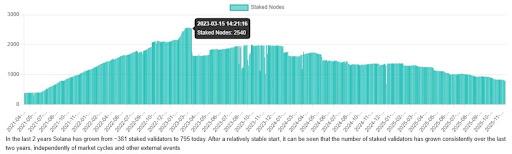
The Solana network has seen its validator count crash by more than 68% over the past three years, falling from thousands of active nodes to just around 800. The massive decline in validators has sparked discussions about whether this could become a threat to the blockchain network or a natural pruning of inactive nodes to increase efficiency. 

Solana loses 68% Of Its Validators In 3 Years

A new report from Criptonocias reveals that Solana has experienced a dramatic decline in the number of its validators, active and non-active, since March 2023. This decrease has raised concerns across the crypto community about the network’s overall health and security

Over the last three years, the Solana network has steadily lost validators, going from 2,500 to 2,100 in November 2022 and now hovering around 800. This decline means the blockchain has lost a total of 1,700 validators. Although this considerable decrease should trigger warning alerts, it could be a result of ledger pruning, which involves removing inactive or redundant nodes to streamline a network and improve its performance without compromising security. 

Notably, validators are crucial for the operation of a blockchain network, as they run nodes, confirm transactions, and help maintain the integrity of the system. Each validator adds to the diversity of the network and reduces the risk of any single entity gaining excessive control.  
Solana

According to the report, some voices in the Solana ecosystem see the reduction of validators in a positive light. They argue that losing “Sybil validators,” which are nodes pretending to be multiple independent operators but are actually controlled by a single party, can be beneficial. Based on this perspective, having a smaller number of reliable and active validators is healthier than maintaining thousands of nodes that do not contribute meaningfully to the blockchain network.

Criptonocias revealed that teams such as Layer 33, which develops infrastructure node tools and provides network services for Solana, point out that many of the validators leaving the blockchain are not Sybils but legitimate node operators. This suggests that the drop in numbers does not automatically equate to improved network quality despite widespread talks about ledge pruning.  

Notably, the potential impact on the Solana network, whether negative or positive, depends on the independence of the remaining validators and the distribution of power among them. An updated report of the validator count reveals that it has dropped again from 800 to 795. 

Solana Faces Liquidity Crunch As Profitability Declines

Amidst its decline in validators, the Solana network is showing signs of strain as liquidity dries up and profitability declines. On-chain data from Glassnode highlights a troubling trend in the network’s trading activity, with the 30-day average realized profit-to-loss ratio remaining below 1 since mid-November. 

This level is typically associated with bear market conditions and points to a growing imbalance between gains and losses among traders. A ratio below 1 also indicates that traders are realizing losses more frequently than profits, underscoring the cryptocurrency’s weakening market sentiment.

Solana

What Ripple’s CEO Appearance At The Banking Committee Means For XRP

Crypto pundit JackTheRippler recently drew the community’s attention to Ripple CEO Brad Garlinghouse’s appearance at the Senate Banking Committee hearing. The CEO spoke about XRP amid his talk on how his company is building the “internet of value.”

Ripple CEO Talks About XRP During Banking Committee Appearance

In an X post, JackTheRippler shared a video of the Ripple CEO at the Banking Committee hearing, where he spoke about Ripple and XRP. Garlinghouse stated that they were building the internet of value, where money moves as easily as information. He added that their payment services were made possible through the use of the XRP Ledger (XRPL) and its native token XRP. 

The Ripple CEO further noted that XRP is built to enable fast, low-cost, and highly scalable transactions, which makes it suitable as the bridge currency for their cross-border payment services. Garlinghouse made these comments in relation to his testimony on the need for “smart” crypto regulations, including market-structure legislation, to eliminate regulatory uncertainty and advance innovation in the U.S. 

The CEO mentioned that his company was among the notable victims of the previous SEC administration’s regulation-by-enforcement approach. The commission had sued the crypto firm, arguing that XRP was a security and that the firm had violated securities laws through institutional sales of the token. 

However, as the CEO noted, Judge Torres ruled that XRP was not a security in itself. Garlinghouse believes that the crypto market structure legislation will help the crypto industry progress while also protecting consumers, like XRP holders, who were affected by the SEC vs. Ripple lawsuit. XRP’s price was affected by uncertainty about its legal status at the time of the lawsuit, which spanned over four years. 

DAS Research Provides Bull Case For XRP

In an X post, market expert Stern Drew highlighted a report from DAS Research, which provided a bull case for XRP. Drew highlighted how the report stated that XRP and Ripple are no longer competing in crypto. Instead, they are evolving into a global payment infrastructure, which will be adopted by banks, fintechs, and cross-border networks that demand speed, scale, and settlement certainty. 

Drew further pointed out three core realities highlighted by the report. The first is that XRP is said to have the structural advantage with fast settlement, low cost, being a neutral bridge asset on a globally distributed ledger, and with institutional-grade reliability. 

The expert noted that this is why adoption is rising among enterprises that need predictable value transfer. The other two realities are Ripple’s integration of the RLUSD stablecoin and its institutional partnerships, which will help boost XRP’s utility. 

At the time of writing, the XRP price is trading at around $2.08, up in the last 24 hours, according to data from CoinMarketCap.

XRP

More Details On The Wall Street $500 Million Investment In XRP

Ripple’s most recent funding round has become one of the biggest crypto-related deals of the year, mainly because of who joined in and how the deal was structured. 

According to details shared in Bloomberg’s report, major Wall Street names, including affiliates of Citadel Securities, Fortress Investment Group, Brevan Howard, and Galaxy Digital, put $500 million into Ripple, giving the company a valuation of around $40 billion. This instantly turned the round into one of the strongest signs yet that traditional finance is taking a serious interest in the XRP ecosystem.

How Wall Street Structured The Deal To Protect Themselves

In early November 2025, Ripple closed a major private equity round that injected $500 million into the company, resulting in a valuation of roughly $40 billion. However, new details show that the most surprising part of the transaction is not the amount raised but the agreement behind it. Bloomberg reports that investors in this round did not simply buy Ripple shares and hope the value rises. Instead, they secured built-in protections that guarantee them profits later.

They were given the right to sell their shares back to Ripple in three to four years at a 10% yearly return, unless Ripple goes public before then. At that rate, Ripple would need to pay roughly $732 million to buy the shares back after four years. That means even if Ripple’s valuation stays flat or drops, the investors still walk away with guaranteed gains.

However, if Ripple decides to buy the shares back earlier, the investors get an even higher payout of around 25% annualized rate. A liquidation preference was also included, meaning these investors get paid first if anything goes wrong. Ripple noted in its announcement of the investment round that it has repurchased more than 25% of its outstanding shares over the past few years.

Why The Deal Is Really A Bet On XRP

Even though the investors bought equity in Ripple, not XRP itself, most of Ripple’s value still comes from its massive XRP holdings. According to Bloomberg, two of the funds that put in money noted that at least 90% of Ripple’s net value is tied to XRP. As of July 2025, Ripple held around $124 billion worth of XRP, although most of its XRP holdings are held in escrow.

This means the investment round, in reality, is also a bet on XRP’s long-term relevance and future market strength. If the price of XRP grows, Ripple benefits, and so do the investors who now hold equity backed by a company sitting on one of the world’s largest digital asset reserves. 

However, the $500 million investment does show that serious investors believe Ripple will continue growing, but just that Ripple’s success is still directly linked to the XRP price.

XRP

XRP Rising Against All Odds: Ripple CEO Celebrates These Achievements

Spot XRP ETFs first debuted in the United States back in 2025, and since then, it has been a story of success. The very first, the XRPC by Canary Capital, opened the floodgates, and since then, multiple XRP ETFs have been approved by the US Securities and Exchange Commission (SEC), all to great success. As a result, Ripple CEO Brad Garlinghouse has taken time out to celebrate these approvals and the immense success that the ETFs have enjoyed since launch.

Ripple CEO Celebrates XRP ETFs’ Success

Earlier this week, it was reported that the XRP ETFs currently trading in the market have crossed $1 billion in Assets Under Management (AUM). While this is not out of the ordinary, with others such as Bitcoin and Ethereum Spot ETFs sitting at billions of dollars in AUM, the difference that XRP made is how fast it reached this target.

Garlinghouse took to the X (formerly Twitter) platform to share that XRP was the fastest cryptocurrency ETF to hit the $1 billion milestone. The anticipation and rapid buy-in from institutional investors saw inflows ramp up quickly, and in less than four weeks, crossing the $1 billion mark. Furthermore, this $1 billion milestone was in the United States alone, suggesting much higher figures from other regions.

This milestone prompted the crypto founder to elaborate on why this is, giving a number of reasons. The first is the fact that the market looks ready for more crypto-related products. The speed with which XRP ETFs crossed this milestone is evidence of rising demand, and with over 40 crypto products launched this year, Garlinghouse explains that this shows there has been “pent-up demand.”

In addition to the demand, there is also the rising demand for there to be more long-lasting investment options in the crypto market. The advent of ‘pump-and-dumps’ has done significant damage to crypto’s reputation. However, these “off-chain crypto holders”, who buy into these crypto products, are moving more toward “longevity, stability, and community.”

Quickly Become An Investor Favorite

Following the launch of the XRP ETFs, institutional interest has quickly blown up. According to the CoinShares Digital Asset Fund Flows Weekly Report, institutional investments in the altcoin managed to surpass that of Ethereum over the last week, putting it behind only Bitcoin.

As the report shows, net flows for XRP came out to 244.7 million, compared to only $39.1 million for Ethereum. This has brought up its AUM to $3.112 billion as of the latest report, showing a rapid increase in investment. Year-to-date inflows have also risen drastically, up to $3.1 billion from the $608 million recorded back in 2024.

Currently, there are a total of nine XRP ETFs trading in the open market. Additionally, there are still nine pending applications that are expected to be approved.

XRP price chart from Tradingview.com

The Current Bitcoin Price Pump Will End In A Crash – Here’s When To Start Selling

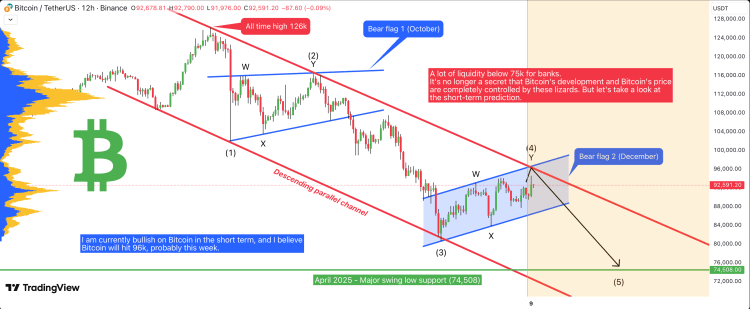
Over the last few days, the Bitcoin price has fluctuated, but the most prominent moves have been upwards, going from below $90,000 to over $94,000. As expected, this rapid climb already has investors calling for a return of the bull run, but not everyone is convinced. For some, the current Bitcoin price momentum is most likely a bull trap, and crypto analyst Xanrox highlights this in a recent analysis, outlining the best level to start selling the digital asset.

Why The Bitcoin Price Risks A Crash To $74,000

Xanrox’s analysis focuses on the bearish formations that have appeared on the Bitcoin price crash following the recent upward move. While many in the crypto community celebrate the rise above $90,000 again, the crypto analyst sounds an alarm that this is the time to go bearish on the cryptocurrency.

According to the analysis shared on the TradingView website, there has been a clear bear flag formation for the cryptocurrency. This bearish formation is visible on both the 12-hour chart and the 1-Day chart. Regardless, both of these charts point to one possible outcome, and that is an almost perfect textbook bear flag formation.

In addition to the bear flag formation, Xanrox also highlights that there is a WXY corrective pattern inside the bear flag. Both of these point to a possible continuation to the initial downtrend that began after the Bitcoin price hit $126,000 back in October.

Bitcoin price

As for how far the current rally could go, the crypto analyst sees it reaching as high as $96,000 before momentum runs out. This presents the “perfect” time to sell or enter a short as the price continues its decline. The target for this is an over 25% crash that will send the price going toward $74,000.

The $74,000 target makes an appearance as it is a swing low from April 2024, meaning that crypto traders who are long on the digital asset would have their stop losses below it. Thus, this makes it an attractive point for market makers to push the price towards in order to clear significant liquidity.

The timeframe for this to play out is placed over the next few weeks, riding out the end of 2025 and moving into January 2026. However, the swing low support at $74,000, if it holds up, could end up serving as the next bounce-off point for the Bitcoin price.

Bitcoin price chart from Tradingview.com

What BlackRock’s Latest Filing Means For The Ethereum Price

The latest S-1 registration submitted to the US Securities and Exchange Commission has placed Ethereum back at the center of market speculation. A recent SEC document shows that BlackRock’s iShares division has formally filed to launch a staked ETH exchange-traded fund, a move that would give traditional investors access not only to ETH price exposure but also to staking rewards through a regulated product.

A New ETF Structure That Brings Staking Into Traditional Finance

The proposed trust, which is called the iShares Staked Ethereum Trust ETF (ETHB), differs from previous Ethereum filings because it incorporates staking into its core design. According to the S-1 filing, the ETF would hold ether directly while delegating most of its balance to external validators, allowing staking rewards to feed into the trust’s net asset value. This approach offers institutions a pathway to access ETH’s yield component without interacting with on-chain staking infrastructure themselves.

Related Reading: Industry Leader Shares Why Ethereum Price Will Reach $12,000

The structure is bullish for Ethereum, as it shows that major asset managers like BlackRock are looking beyond basic price exposure and toward products that reflect how Ethereum now operates after its transition to proof-of-stake.

The first indication of BlackRock’s interest in ETH staking was in July, when it filed an application to add ETH staking in its iShares Ethereum Trust (ETHA). It seems the fund issuer is now taking proactive action on the staking trust with the recent standalone filing. Under SEC procedure, the new filing begins the review period, although a formal approval timeline does not start until the exchange responsible for listing the ETF submits a Form 19b-4.

If approved, the ETF could influence Ethereum’s circulating supply over time. The plan is to stake between 70% and 90% of the trust’s ETH, and this means that large inflows would steadily route more ether into long-term staking, reducing the volume actively available on the open market.

What This Could Mean For ETH’s Price Outlook

The potentially smaller liquid supply is going to contribute to a bullish ETH price, particularly during periods when demand for ETH rises. The filing itself does not change ETH’s price in the short term, nor does it signal any immediate regulatory approval. 

Related Reading: Ethereum Buyers Have Re-Entered The Arena Below $3,400, Here’s How Much They’ve Bought

What the filing does provide is a clearer picture of how ETH might fit into the next generation of institutional investment products. A staked ETH ETF would formalize staking as an investable feature and increase the types of investors who consider the altcoin a viable long-term asset.

Any eventual impact on Ethereum’s price will depend on how the approval process unfolds and how much capital flows into the product once it launches. BlackRock’s existing footprint in the Ethereum ETF niche shows how influential those inflows can be. Its iShares Ethereum Trust (ETHA) has consistently led other spot issuers, including over the past 24 hours, when ETHA recorded $23.66 million in inflows compared to Grayscale’s $11.83 million, while other issuers saw no inflows at all.

Once approved, shares of the iShares Ethereum Staking Trust are expected to trade on Nasdaq under the ticker ETHB.

Ethereum

Crypto Investor Reveals Drastic Move As He Dumps Bitcoin To Buy XRP

A well-known crypto investor, who claimed to have bought Bitcoin when it was $3,000, has announced that he has dumped all his BTC to load up on XRP. The unexpected move comes at a time when the market is experiencing significant volatility, with Bitcoin trading at an uncharacteristically low price and XRP experiencing a downtrend. Despite choppy market conditions, the analyst is highly confident in the altcoin’s future performance.

Crypto Investor Sells Entire Bitcoin Stash To Buy XRP

A crypto entrepreneur who goes by Crypto X AiMan on X social media shocked the broader market this week by announcing that he had sold his entire Bitcoin position and moved the proceeds into XRP. The crypto investor unapologetically declared he had gone 100% all-in on the token. The unexpected pivot sparked instant reactions, with many in the crypto community voicing similar optimism for the altcoin and admitting they have already made, or plan to make, the same move. 

In his post, AiMan explained that his primary reason for the sudden portfolio switch was the level of regulatory clarity that XRP gained in the United States after the resolution of its prolonged legal battle with the Securities and Exchange Commission (SEC). While the broader legal landscape around digital assets is still evolving, the crypto investor argues that XRP now holds a unique position as a non-security among established cryptocurrencies in the US. 

AiMan also highlighted Ripple’s considerable reserves and its more than 300 banking and payment partnerships as primary reasons for his decision to diversify into the third-largest cryptocurrency. At present, Ripple owns more than 45 billion XRP, representing over 45% of the total supply of 100 billion tokens. Under normal circumstances, such a concentration might raise concerns about centralization and excessive issuer control. However, AiMan has indicated that this level of institutional oversight is actually a strategic advantage. 

Additionally, the crypto investor pointed to Ripple’s partnerships with central banks and major financial institutions, especially those preparing for the ISO 20022 upgrade, which is expected to reset global messaging standards in 2026. With all of these in place, AiMan views the token as an asset with incredible potential.

The crypto entrepreneur drew a comparison between the altcoin and BTC. He described Bitcoin as a form of digital gold that prioritizes scarcity and decentralization, but that faces limitations in speed and transaction costs. On the other hand, he portrayed XRP as a “digital dollar,” framing it as a more practical instrument for cross-border payments, designed to move value quickly and at low cost. 

Investor Embraces Full Risks As He Goes All In On The Altcoin 

In his post, AiMan acknowledged the significant risks of investing 100% of his BTC proceeds into XRP. He admitted that XRP could lose all of its value, leaving him with nothing. Despite this, he remained undeterred, emphasizing that if things go well, the potential rewards could be life-changing

He pointed out a stark contrast between Bitcoin’s current market capitalization of over $2 trillion and the global cross-border payments industry, which is valued at approximately $250 trillion. According to the crypto entrepreneur, if the altcoin were to capture just 1% of that market, its value could increase exponentially.

XRP

Bitcoin Addresses Holding Over 0.1 BTC Haven’t Grown in Two Years, What Does This Mean?

Since Bitcoin’s launch, the number of addresses holding more than 0.1 BTC has climbed steadily through every market cycle, until now. Data shows that addresses in this cohort haven’t grown at all over the past two years, breaking a trend that held for more than a decade. 

The stagnation indicates a change in how smaller and mid-sized investors engage with Bitcoin, even as broader institutional activity in the market continues to rise.

Small Holder Participation Reaches A Standstill

The 0.1 BTC threshold has historically represented an important milestone for retail holders, large enough to signal commitment but small enough to remain widely attainable. For more than a decade, wallets crossing that line grew year after year, even during drawdowns when long-term buyers were accumulating quietly.

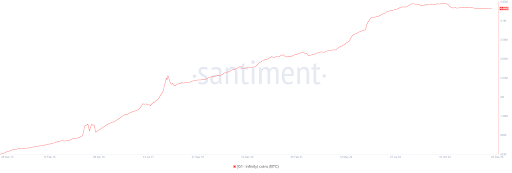
That pattern is no longer intact. The number of addresses with more than 0.1 BTC has flattened since 2023 and is showing no signs of returning to its previous trajectory. Particularly, data from the on-chain analytics platform Santiment shows that the number of these addresses has stalled at around 4.44 million for the past year. This suggests that fewer new participants are choosing to build self-custodied Bitcoin positions at this level.

Bitcoin

The stagnation becomes more notable considering Bitcoin’s rising mainstream visibility and repeated pushes toward new all-time highs this year. In earlier cycles, such conditions have led to a surge in retail accumulation. This time, the address count has stayed frozen, and this means retail addresses holding Bitcoin might actually be plateauing. 

How Bitcoin’s Holder Base Is Changing

Although on-chain data points to a slowdown in the growth of overall Bitcoin addresses holding more than 0.1 BTC, it doesn’t necessarily signal a decline in overall adoption. For many market participants, Bitcoin exposure now happens entirely off-chain.

Larger investor cohorts, from high-net-worth individuals to funds and corporate entities, are buying huge amounts of Bitcoin. For instance, Santiment data shows that large Bitcoin holders controlling more than 100 BTC have increased their balances throughout 2024 and 2025, even as smaller address cohorts have stalled.

At the same time, more investors are choosing to access Bitcoin through custodial avenues instead of managing their own wallets. Spot Bitcoin ETFs have become one of the most important gateways for new BTC exposure. In the US alone, Spot Bitcoin ETFs now control almost $120 billion worth of Bitcoin, with BlackRock’s IBIT consistently recording the strongest demand. 

Together, these developments point to a new phase in Bitcoin’s development. What was once dominated by individual self-custodied users is now increasingly shaped by institutions, ETFs, funds, and professionally managed capital. Therefore, the numbers from on-chain wallet metrics reflect a smaller portion of the actual user base.

Bitcoin

How Does Ripple’s XRP Enable The Trillion-Dollar Tokenization Market?

Crypto pundit Pumpius has provided insights into Ripple’s XRP’s role to enable the trillion-dollar tokenization market on the XRP Ledger (XRPL). He also explained how the altcoin and Ripple’s RLUSD stablecoin work hand in hand rather than being competitors on the network. 

Ripple XRP’s Role In Enabling Tokenization On The XRPL

In an X post, Pumpius stated that XRP handles cross-border liquidity and deep global routing while Ripple’s RLUSD supports domestic flows, tokenized assets, and institutional balance sheets. This came as he noted that pairing XRP with RLUSD creates a two-asset settlement engine in the push for tokenization on the XRPL. 

The crypto pundit further stated that both XRP and Ripple’s RLUSD unlock instant settlement for tokenized assets, atomic swaps, capital-efficient markets, and unified liquidity across the entire XRPL ecosystem. He asserted that without instant, programmable, and compliant settlement, tokenized assets are nothing more than digital placeholders. 

Pumpius remarked that this is where Ripple’s RLUSD becomes transformative. He explained that the stablecoin is the operational backbone for real-world assets on the XRP Ledger. The crypto pundit added that it is the first dollar that settles at XRPL speed with institutional-grade transparency and regulatory alignment.  

In line with this, Pumpius reiterated that tokenization is useless without settlement. While RLUSD fixes the settlement problem, he stated that XRP amplifies it and that the emerging ZK layer will protect it. Regarding the ZK layer, the pundit stated that as private ZK infrastructure begins to anchor the XRPL identity, privacy and compliance layers will slot into this model, making settlement fast, verifiable, and shielded when needed. 

He declared that settlement, privacy, and compliant identity are the final form institutions have been waiting for before they begin tokenizing on the XRP Ledger. Notably, Ripple has already included introducing privacy features on the network into its roadmap. 

Ripple CTO Defends XRP And XRPL

In an X post, Ripple CTO David Schwartz defended XRP and the XRPL after the altcoin was described as being “extremely centralized” because it is permissioned. Schwartz rebutted the statement that it was permissioned, noting that no one needs, or could have, any special permission to issue or execute XRPL transactions.

He further stated that XRP is unpermissioned for the same reason Bitcoin is. He added that if anyone were to exercise control over the network in a way that is perceived as unfair, everyone else would change whatever was needed to regain fairness. The Ripple CTO also mentioned that, over more than a decade, no XRP transaction has been censored. At the same time, he claimed that Bitcoin miners routinely delay transactions they disfavor for any reason. 

At the time of writing, the XRP price is trading at around $2.05, down in the last 24 hours, according to data from CoinMarketCap.

Ripple

Why The Litecoin Price Could Stage A 33% Rally To $110

A crypto analyst has forecasted that the Litecoin price is gearing up for an explosive rally to $110. Unlike Bitcoin and Ethereum, which have seen considerable declines over the past few months, Litecoin appears to be stabilizing, gaining about 7.8% this past week, according to CoinMarketCap. Although LTC has seen its fair share of declines this year, analysts still hold hope that the cryptocurrency could cross the $100 threshold and reclaim former highs. 

Litecoin Price Targets A $110 Breakout

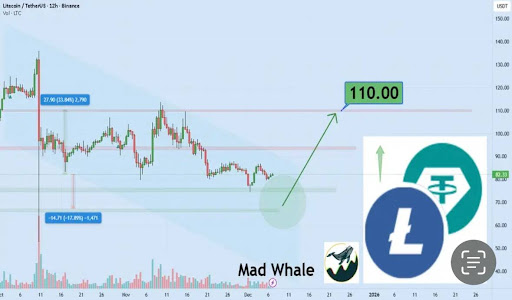
Litecoin may be preparing for a strong upward move, according to a new analysis from TradingView market expert MadWhale. The analyst has indicated that the cryptocurrency has the technical structure needed to break out of its long-term descending channel and potentially climb toward $110. With its current price sitting around $83, a surge to this level would represent a significant 33% rally. 

MadWhale has based his bullish LTC forecast on weekly candlesticks and how the cryptocurrency has consistently responded to past support and resistance levels. He explained that the altcoin had been trapped in a descending channel that has controlled its price for several weeks now. According to the TradingView analyst, Litecoin is now approaching the upper resistance region of the descending channel–a point where traders usually watch for either a clean breakout or a sharp rejection.

Litecoin

From the analyst’s price chart, Litecoin’s support zones have repeatedly held firm, showing that buyers consistently defended the area. Due to this steady support, he expects Litecoin’s bounce near the descending channel’s upper resistance to build momentum. If the support holds, MadWhale suggests the cryptocurrency could skyrocket to $110, completing its breakout from the descending channel. 

A breakout could signal a significant shift, potentially transforming Litecoin’s recent downtrend into a new bullish phase. MadWhale’s chart also highlights the cryptocurrency’s volatility, showing that in early October, LTC had rallied around 33.84%, climbing above $120. However, just days later, it crashed more than 17%, coinciding with the October 10 liquidation event that shook the market. 

Update On LTC’s Price Action

Litecoin is approximately 79% below its all-time high of over $410, recorded during the 2021 bull run. The cryptocurrency has dropped 17.68% over the past week and is down 33% for the year, mirroring the broader decline seen across altcoins. Despite its performance, LTC’s Fear and Greed Index remains in the neutral zone, suggesting that crypto investors are cautiously optimistic.

According to market analyst CW on X, the next sell wall for Litecoin is at $98, about 15% above its current price. Once the cryptocurrency reaches this level, CW expects a significant number of sellers to offload their coins. His chart also highlights the next key resistance levels for LTC, suggesting a potential surge to $98 first and then to the $106-$110 range.

Litecoin

Shiba Inu’s Volume Explosion: Leading Meme Coin Barrels Ahead In This Metric

Shiba Inu has recorded a notable surge in spot trading activity on several exchanges over the last seven days. This provides a bullish outlook for the second-largest meme coin by market cap, which has been one of the underperformers in this market cycle

Shiba Inu Sees Surge In Spot Trading Activity

CoinGlass data show a 154% surge in Shiba Inu USD spot trading volume on Kraken over the last seven days. There has also been a significant surge on other major exchanges, such as Binance, Bybit, OKX, and Gemini, during the same period. This indicates that spot buyers may be stepping in to defend the SHIB price at a critical support amid the broader crypto market decline

Notably, Shiba Inu is one of the altcoins that are in the green over the last week, suggesting that the bulls may be in control at the moment. CoinMarketCap data shows that the second-largest meme coin by market cap is up almost 7% during this period despite Bitcoin’s choppy price action. 

Meanwhile, further data from CoinGlass also shows that most leverage traders are currently betting on an increase in the Shiba Inu price, with the long/short ratio currently above 1. However, it is worth noting that derivatives volume is down by over 10% and open interest is down by almost 4%, which presents a bearish outlook for the meme coin. 

Another positive for Shiba Inu, besides the surge in spot trading volume, is that the Fed is likely to cut interest rates again at this week’s FOMC meeting. This could inject more liquidity into the crypto market, with altcoins like SHIB benefiting from it. Meanwhile, Bitcoin is currently looking to hold above the psychological $90,000 level, which could pave the way for higher prices for SHIB given their positive correlation.  

Community Gives Update On SHIB’s Progress

In an X post, Shiba Inu community member Shibizens gave an update on SHIB’s progress over the last few days. The community member noted that over 45 billion SHIB have been moved off exchanges, indicating that holders are accumulating. Shibizens also alluded to a $35 million whale transfer into a private wallet, suggesting that SHIB whales are also bullish. 

Furthermore, Coinbase is set to launch Shiba Inu futures on December 12 for institutional and retail investors, which could boost the meme coin’s adoption. Meanwhile, NYSE Arca has filed the 19b-4 for T. Rowe’s Shiba Inu ETF, bringing the ETF one step closer to launch. 

Shibuzens also highlighted upgrades on the Shibarium network, which could provide a major boost for SHIB. This includes the RPC upgrade, while a full privacy upgrade has been confirmed using encrypted tech. There are plans to roll this out by next year. 

At the time of writing, the Shiba Inu price is trading at around $0.000008498, up in the last 24 hours, according to data from CoinMarketCap.

Shiba Inu

Analyst Predicts Bitcoin Price Crash To $15,000 Using Gold Chart

Following the Bitcoin price crash below $100,000 back in November, different bearish predictions have begun to make the rounds in the crypto community. For some, this crash signifies the end of the bull market, ushering in the dreaded bear market. While some of the predictions have been conservative, putting the pioneer cryptocurrency somewhere around $50,000 at the bottom, one analyst in particular has predicted a deeper crash, and this was done using the gold chart.

Why A Crash Could Be Coming For The Bitcoin Price

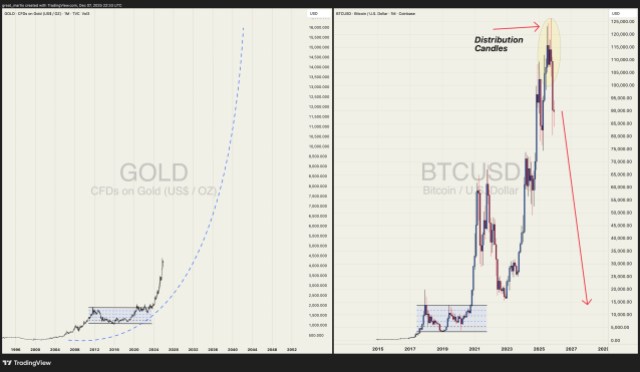
Crypto analyst The Great Martis took to X (formerly Twitter) to share their prediction of where the Bitcoin price is headed next. The chart shows a possible decline that could send Bitcoin moving below $20,000, before eventually reaching a bottom at around $15,000. Although this is not out of the ordinary for analysts to predict such crashes, the reason why Mathis believes this is possible is what is interesting.

The crypto analyst points out that the gold performance, which has seen the asset hitting new all-time highs this year, was being driven by speculation. Martis explains that the Fed’s intervention is something that will continue to drive the price of gold higher, and this could, in turn, continue to push down the Bitcoin price.

Furthermore, the analyst expects that the gold price will rise into the $12,000 territory, putting it in the same region that the Bitcoin price was in back in 2021. The interesting thing to note about Bitcoin in 2021 is that this was the year that the digital asset went on one of its most explosive rallies so far.

Bitcoin price gold

If Bitcoin continues to perform inversely to gold, then a rise to 5-digits for gold would mean a bearish market for Bitcoin. A crash to $15,000 would translate to a more than 70% decrease in price from the current level, and an almost 90% decline from its $126,000 all-time high.

So far, this year, gold has been the better performer of the two when compared side-by-side. For context, the gold price is already up over 55% in the year 2025; meanwhile, the Bitcoin price suffered a major 30% drop in price after hitting $126,000 back in October.

While both of these assets continue to lead in their respective sectors, gold continues to remain the standard for what investors consider a “safe” investment compared to Bitcoin, which is known for its wild price fluctuations.

Bitcoin price chart from Tradingview.com

Dogecoin Price Will Rally Before It Crashes, But What’s The Target?

The Dogecoin price is already struggling amid the bearish pressure that has dominated the crypto market recently. After the initial fall to $0.2, DOGE bulls had attempted to hold support, pushing for a rebound. However, with the bearish headwinds of the last quarter of the year, the Dogecoin price has since succumbed and is now trading below the $0.15 support level, and continues to struggle.

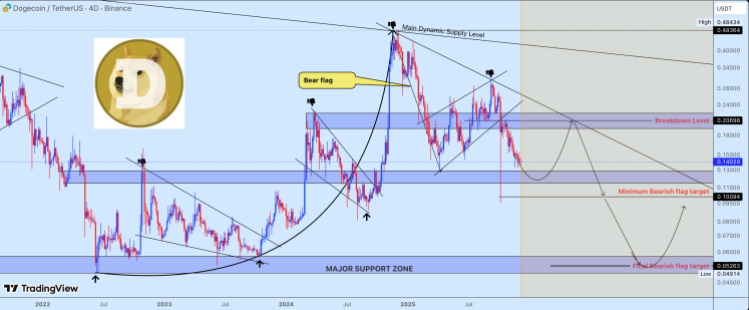
Despite the already troubling price performance, crypto analyst Weslad says that the worst might be yet to come. This is due to a corrective structure that has appeared on the meme coin’s price chart, and the result of this has been a bearish flag. As these technical developments unfold, the crypto analyst has warned investors of what to expect, outlining why the Dogecoin price could see a major crash while attempting to recover.

Dogecoin Price To Rise And Then Fall

The analysis, which was shared on the TradingView website, points to the bearish flag as a precursor of what is to come. Weslad explains that the bearish flag had triggered the Dogecoin price breakdown that had led to the downward leg. As a result, the sentiment has skewed negative so far, suggesting that there could be more declines to come.

However, the crypto analyst points out that the Dogecoin price is still well below its breakout zone. Given this, it is likely that there could be an initial relief rally for the meme coin. If this rally plays out, then there would be an initial decline below $0.12 to form support above $0.118. Once this support is established, then the resulting bounce is expected to push the Dogecoin price to $0.2.

Dogecoin price

Once this move is completed, though, the analyst predicts an even deeper crash on the horizon. From the $0.2 mark, Weslad’s chart shows that the Dogecoin price could decline another 70%, falling toward $0.05 in the process, which would mean a return to 2-year lows.

“The immediate plan is to monitor a pullback toward the minimum bearish flag targets around the $0.12 region, which aligns with the former structure support and breakout zone,” the crypto analyst said. This bottom area serves as a “supply on the retest” and could trigger the next decline.

For now, the analyst expects that the Dogecoin price will continue on its bearish path. This is dependent on the broader market performance, and so far, a breakdown looks to be more likely.

Dogecoin price chart from Tradingview.com

Betting Big On XRP: Billion-Dollar Asset Manager Confirms What Smart Money Has Been Doing

Institutional investors are quietly reshaping the narrative around XRP, with the latest analysis report from the billion-dollar asset manager WisdomTree confirming what insiders have long suspected. According to the report, XRP is garnering institutional interest and demand on a global scale. While retail traders debate short-term price movements, smart money capital inflows into XRP are surpassing those of almost every other altcoin. 

XRP Dominates Institutional Inflows Across Europe And The Globe

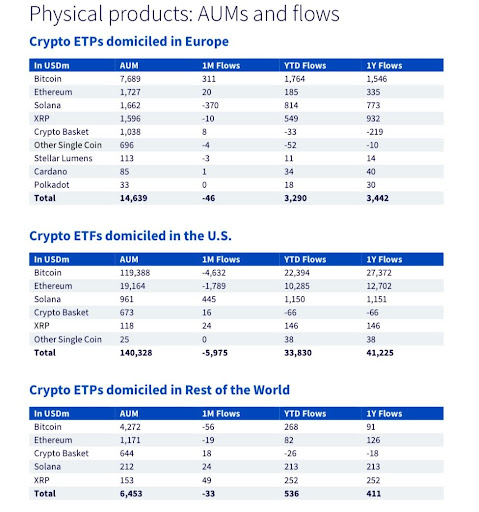
According to an X post by crypto expert Stern Drew, the latest WisdomTree report shows that XRP is the only digital asset attracting consistent institutional demand worldwide. In Europe, XRP has attracted over $549 million in new institutional capital this year, more than three times the inflows into Ethereum. This figure surpasses the total for every altcoin in the market and multi-asset products except Bitcoin. 

In a continent traditionally known for conservative investment strategies, these flows into XRP represent a decisive vote of confidence from European institutional investors. Drew has revealed that the demand for XRP has also extended beyond Europe. Outside the United States, XRP has captured roughly $252 million in fresh institutional capital just this year. 

XRP

By comparison, Bitcoin products absorbed only $268 million in smart money capital. Given that BTC products are more than 25 times the size of XRP products, this suggests that institutions have directed nearly 25 times more new capital into XRP than into Bitcoin. Drew has suggested that this increase in flows indicates careful, deliberate positioning rather than short-term speculative activity, which highlights the market’s growing preference for XRP

US Adoption Signals Broader Shift

In his post, Drew also revealed the growing institutional interest in XRP within the US. This year, a new synthetic XRP product attracted $241 million, surpassing flows into Solana and all other altcoin products in the same category. This surge came at a time when the two largest cryptocurrencies, Bitcoin and Ethereum, collectively saw $6.4 billion exit their ETF structures

Drew revealed that the dramatic outflows from BTC and ETH signaled that institutional investors were diversifying from established assets while selectively accumulating XRP. The WisdomTree report also showed that, excluding Europe and the US, regions such as Asia and other global markets are increasing their exposure to XRP. 

Surprisingly, this surge in global institutional demand is occurring during periods of market stress rather than euphoric rallies. The XRP price is currently down by more than 15% this year and trading at just $2.1. The cryptocurrency has also been experiencing significant choppy action over the past few months, failing to reclaim former highs above $3.

Despite this structural weakness, institutions continue to accumulate XRP in large quantities, indicating a clear bias toward the cryptocurrency. Drew has also revealed that smart money views XRP as a settlement-grade asset, well-suited for integration into the future architecture of regulated digital finance. He highlights that, as global institutional preference increasingly concentrates on XRP, price movements might follow later.

XRP

Bitcoin RSI Shows Shocking Similarities To 2012-2015, But What Happened Last Time?

A crypto analyst has revisited long-term charts from 2012-2015, noting that the current Bitcoin (BTC) cycle shows striking similarities to this timeline, in terms of the Relative Strength Index (RSI) and price action. During the 2017-2015 bull run, BTC experienced one of the strongest multi-year advances before bottoming out. The market expert claims that the same sequence of peaks and pullbacks observed in that timeline is now unfolding again in this cycle. 

Bitcoin RSI Comparison Signals Bottoming Structure

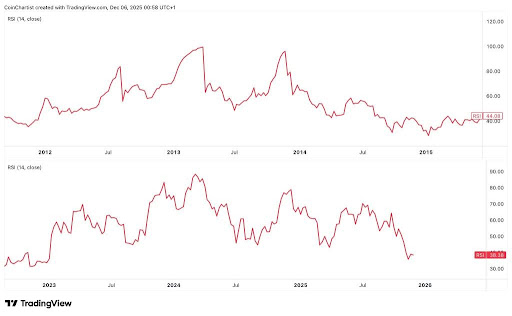
Bitcoin’s latest momentum study by crypto analyst Tony Severino has drawn significant attention from market watchers. In his X post on December 6, Severino highlighted surprising similarities between the RSI trend and price movements of the 2023-2026 cycle and those observed from 2012 to 2015. 

His comparison focuses on the timing of several major points that appeared in both cycles. These include the moment a price bottom began to form, the first price peak, a subsequent momentum peak, and finally a Bearish Divergence that typically precedes deeper corrective phases.

Severino shared a chart from the 2012-2015 cycle showing that Bitcoin’s RSI had gradually climbed, with several short bursts of sharper upward momentum along the way. Eventually, momentum faded, and the indicator declined for an extended period before settling in a mid-range zone at the 44 level. 

Bitcoin

In the current cycle, which began in 2023, the RSI also climbed sharply before reaching a notable peak. Since then, the indicator has been gradually declining, currently sitting around 38. This level is similar to the mid-range RSI values observed in the former cycle before Bitcoin advanced again. 

Sharing a second chart, Severino also pointed to Bitcoin’s price action relative to its RSI performance across both cycles. During the earlier cycle, Bitcoin’s price sat around $233.54, while in the recent cycle, it has declined to $89,352. The analyst argues that the alignment between the RSI movements and price action in both timelines strengthens his theory that Bitcoin may be approaching a meaningful bottom soon. 

Severino also suggested that if history repeats in the 2023-2026 cycle, traders could be looking at the early stages of a year-long accumulation phase, similar to what played out a decade ago. Nevertheless, he acknowledged that there is no guarantee that the current cycle will mirror past patterns completely. 

Analyst Flags New BTC Bullish Crossover

Crypto analyst AO has shared a more optimistic outlook for Bitcoin, highlighting the formation of a Bullish Crossover—a key technical signal that has historically preceded significant price surges. According to him, each time the Stochastic RSI on US10Y*CN10Y experiences a Bullish Crossover, Bitcoin enters a significant bull run.

AO presented a chart showcasing four previous Bullish Crossovers, each followed by a massive price increase. The first crossover appeared in 2013 and coincided with an early surge. The second came in 2017, marking the start of a multi-month bull run. The third occurred in late 2020, shortly before BTC’s record-breaking run in 2021. The most recent signal has not emerged in 2025, suggesting the potential for a similar upward move.

Bitcoin

Ripple Secures 4 Groundbreaking Wins That Mark An Exciting Phase For XRP

Ripple and the XRP ecosystem have entered one of their most important weeks to date. A series of regulatory and market-structure breakthroughs has pushed the token deeper into the core of federally supervised financial infrastructure, and this carries implications far beyond short-term sentiment, starting with its advancement into new territory under the Commodity Futures Trading Commission.

A New Regulatory Alignment Surrounds XRP

Bitnomial, a CFTC-regulated derivatives and spot-crypto platform, secured approval to include XRP within its market structure of the first US-regulated spot-crypto market. This allowed the Chicago-based exchange to activate a supervised spot-XRP contract in the United States, as well as accept the token as margin collateral across its derivatives products. 

The move placed XRP in the same operational category as traditional commodities that must meet liquidity and settlement standards before entering federally regulated markets.

Behind these approvals sits a story that many observers initially missed. An market participant who goes by the name SonOfaRichard on the social media platform pointed out the significance of what had unfolded. 

He noted that the Commodity Futures Trading Commission (CTFC), the Securities and Exchange Commission (SEC), and the Depository Trust & Clearing Corporation (DTCC), three agencies with entirely different remits, moved in the same direction in the same week. 

According to him, the altcoin effectively transitioned into a commodity-grade collateral asset within a federally regulated derivatives ecosystem, and he described this not as a narrative but as plumbing. This is the same standard applied to gold, FX, treasuries, and LME metals.

Secondly, the SEC did not object to the CFTC’s move with Bitnomial, and that silence carried far more weight than a formal statement, because it pointed to an unusual moment of alignment between agencies that typically operate with different mandates on XRP. 

Thirdly, Bitnomial itself became the quiet kingmaker in this entire development, not because of its brand presence or daily trading volume, but because its regulatory position places it in integration with clearing flows that plug directly into institutional pipes. A platform like that does not list XRP unless regulators have already determined what it is.

An Exciting Phase For The Token’s Outlook

Lastly, the DTCC moved toward 24×5 settlement windows. According to the commentator, this move was about interoperability with digital collateral, tokenized treasuries, and real-time clearing.

Taken together, these milestones are not surface-level headlines. They represent a change in how XRP is being integrated. The asset is now accepted as a collateral currency, listed under CFTC oversight, and actively trading inside the country’s first regulated spot-crypto framework.

Other examples of the change in XRP integration on a global scale include the Singapore MPI license for Ripple and Vanguard, allowing XRP ETF access, among a few others.

All these recent advancements by Ripple now point to the ecosystem entering a phase that investors have waited years to witness. The question now may no longer be whether institutions will adopt the token, but how quickly they integrate it into the flows of modern digital finance.

XRP

Confirming The Bitcoin Price Direction: Analyst Reveals What You Should Look Out For

After breaking below $90,000 again, the next direction of the Bitcoin price is being hotly debated once again. This comes with the added burden of a number of major events coming around this week, as well as investor sentiment being stuck in the negative territory for an extended period of time. Crypto analyst, MarcPMarkets, shares his thoughts on the current state of the market and what investors should be looking out for as the next direction is determined.

The Bearish And Bullish Scenarios

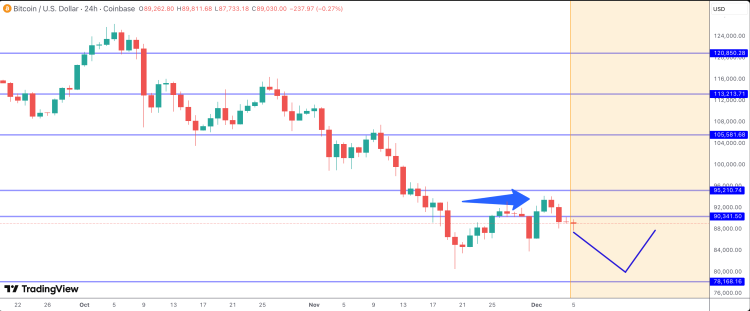
In the analysis shared on the TradingView website, MarcPMarkets highlights the different scenarios that could determine where the Bitcoin price could be headed next. Cautioning investors to watch out for confirmation, the first level that the analyst highlights is the $93,500 area, where the Bitcoin price had failed to reclaim a high.

Since the price fell below $90,000 over the weekend, the next major level now lies at $88,000, and it is where bulls must protect their support. In the event that bulls lose this support and the price breaks decisively below this point, the crypto analyst warns investors to expect the Bitcoin price to crash another $10,000. Next would be the $78,000 area, where the cryptocurrency is likely to secure its next support.

On the flip side, where the Bitcoin price could turn bullish once again, the crypto analyst points to the $95,000 resistance. Investors are to pay attention to this resistance, because if broken, then it would mean that strength is building back up, completely canceling out the bearish scenario highlighted above.

The major targets in the case of a bullish takeover would first be $105,581. Above this lies the next major level of $113,213, and then finally, the $120,850 target that would be the final hit before momentum fizzles out.

Bitcoin price

Developments That Could Affect The Bitcoin Price

Beyond the price action, some events that could affect Bitcoin’s trajectory are expected to unfold this week. The FOMC meeting is drawing closer, with the Fed expected to announce its stance on the financial markets going forward.

If, at the completion of the press conference, the Fed takes on a dovish stance, then the crypto analyst expects that prices will begin to move upward again. Additionally, quantitative tightening ended at the start of December, ushering the markets into an era of quantitative easing, which has always been bullish for risk assets as new liquidity is pumped into the market.

Bitcoin price chart from Tradingview.com

Solana Welcomes Bearish December, But Pundit Shares Possible Move To $170

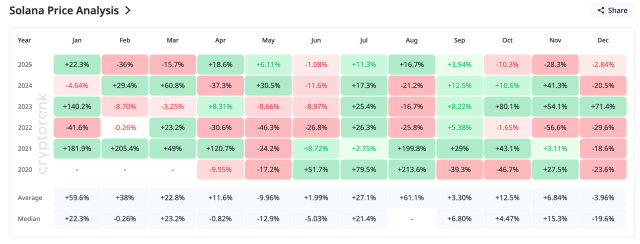
The last quarter of the year has always been quite bearish for the Solana price, marking the highest losses for the altcoin since it was launched back in 2020. Naturally, this has made Q4 a dreaded time for Solana investors, and the year 2025 has not been any different. The last two months have already closed in the red with double-digit losses, and with only December left to go, the Solana price might be on track to complete yet another bearish quarter.

Looking At The Historical Performance Of Solana In Q4

Taking into account data from the CryptoRank website, it shows Solana’s less-than-favorable performance in the last quarter. In the last five years, Q4 has had the highest average losses compared to the other quarters, and the month of December plays a major role in that due to how bearish it is.

December, in particular, boasts the second-highest average losses, second only to May’s -9.96% average. However, when it comes to the median returns, the month of December takes the cake, recording a high average of -19.6% losses over the year.

In the five years of its existence, only one year, in 2023, has the Solana price closed out the month of December in the green with 71.4% gains. The other years have ended with at least 18% losses, and this month is already looking bearish with -0.79% losses so far.

With the months of October and November already closing in the red, it is likely that December will follow. The last time that both October and November closed in the red was back in 2022, and December would follow suit with -29.6% returns for the month.

Solana price

Analyst Says A Bounce Could Come Instead

While historical data suggests that the Solana price could end up struggling this month, one crypto analyst has presented a scenario where the altcoin could bounce back. This move is predicated on Solana’s ability to actually hold the support and break the next resistance.

Interestingly, though, the analyst’s chart shows an initial 15% dump before the Solana price finds support somewhere around $116. After that, the price is expected to rebound, and the target for the cryptocurrency after this would be the $170 level. The weekly candlestick also supports this possible jump, something that would send Solana to the green in September.

For now, the bulls continue to struggle despite last week’s campaign for $150, suggesting that there is a great deal of resistance at this level. If selling continues to build up, then it is likely that Solana will move down as predicted.

Solana price chart from Tradingview.com

Here’s When The Altcoin Season Happens Following The Bitcoin Cycle

Bitcoin’s recent movement has left many traders waiting for signs of an altcoin season, and a post shared by crypto analyst Crypto Nova offers a different way to understand when this will actually begin. 

The explanation, supported by charts from 2017 and 2021, shows that altcoins have historically performed their best while Bitcoin’s price action was already climbing, not after it had reached its peak. The charts she shared show how those earlier cycles unfolded and why the timing of Bitcoin’s surge has been the important factor each time.

Altseasons Form During Bitcoin’s Strongest Surges

This outlook goes against the projection of many crypto analysts, who have been waiting for a downturn in the Bitcoin dominance characterized by outflows from Bitcoin and into the altcoin market.  

However, careful technical analysis shows that the largest and most explosive altcoin seasons did not occur after Bitcoin had completed its run. Instead, they developed while Bitcoin was already pushing to new price highs. 

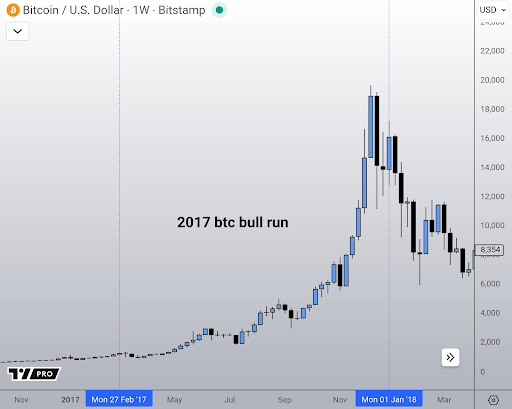
The 2017 cycle illustrated this the most clearly. Bitcoin dominance began to decline during an altcoin season, even as BTC surged from around $1,000 to nearly $20,000. The chart shows a waterfall-like collapse in dominance from 95% in early 2017 to below 40% in early 2018, happening at the exact moment when Bitcoin was rising massively. Altcoins were already outperforming the leading cryptocurrency long before Bitcoin topped just below $20,000.

Bitcoin

A similar pattern played out in 2021. Bitcoin dominance peaked in January of that year and started falling while the Bitcoin price climbed from roughly $30,000 to its mid-cycle high above $60,000. Although altcoins took a little longer to increase compared to 2017, the bulk of their performance still arrived during Bitcoin’s rapid upward trajectory, not after it had stalled or reversed. 

The charts below highlight this synchronicity clearly: dominance moves lower while Bitcoin candles continue to stretch higher.

Bitcoin Needs A Confirmed Bottom And A New Surge

Nova noted that traders are making a mistake by focusing solely on Bitcoin dominance without considering Bitcoin’s broader market structure. It is important to note that dominance does not drop simply because Bitcoin moves sideways or reaches a peak. 

Instead, dominance mostly declines when Bitcoin is in a strong, sustained uptrend, but the altcoin niche is witnessing more inflows compared to the leading cryptocurrency. This means an altcoin season is unlikely to start until Bitcoin prints a confirmed bottom and its rally convinces inflows into altcoins. 

As noted by the analyst, Bitcoin is currently in a downtrend, and without a shift in trend, dominance metrics alone cannot trigger altcoin momentum. This viewpoint challenges the frequent claims circulating online that altseason is here or just about to begin.

As it stands, the crypto industry is still logged into a Bitcoin season, with the CMC altcoin season index sitting at 19 and the CMC Bitcoin dominance at 58.7%.

Altcoin

Dogecoin Payments For Cars: The Quiet Promise That Tesla’s New Code Carries

DOGE community member DogeMemeGirl has drawn the community’s attention to Tesla’s new code, which hints at Dogecoin payments integration. This comes over a year after Elon Musk revealed that Tesla would accept DOGE as a payment option at some point. 

Dogecoin Payments May Be Imminent As Tesla Updates Backend Code

In an X post, DogeMemeGirl revealed that Tesla is upgrading its Dogecoin integration as the new backend code shows a “massive” shift from the old setup. She explained that the old code was basic and dormant, restricted to Tesla’s merchandise only. Meanwhile, the code provides a significant upgrade and hints at DOGE payments for Tesla cars. 

The community member revealed that the new code is woven deep into vehicle checkout for the Tesla Model 3 and the Cybertruck. It also includes hidden “order with Dogecoin” buttons that indicate the Dogecoin payments integration. Lastly, DogeMemeGirl stated that the new code features real-time price conversion and dynamic error handling. 

She also hinted that Dogecoin is likely to be the only crypto that will be accepted by Elon Musk’s Tesla in the meantime. This came as DogeMemeGirl stated that the Bitcoin references have been scrubbed in the new code, while DOGE remains. The community member noted that it is still disabled, but that the infrastructure to buy a Tesla with DOGE is actively being built. 

Tesla’s potential integration of Dogecoin payments could provide a huge boost for the foremost meme coin, expanding its utility and likely leading to more adoption for DOGE. Notably, Musk stated last year that his car company would begin accepting DOGE payments for car purchases at some point. Tesla already accepts the meme coin for some of its merchandise. 

DOGE Integration In X Payments?

This development of the Tesla Dogecoin payments integration comes amid speculations that Elon Musk’s X could also integrate the meme coin into ‘X Payments.’ Musk stated last month that X payments is coming soon, with the possibility that it will still launch this year, as earlier announced by the then-CEO Linda Yaccarino.

DOGE community members, including famous crypto pundit Kevin Capital, have speculated that Musk will integrate DOGE in X payments, which would boost the meme coin’s adoption. Kevin indicated that a potential integration could also significantly impact the DOGE price. 

In the meantime, the meme coin just received another major boost as Argentina’s capital, Buenos Aires, reportedly passed a law allowing its citizens to pay taxes in DOGE. Dogecoin’s official X platform drew attention to this development just as the meme coin celebrated its 12th anniversary, having launched in 2013. 

At the time of writing, the Dogecoin price is trading at around $0.14, up in the last 24 hours, according to data from CoinMarketCap.

Dogecoin

❌