Reading view

There are new articles available, click to refresh the page.

Key Updates On The US Crypto Market Structure Bill: What You Need To Know

The anticipated crypto market structure bill, or namely the CLARITY Act, designed to provide essential regulatory clarity for digital assets in the United States, is approaching critical dates in the Senate. However, it faces significant complexities related to stablecoin yield, conflicts of interest, and decentralized finance (DeFi).

Senate Divided On Crypto Market Structure Bill

Legal expert and Chief Legal Officer of Variant Jake Chervinsky, reports that the Senate is divided into two committees: Banking, which is handling the securities law aspect, and Agriculture, responsible for the commodities law portion. 

Both committees have published drafts of their work this fall, with the next step being markup, a process where hearings will be held to vote on amendments before sending the bill to the Senate floor for a full vote.

However, both committees are cautious and are unlikely to proceed with markup until they resolve ongoing disputes. Among these, three significant issues stand out.

The first major concern involves stablecoin yield. In the GENIUS Act, banks lobbied for a prohibition on interest payments, meaning stablecoin issuers cannot offer holders any form of interest or yield. 

While the current prohibition prevents direct yield payments to holders, it does not address non-yield rewards or yield provided by third parties. Banks consider this gap a “loophole” and are advocating for broader restrictions to be included in the market structure bill. 

Conflicts Of Interest And DeFi Regulations Stall Progress

The second issue revolves around conflicts of interest. Some Democratic senators have indicated they would not support the market structure legislation unless it includes provisions that restrict the President’s family from conducting business in the crypto space. 

The third and perhaps most crucial issue pertains to DeFi. It is important to note that market structure legislation primarily addresses centralized platforms that exercise custody over user funds and transactions. 

Chervinsky believes the bill should primarily focus on protecting DeFi, but traditional finance (TradFi) stakeholders have been pushing Congress to categorize virtually all entities in the crypto sector—developers, validators, and others—as intermediaries. 

The expert emphasized that the success of any market structure bill hinges on ensuring robust protections for developers since the viability of the crypto industry relies on their contributions. 

Given the intricate nature of these issues and the swiftly approaching holiday break, Chervinsky noted that it is possible that discussions about market structure could extend into January. 

Senate Markup Set For December 17-18

Market analyst MartyParty provided another update on December 4, indicating that the bipartisan Digital Asset Market Structure Bill is gaining significant momentum in Congress, with a markup session in the Senate Banking Committee tentatively scheduled for December 17-18, just before the holiday recess

If successfully passed, he states that the bill could establish clearer pathways for tokenized real-world assets (RWAs) and mitigate “debanking” risks, paving the way for compliant exchanges and potentially stimulating market volumes following the Commodity Futures Trading Commission (CFTC) approvals for spot crypto trading. 

This “regulatory convergence” is seen as a catalyst that could drive liquidity and energize the next bull market, reinforcing President Trump’s vision for the US to emerge as the “crypto capital of the world.”

Crypto

Featured image from DALL-E, chart from TradingView.com 

After nearly 30 years, Crucial will stop selling RAM to consumers

On Wednesday, Micron Technology announced it will exit the consumer RAM business in 2026, ending 29 years of selling RAM and SSDs to PC builders and enthusiasts under the Crucial brand. The company cited heavy demand from AI data centers as the reason for abandoning its consumer brand, a move that will remove one of the most recognizable names in the do-it-yourself PC upgrade market.

“The AI-driven growth in the data center has led to a surge in demand for memory and storage,” Sumit Sadana, EVP and chief business officer at Micron Technology, said in a statement. “Micron has made the difficult decision to exit the Crucial consumer business in order to improve supply and support for our larger, strategic customers in faster-growing segments.”

Micron said it will continue shipping Crucial consumer products through the end of its fiscal second quarter in February 2026 and will honor warranties on existing products. The company will continue selling Micron-branded enterprise products to commercial customers and plans to redeploy affected employees to other positions within the company.

Read full article

Comments

© Micron Technology

Microsoft drops AI sales targets in half after salespeople miss their quotas

Microsoft has lowered sales growth targets for its AI agent products after many salespeople missed their quotas in the fiscal year ending in June, according to a report Wednesday from The Information. The adjustment is reportedly unusual for Microsoft, and it comes after the company missed a number of ambitious sales goals for its AI offerings.

AI agents are specialized implementations of AI language models designed to perform multistep tasks autonomously rather than simply responding to single prompts. So-called “agentic” features have been central to Microsoft’s 2025 sales pitch: At its Build conference in May, the company declared that it has entered “the era of AI agents.”

The company has promised customers that agents could automate complex tasks, such as generating dashboards from sales data or writing customer reports. At its Ignite conference in November, Microsoft announced new features like Word, Excel, and PowerPoint agents in Microsoft 365 Copilot, along with tools for building and deploying agents through Azure AI Foundry and Copilot Studio. But as the year draws to a close, that promise has proven harder to deliver than the company expected.

Read full article

Comments

© Wong Yu Liang via Getty Images

Chainlink At A Turning Point: Triangle Pattern Holds, But One Line Must Break

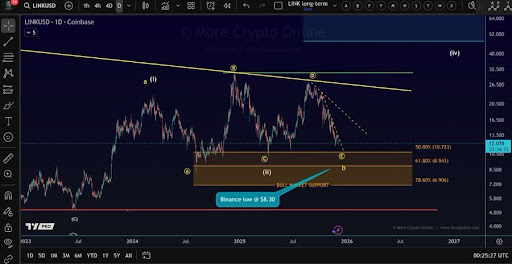
Chainlink is approaching a decisive moment as its price compresses within a well-defined triangle structure. The pattern remains strong, but the market is signaling that a major move is imminent. Everything now hinges on a single trendline break, one that will determine whether LINK is ready to reverse higher or sink into a deeper correction.

B-Wave Extension Back In Focus: Is The Triangle Still Intact?

According to crypto analyst More Crypto Online in a recent update on Chainlink, it is crucial to step back and examine the bigger picture of the asset’s price action. The analyst believes the market is likely still extending the yellow B-wave correction. At the moment, the analyst is considering that this B-wave may be unfolding as a complex triangle pattern, as seen in the “yellow scenario.”

Despite the triangle hypothesis, the analyst emphasizes that there is currently no evidence that a definitive low has formed. To confirm a structural reversal, LINK requires a clear 1-2 setup to the upside, which would signal the start of a new impulsive trend. As stated in previous updates, a confirmed bottom hinges on a break above the first yellow trendline.

Chainlink

The triangle pattern, which typically unfolds as a 5-wave structure (A–B–C–D–E), remains valid for now, without a confirmed low. This pattern suggests that the price will continue to consolidate sideways, trapping both bulls and bears. 

More Crypto Online defined the critical invalidation point for the primary count. If the price were to break below the Monday, April 4th, low at $10.20, the current triangle microstructure would be entirely invalidated. Meanwhile, the broader B-wave correction would still be theoretically possible, but would likely unfold in a different structural path.

Critical Support Cluster: $10.70, $8.94, And $6.90 In Focus

More Crypto Online went further to highlight the next crucial support levels if the current triangle structure fails, which are located at $10.70, $8.94, and $6.90. The analyst cautioned that a definitive break below the $6.90 mark would significantly increase the probability of an alternative scenario for Chainlink: the unfolding of a larger degree Wave 4.

For now, the immediate focus is on how the price reacts within the key Fibonacci support zone defined by the boundaries of $6.90 and $10.70. The analyst concluded by stating the necessary condition for a structural low: the earliest sign of a reversal would be a break above the yellow trendline. Until that happens, the trendline continues to act as firm resistance, keeping the local downtrend structurally intact and signaling that caution remains necessary.

Chainlink

The hot new thing at AWS re:Invent has nothing to do with AI

AWS CEO Matt Garman unveils the crowd-pleasing Database Savings Plans with just two seconds remaining on the “lightning round” shot clock at the end of his re:Invent keynote Tuesday morning. (GeekWire Photo / Todd Bishop)

LAS VEGAS — After spending nearly two hours trying to impress the crowd with new LLMs, advanced AI chips, and autonomous agents, Amazon Web Services CEO Matt Garman showed that the quickest way to a developer’s heart isn’t a neural network. It’s a discount.

One of the loudest cheers at the AWS re:Invent keynote Tuesday was for Database Savings Plans, a mundane but much-needed update that promises to cut bills by up to 35% across database services like Aurora, RDS, and DynamoDB in exchange for a one-year commitment.

The reaction illustrated a familiar tension for cloud customers: Even as tech giants introduce increasingly sophisticated AI tools, many companies and developers are still wrestling with the basic challenge of managing costs for core services.

The new savings plans address the issue by offering flexibility that didn’t exist before, letting developers switch database engines or move regions without losing their discount. 

“AWS Database Savings Plans: Six Years of Complaining Finally Pays Off,” is the headline from the charmingly sardonic and reliably snarky Corey Quinn of Last Week in AWS, who specializes in reducing AWS bills as the chief cloud economist at Duckbill.

Quinn called the new “better than it has any right to be” because it covers a wider range of services than expected, but he pointed out several key drawbacks: the plans are limited to one-year terms (meaning you can’t lock in bigger savings for three years), they exclude older instance generations, and they do not apply to storage or backup costs.

He also cited the lack of EC2 (Elastic Cloud Compute) coverage, calling the inability to move spending between computing and databases a missed opportunity for flexibility.

But the database pricing wasn’t the only basic upgrade to get a big reaction. For example, the crowd also cheered loudly for Lambda durable functions, a feature that lets serverless code pause and wait for long-running background tasks without failing.

Garman made these announcements as part of a new re:Invent gimmick: a 10-minute sprint through 25 non-AI product launches, complete with an on-stage shot clock. The bit was a nod to the breadth of AWS, and to the fact that not everyone in the audience came for AI news.

He announced the Database Savings Plans in the final seconds, as the clock ticked down to zero. And based on the way he set it up, Garman knew it was going to be a hit — describing it as “one last thing that I think all of you are going to love.”

Judging by the cheers, at least, he was right.

Google tells employees it must double capacity every 6 months to meet AI demand

While AI bubble talk fills the air these days, with fears of overinvestment that could pop at any time, something of a contradiction is brewing on the ground: Companies like Google and OpenAI can barely build infrastructure fast enough to fill their AI needs.

During an all-hands meeting earlier this month, Google’s AI infrastructure head Amin Vahdat told employees that the company must double its serving capacity every six months to meet demand for artificial intelligence services, reports CNBC. The comments show a rare look at what Google executives are telling its own employees internally. Vahdat, a vice president at Google Cloud, presented slides to its employees showing the company needs to scale “the next 1000x in 4-5 years.”

While a thousandfold increase in compute capacity sounds ambitious by itself, Vahdat noted some key constraints: Google needs to be able to deliver this increase in capability, compute, and storage networking “for essentially the same cost and increasingly, the same power, the same energy level,” he told employees during the meeting. “It won’t be easy but through collaboration and co-design, we’re going to get there.”

Read full article

Comments

© Google

❌