Reading view

There are new articles available, click to refresh the page.

NASA & GLOBE Connect People, Land, and Space

4 min read

NASA & GLOBE Connect People, Land, and Space

A screenshot of the GLOBE Land Cover satellite comparison table. The table includes information and photographs of the land, submitted by the volunteer, as well as a Moderate Resolution Imaging Spectroradiometer (MODIS) land cover classification image for that location and a Landsat and Sentinel-2 image closest in time to the GLOBE Observer observation.
The GLOBE Land Cover satellite comparison table is generated weekly for every GLOBE Land Cover observation. GLOBE volunteers receive an email with a link to the table. Information about the table may be found on the GLOBE Observer website.

A group of elementary-aged students gather outside of Oldham County Public Library in La Grange, Kentucky, United States to look at clouds in the sky. “If anyone asks what you are doing, tell them, ‘I am a citizen scientist and I am helping NASA,’” Children’s Programming Librarian, Cheri Grinnell, tells the kids. Grinnell supports an afterschool program called Leopard Spot where she engages K-5 students in collecting environmental data with the GLOBE (Global Learning & Observations to Benefit the Environment) Program.

“One little boy really got excited about that, and I heard him tell his mom he was working for NASA as they were leaving,” says Grinnell. That idea is reinforced when the program receives an email from NASA with satellite data that align with the cloud data the students submitted. “I forwarded the NASA satellite response to the after-school coordinator, and she read it to them. That really excited them because it was evidence this is the real deal.”

This experience is one the GLOBE Observer Team (part of the NASA Science Activation program’s NASA Earth Science Education Collaborative, NESEC) hears often: GLOBE volunteers of all ages love getting an email from NASA that compares satellite data with their cloud observations. “Feedback from NASA is huge. It’s the hook,” says Tina Rogerson, the programmer at NASA Langley Research Center who manages the satellite comparison emails. “It ties NASA science into what they saw when they did the observation.”

Now, volunteers will have more opportunities to receive a satellite comparison email from NASA. GLOBE recently announced that, in addition to sending emails about satellite data that align with the cloud observations made by learners, they will now also be sending emails that compare the GLOBE Observer Land Cover observations made by learners with satellite data. The new satellite comparison for land cover builds on the system used to create cloud comparisons at NASA Langley Research Center.

When a volunteer receives the email, they will see a link for each observation they have submitted. The link will open a website with a satellite comparison table. Their observation is at the top, followed by a satellite-based assessment of the land cover at that location. The last row of the table shows the most recent Landsat and Sentinel-2 satellite images of the observation site. Rogerson pulls GLOBE land cover data from the public GLOBE database to generate and send the comparison tables on a weekly basis. While users may opt out of receiving these emails, most participants will be excited to review their data from the space perspective.

These new collocated land cover observations are expected to raise greater awareness of how NASA and its interagency partners observe our changing home planet from space in order to inform societal needs. They will help every GLOBE volunteer see how their observations of the land fit in with the wider space-based view and how they are participating in the process of science. Based on the response to cloud satellite emails, seeing that bigger, impactful perspective via the satellite comparison email is motivating. The hope is to encourage volunteers to continue being NASA citizen scientists, collecting Earth system observations for GLOBE’s long-term environmental record.

“I’m excited that land cover is finally becoming part of the operational satellite comparison system,” says Rogerson. This means that GLOBE volunteers will routinely receive satellite data for both land cover and clouds. “We are bringing real science right into your world.”

NESEC, led by the Institute for Global Environmental Strategies (IGES) and supported by NASA under cooperative agreement award number NNX16AE28A, is part of NASA’s Science Activation Portfolio. Learn more about how Science Activation connects NASA science experts, real content, and experiences with community leaders to do science in ways that activate minds and promote deeper understanding of our world and beyond: https://science.nasa.gov/learn/about-science-activation/.

Share

Details

Last Updated
Nov 25, 2025
Editor
NASA Science Editorial Team

NASA Citizen Science Toolkit for Librarians

2 min read

NASA Citizen Science Toolkit for Librarians

Librarians: NASA Citizen Science has something for you!

Our new Toolkit for Librarians can help you share NASA citizen science opportunities with your patrons and community members. Rural and urban libraries, informal educators, youth group leaders, and retirement community coordinators can all benefit from this resource. Together, we can open the door for more people to join the fun, learning, and thrill of doing NASA science.  

The toolkit prepares a program leader to lead a NASA Science event for people ages 8 and up. The toolkit includes: 

  • A guide to help you prepare for the event, from choosing and equipping the space, to becoming familiar with the citizen science project that will be the focus of the event
  • An editable 8.5” by 11” poster to advertise your event
  • A model agenda to follow during your event
  • A handout for you and your participants to help you explore NASA-sponsored citizen science project opportunities 

The toolkit creators, Sarah Kirn (Participatory Science Strategist, NASA, from the Gulf of Maine Research Institute) and Kara Reiman (librarian), together with NASA’s Citizen Science Officer Marc Kuchner, also recorded a video walk-through of this Toolkit. 

“I appreciate this so much!” said one participant. “I have started Citizen Science Kits for circulation over this past year and am excited to share new opportunities with our patrons!”

“Living in a very rural and primarily native community, the kids here are limited with their nearby opportunities, so sharing this with them is a huge win…” said another.

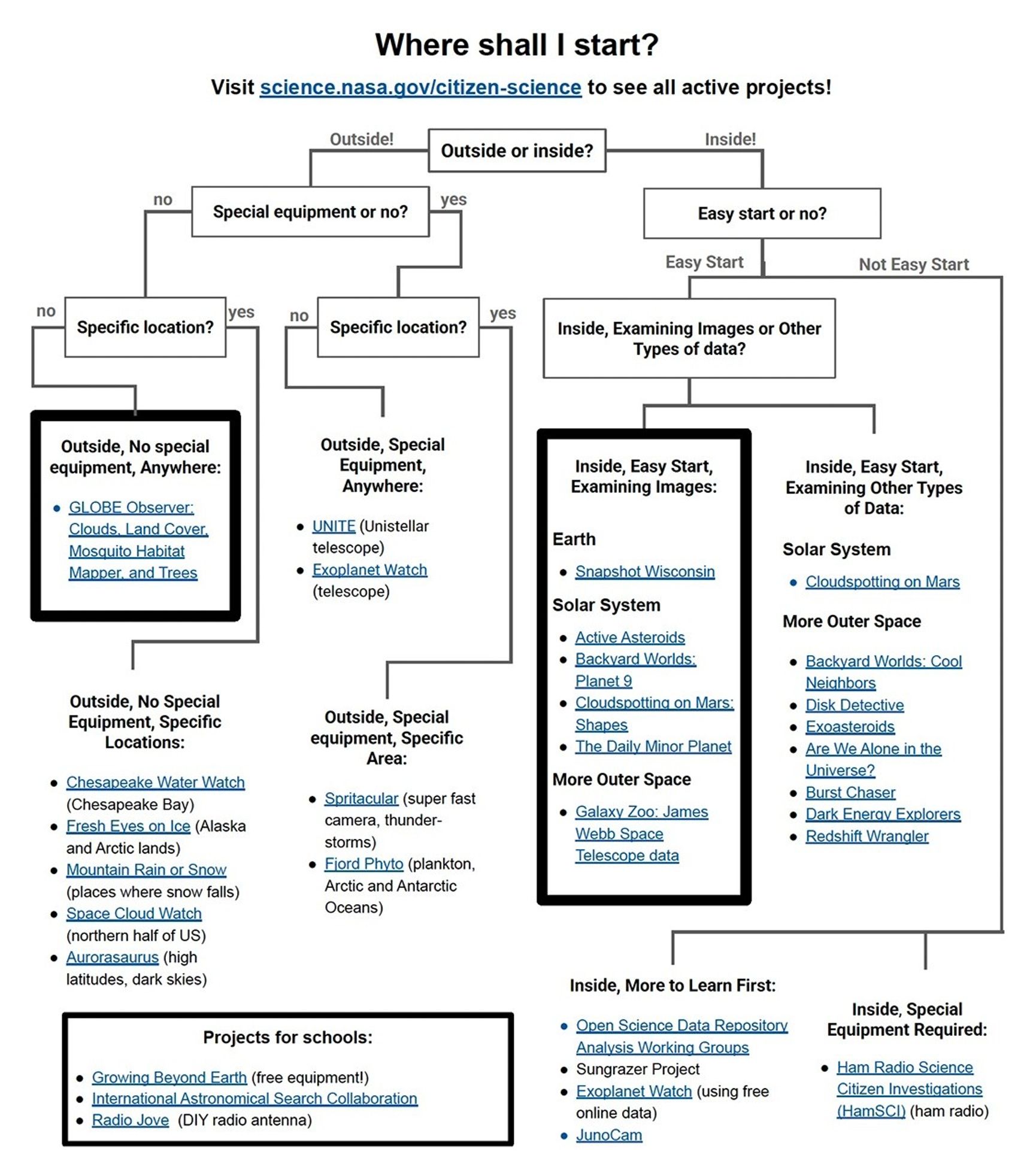
Flowchart sequencing which citizen science projects could be interesting for you.
Which NASA citizen project is best for you? You’ll find all these projects at science.nasa.gov/citizen-science, and you’ll find more resources like this in our Toolkit for Librarians!
Sarah Kirn, GMRI + Marc Kuchner, NASA

Learn More and Get Involved

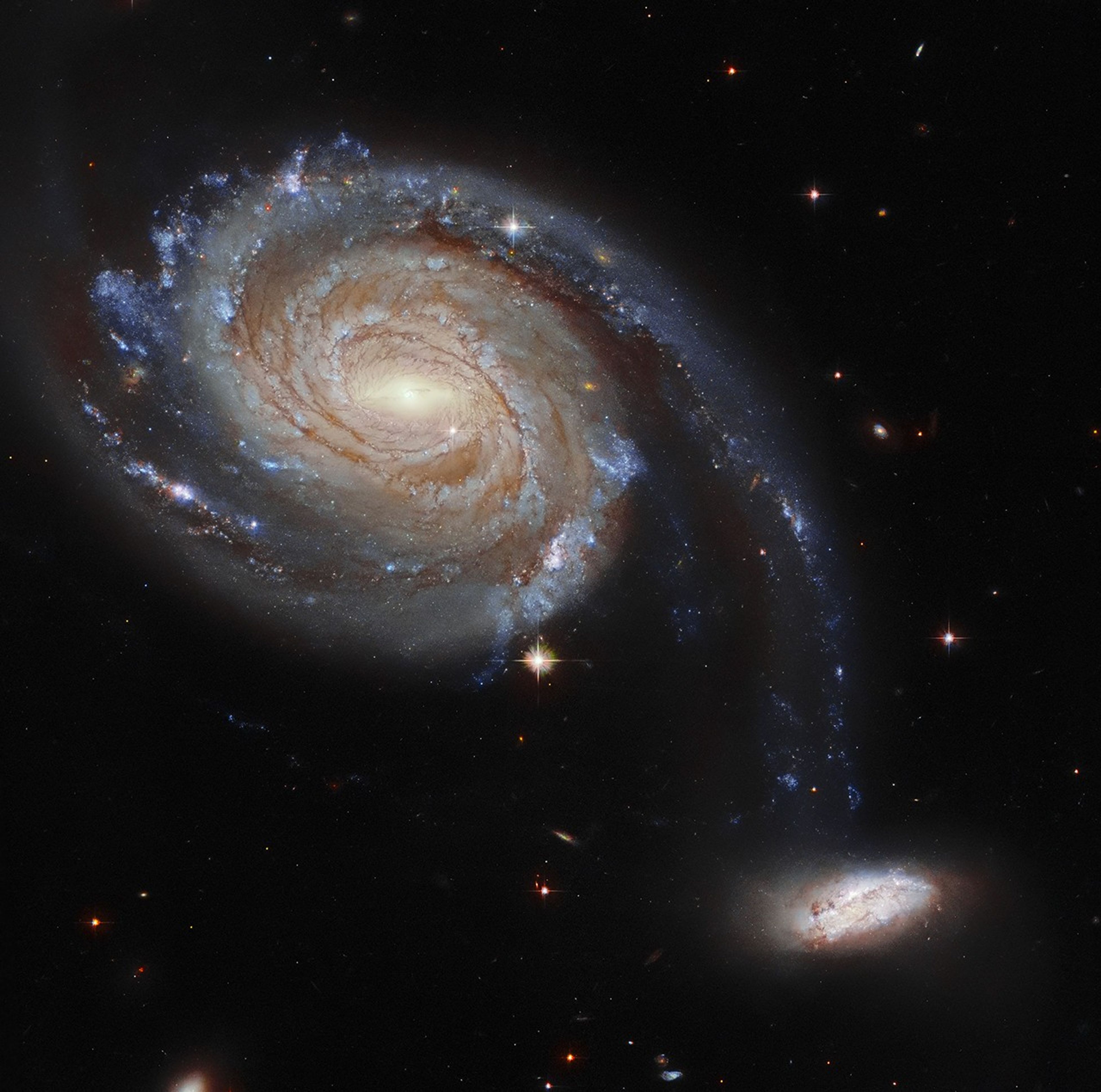
Arp 148 is nicknamed 'Mayall's object' and is located in the constellation of Ursa Major, the Great Bear, about 500 million light-years away. This image is part of a large collection of images of merging galaxies taken by NASA's Hubble Space Telescope.

Please share this toolkit – or use it yourself – to invite more people to do NASA science with us – who knows what they will discover?!

Facebook logo
Instagram logo
Linkedin logo

Share

Details

Last Updated
Nov 24, 2025

Related Terms

New Citizen Science Proposals Funded in 2025

3 min read

New Citizen Science Proposals Funded in 2025

NASA has selected 10 new citizen science proposals for funding in 2025. These selections provide a preview of what’s coming next for NASA citizen science. Note that these investigations are research grants: some of them will result in new opportunities for the public, while others will analyze or build on results from earlier citizen science projects.

Citizen Science Seed Funding Program (CSSFP)

The CSSFP aims to support scientists and other experts to develop citizen science projects and expand the pool of scientists who use citizen science techniques in their science investigations. Four divisions of NASA’s Science Mission Directorate are participating in the CSSFP: the Astrophysics Division, the Biological and Physical Sciences Division, the Heliophysics Division, and the Planetary Science Division. Seven new investigations were recently selected through this program:

Astrophysics Division

  • Cosmic Cataclysms and Citizen Science: Rapidly Observing High-Energy Phenomena with a Global Telescope Network, PI: Thomas Esposito, SETI Institute. Follow up gamma-ray bursts (GRB), compact object mergers, supernovae, and cataclysmic variables using your backyard telescope.
  • Spiral Graph: Cluster Buster – A Participatory Science Project to Improve the Identification of Spiral Arms from All-Sky Survey Galaxy Images, PI Patrick Treuthardt, North Carolina State Museum of Natural Sciences. Help measure the spiral arms of galaxies to reveal the masses of their central black holes!

Planetary Science Division

  • Rubin Comet Catchers: Discovering the Comets of the Large Synoptic Survey Telescope (LSST) with Citizen Science, PI Colin Chandler, University of Washington. Join the hunt for comets by scanning images from the NSF-DOE Vera C. Rubin Observatory’s Legacy Survey of Space and Time (LSST).
  • Search for Thunderstorms in Cassini Images of Jupiter and Saturn, PI Ulyana Dyudina, Space Science Institute, Help refine current estimates of the cooling effect of thunderstorms on Jupiter and Saturn!
  • There are Billions! A Platform for Impact Crater Vetting Across the Solar System, PI Petr Pokorny, Catholic University of America, Help spot craters in images from NASA’s MESSENGER, LRO, and Dawn missions!
  • SPHERExplorer: Identifying Newly Appearing Phenomena in the Near- and Mid-Infrared with Citizen Science, PI Steven Silverberg, Eureka Scientific, Inc, Identify new sources (e.g. new solar system objects, interstellar objects, supernovae) and identify changes in previously known sources (e.g. newly active asteroids) in images from NASA’s Spectro-Photometer for the History of the Universe, Epoch of Reionization and Ices Explorer (SPHEREx) mission!

Heliophysics Division

  • DEMO-ML: DisEntangling Magnetosheath Observations for a Machine-Learning-Ready Dataset, PI Vicki Toy-Edens, Johns Hopkins University, The magnetosheath is the plasma region that lies between the Sun’s powerful solar wind and Earth’s magnetosphere. Help catalog magnetosheath regions with data from NASA’s Magnetospheric Multiscale Mission (MMS) to explore magnetic reconnection, turbulence, and energy transfer in the magnetosphere!

Explore citizen science awards from previous years: 

For more information on NASA’s citizen science programs, visit https://science.nasa.gov/citizenscience.

Facebook logo
Instagram logo
Linkedin logo

Share

Details

Last Updated
Nov 20, 2025

Related Terms

Meet The Shape That Cannot Pass Through Itself

Can a shape pass through itself? That is to say, if one had two identical solids, would it be possible to orient one such that a hole could be cut through it, allowing the other to pass through without breaking the first into separate pieces? It turns out that the answer is yes, at least for certain shapes. Recently, two friends, [Sergey Yurkevich] and [Jakob Steininger], found the first shape proven not to have this property.

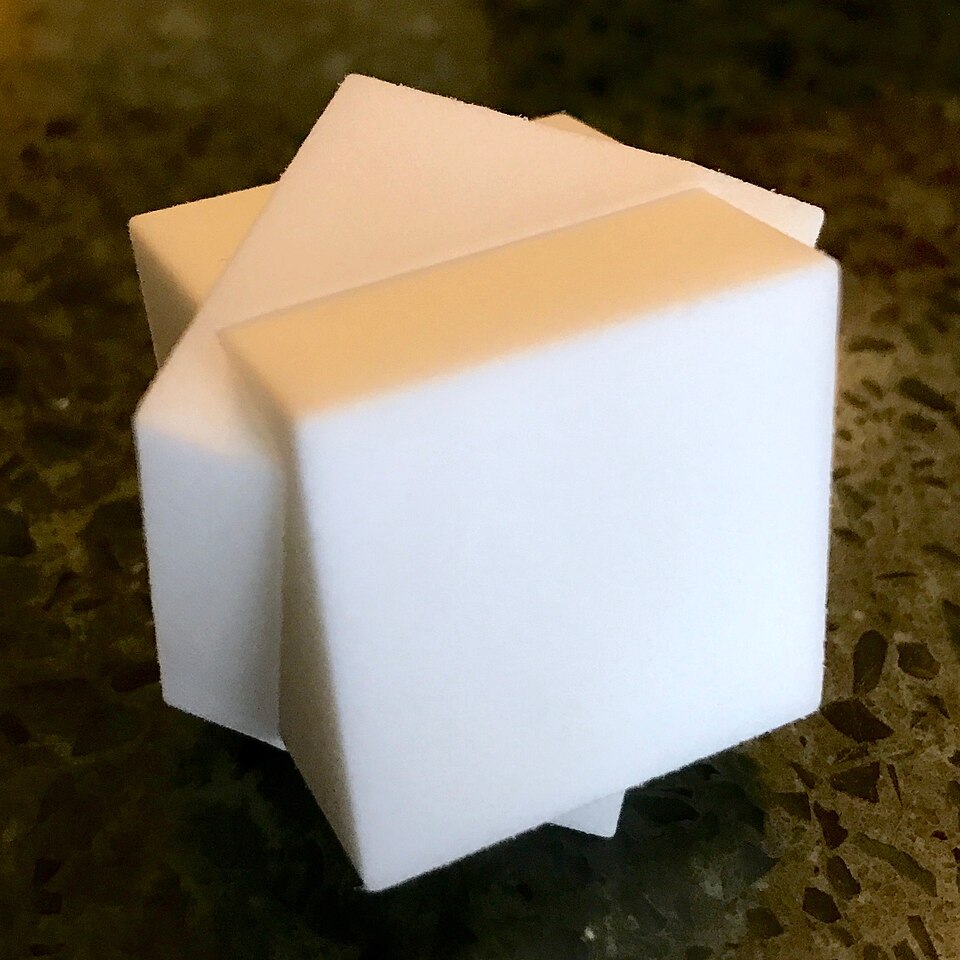
A 3D-printed representation of a cube passing through itself [image: Wikipedia]
Back in the late 1600s, Prince Rupert of the Rhine proved it was possible to accomplish this feat with two identical cubes. One can tilt a cube just so, and the other cube can fit through a tunnel bored through it. A representation is shown here.

Later, researchers showed this was also true of more complex shapes. This ability to pass unbroken through a copy of oneself became known as Rupert’s Property. Sometimes it’s an amazingly tight fit, but it seems to always work.

In fact, it was so difficult to find candidates for exceptions to this that it was generally understood and accepted by mathematicians that every convex polyhedron (that is, every shape with flat sides and no holes, protrusions, or indentations) would have Rupert’s property. Until one was found that did not.

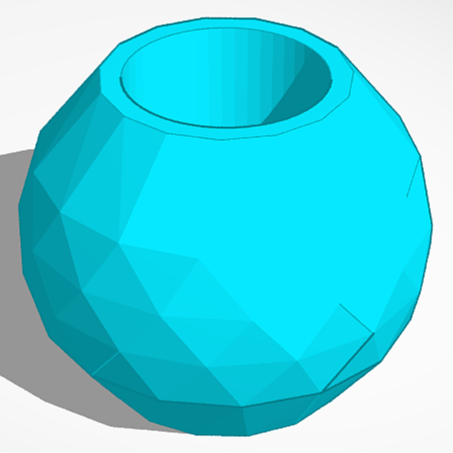
Noperthedron pencil holder

The first shape proven not to be able to pass through itself — known as the Noperthedron — is a vaguely ball-like shape, with a flat top and bottom. A fan has already added a cavity to create a 3D-printable pencil holder version of the noperthedron (shown here) if you want your own.

There are other promising candidate objects (they are rare) that may also lack Rupert’s property, but so far, this is the only proven one.

Shapes with unusual properties are interesting, and we love how tactile and visual they are. Consider Penrose tiles, a tile set that can cover any size of area without repeating. For decades, the minimum number of tile shapes needed to accomplish this was two. Recently, though, the number has dropped to one thanks to a shape known as “the hat.”

Lettuce Find Healthy Space Food! Citizen Scientists Study Space Salads

Lettuce Find Healthy Space Food! Citizen Scientists Study Space Salads

Diagram illustrating research on lettuce grown in space stations and its effects on astronaut health. Lettuce nutritional content is linked to astronaut diet, potential diseases, and astronaut biological response. Missions including I4, JAXA, and NASA’s Twin Study are shown, with graphics of spacecraft, astronauts, the ISS, and biological diagrams.
Volunteer members of the OSDR-Analysis Working Groups examined the nutritional quality of crops grown in Low Earth Orbit and the physiological effects of space-induced nutrient deficiencies on astronauts. You can join the team here!
Credit: npj Microgravity/Barbero et al., 2025

Missions to the Moon and Mars pose nutritional challenges for astronauts, but volunteers from NASA’s Open Science Data Repository Analysis Working Groups (OSDR-AWG) are working together to analyze data on astronaut health. The Analysis Working Groups examine biomedical data from NASA missions and space experiments collected in the NASA Open Science Data Repository. These teams use the data to answer questions in basic science, applied science, and health outcomes for space exploration.

For example, a recent paper on space-grown food examined data on lettuce grown on the International Space Station and the Tiangong II space station. It found that the crop contained 29-31% less calcium and 25% less magnesium than Earth lettuce, falling short of astronaut requirements.

Lettuce tell you more! The study revealed two further health challenges for astronauts relying on space grown veggies.

  • Disrupted calcium signaling: the analysis revealed that astronauts experienced changes in the expression of 163 calcium genes, which could accelerate bone loss. 
  • Leaky gut syndrome: data from the Japan Aerospace Exploration Agency (JAXA) show astronauts experienced compromised intestinal barriers due to altered protein production and regulation, likely disrupting their ability to absorb nutrients.

The researchers proposed a solution to these problems, too: bioengineered crops.! Perhaps plants could be developed that are enriched in calcium or therapeutic proteins to compensate for the deficiencies observed in the space-grown lettuce. 

This research was a collaboration between the ALSDA (Ames Life Sciences Data Archive), the Human Analysis and Plant Working Groups of the OSDR (the expansion of NASA Genelab centered at NASA Ames), along with BioAstra, a space life science non-profit. The data came primarily from OSDR with contributions from the Space Omics and Medical Atlas at Weill Cornell.

You can join the OSDR-Analysis Working Groups yourself and help plan the future of human space exploration. Dozens of project groups are active at any time. Learn more about the AWGs: Learn more about the AWGs.

Facebook logo
Instagram logo
Linkedin logo

Share

Details

Last Updated
Sep 23, 2025

Webinar Series: Teaching with EMERGE & GLOBE Mission Mosquito

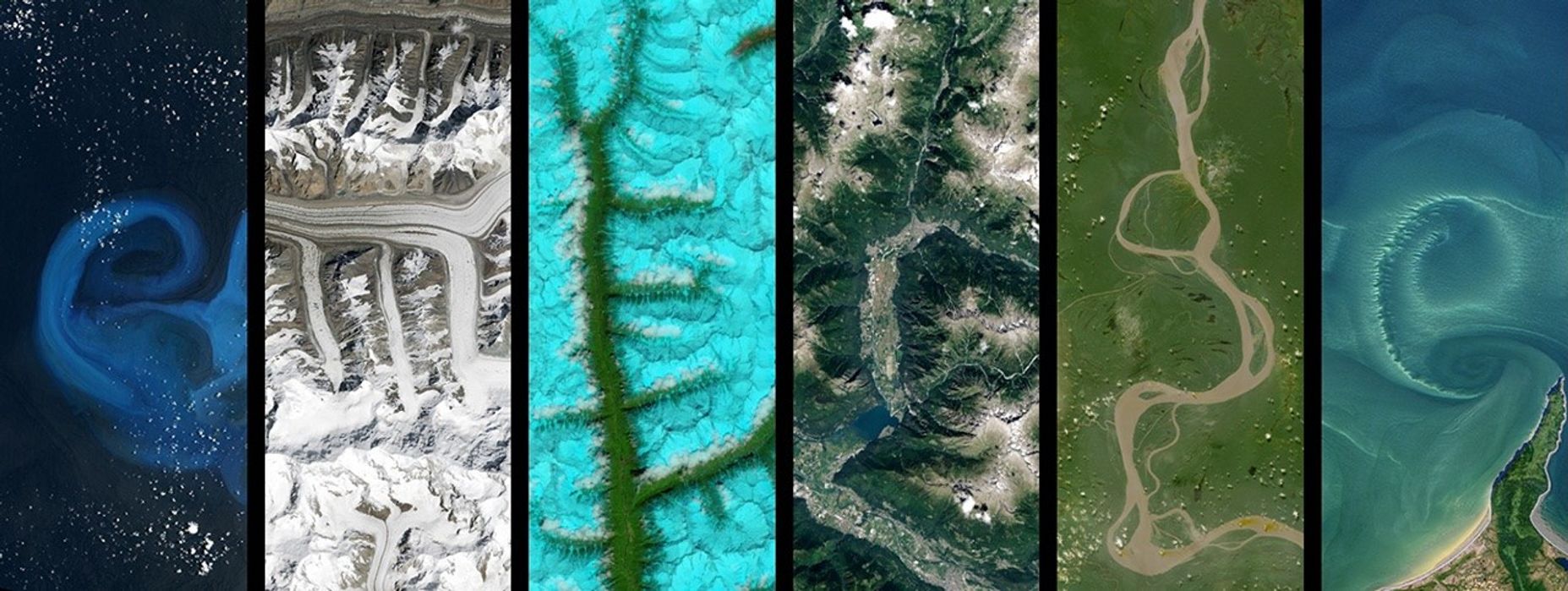
Six satellite images arranged to spell 'emerge': an ocean eddy shaped like an E, a glacier valley forming an M, bright blue ice ridges forming an E, green mountain valleys forming an R, a winding river shaped like a G, and a coastal water spiral forming an E.

Educators, join our free two-part webinar, and learn about bringing coding and citizen science to your learners!

The Global Learning and Observation to Benefit the Environment (GLOBE) program is a science and education program that focuses on advancing Earth systems science through data collection and analysis by citizen scientists. These webinars introduce GLOBE Mission Mosquito—a global program where students and community members collect environmental data—and EMERGE, a Florida-based but widely adaptable project that turns those data into insights about mosquito-borne disease risk.

Session 1 (Sept 17 at 6 PM ET): Introduction to EMERGE and GLOBE. You’ll learn how students can collect mosquito habitat and land cover data with the free GLOBE Observer app, then complete a guided coding assignment to visualize those observations on maps and explore connections with NASA satellite data. It’s a friendly environment for people who haven’t coded before!

Session 2 (Sept 24 at 6 PM ET): We’ll regroup to review the coding assignment—troubleshoot issues, share sample outputs, and discuss strategies for adapting the lesson in classrooms, afterschool programs, and libraries.

Learn more about EMERGE

Learn more about GLOBE Mosquito Habitat Mapper

Facebook logo
Instagram logo
Linkedin logo

Share

Details

Last Updated
Sep 16, 2025

Related Terms

❌