
Reading view

There are new articles available, click to refresh the page.

Your Home Grow Journey Starts With I Love Growing Marijuana

There’s nothing quite like growing your own cannabis at home. Watching a tiny seed turn into a beautiful, potent plant that twinkles with trichomes, smelling those first terpenes, knowing you did it all yourself, is unmatched. But for many people, the dream of growing at home hits a brick wall before they even get started. It’s easy to feel like you’ll mess it up and lose a bunch of time and cash. Thankfully, I Love Growing Marijuana (ILGM) is here to help ensure that doesn’t happen. 

A Dutch cannabis seed company operating exclusively in the US market, ILGM was built on a simple, powerful belief: Anyone can grow their own cannabis.

They are dedicated to providing not only top-tier seeds, but also the expert knowledge and a foolproof safety net you can count on. Expect success at every step of your journey.

From a Simple Blog to a Thriving Community

The company’s story started with its founder, Robert Bergman, a Dutch grower who genuinely loved the plant but was tired of the misinformation around it. So, he started a low-key blog to share what he knew so everyone could grow weed at home. He wanted to pull back the curtain on cultivation and show that it wasn’t some big secret for a few pros. His straightforward approach resonated with the canna-curious and amateur cultivators around the world.

“Getting started can feel like the hardest part,” says ILGM CEO Ernst Rustenhoven. “But if you have a knowledgeable friend who guides you through it, that big hurdle turns into a small step. We are that friend.”

That blog turned into a buzzing community. Growers would jump into the comments to ask questions, share tips and celebrate their wins. It was a true collaboration built on trust and a shared love for growing. That’s what eventually led to the launch of a trusted seedbank.

The seedbank is a huge part of ILGM’s DNA—the belief that the best weed is the one you grew yourself and the best way to do that is with a solid community behind you. It’s this grower-first mindset, mixed with a deep understanding of what US home growers actually need, that gives them their edge.

Top-Shelf Seeds, All The Way To Harvest

The heart of ILGM lies in its genetics, as showcased in their cannabis seed bank. All the cultivars that are carefully selected because they’re easy to grow, tough and have killer terpene profiles. ILGM has done the homework for you, so you can pick a strain that’s a perfect fit for your location.

ILGM also does limited drops from some of the best craft breeders in the country. With every single strain, you get the whole backstory—the breeding intent and the best way to grow it.

But a great cannabis seed is just the start. To really succeed, you need to know what you’re doing. That’s why ILGM has built the industry’s best educational support. Every strain comes with a detailed, step-by-step grow guide. It’s like having a cheat sheet for everything from planting to watering to fertilizing.

And if you ever hit a roadblock, the free ILGM Grow Guide Library is a goldmine. It’s packed with expert-written content on everything from spotting pests to mastering advanced techniques. It’s a resource the company is proud of because it shows they’re in this with you, from the first day to the last.

“Learning to grow cannabis, like everything else, begins with the basics,” Rustenhoven says. “Our grow guides are designed to take you through each stage, from your first grow to advanced techniques, one step at a time.”

The Germination Guarantee: Your Safety Net

One of the biggest anxieties for a new grower is a seed that won’t sprout. It can stop a grow journey before it even gets going. That’s why ILGM created its Germination Guarantee. It’s pretty simple: If your seeds don’t pop, the company will send you new ones, no questions asked. This is a game-changer. It takes the fear of failure off the table and lets you start your grow with a ton of confidence. It’s one of the few truly grower-friendly return policies you’ll find in this business, and it’s ILGM’s way of proving they’ve got your back.

The customer support team is legendary for a reason, too. They’re not just some call center reps; they’re real growers who get it. They offer genuine advice and help, not canned responses.

Ready to Get Growing?

If you’re ready to start your own grow adventure, ILGM is making it easy for you. Check out their wide selection of high-quality seeds, from classic strains to exciting new drops. And while you’re there, be sure to visit the deals page for special bundles and offers, especially if you’re just starting out.

Ultimately, ILGM’s mission is making home cultivation easier and way more fun. They combine top-tier genetics with expert guidance and a promise that you’re set up for success every step of the way. Because when it’s all said and done, the best flower is the one you grew yourself.

The post Your Home Grow Journey Starts With I Love Growing Marijuana appeared first on Cannabis Now.
Species of Cannabis: Ruderalis and Hybrids

Cannabis Ruderalis

Although it’s not nearly as popular as indica and sativa, ruderalis has become a more prevalent species in more recent years. Originating from Central Russia, it has a similar chemical profile to hemp and contains very low levels of THC.

Classification

The name ruderalis comes from the word ruderal, a term used by botanists to describe hardy, non-domesticated plants. So any breed of cannabis that has the ability to adapt to extreme environments and avoid human cultivation has been classified as ruderalis. Only recently have indoor growers begun to utilize the characteristics of the ruderalis plant to influence new hybrid varieties.

Plant Characteristics

This stalky species of cannabis only grows to a height of 1 to 21⁄2 feet tall (30.5cm to .75m) and produces small, chunky buds. But what really differentiates the ruderalis from indica and sativa is its flowering cycle. Unlike the other cannabis species, ruderalis’s flowering cycle is induced according to its maturity and not by the photoperiod (seasonal changes in night length), a process known as auto-flowering. This auto-flowering can begin in as little as 21 days.

Hybrids

Over time, growers have combined their top indica, sativa, or ruderalis strains to create strains with the best aspects of both parents, known as hybrids. One well-known hybrid is Afghanica. This strain, once erroneously identified as indica, is an indica-predominant strain with a potent and sedating high. Great for indoor or outdoor growing, the plant can grow between 5 and 6 feet (1 and 2m) tall, depending on the setting.

Another well-known type of hybrid is an auto-flowering strain. As you might expect, this comes from cross-breeding a strain with ruderalis. Very popular with growers, this hybrid is easy to grow due to the short time from seed to harvest and its ability to flower when mature rather than when seasonal changes happen.

Reprinted from “Idiot’s Guides: Growing Marijuana” by permission of Alpha Books, an imprint of DK, a division of Penguin Random House LLC. Copyright © 2016 Dorling Kindersley Limited. All rights reserved.

Originally published in Issue 26 of Cannabis Now. LEARN MORE

TELL US, ruderalis is very rare, have you ever seen a ruderalis strain?

The post Species of Cannabis: Ruderalis and Hybrids appeared first on Cannabis Now.

Becoming a Marijuana Farmer

In November 2012, my Colorado neighbors and I voted to legalize adult-use cannabis.

The following month, Gov. John Hickenlooper signed Amendment 64 into the state constitution, immediately legalizing the cultivation, possession and use of marijuana – though the legal sales would take more than a year to begin.

Shortly after Hickenlooper’s historic signature, I found myself wanting to grow cannabis for the first time. I hardly have a green thumb, but how many times have I heard the adage, “It grows like a weed?”

But does it really?

There seemed to be a disconnect. If cannabis sprouts as automatically and wildly as the lovely-but-noxious morning glory vines growing along the side of my house, why is there a need for a multimillion-dollar nutrients market? Why are we still arguing about light spectrums and growing mediums when, let’s be real, we see weeds surviving and even thriving in the most unlikely and impossible of places?

With marijuana finally legal for the first time in modern history, and with cannabis surpassing alcohol as my personal intoxicant of choice, it was time to grow my first plant. But instead of reaching out to my master grower pals or seeking the advice of cultivation experts, I wanted to do this on my own terms.

I wanted this plant to serve as an experiment of sorts in my own home laboratory, and I wanted to answer the age-old question: Does weed legitimately grow like a weed?

Finding the Plant

There’s a modest, no-frills medical marijuana shop near my home that I sometimes frequent. The staff is always friendly; you’re met with a cold beverage of your choice upon check-in and I appreciate their edibles selection.

When I stopped by early this last summer and noticed their empty clone counter I asked where all their plants were.

“They always sell so fast,” the budtender replied.

On my next visit a month later, I noticed their picked-over selection of clones, the baby plants that are almost unrecognizable as cannabis. I asked the woman behind the counter about her favorite sativa-dominant strain, and a few minutes later I was walking home with a replenished edibles supply and a fragile little plant that seemed as if it might snap in half in the light afternoon wind.

A few hours later I went to the backyard with purpose. I gently took the plant out of its plastic flat. I dug a shovel deep into a random patch of soil and merged the plant and the soil into a disposable Solo cup.

After feeding it some water from the kitchen faucet, I set the tiny clone on the south-facing kitchen windowsill alongside a houseplant that has thrived in that spot for years.

When my wife came home later that evening, she immediately commented on our new house plant and named her Shelby.

And just like that we became marijauna farmers.

Details of the Experiment

One of my favorite things about musician Jack White — and there are many — is his penchant for limiting himself in the name of art. He intentionally avoided guitar solos entirely on one White Stripes record, while another recording session had him using only antique instruments and gear. He famously created the oft-imitated Seven Nation Army bassline, not with a bass guitar, but with a heavily modified semi-acoustic hollow body guitar.

With Shelby, I too played by my own set of rules: I would plant her in soil dug up from my backyard, I would feed her only water and she would exist on whatever sunlight we could manage – mostly what she took in from the windowsill, though sometimes we’d set her out back to soak up more direct rays.

No special soil or compost tea. No nutrients or grow lights.

This hyper-basic construct was more than enough to fuel the growth of weeds throughout my yard. But was it enough for this particular weed?

Shelby did grow in those first weeks and months. When I first carried her home that afternoon she stood a proud 3 inches tall. Soon her stalk changed from a light green to a sturdier brown, and her size had doubled. Teeny flowers started to develop as she started pushing 9 inches, warranting a bigger pot, and her buds became more defined when she reached the 12-inch mark.

And while observing her evolution was incredibly gratifying, it was also clear to me – and painfully, hilariously clear to my friends who cultivate professionally – that Shelby was wanting for more. She wanted a more consistent light source. She wanted better food and vitamins. She was happy and green and flowering, sure, but she was far from thriving, as evidenced by her stunted size.

As fall began to settle in, Shelby felt the seasonal changes more than I did. She almost drooped with seasonal depression as her excursions outside became less frequent and as the days became shorter. At 13 inches tall, she was but a shadow of the magnificent plants I’ve seen in legal indoor cultivations throughout the legal world. When compared to the giant 12-footers in Humboldt and Mendo, she was merely an ant.

Weed does not grow like a weed, as it turns out, but there’s something more important to be learned from my experience.

An Unexpected Lesson

Something unexpected happened in those months of caring for Shelby. As I was sticking a knuckle into the soil each morning – sometimes watering her and sometimes not, sometimes taking her out to sunbathe and other times leaving her in the kitchen window – I connected with her, and with cannabis, on a different level than I ever had before.

Instead of identifying myself as a consumer of marijuana products, I was now growing the plant itself. I was planning a modest harvest and thinking about how I’d grow my next crop differently.

I was a marijuana farmer.

Of course it makes sense. If you grow anything, you develop a deeper relationship with it. The pride of eating and sharing the cucumbers and tomatoes from your own garden exists for a reason, and that pride is of course shared by professional cannabis cultivators and home-growers alike.

While I didn’t expect this deepened relationship with cannabis from growing only one plant, I’m embracing it. It’s a powerful reminder of this being a product of nature, and even if marijuana doesn’t grow as simply as a weed, its simple complexity is something that will surely make this a future hobby in my home.

Originally published in the print edition of Cannabis Now. LEARN MORE

TELL US, have you tried your hand at marijuana farming?

The post Becoming a Marijuana Farmer appeared first on Cannabis Now.

Truthful Facts About Growing Marijuana Indoor – Time Factor

By: press

Truthful Facts About Growing Marijuana Indoor – Time Factor, It Takes Longer Than You Think. This is the first in a series of articles I’m calling; Truthful Facts About Growing Pot Indoors.

I’ll be posting them over the next few weeks. I love to read your comments and answer questions. Please use the comment section after each page or article.  Thanks!!

It’s a great idea; grow your own and save some money, you’ll know exactly what you have, you’ll know how it was grown and you will save some of your hard earned cash in exchange for a little labor.

The problem is how long it takes to get your first crop versus just running to the store (or finding the weed guy) and buying a bag of weed whenever you need it. The answer is to buy enough reefer to get you through the 147 days you’ll need before you can smoke your pot.

You can start your first grow from seeds or a female clone.

Seeds take from a couple of days to around 12 to sprout. Once they sprout and grow for a few weeks in a peat ring, they are ready to be transplanted into your large pot. I suggest 6 or 7 gallon pots but use whatever fits your grow area. Read this article about pot size.

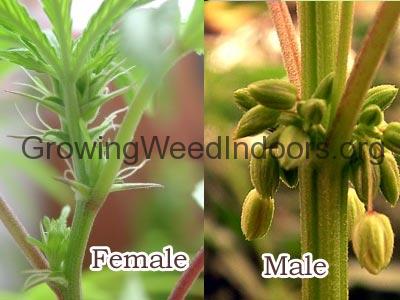
Once they are transplanted, start the flowering cycle (switch your lights to 12 hours on and 12 hours off) to find out which plants are boys and which ones are girls.

It can take up to 15 days or so for the girls to show themselves. Once that happens, you can toss the male plants and switch the girls back to the vegetative light schedule you’re using.

Once you find your girls; they will have tiny wisps of white hairs and you’ll see tiny little buds starting to grow, boys will show little ball sacks, move the boys out and revert back to the vegetative cycle (GLR or 18 hours on 6 hours off), and let them to grow for another 50 days than they’ll be ready for flowering.


female plant and male pot plant

When plants revert they will grow a few odd shaped leafs through the flowers. They don’t hurt anything; you can snip them off or let them grow out.

Restart the flowering cycle by switching back to the 12 hours on 12 hours off lighting schedule.

Of course depending on strain, your flowers reach their full potential and size when the trichomes start turning amber in from 45 to 60 days or possibly longer.

NOTE: the time frames listed are approximate and are dependent on the strain you’re growing, the grow environment and your skills as an indoor gardener. For example; not adhering to a strict light cycle of 18 hours on and 6 hours off. For the best grow, you want the lights the same every day and you MUST refrain from disturbing your girls when the lights are off. Just let them be.


12 days to sprout

15 days as a seedling

10 days of lights on the flowering cycle to sex the plants

50 days vegetative cycle depending on your strain and environment

60 days in the flower cycle.

Total = 147 days for your harvest.

You’ll also need another 14 days to dry and cure your buds giving you a total of 161 days.

You can cheat a little and pick young small buds but before you know it you will have smoked the whole plant. A good way to dry fresh bud you want to sample is using a portable oil heater.

Read the full article about drying wet bud here.

There are many more tips and tricks about growing your own pot at Growing Weed Indoors. Soil mix, nutrients, lighting schedule and equipment used to grow awesome pot; the kind of pot where you’re feeling it after one hit from a one hitter, are fully explained.

Growing marijuana is a whole lot easier with a little help from people like me who actually grow weed indoors at home. This is an important fact when reading or watching how to grow articles and videos. Is it really from somebody with a stealth grow or somebody just trying to sell you something?

Love to hear your comments and answer any questions. Please use the comment section below each post, page or article.

Thanks!

❌