Reading view

There are new articles available, click to refresh the page.

A new CFPB rule strengthens credit data standards, helping lenders and borrowers

Interview transcript

Terry Gerton CFPB recently issued a new rule regarding the Fair Credit Reporting Act and it’s pretty important. Can you walk us through the core of that rule and why you at the Consumer Data Industry Association think it’s important?

Dan Smith Sure, happy to. So the Fair Credit Reporting Act has been in existence since 1970. The leading privacy legislation in the country has specific requirements that lay out how credit reporting should take place, the protections for consumers, and a clear process. And one of the core functions of the Fair Credit Reporting Act is to have a national standard and clearly discusses preemption. Throughout the years, it’s been amended several times. But in the end, Congress is the one who makes decisions on the law. They write the law, and it’s up to judges to interpret the law. In 2022, the CFPB, under the previous administration, put out a document called the Interpretive Rule on Preemption, where they decided what the statute meant. So the first problem was that CFPB actually doesn’t have the authority to do that. They’re not the judge. They implement regulations. They don’t interpret law. That’s up to the courts to decide. They clearly decided to go against the congressional intent of the FCRA. And the current administration believes that that is not their role; that is up to Congress to decide the law. And they were attempting to state that fact, right? So they basically went back to what was common knowledge of the interpretation on preemption to what it was prior to 2022. And they acknowledge in their current interpretive rule that this is not binding, just like the 2022 rule was not binding. It was an interpretation, right? It didn’t go through the APA process, right? We couldn’t sue in 2022 because they didn’t write an actual rule. They just said, this is what we believe. So the current administration is saying you don’t have the right to say, this is what we believe. That is up to Congress. You probably remember the Loper Bright case, which basically said Congress writes the laws, right? If they’re ambiguous, the the regulators actually don’t have the flexibility to interpret it. It’s up to Congress. So I believe the current administration is trying to get the market back to where Congress intended years ago.

Terry Gerton What does this all mean for both consumers and lenders who have to use this kind of data?

Dan Smith The credit reporting ecosystem is critical to every consumer in this country. It provides access to credit. It provides the lender with the ability to mitigate their risks, to analyze the consumer and their ability to repay the loan. It helps facilitate the buying of a car. You could walk into an auto dealer and walk out with a $50,000 car today. And a good reason is because of the credit reporting system. It allows the lender to evaluate the consumer with data. They’re not making judgments. They’re not looking at the person. They are making a decision based on data that talks about their ability to repay the loan. So every day consumers benefit from a robust, complete, accurate credit report. The good, the bad and the not so good. And if you have a system that doesn’t intake the completeness of a consumer’s credit, then you’re going to have decisions that are not accurate. And a lender has two basic choices at that point. They can cut back on their lending, lend to less, or they can charge people more because they’re taking on more risk. Those are their two levers. So the more complete and more accurate a credit report is, the better the lender’s going to be able to manage their risk and lend to more people.

Terry Gerton I’m speaking with Dan Smith. He’s the CEO of the Consumer Data Industry Association. So in the interim between the previous administration’s interpretive rule and this one, some states tried to create their own standards on credit reporting. Were there any particular state actions that raised a red flag for you at CDIA?

Dan Smith Yes. The reason CDIA is so current concerned about the state action is that Congress is the decider of what can and can’t be on a credit report. And it is critical that we have a national standard, that the same data, same types of data appear across the country, so that there is a system that a lender can rely upon if they’re lending in California or they’re lending in Nevada or they’re lending in New Jersey. The credit score that’s based off that information is consistent across the country. If you had data in California that’s different than data in New Jersey, that means the score would act differently. A 750 in California that doesn’t have medical debt would perform different than a 750 in New Jersey that does have medical debt. And I don’t know how a lender can manage a network of 50 different credit reports, 50 different credit scores — and there aren’t just two credit scores, FICO and Vantage score. There’s 50 or 60 different forms of credit scores based on the lender. It’s a complex weave and it’s important to have a national standard so a lender can evaluate the consumer on a level playing field. And if you allow someone other than Congress to determine what can or can’t be on a credit report, you’re bringing politics into the decision making, not sound underwriting decisions. So today’s medical debt, tomorrow’s student loans. Next week is homes damaged by a natural disaster. And before you know it, that credit report is less valuable to the lender and they stop buying the credit report and using it as a tool to lend more.

Terry Gerton You mentioned medical debt along with some of the others. There was a recent decision in the Eastern District of Texas having to do with medical debt that vacated a C F P B rule. Was that in line with the new rule or was that related to the old rule?

Dan Smith So we actually filed that case, CDIA along with Cornerstone Credit Union League out of the Texas area. So you had you have two things. You have the current interpretive rule, which they talked about preemption and what a state can and can’t do. That’s what happened last week. Back in January of 25, the previous administration, as they were leaving, finalized the prohibition on medical debt from being included in credit reports, right? We and others sued saying you don’t have the legal authority to determine that, only Congress does. So back in … 1996, Congress actually prohibited medical debt from being on credit reports, right? People don’t realize, in ’96, they said no medical debt. We don’t think that’s correct. In 2003, they came back and said, oops, that was a mistake. When somebody has $50,000 in any kind of debt, a lender needs to know that so they can make the right choice and not put that consumer in a position that they’ll fail. You don’t want to give people more credit than they can actually afford. So Congress in 2003 passed a law saying both medical debt can be included as long as you can de-identify the medical institution. So if you are a patient at Sloan Kettering, this was an actual example by Congress. You’re a patient at Sloan Kettering and your credit report says. Medical debt, $5,000 Sloan Kettering, the assumption can be made very easily that you have a medical cancer. They don’t think that was fair. And they made the decision that you could put the medical debt, but you have to quote code it or block the identity of that company, the Sloan Kettering. But it says you can definitely put the information on there. So they completely reversed their opinion and said it’s important. So what happened was in ’25 in January, the administration and the CFPB said, we don’t agree with Congress. We’re going to take it off. And they used some data and some analysis and a lot of hyperbole and said, this isn’t fair to the consumer, so we’re gonna take it off. Well, they don’t have the authority to actually do that. So the lawsuit in Texas was to say the authority the Bureau has is to implement regulations, not make law. And the court agreed with us completely.

The post A new CFPB rule strengthens credit data standards, helping lenders and borrowers first appeared on Federal News Network.
© The Associated Press


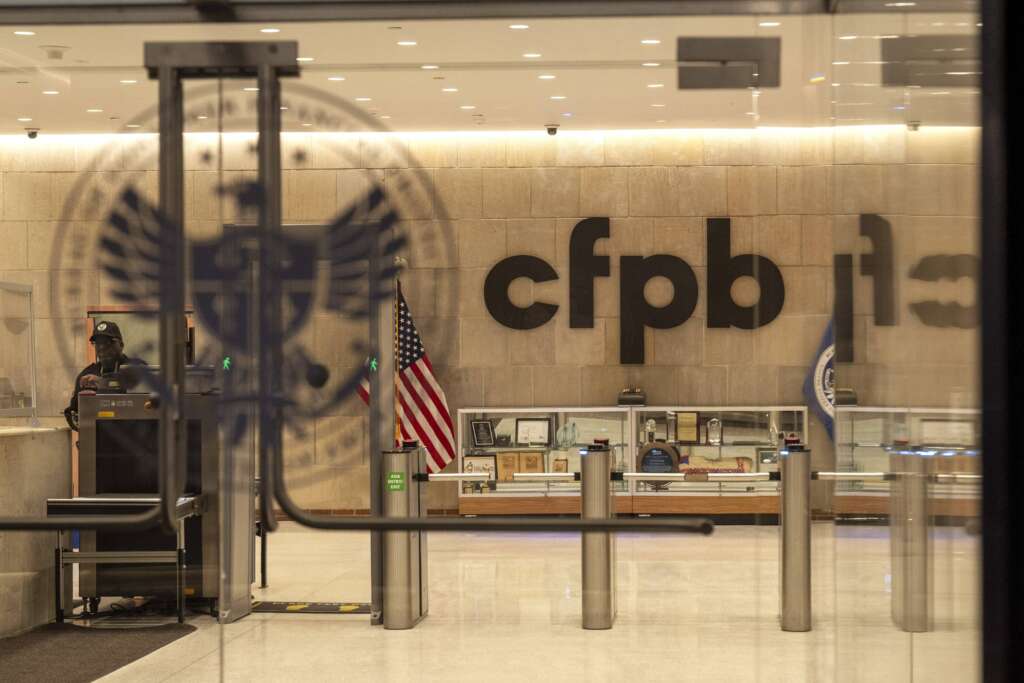
FILE - A security officer works inside of the Consumer Financial Protection Bureau (CFPB) building headquarters Monday, Feb. 10, 2025, in Washington. (AP Photo/Jacquelyn Martin, File)

XRP Adopted As Treasury Asset by Listed Japanese Company – A First Of Its Kind

Even with its price facing volatility, XRP, one of the top 5 crypto assets by market cap, is still gaining recognition around the world. XRP is currently picking up pace at a significant rate in regions such as Asia, and large companies are starting to adopt the leading altcoin in order to create a treasury reserve backed by the token.

Japan-Listed Firm Goes Crypto With XRP Treasury

As a leading asset in the cryptocurrency and financial landscape, XRP is making notable inroads into the Asian region. A publicly traded corporation in Japan has chosen to include the token directly on its balance sheet, causing a new uproar in the country’s corporate sector.

Specifically, this move, which has sent ripples throughout the community, is being carried out by AltPlus, a company that focuses on the design, creation, and running of mobile and social games. The Japanese company has decided to engage with the altcoin by including it in its official treasury strategy, bolstering the XRP Treasury initiative.

In the report shared by BankXRP, a crypto and DeFi enthusiast, outlined that the token is now officially part of the corporate strategy of AltPlus, marking its shift into the ever-evolving cryptocurrency landscape. This move reflects an act of conviction among institutional investors in an environment where the majority of corporations still keep a wary eye on digital assets.

XRP

According to the pundit, the move was revealed in the company’s new shareholder filing. This new document confirms that the firm will purchase and hold XRP alongside Bitcoin, the flagship cryptocurrency, as a strategic asset. AltPlus aims at acquiring value in the long run, diversification, and staking-based income.

The filing details a complete transition of AltPlus into digital assets as the company expands into crypto operations. In this way, the firm is improving its balance sheet and navigating Web3 connections across its gaming and Internet Protocol (IP) ecosystem.

A Huge Wave Of Capital Flowing Into The Asset

While the crypto market is slowly recovering, several major assets witnessed a massive wave of capital, with XRP being among the leaders in inflows. A significant inflow into the altcoin reflects the growing conviction among retail and institutional investors.

Data from CoinShares disclosed by Coin Bureau on X shows that the altcoin pulled in capital worth $289 million in a week, which marks one of its biggest yet. The large inflow coincides with an improvement in investors’ sentiment toward the token, driven by strategic advancements in the larger ecosystem and expanding usefulness throughout international payment corridors.

Meanwhile, the total net inflows for digital asset Exchange-Traded Funds (ETFs) recorded in a week were more than $1 billion, signaling intensifying market interest. As more liquidity pours into digital assets, on-chain activity and market depth seem to be rising dramatically.

XRP

Major Ripple Developments That Could Trigger An XRP Price Surge

Crypto firm Ripple recently achieved a major milestone, providing a bullish outlook for the XRP price. XRP is also seeing significant demand amid the launch of the U.S. spot ETFs, which could trigger a price surge for the altcoin. 

Ripple Developments That Are Bullish For The XRP Price

In a press release, Ripple announced that its stablecoin RLUSD has gained recognition as an accepted Fiat-Referenced token by Abu Dhabi’s financial regulator. This enables the use of the stablecoin within the region’s financial markets. This marks a positive for the XRP price, as it could boost RLUSD’s demand, thereby increasing the demand for the altcoin as the native token of the XRP Ledger. 

Notably, the on-chain analytics platform Sentora (formerly IntoTheBlock) recognized RLUSD as one of the fastest-growing stablecoins, with its market cap increasing by 38.8% over the last month. Meanwhile, this development follows Ripple’s completion of the Hidden Road deal, which also strategically boosts RLUSD demand and positively impacts the XRP price.  

Meanwhile, crypto pundit SMQKE recently highlighted a U.S. Consumer Financial Protection Bureau report that acknowledged Ripple’s role in revolutionizing the cross-border payments industry through XRP. The report also suggested that Ripple’s payment system could be integrated into the traditional financial system, which would also be huge for the XRP price. 

Notably, the report specifically alluded to Ripple’s growth and expanding partnerships, which could make its payment platform the go-to choice for cross-border remittances. Meanwhile, XRP serves as the bridge currency for the effective settlement of these transfers. It is worth mentioning that Ripple Chief Technology Officer (CTO) David Schwartz has also assured that stablecoins cannot replace XRP’s role as the bridge currency on the XRP Ledger (XRPL). 

XRP’s Demand Is On The Rise

A CryptoQuant analysis revealed that the XRP reserves on Binance are plummeting, which could also trigger an XRP price surge. This development comes amid the launch of the U.S. XRP ETFs. The analysis suggested that institutional demand for the altcoin via these ETFs may have contributed to the decline in Binance’s reserves

Binance’s XRP reserves are said to have been steadily decreasing since October and have now dropped to around 2.7 billion XRP, which is one of the lowest levels ever on the exchange. CryptoQuant revealed that roughly 300 million XRP have left the exchange since October 6. The analysis noted that this indicates that real demand is building, which is bullish for the XRP price. 

XRP

Bitcoinist recently reported that institutions last week dumped Bitcoin, Ethereum, and Solana for XRP, which was one of the few majors to record inflows amid the broader outflows from crypto funds. If this demand trend for XRP continues, the CryptoQuant analysis stated the XRP price could enter a more structured phase amid expanding institutional interest. 

At the time of writing, the XRP price is trading at around $$2.21, up in the last 24 hours, according to data from CoinMarketCap.

XRP

U.S. Cyber Command has a new Chief Artificial Intelligence Officer

  • U.S. Cyber Command has a new chief artificial intelligence officer. Brig. Gen. Reid Novotny, who was tapped to serve in the role, said his priority will be ensuring that AI strengthens the nation’s cyber forces and improves decision-making advantages. Novotny previously served as the National Guard Bureau’s director of intelligence and cyber effects operations and most recently as the Office of the National Cyber Director’s senior military policy adviser. Novotny steps into the role amid leadership turnover and other turmoil at the military’s top cyber enterprise.
  • A Bureau of Prisons union is suing the Trump administration to try to restore collective bargaining rights. The new legal action from the American Federation of Government Employees comes after the Bureau of Prisons director terminated the agency’s labor contract. The agreement covered about 30,000 correctional workers across the country. The lawsuit alleges that the decision to cancel the contract was a form of retaliation, and that it violated employees’ First Amendment rights.
    (Lawsuit over BOP contract cancellation - American Federation of Government Employees)
  • Federal employees who are retiring or separating from government can now access some new investment resources. The Federal Retirement Thrift Investment Board has teamed up with the Securities and Exchange Commission to create a new program for retirement advice. The program includes a tutorial covering upcoming changes to the Thrift Savings Plan. It will also explain how to manage a TSP account after leaving government and go over common red flags to look for with potential fraud.
  • The Education Department is taking the next step in the Trump administration’s plan to dismantle the agency. The Education Department has already begun transferring some of its programs and employees to other federal agencies and says more of this work is under way. Education Secretary Linda McMahon says the department has detailed some of its employees to the Labor Department. Education also signed interagency agreements to transfer more of its personnel and programs to departments of State, Health and Human Services and Interior. McMahon says Education is soft-launching this reorganization and that the ultimate goal is to have Congress approve closing the department.
  • The Small Business Administration told laid-off employees they were getting their jobs back, but then walked back that promise. SBA sent reduction-in-force notices to some of its employees just before the government shutdown. The agency’s top HR official told impacted staff Monday that those RIF notices have been rescinded. But a day later, the same official said the layoffs will remain in effect. A federal judge blocked the Trump administration from carrying out layoffs that began during the shutdown. Congress also passed shutdown-ending legislation that would keep these layoffs from coming back at least through January 30.
  • House and Senate negotiators are racing to finalize the fiscal 2026 defense authorization bill. Republican Congressman Rob Wittman said that while disputes between the House and Senate Armed Services Committees have been resolved, there are still issues with other committee jurisdictions. Those committees can either decide to waive jurisdiction or refine the language in ways that ensure the “Big Four” on HASC and SASC will agree to include it in the bill. “I think that those will hopefully be done by the end of the week, and then the bill will be in its final form. It should be on the floor at the beginning of the second week of December.”
  • The Office of Management and Budget has reversed course on a decision to defund the Council on Inspectors General for Integrity and Efficiency. OMB has now released $4.3 million for CIGIE to operate through January 30th. In September, OMB decided not to apportion any new funds for CIGIE. Multiple agency offices of inspector general websites then went dark because they relied on CIGIE services. While CIGIE now has funding through the end of January, OMB is also conducting a programmatic review of the council’s activities.
  • The Trump administration’s new cybersecurity strategy is coming into focus. National Cyber Director Sean Cairncross says the new cyber strategy will have six pillars. Two of them will be focused on imposing costs on adversaries and strengthening partnerships with industry. And during a talk at the Aspen Institute’s cyber summit yesterday, Cairncross said the strategy will not be a thick, 100-page document. “It’s going to be a short statement of intent and policy, and then it will be paired very quickly with action items and deliverables under that,” Cairncross said. Cairncross didn't give a timeline for when the strategy would be out, but said his office is moving as quickly as possible.
    (Aspen Cyber Summit - Aspen Institute )

The post U.S. Cyber Command has a new Chief Artificial Intelligence Officer first appeared on Federal News Network.

© The Associated Press

FILE - The sign outside the National Security Administration (NSA) campus where U.S. Cyber Command is located in Fort Meade, Md., June 6, 2013. Tensions are soaring over Ukraine with Western officials warning about the danger of Russia launching major cyberattacks against its NATO allies. (AP Photo/Patrick Semansky, File)

Agencies prepare to bring back furloughed staff, rescind layoffs as shutdown comes to an end

Agencies are telling furloughed federal employees that they’re expected to show up Thursday morning, now that House lawmakers have ended the longest government shutdown.

Many of these federal employees have been on furlough for the past six weeks, and face a considerable backlog of work upon their return.

At least 670,000 federal employees have been furloughed, and 730,000 employees have been working without pay during the shutdown.

The spending plan passed by the House on Wednesday evening includes back pay for furloughed federal employees and those who worked without pay during the shutdown.

The Senate passed the shutdown-ending spending plan on Monday. The spending package includes a continuing resolution that will keep many agencies funded at current spending levels until Jan. 30, 2026.

Lawmakers also approved FY 2026 funding for the Agriculture Department, the Department of Veterans Affairs, military construction and the legislative branch.

The deal also reserves layoffs for about 4,000 federal employees and protects employees from further layoffs through Jan. 30.

In response, the IRS is in the process of rescinding layoff notices that were sent to mostly human resources and IT employees last month.

The Department of Health and Human Services told employees in an email Wednesday evening that it is “hopeful that the Democrat-led government shutdown may conclude today.”

“Please monitor the news closely and be prepared to return to work if Congress passes the appropriations bill this evening, and President Trump subsequently signs the bill into law,” the HHS email states.

The email, obtained by Federal News Network, states that all HHS employees who were furloughed must report for duty at their official duty station on Nov. 13, if the bill is signed into law on Wednesday night or Thursday morning.

“We deeply appreciate your patience, cooperation, and resilience during this challenging time. Thank you and your teams for your dedication and continued service on behalf of the American people,” the email states.

The Census Bureau is also directing its employees to return to work.

“If you’ve been following, it seems like a return to work is in view,” a bureau manager told employees on Wednesday. “Even in the absence of an [Emergency Notification System] message, we should expect to go to work tomorrow, if the President signs off.”

Meanwhile, the IRS chief human capital office (CHCO) is in the process of rescinding reduction in force notices that were sent to employees on Oct. 10, according to two IRS employees.

An IRS program manager told employees on Wednesday that “when the government reopens, CHCO will be sending RIF recession letters.”

IRS employees told Federal News Network that the layoffs put additional stress on an already beleaguered agency, which is looking to hire and train a substantial number of employees ahead of next year’s filing season.

The IRS is in the middle of preparations for next year’s filing season, which involves more work than usual, because the agency must implement the One Big, Beautiful Bill Act that Congress passed this summer.

An IRS program manager told staff that they “should continue to monitor the news, as we know we are getting closer to reopening and transitioning into the reactivation phase.”

The IRS has already lost about 25% of its workforce so far this year, largely through voluntary incentives.

More than 4,000 federal employees across the government received RIF notices in mid-October, following guidance from the White House that encouraged agencies to move forward with layoffs in the event of a funding lapse.

But those RIF notices will be reversed, as part of the deal to end the government shutdown.

The bill states that between the date of enactment and Jan. 30, no federal funds may be used “to initiate, carry out, implement, or otherwise notice a reduction in force to reduce the number of employees within any department, agency, or office of the federal government.”

White House Press Secretary Karoline Leavitt told reporters on Wednesday that “President Trump looks forward to finally ending this devastating Democrat shutdown with his signature, and we hope that signing will take place later tonight.”

Even with the rollback of the shutdown layoffs, Leavitt said the Trump administration has still taken major steps to “reduce the size of our federal bureaucracy.”

The post Agencies prepare to bring back furloughed staff, rescind layoffs as shutdown comes to an end first appeared on Federal News Network.

© Jory Heckman/Federal News Network

Federal workforce rally
❌