Reading view

There are new articles available, click to refresh the page.

Binance Founder Crushes Bitcoin Critic In Game-Changing BTC Vs. Gold Debate

The Binance Blockchain Week event in Dubai became the center of a high-stakes showdown between traditional and digital innovation, with Bitcoin and gold going head-to-head. Investors, tech enthusiasts, and financial experts watched closely as Binance founder Changpeng Zhao expertly debated renowned Bitcoin critic Peter Schiff, making a compelling argument for why Bitcoin is better than gold. 

Binance Founder Dominates Bitcoin And Gold Debate

During the Binance Blockchain Week in Dubai, Schiff and CZ faced off in a high-profile debate over the value of Bitcoin versus Gold. Schiff defended gold as a safe, stable, and tangible asset while the Binance founder made a compelling case for Bitcoin’s adoption, utility, value, and global reach. 

Throughout the debate, which lasted over an hour, CZ consistently demonstrated the practical advantages of Bitcoin, leaving Schiff’s gold argument largely on the defensive. The Binance founder emphasized Bitcoin’s transparent and predictable supply and its role in the modern financial systems. He pointed to hundreds of millions of users who rely on Bitcoin for payments, savings, and transfers. 

Schiff argued that Bitcoin lacks inherent value and is mainly driven by hype and faith that its price will rise. He stated that gold remains tangible, centuries old, scarce, and valuable in industry, making it superior to BTC. He further asserted that “nobody needs” Bitcoin and that the cryptocurrency is “backed by nothing.”

Practical demonstrations played a key role in the debate between Schiff and CZ. The Binance founder explained how Bitcoin and crypto payments already improve financial efficiency, especially in emerging markets. Schiff questioned whether these transactions truly count as money, since merchants ultimately receive traditional currency. CZ’s response highlighted the importance of adoption and network effects, noting that people who use BTC directly for payments give it real-world significance.

The debate also considered the preferences of younger generations. CZ asked Schiff whether millennials and Gen Z favoured Bitcoin or gold. The Bitcoin critic responded sharply, suggesting that they would choose gold. He pointed out that, with many young investors losing money on BTC, gold offers a safer, more appealing alternative. The Binance founder countered that younger people understand digital value more intuitively and prefer mobile, borderless, and censorship-resistant assets. 

Digital Value And The Future Of Money

The debate between CZ and Schiff also highlighted the changing definition of money. Bitcoin functions as a decentralized network that enables instant settlement and transparent verification. Its adoption has also helped evolve the financial economy, facilitating faster and more seamless cross-border payments. Schiff argued that gold’s scarcity and industrial demand preserve its value and make it a reliable hedge against economic uncertainty. 

Tokenization also became a point of agreement during the discussion, with Schiff emphasizing that gold can be digitized and tokenized for easier ownership and distribution without moving the physical metal. CZ contended that Bitcoin offers similar advantages while also enabling global financial inclusion. They also discussed the supply of both assets, with the Binance founder noting that Bitcoin has a visible supply, while gold doesn’t. 

They also talked about the performance of both assets over the years. Schiff argued that gold had outperformed BTC over the past four years. CZ contended that Bitcoin has far outpaced gold over the last 8 years, and since its launch in 2009, it has skyrocketed from a few cents to an ATH above $126,000. He concluded his debate, predicting that Bitcoin’s growth will outpace gold over time.

Bitcoin

CZ Pushes to Make America a Global Crypto Capital as Binance Eyes US Expansion

Changpeng Zhao (CZ), founder of the world’s largest cryptocurrency exchange Binance, announced plans to help make America a global crypto hub. CZ shared his thoughts on the United States market during a private press conference at Binance Blockchain Week, which took place at the Coca Cola Arena in Dubai Dec. 3-4.

When asked by a member of the media about his involvement in the US following President Trump’s pardon, CZ explained that he is “very appreciative of the pardon from Trump,” noting that this allows Binance to conduct business more “freely” in every part of the world – America included.

“It’s my full intention to help make America the capital of crypto,” CZ stated. “Also, America is an emerging land for Binance. For the last few years we have been dealing with the Biden administration so much that we have tried to withdraw from the US as much as possible. We didn’t invest in the US and we tried to pull out. But now I fully intend to help crypto businesses in the US.”

You heard it here first: ⁦@cz_binance⁩ of ⁦@binance⁩ says he has nothing to do with the Trump family. CZ also has plans to help blockchain & crypto companies innovate in the United States, 🇺🇸 such an insightful and inspiring fireside chat at #binanceblockchainweek pic.twitter.com/J4dFAJYtiZ

— Rachel Wolfson (@Rachelwolf00) December 4, 2025

The United States Becomes Strategic Market For Binance

CZ added that Binance US – which was launched in September 2019 to legally service US residents – still exists, yet it remains a small business.

He explained that in 2023 the SEC sued Binance US, causing the business to lose all banking access and a few state licenses. However, CZ now views the US as “a very important market” and a leading region in terms of tech talent. However, he believes that leaders in the blockchain industry still reside outside of the United States.

“Large businesses like Binance and a few other large players are not technically in the US, so I do want to help bring many of those businesses back into the region,” he said “Also, many institutional investors do not have access or exposure to BNB, so we want to help with that.”

CZ speaks at private press conference alongside Nina Rong, BNB Director of Growth. Source: Rachel Wolfson, Cryptonews Reporter

CZ Says US Has Clear Crypto Regulations

Cryptonews further asked CZ about challenges holding back crypto adoption globally and how Binance aims to combat this moving forward.

CZ mentioned that first and foremost regulatory frameworks have to become clarified in many parts of the world. To enable this, he explained his involvement with more than a dozen different countries on ways to develop and implement regulations.

CZ added that currently only a handful of countries have clear regulations around digital assets, yet pointed out that the US is leading the way.

“Now the US is leading – which is good, but the US is only just starting. Trump has only been in power for a year,” he stated.

CZ further remarked that progress has been made with the recent passing of the GENIUS Act, which establishes clear rules around stablecoins. He added that the CLARITY Act, which aims to define digital assets, remains a work in progress.

“Also the first draft of regulations will not be perfect – it takes time to evolve. After this, the banks will need to work closely with crypto businesses. We need to integrate with existing financial systems to enable mainstream adoption, as that’s the best way for growth,” CZ remarked.

CZ Speaks Out About Prison Time

In addition to sharing his thoughts on the importance of the US market for crypto expansion, CZ described his time in prison. The executive was sentenced to four months in a US prison in April 2024 after pleading guilty to violating US money laundering laws.

You heard it here first: ⁦@cz_binance⁩ founder of ⁦@binance⁩ reflects on time in US prison, noting that he went through a lot of challenges but thankfully no one got hurt 💯
Thank you CZ for all that you do for the crypto ecosystem #binanceblockchainweek #binance pic.twitter.com/SwMKuSW8ok

— Rachel Wolfson (@Rachelwolf00) December 5, 2025

“I went through a lot of challenges – I went to jail, etc. but I know that no one got hurt,” CZ stated. “There was no fraud, there were no users that got hurt because of my actions, so when I sleep at night I sleep very well because I know I am helping a lot of people.”

The post CZ Pushes to Make America a Global Crypto Capital as Binance Eyes US Expansion appeared first on Cryptonews.

Binance Takes Family-Centric Approach to Crypto with Junior Wallet

Cryptocurrency is no longer just for adults. While traditional financial assets like stocks and bonds are often gifted to children by parents who open custodial accounts, crypto exchange Binance aims to help families build wealth through crypto assets.

Announced on Wednesday during Binance Blockchain Week, the crypto exchange explained that “Binance Junior” is the first standalone mobile app that is controlled entirely by parents for children.

Introducing Binance Junior, a parent-controlled app and sub-account for kids and teens.

Build family-focused crypto savings and prepare your child for a future empowered by crypto.

Try it now 👉 https://t.co/q4Y50PvApy pic.twitter.com/O1R2yZ4vVE

— Binance (@binance) December 3, 2025

The app allows adults with a Binance account to deposit crypto into a savings account for kids and teenagers between the ages of 6 to 17. The tool also allows parents to set spending and transfer limits, while enabling earn products for kids dependent on local regulations.

The Importance of Crypto Adoption at Young Ages

Binance’s newly appointed co-founder Yi He explained the importance behind Binance Junior at Binance Blockchain Week.

“We not only nurture children in their early development, but also with long-term growth, responsibility and wisdom,” the executive stated. “Helping children face real life challenges independently means that financial health and literacy are key to preparing them for the future, especially as money is evolving.”

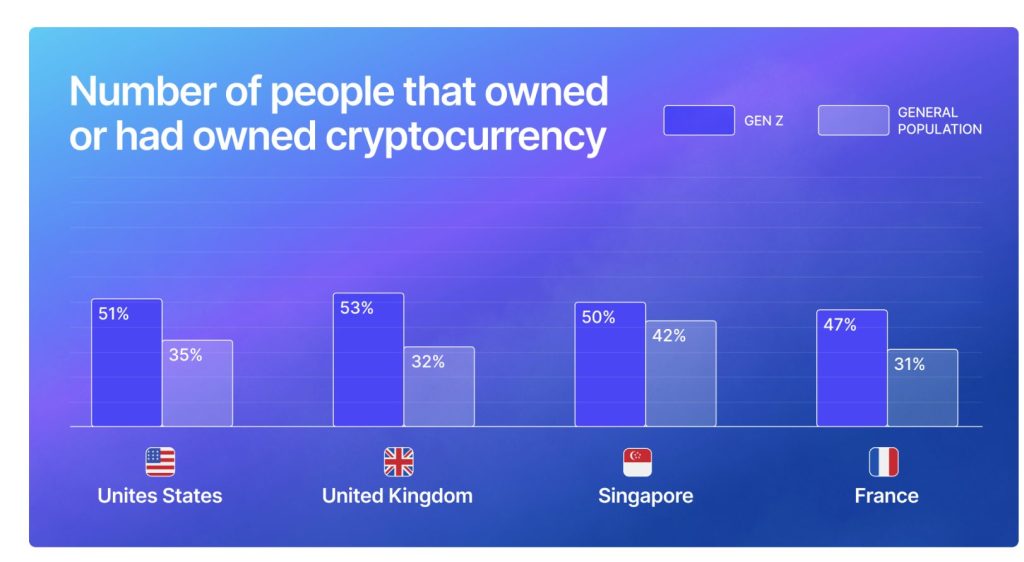
While the notion of educating children on the importance of cryptocurrency may be controversial, findings from a recent survey conducted by Gemini show that more than half (51%) of global Gen Z respondents currently own cryptocurrency or have owned it in the past. The report also notes that over half of Gen Z respondents located in the US owned or had owned cryptocurrency (51%), compared to 49% of Millennials (people born 1981-1994).

Source: Gemini

This demonstrates the growing appeal for crypto adoption amongst younger generations. Binance Junior aims to further facilitate this by allowing children 13 years and up to initiate transfers independently within the app, as long as local regulations are met and daily limits are applied.

Teaching Children About Crypto: Beneficial or Concerning?

While some users on the social media platform X expressed concerns around Binance Junior, the new app aims to align with a growing trend of teaching children about the importance of cryptocurrency at early ages.

Henri Arslanian, co-founder of Nine Blocks Capital and a best-selling author, told Cryptonews that it shouldn’t come as a surprise that Binance has launched Binance Junior.

“Children used to have penny banks to keep fiat in, but now we have hard assets like Bitcoin and there is a huge learning element there that becomes critical,” he said.

Arslanian added that Binance Junior aligns with children’s books and toys centered around cryptocurrency. In September last year, Arslanian published Decoding Crypto, a best-selling children’s book that explains digital assets in simple terms.

Here’s why you should check out my latest kids book, Decoding Crypto, for your kids.

Grab your copy of Amazon’s number 1 new release kids book, Decoding Crypto with @henriandhodler https://t.co/n2hYqlc7bW pic.twitter.com/W7CSmvIsOP

— Henri Arslanian (@HenriArslanian) February 11, 2025

Other books including B is for Bitcoin by Graeme Moore – which is an A-to-Z style alphabet book where each letter links to a crypto term – also aim to make crypto learning fun for children. Goodnight Crypto by Scott Blair is a book that is even suitable for toddlers. Included in the story are 42 collectible non-fungible tokens (NFTs) that can be minted and added to a crypto wallet.

In addition, Binance released a self-published book entitled ABC’s of Crypto that breaks down fundamental terms including security and blockchain technology, to different types of crypto coins.

Cautiously Preparing the Next Generation for Crypto Adoption

While it’s notable that initiatives are being taken to teach young children about digital assets, caution should be exercised.

Parents and teachers explaining cryptocurrency to younger generations may wish to point out the volatile nature of digital assets. Focusing on concepts like savings, diversification, long-term thinking, and risk versus reward rather than price speculation may also be helpful.

The post Binance Takes Family-Centric Approach to Crypto with Junior Wallet appeared first on Cryptonews.

Solana Treasury Companies Mark New Lows In Ongoing Downtrend – What This Means For SOL’s Price

In a significant development, the bearish action of the Solana price is currently spilling into the SOL-backed Treasury reserves. A recent report shows that corporate treasury companies are experiencing a sharp decline in their SOL holdings in the shadow of broader market unease.

Corporate Solana Reserves Continue To Bleed

Solana is experiencing a notable development that is capable of shaping its next market direction. Ted Pillows, a market expert and investor, shared on the X platform that the corporate treasuries of Solana are sinking further as the price of SOL struggles to regain upward traction.

According to the expert, SOL treasury companies are making new lows that echo through the on-chain corridors of the network. This implied that the wallets previously renowned for their steady accumulation are now showing diminishing conviction as balances discreetly shrink in the current bearish market phase.

The trend shows how institutional Solana holders are adjusting in the face of tightened liquidity and increased volatility, but it’s not a sudden exodus. Rather, it may be a steady, calculated exhalation.

Solana

Pillows highlighted that this drop to new lows is a major reason why the price of SOL has been performing badly, as buying demand has faded among institutional investors. Until these companies recover, the expert is confident that a recovery in SOL will be difficult.

However, Solana has started throwing up a quiet flare, one that heralds a recovery. After examining the altcoin’s price action on the weekly time frame, Ali Martinez, a crypto analyst and trader, revealed that SOL is flashing a bullish signal that points to a potential upward move. 

Martinez’s analysis hinges on the key Tom DeMark (TD) Sequential indicator. Since March 2023, the TD Sequential has proven to be very accurate when it comes to identifying SOL trend shifts on the weekly chart. During the ongoing bearish wave, the indicator is flashing a buy signal, suggesting that Solana is likely gearing up for a bounce.

SOL Activity Is On The Rise

Despite Solan’s price facing volatility, the leading network continues to wax strong as activity grows. In a post on X, Solana Daily disclosed that the network’s x402 activity is accelerating at a pace that feels more like an explosion this week. Currently, transactions are broadening, participation is expanding, and on-chain discussion is rising in the community.

The platform highlighted that the daily transaction volume on the protocol reached a new all-time high with approximately $380,000 processed on November 30 alone. This move to a new peak represents a 750% Week-over-Week (WoW) surge.

Furthermore, Solana has flipped the chart in dollar volume for the first time since its inception. With x402 transactions reaching new highs and a flip in dollar volume, the network is emerging as the most active in the cohort.

Solana

Ferguson’s AI balancing act: Washington governor wants to harness innovation while minimizing harms

Washington Gov. Bob Ferguson speaks at Seattle AI Week, at the AI House on Pier 70 along the city’s waterfront. (GeekWire Photo / Todd Bishop)

Washington state Gov. Bob Ferguson is threading the needle when it comes to artificial intelligence.

Ferguson made a brief appearance at the opening reception for Seattle AI Week on Monday evening, speaking at AI House on Pier 70 about his approach to governing the consequential technology.

“I view my job as maximizing the benefits and minimizing harms,” said Ferguson, who took office earlier this year.

Ferguson called AI one of the “top five biggest challenges” he thinks about daily, both professionally and personally.

In a follow-up interview with GeekWire, the governor said AI “could totally transform our government, as well as the private sector, in many ways.”

His comments came just as Amazon, the largest employer in Washington state, said it would eliminate about 14,000 corporate jobs, citing a need to reduce bureaucracy and become more efficient in the new era of artificial intelligence.

Ferguson told the crowd that the future of work and “loss of jobs that come with the technology” is on his mind.

The governor highlighted Washington’s AI Task Force, created during his tenure as attorney general, which is studying issues from algorithmic bias to data security. The group’s next set of recommendations arrives later this year and could shape upcoming legislation, he said.

States are moving ahead with their own AI rules in the absence of a comprehensive federal framework. Washington appears to sit in the pragmatic middle of this fast-moving regulatory landscape — using executive action and an expert task force to build guidelines, while watching experiments in states such as California and Colorado.

Seattle city leaders are also getting involved. Seattle Mayor Bruce Harrell last month announced a “responsible AI plan” that provides guidelines for Seattle’s use of artificial intelligence and its support of the AI tech sector as an economic driver.

(GeekWire Photo / Taylor Soper)

Ferguson said he’s aware of how AI can “really revolutionize our economy and state in so many ways,” from healthcare to education to wildfire detection.

But he also flagged his concerns — both as a policymaker and parent. The governor, who has 17-year-old twins, said he worries about the technology’s impact on young people, referencing reports of teen suicides linked to AI chatbots.

Despite those concerns, Ferguson maintained an upbeat tone during his remarks at Seattle AI Week, citing the region’s technical talent and economic opportunity from the technology.

He noted that the state, amid a $16 billion budget shortfall this year, kept $300,000 in funding for the AI House, the new waterfront startup hub that hosted Monday’s event.

“There is no better place anywhere in the United States for this innovation than right here in the Northwest,” he said.

Related: A tale of two Seattles in the age of AI: Harsh realities and new hope for the tech community

A tale of two Seattles in the age of AI: Harsh realities and new hope for the tech community

The opening panel at Seattle AI Week 2025, from left: Randa Minkarah, WTIA chief operating executive; Joe Nguyen, Washington commerce director; Rep. Cindy Ryu; Nathan Lambert, Allen Institute for AI; and Brittany Jarnot, Salesforce. (GeekWire Photo / Taylor Soper)

Seattle is looking to celebrate and accelerate its leadership in artificial intelligence at the very moment the first wave of the AI economy is crashing down on the region’s tech workforce.

That contrast was hard to miss Monday evening at the opening reception for Seattle AI Week 2025 at Pier 70. On stage, panels offered a healthy dose of optimism about building the AI future. In the crowd, buzz about Amazon’s impending layoffs brought the reality of the moment back to earth.

A region that rose with Microsoft and then Amazon is now dealing with the consequences of Big Tech’s AI-era restructuring. Companies that hired by the thousands are now thinning their ranks in the name of efficiency and focus — a dose of corporate realism for the local tech economy.

The double-edged nature of this shift is not lost on Washington Gov. Bob Ferguson.

“AI, and the future of AI, and what that means for our state and the world — each day I do this job, the more that moves up in my mind in terms of the challenges and the opportunities we have,” Ferguson told the AI Week crowd. He touted Washington’s concentration of AI jobs, saying his goal is to maximize the benefits of AI while minimizing its downsides.

Gov. Bob Ferguson addresses the AI Week opening reception. (GeekWire Photo / Todd Bishop)

Seattle AI Week, led by the Washington Technology Industry Association, was started last year after a Forbes list of the nation’s top 50 AI startups included none from Seattle, said the WTIA’s Nick Ellingson, opening this year’s event. That didn’t seem right. Was it a messaging problem?

“A bunch of us got together and said, let’s talk about all the cool things happening around AI in Seattle, and let’s expand the tent beyond just tech things that are happening,” Ellingson explained.

So maybe that’s the best measuring stick: how many startups will this latest shakeout spark, and how can the Seattle region’s startup and tech leaders make it happen? Can the region become less dependent on the whims of the Microsoft and Amazon C-suites in the process? 

“Washington has so much opportunity. It’s one of the few capitals of AI in the world,” said WTIA’s Arry Yu in her opening remarks. “People talk about China, people talk about Silicon Valley — there are a few contenders, but really, it’s here in Seattle. … The future is built on data, on powerful technology, but also on community. That’s what makes this place different.”

And yet, “AI is a sleepy scene in Seattle, where people work at their companies, but there’s very little activity and cross-pollinating outside of this,” said Nathan Lambert, senior research scientist with the Allen Institute for AI, during the opening panel discussion.

No, we don’t want to become San Francisco or Silicon Valley, Lambert added. But that doesn’t mean the region can’t cherry-pick some of the ingredients that put Bay Area tech on top.

Whether laid-off tech workers will start their own companies is a common question after layoffs like this. In the Seattle region at least, that outcome has been more fantasy than reality. 

This is where AI could change things, if not with the fabled one-person unicorn then with a bigger wave of new companies born of this employment downturn. Who knows, maybe one will even land on that elusive Forbes AI 50 list. (Hey, a region can dream!)

But as the new AI reality unfolds in the regional workforce, maybe the best question to ask is whether Seattle’s next big thing can come from its own backyard again.

Related: Ferguson’s AI balancing act: Washington governor wants to harness innovation while minimizing harms

KnowBe4 warns of new PayPal invoice phishing scam

Security awareness firm KnowBe4 has issued a warning about a new PayPal themed phishing scam that uses real PayPal email addresses to trick victims into handing over sensitive financial information.


The scam begins when victims receive an email from a legitimate PayPal domain containing an invoice for a large purchase they never made. The message also includes a phone number to call if the recipient wants to dispute the charge.


However, while the email may appear authentic, the invoice is fake. Cybercriminals are creating genuine PayPal accounts and using them to send these fraudulent invoices. If the victim calls the listed number, they are connected not to PayPal but to a fraudster posing as a support representative, who will attempt to extract credit card details or pressure the victim into paying a bogus “account fee.”


Javvad Malik, Lead CISO Advisor at KnowBe4, explained that the scam exploits people’s trust in familiar brands and their tendency to react quickly to unexpected charges.


“Even though the email may come from a real PayPal address, this is a clever social engineering trick designed to create panic,” Malik said. “Cybercriminals know that if they can get you to act before you think, they can manipulate you into giving away information or money.”


To stay safe from this and similar scams, Malik advises users to:

  • Never call phone numbers listed in suspicious emails.
  • If you receive an unexpected invoice, log in directly to PayPal via the official website or app to verify its authenticity.
  • Be cautious of any unexpected bills or urgent requests for money—even if the email appears genuine.

The post KnowBe4 warns of new PayPal invoice phishing scam appeared first on IT Security Guru.

Cannabis Seed Genetics Explained

By: TeamVault

Cannabis Seed Genetics Explained


Cannabis Seed Genetics Explained: Grow Your Dream Strain with The Vault


So, you’ve got your grow lights set up, your soil primed, and your excitement through the roof—but how much do you really know about the genetics of the cannabis seeds you’re planting? If you’re serious about growing top-shelf cannabis, understanding cannabis genetics is the secret sauce. And trust me, once you get the hang of it, choosing seeds from The Vault Cannabis Seed Store will feel like picking out a legendary Pokemon!

In this blog, we’ll demystify cannabis seed genetics and explain why this matters for every grower, whether you’re just starting or already have a few bountiful harvests under your belt. Let’s unlock the door to a world of knowledge that can help you grow the strain of your dreams.


The Basics: What Are Cannabis Seed Genetics?

When we talk about cannabis seed genetics, we’re essentially talking about a plant’s DNA. Just like in humans and animals, the genetic makeup of a cannabis plant dictates its appearance, growth habits, and effects. Whether it will grow tall and lanky or short and bushy, produce dense buds or airy flowers, be rich in THC or packed with CBD—all of these traits are written in its genetic code.


In cannabis, genetics determine:

Strain type (Sativa, Indica, Hybrid)
Cannabinoid profile (THC, CBD, CBG, etc.)
Terpene profile (those tasty aromatic compounds!)
Growth traits (height, yield, flowering time)
Resistance to pests, diseases, and environmental conditions
To make it easy, think of cannabis seed genetics like the ultimate blueprint for your plant. Choose wisely, and you could end up with a strain that checks off every box on your wish list.


Indica vs. Sativa vs. Hybrid: The Classic Debate

Before we dive into more complex genetic details, let’s cover the basics of Indica, Sativa, and Hybrid strains. If you’re new to growing, you’ll likely see these terms everywhere, and they’re foundational to understanding cannabis seed genetics.


Indica

Indica strains are often short, bushy, and suited to colder climates. They’re known for producing a “body high”—that warm, relaxing sensation that leaves you glued to the couch and binge-watching your favorite shows. They typically have shorter flowering times, which makes them appealing for growers looking to harvest sooner rather than later.


Common traits of Indica plants include:

Shorter height (great for indoor grows)
Broad leaves
Relaxing, sedative effects
Shorter flowering time (usually 6-9 weeks)
Popular Indica strains you can snag from The Vault Cannabis Seed Store include Northern Lights and Granddaddy Purple.


Sativa

On the flip side, Sativa strains are tall, lanky, and thrive in warmer climates. These plants are known for their “head high”—a cerebral, uplifting effect that pairs well with creativity and focus. If you’re a day-time user or want a strain that helps you feel energized and inspired, Sativa is your go-to.


Common traits of Sativa plants include:


Taller height (sometimes up to 12 feet!)
Narrow leaves
Uplifting, energetic effects
Longer flowering time (usually 10-14 weeks)
Some popular Sativa seeds at The Vault include Amnesia Haze and Durban Poison.


Hybrid

Then there are Hybrid strains, which are a blend of both Indica and Sativa genetics. These strains give growers and consumers the best of both worlds, often combining the relaxation of Indica with the mental stimulation of Sativa. Hybrids can lean more towards one side or be a true 50/50 split, offering a wide range of effects.

For a hybrid experience, check out strains like Blue Dream or Girl Scout Cookies, both available at The Vault Cannabis Seed Store.


The Importance of Parent Genetics: It’s All in the Family

If you’ve ever heard of a strain being referred to as the “child” of two other strains, you’re not imagining things. Cannabis plants, like animals, have parents. Breeders combine strains (called “crossing”) to develop specific traits, and the offspring (your seeds) inherit traits from both the mother and father plants. It’s like playing with the ultimate genetic toolkit!

For example, if a breeder wants a strain that grows fast (Indica trait) but also produces high yields (Sativa trait), they might cross an Indica-dominant strain with a high-yielding Sativa. The resulting strain might be exactly what they were aiming for—or it might not. Breeding is both an art and a science, and that’s why the genetics behind your seeds are so important.

At The Vault Cannabis Seed Store, you’ll notice strains like White Widow or OG Kush that have been used to breed many of the most popular hybrids on the market today. Knowing the lineage of your strain gives you insights into what you can expect during your grow.


Landrace Strains: The Originals

Let’s talk about landrace strains, which are like the ancient ancestors of today’s cannabis. These strains developed naturally in specific geographic regions, without human interference, and are often the purest forms of Indica or Sativa genetics you can find. Think of them as the OGs of the cannabis world.

Some famous landrace strains include Afghani, Thai, and Durban Poison. While modern hybrid strains might offer more specialized effects or better yields, landrace strains offer a piece of cannabis history and some of the purest genetics available. If you’re a purist or a cannabis historian, growing landrace strains can be an exciting way to experience cannabis in its original form.


Feminized vs. Regular Seeds: The Genetic Dilemma

When shopping for seeds, you’ll come across terms like feminized and regular. This is another crucial aspect of cannabis seed genetics that every grower should understand.


Feminized Seeds

Most growers opt for feminized seeds because they eliminate the guesswork. Feminized seeds are genetically engineered to produce only female plants—important because only female plants produce the resinous buds we all love.

Pros: No need to worry about male plants, which means no accidental pollination or wasted space.
Cons: Some growers argue that feminized seeds might not be as genetically stable as regular seeds, but with high-quality breeders, this isn’t usually an issue.
At The Vault, you can find an extensive selection of feminized seeds, such as Purple Punch and Wedding Cake.


Regular Seeds

Regular seeds give you both male and female plants, meaning you’ll need to sex them and remove the males if you’re only after those glorious buds. However, regular seeds are favored by breeders who want to create new strains by crossing male and female plants.


Pros: Potential to breed your own strains.

Cons: You’ll need to watch out for males unless you’re specifically breeding.

The Vault also stocks an impressive range of regular seeds, like Skunk #1 for those adventurous growers looking to tinker with genetics.


Autoflowering Genetics: The Quick Grower’s Dream

Another genetic factor that’s shaking up the cannabis world is autoflowering seeds. Unlike traditional photoperiod strains, which depend on light cycles to flower, autoflowering strains will automatically switch from vegetative growth to flowering after a certain amount of time, regardless of light exposure.

Autoflowering seeds are often created by breeding cannabis strains with Cannabis ruderalis, a wild, hardy cannabis species known for its ability to flower quickly. These plants tend to be smaller and have shorter grow cycles, making them perfect for beginners or those with limited space and time.

For a speedy grow, check out autoflowering strains like Auto Gorilla Glue or Auto White Widow at The Vault Cannabis Seed Store.


Why Buy from The Vault Cannabis Seed Store?

Alright, now that you’re a cannabis genetics whiz, let’s talk about why The Vault Cannabis Seed Store is the best place to shop for cannabis seeds. Whether you’re looking for landrace strains, hybrid powerhouses, or autoflowering seeds, The Vault offers:

A vast selection of premium genetics from trusted breeders.
Feminized, regular, and autoflowering options to suit every grower’s needs.
Discreet worldwide shipping to ensure your seeds arrive safely.
Exclusive promotions and freebies to make your purchase even sweeter.

Conclusion

Cannabis seed genetics are the backbone of every successful grow. Whether you’re after a relaxing Indica, an energetic Sativa, or a balanced Hybrid, understanding the genetics of your seeds is crucial to growing the perfect plant. And with the wide range of high-quality seeds available at The Vault Cannabis Seed Store, you’re just a click away from growing your dream strain. So what are you waiting for? Get growing today!


Newsletter Sign Up

Make sure you never miss another Vault promo – sign up for our newsletter


Remember: It is illegal to germinate cannabis seeds in many countries including the UK.  It is our duty to inform you of this fact and to urge you to obey all of your local laws to the letter.  The Vault only ever sells or sends out seeds for souvenir, collection or novelty purposes.

The post Cannabis Seed Genetics Explained first appeared on Cannabis Seeds News.

Eye-opening data privacy trends and statistics (2023 and beyond)

By: slandau

EXECUTIVE SUMMARY:

Data is one of the most important and valuable assets for businesses. It functions as a guiding light, helping leaders see around corners, make transformative strategy decisions, stay uber competitive, and deliver better tangible business outcomes. In some cases, data is as elevated and celebrated as revenue, customer service excellence, and profitability.

However, data is uniquely vulnerable to an unintended effect of the rapid shift to digitization and the cloud; the data breach epidemic. Since the start of the coronavirus pandemic, a dizzying number of organizations have been experiencing a disturbing number of data breaches.

In 2022, a total of 4,100 publicly disclosed data breaches led to the exposure of approximately 22 billion records.  In response, Check Point Field CISO, Deryck Mitchelson says, “For me, it feels as though we are growing numb to all of this…What we’re forgetting is that on the back of these breaches, it’s your data, it’s my data that is being compromised.”

When it comes to contending with the complexity of data ecosystems and data protection, most organizations are under-prepared. As a result, we’re seeing that consumers are willing to vote with their digital footprints. The story is in the statistics, below.

Global data privacy trends and statistics (2023)

  1. 45% of websites use some type cookie tracking set-up.
  2. Data collection can yield as much as a 4% increase in revenue, which can translate to billion of dollars for some of the largest multi-national companies.
  3. 81% of survey respondents say that the way an organization treats personal data is “indicative of how it views and respects its customers.”
  4. 84% of customers are more loyal to brands that have strong security controls.
  5. 76% of consumers would not make purchases from a company that they did not trust with their data.
  6. 37% of consumers say they have already switched companies or providers to better protect their privacy – up from 34% two years ago.
  7. 58% of organizations don’t acknowledge data breach disclosures. According to a Comparitech study, 23% of organizations responded to data breach disclosures within a day, 12% of organizations responded within two days, and two percent within three days. Five percent took 17 days to respond. More than half (58%) never sent a response at all.
  8. 62% of Americans don’t believe it’s possible to experience a normal day of life without companies collecting data about them.
  9. The average data breach in the U.S. costs 4.2 million, according to an IBM report.
  10. A hacker strikes every 39 seconds.
  11. In a PwC survey, 87% of business leaders stated that they believed their consumers trust their company.
  12. In contrast, just 30% of consumers in the same PwC survey stated that they have a high level of trust in companies.

Data breach trends and statistics: Insights

Earn consumer trust by avoiding data breaches. Second-only to industry conditions, levels of consumer trust are the next biggest determinant of an organization’s market performance.

According to one study, roughly three weeks after a given company breach was made public, company share prices dropped by 3.5 percent (on average). A year after a breach, affected companies under-performed the NASDAQ by 8.6 percent. After three years, companies continued to under-perform the market by more than 15 percent.

Data breach trends and statistics: Consumer perspective

For consumers, digital data collection, sharing, analysis and privacy are difficult to understand. Thirty-five years ago, there weren’t smartphones or laptops emitting location data. Cameras weren’t built into nearly every technological device. Everyday devices couldn’t easily be misused or misrepresented to consumers in relation to unwanted tracking, data collection and subsequent possible identity theft.

To respect data is to respect your end-consumers and your business growth potential.

In conclusion

Data privacy and security can be incredibly technical and complex. But in failing to protect your data and your reputation in the eyes of consumers, you might experience a nightmare.

Be a #dataprivacyweek advocate

Data Privacy Week is January 22 – 28th. Share these #dataprivacyweek tweets with your network.


#dataprivacyweek is a call to action. After all, 84% of customers are more loyal to brands that have strong security controls. Improve your #datasecurity.
Click To Tweet


Did you know? The average data breach in the U.S. costs 4.2 million. Protect your data; protect your resources. #dataprivacyweek
Click To Tweet


Learn more about how to champion data privacy within your organization. See 10 data privacy tips to protect your organization this year. Also check out this executive-level insights article.

Lastly, don’t miss registration for the most important cyber security event of 2023; CPX 360. Register here.

The post Eye-opening data privacy trends and statistics (2023 and beyond) appeared first on CyberTalk.

10 data privacy tips to protect your organization this year

By: slandau

It’s data privacy week! This week-long international initiative was developed by the National Cybersecurity Alliance, and encourages all organizations to respect data through improved security and management transparency.

Rich streams of data have enabled organizations to analyze client behavior, identify opportunities, establish baselines, set performance goals, gather business intelligence and so much more. While our data-driven culture fosters continuous improvements, lack of strategic alignment around data protection can result in the loss of this asset’s value or your organization’s value – and it can happen quickly.

The average company has 534,465 files containing sensitive data. In certain industries, like finance, every employee is given access to over 1,000 sensitive files. Worse yet, more than 70% of employees have been known to share sensitive and business-critical data via insecure or under-secured platforms and devices. Data exposure can result in reputational damage, legal penalties and other unwanted business outcomes.

Proactively address privacy and data protection requirements with future-proof strategies, technologies, and other positive measures. Doing so means differentiating your enterprise, increasing your organization’s value proposition and building consumer trust.

10 data privacy tips to protect your organization

1. Locate and identify data. You can’t protect your firm’s information effectively if you don’t know that it exists, where it’s located, or what data you retain. Data can easily get lost within home-grown systems, documents, emails and retired legacy applications.

Your organization’s security team needs to understand where all critical systems and data are stored within the business. The security team also needs to track who has access to which data, why, and how it is being used, if at all. In turn, this will enable your security team to develop processes, controls and safeguards through which to ensure sufficient data protection and regulatory compliance.

2. Create clear security policies. When new regulations come into play, organizations commonly try to follow laws by implementing complicated policies as addendums to existing policies. While this approach may accomplish legal objectives, employees often struggle to understand and apply the new policies to their day-to-day tasks.

Organizations need to establish clear and easy-to-understand security policies. Policies need to address global security and privacy compliance requirements. They also need to be consistent. Pursue opportunities to simplify your data protection and privacy policies and processes. In so doing, you will assist everyone who genuinely strives to protect your organization’s data.

3. Develop connections. Security often involves a maddening number of stakeholders, especially within larger enterprises. To meet data privacy expectations, security teams will need to develop strong working relationships with professionals across all departments that need to secure data. In addition to better communication, policy development, and implementation, cross-departmental connections may allow your organization to discover and address non-compliance issues before an external auditor reports them.

4. Employee awareness. Educating employees about cyber security risks, data protection policies, and data protection best practices allows you to broadly reduce vulnerabilities. A strong awareness program should include educational content, follow-up messaging, testing, and measurement of employee involvement in said programs. Set your organization up for success by focusing on data protection best practices and by engaging in cross-team collaboration to create a data security and privacy ecosystem that supports evolving regulations and business growth.

5. Data loss prevention (DLP). Data loss prevention refers to a series of strategies and tools that organizations can employ to prevent data theft, loss, or accidental deletion. Organizations commonly use DLP to protect Personally Identifiable Information, to adhere to corresponding regulations, to protect intellectual property, to achieve greater data visibility, to secure the distributed workforce and to secure data on remote cloud systems.

Ahead of adoption, determine the most appropriate DLP deployment architecture or combination of architectures for your organization. In addition to helping achieve the aforementioned objectives, adoption of DLP also allows CISOs to retain the necessary reporting capabilities that enable frequent data security updates to management.

6. Backups, snapshots, replications. All three of these things have a role to play in data protection. While the three are often confused, all of them are intended to protect your data in different ways:

Data backups: In the event of loss or corruption, data backups enable you to restore systems to a previous point in time. Data backups create “save points” on your production servers. Because data backups can take a while to create, many firms schedule them at night or on weekends. Data backups are critical for compliance purposes.

Data snapshots: A data snapshot copies the state of an entire system at a certain point in time, presenting a virtual ‘snapshot’ of a server’s file systems and settings. In contrast with backups, snapshots only copy the settings and metadata required to restore data after a disruption.

Data replication: The term ‘data replication’ refers to copying data to another location – whether that’s a storage system within the same data center or a system in a remote data center. This data storage methodology enables all users to work from the same data sets. Data replication results in a consistent, distributed database.

7. Firewalls. While your company might have a firewall, are the networks still vulnerable at their core? Ensure that your firewall solution is configured securely. Take the following steps: Disable insecure protocols like telnet and SNMP or use a secure SNMP configuration. Schedule regular backups of the configuration and the database. Add a stealth rule in the firewall policy to hide the firewall from network scans. More in-depth insights here.

Guides to firewall security are often available from security vendors and third parties, such as the Center for Internet Security (CIS), which publishes CIS Benchmarks Network Devices. Also, see the SANS Firewall Checklist.

8. Authentication and authorization. These types of controls assist with the verification of credentials and ensure that user privileges are applied appropriately. Typically, these measures are implemented in conjunction with an identity and access management (IAM) solution and in tandem with role-based access controls (RBAC).

9. Endpoint protection (EDR). As part of a layered cyber security approach, endpoint protection helps secure desktops, laptops and mobile devices. Essential features of an endpoint solution include: anti-malware, behavioral analytics, the ability to enforce compliance with enterprise security policies, data encryption, sandbox inspection, secure remote access, and URL filtering.

When it comes to endpoint security solutions, the right choice depends on the endpoints in question and a given organization’s unique needs. Your organization might also consider an XPR/XDR solution, which integrates endpoint security, cloud computing security, email security and other security architectures.

10. Data erasure. By deleting data that your organization does not need to store and does not use, your organization can limit its liabilities when it comes to data protection. Under many compliance rules, erasure of unnecessary data is a requirement. In short, data erasure is a critical element of the data lifecycle management process.

Conclusion

Protecting the privacy and integrity of data helps your organization stay competitive, increases value and improves trust.

To learn more about data privacy week and executive-level data privacy protection strategies, see CyberTalk.org’s past coverage.

Lastly, don’t miss registration for the most important cyber security event of the year; CPX 360 2023. Register here.

The post 10 data privacy tips to protect your organization this year appeared first on CyberTalk.

❌