Reading view

There are new articles available, click to refresh the page.

How Does Ripple’s XRP Enable The Trillion-Dollar Tokenization Market?

Crypto pundit Pumpius has provided insights into Ripple’s XRP’s role to enable the trillion-dollar tokenization market on the XRP Ledger (XRPL). He also explained how the altcoin and Ripple’s RLUSD stablecoin work hand in hand rather than being competitors on the network. 

Ripple XRP’s Role In Enabling Tokenization On The XRPL

In an X post, Pumpius stated that XRP handles cross-border liquidity and deep global routing while Ripple’s RLUSD supports domestic flows, tokenized assets, and institutional balance sheets. This came as he noted that pairing XRP with RLUSD creates a two-asset settlement engine in the push for tokenization on the XRPL. 

The crypto pundit further stated that both XRP and Ripple’s RLUSD unlock instant settlement for tokenized assets, atomic swaps, capital-efficient markets, and unified liquidity across the entire XRPL ecosystem. He asserted that without instant, programmable, and compliant settlement, tokenized assets are nothing more than digital placeholders. 

Pumpius remarked that this is where Ripple’s RLUSD becomes transformative. He explained that the stablecoin is the operational backbone for real-world assets on the XRP Ledger. The crypto pundit added that it is the first dollar that settles at XRPL speed with institutional-grade transparency and regulatory alignment.  

In line with this, Pumpius reiterated that tokenization is useless without settlement. While RLUSD fixes the settlement problem, he stated that XRP amplifies it and that the emerging ZK layer will protect it. Regarding the ZK layer, the pundit stated that as private ZK infrastructure begins to anchor the XRPL identity, privacy and compliance layers will slot into this model, making settlement fast, verifiable, and shielded when needed. 

He declared that settlement, privacy, and compliant identity are the final form institutions have been waiting for before they begin tokenizing on the XRP Ledger. Notably, Ripple has already included introducing privacy features on the network into its roadmap. 

Ripple CTO Defends XRP And XRPL

In an X post, Ripple CTO David Schwartz defended XRP and the XRPL after the altcoin was described as being “extremely centralized” because it is permissioned. Schwartz rebutted the statement that it was permissioned, noting that no one needs, or could have, any special permission to issue or execute XRPL transactions.

He further stated that XRP is unpermissioned for the same reason Bitcoin is. He added that if anyone were to exercise control over the network in a way that is perceived as unfair, everyone else would change whatever was needed to regain fairness. The Ripple CTO also mentioned that, over more than a decade, no XRP transaction has been censored. At the same time, he claimed that Bitcoin miners routinely delay transactions they disfavor for any reason. 

At the time of writing, the XRP price is trading at around $2.05, down in the last 24 hours, according to data from CoinMarketCap.
Ripple

Why The Litecoin Price Could Stage A 33% Rally To $110

A crypto analyst has forecasted that the Litecoin price is gearing up for an explosive rally to $110. Unlike Bitcoin and Ethereum, which have seen considerable declines over the past few months, Litecoin appears to be stabilizing, gaining about 7.8% this past week, according to CoinMarketCap. Although LTC has seen its fair share of declines this year, analysts still hold hope that the cryptocurrency could cross the $100 threshold and reclaim former highs. 

Litecoin Price Targets A $110 Breakout

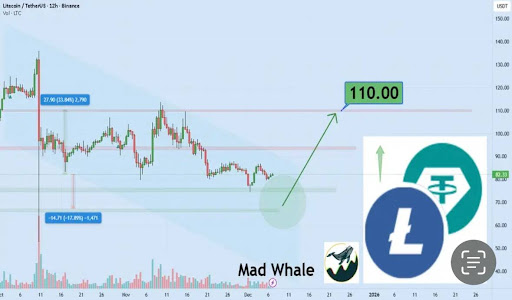
Litecoin may be preparing for a strong upward move, according to a new analysis from TradingView market expert MadWhale. The analyst has indicated that the cryptocurrency has the technical structure needed to break out of its long-term descending channel and potentially climb toward $110. With its current price sitting around $83, a surge to this level would represent a significant 33% rally. 

MadWhale has based his bullish LTC forecast on weekly candlesticks and how the cryptocurrency has consistently responded to past support and resistance levels. He explained that the altcoin had been trapped in a descending channel that has controlled its price for several weeks now. According to the TradingView analyst, Litecoin is now approaching the upper resistance region of the descending channel–a point where traders usually watch for either a clean breakout or a sharp rejection.

Litecoin

From the analyst’s price chart, Litecoin’s support zones have repeatedly held firm, showing that buyers consistently defended the area. Due to this steady support, he expects Litecoin’s bounce near the descending channel’s upper resistance to build momentum. If the support holds, MadWhale suggests the cryptocurrency could skyrocket to $110, completing its breakout from the descending channel. 

A breakout could signal a significant shift, potentially transforming Litecoin’s recent downtrend into a new bullish phase. MadWhale’s chart also highlights the cryptocurrency’s volatility, showing that in early October, LTC had rallied around 33.84%, climbing above $120. However, just days later, it crashed more than 17%, coinciding with the October 10 liquidation event that shook the market. 

Update On LTC’s Price Action

Litecoin is approximately 79% below its all-time high of over $410, recorded during the 2021 bull run. The cryptocurrency has dropped 17.68% over the past week and is down 33% for the year, mirroring the broader decline seen across altcoins. Despite its performance, LTC’s Fear and Greed Index remains in the neutral zone, suggesting that crypto investors are cautiously optimistic.

According to market analyst CW on X, the next sell wall for Litecoin is at $98, about 15% above its current price. Once the cryptocurrency reaches this level, CW expects a significant number of sellers to offload their coins. His chart also highlights the next key resistance levels for LTC, suggesting a potential surge to $98 first and then to the $106-$110 range.

Litecoin

Shiba Inu’s Volume Explosion: Leading Meme Coin Barrels Ahead In This Metric

Shiba Inu has recorded a notable surge in spot trading activity on several exchanges over the last seven days. This provides a bullish outlook for the second-largest meme coin by market cap, which has been one of the underperformers in this market cycle

Shiba Inu Sees Surge In Spot Trading Activity

CoinGlass data show a 154% surge in Shiba Inu USD spot trading volume on Kraken over the last seven days. There has also been a significant surge on other major exchanges, such as Binance, Bybit, OKX, and Gemini, during the same period. This indicates that spot buyers may be stepping in to defend the SHIB price at a critical support amid the broader crypto market decline

Notably, Shiba Inu is one of the altcoins that are in the green over the last week, suggesting that the bulls may be in control at the moment. CoinMarketCap data shows that the second-largest meme coin by market cap is up almost 7% during this period despite Bitcoin’s choppy price action. 

Meanwhile, further data from CoinGlass also shows that most leverage traders are currently betting on an increase in the Shiba Inu price, with the long/short ratio currently above 1. However, it is worth noting that derivatives volume is down by over 10% and open interest is down by almost 4%, which presents a bearish outlook for the meme coin. 

Another positive for Shiba Inu, besides the surge in spot trading volume, is that the Fed is likely to cut interest rates again at this week’s FOMC meeting. This could inject more liquidity into the crypto market, with altcoins like SHIB benefiting from it. Meanwhile, Bitcoin is currently looking to hold above the psychological $90,000 level, which could pave the way for higher prices for SHIB given their positive correlation.  

Community Gives Update On SHIB’s Progress

In an X post, Shiba Inu community member Shibizens gave an update on SHIB’s progress over the last few days. The community member noted that over 45 billion SHIB have been moved off exchanges, indicating that holders are accumulating. Shibizens also alluded to a $35 million whale transfer into a private wallet, suggesting that SHIB whales are also bullish. 

Furthermore, Coinbase is set to launch Shiba Inu futures on December 12 for institutional and retail investors, which could boost the meme coin’s adoption. Meanwhile, NYSE Arca has filed the 19b-4 for T. Rowe’s Shiba Inu ETF, bringing the ETF one step closer to launch. 

Shibuzens also highlighted upgrades on the Shibarium network, which could provide a major boost for SHIB. This includes the RPC upgrade, while a full privacy upgrade has been confirmed using encrypted tech. There are plans to roll this out by next year. 

At the time of writing, the Shiba Inu price is trading at around $0.000008498, up in the last 24 hours, according to data from CoinMarketCap.
Shiba Inu

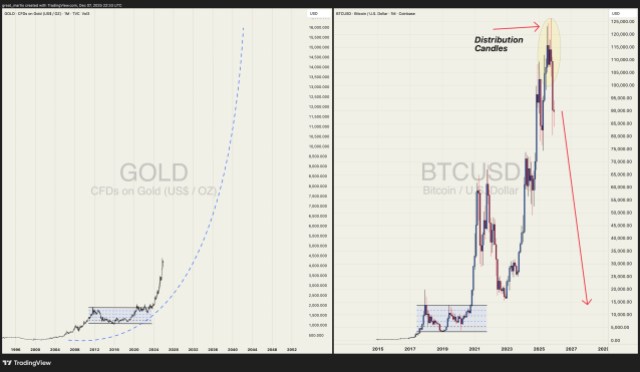
Analyst Predicts Bitcoin Price Crash To $15,000 Using Gold Chart

Following the Bitcoin price crash below $100,000 back in November, different bearish predictions have begun to make the rounds in the crypto community. For some, this crash signifies the end of the bull market, ushering in the dreaded bear market. While some of the predictions have been conservative, putting the pioneer cryptocurrency somewhere around $50,000 at the bottom, one analyst in particular has predicted a deeper crash, and this was done using the gold chart.

Why A Crash Could Be Coming For The Bitcoin Price

Crypto analyst The Great Martis took to X (formerly Twitter) to share their prediction of where the Bitcoin price is headed next. The chart shows a possible decline that could send Bitcoin moving below $20,000, before eventually reaching a bottom at around $15,000. Although this is not out of the ordinary for analysts to predict such crashes, the reason why Mathis believes this is possible is what is interesting.

The crypto analyst points out that the gold performance, which has seen the asset hitting new all-time highs this year, was being driven by speculation. Martis explains that the Fed’s intervention is something that will continue to drive the price of gold higher, and this could, in turn, continue to push down the Bitcoin price.

Furthermore, the analyst expects that the gold price will rise into the $12,000 territory, putting it in the same region that the Bitcoin price was in back in 2021. The interesting thing to note about Bitcoin in 2021 is that this was the year that the digital asset went on one of its most explosive rallies so far.

Bitcoin price gold

If Bitcoin continues to perform inversely to gold, then a rise to 5-digits for gold would mean a bearish market for Bitcoin. A crash to $15,000 would translate to a more than 70% decrease in price from the current level, and an almost 90% decline from its $126,000 all-time high.

So far, this year, gold has been the better performer of the two when compared side-by-side. For context, the gold price is already up over 55% in the year 2025; meanwhile, the Bitcoin price suffered a major 30% drop in price after hitting $126,000 back in October.

While both of these assets continue to lead in their respective sectors, gold continues to remain the standard for what investors consider a “safe” investment compared to Bitcoin, which is known for its wild price fluctuations.

Bitcoin price chart from Tradingview.com

Dogecoin Price Will Rally Before It Crashes, But What’s The Target?

The Dogecoin price is already struggling amid the bearish pressure that has dominated the crypto market recently. After the initial fall to $0.2, DOGE bulls had attempted to hold support, pushing for a rebound. However, with the bearish headwinds of the last quarter of the year, the Dogecoin price has since succumbed and is now trading below the $0.15 support level, and continues to struggle.

Despite the already troubling price performance, crypto analyst Weslad says that the worst might be yet to come. This is due to a corrective structure that has appeared on the meme coin’s price chart, and the result of this has been a bearish flag. As these technical developments unfold, the crypto analyst has warned investors of what to expect, outlining why the Dogecoin price could see a major crash while attempting to recover.

Dogecoin Price To Rise And Then Fall

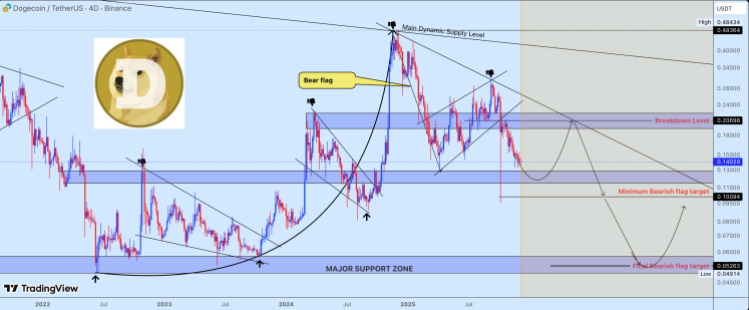
The analysis, which was shared on the TradingView website, points to the bearish flag as a precursor of what is to come. Weslad explains that the bearish flag had triggered the Dogecoin price breakdown that had led to the downward leg. As a result, the sentiment has skewed negative so far, suggesting that there could be more declines to come.

However, the crypto analyst points out that the Dogecoin price is still well below its breakout zone. Given this, it is likely that there could be an initial relief rally for the meme coin. If this rally plays out, then there would be an initial decline below $0.12 to form support above $0.118. Once this support is established, then the resulting bounce is expected to push the Dogecoin price to $0.2.

Dogecoin price

Once this move is completed, though, the analyst predicts an even deeper crash on the horizon. From the $0.2 mark, Weslad’s chart shows that the Dogecoin price could decline another 70%, falling toward $0.05 in the process, which would mean a return to 2-year lows.

“The immediate plan is to monitor a pullback toward the minimum bearish flag targets around the $0.12 region, which aligns with the former structure support and breakout zone,” the crypto analyst said. This bottom area serves as a “supply on the retest” and could trigger the next decline.

For now, the analyst expects that the Dogecoin price will continue on its bearish path. This is dependent on the broader market performance, and so far, a breakdown looks to be more likely.

Dogecoin price chart from Tradingview.com

Betting Big On XRP: Billion-Dollar Asset Manager Confirms What Smart Money Has Been Doing

Institutional investors are quietly reshaping the narrative around XRP, with the latest analysis report from the billion-dollar asset manager WisdomTree confirming what insiders have long suspected. According to the report, XRP is garnering institutional interest and demand on a global scale. While retail traders debate short-term price movements, smart money capital inflows into XRP are surpassing those of almost every other altcoin. 

XRP Dominates Institutional Inflows Across Europe And The Globe

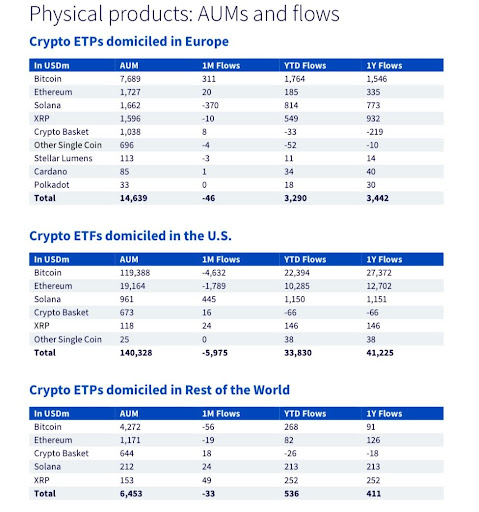
According to an X post by crypto expert Stern Drew, the latest WisdomTree report shows that XRP is the only digital asset attracting consistent institutional demand worldwide. In Europe, XRP has attracted over $549 million in new institutional capital this year, more than three times the inflows into Ethereum. This figure surpasses the total for every altcoin in the market and multi-asset products except Bitcoin. 

In a continent traditionally known for conservative investment strategies, these flows into XRP represent a decisive vote of confidence from European institutional investors. Drew has revealed that the demand for XRP has also extended beyond Europe. Outside the United States, XRP has captured roughly $252 million in fresh institutional capital just this year. 

XRP

By comparison, Bitcoin products absorbed only $268 million in smart money capital. Given that BTC products are more than 25 times the size of XRP products, this suggests that institutions have directed nearly 25 times more new capital into XRP than into Bitcoin. Drew has suggested that this increase in flows indicates careful, deliberate positioning rather than short-term speculative activity, which highlights the market’s growing preference for XRP

US Adoption Signals Broader Shift

In his post, Drew also revealed the growing institutional interest in XRP within the US. This year, a new synthetic XRP product attracted $241 million, surpassing flows into Solana and all other altcoin products in the same category. This surge came at a time when the two largest cryptocurrencies, Bitcoin and Ethereum, collectively saw $6.4 billion exit their ETF structures

Drew revealed that the dramatic outflows from BTC and ETH signaled that institutional investors were diversifying from established assets while selectively accumulating XRP. The WisdomTree report also showed that, excluding Europe and the US, regions such as Asia and other global markets are increasing their exposure to XRP. 

Surprisingly, this surge in global institutional demand is occurring during periods of market stress rather than euphoric rallies. The XRP price is currently down by more than 15% this year and trading at just $2.1. The cryptocurrency has also been experiencing significant choppy action over the past few months, failing to reclaim former highs above $3.

Despite this structural weakness, institutions continue to accumulate XRP in large quantities, indicating a clear bias toward the cryptocurrency. Drew has also revealed that smart money views XRP as a settlement-grade asset, well-suited for integration into the future architecture of regulated digital finance. He highlights that, as global institutional preference increasingly concentrates on XRP, price movements might follow later.

XRP

Bitcoin RSI Shows Shocking Similarities To 2012-2015, But What Happened Last Time?

A crypto analyst has revisited long-term charts from 2012-2015, noting that the current Bitcoin (BTC) cycle shows striking similarities to this timeline, in terms of the Relative Strength Index (RSI) and price action. During the 2017-2015 bull run, BTC experienced one of the strongest multi-year advances before bottoming out. The market expert claims that the same sequence of peaks and pullbacks observed in that timeline is now unfolding again in this cycle. 

Bitcoin RSI Comparison Signals Bottoming Structure

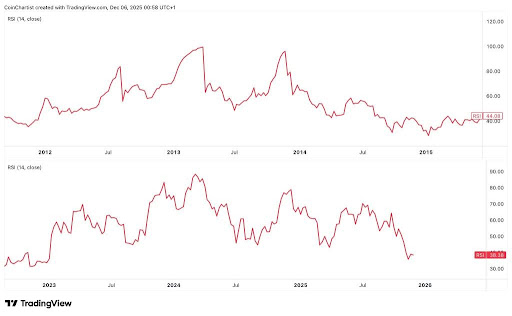
Bitcoin’s latest momentum study by crypto analyst Tony Severino has drawn significant attention from market watchers. In his X post on December 6, Severino highlighted surprising similarities between the RSI trend and price movements of the 2023-2026 cycle and those observed from 2012 to 2015. 

His comparison focuses on the timing of several major points that appeared in both cycles. These include the moment a price bottom began to form, the first price peak, a subsequent momentum peak, and finally a Bearish Divergence that typically precedes deeper corrective phases.

Severino shared a chart from the 2012-2015 cycle showing that Bitcoin’s RSI had gradually climbed, with several short bursts of sharper upward momentum along the way. Eventually, momentum faded, and the indicator declined for an extended period before settling in a mid-range zone at the 44 level. 

Bitcoin

In the current cycle, which began in 2023, the RSI also climbed sharply before reaching a notable peak. Since then, the indicator has been gradually declining, currently sitting around 38. This level is similar to the mid-range RSI values observed in the former cycle before Bitcoin advanced again. 

Sharing a second chart, Severino also pointed to Bitcoin’s price action relative to its RSI performance across both cycles. During the earlier cycle, Bitcoin’s price sat around $233.54, while in the recent cycle, it has declined to $89,352. The analyst argues that the alignment between the RSI movements and price action in both timelines strengthens his theory that Bitcoin may be approaching a meaningful bottom soon. 

Severino also suggested that if history repeats in the 2023-2026 cycle, traders could be looking at the early stages of a year-long accumulation phase, similar to what played out a decade ago. Nevertheless, he acknowledged that there is no guarantee that the current cycle will mirror past patterns completely. 

Analyst Flags New BTC Bullish Crossover

Crypto analyst AO has shared a more optimistic outlook for Bitcoin, highlighting the formation of a Bullish Crossover—a key technical signal that has historically preceded significant price surges. According to him, each time the Stochastic RSI on US10Y*CN10Y experiences a Bullish Crossover, Bitcoin enters a significant bull run.

AO presented a chart showcasing four previous Bullish Crossovers, each followed by a massive price increase. The first crossover appeared in 2013 and coincided with an early surge. The second came in 2017, marking the start of a multi-month bull run. The third occurred in late 2020, shortly before BTC’s record-breaking run in 2021. The most recent signal has not emerged in 2025, suggesting the potential for a similar upward move.

Bitcoin

Ripple Secures 4 Groundbreaking Wins That Mark An Exciting Phase For XRP

Ripple and the XRP ecosystem have entered one of their most important weeks to date. A series of regulatory and market-structure breakthroughs has pushed the token deeper into the core of federally supervised financial infrastructure, and this carries implications far beyond short-term sentiment, starting with its advancement into new territory under the Commodity Futures Trading Commission.

A New Regulatory Alignment Surrounds XRP

Bitnomial, a CFTC-regulated derivatives and spot-crypto platform, secured approval to include XRP within its market structure of the first US-regulated spot-crypto market. This allowed the Chicago-based exchange to activate a supervised spot-XRP contract in the United States, as well as accept the token as margin collateral across its derivatives products. 

The move placed XRP in the same operational category as traditional commodities that must meet liquidity and settlement standards before entering federally regulated markets.

Behind these approvals sits a story that many observers initially missed. An market participant who goes by the name SonOfaRichard on the social media platform pointed out the significance of what had unfolded. 

He noted that the Commodity Futures Trading Commission (CTFC), the Securities and Exchange Commission (SEC), and the Depository Trust & Clearing Corporation (DTCC), three agencies with entirely different remits, moved in the same direction in the same week. 

According to him, the altcoin effectively transitioned into a commodity-grade collateral asset within a federally regulated derivatives ecosystem, and he described this not as a narrative but as plumbing. This is the same standard applied to gold, FX, treasuries, and LME metals.

Secondly, the SEC did not object to the CFTC’s move with Bitnomial, and that silence carried far more weight than a formal statement, because it pointed to an unusual moment of alignment between agencies that typically operate with different mandates on XRP. 

Thirdly, Bitnomial itself became the quiet kingmaker in this entire development, not because of its brand presence or daily trading volume, but because its regulatory position places it in integration with clearing flows that plug directly into institutional pipes. A platform like that does not list XRP unless regulators have already determined what it is.

An Exciting Phase For The Token’s Outlook

Lastly, the DTCC moved toward 24×5 settlement windows. According to the commentator, this move was about interoperability with digital collateral, tokenized treasuries, and real-time clearing.

Taken together, these milestones are not surface-level headlines. They represent a change in how XRP is being integrated. The asset is now accepted as a collateral currency, listed under CFTC oversight, and actively trading inside the country’s first regulated spot-crypto framework.

Other examples of the change in XRP integration on a global scale include the Singapore MPI license for Ripple and Vanguard, allowing XRP ETF access, among a few others.

All these recent advancements by Ripple now point to the ecosystem entering a phase that investors have waited years to witness. The question now may no longer be whether institutions will adopt the token, but how quickly they integrate it into the flows of modern digital finance.

XRP

Confirming The Bitcoin Price Direction: Analyst Reveals What You Should Look Out For

After breaking below $90,000 again, the next direction of the Bitcoin price is being hotly debated once again. This comes with the added burden of a number of major events coming around this week, as well as investor sentiment being stuck in the negative territory for an extended period of time. Crypto analyst, MarcPMarkets, shares his thoughts on the current state of the market and what investors should be looking out for as the next direction is determined.

The Bearish And Bullish Scenarios

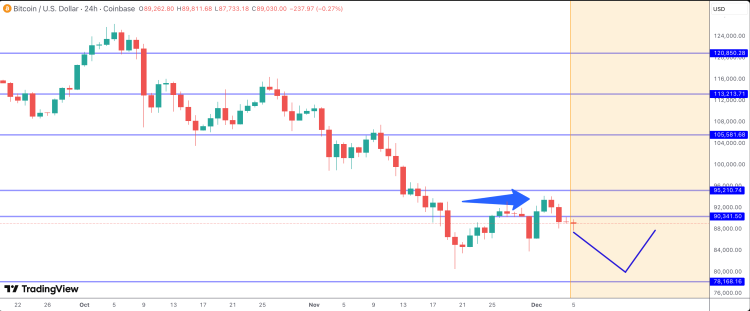
In the analysis shared on the TradingView website, MarcPMarkets highlights the different scenarios that could determine where the Bitcoin price could be headed next. Cautioning investors to watch out for confirmation, the first level that the analyst highlights is the $93,500 area, where the Bitcoin price had failed to reclaim a high.

Since the price fell below $90,000 over the weekend, the next major level now lies at $88,000, and it is where bulls must protect their support. In the event that bulls lose this support and the price breaks decisively below this point, the crypto analyst warns investors to expect the Bitcoin price to crash another $10,000. Next would be the $78,000 area, where the cryptocurrency is likely to secure its next support.

On the flip side, where the Bitcoin price could turn bullish once again, the crypto analyst points to the $95,000 resistance. Investors are to pay attention to this resistance, because if broken, then it would mean that strength is building back up, completely canceling out the bearish scenario highlighted above.

The major targets in the case of a bullish takeover would first be $105,581. Above this lies the next major level of $113,213, and then finally, the $120,850 target that would be the final hit before momentum fizzles out.

Bitcoin price

Developments That Could Affect The Bitcoin Price

Beyond the price action, some events that could affect Bitcoin’s trajectory are expected to unfold this week. The FOMC meeting is drawing closer, with the Fed expected to announce its stance on the financial markets going forward.

If, at the completion of the press conference, the Fed takes on a dovish stance, then the crypto analyst expects that prices will begin to move upward again. Additionally, quantitative tightening ended at the start of December, ushering the markets into an era of quantitative easing, which has always been bullish for risk assets as new liquidity is pumped into the market.

Bitcoin price chart from Tradingview.com

Solana Welcomes Bearish December, But Pundit Shares Possible Move To $170

The last quarter of the year has always been quite bearish for the Solana price, marking the highest losses for the altcoin since it was launched back in 2020. Naturally, this has made Q4 a dreaded time for Solana investors, and the year 2025 has not been any different. The last two months have already closed in the red with double-digit losses, and with only December left to go, the Solana price might be on track to complete yet another bearish quarter.

Looking At The Historical Performance Of Solana In Q4

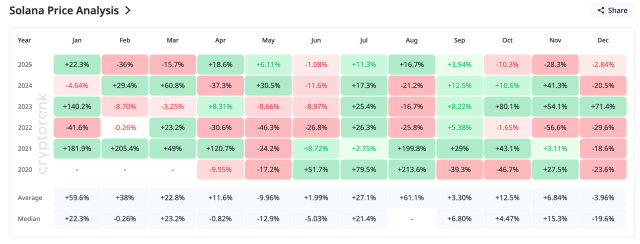
Taking into account data from the CryptoRank website, it shows Solana’s less-than-favorable performance in the last quarter. In the last five years, Q4 has had the highest average losses compared to the other quarters, and the month of December plays a major role in that due to how bearish it is.

December, in particular, boasts the second-highest average losses, second only to May’s -9.96% average. However, when it comes to the median returns, the month of December takes the cake, recording a high average of -19.6% losses over the year.

In the five years of its existence, only one year, in 2023, has the Solana price closed out the month of December in the green with 71.4% gains. The other years have ended with at least 18% losses, and this month is already looking bearish with -0.79% losses so far.

With the months of October and November already closing in the red, it is likely that December will follow. The last time that both October and November closed in the red was back in 2022, and December would follow suit with -29.6% returns for the month.

Solana price

Analyst Says A Bounce Could Come Instead

While historical data suggests that the Solana price could end up struggling this month, one crypto analyst has presented a scenario where the altcoin could bounce back. This move is predicated on Solana’s ability to actually hold the support and break the next resistance.

Interestingly, though, the analyst’s chart shows an initial 15% dump before the Solana price finds support somewhere around $116. After that, the price is expected to rebound, and the target for the cryptocurrency after this would be the $170 level. The weekly candlestick also supports this possible jump, something that would send Solana to the green in September.

For now, the bulls continue to struggle despite last week’s campaign for $150, suggesting that there is a great deal of resistance at this level. If selling continues to build up, then it is likely that Solana will move down as predicted.

Solana price chart from Tradingview.com

Here’s When The Altcoin Season Happens Following The Bitcoin Cycle

Bitcoin’s recent movement has left many traders waiting for signs of an altcoin season, and a post shared by crypto analyst Crypto Nova offers a different way to understand when this will actually begin. 

The explanation, supported by charts from 2017 and 2021, shows that altcoins have historically performed their best while Bitcoin’s price action was already climbing, not after it had reached its peak. The charts she shared show how those earlier cycles unfolded and why the timing of Bitcoin’s surge has been the important factor each time.

Altseasons Form During Bitcoin’s Strongest Surges

This outlook goes against the projection of many crypto analysts, who have been waiting for a downturn in the Bitcoin dominance characterized by outflows from Bitcoin and into the altcoin market.  

However, careful technical analysis shows that the largest and most explosive altcoin seasons did not occur after Bitcoin had completed its run. Instead, they developed while Bitcoin was already pushing to new price highs. 

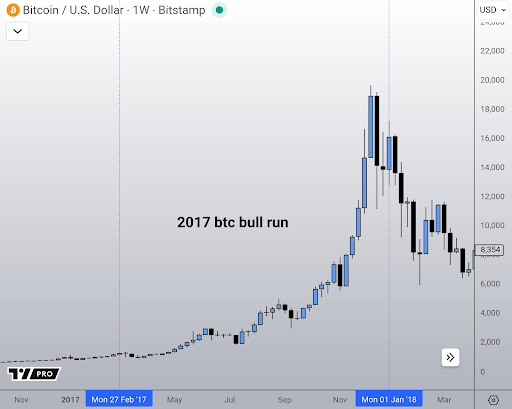
The 2017 cycle illustrated this the most clearly. Bitcoin dominance began to decline during an altcoin season, even as BTC surged from around $1,000 to nearly $20,000. The chart shows a waterfall-like collapse in dominance from 95% in early 2017 to below 40% in early 2018, happening at the exact moment when Bitcoin was rising massively. Altcoins were already outperforming the leading cryptocurrency long before Bitcoin topped just below $20,000.

Bitcoin

A similar pattern played out in 2021. Bitcoin dominance peaked in January of that year and started falling while the Bitcoin price climbed from roughly $30,000 to its mid-cycle high above $60,000. Although altcoins took a little longer to increase compared to 2017, the bulk of their performance still arrived during Bitcoin’s rapid upward trajectory, not after it had stalled or reversed. 

The charts below highlight this synchronicity clearly: dominance moves lower while Bitcoin candles continue to stretch higher.

Bitcoin Needs A Confirmed Bottom And A New Surge

Nova noted that traders are making a mistake by focusing solely on Bitcoin dominance without considering Bitcoin’s broader market structure. It is important to note that dominance does not drop simply because Bitcoin moves sideways or reaches a peak. 

Instead, dominance mostly declines when Bitcoin is in a strong, sustained uptrend, but the altcoin niche is witnessing more inflows compared to the leading cryptocurrency. This means an altcoin season is unlikely to start until Bitcoin prints a confirmed bottom and its rally convinces inflows into altcoins. 

As noted by the analyst, Bitcoin is currently in a downtrend, and without a shift in trend, dominance metrics alone cannot trigger altcoin momentum. This viewpoint challenges the frequent claims circulating online that altseason is here or just about to begin.

As it stands, the crypto industry is still logged into a Bitcoin season, with the CMC altcoin season index sitting at 19 and the CMC Bitcoin dominance at 58.7%.

Altcoin

Dogecoin Payments For Cars: The Quiet Promise That Tesla’s New Code Carries

DOGE community member DogeMemeGirl has drawn the community’s attention to Tesla’s new code, which hints at Dogecoin payments integration. This comes over a year after Elon Musk revealed that Tesla would accept DOGE as a payment option at some point. 

Dogecoin Payments May Be Imminent As Tesla Updates Backend Code

In an X post, DogeMemeGirl revealed that Tesla is upgrading its Dogecoin integration as the new backend code shows a “massive” shift from the old setup. She explained that the old code was basic and dormant, restricted to Tesla’s merchandise only. Meanwhile, the code provides a significant upgrade and hints at DOGE payments for Tesla cars. 

The community member revealed that the new code is woven deep into vehicle checkout for the Tesla Model 3 and the Cybertruck. It also includes hidden “order with Dogecoin” buttons that indicate the Dogecoin payments integration. Lastly, DogeMemeGirl stated that the new code features real-time price conversion and dynamic error handling. 

She also hinted that Dogecoin is likely to be the only crypto that will be accepted by Elon Musk’s Tesla in the meantime. This came as DogeMemeGirl stated that the Bitcoin references have been scrubbed in the new code, while DOGE remains. The community member noted that it is still disabled, but that the infrastructure to buy a Tesla with DOGE is actively being built. 

Tesla’s potential integration of Dogecoin payments could provide a huge boost for the foremost meme coin, expanding its utility and likely leading to more adoption for DOGE. Notably, Musk stated last year that his car company would begin accepting DOGE payments for car purchases at some point. Tesla already accepts the meme coin for some of its merchandise. 

DOGE Integration In X Payments?

This development of the Tesla Dogecoin payments integration comes amid speculations that Elon Musk’s X could also integrate the meme coin into ‘X Payments.’ Musk stated last month that X payments is coming soon, with the possibility that it will still launch this year, as earlier announced by the then-CEO Linda Yaccarino.

DOGE community members, including famous crypto pundit Kevin Capital, have speculated that Musk will integrate DOGE in X payments, which would boost the meme coin’s adoption. Kevin indicated that a potential integration could also significantly impact the DOGE price. 

In the meantime, the meme coin just received another major boost as Argentina’s capital, Buenos Aires, reportedly passed a law allowing its citizens to pay taxes in DOGE. Dogecoin’s official X platform drew attention to this development just as the meme coin celebrated its 12th anniversary, having launched in 2013. 

At the time of writing, the Dogecoin price is trading at around $0.14, up in the last 24 hours, according to data from CoinMarketCap.

Dogecoin

What’s Happening With XRP And Why Did Its Spot ETF Crash 20%?

XRP’s price has continued to chop, trading sideways, which has impacted the price of the U.S. spot ETFs that provide exposure to the altcoin. Canary Capital’s XRP fund has crashed 20% since its launch, although this fund remains the largest by assets under management (AuM). 

XRP’s Sideways Price Action Leads To Spot ETF Crash

The XRP price has continued to trade within a tight range, just above the psychological $2 level, sparking bearish sentiment among investors. The altcoin is down over 10% in the last month, around the time the first spot XRP ETF, Canary’s fund, launched. This bearish price action has notably contributed to a price crash for Canary’s XRPC fund. 

TradingView data shows that Canary’s XRP ETF is down 20% since its launch on November 13. XRPC also dropped almost 10% last week amid choppy price action. Canary’s fund has also likely crashed due to increased competition from three other spot funds that launched after it. This has led to a slowdown in its inflows since these funds launched. 

XRP

Meanwhile, these funds track the spot XRP price, which also explains Canary’s XRPC crash. XRP has mirrored Bitcoin’s price action amid concerns that the crypto market may already be in a bear market. XRP whales also look to be bearish at the moment, as Santiment data shows a drop in whale transactions from a recent high recorded in November. 

However, despite this bearish sentiment, with the crypto market currently in a state of fear, the XRP ETFs have continued to record daily net inflows. SoSo Value data show that these funds have been on a 16-day net inflow streak since Canary’s XRP fund launched on November 13, and they have yet to record a net outflow day. 

Canary’s XRP ETF, which has suffered a 20% price crash, is currently the largest spot XRP fund with $364 million in assets under management. Grayscale’s GXRP is second with $211 million, while Bitwise and Franklin Templeton are third and fourth. As a group, these XRP funds are about to hit $1 billion in assets under management, with $861 million in total net assets. 

Some Positives For The Altcoin

Santiment data show that XRP exchange outflows have outweighed inflows in recent times. This is a positive as it indicates that more investors are accumulating than selling. Exchange outflows typically represent moves for long-term holding, especially in anticipation of higher prices. 

In an X post, Santiment mentioned that the XRP Ledger is seeing a fascinating trend of whale and shark wallets shrinking in number but continuing to grow in coins held. The on-chain analytics platform noted that there are 20.6% fewer 100 million XRP wallets, but that these wallets, as a group, still own a 7-year high 48 billion coins. As such, the existing 100 million XRP wallets are doubling down on their accumulation efforts and making up for the shrinking number of wallets. 

At the time of writing, the altcoin’s price is trading at around $2.07, up in the last 24 hours, according to data from CoinMarketCap.
XRP

Dogecoin’s Dozen Years: King Of Meme Coins Marks 12th Birthday In Rough Markets

Dogecoin has just celebrated its 12th anniversary, a milestone that arrives during a period of shaky price action. The meme coin has spent the majority of recent days trading with a bearish tone, but its anniversary places into perspective how much the crypto environment has changed since the token’s joke-related launch in 2013. 

The celebration comes as analysts continue to debate whether Dogecoin’s long accumulation structure is nearing a turning point, and its next breakout might define its 13th year.

A Milestone That Shows How Far Dogecoin Has Come

Dogecoin began as a lighthearted project by developer Billy Markus and Adobe sales employee Jackson Palmer in order to poke fun at the rising popularity of Bitcoin at the time. Over the years, what started as a joke has grown into one of the world’s most recognized cryptocurrencies. 

Happy birthday to Dogecoin.

12 years and going. pic.twitter.com/n9Qg6KtfQU

— dogegod (@_dogegod_) December 6, 2025

At its peak on May 8, 2021, DOGE reached an all-time high of $0.73 with a market capitalization nearing $88.7 billion. Today, despite the recent price action, Dogecoin is still among the top 10 cryptocurrencies, with a market value around $22.5 billion and trading near $0.14.

The 12th birthday of Dogecoin came at a time when broader market sentiment is weak and investors remain cautious. On its anniversary, Dogecoin dropped by 3.1%, steeper than the general market dip, due to ongoing pressure on meme coins.

Amidst this, some milestones still stand out. The introduction of a Spot Dogecoin ETF shows this transformation more vividly than anything else, because it shows major financial players now view the meme coin as an asset worthy of structured, regulated investment exposure. 

Although early participation has been modest, the token’s entry into ETF territory is much more symbolic, as it represents a profound departure from the ecosystem that shaped its early years, and this could lead the cryptocurrency to new all-time highs in the coming months. 

What The 12th Year Means For Dogecoin’s Future

Reaching 12 years isn’t just a symbolic milestone. It illustrates Dogecoin’s longevity in a crypto environment where many cryptocurrencies fade quickly. The fact that Dogecoin still holds a top-tier market position suggests resilience. That resilience is now being echoed on-chain, as some of the largest Dogecoin wallets have begun adding to their balances again after activity recently fell to a multi-month low.

There are rumors that the updated internal code of Tesla’s website contains deeper Dogecoin payment mechanisms for electric cars like the Model 3 and Cybertruck, which is possibly related to the announced XMoney payment system on the X platform. 

This naturally circles back to the influence of Elon Musk, whose support has shaped Dogecoin’s public profile for years. The billionaire has consistently kept Dogecoin in the mainstream conversation through social media posts, product references, and earlier acknowledgments of Dogecoin-related payments for Tesla merchandise.

As for Dogecoin’s price outlook, many analysts are staying bullish. Predictions and price targets for the meme coin range from $0.75, to $1.30, with some pointing to ranges as high as $10.  

Featured image from Pexels, chart from TradingView

Altcoins Struggle, But Technical Analysis Says A Major Opportunity Is Forming

The latest market conditions have pushed hopes of an altcoin season even further out of reach. Bitcoin continues to dominate the market with a 59.6% share, and its recent struggle to hold bullish momentum has not translated into any meaningful boost for altcoins. 

Broader sentiment has weakened as well, with the CMC Altcoin Season Index registering just 20, which still places the entire market in a Bitcoin-favored phase. Meanwhile, a critical indication has been detected from on-chain data that suggests this may be a rare moment to accumulate strong altcoin positions before conditions eventually turn.

Altcoins Stay Subdued As Market Sentiment Worsens

Altcoin performance has really been lagging behind Bitcoin throughout this year, and the persistent weakness is now being reflected across multiple market indicators. Bitcoin’s dominance has only increased, meaning the capital rotation that typically sparks an altcoin season has yet to begin. 

The wait for an altcoin breakout has now stretched far longer than many anticipated. Even as the Bitcoin price is struggling, traders have not redirected liquidity toward altcoins. The leading cryptocurrency is now down by 28.9% from its October all-time high of $126,080. Instead, altcoins have also stayed muted, and their combined market cap shows no signs of outperforming the leading cryptocurrency. 

Data from CoinMarketCap’s Altcoin Season Index shows the reading is currently at 20. The low reading shows that altcoins are still losing ground relative to Bitcoin. To put this into context, the index was at a reading of 83 this time last year. 

The sentiment is also evident in CoinMarketCap’s Fear and Greed Index, which is now at 22. Readings this low signal hesitation across the market, as investors shy away from taking new positions, and this environment makes an altcoin season much harder to materialize.

CryptoQuant Data Signals A High-Value Accumulation Window

Technical analysis using data from on-chain analytics platform CryptoQuant shows that altcoin traders may be entering another window that has frequently been favorable for accumulation. The data compares the 30-day trading volume of altcoins against their yearly average and finds that current volumes have slipped back below that long-term line. 

Each time this pattern has appeared in past cycles, it marked a period when activity was unusually quiet and traders were hesitant, but it also tended to show up just before the market picked up again.

According to the analysis, this drop in volume can be called a “buying zone,” which is a phase where dollar-cost averaging into selective altcoins has often paid off over time. These low-volume stretches can last for weeks or even months, giving investors enough room to build their positions gradually.

The message from the data is that this calmer part of the cycle may offer one of the better chances to position ahead of the next broader market move.

Featured image from Pexels, chart from TradingView

Ripple CTO Joins Debate On Bitcoin Versus Gold, Says Crypto Cannot Be Replicated

The long-running question about whether another cryptocurrency can truly match what Bitcoin represents has resurfaced, and Ripple’s Chief Technology Officer David Schwartz has stepped forward to offer his opinion. 

His comments were based on an argument claiming that Bitcoin’s properties could be copied by simply recreating its code. This, in turn, was based on comments regarding a debate between Binance founder Changpeng Zhao and Bitcoin critic Peter Schiff.

Inside The Zhao-Schiff Debate On Bitcoin’s Value

During their discussion at the Binance Blockchain Week, Schiff stated that a token backed by gold is grounded in physical utility because the token merely represents ownership of a scarce commodity used by industries across the world. He contrasted this with Bitcoin, which he claimed derives its value from faith and has no practical use. 

Zhao countered by pointing out that even physical gold is difficult to divide or verify without additional processes, noting that he once received a gold bar as a gift but could not break it or confirm its purity without specialized tools. He contrasted this directly with Bitcoin, which can be transferred and verified instantly through the blockchain.

Again, Schiff responded by insisting that Bitcoin remains worthless to him because you can’t do anything with it, while gold carries intrinsic industrial demand. Zhao pushed back by highlighting that Bitcoin’s utility is tied to its transparent network, fixed supply, and verifiable ownership. He argued that unlike gold, whose total global reserves are uncertain, Bitcoin offers perfect clarity about supply and movement. 

The debate eventually escalated into a broader argument over value, with Schiff insisting Bitcoin has only speculative worth, while Zhao maintained that its network and transparency serve as the foundation for its trillion-dollar market capitalization.

“We’ll agree to disagree,” Zhao said.

Comment Raises Question: Can Bitcoin Be Replicated?

Following the debate, a viewer commented that Bitcoin’s uniqueness is overstated because someone could simply replicate it. The comment noted, “How long would it take to replicate Bitcoin? Create a new one, exactly the same. How much would it cost?”

It was this claim, rooted in Schiff’s argument that Bitcoin lacks intrinsic qualities, that led to David Schwartz entering the conversation.

Schwartz responded with a rhetorical question that cuts through the idea entirely. He asked how the new Bitcoin could be new and exactly the same as the original one. He continued, “And how would the existence of replicas of Bitcoin affect Bitcoin?” 

His point echoed Zhao’s argument about verifiability. A replica may copy Bitcoin’s code, but it cannot copy the network of users, miners, institutions, and real-time validation that give Bitcoin its identity. 

The existence of another chain does not dilute Bitcoin’s legitimacy any more than counterfeit gold reduces the value of real gold when proper verification exists. It also goes back to the comment by Changpeng Zhao that Bitcoin can be easily verified in multiple ways, unlike gold.

Featured image from Unsplash, chart from TradingView

Forget Bitcoin, The Uber-Wealthy Are Now Rapidly Buying XRP: CEO

Jake Claver, CEO of Digital Ascension Group, says ultra-wealthy families are rapidly accumulating XRP, and he believes most XRP holders still don’t realize how rare their position is. In a video posted on X, Claver revealed that his firm has been in recent conversations with large family offices that are now making significant allocations into XRP. 

His comments arrive at a moment when XRP’s long-term narrative is witnessing increased interest due to ETFs, and they highlight a shift happening among investors who have always avoided cryptocurrencies altogether.

Wealthy Families Quietly Accumulating XRP

Claver explained that XRP ownership is currently extremely limited relative to the global population, noting that only around 8 million wallets exist on the XRPL. Half of those wallets contain fewer than 100 XRP, which makes existing holders far more uncommon than they may think. He contrasted this with Bitcoin’s widespread ownership, arguing that XRP is still early in its adoption curve.

He said the wealthy families showing interest are not looking for quick profits. According to him, they have already built their fortunes and instead see XRP as a form of insurance. According to his post, these families are buying crypto, not to get richer, but to protect the wealth they already have. 

He described their interest in cryptocurrencies as a hedge. These investors want something uncorrelated in their portfolios ahead of any potential shock in traditional markets.

Claver’s $10K Price Target And The Conditions He Outlined

When asked where he sees the price of XRP going, Claver stated that he believes the cryptocurrency could be trading at $10,000 by late 2026 or early 2027. He tied this prediction to how much ecosystem infrastructure becomes active on the XRPL over the next two years. 

He said the network would need substantial institutional-grade utilities, including XRP treasury systems, Evernorth’s launch, on-chain borrowing mechanisms, and new amendments to the XRP Ledger that will bring in additional compliance layers and smart-contract features.

His projection assumes that rising network volume will require higher liquidity levels and that price stability at four- and five-figure ranges will only be achievable if the ledger is handling large-scale financial flows. He also pointed to ETFs as a major factor in shaping supply and demand, noting that as ETF adoption grows, more XRP will be locked away in long-term institutional products. 

Speaking of ETFs, Spot XRP ETFs are now approaching $1 billion in total net assets and could cross that threshold within the next few days. Since their debut, these funds have taken in about $897.35 million worth of XRP from exchanges and OTC desks, and they have yet to record a single day of outflows

This growing demand ties directly into a quiet change happening among institutions, a trend Ripple’s CEO Brad Garlinghouse recently highlighted. He explained that Ripple is seeing notable activity through Ripple Prime, where long-watching institutions that once stayed out due to regulatory uncertainty or simple risk aversion are finally beginning to step in. 

Featured image from Unsplash, chart from TradingView

Brace For A Bitcoin Price Crash: How Low Does The Next Major Support Level Lie?

A crypto analyst has predicted another devastating Bitcoin price crash that could see the leading cryptocurrency slide back below $85,000. With its weak performance over the past few months and price action showing signs of exhaustion, the analyst has predicted that the next major support level lies more than 33% below all-time highs. 

Analyst Breaks Down Chart Signaling Bitcoin Price Crash 

TradingView crypto expert ‘EliteGoldAnalysis’ has released a fresh chart study on Bitcoin’s next selling move, warning that the cryptocurrency’s downtrend may not be over yet. The analyst’s breakdown highlights a key support level he believes Bitcoin could crash to if its current downward momentum persists. 

EliteGoldAnalysis outlines a price structure on the chart that begins with a weak high, a technical condition that often reflects a liquidity grab before a reversal. The appearance of a weak high near the top of Bitcoin’s most recent rally indicates that buyers may have been swept out before the momentum fully shifted. This pattern is accompanied by a steadily forming lower high, hinting at a developing bearish structure

From his perspective, the analyst explains that a short bias becomes relevant only after a clear confirmation of a bearish trend. Based on the Bitcoin price chart, such confirmation could include a break of minor support beneath the weak high, followed by a retest of that level. EliteGoldAnalysis also noted that a bearish rejection through wick actions or a strong bearish close would strengthen the case for a temporary Bitcoin price crash

While the analyst’s breakdown is just an interpretation of the chart rather than a trading call, Bitcoin’s price structure still hints at a possible retracement amid strengthening sell-side pressure

How Low Bitcoin Price Could Decline 

In his TradingView chart, EliteGoldAnalysis outlined critical zones that could dictate Bitcoin’s next bearish moves. The first region to watch is the potential “target level” marked in the purple zone above $85,000. The analyst views this level as a demand or imbalance area. Should Bitcoin reach and hold this target, it may act as the first checkpoint before the market decides whether to correct downwards or push higher. 

Just beneath the $85,000 region lies a “strong support level” highlighted in blue at $84,000 on the chart. EliteGoldAnalysis predicts that Bitcoin could decline to as low as this $84,000 support area. The analyst suggests that this level is the final retracement target, potentially representing a significant liquidity pool that could attract buyers if the price declines. 

A decisive drop toward this level would reflect a more than 6% decline from current levels above $89,000. Such a move would also mark the completion of the downside move implied by the chart structure. Over the past 24 hours, the price of Bitcoin has fallen roughly 3%, meaning a crash to $84,000 would further prolong the ongoing downtrend.  

Featured image from Unsplash, chart from TradingView

Analyst Says Dogecoin Price Is Ready To Fly, Here’s Why

Dogecoin has been bleeding lower in recent days, grinding back toward the mid-$0.13 band. Sellers have been in control of most candles in the past 24 hours, and each attempt at a rebound has faded quickly, leaving Dogecoin stuck near the bottom of a range.

One crypto analyst on X has focused attention on an important technical level on the 2-day chart. Even though price action looks weak, Dogecoin is now sitting right on a long-term support zone inside a descending triangle pattern, and this area could become the launchpad for a strong upside move if buyers react from here. The chart shared with the analysis highlights exactly where Dogecoin is resting and why this region matters.

Dogecoin Sitting On Major Descending Triangle

Technical analysis of Dogecoin’s price action on the 2-day candlestick timeframe chart shows the meme coin has been trading in a clear descending triangle since December 2024. A downward-sloping trendline has capped every rally this year, leading to the creation of a series of lower highs that reflect persistent selling pressure throughout the year. At the same time, a horizontal support zone underneath in the mid-$0.135 to $0.14 region has caught multiple drops and prevented a deeper breakdown.

Right now, Dogecoin is pressing that lower border again. The candles on the 2-day chart cluster just above the dashed support band, and the analyst, who goes by Butterfly on X, circled this cluster in green to show how closely the price is hugging the level. 

Dogecoin

Each prior visit to this zone has produced at least a temporary bounce, which is why the current test is notable. The price action is tightening, and there is less room left for sideways movement before a decisive break happens.

Dogecoin Is “Ready To Fly”

In the post on X, the analyst notes that this support has been “respected multiple times” and that bulls are “getting ready to step in.” The most important thing is for the lower support to hold again, and the descending triangle may flip from a slow grind lower into a springboard for a strong reaction.

A firm defense of this zone would mean that sellers are running out of momentum at these prices. From there, even a modest wave of buying could drive Dogecoin back toward the descending resistance line that cuts across the chart from the $0.25 to $0.26 area. A break and close above that trendline would mark the first clean higher high in months and would confirm that the triangle has resolved to the upside.

The analyst’s green arrow on the chart sketches out this potential path. The path shows Dogecoin lifting from the current support band, breaking above resistance, and reaching as high as $0.4 in one swift move.

Dogecoin

Ripple Announces Groundbreaking “One-Stop Shop” For Everything, Here’s What It Is

Crypto firm Ripple recently announced its mission to be the one-stop shop for crypto infrastructure. This came as the firm highlighted the acquisitions it made this year in a bid to achieve this mission. 

Ripple Unveils One-Stop Shop For Digital Asset Infrastructure 

In a blog post, Ripple touted itself as the one-stop for crypto infrastructure. The firm noted that it had invested almost $4 billion into the crypto ecosystem through strategic investments and acquisitions. It added that 2025 marked its most ambitious year yet with four major acquisitions pointing toward one mission of being the one-stop infrastructure provider for moving value the way information moves today. 

Ripple stated that some acquisitions will plug directly into Ripple payments to give its customers a unified, seamless operating environment with even more capabilities and currencies. Meanwhile, others will operate independently while benefiting from shared infrastructure. The firm noted that together, these companies will bring it closer to owning the full financial plumbing behind global value movement. 

Furthermore, the company noted that businesses are operating in real time, but their financial infrastructure still isn’t. The firm believes that its unified offering gives companies the ability to bring their money management and movement up to the expectations of the digital world. It then went on to highlight how its newest acquisitions are critical to powering this change. 

Highlighting The Role Of Its Latest Acquisitions 

The firm stated that its now-closed acquisition of GTreasury marks a significant expansion into the multi-trillion-dollar corporate finance arena, a market that it noted many predict will lead the next phase of crypto adoption. The firm further remarked that through access to the global repo market via Ripple Prime and Ripple Payments’ real-time cross-border rails, corporate treasury teams can unlock idle capital, move money instantly, and open up new growth opportunities. 

Ripple then highlighted its $200 million acquisition of Rail, which it stated will make the firm’s Payments the market’s most comprehensive end-to-end stablecoin payments solution. The firm said that it is compliantly connecting the best of fiat and crypto assets so that businesses can move money faster, save costs, and build to grow. 

Ripple stated that its acquisition of Palisade broadens the range of customer use cases for custody, which is one of its central product strategies. It noted that Palisade’s “wallet-as-a-service” technology extends the company’s Custody’s inherent appeal to banks and financial institutions that carry out high-frequency transactions. 

Lastly, the payment firm highlighted its acquisition of Hidden Road, which is now Ripple Prime. It stated that this completes the liquidity and execution layer of its one-stop shop vision. The Prime offers institutional-grade prime brokerage, clearing, and financing. This enables clients to execute OTC spot trades for major crypto assets, including XRP and RLUSD. While Palisade custodies assets and Rail moves them, Ripple noted that its brokerage business ensures that they can be traded efficiently, financed responsibly, and accessed through regulated channels.

Ripple

❌