 Login
LoginSam Altman Wants His Own Rocket Company

The OpenAI CEO explored a deal with Stoke Space that would have put him in control of the rocket startup.


The shoe is most certainly on the other foot. On Monday, OpenAI CEO Sam Altman reportedly declared a “code red” at the company to improve ChatGPT, delaying advertising plans and other products in the process, The Information reported based on a leaked internal memo. The move follows Google’s release of its Gemini 3 model last month, which has outperformed ChatGPT on some industry benchmark tests and sparked high-profile praise on social media.
In the memo, Altman wrote, “We are at a critical time for ChatGPT.” The company will push back work on advertising integration, AI agents for health and shopping, and a personal assistant feature called Pulse. Altman encouraged temporary team transfers and established daily calls for employees responsible for enhancing the chatbot.
The directive creates an odd symmetry with events from December 2022, when Google management declared its own “code red” internal emergency after ChatGPT launched and rapidly gained in popularity. At the time, Google CEO Sundar Pichai reassigned teams across the company to develop AI prototypes and products to compete with OpenAI’s chatbot. Now, three years later, the AI industry is in a very different place.


© Anadolu via Getty Images


OpenAI’s Foxconn deal ties US data center hardware into its $500B Stargate buildout and $1.4T spend, raising fresh questions about risk and an AI bubble.
The post Inside OpenAI’s $1.4 Trillion Bet: Foxconn Factories and the Stargate Data Center Race appeared first on TechRepublic.
OpenAI’s Foxconn deal ties US data center hardware into its $500B Stargate buildout and $1.4T spend, raising fresh questions about risk and an AI bubble.
The post Inside OpenAI’s $1.4 Trillion Bet: Foxconn Factories and the Stargate Data Center Race appeared first on TechRepublic.
On Tuesday, Microsoft and Nvidia announced plans to invest in Anthropic under a new partnership that includes a $30 billion commitment by the Claude maker to use Microsoft’s cloud services. Nvidia will commit up to $10 billion to Anthropic and Microsoft up to $5 billion, with both companies investing in Anthropic’s next funding round.
The deal brings together two companies that have backed OpenAI and connects them more closely to one of the ChatGPT maker’s main competitors. Microsoft CEO Satya Nadella said in a video that OpenAI “remains a critical partner,” while adding that the companies will increasingly be customers of each other.
“We will use Anthropic models, they will use our infrastructure, and we’ll go to market together,” Nadella said.
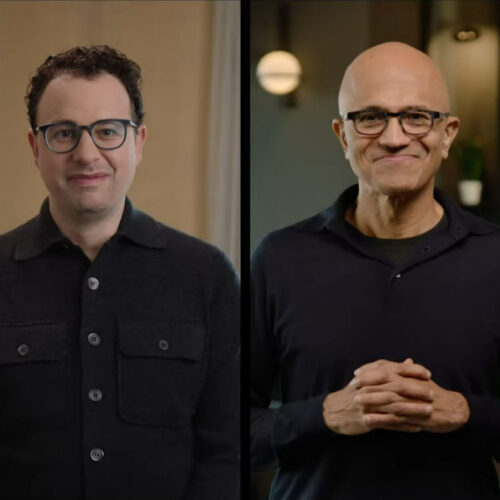
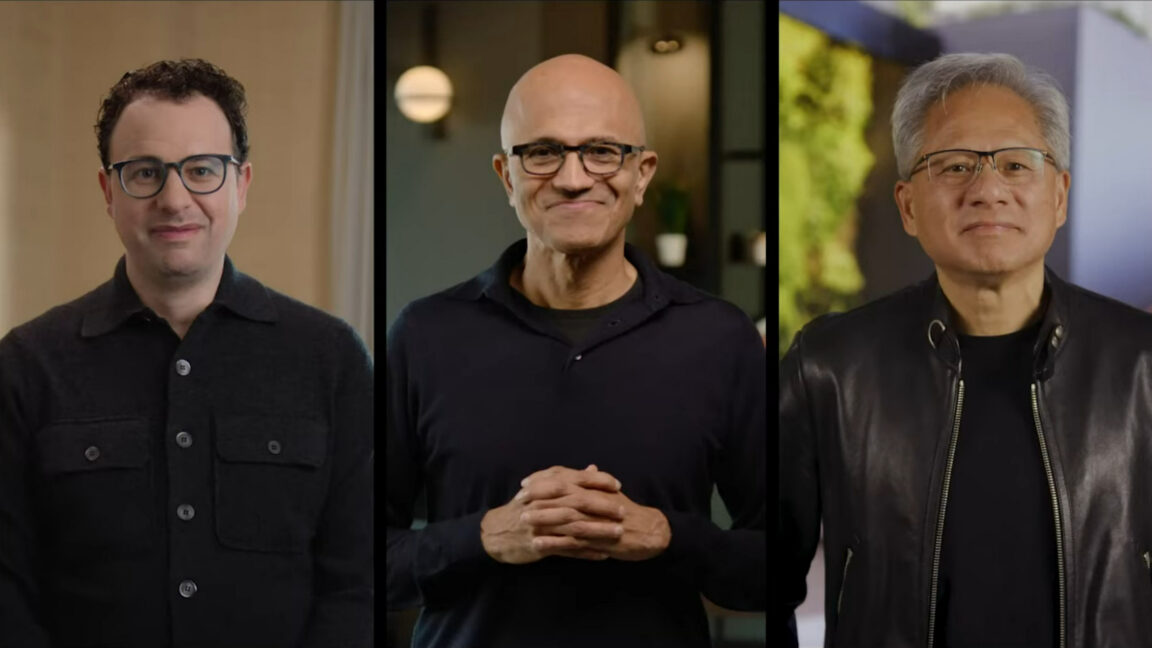
© https://www.youtube.com/watch?v=bl7vHnOgEg0&t=4s
Em dashes have become what many believe to be a telltale sign of AI-generated text over the past few years. The punctuation mark appears frequently in outputs from ChatGPT and other AI chatbots, sometimes to the point where readers believe they can identify AI writing by its overuse alone—although people can overuse it, too.
On Thursday evening, OpenAI CEO Sam Altman posted on X that ChatGPT has started following custom instructions to avoid using em dashes. “Small-but-happy win: If you tell ChatGPT not to use em-dashes in your custom instructions, it finally does what it’s supposed to do!” he wrote.
The post, which came two days after the release of OpenAI’s new GPT-5.1 AI model, received mixed reactions from users who have struggled for years with getting the chatbot to follow specific formatting preferences. And this “small win” raises a very big question: If the world’s most valuable AI company has struggled with controlling something as simple as punctuation use after years of trying, perhaps what people call artificial general intelligence (AGI) is farther off than some in the industry claim.


© Yurii Karvatskyi via Getty Images

Microsoft has formed a new Superintelligence team within its AI division, aiming to develop what it calls “humanist superintelligence” — advanced AI that remains under human control.
The team, announced Thursday morning in a post by Mustafa Suleyman, CEO of Microsoft AI, reflects the company’s ambitions to shape the next era of artificial intelligence while addressing concerns about safety and control in the development of advanced AI systems.
“We are doing this to solve real concrete problems and do it in such a way that it remains grounded and controllable,” Suleyman wrote. “We are not building an ill-defined and ethereal superintelligence; we are building a practical technology explicitly designed only to serve humanity.”
The approach contrasts with the broader pursuit of artificial general intelligence, or AGI — the goal of creating AI systems that can match or surpass human capabilities across virtually any task — which is core to the mission of Microsoft’s longtime partner, OpenAI, and its CEO Sam Altman.
In his message, Suleyman cited early directions in areas such as healthcare, where Microsoft researchers are developing expert-level diagnostic models, and clean energy, where AI could accelerate breakthroughs in materials, batteries, and fusion research.
The goal, he wrote, is to advance technology “within limits” — keeping humanity in control while harnessing AI’s potential to improve lives on a global scale
Suleyman will lead the new MAI Superintelligence Team, joined by Microsoft AI Chief Scientist Karén Simonyan and other core Microsoft AI leaders and researchers. Key leaders who’ve been involved in Microsoft’s model development work are also expected to be part of the effort.
The company hasn’t disclosed how large the group is expected to become.

ChatGPT maker OpenAI, exercising newfound freedom under its renegotiated Microsoft partnership, will expand its cloud footprint for training and running AI models to Amazon’s infrastructure under a new seven-year, $38 billion agreement.
The deal, announced Monday, positions Amazon as a major infrastructure provider for Microsoft’s flagship AI partner, highlighting seemingly insatiable demand for computing power and increasingly complex alliances among big companies seeking to capitalize on AI.
It comes as Microsoft, Amazon, and big tech companies attempt to reassure investors who’ve grown concerned about a possible bubble in AI spending and infrastructure investment.
Under its new Amazon deal, OpenAI is slated to begin running AI workloads on Amazon Web Services’ new EC2 UltraServers, which use hundreds of thousands of Nvidia GPUs. Amazon says the infrastructure will help to run ChatGPT and train future OpenAI models.
Amazon shares rose nearly 5% in early trading after the announcement.
“Scaling frontier AI requires massive, reliable compute,” said OpenAI CEO Sam Altman in the press release announcing the deal. “Our partnership with AWS strengthens the broad compute ecosystem that will power this next era and bring advanced AI to everyone.”
Matt Garman, the AWS CEO, said in the release that Amazon’s cloud infrastructure will serve as “a backbone” for OpenAI’s ambitions.
In an interview with CNBC, Dave Brown, Amazon’s vice president of compute and machine learning services, said the new agreement represents “completely separate capacity” that AWS is building out for OpenAI. “Some of that capacity is already available, and OpenAI is making use of that,” Brown told CNBC.
Amazon has also been deepening its investment in AI infrastructure for Anthropic, the rival startup behind the Claude chatbot. Amazon has invested and committed a total of $8 billion in Anthropic and recently opened Project Rainier, an $11 billion data center complex for Anthropic’s workloads, running on hundreds of thousands of its custom Trainium 2 chips.
Microsoft has been expanding its own relationship with Anthropic, adding the startup’s Claude models to Microsoft 365 Copilot, GitHub Copilot, and its Azure AI Foundry platform
Up to this point, OpenAI has relied almost exclusively on Microsoft Azure for the computing infrastructure behind its large language models. The new deal announced by Microsoft and OpenAI last week revised that relationship, giving OpenAI more flexibility to use other cloud providers — removing Microsoft’s right of first refusal on new OpenAI workloads.
At the same time, OpenAI committed to purchase an additional $250 billion in Microsoft services. Microsoft still holds specific IP rights to OpenAI’s models and products through 2032, including the exclusive ability among major cloud platforms to offer OpenAI’s technology through its Azure OpenAI Service.
OpenAI’s new $38 billion deal with Amazon builds on a relationship that began earlier this year, when Amazon added OpenAI’s first open-weight models in five years to its Bedrock and SageMaker services. Released under an open-source license, those models weren’t bound by OpenAI’s exclusive API agreement with Microsoft, letting Amazon offer them on its platforms.
The latest announcement is part of a series of deals by OpenAI in recent months with companies including Oracle and Google — committing hundreds of billions of dollars overall for AI computing capacity, and raising questions about the long-term economics of the AI boom.
