A mockup of a fuel bundle for TerraPower’s Natrium reactor. (TerraPower Photo)
Nuclear power company TerraPower has passed the Nuclear Regulatory Commission staff’s final safety evaluation for a permit to build a reactor in Wyoming. The Washington-based company backed by Bill Gates and NVIDIA could be the first to deploy a utility-scale, next-generation reactor in America.
TerraPower’s Natrium design pairs a small modular reactor (SMR) with an integrated thermal battery. The SMR generates 345 megawatts of continuous electrical power. The thermal battery, which stores excess heat in molten salt, allows the system to surge its output to 500 megawatts for more than five hours, generating enough energy to power 400,000 homes at maximum capacity.
“Today is a momentous occasion for TerraPower, our project partners and the Natrium design,” said company CEO Chris Levesque in a statement issued Monday. The favorable assessment “reflects years of rigorous evaluation, thoughtful collaboration with the NRC, and an unwavering commitment to both safety and innovation.”
The company launched in 2006 and is building on technology used in an experimental breeder reactor in Idaho that operated for nearly 30 years before shutting down.
TerraPower set a goal of producing power at the Kemmerer, Wyo., site by 2030. The reactor is located near a retiring coal plant.
There is tremendous renewed interest in nuclear as tech giants and data center operators scramble for new energy sources to power AI operations. Microsoft, Amazon and others have invested in a combination of existing nuclear plants that can be restarted and construction of new facilities. The Trump administration has pledged to expedite permitting.
“We’ve finished our technical work on the Kemmerer review a month ahead of our already accelerated schedule, as we aim to make licensing decisions for new, advanced reactors in no more than 18 months,” said Jeremy Groom, acting director of the NRC’s Office of Nuclear Reactor Regulation.
“We thank TerraPower for promptly addressing the agency’s questions to ensure safety and enable the NRC to efficiently process the application,” he added in a statement.
The NRC said there are no safety aspects that would preclude issuing a construction permit for the reactor. TerraPower last year broke ground in Wyoming on non-nuclear components of the facility.
In June the company announced $650 million in new funding from Gates, who helped start TerraPower, as well as the venture arm of chip giant NVIDIA. It previously raised more than $1 billion, including investments from Gates as well as South Korea-based SK Inc. and SK Innovation, according to PitchBook. TerraPower has additionally been awarded roughly $2 billion from the U.S. Department of Energy.
There are still additional permitting hurdles to complete:
In the coming weeks, the NRC staff will provide a safety evaluation and final environmental impact statement to the Commission for the final phase of the licensing.
The Commission then determines whether the staff’s review supports the findings required to issue the permit, and votes on whether to direct the staff to issue the permit.
If the NRC issues the permit, TerraPower will need to submit an operating license application for approval.
Following the longest shutdown in U.S. history, the federal workforce is now trying to get back to at least some sense of normalcy.
While federal employees who have been furloughed for the last 43 days return to work Thursday, the Office of Personnel Management is setting expectations for agencies as they begin to update pay, leave and benefits for those impacted by the lapse in appropriations.
In new guidance, OPM said it is “is committed to ensuring that retroactive pay is provided as soon as possible.” Compensation will be provided for both furloughed and excepted federal employees, as the spending agreement that was enacted Wednesday evening reaffirmed. A 2019 law previously called for retroactive compensation for all federal employees impacted by a shutdown.
A senior Trump administration official said the White House “has urged agencies to get employee paychecks out expeditiously and accurately to not leave anyone waiting longer than necessary.”
But the timing of employees receiving their back pay varies, depending on what payroll provider an agency uses, and the different pay schedules across the federal workforce.
Sending out retroactive payments to employees involves working across agency HR offices, federal payroll providers and shared service centers. Agency HR offices, for instance, have to submit timecards for federal employees, which are then processed by the government’s various payroll providers.
According to the senior administration official, employees from the General Services Administration and OPM will be among the first to receive their retroactive paychecks, with an expected deposit date set for Saturday.
Employees at the departments of Veterans Affairs, Energy, and Health and Human Services, as well as civilian employees from the Defense Department, will receive their deposits shortly after that — this Sunday.
On Monday, affected employees from the departments of Education, State, Interior and Transportation, as well as the Environmental Protection Agency, National Science Foundation, Nuclear Regulatory Commission, Social Security Administration and NASA, are all expected to receive their back pay.
Then on Wednesday, employees from the departments of Agriculture, Commerce, Treasury, Labor and Justice, along with the Department of Homeland Security, the Department of Housing and Urban Development and the Small Business Administration, are projected to get their paychecks. The timing of the retroactive payments for feds was first reported by Semafor.
The National Finance Center, a payroll provider housed under the Agriculture Department, confirmed that employees at agencies using NFC’s services should expect a payroll deposit by the middle of next week.
“In order to provide backpay for employees as quickly as possible, the National Finance Center will be expediting pay processing for pay period 22 and backpay for pay periods 19 (October 1-4), 20 (October 5-18), and 21 (October 19-November 1),” USDA wrote in an all-staff email Wednesday evening, obtained by Federal News Network.
Federal News Network has reached out to several other federal payroll providers requesting details on the timeline for processing retroactive payments.
The National Treasury Employees Union urged immediate back pay for all federal employees who have been going without compensation for the last six weeks.
“This is an emergency for federal employees across the country, and they should not have to wait another minute longer for the paychecks they lost during the longest government shutdown in history,” NTEU National President Doreen Greenwald said. “We call on all federal agencies to process the back pay immediately.”
In its new guidance, OPM also noted that to make payments as quickly as possible, payroll providers may need to “make some adjustments.” That could mean, for instance, that the initial retroactive payments employees receive might not reflect the exact calculations of their pay and leave hours.
“Payroll providers will work with agencies to make any necessary adjustments as soon as practicable,” OPM said.
Who receives back pay, and how much?
Furloughed employees will receive their “standard rate of pay” for the hours they would have worked if the government shutdown hadn’t occurred, OPM said in its guidance Wednesday evening.
But there are some exceptions to that. If a furloughed employee, for example, had been scheduled for overtime hours that would have occurred during the shutdown, OPM said they should be paid their premium rate for those hours.
Additionally, OPM said that allowances, differentials and other types of payments, like administratively uncontrollable overtime pay or law enforcement availability pay, should be paid as if the furloughed employee continued to work.
Although most employees impacted by the shutdown are ensured back pay, there are some smaller exceptions carved out where employees may not receive retroactive pay, OPM added.
If a furloughed employee was in a non-pay status before the shutdown began, for instance, then they are not entitled to receive back pay.
Excepted employees who were considered “absent without leave” (AWOL) — or in other words, took unapproved time off — will also not receive back pay for that time.
Guidance on leave, post-shutdown
Although excepted employees are not required to use paid leave for taking time off during the shutdown — and can instead enter a “furlough” period — there may still have been some instances where excepted employees took leave during the funding lapse, OPM wrote in its guidance.
In those cases, excepted employees who were approved to take paid leave during the shutdown will be charged for the hours from their leave bank, OPM said.
Agencies are also expected to begin adjusting leave accrual for furloughed employees. Now that the shutdown is over, furloughed employees should be placed in a “pay status” for the time they would have otherwise spent working during the funding lapse. That means accrual of annual and sick leave will be retroactively adjusted as if the employees were in a pay status, OPM said.
Excepted employees continued to accrue leave during the shutdown, which should be reflected in their leave banks, OPM said.
What happens to RIFs of federal employees?
On top of reaffirming back pay, the spending bill that was enacted Wednesday evening also rescinds the roughly 4,000 reductions in force that have occurred since Oct. 1. Federal employees will be temporarily protected from additional RIFs, at least until the end of January.
Agencies have five days to inform federal employees who received RIF notices in October that those actions are rescinded.
“Agencies should issue those notices and confirm to OPM the rescissions have been issued,” OPM’s guidance states.
At least 670,000 federal employees have been furloughed, and 730,000 employees have been working without pay during the shutdown. Agencies have been putting plans in the works to return all furloughed federal employees to their duties as of Thursday.
OPM also said agencies “may consider” providing flexibility for employees who might not be able to return to work immediately, such as by approving personal leave or adjusting individual work schedules.
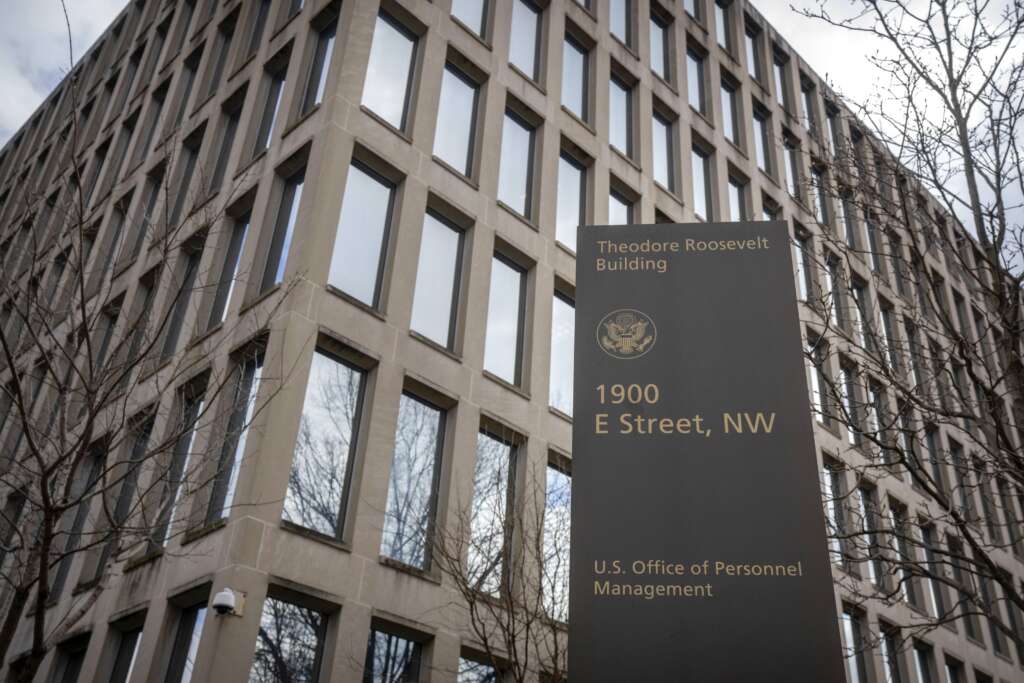
The Theodore Roosevelt Building, location of the U.S. Office of Personnel Management, on Tuesday, Feb. 13, 2024, in Washington. Former President Donald Trump has plans to radically reshape the federal government if he returns to the White House, from promising to deport millions of immigrants in the U.S. illegally to firing tens of thousands of government workers. (AP Photo/Mark Schiefelbein)

 Login
Login