
Reading view

There are new articles available, click to refresh the page.

OPM encourages agencies to consider reassigning SES members

  • Federal executives may soon see even more changes coming from the Trump administration. The Office of Personnel Management is now encouraging agencies to consider possible reassignments of Senior Executive Service members. In a new memo, OPM argued that the SES has not served as a “mobile corps” of managers, and members are instead being “entrenched” at agencies. The new memo comes after OPM also advised agencies to consider lowering their staffing allocations for senior-level positions.
    (Guidance on Senior Executive Service reassignments - Office of Personnel Management)
  • More than 118,000 Defense Department employees under the Federal Wage System are finally getting their long-delayed 2024 pay raise. The Pentagon’s Wage Committee met last week for the first time this year and approved updates to roughly 1,600 wage schedules across 250 wage areas. The panel had been unable to meet since March, when Defense Secretary Pete Hegseth paused all advisory committees for a broader review. Wage grade employees haven’t received a pay increase since 2023. The approved pay raises will be retroactive, and may not show up in paychecks until January 2026.
  • The Pentagon said it’s ready to launch a new plan to spend about $1 billion on small, inexpensive drones over the next two years. A request for information the Defense Department issued to industry this week ask for input on the possibility of building 300,000 small drones for one-way attack missions. DoD wants to start testing potential systems by February as part of a series of “gauntlets.” Up to 12 vendors could get awards after the first gauntlet.
  • A bill to overhaul the federal probationary period has cleared a hurdle in the House. The Oversight and Government Reform Committee advanced the so-called EQUALS Act along party lines on Tuesday. If enacted, the bill would double the length of the probationary period from one year to two years for most new federal hires. Committee Democrats criticized the legislation, saying it could open the door to more terminations of probationary workers. The EQUALS Act was one of about a dozen federal workforce bills the Oversight committee approved for further consideration in the House.
  • Thousands of post offices across the country have closed over the past few decades, according to a recent data analysis. The startup Use Postal estimates that 8,000 post offices have closed since the 1960s. It also estimates that out of the nearly 40,000 to have existed, about 67% of them are still operational to this day. Post office closures have disproportionately impacted states like Kentucky, West Virginia and Virginia.
  • The State Department is telling employees targeted by mass layoffs this summer that their official separation date is imminent. The department’s human resources office told laid off Foreign Service employees that they will be officially separated from the agency this Friday. State Department attorneys determined that a recent stopgap spending bill passed by Congress does not require the agency to rescind any RIF notices that were sent before the government shutdown. These Foreign Service employees were originally on track to be separated from the agency on Nov. 10. But the department said it’s extending their administrative leave to address “administrative errors."
  • The General Services Administration made its 14th deal under its OneGov initiative. Through a new contract with SAP, agencies would receive up to an 80% discount off of Schedule prices for the company's database, integration, analytics and cloud software titles. GSA said this could save the government $165 million dollars over the agreement's 18-month duration, calculated against current government rates. GSA said this agreement is available to existing SAP customers for renewals, expansions or modernization projects.
    (GSA adds SAP to its OneGov program - General Services Administration)
  • The federal offices are back open and hundreds of thousands of federal workers have returned to work after the longest shutdown in history. But nothing is back to normal. Federal workers say morale and trust in leadership are at an all-time low, tensions are high between furloughed staff and those who worked through the shutdown, schedules are slipping and projects are being pushed back. More people are accelerating their retirement plans or leaving federal service altogether. But the recent shutdown has exacerbated the existing problems, and added to what federal workers described as an already extremely trying year for the federal workforce. “As if morale wasn’t already non-existent, it sure is now,” one government worker said.

The post OPM encourages agencies to consider reassigning SES members first appeared on Federal News Network.
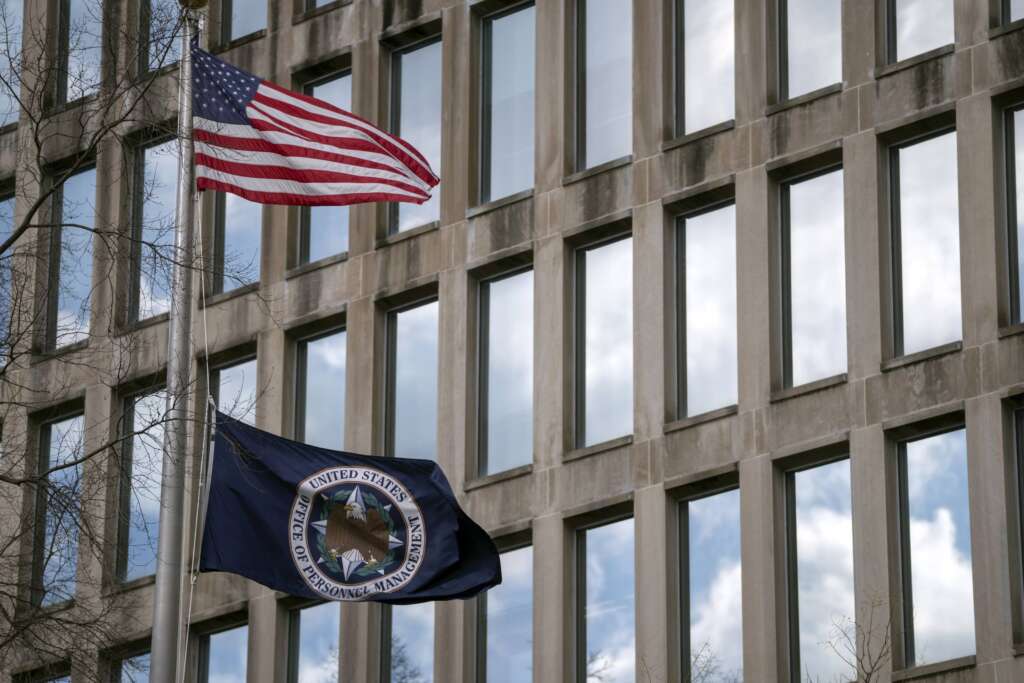
© AP Photo/Mark Schiefelbein

U.S. and agency flags fly outside the Theodore Roosevelt Building, location of the U.S. Office of Personnel Management, on Tuesday, Feb. 13, 2024, in Washington. Former President Donald Trump has plans to radically reshape the federal government if he returns to the White House, from promising to deport millions of immigrants in the U.S. illegally to firing tens of thousands of government workers. (AP Photo/Mark Schiefelbein)

3 federal workforce bills to watch in House Oversight Committee markup

The House Oversight and Government Reform Committee is convening Tuesday morning to mark up a slew of bills, many of which would impact the federal workforce in one way or another.

Tuesday’s meeting will be the first legislative markup session the committee has held in nearly two months, with the last being prior to the 43-day government shutdown. Any bills that the committee approves during the markup will advance to the full House for further consideration.

Lawmakers are expected to consider bills covering everything from whistleblower protections and skills-based hiring for federal contractors, to relocation incentives for federal employees.

Several other legislative changes may be on the horizon as well. Here are three key bills up for the committee’s consideration that may bring significant changes for the federal workforce:

Probationary period, federal workforce changes

One Republican-led bill, introduced by Rep. Brandon Gill (R-Texas) in October, aims to cement many of the changes the Trump administration has made to the government’s rules for the probationary period in the federal workforce.

If enacted, the so-called EQUALS Act would require most new federal employees to serve a two-year probationary period — a time in which employees have limited appeal rights and are easier to remove, before their employment in the federal workforce can be solidified.

Part of the bill would compel agencies to evaluate their employees regularly throughout the federal probationary period. And in the last 30 days of that two-year period, agencies would have to certify — and get the Office of Personnel Management to approve — that the probationary employee “advances the public interest,” before the employee can become tenured.

Any probationary employees who are not actively certified by their agency would be terminated, according to the GOP-led legislation.

The bill also states that when making a decision on whether to keep a probationary employee, agencies can additionally consider performance and conduct; the “needs and interests” of the agency; and whether the employee would advance “organizational goals” or “efficiency.”

The EQUALS Act aligns with efforts from the Trump administration earlier this year to overhaul the rules for the government’s probationary period. In April, President Donald Trump called for the creation of “Civil Service Rule XI,” which similarly required agencies to review and actively sign off on probationary workers’ continued employment before they can be moved out of a probationary period.

Trump’s executive order also expanded the reasons that probationary period employees can be fired. In June, OPM further clarified that probationary employees can be terminated based on broader reasons than the previous limitations set only to performance or conduct.

The House bill also comes after the Trump administration fired tens of thousands of probationary employees earlier this year, stating that the removals were due to “poor performance.” But in September, a federal judge found that OPM unlawfully directed the mass probationary firings. The judge ordered agencies to update employees’ personnel files to reflect that their firings were not due to performance or misconduct.

An eye on official time

A separate bill teed up by Republicans would compel agencies to provide much more detail on federal union representatives’ use of official time to both Congress and the public on an annual basis.

The Official Time Reporting Act from Rep. Virginia Foxx (R-N.C.) would require all agencies to submit reports on how much official time is used in each fiscal year, and justify any potential increases in official time that may occur.

The legislation would then require OPM and the Office of Management and Budget to create and send a joint report to Congress, and make publicly available online, the details of official time governmentwide. Those reports would have to cover how much official time each federal employee used, as well as provide data on official time hours calculated against the total number of bargaining unit employees for an “official time rate.”

Under the GOP-led legislation, those annual reports would additionally have to detail the specific purpose of all official time, the amount of money withheld for union dues, the cost of pay and benefits for all employees while they are on official time, and the office space and resources union representatives use while on official time.

Generally, official time refers to on-the-clock hours that go toward work such as negotiating union contracts, meeting with management, filing complaints or grievances against an agency, or representing employees who are dealing with disciplinary actions or other management disputes. Federal unions are allotted, by law, specific and limited amounts of agency time and resources to conduct activities on official time.

Official time by union representatives has been a major target of the Trump administration this year. Some agencies have either reduced or fully removed official time options, in response to executive orders from Trump calling for the termination of collective bargaining at the majority of executive branch agencies.

The administration’s actions have received major pushback from federal unions such as the American Federation of Government Employees, which said OPM’s characterization of official time as “taxpayer-funded union time” is false and stigmatizing.

Mandatory executive training

During Tuesday’s markup, Oversight committee lawmakers also plan to consider legislation that would require a mandatory training program all managers and supervisors across the federal workforce would have to take.

Under the Federal Supervisor Education Act, which Rep. William Timmons (R-S.C.) introduced in October, agencies would have to work with OPM to create training programs for agency managers, with at least some modules focused on goals like performance management, employee engagement and productivity.

The bill would also require the training programs to cover how supervisors should manage employees who have “unacceptable performance,” as well as how to make use of the probationary period. The bill also mandates that managers and supervisors receive training on how to address reports of harassment, prohibited personnel practices, employee rights, and more.

The legislation emphasizes that agencies should use “instructor-based” training as much as practicable. If enacted, supervisors would have to complete the training within one year of being appointed to a supervisory role, and would have to retake the trainings at least once every three years following that.

The Republican-led effort comes after OPM launched two federal workforce training programs for senior executives in November, incorporating common themes from the Trump administration on “accountability,” performance management and adherence to the president’s priorities.

Although both new programs are optional, OPM still told agencies to “set the expectation” that all career Senior Executive Service members should at least complete training modules on “returning to founding principles” and “implementing administration priorities” within the next year.

In the Oversight committee meeting Tuesday, all three federal workforce bills, along with many others, will be up for consideration and potential advancement in the House.

The post 3 federal workforce bills to watch in House Oversight Committee markup first appeared on Federal News Network.

© Getty Images/bpperry

US Capitol lights on its north side

OPM advises agencies to consider reducing senior executive staffing

Following the federal workforce reductions that have occurred this year, the Trump administration is now telling agencies to rethink how many senior executives they will need on staff as a result of those cuts.

A Nov. 24 memo from OPM encouraged agencies to consider reducing their staffing allocations for senior-level positions within their workforces.

No later than Dec. 19, OPM said agencies should submit a workforce assessment, detailing their current staffing allocations for various senior-level positions, and by how much they plan to reduce those allocations going forward — if at all. The memo includes a template that OPM expects agencies to fill out with more details on their projected allocations.

Agencies’ staffing assessments should reconsider allocations for Senior Executive Service (SES) members, as well as Senior Level (SL) and Scientific/Professional (ST) positions, OPM said.

“This review is especially important in light of headcount reductions and workforce restructuring, which may lead to a corresponding reduction in the need for SES, SL and ST allocations,” OPM wrote in its memo, addressed to agency chief human capital officers.

OPM said the senior-level staffing assessments should also take into account how agencies are reaching “optimal implementation of presidential priorities.”

“These assessments should also inform whether SES, SL and ST positions are appropriately classified and designated,” the memo reads.

OPM’s memo comes in response to an Oct. 15 executive order from President Donald Trump, which maintains limits for agencies on their recruitment efforts. Agencies have spent most of the year under a governmentwide hiring freeze, with a few exceptions carved out for positions in immigration enforcement, national security and public safety.

Trump’s executive order from October mandated that each agency create a “strategic hiring committee,” composed of senior officials and political appointees who will have to ensure that any hiring that does take place going forward is focused on “agency needs, the national interest and administration priorities.”

Already, the Trump administration has surpassed its goal of reducing the federal workforce by more than 300,000 employees during 2025. After reporting that approximately 317,000 federal employees have so far left the government this year, OPM is now pushing agencies toward their next steps for staffing plans.

At the same time that it’s encouraging a reduction of senior-level staffing, the administration has taken steps to give agencies more leeway in hiring politically appointed senior leaders instead. Over the summer, the White House created a new “Schedule G” employment classification, focused in particular on hiring non-career feds for roles in policy-making or policy-advocating work.

OPM’s new memo on senior executive allocations also comes after those in higher-level positions across government have seen a number of other changes from the Trump administration this year.

Most recently, OPM launched two new training series, in part focused on teaching senior leaders more in-depth about how they can best implement Trump’s workforce priorities, and to ensure they are adhering to “President Trump’s executive orders and other executive branch priorities.”

The Trump administration earlier this year also overhauled performance standards for senior executives, making adherence to the president’s priorities the “most critical element” of their reviews. Agencies are now being directed to set stricter limits on how many executives can be considered top performers.

The post OPM advises agencies to consider reducing senior executive staffing first appeared on Federal News Network.

© Getty Images/iStockphoto/ArtemisDiana

e-Recruitment and Online Recruitment - Use of Information Technology Resources to Attract and Recruit Job Candidates - Conceptual Illustration

OPM touts new training programs, aligned with Trump administration’s federal workforce reshaping

The Office of Personnel Management has launched a new training series, designed to educate senior executives in the federal workforce, while incorporating common themes from the Trump administration on “accountability,” performance management and adherence to the president’s priorities.

Two new training programs that OPM announced last week are targeted toward both career and political members of the Senior Executive Service, as well as GS-14 and GS-15 federal employees. The trainings largely reflect the Trump administration’s reshaping of the federal workforce this year, according to OPM Director Scott Kupor.

“We’re trying to move towards a performance-based culture in government. It’s only fair if we’re going to do that, that we give people the tools and the training necessary, so that they understand very clearly what they’re held accountable to,” Kupor said Friday in an interview with Federal News Network. “Now we have a mechanism ultimately to, as part of their performance review, make sure that [federal executives] are adhering to those principles.”

Through the new programs, OPM is aiming to inform senior leaders in more depth how the Trump administration has changed various federal workforce policies, and how senior leaders can best embed those changes at agencies.

As an example, Kupor pointed to the administration’s overhauls of the government’s performance management system. In February, OPM updated performance standards for the SES, to set much stricter limits on how many SES members can be rated as high performers, and make adherence to the president’s policies the “most critical element” of their performance reviews.

“For things that are within the bailiwick of what we expect managers to do, that are now represented in the form of executive orders, we want to make sure people really do understand both the derivation of those, as well as how we think about the appropriate implementation of those policies,” Kupor said.

In a memo last week, OPM called on agencies to encourage their senior leaders to sign up for the optional training programs, which are available governmentwide. Agencies have until Dec. 19 to inform executives that the trainings are open for registration on OPM’s website.

Details of OPM’s development programs

OPM’s two new programs for training federal executives differ in both content and cost. One of the new trainings, called the “Senior Executive Development Program,” uses a combination of video modules and “podcast-style discussions” among federal experts. It will train executives on topics like “constitutional governance,” budget, policy and strategic human capital management, according to OPM’s memo.

The SEDP is a fully online course that executives can complete at their own pace, for a tuition cost of $1,500.

OPM’s other new training program, called “Leadership for an Efficient and Accountable Government,” includes a combination of in-person and online trainings, costing $8,500 per registrant for the 80-hour course. OPM said the LEAG program is focused on “efficiency” and “accountability,” and includes modules centered on “President Trump’s executive orders and other executive branch priorities.”

“LEAG participants will gain essential skills to bridge policy and implementation, drive efficiency, uphold accountability, and expand their impact as senior leaders serving the American people,” OPM wrote in its memo.

Although both programs are optional, OPM still told agencies to “set the expectation” that all career SES members should at least complete training modules on “returning to founding principles” and “implementing administration priorities” within the next year.

Marcus Hill, president of the Senior Executives Association, said there is a continuous need for training among SES members, to “strengthen their ability to manage people, programs and resources responsibly.”

“Above all, these programs should reinforce what every federal leader swears to uphold: the obligation to ‘support and defend the Constitution of the United States’ and to ‘faithfully discharge the duties of the office’ to which they were appointed,” Hill said in a statement. “Understanding the legal and constitutional framework in which we operate is fundamental to maintaining public trust and carrying out our responsibilities with integrity.”

Next steps for federal workforce training

In part, OPM’s two new programs appear to replace prior opportunities from the Federal Executive Institute. The FEI was a long-time training program OPM ran for federal employees governmentwide — until President Donald Trump directed the dismantling of FEI in February.

When initially announcing plans to launch new trainings in August, OPM said the upcoming SES programs would be “radically different” from what existed previously through FEI.

Kupor told Federal News Network that FEI “was lacking in a couple areas,” and argued that the cost of the program surpassed its overall value to senior executives.

“It literally had a physical campus to it, so it required people to be away from office for several days in order to do it,” Kupor said. “Unfortunately, it was prohibitive both in terms of dollars, as well as just people’s time.”

Earlier this year, OPM eliminated its Center for Leadership Development through a reduction in force (RIF). The office was previously responsible for running various training and development programs for the federal workforce, but in the absence of CLD, the new training programs are being run through OPM’s Human Resources Solutions office, in partnership with the director’s office.

Some workforce experts, however, have previously questioned OPM’s internal capacity to manage new training programs. Since January, the agency has reduced its workforce by about one-third, as part of the Trump administration’s efforts to reduce headcount across government.

Jason Briefel, a federal workforce policy expert, said he generally considers the idea of a governmentwide SES training program from OPM to be a positive development. But he expressed reservations about what the trainings would actually entail — and what types of results the programs may deliver.

“With agencies shrinking their workforces, and with more demands being placed on executive leaders, how will they balance actually doing the training, and then applying what they’ve learned, while still trying to do their job?” Briefel said.

Briefel also questioned whether agencies would have the budget to afford the new OPM trainings, as most are still operating under a continuing resolution and uncertain of their long-term funding options.

Moving forward, Kupor said OPM plans to update the training modules over time, as well as expand the program to add more development opportunities for other sectors of the federal workforce.

“We will need help from external parties to do that — OPM doesn’t have this view that we need to own and develop everything,” Kupor said. “There are plenty of organizations external to OPM who, to the extent they have ways in which they can help us further develop the curriculum, we’re very open to that.”

The post OPM touts new training programs, aligned with Trump administration’s federal workforce reshaping first appeared on Federal News Network.

© AP Photo/Mark Schiefelbein

Scott Kupor, left, President Donald Trump's pick to be Director of the Office of Personnel Management, speaks as Eric Ueland, right, Trump's pick to be Deputy Director for Management at the Office of Management and Budget, listens during a hearing of the Senate Committee on Homeland Security and Governmental Affairs on Capitol Hill, Thursday, April 3, 2025, in Washington. (AP Photo/Mark Schiefelbein)

Strengthening executive leadership to serve our nation

The federal government’s ability to deliver results for the American people hinges on the effectiveness of its leadership. At the core of this leadership is the Senior Executive Service, a cadre of high-level officials entrusted with the responsibility of translating presidential priorities into operational outcomes. The stakes are high: Senior executive leadership affects whether the president’s agenda is properly implemented and whether agencies deliver on their missions. SES officials are the president’s senior-most career executives, and their leadership affects the lives of millions of Americans every day.

Given the gravity of their responsibilities, SES members must be equipped with the right knowledge and tools. Statutory mandates require both the Office of Personnel Management and federal agencies to provide ongoing executive development. And for good reason. Just as private-sector CEOs may benefit from executive development programs, our senior executives need the same level of preparation tailored to the constitutional role they hold and the scale of the missions they lead.

Historically, federal leadership programs have imitated academic or private-sector programs — many of which are expensive, time-consuming and not designed to meet the unique needs of government executives. With the closure of the Federal Executive Institute, OPM is refocusing and reimagining executive development, building on the best leadership development theories and practices with a renewed focus on the specific job knowledge, skills and tools SES officials need to be successful in their jobs.

Thus, to ensure the successful implementation of the president’s agenda by equipping SES through high-quality, targeted training programs, OPM has launched the Senior Executive Development Program (SEDP) — a targeted, administration-driven training initiative designed to ensure SES officials have the knowledge, context and clarity necessary to carry out the president’s agenda and best serve the American people.

The SEDP reflects a significant shift in how we approach executive development. More than just generic leadership training, the program will equip senior executives with the practical knowledge and skills to thrive as government leaders, covering topics such as constitutional governance, budget and policymaking, executive core qualifications, and strategic human capital management. Rather than relying on just generalized management theory one could get from academic or private-sector programs, this program provides high-impact, directly relevant training that speaks to the needs of today’s federal executives. The curriculum is designed around the constitutional role of the executive, the rule of law, merit system principles, and the operational realities of modern governance and leading responsive and efficient bureaucratic organizations. Participants will hear from seasoned career executive colleagues and administration officials on topics directly applicable to the complex missions and organizations they lead.

The SEDP is not a one-size-fits-all program. It’s designed to be flexible and scalable, leveraging high-quality recorded video modules delivered through OPM’s centralized learning management system. This approach allows executives to learn on demand, at their own pace, while maintaining full access to their day-to-day responsibilities. It also allows OPM to track participation and outcomes — ensuring transparency, accountability and a strong return on investment.

The goal is clear: to strengthen our federal leadership by ensuring every SES member has technical expertise and a true understanding of their constitutional responsibilities and the president’s vision. The success of any administration depends on its ability to act. And acting depends on leadership.

Through the Senior Executive Development Program, OPM is reaffirming its commitment to preparing that leadership – ensuring that America’s senior executives are ready, responsive and capable of delivering for the American people.

Scott Kupor is director of the Office of Personnel Management.

The post Strengthening executive leadership to serve our nation first appeared on Federal News Network.

© AP Photo/Mark Schiefelbein

Scott Kupor, President Donald Trump's pick for director of the Office of Personnel Management, listens during Senate Homeland Security and Governmental Affairs Committee nomination hearing, April 3, 2025. (AP Photo/Mark Schiefelbein)
❌