Reading view

There are new articles available, click to refresh the page.

US Fed Has Ended Quantitative Tightening, But Why Is The Bitcoin Price Still Below $100,000?

The Federal Reserve has officially brought its multi-year quantitative tightening program to a close, freezing its balance sheet at about $6.57 trillion after draining more than $2.3 trillion from the system since 2022. 

The Federal Reserve’s decision to formally end quantitative tightening has created a sense of anticipation across the crypto market. Liquidity inflows have shaped every major crypto cycle, and removing the multi-year drain on liquidity is expected to set the stage for healthier crypto market conditions and see the Bitcoin price push above $100,000 in the coming days.

Policy Shift Meets A Market Still Searching For Direction

The Fed has frozen its balance sheet at roughly $6.57 trillion after three years of balance-sheet reduction. Treasury runoff has stopped on December 1, though mortgage-backed securities will continue declining slowly. 

Ending QT means that the Fed is stepping away from the rapid balance-sheet reduction that tightened financial conditions throughout 2023 and 2024. The move comes after bank reserves fell to levels that threatened short-term funding stability, and the Fed made the move to halt any further liquidity drain.

Crypto investors are expecting the end of QT to relieve some of the selling pressure that has contributed to the crypto industry in recent months. This is due to historical comparisons of how the industry played out in previous ends to QT. 

In 2019, when the Fed last ended QT, digital assets bottomed within weeks and then entered a strong recovery phase. That period represented a decisive low for altcoins and preceded Bitcoin’s rise from roughly $3,800 to $29,000 over the next year and a half.

Interestingly, the entire crypto market’s short-term behavior is starting to show signs of bullishness. Particularly, the entire market is up by 7.2% in the past 24 hours, with Bitcoin leading the charge. However, cryptocurrencies are facing a different macro environment today, and the outlook is whether Bitcoin and other cryptocurrencies can go on another extended bullish rally in the coming months.

Why Is Bitcoin’s Reaction Delayed?

Ending QT is a meaningful turning point, but it does not automatically flood the system with fresh liquidity. Benjamin Cowen, founder of IntoTheCryptoverse, offers one of the clearest explanations for what to expect. 

He noted that in 2019, the Fed announced QT would end on August 1, but the balance sheet continued falling through mid-August because previously scheduled Treasury maturities had not yet settled. It wasn’t until early 2020 that Bitcoin started to experience explosive gains. According to Cowen, the same dynamic applies now. 

Therefore, the Federal Reserve’s balance sheet could continue edging lower for a few more weeks, meaning the first meaningful uptick in liquidity may not show up until early 2026. This delay suggests that traders hoping for an immediate boost or a quick return of Bitcoin above $100,000 are simply ahead of the cycle. The tightening phase has ended, but the actual recovery in liquidity has yet to begin.

Bitcoin

This Subwave Says Bitcoin Price Is Headed For A 50% Crash To $42,000

Crypto analyst Tony Severino has revealed a historical bearish pattern that could send the Bitcoin price to as low as $42,000. This bearish outlook for BTC comes amid a rebound for the flagship crypto, with a recent surge above the psychological $90,000 level. 

Bitcoin Price Risks 50% Drop To $42,000 Based On This Pattern

In an X post, Severino stated that the Bitcoin price likes to retrace to subwave 3/4 of wave 3/4 of its impulse. Based on this, the analyst indicated that BTC could crash to as low as $42,000 on wave C of this move to the downside. His accompanying chart showed that this decline could happen sometime at the start of next year. 

This bearish Bitcoin price prediction comes amid BTC’s rebound above $90,000 following the end of quantitative tightening (QT) by the U.S. Federal Reserve. The flagship crypto has also rebounded amid optimism of another rate cut at this month’s FOMC meeting. CME FedWatch data shows there is almost a 90% chance that the Fed will lower rates again this month. 

Bitcoin

However, despite these macro positives for the Bitcoin price, analysts such as Tony Severino have suggested that BTC is in a bear market and is likely to trend lower in the coming months. In an X post, he highlighted the BTC monthly chart, suggesting it showed a subtle volume breakout that confirmed a “not-so-subtle” trendline breakdown.  

Meanwhile, market technician JT described statements that the QT ending is bullish for the Bitcoin price as being a “fallacy.” He alluded to the possibility that the Bank of Japan (BOJ) may hike rates this month as one of the stressors to liquidity beyond QT.  

Peter Brandt Predicts Drop To Mid $40ks

In an X post, veteran trader and analyst Peter Brandt predicted that the Bitcoin price could drop to mid $40,000. He stated that the upper boundary of the lower green zone starts below $70,000 and that the lower support boundary is in the mid $40,000. Notably, Brandt had previously predicted that BTC could drop to around $50,000 before it then rallies to around $200,000 in the next bull market. 

The veteran analyst noted that there have been five major bull market cycles for the Bitcoin price since its inception. He further stated that in all previous cycles, the violation of the dominant parabolic advance has been followed by a 75% plus correction with no exception. As such, he expects BTC to undergo another significant correction in this cycle, potentially dropping below $50,000. 

At the time of writing, the Bitcoin price is trading at around $93,000, up almost 7% in the last 24 hours, according to data from CoinMarketCap.

Bitcoin

Bitcoin And The 2026 Fed Shift: Expert Says Markets Aren’t Ready

Macro strategist Alex Krüger is tying Bitcoin’s next macro chapter directly to the coming reshuffle at the Federal Reserve, warning that investors are underpricing how far US rates could fall under a Trump-aligned central bank.

In a long X post titled “2026: The Year of the Fed’s Regime Change,” he argues that “the Federal Reserve as we know it ends in 2026” and that the most important driver of asset returns will be a new, much more dovish Fed led by Kevin Hassett. His base case is that this shift becomes a key driver for risk assets broadly and Bitcoin in particular in 2026, even if crypto markets are currently trading as if nothing fundamental has changed.

Why The Federal Reserve Will Dramatically Change

Krüger’s scenario is anchored in personnel. He notes that prediction platform Kalshi put the odds of Hassett becoming chair at 70% as of 2 December, and describes him as a supply-side loyalist who “champions a ‘growth-first’ philosophy, arguing that with the inflation war largely won, maintaining high real rates is an act of political obstinacy rather than economic prudence.”

A few hours after Krüger’s thread, Trump himself added fuel, telling reporters at the White House that he would announce his Fed pick “early next year” and explicitly teasing National Economic Council Director Kevin Hassett as a possible choice, after saying the search had been narrowed down to one candidate.

To explain how this would translate into policy, Krüger reconstructs Hassett’s stance from his own 2024 comments. On 21 November, Hassett said “the only way to explain a Fed decision not to cut in December would be due to anti-Trump partisanship.” Earlier he argued, “If I’m at the FOMC, I’m more likely to move to cut rates, while Powell is less likely,” adding, “I agree with Trump that rates can be a lot lower.” Across the year he endorsed expected rate cuts as merely “a start,” called for the Fed to “keep cutting rates aggressively,” and supported “much lower rates,” leading Krüger to place him at 2 on a 1–10 dove–hawk scale, with 1 being the most dovish.

Institutionally, Krüger maps a concrete path: Hassett would first be nominated as a Fed governor to replace Stephen Miran when his short term expires in January, then elevated to chair when Powell’s term ends in May 2026. Powell, he assumes, follows precedent by resigning his remaining Board seat after pre-announcing his departure, opening a slot for Kevin Warsh, whom Krüger treats not as a rival but as a like-minded ally who has been “campaigning” for a structural overhaul and arguing that an AI-driven productivity boom is inherently disinflationary. In that configuration, Hassett, Warsh, Christopher Waller and Michelle Bowman form a solidly dovish core, with six other officials seen as movable votes and only two clear hawks on the committee.

The main institutional tail risk, in Krüger’s view, is that Powell does not resign his governor seat. He warns that this would be “extremely bearish,” because it would prevent Warsh’s appointment and leave Powell as a “shadow chair,” a rival focal point for FOMC loyalty outside Hassett’s inner circle. He also stresses that the Fed chair has no formal tie-breaking vote; repeated 7–5 splits on 50-basis-point cuts would look “institutionally corrosive,” while a 6–6 tie or a 4–8 vote against cuts “would be a catastrophe,” turning the publication of FOMC minutes into an even more potent market event.

On rates, Krüger argues that both the official dot plot and market pricing understate how far policy could be pushed lower. The September median projection of 3.4% for December 2026 is, he says, “a mirage,” because it includes non-voting hawks; by re-labeling dots based on public statements, he estimates the true voters’ median closer to 3.1%. Substituting Hassett and Warsh for Powell and Miran, and using Miran and Waller as proxies for an aggressive-cuts stance, he finds a bimodal distribution with a dovish cluster around 2.6%, where he “anchors” the new leadership, while noting that Miran’s preferred “appropriate rate” of 2.0%–2.5% suggests an even lower bias.

As of 2 December, Krüger notes, futures price December 2026 fed funds at about 3.02%, implying roughly 40 basis points of additional downside if his path is realized. If Hassett’s supply-side view is right and AI-driven productivity pushes inflation below consensus forecasts, Krüger expects pressure for deeper cuts to avoid “passive tightening” as real rates rise. He frames the likely outcome as a “reflationary steepening”: front-end yields collapsing as aggressive easing is priced in, while the long end stays elevated on higher nominal growth and lingering inflation risk.

What This Means For Bitcoin

That mix, he argues, is explosive for risk assets like Bitcoin. Hassett “would crush the real discount rate,” fueling a multiple-expansion “melt-up” in growth equities, at the cost of a possible bond-market revolt if long yields spike in protest. A politically aligned Fed that explicitly prioritizes growth over inflation targeting is, in Krüger’s words, textbook bullish for hard assets such as gold, which he expects to outperform Treasuries as investors hedge the risk of a 1970s-style policy error.

Bitcoin, in Krüger’s telling, should be the cleanest expression of this shift but is currently trapped in its own psychology. Since what he calls the “10/10 shock,” he says Bitcoin has developed “a brutal downside skew,” fading macro rallies and crashing on bad news amid “4-year cycle” top fears and an “identity crisis.” Even so, he concludes that the combination of a Hassett-led Fed and Trump’s deregulation agenda would “override the dominant self-fulfilling bearish psychology, in 2026” — a macro repricing he insists “markets aren’t ready” for yet.

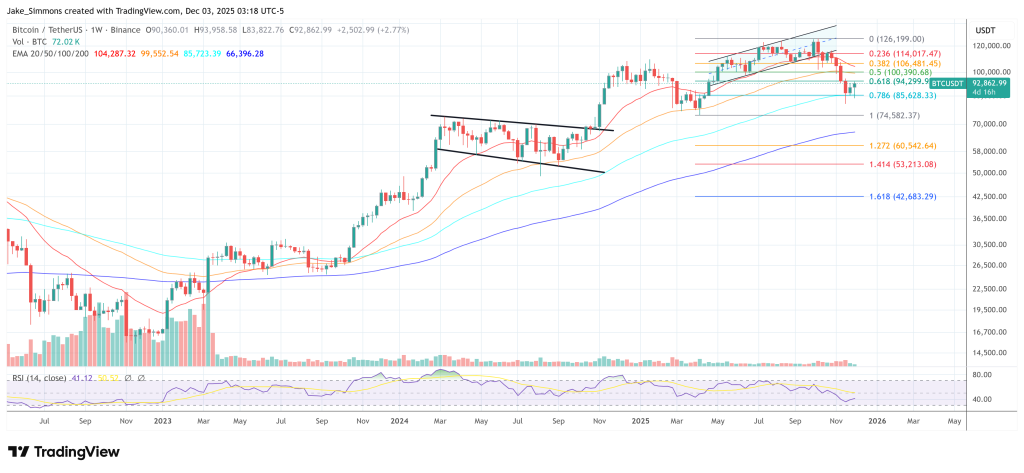
At press time, Bitcoin traded at $92,862

Bitcoin price

Would A 30% Bitcoin Price Crash Be Devastating For Tether’s USDT? Here’s The Truth

Tether, the issuer of USDT, has long been considered one of the most stable assets in the crypto market, but a recent report suggests that a crash in the Bitcoin price could jeopardize the stablecoin’s solvency. Arthur Hayes, co-founder and CIO of BitMEX, has revealed that a portion of USDT’s reserves is allocated to BTC, potentially exposing it to heightened market volatility. 

Bitcoin Price Crash To Threaten Tether USDT Stability 

In a recent report shared on X earlier this week, Hayes outlined market risks that could have a devastating impact on Tether’s USDT. The BitMEX founder explained that the stablecoin issuer has been executing a large-scale interest rate trade, likely betting on a Federal Reserve (FED) rate cut

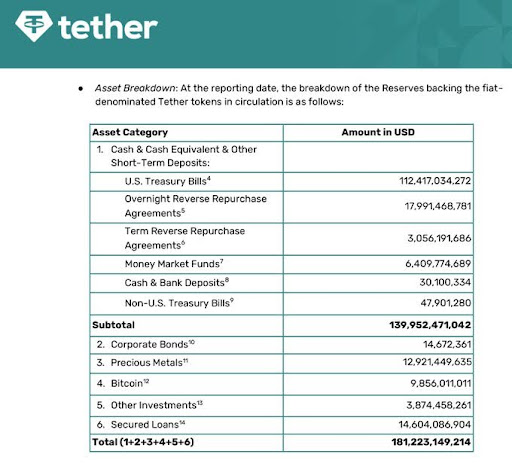
He stated that the stablecoin issuer has accumulated significant positions in Bitcoin and gold to hedge against falling interest income. As a result, Hayes has warned that if Tether’s positions in both gold and Bitcoin were to decline by roughly 30%, it could wipe out its entire equity, theoretically putting USDT at risk of insolvency

Since stablecoins are typically backed by the US dollar, the crypto founder has stated that a severe drop in Tether’s reserve value could trigger panic amongst USDT holders and crypto exchanges. In such a scenario, they might demand immediate insight into the stablecoin issuer’s balance sheet to gauge solvency risk. Hayes has also suggested that the mainstream media could further amplify the concerns, creating widespread market alarm.  

Analyst Fires Back Against Hayes’ USDT Claims

Following Hayes’ statements on X, Tether’s USDT has come under scrutiny, with crypto analysts debating the resilience of its reserves. A former Citi Research lead, Joseph Ayoub, challenged Hayes’ claims, arguing that even if Bitcoin and gold prices were to crash 30%, a USDT insolvency remains highly unlikely. 

He highlighted that the BitMEX co-founder had missed three key points in his post. Ayoub noted that Tether’s publicly disclosed assets do not represent the entirety of its corporate holdings. According to him, when Tether issues USDT, it maintains a separate equity balance sheet that is not publicly reported. The reserve numbers that are eventually disclosed are intended to show how USDT is backed. At the same time, the company maintains a balance sheet for equity investments, mining operations, corporate reserves, possibly more Bitcoin, and the rest distributed as dividends to shareholders.

Ayoub also described Tether’s core operations as highly profitable and efficient. He stated that the company holds over $100 billion in interest-yielding treasuries, generating roughly $10 billion in liquid profit annually while operating a relatively small team. The former Citi research lead estimated that the stablecoin issuer’s equity is likely valued at between $50 billion and $100 billion, providing it with a substantial cushion against losses in its crypto and gold holdings

Finally, Ayoub disclosed that Tether operates like traditional banks, maintaining only 5-10% of deposits in liquid assets, while the remaining 85% are held in longer-term investments. He also noted that the stablecoin issuer is significantly better collateralized than banks, adding that with their ability to print money, bankruptcy is virtually impossible.

Bitcoin

A Pivotal Moment for Bitcoin Price

Bitcoin Magazine

A Pivotal Moment for Bitcoin Price

As the Federal Reserve prepares to end Quantitative Tightening (QT), the bitcoin price stands at a critical macroeconomic inflection point. With odds for a December rate cut now pricing it in as almost a certainty, the stage is set for a potential shift in monetary policy that could fundamentally alter the trajectory of Bitcoin and broader risk assets. History suggests that when the Fed’s balance sheet stops contracting, Bitcoin typically experiences significant bullish catalysts.

Balance Sheet Reversals and the Bitcoin Price

The Fed balance sheet versus Bitcoin chart reveals a compelling pattern. Over Bitcoin’s history, there have been only three previous instances where QT ended and the federal balance sheet began flatlining or expanding. The first occurred on October 27, 2010, followed almost immediately by a massive Bitcoin bull rally. The second instance on September 26, 2012, again resulted in an explosive rally into the 2013 double-peak cycle. The third signal came in 2019, though this one was complicated by the COVID-19 pandemic and initial market crash—yet it eventually drove Bitcoin from around $3,000 to over $67,000.

Business Cycle Impact on Bitcoin Price

Bitcoin’s recent stagnation despite rising Global M2 suggests that monetary liquidity alone isn’t driving prices. Instead, the asset appears increasingly correlated with traditional business cycle indicators, particularly the U.S. Purchasing Managers Index (PMI). This metric measures manufacturing confidence and economic activity, and its correlation with S&P 500 yearly returns is striking: when PMI rises, equities typically deliver outsized returns; when PMI falls, markets enter periods of underperformance or recession.

A leading indicator for PMI trends is the copper-to-gold ratio. This relationship is nearly perfectly correlated, but copper often leads, bottoming ahead of PMI rallies and topping before PMI declines. Currently, the Copper/Gold ratio appears to be bottoming out, aligning with the historical timeline of Fed balance sheet reversals. This suggests the traditional business cycle may be about to turn favorable again after a period of economic softening.

Conclusion: Next Move for Bitcoin Price

The end of QT, combined with a resurgent Copper/Gold ratio and historical precedent spanning Bitcoin’s entire existence, suggests that monetary conditions are about to become materially more favorable. While Bitcoin has recently lagged traditional assets, this underperformance appears tied to deteriorating economic confidence rather than fundamental weakness in Bitcoin itself. As both monetary policy and business cycle indicators potentially turn positive, the confluence of these forces could mark the beginning of a significant trend reversal. Bitcoin stands positioned to benefit from this dual tailwind, making the coming weeks and months critical for monitoring whether these historical signals finally translate into sustained price appreciation.


For deeper data, charts, and professional insights into bitcoin price trends, visit BitcoinMagazinePro.com. Subscribe to Bitcoin Magazine Pro on YouTube for more expert market insights and analysis!


Bitcoin Magazine Pro

Disclaimer: This article is for informational purposes only and should not be considered financial advice. Always do your own research before making any investment decisions.

This post A Pivotal Moment for Bitcoin Price first appeared on Bitcoin Magazine and is written by Matt Crosby.

Regulators ramp up US stablecoin rules as GENIUS Act takes effect

  • A second FDIC rule on prudential requirements will follow early next year.
  • The FDIC will supervise bank subsidiaries issuing payment stablecoins.
  • Guidance on tokenised deposits is under development.

US regulators are moving quickly to build the country’s new stablecoin supervision system, with federal agencies preparing detailed rulemaking as the GENIUS Act begins to shape policy.

The Federal Deposit Insurance Corporation is set to publish an application framework for payment stablecoin issuers later this month, marking one of the earliest steps in implementing the law signed by President Donald Trump earlier this year.

Alongside the FDIC, the Federal Reserve, and the Treasury Department are working on their own regulatory responsibilities, signalling a coordinated effort to bring stablecoins under a clearer, more structured oversight regime.

FDIC develops licensing framework for stablecoin issuers

The FDIC has confirmed through written testimony scheduled for delivery to the House Financial Services Committee on December 2 that it is close to releasing a proposed rule outlining how payment stablecoin issuers will apply for approval.

The agency began the process earlier this year as part of its duty to implement the GENIUS Act, and the first formal proposal is expected before the end of the month.

Another proposal focusing on prudential requirements for FDIC-supervised issuers is planned for early next year.

Once the application framework is published, the agency will gather public comments before moving toward a final rule, a phase that typically spans several months.

GENIUS Act expands oversight for bank-linked stablecoins

The GENIUS Act introduces a national structure that requires federal and state regulators to coordinate their supervision of stablecoin issuers.

Under the law, the FDIC will oversee and license subsidiaries of insured depository institutions that issue payment stablecoins.

The agency will also set out capital rules, liquidity expectations, and reserve diversification standards.

Much of this work will roll out over the coming year, as several rulemakings are needed to meet the obligations laid out in the legislation.

The FDIC is also consulting recommendations released in July by the President’s Working Group on Digital Asset Markets, which urged regulators to clarify digital asset activities allowed for banks, including asset and liability tokenisation.

Tokenised deposits included in regulatory review

In addition to its stablecoin responsibilities, the FDIC is preparing new guidance aimed at clarifying how tokenised deposits will be treated under federal regulation.

This area has gained attention as banks explore digital versions of traditional deposit products.

The forthcoming guidance is expected to help institutions understand which activities fall within supervisory boundaries and how they will be monitored.

Federal Reserve coordinates its own stablecoin standards

The Federal Reserve will join the FDIC at Tuesday’s House hearing, with Vice Chair for Supervision Michelle Bowman detailing the central bank’s work on stablecoin rules.

The Federal Reserve is coordinating with other banking regulators to craft capital, liquidity, and diversification standards required under the GENIUS Act.

The focus includes creating clarity for banks engaged in digital asset activities and providing regulatory feedback on new use cases as they emerge.

This joint push aims to ensure the banking system can support digital asset development while maintaining stability and compliance.

Other agencies are also advancing their obligations under the GENIUS Act.

The Treasury Department has already completed its public consultations, which concluded in November, and is developing its own rules.

These efforts will run in parallel with the FDIC and Federal Reserve processes, contributing to the broader national framework being built to govern stablecoins across the US.

The post Regulators ramp up US stablecoin rules as GENIUS Act takes effect appeared first on CoinJournal.

Tether Makes Bold Reserve Pivot Toward Bitcoin And Gold As Treasury Holdings Decline

In a strategic move, Tether has shifted its reserve strategy, reducing its exposure to treasuries while increasing allocations to Bitcoin and gold. The USDT issuer has shown a notable reduction in government debt exposure, paired with an expanded position in hard assets known for durability and independence from traditional financial systems. 

Treasury Exposure Drops Amid Changing Macro And Regulatory Landscape

Stablecoin giant, Tether, has reduced its US Treasury holdings and increased its Gold and Bitcoin reserves. CryptosRus reported on X that Tether is quietly repositioning itself for what the company expects to be the Federal Reserve’s (FED) next round of rate cuts.

Related Reading: Rumble At The Core: How Tether Plans To Dominate The US Stablecoin Market

According to BitMex founder Arthur Hayes, Tether’s latest reserve update shows a clear shift away from the US treasuries and deeper into BTC and gold, a sign that the company is positioning for a changing macro environment. Furthermore, the Standard & Poor (S&P) Global noted that Tether is now leaning more heavily into assets with larger price swings in value, warning that this mix could expose USDT if markets turn volatile. Meanwhile, the current S&P Global rating on Tether remains weak.

Bitcoin

Thus, Tether CEO Paolo Ardoino has pushed back, saying that the company holds no toxic assets. He claims that its rapid growth reflects a broader shift towards new financial systems that operate outside the traditional banking world.

Why Attempts To Break Tether Are Difficult In Practice

Crypto analyst Ted Pillows has also offered insight into the Tether Fear Uncertainty and Doubt (FUD) as it is making its usual rounds again. The narrative is latching onto the company’s latest attestation, showing a notable shift into Gold and Bitcoin to offset declining interest income. Meanwhile, if these risk assets drop by 30%, Tether’s equity buffer could evaporate, creating an environment where Tether will be insolvent, and panic will kick in.

Related Reading: Tether Targets $500 Billion Valuation In New Equity Offering Amid US Expansion Plans

However, Ted is steadfast and believes that Tether has been through a decade of this same FUD, and USDT is still sitting at $1.00. They’re fully liquid, but they operate on a fractional-reserve model, much like traditional banks. As long as redemptions remain normal, everything will work smoothly. A problem will only arise if there’s an irrational panic, and then liquidity stress could hit quickly. 

According to Ted, the USDT isn’t fully backed by cash, but it’s backed by a diverse portfolio that includes the US treasuries, yield-generating assets, and some risk assets. This is all scaled to a massive $174 billion stablecoin. “If someone wants to kill USDT, it’s possible, but I highly doubt it,” Ted noted.

Bitcoin

Federal Reserve and Bank of Japan Indicators Hit Crypto, Market Losses Deepen

Market anxiety is driving price action. Bitcoin is trading around $85,000 after a sharp single-session drop of nearly 6%, extending a decline from the October peak of around $125,000.

The Crypto Fear and Greed Index is currently near 20, following a trough around 10, which still indicates extreme fear. That backdrop links directly to central-bank signs, thinner liquidity, and continued long liquidations.

Bitcoin Under Policy Pressure

The Bank of Japan has been preparing markets for a shift away from ultra-easy settings, with Governor Kazuo Ueda indicating that a policy change meeting is scheduled for December, contingent on wage data. Traders have read that guidance as a potential end to the negative-rate era, which tightened financial conditions into the weekend and helped set off the slide.

On the U.S. side, Federal Reserve officials have leaned cautious on additional easing. Boston Fed President Susan Collins said she would be “hesitant to ease policy further,” describing a “relatively high bar” for further moves without clearer labor-market deterioration.

The remarks of the Federal Reserve and the talk of a policy shift in Japan have pushed yields higher and firmed the dollar; the combination raises funding costs, softens futures basis toward neutral, and reduces tolerance for leverage that had supported rallies during stronger tapes.

Outflows from some spot vehicles on risk-off sessions compound that pressure because they drain cash that would otherwise stabilize closes.

What Would Ease The Strain

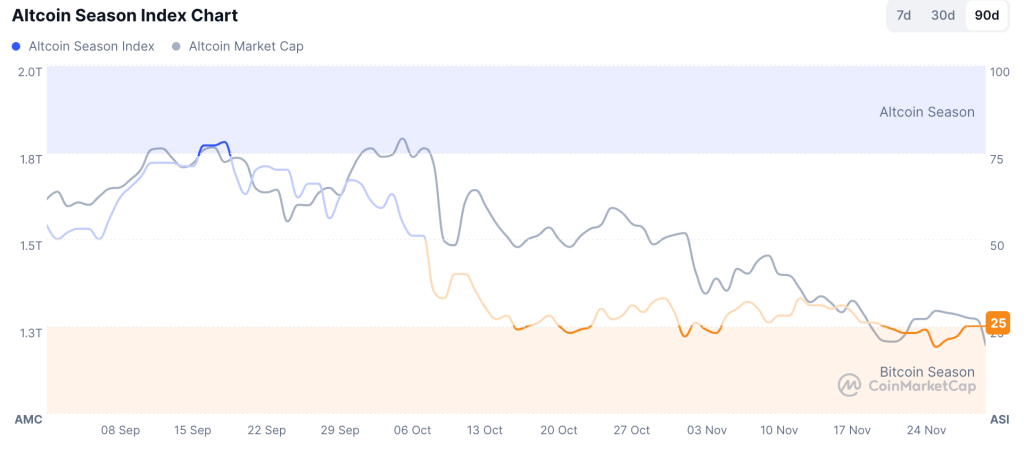
Crypto markets shed billions as the global market enters December 2025. More than $637 million in long positions were liquidated during the slide, and the Altcoin Season Index fell to 25, pointing to weak breadth beyond Bitcoin.

Altcoin Season Index (Source: CoinMarketCap)

A credible turn would show up together rather than in fragments. Order-book depth on the largest BTC and ETH pairs would rebuild into and after the United States session, while spreads would stay contained during moderate selling, and funding would stabilize without leaning on short squeezes that exhaust by the close.

Spot product creations would need to improve alongside a rise in net stablecoin issuance, since that pairing signs fresh cash coming in rather than transient covering. When those flows persist for several sessions, rebounds tend to settle more cleanly at the end of the day.

Central bank remarks that push yields higher or firm the dollar can keep bids soft, and relief rallies risk fading when depth thins and exchange-traded flow does not offset de-risking. The tone across majors still follows Bitcoin, and Bitcoin remains one policy headline away from another test of support.

The post Federal Reserve and Bank of Japan Indicators Hit Crypto, Market Losses Deepen appeared first on Cryptonews.

Why is the crypto market down today? (Dec 1)

By: Rony Roy
The crypto market has started December in the red, shedding over $200 billion in total market value to settle at $3 trillion, its lowest level over the past week. Bitcoin (BTC), the world’s largest crypto asset, dropped below key support…

Weekly Crypto Regulation Roundup: SEC Clears Solana’s Fuse Token and Trump Eyes Crypto-Friendly Fed Chair

It’s been another consequential week in Washington and beyond, with U.S. regulators sending mixed but meaningful signs across crypto, AI, and financial policy. From the SEC greenlighting a Solana-based token to the prospect of a crypto-friendly Federal Reserve chair, the regulatory climate is shifting fast—particularly as policymakers grapple with emerging technologies that are outpacing existing frameworks.

SEC Grants Fuse a Rare No-Action Letter

The big headline came from the U.S. Securities and Exchange Commission, which issued a no-action letter to Solana-based DePIN project Fuse—an unusual step for a blockchain project looking for clarity around token sales.

👨🏻‍⚖️ The SEC granted @fuseenergy a no-action letter, confirming it will not recommend enforcement if the FUSE token is sold as described.#SEC #Cryptohttps://t.co/crv9LwdICN

— Cryptonews.com (@cryptonews) November 25, 2025

Fuse asked the SEC’s Division of Corporation Finance on Nov. 19 to confirm it would not recommend enforcement action over the offer and sale of its FUSE token. The project emphasized that FUSE isn’t pitched as a speculative asset: it’s strictly a network participation token, distributed as a reward to users who maintain the protocol’s decentralized infrastructure. The SEC agreed.

In a letter signed by deputy chief counsel Jonathan Ingram, the regulator stated it would not pursue enforcement “based on the facts presented” if Fuse adheres to the guardrails it outlined.

Additionally, the token can only be redeemed through third-party venues at market rates, showing the SEC’s focus on removing any investment-like characteristics.

This marks the second DePIN-related no-action letter in recent months. While not precedent-setting, the decision is a useful datapoint: when tokens are tightly scoped to utility and distribution is controlled, the SEC appears more open to relief. For projects building real-world infrastructure on-chain, it’s one of the clearest regulatory signs we’ve seen in months.

Trump’s Top Fed Pick Has Deep Crypto Ties

Crypto markets may soon have a sympathetic voice at the very top of U.S. monetary policy. Kevin Hassett—director of the White House National Economic Council and longtime Trump ally—has emerged as the leading candidate to replace Jerome Powell as Federal Reserve chair.

🏛 Kevin Hassett, director of the National Economic Council, has emerged as Trump’s top Fed chair contender, putting a crypto-linked ally within reach of leading the central bank.#KevinHassett #FedChair https://t.co/Oa59lRry11

— Cryptonews.com (@cryptonews) November 26, 2025

What’s striking is Hassett’s history with digital assets. He has publicly engaged with the crypto sector, consulted with policy groups connected to the space, and indicated openness to digital-asset innovation.

Trump’s advisers describe him as someone whom the president trusts deeply on interest-rate policy—particularly on the question of cutting more aggressively than Powell. Hassett has also reportedly indicated he would accept the role if selected.

If appointed, this would be the most crypto-friendly Fed chair in U.S. history. While the Fed is not a crypto regulator, its stance on dollar liquidity, stablecoins, and payment systems has enormous downstream effects. A pro-innovation chair could spur greater openness across other agencies—or at the very least, reduce friction.

Bipartisan Bill Targets Rising AI-Powered Fraud

AI-generated scams are surging, and Congress is taking notice. This week, lawmakers introduced the AI Fraud Deterrence Act, a bipartisan proposal from Rep. Ted Lieu (D-CA) and Rep. Neal Dunn (R-FL). The bill seeks to impose tougher penalties on crimes committed using artificial intelligence—particularly impersonation schemes, deepfakes, automated theft, and coordinated fraud rings.

🚨 U.S. lawmakers propose the AI Fraud Deterrence Act against rising AI‑powered fraud and deepfake scams.#AIFraud #CyberSecurityhttps://t.co/ciWFO9LUcf

— Cryptonews.com (@cryptonews) November 26, 2025

The legislation is also explicitly tied to financial markets and crypto, where AI-powered fraud is growing at an alarming rate. High-profile cases involving deepfake video scams, impersonation bots, and automated phishing rings have intensified pressure on lawmakers to intervene.

The bill’s broader message is clear: manipulation, impersonation, and automated fraud using AI tools will face harsher federal consequences. Expect this framework to evolve quickly, given the sharp rise in AI-driven schemes across exchanges and Web3 platforms.

CFTC Pushes for New Prediction Markets Framework

Finally, at the CFTC, Commissioner Caroline Pham is making moves to bring prediction markets into sharper regulatory focus.

Pham announced that the agency is seeking nominations for its new CEO Innovation Council, a body designed to advise on emerging markets and frontier financial technologies. One of the council’s early priorities will be the rapidly evolving prediction markets sector—a space that has grown too large and too influential for federal regulators to ignore.

🏛 CFTC Commissioner Caroline Pham is looking for nominations to join the agency's new CEO Innovation Council.#CFTC #CarolinePhamhttps://t.co/1CDTrZtFyU

— Cryptonews.com (@cryptonews) November 26, 2025

Through a Nov. 25 press release, Pham invited public nominations and encouraged industry stakeholders to propose topics the council should prioritize. With prediction markets increasingly touching politics, finance, sports, and crypto, the CFTC is clearly preparing a more structured approach.

This comes as platforms like Polymarket continue to expand and attract mainstream attention, forcing regulators to reconsider how forecasting markets fit within existing derivatives law.

The Big Picture

From the SEC’s cautious openness to utility-focused tokens, to Congress tightening the screws on AI-based crime, to the CFTC’s attempt to modernize its oversight, the regulatory ecosystem is shifting in real time.

But the most consequential development may be Trump’s apparent interest in appointing a Fed chair aligned with crypto innovation. That appointment would reverberate through every corner of financial policy—from stablecoins to global dollar rails to payments innovation.

The post Weekly Crypto Regulation Roundup: SEC Clears Solana’s Fuse Token and Trump Eyes Crypto-Friendly Fed Chair appeared first on Cryptonews.

Fed To End QT In December: Will Bitcoin Mirror The Massive Price Crash From Last Time?

Bitcoin has not grown at the rapid rate expected so far in the cycle, and some have blamed this on the fact that the Federal Reserve has been practicing quantitative tightening. This refers to a period when the central bank is reducing its money supply in a bid to reel in excess liquidity. As a result, buying power seems to have fallen as there isn’t enough liquidity flowing into risk assets such as Bitcoin. However, this could all be changing very soon as the Fed begins to change its stance.

Quantitative Easing Could Bring About More Liquidity

After a long stretch of quantitative tightening, the Fed’s recent comments suggest that there is a move toward quantitative easing. This is expected to happen sometime in December, and it could trigger a massive shift as the market looks to close another year.

Quantitative easing, as the name suggests, is the opposite of quantitative tightening, and the former sees the Fed pump liquidity into the market. This rush in liquidity could lead to investors taking more risks, and this, in turn, would be good for assets like Bitcoin as investors move into the crypto market for the long term.

The announcement for a move to quantitative easing is expected to come on December 1, and naturally, there have been debates on its impact on the Bitcoin price. Crypto analyst and investor Ted Pillows shared a chart showing that the last time the Fed ended quantitative tightening in 2019, the Bitcoin price had suffered a notable crash.

The post suggests that this could be the case as the Fed makes its move in less than two weeks. However, this point has been countered by another crypto analyst, who pointed out the differences between what happened in 2019 and what is going on in 2025.

Why This Time Could Be Different For Bitcoin

In a response to Pillows, pseudonymous crypto analyst Sykodelic outlined that one of the very first reasons the Bitcoin price won’t crash with the announcement of quantitative easing is the fact that the Fed overdid it in 2019. According to the post, the Fed overdid quantitative tightening, which led to the 2019 repo crisis.

However, this time around, while the reserves are low, they haven’t reached danger territory. Also, with a $2 trillion fiscal deficit, the analyst explains that the US will have no choice but to stimulate the economy with liquidity, or else it risks going bankrupt.

Since the Bitcoin price already had a major drop, reaching record-breaking MACD levels, the analyst believes the chances of a drop are low. “If you are betting on a year long bear market you are basically betting that the USA will let itself go broke,” the analyst said. “There is simply no room left for the FED to turn.”

Bitcoin price chart from Tradingview.com

Japan stimulus shakes global markets as yen sinks and crypto demand rises

  • Japan’s 40-year bond yield rose to 3.774% on Thursday.
  • Five-year CDS spreads reached 21.73 basis points on 20 November.
  • GDP contracted in Q3 2025 and inflation reached 3% in October.

Japan’s new stimulus package is setting off sharp reactions across global markets, with the yen sliding to its weakest point against the US dollar since January 2025 and long-term bond yields rising to record levels.

The cabinet approved a 21.3 trillion yen package on Friday, the largest since the COVID-19 period, and the announcement immediately shifted expectations in currency, bond, and crypto markets.

The scale of the support and the pressure on Japan’s finances are now pushing investors to reconsider how they assess global risk, particularly as liquidity conditions evolve.

Economic reset

The package focuses on easing price pressures, supporting growth, and strengthening defence and diplomatic capacity.

Local government grants and energy subsidies form a key part of the plan, and households are expected to receive around 7,000 yen in benefits over three months.

The government also aims to lift defence spending to 2% of GDP by 2027.

The supplementary budget is expected to pass before the end of the year, although the ruling coalition currently holds only 231 of 465 Lower House seats.

The support comes during a period of weakening growth.

Japan’s GDP fell 0.4% in the third quarter of 2025, equal to a 1.8% annualised contraction.

Inflation has remained above the Bank of Japan’s 2% target for 43 months and reached 3% in October 2025.

Policymakers expect the new measures to lift real GDP by 24 trillion yen and generate a total economic impact near 265 billion dollars.

Rising market pressure

The fiscal boost has intensified concerns about long-term debt sustainability and market stress.

Five-year credit default swaps on Japanese government bonds reached 21.73 basis points on 20 November, the highest level in six months.

The country’s 40-year bond yield rose to 3.697% immediately after the announcement and climbed further to 3.774% on Thursday.

Every 100-basis-point increase in yields raises annual government financing costs by about 2.8 trillion yen, which has drawn attention to the strain on public finances over time.

Nikkei reports lingering caution about the continued use of fiscal stimulus beyond emergencies, adding another layer to investor concerns.

This debate has become more relevant as the yield curve shifts and Japan’s borrowing costs rise.

These movements are also important for the 20 trillion dollar yen-carry trade. Investors typically borrow yen at low rates and invest in higher-yielding markets overseas.

A mix of higher yields and sudden currency moves can force unwinding.

Historical data show a 0.55 correlation between yen-carry trade reversals and S&P 500 declines, which adds another source of volatility.

Yen reaction

The yen dropped sharply after the stimulus announcement, prompting speculation about future currency stability and the potential for intervention.

October exports rose 3.6% year on year, but the increase was not enough to ease concerns about broader economic pressure.

The scale of fiscal support and the persistence of inflation have become central factors in how global markets interpret Japan’s next steps.

Crypto shift

These conditions are feeding directly into crypto markets.

A weaker yen tends to drive Japanese investors toward alternative assets, including Bitcoin, especially during periods of rising liquidity.

Experts have noted that Japan’s decision adds to a global environment that already includes potential US Federal Reserve easing, Treasury cash movements, and continued liquidity support from China.

Together, these factors are creating conditions that could lift crypto demand into 2026.

At the same time, higher long-term yields pose a risk.

If yen-carry trades unwind quickly, institutions may be forced to sell assets, including Bitcoin, to meet liquidity needs.

The post Japan stimulus shakes global markets as yen sinks and crypto demand rises appeared first on CoinJournal.

Kiyosaki defends Bitcoin and warns Wall Street as crypto volatility returns

  • Kiyosaki accused Wall Street of promoting paper assets that benefit insiders.
  • He said gold, silver, and Bitcoin provide value outside institutional control.
  • His Bitcoin forecast puts the price at $250,000 by 2026.

As volatility grips the crypto market again, Rich Dad Poor Dad author Robert Kiyosaki has stepped up in defence of Bitcoin and decentralised assets.

Amid renewed price swings and public doubt over digital currencies, Kiyosaki argued that Bitcoin remains a hedge against centralised financial systems and inflation.

He described it as “people’s money,” contrasting it with what he calls “fake money” issued by the US Federal Reserve and Treasury.

While Warren Buffett’s past criticisms labelling Bitcoin as “gambling” resurfaced online, it was Kiyosaki’s response that reignited debate across financial communities.

His message was clear: the fault lies not with crypto, but with a broken fiat system that he believes Wall Street continues to uphold.

Fiat risks and distrust in institutions

Kiyosaki has long rejected the idea that centralised institutions should be the backbone of wealth.

In his view, the real danger to investors is not Bitcoin’s volatility, but the ongoing reliance on a system driven by inflation and debt.

He warned that assets like stocks and bonds, frequently promoted by institutional investors, are just as vulnerable to collapse.

According to him, the core issue is trust. While traditional markets claim to offer safety, Kiyosaki sees them as tools that enrich the powerful while exposing regular people to risk.

This, he argues, is why decentralised assets like Bitcoin and Ethereum are gaining ground—they provide financial autonomy in an unstable environment.

He classifies gold and silver as “God’s money” and Bitcoin as “people’s money,” highlighting their independence from government control and printing presses.

With Bitcoin capped at 21 million coins, Kiyosaki says it offers protection that fiat currencies simply cannot match.

Kiyosaki’s challenge to the financial establishment

As Wall Street continues to sell institutional products, Kiyosaki is urging people to reconsider what really holds value.

He questioned how long investors can trust paper-based assets in a world where central banks can print currency without limits.

He emphasised that real-world necessities cannot be replaced with financial abstractions.

“You cannot live in a paper house, drive using paper fuel, or eat paper food,” he wrote, pointing to the artificial nature of fiat-based wealth.

By comparison, assets like Bitcoin offer a limited-supply, decentralised alternative that he believes is better suited to survive economic instability.

Bitcoin prediction and market direction

Amid the broader market uncertainty, Kiyosaki has also made a bold forecast. He predicts Bitcoin could reach $250,000 by 2026, a significant rise from its current level around $95,600.

While this projection is speculative, it aligns with his belief that decentralised assets will outperform as trust in fiat continues to erode.

Though Warren Buffett’s view of Bitcoin as speculative persists, Kiyosaki’s message offers a pointed challenge to the financial status quo.

His comments reflect a growing shift in investor sentiment, where control, transparency, and scarcity are seen as more valuable than institutional assurance.

The post Kiyosaki defends Bitcoin and warns Wall Street as crypto volatility returns appeared first on CoinJournal.

Tenth Circuit Hands Fed a Win: Custodia Denied Master Account in Blow to Crypto Sovereignty,  Dissent Brings the Heat

Bitcoin Magazine

Tenth Circuit Hands Fed a Win: Custodia Denied Master Account in Blow to Crypto Sovereignty,  Dissent Brings the Heat

In a 2-1 decision issued today, the Tenth Circuit affirmed the denial of a Federal Reserve master account to Custodia Bank, the Wyoming-chartered Special Purpose Depository Institution (SPDI) that has become the test case for crypto-native banking. The panel upheld the district court across the board and left Reserve Banks with broad (and potentially unreviewable, in the words of the dissent) discretion over access.

Master accounts are the keys to the fiat kingdom. They’re the ledger entries that let institutions clear and settle directly at the Fed; without one, a “bank” is functionally just a vault dependent on fickle intermediaries and third-party rails. That practical choke point (which has been abused by regulators before) gives any discretion over access extraordinary policy significance.

Wyoming created SPDIs to pair traditional (but fully reserved) dollar banking rails with segregated digital-asset services. Custodia, barred from making loans and required to keep dollar deposits 100% backed by high-quality liquid assets, applied for a master account in October 2020. Early signals from the Kansas City Fed were positive (“no showstoppers”), but after the Board finalized its 2022 access Guidelines, FRBKC treated Custodia as a Tier 3 applicant, the bucket that “generally receive[s] the strictest level of review,” and formally denied the account in January 2023. The Board, consulted beforehand, emailed it had “no concerns” with FRBKC communicating a denial.

The Majority Opinion

Writing for the court, Judge Ebel rejected Custodia’s statutory and administrative claims, and essentially granted the Federal Reserve broad, and potentially unbounded, discretion on this point. Reading the Federal Reserve Act’s § 342 (“may receive deposits”) together with the Monetary Control Act’s § 248a, the panel concluded that access decisions remain discretionary with the Reserve Banks; § 248a(c)(2)’s “shall be available” language concerns pricing and parity for services the Board prices, it doesn’t force the Banks to open an account for every eligible institution. The court also treated the 2022 “Toomey Amendment” (§ 248c) as transparency-oriented, not a mandate to approve applications.

On the APA front, the panel held the Board’s “no-concerns” email was not final agency action, the ultimate decision belonged to FRBKC under the Guidelines, so it carried no independent legal effect. That also undercut theories aimed at the Board itself. Finally, Judge Ebel dispenses with Custodia’s constitutional argument related to the Presidential appointment of inferior officers on a (in my opinion) flimsy technicality: that the argument was not properly preserved.

The Dissent 

Judge Tymkovich dissented, reading § 248a(c)(2)’s “shall be available” as a substantive access guarantee, not mere pricing boilerplate. In his view, when Congress opened the Fed’s services to “nonmember depository institutions,” it made master-account access a duty enforceable, if necessary, through traditional tools like mandamus, rather than a roving veto lodged in unappointed Reserve Bank officers (a framework he warns invites constitutional headaches). He also emphasized that courts in related master-account litigation (e.g., Banco San Juan) recognize the centrality of § 342 but do not resolve away the MCA’s “shall” command.

We are bound by the ordinary language of the statute and, in my view, shall means shall. Section § 248a(c)(2) mandates access to the Fed’s payment services for all nonmember depository institutions. By denying Custodia a master account, the Kansas City Fed has unlawfully denied it access to those services which are vital to its business. That, it cannot do.

The Road Ahead

We need to see the result in PayServices (Ninth Circuit). If that court goes the other way, a circuit split would materially increase the odds of Supreme Court review. It’s interesting to note that Judge Tymkovich was also on that case. But, for now, the ball is firmly in Custodia’s court.  

Today’s ruling cements Reserve Bank discretion at the access gate; the dissent, by contrast, reads the MCA as Congress’s promise of open access for state-chartered, deposit-taking institutions like Custodia’s SPDI. The stakes, for constitutional structure, state innovation, and Bitcoin-adjacent banking, couldn’t be clearer.

Disclosure: I authored an amicus brief on behalf of Wyoming’s Secretary of State supporting Custodia.

This is a guest post by Colin Crossman. Opinions expressed are entirely their own and do not necessarily reflect those of BTC Inc or Bitcoin Magazine.

This post Tenth Circuit Hands Fed a Win: Custodia Denied Master Account in Blow to Crypto Sovereignty,  Dissent Brings the Heat first appeared on Bitcoin Magazine and is written by Colin Crossman.

Bitcoin Price Crashes Down to $106,000 As Red Week Continues

Bitcoin Magazine

Bitcoin Price Crashes Down to $106,000 As Red Week Continues

Bitcoin price continued its slide through much of Thursday, dipping to as low as $106,290 as traders digested a wave of macro uncertainty — from Federal Reserve Chair Jerome Powell’s cautious tone on future rate cuts to renewed volatility following U.S.–China trade talks.

The bitcoin price fell over 3% in early trading before stabilizing slightly above $107,000. The drop extends a multi-day long decline that began after the Federal Reserve delivered a widely expected 25 basis point rate cut but signaled that December’s meeting may not bring another.

Powell’s remarks at the post-meeting press conference struck a notably hawkish tone. While acknowledging progress toward the Fed’s 2% inflation goal, he emphasized that the committee had “strongly differing views” and that no decision had been made about a December cut. 

Traders quickly scaled back expectations — with futures now pricing roughly a 60% chance of another reduction, down from nearly full certainty just a day earlier.

“Powell’s comments created a bit of risk-off sentiment,” said Charlie Sherry, head of finance at BTC Markets, according to Bloomberg. “Add in the Trump–Xi meeting stirring markets today, and, unsurprisingly, you get some volatility. Some technology stocks are rallying, but crypto hasn’t followed — which shows some relative weakness and hesitation in digital assets right now.”

Treasury yields and the U.S. dollar climbed following Powell’s remarks, while risk assets broadly sold off. The two-year Treasury yield jumped nearly 10 basis points as traders reassessed the Fed’s trajectory.

Meanwhile, market attention also turned to Seoul, where U.S. President Donald Trump met with Chinese President Xi Jinping. Trump described the talks as “amazing” and announced a deal to halve tariffs on fentanyl-related goods, claiming the two sides were “pretty close” to a broader trade agreement involving rare earth materials and agricultural purchases.

While such developments have little direct impact on Bitcoin, risk sentiment tends to spill across markets — and Thursday’s pullback in equities appeared to drag digital assets with it.

SpaceX moves $471 million in Bitcoin

Amid the macro jitters, on-chain analysts also flagged large Bitcoin movements linked to Elon Musk’s SpaceX. Data from Arkham Intelligence shows the company moved 281 BTC (worth roughly $31 million) late on October 29 — its fifth transfer this month, totaling 4,337 BTC (about $472 million).

The transfers were routed through Coinbase Prime, suggesting institutional custody activity rather than market sales. Some believe SpaceX may be reorganizing its wallets from older Bitcoin address formats (“1”-prefix legacy types) to newer Taproot and SegWit formats.

Musk first confirmed SpaceX’s Bitcoin holdings in 2021, though the firm reportedly reduced its stack by about 70% during the 2022 market crash. 

As of this month, Arkham tracks roughly 7,258 BTC (about $799 million) still linked to SpaceX addresses, though that figure could rise as recent transfers are reclassified.

Tesla, meanwhile, retains 11,509 BTC, worth about $1.3 billion, according to the same data.

Bitcoin price is waiting for clarity

With U.S. monetary policy in flux, trade negotiations uncertain, and major corporate holders quietly reshuffling coins, Bitcoin’s latest move reflects a broader narrative: investors waiting for direction.

The next major catalyst may arrive in December — either from a Fed rate cut or from markets losing faith that one is coming. Until then, Bitcoin remains in a holding pattern between macro optimism and monetary restraint.

This post Bitcoin Price Crashes Down to $106,000 As Red Week Continues first appeared on Bitcoin Magazine and is written by Micah Zimmerman.

Bitcoin Price Craters to $107,000 as Fed Turns Cautious, Traders React to Trump–Xi Meeting

Bitcoin Magazine

Bitcoin Price Craters to $107,000 as Fed Turns Cautious, Traders React to Trump–Xi Meeting

Bitcoin price tumbled sharply Thursday morning, falling to the low $107,000s as traders digested cautious remarks from Federal Reserve Chair Jerome Powell and mixed signals from the latest Trump–Xi meeting. 

The bitcoin price drop erased last week’s rebound and extended the bitcoin’s weak October performance, weighed down by macro headwinds and China-U.S. trade relations.

The world’s largest cryptocurrency was down to $107,472 by early Thursday, according to Bitcoin Magazine Pro data, after briefly plunging to $107,925 overnight.

Bitcoin price reacts to Jerome Powell’s comments

The move followed the Fed’s 25-basis-point rate cut on Wednesday — its second of 2025 — bringing the target range to 3.75%–4%. While the cut was widely anticipated, Powell’s message was clear: further easing this year is far from guaranteed.

There were “strongly differing views among policymakers,” Powell said during his post-meeting press conference, adding that the Fed might “wait a cycle” before considering another reduction. 

The remarks rattled markets that had been pricing in a December cut, with CME FedWatch data showing probabilities for another move dropping from 90% to just 71% after his comments.

Risk assets broadly weakened yesterday. The S&P 500 finished flat, the Dow Jones Industrial Average slipped 0.2%, and the Nasdaq Composite managed a modest 0.6% gain. As of writing, markets for Thursday look bleak as well. 

Bitcoin, which traded near $116,000 earlier in the week, sank as Powell spoke, briefly touching $109,000 in a sharp sell-off before stabilizing near $111,000 overnight.

The Fed’s tone also overshadowed what had appeared to be a positive outcome from the Trump–Xi summit. Following the meeting, President Trump said China would “immediately resume soybean purchases” and that “all rare-earth issues have been resolved.” 

Still, it looks like traders remained cautious, focusing instead on the Fed’s hawkish pivot and the ongoing U.S. government shutdown, now entering its fourth week.

Institutional demand also showed early signs of weakness. U.S.-listed spot Bitcoin ETFs saw $470.7 million in outflows on Wednesday, ending a four-day inflow streak and marking the largest daily outflow since October 16, per Bitcoin Magazine Pro data.  

Will the bitcoin price react to Quantitative Tightening ending? 

Powell did confirm that the Fed is nearing the end of its Quantitative Tightening (QT) program — a move that could eventually boost liquidity in risk assets. 

Since 2022, QT has drained nearly $1 trillion from the Fed’s balance sheet by allowing Treasury and mortgage holdings to mature without reinvestment. 

Powell said the process could conclude by December but warned that future decisions remain data-dependent. Despite the sharp correction, analysts remain divided on Bitcoin’s near-term direction.

This post Bitcoin Price Craters to $107,000 as Fed Turns Cautious, Traders React to Trump–Xi Meeting first appeared on Bitcoin Magazine and is written by Micah Zimmerman.

❌